
A complete issue · 16 pages · 1888
Life — March 29, 1888
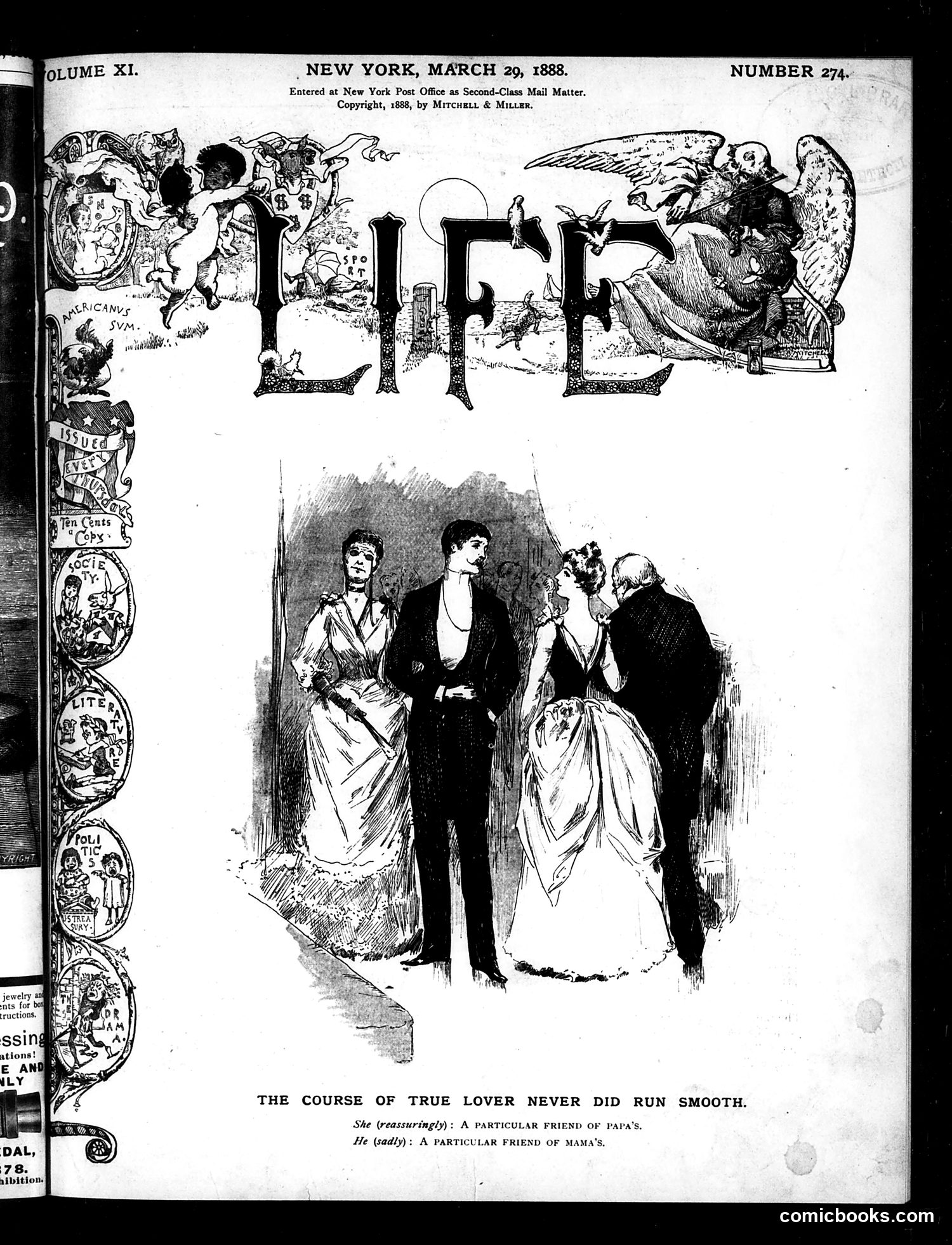
This page features a single satirical illustration titled "The Course of True Love Never Did Run Smooth," referencing Shakespeare's *A Midsummer Night's Dream*. The cartoon depicts four figures in formal Victorian dress in what appears to be an awkward social encounter. The caption identifies two key characters: "She (reassuringly): A particular friend of Papa's" and "He (sadly): A particular friend of Mama's." The satire concerns romantic complications in upper-class courtship. The joke hinges on the uncomfortable revelation that the two young people's parents each have their own separate "particular friends"—implying infidelity or inappropriate relationships among the adults. This social scandal ruins the young couple's romance prospects, making their path to love genuinely complicated despite their apparent interest in each other.
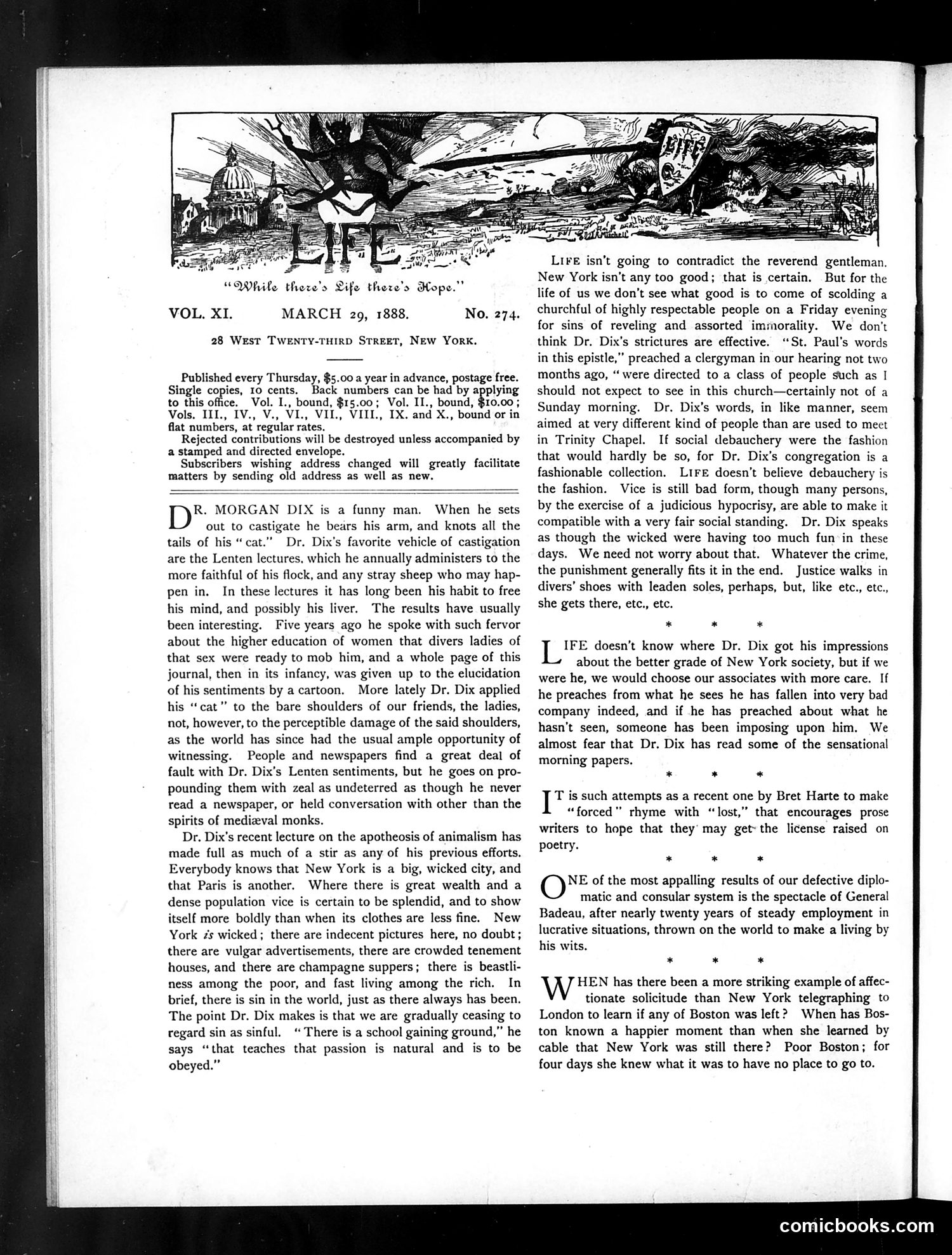
The header cartoon shows a figure sitting beneath a gnarled tree with text "While there's Life there's Scope." The imagery appears allegorical—the twisted tree and solitary figure likely represent Life magazine itself or its editorial mission, suggesting resilience and continued potential despite hardship. The page's main content is editorial commentary by Dr. Morgan Dix, a clergyman whom Life satirizes as self-righteous. The text mocks his Lenten lectures condemning sin while Life's editors suggest he misunderstands New York society and may be reading sensational newspapers rather than observing reality directly. The satire targets his hypocrisy and moral smugness about urban vice.
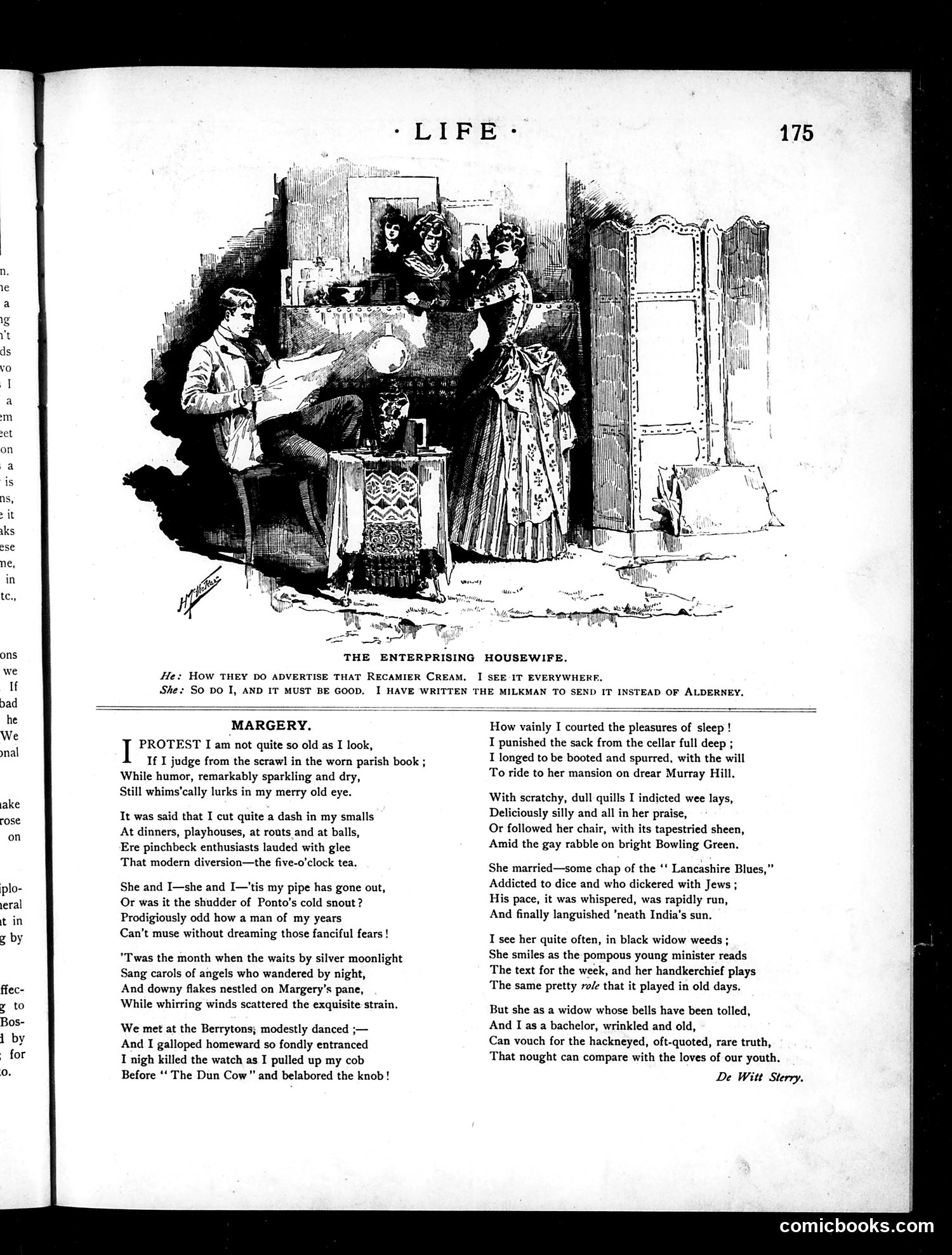
This cartoon satirizes aggressive advertising practices of the era. The illustration shows a woman interrupting a man's reading with advertisements, while other women cluster around promoting products. The dialogue parodies common advertising claims: the housewife mentions "Recamier Cream" everywhere and boasts she's written to manufacturers suggesting inferior products be replaced with their brand—treating advertising slogans as conversation. The accompanying poem "Margery" nostalgically contrasts this modern commercial intrusion with simpler times, mentioning specific place names (Lancashire, Bowling Green, India) and lamenting how relentless advertising has invaded domestic life. The satire targets both overeager wives promoting dubious products and manufacturers' invasive marketing tactics that saturate Victorian and early 20th-century households.
This page contains satirical commentary on New York society and politics during what appears to be the Gilded Age. **Key targets include:** - **Mayor Hewitt**: Described sarcastically as "not dyspeptic" despite his crustiness, suggesting his difficult temperament is widely known - **Jay Gould**: Referenced regarding his retirement from Wall Street, with skepticism about whether it's genuine - **John L. Sullivan**: The prize fighter, criticized for his assault on foreign applicants under a "benign" justification—satire mocking both his violence and the excuses made for it **The humor** relies on mocking prominent public figures' hypocrisy, particularly around claims of civility masking brutish behavior. The small dialogue at bottom shows job-seeker humor, with a circus manager questioning an applicant's qualifications. The overall tone is acerbic commentary on New York's elite and their pretenses.
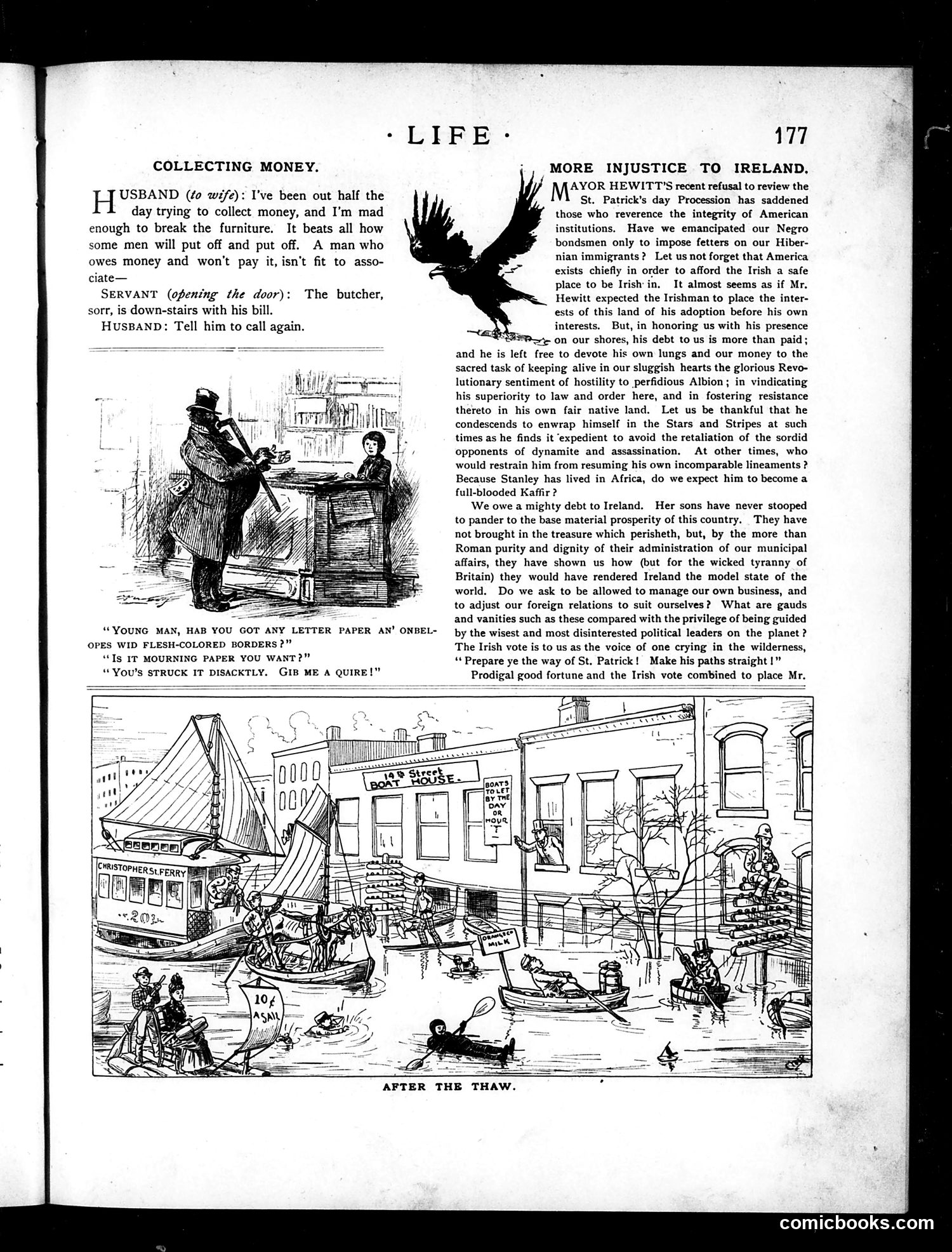
**Top Section ("Collecting Money"):** A satirical dialogue shows a husband unsuccessfully trying to collect money from a butcher for unpaid debts. The joke plays on domestic financial struggles and creditor persistence. **"More Injustice to Ireland":** This editorial piece criticizes American treatment of Irish immigrants and Irish-American political influence. It references St. Patrick's Day processions and debates about Irish-American loyalty, apparently responding to criticism from someone named Hewitt or Stanley regarding Irish-American activism and their place in American society. **Bottom Illustration ("After the Thaw"):** A street scene showing flooding and chaos—likely depicting springtime consequences when frozen rivers thaw, with people using boats in flooded city streets. This appears to be satirical commentary on urban infrastructure problems.
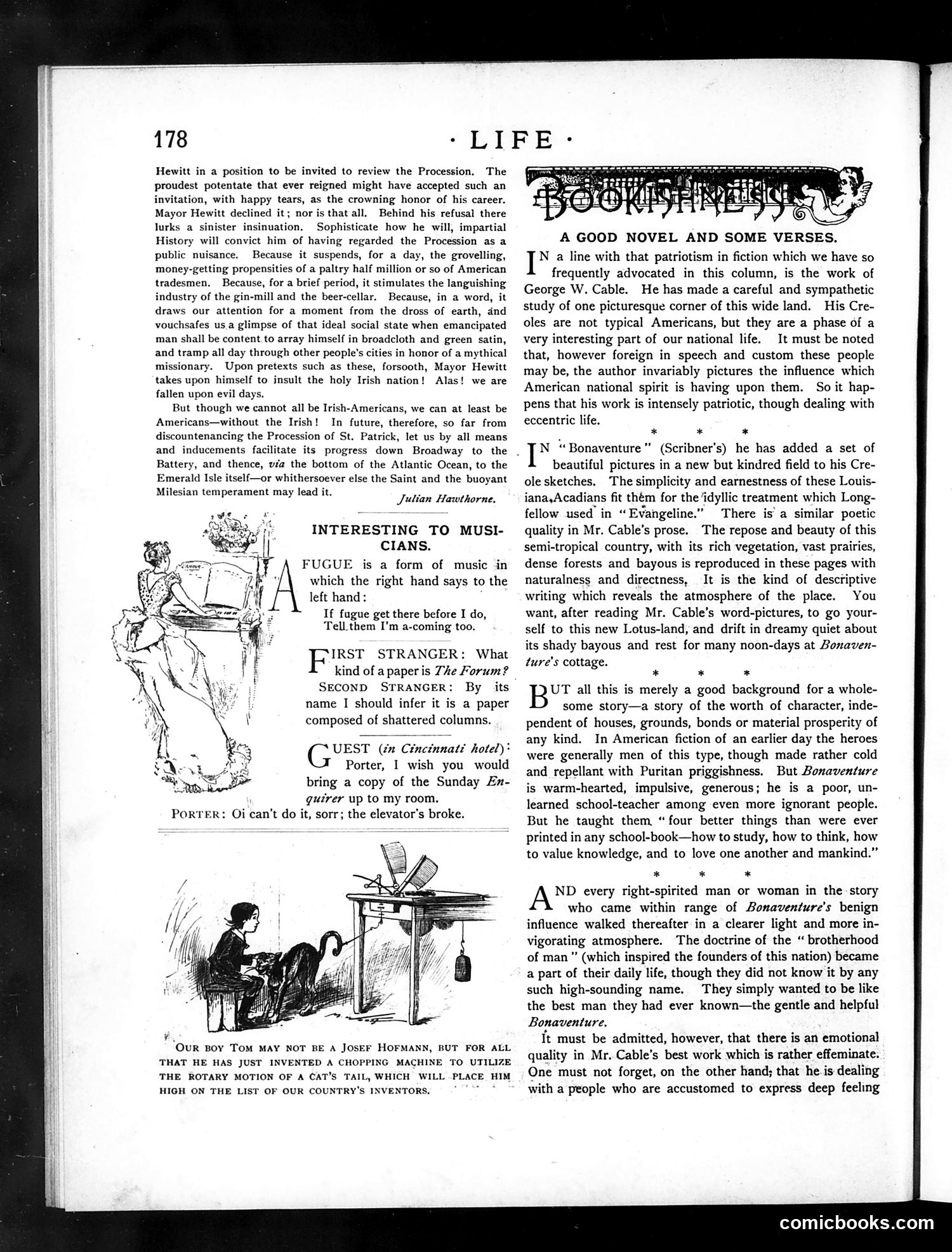
This page contains a **book review** of George W. Cable's work "Bonaventure," praised for its patriotic American fiction depicting Louisiana Creoles and Acadians. The review emphasizes Cable's sympathetic portrayal of regional American life. The **satirical cartoons** illustrate a musical joke about "fugue" (a compositional form). The setup involves a "First Stranger" asking what kind of paper "The Forum" is, with a "Second Stranger" explaining it's composed of "shattered columns"—a pun on architectural ruins. The bottom cartoon shows a boy inventing a machine using a cat's tail to power a rotary motor—absurdist humor mocking pseudo-scientific invention. These are gentle, **wordplay-based jokes** typical of Life's light satirical style, unrelated to the book review above them.
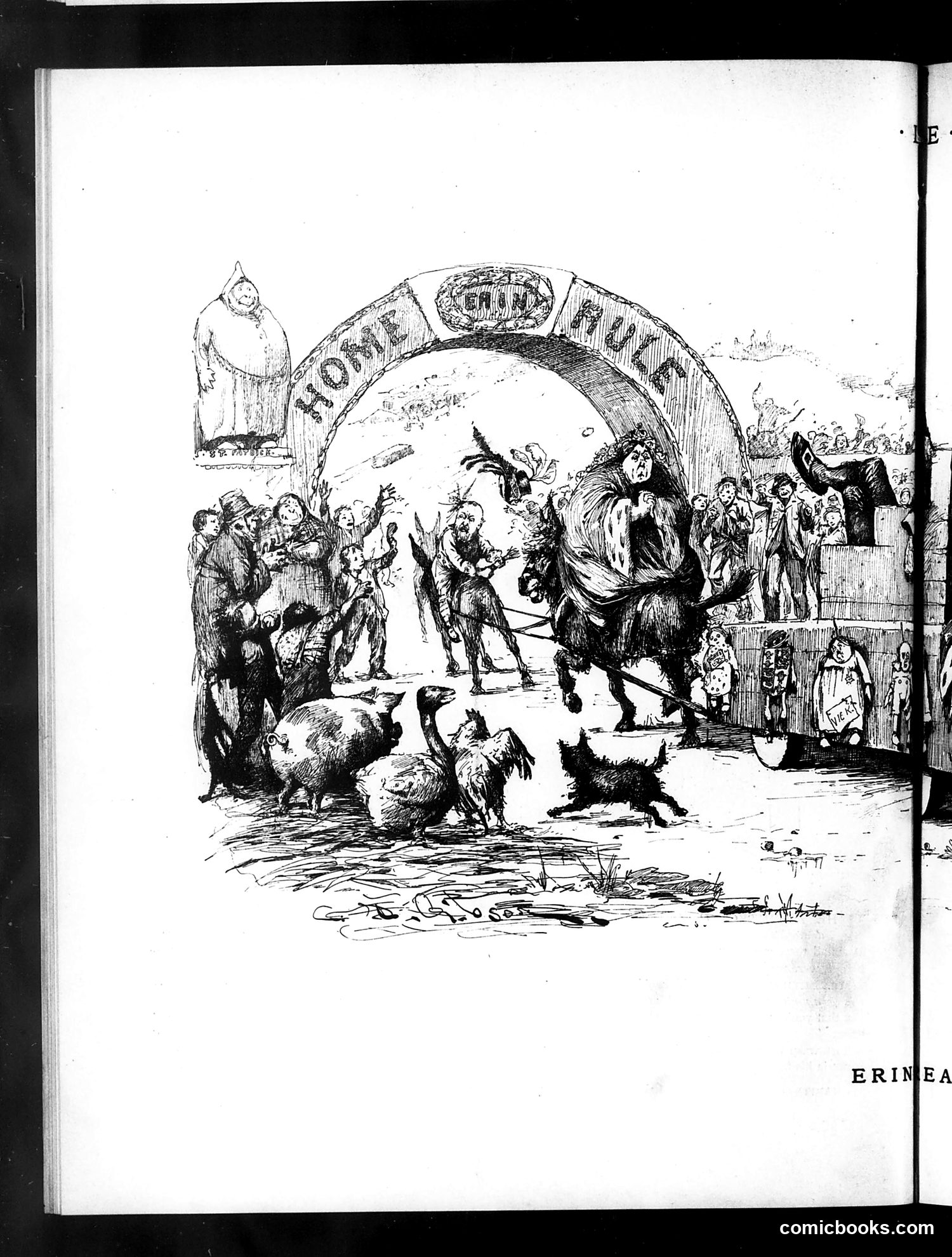
This appears to be a satirical circus scene from Life magazine. The central image depicts a grand circus tent or archway labeled "ROBBER" with spectators crowded around viewing stands on both sides. In the arena, figures with exaggerated features appear to be performing or acting out a scene, with horses and various characters in dramatic poses. The style and composition suggest this is political satire commenting on corruption or criminal activity being publicly displayed as entertainment. The word "ROBBER" prominently featured suggests the cartoon mocks either actual robbery/corruption or uses circus performance as metaphor for public scandal treated as spectacle. The gathered crowd indicates commentary on public complicity or fascination with wrongdoing. Without clearer text or dating information, the specific political figures or events referenced remain unclear, though the satirical intent is evident.
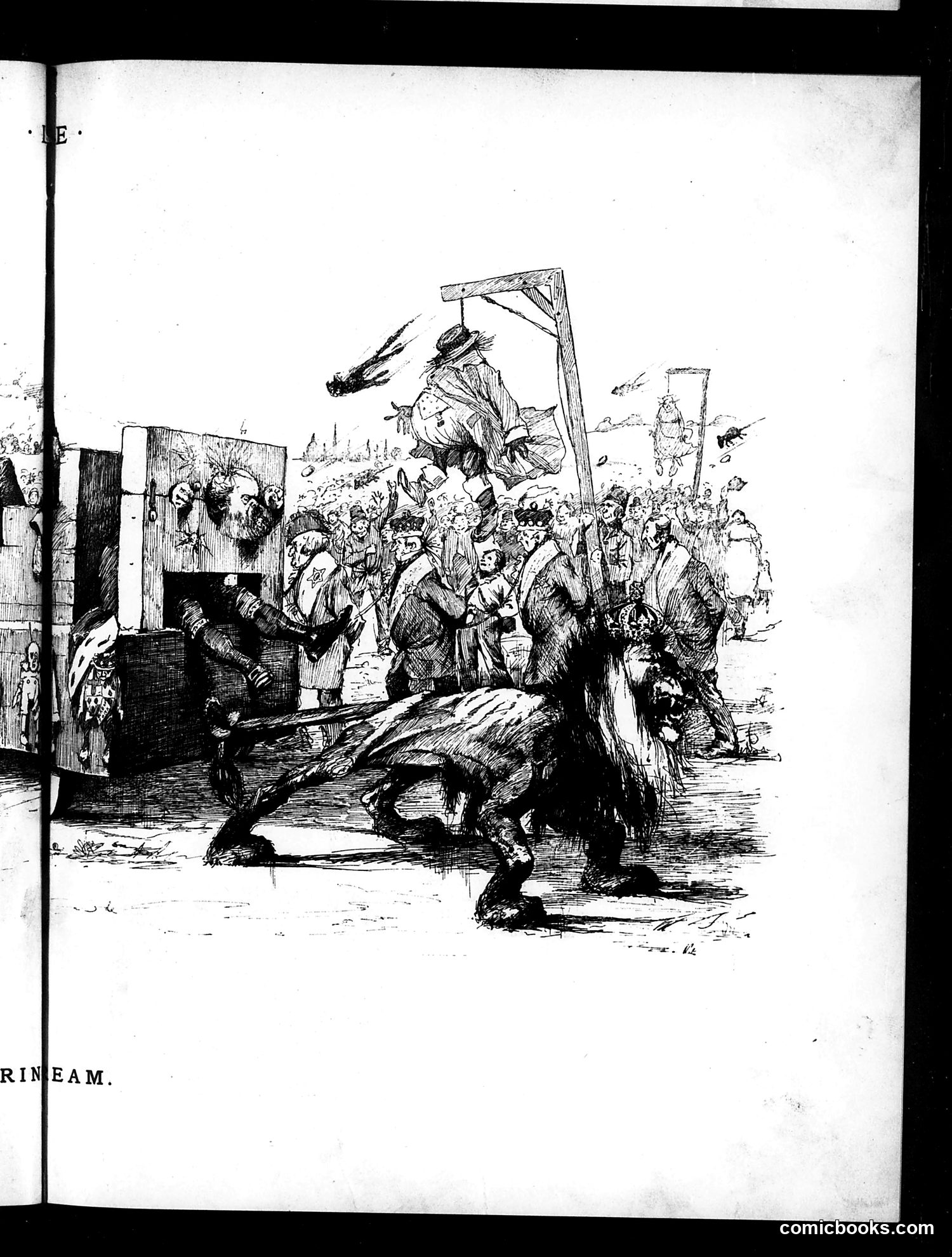
This appears to be a satirical engraving depicting a public execution by hanging, with a large crowd gathered to witness it. The scene shows a figure suspended from a gallows while onlookers—dressed in period clothing suggesting 19th century—observe. The text fragment "RINEAM" at bottom left is incomplete, making precise identification difficult. Without clearer context or visible publication date, I cannot definitively identify which historical execution this references or what political figure is being caricatured. The satirical intent likely critiques either capital punishment practices, a specific controversial execution, or contemporary political/judicial proceedings through dark humor. However, without additional identifying information on the page, asserting specific historical references would be speculation rather than supported interpretation.
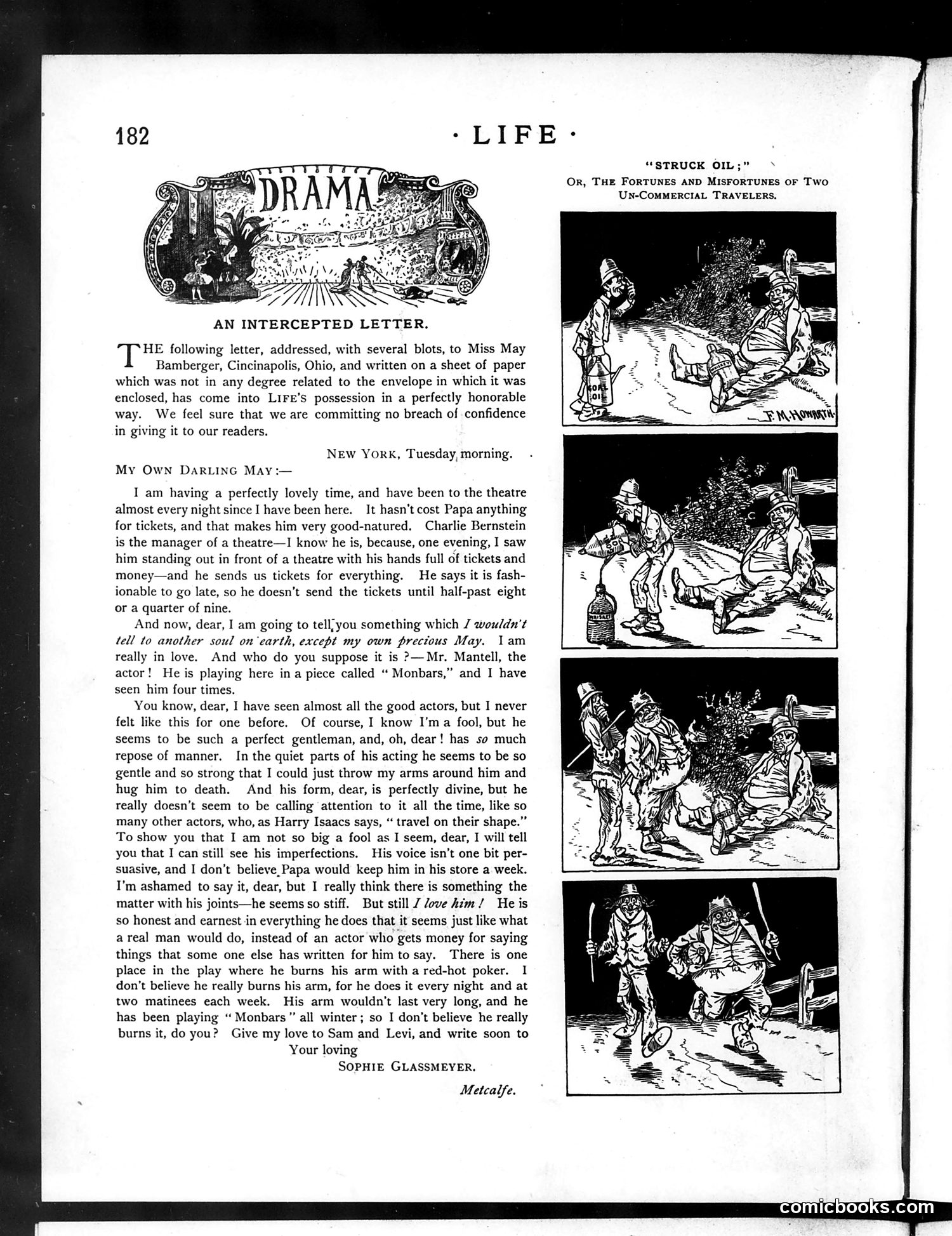
This page presents a serialized visual narrative titled "Struck Oil; Or, The Fortunes and Misfortunes of Two Un-Commercial Travelers." The four sequential illustrations depict two traveling salesmen encountering what appears to be an oil strike or gusher. The drawings use exaggerated physical comedy typical of early Life magazine humor—the figures are knocked about, covered in oil, and rendered in slapstick situations. The left column contains "An Intercepted Letter," a society piece about a young woman named Sophie Glassmeyer writing from New York about attending theater and falling in love with actor Mr. Mantell. The satire gently mocks her romantic enthusiasms and theatrical gossip. The comic strip's humor derives from the physical chaos of accidentally discovering oil—a relevant economic topic of the era—contrasted with the letter's romantic sentimentality.
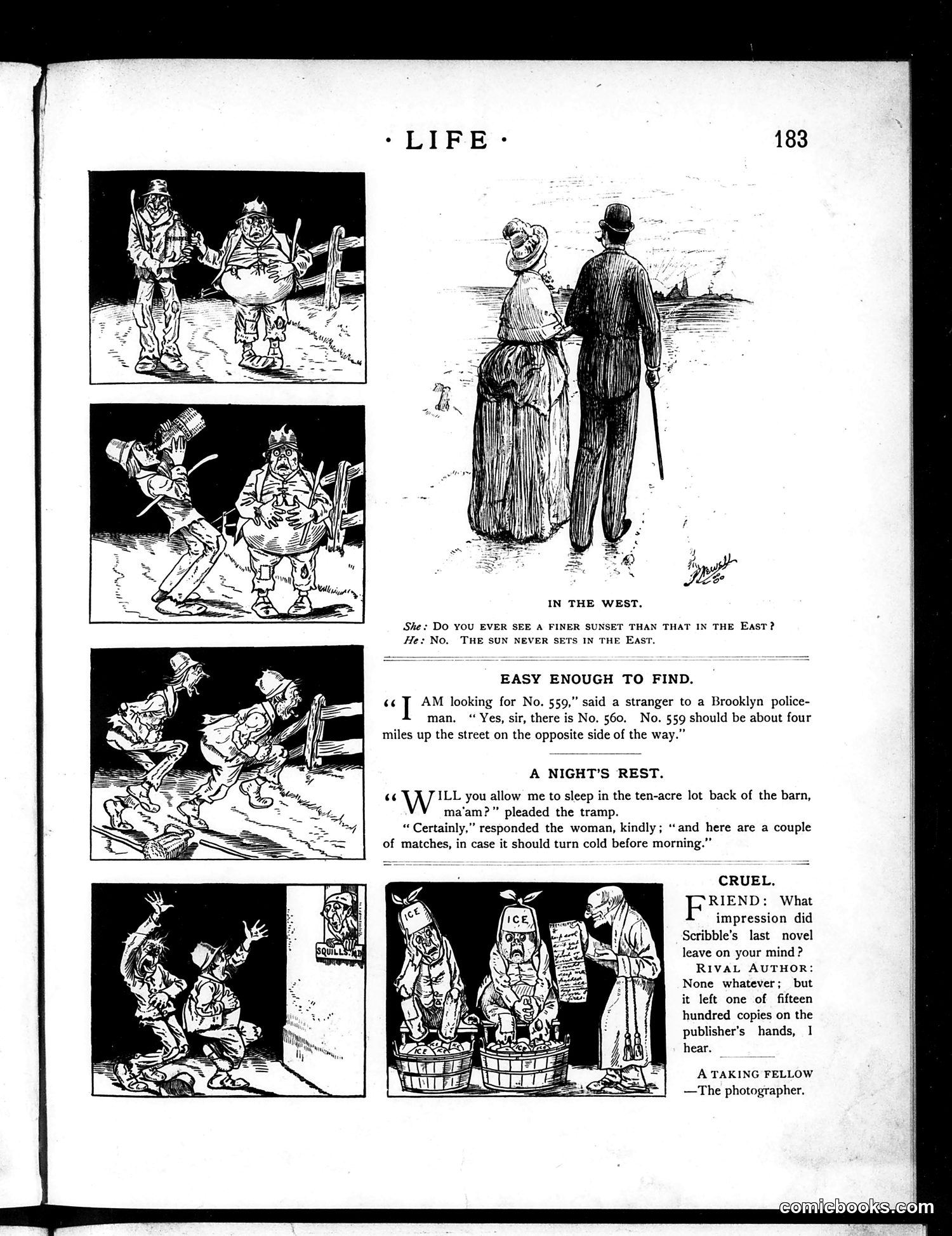
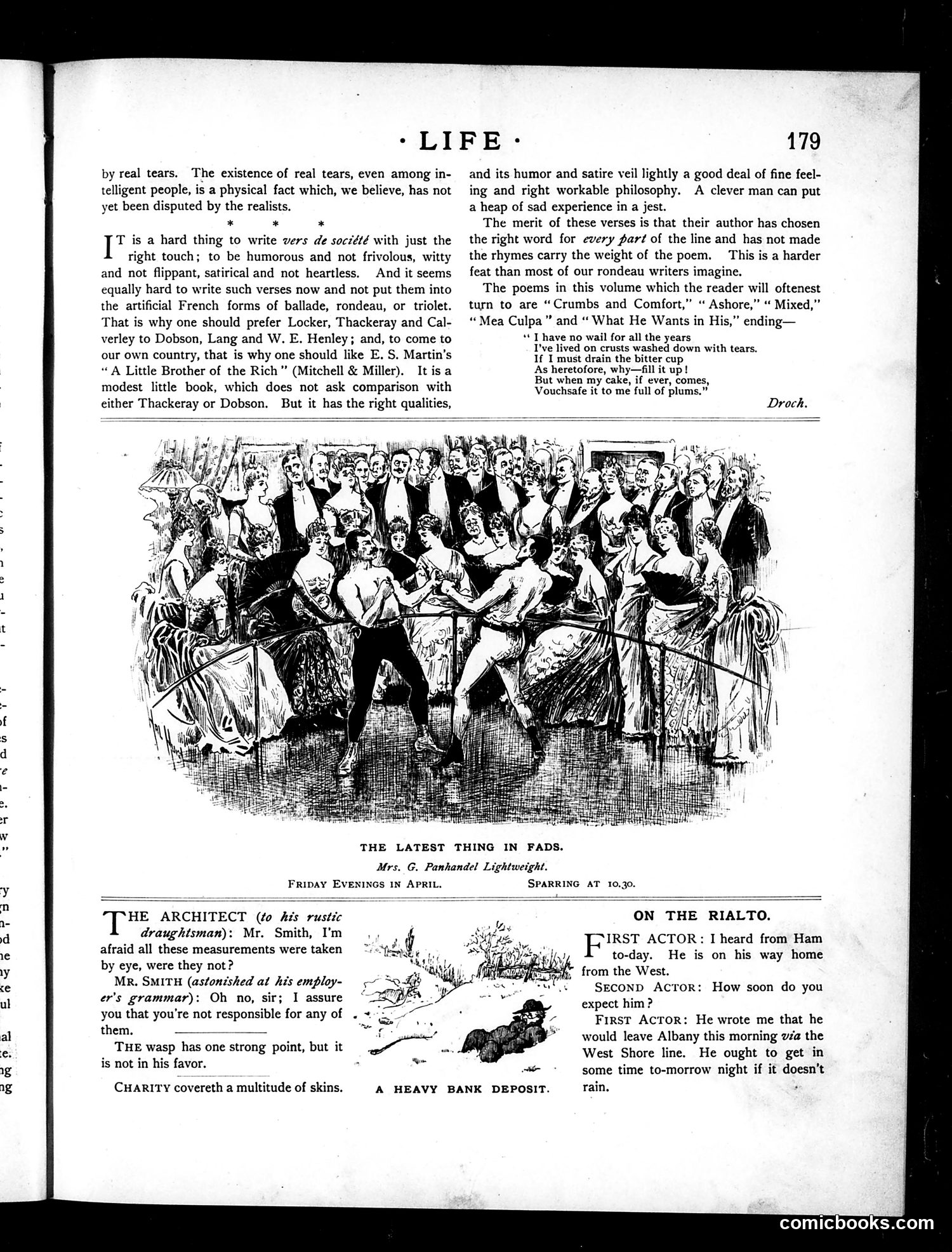
This page contains four separate joke items typical of Life's satirical humor: 1. **"In the West"**: A couple's dialogue plays on geography—the man jokes that the sun never sets in the East (a reference to imperial expansion and the phrase "the sun never sets on the British Empire"), so western sunsets are by definition superior. 2. **"Easy Enough to Find"**: A Brooklyn policeman's absurd directions mock bureaucratic incompetence or deliberate unhelpfulness—directing someone to look four miles away for a nearby address. 3. **"A Night's Rest"**: Dark humor about vagrancy and poverty. A tramp asks for shelter; a kindly woman grants it but gives him matches "in case it should turn cold"—a grim joke implying he might freeze to death or burn the barn down. 4. **"Cruel"**: A rival author's jealous complaint that Scribble's novel failed commercially, leaving 1,500 unsold copies with the publisher—satirizing literary competition and publishing economics. The cartoons (left side) appear to illustrate the tramp scenario with physical comedy.
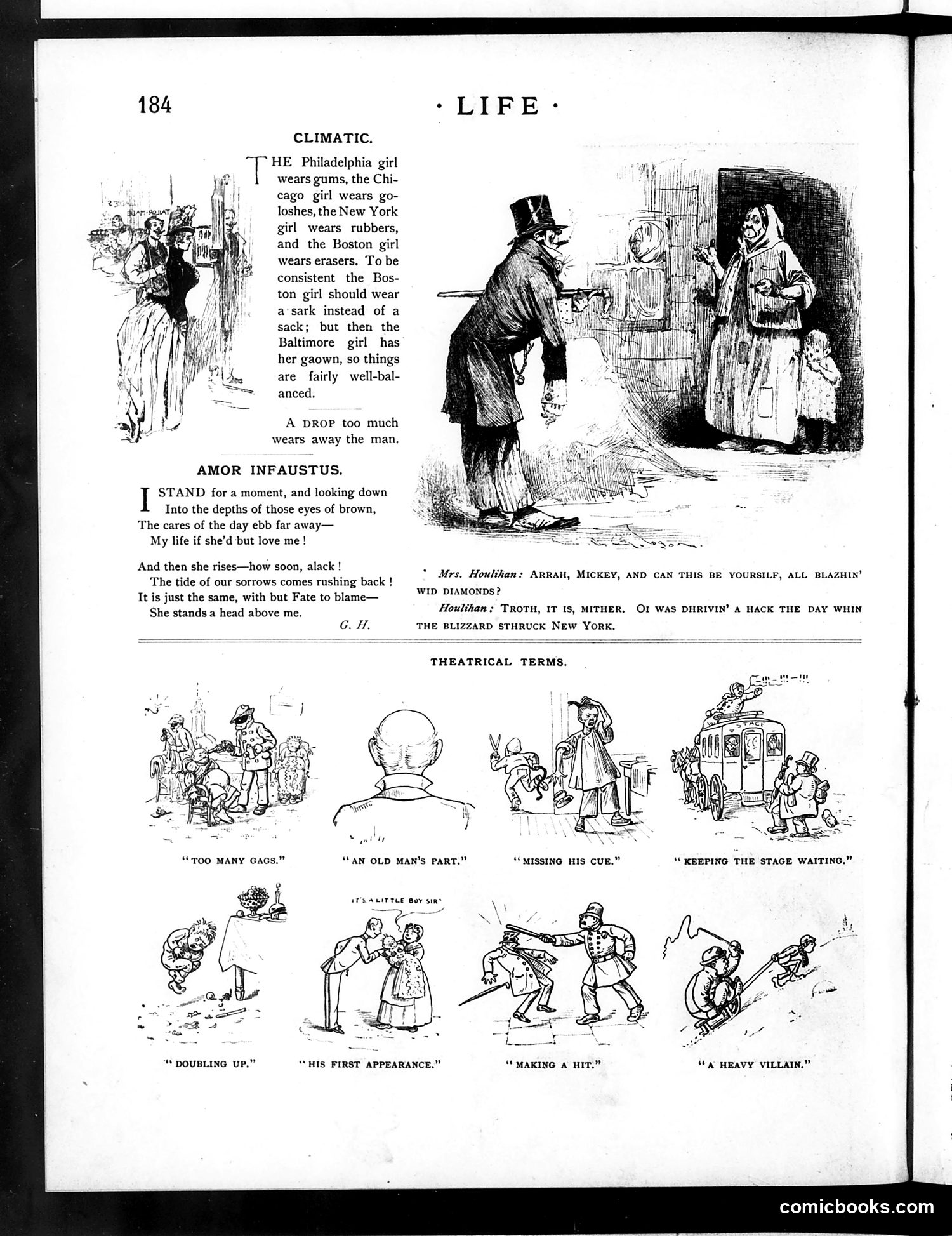
This page contains three distinct humor sections: **"Climatic"** is regional satire mocking how different American city girls dress differently ("gums," "goloshes," "rubbers," "erasers") to cope with wet weather. The joke plays on Boston girls' supposed pretension—they should wear a "sark" (shirt) instead of a "sack," but other cities' girls are equally peculiar. **"Amor Infaustus"** is a romantic poem joke: a man admires a woman with "eyes of brown" until she stands up—she's literally taller than him ("stands a head above me"), ruining the romance. **"Theatrical Terms"** illustrates eight theatrical expressions through comic situations: "too many gags," "an old man's part," "missing his cue," "keeping the stage waiting," "doubling up," "his first appearance," "making a hit," and "a heavy villain." These appear to be visual puns on theatre jargon for modern readers unfamiliar with period stage terminology.
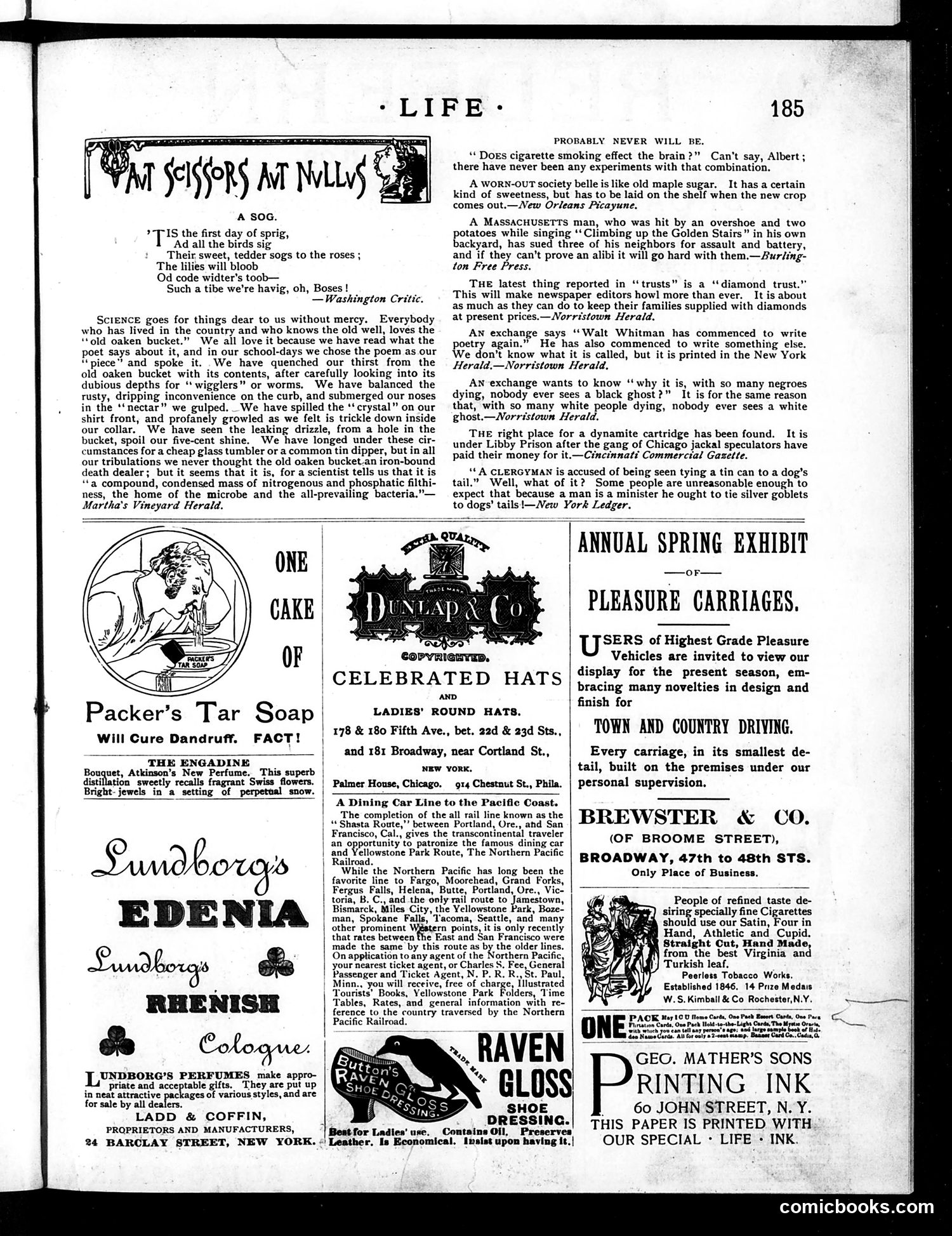
This page is primarily **advertising and miscellaneous content** rather than political commentary. The main cartoon element is a decorative header "I'M SCISSORS AT NULLS" illustrated with scissors and a rose, accompanying a poem celebrating spring. The page contains **various product advertisements** (Packer's Tar Soap, Lundborg's perfumes, Dunlap hats, Raven Gloss shoe dressing, and Brewster & Co. carriages) interspersed with brief satirical notes about contemporary topics—including scientific observations, newspaper gossip about trusts and society, and humorous commentary on clergy and social behaviors. The overall tone is lighthearted social satire typical of *Life* magazine's format: mixing poetry, ads, and witty observations about 1890s-era American life without focused political messaging.
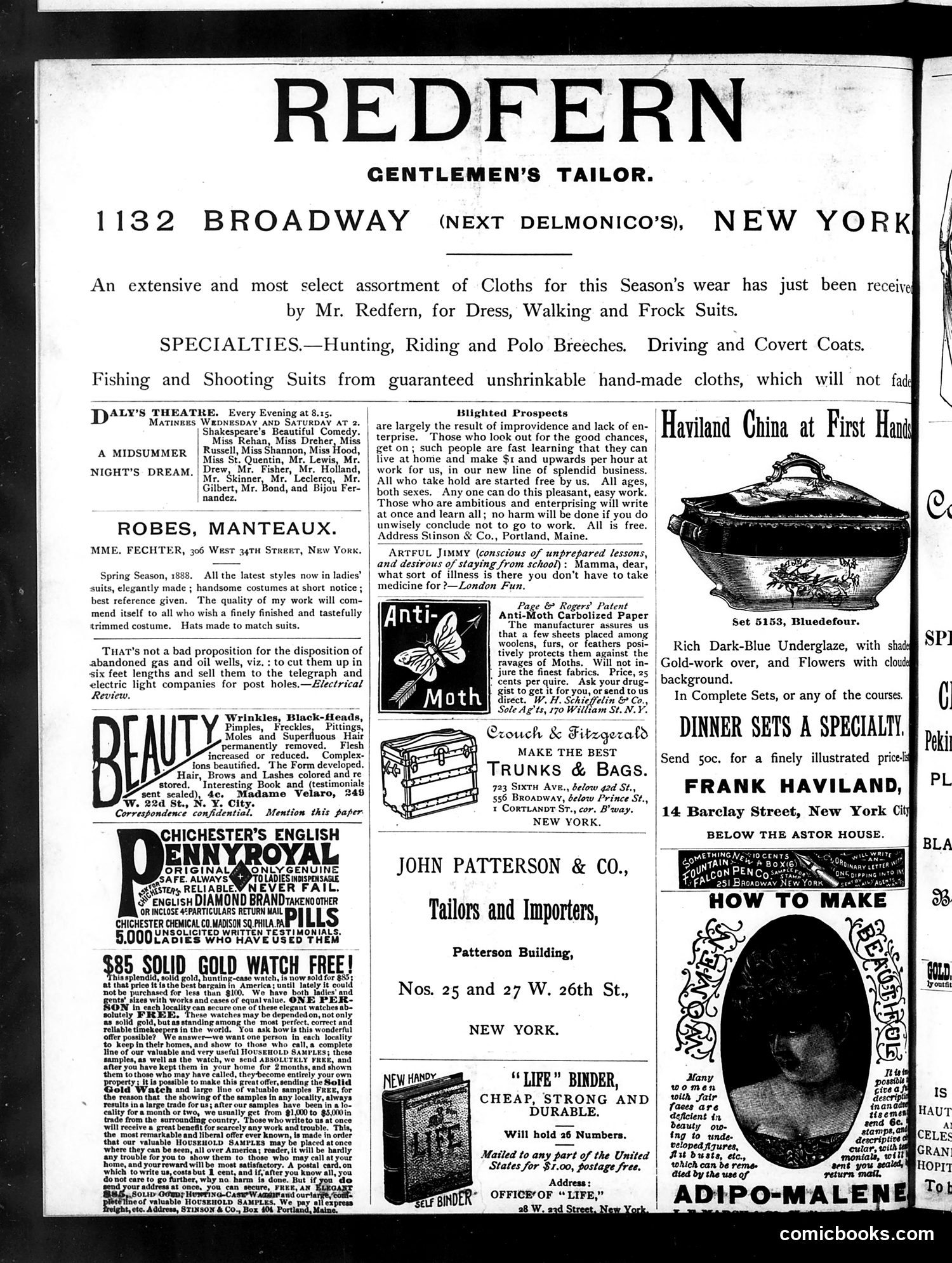
This page is primarily **advertisements**, not satirical content. It's from a late 19th-century American magazine and showcases period commercial offerings. **Key advertisements include:** - **Redfern** (top): A gentlemen's tailor advertising high-end clothing for the wealthy—suits, hunting breeches, and fishing wear - **Daly's Theatre**: Promoting Shakespeare's "A Midsummer Night's Dream" - **Beauty treatments** and "Chichester's Pills": Patent medicines and cosmetic services typical of the era - **"Blighted Prospects" job offer**: A work-from-home scheme promising "$1 and upwards per hour"—likely exploitative by modern standards - **Haviland China**: Elegant dinnerware advertisement - **"Life" Binder and Adipfo-Malene**: Various household products The social context reflects Gilded Age consumerism targeting affluent readers, alongside dubious medical claims and "get rich quick" employment schemes that were common then. The page reveals period attitudes toward luxury goods, self-improvement, and unregulated advertising.
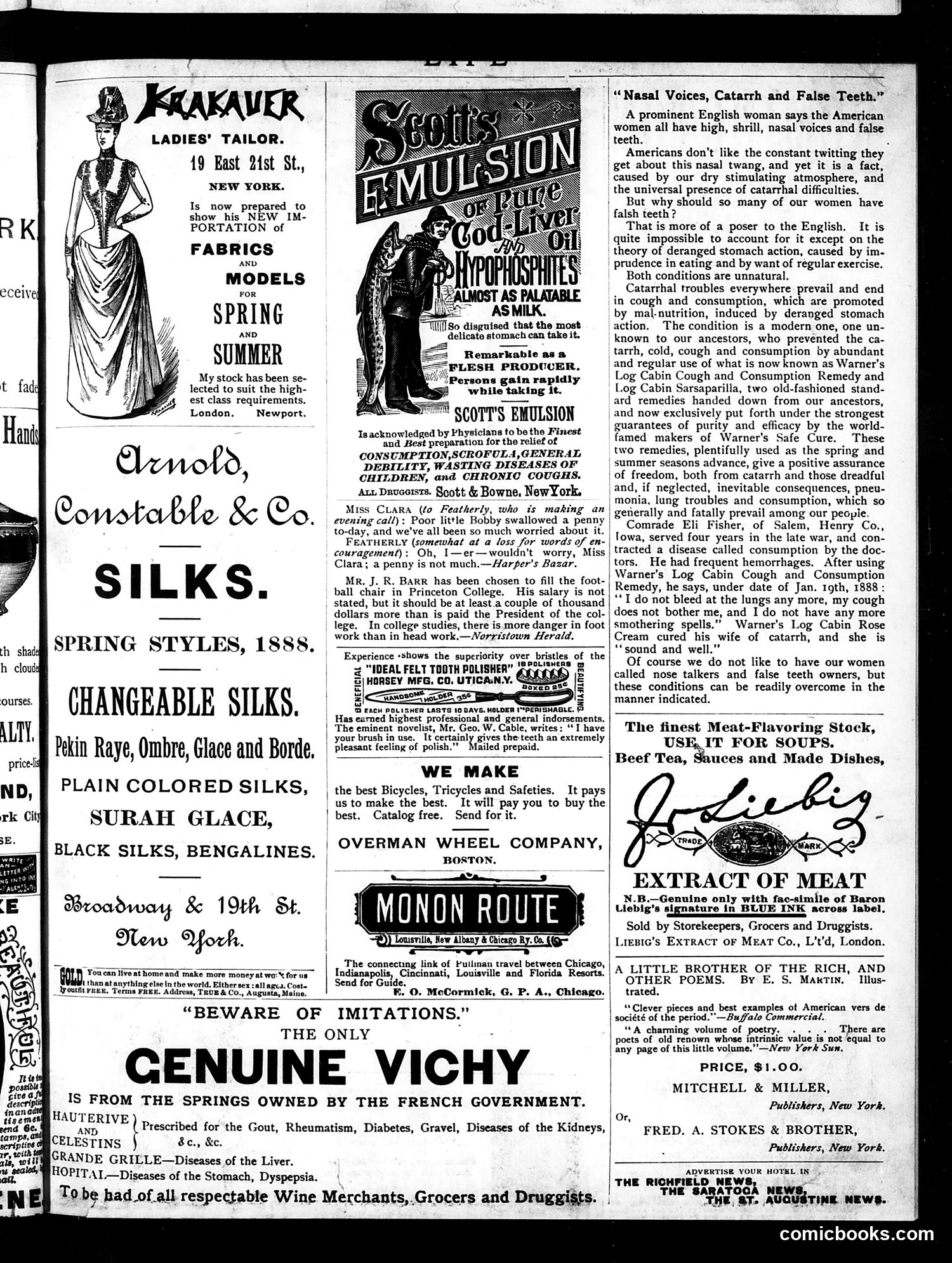
This page is primarily **advertising**, not political cartoons. However, it contains period social commentary worth noting: The lead article "Nasal Voices, Catarrh and False Teeth" presents a British critique of American women, claiming they have harsh voices and poor teeth. The piece attributes this to America's "dry stimulating atmosphere" and poor digestion from irregular eating and exercise—essentially blaming modern American lifestyle. The irony is that this criticism serves as a vehicle for Warner's patent medicine advertisement, which claims their "Log Cabin" remedies (drawing on frontier nostalgia) can prevent such ailments. The small humor piece features a social anxiety joke: a visitor reassures a worried mother about her child swallowing a penny by saying "a penny is not much"—the humor lying in his obliviousness to her concern. The page otherwise showcases typical 1880s advertisements for silks, bicycles, tooth polish, and mineral water—reflecting the era's consumer culture and faith in patent medicines.
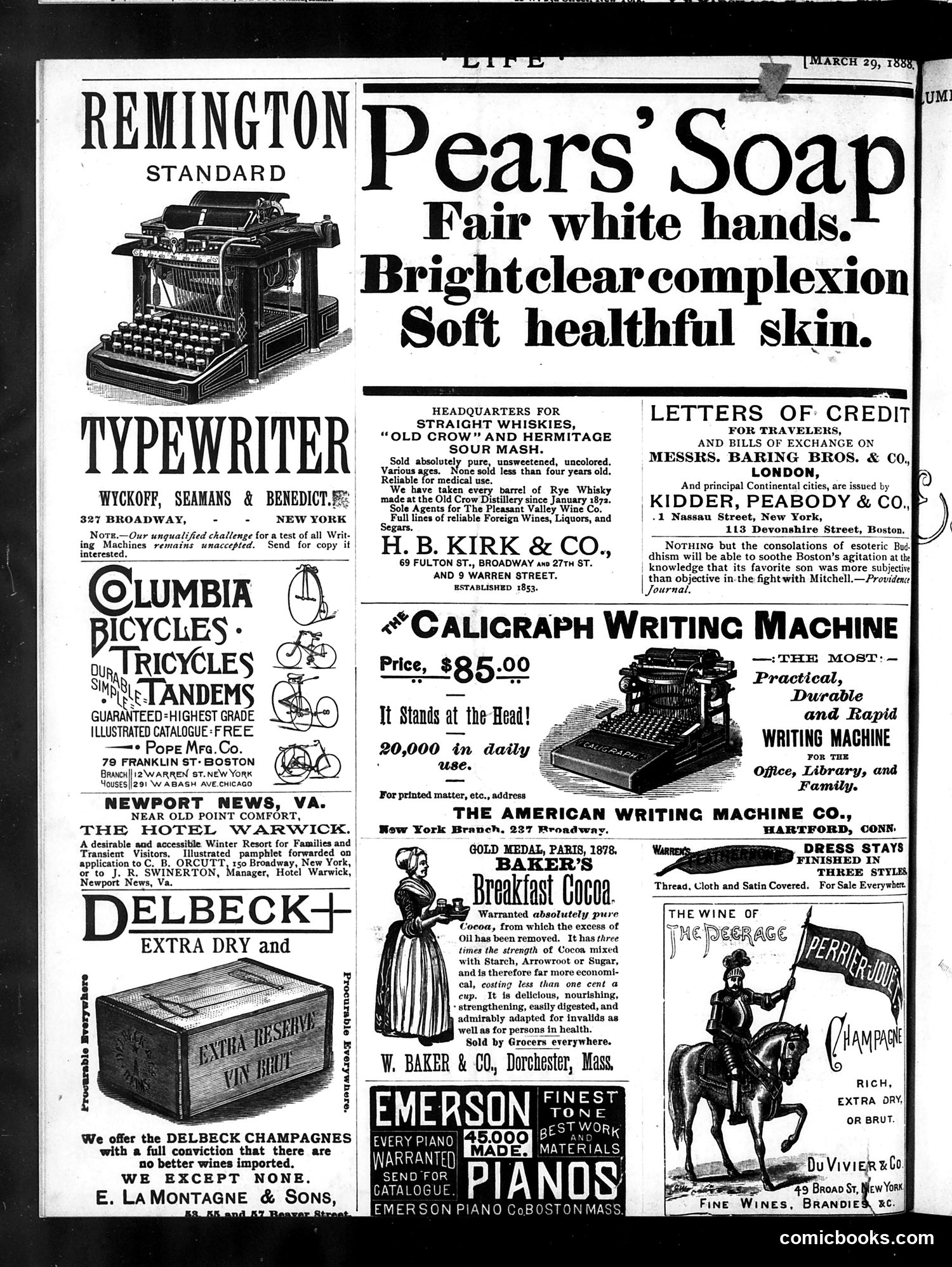
This is primarily an **advertising page** with no political cartoons or satirical content to analyze. The page consists entirely of commercial advertisements typical of the 1880s, including: - Pears' Soap (emphasizing "fair white hands" and "bright clear complexion") - Remington Standard typewriter - Columbia bicycles and tricycles - Caligraph writing machines - Various alcoholic beverages (whiskey, wine, champagne) - Baker's breakfast cocoa - Emerson pianos - Hotels and financial services The only editorial content appears to be a brief note referencing Boston's "agitation" over someone named Mitchell in a fight, mentioning esoteric Buddhism—but this fragment lacks sufficient context for meaningful interpretation. This appears to be a typical monetized page from *Life* magazine, where advertising revenue sustained the publication's satirical content elsewhere in the issue.