
Life, 1888-03-29 · page 2 of 16
Life — March 29, 1888 — page 2: what you’re looking at
What you’re looking at
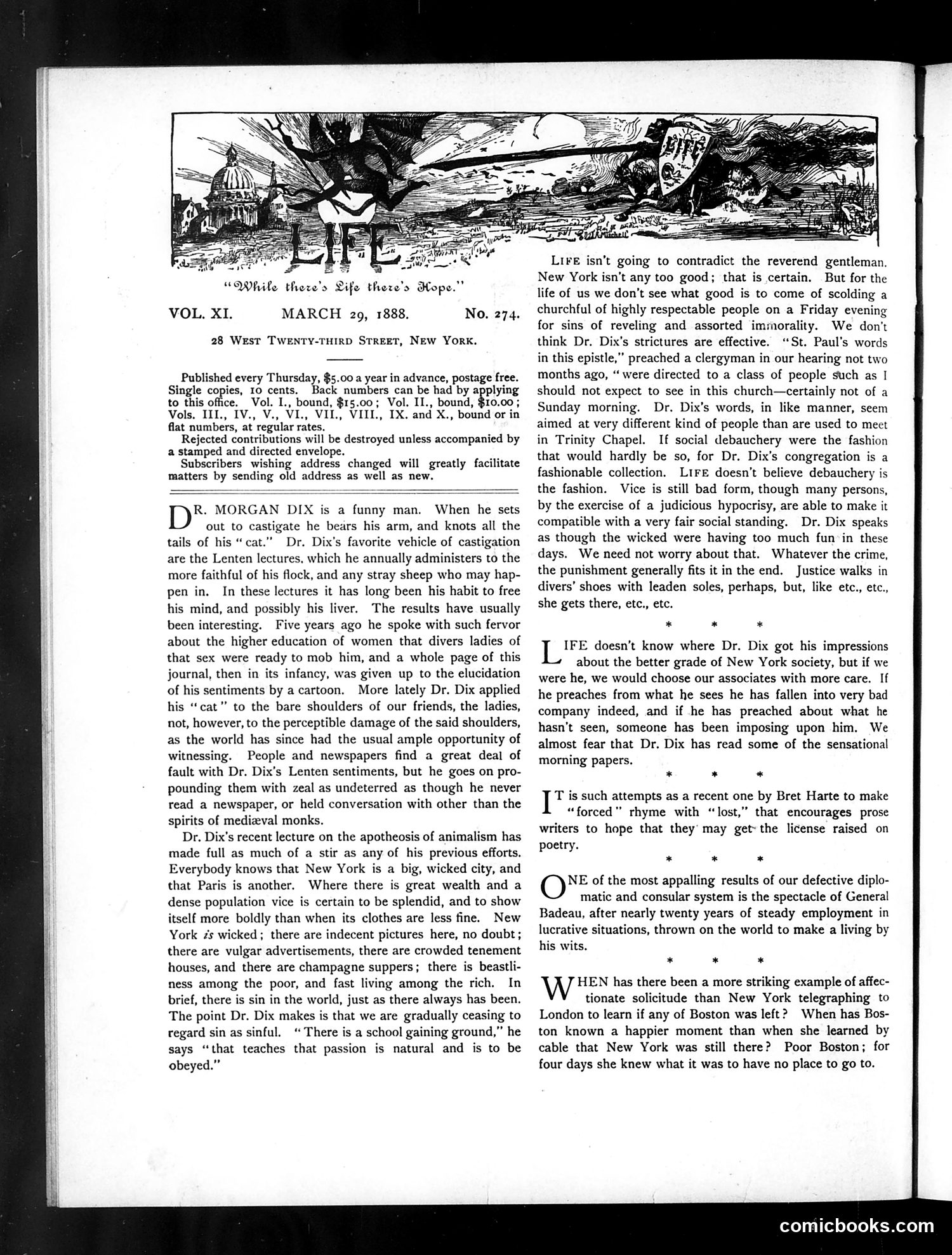
The header cartoon shows a figure sitting beneath a gnarled tree with text "While there's Life there's Scope." The imagery appears allegorical—the twisted tree and solitary figure likely represent Life magazine itself or its editorial mission, suggesting resilience and continued potential despite hardship. The page's main content is editorial commentary by Dr. Morgan Dix, a clergyman whom Life satirizes as self-righteous. The text mocks his Lenten lectures condemning sin while Life's editors suggest he misunderstands New York society and may be reading sensational newspapers rather than observing reality directly. The satire targets his hypocrisy and moral smugness about urban vice.
📄 Transcribed text from this page (OCR, searchable)
Machine-transcribed from the original scan — historical spelling and the odd misread are preserved.
VOL. XI. MARCH 29, 1888. No. 274. 28 West TWENTY-THIRD STREET, NEw York. Published every Thursday, $5.00 a year in advance, postage free. Single copies, 10 cents. Back numbers can be had by applying to this office. Vol. I., bound, $15.00; Vol. II., bound, $10.00 ; Vols. III., IV., V., VI., VII., VIII., IX. and X., bound or in flat numbers, at regular rates. Rejected contributions will be destroyed unless accompanied by a stamped and directed envelope. Subscribers wishing address changed will greatly facilitate matters by sending old address as well as new. R. MORGAN DIX is a funny man. When he sets out to castigate he bears his arm, and knots all the tails of his “cat.” Dr. Dix’s favorite vehicle of castigation are the Lenten lectures, which he annually administers to the more faithful of his flock, and any stray sheep who may hap- pen in. In these lectures it has long been his habit to free his mind, and possibly his liver. The results have usually been interesting. Five years ago he spoke with such fervor about the higher education of women that divers ladies of that sex were ready to mob him, and a whole page of this journal, then in its infancy, was given up to the elucidation of his sentiments by a cartoon. More lately Dr. Dix applied his “cat” to the bare shoulders of our friends, the ladies, not, however, to the perceptible damage of the said shoulders, as the world has since had the usual ample opportunity of witnessing. People and newspapers find a great deal of fault with Dr. Dix’s Lenten sentiments, but he goes on pro- pounding them with zeal as undeterred as though he never read a newspaper, or held conversation with other than the spirits of mediaeval monks. Dr. Dix’s recent lecture on the apotheosis of animalism has made full as much of a stir as any of his previous efforts. Everybody knows that New York is a big, wicked city, and that Paris is another. Where there is great wealth and a dense population vice is certain to be splendid, and to show itself more boldly than when its clothes are less fine. New York zs wicked; there are indecent pictures here, no doubt; there are vulgar advertisements, there are crowded tenement houses, and there are champagne suppers; there is beastli- ness among the poor, and fast living among the rich. In brief, there is sin in the world, just as there always has been. The point Dr. Dix makes is that we are gradually ceasing to regard sin as sinful. “ There is a school gaining ground,” he says “that teaches that passion is natural and is to be obeyed.” Lire isn’t going to contradict the reverend gentleman. New York isn’t any too good; that is certain. But for the life of us we don’t see what good is to come of scolding a churchful of highly respectable people on a Friday evening for sins of reveling and assorted immorality. We don't think Dr. Dix’s strictures are effective. “St. Paul's words in this epistle,” preached a clergyman in our hearing not two months ago, “were directed to a class of people such as | should not expect to see in this church—certainly not of a Sunday morning. Dr. Dix’s words, in like manner, seem aimed at very different kind of people than are used to meet in Trinity Chapel. If social debauchery were the fashion that would hardly be so, for Dr. Dix’s congregation is a fashionable collection. Lire doesn’t believe debauchery is the fashion. Vice is still bad form, though many persons, by the exercise of a judicious hypocrisy, are able to make it compatible with a very fair social standing. Dr. Dix speaks as though the wicked were having too much fun in these days. We need not worry about that. Whatever the crime, the punishment generally fits it in the end. Justice walks in divers’ shoes with leaden soles, perhaps, but, like etc., etc., she gets there, etc., etc. * * * IFE doesn’t know where Dr. Dix got his impressions about the better grade of New York society, but if we were he, we would choose our associates with more care. If he preaches from what he sees he has fallen into very bad company indeed, and if he has preached about what he hasn't seen, someone has been imposing upon him. We almost fear that Dr. Dix has read some of the sensational morning papers. * * *« T is such attempts as a recent one by Bret Harte to make “forced” rhyme with “lost,” that encourages prose writers to hope that they’ may get~ the license raised on poetry. * * * NE of the most appalling results of our defective diplo- matic and consular system is the spectacle of General Badeau, after nearly twenty years of steady employment in lucrative situations, thrown on the world to make a living by his wits. * * * HEN has there been a more striking example of affec- tionate solicitude than New York telegraphing to London to learn if any of Boston was left? When has Bos- ton known a happier moment than when she learned by cable that New York was still there? Poor Boston; for four days she knew what it was to have no place to go to. comicbooks.com