
A complete issue · 16 pages · 1887
Life — December 15, 1887
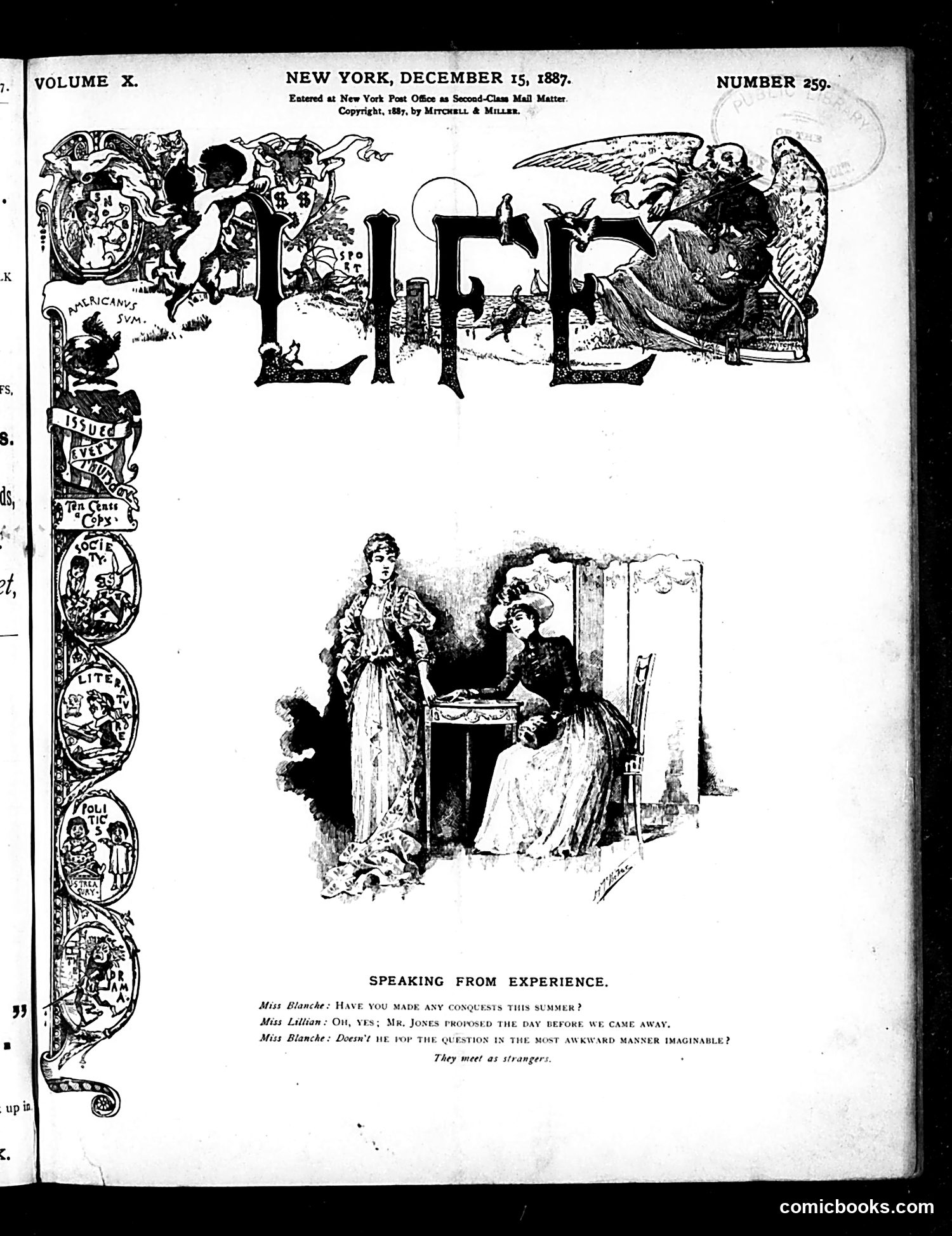
This page presents a satirical cartoon titled "Speaking from Experience." The scene depicts three women in Victorian dress discussing marriage proposals. **The Joke:** Miss Blanche asks Miss Lillian if she's made any marriage conquests. Miss Lillian replies that Mr. Jones proposed the day before they left (presumably on a trip). Miss Blanche then quips that Jones must lack an "awkward manner" to propose so quickly to a stranger. **The Satire:** The humor targets rapid courtship and hasty marriage proposals among the wealthy leisure class. The caption "They meet as strangers" underscores the absurdity—that Jones would propose to a woman he barely knows. This satirizes both overeager male suitors and the superficial marriage market of 1880s high society, where matrimonial prospects were negotiated quickly among the elite.
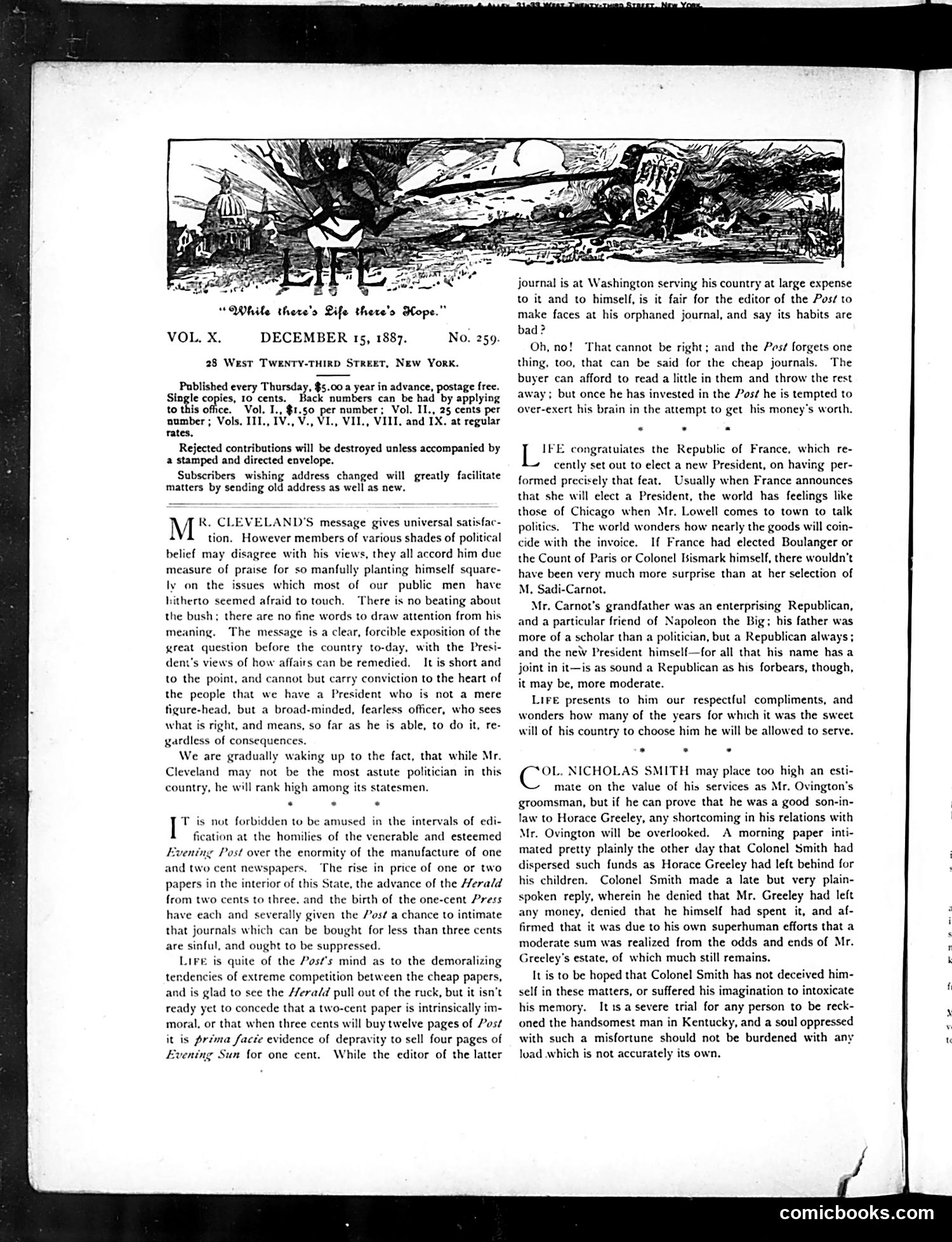
**The Cartoon Header** depicts a landscape with classical and religious imagery—a dome structure (possibly representing government/institutions) alongside natural scenery. The motto reads "Where there's Life there's Hope." **The Editorial Content** discusses President Cleveland's political standing, praising his courage on public issues. It also comments on French politics, noting France's election of a new President. The page includes remarks about Colonel Nicholas Smith's financial disputes with Horace Greeley, a prominent 19th-century editor and politician. The editors defend Smith's reputation against allegations he misappropriated funds from Greeley's estate. **Overall**: This is political commentary on American leadership and financial conduct during the Gilded Age, using specific disputes to illustrate broader questions about public integrity.
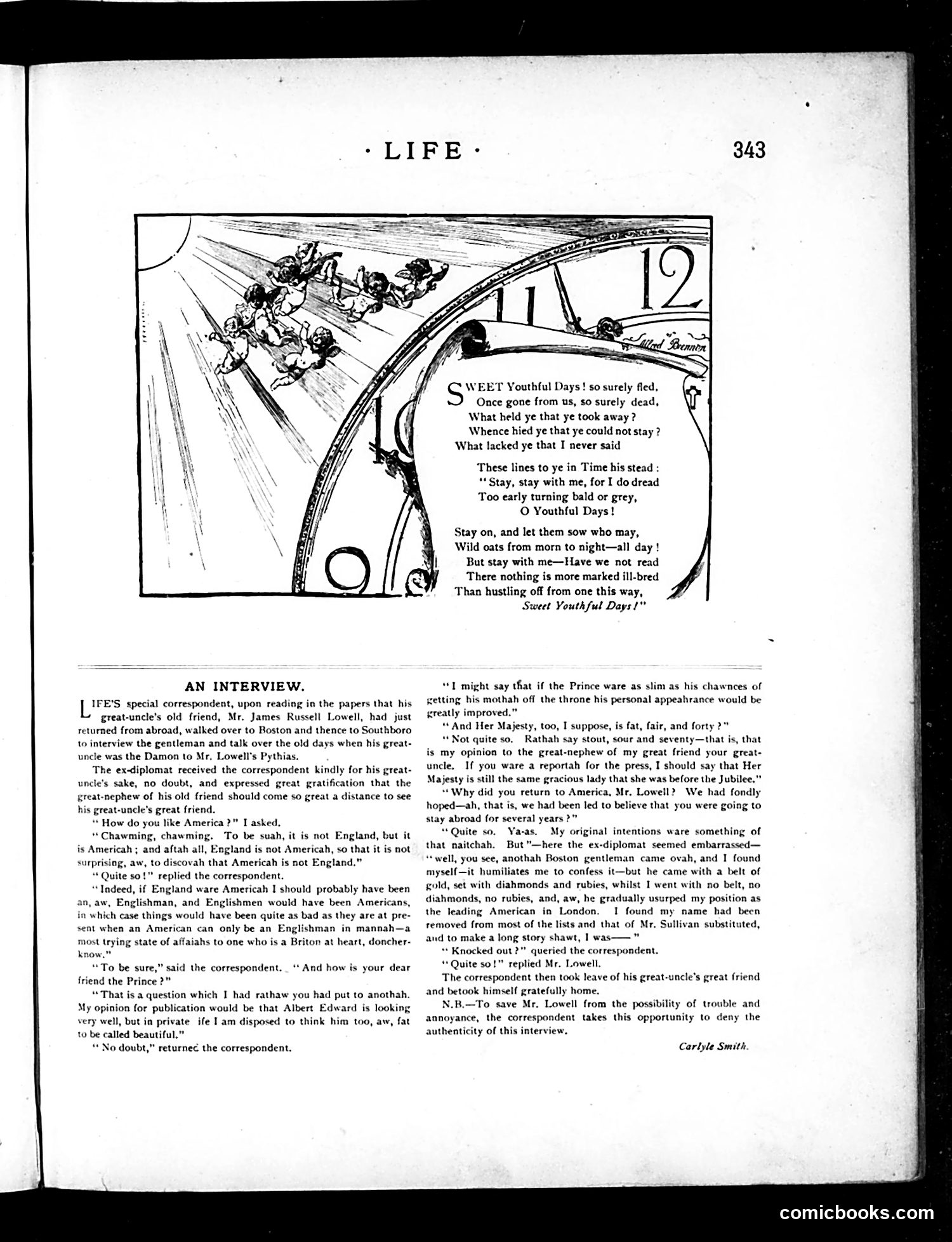
The page contains two distinct elements: **Upper illustration**: A clock-face design with figures and a poem titled "Sweet Youthful Days!" The image appears to be sentimental rather than satirical, depicting cherubs or young figures near clock numbers, accompanying nostalgic verse about youth passing away. **Lower section "An Interview"**: A satirical conversation between a Life correspondent and James Russell Lowell about his recent return from abroad. The correspondent teases Lowell about whether England or America is superior. Lowell defends America against Englishmen's assumptions of superiority, humorously noting that calling something "American" in England is considered insulting. The satire targets Anglo-American cultural snobbery and nationalist pride of the era. The piece is signed by Carlyle Smith.
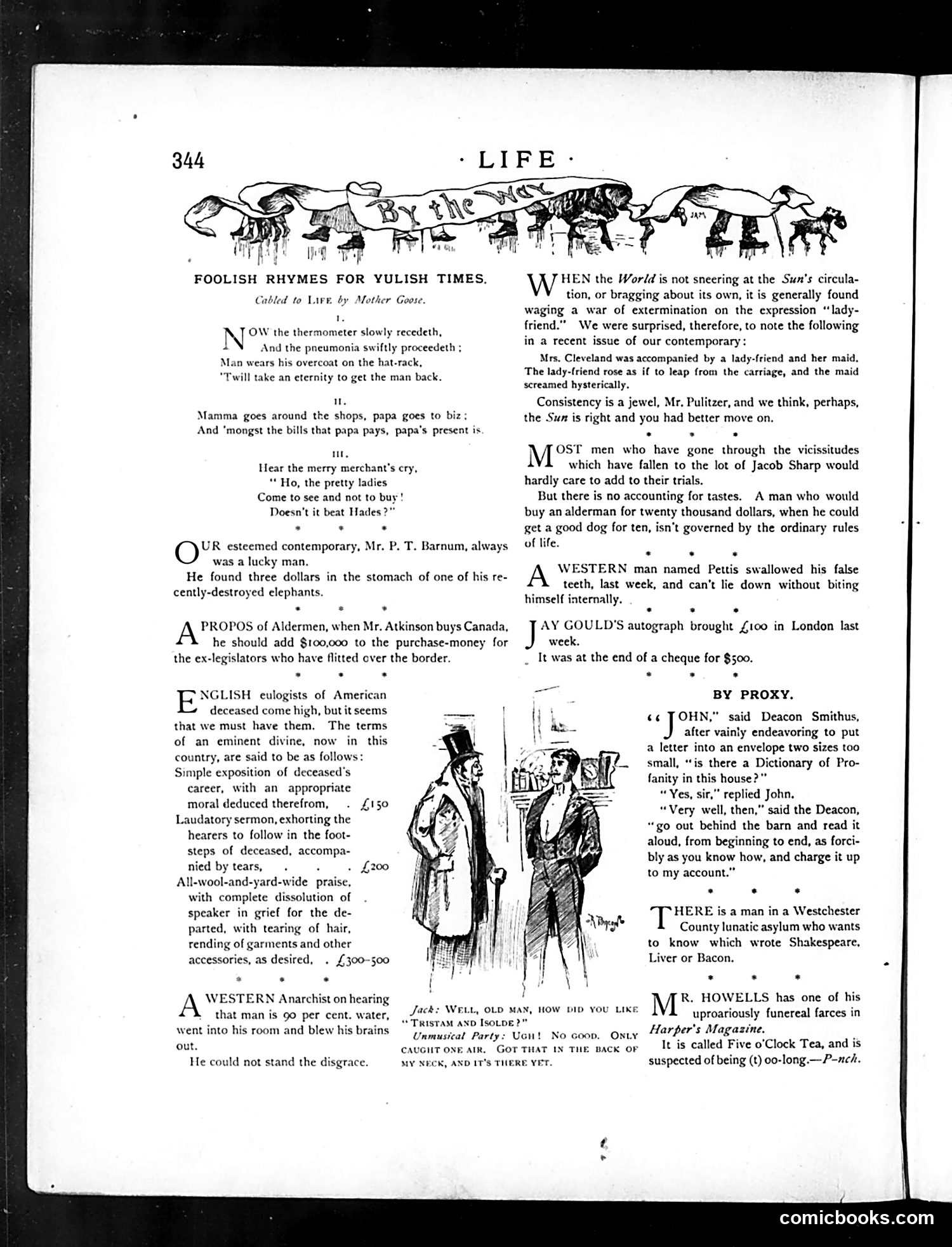
This page contains miscellaneous satirical snippets rather than a single cartoon. The main illustrated item is titled "By Proxy," depicting two men in conversation—one instructing the other to read a letter aloud from behind a barn to avoid personal confrontation. The scattered text items mock various absurdities: a man who swallowed false teeth, an Alderman's proposal to charge Americans for Canadian legislation, expensive funerals with excessive ceremonies, and a Westchester lunatic claiming to identify Shakespeare's works. The humor relies on social commentary about American pretension, bureaucratic absurdity, and upper-class excess typical of early 20th-century *Life* magazine's satirical approach. Without specific dated references visible, the exact targets remain somewhat unclear, though the general critique of vanity and social pretension is evident.
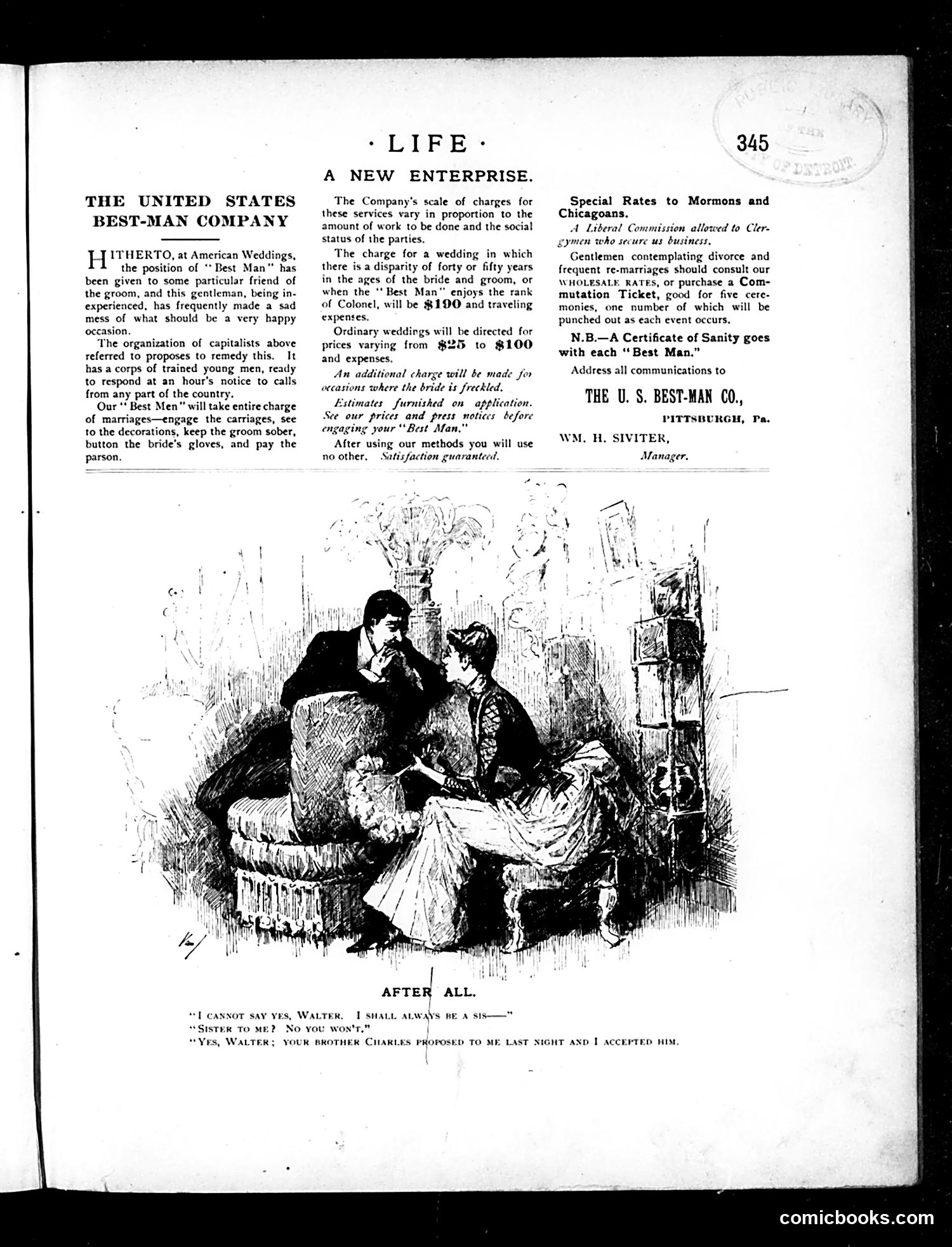
This page contains a satirical advertisement for "The United States Best-Man Company," a fictional service offering to hire professional "best men" for weddings. The ad humorously addresses the growing commercialization of American social rituals. The accompanying illustration titled "After All" depicts a domestic scene where a man learns his sister has accepted a marriage proposal from his brother Charles. The caption presents this as a resignation to inevitable social circumstances. The satire targets the commodification of personal milestones—suggesting that even intimate social roles like "best man" have become purchasable services in modern America. This reflects late-19th/early-20th-century anxieties about capitalism's encroachment into traditionally personal and familial domains.
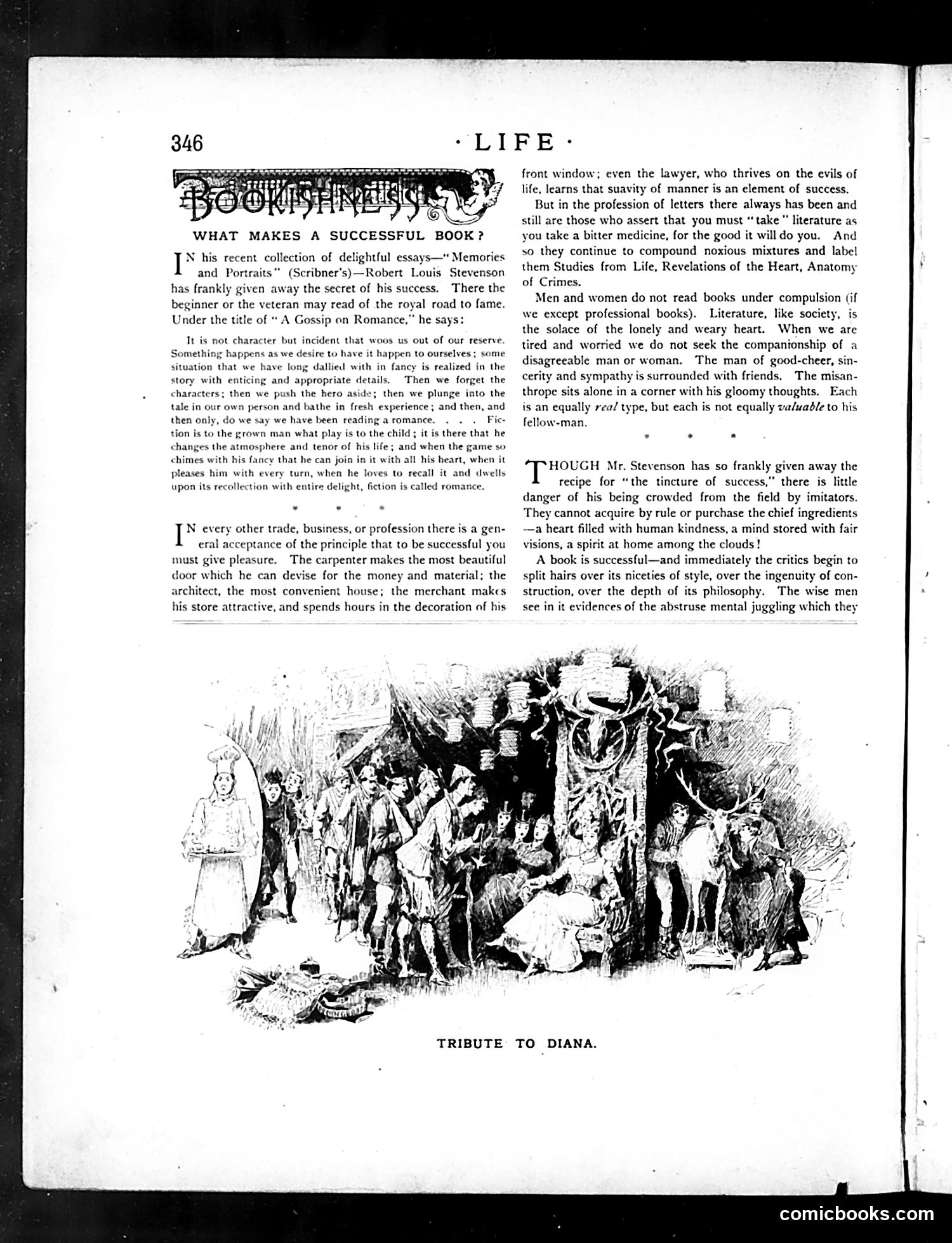
This page discusses literary success, referencing Robert Louis Stevenson's essay collection "Memories and Portraits." The article argues that successful books require more than technical skill—they need authentic human emotion and character development that resonates with readers. The illustration titled "Tribute to Diana" appears to be a classical or mythological scene, likely depicting the Roman goddess Diana with attendants and hunting imagery. Without additional context, the connection between this image and the book-success discussion is unclear—it may be decorative, or possibly illustrate a point about literary inspiration or classical themes in successful literature. The page critiques overly analytical literary criticism that "split hairs" rather than appreciating genuine storytelling merit.
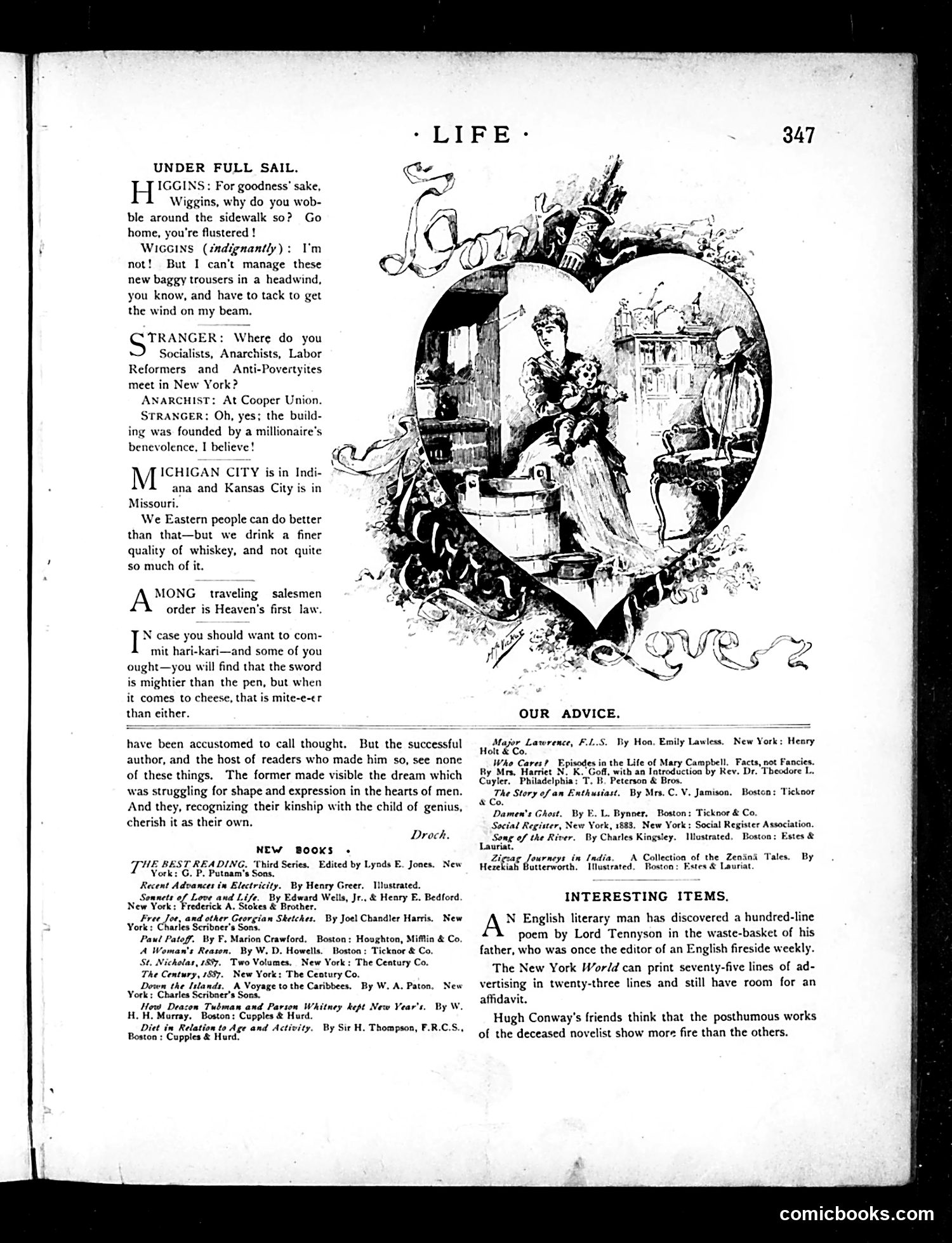
This page features a satirical dialogue between characters discussing American geography and social movements. The main illustrated cartoon shows an ornate heart-shaped vignette depicting domestic or romantic scenes. The text mocks a character named Wiggins for wobbling about sidewalk construction, then presents exchanges with a "Stranger" about radical movements (Socialists, Anarchists, Labor Reformers, Anti-Poverty-ites) meeting in New York. The humor appears to target both naive provincialism—a Michigander bragging about superior whiskey—and Eastern intellectual pretension regarding radical politics. The joke suggests that serious political ideology is less important than practical concerns like cheese and whiskey. The "Our Advice" section below lists new book recommendations, typical of Life's literary coverage during this period.
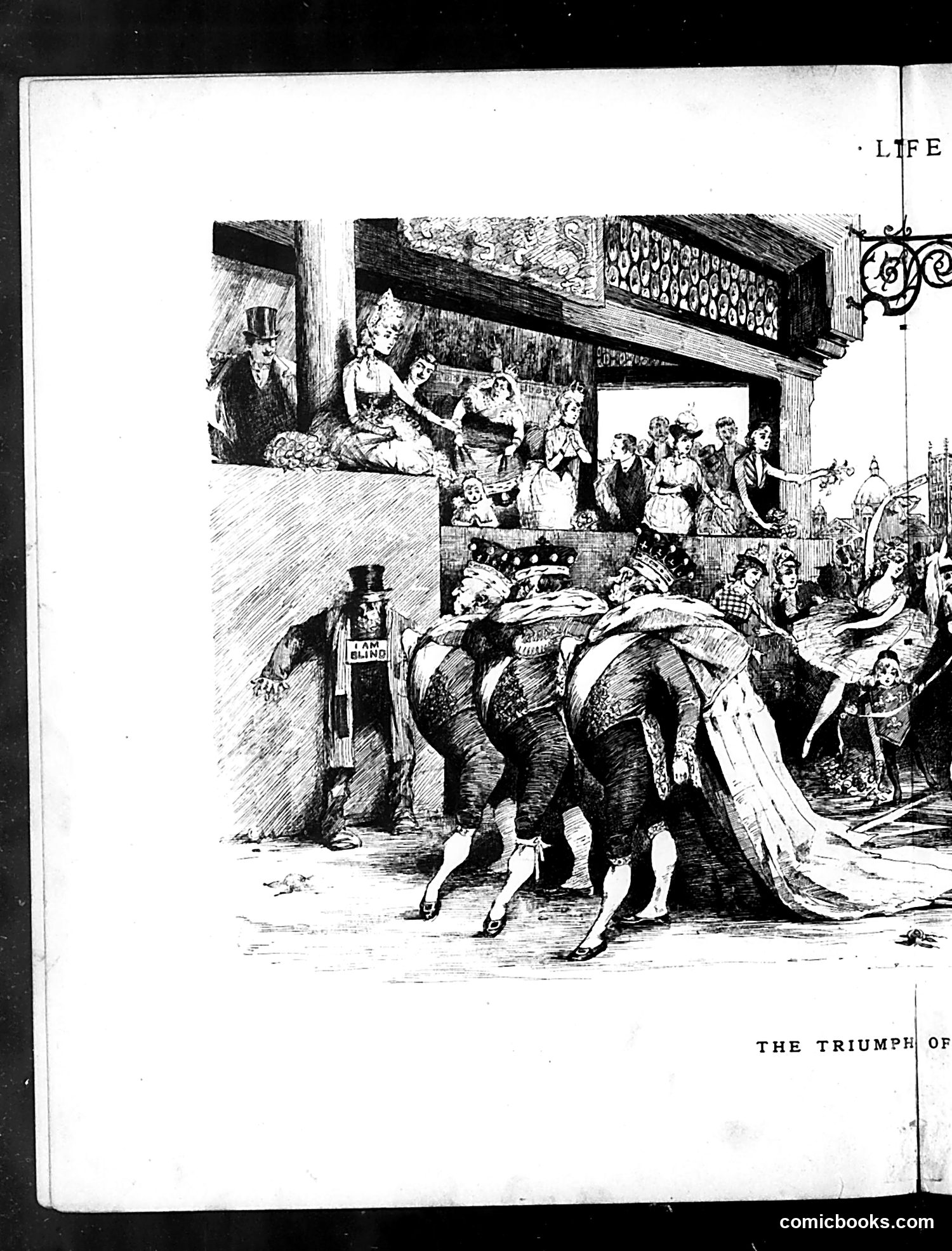
This engraving depicts a circus or street procession scene with three large elephants parading through a town street, observed by crowds from buildings and windows above. A blind man with a cane stands prominently at left, labeled "BLIND." The caption reads "THE TRIUMPH OF—" (cut off). This appears to be political satire, likely from the 19th century. The "blind" figure watching the elephants may symbolize either a political figure or the public itself being blind to something. The incomplete caption suggests the satire's target is obscured to modern readers without additional context. The elaborate procession suggests triumph or celebration, possibly mocking a political victory or public figure through the contrast between spectacle and blindness—implying something important is being overlooked despite obvious display.
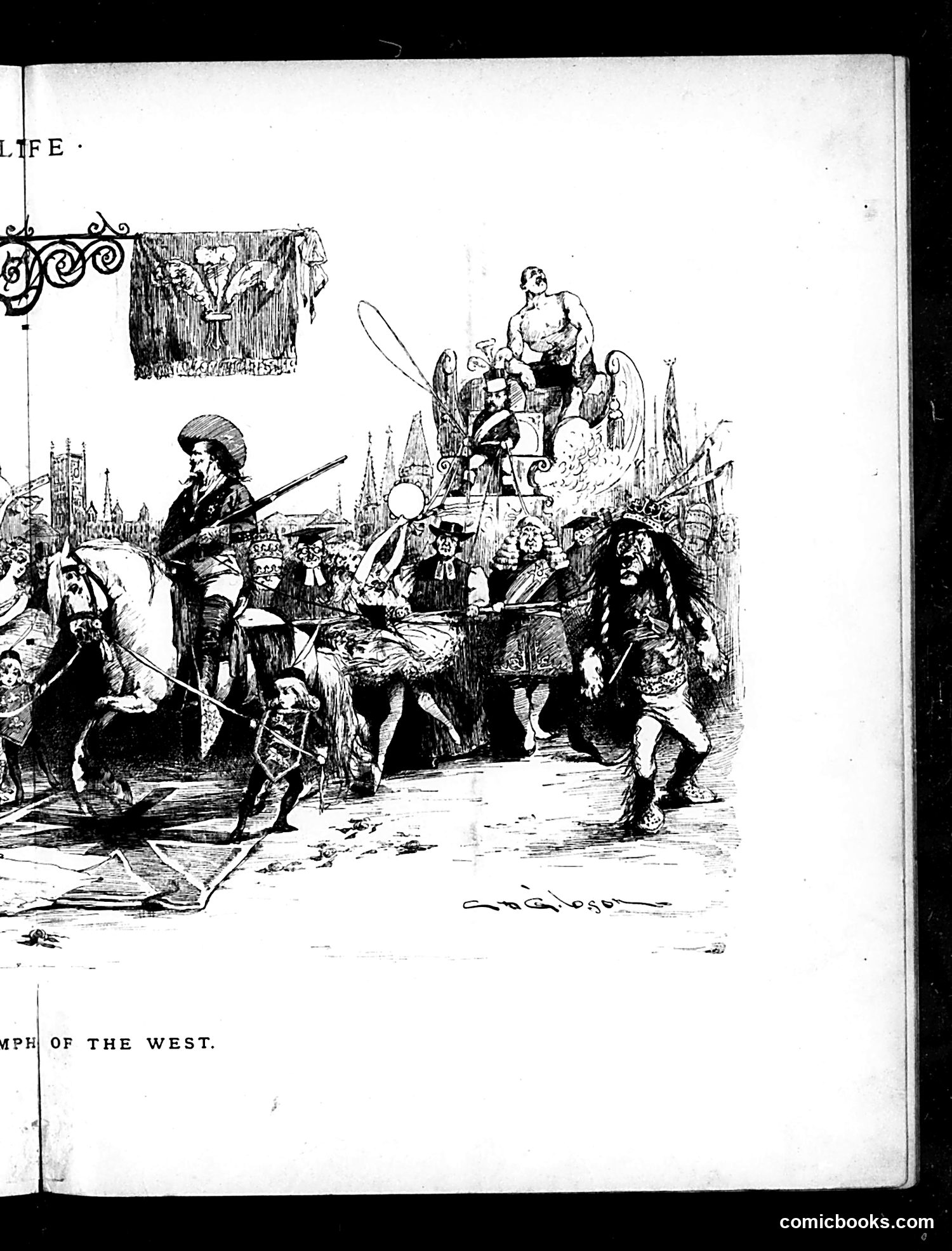
This page from *Life* magazine shows a satirical illustration titled "Triumph of the West." The image depicts a grand procession or military parade with mounted soldiers, elaborate pageantry, and Gothic architecture in the background. A figure on horseback (left) appears to be a military or political leader, while another seated figure (center, elevated) seems to represent authority or royalty. The style suggests European imperial conquest or expansion. The satire likely mocks Western imperialism and military might during the late 19th or early 20th century. The ornate, elaborate nature of the "triumph" scene—with its theatrical elements and exaggerated pageantry—suggests *Life* is critiquing the self-congratulatory nature of Western colonial and military adventures. However, without clearer text identifying specific historical events or figures, the exact target remains unclear.
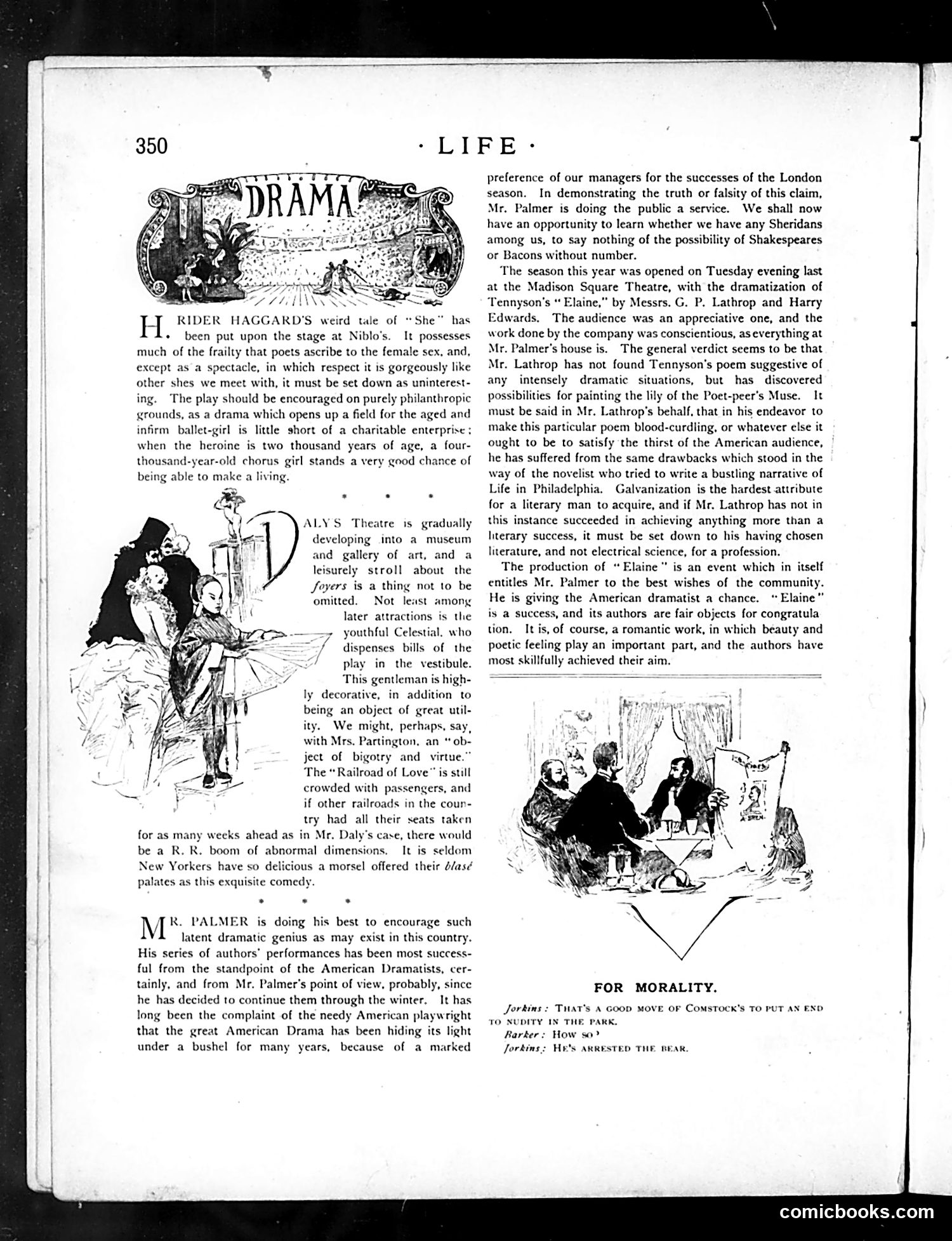
This page discusses Mr. Palmer's theatrical productions, particularly praising his dramatization of Tennyson's "Elaine" at Madison Square Theatre. The text criticizes the production as failing to capture Tennyson's poetic depth, calling it "blood-curdling" and comparing it unfavorably to the novel. The main cartoon at bottom, titled "For Morality," depicts what appears to be a social scene with figures discussing putting "an end to nudity in the park." One character responds "He's arrested the bear"—likely a satirical jab at overzealous morality enforcement, suggesting the absurdity of focusing on minor infractions while missing larger issues. The cartoon mocks prudish social movements of the era.
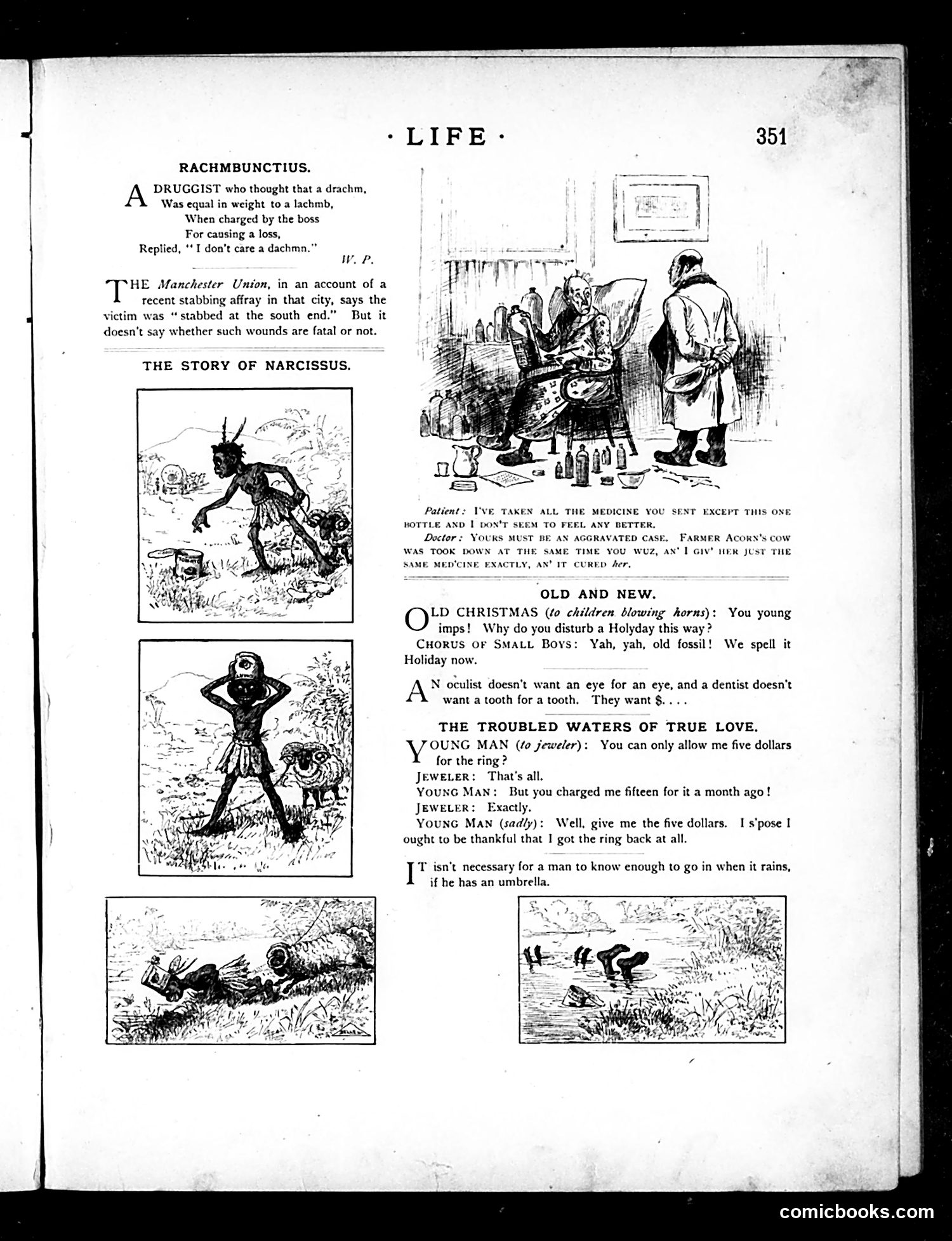
This page from the satirical magazine *Life* contains several standalone jokes and illustrated pieces mocking contemporary society: **"Rachmbunctius"** ridicules a careless druggist who confuses measurements (drachm/lachm/dachmn—intentionally garbled weights), showing professional incompetence with casual indifference. **"The Story of Narcissus"** illustrates three panels from classical mythology, likely contrasting vanity with modern themes (unclear without fuller context). **"Old and New"** satirizes generational conflict: old-fashioned adults annoyed by children who modernize spelling ("Holiday" instead of traditional forms), plus commentary on professional greed (eye doctors and dentists charging fees rather than practicing reciprocal justice). **"The Troubled Waters of True Love"** mocks a young man's desperate financial situation—forced to accept a ring's resale value (five dollars) after originally paying fifteen, accepting this loss as fortunate. The closing aphorism jokes about practical ignorance being acceptable when one has tools to compensate. Overall, these pieces satirize professional dishonesty, generational change, commercialism, and human foolishness.
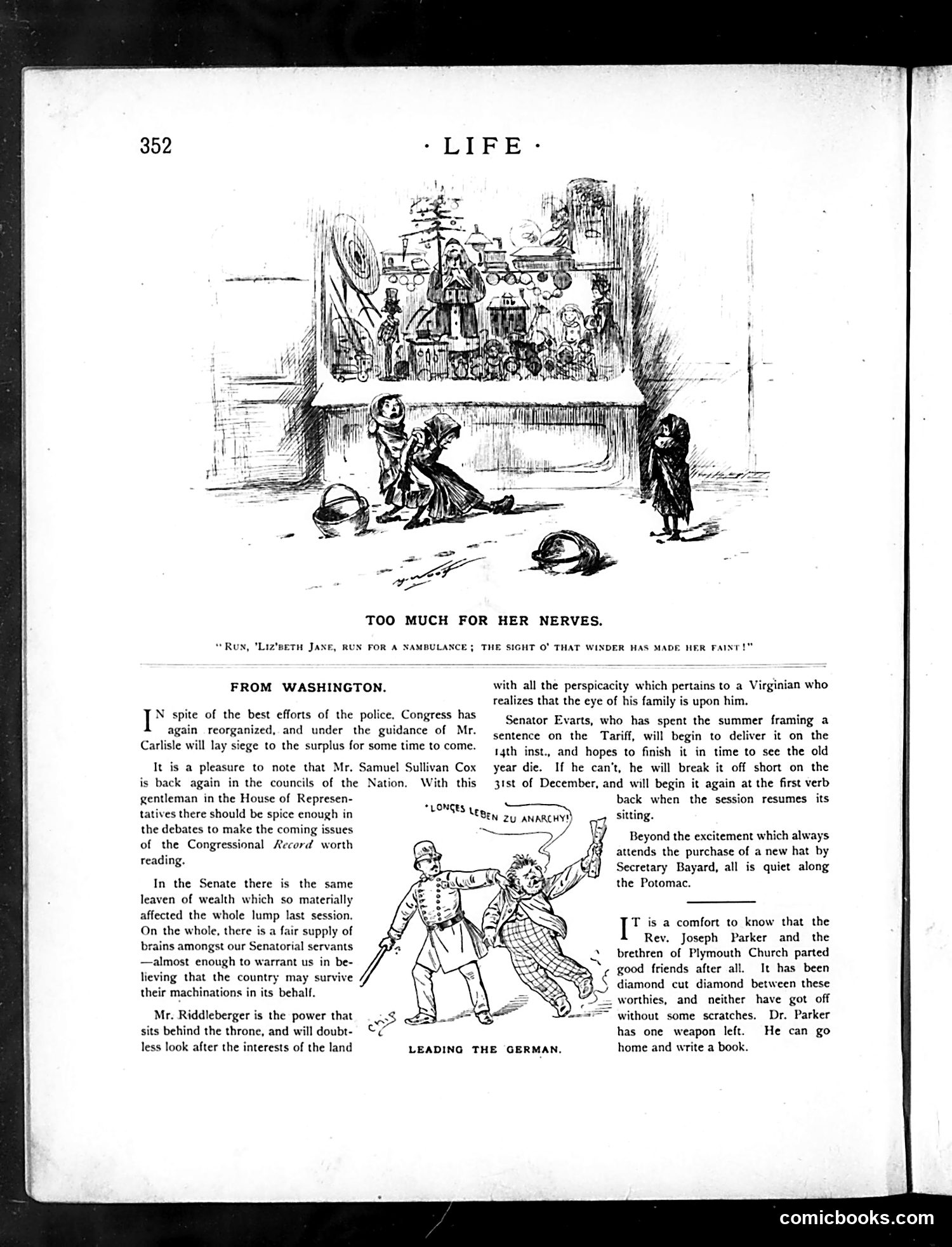
This page contains Washington political commentary and two cartoons satirizing late 19th-century American politics. **Top cartoon ("Too Much for Her Nerves"):** Shows a woman fainting at the sight of a circus or theatrical performance, likely satirizing public reaction to Congressional proceedings—suggesting politics is as absurd and overstimulating as cheap entertainment. **Main text:** Discusses Congressional reorganization under Mr. Carlisle and mentions specific senators (Evarts, Cox, Riddleberger) as power players. The tone is mocking—suggesting the Senate contains barely enough brains to prevent the country's ruin, and that wealth rather than wisdom drives their machinations. **Lower cartoon ("Leading the German"):** Depicts two figures in a dance pose with German text, likely satirizing diplomatic or political maneuvering with Germany during this period. **Plymouth Church reference:** Alludes to a dispute between Rev. Joseph Parker and church members, resolved amicably—suggesting even religious figures engage in calculated conflict and "weaponize" their ability to write about disputes. The overall message: Washington politics is theater, wealth-driven, and populated by mediocre opportunists.
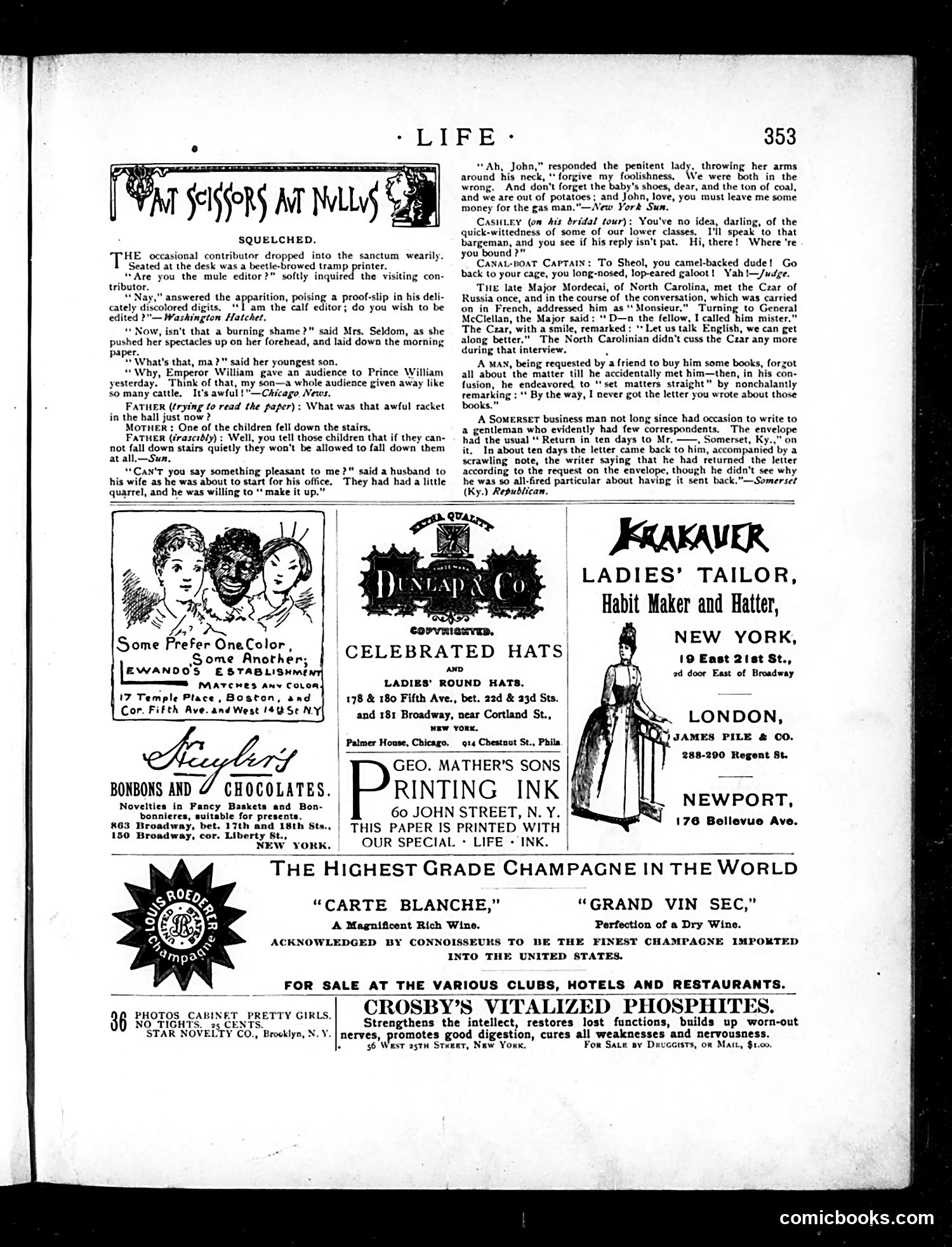
This page consists primarily of **short humorous anecdotes** rather than political cartoons. The jokes target common domestic and social situations of the era: **Key jokes include:** - A "mule editor" vs. "calf editor" pun about newspaper staff - Emperor William's audience compared to giving away cattle (mocking royal pretense) - A child falling downstairs, with the father ironically forbidding quiet falls - A newlywed husband's interaction with a crude canal-boat captain who insults him - A Civil War-era anecdote about Major Mordecai meeting the Czar of Russia - A Somerset businessman's confusion about returning mail **Themes:** The satire targets **pretension, miscommunication, domestic friction, class differences** (particularly the contrast between refined society and working-class rudeness), and **absurd logic**. The page is otherwise filled with **period advertisements** for hats, chocolates, printing ink, and champagne. The humor relies on wordplay, exaggeration, and ironic reversals typical of 19th-century American comedy magazines.
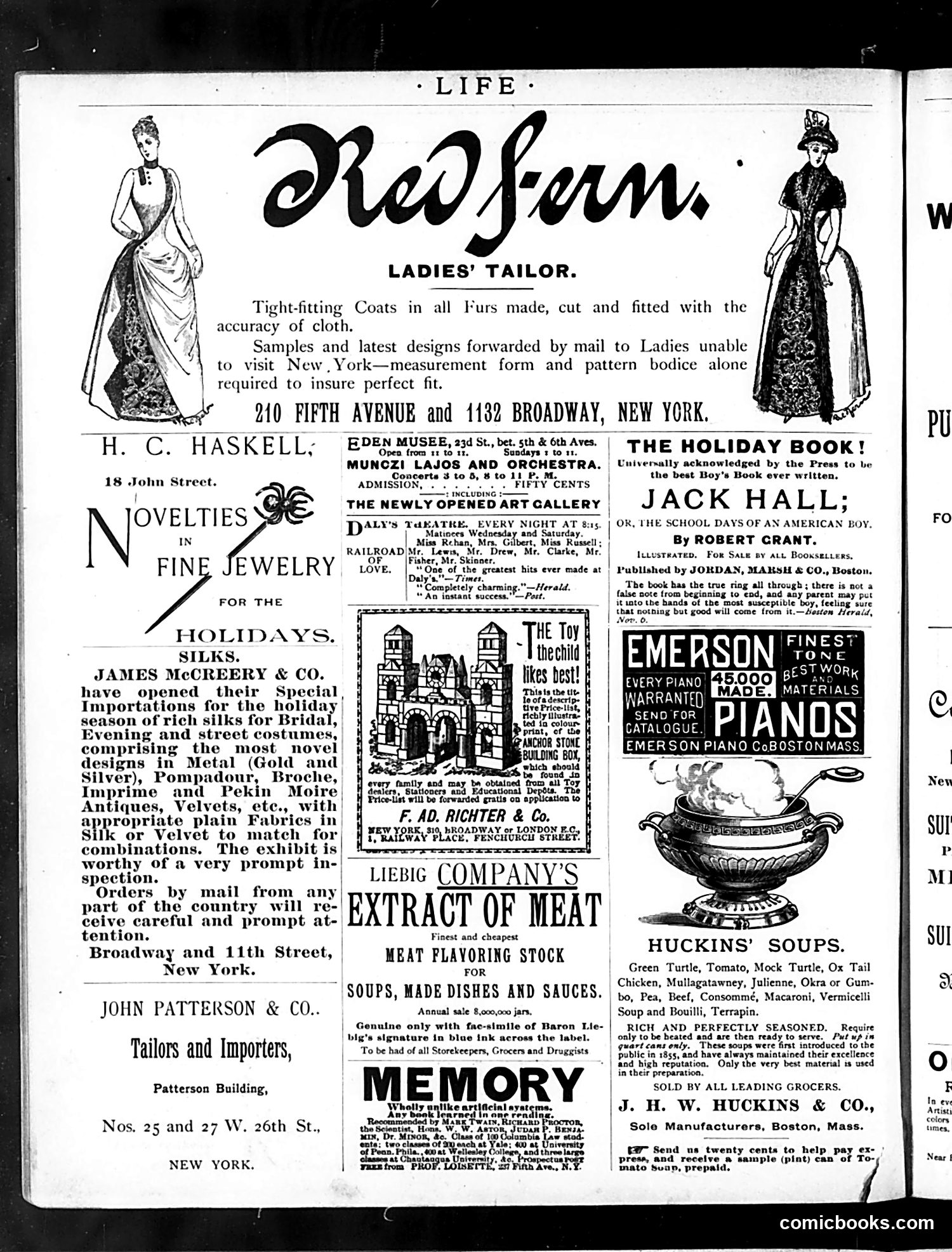
This is primarily an **advertising page** from Life magazine, not a political cartoon or satirical content page. It features holiday-season advertisements (circa late 1800s based on styling) for luxury goods aimed at wealthy consumers: **Key advertisers include:** - Red Fern (ladies' tailoring) - H.C. Haskell (fine jewelry) - James McCreery & Co. (silks for bridal/evening wear) - John Patterson & Co. (tailors) - Various cultural venues and consumer products (pianos, soup extracts, theater) **Historical context:** These ads reflect Gilded Age consumption patterns—mail-order services for rural customers, emphasis on European imports, luxury fabrics, and formal entertainment. The page targets affluent urban readers with disposable income for Christmas shopping. **Notable social element:** Multiple ads emphasize mail-order convenience for ladies "unable to visit New York," reflecting both women's consumer power and geographic limitations of the era. This is essentially a **commercial page**, not satirical content, though Life magazine itself was known for its humor and social commentary elsewhere.
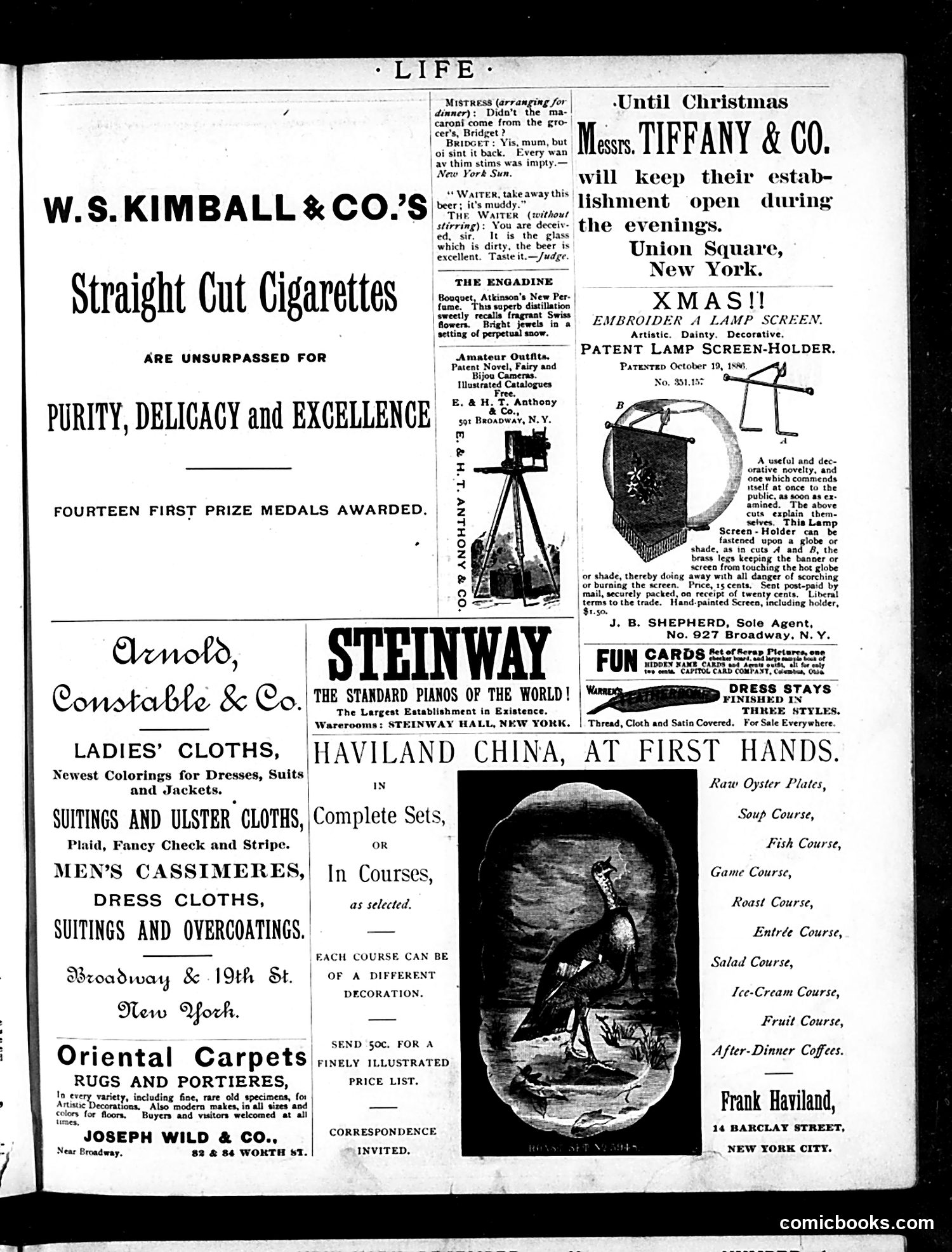
This page is primarily **advertising**, typical of 19th-century magazines. However, it contains two brief humorous anecdotes in the upper left: 1. **"Mistress" joke**: A servant (Bridget, characterized with Irish dialect) returns pasta to the grocer because each piece was empty—a play on the hollow nature of pasta tubes. 2. **"Waiter" joke**: A customer complains beer is muddy; the waiter insists the problem is the dirty glass, not the beer—a clever reversal blaming the customer's perception rather than the product. Both jokes employ working-class characters and domestic/service scenarios typical of *Life*'s humor. The surrounding advertisements (cigarettes, pianos, china, clothing) target wealthy consumers, contrasting sharply with the humble settings of the jokes—characteristic of the magazine's approach to satirizing class differences and social pretension in Gilded Age America.
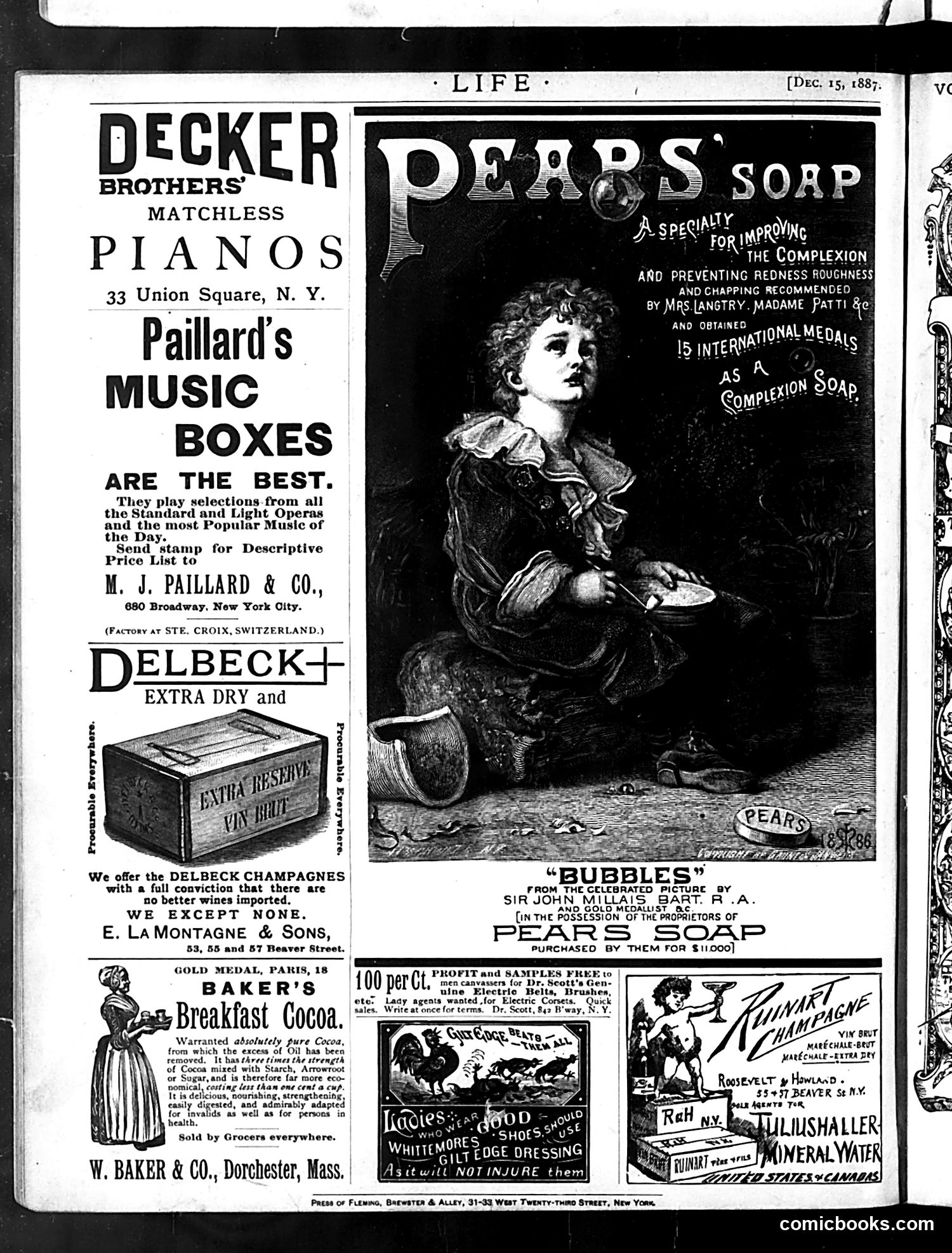
This is primarily an **advertising page**, not a political cartoon. The page features Victorian-era product advertisements for luxury and everyday goods: pianos, champagne, cocoa, soap, and patent medicines. The most notable image is **Pears' Soap's large central advertisement**, featuring a painting titled "Bubbles" by Sir John Millais (a famous Pre-Raphaelite artist). The company purchased the painting for $11,000—a significant sum at the time—to use as their brand image. The advertisement claims the soap improves complexion and was endorsed by celebrities like actress Lillie Langtry and opera singer Adelina Patti. Other ads include **Baker's Breakfast Cocoa** (emphasizing purity and strength), **Delbeck Champagne**, and **Dr. Scott's Electric Belts**—a common patent medicine of the era claiming health benefits through electricity. The page reflects late-Victorian consumer culture and the emerging practice of using celebrity endorsements and famous artwork in advertising.