
A complete issue · 16 pages · 1887
Life — March 24, 1887
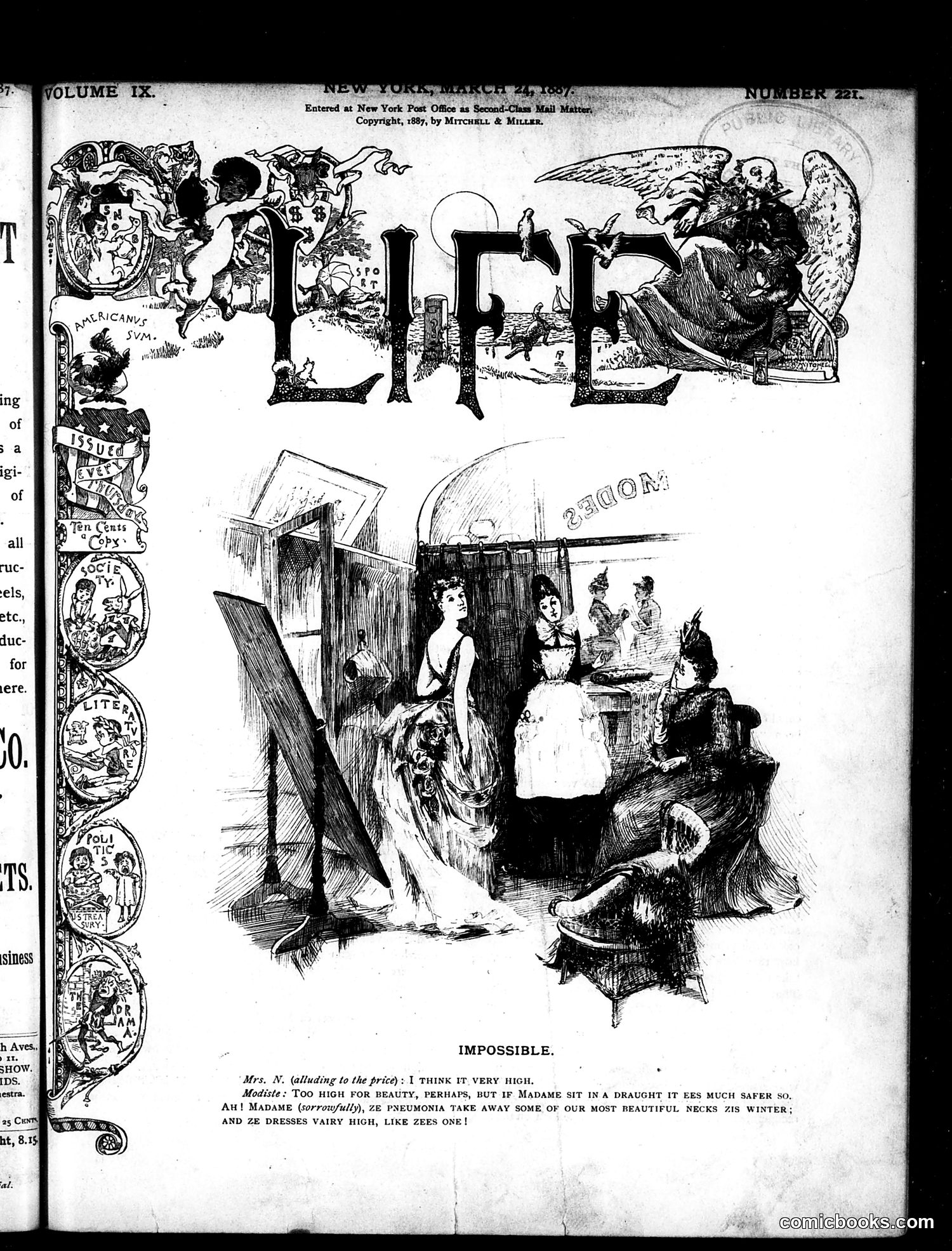
This cartoon satirizes fashion and social class through a dialogue about neckline height. Mrs. N. comments that a dress's neckline is "very high," while Modiste (a dressmaker) responds that it's actually "too high for beauty," but notes that wearing it low in a carriage is "much safer" because pneumonia steals beautiful necks in winter, and dresses vary in height "like zees one!" The humor lies in the contradiction: the fashionable high neckline is simultaneously impractical (dangerous to health) and constantly variable. The title "Impossible" suggests the absurdity of following such inconsistent fashion standards. This reflects Victorian-era anxieties about women's fashion dictates that were simultaneously rigid and changeable, while also joking about genuine health concerns from drafty carriages.
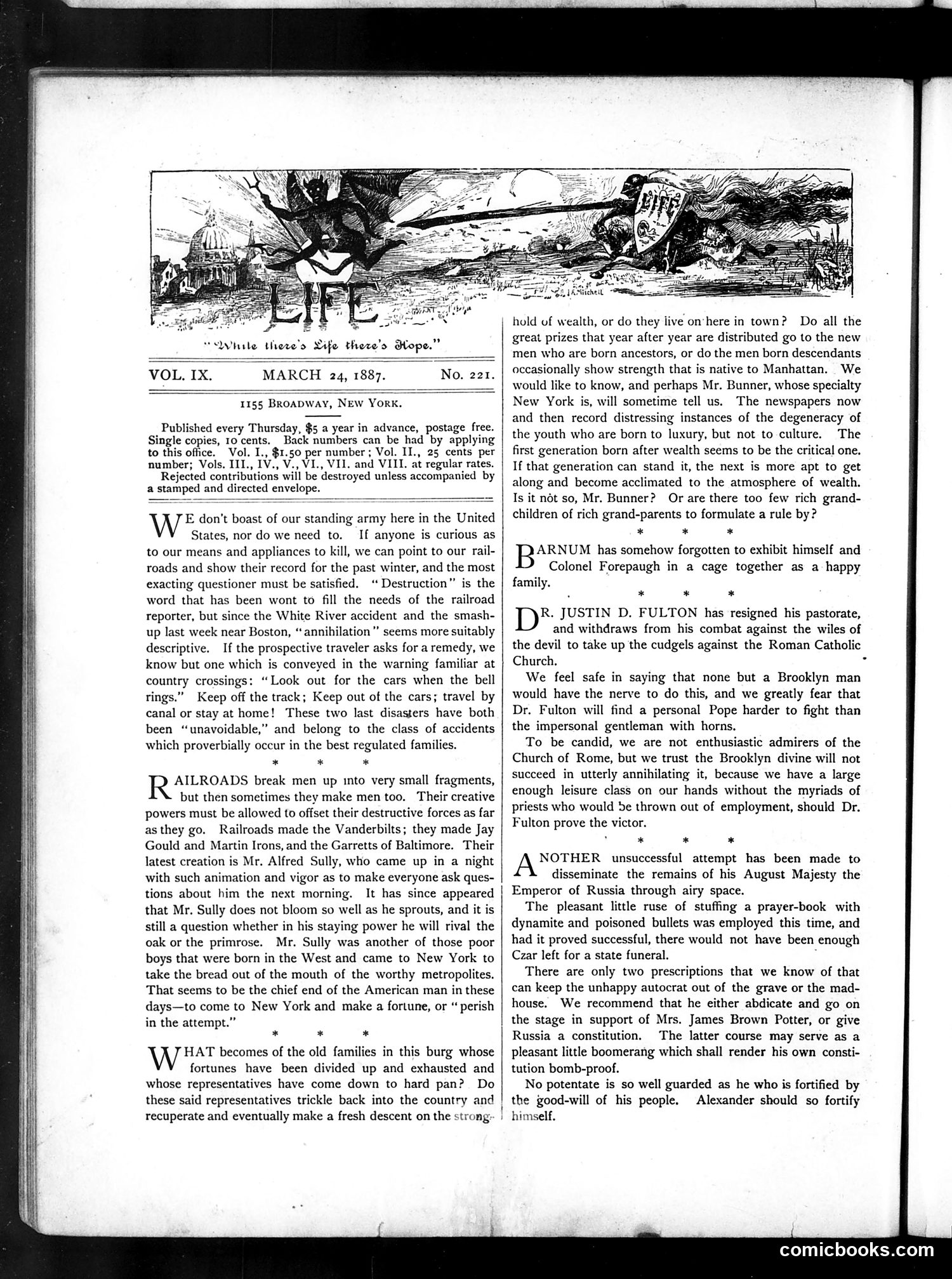
The masthead cartoon depicts **Death (labeled "LIFE")** as a skeletal figure carrying a scythe, with the caption **"While there's Life there's Hope."** This is a dark visual pun playing on the magazine's own name—*Life* magazine ironically uses Death as its personification. The editorial content addresses contemporary social concerns: wealth inequality and generational degeneration among the wealthy, railroad safety disasters, criticism of Dr. Justin Fulton's anti-Catholic activism, and an assassination attempt on the Russian Emperor using dynamite hidden in a prayer-book. The satire mocks societal anxieties about inherited wealth, industrial accidents, sectarian religious conflict, and anarchist violence—all prominent 1880s concerns. The cartoon's memento mori imagery reinforces the magazine's darkly humorous social critique.
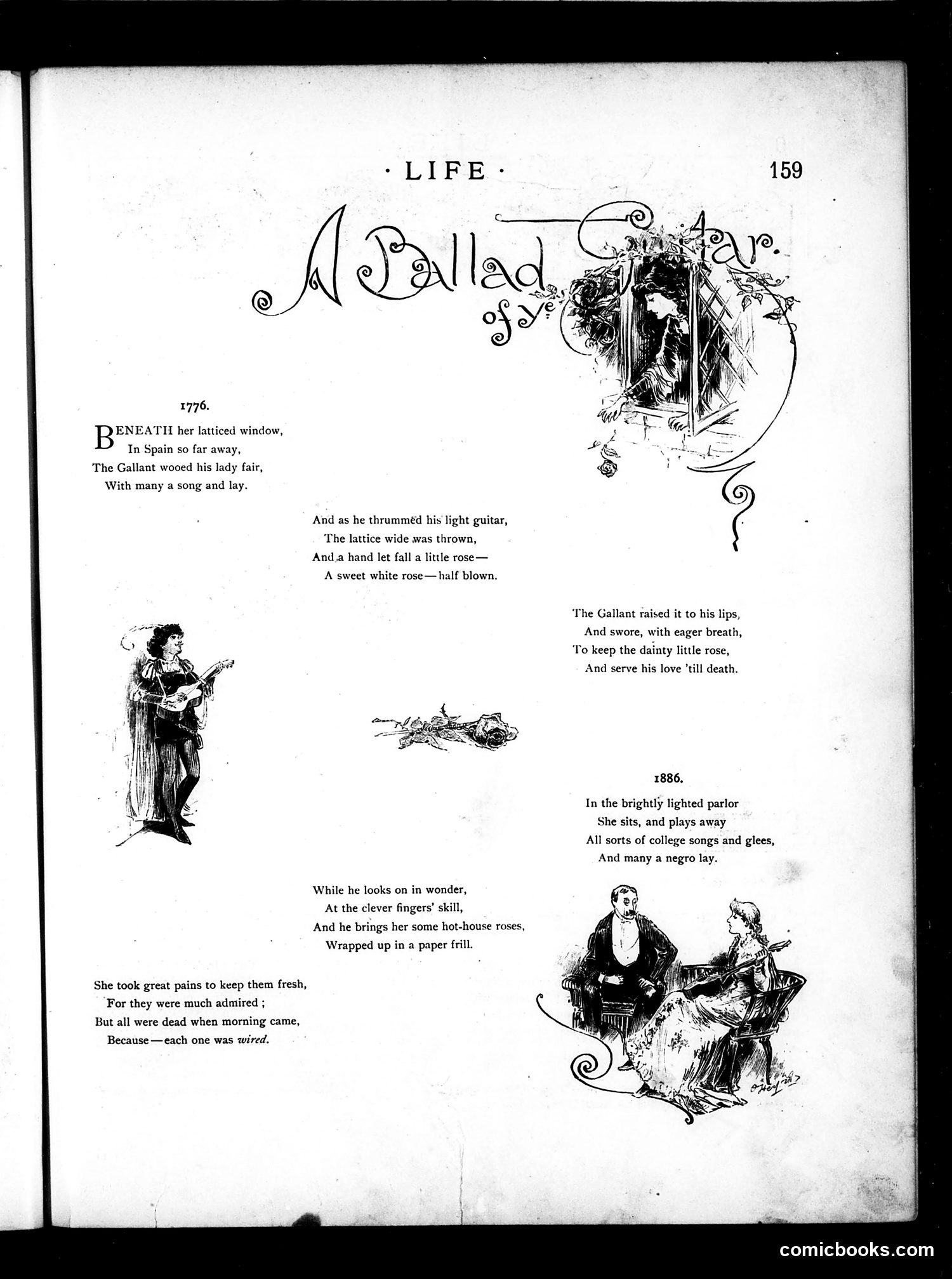
This page presents two romantic narrative poems illustrated with period engravings. The first (1776) depicts a Spanish gallant serenading a woman beneath her latticed window with guitar and roses—a classic romantic trope. The second (1886) contrasts this: a woman plays piano in a well-lit parlor while a gentleman watches, but the poem's punchline reveals the roses have wilted—"each one was wired." The satire critiques modern romance (1886) as artificial compared to historical authenticity. The "wired" roses represent manufactured sentiment replacing genuine passion. By juxtaposing the idealized 1776 scene with the disappointed 1886 version, the magazine mocks contemporary courtship as commercially packaged and inauthentic, suggesting nostalgia for supposedly more honest romantic expression.
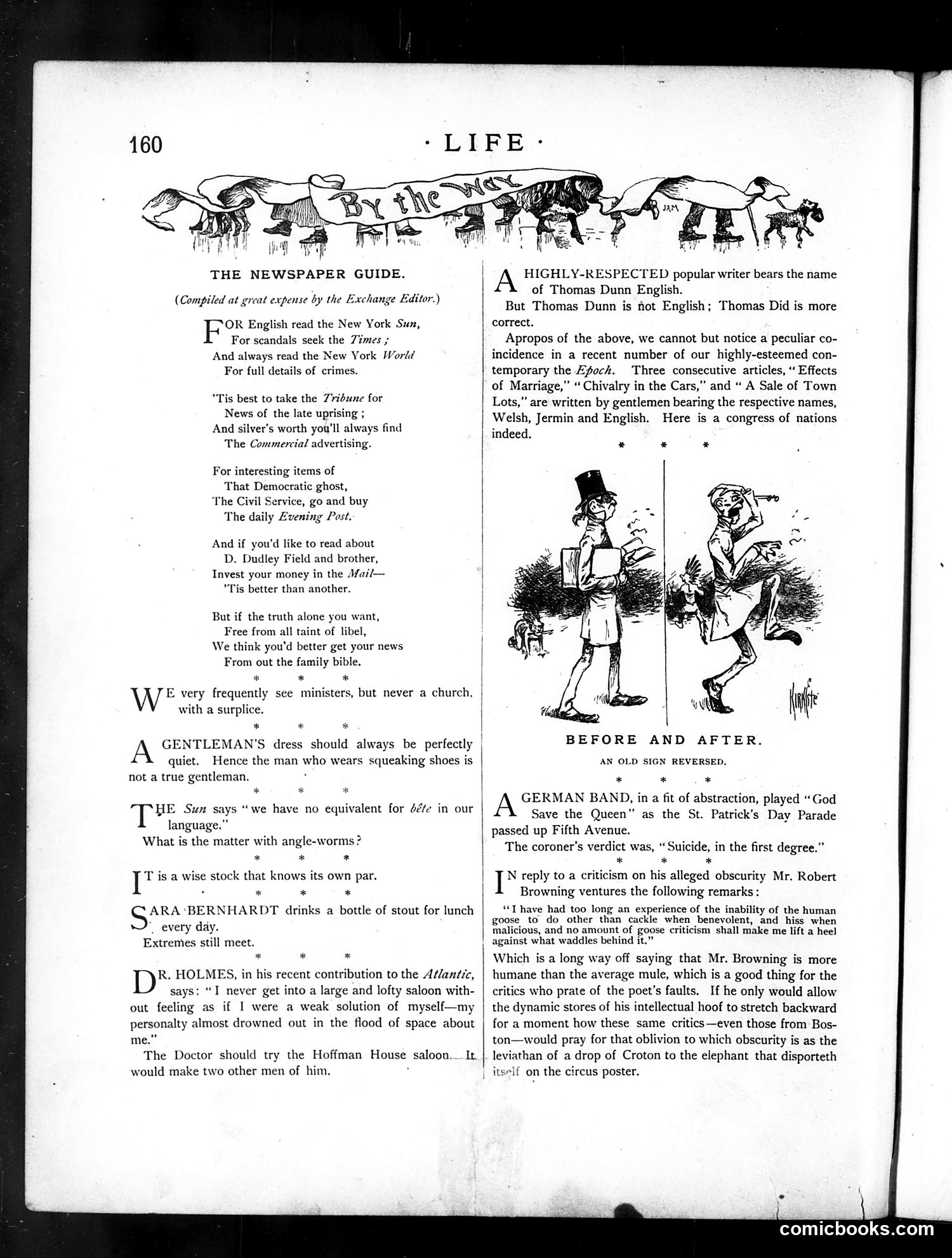
This cartoon illustrates a visual pun about reversing signage. The left figure shows a man in formal dress reading a sign normally; the right figure depicts the same man reading it upside-down or backwards. The joke plays on how reversing text or imagery creates absurdist humor—a common device in early 20th-century satirical magazines. The caption "Before and After" and "An Old Sign Reversed" suggest the humor derives from the physical act of flipping or inverting a sign, changing its meaning. Without identifying the specific sign referenced, the cartoon exploits the visual comedy of mistaken or inverted reading—a straightforward visual gag typical of *Life* magazine's humor style.
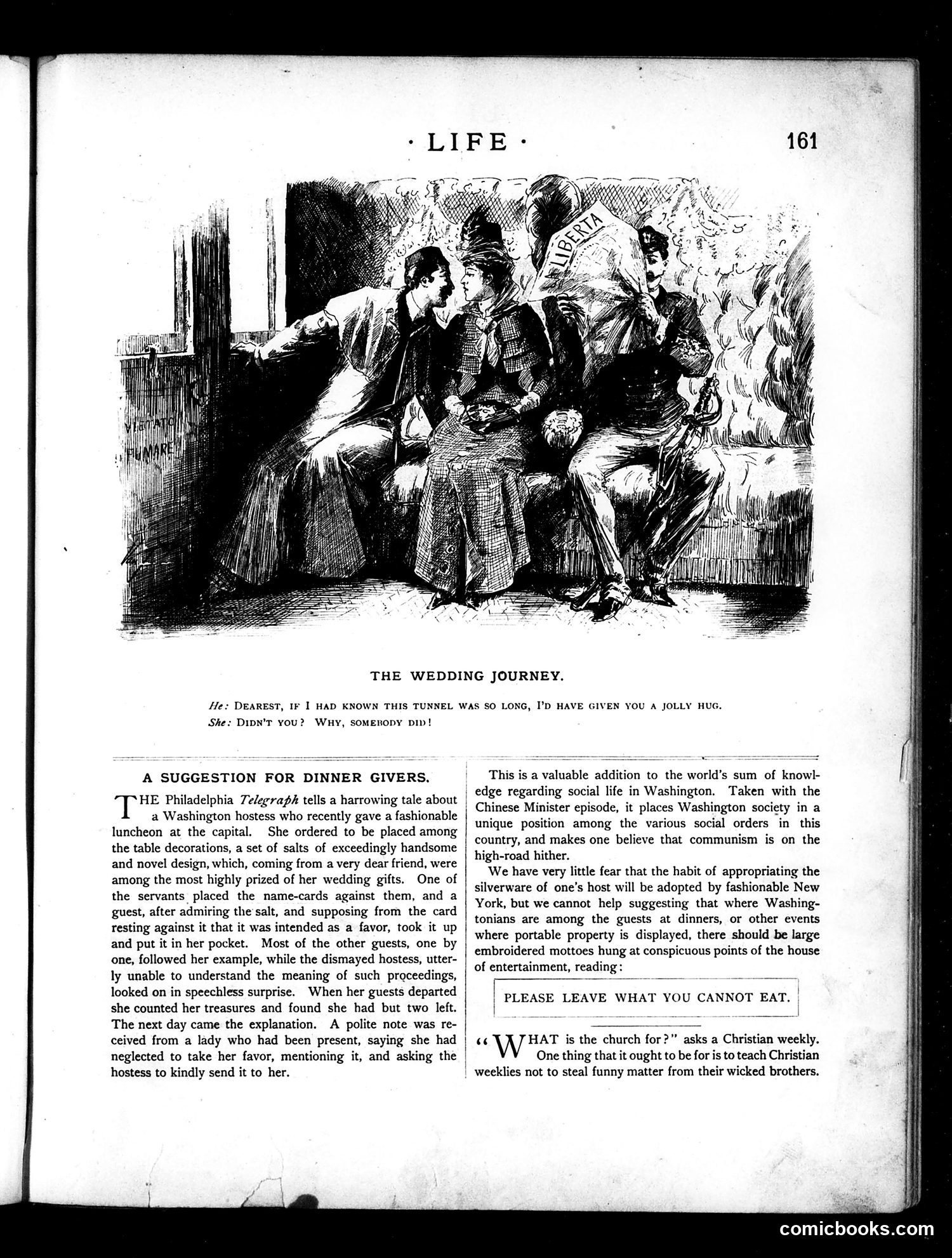
The main cartoon, "The Wedding Journey," depicts a couple on a train through a tunnel. The husband quips about giving his wife "a jolly hug" during the dark passage, while she responds skeptically. This is a classic Victorian-era joke playing on the privacy and intimacy a tunnel provides—a common subject for period humor about newlyweds. Below, "A Suggestion for Dinner Givers" satirizes Washington society's pretensions. It recounts a hostess who displayed ornate salt cellars as wedding gifts at a fashionable luncheon, only to have guests steal them. The piece mocks both the hostess's ostentatious display and the guests' lack of decorum, suggesting embroidered mottos warning against theft would be appropriate for such events.
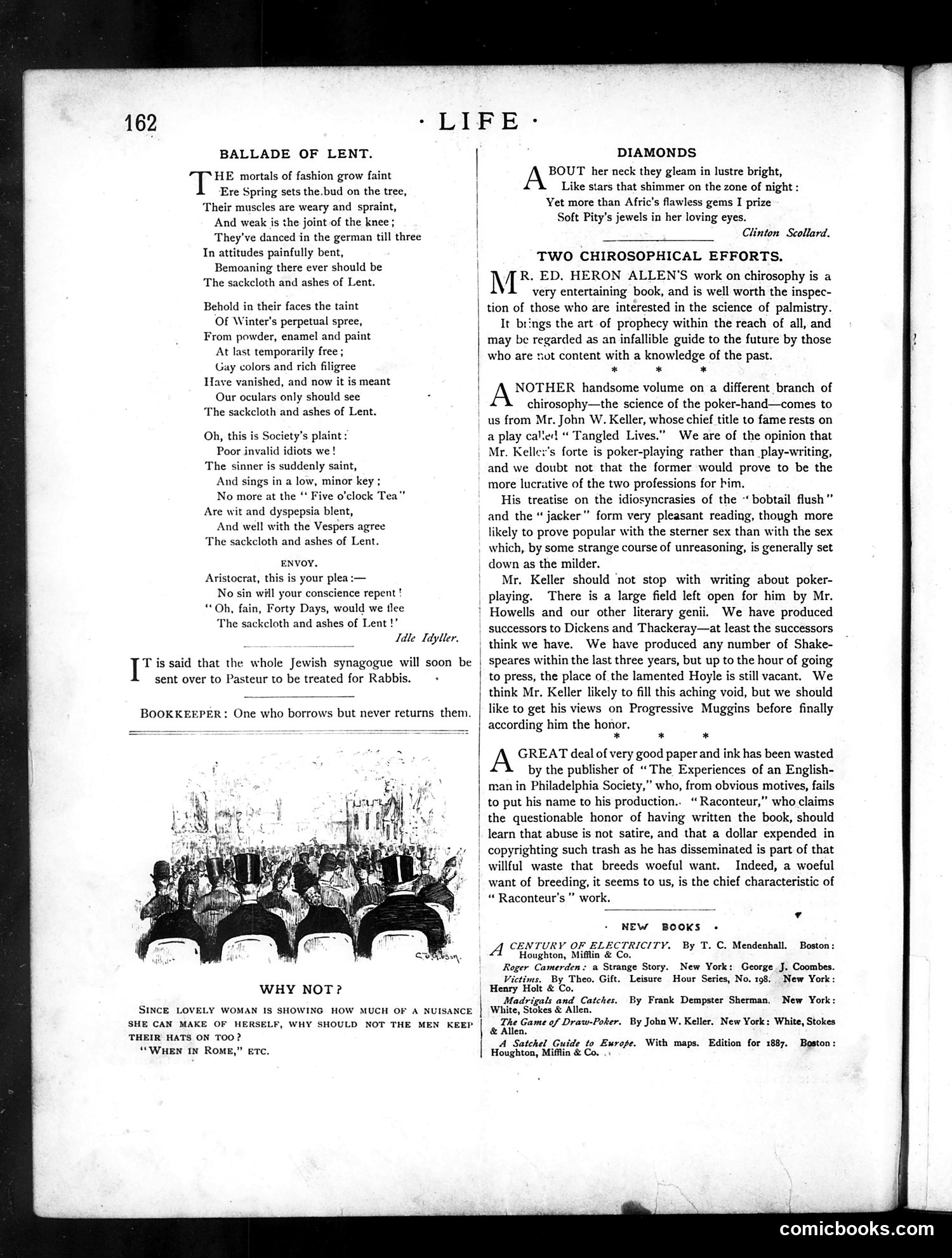
This cartoon satirizes the Victorian double standard regarding fashion and social conduct. The caption points out the hypocrisy: women are criticized for displaying "too much of a nuisance" through fashionable dress and public visibility, yet men—who "keep their hats on too"—face no such scrutiny. The reference to "When in Rome" suggests inconsistent social rules. The crowded scene depicts a public gathering where women's prominent presence draws commentary, while men's similar participation goes unremarked. The cartoon mocks the gendered expectations of propriety: women must conform to restrictive dress codes and behavioral standards, while men enjoy freedom from comparable social judgment. It's a pointed critique of Victorian era inequality in public life.
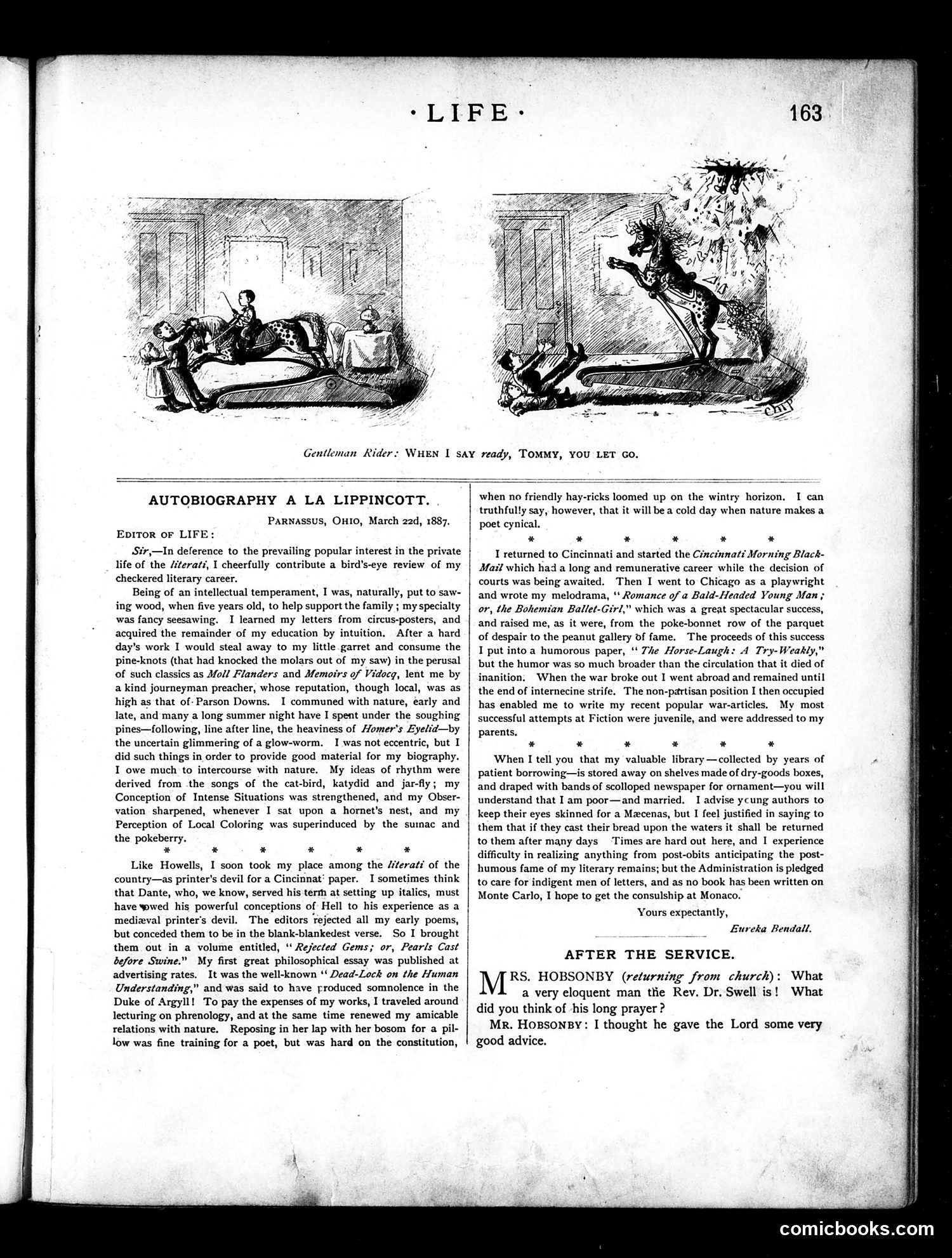
The page contains two cartoon panels labeled "Gentleman Rider: When I say ready, Tommy, you let go." **The Joke**: Both cartoons depict a man on a rearing horse about to be released by a handler named Tommy. The humor appears to rest on the absurdity of the situation—the rider is unprepared or unbalanced, making the imminent release dangerous or ridiculous. **Context**: This is a straightforward visual gag without apparent political reference. The cartoons mock either incompetent horsemanship or the false confidence of an amateur rider. The repeated setup emphasizes the comedic timing and the rider's precarious position. The remainder of the page features an autobiography submission and a brief dialogue titled "After the Service," unrelated to the cartoons.
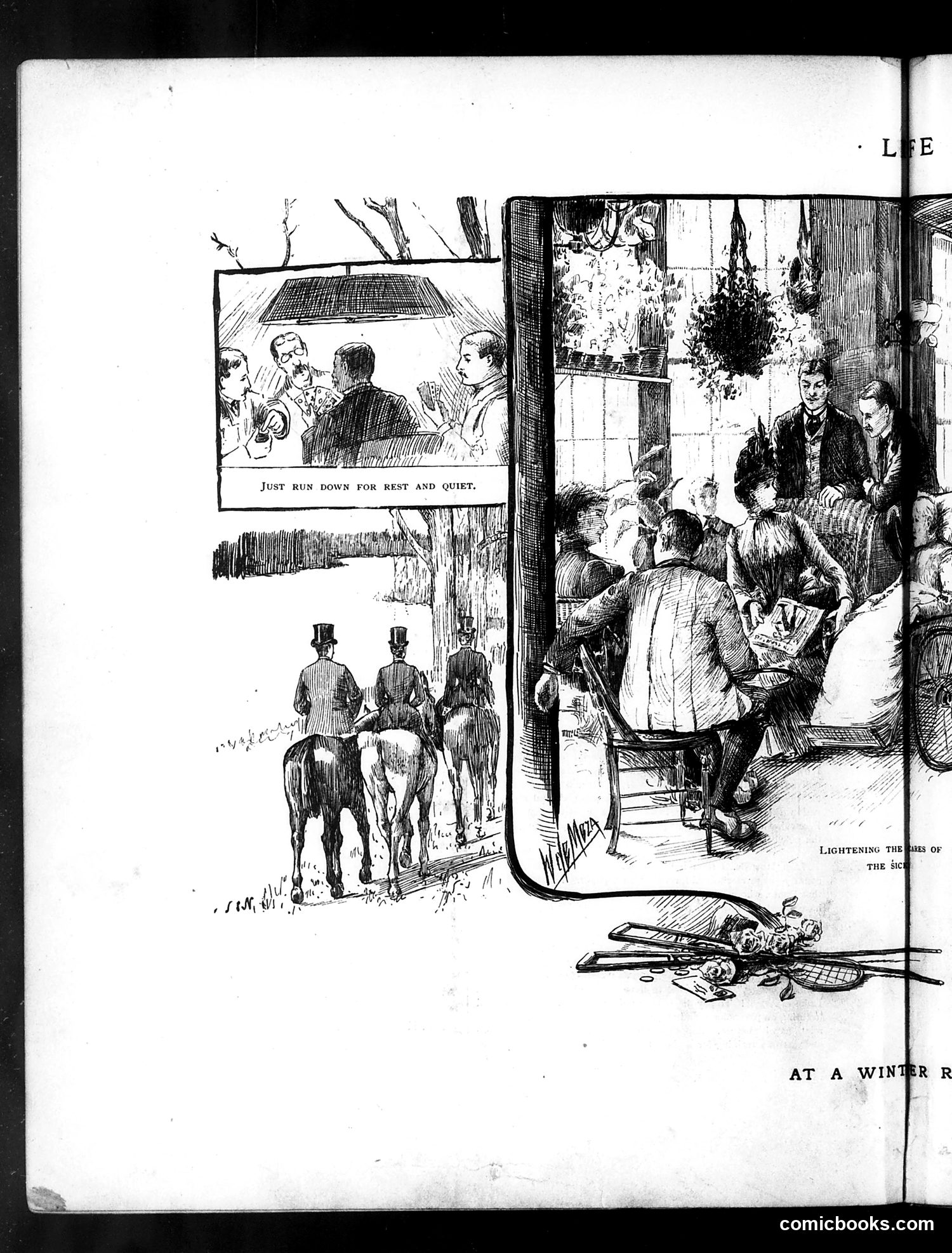
This page contains two illustrated scenes from what appears to be a Victorian-era Life magazine. The top panel, captioned "Just run down for rest and quiet," shows four men in formal dress in what seems to be an indoor setting. Below that, three men in top hats ride horses past a building. The larger right panel depicts "Lightening the Ills of the Scheme" (text partially visible), showing multiple figures gathered indoors around what appear to be sporting equipment—tennis rackets visible at bottom suggest this concerns recreational activities. The overall theme appears to satirize leisure activities and social gatherings among the wealthy class, though the specific political or social commentary remains unclear without additional context or complete caption text.
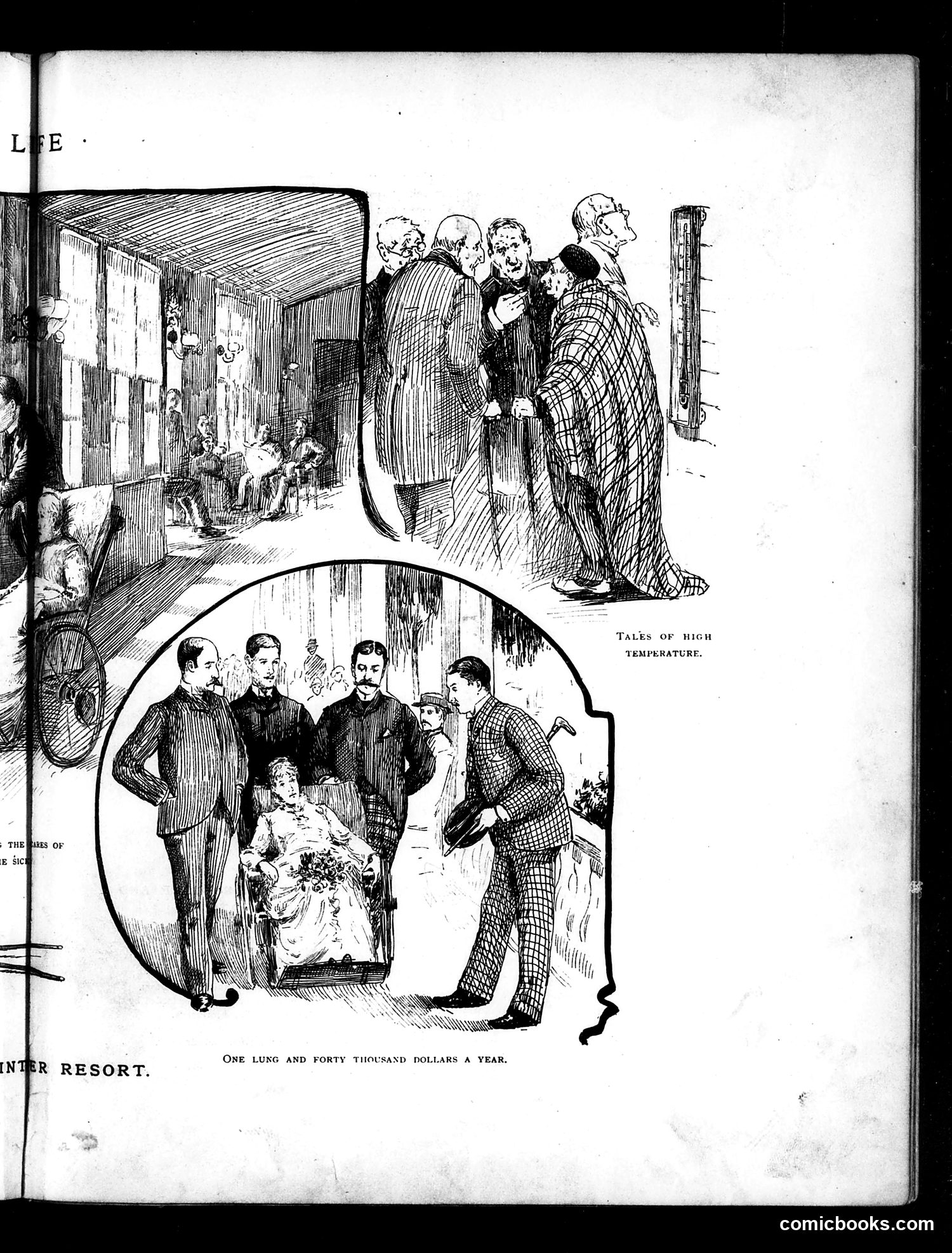
This page contains two satirical scenes titled "Tales of High Temperature" and "One Lung and Forty Thousand Dollars a Year." The cartoons appear to mock wealthy patients seeking medical treatment at a winter resort. The upper scene shows elegantly dressed men gathered outside, while the lower scene—framed within a profile of a man's head—depicts a wealthy invalid being examined by physicians. The satire targets the conspicuous consumption and vanity of the rich: patients spending enormous sums ($40,000 annually) traveling to exclusive resorts for dubious health treatments. The "high temperature" likely refers to either actual fever or metaphorically to the heated atmosphere of fashionable society seeking cure-alls. The cartoon mocks both the wealthy patients' credulity and the medical establishment's willingness to profit from their health anxieties through expensive resort treatments.
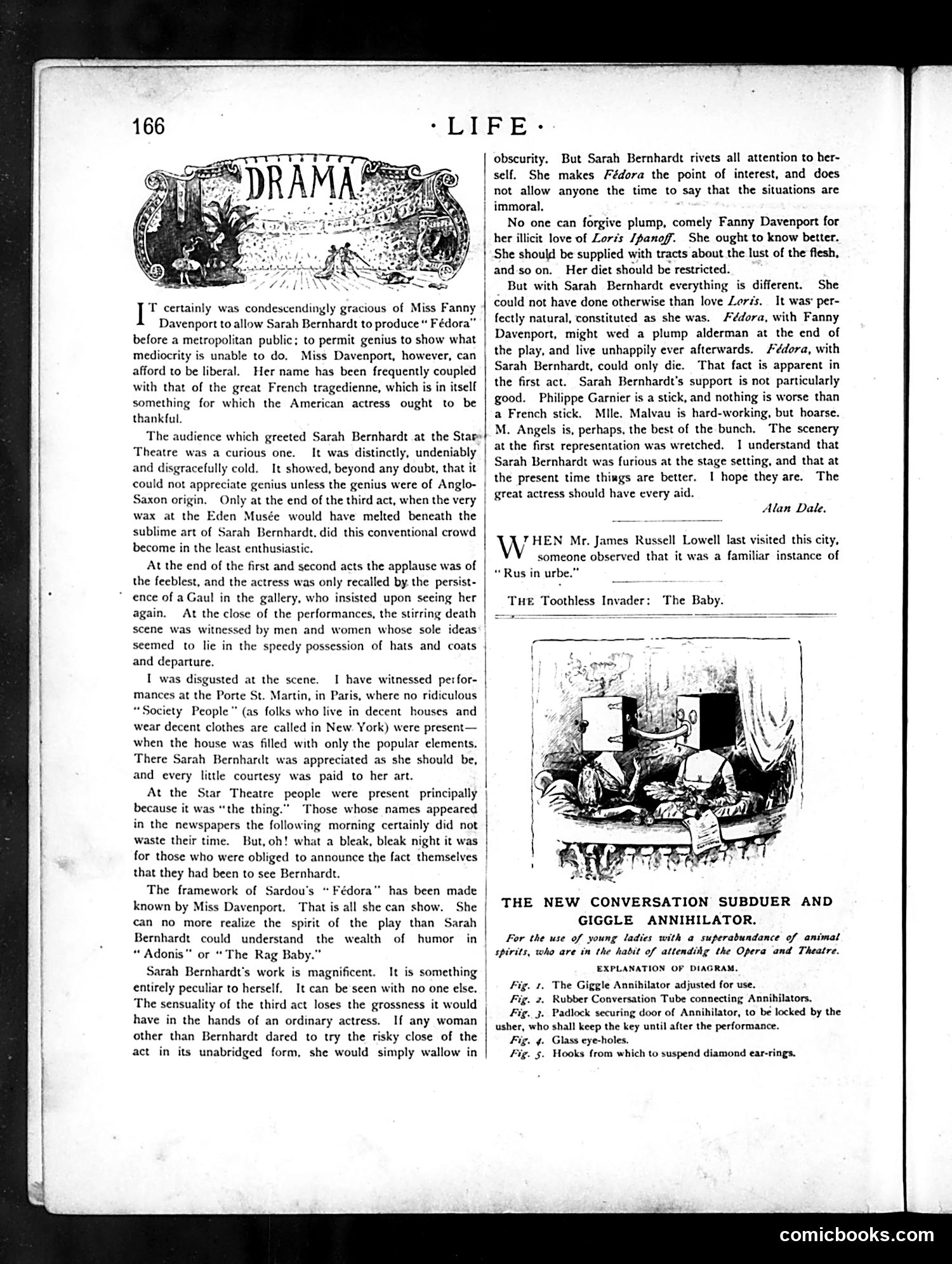
This page contains theatrical criticism of Sarah Bernhardt's performance in *Fédora* at the Star Theatre. The left column reviews her acting, praising her genius while critiquing the play itself as conventional melodrama unsuitable for her talents. The right column includes a brief anecdote about James Russell Lowell and concludes with a diagram labeled "The Toothless Invader: The Baby"—an illustration for a piece about animal-spirit ventriloquism equipment used in theatrical productions. The main content is **drama criticism, not political satire**. It represents *Life* magazine's cultural commentary function, evaluating the famous French actress's American theatrical debut and technical theatrical innovations of the era.
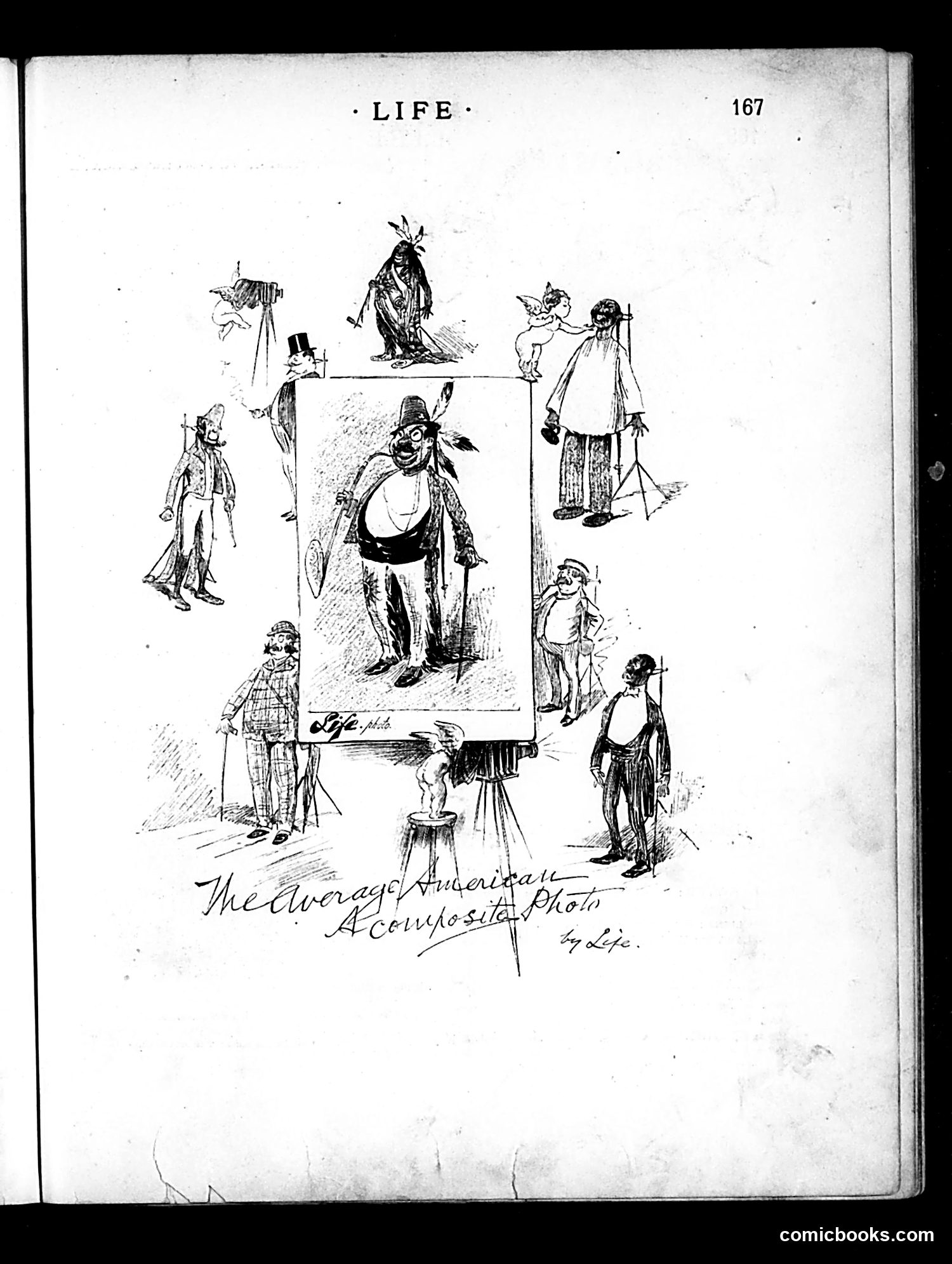
This satirical cartoon depicts a photographer displaying various character types arranged around a central figure. The title plays on "acoustic" (likely a misspelling or pun for "acousitic" or similar), suggesting this represents a composite or cross-section of "average American" society. The central enlarged figure appears to be a rotund man in formal dress, positioned as the archetypal average American. Surrounding him are various stereotypical character types—including what appears to be immigrants, workers, and social types—each rendered in exaggerated caricature style typical of early 20th-century satirical illustration. The cartoon satirizes American identity and demographic composition, using visual caricature to comment on social class, ethnicity, and what constituted "average" American society during this period. The exact satirical target remains somewhat unclear without additional historical context.
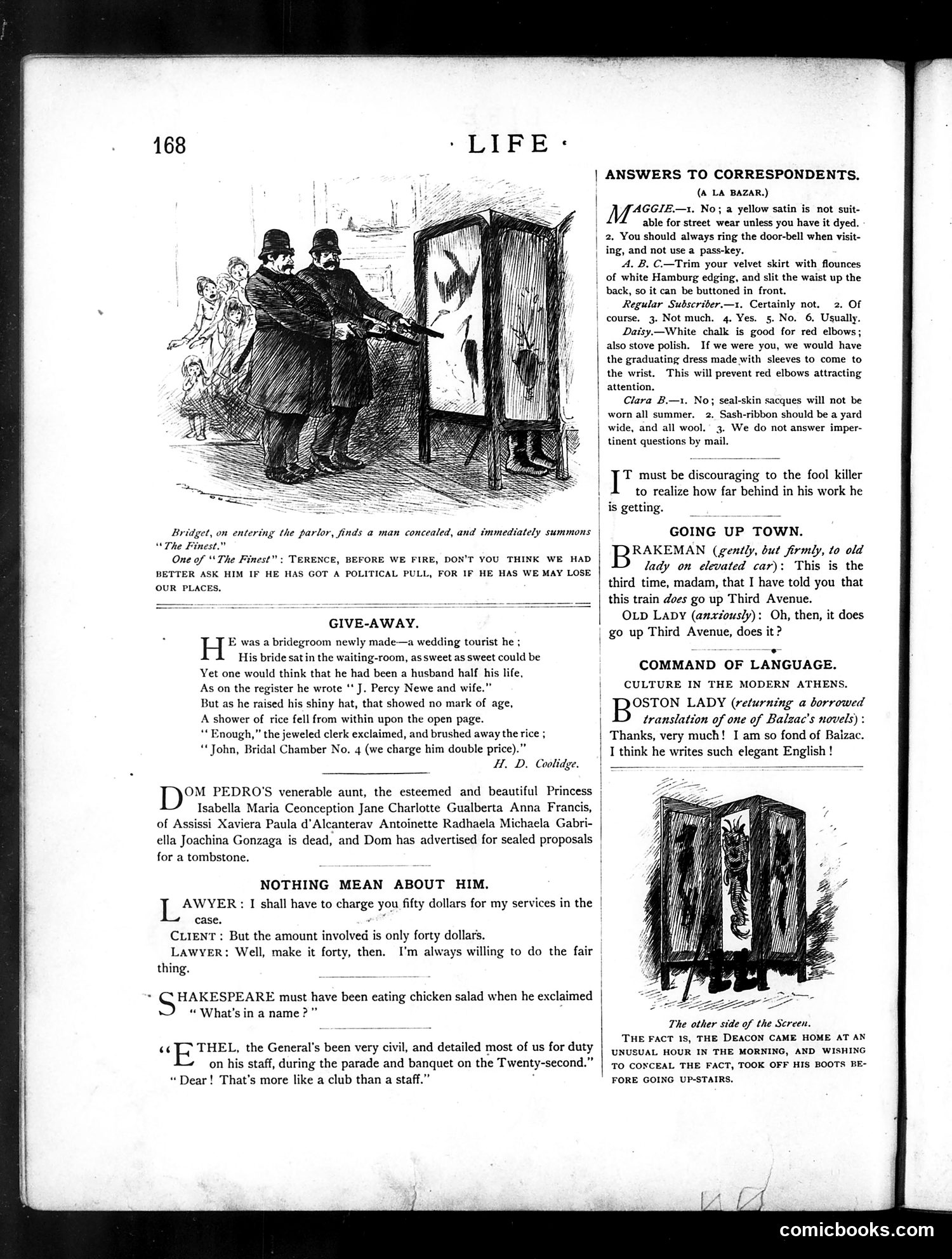
The main cartoon satirizes police corruption in American cities, likely New York. When a bridegroom's servant ("Bridget") discovers an intruder in the parlor, she summons "The Finest" (slang for police). However, the officer's first concern isn't apprehending the criminal—he asks if the suspect has "political pull" (connections), warning that arresting someone with political protection could cost the officers their jobs. This exposes how urban police forces were compromised by patronage systems, where political connections trumped law enforcement. The surrounding content includes humorous shorts mocking lawyers' greed, misspelled hotel registers, and pretentious Bostonians. Together, these pieces reflect late-19th-century American anxieties about urban corruption, class absurdities, and institutional dishonesty.
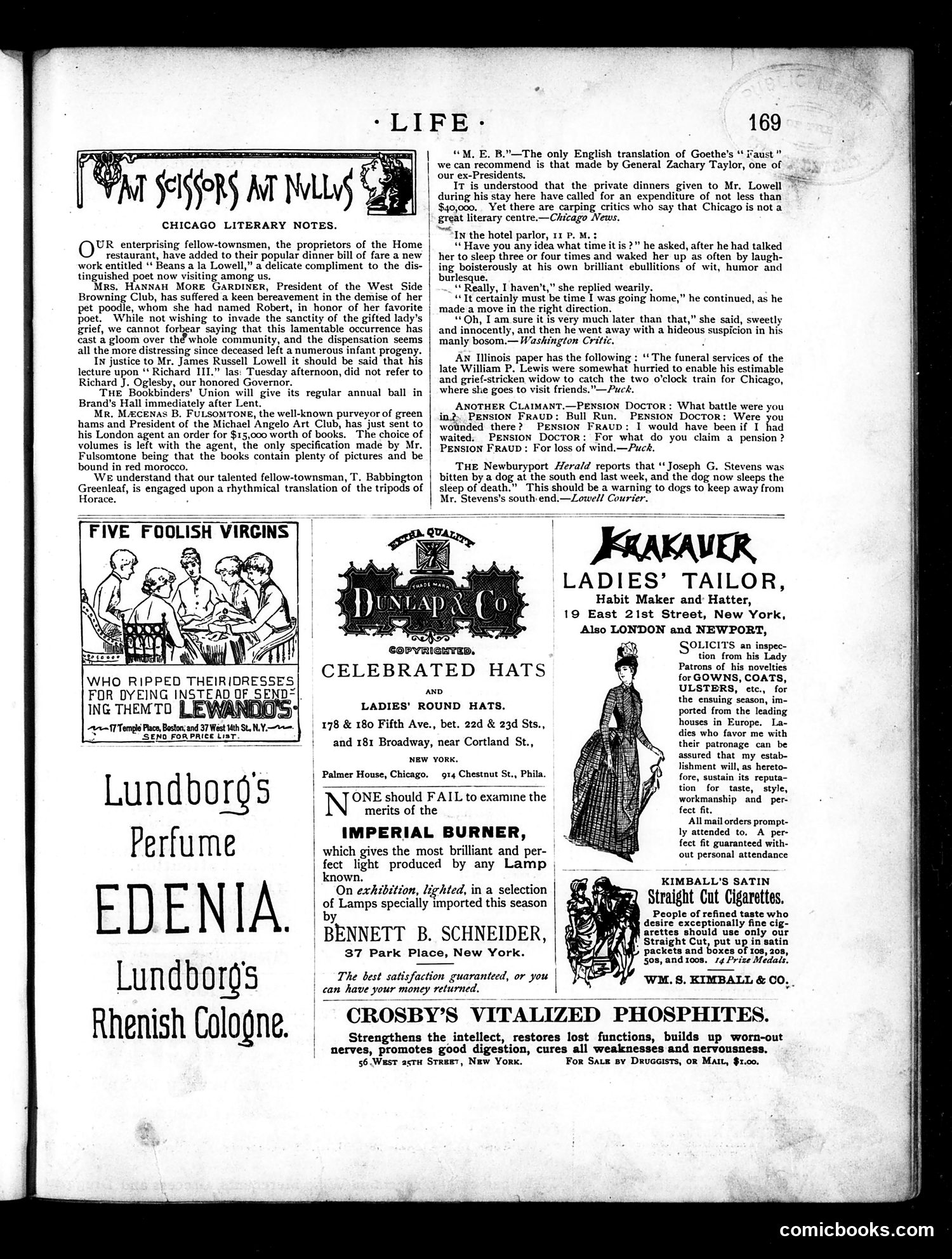
This page from *Life* magazine contains satirical Chicago literary notes mocking the city's cultural pretensions. The main joke targets James Russell Lowell's visit: a restaurant names a bean dish "Beans à la Lowell" to flatter the poet, while the text sarcastically notes Chicago spent $40,000 on his dinners yet faces "carping critics" who deny it's a literary center. The cartoon "Five Foolish Virgins" appears to reference the Biblical parable, depicting women who impulsively damaged their dresses to dye them rather than send them to professionals—illustrating foolish decision-making. Other items mock Chicago's wealthy pretenders: a collector ordering $15,000 in books specified only that they have "plenty of pictures" and red leather bindings, suggesting aesthetic superficiality over genuine literary taste. The humor targets nouveau-riche Midwesterners trying to appear cultured while revealing their actual ignorance and vanity.
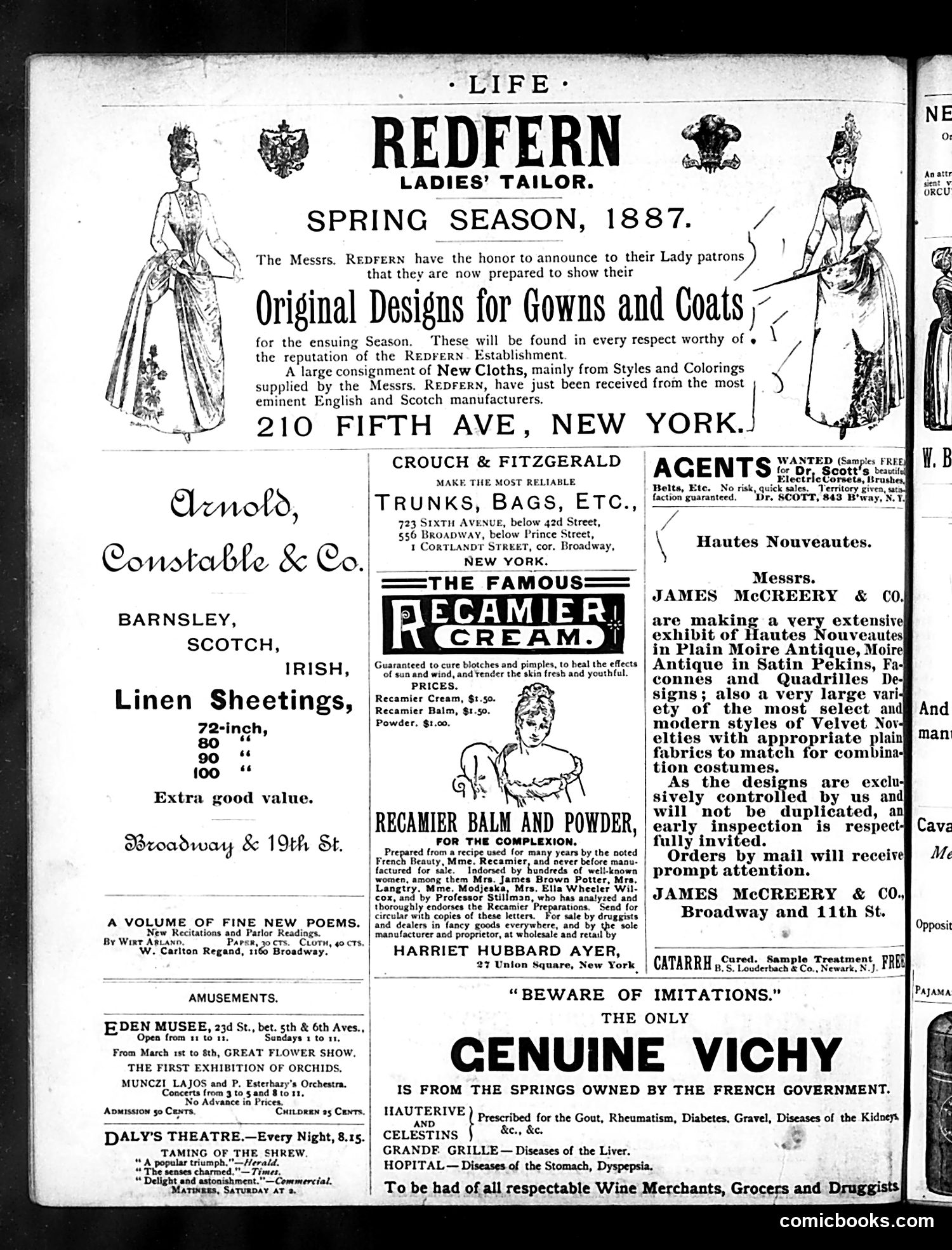
This is primarily a **commercial advertisement page**, not satirical content. It showcases luxury goods and services for affluent New York consumers in the 1880s. The page features **fashion and beauty advertisements** typical of the era: Redfern (a prestigious ladies' tailor at 210 Fifth Avenue) advertising spring gowns and coats with "original designs"; James McCreery & Co. promoting haute couture fabrics; and Recamier Balm and Powder claiming to cure blemishes and keep skin youthful—endorsed by celebrities like Lillie Langtry. Also advertised are **practical goods**: linens from Arnold, Constable & Co.; trunks and bags; and Vichy mineral water, marketed as medicinal for gout, rheumatism, and digestive ailments—a common patent medicine claim of the period. The page includes **entertainment notices** for Eden Musee, orchid exhibitions, and Daly's Theatre production of *Taming of the Shrew*. There is **no discernible political satire or cartoon** on this page—it's a straightforward commercial compilation reflecting 1880s consumer culture and advertising practices.
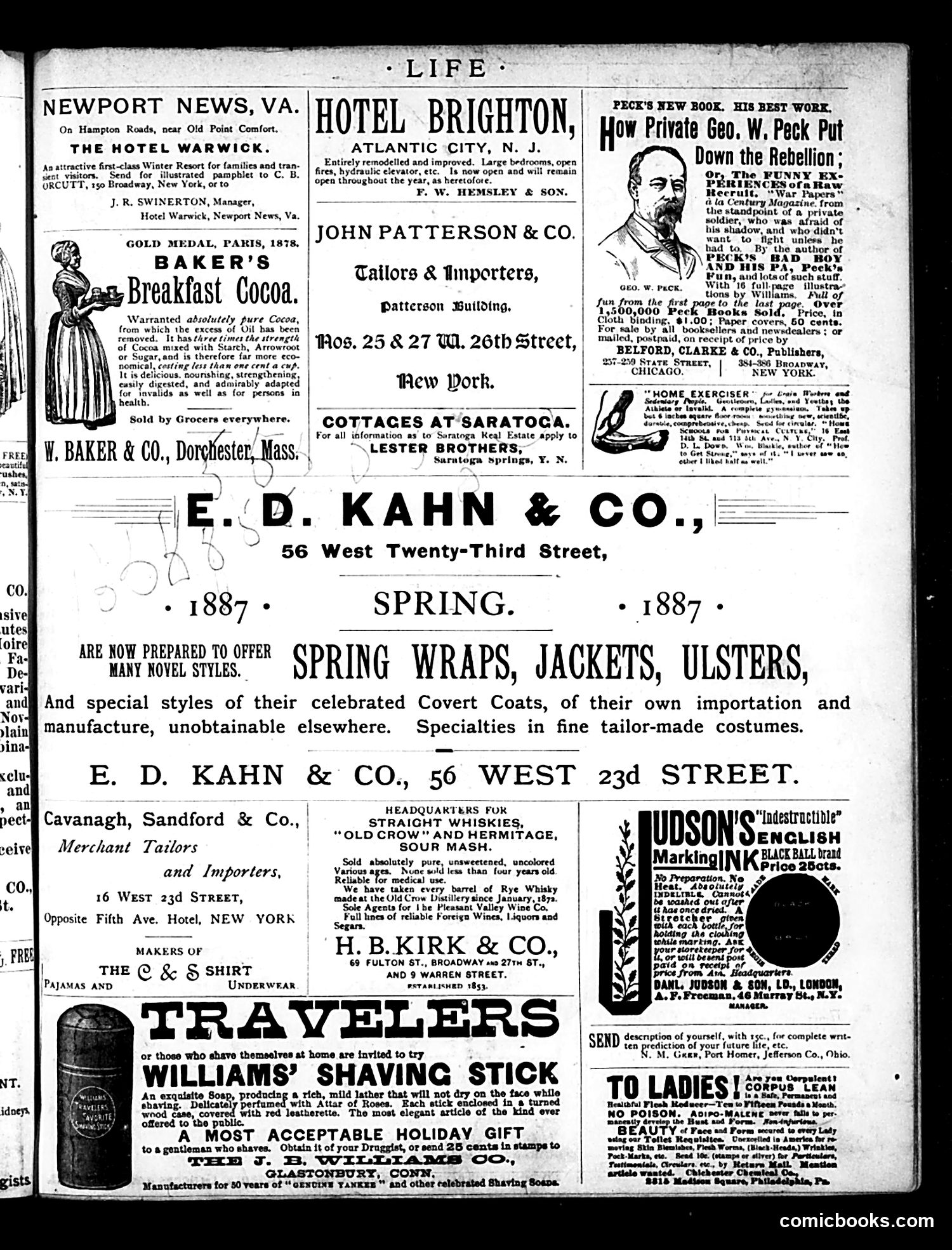
This page is primarily **advertising**, not political satire or comics. However, there is one illustrated element: a portrait of **George W. Peck** promoting his book "How Private Geo. W. Peck Put Down the Rebellion." **The content**: Peck's advertisement promotes a humorous Civil War memoir written from a private soldier's perspective—specifically someone "afraid of his shadow" who didn't want to fight. This is satirical commentary on war itself: the book humorously subverts heroic war narratives by centering a reluctant, fearful recruit rather than a brave soldier. The remaining page contains hotel advertisements, product endorsements (cocoa, whiskey, tailoring services, shaving products), and merchant listings—typical of 1887 Life magazine's revenue model. Nothing overtly political appears, though Peck's war book suggests post-Civil War American audiences enjoyed irreverent humor about the conflict.
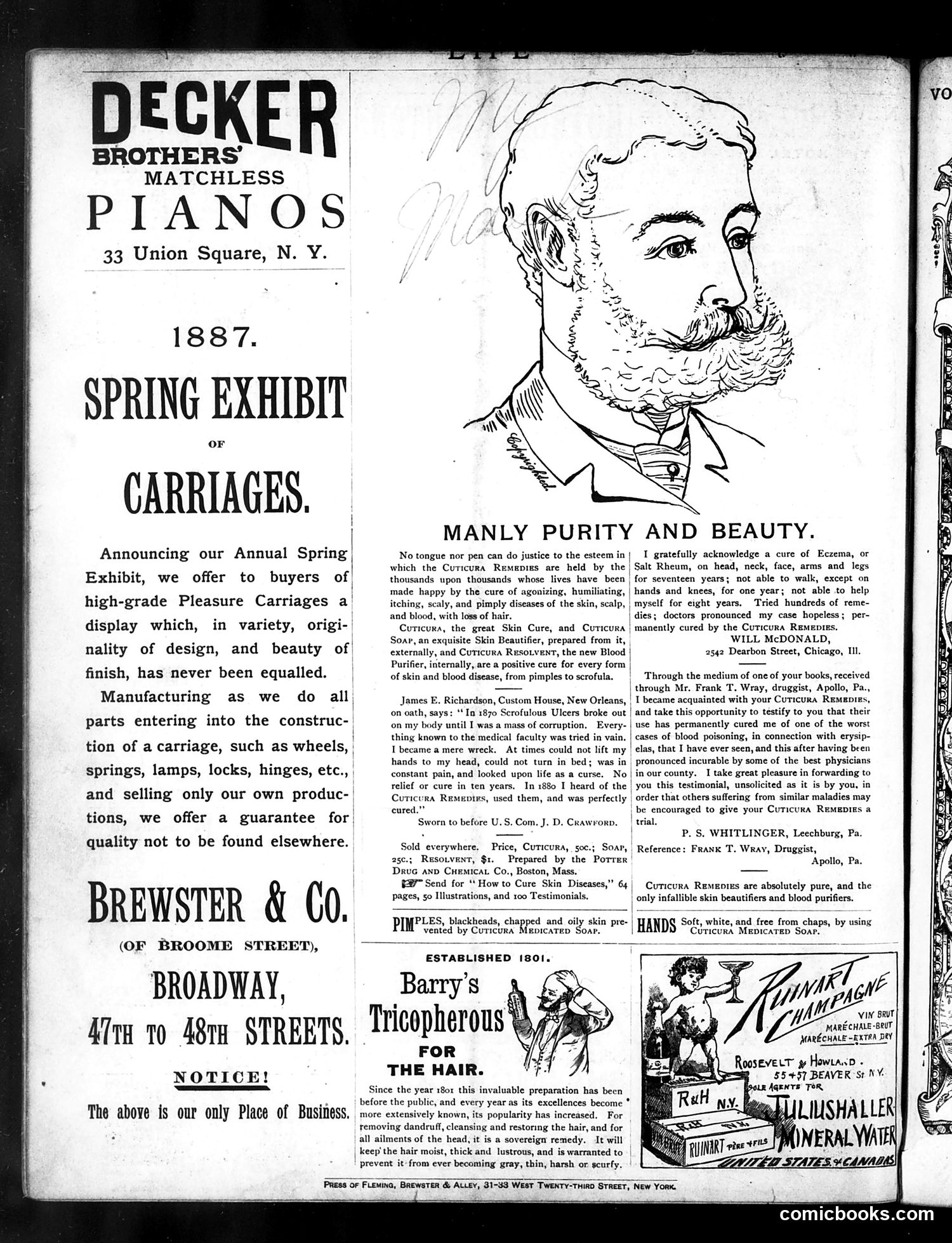
This page is primarily **advertising**, not satirical content or political commentary. The main elements are: 1. **Decker Brothers Pianos** advertisement (top left) 2. **Brewster & Co. Carriages** announcement for their spring exhibit (left side) — a luxury carriage manufacturer located on Broadway 3. **Cuticura Remedies** advertisements (center and right) — a patent medicine for skin diseases, featuring testimonials from satisfied customers claiming cures for eczema, salt rheum, scrofula, and blood poisoning 4. **Barry's Tricopherous** hair product advertisement (bottom) 5. Minor advertisements for **Kummel Champagne** and **Mineral Water** The portrait labeled "Manly Purity and Beauty" appears to be associated with the Cuticura advertisement, promoting the product's benefits. This represents typical 1887 magazine advertising: luxury goods (pianos, carriages) mixed with patent medicines making expansive health claims, now recognized as fraudulent but then presented as legitimate.