
Life, 1887-03-24 · page 2 of 16
Life — March 24, 1887 — page 2: what you’re looking at
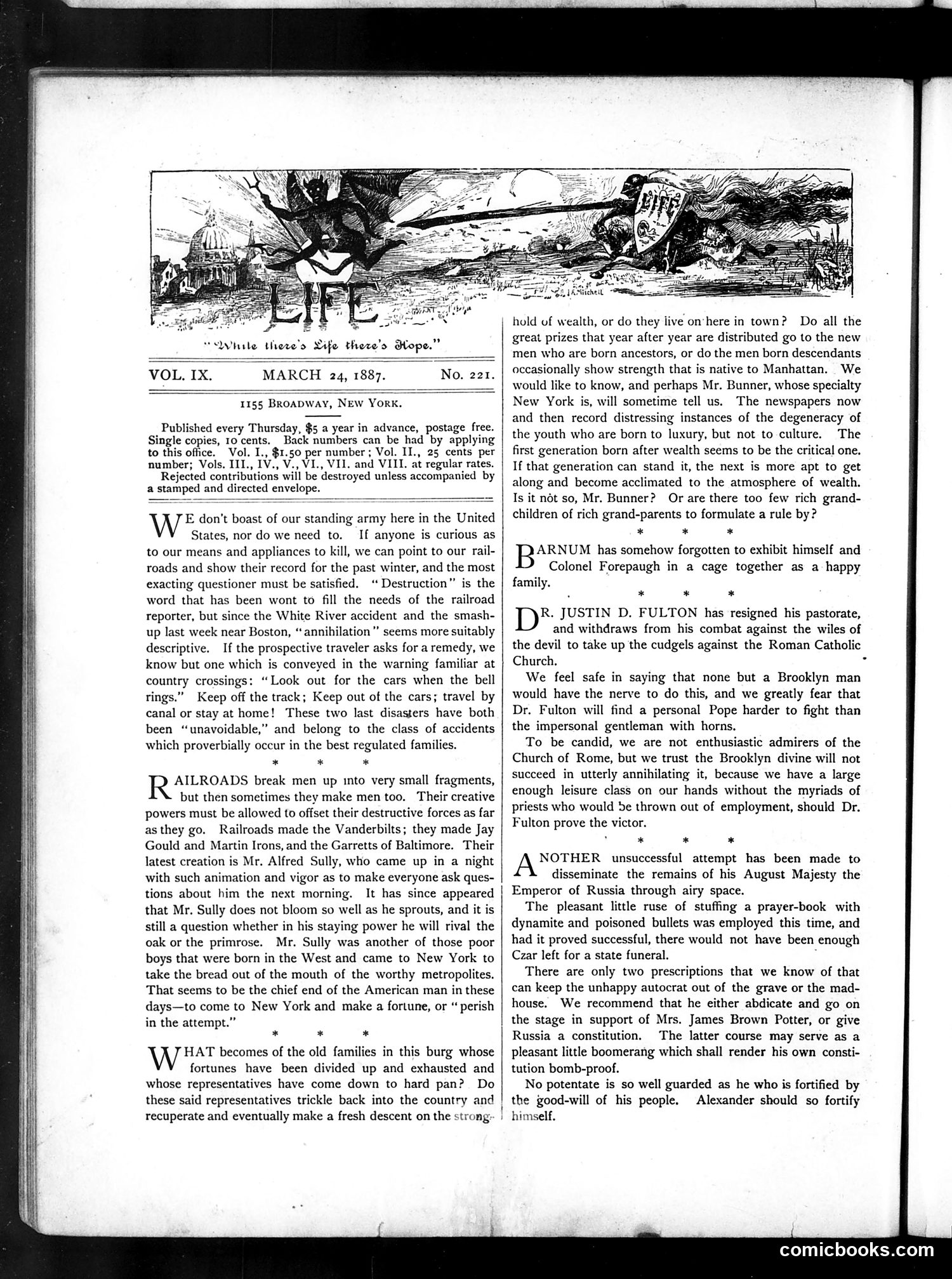
What you’re looking at
The masthead cartoon depicts **Death (labeled "LIFE")** as a skeletal figure carrying a scythe, with the caption **"While there's Life there's Hope."** This is a dark visual pun playing on the magazine's own name—*Life* magazine ironically uses Death as its personification. The editorial content addresses contemporary social concerns: wealth inequality and generational degeneration among the wealthy, railroad safety disasters, criticism of Dr. Justin Fulton's anti-Catholic activism, and an assassination attempt on the Russian Emperor using dynamite hidden in a prayer-book. The satire mocks societal anxieties about inherited wealth, industrial accidents, sectarian religious conflict, and anarchist violence—all prominent 1880s concerns. The cartoon's memento mori imagery reinforces the magazine's darkly humorous social critique.
📄 Transcribed text from this page (OCR, searchable)
Machine-transcribed from the original scan — historical spelling and the odd misread are preserved.
eas = au “While there's Life theze’s Hope.” No. 221. VOL. Ix. : MARCH 24, 1887. 1155 BRoapWay, NEW York. Published every Thursday, $5 a year in advance, postage free. Single copies, ro'cents. Back numbers can be had by applying to this office.’ Vol. I., $1.50 per number ; Vol. II., 25 cents per number; Vols. III, IV., V., VI., VI. and VIII. at regular rates. Rejected contributions will be destroyed unless accompanied by a stamped and directed envelope. E don't boast of our standing army here in the United States, nor do we need to. If anyone is curious as to our means and appliances to kill, we can point to our rail- roads and show their record for the past winter, and the most exacting questioner must be satisfied. “ Destruction” is the word that has been wont to fill the needs of the railroad reporter, but since the White River accident and the smash- up last week near Boston, “annihilation” seems more suitably descriptive. If the prospective traveler asks for a remedy, we know but one which is conveyed in the warning familiar at country crossings: “Look out for the cars when the bell rings.” Keep off the track; Keep out of the cars; travel by canal or stay at home! These two last disasters have both been “unavoidable,” and belong to the class of accidents which proverbially occur in the best regulated families. * * * AILROADS break men up into very small fragments, but then sometimes they make men too. Their creative powers must be allowed to offset their destructive forces as far as they go. Railroads made the Vanderbilts; they made Jay Gould and Martin Irons, and the Garretts of Baltimore. Their latest creation is Mr. Alfred Sully, who came up in a night with such animation and vigor as to make everyone ask ques- tions about him the next morning. It has since appeared that Mr. Sully does not bloom so well as he sprouts, and it is still a question whether in his staying power he will rival the oak or the primrose. Mr. Sully was another of those poor boys that were born in the West and came to New York to take the bread out of the mouth of the worthy metropolites. That seems to be the chief end of the American man in these days—to come to New York and make a fortune, or “ perish in the attempt.” * * HAT becomes of the old families in this burg whose fortunes have been divided up and exhausted and whose representatives have come down to hard pan? Do these said representatives trickle back into the country and | ) himself. recuperate and eventually make a fresh descent on the strong: hold of wealth, or do they live on’here in town? Do all the great prizes that year after year are distributed go to the new men who are born ancestors, or do the men born descendants occasionally show strength that is native to Manhattan. We would like to know, and perhaps Mr. Bunner, whose specialty New York is, will sometime tell us. The newspapers now and then record distressing instances of the degeneracy of the youth who are born to luxury, but not to culture. The first generation born after wealth seems to be the critical one. If that generation can stand it, the next is more apt to get along and become acclimated to the atmosphere of wealth. Is it ndt so, Mr. Bunner? Or are there too few rich grand- children of rich grand-parents to formulate a rule by? * * * ARNUM has somehow forgotten to exhibit himself and Colonel Forepaugh in a cage together as a happy family. . * * * R. JUSTIN D. FULTON has resigned his pastorate, and withdraws from his combat against the wiles of the devil to take up the cudgels against the Roman Catholic Church, We feel safe in saying that none but a Brooklyn man would have the nerve to do this, and we greatly fear that Dr. Fulton will find a personal Pope harder to fight than the impersonal gentleman with horns. To be candid, we are not enthusiastic admirers of the Church of Rome, but we trust the Brooklyn divine will not succeed in utterly annihilating it, because we have a large enough leisure class on our hands without the myriads of priests who would de thrown out of employment, should Dr. Fulton prove the victor. * * * NOTHER unsuccessful attempt has been made to disseminate the remains of his August Majesty the Emperor of Russia through airy space. The pleasant little ruse of stuffing a prayer-book with dynamite and poisoned bullets was employed this time, and had it proved successful, there would not have been enough Czar left for a state funeral. There are only two prescriptions that we know of that can keep the unhappy autocrat out of the grave or the mad- house. We recommend that he either abdicate and go on the stage in support of Mrs. James Brown Potter, or give Russia a constitution. The latter course may serve as a pleasant little boomerang which shall render his own consti- tution bomb-proof. No potentate is so well guarded as he who is fortified by the good-will of his people. Alexander should so fortify comicbooks.com