
A complete issue · 16 pages · 1887
Life — February 10, 1887
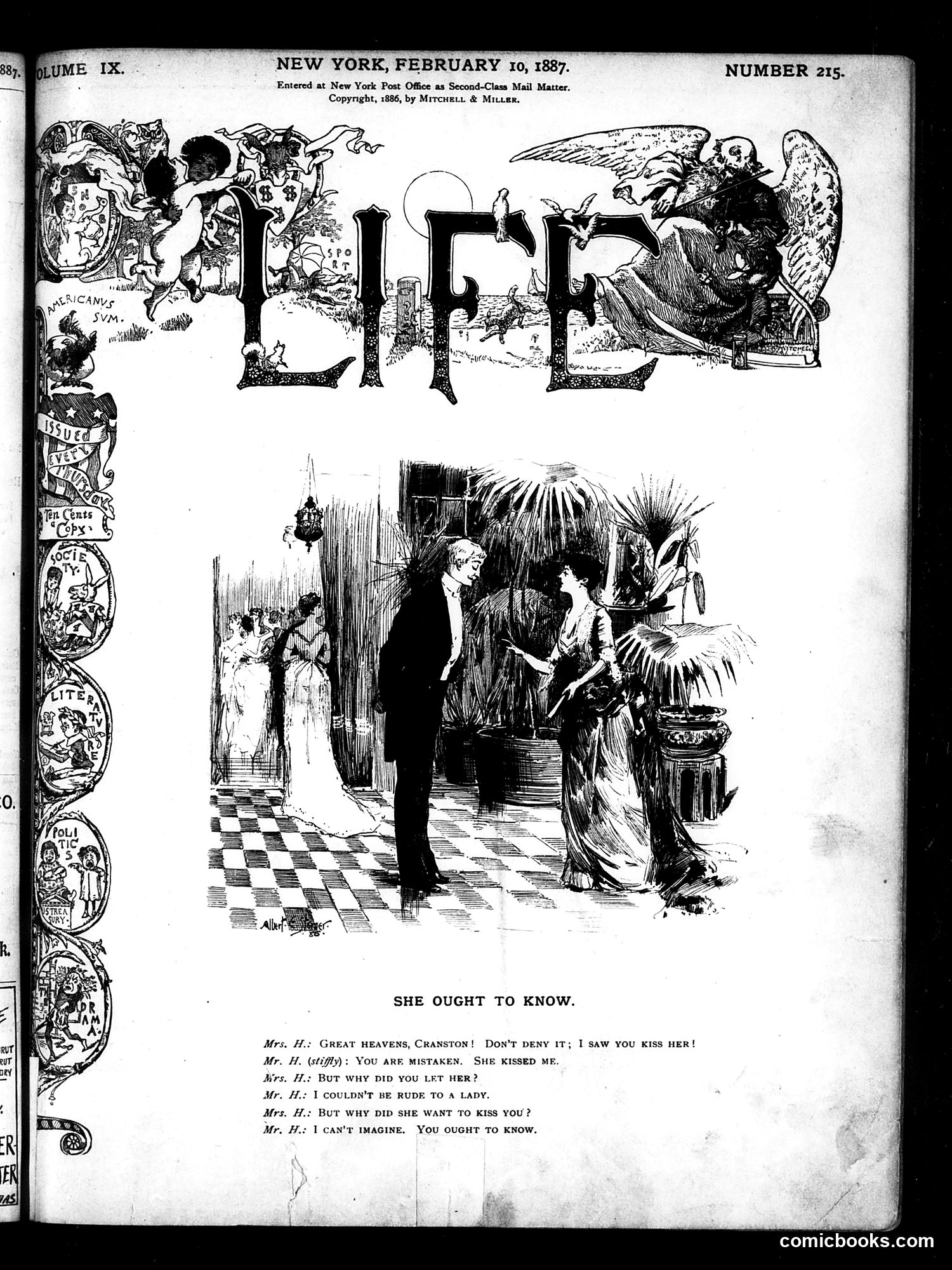
This is a Victorian-era domestic comedy sketch. A gentleman has been caught kissing a woman by his wife (Mrs. H.), who confronts him indignantly. When questioned why he allowed the kiss, the man claims he "couldn't be rude to a lady." Mrs. H. then pointedly asks why the other woman wanted to kiss him—implying the real question is about *her* motives and behavior, not his passivity. The humor relies on late-19th-century gender dynamics: the assumption that men are passive in romantic encounters while women are the active pursuers. The title "She Ought to Know" suggests the wife understands female nature better than her husband does. It's gentle satire of marital relations and the social hypocrisy surrounding propriety and attraction.
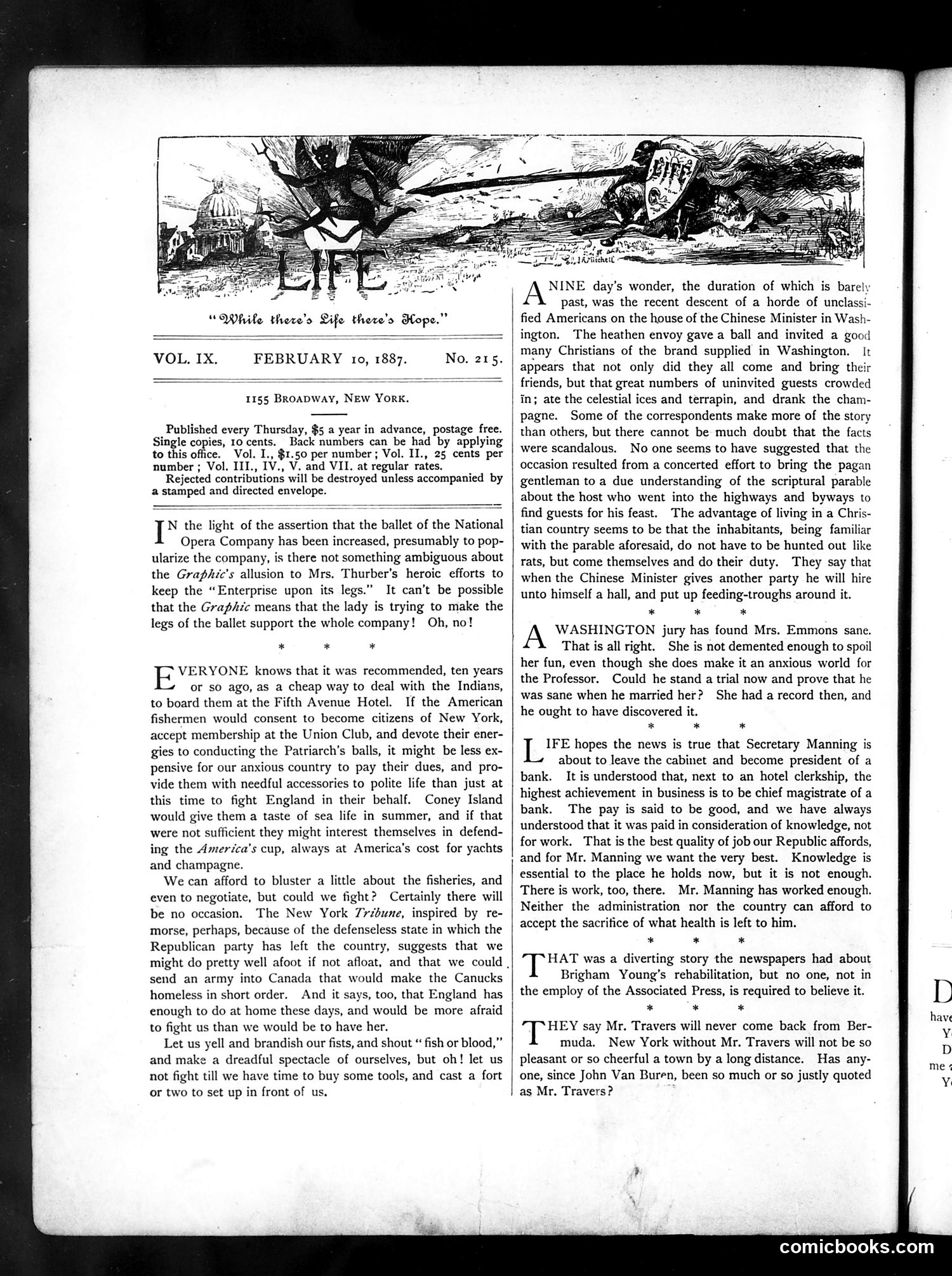
**The Cartoon:** The header illustration shows a skeletal figure labeled "LIFE" saying "While there's Life there's Hope." The grim reaper imagery suggests dark commentary on mortality or social decline. **The Text Content:** The page contains satirical commentary on contemporary issues: 1. **National Opera Company**: Criticism of efforts to popularize opera by increasing the ballet budget, suggesting the company relies on spectacle rather than artistic merit. 2. **Chinese Minister's Ball**: A scandal where uninvited guests crashed a diplomatic reception in Washington, ate lavishly, and behaved scandalously. The satire questions whether the host should have anticipated such behavior. 3. **Secretary Manning**: Discussion of a potential cabinet resignation and shift to banking, debating whether knowledge alone qualifies someone for such positions. The magazine critiques social pretension, diplomatic etiquette failures, and government personnel decisions.
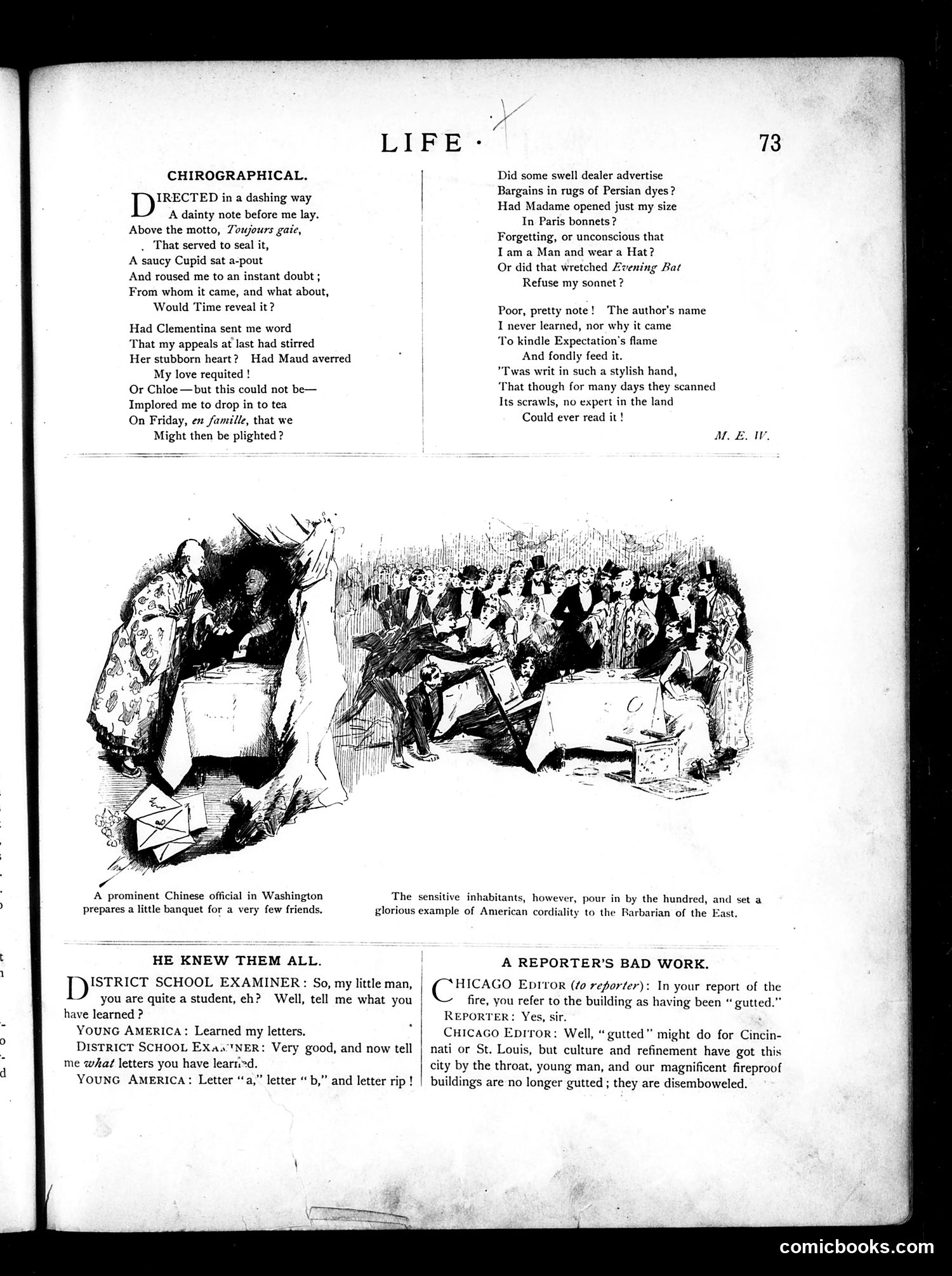
This page contains three distinct humor pieces: 1. **"Chirographical"**: A poem mocking a woman who received an anonymous love note. The joke hinges on her uncertainty about the sender's identity and the note's illegibility. 2. **Two illustrations** (top): The left shows a Chinese official's small dinner party in Washington; the right depicts what appears to be a larger American social gathering. The caption emphasizes American "cordiality to the Barbarians of the East"—likely satirizing American pretensions toward diplomatic sophistication when hosting foreign dignitaries. 3. **"He Knew Them All"** and **"A Reporter's Bad Work"**: Brief comedic dialogues—one about a student's education, another about a Chicago fire report using the term "gutted." The page reflects turn-of-century American social satire and cultural attitudes toward foreigners.
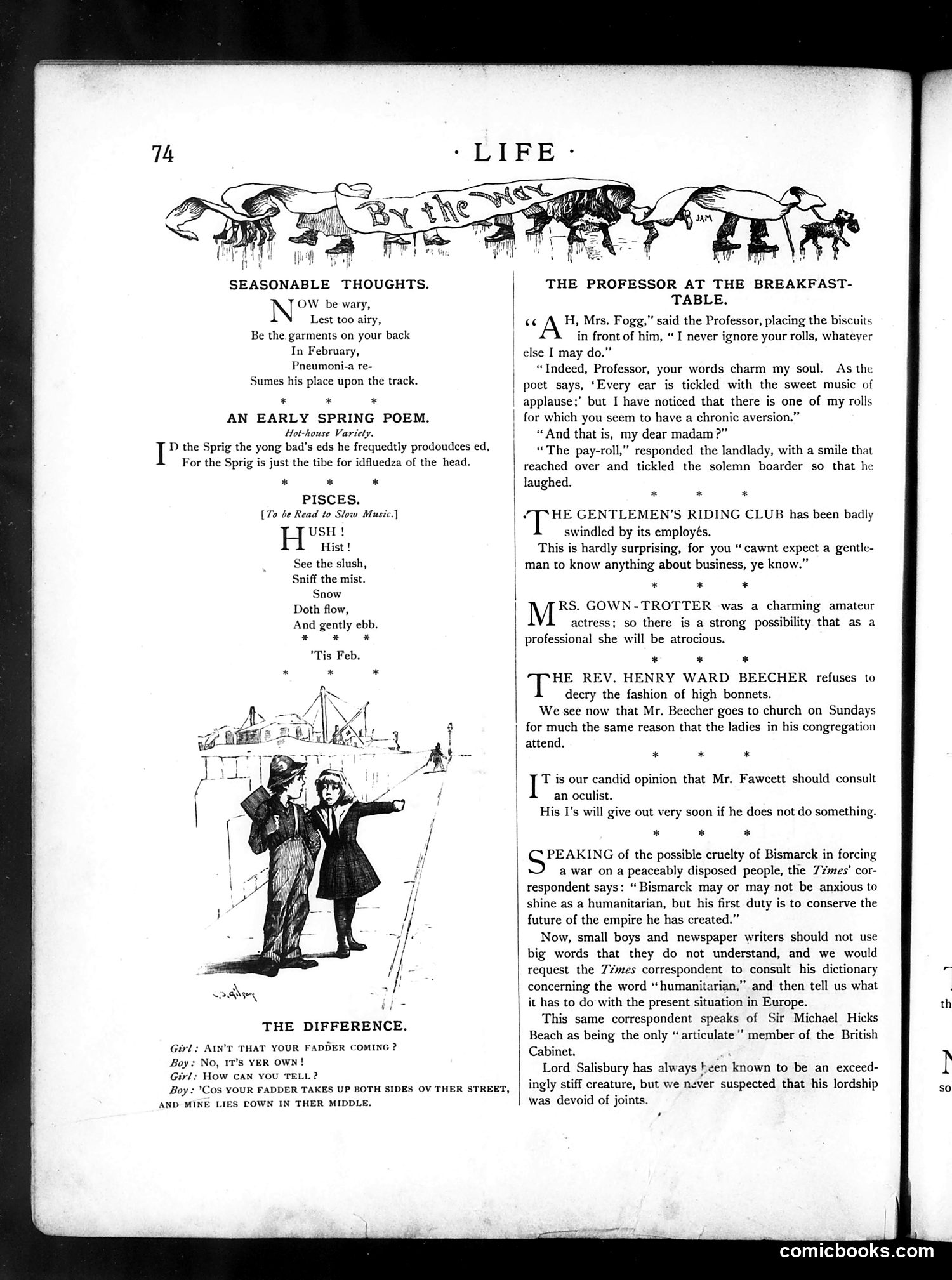
This page from *Life* magazine contains several satirical pieces about contemporary society: **"The Professor at the Breakfast-Table"** mocks academic pretension through dialogue about a professor's aversion to certain bread rolls—likely satirizing overly refined or affected behavior among intellectuals. **"The Gentlemen's Riding Club"** jokes that the club's employees are swindling it, with the ironic note that gentlemen naturally know nothing about business matters. **"The Difference"** is a brief comic dialogue contrasting how city dwellers (who navigate streets on both sides) differ from rural folk (with cows in the middle). The scattered aphorisms mock seasonal affectations and high-brow pretension. The page primarily satirizes middle and upper-class social conventions and intellectual vanity rather than addressing specific political events or identifiable figures.
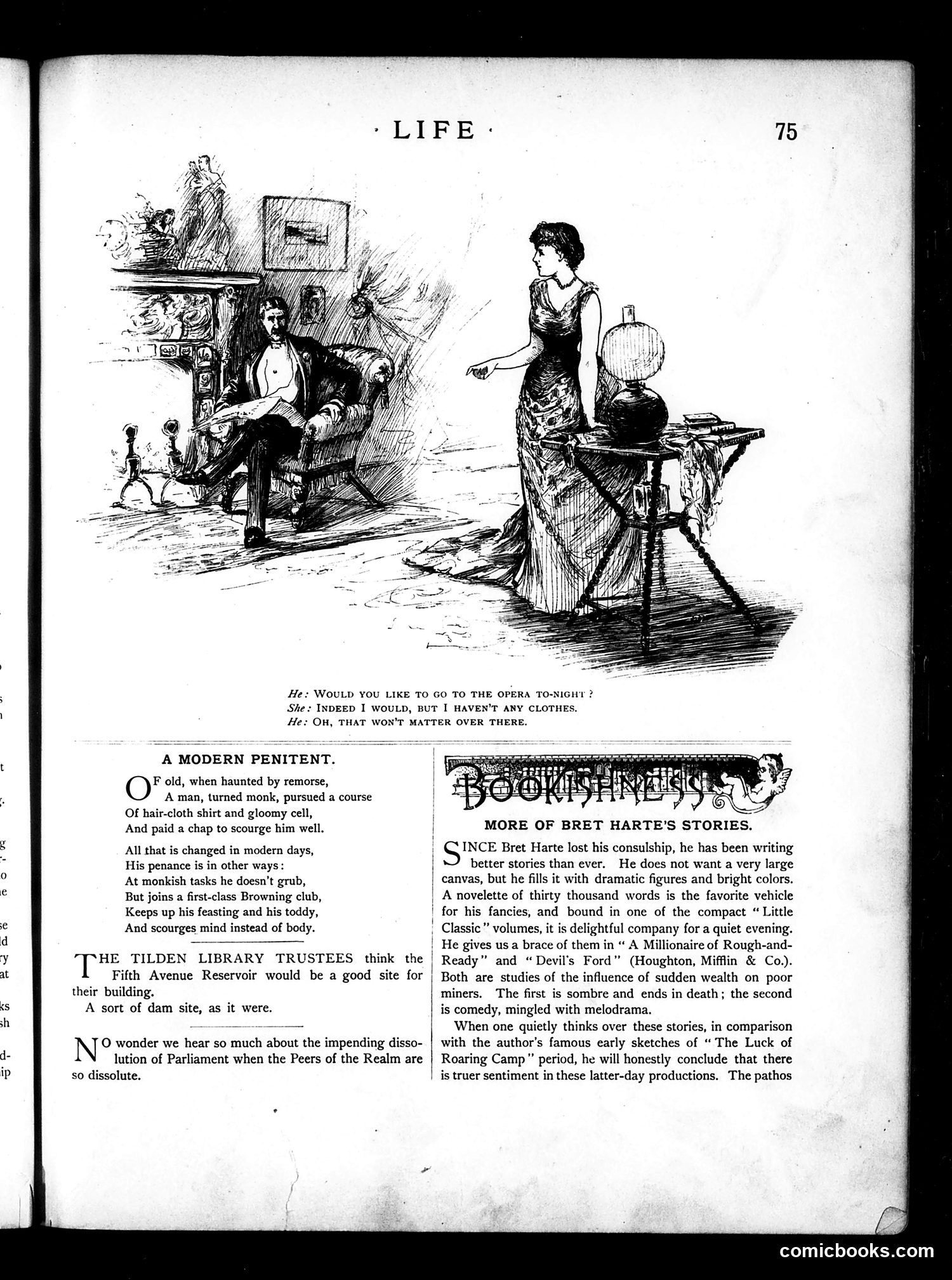
**Top Cartoon:** This depicts a wealthy man (seated left, surrounded by luxurious furnishings) proposing an opera outing to a woman. She declines, claiming she has no suitable clothes. His dismissive response—"Oh, that won't matter over there"—is the satirical point: he's implying the opera audience is so inattentive or unrefined that her appearance wouldn't be noticed. The joke mocks both upper-class pretensions about culture and the wealthy man's tactless insult. **Lower Content:** Includes a poem titled "A Modern Penitent" criticizing how wealthy individuals escape moral consequences through club memberships rather than genuine reform. Text also advertises Bret Harte's stories, noting his recent literary productivity. The page reflects *Life*'s characteristic satire of Gilded Age wealth and social hypocrisy.
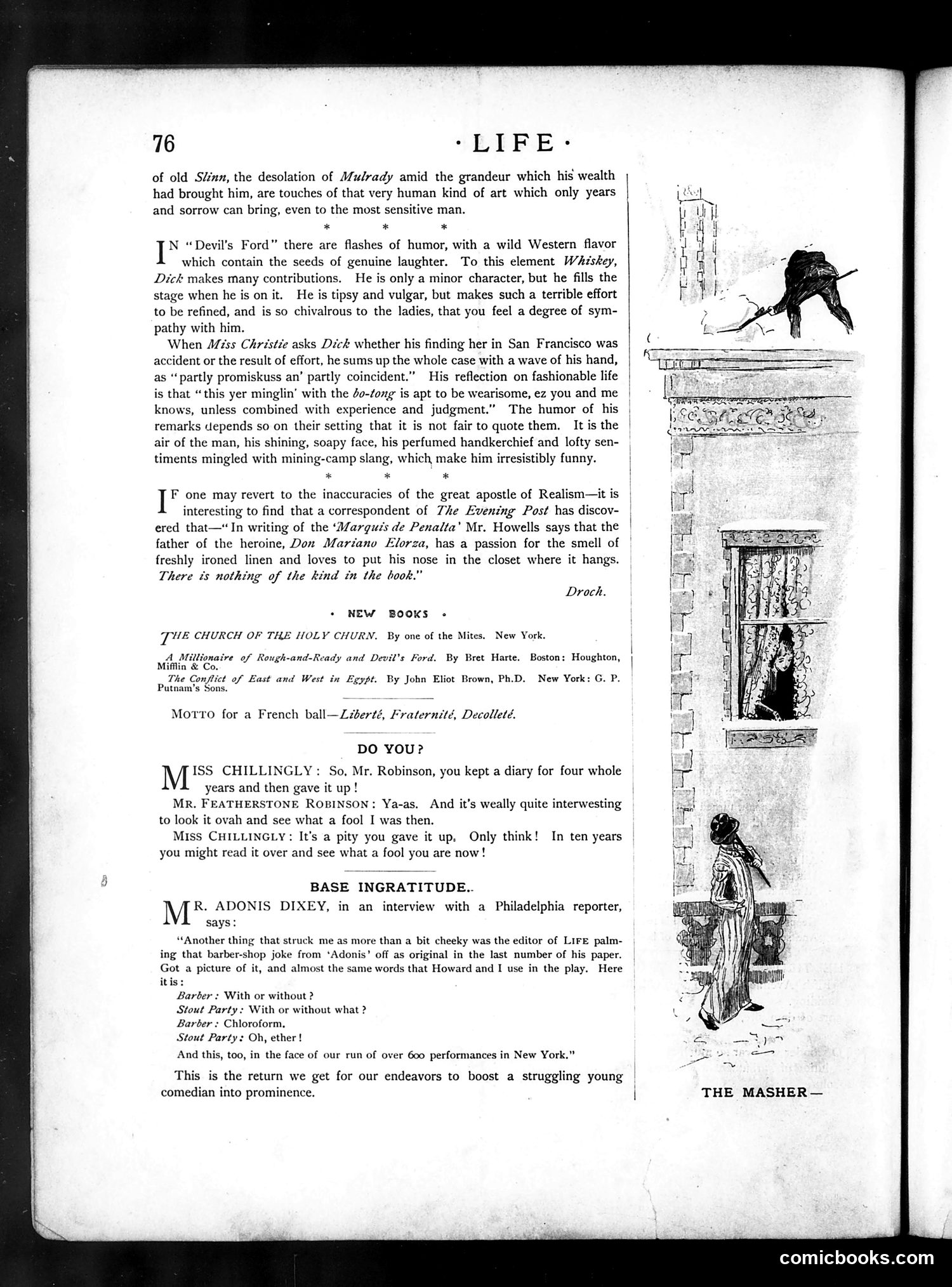
This page from *Life* magazine features three sketches titled "The Masher," depicting a man in late 19th-century dress pursuing women in urban settings. "Masher" was period slang for an aggressive male flirt or street harasser who made unwanted advances toward women in public spaces. The cartoons satirize this common social nuisance—showing the figure attempting to ingratiate himself with women on streets and near buildings. The accompanying text discusses literary characters and theatrical humor, but the visual satire targets the "masher" as a recognizable urban type worthy of ridicule. The sketches use exaggerated poses and expressions typical of *Life*'s satirical style to mock this socially irritating behavior.
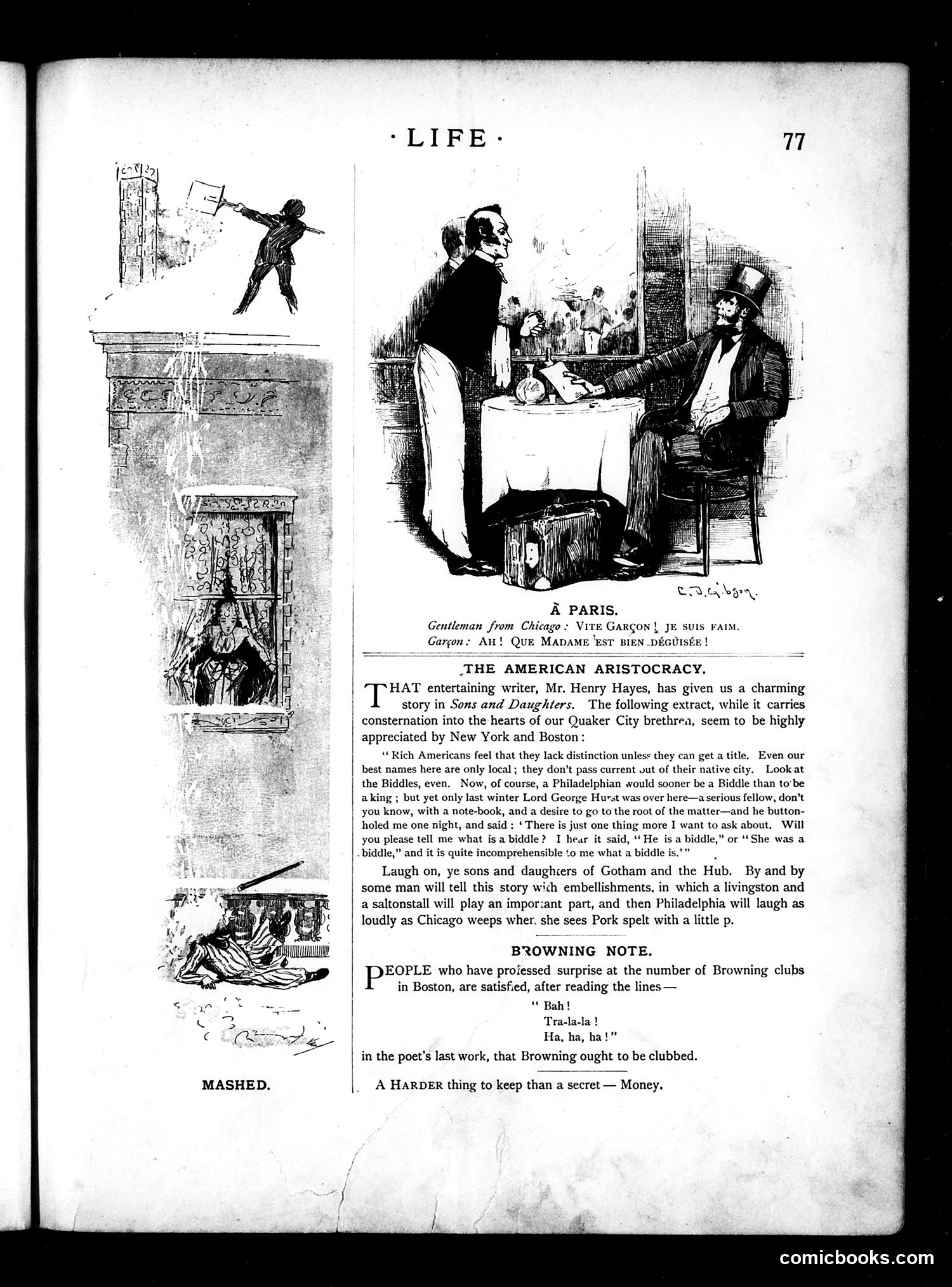
**"À Paris" cartoon (top right):** A Chicago businessman complains to a Parisian waiter that he's hungry ("Je suis faim"). The waiter responds dismissively about Madame's reputation. This satirizes American tourists abroad—specifically wealthy Chicagoans—as culturally ignorant and socially awkward in European settings. **"The American Aristocracy" article:** Mocks wealthy Americans' obsession with titles and social distinction. The excerpt describes how rich Americans feel inferior without aristocratic titles, even though American fortunes are "only local." It references Philadelphia's "Biddles" family and pokes fun at their pretensions. **"Mashed" (left side):** Illustrates the broader theme—American social climbing and class anxiety. The overall message: American wealth cannot buy genuine European sophistication or respectability.
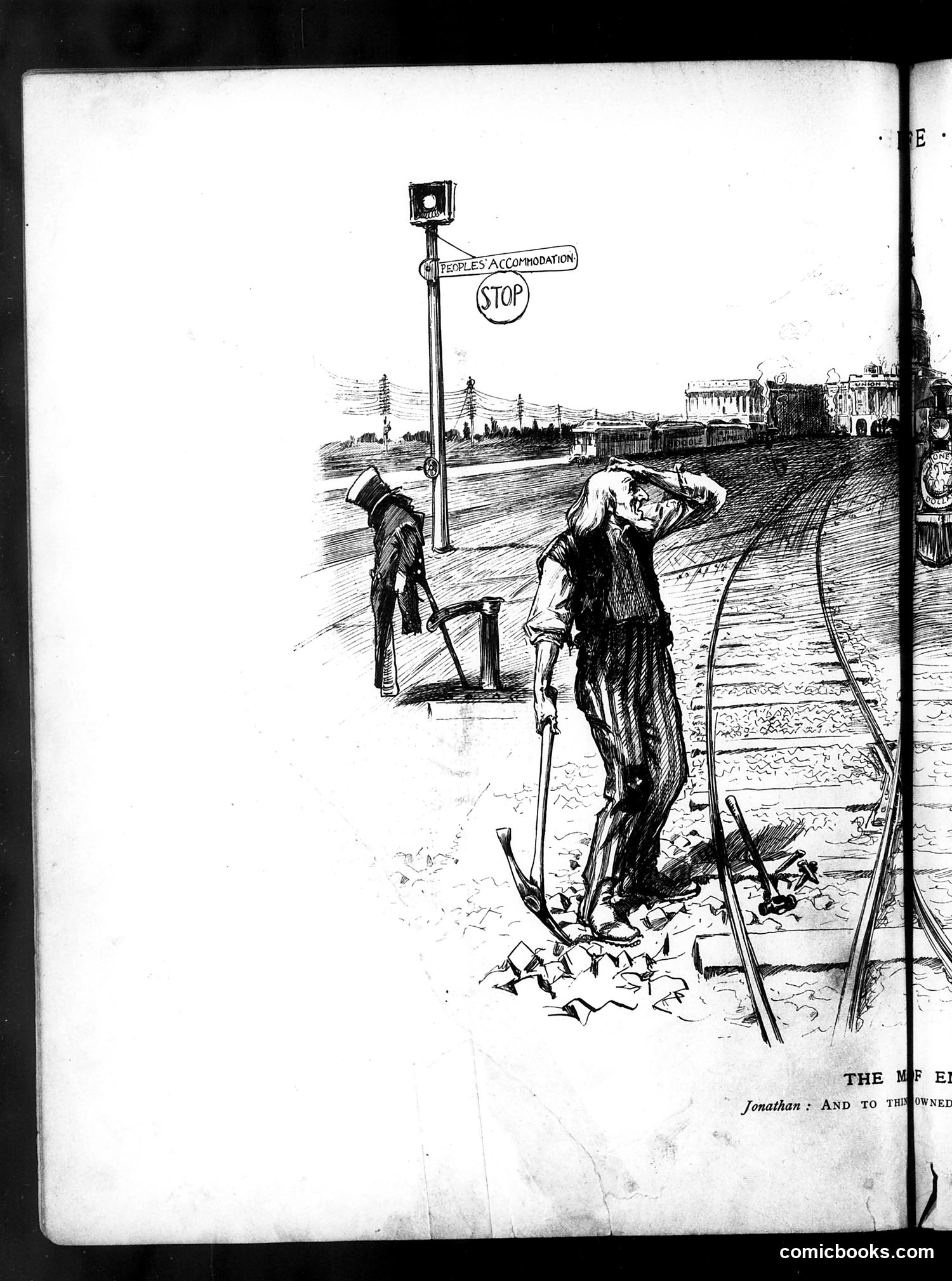
This illustration depicts a vagabond or tramp standing at a railroad crossing, looking at a signal post with two signs: "PEOPLES ACCOMMODATION" and "STOP." The figure appears bewildered, scratching his head in confusion at the contradictory messages. The satire likely critiques a political or social contradiction—possibly referencing promises made to working-class or poor people ("peoples accommodation") that are undercut by restrictive policies or actual barriers ("stop"). The railroad setting suggests industrial-era labor issues or mobility restrictions. The cartoon appears to mock the gap between stated public welfare intentions and practical denial of benefits or access. Without the magazine's date or surrounding context, the specific political target remains unclear, though it reflects turn-of-the-century American debates about labor rights and public welfare.
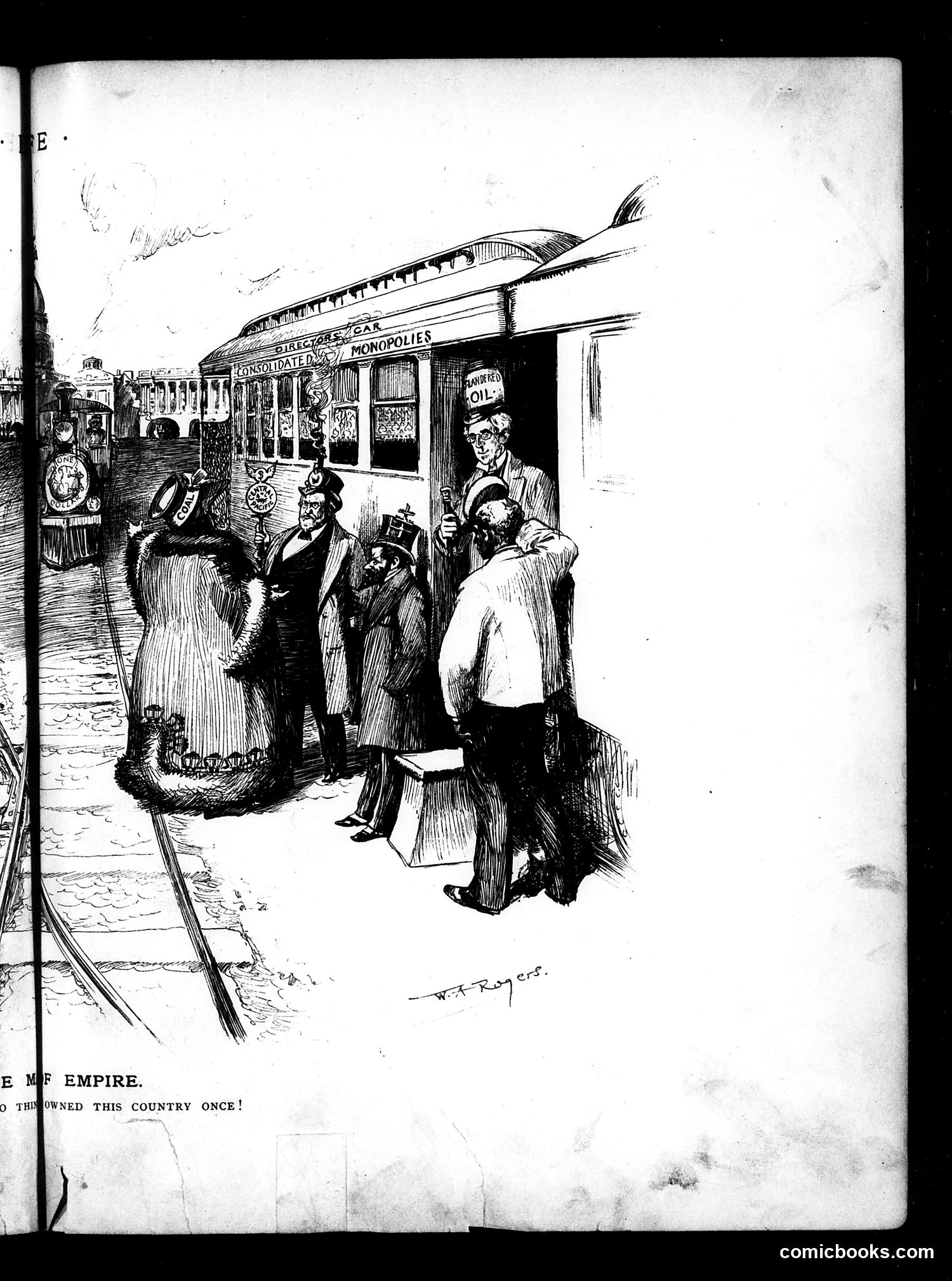
This appears to be a satirical cartoon about corporate monopolies and imperial power. The storefront displays text reading "DIRECT POPULAR CAR," "MONOPOLIES," and references to oil, suggesting criticism of large corporations controlling markets. The figures in formal dress appear to be wealthy businessmen or industrialists conducting transactions at what looks like a monopoly establishment. The visible text fragment at bottom mentions "EMPIRE" and "OWNED THIS COUNTRY ONCE," implying commentary on how corporate monopolies exercise power similar to imperial control. The cartoon likely critiques the Gilded Age concentration of wealth and corporate dominance over American commerce and governance. The caricatured style and exaggerated features are typical of early-20th-century satirical illustration attacking robber barons and monopolistic business practices.
This page is primarily **advertising and theatrical commentary**, not political satire. The left column contains **patent medicine ads** typical of the era (Gummiline tooth powder, "Nursery Bomb" toys, Pompadour Cream), reflecting common turn-of-the-century marketing. The right side features a **theater drama section** titled "To the Woman with the High Hat at the Theatre," humorously addressing audience etiquette—advising women not to wear tall hats blocking others' views. The main theatrical commentary discusses **Rose Coghlan**, an actress making a comeback. The review critiques her performance as "Lady Gay Spanker" in a play, noting she delivers emotion through "corrugated voice" rather than nuance. The writer calls her "an incomprehensible creature" while acknowledging her talent and beauty. This reflects **early 1900s theatrical criticism** and audience concerns about theater behavior.
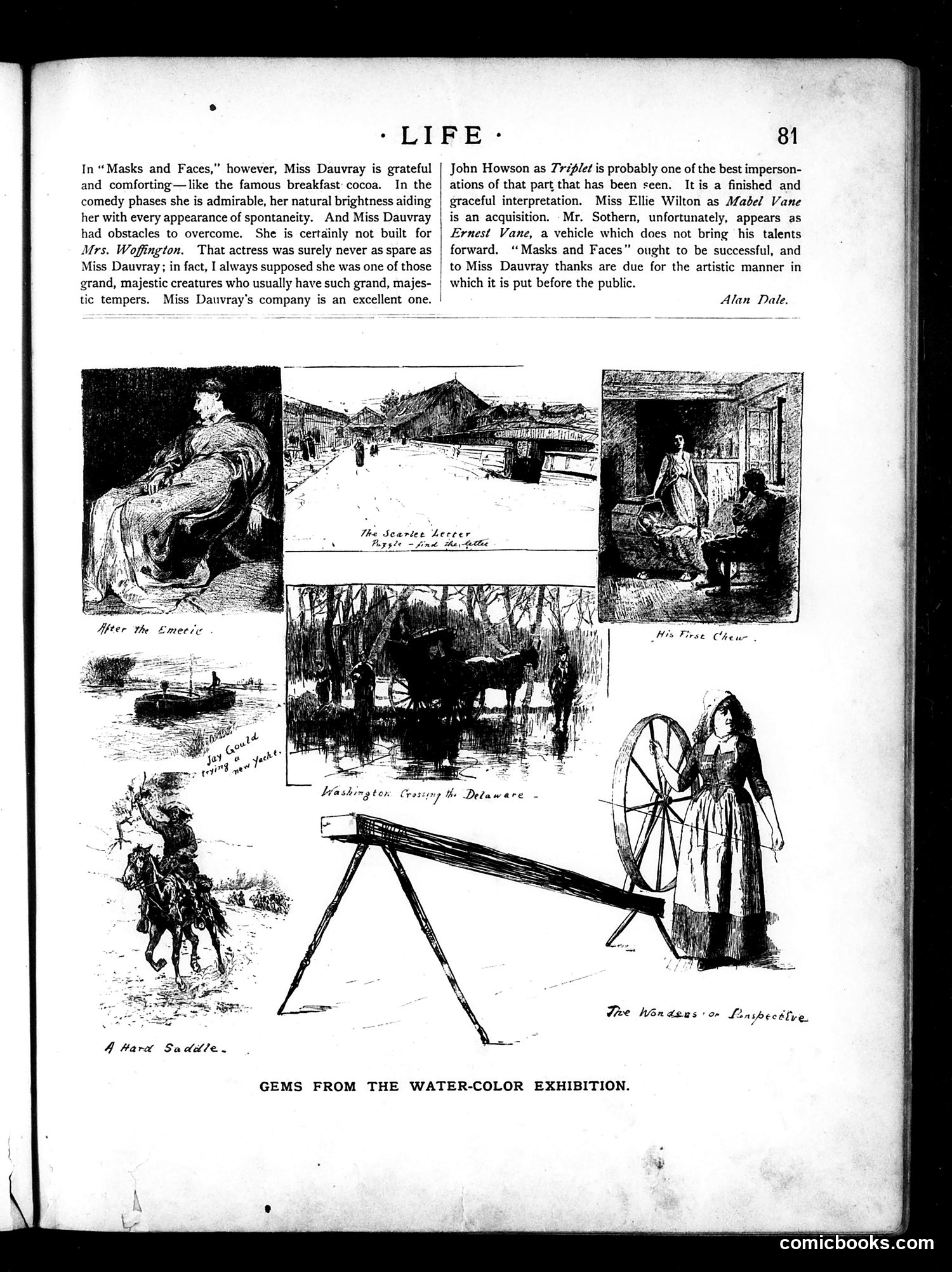
This page contains theatrical reviews rather than political cartoons. The text discusses stage performances of a play called "Masks and Faces," praising actress Miss Dauvray's comedic abilities and natural brightness, though noting she's physically unsuited to play the grand character Mrs. Woffington. The reviewer (Alan Dale) praises supporting actors John Howson and Ellie Wilton while criticizing Mr. Sothern's performance. The illustrations below are water-color exhibition pieces—landscape and genre sketches including a riverboat scene, a canal crossing, a woman with a spinning wheel, and rural imagery. These appear unrelated to the theatrical review above. The page reflects late-19th-century *Life* magazine's focus on entertainment criticism and art appreciation rather than political satire.
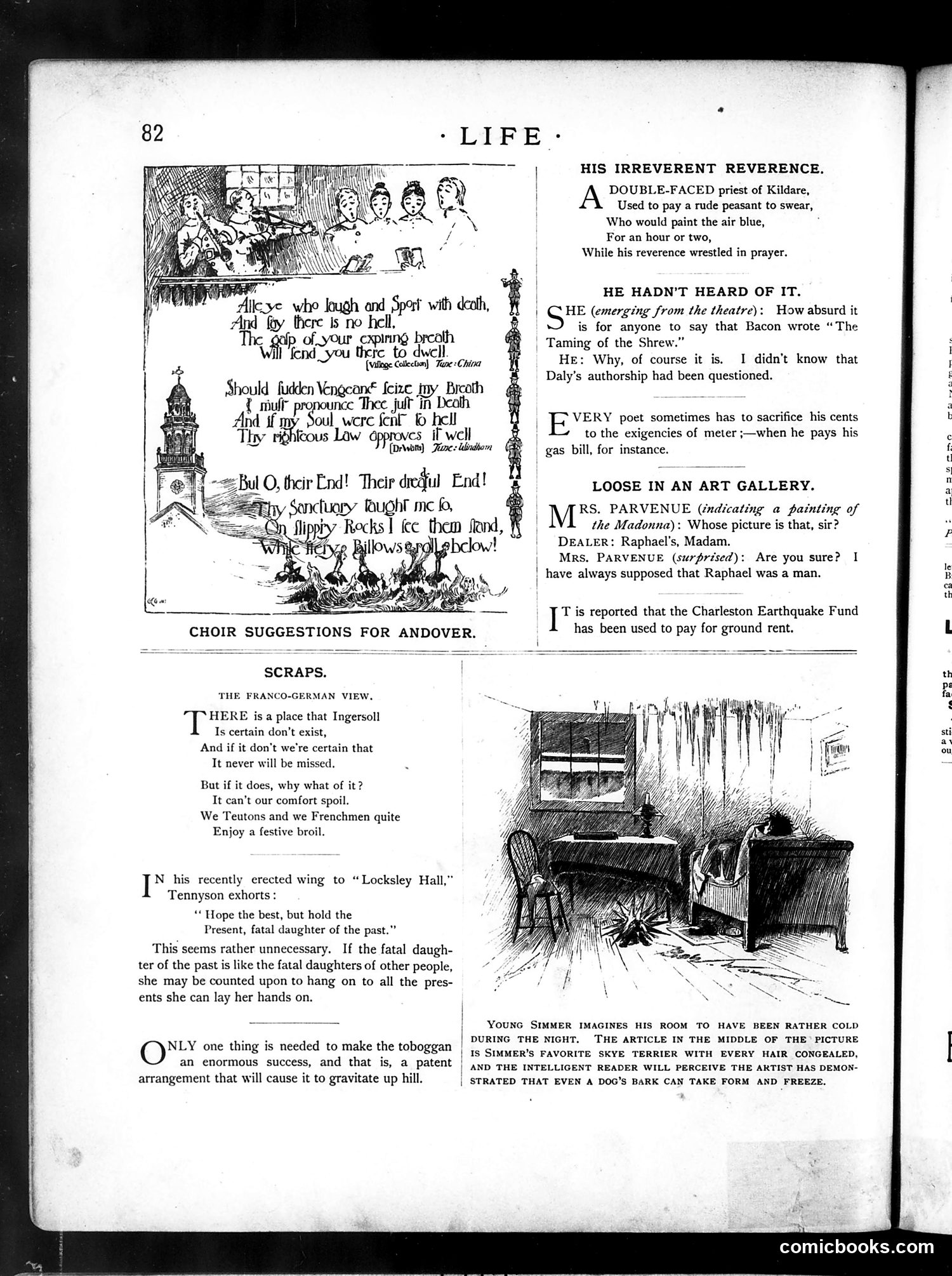
This page contains several short satirical pieces typical of Life magazine's humor: **"His Irreverent Reverence"** mocks a hypocritical Irish priest who pays peasants to blaspheme while he prays—satire on religious hypocrisy. **"He Hadn't Heard of It"** jokes about theater authorship disputes, likely referencing contemporary debates over Shakespeare attribution (the "Bacon wrote Shakespeare" controversy was active in this era). **"Loose in an Art Gallery"** satirizes newly wealthy social climbers (a "parvenue" is a nouveau riche woman) who lack cultural education, humorously assuming the Renaissance master Raphael was female. **The scraps section** includes political commentary on Franco-German tensions, mockery of Tennyson's poetry, and absurdist humor about toboggans and a frozen dog. The page's central cartoon shows a cold bedroom with a frozen dog, illustrating the visual joke that cold can literally freeze a dog's bark into visible form—period absurdist humor.
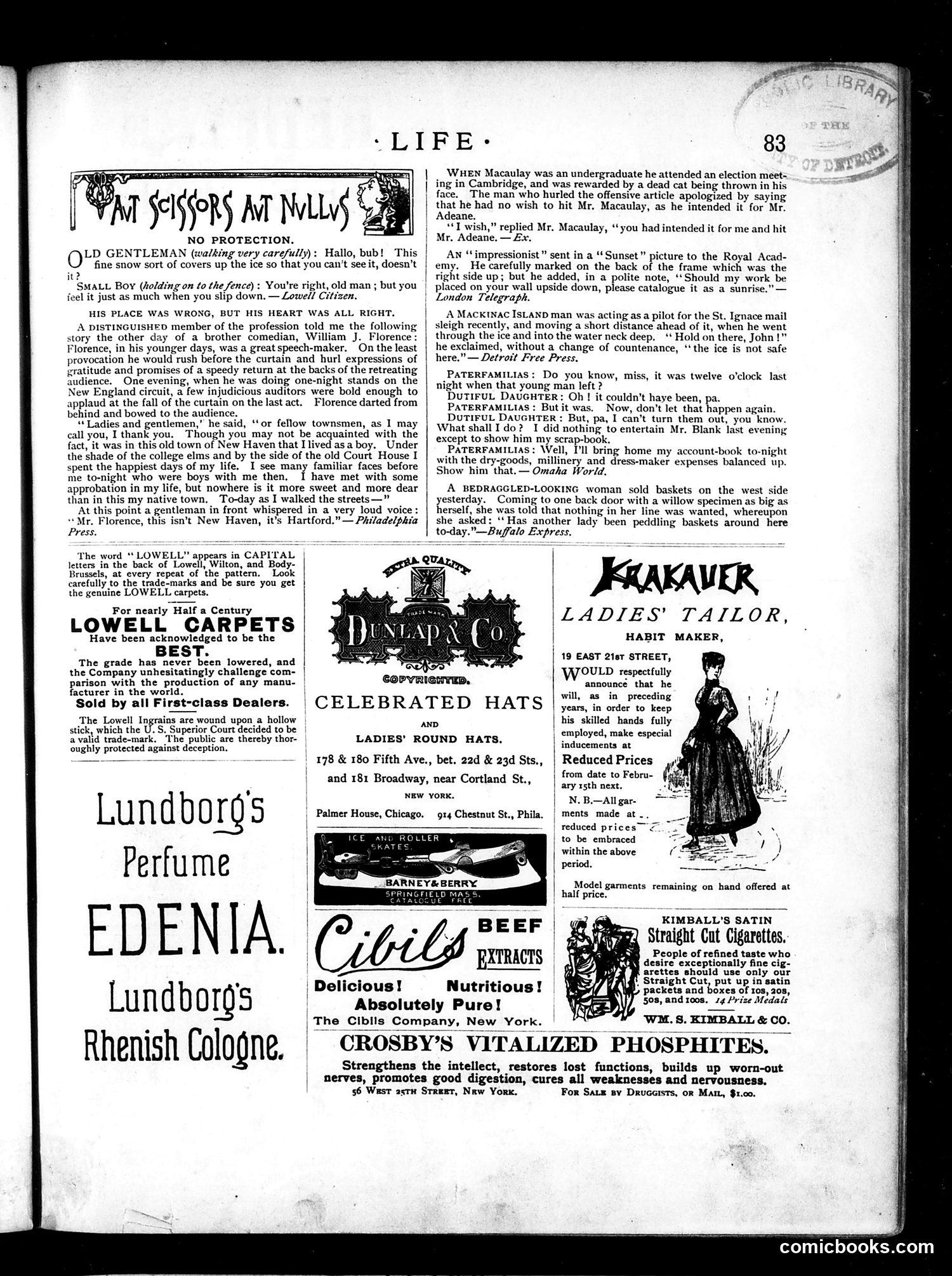
This page's main cartoon, "At Scissors at Nully: No Protection," depicts a satirical exchange between an old gentleman and a small boy. The joke concerns deceptive snow coverage: the gentleman observes that fresh snow conceals dangerous ice patches, making them invisible. The boy agrees but notes you still "feel it" when you slip—the snow provides false security. The satire targets **complacency and hidden danger**. Snow metaphorically represents any superficial covering that masks underlying problems. The cartoon suggests that appearances can deceive; something may *look* safe while remaining genuinely hazardous. The page also includes humorous anecdotes about **mistaken identity** (Macaulay and the dead cat) and **understated crisis** (the pilot falling through ice). These reinforce themes of miscommunication and danger lurking beneath calm surfaces. The remainder is advertising for period products (carpets, perfume, hats, beef extract).
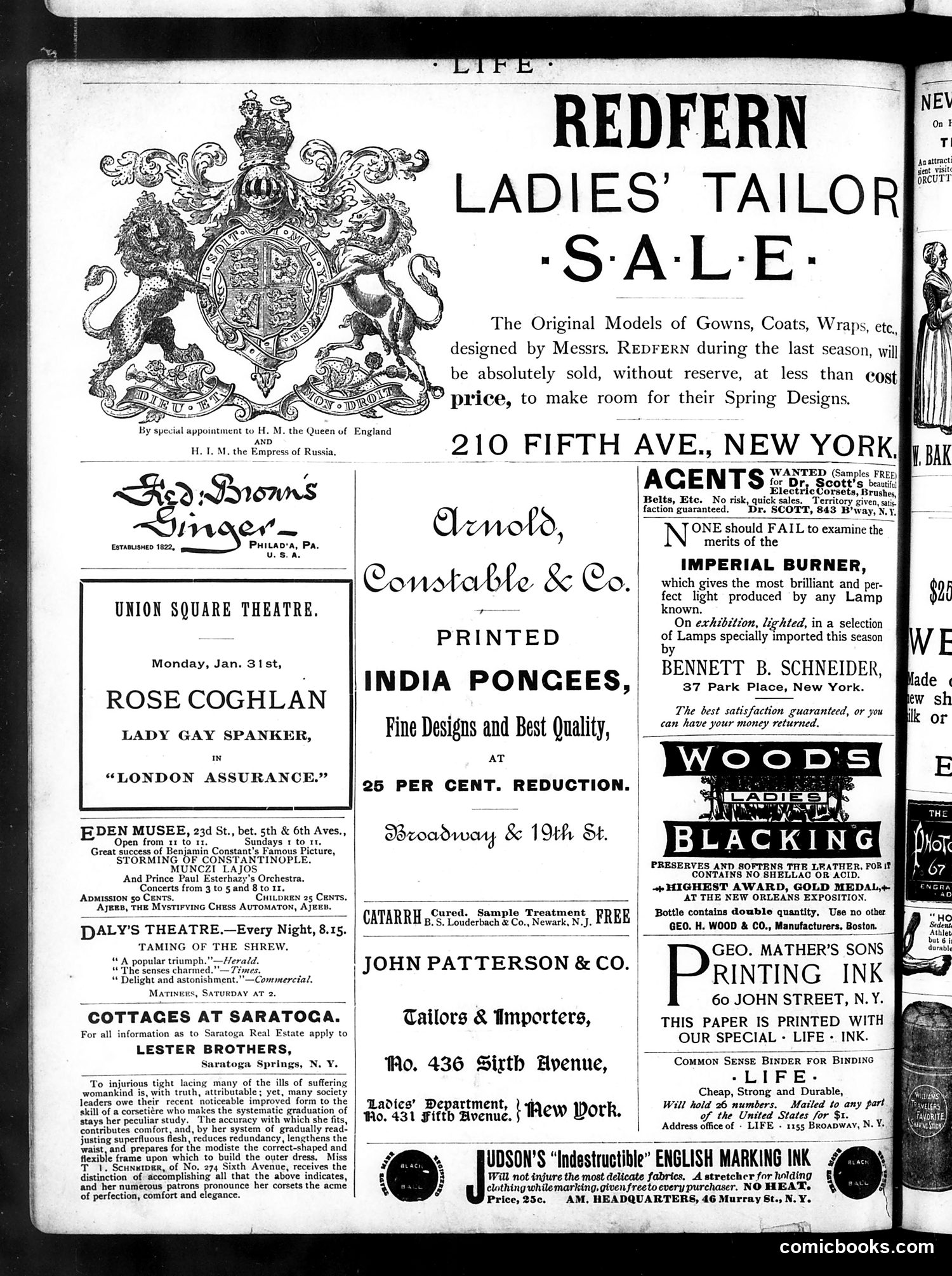
This is primarily an **advertising page** with no political cartoons or satirical content. The page showcases late-Victorian consumer goods and services. **Key advertisements reflect period concerns:** - **Corsetry dominance**: Multiple ads emphasize tight-lacing and figure correction, promoting the era's extreme wasp-waist ideal. One corsetière advertises her skill in "graduating stays" and "reducing redundancy" in women's bodies. - **Fashion sales**: Redfern's clearance of designer gowns suggests high-end retail competition. - **Theatrical entertainment**: Union Square Theatre and Daly's Theatre listings show popular dramatic productions of the period. - **Emerging technology**: Ads for electric corsets, the "Imperial Burner" lamp, and marking inks reflect late-Victorian technological optimism. The Redfern masthead's royal warrant (Queen of England, Empress of Russia) indicates aspirational international prestige marketing. **For modern readers**: This page documents obsessive period anxiety about women's bodies and consumption, alongside genuine technological innovation—revealing the era's contradictions.
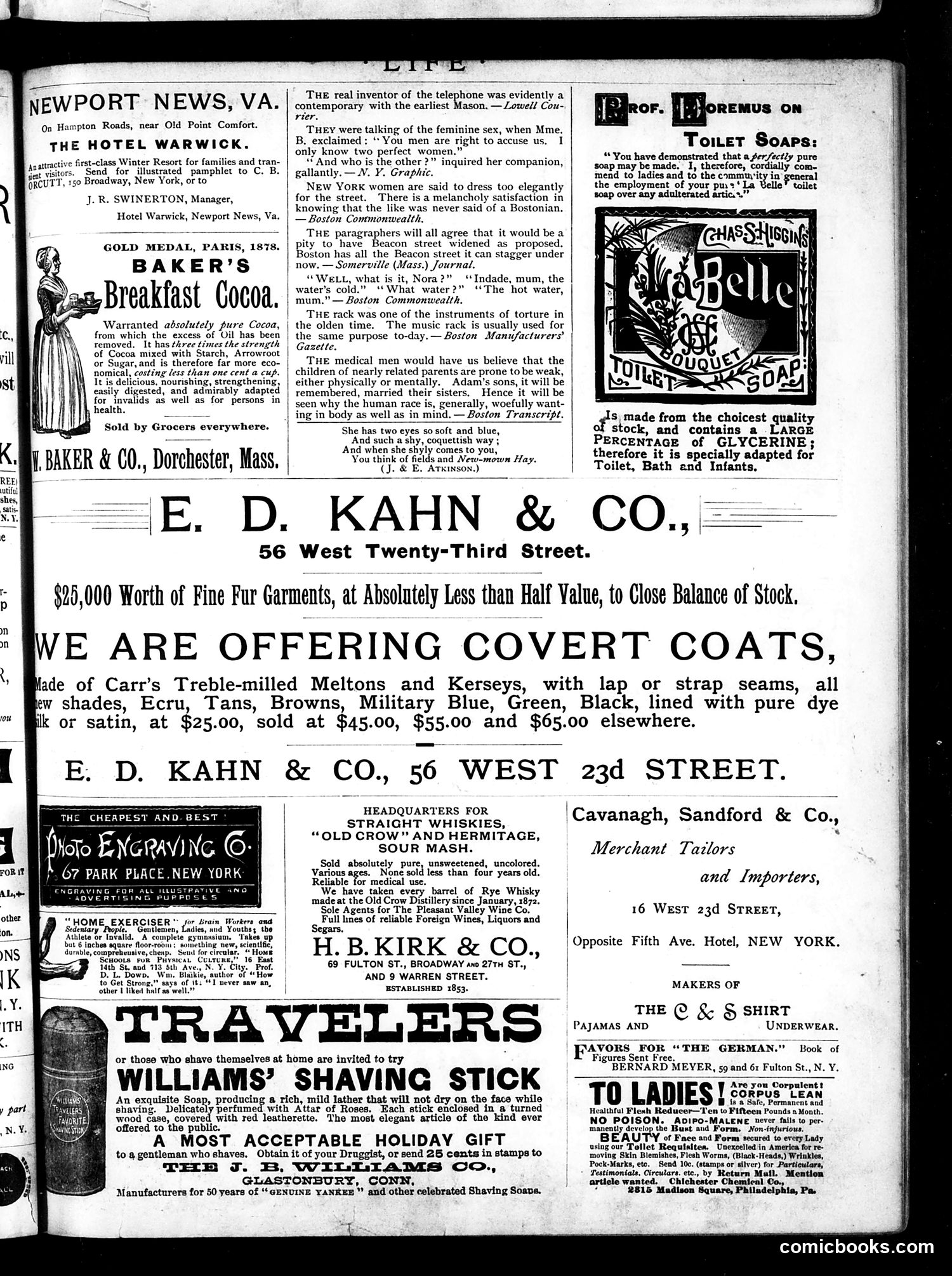
This page is **primarily advertisements** rather than political satire or comics. It's a late 19th-century commercial section featuring luxury goods and services. The small text snippets scattered throughout are brief **humorous quips** rather than cartoons—jokes about telephone inventors, women's fashion, Boston society, and Irish servants. These are typical period humor: gentle ribbing of social groups (Irish maids, Bostonians, women) and observations about contemporary life. The actual "cartoons" are absent; instead, the page showcases illustrated **product advertisements**: Baker's Cocoa, Belle Toilet Soap, fine furs from E.D. Kahn & Co., whiskey, shaving sticks, and merchant tailors. The decorative engravings accompanying these ads (like the woman with the cocoa tin) are commercial illustrations, not satirical commentary. The page reflects what Life's advertising sections actually contained during this era—upscale consumer goods marketed to wealthy readers—rather than the magazine's famous satirical editorial cartoons that appeared elsewhere.
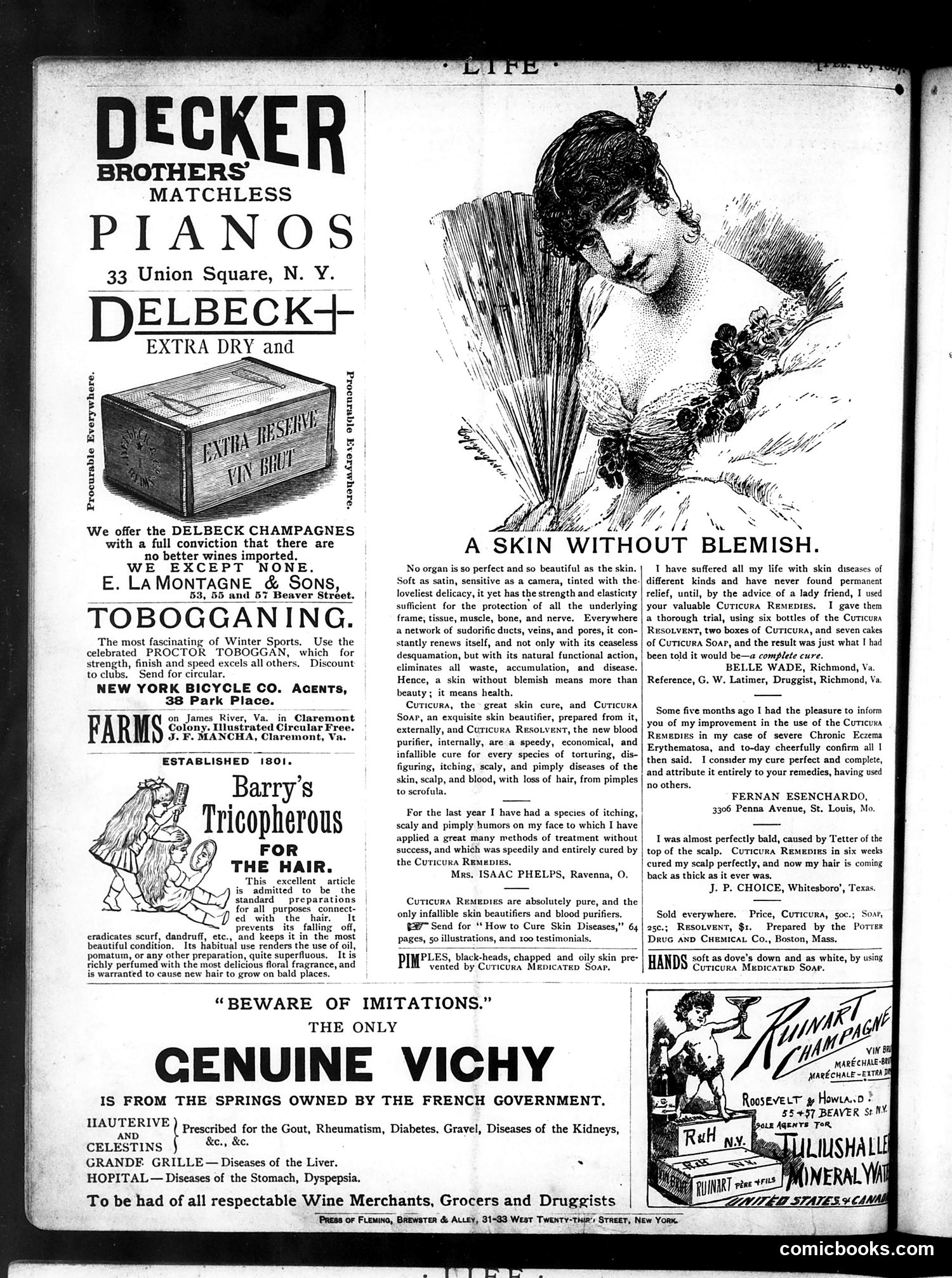
This page is **primarily advertising**, not political satire. It consists of commercial advertisements for late 19th-century products and services. The main illustrated content shows **"A Skin Without Blemish"**—an advertisement for Cuticura remedies (soap, salve, and blood purifier) featuring a woman's face with decorative fan-like design. The ad uses testimonial letters from satisfied customers to promote the product's claimed ability to cure various skin conditions. Other ads include pianos, champagne, toboggan equipment, bicycles, hair tonic (Barry's Tricopherous), and mineral water (Vichy). There's also a small illustrated cartoon for what appears to be a theatrical production in the lower right. The page reflects the era's approach to medical advertising, where companies made sweeping health claims for patent medicines without modern FDA regulation. No political satire or social commentary is evident—this is a standard period advertising layout with one decorative product illustration.