
Life, 1887-02-10 · page 5 of 16
Life — February 10, 1887 — page 5: what you’re looking at
What you’re looking at
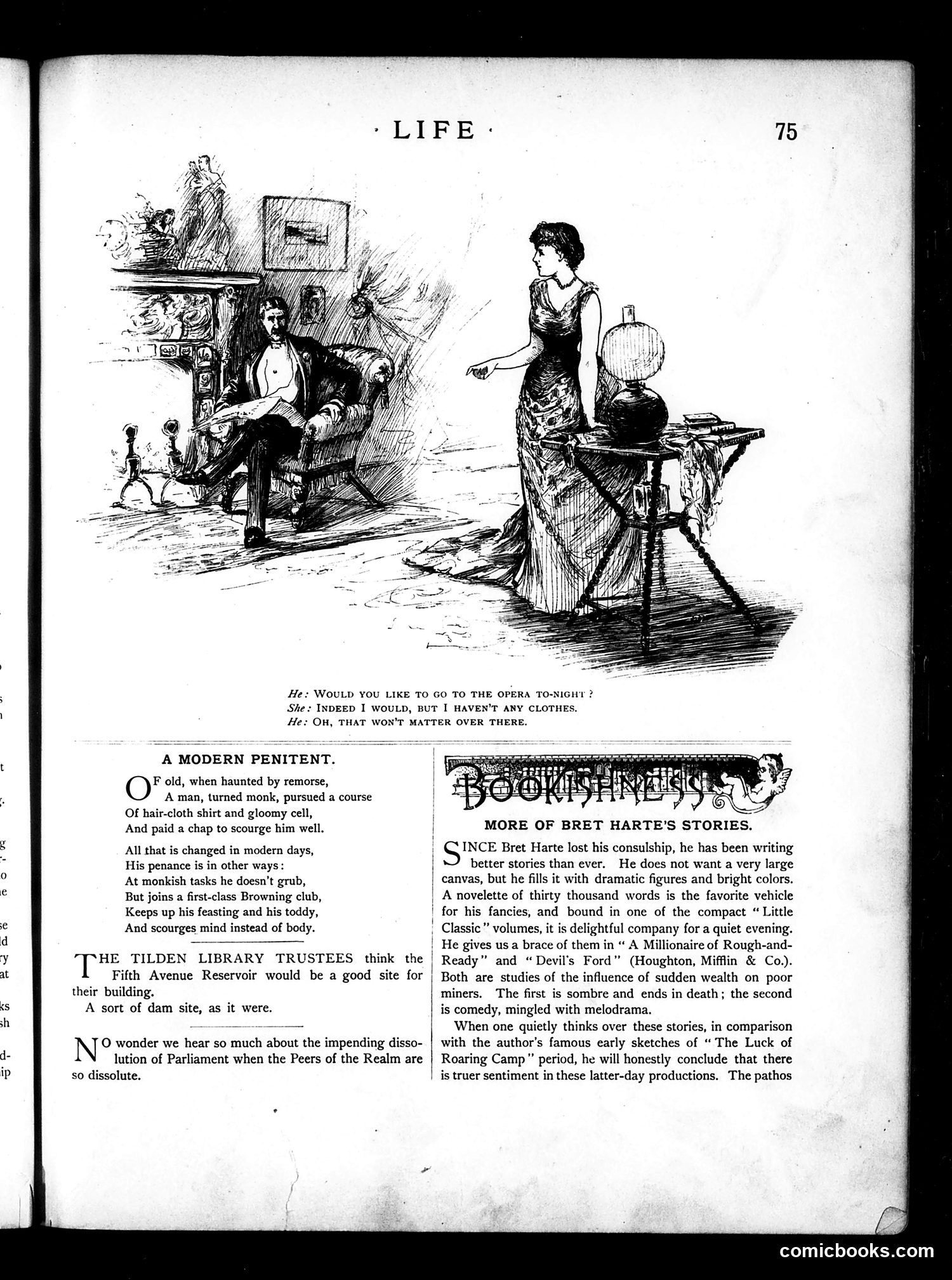
**Top Cartoon:** This depicts a wealthy man (seated left, surrounded by luxurious furnishings) proposing an opera outing to a woman. She declines, claiming she has no suitable clothes. His dismissive response—"Oh, that won't matter over there"—is the satirical point: he's implying the opera audience is so inattentive or unrefined that her appearance wouldn't be noticed. The joke mocks both upper-class pretensions about culture and the wealthy man's tactless insult. **Lower Content:** Includes a poem titled "A Modern Penitent" criticizing how wealthy individuals escape moral consequences through club memberships rather than genuine reform. Text also advertises Bret Harte's stories, noting his recent literary productivity. The page reflects *Life*'s characteristic satire of Gilded Age wealth and social hypocrisy.
📄 Transcribed text from this page (OCR, searchable)
Machine-transcribed from the original scan — historical spelling and the odd misread are preserved.
He: WOULD YOU LIKE TO GO TO THE OPERA TO-NIGHT ? She: INDEED I WouLD, BUT I HAVEN’T ANY CLOTHES. He: OH, THAT WON'T MATTER OVER THERE. A MODERN PENITENT. F old, when haunted by remorse, A man, turned monk, pursued a course Of hair-cloth shirt and gloomy cell, And paid a chap to scourge him well. All that is changed in modern days, His penance is in other ways: At monkish tasks he doesn’t grub, But joins a first-class Browning club, Keeps up his feasting and his toddy, And scourges mind instead of body. HE TILDEN LIBRARY TRUSTEES think the Fifth Avenue Reservoir would be a good site for their building. A sort of dam site, as it were. O wonder we hear so much about the impending disso- lution of Parliament when the Peers of the Realm are so dissolute. MORE OF BRET HARTE’S STORIES. INCE Bret Harte lost his consulship, he has been writing better stories than ever. He does not want a very large | canvas, but he fills it with dramatic figures and bright colors. A novelette of thirty thousand words is the favorite vehicle | for his fancies, and bound in one of the compact “ Little | Classic” volumes, it is delightful company for a quiet evening. | is truer sentiment in these latter-day productions. The pathos He gives us a brace of them in “ A Millionaire of Rough-and- Ready” and “ Devil's Ford” (Houghton, Mifflin & Co.). Both are studies of the influence of sudden wealth on poor miners. The first is sombre and ends in death; the second is comedy, mingled with melodrama. When one quietly thinks over these stories, in comparison with the author’s famous early sketches of “ The Luck of Roaring Camp” period, he will honestly conclude that there comicbooks.com ee