
A complete issue · 16 pages · 1884
Life — October 23, 1884
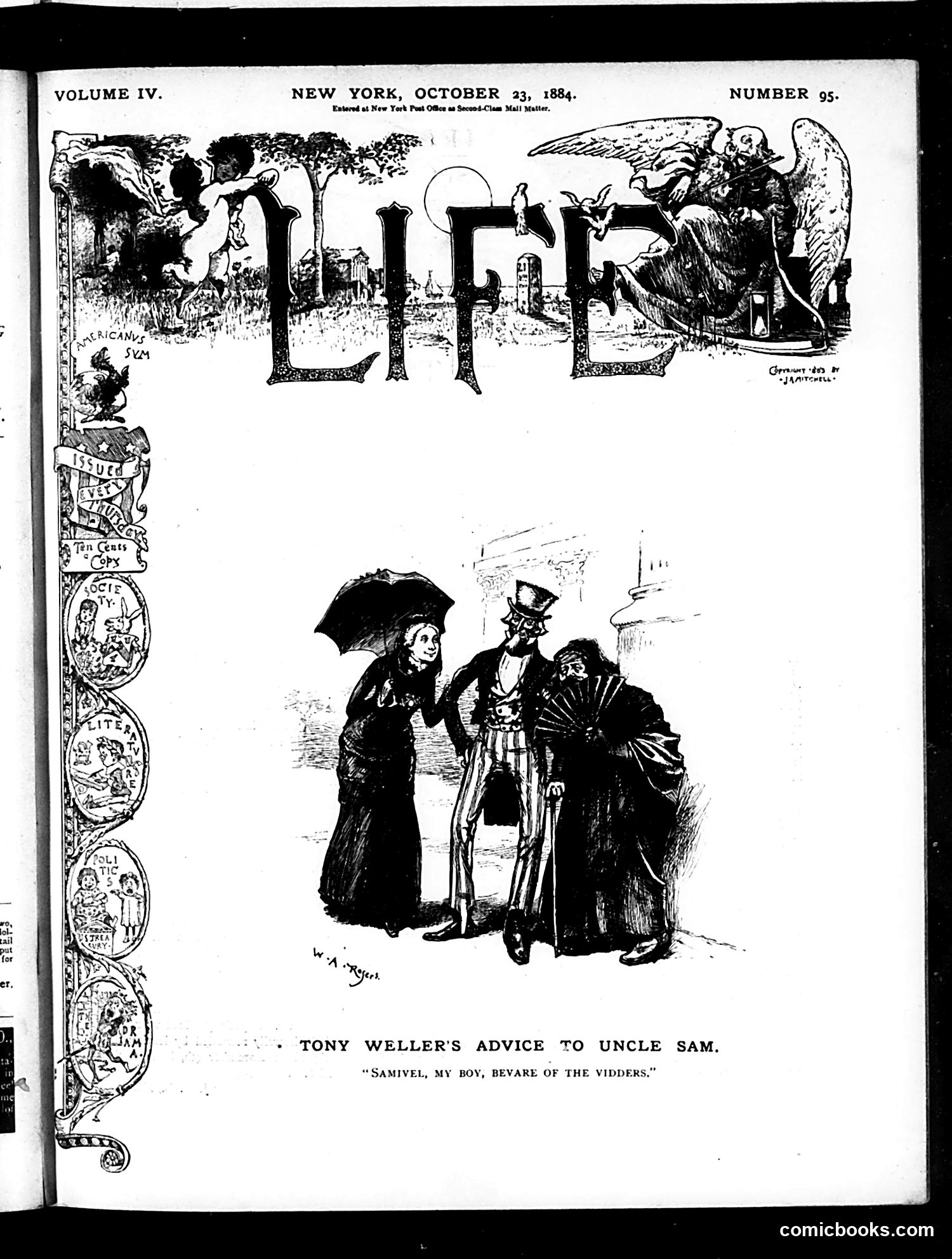
This cartoon references **Tony Weller**, a character from Charles Dickens's *Pickwick Papers* (1836-37), known for dispensing folksy wisdom. The satire imports this literary character to offer advice to "Uncle Sam"—the personification of the United States government. The caption reads: "SAMUEL, MY BOY, BEWARE OF THE VIDDERS" (using Dickens's characteristic misspelling of "widows"). In Dickens, Tony Weller warns his son about marrying widows, viewing them as scheming and predatory. The 1884 cartoon likely uses this analogy to satirize some contemporary political or social concern—possibly warning against financial entanglements, foreign relations, or dubious alliances—though the specific target remains unclear without additional 1884 context. The literary reference would appeal to educated readers familiar with Dickens.
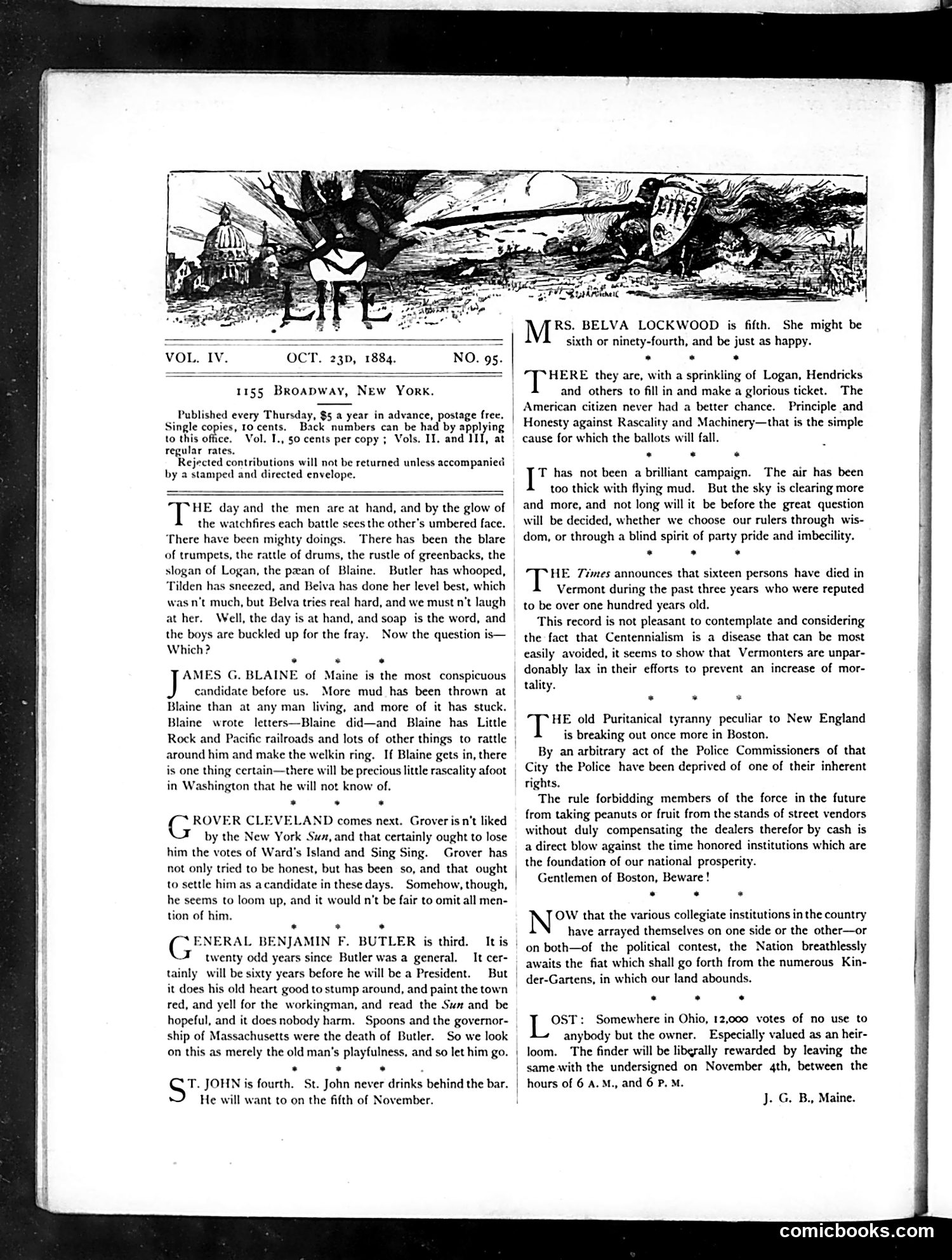
The masthead cartoon depicts a chaotic scene with figures labeled "LIFE" amid destruction and turmoil. The text below discusses the 1884 presidential election, mentioning candidates James G. Blaine (Maine), Grover Cleveland, and Benjamin F. Butler as political figures under scrutiny. The satire centers on the election's moral dimensions: Blaine faces accusations of corruption ("Honesty against Rascality and Machinery"); Cleveland is characterized as a potential winner despite establishment opposition. Butler, positioned as a third candidate, is dismissed as a marginal figure whose candidacy matters little. The overall tone mocks the chaos and hypocrisy of the election campaign—depicting politics as fundamentally muddy and contested, with various factions and candidates vying for legitimacy through questionable means rather than genuine principle.
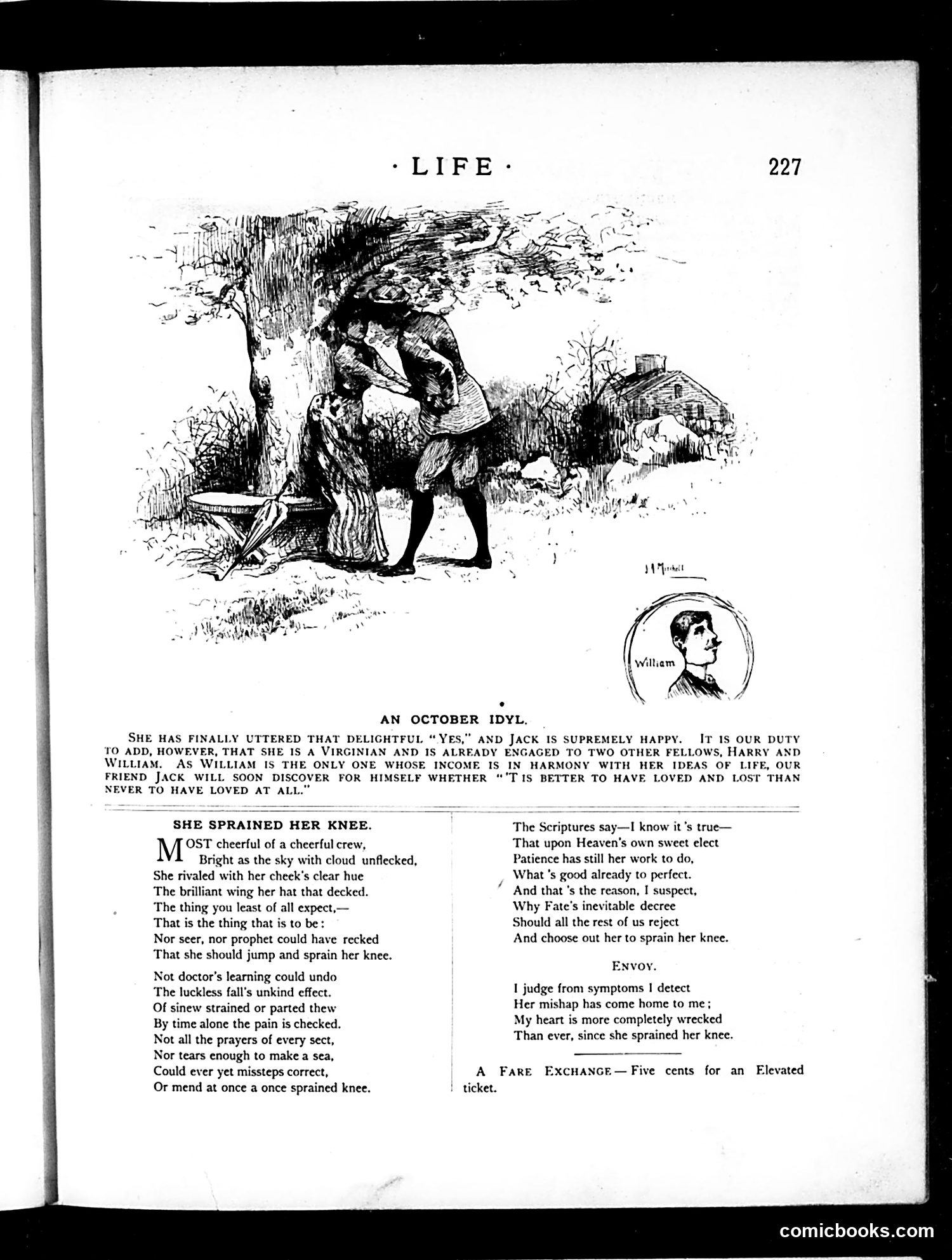
This page from *Life* magazine features a sentimental narrative piece titled "An October Idyl" about a woman named Jack who has accepted a marriage proposal. The accompanying illustration shows a couple by a tree near a rural cottage. Below this narrative is a poem titled "She Sprained Her Knee," which humorously describes a woman's mishap and the various remedies attempted to heal her injury. The poem uses Victorian sentimentality ironically—presenting the sprained knee as a quasi-tragic event worthy of elaborate consolation. The section labeled "Envoy" continues the joke, with a character lamenting that his heart is "more completely wrecked" than ever since witnessing her injury. A final line advertises "A Fake Exchange—Five cents for an Elevated ticket," suggesting a separate satirical item (details unclear from this excerpt).
This page contains brief satirical "boomlets" (short political commentaries) rather than cartoons. The items mock various 1880s political figures and trends: **Key targets include:** - **Mr. Blaine** - appears to be a presidential candidate whose name change to "the Be-Nighted States" is mocked - **Mrs. Blake vs. Mrs. Lockwood** - competing Women's Rights candidates for President - **Mr. Pomeroy** - a Prohibitionist candidate whose withdrawal is sarcastically noted - **St. John** - another presidential hopeful - The **Republican Campaign Committee** - criticized for Butler's expensive canvassing The satire ridicules the era's proliferation of fringe candidates, women's political involvement, and campaign excess. The page also includes a section mocking sentimental "patent medicine" novels like *Barriers Burned Away*, suggesting publishers exploit readers' emotions for profit.
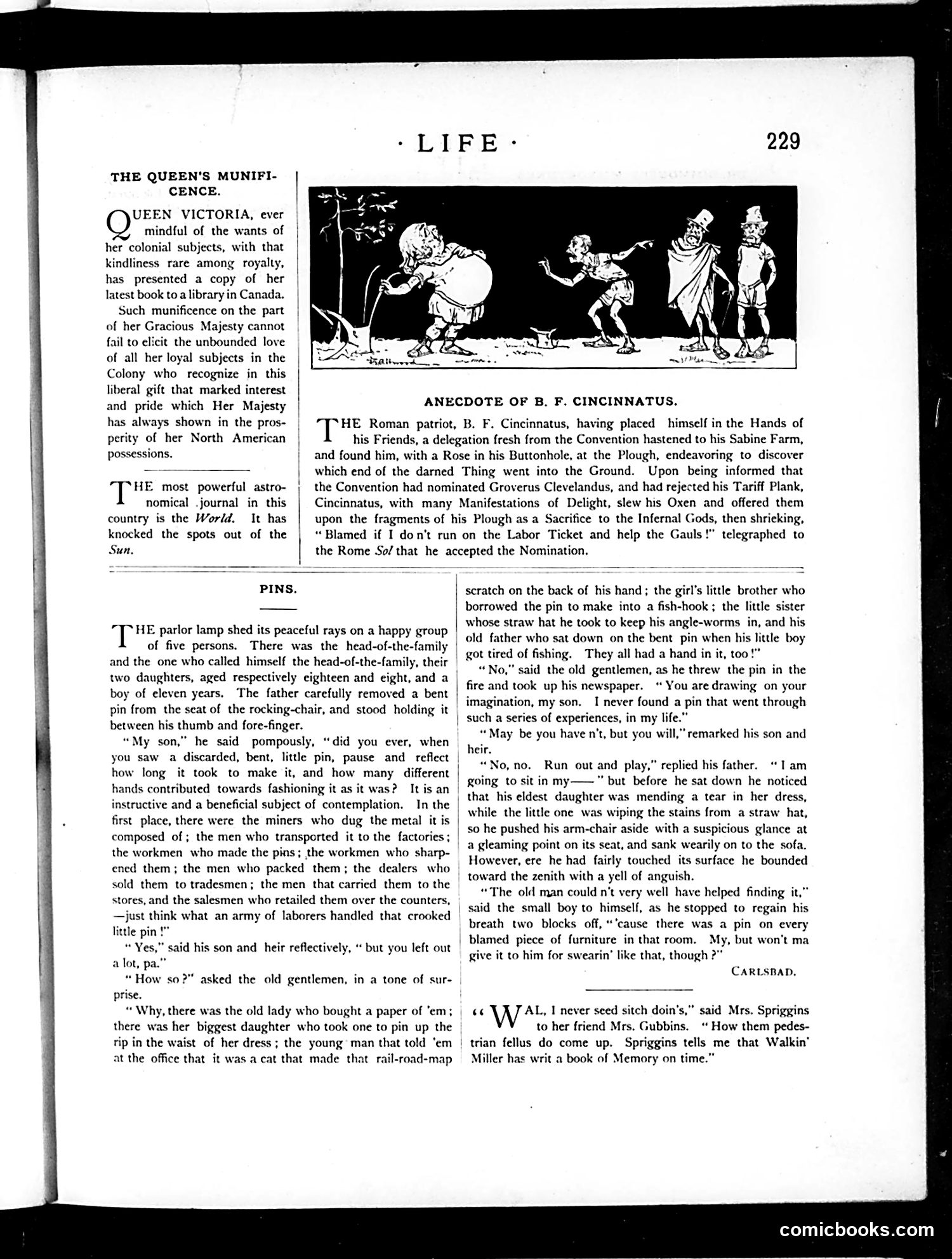
**Top Section - "The Queen's Munificence":** A brief note praising Queen Victoria's gift of her latest book to a Canadian library, framed as evidence of her interest in colonial subjects. **Cartoon - "Anecdote of B. F. Cincinnatus":** The illustration depicts a Roman patriot story. The text describes Cincinnatus rejecting a nomination at a political convention, claiming he won't abandon his labor principles or support specific candidates. This appears to be political satire about convention politics and politicians' public claims of reluctance regarding nominations—a common 19th-century rhetorical device. **"Pins" Story:** A humorous anecdote tracing pins' production journey from miners through factories to retail, culminating in a grandfather's musing about how many hands touched a simple pin—reflecting period fascination with industrial complexity.
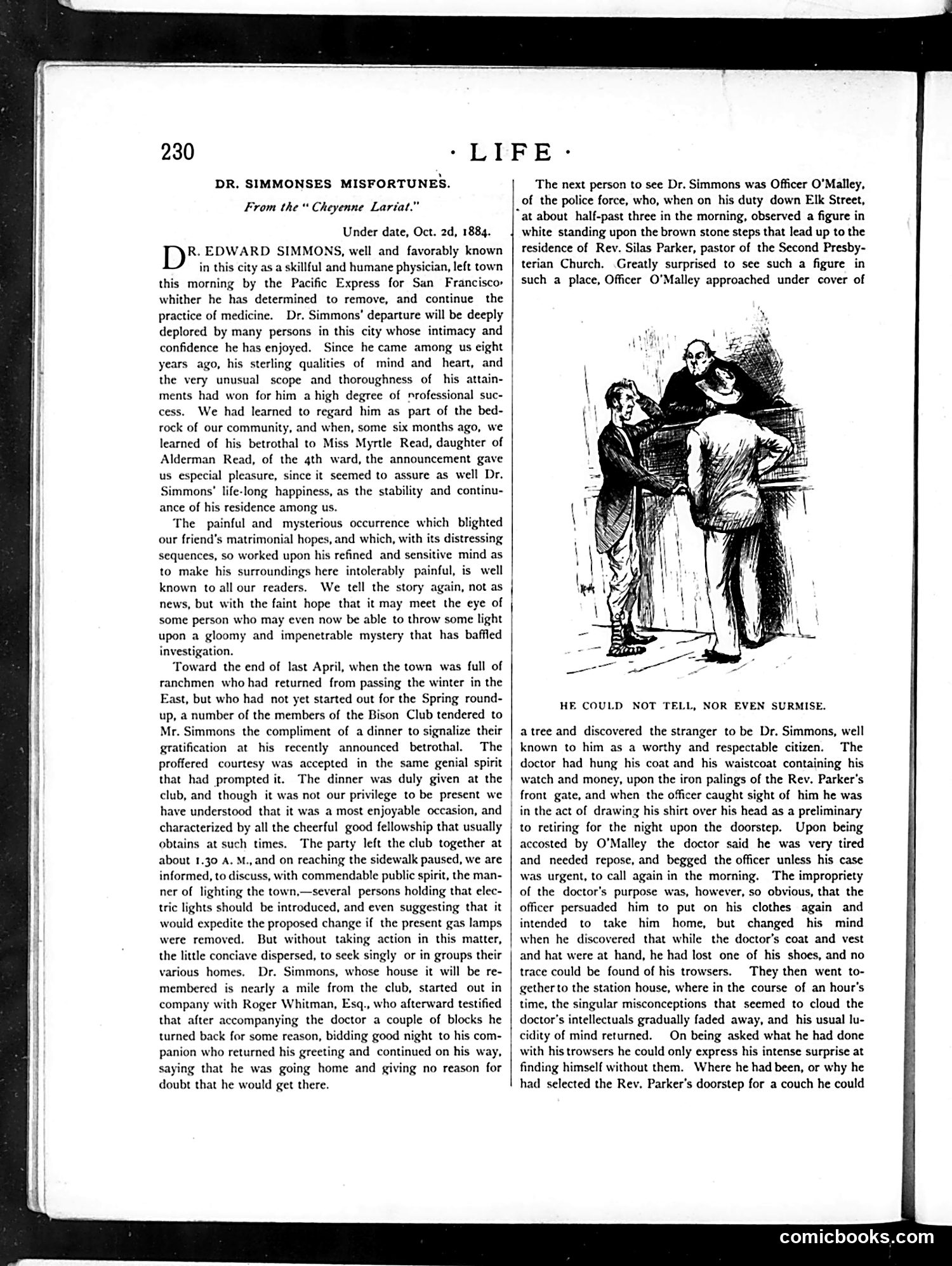
This page recounts a mysterious incident involving Dr. Edward Simmons, a respected Cheyenne physician who left town via Pacific Express. The accompanying sketch shows Officer O'Malley discovering the doctor in an undignified position near Rev. Parker's church—apparently caught removing his clothing. The narrative is humorous rather than scandalous. Dr. Simmons had lost his coat, vest, watch, money, and shoes during an evening outing. Unable to explain his predicament, he claimed to have "no trace" of his trousers. The story appears designed to entertain readers with the embarrassing situation of a prominent community figure, while maintaining charitable tone toward his reputation. The satire targets urban respectability and the gap between public persona and private mishap.
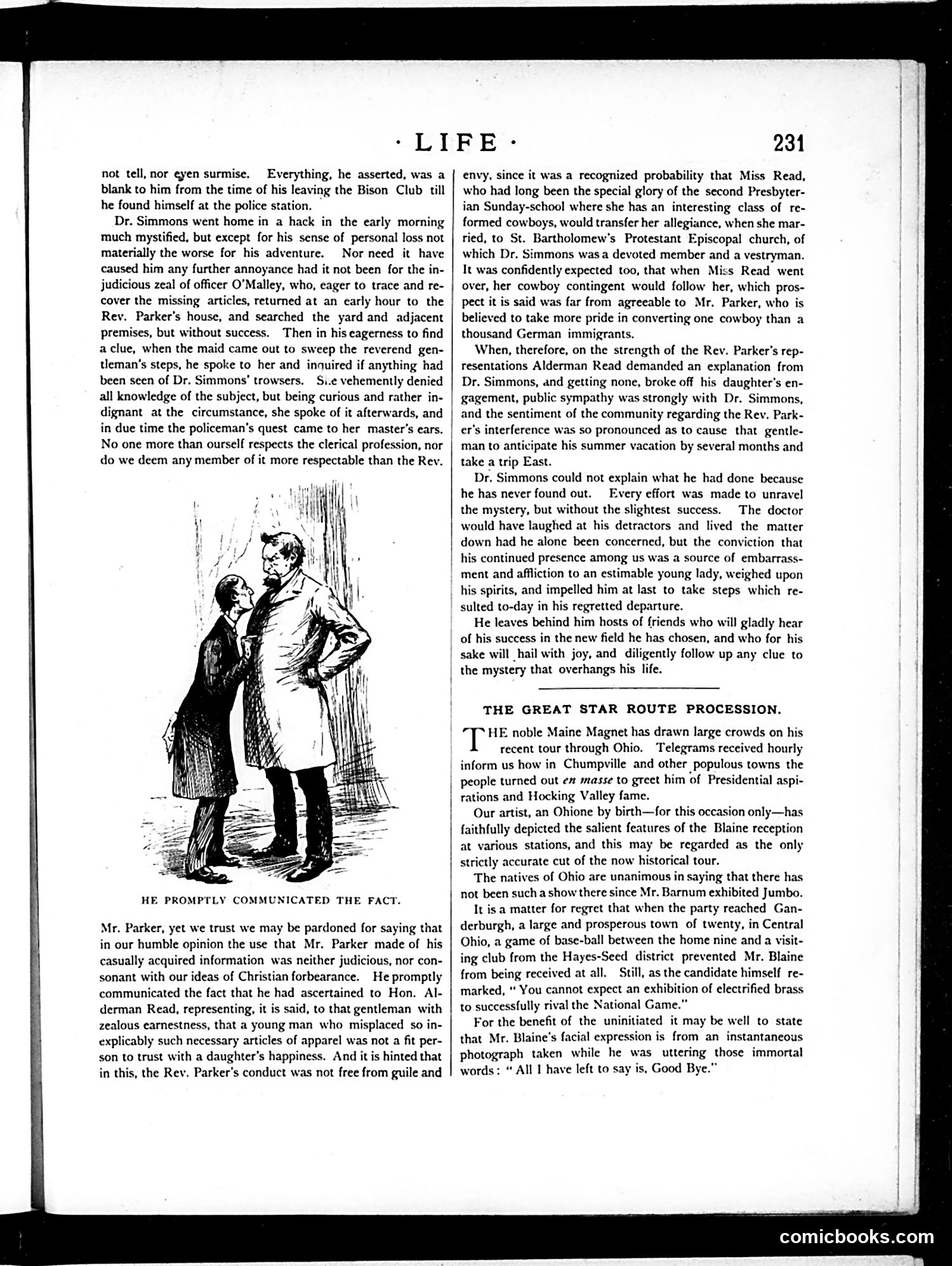
The illustrated vignette captioned "HE PROMPTLY COMMUNICATED THE FACT" depicts a serious conversation between two men—one appears to be a clergyman or authority figure (taller, in formal dress) and a younger man in darker clothing. The accompanying text describes a dispute involving Dr. Simmons, Rev. Parker, and Miss Read regarding a young woman's potential conversion from Presbyterianism to Episcopalianism. The satire targets religious rivalry and social pretension: a clergyman's intense concern over losing a parishioner to another denomination, and the community scandal this creates. The humor lies in depicting institutional religion as petty and self-interested, prioritizing denominational loyalty over genuine spiritual concerns—a critique common to 19th-century American satirical magazines like *Life*.
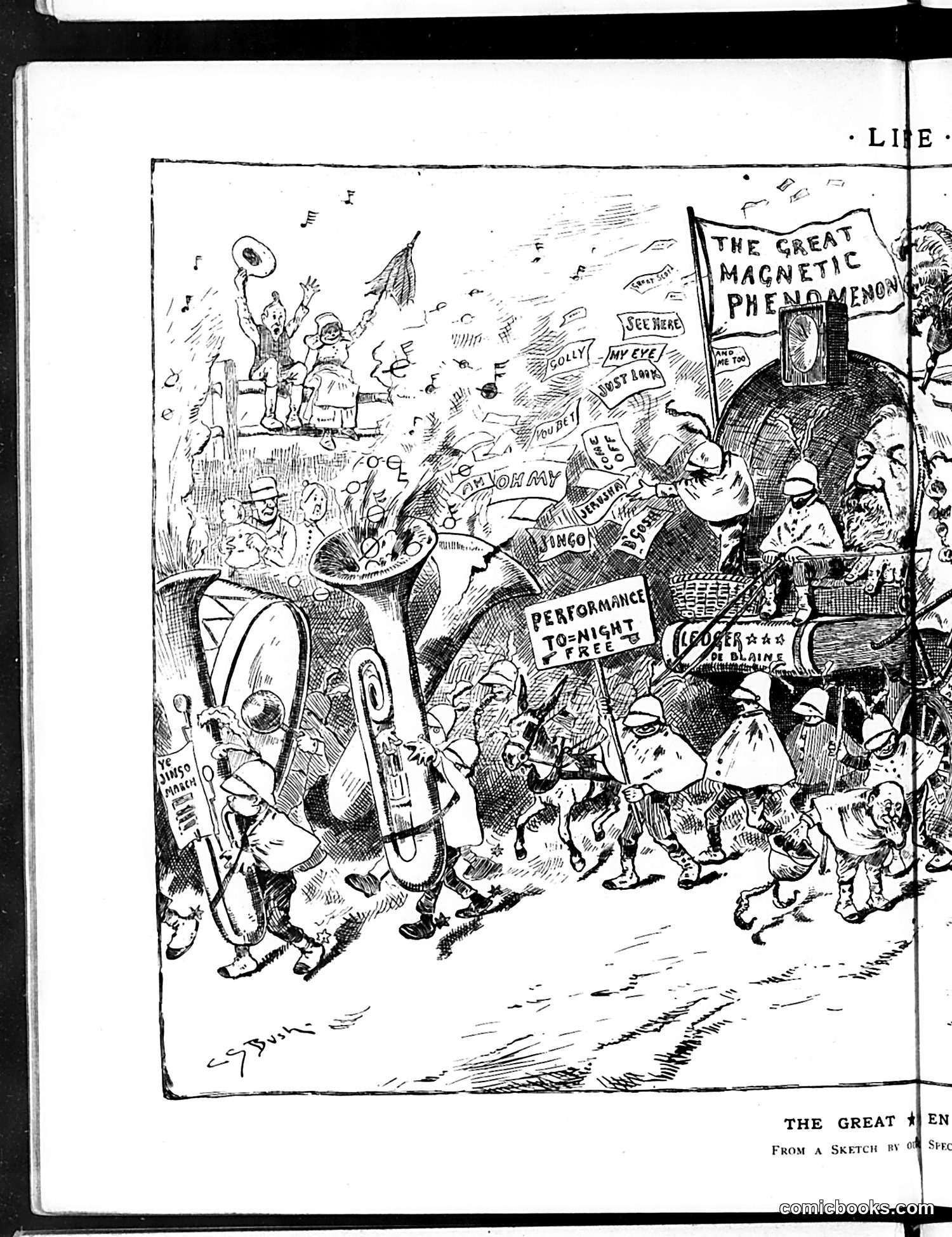
This satirical sketch depicts a circus-like spectacle centered on "The Great Magnetic Phenomenon"—a large attraction drawing crowds of eager spectators. The cartoon appears to satirize popular obsessions with novelty attractions and pseudoscientific claims of the era. Visible signage references various performers and acts ("See Here," "My Eye," "Performance Tonight Free"), suggesting commentary on how crowds are drawn to dubious attractions through sensational marketing. The chaotic crowd scene, with figures of various sizes including children, emphasizes how such phenomena appeal across all social classes. The style and presentation suggest this mocks either contemporary carnival attractions, medical quackery claims, or possibly spiritualist phenomena that were popular in early 20th-century America. The magnetic theme likely references pseudo-scientific attractions that claimed extraordinary powers.
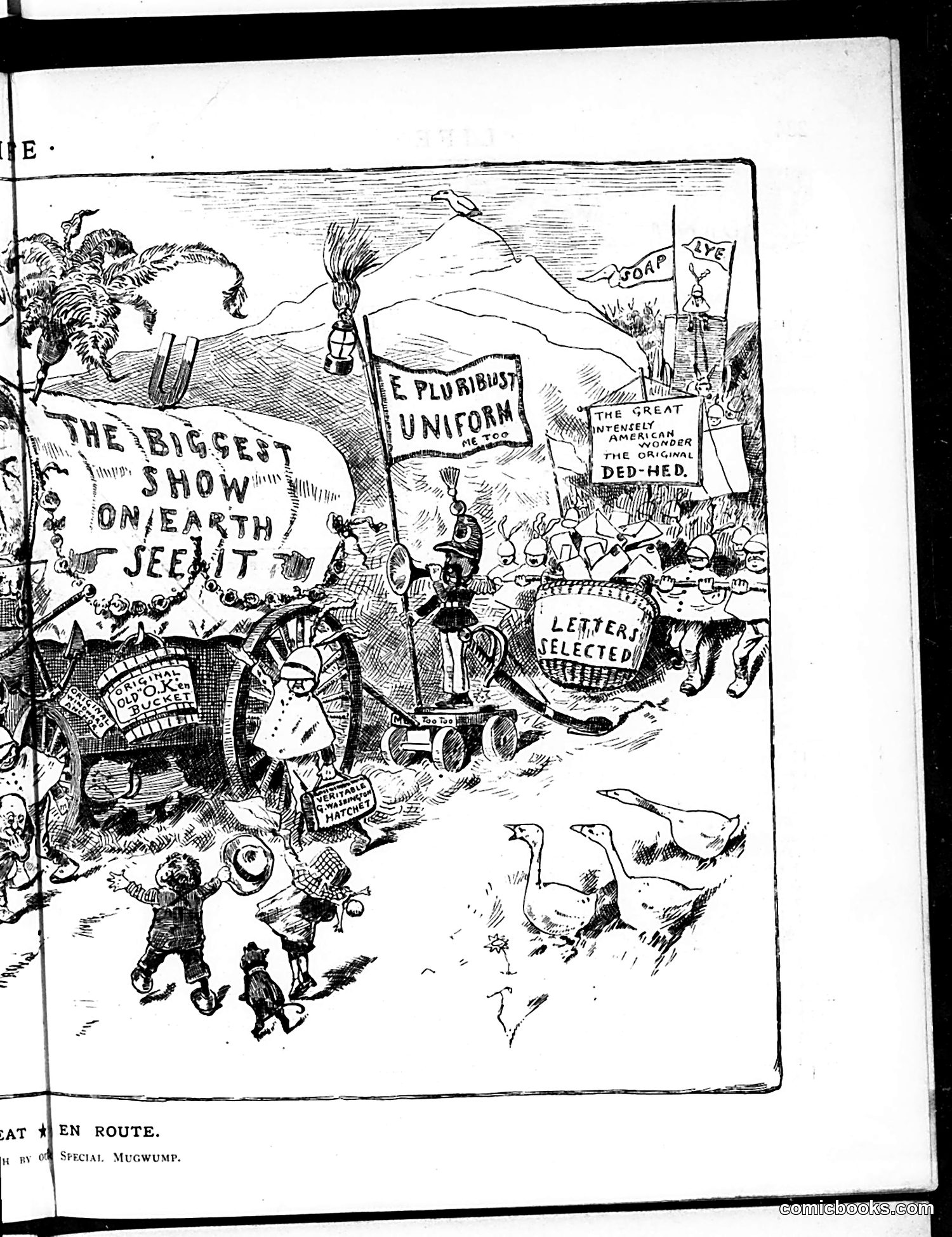
This satirical illustration depicts "The Biggest Show on Earth" — a carnival or circus scene showcasing various American attractions and personalities of the era. The banners reference shows including "E Pluribus Unum Uniform," "The Great Intensely American Original Dead," and "Letters Selected." The cartoon appears to mock American popular culture and entertainment through exaggerated carnival imagery. Giant geese in the foreground and crowds of spectators suggest the spectacle being satirized. The composition uses the carnival/circus as metaphor for American society itself — competitive, loud, and somewhat chaotic. Without clearer identification of specific figures or knowing the publication date, the exact political targets remain unclear, though the overall tone critiques American showmanship and commercial entertainment culture.
This page contains **theater criticism and humorous literary content**, not political cartoons. The main article reviews **Mr. Daly's theatrical company** returning from a successful European tour. The critic praises their production of "A Wooden Spoon," an adaptation of a German play about **political campaign methods**—noting the satire's timeliness to current electoral contests. He commends the acting performances (particularly Drew and Gilbert) while finding the play's humor somewhat dated by the campaign season's end. The page includes two separate pieces of **light verse**: "A Victory" by David A. Curtis, a whimsical poem about a boy picking an unripe peach, and the beginning of "The Thompson Street Poker Club," a humorous narrative about working-class characters (a Rev. Johnson, various club members) discussing their wages and personal misfortunes in colloquial dialect. **Context for modern readers**: This reflects Life's mix of theatrical reviews with satirical short fiction and poetry—typical 19th-century magazine content targeting educated, urban readers interested in theater and contemporary politics.
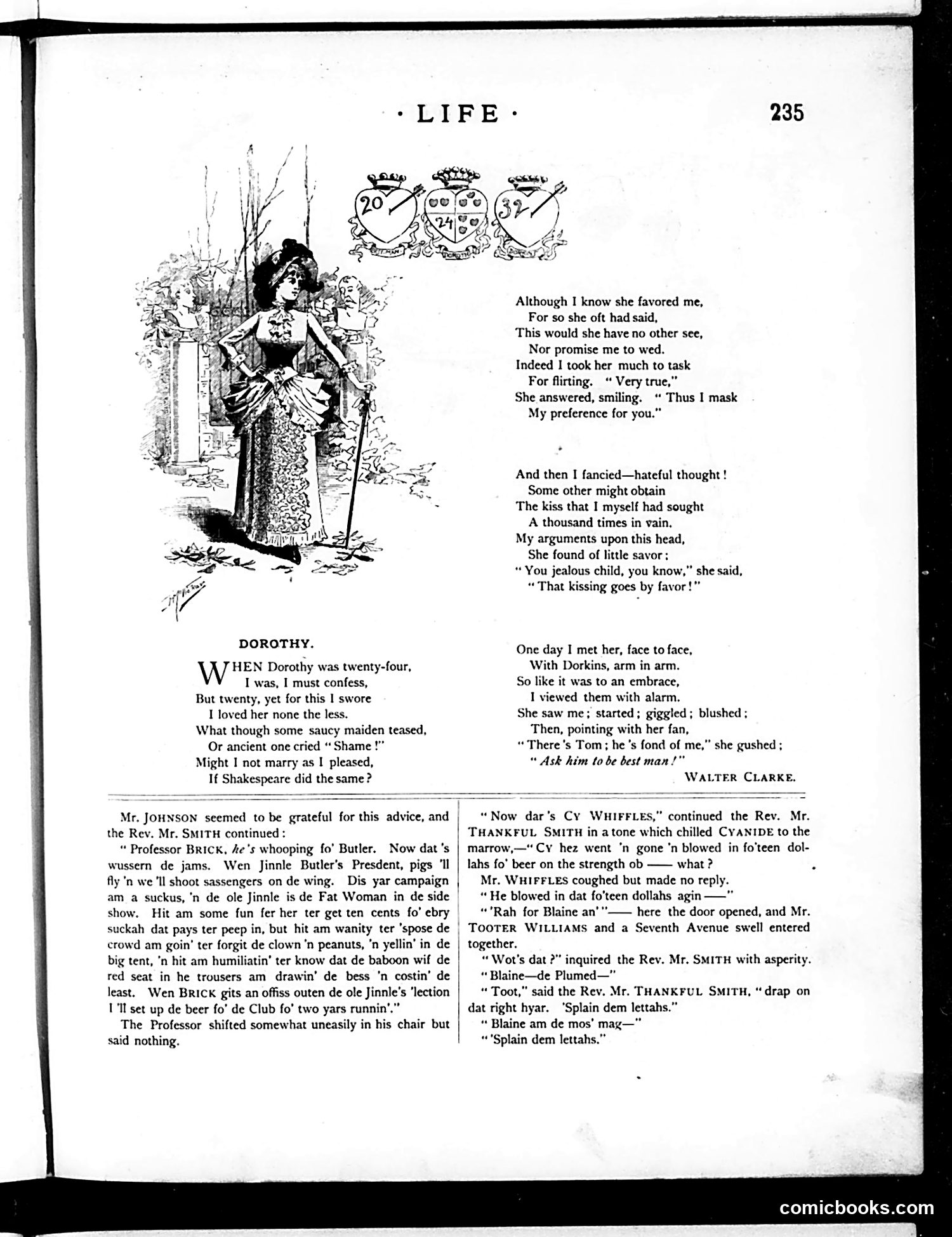
This page contains **two distinct pieces**: **Upper section—"Dorothy" poem by Walter Clarke:** A romantic verse about a young man pursuing Dorothy, who playfully resists commitment while flirting with others. The humor lies in her witty deflections—she tells him "kissing goes by favor" and later suggests he ask another man (Tom Dorkins) to be his best man. It's light romantic satire on courtship and female autonomy. **Lower section—Political dialogue:** A conversation featuring Rev. Mr. Thankful Smith criticizing political figures. Smith denounces "Professor Brick" supporting "Jinnle Butler" (likely James G. Blaine, referenced as "the Plumed"), calling the campaign a circus. He also scolds Cy Whiffles for wasting money on beer. The dialectal speech ("fo'teen dollahs," "'Splain dem lettahs") suggests satirizing rural or working-class political commentary, likely mocking both campaign enthusiasm and foolish spending during what appears to be an 1880s election cycle.
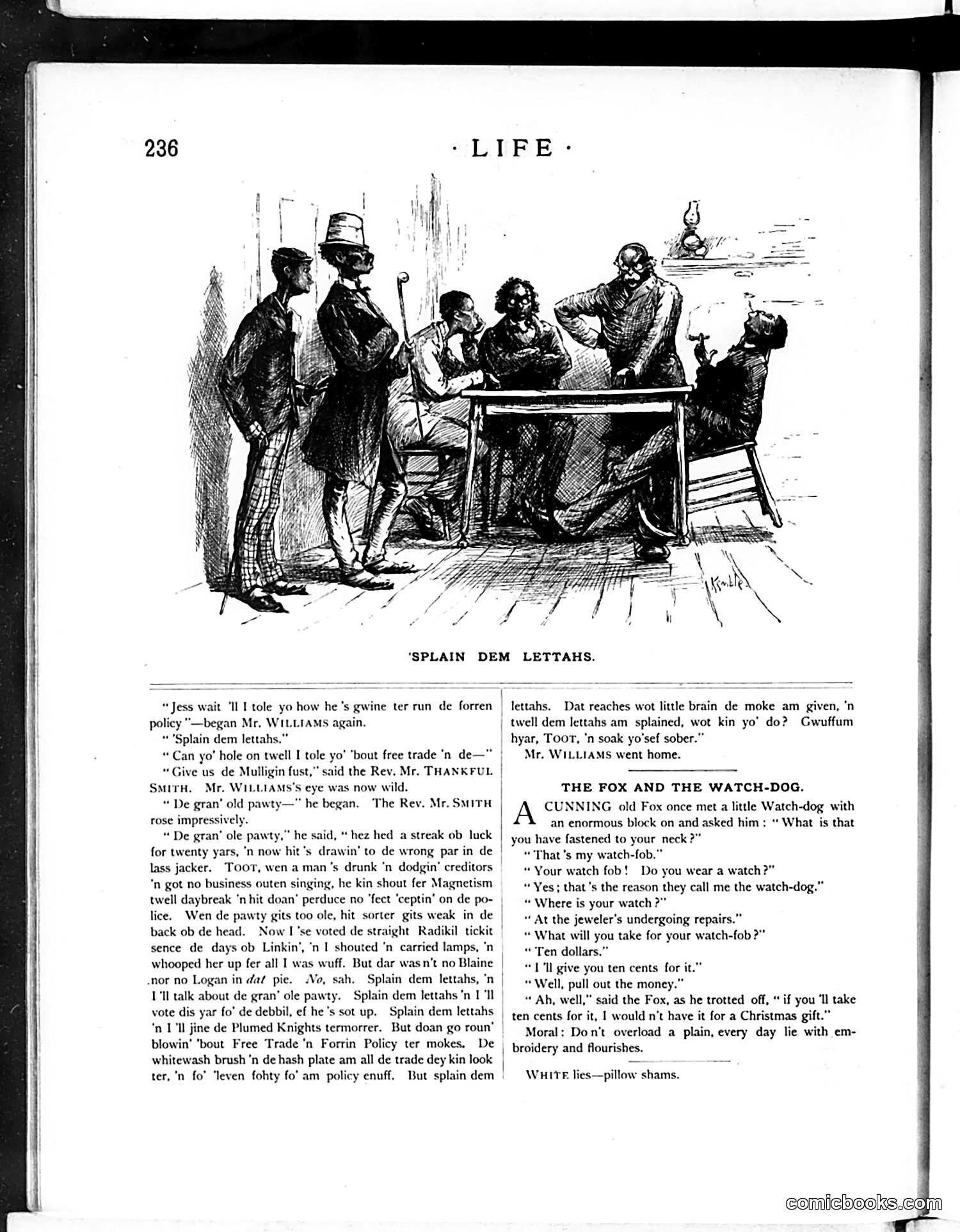
This Life magazine page contains two satirical pieces: **"'Splain Dem Lettahs"** (top cartoon): A dialect-heavy political sketch mocking African American voters. Mr. Williams, a Black Republican, demands to understand mysterious "letters" before discussing politics with Rev. Smith. The satire targets both Black voters portrayed as easily manipulated and the Republican Party's declining relevance ("the gran' ole pawty"). References to Blaine and Logan (Republican leaders) and the "Plumed Knights" (James Garfield supporters) suggest this dates to the 1880s era. The crude dialect reflects the racist caricature conventions of the era. **"The Fox and the Watch-Dog"** (bottom): A fable about deception. A cunning fox exploits a watch-dog's vanity—the dog wears only a fob (chain ornament) without an actual watch, claiming it's undergoing repairs. The fox easily cons him into accepting ten cents for it. The moral warns against embellishing lies; simple falsehoods are more credible than elaborate ones. Both pieces use humor to critique perceived foolishness and dishonesty in their respective subjects.
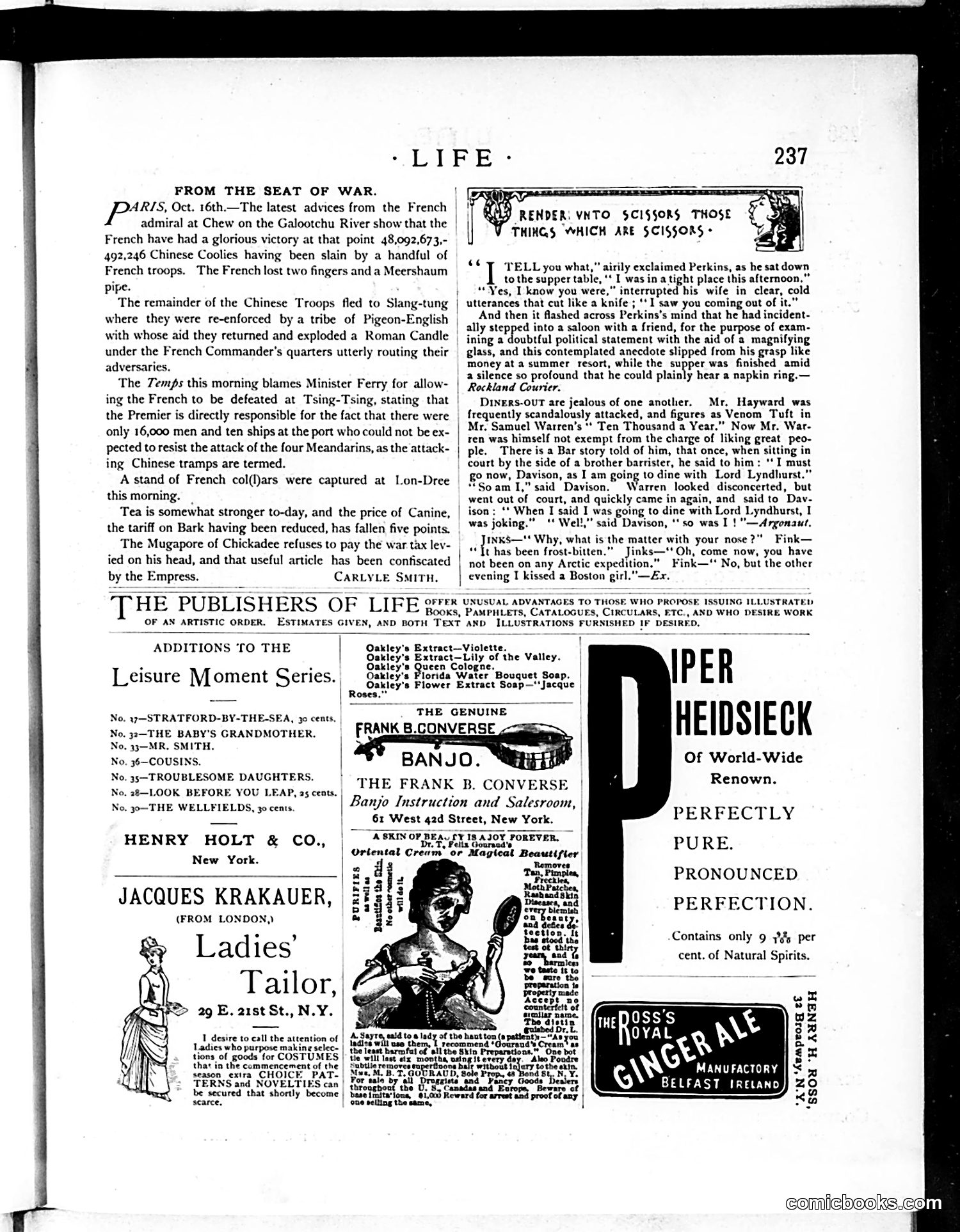
This page (October 16th) contains a satirical war dispatch titled "From the Seat of War," mocking European colonial military adventurism in China. The comedy relies on exaggeration and absurdity: French forces supposedly kill nearly 50 billion Chinese coolies while losing only two fingers and a pipe. References to "Pigeon-English" and fabricated place names ("Slang-tung," "Tsing-Tsing") suggest mockery of both the conflict's actual scale and Western colonial incompetence. The dispatch likely targets the Sino-French War (1884-1885) and contemporary colonial politics. Minister Ferry appears by name—he oversaw French colonial expansion and faced domestic criticism for military failures, making him a natural satirical target. The page's remaining content—domestic humor columns and advertisements—is typical of Life's mixed format. The cartoons emphasize domestic marital tension and social pretension rather than war commentary. The satire's point: colonial wars are absurd exercises in imperial posturing, reported through deliberately false statistics and fabricated military jargon.
This is primarily an **advertising page with no political cartoons or satirical content**. It consists entirely of commercial advertisements from late 19th-century New York businesses. Notable ads include: - **Luxury goods**: perfumes, fine fabrics, champagne (Bouché) - **Patent medicines**: charcoal tablets for dyspepsia, "electric belts" promising to cure "nervous debility" and "loss of manhood" (a common quack remedy of the era) - **Services**: merchant tailors, printers - **Entertainment**: theater listings for Daly's Theatre and the Eden Musée (a wax museum) - **Whiskey**: H.B. Kirk's "Old Crow" claiming monopoly on barrels since 1872 The ads reflect Gilded Age consumer culture and the prevalence of fraudulent medical devices marketed to young men. There is **no cartoon or satirical commentary visible** on this page.
This page is **primarily advertising** with one small cartoon. The cartoon shows two cherubs or cupids in conversation—one claims insomnia, the other says "Verve" cured him. It's a humorous advertisement for "Verve," a patent medicine claiming to treat insomnia naturally. The joke relies on the era's widespread insomnia epidemic, blamed on modern "Nervous Exhaustion" from overwork and worry. "Verve" marketed itself as a vegetable alternative to dangerous habit-forming drugs (opium, morphine, chloral) then commonly used as sleep aids. The remaining content is typical 1880s advertising: diamonds, magazines, cigarettes, rubber garments, fabric goods, and other patent medicines. The page reflects both genuine commercial products and dubious medical claims characteristic of the unregulated period—notably the "Cloth of Gold Cigarettes" and "Nervous Debility" cure also advertised here.
This page is predominantly **advertisements and magazine promotion**, not political satire or comics requiring historical context. The main content announces **The Century Magazine's** major new feature: a series of Civil War battle accounts written by prominent Union and Confederate generals (Grant, Beauregard, McClellan, Longstreet, etc.). This was presented as a significant publishing enterprise for November's edition. The page also advertises consumer products typical of the 1880s-90s: patent medicines (Crosby's Phosphites for "nerve tonic," Cuticura for skin conditions), pianos, clocks, candy, and bicycles. The only illustration with narrative element is "Tiny Tim," a food product advertisement, unrelated to Dickens. **There is no political cartoon or satire on this page.** It's a commercial/promotional page reflecting late-19th-century advertising and magazine publishing.