
Life, 1884-10-23 · page 7 of 16
Life — October 23, 1884 — page 7: what you’re looking at
What you’re looking at
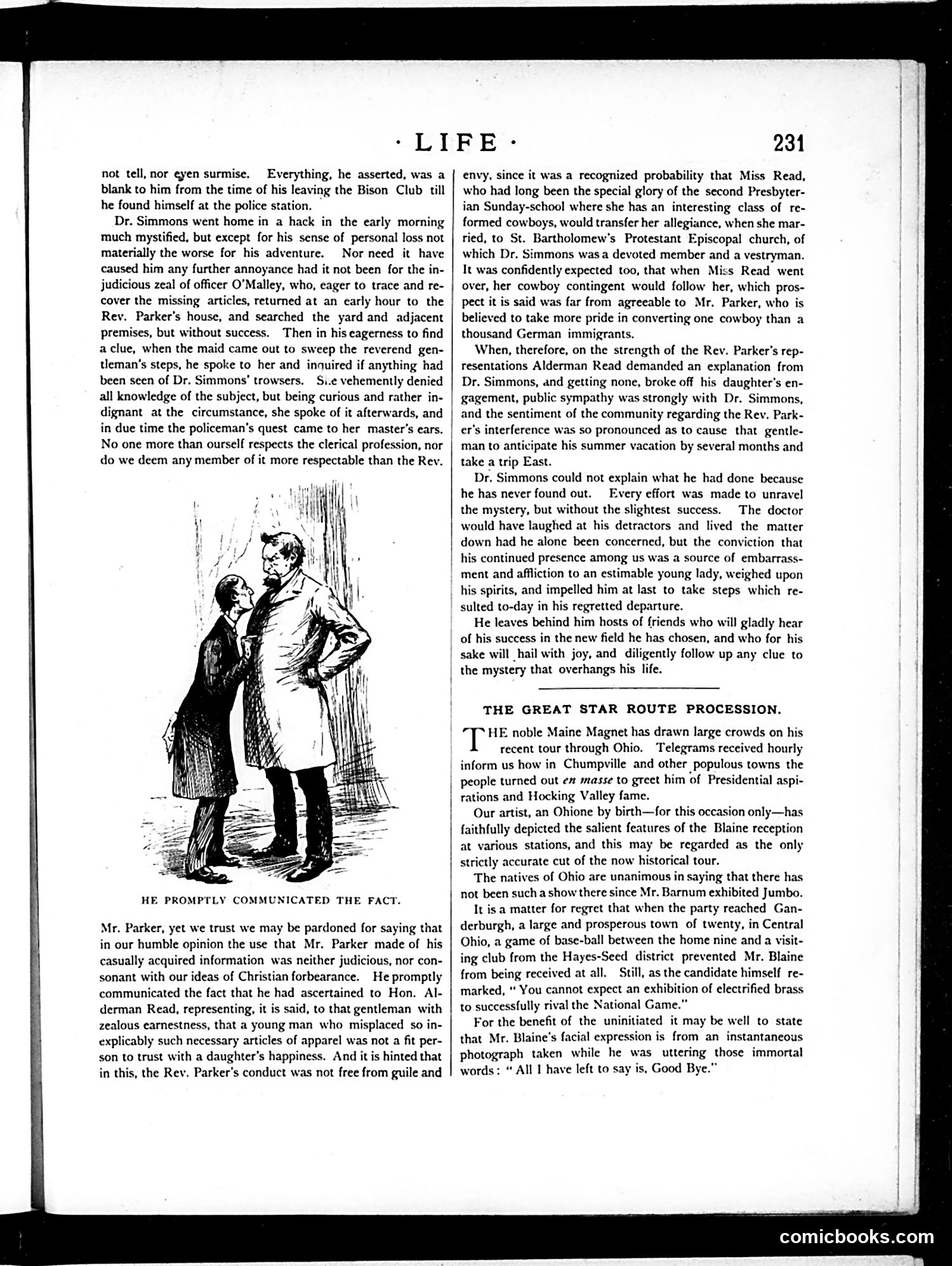
The illustrated vignette captioned "HE PROMPTLY COMMUNICATED THE FACT" depicts a serious conversation between two men—one appears to be a clergyman or authority figure (taller, in formal dress) and a younger man in darker clothing. The accompanying text describes a dispute involving Dr. Simmons, Rev. Parker, and Miss Read regarding a young woman's potential conversion from Presbyterianism to Episcopalianism. The satire targets religious rivalry and social pretension: a clergyman's intense concern over losing a parishioner to another denomination, and the community scandal this creates. The humor lies in depicting institutional religion as petty and self-interested, prioritizing denominational loyalty over genuine spiritual concerns—a critique common to 19th-century American satirical magazines like *Life*.
📄 Transcribed text from this page (OCR, searchable)
Machine-transcribed from the original scan — historical spelling and the odd misread are preserved.
*- LIFE: not tell, nor eyen surmise. Everything, he asserted, was a blank to him from the time of his leaving the Bison Club till he found himself at the police station. Dr. Simmons went home in a hack in the early morning much mystified, but except for his sense of personal loss not materially the worse for his adventure. Nor need it have caused him any further annoyance had it not been for the in- judicious zeal of officer O'Malley, who, eager to trace and re- cover the missing articles, returned at an early hour to the Rev. Parker's house, and searched the yard and adjacent premises, but without success. Then in his eagerness to find aclue, when the maid came out to sweep the reverend gen- tleman’s steps, he spoke to her and inquired if anything had been seen of Dr. Simmons’ trowsers. Si.e vehemently denied all knowledge of the subject, but being curious and rather in- dignant at the circumstance, she spoke of it afterwards, and in due time the policeman’s quest came to her master’s ears. No one more than ourself respects the clerical profession, nor do we deem any member of it more respectable than the Rev. HE PROMPTLY COMMUNICATED THE FACT. Mr. Parker, yet we trust we may be pardoned for saying that in our humble opinion the use that Mr. Parker made of his casually acquired information was neither judicious, nor con- sonant with our ideas of Christian forbearance. He promptly communicated the fact that he had ascertained to Hon. Al- derman Read, representing, it is said, to that gentleman with zealous earnestness, that a young man who misplaced so in- explicably such necessary articles of apparel was not a fit per- son to trust with a daughter's happiness. And it is hinted that in this, the Rev. Parker's conduct was not free from guile and 231 envy, since it was a recognized probability that Miss Read, who had long been the special glory of the second Presbyter- ian Sunday-school where she has an interesting class of re- formed cowboys, would transfer her allegiance, when she mar- ried, to St. Bartholomew's Protestant Episcopal church, of which Dr. Simmons was a devoted member and a vestryman. It was confidently expected too, that when Miss Read went over, her cowboy contingent would follow her, which pros- pect it is said was far from agreeable to Mr. Parker, who is believed to take more pride in converting one cowboy than a thousand German immigrants. When, therefore, on the strength of the Rev. Parker's rep- resentations Alderman Read demanded an explanation from Dr. Simmons, and getting none, broke off his daughter's en- gagement, public sympathy was strongly with Dr. Simmons, and the sentiment of the community regarding the Rev. Park- er's interference was so pronounced as to cause that gentle- man to anticipate his summer vacation by several months and take a trip East. Dr. Simmons could not explain what he had done because he has never found out. Every effort was made to unravel the mystery, but without the slightest success. The doctor would have laughed at his detractors and lived the matter down had he alone been concerned, but the conviction that his continued presence among us was a source of embarrass- ment and affliction to an estimable young lady, weighed upon his spirits, and impelled him at last to take steps which re- sulted to-day in his regretted departure. He leaves behind him hosts of friends who will gladly hear of his success in the new field he has chosen, and who for his sake will hail with joy, and diligently follow up any clue to the mystery that overhangs his life. THE GREAT STAR ROUTE PROCESSION. HE noble Maine Magnet has drawn large crowds on his recent tour through Ohio. Telegrams received hourly inform us how in Chumpville and other populous towns the people turned out 7 masse to greet him of Presidential aspi- rations and Hocking Valley fame. Our artist, an Ohione by birth—for this occasion only—has faithfully depicted the salient features of the Blaine reception at various stations, and this may be regarded as the only strictly accurate cut of the now historical tour. The natives of Ohio are unanimous in saying that there has not been such a show there since Mr. Barnum exhibited Jumbo. It isa matter for regret that when the party reached Gan- derburgh, a large and prosperous town of twenty, in Central Ohio, a game of base-ball between the home nine and a visit- ing club from the Hayes-Seed district prevented Mr. Blaine from being received at all. Still, as the candidate himself re- marked, “ You cannot expect an exhibition of electrified brass to successfully rival the National Game.” For the benefit of the uninitiated it may be well to state that Mr. Blaine’s facial expression is from an instantaneous photograph taken while he was uttering those immortal words: “ All I have left to say is, Good Bye.” comicbooks.com