
A complete issue · 16 pages · 1883
Life — October 4, 1883
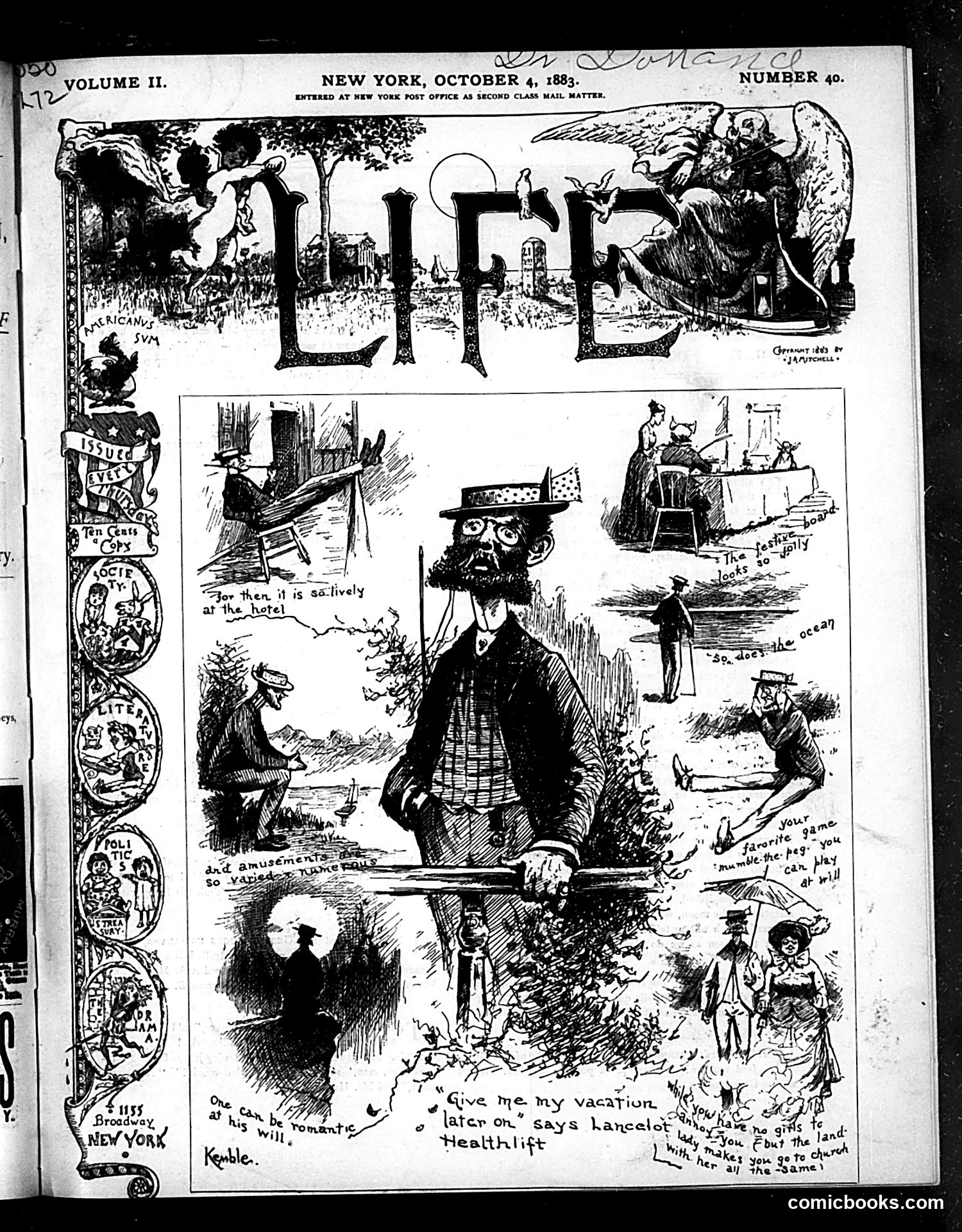
This page satirizes the leisure activities and pretensions of wealthy Americans. The central figure appears to be a portly gentleman in a top hat, surrounded by vignettes depicting various vacation amusements—hotel stays, fishing, and seaside recreation. The captions mock these pursuits as artificial diversions. The satire targets the wealthy class's desperate search for entertainment and relaxation. One caption reads "Give me my vacation later on," suggesting that even leisure time feels obligatory and scheduled rather than genuinely restful. The overall message critiques how the wealthy, despite their resources, cannot find authentic satisfaction—their vacations and "healthful" diversions are merely performative escapes from their actual lives. The decorative sidebar showcases Life magazine's typical illustrated advertisements and branding from this period.
The page contains a decorative header illustration but consists primarily of brief satirical commentary pieces ("departments") rather than political cartoons. The visible items mock various subjects: - A lengthy piece advocates exploring frozen regions (likely Arctic exploration, a contemporary obsession) - A quip about Prince George of England and Niagara Falls - References to Miss Anderson (unclear which figure), the Prince of Wales, and war maps - Comments on the Queen of Servia's debt and poetry - Brief notes about Buffalo harmony, Roman Catholic appointments, and Western Union/Denver Without identifying the specific individuals referenced beyond Prince George, the page exemplifies Life's typical satirical format: witty, topical commentary on current events, public figures, and social absurdities. The tone is gossipy and irreverent rather than deeply political.
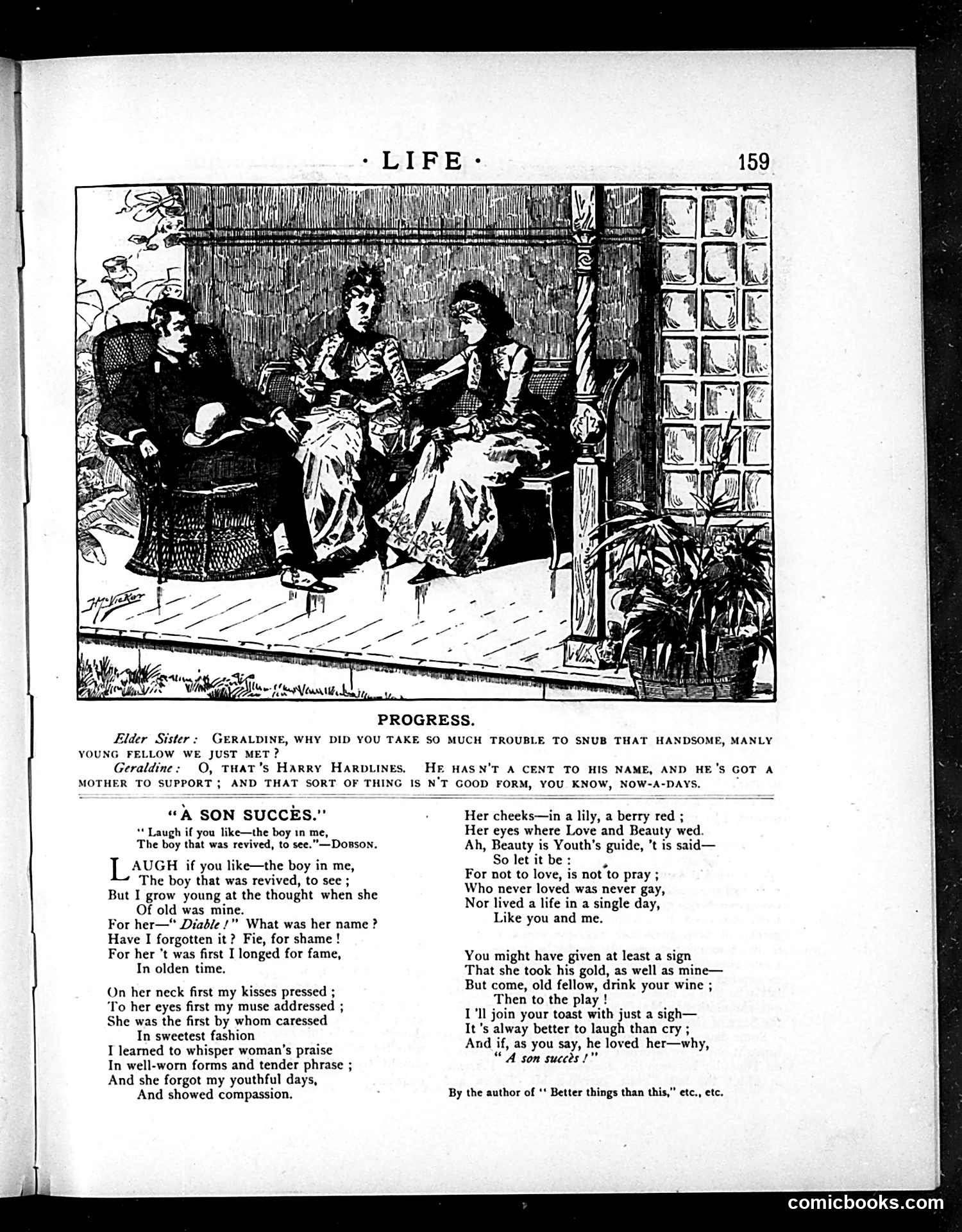
This satirical cartoon depicts four women in an interior setting, illustrating a dialogue about courtship standards. The "Elder Sister" criticizes "Geraldine" for snubbing "Harry Hardlines," a poor but respectable young man without money or family connections. The accompanying poem "A Son Succeeds" mocks this attitude, suggesting that modern women prioritize wealth and social status over genuine character and love. The satire critiques what the author views as shallow, materialistic values in courtship—the elevation of financial "progress" over emotional connection. The title "Progress" is ironic: the poem questions whether this represents actual social advancement or moral decline. It's a commentary on Gilded Age values, where marriage had become transactional rather than romantic.
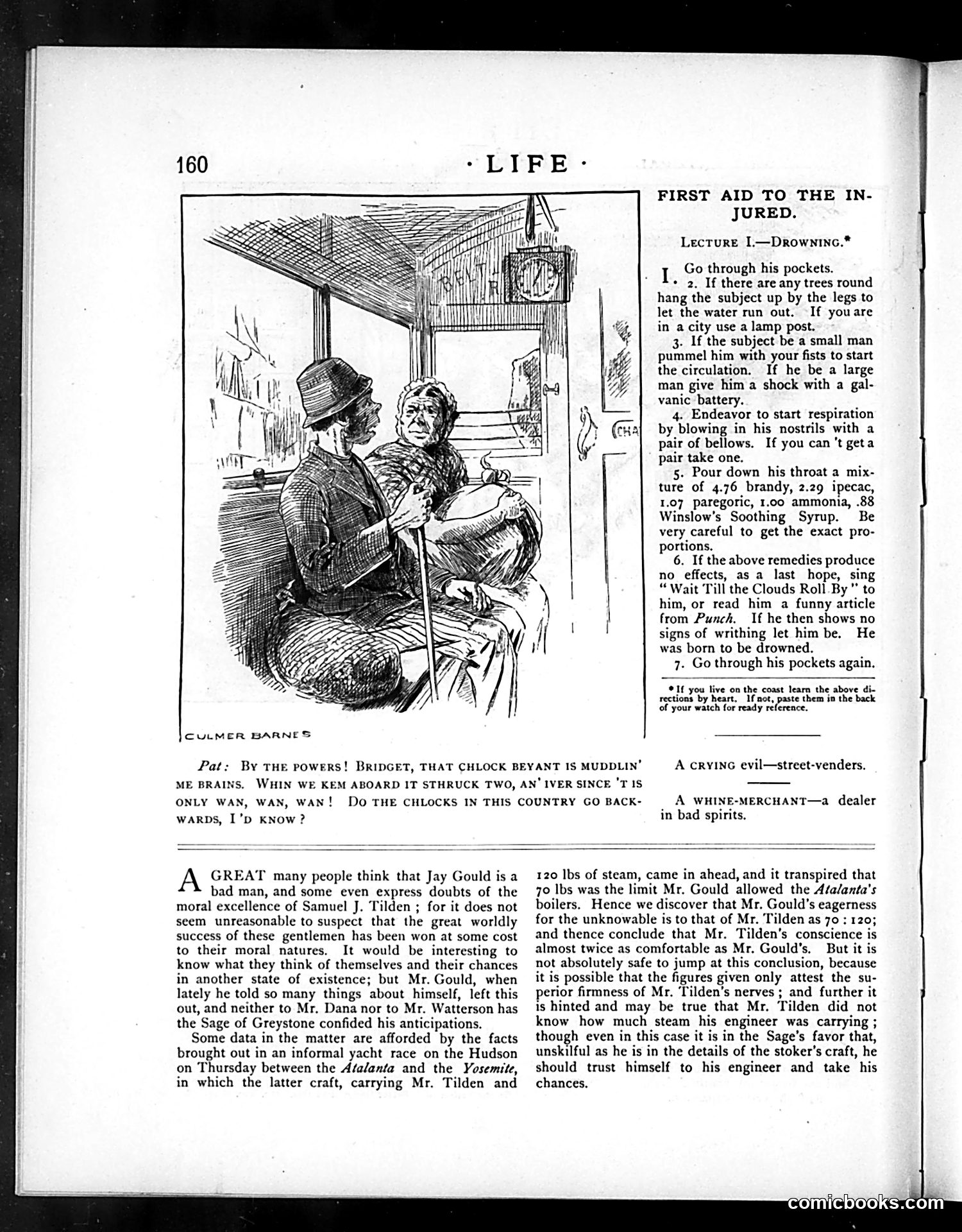
The main cartoon by Culmer Barnes depicts two figures in a railway carriage—one wearing a top hat (appearing to be a gentleman) and another (seemingly working-class). The caption's dialect humor ("By the powers! Bridget, that chlock beyant is muddlin' me brains") satirizes Irish immigrant speech patterns. The accompanying text discusses Jay Gould (a prominent 19th-century railroad magnate) and Samuel Tilden, examining their moral character and business practices. The satire criticizes Gould's reputation as ruthless and morally questionable, while defending Tilden's integrity. The page represents *Life*'s characteristic social commentary: mocking immigrant accents and Irish stereotypes while simultaneously critiquing wealthy railroad barons' business ethics—reflecting class tensions of the Gilded Age.
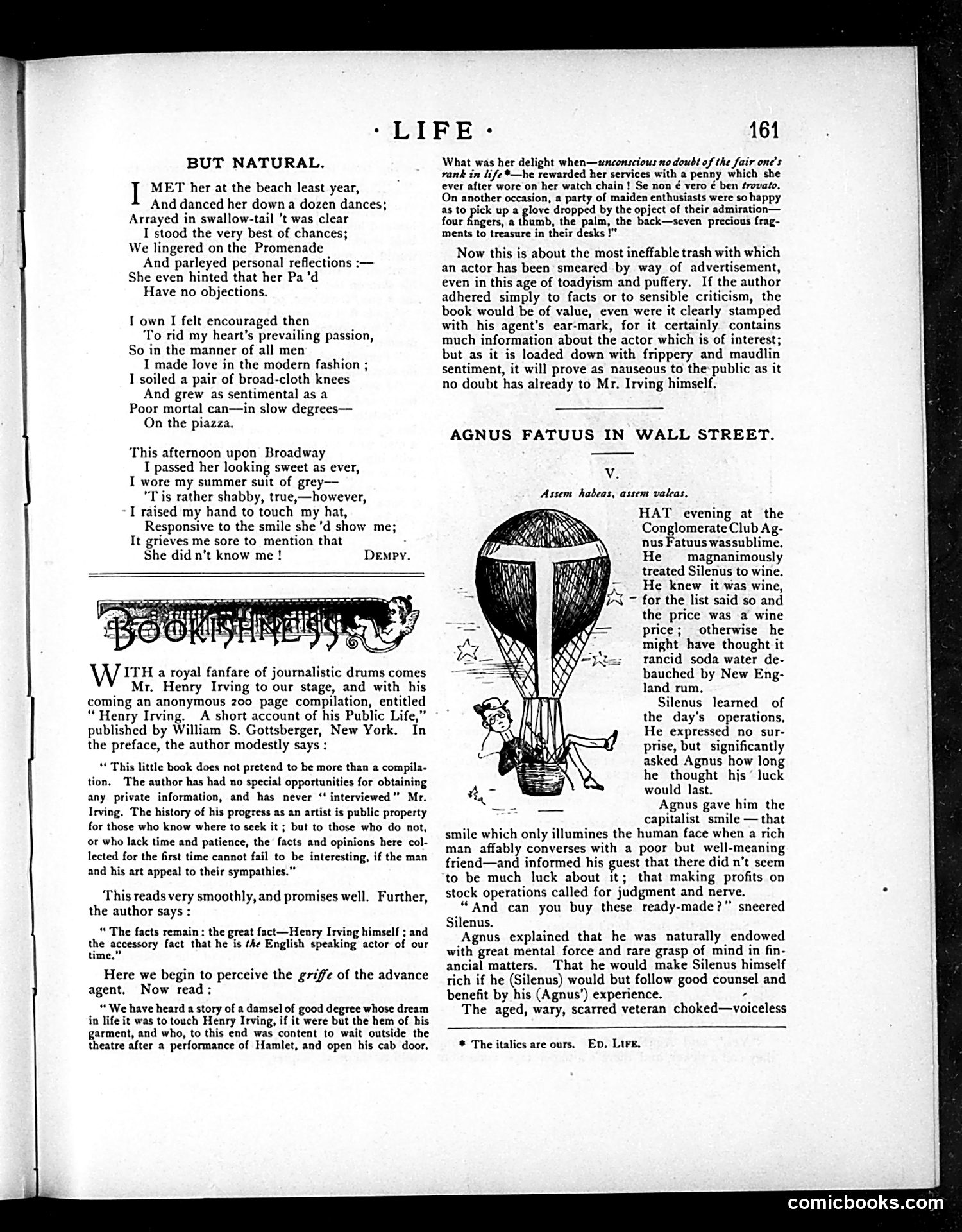
This page contains two distinct sections: **"But Natural"** (left): A poem about a romantic encounter at the beach, culminating in the speaker's regret at a missed social opportunity. It's sentimental Victorian-era verse typical of Life's humor—mocking overly earnest romantic poetry through understated rejection. **"Agnus Fatuus in Wall Street"** (right): A satirical piece about Henry Irving, a celebrated actor of the era, whose unauthorized biography was published. The text criticizes the book as exploitative gossip dressed up as serious literature. The accompanying illustration shows a hot-air balloon (labeled "Agnus Fatuus"—Latin for "foolish fire," a will-o'-the-wisp), mocking how such publicity inflates actors' egos. The satire targets both invasive celebrity biography and the theatrical world's vanity.
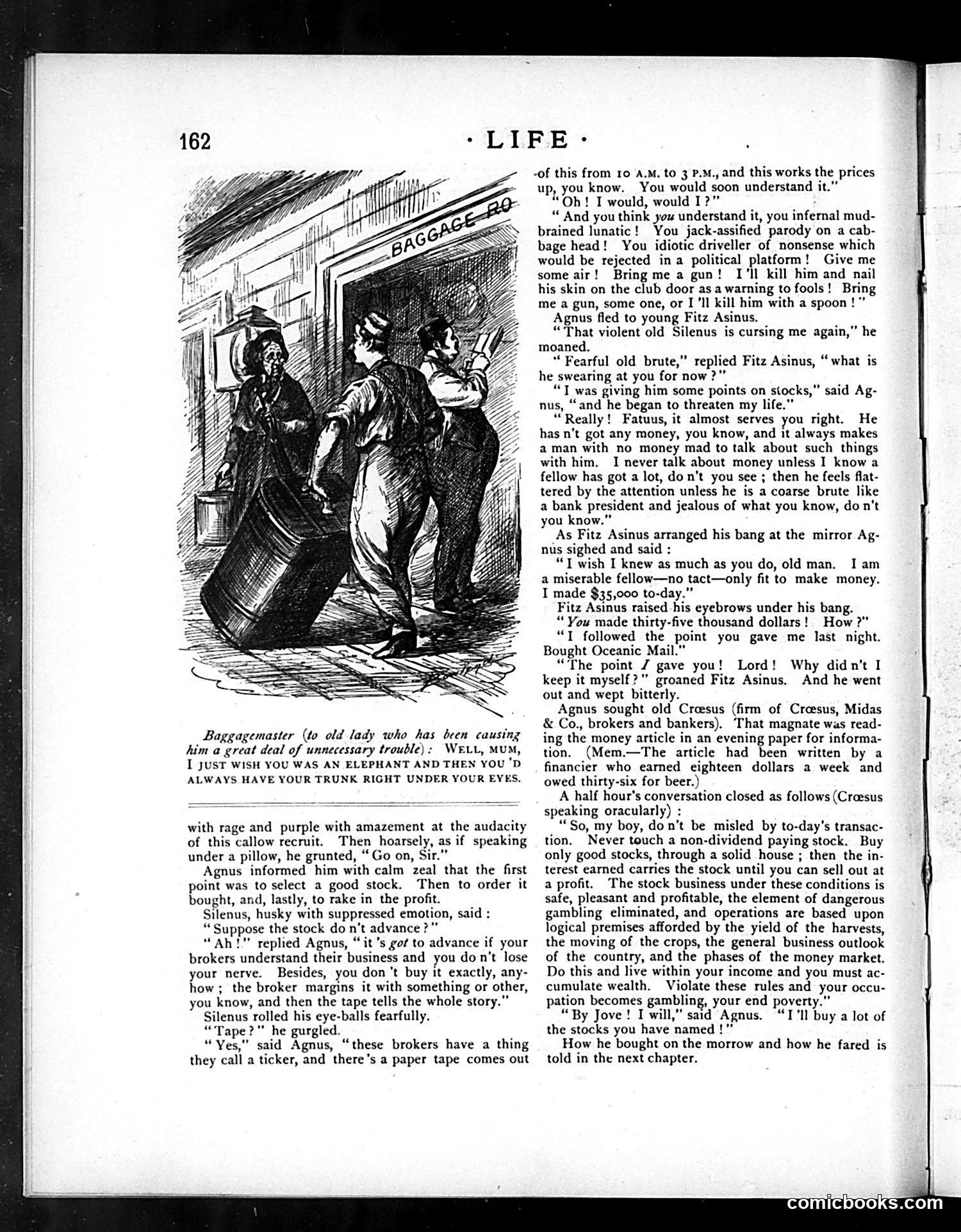
The illustration depicts a "Baggagemaster" confronting what appears to be a railway passenger or traveler at a baggage room. The caption reads: "Well, mum, I just wish you was an elephant and then you'd always have your trunk right under your eyes." This is a visual pun satirizing absent-minded travelers—the joke plays on the double meaning of "trunk" (both luggage and an elephant's appendage). The accompanying text discusses stock market speculation and investment advice, featuring characters named Agnus, Fitz Asinus, and Silanus debating financial tactics. The passage mocks get-rich-quick schemes and warns against risky stock trading, advocating instead for conservative, dividend-paying investments based on fundamental business principles. The page combines humor with financial satire typical of Life's era.
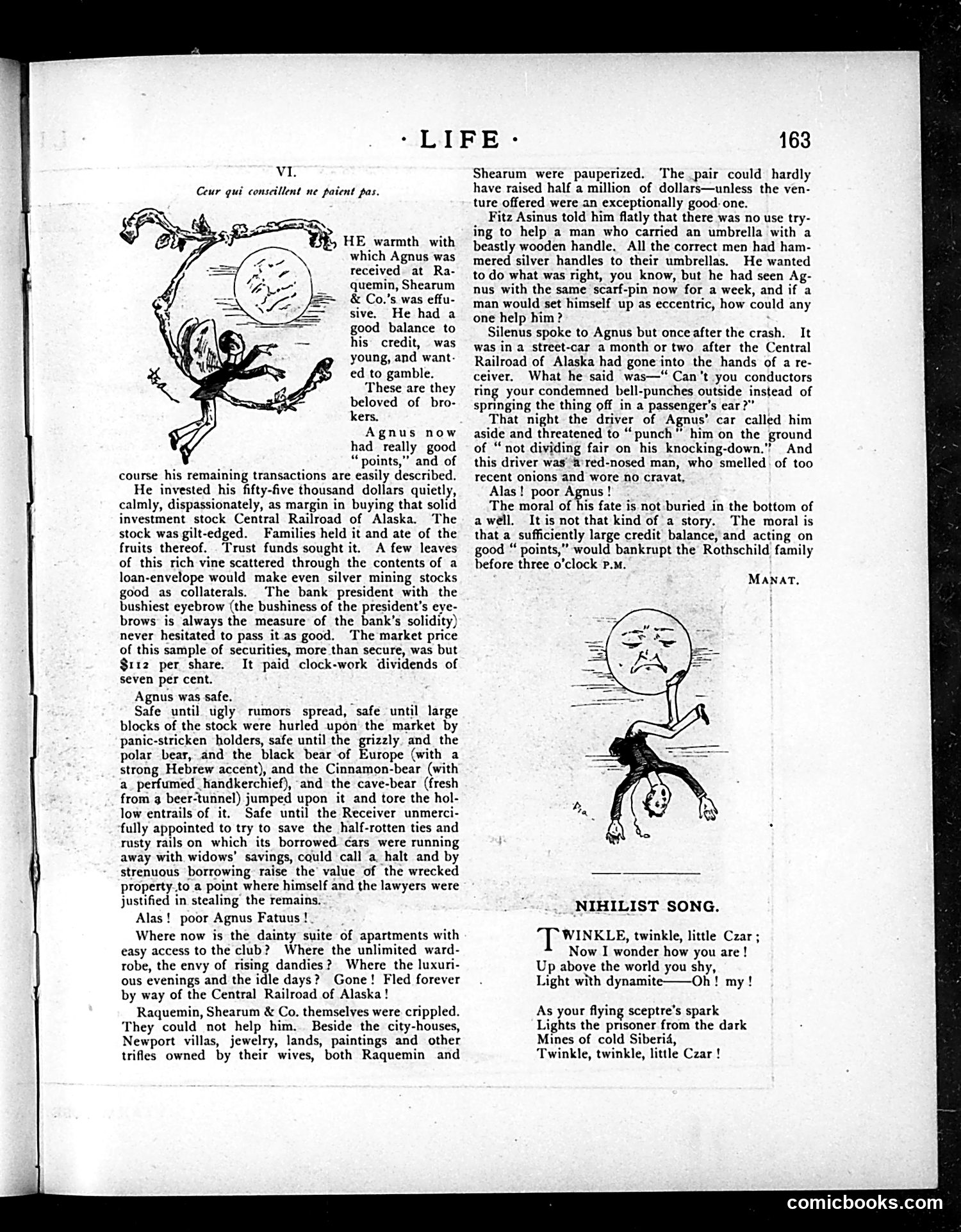
This page contains two distinct satirical pieces about financial collapse, likely from the early 1900s. **Top Section ("Cur qui consuluit ne paint pas"):** The cartoon depicts Agnus, a financier who invested in Central Railroad of Alaska stock. The text satirizes his catastrophic losses when the railroad failed—stock became worthless as "panic-stricken holders" dumped shares. The story mocks wealthy investors who lost fortunes, including properties and art collections, through what appears to be the Alaska railroad scheme collapse. **"Nihilist Song":** This poem appears to mock Russian nihilism or anarchism, addressing "little Czar" with dark humor about dynamite and Siberian mines. The page satirizes both financial speculation's dangers and radical political movements of the era.
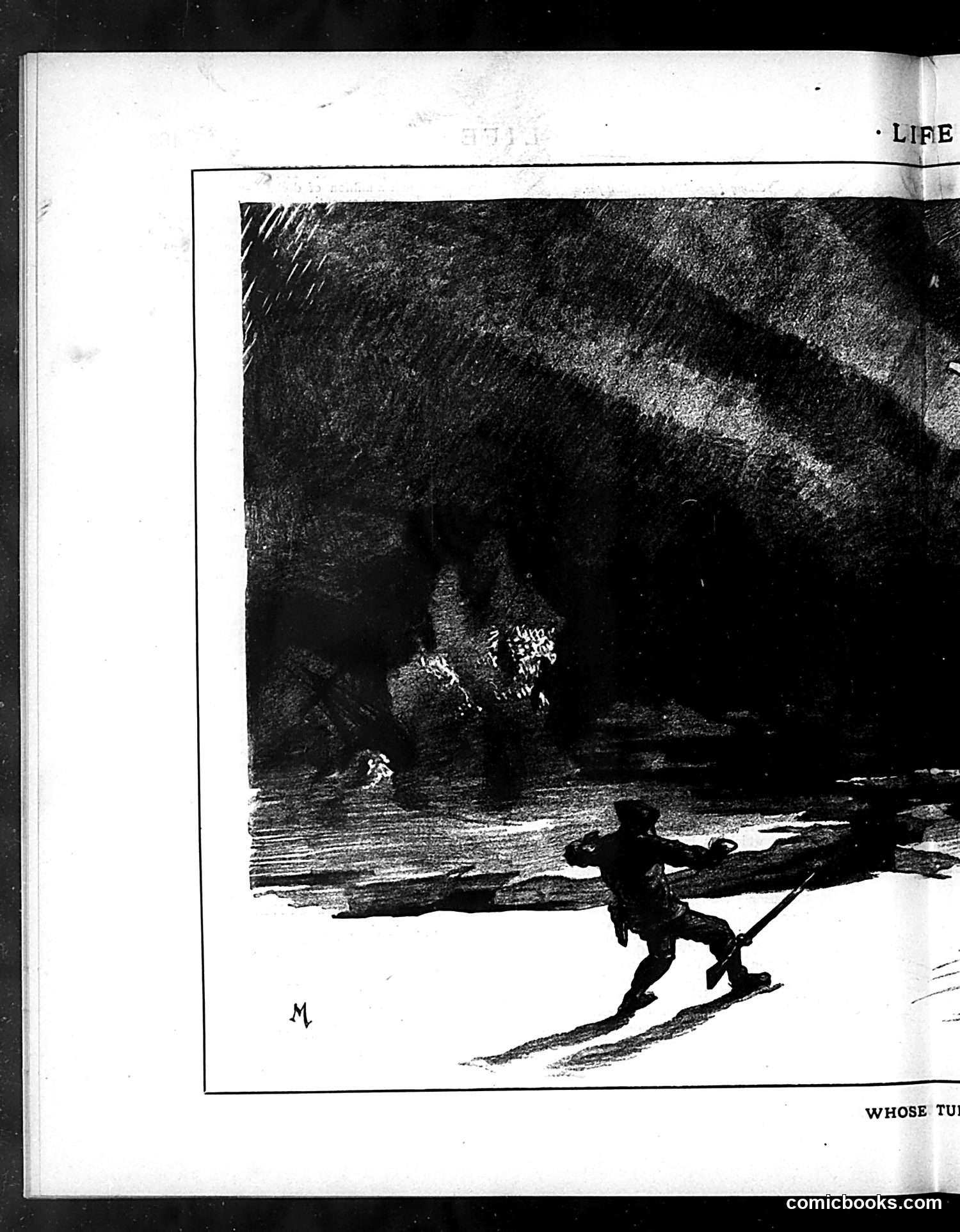
This page from *Life* magazine shows a silhouetted figure skiing or water-skiing, being pulled by what appears to be a large fallen log or timber in a mountainous/forested setting. The image is dramatically lit with strong contrasts between dark shadows and bright highlights. The partial caption reads "WHOSE TU[...]" (cut off), making the specific satirical target unclear from the visible text. Without the complete caption or publication date, I cannot definitively identify which political figure or social phenomenon this cartoon targets. The composition suggests commentary on being dragged or pulled along by external forces—possibly critiquing someone's dependence on or manipulation by another party or circumstance—but the precise meaning remains uncertain without additional context.
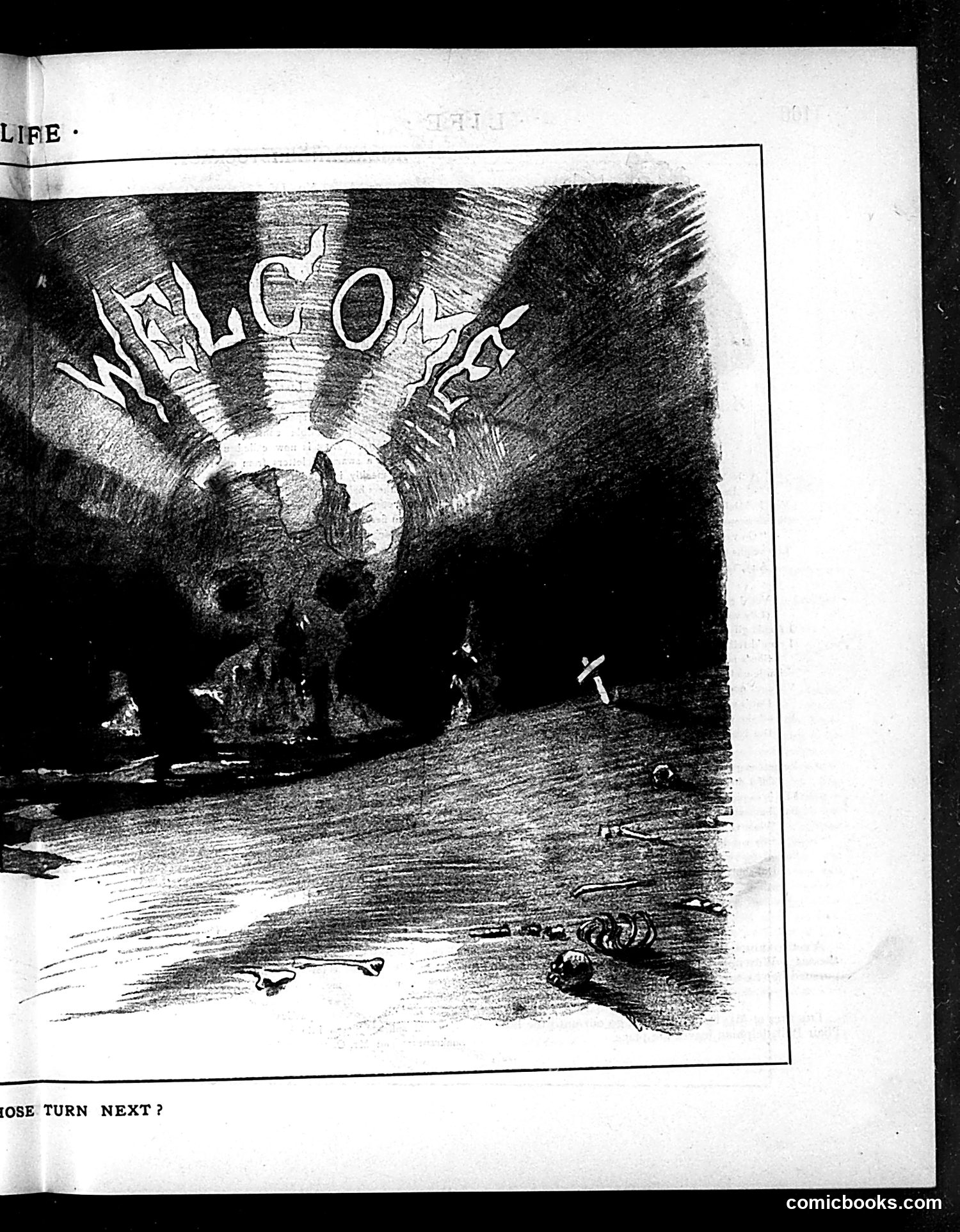
This appears to be a political cartoon from Life magazine's satirical section. The image shows a nighttime scene with figures gathered around what appears to be a grave or funeral setting, with crosses visible. The prominent text "WHOSE TURN NEXT?" at the bottom suggests dark commentary about death or elimination. The dramatic lighting and skeletal imagery, combined with the ominous question, indicate this is likely satirizing political or social conflict—possibly referencing deaths, purges, or violent conflict during a specific historical period. Without clearer identification of the figures or additional context text visible on the page, I cannot definitively state which political figures or events are being referenced. The style and approach suggest early-to-mid 20th century American political satire.
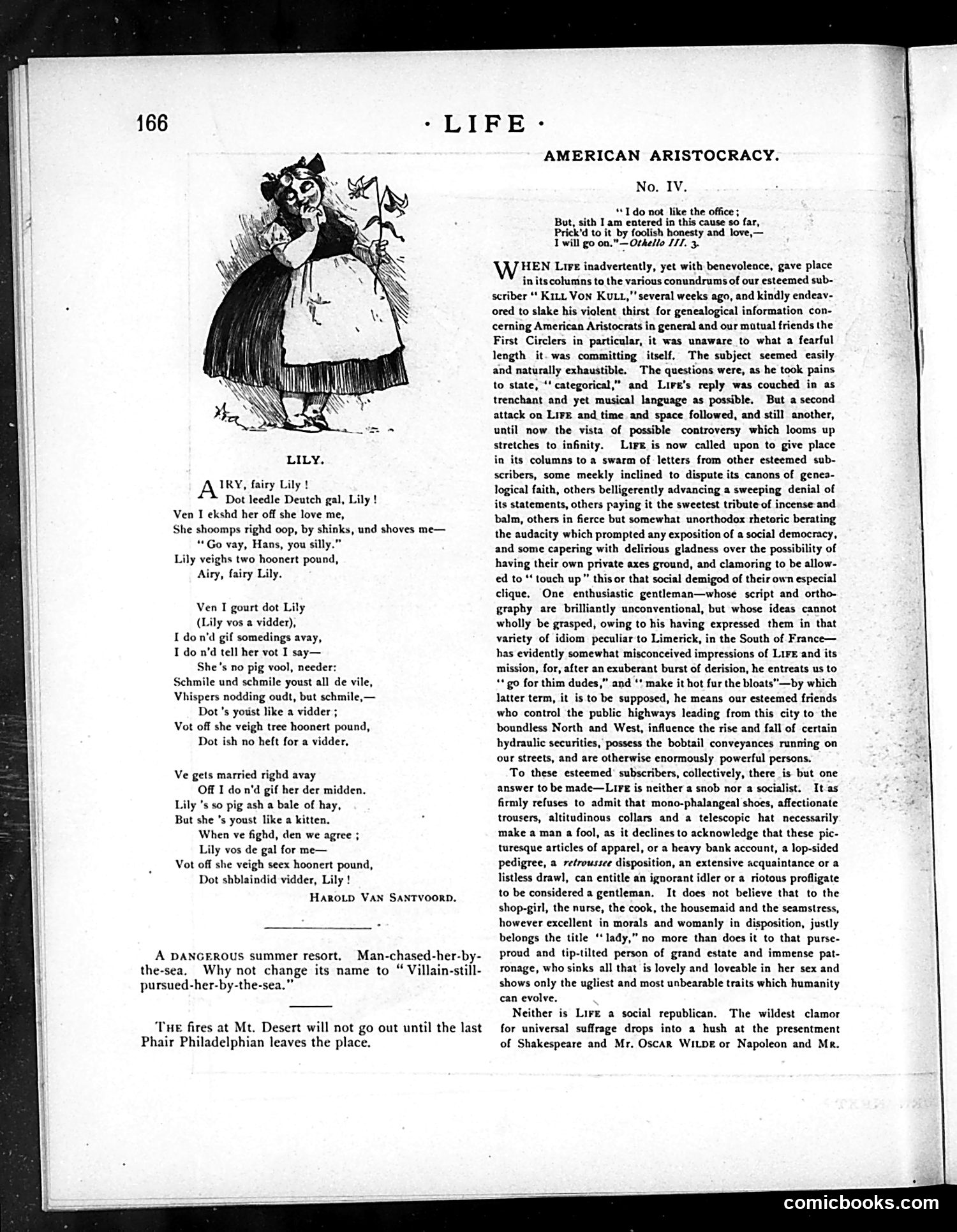
**The "Lily" Poem:** A comedic dialect piece mocking German-American courtship. The speaker, "Hans," pursues a rotund German girl named Lily, progressively exaggerating her weight (200, 300, even 600 pounds). The humor relies on heavy Germanic accent rendering ("dot," "vos," "schmile") and the absurdist image of a massive woman who remains desirable despite her size. This satirizes both immigrant speech patterns and romantic folly. **"American Aristocracy No. IV":** Life responds to reader backlash over previous articles about New York's elite "First Circlers." Subscribers—some defending genealogical claims, others attacking Life's social commentary—have flooded the magazine with letters. Life defends itself as neither snobbish nor socialist, but simply objective about America's wealthy classes who control "public highways," finance, and transportation. The piece mocks both the aristocrats themselves and readers obsessed with defending or attacking them.
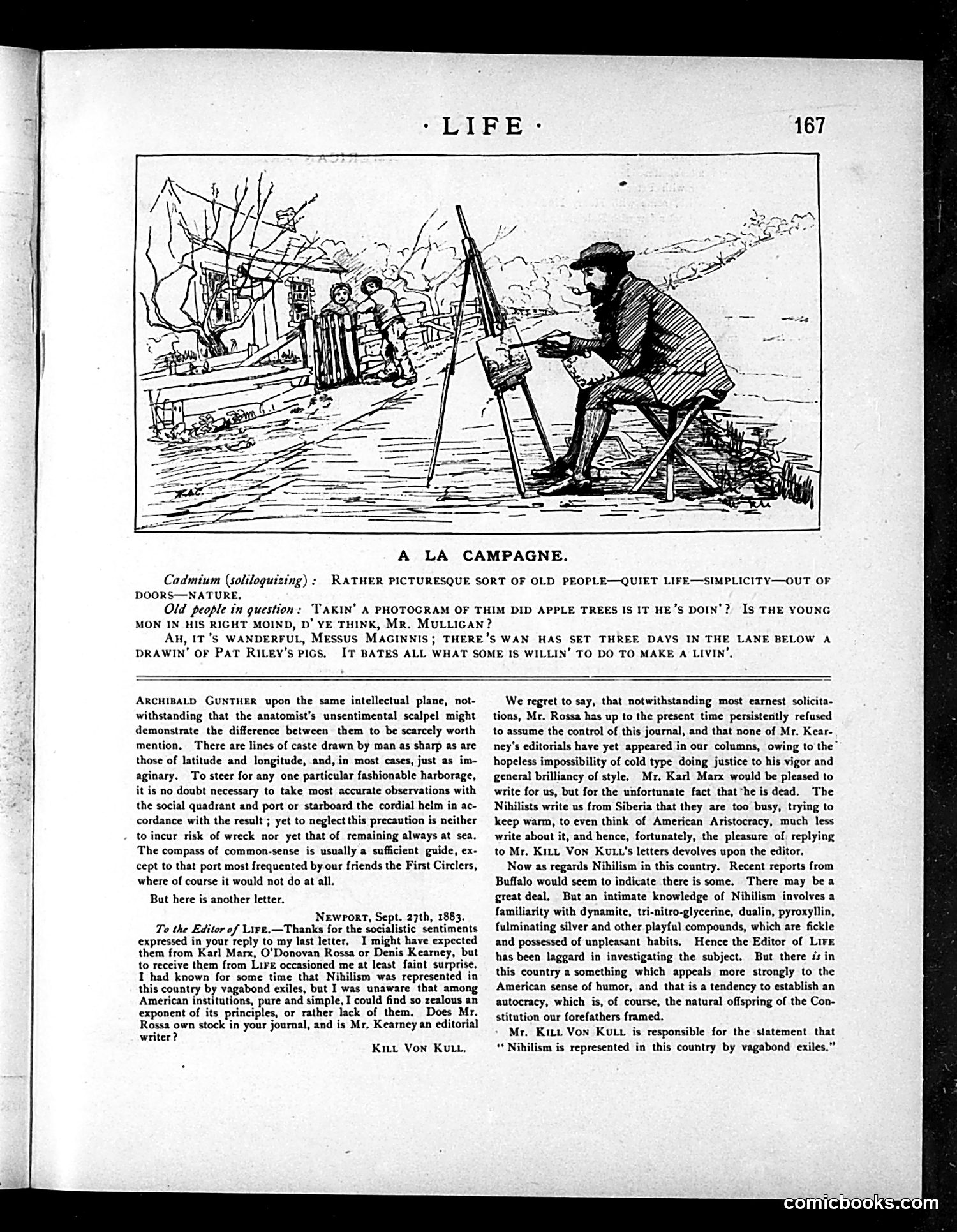
**The Cartoon ("A La Campagne"):** A man sketches rural Irish peasants and their pigs, apparently spending three days drawing Pat Riley's swine to make a living. The Irish characters (identified by dialect spelling) mock the artist's dedication, questioning whether he's "in his right mind." This satirizes starving artists and absurd labor—someone wasting days on a trivial subject for meager income. **The Letters Section:** The main content addresses "Nihilism in America." A correspondent (Kill Von Kull) sarcastically accuses *Life* of promoting socialist/Nihilist ideology. The editor responds with mock-serious wit, claiming Karl Marx is dead and Siberian Nihilists are too cold to write. The piece pokes fun at both: wealthy elites' paranoia about radical foreign exiles, and the Nihilists' supposed threat level. The editor suggests America's real problem is homegrown autocracy among the wealthy, not imported Russian bomb-throwers—a critique of American aristocratic pretension masked as humor.
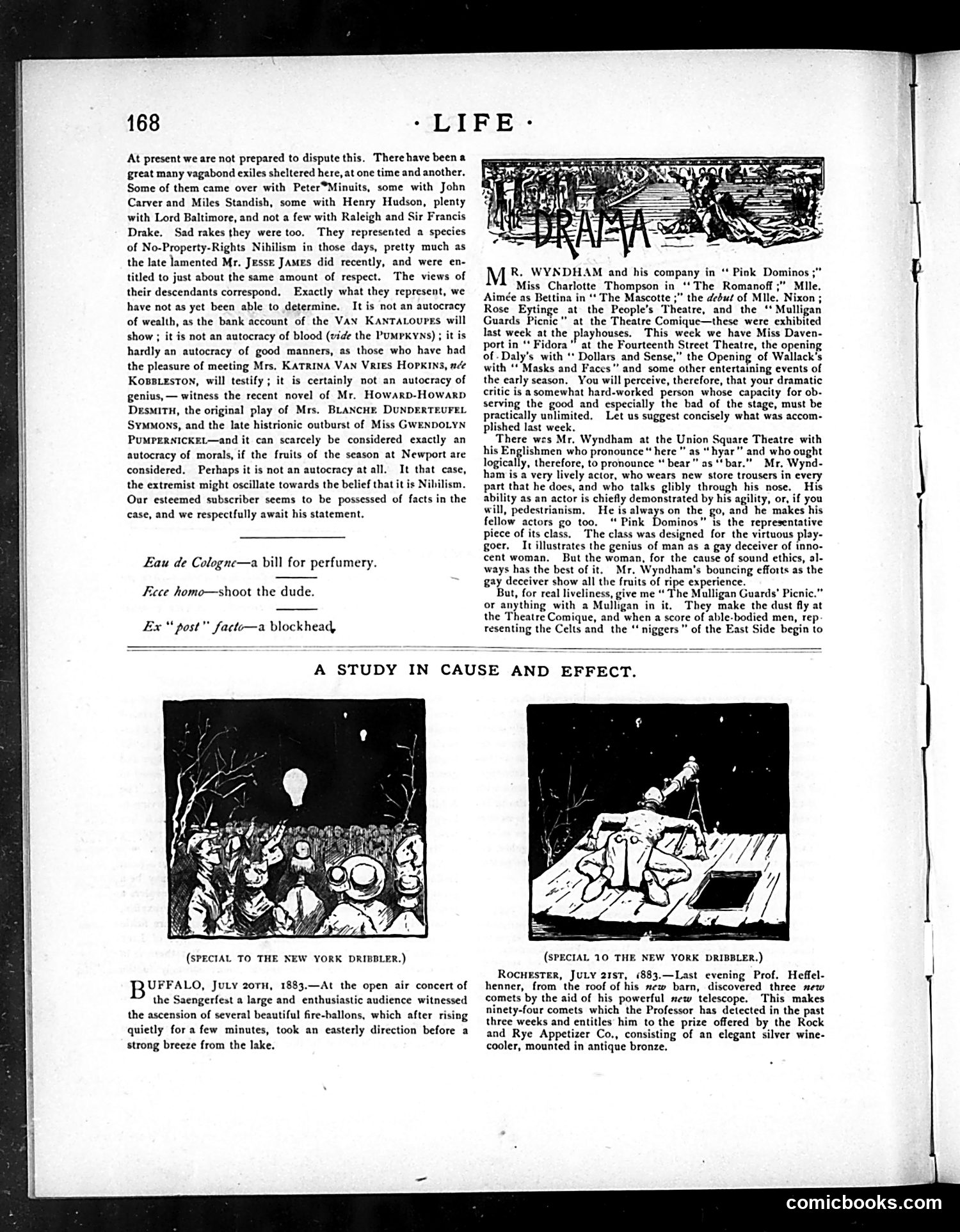
This page contains two satirical cartoons with accompanying text mocking New York's wealthy elite and theatrical scene. **The cartoons** depict absurd scenarios: the left shows a crowd gathered beneath a glowing orb in darkness; the right shows a figure on a platform with mechanical apparatus. These illustrate frivolous upper-class entertainments—likely referencing a balloon ascension at a "Saengerfest" (German singing festival) in Buffalo. **The main satire** targets New York's aristocratic families (Van Kantaloupes, Pumpkyns, Hopkins) who claim superiority through wealth, bloodline, or morals—yet the text sardonically demolishes each claim. The author notes these families produce mediocre novels, bad theater, and scandalous behavior, suggesting their pretensions to gentility are hollow. **The theatrical reviews** mock actor Mr. Wyndham's over-the-top physical comedy and affected accent, dismissing "Pink Dominos" as shallow entertainment designed to titillate while maintaining moral facades. The overall point: New York's wealthy elite are hypocritical "rakes" with no genuine superiority, merely echoing imported vices from America's disreputable founding exiles.
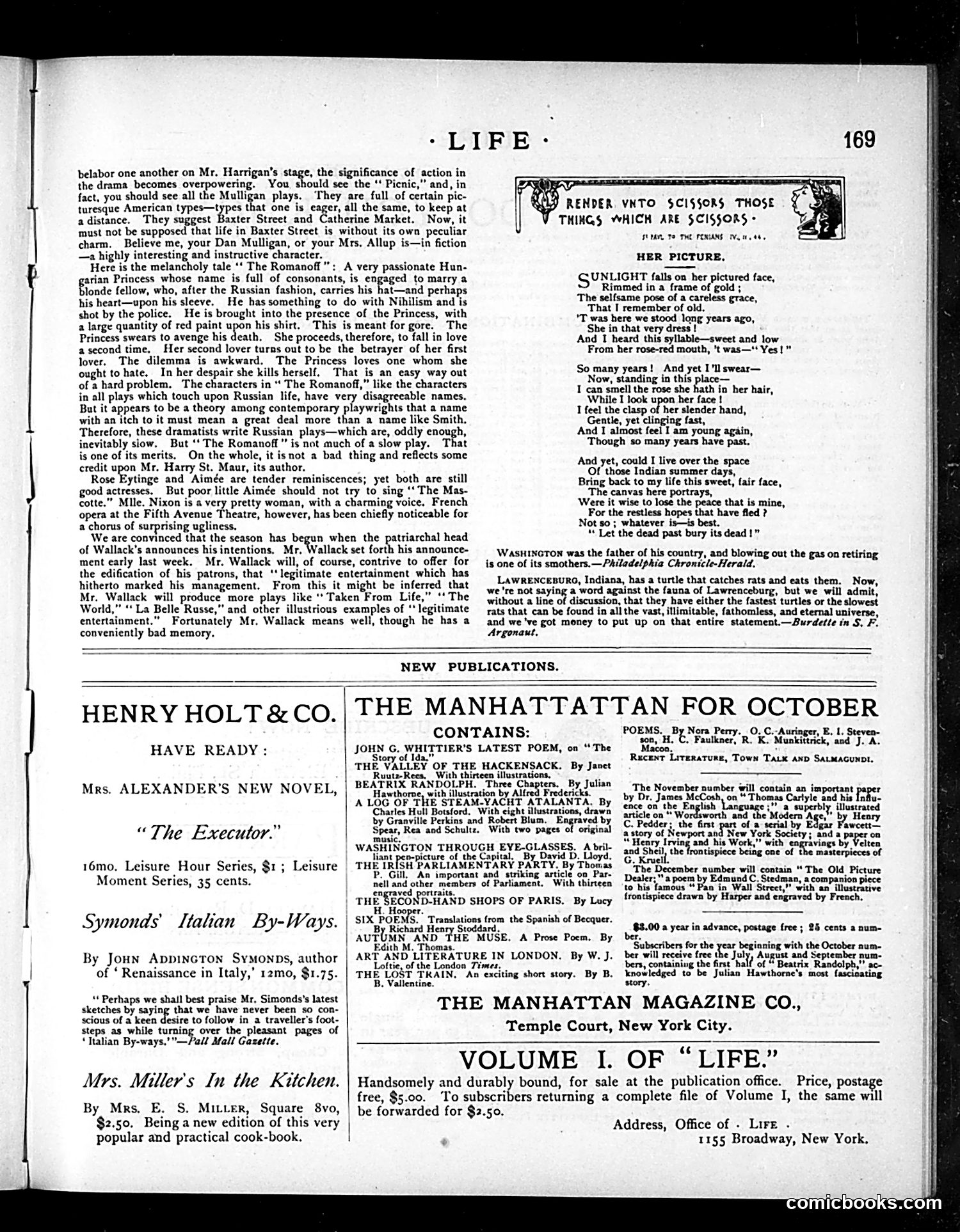
This page contains theater criticism and advertising, not a political cartoon. The small illustrated header "Render Unto Scissors Those Things Which Are Scissors" appears to be a humorous playing on the biblical phrase "Render unto Caesar," likely making a joke about scissors or cutting—the specific reference is unclear without more context. The main content is a drama review by Life magazine's theater critic, discussing contemporary plays including "The Romanoff" (about a Russian Princess) and productions at Wallack's Theatre. The critic praises the "Mulligan plays" featuring realistic American character types from working-class neighborhoods like Baxter Street. The poem "Her Picture" is sentimental Victorian verse about remembering a lost love through her photograph. The page is primarily **advertising for new books and Life magazine subscriptions**, not satire.
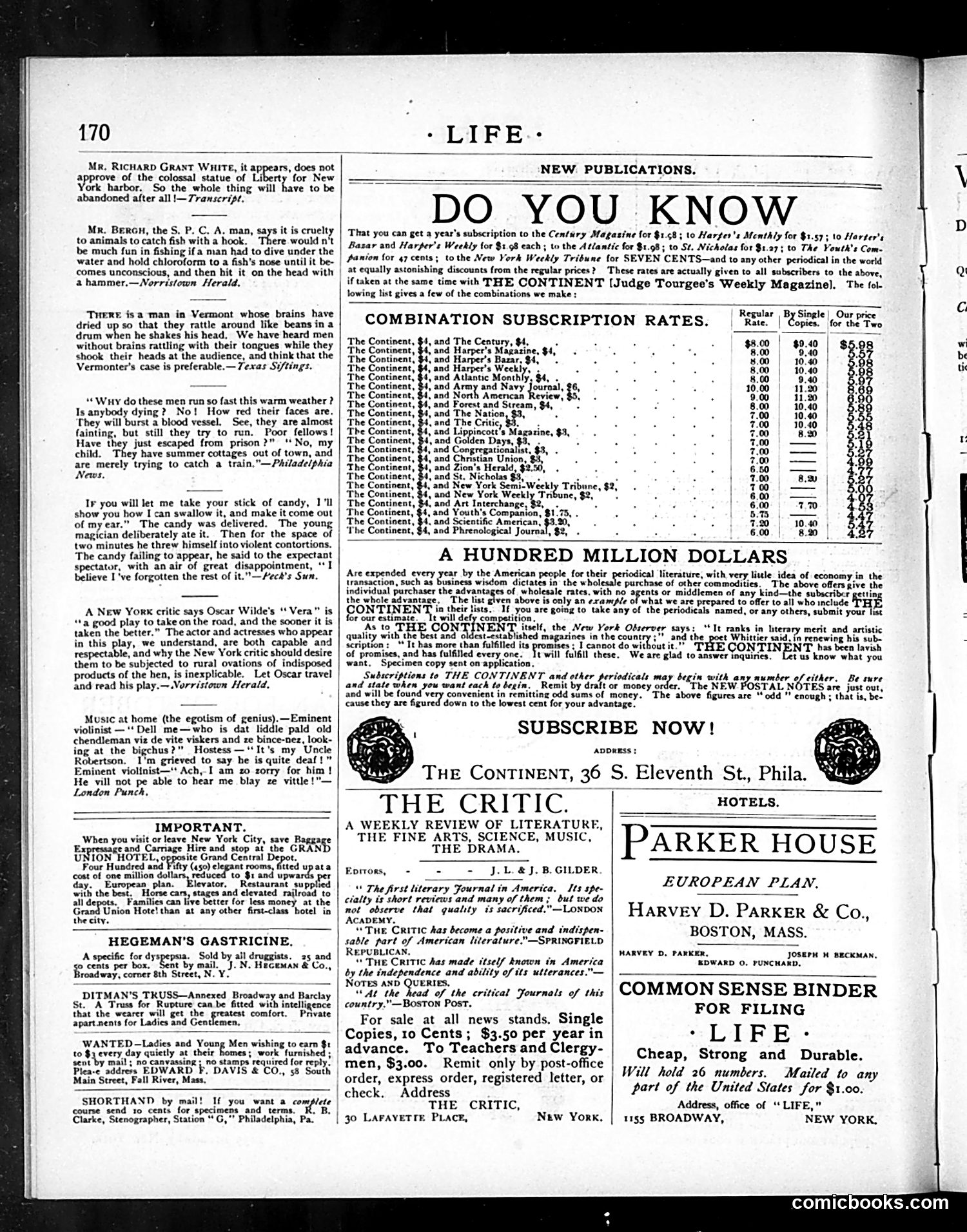
This is primarily an **advertising and promotional page** rather than a satirical cartoon page. The content consists of: **Main Features:** - Brief humorous anecdotes in the left column mocking various subjects (a man's brainless behavior, people running to catch trains, a failed magic trick) - A large advertisement for **The Continent magazine**, promoting discounted subscription combinations with other major publications (Century, Harper's, Atlantic Monthly, etc.) - Smaller advertisements for various products and services (Parker House hotel, Common Sense Binder, etc.) **The Point:** The page uses satirical short jokes to entertain readers while promoting The Continent's competitive subscription rates—positioning bulk magazine subscriptions as economical compared to purchasing individually. The "hundred million dollars" headline emphasizes Americans' yearly spending on periodicals. **No identifiable political figures or cartoons appear on this page.** It's a business-focused advertising spread using light humor as a marketing tool, typical of Life magazine's format during this era.
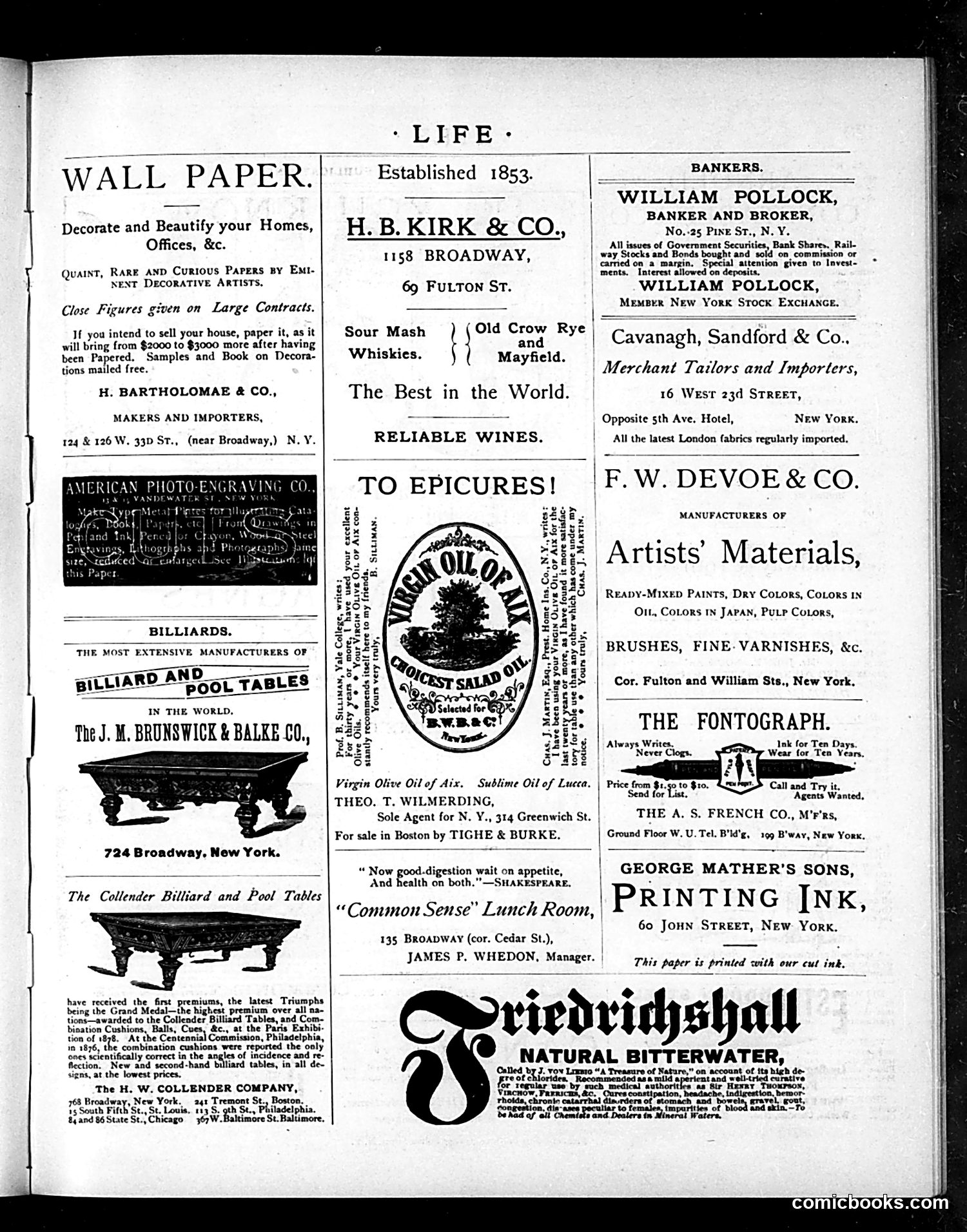
This is primarily an **advertising page** from Life magazine (established 1853). There are no political cartoons or satirical content visible. The page contains commercial advertisements for various New York businesses: wallpaper decorators, billiard table manufacturers, bankers, whiskey and wine sellers, merchant tailors, art supply companies, a lunch room, printing ink, and a German mineral water. The only notable feature is the large ornamental advertisement at bottom for "Friedrichshall Natural Bitterwater," a German patent medicine marketed as a digestive aid and cure for constipation and gout, endorsed by medical authorities (names appear garbled in OCR). This represents typical 19th-century magazine advertising—dense, text-heavy promotions mixed with decorative typography. There is no satire, no identifiable caricatures, and no political commentary on this particular page. It's a straightforward commercial layout.
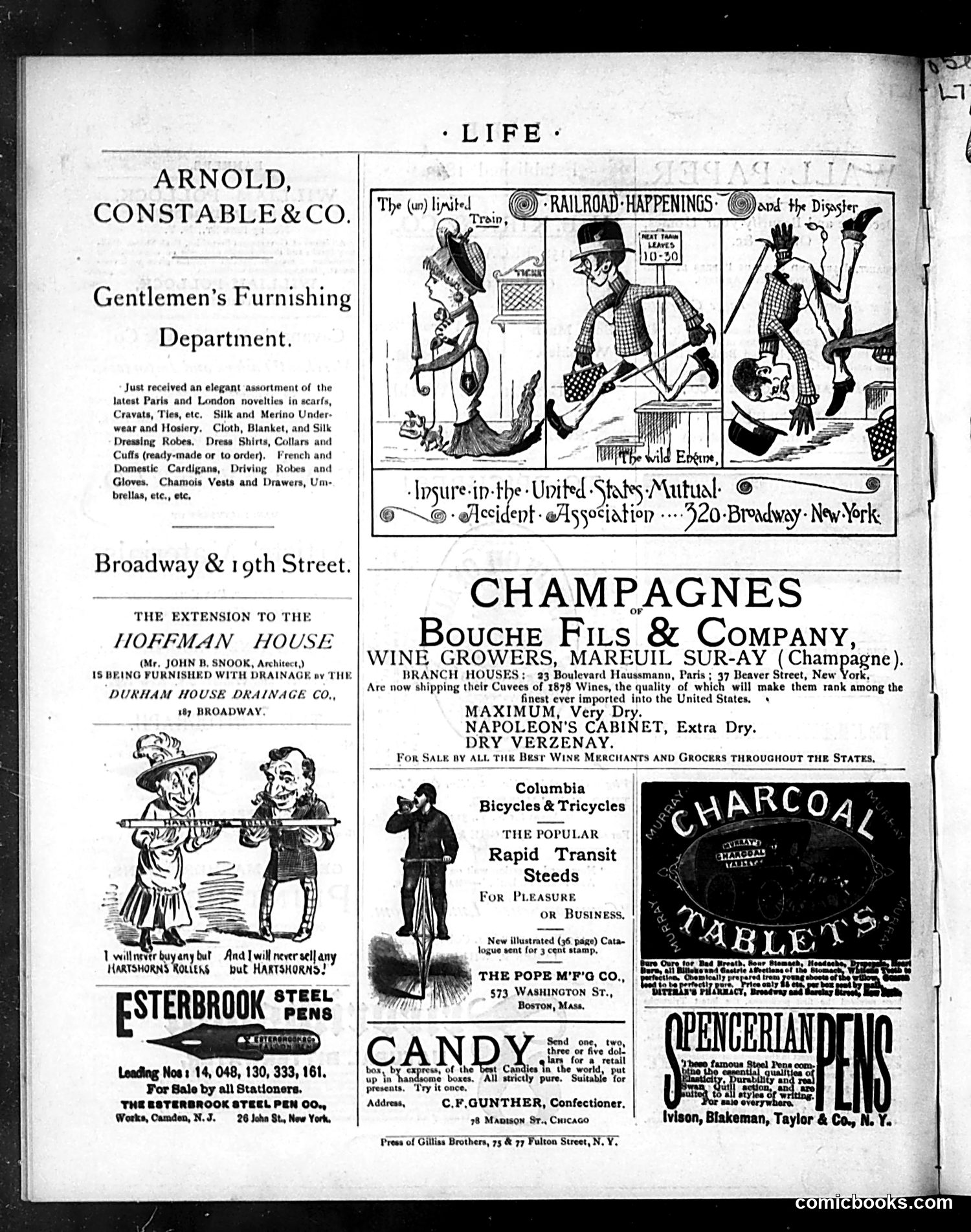
This is primarily an **advertising page** from Life magazine, not a political cartoon. The dominant content is commercial advertisements for late 19th-century luxury goods and services. The one **cartoon illustration** (upper right) titled "Railroad Happenings and the Disaster" appears to depict a comedic train accident or mishap, showing anthropomorphized figures in exaggerated poses amid chaos. The specific incident referenced is unclear without additional context, but it satirizes railroad safety or passenger behavior—a common subject for contemporary humor given the era's rapid rail expansion and frequent accidents. The page otherwise showcases upscale merchandise: gentlemen's clothing (Arnold, Constable & Co.), champagne, bicycles, fountain pens, and confections. These ads target wealthy urban readers, reflecting Gilded Age consumer culture. The Hoffman House drainage advertisement suggests infrastructure improvements in New York City development. The page represents Life's dual function: satirical commentary mixed with premium advertising revenue.