A complete issue · 43 pages · 1936
Judge — June 1936
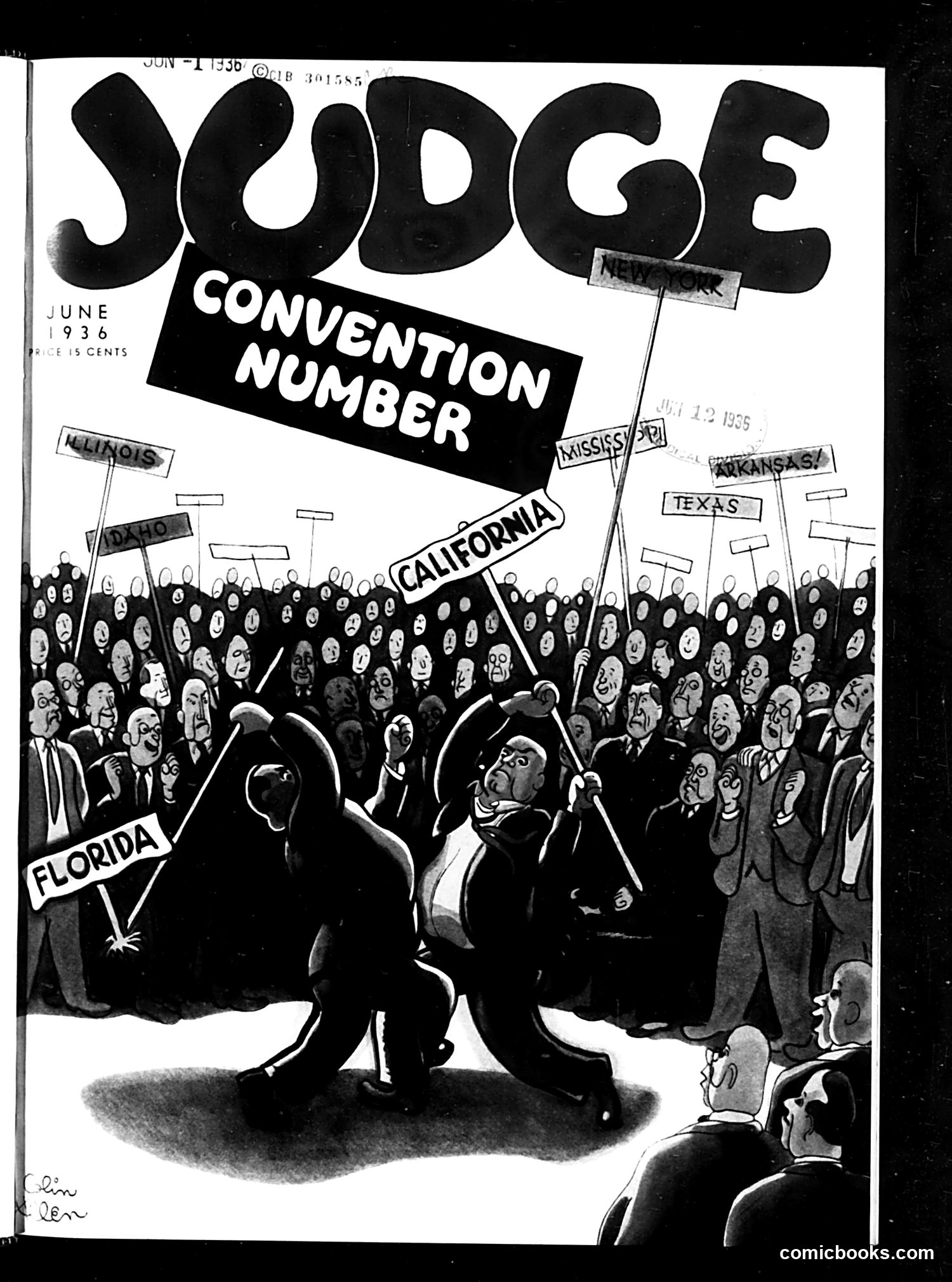
# Political Cartoon Analysis: "Judge" Magazine, June 1936 This satirical cartoon depicts the 1936 Democratic National Convention as a massive gathering where state delegations (labeled California, Texas, Arkansas, Mississippi, Illinois, Idaho, Florida) hold signs competing for attention. The large "JUDGE" masthead dominates as "Convention Number." The cartoon satirizes the competitive scramble among states for political influence and convention delegates. The caricatured crowd and raised signs suggest chaos and self-interested jockeying typical of nominating conventions. Two prominent hooded figures in the center appear designed to represent competing factions or political forces vying for control. The satire critiques how state interests clash during convention proceedings, portraying the democratic process as a somewhat unseemly competition rather than orderly deliberation. The exaggerated expressions and crowded composition emphasize the pandemonium of convention politics.
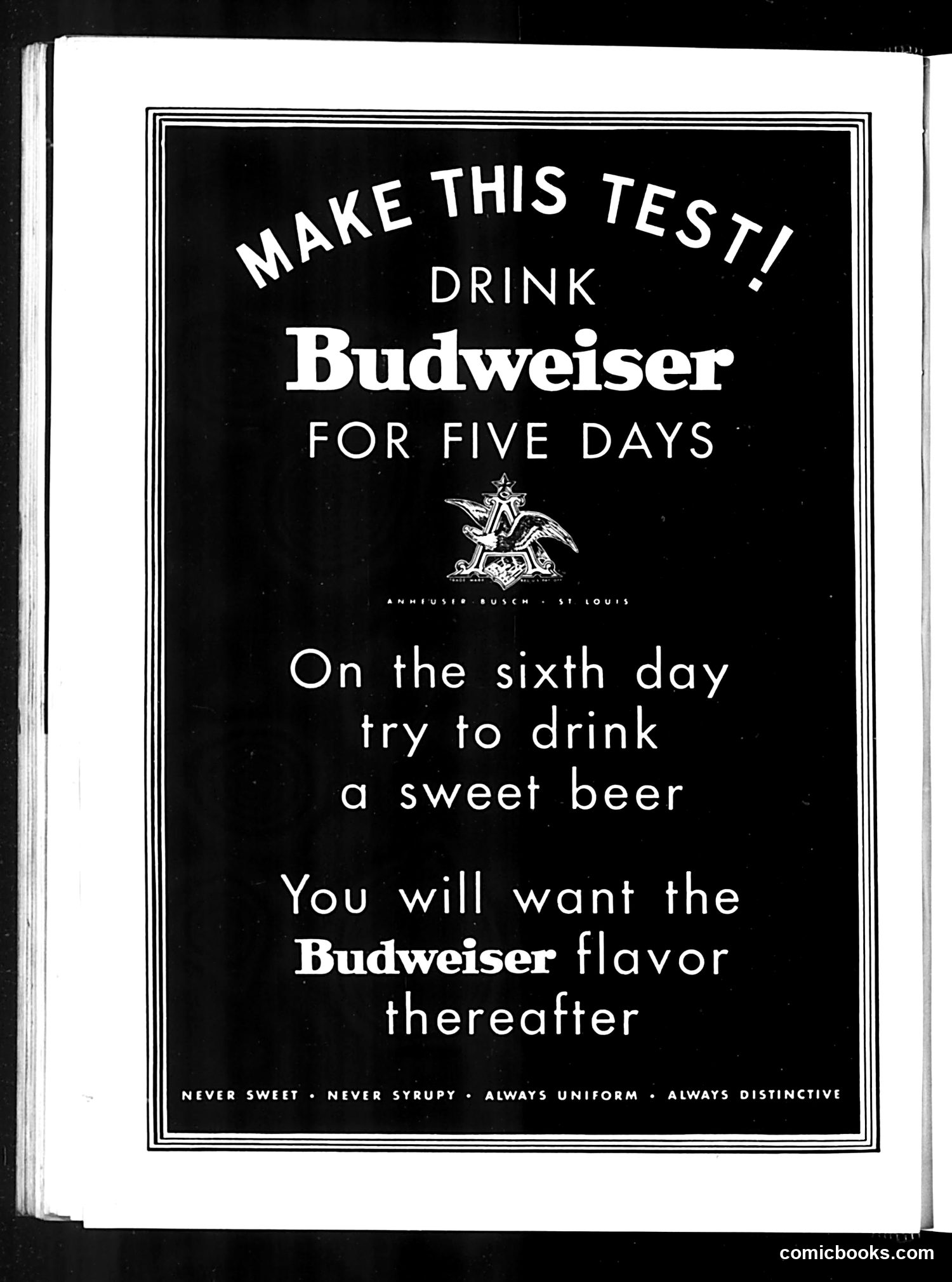
# Analysis This page is **not a cartoon or satirical content** — it's a straightforward **advertisement for Budweiser beer**. There are no political figures, caricatures, or satire to analyze. The ad uses a humorous hook: it challenges readers to drink Budweiser exclusively for five days as a "test," then predicts that on the sixth day, if they try a sweeter beer, they'll prefer Budweiser's flavor again. The tagline emphasizes consistency: "Never sweet, never syrupy, always uniform, always distinctive." This is simply a vintage beer advertisement leveraging psychology and brand loyalty messaging rather than commentary on current events or social issues typical of Judge magazine's satirical content.
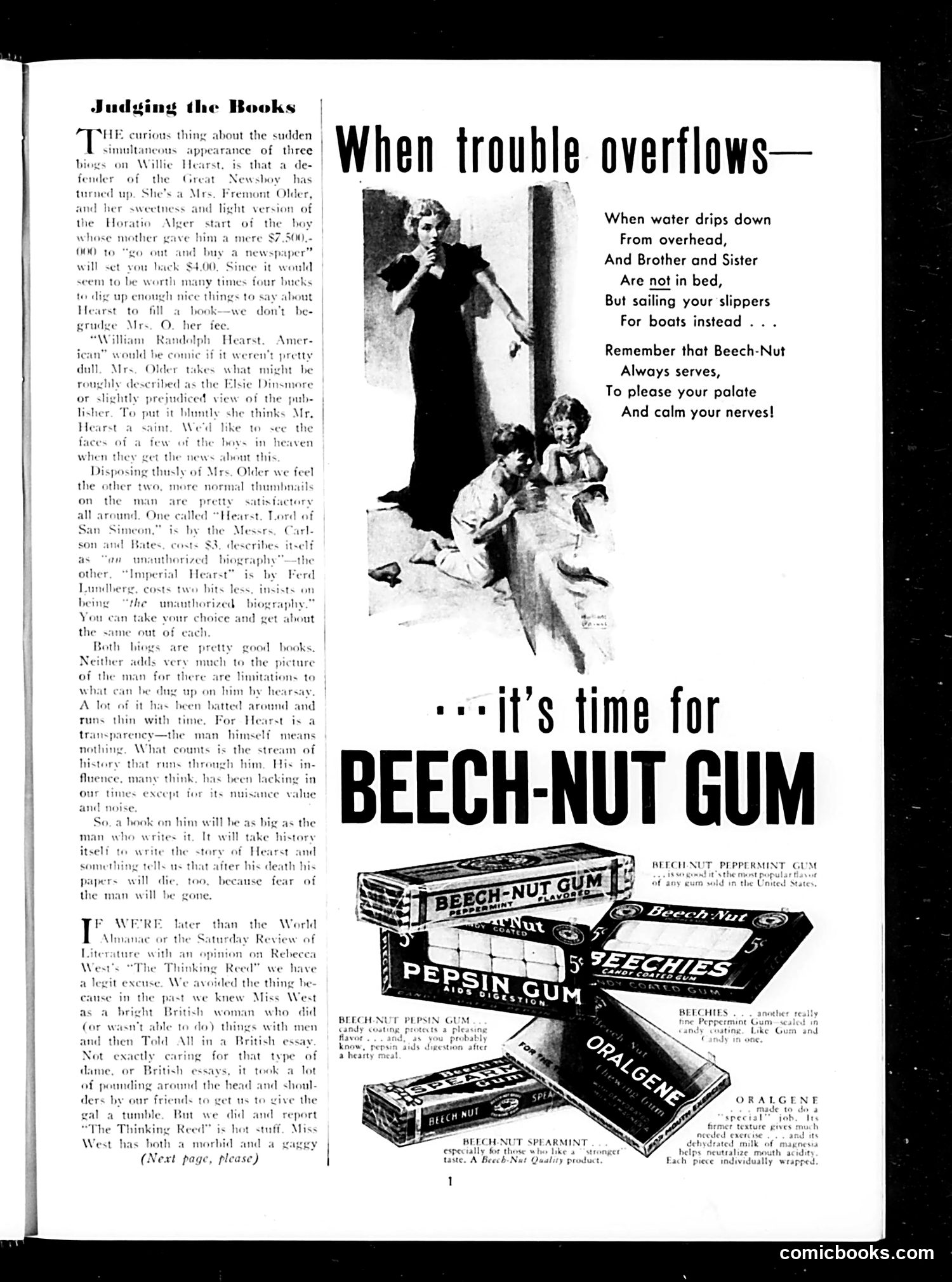
# Analysis This page is primarily a **Beech-Nut Gum advertisement** rather than political satire. The main content features a humorous domestic scene depicting children causing water damage ("When trouble overflows") as a setup to advertise the product as a palate-pleaser and nerve-calmer. The left column contains "Judging the Books," a brief book review section discussing three recent publications, including biographies of William Randolph Hearst. This appears to be standard magazine content rather than satire—the reviewer discusses their merits straightforwardly. The advertisement and review occupy roughly equal space, with the ad being the page's dominant visual element. There is **no identifiable political cartoon or satirical commentary** on this particular page.
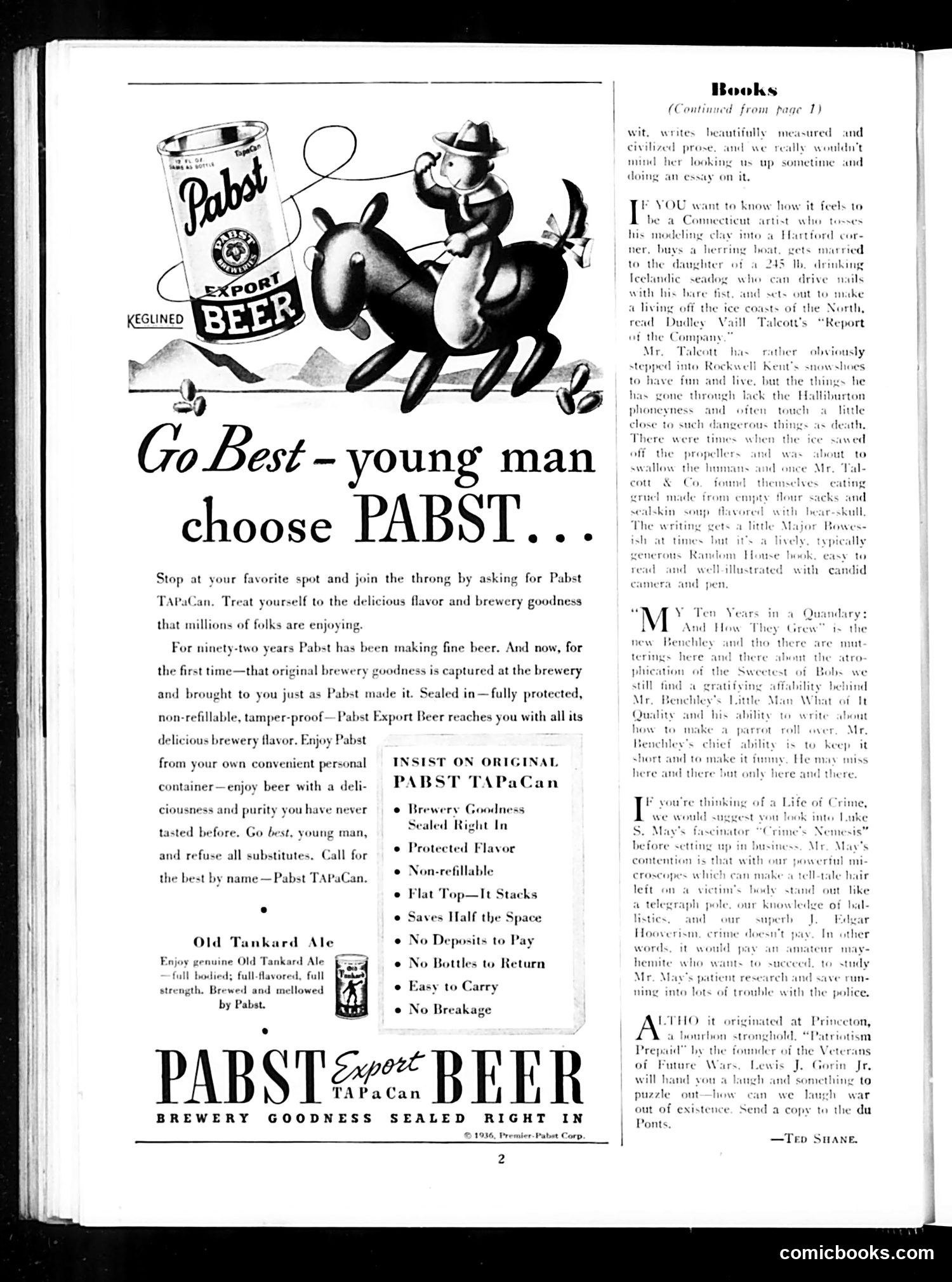
# Analysis of Pabst Beer Advertisement Page This page is **primarily advertising**, not satirical content. The dominant feature is a full-page Pabst Export Beer advertisement from around 1936 (per copyright mark). The cartoon element shows a stylized man in a hat riding a bucking bull or similar animal, with a Pabst beer can, illustrating the slogan "Go Best—young man choose PABST." This appears designed to appeal to masculine vigor and leisure. The right column contains book reviews unrelated to the advertisement. The ad itself emphasizes Pabst's 92-year brewing history and the novelty of their new "TAPaCan" container—highlighting convenience features like portability and no bottle returns. This represents straightforward commercial advertising rather than political satire typical of Judge magazine's editorial content.
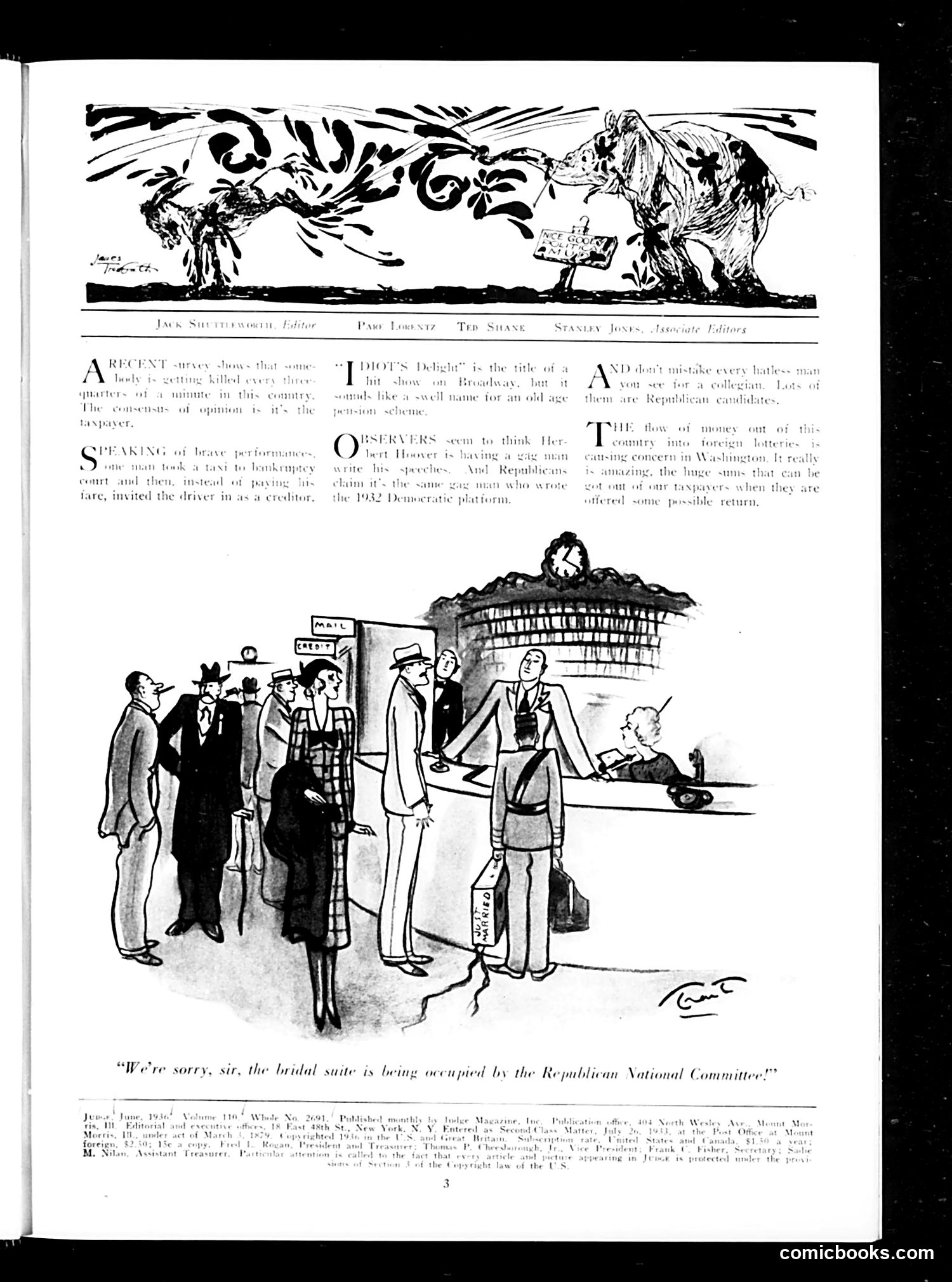
# Political Cartoon Analysis This Judge magazine page contains editorial commentary and a political cartoon satirizing the 1932 presidential race. The main cartoon depicts people at what appears to be a government building (likely the White House) with the caption: "We're sorry, sir, the bridal suite is being occupied by the Republican National Committee." The satire targets Republicans, suggesting they've "occupied" the White House like newlyweds in a hotel suite—implying they're overstaying their welcome during the Great Depression. The editorial text references Herbert Hoover's "gag man" speeches and Republicans' platform, contrasting Democratic candidates as relief to voters' concerns. The cartoon mocks Republican incumbency and their perceived failure to address the economic crisis, suggesting it's time for them to vacate office.
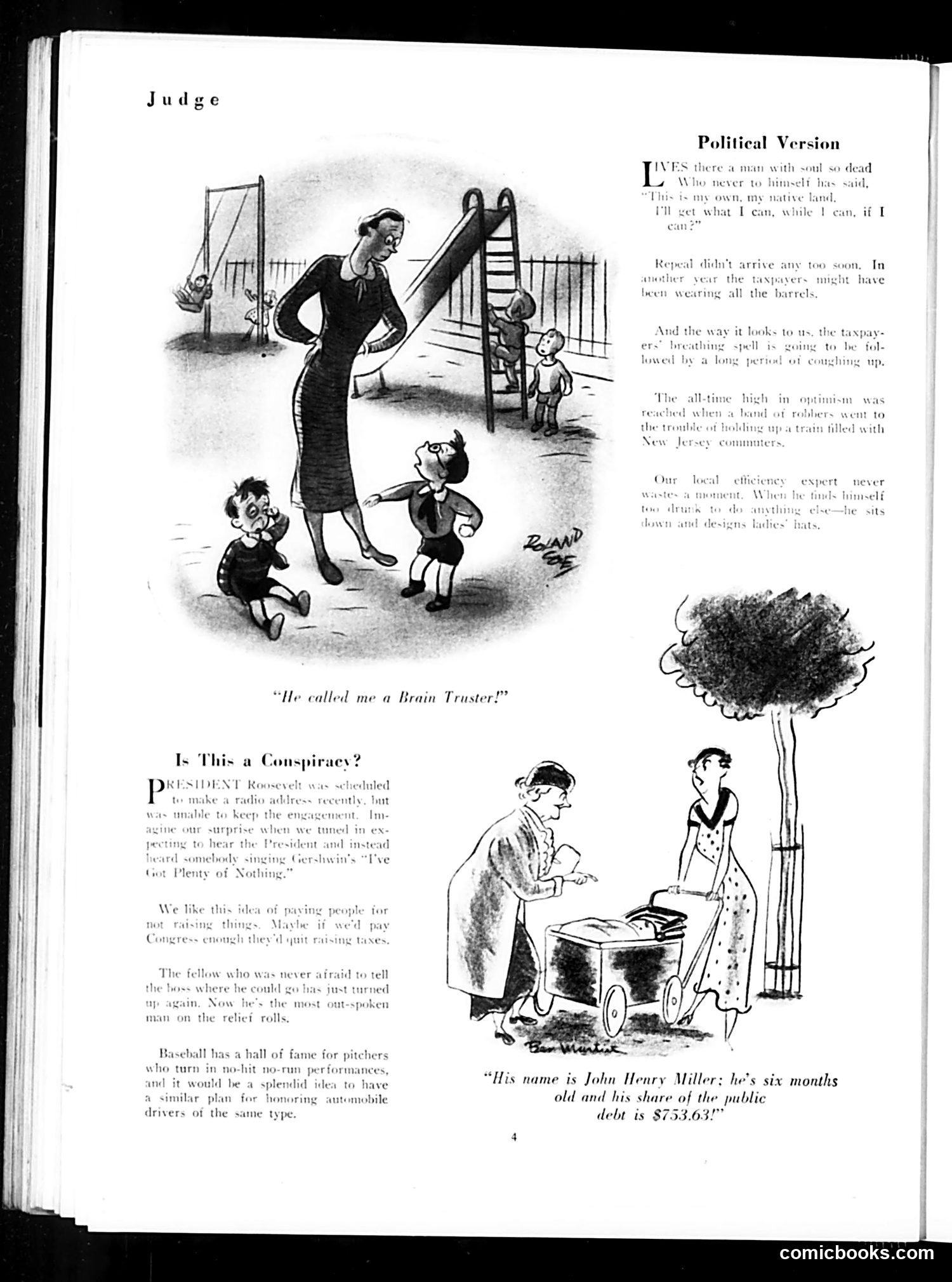
# Analysis of Judge Magazine Page This page contains two political cartoons satirizing American governance and public debt. **Top cartoon ("He called me a Brain Truster!"):** A woman supervises children on a playground. The "Brain Truster" reference likely alludes to FDR's "Brain Trust"—his informal advisory group during the New Deal. The satire suggests these advisors were childish or incompetent. **Bottom cartoon ("Is This a Conspiracy?"):** A couple with a baby carriage labeled with a debt figure ($753.63) represents the national debt burden passed to infants. The text mocks President Roosevelt's radio address excuse that he was "unable to keep the engagement," satirizing government evasion of accountability for rising public debt. Both cartoons critique New Deal policies and government spending through domestic metaphors.
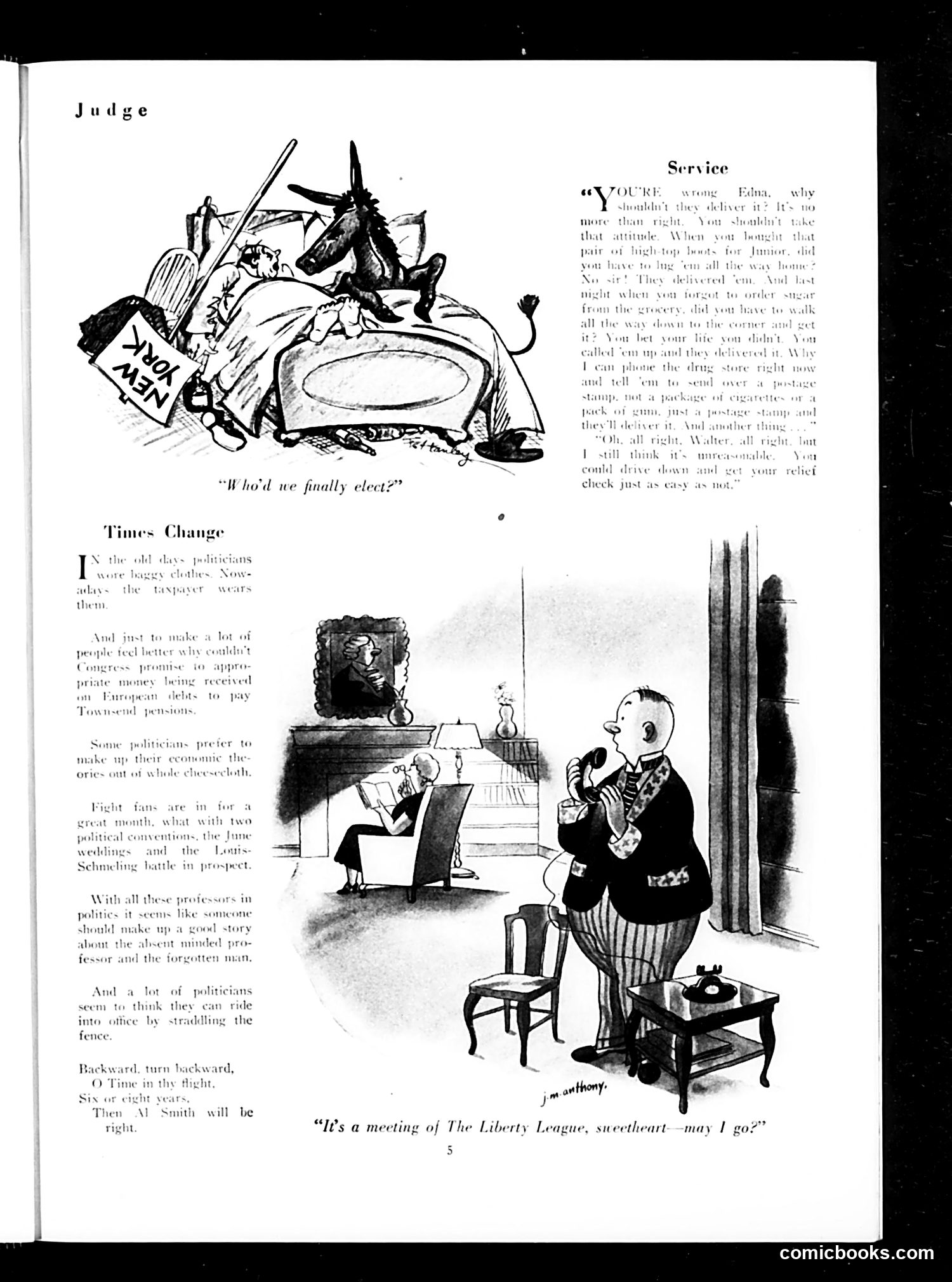
# Political Satire Analysis **"Judge" Magazine Page - Political Commentary** The top cartoon "Who'd we finally elect?" mocks judicial indecision through a cluttered, chaotic image labeled "Jack Men"—likely referencing multiple judicial candidates or conflicting political positions. The lower section, "Times Change," satirizes politicians' inconsistency and self-serving economics. The text criticizes politicians wearing "baggy clothes" (appearing poor) while taxpayers support them, and notes politicians invent economic theories to justify receiving "Townsend pensions" (likely referencing a Depression-era pension plan). The second cartoon shows a man being asked about attending "a meeting of The Liberty League"—this references the anti-New Deal organization that opposed FDR's policies. The satire suggests politicians shift positions opportunistically. **Context**: This appears Depression-era, critiquing New Deal-era political hypocrisy and changing allegiances.
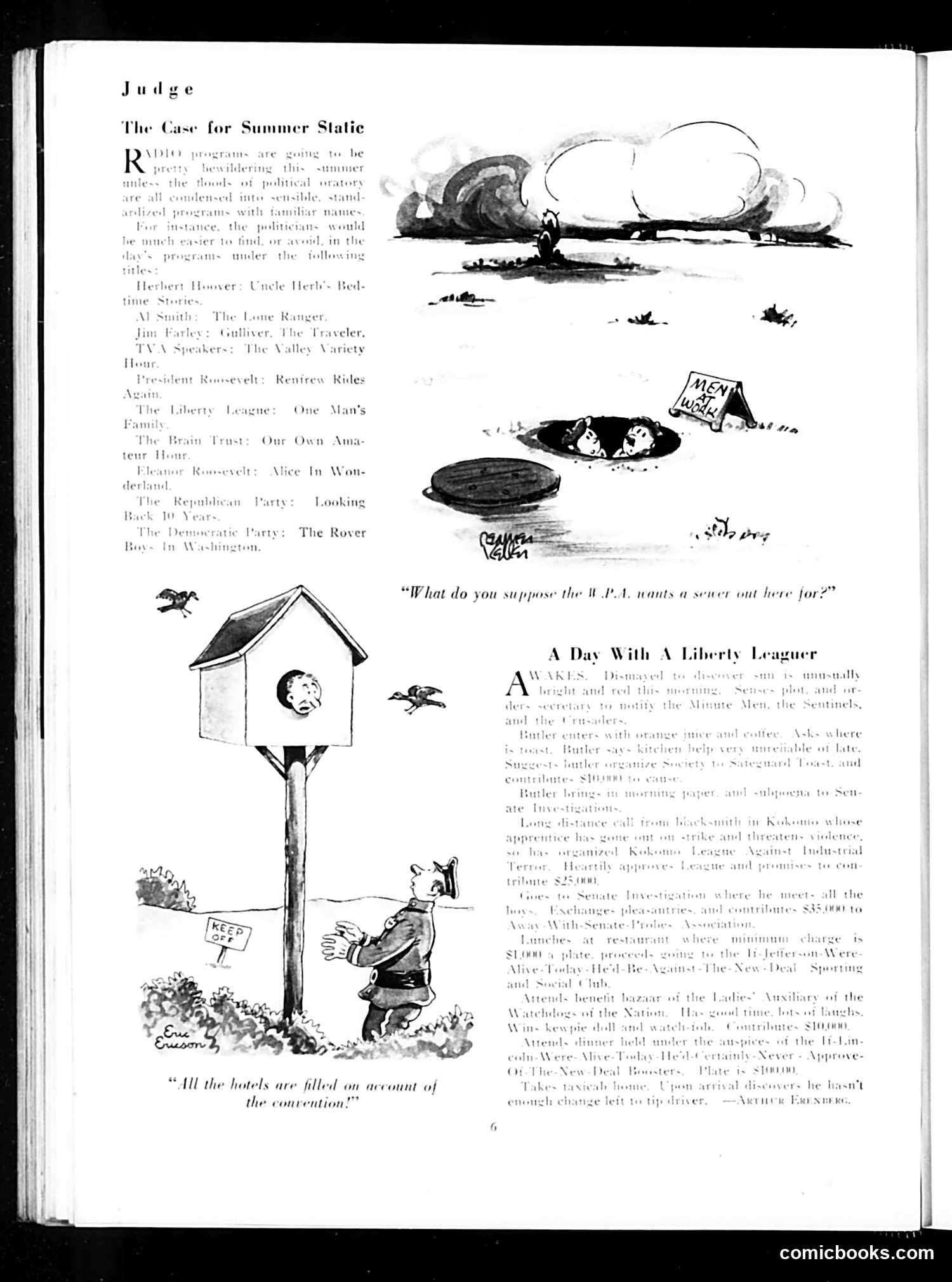
# Analysis of Judge Magazine Page This page contains two separate cartoons satirizing American summer politics and civic activities. The upper cartoon mocks the W.P.A. (Works Progress Administration), a New Deal employment program. It shows UFO-like objects descending, labeled "What do you suppose the W.P.A. wants a sewer out here for?" — suggesting absurdity in the program's infrastructure projects. The lower cartoon depicts a birdhouse with a keeper shooing away someone, captioned "All the hotels are filled on account of the convention?" — satirizing the crowding and chaos of a political convention (likely the 1932 or 1936 Democratic/Republican conventions). The accompanying article "A Day With A Liberty Leaguer" describes someone's activist schedule, suggesting mockery of anti-New Deal organization members and their social activities during the Roosevelt era.
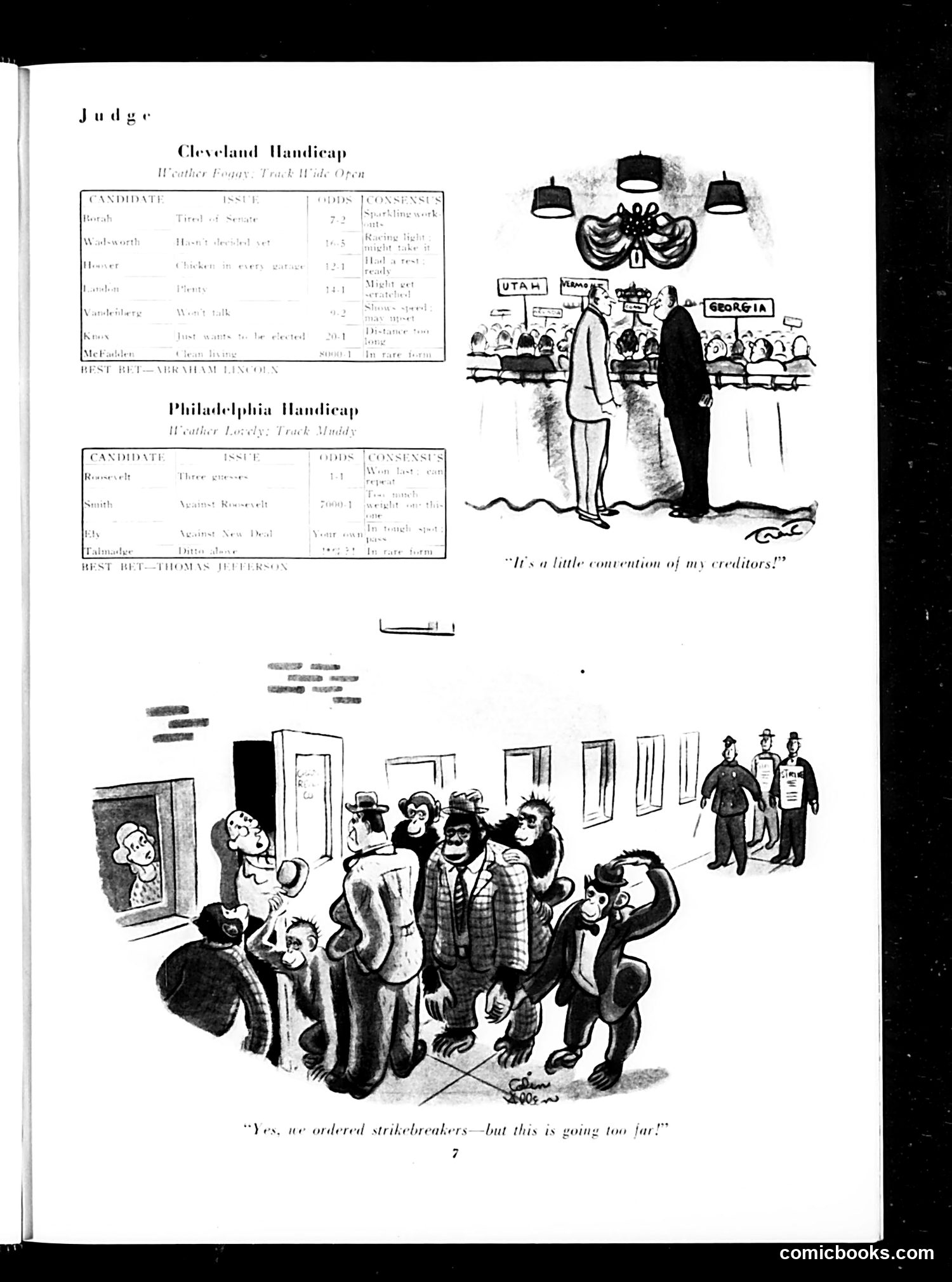
# Judge Magazine Page Analysis This page contains two horse-racing handicap predictions (Cleveland and Philadelphia races) with betting odds and best-bet recommendations, followed by two cartoons. The top cartoon shows two well-dressed men observing a convention crowd labeled with state names (Utah, Georgia visible), captioned "It's a little convention of my creditors!" — satirizing someone who owes money to people across the country. The bottom cartoon depicts men who appear to be primates or caricatured as ape-like figures in what looks like a hallway or office, with the caption "Yes, we ordered strikebreakers—but this is going too far!" This likely satirizes labor disputes of the era, mocking employers' recruitment of replacement workers by suggesting they've hired unsuitable (and ape-like) individuals, reflecting period prejudices and class anxieties about labor conflict.
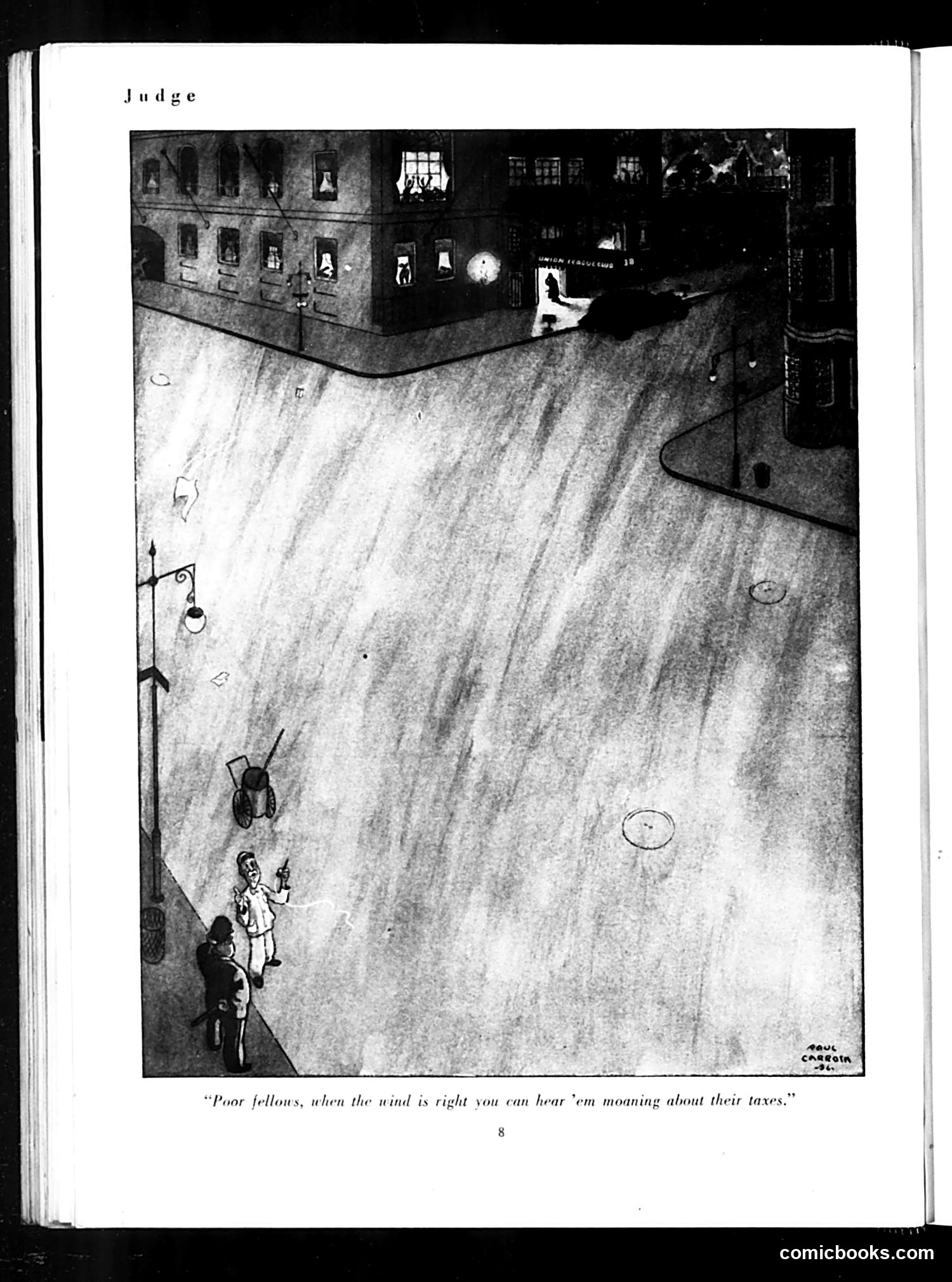
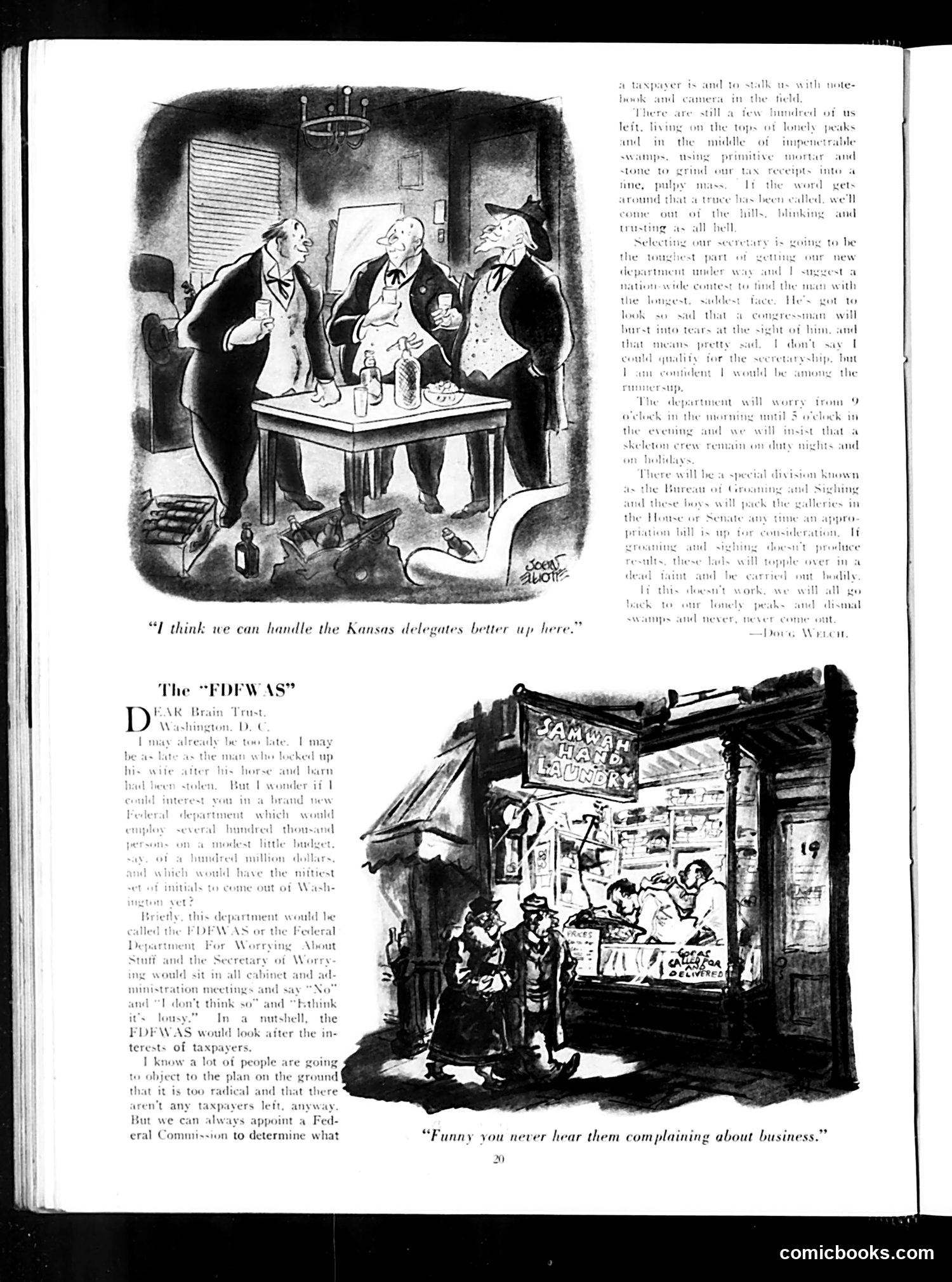
# Judge Magazine Cartoon Analysis This cartoon depicts an aerial view of a town square where a judge observes common people below. The judge, positioned high above in a building, comments that when wind conditions are right, one can hear citizens complaining about their taxes. The satire mocks the disconnect between authority figures (judges/the wealthy elite) and ordinary citizens struggling with tax burdens. The elevated perspective literally illustrates how judges and the powerful are removed from—and dismissive of—ordinary people's financial hardships. The judge's tone is detached and somewhat contemptuous, treating taxpayers' legitimate grievances as mere ambient noise rather than serious concerns. This reflects early 20th-century American anxieties about taxation and class inequality, satirizing judicial indifference to working-class struggles.
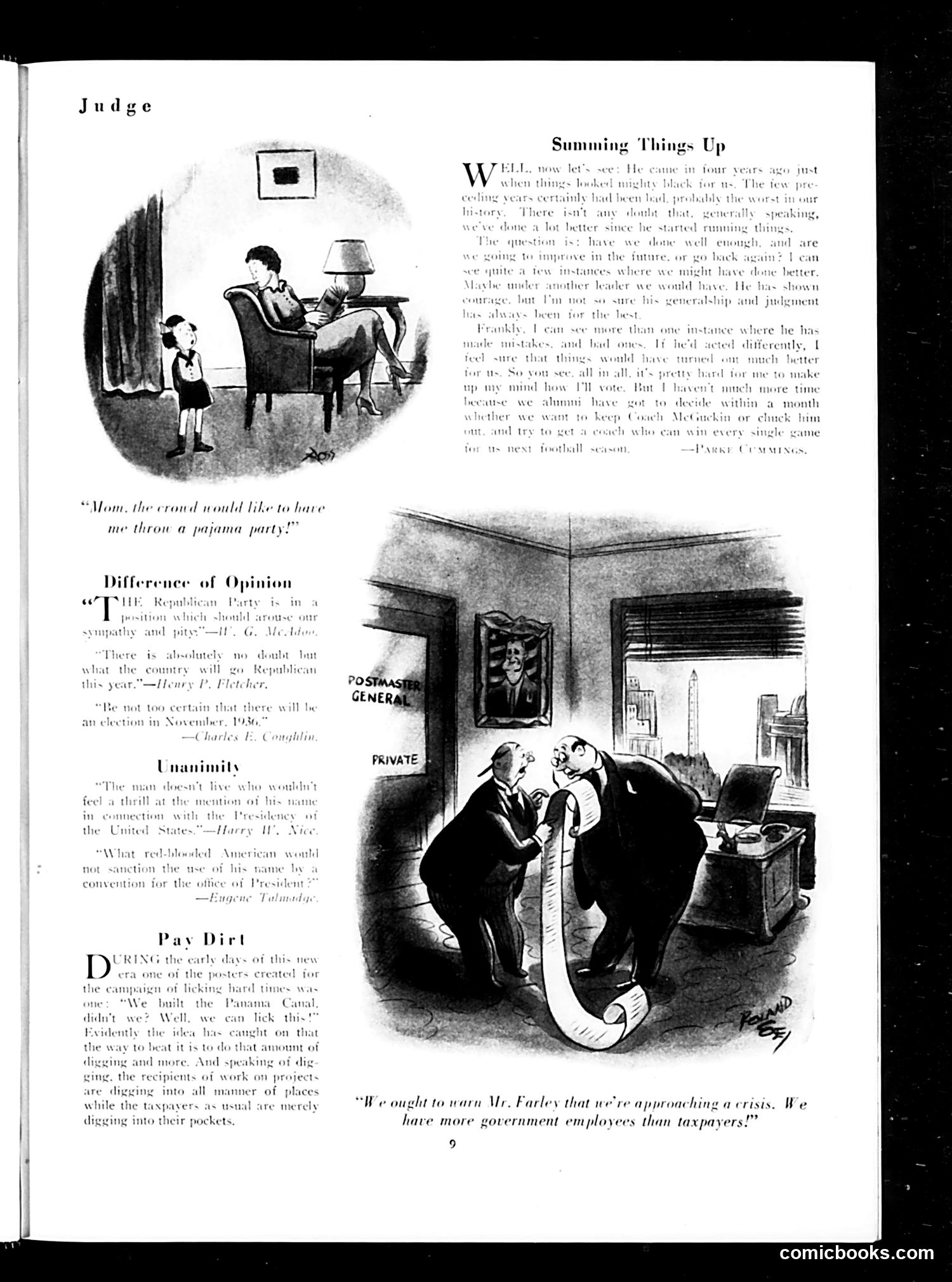
# Judge Magazine Political Commentary Page This page from Judge magazine contains several editorial sections critiquing American politics and leadership circa the 1930s. **"Summing Things Up"** appears to be a column assessing a political leader's four-year tenure, weighing accomplishments against failures and uncertainties about future direction. **"Difference of Opinion"** quotes Republican and other political figures debating the party's prospects, including a reference to Charles E. Coughlin, the controversial radio priest-politician of that era. **The main cartoon** depicts a postmaster and another official unrolling an enormous scroll of government paperwork, with the caption warning that government employees now outnumber taxpayers—a satirical jab at New Deal employment expansion under Franklin D. Roosevelt. The "Pay Dirt" section reinforces this theme, criticizing public works projects that benefit workers while ordinary citizens merely "dig into their pockets" through taxation. The overall message: Judge criticized the Roosevelt administration's growing federal workforce as fiscally unsustainable.
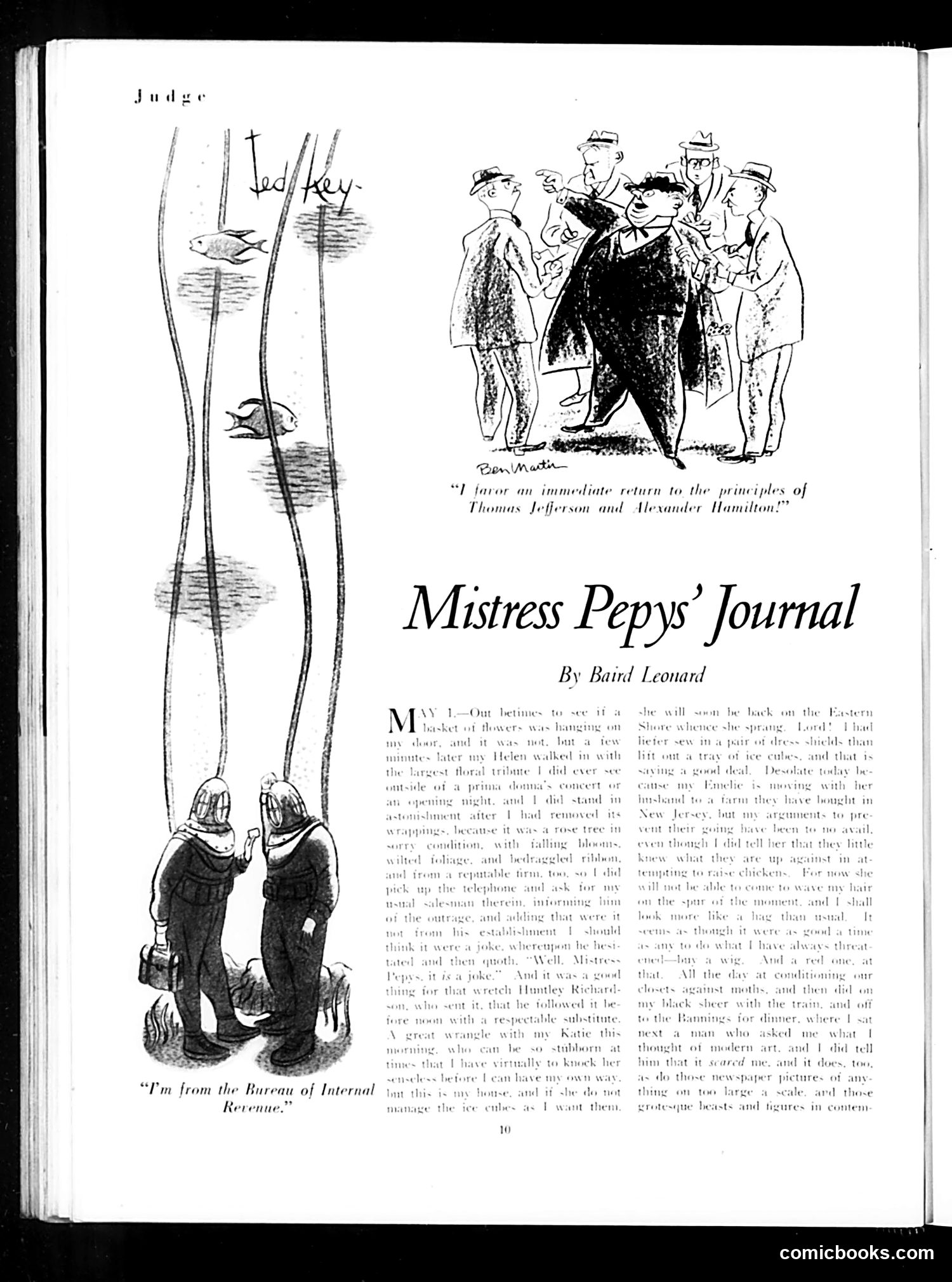
# Political Content Analysis This page contains two satirical cartoons. The top cartoon depicts a rotund politician surrounded by men in suits, declaring he favors returning to "the principles of Thomas Jefferson and Alexander Hamilton"—a hollow political platitude. The satire targets politicians who invoke founding fathers' principles insincerely. The bottom cartoon shows a person identifying themselves as "from the Bureau of Internal Revenue," illustrated with exaggerated, menacing appearance. This mocks tax collectors, portraying them as feared, intrusive government agents—a common satirical target reflecting public anxiety about taxation and government overreach. The accompanying "Mistress Pepys' Journal" is a humorous domestic narrative (appearing to be comedic fiction rather than political satire) about household management and marital disputes. The overall page exemplifies *Judge* magazine's blend of political commentary and genteel humor for early 20th-century audiences.