A complete issue · 36 pages · 1932
Judge — April 23, 1932
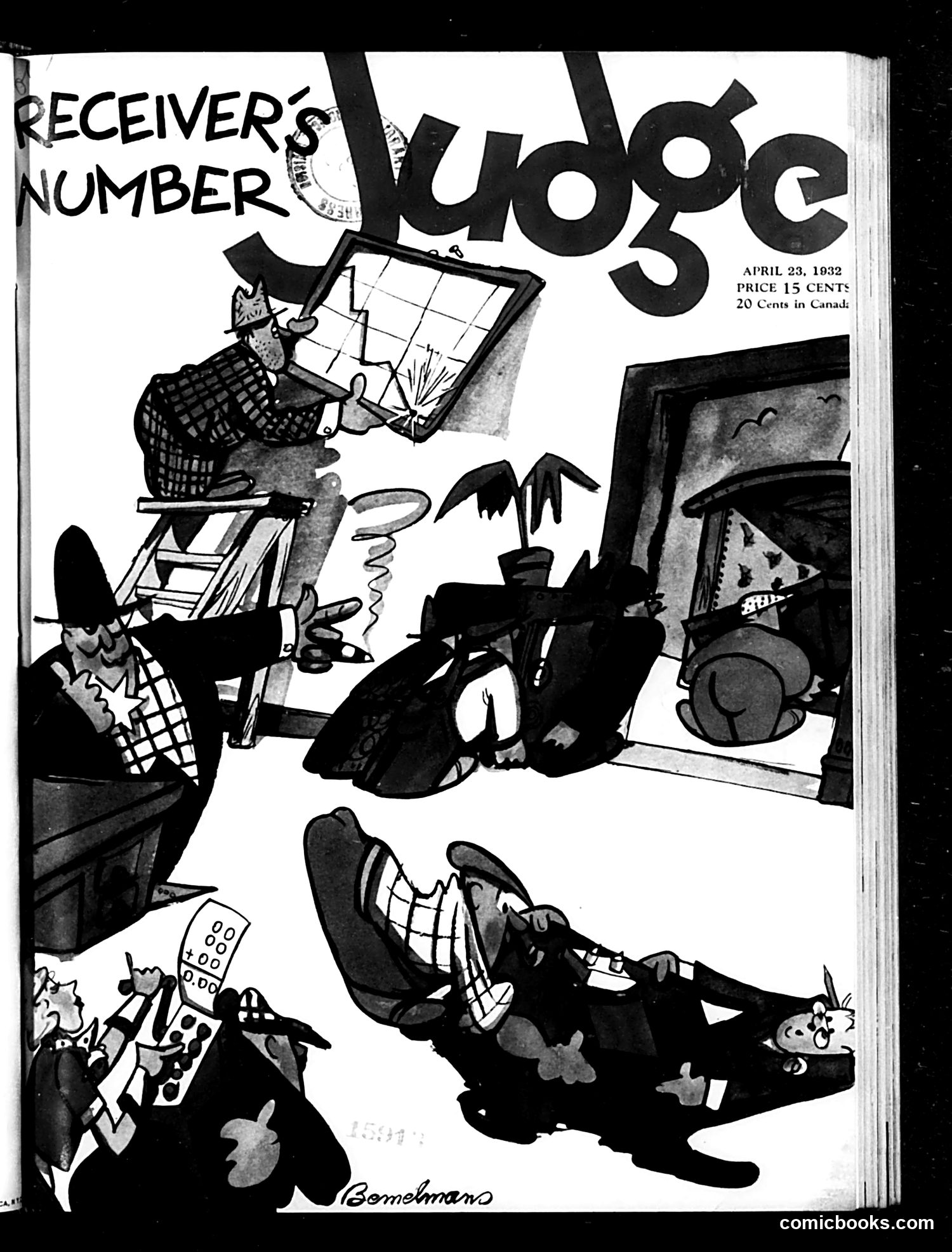
# Analysis of Judge Magazine Cover (April 23, 1932) This cover satirizes the economic chaos of the Great Depression. The chaotic scene depicts figures in distress amid scattered financial documents and household items—representing widespread economic collapse and domestic upheaval. The central figures appear to be ordinary citizens struggling with financial ruin, a common Judge theme during the Depression era. The "receiver's number" text likely references court-appointed receivers managing bankrupt businesses—a frequent occurrence in 1932. The satire critiques the period's economic devastation: families losing homes, businesses failing, and citizens caught in financial turmoil beyond their control. The cluttered, frantic composition visually reinforces the sense of panic and disorder gripping American society during this severe economic crisis. The $0.15 price reflects Depression-era affordability.
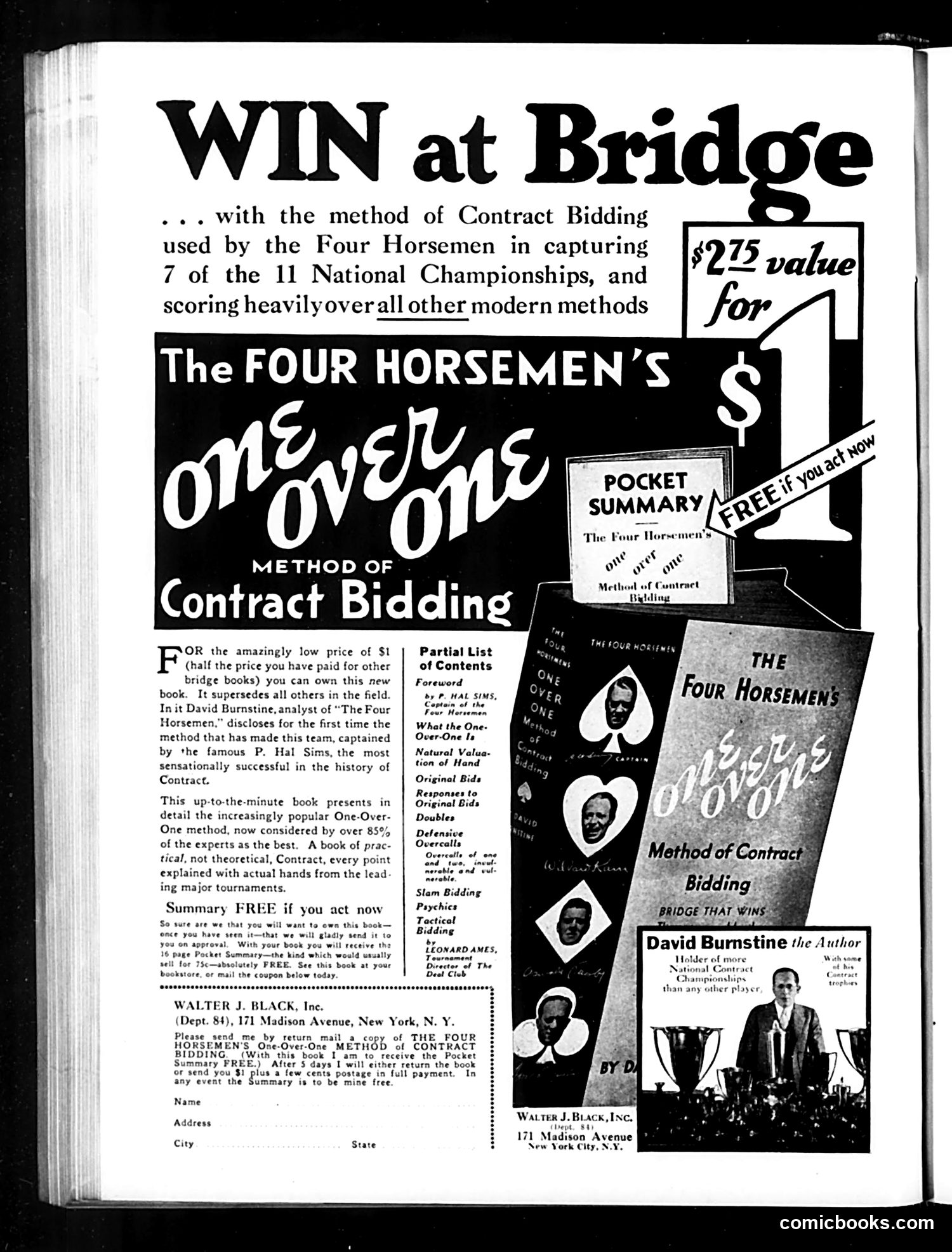
# Analysis This page is primarily **advertising, not satire or political commentary**. It promotes "The Four Horsemen's One Over One Method of Contract Bidding," a bridge instruction book by David Burnstine. The ad claims this bidding system helped "the Four Horsemen" (a famous bridge partnership) win 7 of 11 National Championships. The "Four Horsemen" appears to refer to a real, well-known bridge team of that era. The page offers the $2.75 book for $1, plus a free pocket summary. It includes a mail-order form and shows the book's cover and contents. There is no political satire or social commentary evident. This is straightforward commercial advertising for a bridge strategy book, likely from the 1930s-40s based on design and pricing.
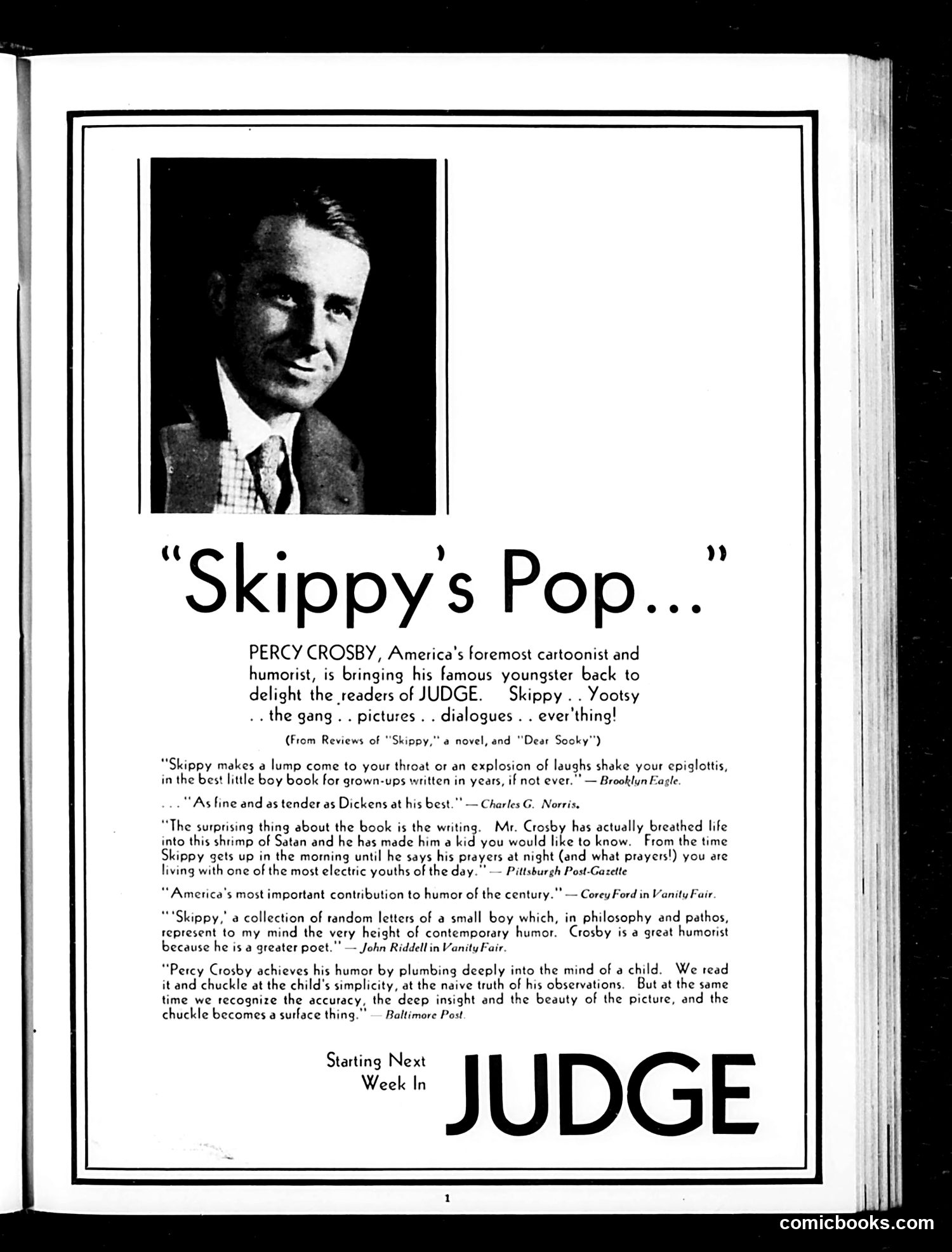
# "Skippy's Pop" - Judge Magazine Advertisement This is an advertisement promoting Percy Crosby's "Skippy," a popular comic strip character, coming to *Judge* magazine. The page features a portrait photograph of Crosby himself, identified as "America's foremost cartoonist and humorist." The quotes below praise Skippy's humor and appeal. Critics highlight that Crosby captures authentic childhood perspectives with both comedic simplicity and deeper psychological insight. References mention the strip's "gang," "pictures," and "dialogues"—standard comic strip elements. The advertisement emphasizes Skippy as important American humor, suitable for adults despite focusing on a young protagonist. This reflects early 20th-century comics' emergence as respectable literary entertainment for general audiences, not just children. The announcement promises the character's appearance "Starting Next Week in JUDGE."
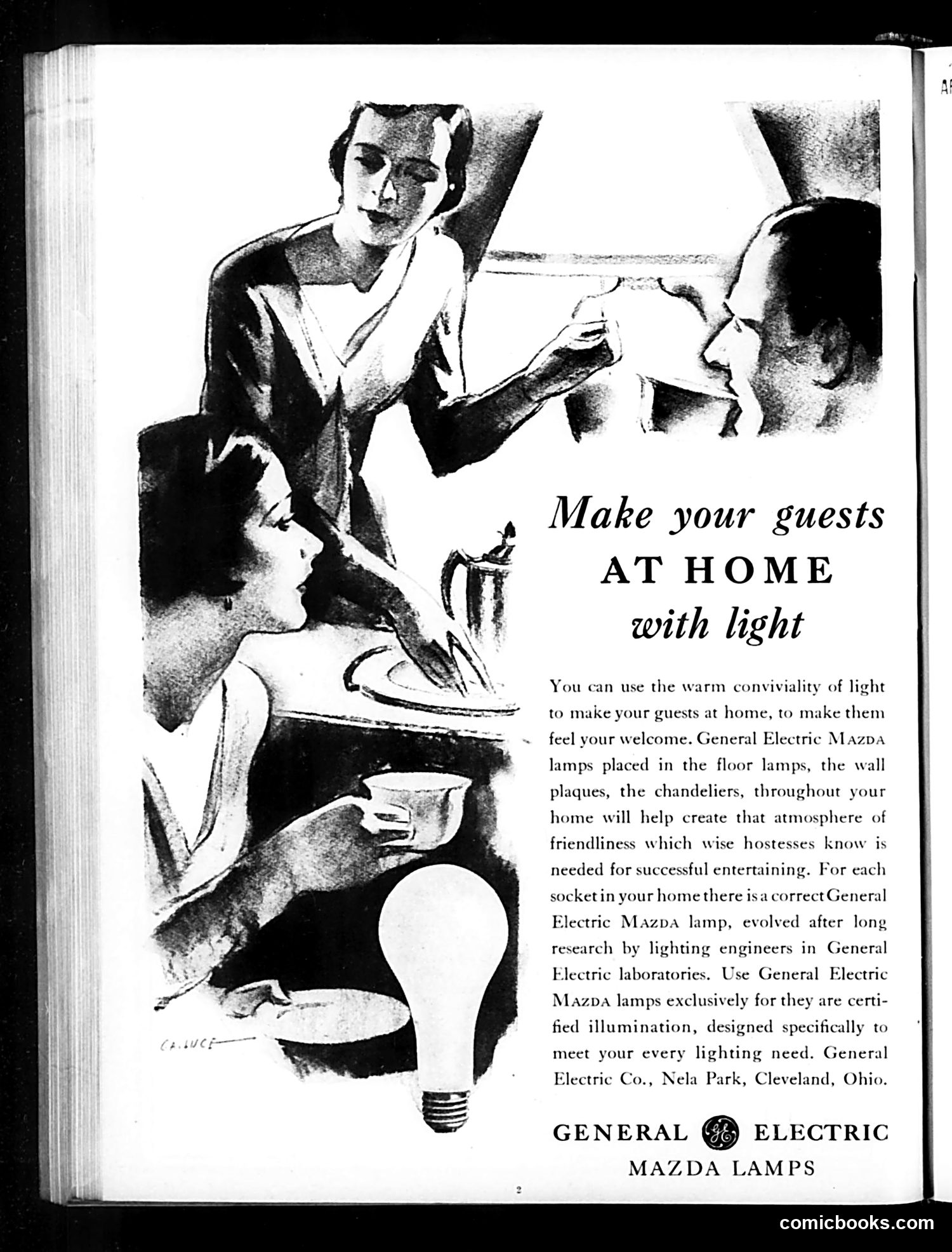
This is primarily a **General Electric Mazda Lamps advertisement**, not a satirical cartoon. The image shows a stylized illustration of a woman entertaining guests—serving drinks and food while positioned near a floor lamp displaying a glowing Mazda bulb. The ad's message is straightforward: proper home lighting creates a welcoming atmosphere for entertaining. The copy emphasizes that GE Mazda lamps, placed throughout the home (floor lamps, wall sconces, chandeliers), foster "friendliness" and make guests feel welcome. The ad claims these lamps represent "certified illumination, designed specifically to meet your every lighting need." This reflects mid-century advertising that connected domestic comfort and social status with consumer products.
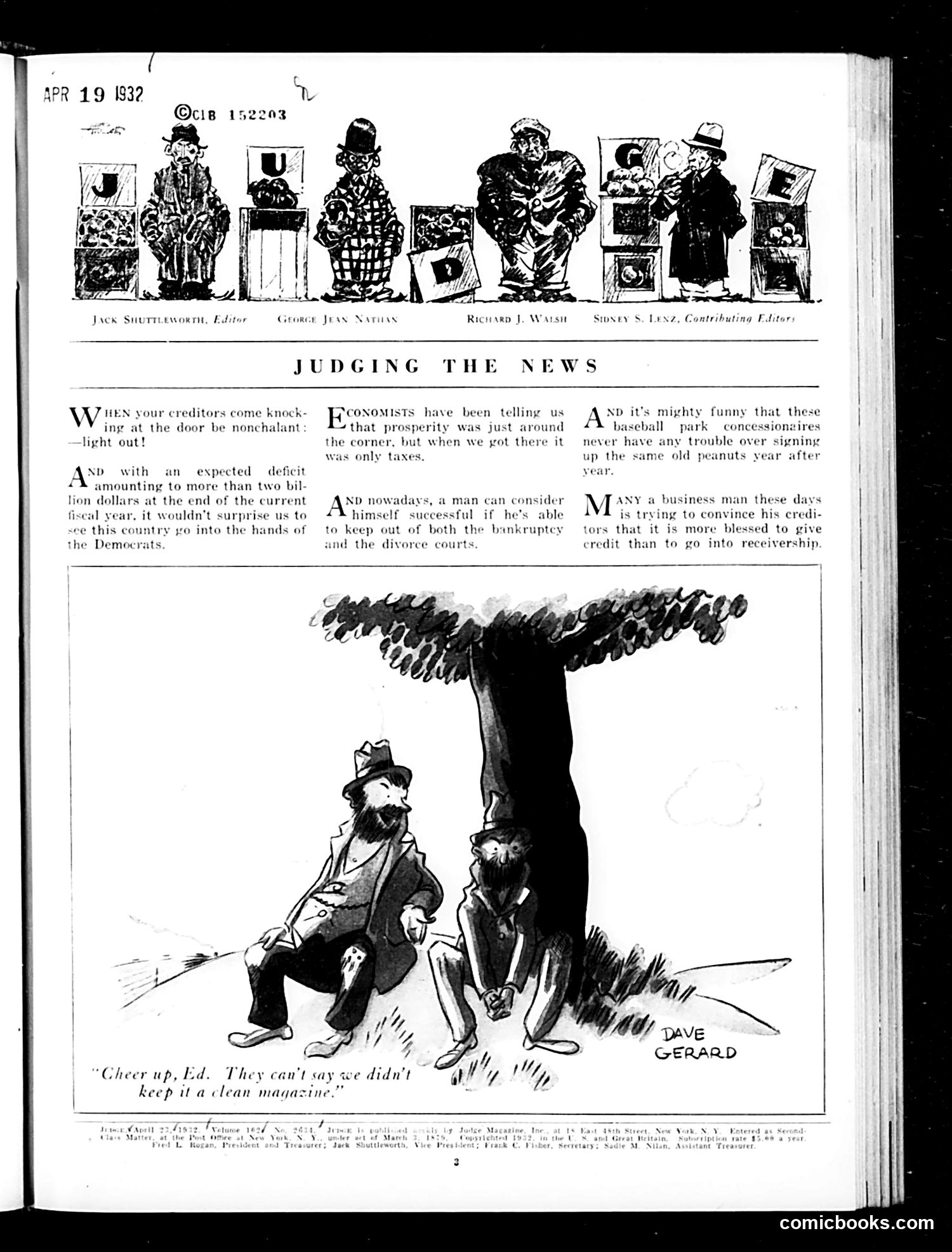
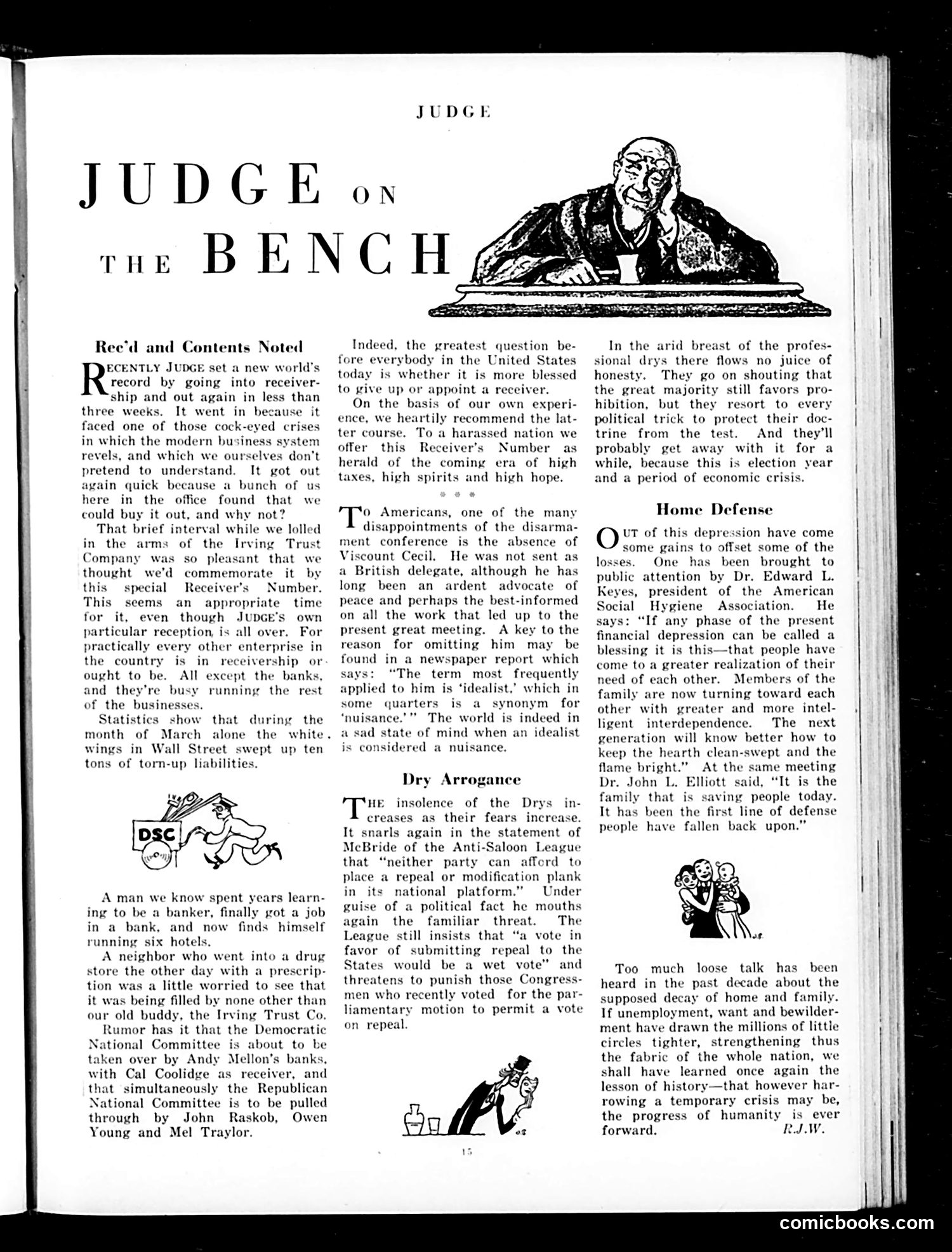
# "Judging the News" - April 19, 1932 This editorial cartoon page satirizes Depression-era economic hardship. The masthead features caricatured editors evaluating current events. The main cartoon by Dave Gerard depicts two dejected figures beneath a dead tree—symbolizing economic collapse—with the caption "Cheer up, Ed. They can't say see didn't keep it a clean magazine." The accompanying text mocks contemporary economic contradictions: economists claiming prosperity was "just around the corner" despite rising taxes, men considering bankruptcy preferable to divorce, and business owners claiming receivership is "more blessed" than giving credit. The satire targets both failed economic predictions and the absurd mental gymnastics people employed to cope with the financial crisis, while the cartoon's dead tree suggests their optimism is hollow.
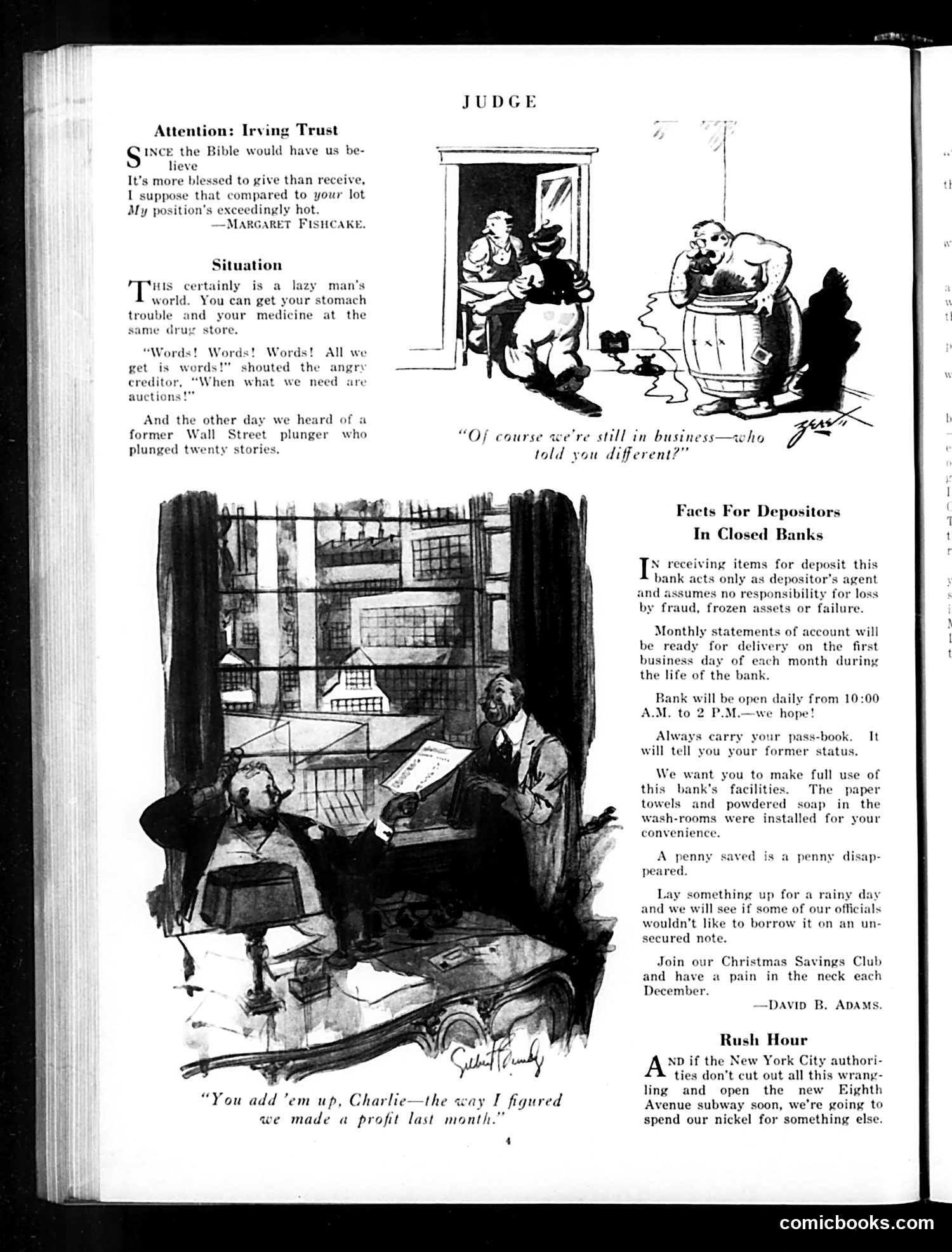
# Analysis of Judge Magazine Page This page contains two separate cartoons satirizing early 20th-century American life: **Top cartoon**: Shows a businessman confronting what appears to be a banker or financial advisor about ongoing business operations. The caption "Of course we're still in business—who told you different?" suggests satirizing false optimism during economic uncertainty, possibly related to bank failures or financial instability of the era. **Bottom cartoon**: Depicts accountants or clerks calculating profits, with the caption "You add 'em up, Charlie—the way I figured we made a profit last month." This mocks creative accounting practices—manipulating numbers to show false profitability, a recurring target of Judge's financial satire. The right column contains practical banking advice for depositors during economically unstable times, suggesting this issue addressed financial concerns relevant to its contemporary readers.
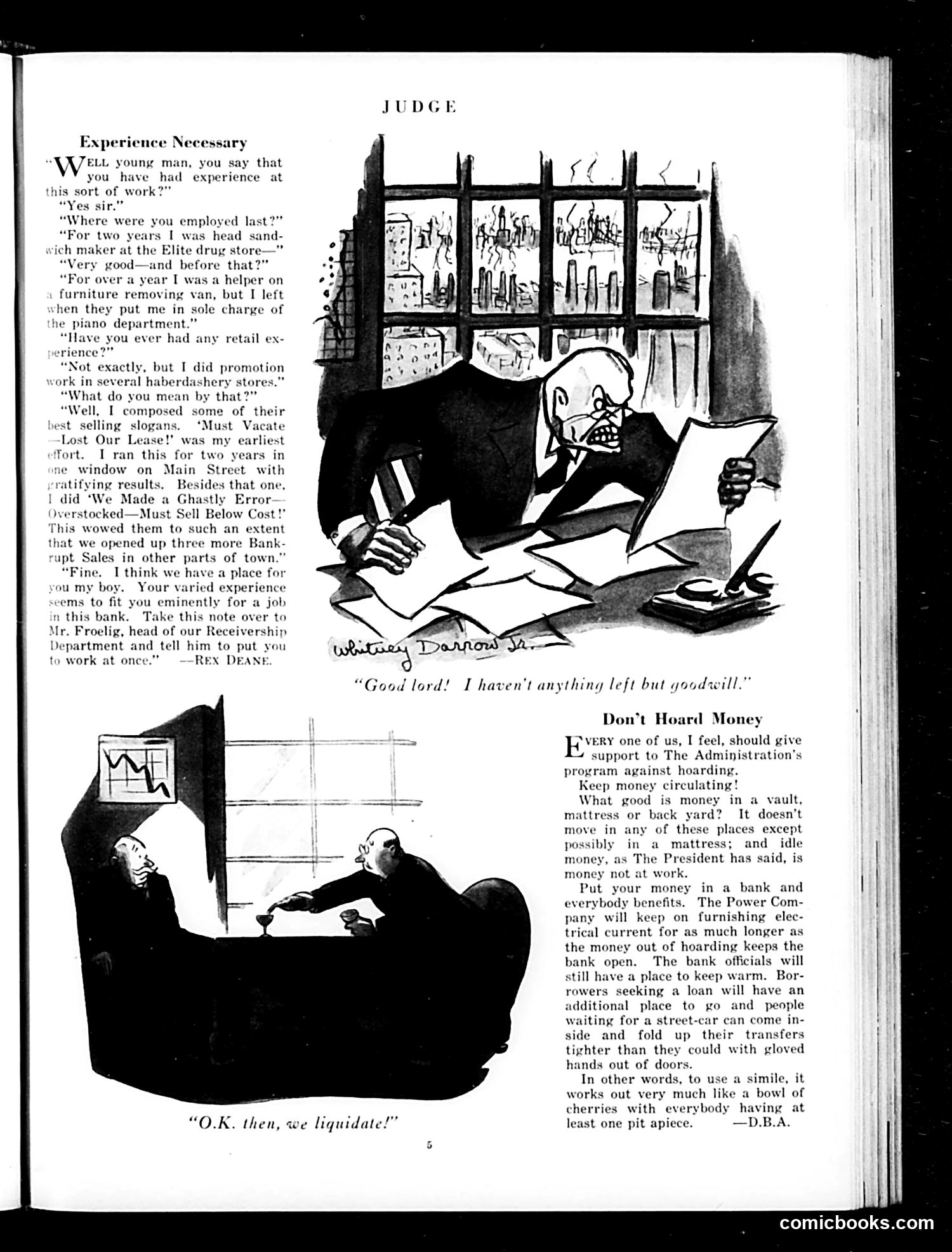
# Page Analysis: Judge Magazine This page contains two distinct cartoons and articles from Judge magazine addressing Depression-era economic concerns. **"Experience Necessary"** (top): A satirical interview where a young job applicant claims experience at various retail positions, but admits he actually composed store slogans and window displays. The hiring manager (appears to be a bank official) recognizes his varied experience as suitable for banking work. The joke mocks both the applicant's inflated claims and how retail promotion skills translate oddly into banking. **"Don't Hoard Money"** (bottom): Text argues citizens should deposit money in banks rather than hoarding it at home. The accompanying cartoon shows two figures discussing liquidation, likely satirizing bank failures or financial instability of the era. The piece advocates for public support of banking institutions and economic circulation during Depression uncertainty.
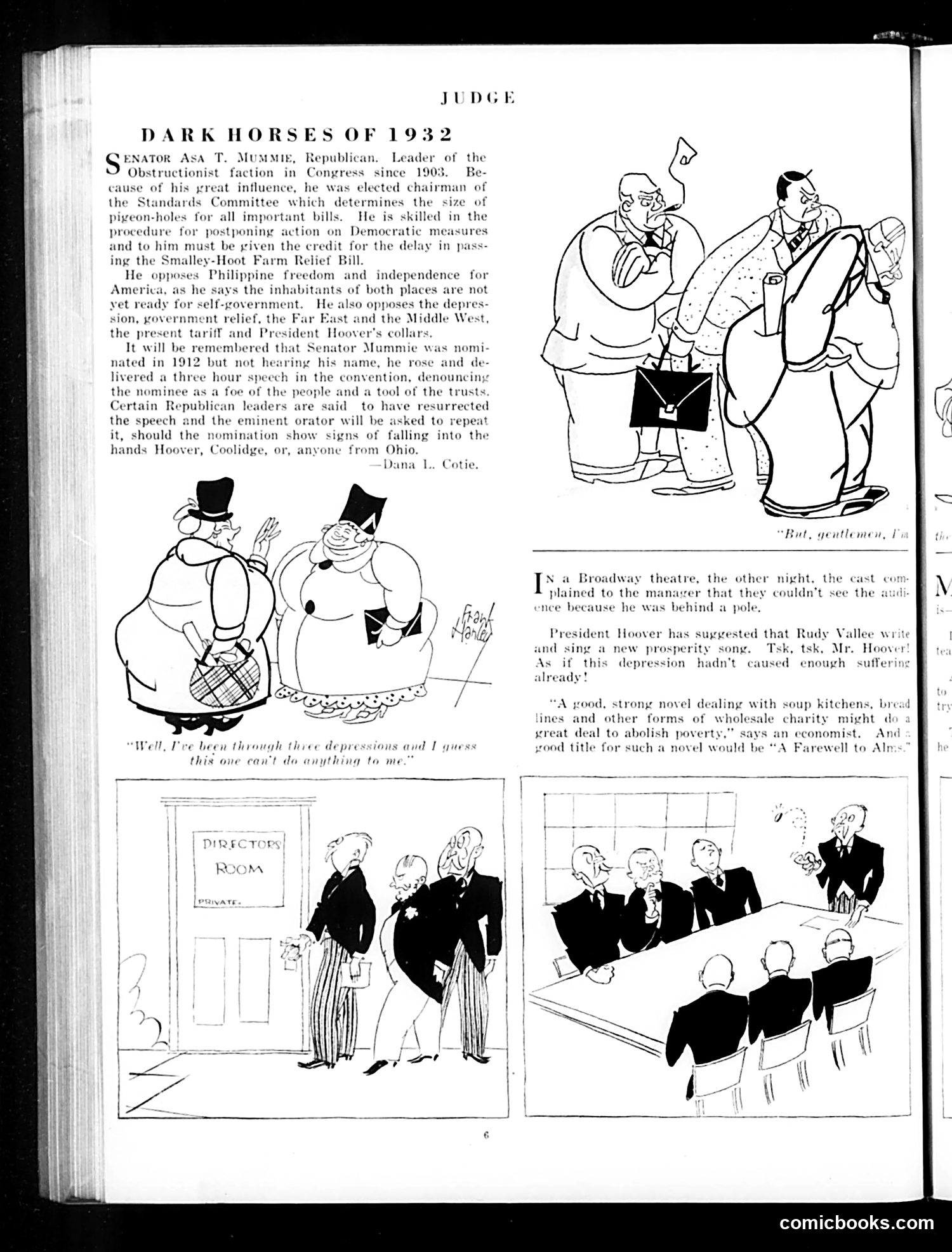
# Judge Magazine - "Dark Horses of 1932" This page satirizes Senator Asa G. Jimmie (Republican), depicted as an obstructionist who delayed Democratic measures and opposed the Smalley-Hoof Farm Relief Bill. The cartoons mock him as a political "dark horse"—an unexpected or undesirable candidate. The top cartoon shows figures labeled as potential alternatives (possibly Hoover, Coolidge, or Ohio politicians), with the caption "But, gentlemen, I—" suggesting reluctant nomination. The middle cartoon presents two heavy-set men claiming depression endurance: "Well, I've been through three depressions and I guess this one can't do anything to me." The bottom panels depict boardroom and directorial scenes, likely illustrating corporate or political maneuvering during the 1932 election cycle. The overall message criticizes Republican obstruction during economic hardship.
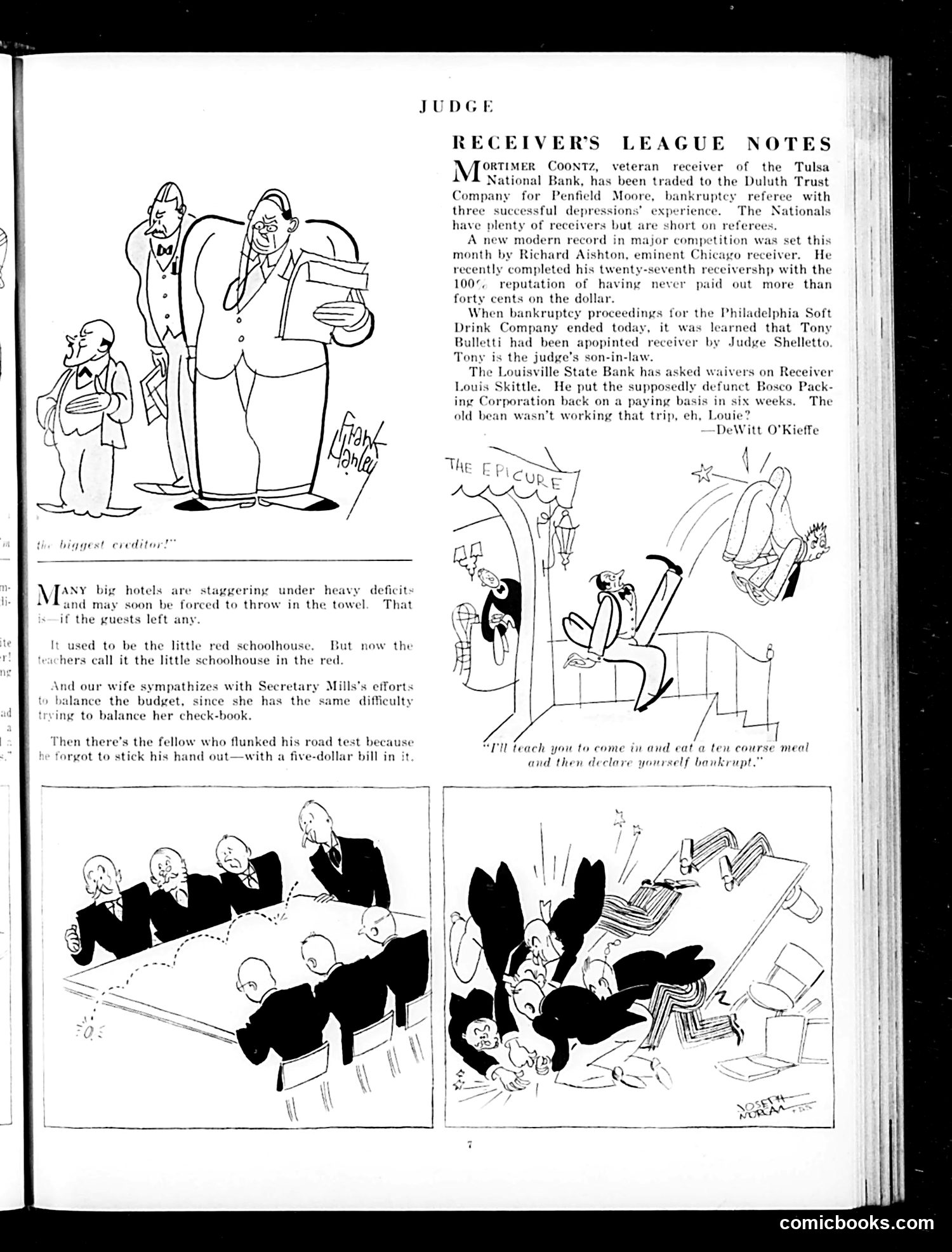
# Judge Magazine Satire: "Receiver's League Notes" This page satirizes the proliferation of **bankruptcy receivers** during the Great Depression. The article treats bankruptcy receiverships like a sports league, with receivers being "traded" between banks and tracked for their records—humorously noting one receiver who "never paid out more than forty cents on the dollar." The satire targets: 1. **Nepotism and corruption**: A judge appointing his son-in-law as receiver 2. **Systemic dysfunction**: Hotels and institutions collapsing; even the schoolhouse metaphor shifts from "little red schoolhouse" to "schoolhouse in the red" (financially bankrupt) 3. **Widespread financial crisis**: The casual treatment of constant bankruptcies as routine The cartoon panels (bottom) appear to show chaotic boardroom scenes, likely depicting the bedlam of bankruptcy proceedings. The overall message critiques how normalized financial collapse had become—so endemic that it's treated as entertainment rather than tragedy. This reflects Depression-era anxieties about institutional failure and corruption among those managing financial collapse.
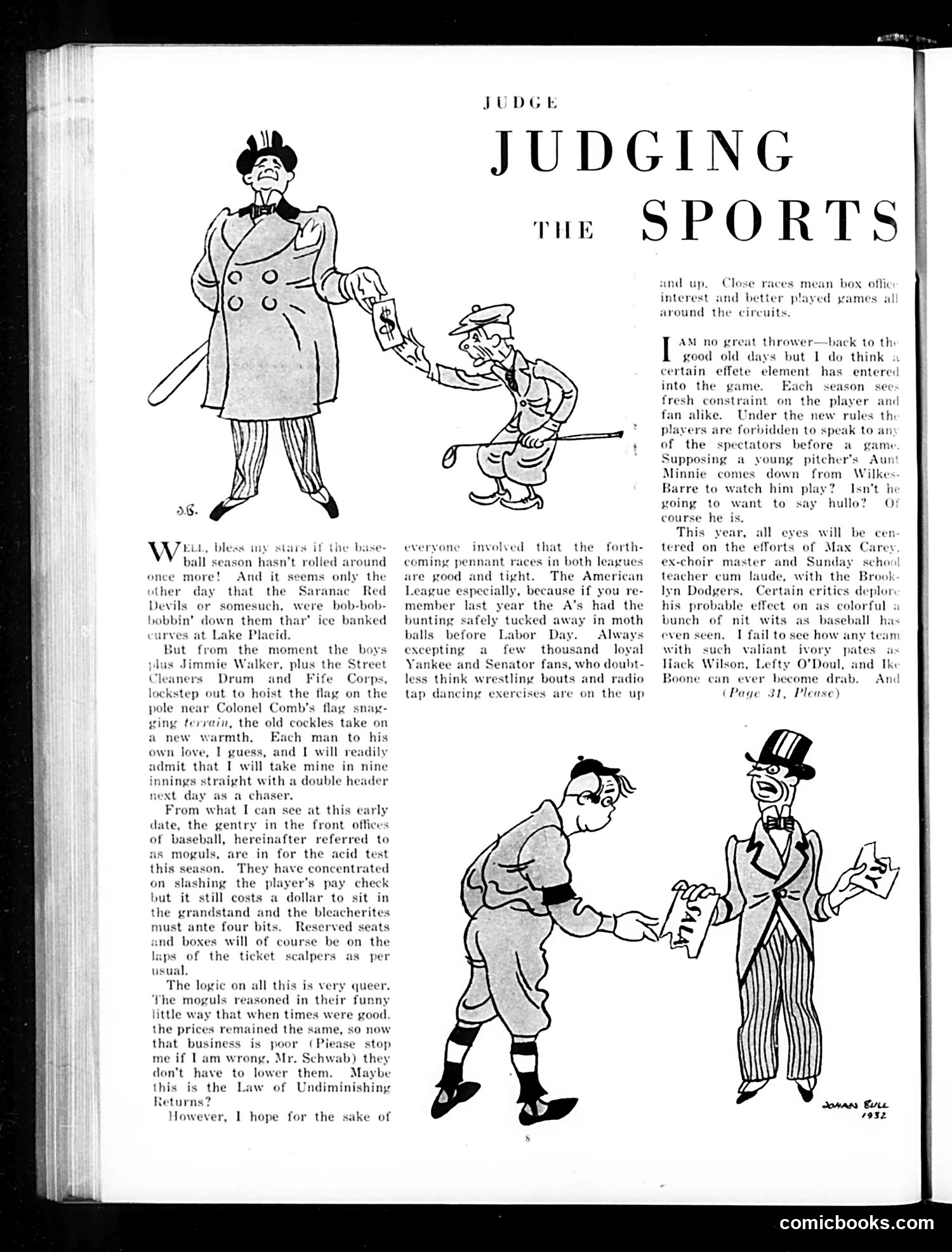
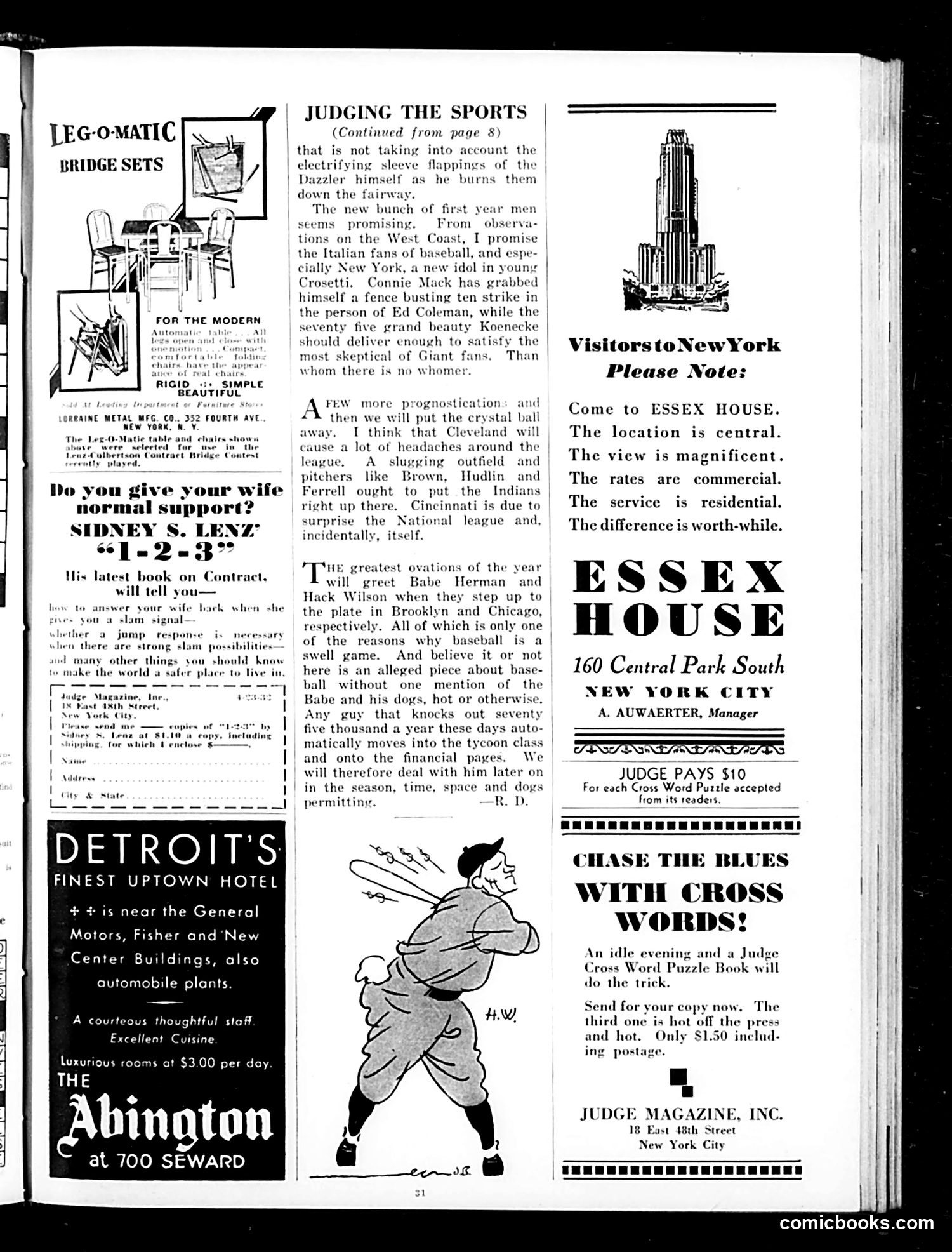
# "Judging the Sports" — Judge Magazine This is a satirical column about baseball, likely from the 1920s or early 1930s (based on references to Max Carey and the Brooklyn Dodgers). The author critiques new rules restricting player-fan interaction as overly "effete" and unnecessarily constraining the game's natural warmth and character. The main targets of satire are: 1. **Baseball "moguls" (executives)**: Their illogical pricing strategy—keeping ticket prices unchanged during prosperous times, then refusing to lower them during economic hardship ("Please stop me if I am wrong, Mr. Schwab"). 2. **New restrictive rules** that forbid players from greeting fans, exemplified by the absurd hypothetical of a pitcher unable to say hello to his visiting aunt. The cartoons illustrate the tension between authority figures (judges/officials) and players. The author celebrates colorful players like Hack Wilson and Lefty O'Doul, fearing regulations will eliminate baseball's personality and charm.
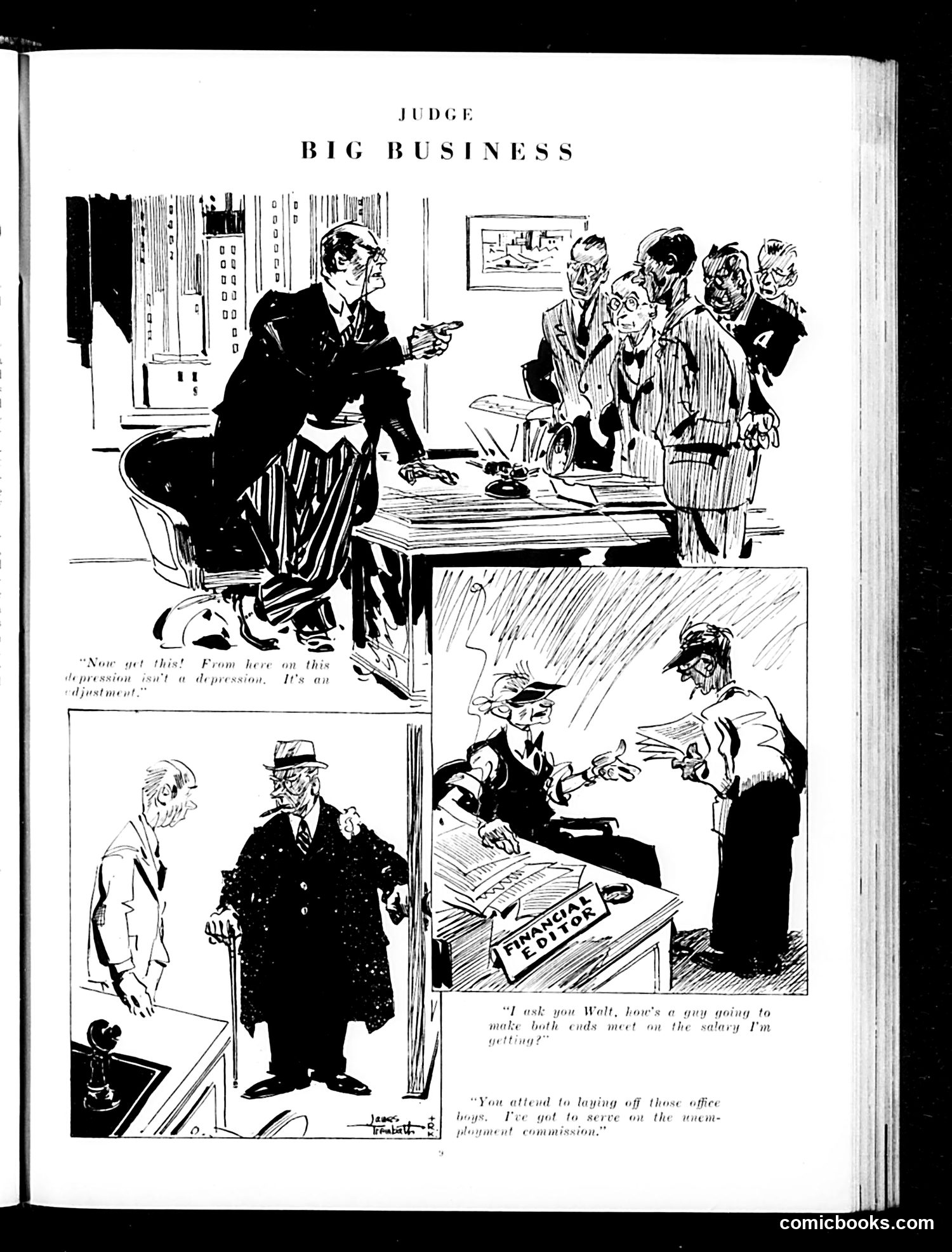
# "Judge: Big Business" - Political Cartoon Analysis This satirical page critiques corporate management during an economic depression. The top panel shows a judge or authority figure addressing businessmen, declaring "From here on this depression isn't a depression. It's an adjustment"—mocking how executives use euphemistic language to downplay economic hardship. The lower panels depict workplace friction: one shows two men in conflict (one appears to be a worker or employee), while another depicts a tense salary negotiation where someone asks how two workers will "make both ends meet on the salary I'm getting?" The final caption references "laying off office boys" and serving notice on "the unemployment commission"—satirizing how big business shifts economic burden onto workers and government during downturns, while using semantics to reframe crises as mere "adjustments."
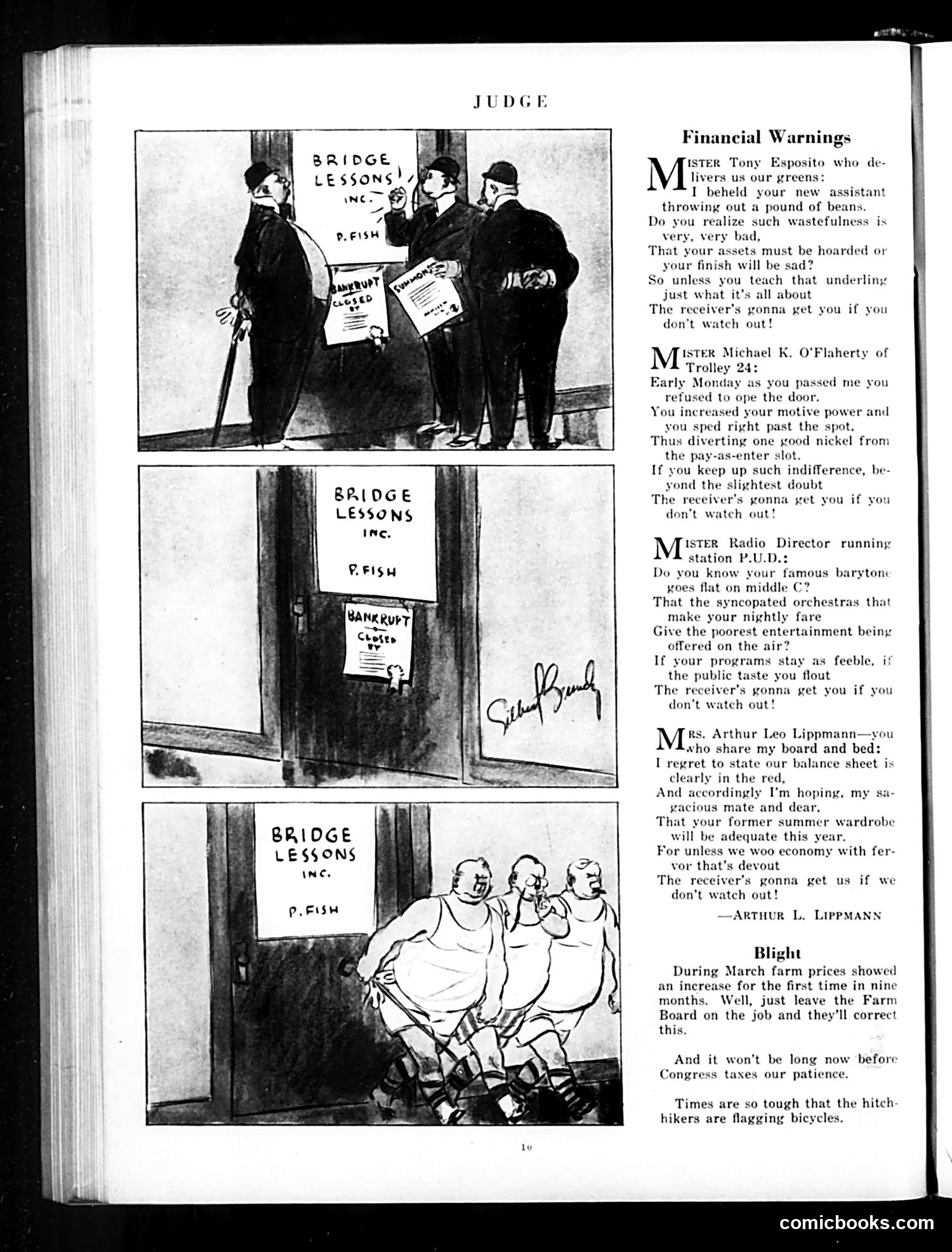
# "Financial Warnings" — Judge Magazine Cartoon Analysis This page presents three-panel satirical comics by P. Fish mocking a business called "Bridge Lessons Inc." The cartoons employ the recurring threat "The receiver's gonna get you if you don't watch out!"—a parody of the children's poem "Santa Claus Is Coming to Town." Each panel targets different targets of financial mismanagement during what appears to be the Great Depression era: 1. **Panel 1**: Business associates wasting resources (throwing out beans) 2. **Panel 2**: A trolley operator (Michael K. O'Flaherty) refusing passengers to avoid paying the receiver, diverting fare revenue 3. **Panel 3**: Overweight men representing failed entertainment/management The satire warns that financial irresponsibility invites bankruptcy receivers to seize assets. The accompanying "Blight" section includes economic commentary: mocking the Farm Board's ineffectiveness and joking that economic desperation has reduced hitchhikers to flagging bicycles instead of cars. The humor relies on Depression-era anxiety about business failure and receivership.