
Judge, 1932-04-23 · page 20 of 36
Judge — April 23, 1932 — page 20: what you’re looking at
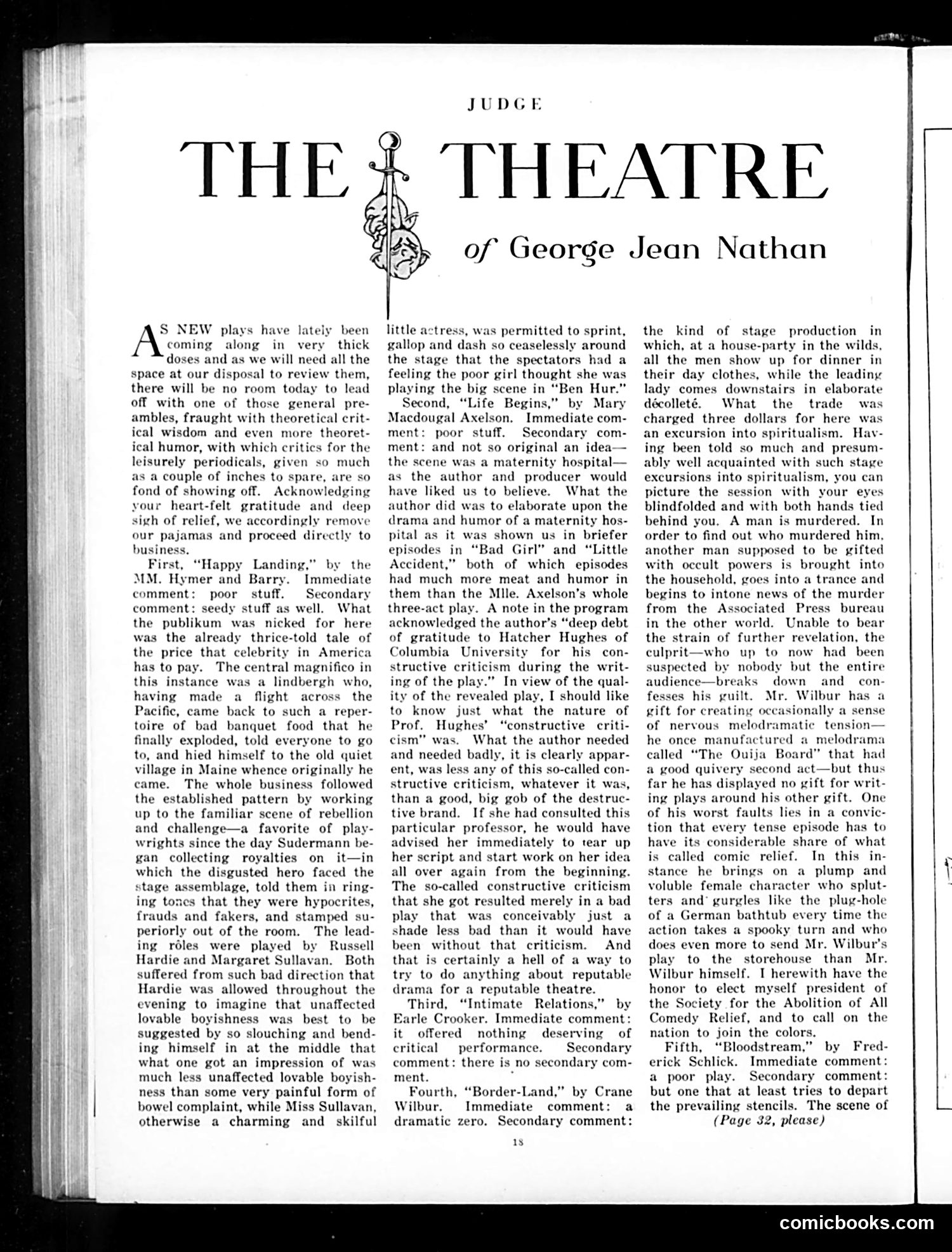
A restored page from Judge, 1932-04-23. Page through the whole issue in the reader above.
📄 Transcribed text from this page (OCR, searchable)
Machine-transcribed from the original scan — historical spelling and the odd misread are preserved.
HE NEW plays have lately been oming along in very thick doses and as we will need all the space at our disposal to review them, there will be no room today to lead off with one of those general pre- ambles, fraught with theoretical crit- ical wisdom and even more theoret- ical humor, with which critics for the leisurely periodic: given so much as a couple of inches to spare, are so fond of showing off. Acknowledging your heart-felt gratitude and deep sigh of relief, we accordingly remove our pajamas and proceed directly to business. First, “Happy Landing,” by the MM. Hymer and Barry. Immediate commen poor stuff. Secondary commen edy stuff as well. What the publikum vw nicked for here was the already thrice-told tale of the price that celebrity in America has to p: The central magnifico in this instance was a lindbergh who, having made a flight across the Pacific, came back to such a reper- toire of bad banquet food that he finally exploded, told everyone to go to, and hied himself to the old quiet village in Maine whence originally he came. The whole business followed the established pattern by working up to the familiar scene of rebellion and challenge—a favorite of play wrights since the day Sudermann be- gan collecting royalties on it—in which the disgusted hero faced the stage assemblage, told them in ring- ing tones that they were hypocrites, frauds and fakers, and stamped su- periorly out of the room. The lead- ing roles were played by Russell Hardie and Margaret Sullavan. Both suffered from such bad direction that Hardie was allowed throughout the evening to agine that unaffected lovable boyishness was best to be suggested by so slouching and bend- ing himself in at the middle that what one got an impression of v much less unaffected lovable boyish- ness than some very painful form of bowel complaint, while Miss Sullav otherwise a charming and JUDGE THEATRE of George Jean Nathan little actress, was permitted to sprint, gallop and dash so ceaselessly around the st. that the spectators had a feeling the poor girl thought she was playing the big scene in “Ben Hur.” Second, “Life Begins,” by Mary Macdougal Axelson. Immediate com- ment: poor stuff. Secondary com- ment: and not so origi an idea— the scene wa maternity hospital— as the author and producer would have liked us to believe. What the author did was to elaborate upon the drama and humor of a maternity hos- pital as it was shown us in briefer episodes in “Bad Girl” and “Little Accident,” both of which episodes had much more meat and humor in them than the Mlle. Axelson’s whole three-act play. A note in the program acknowledged the author’s “deep debt of gratitude to Hatcher Hughes of Columbia University for his con- structive criticism during the writ- ing of the play.” In view of the qual- ity of the revealed play, I should like to know just what the nature of Prof. Hughes’ “constructive criti- cism” was. What the author needed and needed badly, it is clearly appar- ent, was less any of this so-called con- structive criticism, whatever it was, than a good, big gob of the destruc- tive brand. If she had consulted this particular professor, he would have advised her immediately to tear up her script and start work on her idea all over again from the beginning. The so-called constructive criticism that she got resulted merely in a bad play that was conceivably just a shade less bad than it would have been without that criticism. And that is certainly a hell of a v try to do anything about repu drama for a reputable theatre. Third, “Intimate Relations,” by Earle Crooker. Immediate comment: it offered nothing deserving of critical performance. Secondary comment: there is no secondary com- ment. . Fourth, “Border-Land,” by Crane Wilbur. Immediate comment: a dramatic zero. Secondary comment: 1s the kind of stage production in which, at a house-party in the wilds all the men show up for dinner in their day clothes, while the leading lady comes downstairs in elaborate décolleté. What the trade was charged three dollars for here was an excursion into spiritualism. Hav- ing been told so much and presum- ably well acquainted with such stage excursions into spiritualism, you picture the session with your e blindfolded and with both hands tied behind you. A man is murdered. In order to find out who murdered him, another man supposed to be gifted with occult powers is brought into the household, goes into a trance and begins to intone news of the murde from the Associated Press bureau in the other world. Unable to bear the strain of further revelation, the culprit—who up to now had been suspected by nobody but the entire audience—breaks down and con- fesses his guilt. Mr. Wilbur has a gift for creating occasionally a sense of nervous melodramatic tension— he once manufactured a melodrama called “The Ouija Board” that had a good quiv second act—but thus far he has displayed no gift for writ- ing plays around his other gift. One of his worst faults lies in a convic- tion that every tense episode has to have its cons nle share of what is called comic relief. In this in- stance he brings on a plump and voluble female character who splut- ters and’ gurgles like the plug-hole of a German bathtub every time the action takes a spooky turn and who does even more to send Mr. Wilbur's play to the storehouse than Mr. Wilbur himself. I herewith have the honor to elect myself president of the Society for the Abolition of All Comedy Relief, and to call on the nati to join the colors. Fifth, “Bloodstream,” by Fred- erick Schlick. Immediate comment: a poor play. Secondary comment: but one that at least tries to depart the prevailing stencils. The scene of (Page 32, please) comicbooks.com