A complete issue · 36 pages · 1930
Judge — December 20, 1930
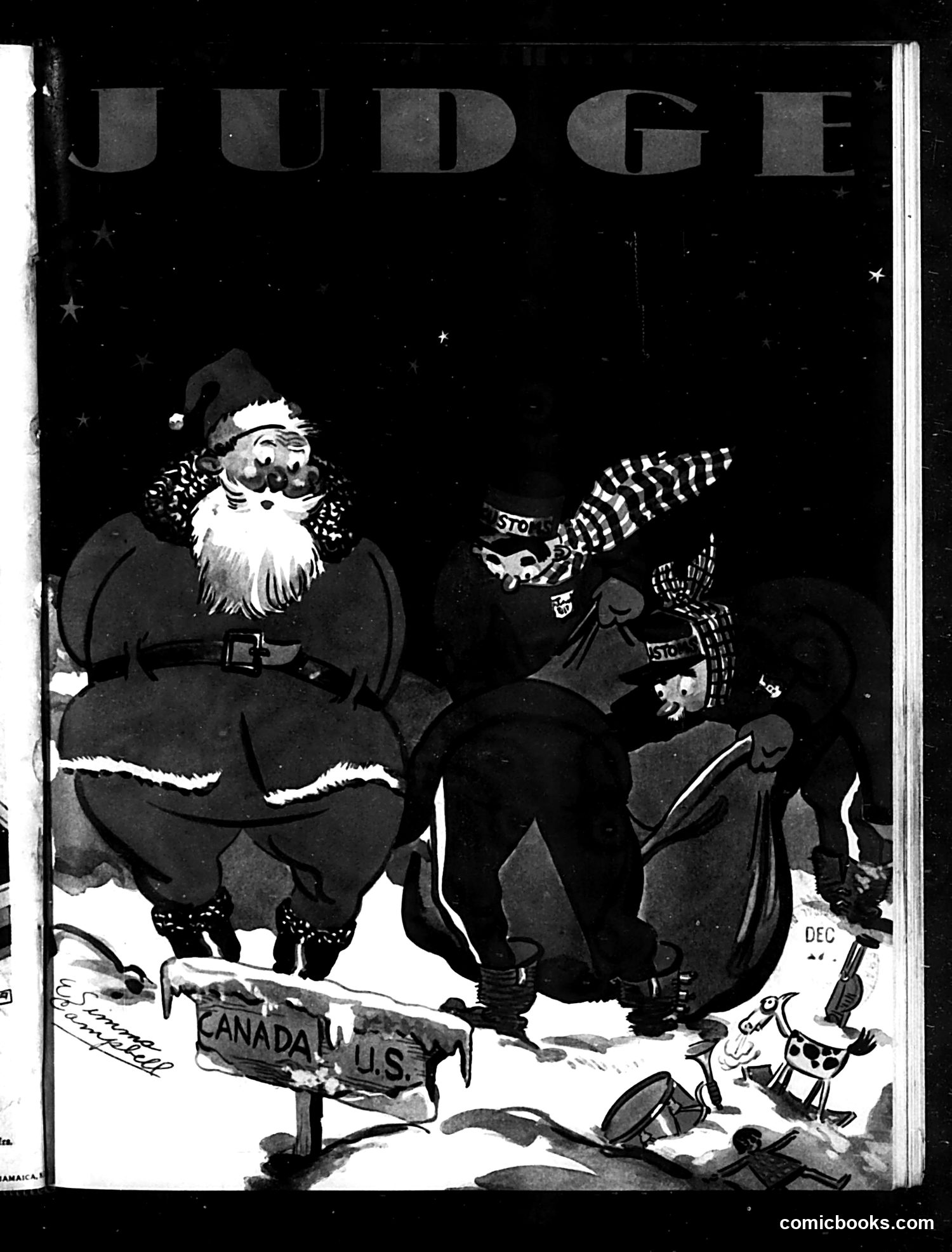
# Political Cartoon Analysis This **Judge** magazine cover depicts Santa Claus and what appears to be a witch or dark figure at the Canada-U.S. border during winter. The satire likely comments on cross-border relations or trade between the United States and Canada, a recurring theme in early 20th-century American political humor. Santa represents American goodwill or commerce, while the witch figure (possibly personifying Canada or a Canadian political figure) suggests suspicion or hostility in bilateral relations. The snowy border setting emphasizes the geographical and political divide. Without the specific publication date visible, the exact historical context remains unclear—this could reference tariff disputes, trade wars, or diplomatic tensions common during this era. The starry sky and holiday setting contrast sharply with the tense encounter depicted.
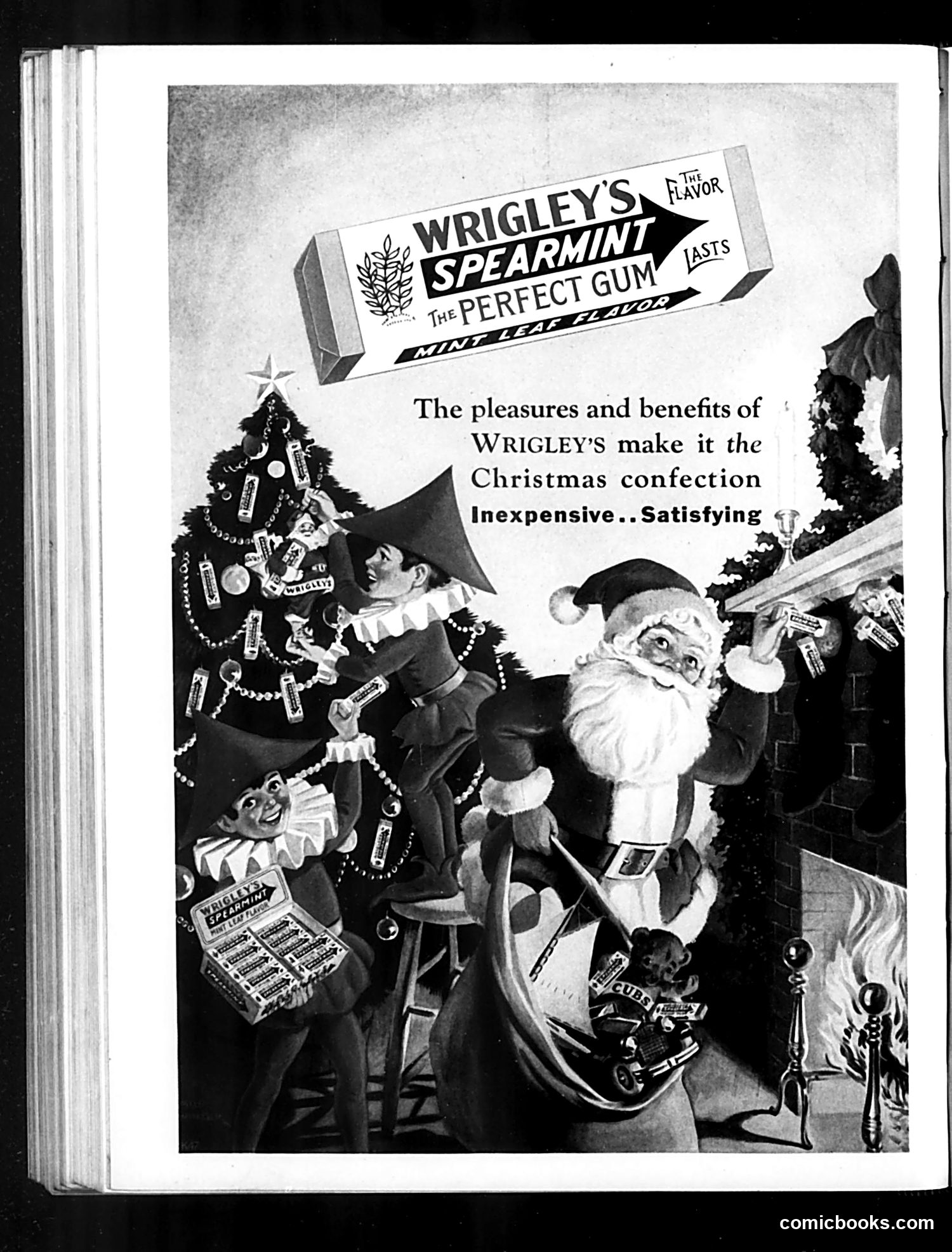
# Wrigley's Spearmint Gum Advertisement This is a **commercial advertisement**, not political satire. It depicts Santa Claus and elves decorating a Christmas tree with Wrigley's Spearmint Gum packages as ornaments. The ad copy emphasizes that Wrigley's gum makes an "Inexpensive...Satisfying" Christmas gift. The visual joke plays on the idea of gum as stocking-stuffers or small presents—affordable enough for mass gift-giving during the holiday season. This reflects 1920s-30s consumer culture when mass-produced goods became popular Christmas gifts. There is no political content or satirical commentary present. Judge magazine, while primarily known for satire, regularly published advertisements like this one to generate revenue.
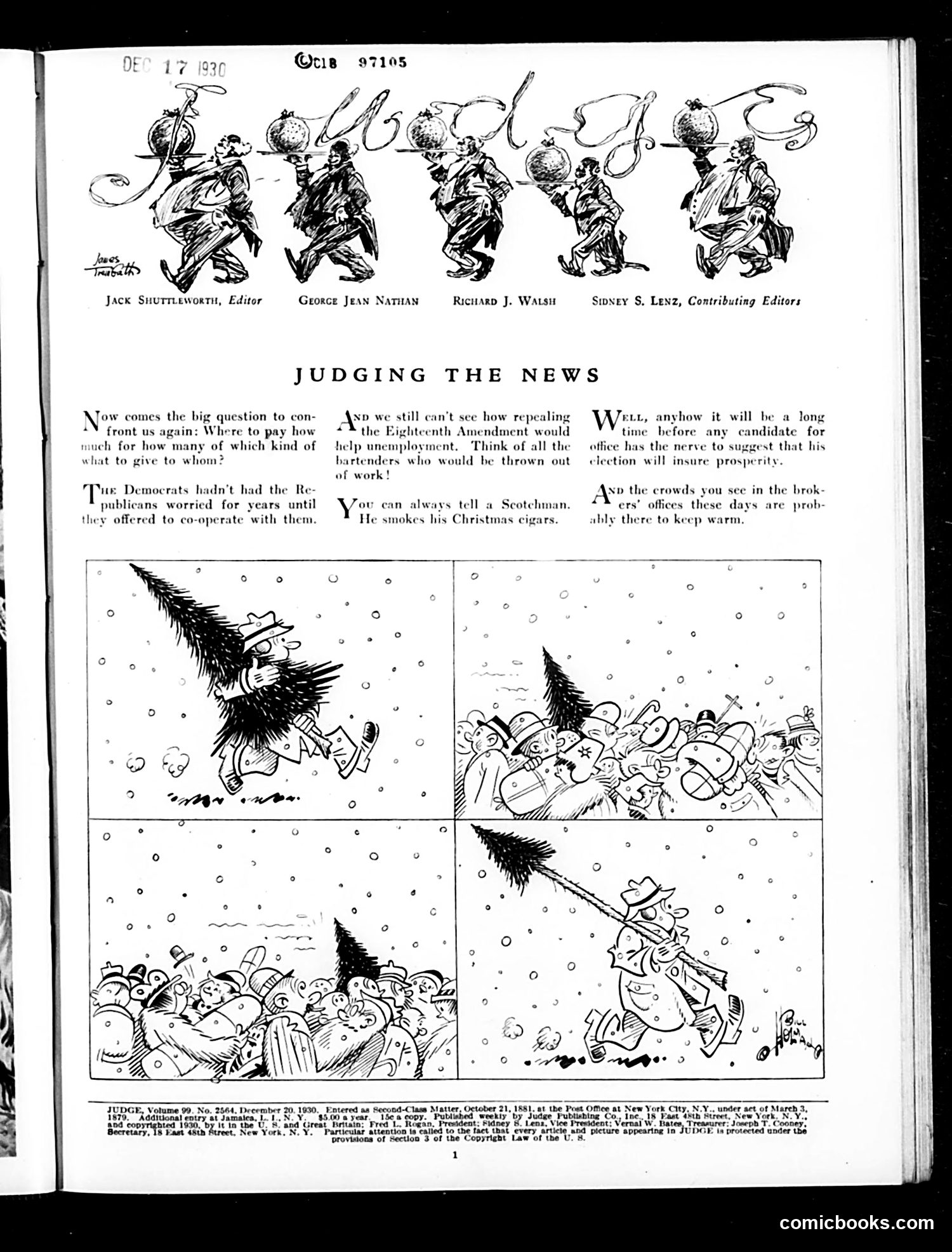
# Analysis of "Judging the News" This December 1930 *Judge* page satirizes contemporary economic and political debates during the Great Depression's early stages. The header cartoon shows five editors juggling globes and tools—visual metaphors for handling news stories. The main comic strip (three panels) depicts a Christmas tree being carried through increasingly crowded, chaotic scenes. The satire likely comments on how people are struggling during economic hardship while still attempting holiday celebrations. The text snippets reference Republican-Democratic cooperation on unemployment relief and make a cynical joke about Scottish Christmas traditions (smoking cigars indoors to stay warm), implying the Eighteenth Amendment (Prohibition) prevents alternative warming methods. The overall message criticizes politicians' inability to address Depression-era suffering while ordinary citizens maintain desperate normalcy.
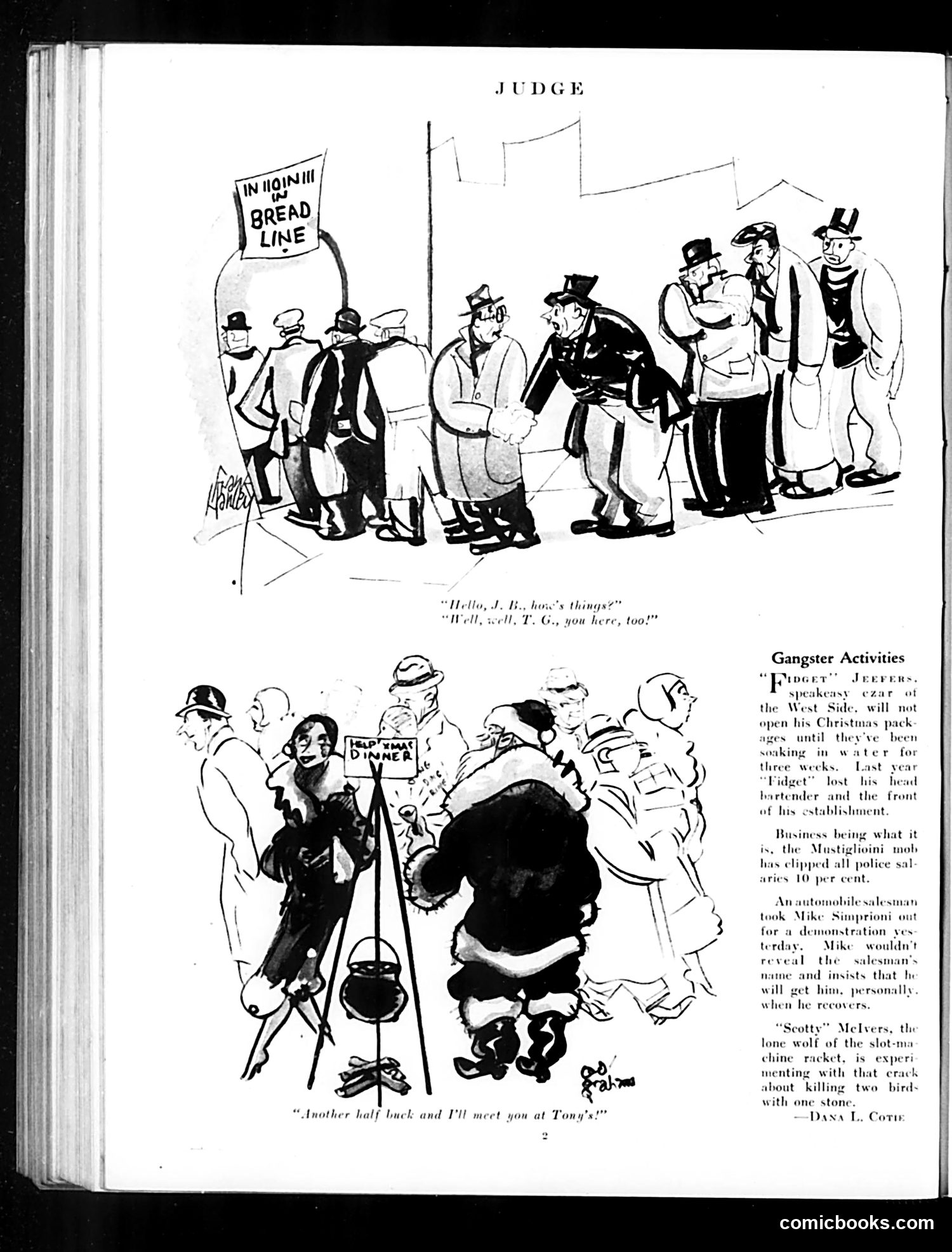
# Analysis of Judge Magazine Page **Top Cartoon ("Judge"):** Depicts a bread line—unemployed men waiting for food assistance. One holds a sign reading "UNION BREAD LINE." The caption exchanges greetings between "J.D." (likely J.D. Rockefeller or similar wealthy figure) and "T.G." (unclear), sarcastically suggesting these wealthy individuals are present in the breadline. This satirizes wealth inequality and the contrast between the rich and poor during economic hardship. **Bottom Cartoon & "Gangster Activities" Section:** Illustrates criminal underworld figures near a restaurant, referencing Prohibition-era organized crime. Text details "Fidget" Jeffers' speakeasy operations and violence. Accompanying stories describe mob extortion, automobile salesmen being targeted, and "Scotty" Melvers' slot-machine racket experiments. This documents contemporary gangster activities during Prohibition.
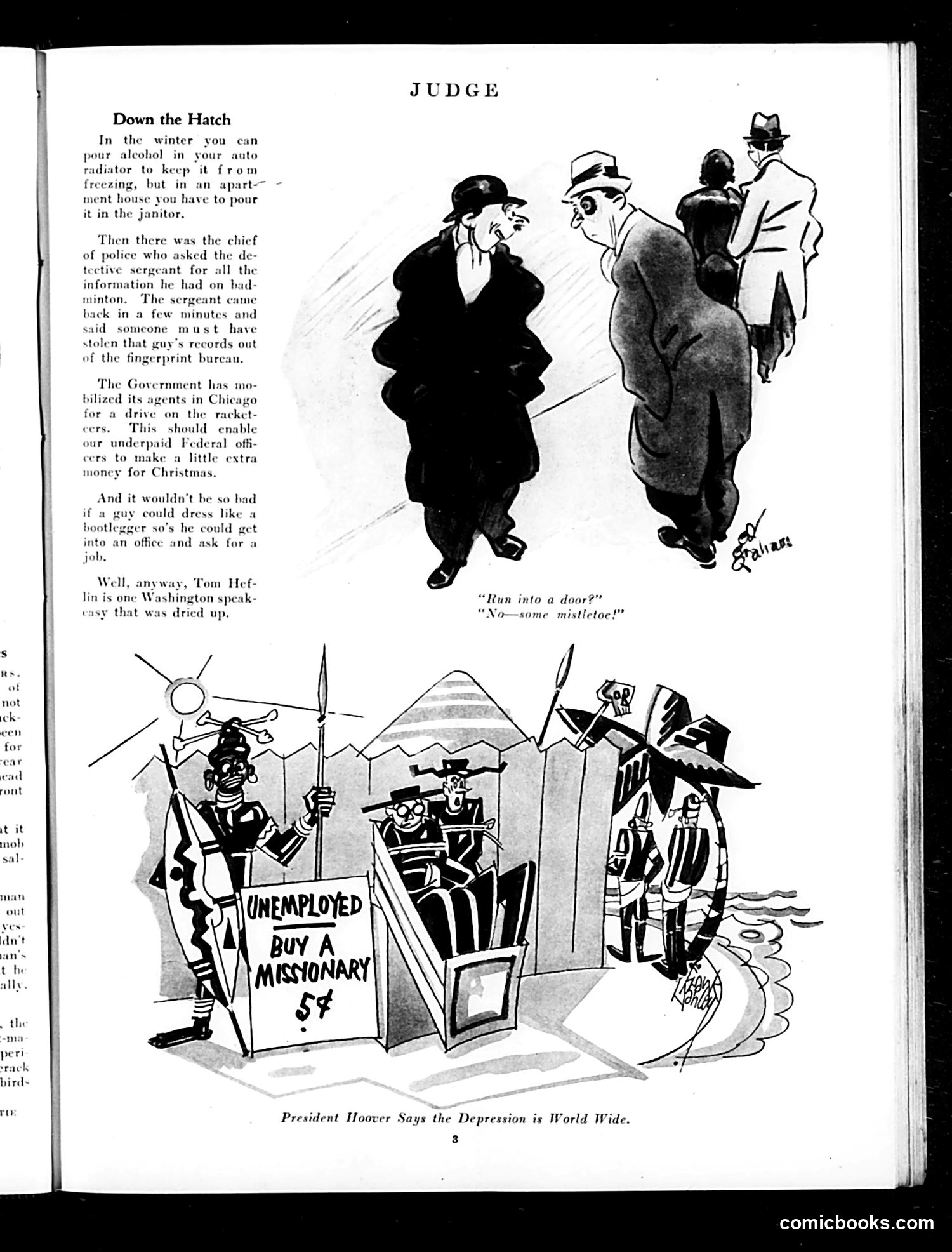
# Analysis of Judge Magazine Page **Top Cartoon:** Shows men in coats and hats running, with caption "Run into a door?" and "No—some mistletoe!" This is a holiday-season visual gag about Christmas mistletoe traditions (kissing under mistletoe), with the implication that someone's black eye came from amorous holiday encounters rather than accident. **Bottom Cartoon:** Depicts a tent labeled "UNEMPLOYED BUY A MISSIONARY 5¢" with various caricatured figures around it, including what appears to be an indigenous figure with a spear and wealthier figures with money. The caption states "President Hoover Says the Depression is World Wide." **Context:** This satirizes the Great Depression-era irony of Americans being too poor to help themselves while still expected to fund missionary work. The cartoon mocks the disconnect between widespread unemployment and continued charitable appeals.
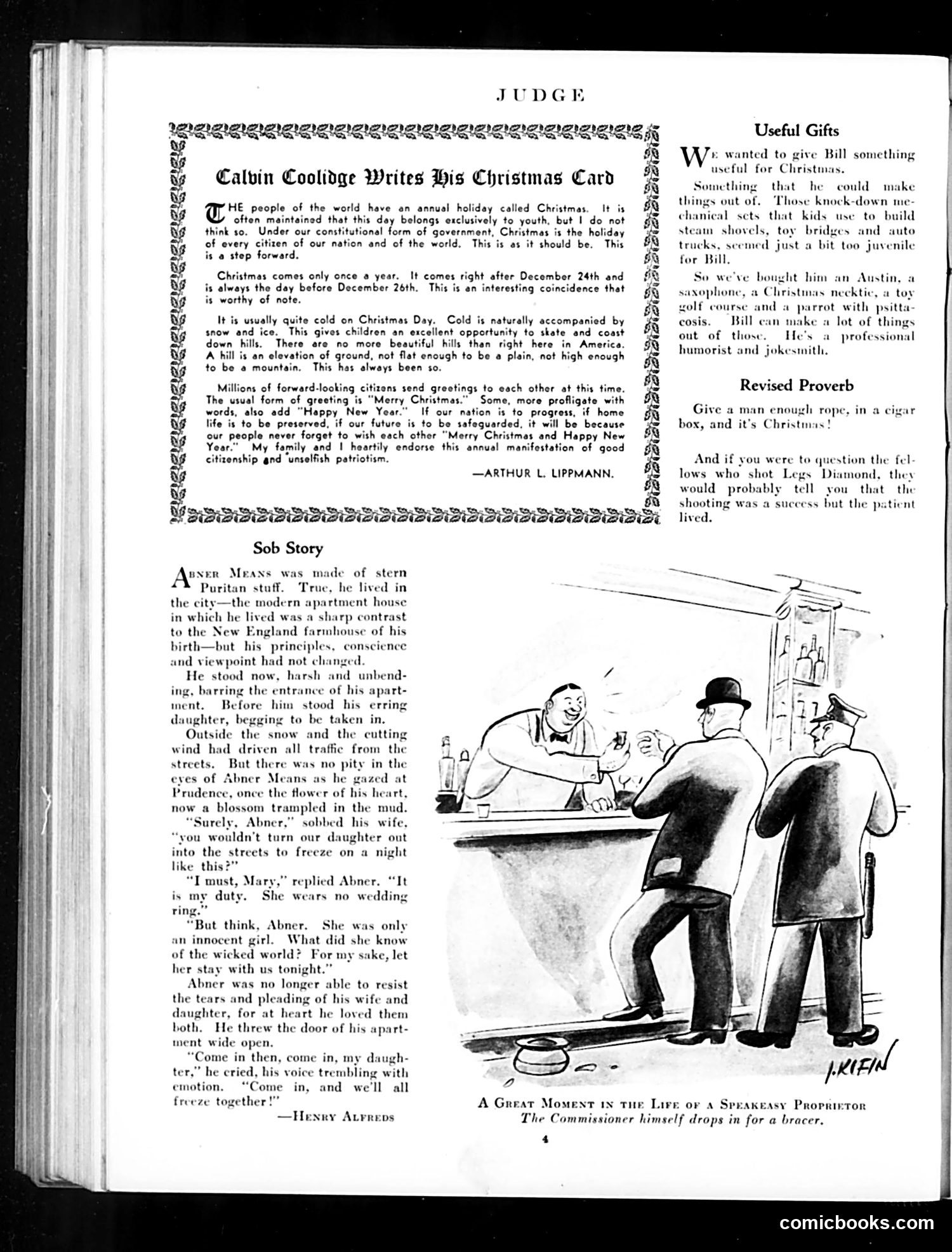
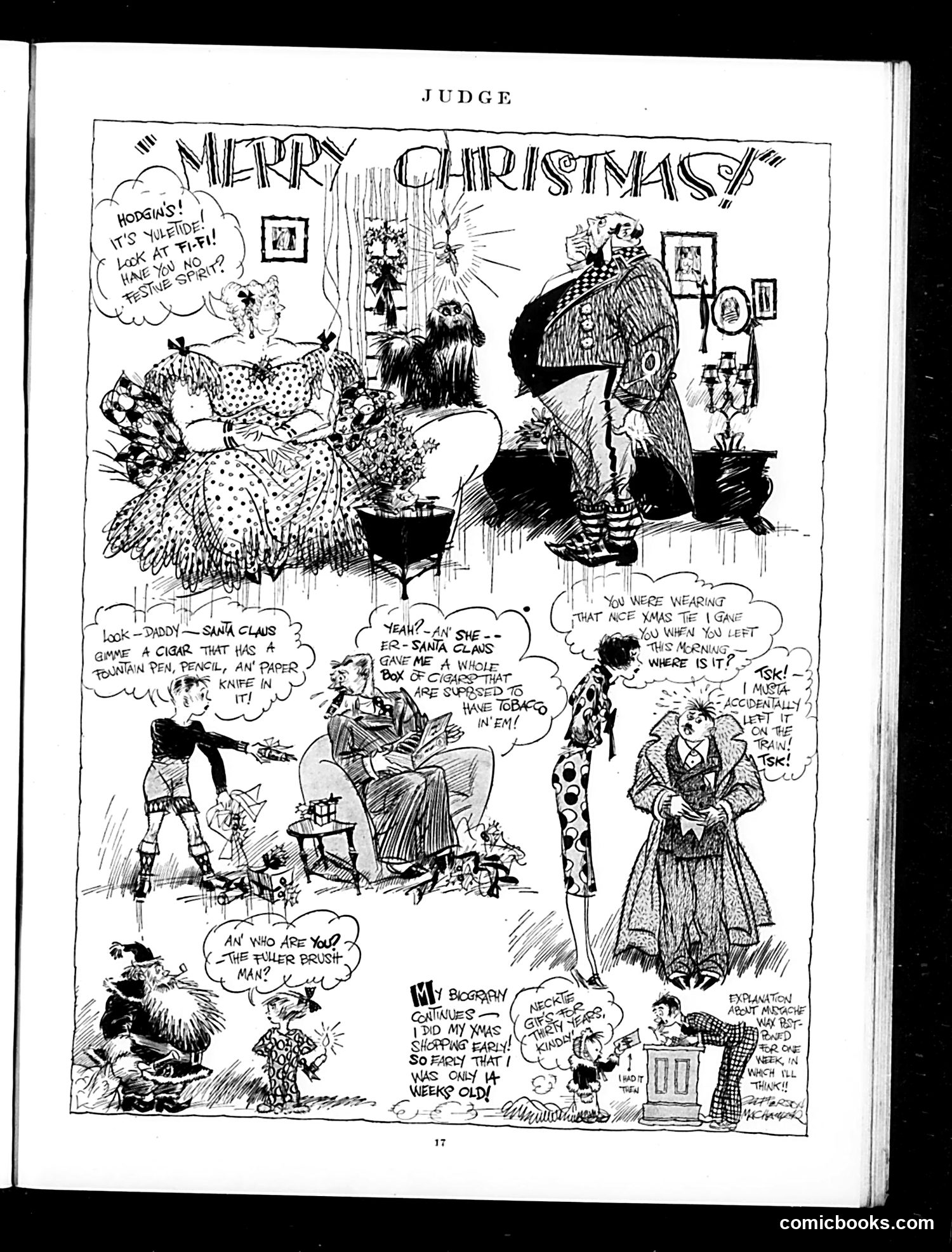
# Analysis of Judge Page Content This page contains three distinct pieces: 1. **"Calvin Coolidge Writes His Christmas Card"** — An editorial essay by Arthur L. Lipmann praising Christmas as an American holiday that transcends politics, written in Coolidge's voice. 2. **"Sob Story"** by Henry Alfreds — A narrative about Abner Means, a stern Puritan-like figure who initially refuses to let his daughter leave on a snowy night, then relents emotionally, inviting her to "come in" and "we'll all freeze together." 3. **"A Great Moment in the Life of a Speakeasy Proprietor"** — A cartoon (signed by Kirn) showing men at what appears to be an illegal bar during Prohibition, with the caption suggesting a police commissioner making a bribe ("drops in for a brocer"). The speakeasy cartoon satirizes corruption during Prohibition, depicting the normalized bribery between law enforcement and illegal alcohol establishments.
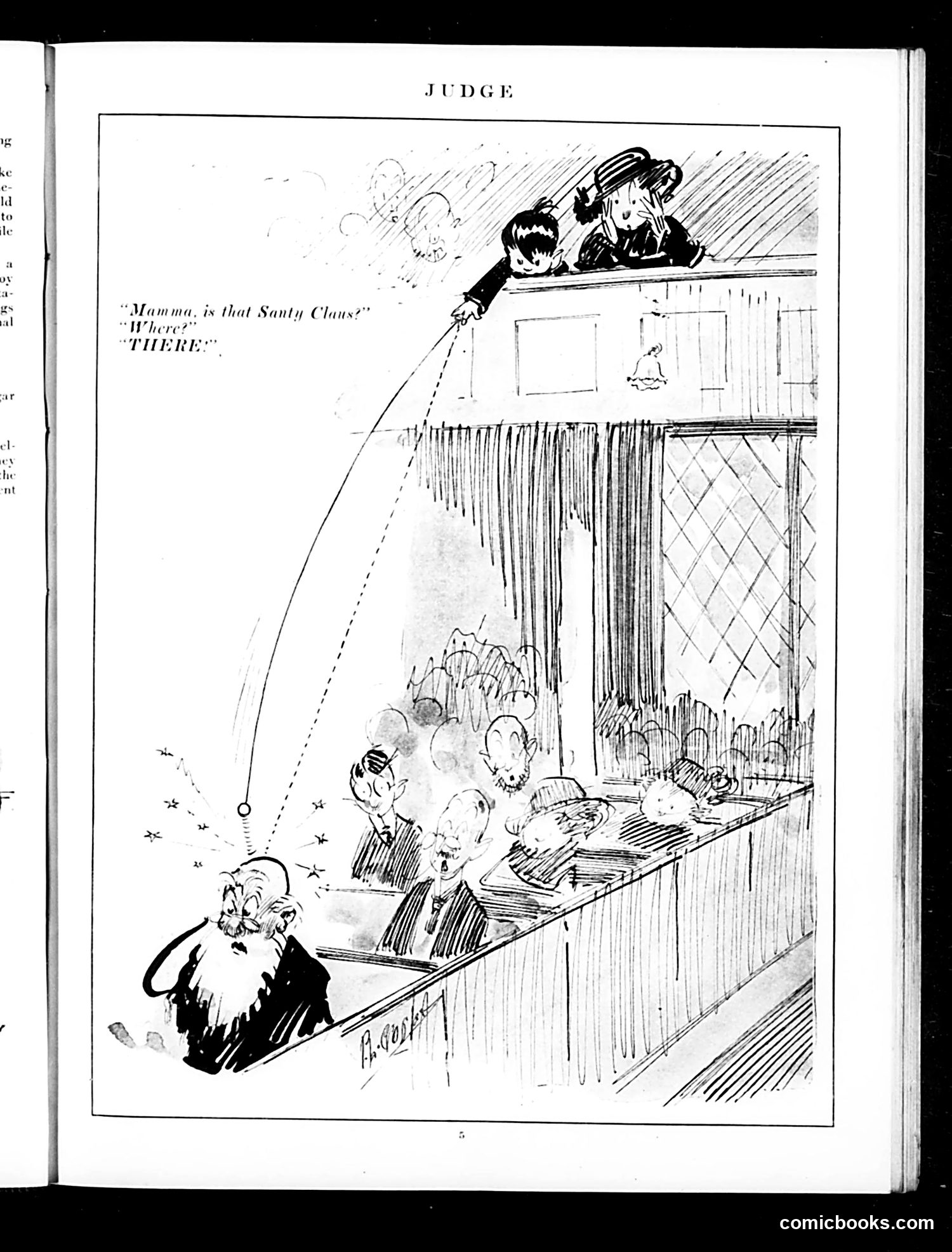
# Analysis of "Judge" Cartoon: "JUDGE" This cartoon depicts a courtroom scene with a clear satirical message. Two children peer from a window above, with one asking "Mamma, is that Santy Claus?" while pointing downward with the response "THERE!" The figure below—an old man with a long beard seated in the courtroom—is being identified as "Santa Claus" by the children. This appears to be political satire conflating a judge or legal authority with Santa Claus, likely mocking either the judge's appearance, decisions, or reputation. The jury members visible in the background suggest an active trial. The satire's precise target remains unclear without additional context, but the comparison suggests either criticism of judicial leniency, favoritism, or the judge's character—presenting him as either benevolent or ridiculous, depending on intended tone.
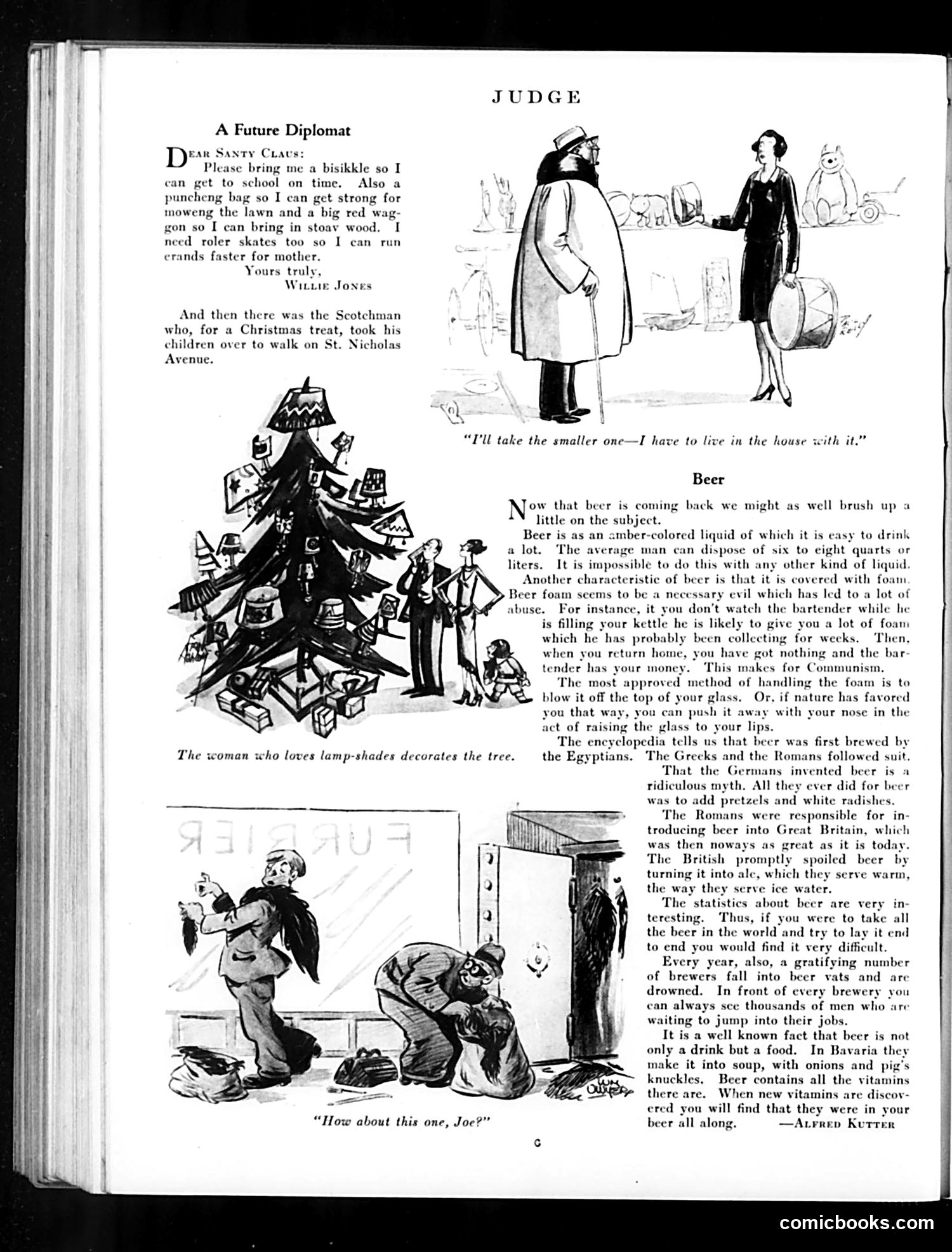
# Analysis of Judge Magazine Page This page contains three separate pieces: **"A Future Diplomat"** - A humorous letter from child Willie Jones to Santa Claus requesting practical items (bicycle, punchbag, roller skates, wood) rather than toys, framed as preparation for diplomatic work. The joke is that this practical-minded child will become a diplomat. **"The woman who loves lamp-shades decorates the tree"** - A cartoon satirizing women who excessively decorate Christmas trees with lampshades, treating holiday decoration as excessive interior design rather than traditional celebration. **"Beer"** - A lengthy article by Alfred Kütter discussing beer's history, properties, and cultural significance. The accompanying cartoon labeled "How about this one, Joe?" depicts working-class men casually selecting beer, reflecting beer's role as an everyday beverage. The page reflects early 20th-century American attitudes toward consumption, domesticity, and class culture.
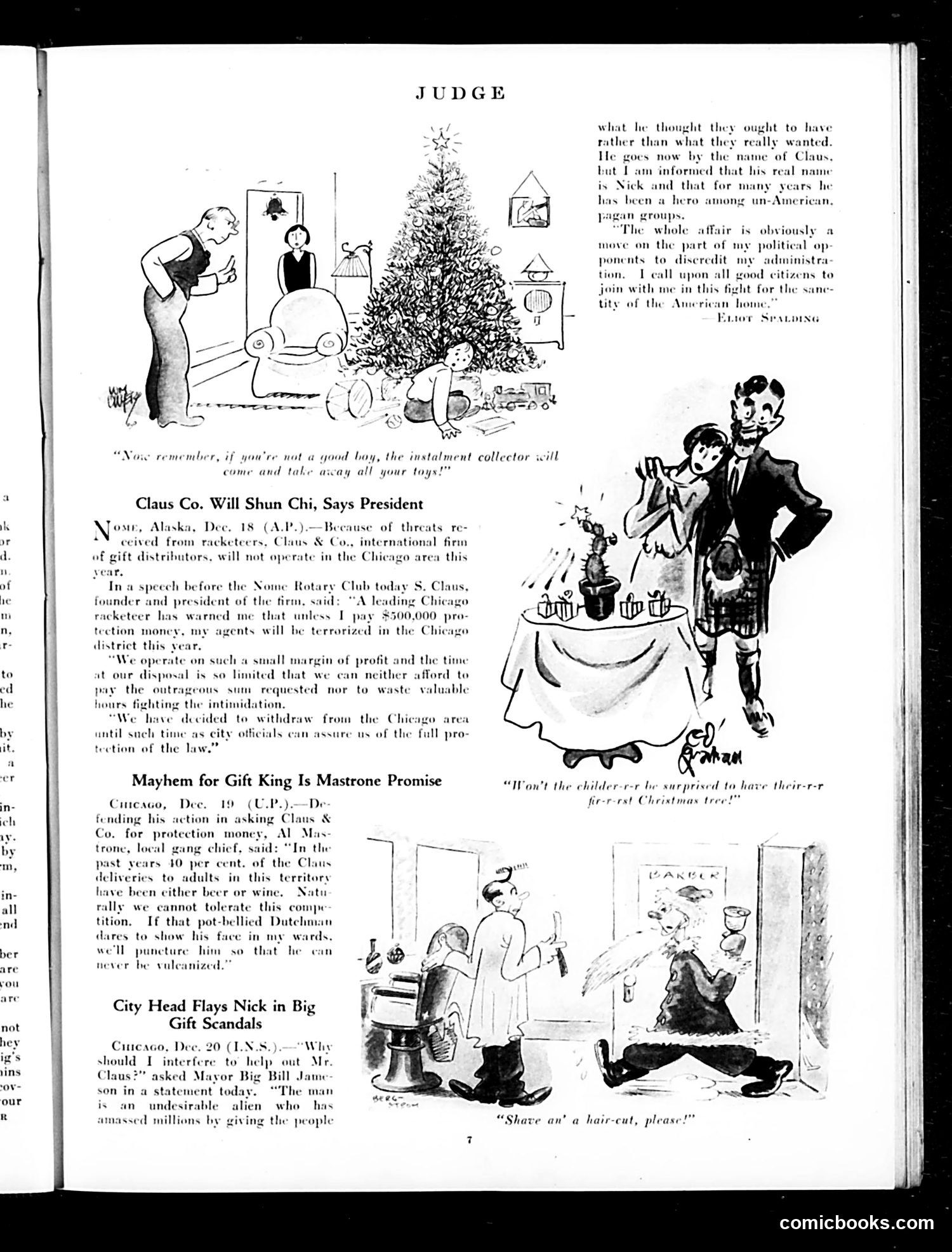
# Judge Magazine Political Satire Analysis This page satirizes Depression-era Chicago corruption through a fake news story about Santa Claus ("Claus & Co."). The satire works on multiple levels: **The Setup:** Santa is being extorted by Chicago racketeers (led by "Mastrone," likely referencing real gang activity) demanding $500,000 protection money, forcing him to abandon Chicago. **The Political Target:** Mayor "Big Bill" Jameson (based on real Chicago Mayor Big Bill Thompson) dismisses Santa's plight, calling him an "undesirable alien"—a xenophobic attack using anti-immigrant rhetoric. An unnamed politician quotes Santa as having a "real name" ("Nick"), implying foreign/un-American origins, a dog-whistle against immigrants. **The Joke:** Authorities blame the victim rather than address organized crime. The cartoons show children robbed of Christmas gifts, highlighting how corruption harms ordinary citizens. **Historical Context:** This reflects real 1920s-30s Chicago gang violence, police corruption, and nativist politics that scapegoated immigrants while ignoring criminal syndicates. The satire criticizes both organized crime and hypocritical politicians who exploit xenophobia instead of actually protecting citizens.
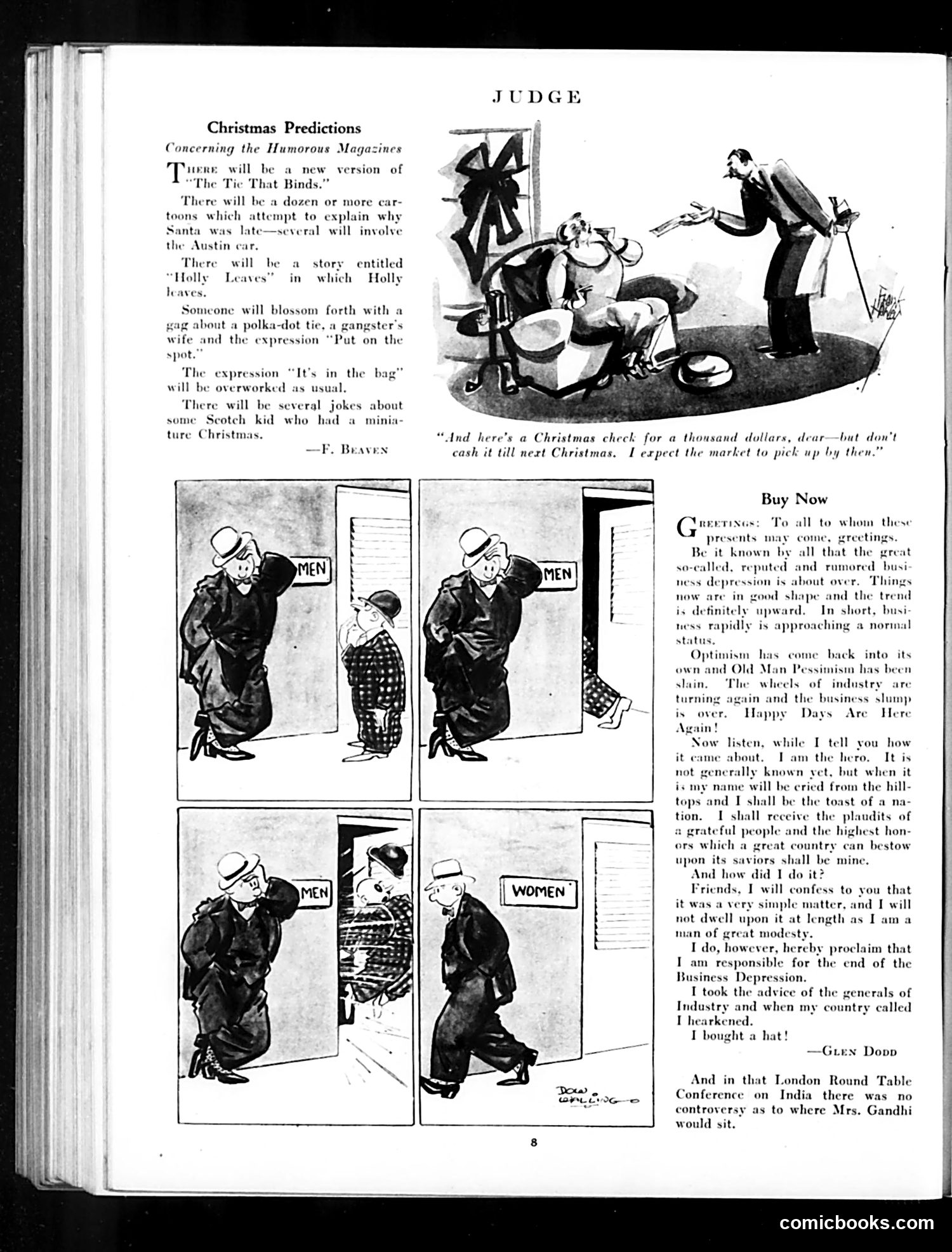
# Explanation for Modern Readers This page from *Judge* magazine contains **Christmas predictions** satirizing typical holiday content in humorous magazines, plus two pieces claiming credit for ending the Great Depression. The four-panel **cartoon** (bottom left) shows a man repeatedly trying to enter doors marked "MEN" and "WOMEN," apparently confused about which restroom to use—a slapstick gag about gender confusion typical of early 20th-century humor. The **"Buy Now" section** mocks overconfident economic optimism following the Depression. One piece facetiously claims the narrator single-handedly ended the crisis by "buying a hat"—satirizing both the absurdity of consumer confidence and business leaders' simplistic solutions. The final line references the **London Round Table Conference on India** and **Mrs. Gandhi** (Mohandas Gandhi's wife), joking that there was "no controversy as to where Mrs. Gandhi would sit"—likely alluding to seating disputes at the real 1931 conference regarding British colonial hierarchy and Indian representation. The satire targets both shallow magazine content and unfounded economic optimism.
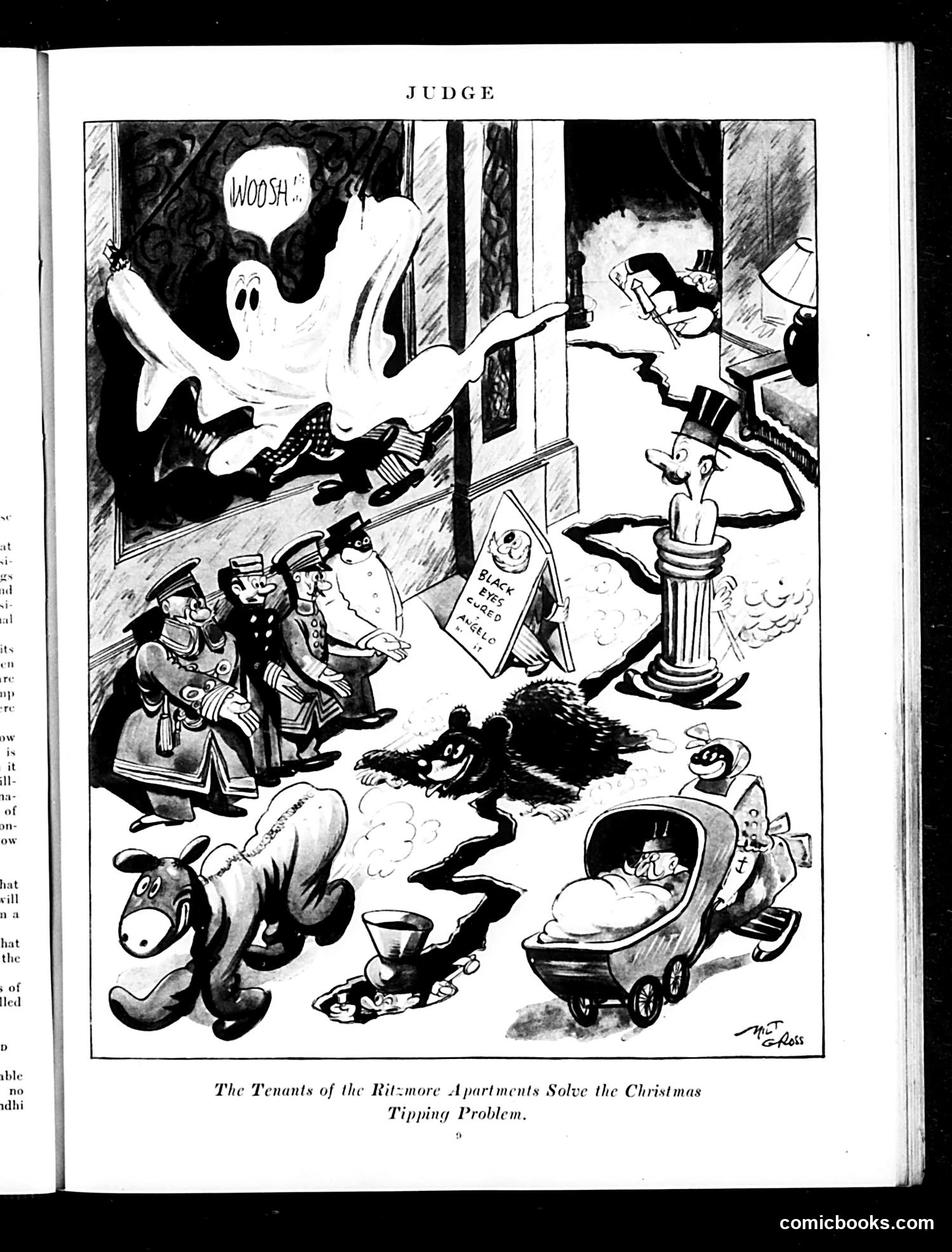
# Analysis This satirical cartoon illustrates the "Christmas tipping problem"—a social issue where tenants of apartment buildings were expected to give monetary gifts to doormen, superintendents, and other service staff during the holidays. The cartoon depicts the Ritzmore Apartments' tenants solving this by creating chaos: a ghost haunting the building, animals running loose (including what appears to be a donkey and a black cat), and general mayhem involving delivery vehicles and household disruption. The satire suggests that rather than pay customary tips, wealthy apartment dwellers deliberately make conditions so unpleasant that service staff quit or flee, eliminating the obligation. It's a commentary on both the burden of the tipping custom and the callousness of the wealthy toward their employees' livelihoods—a perennial social tension that remains relevant today.
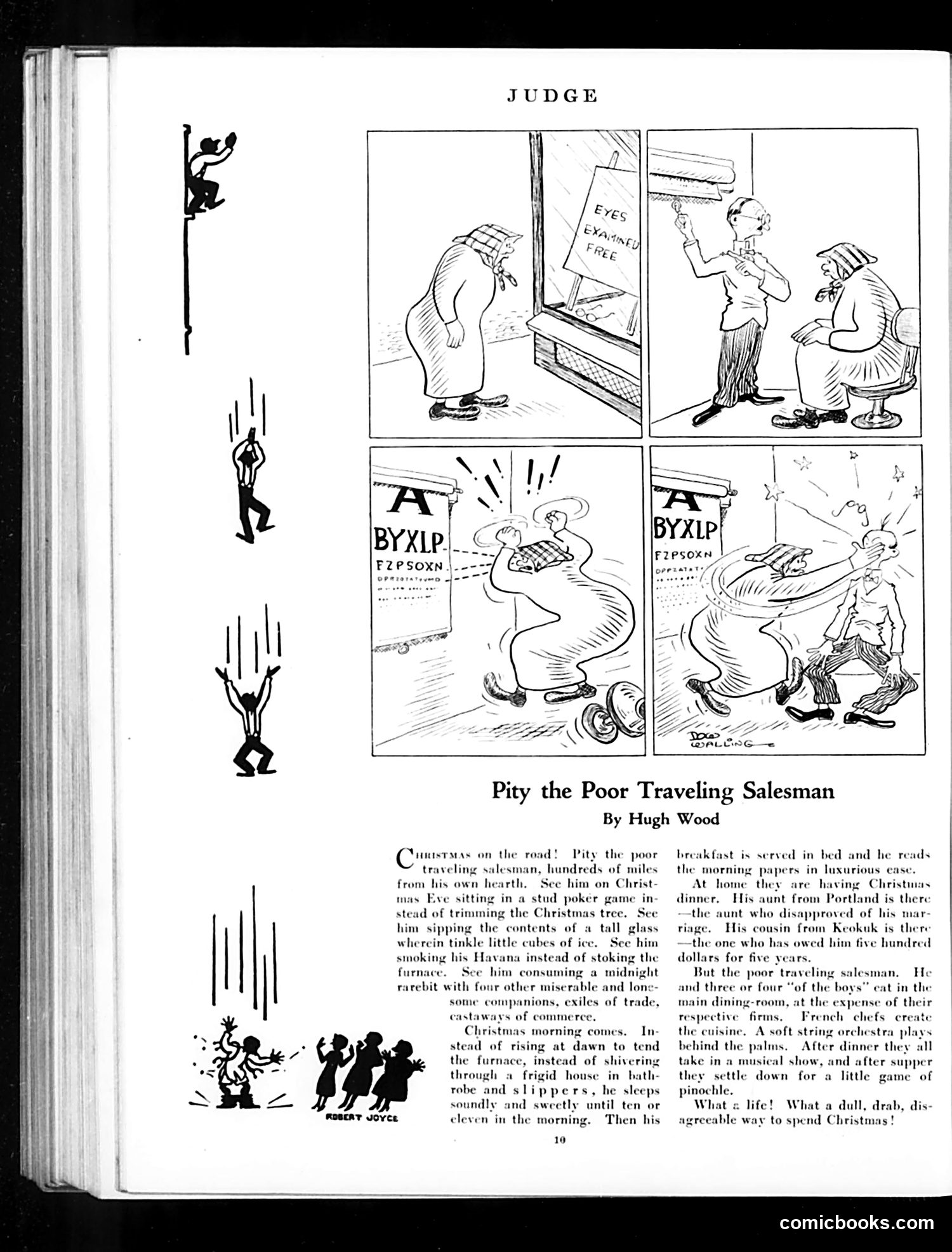
# "Pity the Poor Traveling Salesman" This is a humorous commentary on the traveling salesman's peculiar Christmas situation by Hugh Wood. The four-panel cartoon shows a salesman examining his reflection in a mirror marked "Eyes Examined Free," then interacting with an optometrist or eye doctor, followed by two panels depicting his exaggerated physical distortions—likely representing dizziness or disorientation. The accompanying text ironically contrasts the salesman's lonely, vice-filled Christmas away from home (poker games, whiskey, late-night meals) with the domestic misery he'd face if present (disapproving relatives, unpaid debts). The satire's "pity" is tongue-in-cheek: the salesman actually escapes Christmas obligations and family friction, living in comparative luxury—suggesting his exile from home is secretly preferable. The joke targets both traveling salesmen (a common figure in early-20th-century commerce) and the hypocrisy of forced holiday sentimentality.