
Judge, 1930-12-20 · page 18 of 36
Judge — December 20, 1930 — page 18: what you’re looking at
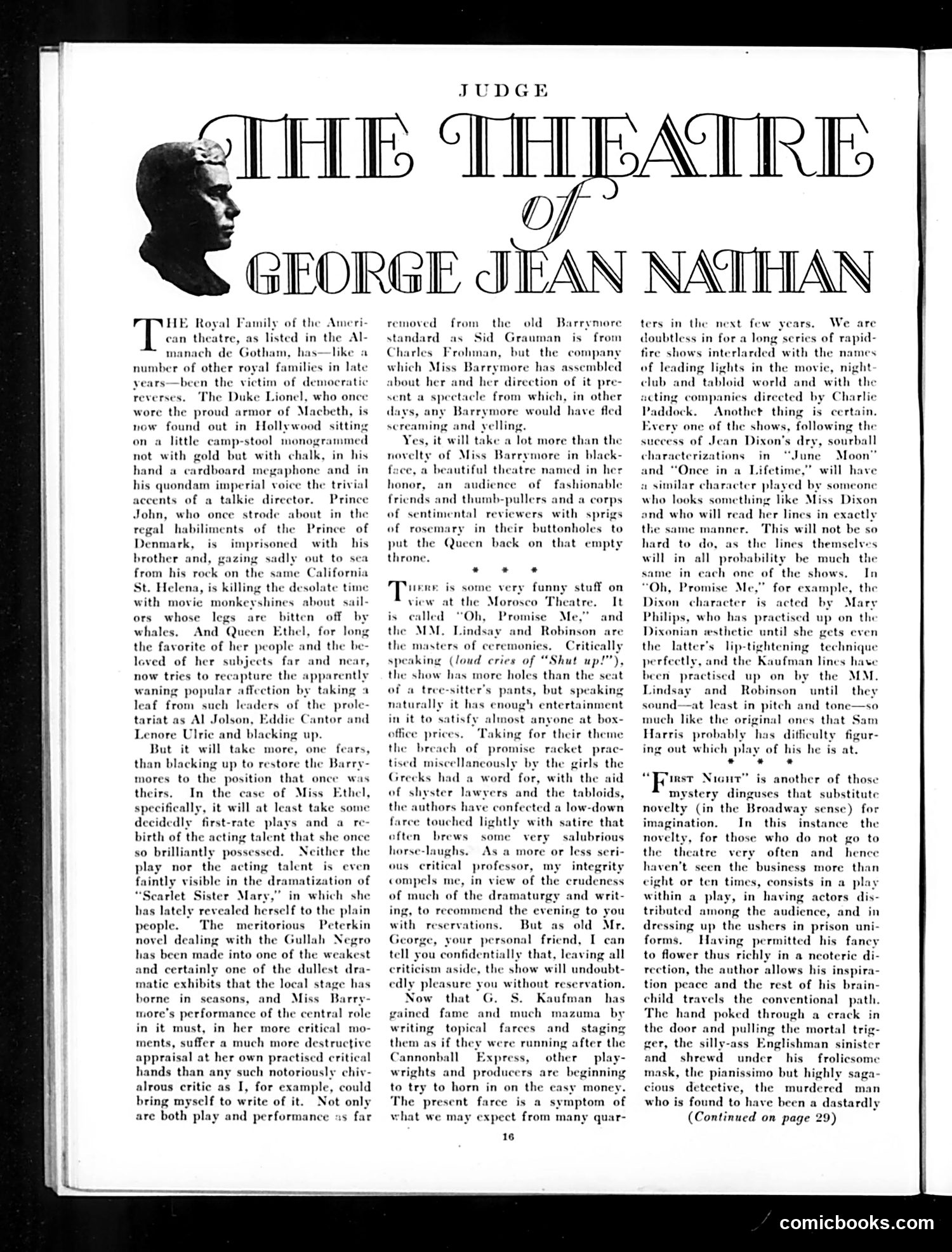
A restored page from Judge, 1930-12-20. Page through the whole issue in the reader above.
📄 Transcribed text from this page (OCR, searchable)
Machine-transcribed from the original scan — historical spelling and the odd misread are preserved.
JUDGE STHE GEORGE J HE Royal Family of the Ameri- | n theatre, as listed in the Al- anach de tham, has—like a number of other royal families in late years—been the victim of democratic The Duke Lionel, who once wore the proud armor of Macbeth, now found out in Hollywood siti on a little camp-stool monogrammed not with gold but with chalk, in his hand a cardboard megaphone and in his quondam imperial voice the trivial accents of a talkie director. Prince John, who once strode about in the regal habiliments of the Prince of Denmark, is imprisoned with his brother and, gazing sadly out to sea from his rock on the same California St. Helena, is killing the desolate time with movie monkeyshines ors whose legs are bitten off by whales, And Queen Ethel, for long the favorite of her people and the be- loved of her subjects far and near, now tries to recapture the apparently popular affection by taki leaf from such leaders of the prole- tariat as Al Jolson, Eddie Cantor and ; Ulric and bl up. But it will take more, fears, than blacking up to restore the Barry- mores to the position that once was theirs. In the «© of Miss Ethel, specifically, it will at least take some decidedly first-rate plays and a re- birth of the acting talent that she once so brilliantly 4. Neither the play nor the talent is ntly visible reverses, about sail- possess cting y revealed herself to the plai people. The meritorious Peterkin novel dealing with the Gullah Negro has been made into one of the and certainly one of the dullest dra- matie exhibits that the local stage borne in seasons, and Miss Barry- more’s performance of the central role in it must, in her more critical mo- ments, suffer a much more destructive appraisal at her own practised ¢ hands than any such notoriously chiv- alrous critic as I, for example, could bring mysclf to write of it. Not only are both play and performance as far has D from the old standard as Sid auman is from Charles Frohinan, but the company which Miss Barrymore has assembled about her and her dircetion of it pre- sent a spectacle from which, in other s, any Barrymore would have fled saming and yelling. s, it will a lot more than the novelty of Miss Barrymore in black- face, a beautiful theatre named in her honor, an audience of fashionable friends and thumb-pullers and a corps of sentimental reviewers with sprigs of rosemary in their buttonholes to put the Queen back on that empty throne. T" ne is some removed Barrymore * * * very funny stuff on view at the Morosco Theatre. It is called “Oh, Promise the MM. Lindsay and Robinson are the masters of ceremonies. Critically speaking (loud cries of “Shut up!"’), the show has more holes than the of a tre seat sitter’s pants, but speaking naturally it has enough enter in it to satisfy office inment almost anyone at box- Taking for their theme the breach of promise racket prac- tised miscellancously by the girls the Greeks had a word for, with the aid of shyster lawyers and the tabloids, uthors have confected a low-down touched lightly with satire that brews. very salubrious As a more or less seri- ous critical professor, my integrity compels me, in view of the crudeness of much of the dramaturgy and wr ing, to recommend the evening to you with reservations. But as old Mr. George, your personal friend, I can tell you confidentially that, leaving all criticism aside, the show will undoubt- edly pleasure you without reservation. Now that G. S. Kaufman ned fame and much mazuma by writing topical farces and staging them as if they were running after the Cannonball Express, other play- wrights and producers are beginning to try to horn in on the casy money. The present farce is a symptom of we may expect from many qu: 16 prices. often horse-laughs. some has ACRE: NATHAN years. We are ters in the next few doubtless in for a lon; fire shows int of leading lights in the movie, night club and tabloid world and with the acting companies directed by Charlie 1 ok. Anothet thing is Every one of the shows, following the n Dixon's dry, sourball tions in une Moon” ‘Once in a Lifetime,” will have i racter played by someon: who looks something like Miss Dixon and who will read her lines in exactly the same manner. This will not be so hard to do, as the lines themselves will in all probability be much the same in cach one of the “Oh, I Me,” for example, the Dixon character is acted by Mary Philips, who has practised up on the Dixonian wsthetic until she the latter's lip-tightening technique perfectly, and the Kaufman lines have been practised up on by the MM. Lindsay and Robinson until they sound—at least in pitch and tone—so much like the original ones that Sam Harris probably has difficulty figur- ing out which play of his he is at. e @ certs shows. In gets even inst Niaut” is mystery dinguses novelty (in the Br imagination. In another of those that substitute adway sense) for this instance the novelty, for those who do not go to the th often and hence haven't seen the business more than cight or ten times, consists in a play within a play, in having actors dis- tributed among the audience, and in dressing up the ushers in prison uni- forms. Having permitted his fancy to flower thus richly in a neoteric di- rection, the author allows his inspira- tion peace and the rest of his brain- child travels the conventional path. The hand poked through a crack in the door and pulling the mortal trig- ger, the silly-ass Englishman sinister and shrewd under his frolicsome mask, the pianissimo but highly saga- cious detective, the murdered man who is found to have been a dastardly (Continued on page 29) atre very comicbooks.com