A complete issue · 36 pages · 1930
Judge — November 15, 1930
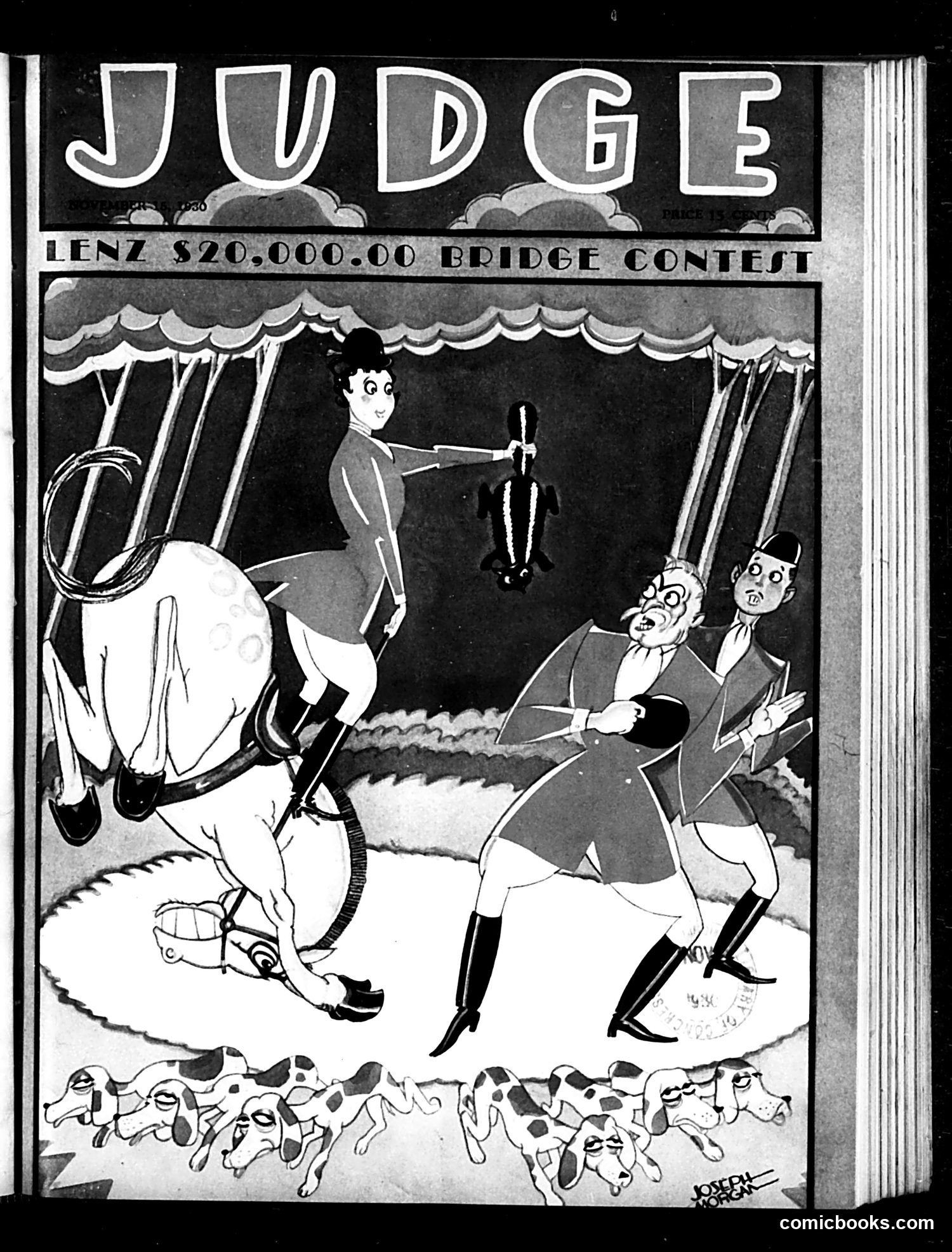
# Judge Magazine: "Lenz $20,000.00 Bridge Contest" This cartoon satirizes a bridge-building contest sponsored by someone named Lenz with a $20,000 prize. The circus setting—complete with tent, ringmaster, and performing dogs—mocks the spectacle of the competition. The central figure appears to be demonstrating or "judging" a bridge design (the dark object being held up), while two suited men react with exaggerated concern or skepticism. The dog performers at the bottom reinforce the "circus" metaphor, suggesting the contest is entertainment rather than serious engineering. The satire implies that the bridge competition is absurdly theatrical or that the proposed designs are ridiculous—worthy of mockery rather than serious consideration. Without additional context about the specific historical Lenz contest, the precise target remains unclear, but the cartoon clearly ridicules the event's legitimacy.
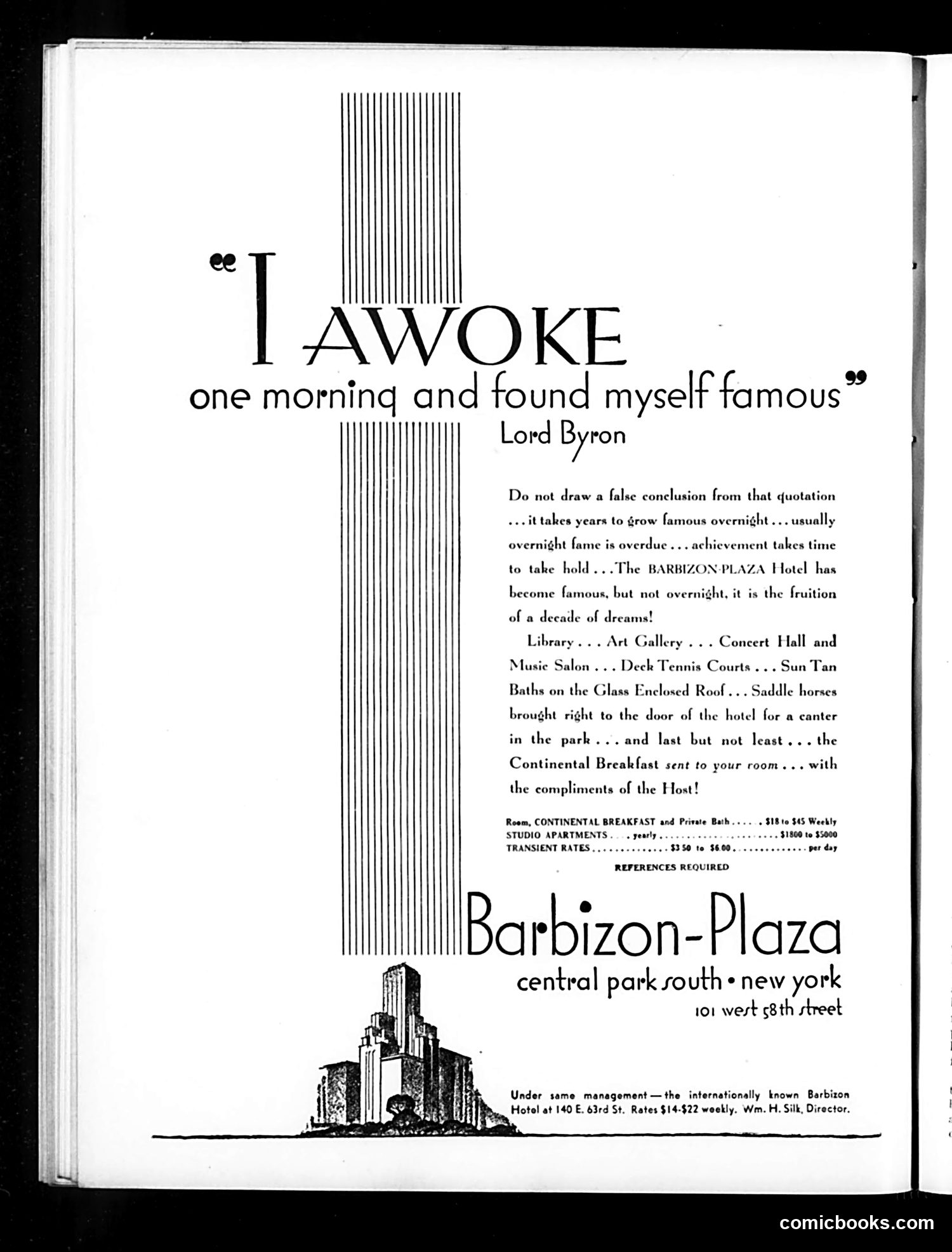
# Analysis This page is primarily **an advertisement for the Barbizon-Plaza Hotel** in New York (Central Park South, 101 West 58th Street), not a political cartoon. The ad uses **Lord Byron's famous quote** about waking up famous overnight to market the hotel's amenities and prestige. The copywriting argues against drawing false conclusions from Byron's words—that achieving fame actually takes years of effort, not overnight luck. The Barbizon-Plaza is then presented as an example of this principle: it "became famous, but not overnight," representing a decade of planning and achievement. The ad lists luxury features (library, art gallery, concert hall, tennis courts, sun baths, saddle horses, and complimentary continental breakfast) to justify its prestigious reputation and justify rates of $18-45 weekly for rooms. This is essentially **luxury hospitality marketing**, not satire.
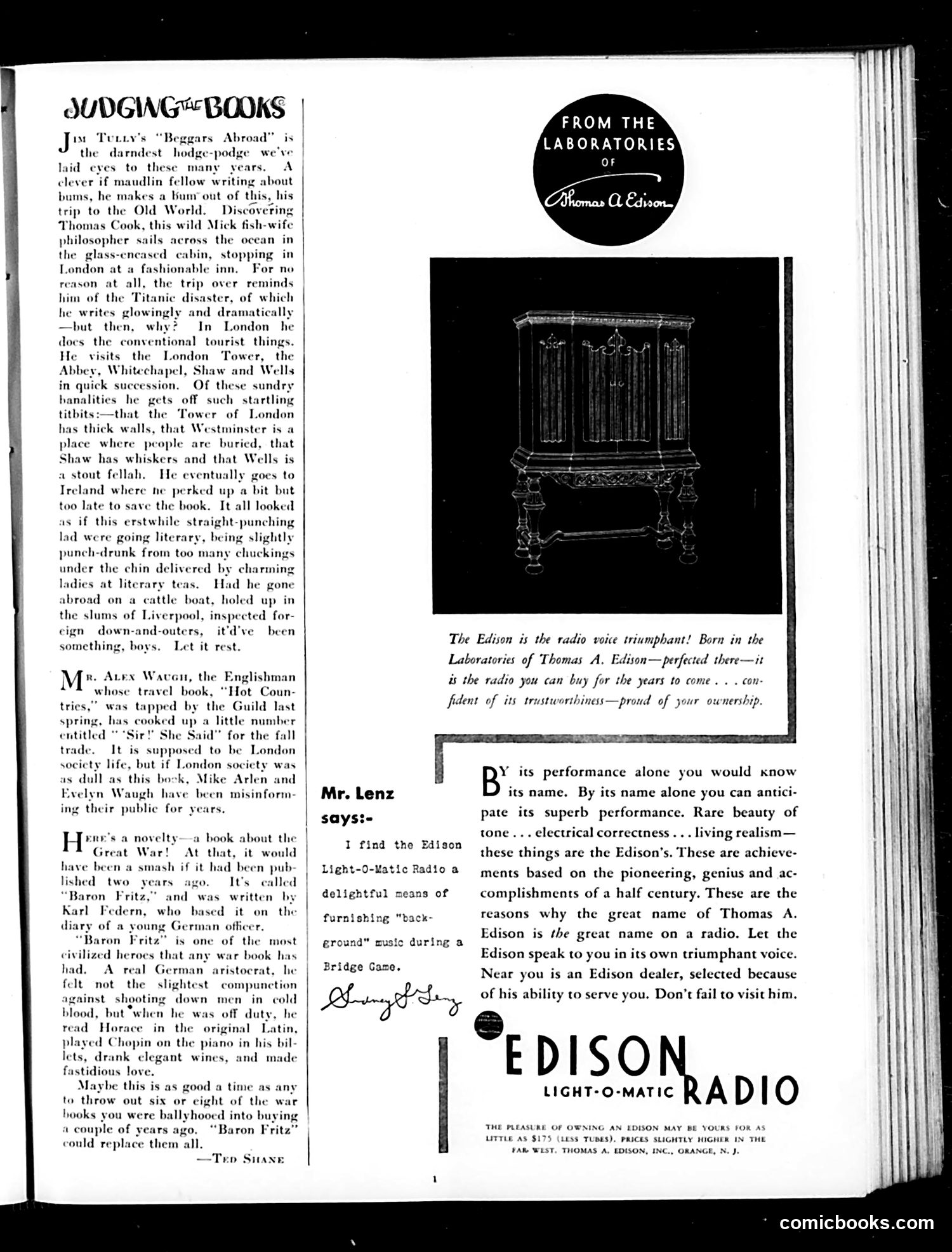
# Analysis This page is **primarily advertising**, not satire or political commentary. The left column contains book reviews by "Ted Shane" for *Judge* magazine's "Judging the Books" section—discussing travel narratives and war literature. The right side features a full-page **Edison Radio advertisement** showcasing the "Light-O-Matic" model. The ad includes a testimonial from "Mr. Lenz" praising the radio's performance and tone quality, emphasizing Edison's reputation for innovation. The advertisement appeals to consumer desire for quality electronics and brand prestige rather than engaging in political satire. The page reflects 1920s advertising practices and consumer culture, with no apparent satirical commentary on the advertisements themselves.
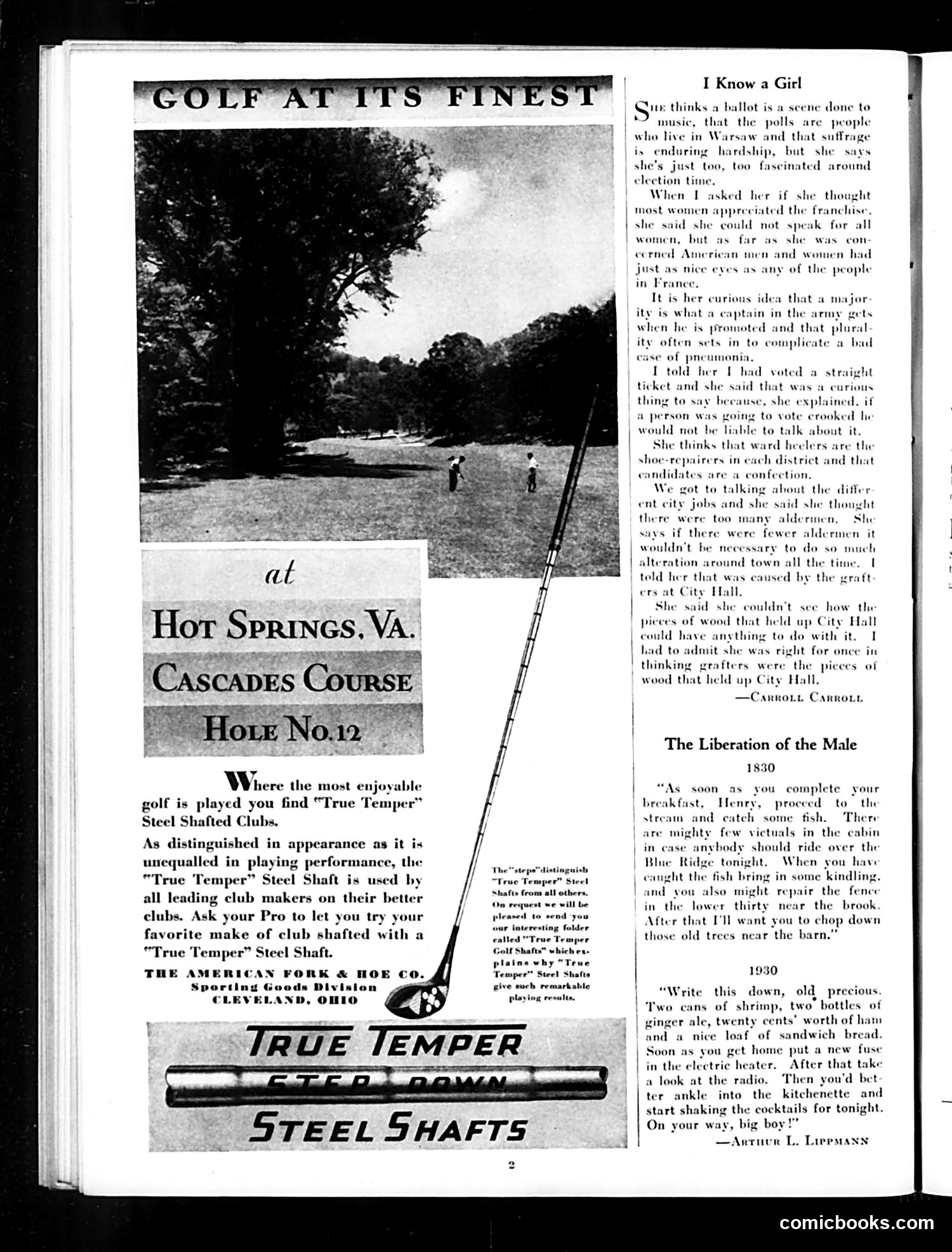
# Page Analysis This page contains **no political cartoon**. Instead, it features: 1. **Golf advertisement** (left): A scenic photograph of Cascades Course at Hot Springs, Virginia, promoting "True Temper" steel-shafted golf clubs made by American Fork & Hoe Co. of Cleveland, Ohio. The ad emphasizes the superior performance of steel shafts. 2. **"I Know a Girl"** (top right): A humorous social commentary by Carroll Carroll about a woman fascinated by election time, discussing her observations about politics, city jobs, and bureaucratic inefficiency—particularly grafters at City Hall supporting wooden structures. 3. **"The Liberation of the Male"** (bottom right): Two dated vignettes (1830 and 1930) humorously contrasting men's freedoms across centuries. The page is primarily **advertising and light social humor**, not satirical political commentary.
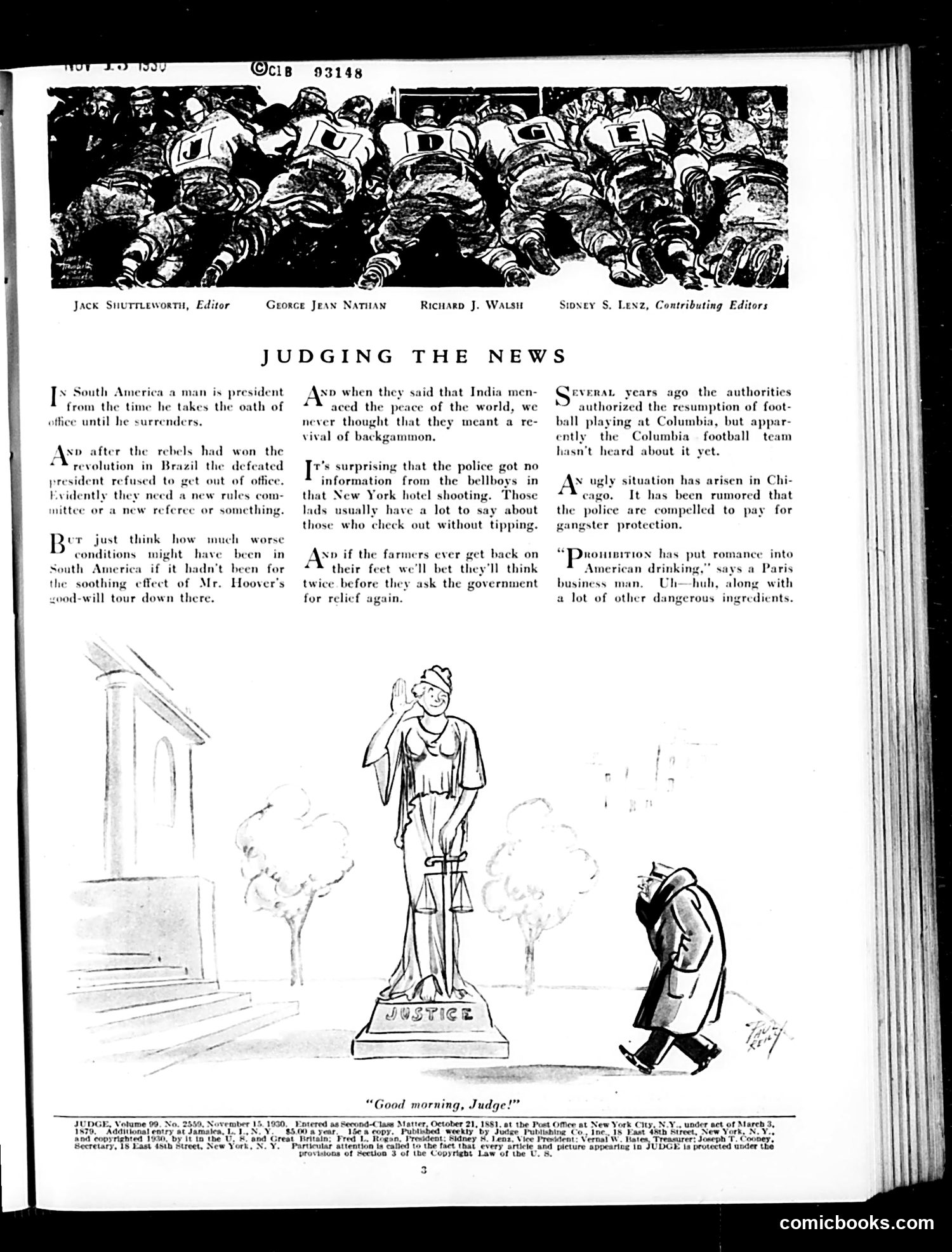
# "Good Morning, Judge!" Cartoon Analysis This cartoon satirizes the disconnect between judicial authority and political reality. The central figure is **Lady Justice**, depicted as a blind statue holding scales—a traditional symbol of impartial law. A well-dressed man (likely representing a politician or government official) approaches her deferentially, tipping his hat with "Good morning, Judge!" The satire suggests that despite Justice's blindness and supposed impartiality, politicians greet and attempt to influence her—implying that the legal system is actually accessible to or manipulated by those in power. The cartoon critiques the corruption or politicization of American courts, where formal institutions of justice are compromised by backroom dealings and political pressure.
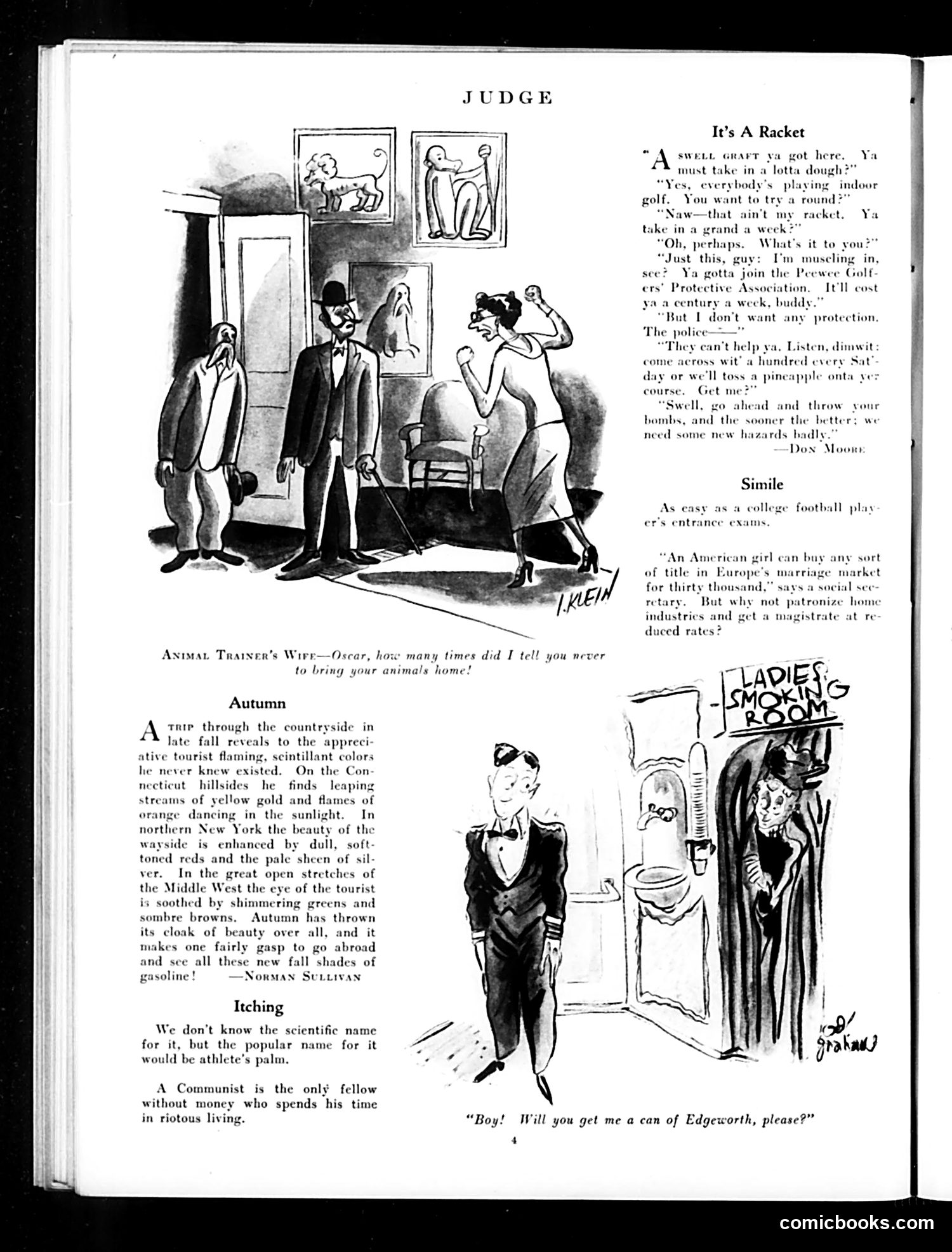
# Analysis of Judge Magazine Page The main cartoon, "Animal Trainer's Wife," depicts a domestic scene where a woman confronts her husband about repeatedly failing to bring animals home—likely referencing his work as a circus or performance animal trainer. The humor relies on the wife's exasperation with his professional habits intruding on home life. The page also contains several shorter satirical pieces: "It's A Racket" mocks golf club protection associations as extortion schemes; "Simile" critiques American women's pursuit of European titles through marriage; and "Autumn" poetically describes fall landscapes, attributed to Norman Sullivan. The "Ladies Smoking Room" cartoon shows a woman requesting Edgesworth tobacco—likely advertising content disguised as humor. The specific historical context of these references remains unclear without additional dating information.
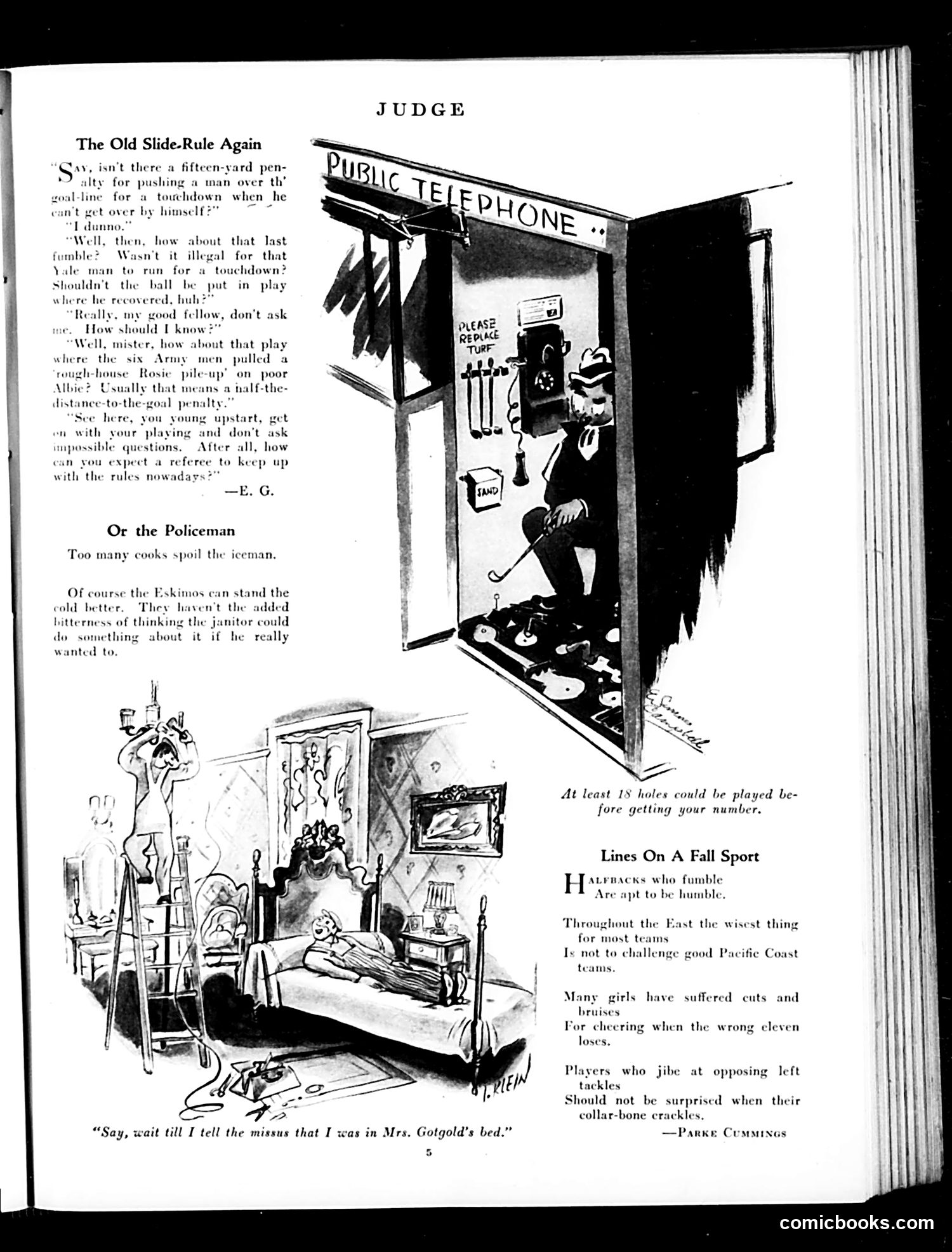
# Judge Magazine Page Analysis This page contains three separate satirical pieces from an early 20th-century American humor magazine: 1. **"The Old Slide-Rule Again"** — A dialogue mocking football rule debates, suggesting people argue about technicalities without understanding the actual sport. 2. **"Public Telephone" cartoon** — Shows a man in a cramped phone booth surrounded by golf clubs, satirizing how people attempt recreational activities in inconvenient spaces. The caption jokes that "at least 18 holes could be played before getting your number" — mocking both the difficulty of using public phones and golf culture. 3. **"Lines On A Fall Sport"** — Brief humorous verses about football season mishaps and injuries, written by Parker Cummings. The overall theme mocks American sports enthusiasm and the confusion surrounding their rules and culture.
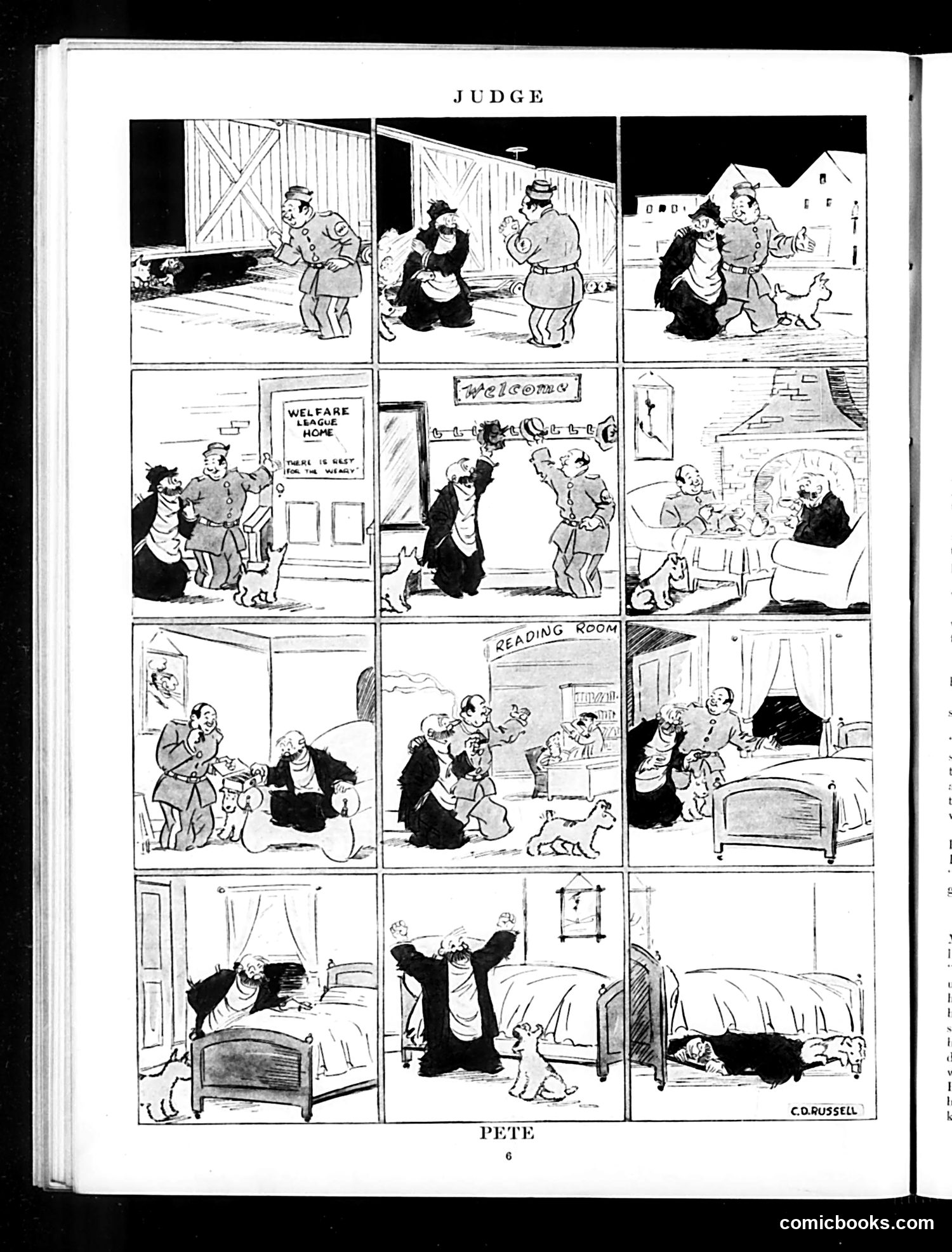
# "Judge: Pete" Comic Strip Analysis This comic strip, titled "Pete" and signed by C.D. Russell, depicts a domestic welfare scenario. The narrative follows what appears to be a social welfare worker (in the hat and uniform) visiting homes, including a "Welfare League Home." The satire likely critiques early 20th-century welfare administration and bureaucratic oversight of poor families. The sequence shows the welfare official observing conditions in working-class homes, a "Reading Room," and bedtime scenes. The humor appears to stem from the contrast between official welfare inspection protocols and the messy reality of domestic life. The comic references the then-contemporary "Welfare League"—an actual charitable organization—suggesting Judge magazine's satirical take on Progressive Era social welfare programs and their often-intrusive inspections of recipient families.
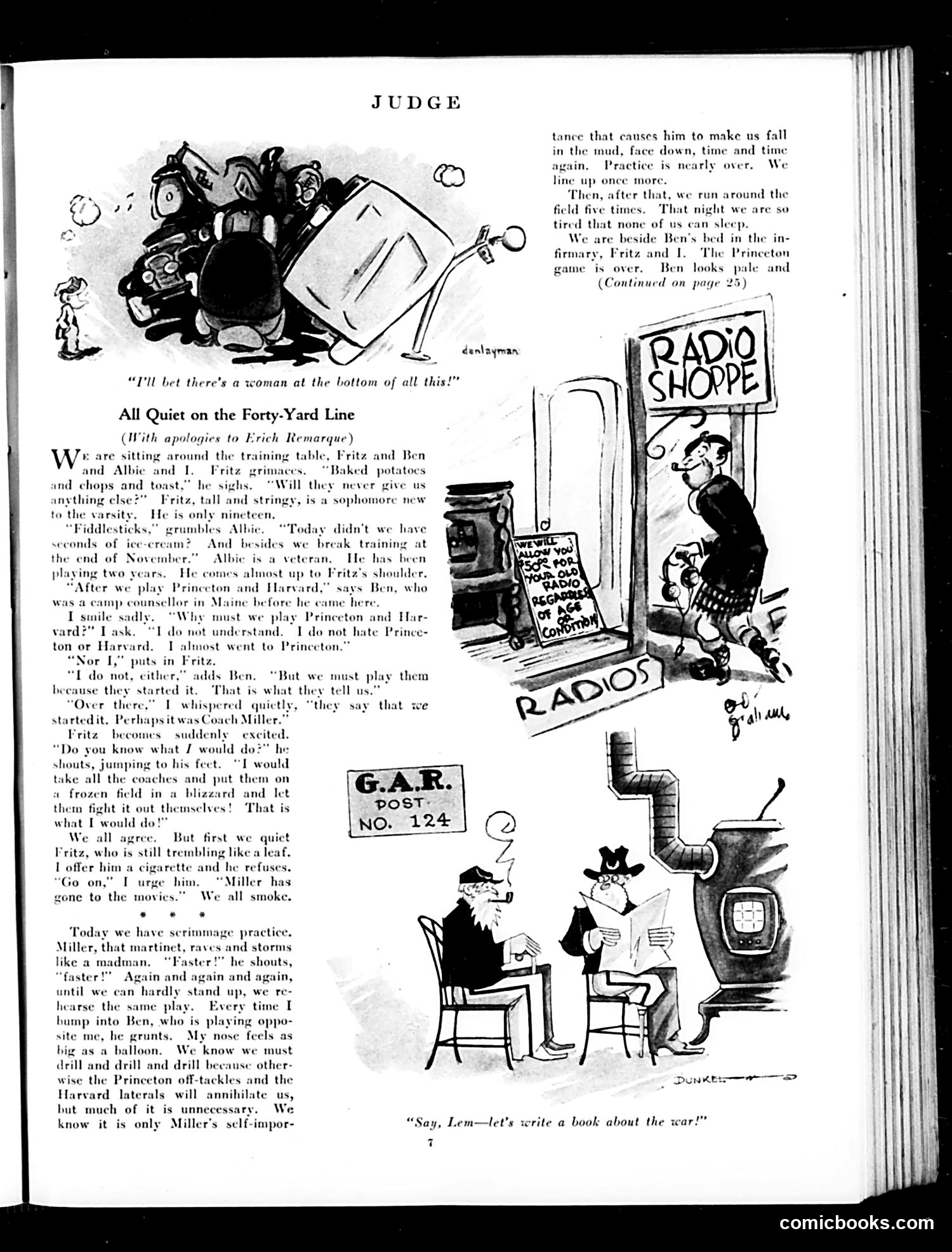
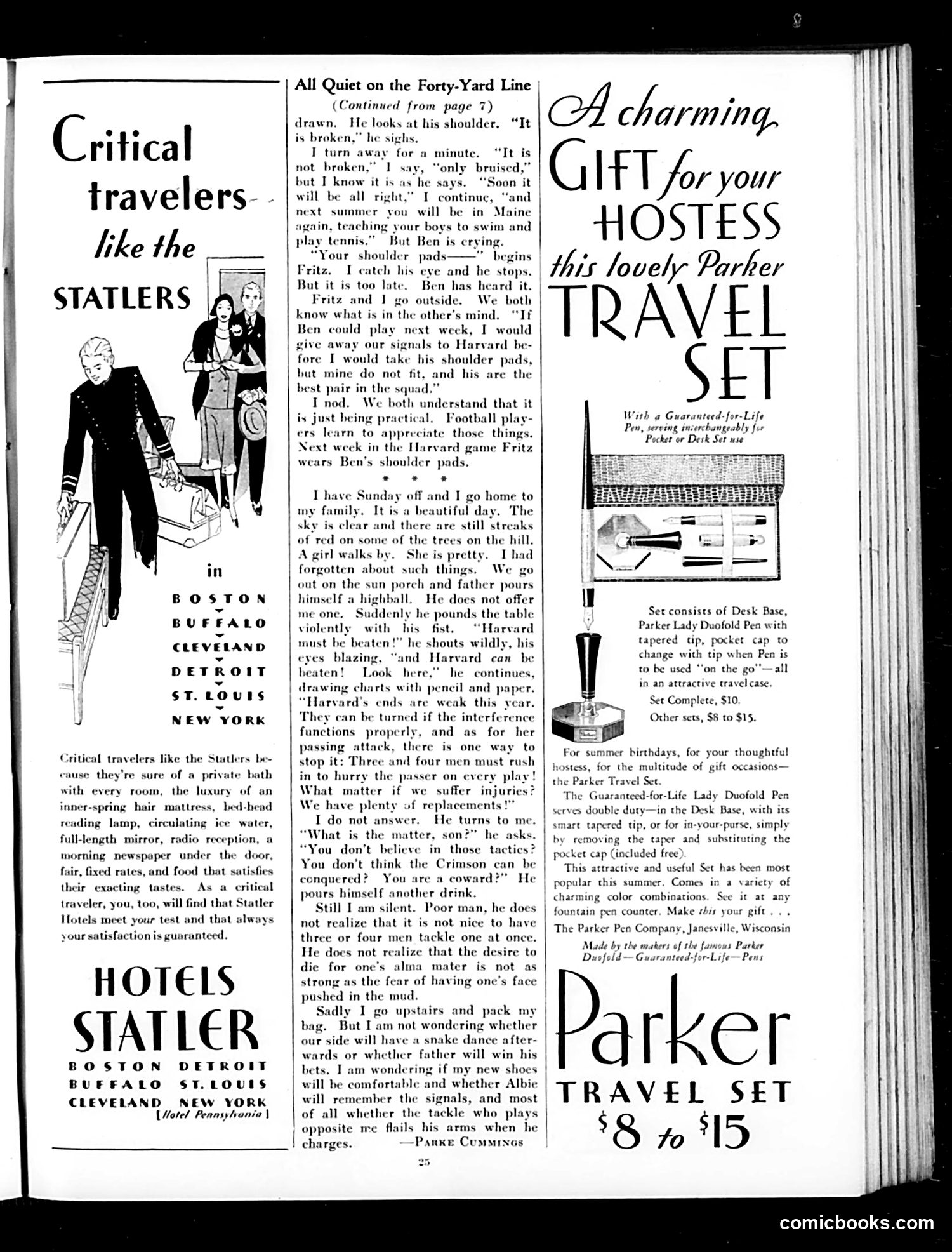
# "All Quiet on the Forty-Yard Line" This is a satirical piece parodying Erich Maria Remarque's *All Quiet on the Western Front* (1929), a celebrated anti-war novel. The satire applies that work's dark tone to college football practice instead of actual warfare. The joke: Young athletes endure brutal conditioning drills under an tyrannical coach named Miller, and they discuss it with the same existential weariness soldiers use discussing combat. References to Princeton and Harvard—rival football teams—are treated as actual enemies ("they started it"), echoing how soldiers discuss opposing armies. The accompanying cartoons mock consumer culture and commercialism (the "Radio Shorpe" and "G.A.R. Post" sketches), likely suggesting American society's obsession with entertainment and business even during serious times. The final caption—"Say, Lem—let's write a book about the war!"—completes the parody: even trivial college sports experiences are dramatized as profound.
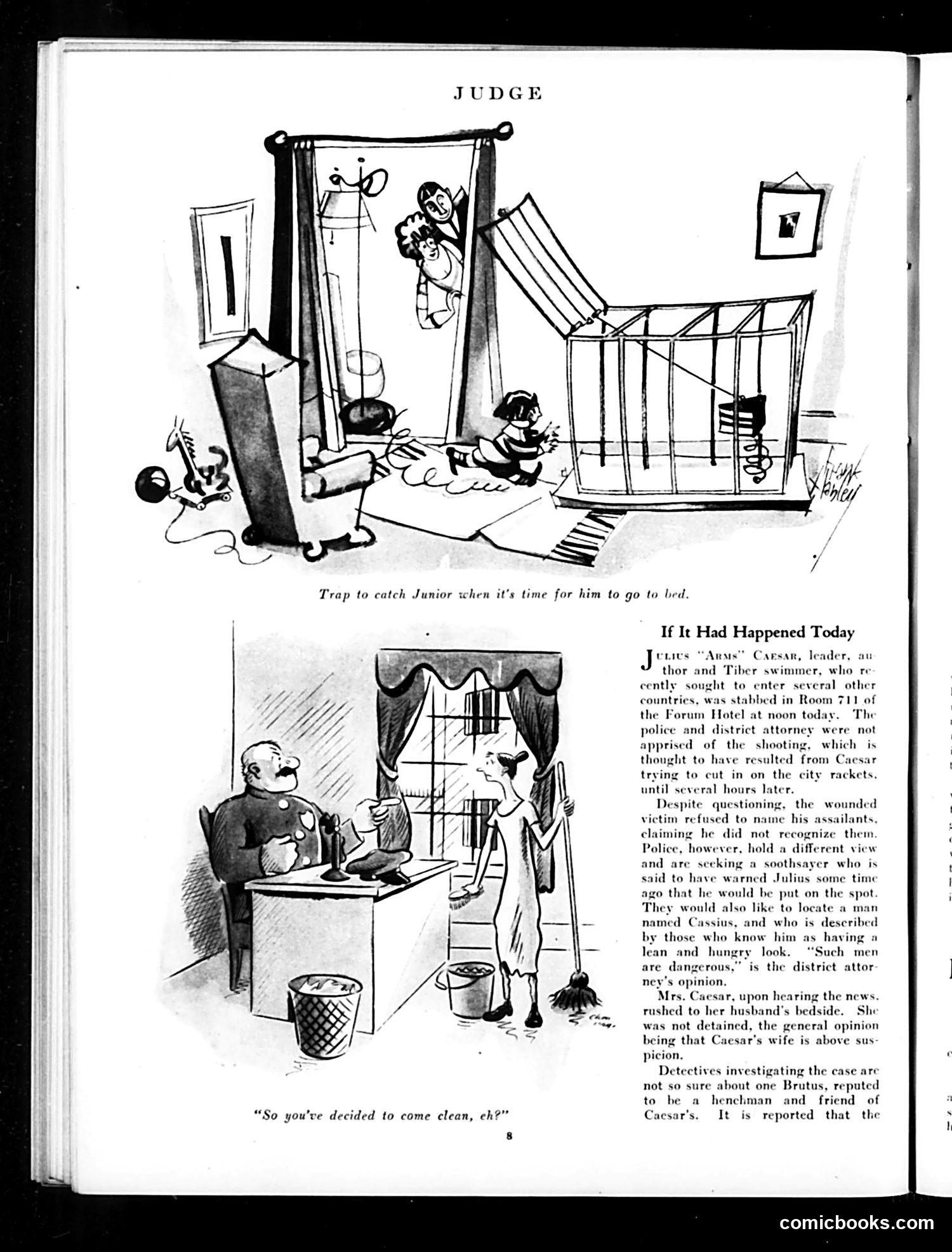
# Political Satire Explanation This page contains two cartoons satirizing American life, plus a mock news story parodying the assassination of Julius Caesar as if it occurred in contemporary 1920s-30s America. **Top cartoon**: A humorous domestic scene showing an elaborate "trap" (bed frame with pulleys and mechanisms) designed to catch a child at bedtime—satirizing parents' struggles with reluctant kids. **Bottom cartoon and article**: The main satire transposes Caesar's assassination into modern organized crime. "Julius 'Ars' Caesar" is stabbed at the "Forum Hotel" and claims not to recognize his attackers. The satire mocks contemporary crime culture: police incompetence, witnesses refusing cooperation with authorities, suspicion falling on associates like "Brutus" and "Cassius," and the general assumption that Caesar was involved in "city rackets." The reference to Caesar's wife being "above suspicion" maintains the classical parallel while satirizing how crime families protected family members from legal scrutiny. The joke targets both the historical drama and modern American criminal underworld conventions.
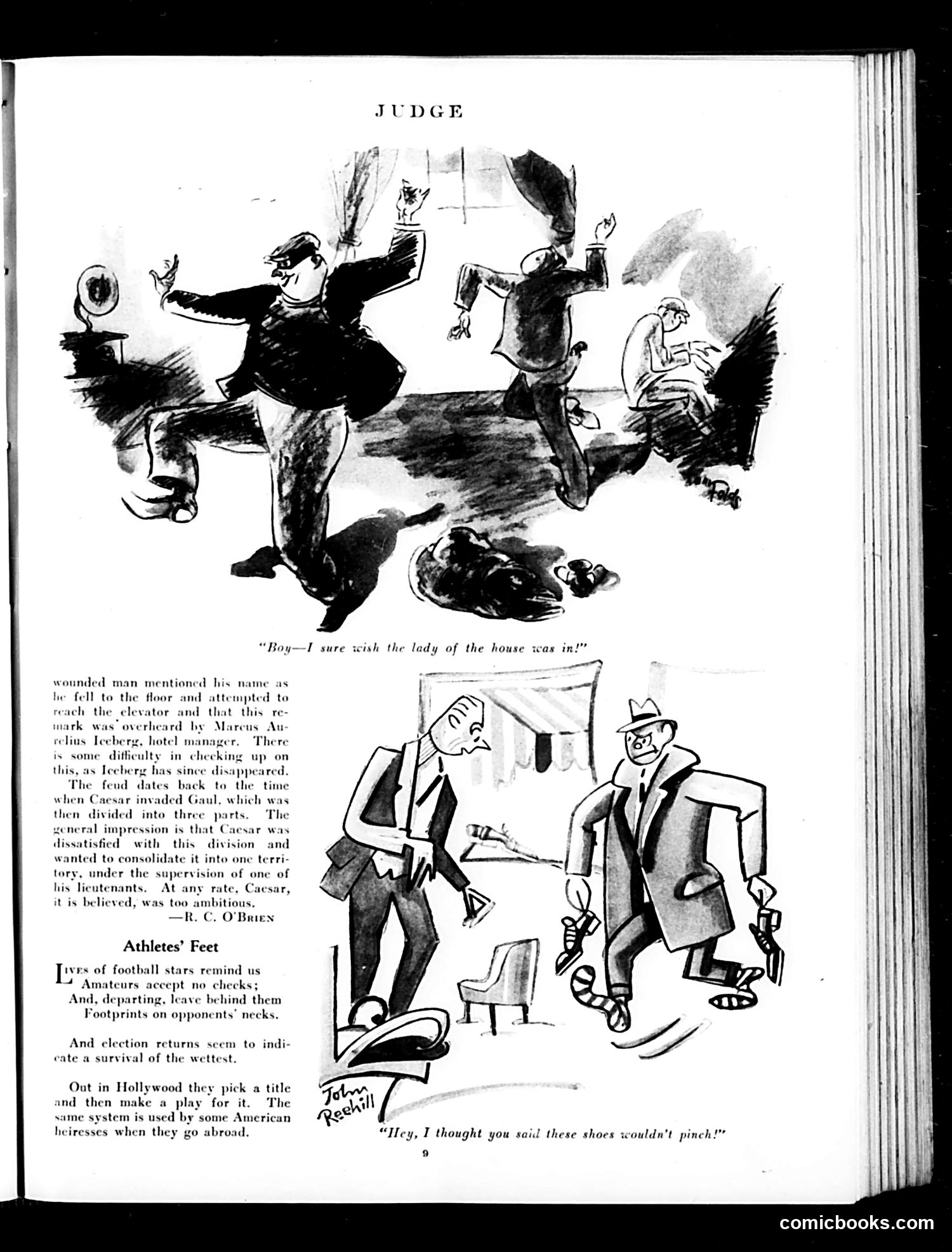
# Judge Magazine Page Analysis This page contains two separate satirical cartoons: **Top cartoon ("Judge"):** A chaotic courtroom scene where a judge appears to be literally kicking defendants or witnesses out. The caption "Boy—I sure wish the lady of the house was in!" suggests domestic/legal chaos. The accompanying text discusses Caesar's division of Gaul and a hotel incident, implying commentary on ineffective legal authority or judicial mismanagement. **Bottom cartoon ("Athletes' Feet"):** Two men in suits stand amid tangled rope/string near a chair. The caption "Hey, I thought you said these shoes wouldn't pinch!" is a pun on "athletes' feet"—the poem above jokes that football players leave "footprints on opponents' necks," while the cartoon appears to satirize either uncomfortable situations, political entanglements, or failed promises. The style suggests early 20th-century American satire focused on everyday absurdities and wordplay rather than specific political figures.
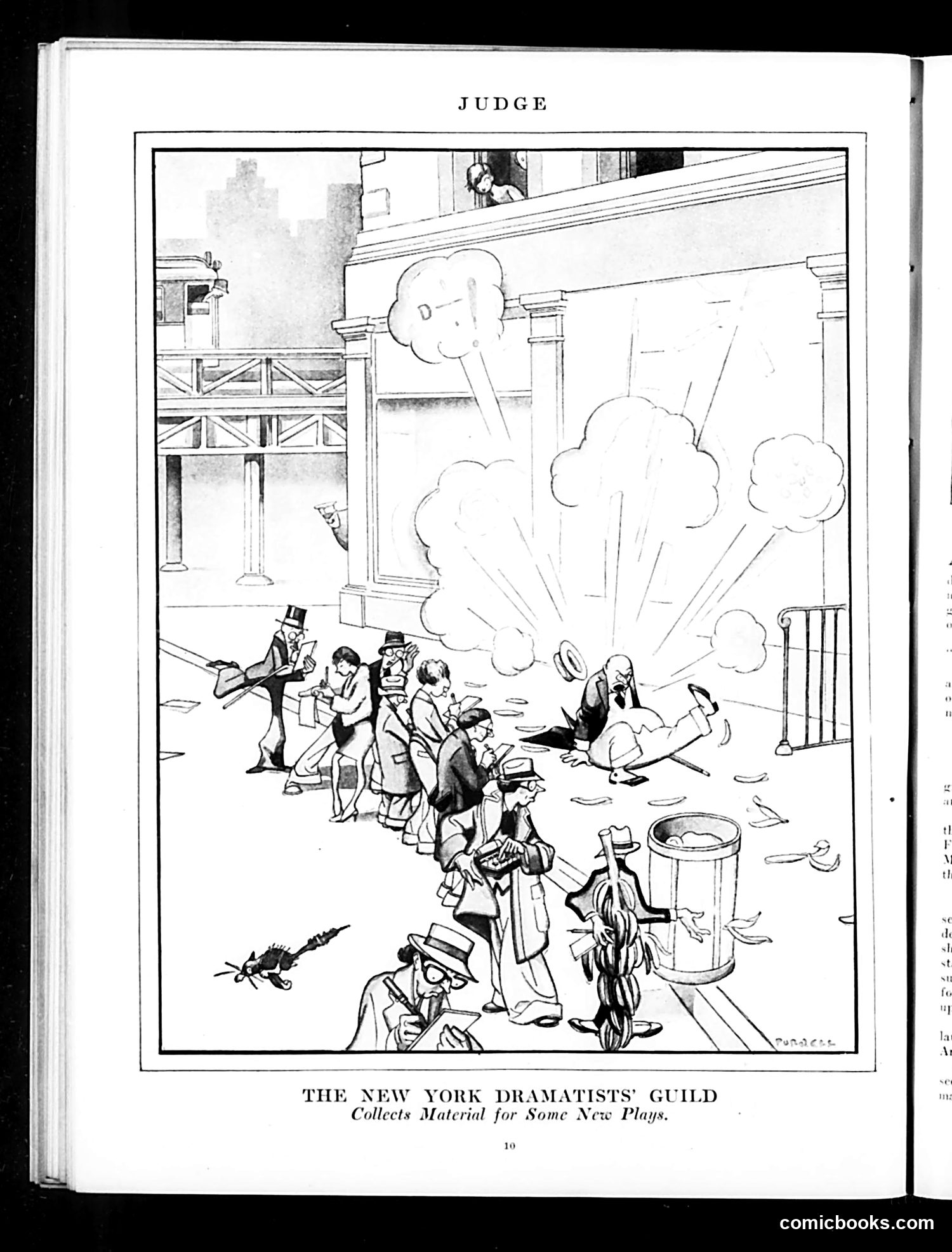
# Analysis This cartoon satirizes the New York Dramatists' Guild by depicting playwrights as literal scavengers collecting material from urban chaos. The scene shows well-dressed men in top hats gathering "inspiration" from a courtyard explosion—debris, mayhem, and a massive explosion cloud dominate the composition. A large insect in the lower left appears to represent some kind of pest or nuisance also being "collected." The satire suggests that contemporary playwrights rely on sensationalism, violence, and urban disasters for their scripts rather than genuine dramatic creativity. By showing them actively harvesting catastrophic scenes like material samples, the cartoon mocks both the Dramatists' Guild and early 20th-century theater's apparent appetite for melodramatic, sensation-driven plots drawn from real urban life. This reflects period anxieties about theatrical quality and artistic integrity.