
Judge, 1930-11-15 · page 18 of 36
Judge — November 15, 1930 — page 18: what you’re looking at
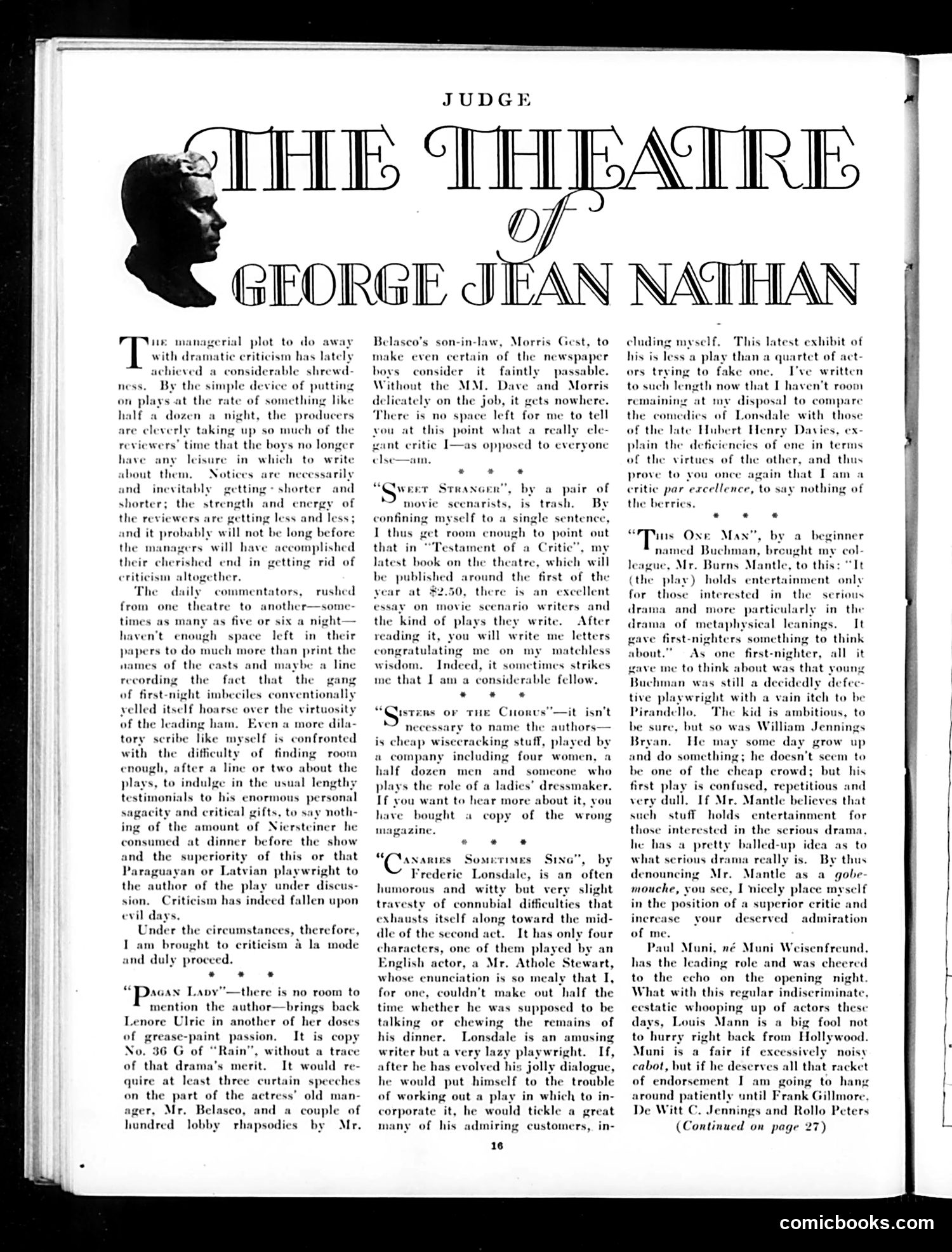
A restored page from Judge, 1930-11-15. Page through the whole issue in the reader above.
📄 Transcribed text from this page (OCR, searchable)
Machine-transcribed from the original scan — historical spelling and the odd misread are preserved.
GEORGE J ie managerial plot to do away with dramatic criticism has lately achieved a considerable shrew ness. By the simple devi of putting on plays at the rate of something like half a dozen a night, the producers ire cleverly taking up so much of the reviewers’ time that the boys no longer have any leisure in which to write about them, Notices are necessarily and inevitably getting > shorter and shorter; the strength and energy of the reviewers are getting less and less; and it probably will not be long before the managers will have accomplished their cherished end in getting rid of criticism altogether, The daily commentators, rushed from one theatre to another—some- times as many as five or six ¢ haven't enough space left in’ their papers to do much more than print the names of the casts and maybe a line recording the fact that the gang of first-night imbeciles conventionally yelled itself hoarse over the virtuosity of the leading ham. Even a more dila- tory scribe like myself is confronted ) the difficulty of finding room enough, after a line or two about the plays, to indulge in the usual lengthy testimonials to his enormous personal sagacity and critical gifts, to say noth- ing of the amount of Niersteiner he consumed at dinner before the show and the superiority of this or that Paragu an playwright to the author of the play under discus- sion. Criticism has indeed fallen upon Under the cireumst I am brought to crit and duly proceed. “ * «6 res, therefore, m a la mode “Dagan Lapy’—there is no room to mention the author—brings back Lenore Ulric in another of her doses of grease-paint passion. It is copy No. 36 G of “Rain”, without a trace of that drama’s merit. It would re- quire at least three curtain spe on the part of the actress’ old man- ager, Mr. Be couple of hundred i Mr. Belasco’s son-in-law, Morris Gest, to make even certain of the newspaper boys consider it faintly passable. Without the MM. Dave and Morris delicately on the job, it gets nowhere. There is no space left for me to tell you at this point what a really ele- gant critic I—as opposed to everyone else—am. * * “Gweer Sreasore’, by a pair of movie scenarists, is trash. By confining myself to a single sentenc: I thus get room enough to point out that in “Testament of a Critic’, my latest book on the theatre, which will be published around the first of th year at 50, there is an excellent essay on movie scenario writers and the kind of plays they write. After reading it, you will write me letters congratulating me on my matchless wisdom. Indeed, it sometimes strikes me that I am a considerable fellow. * 8 « “Qistens or tHe Ciorvs'’—it isn’t necessary to name the authors— is cheap wisecracking stuff, played by a company including four women, a half dozen men and someone who plays the role of a ladies’ dressmaker. If you want to hear more about it, you copy of the wror * 8 ANaries Sometimes Sine”, by Frederic Lonsdale, is an often humorous and witty but very slight travesty of connubial difficulties that exhausts itself along toward the mid- dle of the second act. It has only four characters, one of them played 1 English actor, a Mr. Athole Ste whose enunciation is so mealy th for one, couldn’t make out time whether he was supposed to be talking or chewing the remains his dinner. Lonsdale is « musing writer but a ve y playwright. If, after he has evolved his jolly dialogue, he would put himself to the trouble of working out a } which to in- corporate it, he would tickle a great many of his admiring customers, 16 myself. This latest exhibit of his is less na quartet of act- I've written to such le F aven'| nv remainit my disposal to compare the comedies of Lonsdale with those of the late Hubert Henry Davies, ex- plain the deticiencies of ene in terms of the virtues of the other, and thus prove to you once in that Tam a critic par excellence, to say nothing of the berries. ors tryi “ 8 «@ “Pins Oxr Max”, by a beginner named Buchman, breught my col league, Mr. Burns Mantl ‘It (the play) holds entertainment only for those interested in’ the serious drama and more particularly in the drama of metaphysical leanings. It e first-nighters something to think yout.” As one first er, alll it gave me to think about was that young Buchman was still a decidedly defec tive playwright with a vain itch to be Pirandello, The kid is ambitious, to be sure, but so was William Jennings Bryan. He may some day grow up and do something; he doesn’t seem to be one of the cheap crowd; but his first play is confused, repetitious and very dull, If Mr. Mantle believes that such stuff holds ent: inment for those interested in the serious drama, he has a pretty balled-up idea as to what serious drama really is. By thus denouncing Mr. Mantle gobe mouche, you see, I nic in the position of a superior critic « increase your deserved admiration of me. Paul Muni, né Muni Weisenfreund, has the leading role and was cheere to the echo on the opening n What with this regular indiserimin ecstatic whooping up of actors these days, Louis Mann is a big fool not to hurry right back from Hollywood. Muni is a fair if excessively noisy cabot, but if he deserves all that racket of endorsement I am going to h around patiently until Frank Gillmore, De Witt C. Jennings and Rollo Peters (Continued on page 27) comicbooks.com