A complete issue · 36 pages · 1930
Judge — August 16, 1930
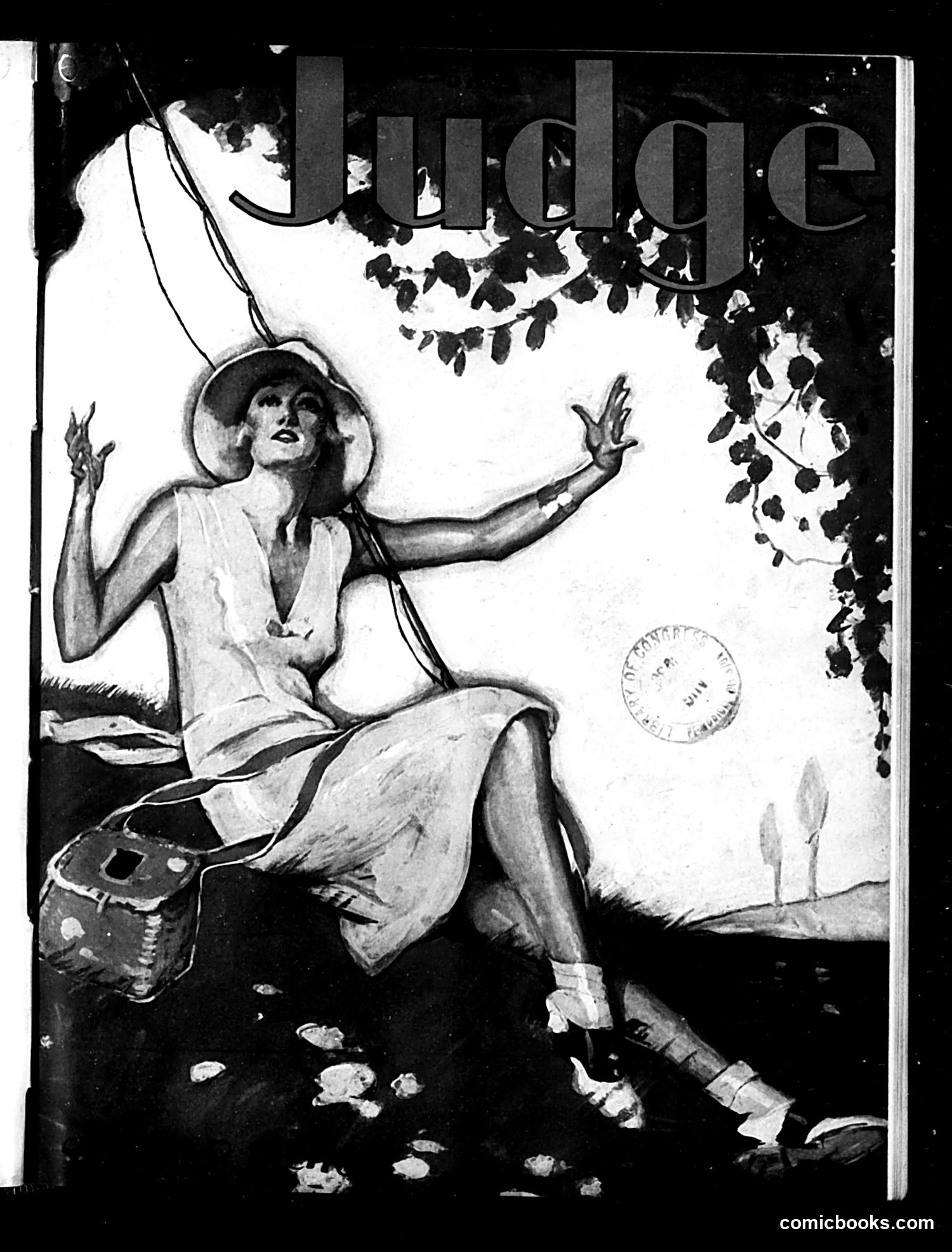
# Judge Magazine Cover Analysis This appears to be a cover from **Judge**, the American satirical weekly magazine. The illustration depicts a woman in a bathing suit and wide-brimmed hat, reclining in a leisure pose with what appears to be radio equipment nearby. The word "judge" is visible at the top. The image likely satirizes **1920s-1930s leisure culture** and possibly the novelty of radio technology becoming domesticated into entertainment and vacation settings. The woman's fashionable attire and relaxed demeanor suggest commentary on modern consumer culture or changing social norms around women's public appearance and recreation. Without additional context or legible text, the specific satirical target remains unclear, though it likely reflects Judge's typical commentary on contemporary American social trends.
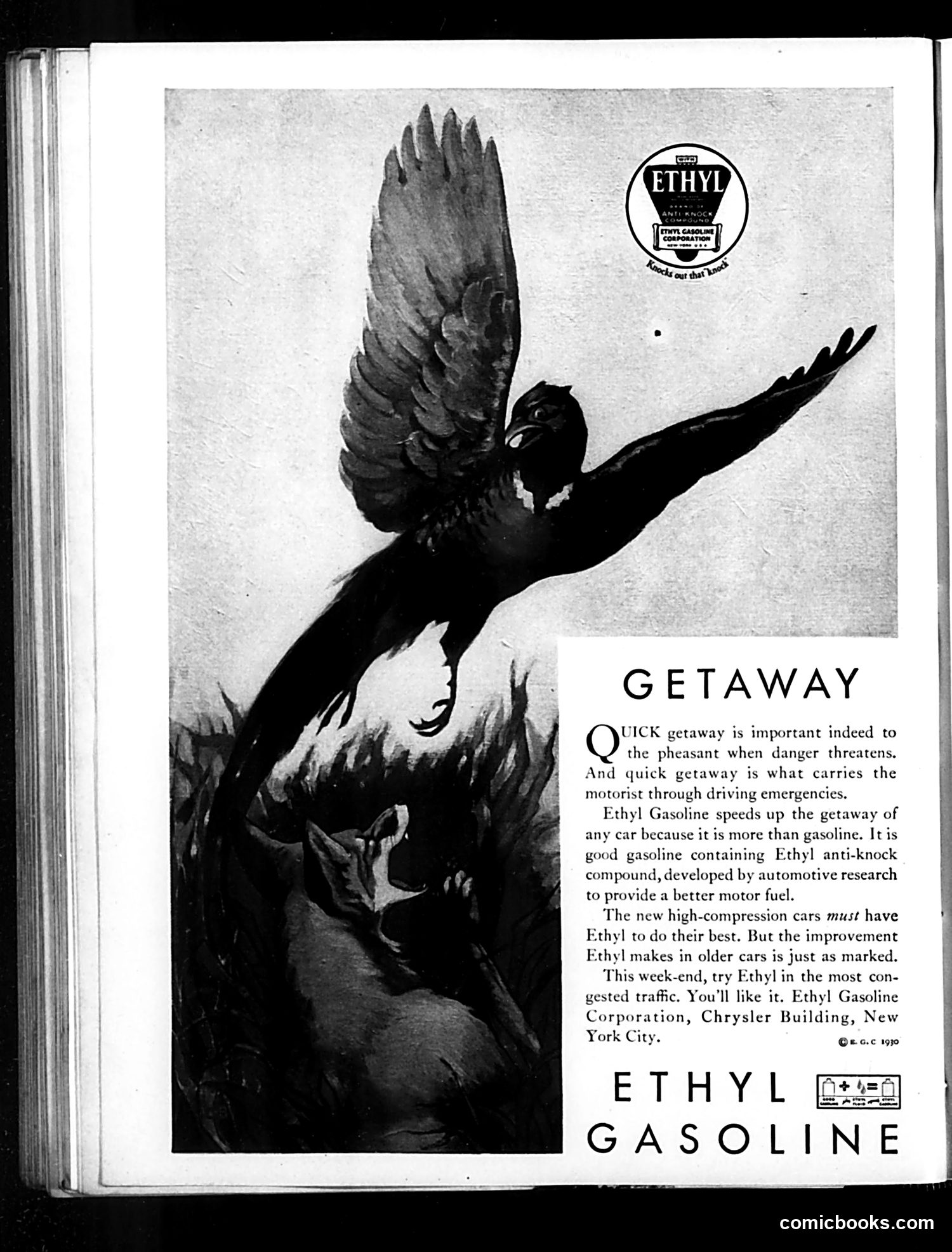
# Analysis This page is primarily a **commercial advertisement, not satire or political content**. The image shows a pheasant in dramatic escape pose, wings spread in flight. The advertisement's headline "GETAWAY" compares the bird's quick escape to how Ethyl Gasoline helps cars accelerate through driving emergencies. The text explicitly promotes Ethyl's anti-knock compound as superior fuel for modern high-compression engines. It concludes with a call to action: try Ethyl in congested traffic this weekend. While *Judge* magazine typically featured satire, this page is straightforward product marketing for the Ethyl Gasoline Corporation (Chrysler Building, New York City), using an eye-catching nature photograph as the hook. The copyright date appears to be 1930.
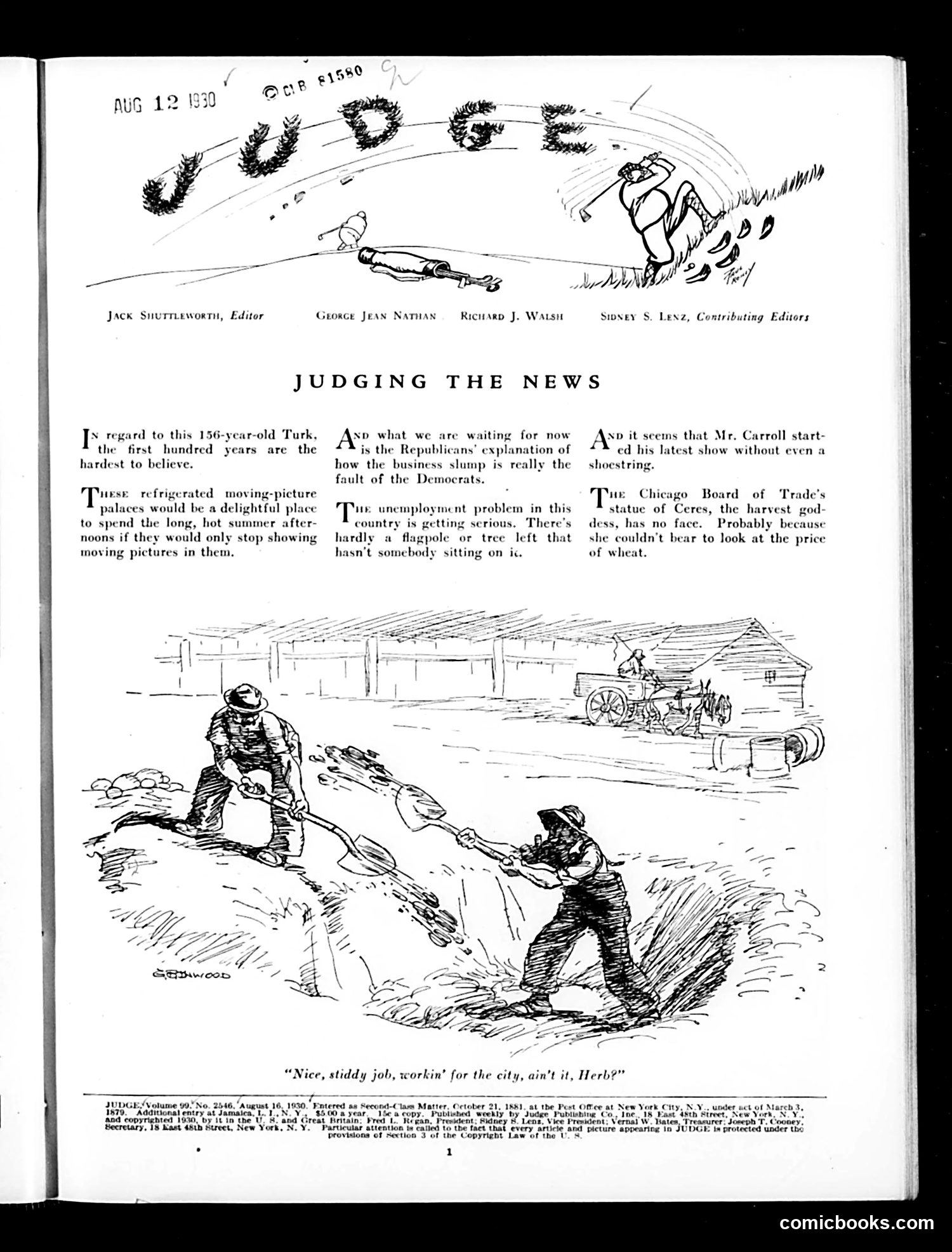
# Analysis of Judge Magazine Page (August 12, 1930) This page satirizes economic hardship during the Great Depression. The main cartoon depicts two laborers doing road work with the caption "Nice, steady job, workin' for the city, ain't it, Herb?"—ironic commentary on how municipal make-work jobs, while better than nothing, represented a grim reality for the unemployed. The editorial column "Judging the News" critiques Republicans for blaming Democrats for the economic slump, and sarcastically notes that Chicago's Board of Trade statue of Ceres (goddess of harvest) "has no face"—likely because wheat prices had collapsed, making the symbol of agricultural prosperity embarrassing. The page reflects 1930 anxieties about joblessness and government relief measures.
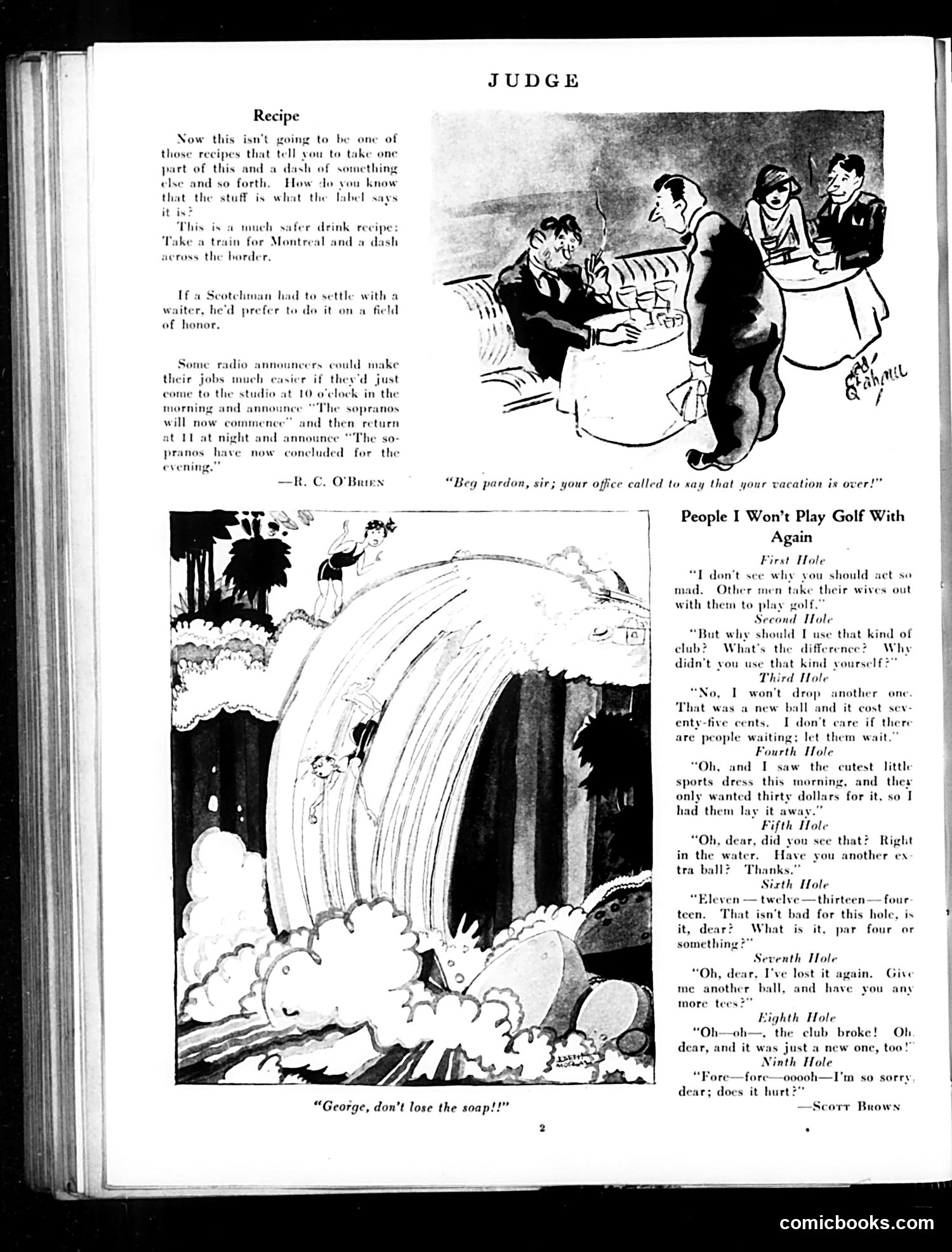
# Analysis of Judge Magazine Page The page contains two main pieces: **Top cartoon** ("Beg pardon, sir; your office called..."): Satirizes radio announcers' scheduling inefficiency. The joke concerns an announcer who works split shifts (morning and evening), creating absurd logistics. The satire targets early radio broadcasting's operational chaos—announcers literally commuting between home and studio multiple times daily. **Bottom section** ("People I Won't Play Golf With Again"): A humorous monologue by Scott Brown cataloging golf etiquette violations. Each numbered "hole" represents a complaint—wives dragging husbands along, lost balls, expensive equipment, wet balls, and broken clubs. This satirizes golf culture's pretensions and the sport's capacity to frustrate players. The large illustration shows someone losing soap in what appears to be a flood or waterfall scenario.
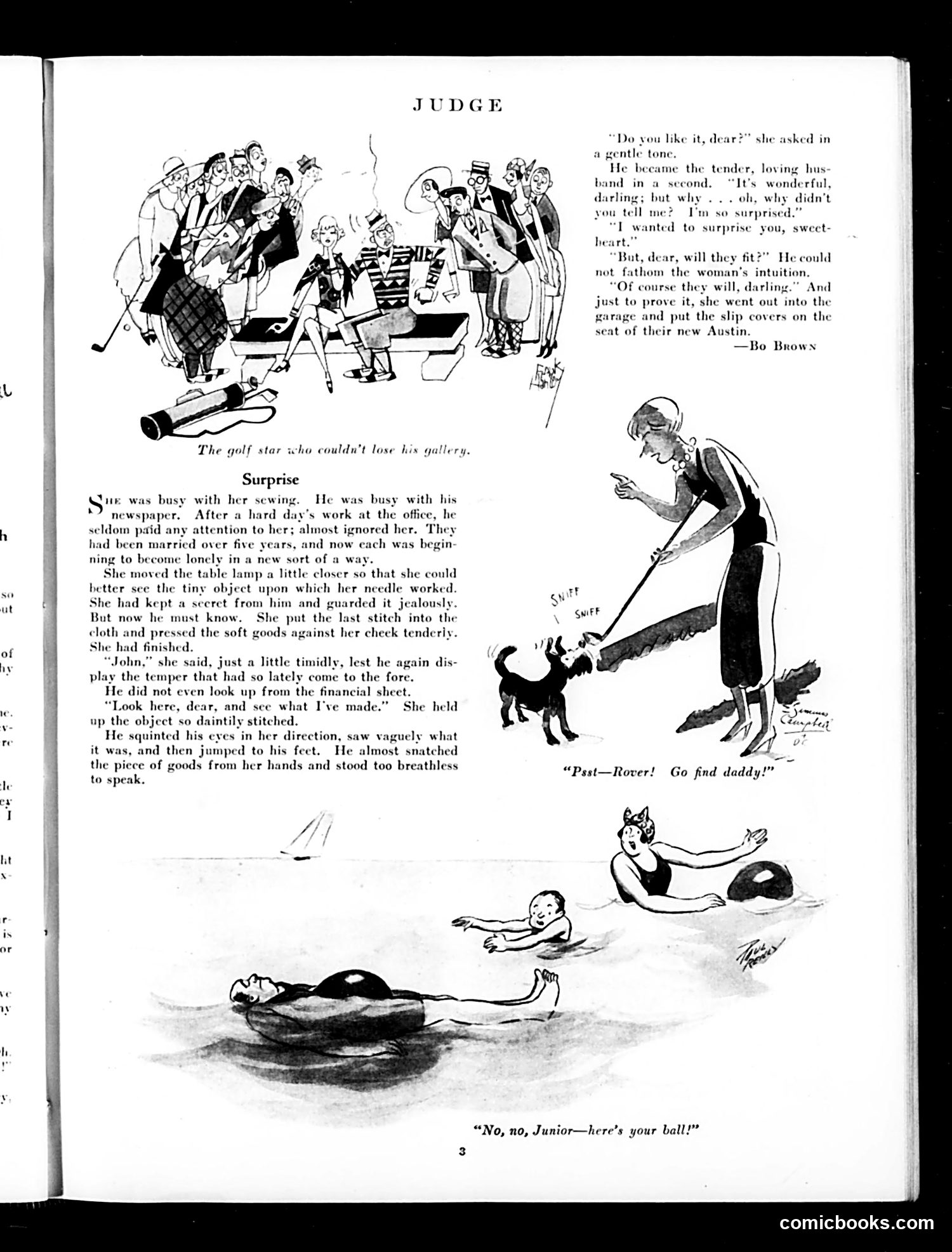
# Analysis of Judge Magazine Page This page presents three separate cartoon narratives about domestic life and leisure: 1. **"The golf star who couldn't lose his gallery"** (top): Shows a man surrounded by spectators at what appears to be a social gathering, satirizing how celebrity golfers attract unwanted attention even in private settings. 2. **"Surprise"** (middle): A story about a wife presenting her husband with a homemade item. He dismisses it without looking, prompting her to reveal it anyway. The satire targets husbands' inattentiveness to wives' domestic efforts and emotional labor. 3. **"Pst—Rover! Go find daddy!"** (bottom): Depicts swimming/beach scenes, likely poking fun at family vacation dynamics or fathers avoiding their responsibilities. These cartoons reflect early 20th-century domestic humor focused on marriage tensions, male indifference, and leisure activities.
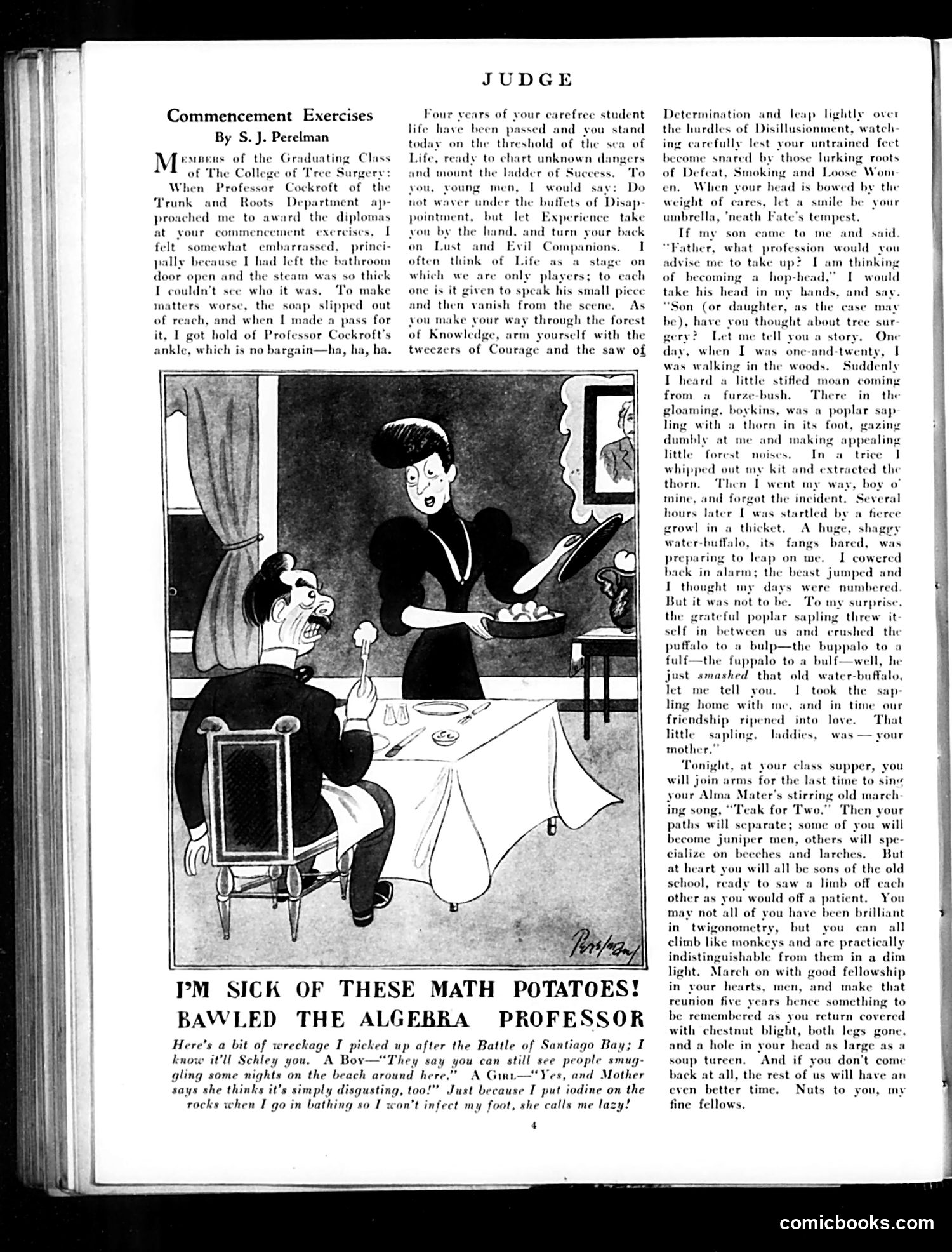
# Analysis This page contains a commencement speech by S.J. Perelman (a prominent humorist) addressed to graduating medical students from the College of Tree Surgery, alongside a cartoon illustration. The main cartoon depicts a domestic scene where a woman serves food to a seated man, with the caption "I'M SICK OF THESE MATH POTATOES! BAWLED THE ALGEBRA PROFESSOR." The humor operates on multiple levels: it's a nonsensical domestic complaint (potatoes having nothing to do with algebra), playing on the absurdity of literal interpretation. The "College of Tree Surgery" itself appears to be satirical wordplay. The cartoon likely mocks pedantic academics who impose their specialized vocabularies onto everyday domestic life, creating comical incongruity. The overall piece exemplifies Judge magazine's characteristic satirical approach to American institutional life and pretension.
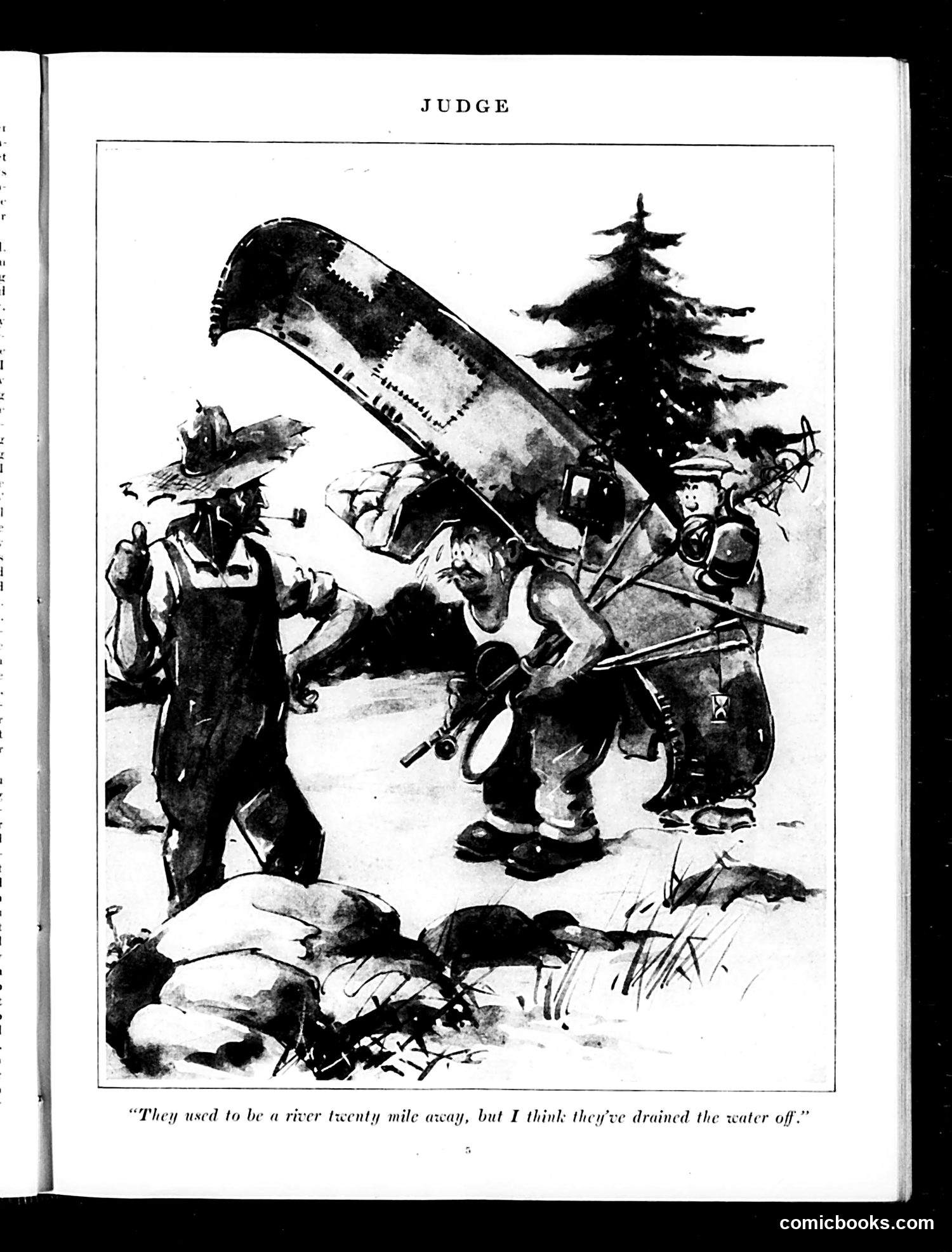
# Analysis This cartoon from *Judge* magazine satirizes environmental mismanagement or water resource depletion. The caption reads: "They used to be a river twenty mile away, but I think they've drained the water off." The scene depicts what appears to be frontier or rural figures (drawn in exaggerated caricature style typical of early 20th-century satire) discovering a dried riverbed. The absurdist humor lies in the deadpan acceptance of an environmental disaster—casually attributing a river's disappearance to someone deliberately "draining" it. The cartoon likely critiques either: industrial water usage, poor water management policies, or environmental carelessness during America's development era. The specific historical context—which drought, industrial project, or policy this references—remains unclear without additional dating information.
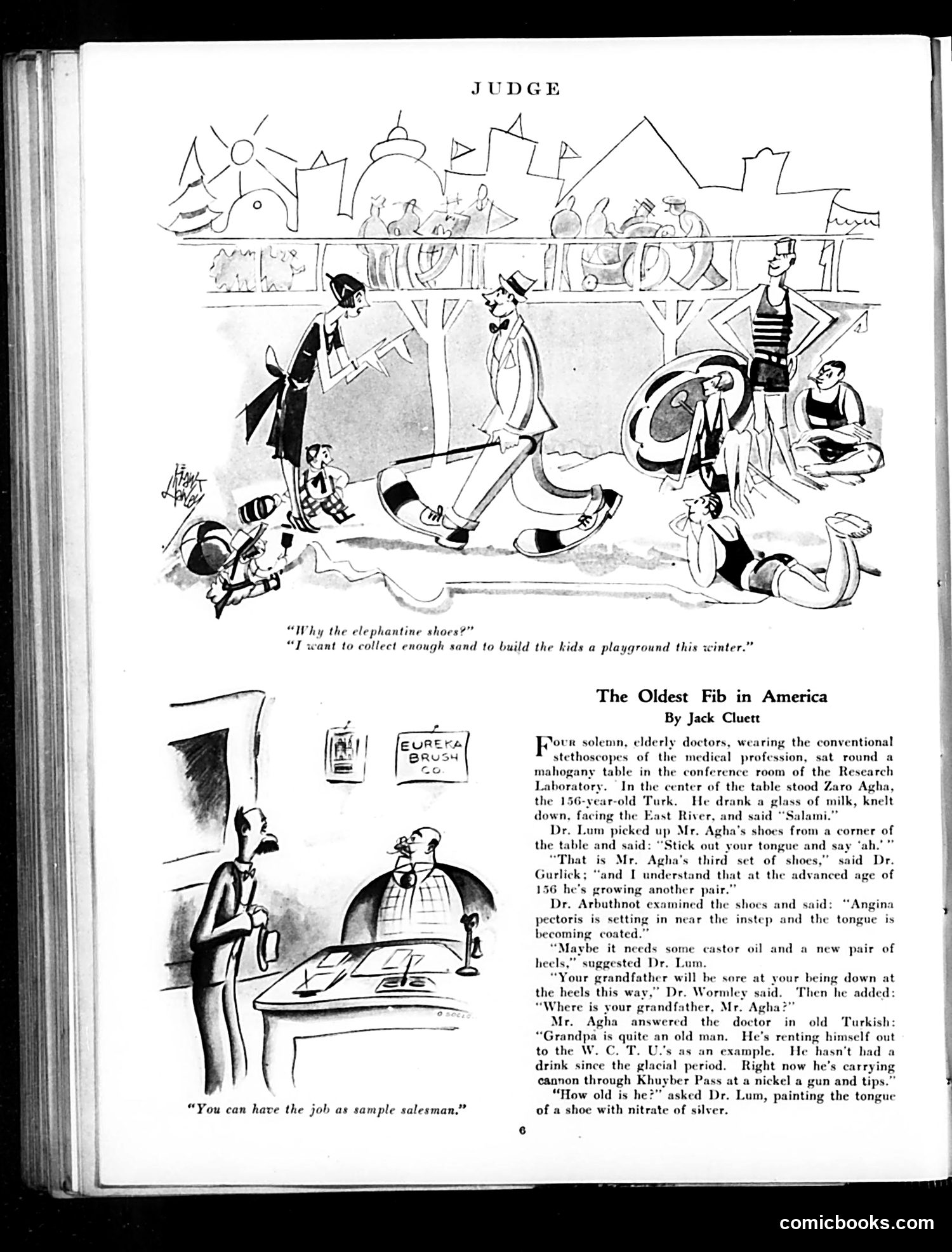
# Analysis of Judge Magazine Page **Top Cartoon ("Judge"):** A man in formal attire stands before what appears to be a judge's bench or elevated platform, surrounded by children playing with sand and toys. The caption reads: "Why the elephantine shore?" / "I want to collect enough sand to build the kids a playground this winter." This satirizes wealthy individuals' extravagant or absurd justifications for their actions—here, a man claims he's removing sand from a beach under the pretext of building a children's playground, a transparently self-serving excuse dressed up in philanthropic language. **Bottom Cartoon:** A man shows product samples (marked "EUREKA BRUSH CO.") to another man. Caption: "You can have the job as sample salesman." This depicts straightforward job-seeking humor about commission-based sample sales work.
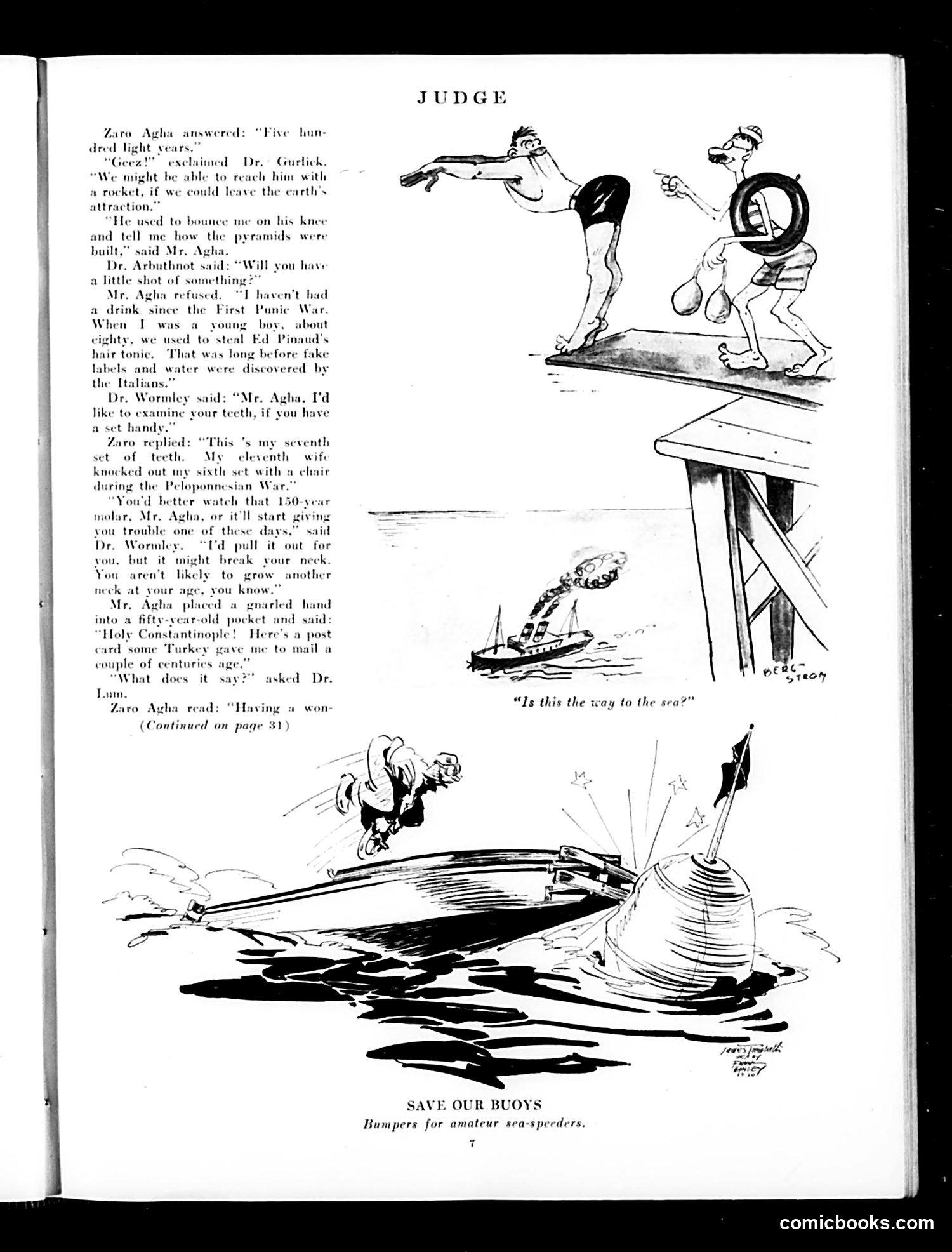
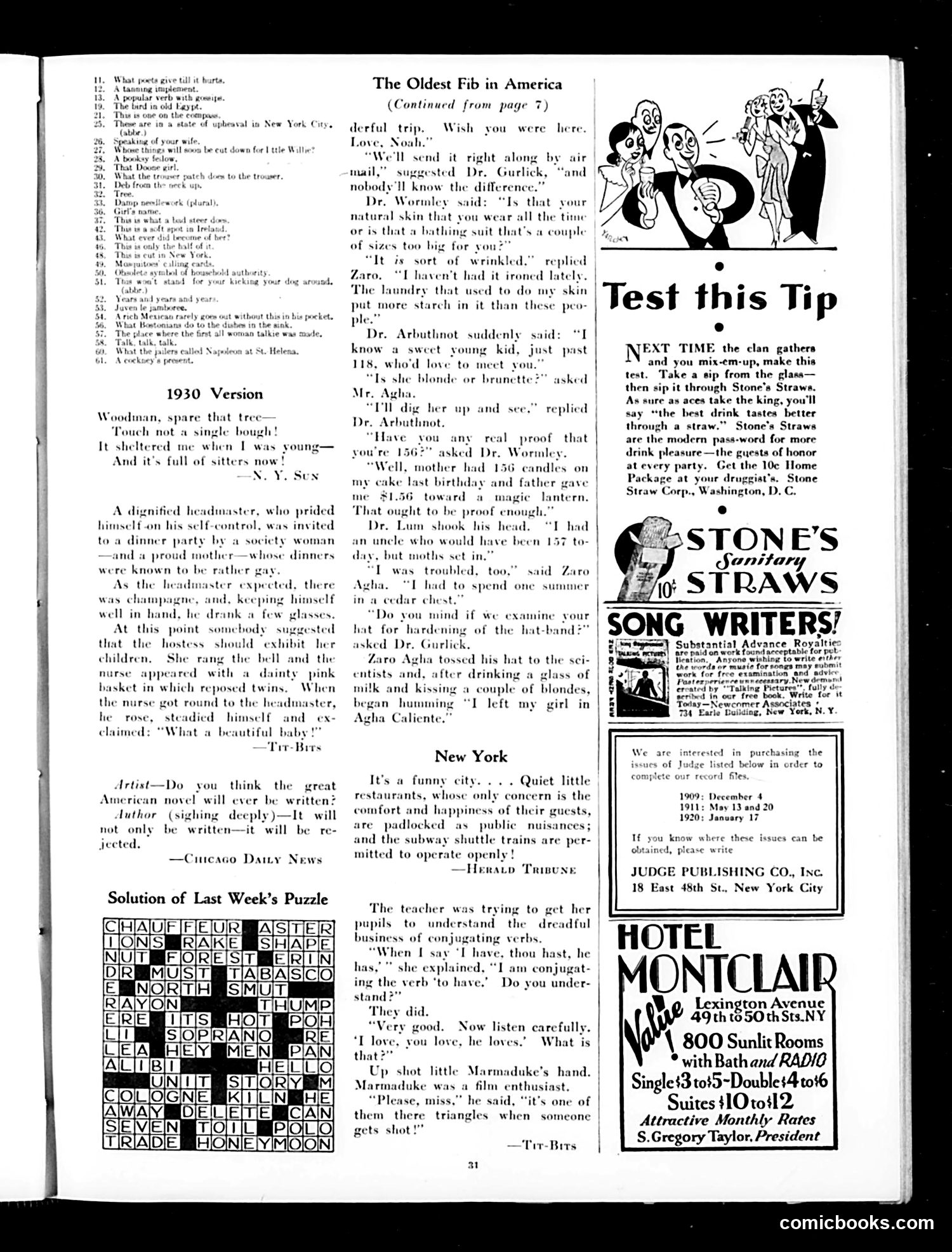
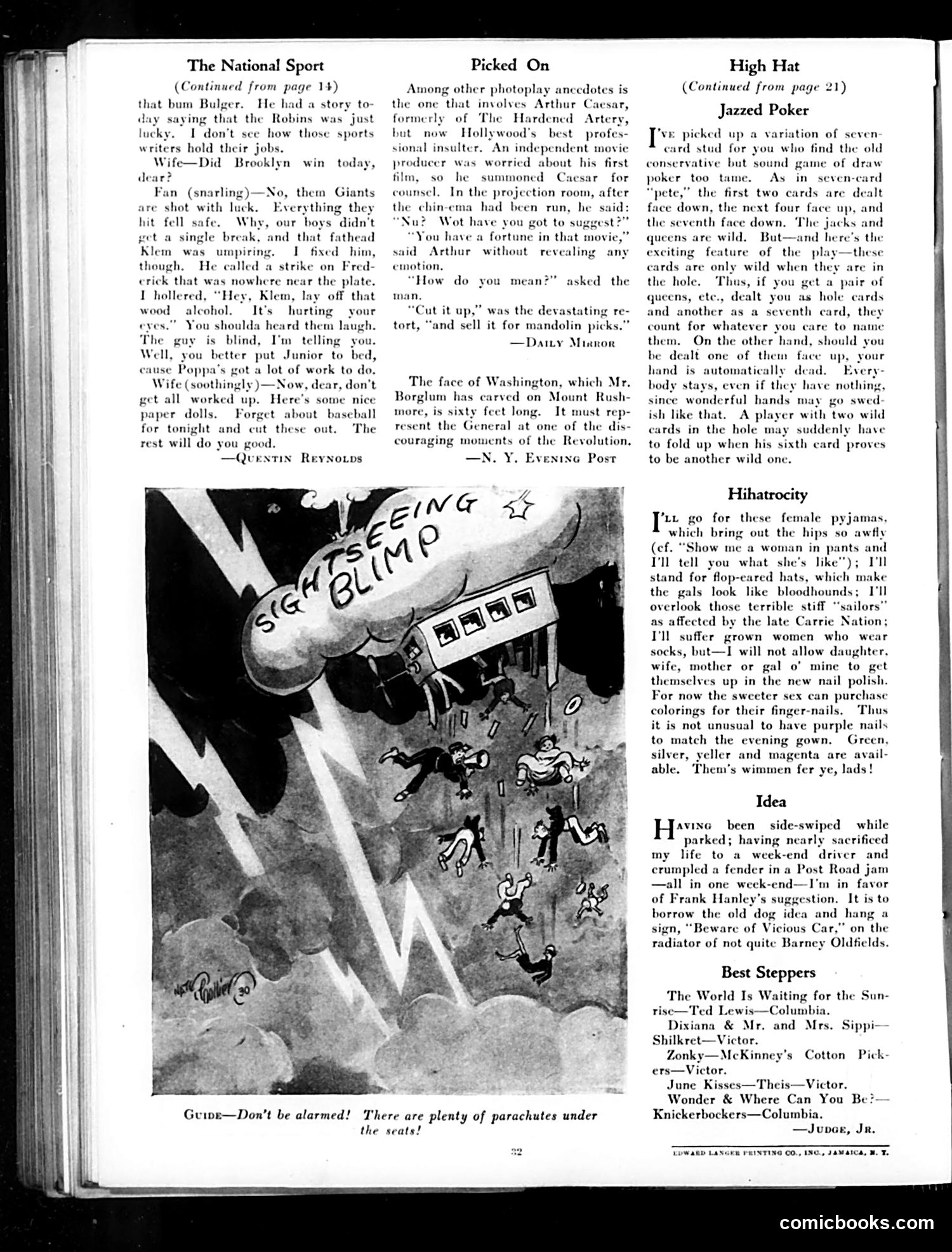
# Explanation for Modern Readers This page from *Judge* magazine features two satirical elements: **Upper section:** A conversational narrative about "Zaro Agha," presented as an absurdly ancient man who claims to have lived through multiple historical wars (First Punic War, Peloponnesian War) and repeatedly replaced his teeth and wives. The joke relies on exaggeration—doctors express amazement at his impossible longevity. This appears to be satirizing either a real person claiming extreme age or the general public's fascination with sensationalized "oldest man alive" stories. **Lower cartoon:** "Save Our Buoys" depicts amateur boaters in comical distress—figures being thrown from vessels and flailing in water. The caption's pun ("buoys/boys") suggests satire of unsafe recreational boating practices and perhaps novice sailors' incompetence, presented as a humorous public safety warning. Both elements use exaggeration and wordplay typical of *Judge*'s satirical approach to contemporary social topics.
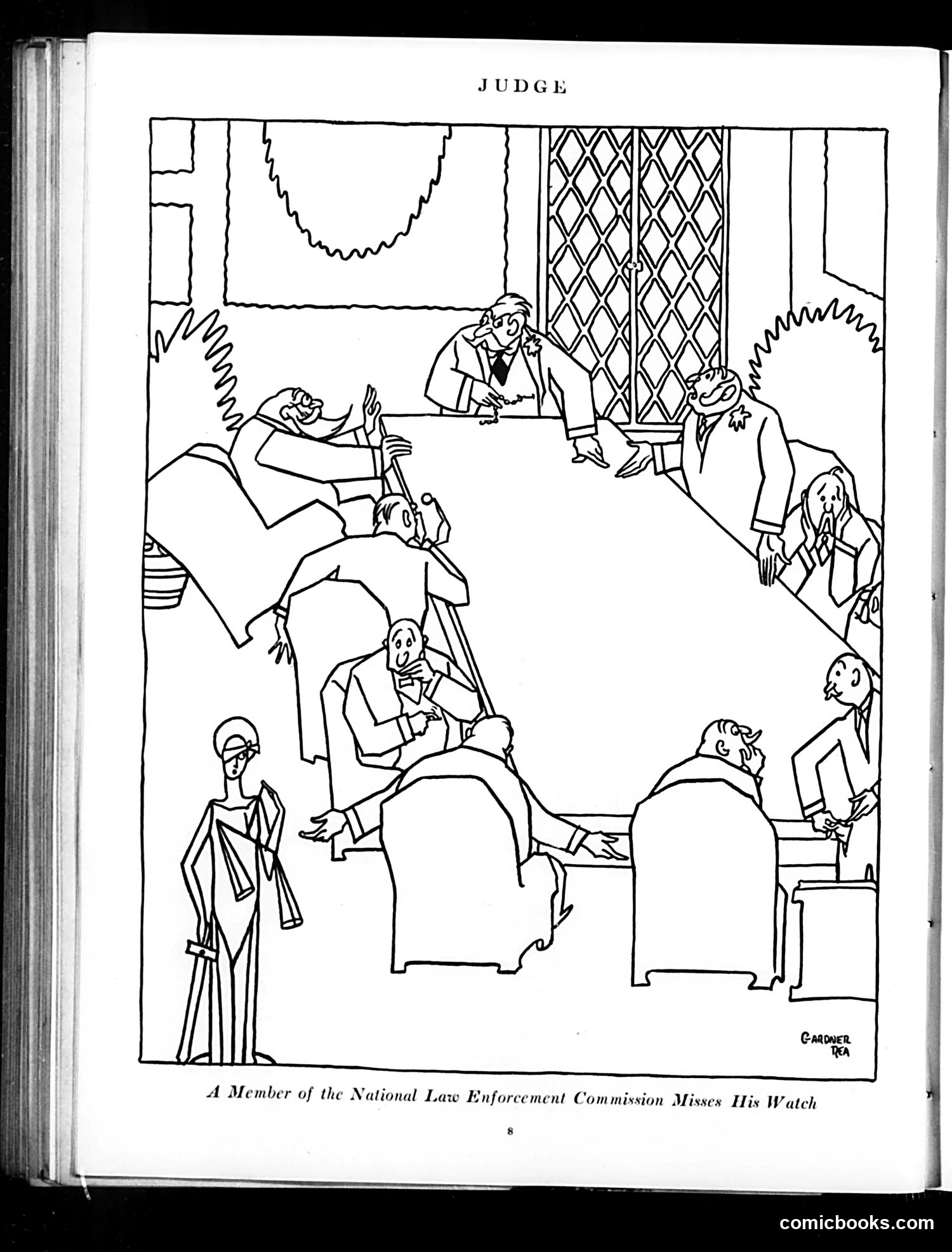
# Analysis of "Judge" Cartoon Page This single-panel cartoon satirizes the **National Law Enforcement Commission**, depicting a courtroom scene where Lady Justice (left, blindfolded) observes chaos. The caption states "A Member of the National Law Enforcement Commission Misses His Watch." The joke targets law enforcement corruption or inattention: a commission member is so distracted by courtroom proceedings (or misconduct) that he fails to notice his own watch being stolen. This is satirical irony—someone tasked with enforcing law cannot even protect his own property. The cartoon likely critiques the Commission's ineffectiveness during Prohibition era (Judge magazine's heyday, 1920s-1930s), suggesting law enforcement officials were either corrupt, negligent, or overwhelmed. The crowded, chaotic courtroom emphasizes institutional disorder.
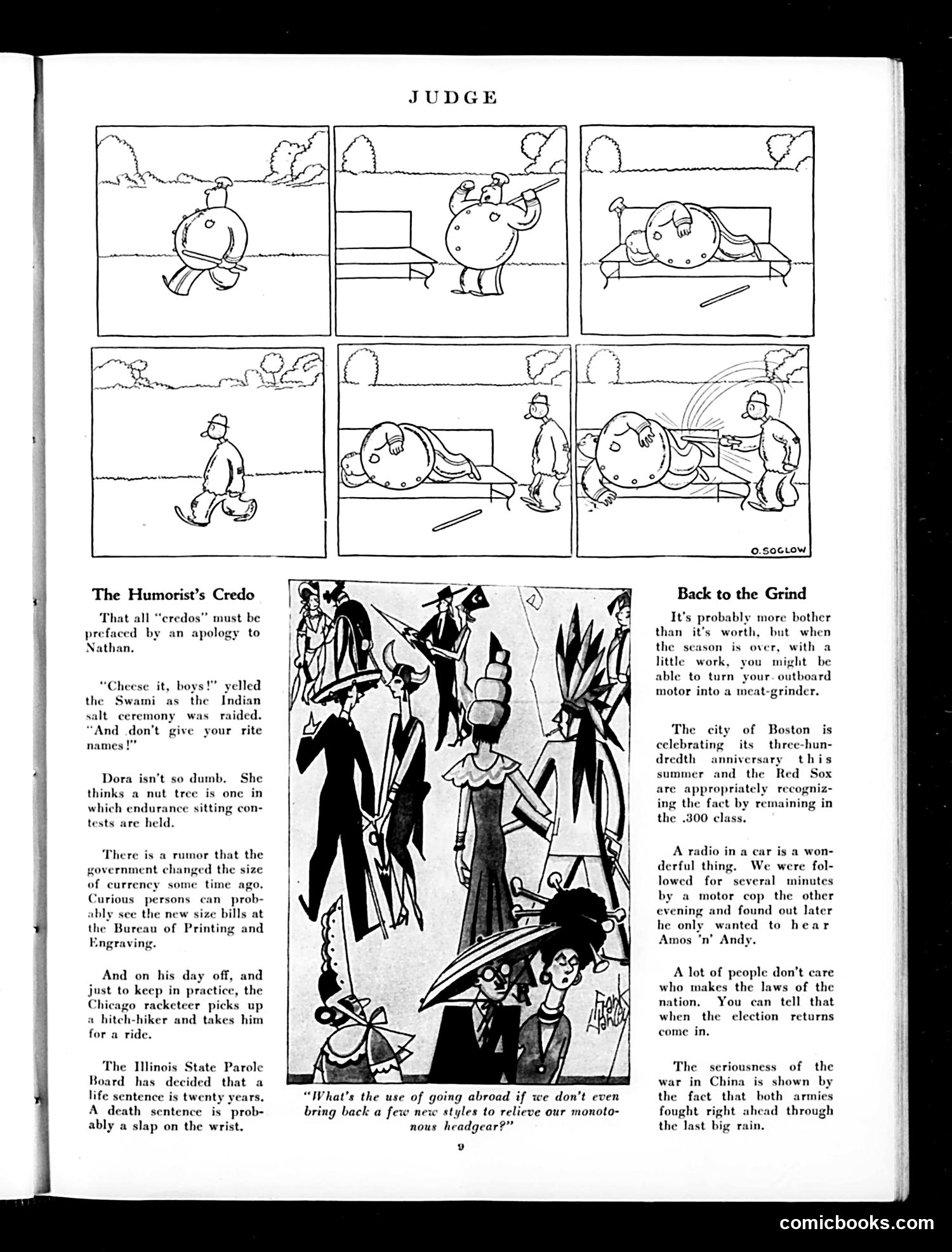
# Judge Magazine Page Analysis This page from *Judge* (a satirical magazine) contains a comic strip and humorous commentary pieces typical of the era. **The Comic Strip ("Judge"):** The six-panel strip depicts slapstick humor involving a rotund character and a judge's bench, escalating from the character bouncing on the bench to eventual chaos with multiple figures and a water spray. The humor is purely visual/physical comedy with no apparent political message. **The Text Sections:** These are brief satirical observations on contemporary American life: - References to "Nathan" (unclear which Nathan is meant) - Jokes about currency changes, the mob ("racketeers"), and the Illinois parole system - Commentary on Boston's 300th anniversary and the Red Sox remaining in the ".300 class" (batting average) - References to "Amos 'n' Andy" (a popular radio show) - Observations about voter apathy during elections - A comment on the Sino-Japanese conflict (1937-1945 era, likely) The central cartoon shows well-dressed figures in what appears to be a fashion/style commentary. The overall page is light satirical commentary on contemporary American society rather than hard political satire.
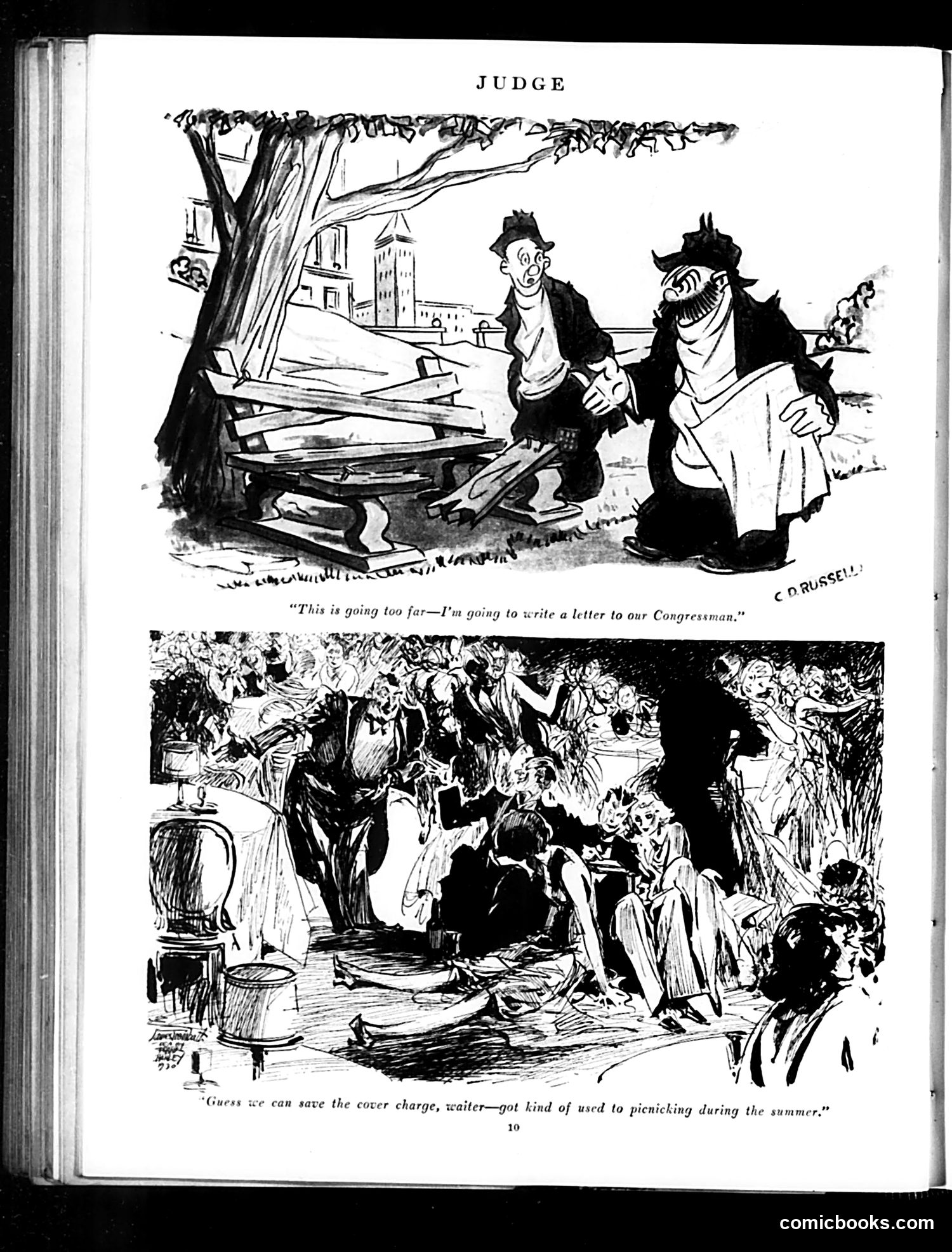
# Analysis of Judge Magazine Page This page contains two satirical cartoons by C. Russells. The **top cartoon** shows two men under a tree threatening to write their congressman because something "is going too far"—likely referring to wartime regulations or rationing. The **bottom cartoon** depicts a crowded restaurant scene where a waiter is being told patrons have "got kind of used to picnicking during the summer" and want to avoid paying the cover charge. This satirizes post-WWI economic attitudes: Americans had grown accustomed to outdoor, inexpensive wartime entertainment and were reluctant to return to pre-war restaurant expenses and formality. Both cartoons mock Americans adapting (or refusing to adapt) to post-war normalcy and expense. The humor targets consumer resistance to returning to conventional economic patterns after the war disrupted normal spending habits.