A complete issue · 36 pages · 1930
Judge — February 22, 1930
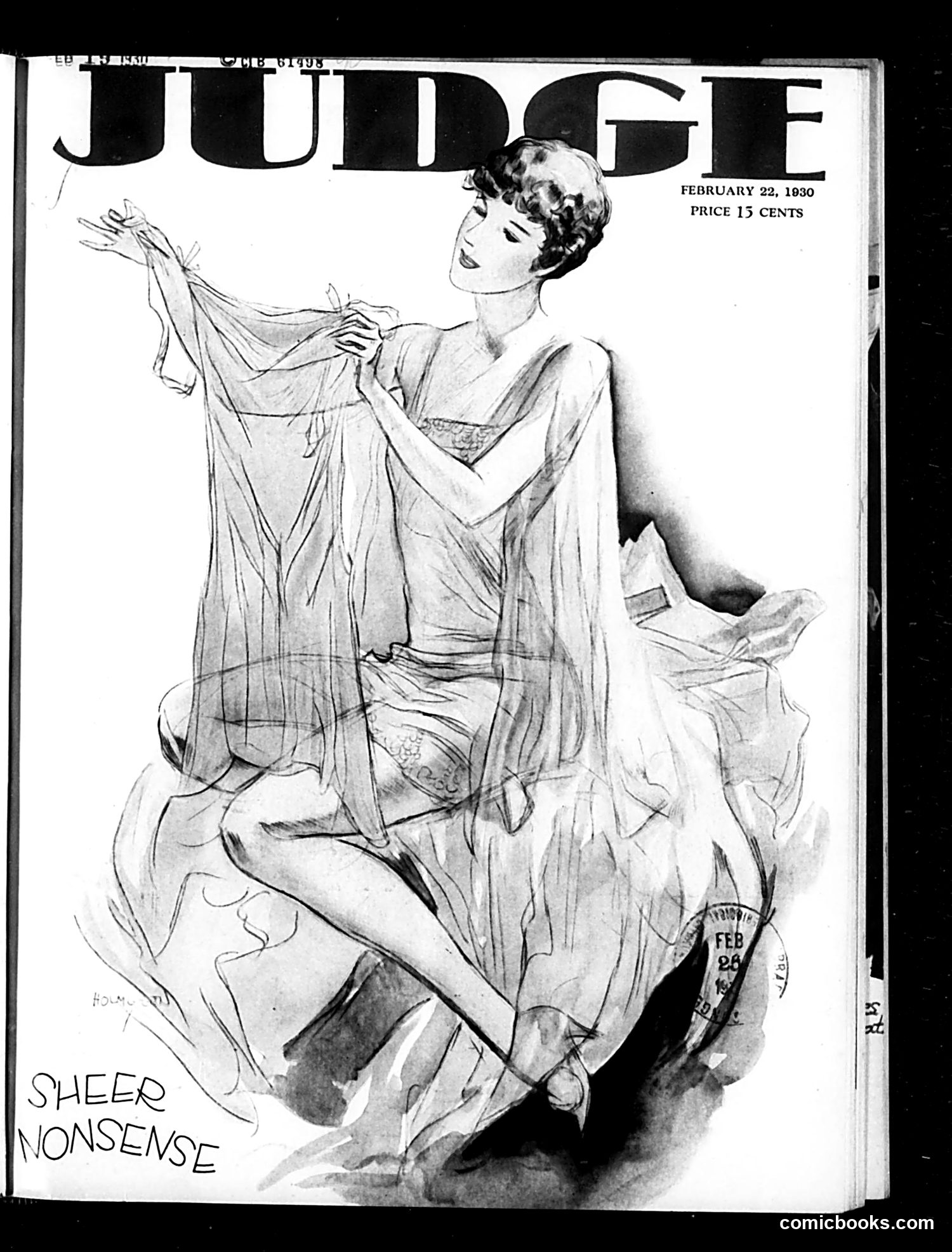
# Judge Magazine Cover Analysis - February 22, 1930 This cover illustrates a woman in diaphanous, flowing negligee examining delicate fabric or lace she's holding up. The title "SHEER NONSENSE" is the primary joke. The humor operates on a double meaning: "sheer" refers both to the transparent quality of the garments depicted and to the nonsensical nature of the content. This appears to be a lighthearted commentary on women's intimate apparel or fashion—particularly the transparency and impracticality of contemporary sleepwear styles. The illustration style and artistic treatment are typical of Judge's satirical approach to social and domestic life. At 15 cents, this February 1930 issue predates the Great Depression's full impact, when such luxury items and leisurely domestic humor remained culturally relevant topics for a middle-class readership.
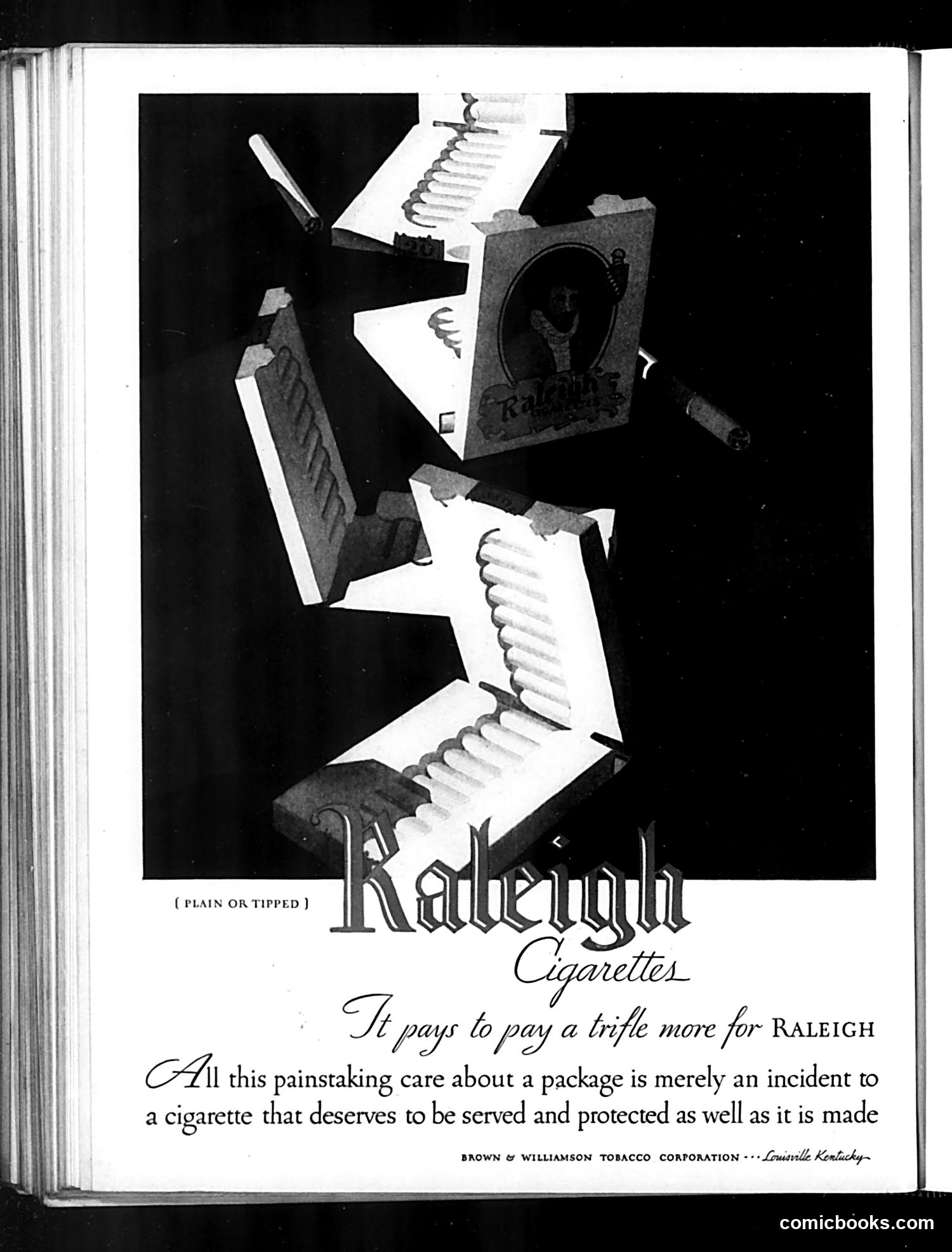
# Analysis This page is primarily a **cigarette advertisement**, not political satire. It promotes Raleigh cigarettes, manufactured by Brown & Williamson Tobacco Corporation in Louisville, Kentucky. The ad features decorative packaging imagery—ornate cigarette boxes and cases arranged artistically—emphasizing the product's presentation. The tagline "It pays to pay a trifle more for RALEIGH" and the closing statement about "painstaking care about a package" position premium packaging as justification for higher cost. The notation "(PLAIN OR TIPPED)" indicates the cigarettes came in two varieties. There is no political cartoon or satirical commentary on this page—it is straightforward mid-twentieth-century tobacco advertising that would be illegal today due to modern restrictions on cigarette marketing.
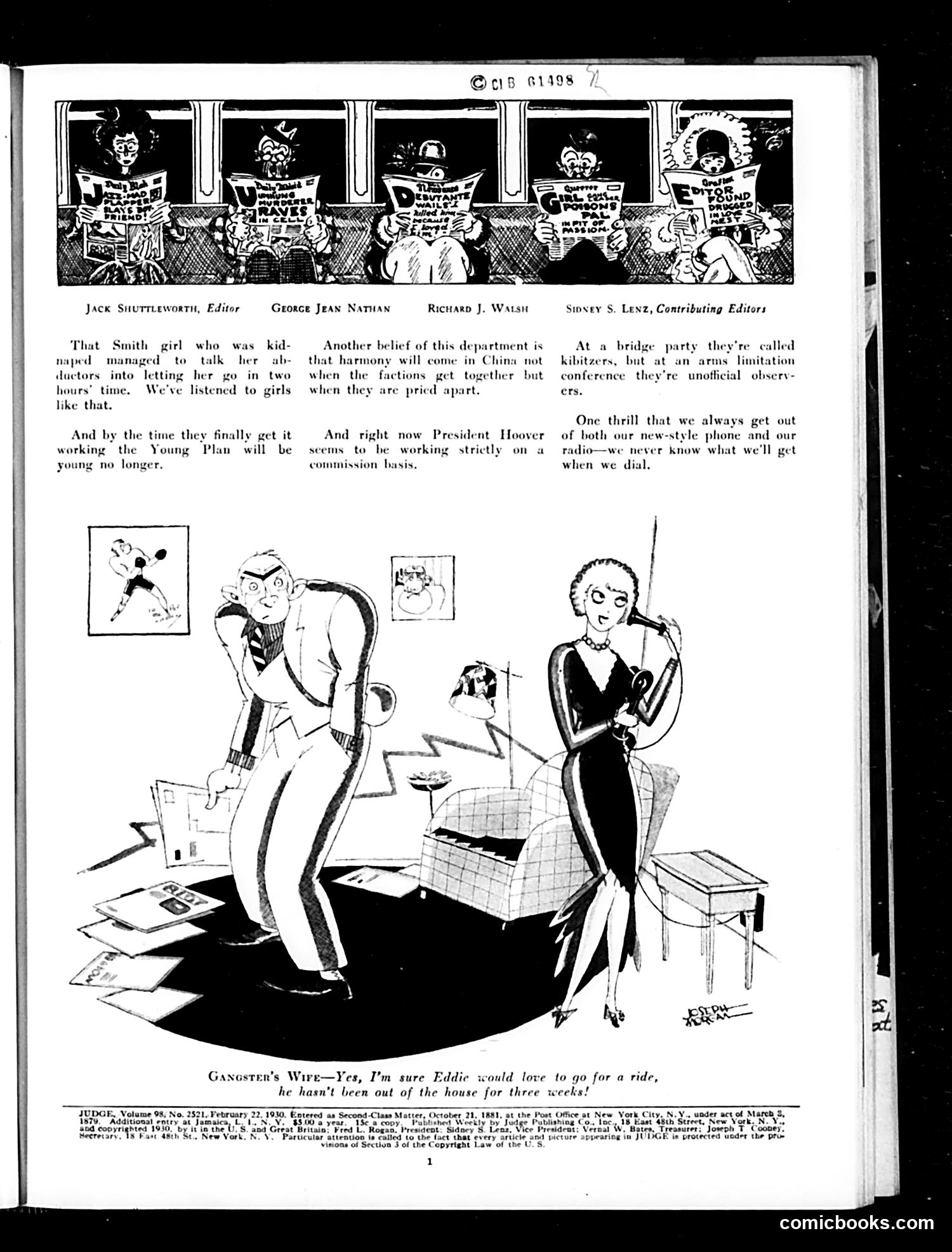
# Analysis This Judge magazine page from February 22, 1930 contains editorial commentary and a cartoon titled "Gangster's Wife." **The Cartoon**: A stylized drawing shows a woman in an evening dress wielding a rifle or gun, standing with a man in a suit amid scattered money and documents. The caption reads: "Yes, I'm sure Eddie would love to go for a ride, he hasn't been out of the house for three weeks!" **The Satire**: The cartoon satirizes Prohibition-era gangster culture and the domestic lives of organized crime figures. The phrase "go for a ride" was contemporary slang for execution. The joke plays on the irony of a gangster's wife casually referencing her husband's imprisonment indoors while casually handling weapons—depicting the criminal underworld's violence and paranoia as mundane domesticity. The accompanying editorial discusses political factions and President Hoover's commission-based governance.
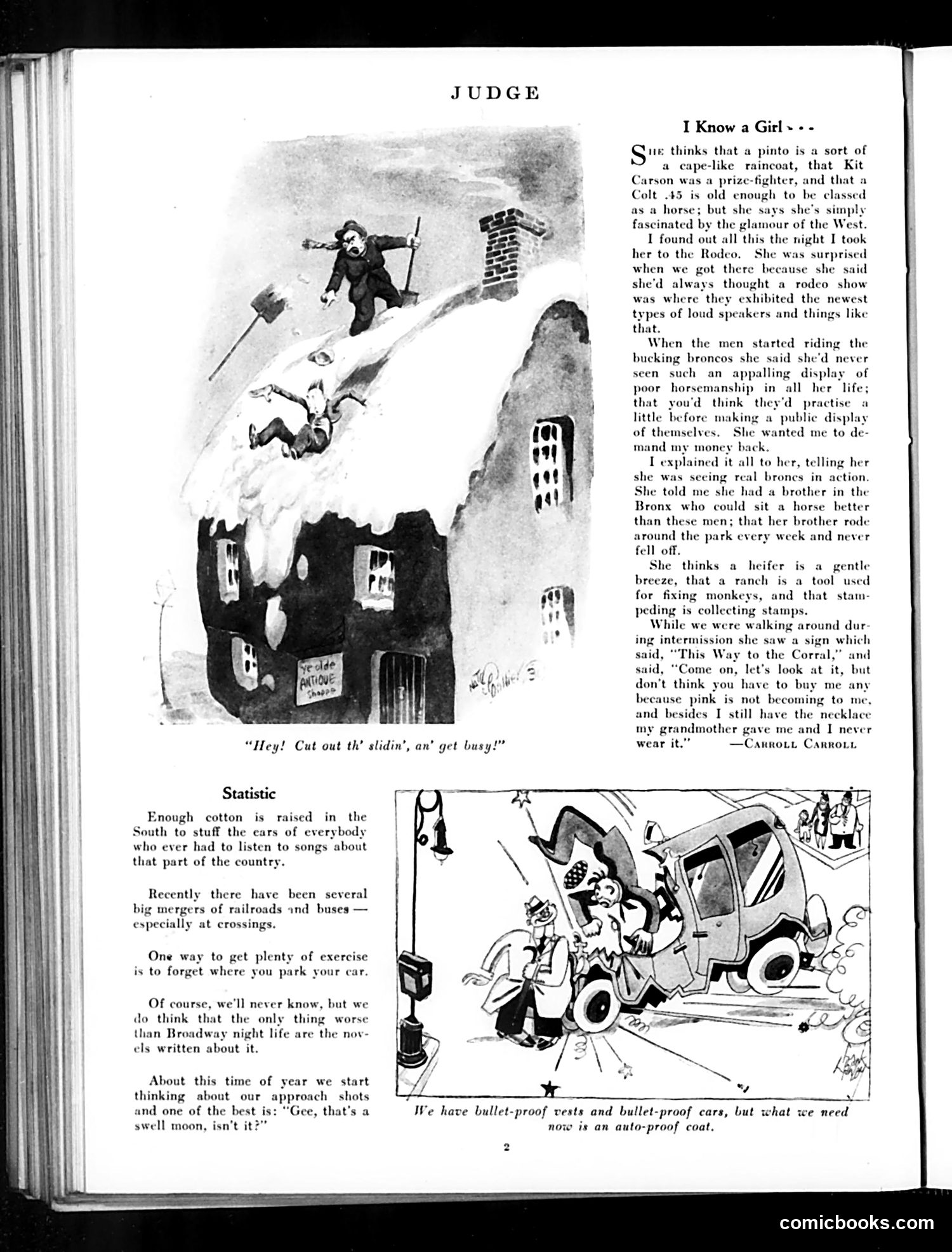
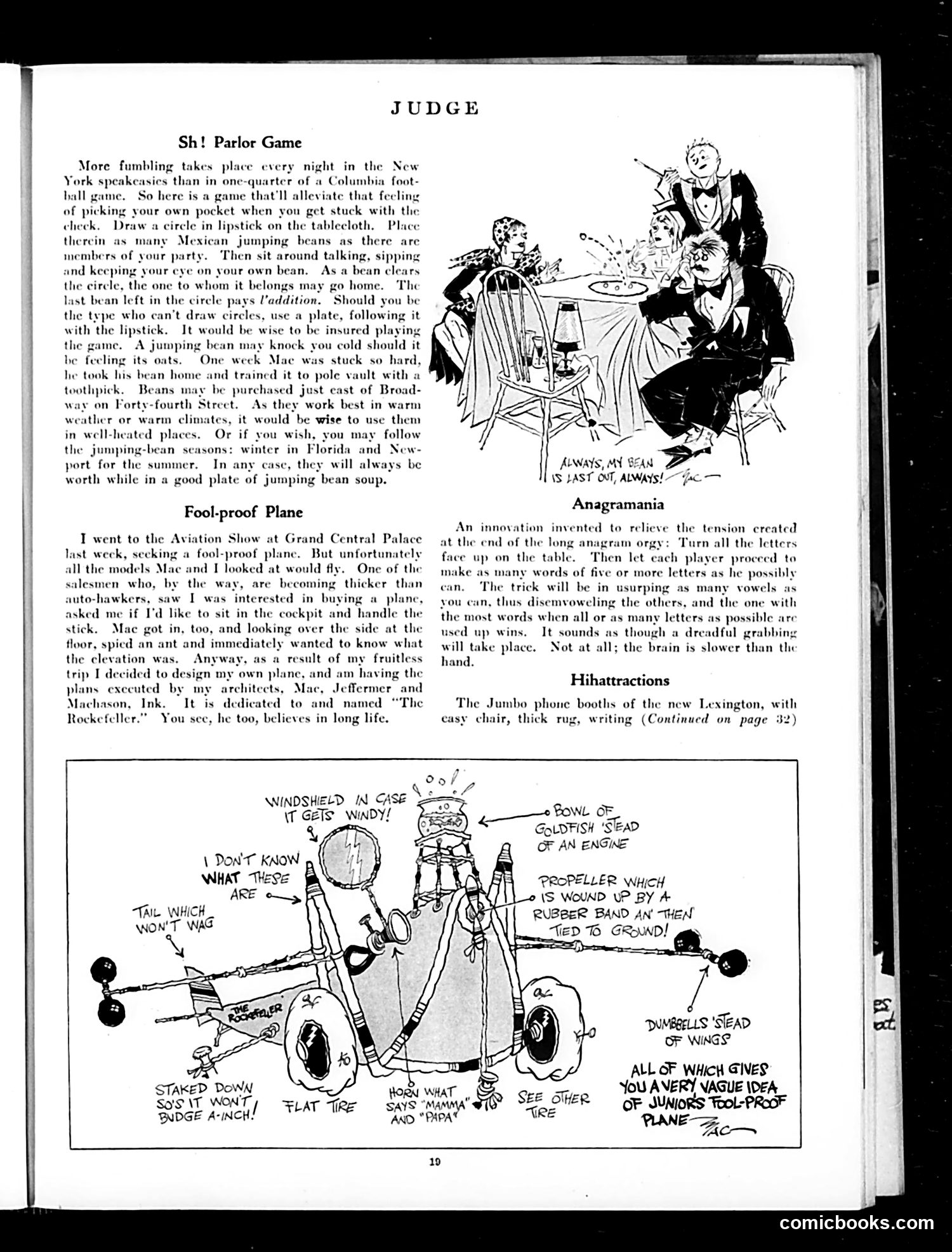
# Analysis of Judge Magazine Page The page contains two distinct pieces: **Top illustration ("Hey! Cut out th' slidin', ain't git busy!"):** Shows people sliding down a snowy rooftop of a tenement building. The satire appears to target urban poverty and unsafe living conditions, depicting working-class recreation as dangerous improvisation on dilapidated housing. **"I Know a Girl" article:** A humorous anecdote about a girl's misconceptions of Western culture—confusing rodeos with theatrical spectacle, misidentifying horse equipment (thinking a ".45 is old enough to be classified as a horse"). The humor relies on urban naivety about frontier life. **"Statistic" section:** Brief satirical commentary on railroad/bus mergers, traffic safety, and New York social life—typical period concerns about modernization and urban congestion. The overall tone is gentle mockery of contemporary social observations.
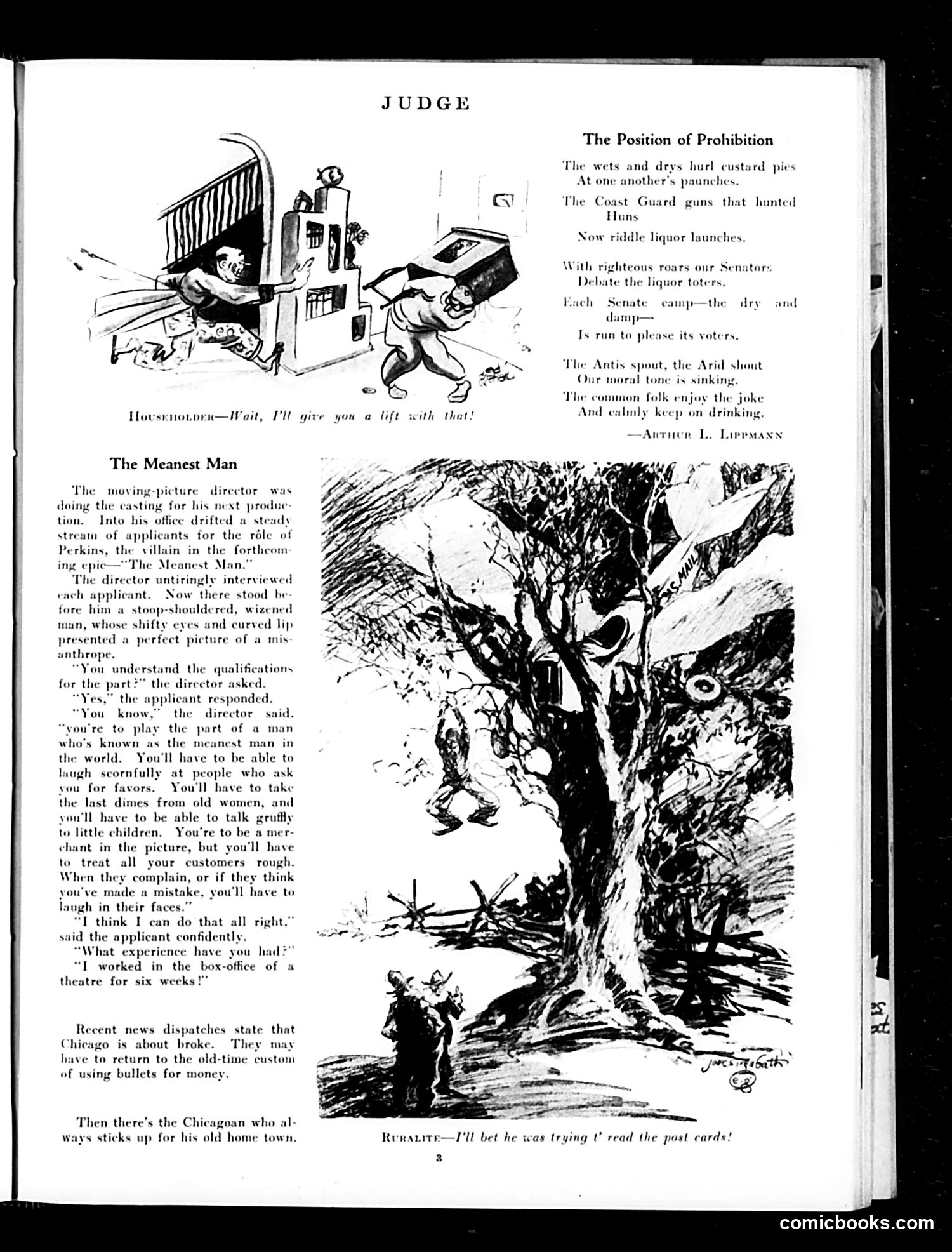
# Analysis of Judge Magazine Page **"The Position of Prohibition" (top cartoon):** This satirizes Prohibition-era enforcement. The cartoon shows a householder offering a bribe to what appears to be a law enforcement officer at a distillery or liquor operation. The accompanying poem mocks the contradictions of Prohibition: senators debate "liquor toters" while "riddle liquor launches" operate, and citizens joke about drinking despite the ban. The satire suggests Prohibition is unenforced and hypocritical—officials debate while illegal operations flourish and common people openly flout the law. **"The Meanest Man" (bottom section):** This is primarily a humorous anecdote about a film director casting for a villain role. An applicant describes six weeks' box office experience, and the director sarcastically assigns him the part of "the meanest man in the world," requiring him to be cruel to customers and staff. It's light workplace humor with no apparent political significance.
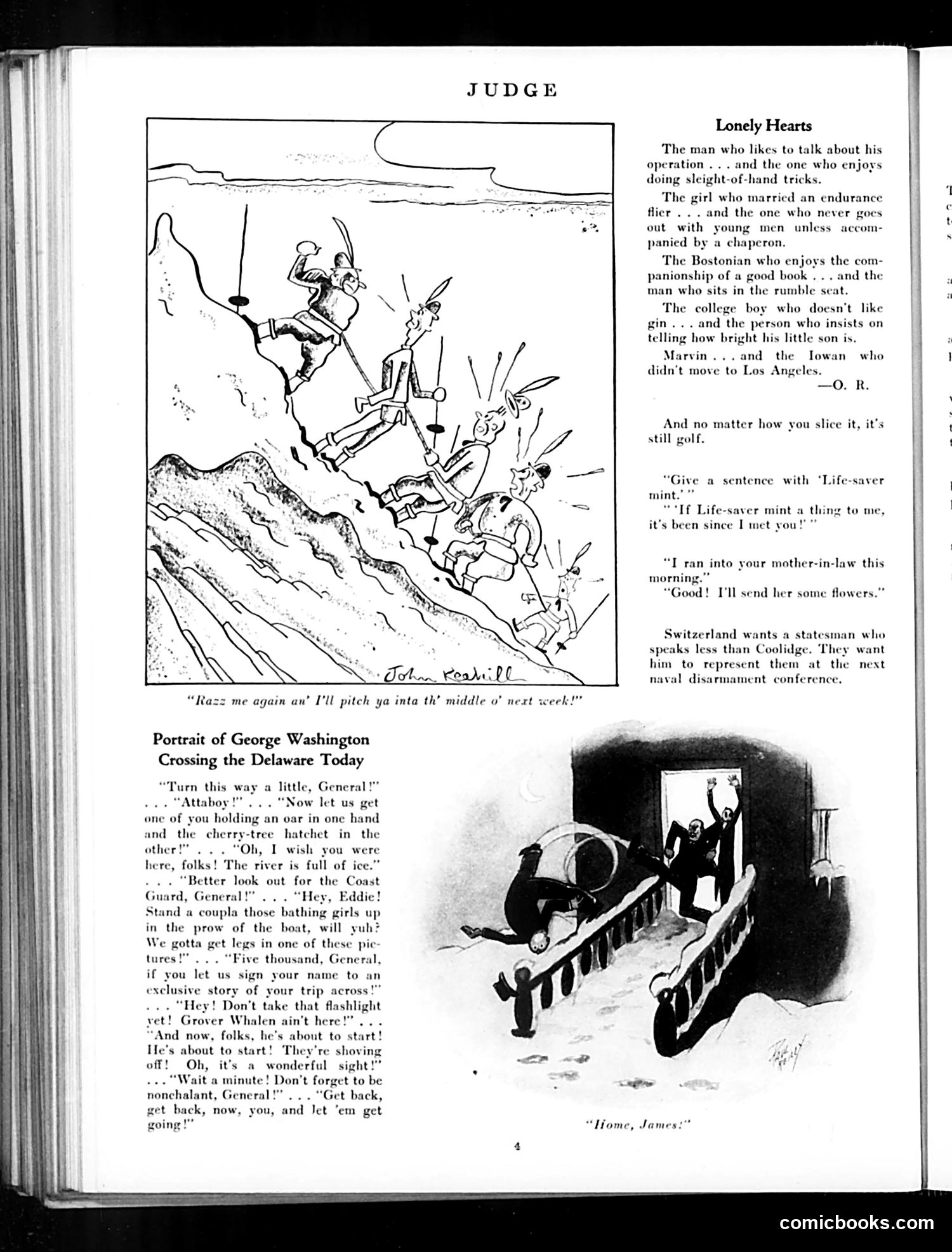
# Judge Magazine Page Analysis The top cartoon depicts skiers tumbling down a snowy slope in chaotic disarray, captioned "Razz me again an' I'll pitch ya inta th' middle o' next week!" This appears to be physical comedy about ski mishaps rather than political satire. Below is a section titled "Portrait of George Washington Crossing the Delaware Today," which reimagines the famous historical crossing with modern elements—soldiers holding oars, references to "bathing girls," ice hazards, and casual banter. This satirizes how modern mundane concerns and casual attitudes contrast sharply with the gravitas of Washington's actual 1776 crossing, poking fun at contemporary culture's trivialization of historical significance. The lower cartoon shows people with a barrel on an inclined track, captioned "Home, James!"—likely domestic humor about transportation.
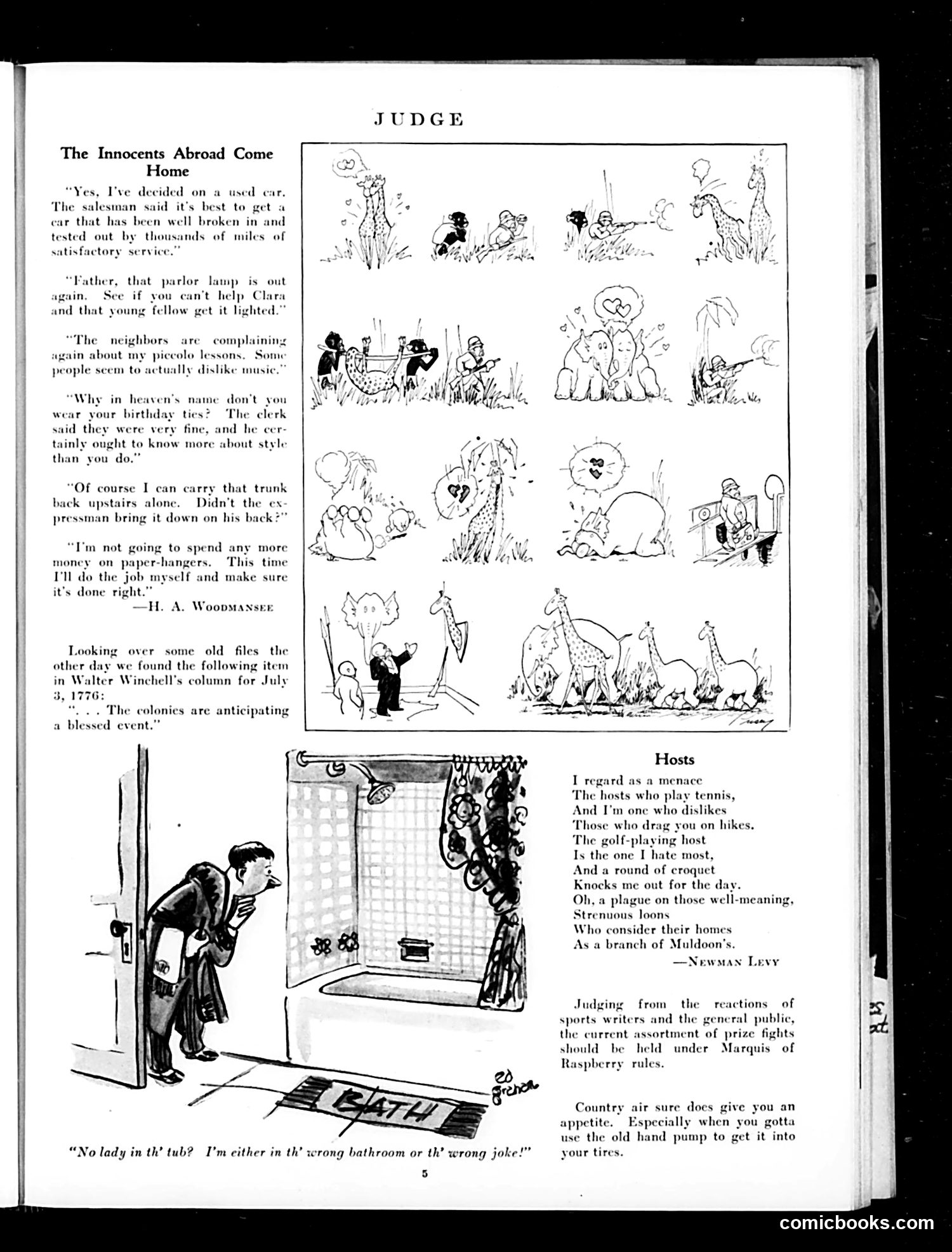
# Analysis of Judge Magazine Page This page contains two main satirical pieces: **"The Innocents Abroad Come Home"** (top): A multi-panel comic strip depicting Americans returning from European travel, now affecting pretentious mannerisms. The quoted dialogue shows returning travelers adopting superior attitudes about fashion, music, and home décor—mocking the common phenomenon of Americans gaining inflated sophistication from brief foreign visits. **"No lady in th' tub?"** (bottom left): A single-panel cartoon showing a man peering into a bathroom. The joke plays on confusion about bathroom etiquette or a misunderstanding, likely satirizing social awkwardness or misconceptions about proper household behavior. **"Hosts"** (right): A humorous poem by Newman Levy listing types of annoying hosts—tennis players, golf enthusiasts, croquet players—portraying hosts as using their homes primarily for entertaining rather than genuine hospitality. The overall theme critiques American social pretension and uncomfortable social situations.
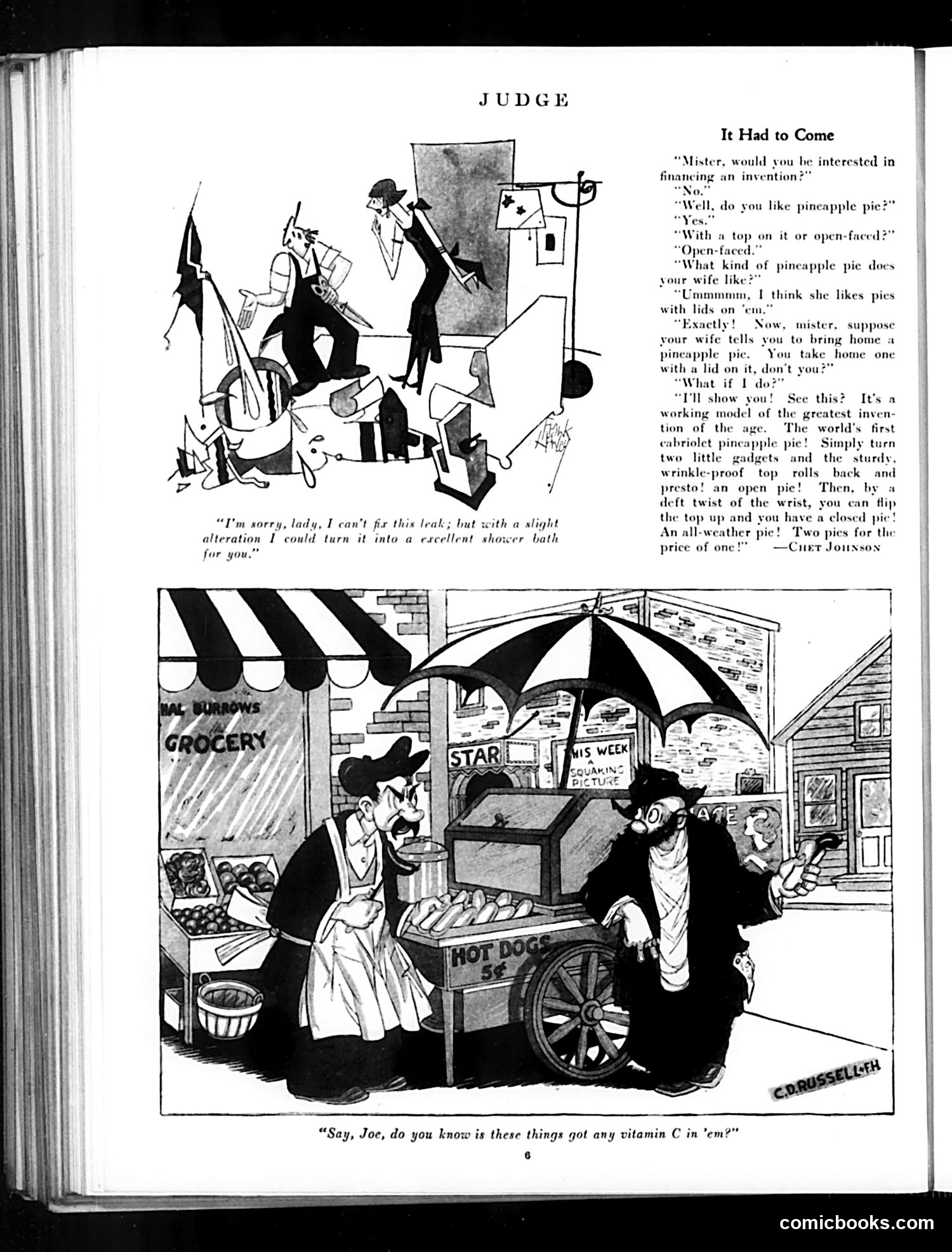
# Analysis of Judge Magazine Page This page contains two satirical cartoons mocking American consumer culture and business schemes. The **top cartoon** depicts a chaotic inventor's workshop where a businessman pitches an absurd "cabaret pineapple pie"—a novelty dessert with a hinged, flip-top lid. The satire targets both gullible investors willing to finance ridiculous inventions and the era's obsession with gadgetry disguised as innovation. The **bottom cartoon** shows street vendors selling hot dogs and other food items. The caption "Say, Joe, do you know if these things got any vitamin C in 'em?" satirizes Americans' newfound concern with nutritional science and vitamins, suggesting vendors and consumers alike are clueless about what they're actually consuming—mocking both commercial food safety standards and public health awareness of the period.
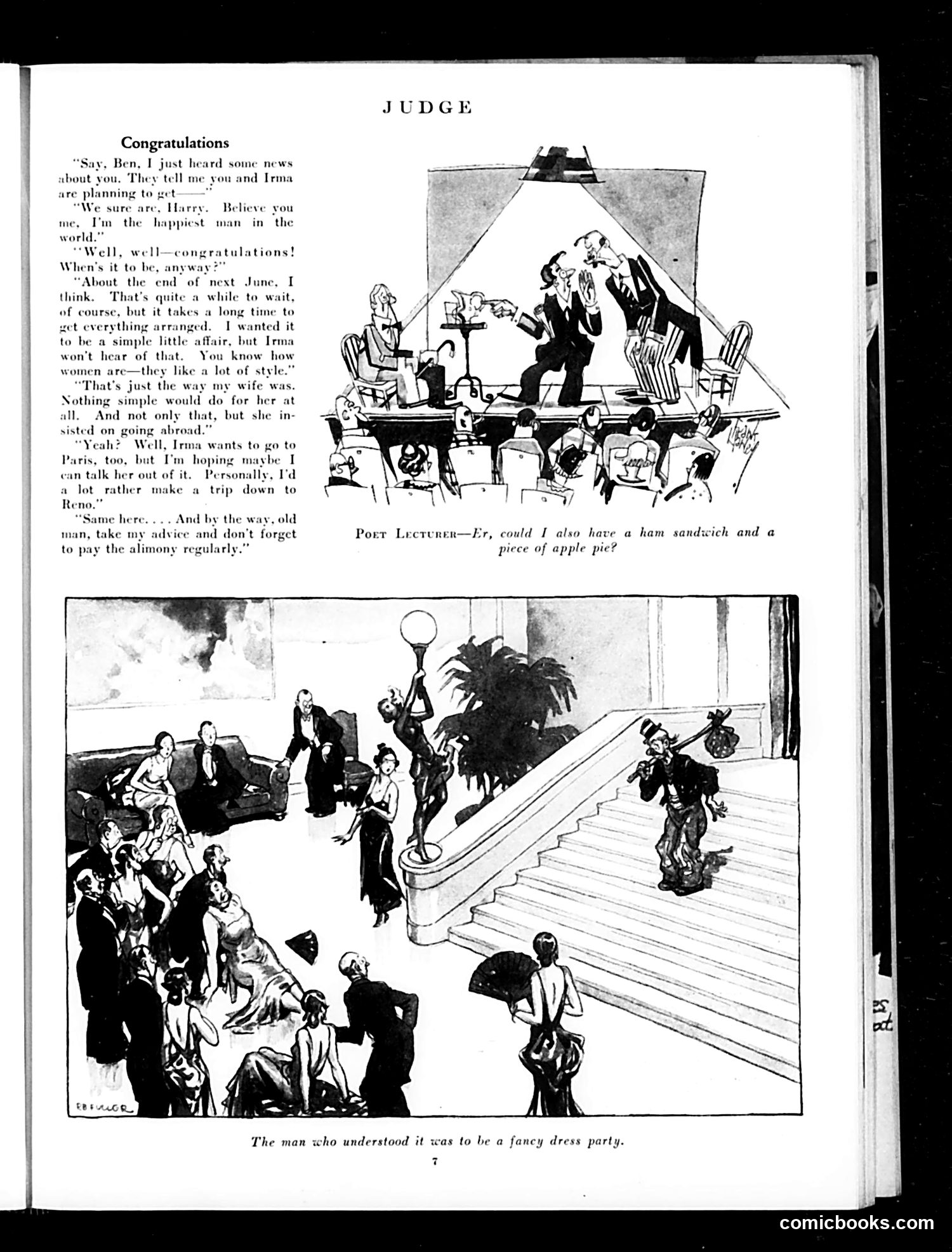
# Analysis This page contains two satirical pieces about marriage and social expectations in early 20th-century America. The top conversation mocks the elaborate planning and expense of weddings. Ben announces his engagement to Irma, but expresses frustration that she insists on an elaborate affair in Paris rather than a simple ceremony. The humor culminates in a cynical punchline: an older man advises Ben to "pay the alimony regularly"—suggesting that marriage inevitably ends in divorce and financial obligation. This reflects contemporary anxieties about marital instability and the growing expense of modern weddings among the wealthy. The lower cartoon depicts a fancy dress party misunderstanding: a working-class man (likely a laborer, based on the figure on the stairs) has interpreted "fancy dress party" literally and arrived in costume, oblivious to the sophisticated social gathering. The humor derives from class confusion and the gap between literal and colloquial meanings—a common source of satire in Judge magazine's commentary on American social hierarchies.
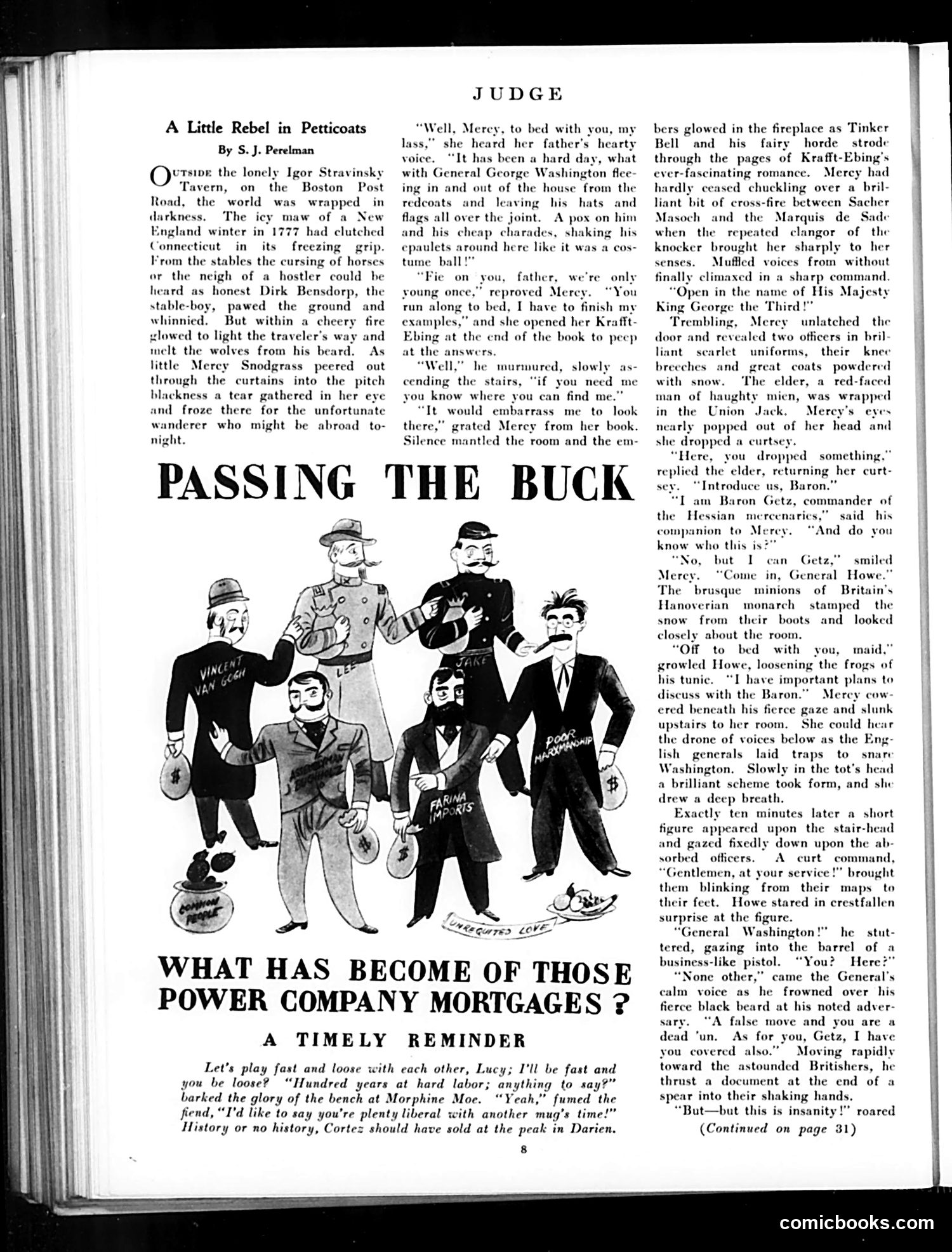
# Political Satire Analysis: Judge Magazine Page This page contains two distinct pieces: **"A Little Rebel in Petticoats"** (by S.J. Perelman): A humorous short story set during the American Revolution, satirizing overwrought period fiction. It's a parody of melodramatic spy stories, featuring exaggerated characters (a stable-boy who "whinnies," absurd references mixing historical and anachronistic elements like Krafft-Ebing's psychology texts). **"Passing the Buck"** (main cartoon): The central illustration depicts six caricatured political/business figures passing a spherical object labeled with various financial schemes. The caption asks: "What has become of those power company mortgages?" This is a **direct political satire** attacking corporate corruption and financial misconduct by utility companies—likely referencing real power company scandals involving hidden mortgages or misappropriated funds. The "passing the buck" metaphor shows officials avoiding responsibility by shifting blame/liability among themselves. The bottom text reinforces themes of legal corruption and financial malfeasance. The cartoon targets **early 20th-century corporate fraud** in the utility industry.
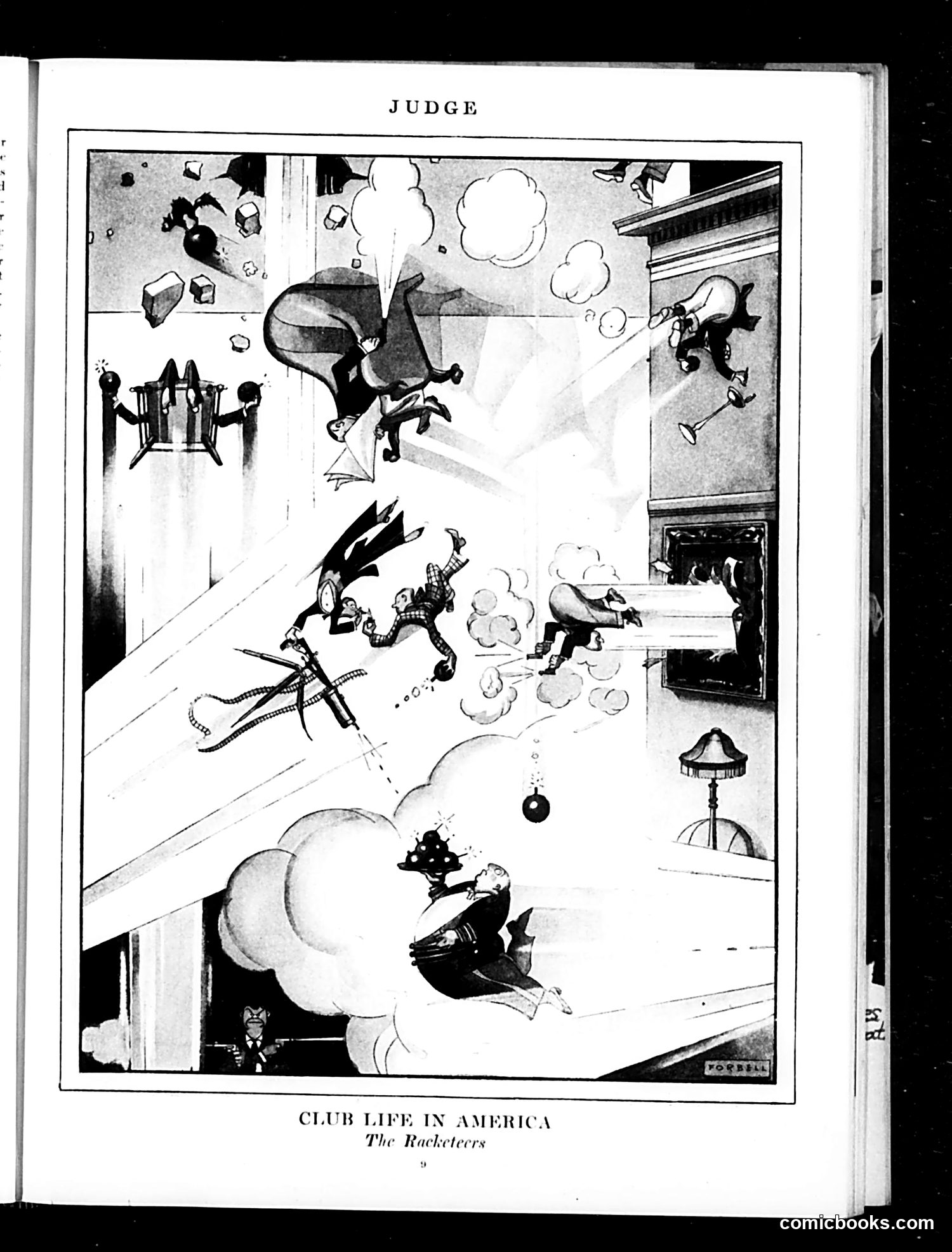
# "Club Life in America: The Racketeers" This Judge cartoon satirizes organized crime and corrupt "club life" during what appears to be the Prohibition era. The illustration depicts chaotic violence and criminal activity—figures wielding weapons, explosions, and general mayhem occurring within what seems to be an upscale establishment. "Racketeers" refers to organized crime figures who ran illegal gambling, bootlegging, and protection schemes. The cartoon mocks how such criminal enterprises operated openly under the guise of "clubs" during Prohibition (1920-1933), when legitimate nightclubs became fronts for illegal alcohol sales and gangster activity. The satirical point: American "club life" had been corrupted by organized crime, turning supposedly respectable social venues into battlegrounds for competing criminal gangs.
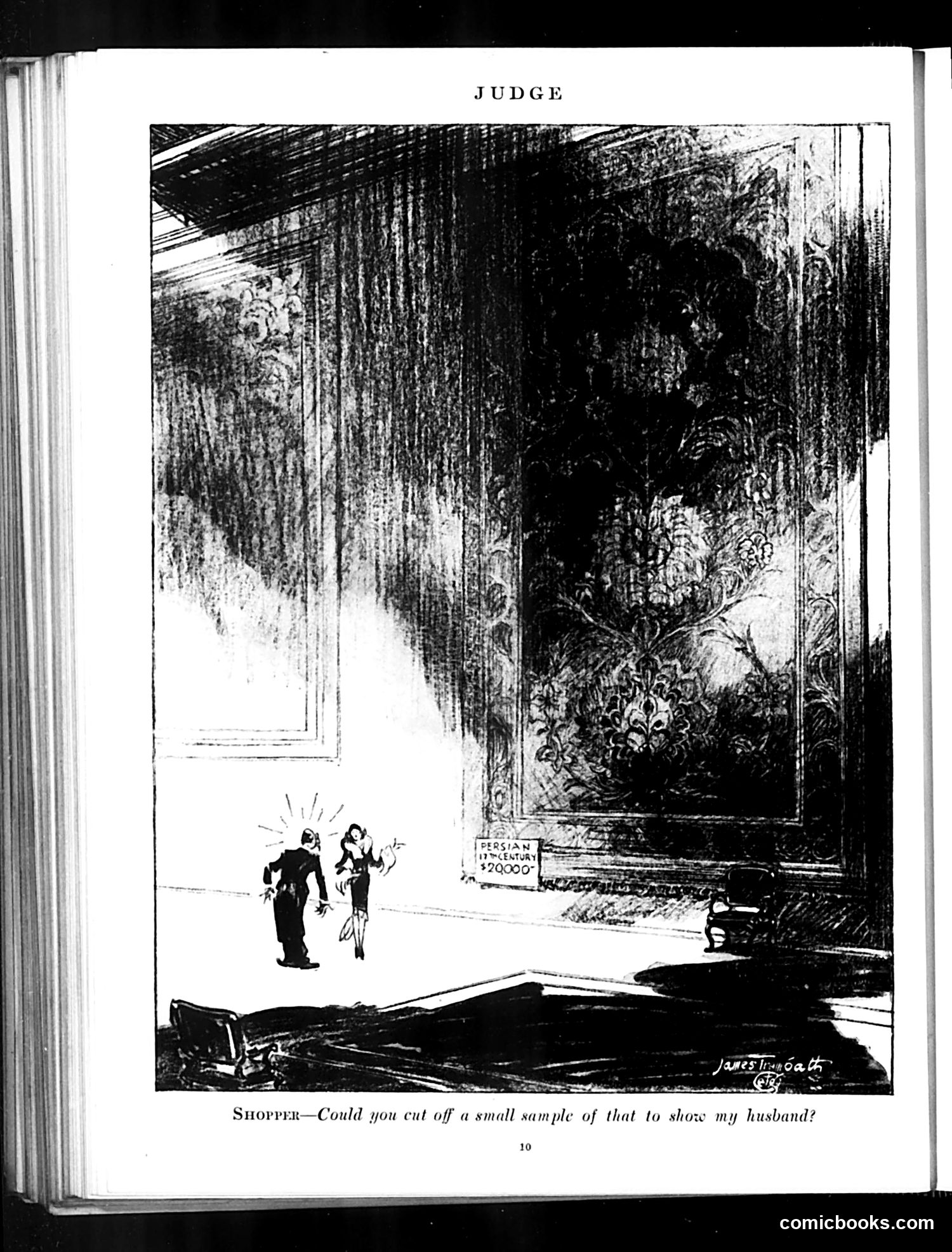
# Analysis This single cartoon depicts a woman (labeled "Shopper") in an art museum or gallery, standing before what appears to be an expensive Persian tapestry or artwork (marked "$70,000"). She's asking a guard or attendant if he could cut off a small sample to show her husband. The satire targets wealthy women's extravagant spending habits and materialism. The joke is absurd—asking to damage a priceless artwork for a home shopping errand—suggesting the shopper views even museum-quality treasures as mere commodities to purchase. It mocks both the frivolousness of affluent female consumers and the impracticality of their desires. The humor relies on the incongruity between proper museum conduct and casual consumer behavior.