
Judge, 1930-02-22 · page 18 of 36
Judge — February 22, 1930 — page 18: what you’re looking at
A restored page from Judge, 1930-02-22. Page through the whole issue in the reader above.
📄 Transcribed text from this page (OCR, searchable)
Machine-transcribed from the original scan — historical spelling and the odd misread are preserved.
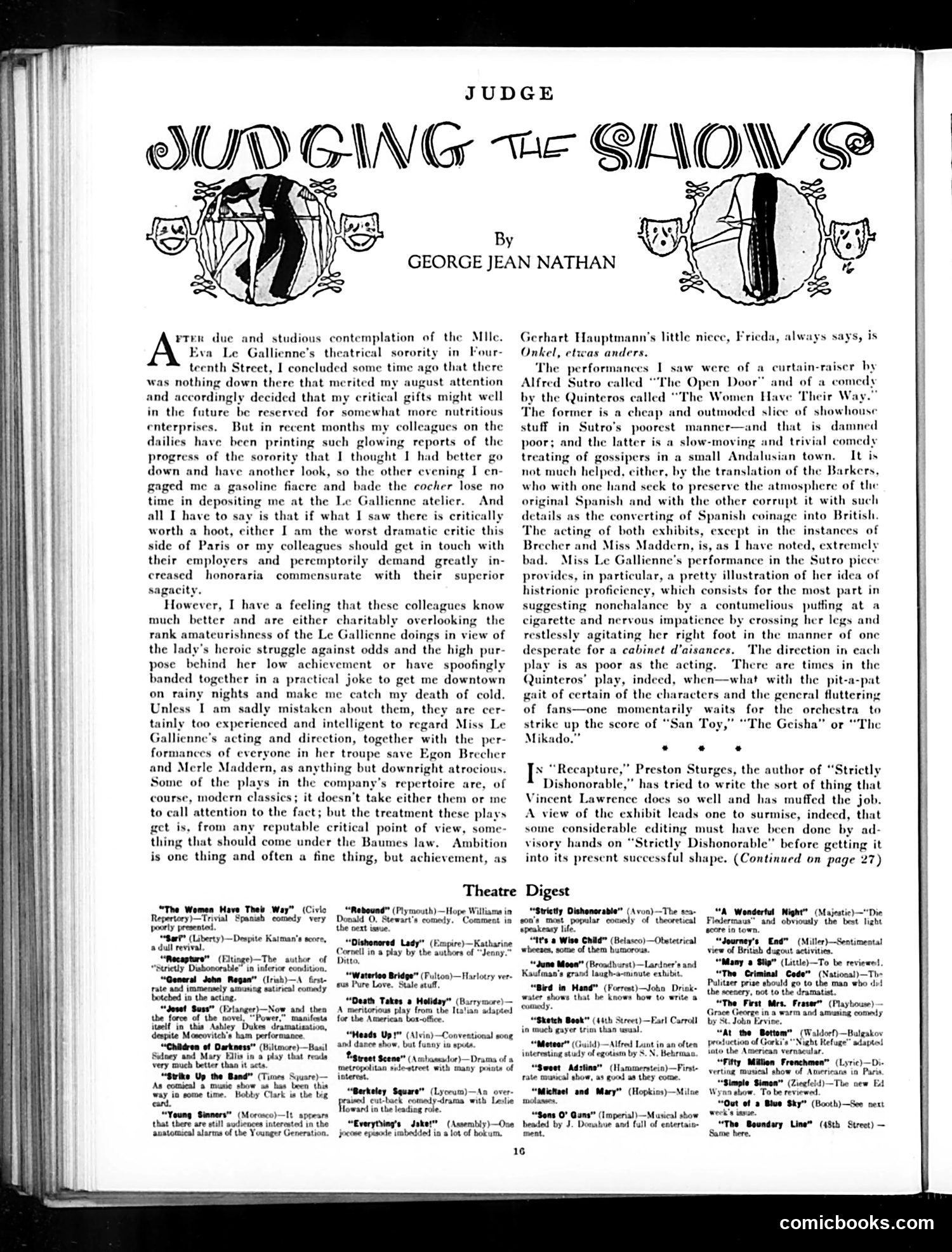
JUDGE ING we GAOWS By GEORGE JEAN NATHAN rten due and studious contemplation of the Mlle. Eva Le Gallienne’s theatrical sorority teenth Street, I concluded some time ago that there was nothing down there that merited my august attention and accordingly decided that my critical gifts might well in the future be reserved for somewhat more nutritious enterprises. But in recent months my colleagues on the dailies have been printing such glowing reports of the progress of the sorority that I thought I had better go down and have another look, so the other evening I en- gaged me a gasoline fiacre and bade the cocher lose no time in depositing me at the Le Gallienne atelier. And all I have to say is that if what I saw there 3 worth a hoot, either I am the worst dramatic critic this side of Paris or my colleagues should get in touch with their employers and peremptorily demand greatly in- creased honoraria commensurate with their sagacity. However, I have a feeling that these colleagues know much better and are either charitably overlooking the rank amateurishness of the Le Gallicnne doings in view of the lady's heroic struggle against odds and the high pur- pose behind her low achievement or have spoofingly banded together in a practical joke to get me downtown on rainy nights and make me catch my death of cold. Unless I am sadly mistaken about them, they are cer- tainly too experienced and intelligent to regard Miss Le Gallienne’s acting and dircetion, together with the per- formances of everyone in her troupe save Egon Brecher and Merle Maddern, as anything but downright atrocious. Some of the plays in the company’s repertoire are, of course, modern classics; it doesn’t take either them or me to call attention to the fact; but the treatment these plays get is, from any reputable critical point of view, some- thing that should come under the Baumes law. Ambition is one thing and often a fine thing, but achievement, as superior Theatre & Gerhart Hauptmann’s little nie Onkel, etwas anders. The performances I saw were of a curtain-raiser by Alfred Sutro called “The Open Door” and of a con by the Quinteros called “The Women Have Their Was The former is a cheap and outmoded s1 »f showhous: stuff in Sutro’s poorest’ manner— is damned poor; and the latter is a slow-moving « jal comedy treating of gossipers in a small Andalusian town. It is not muc! ther, by the translation of the Barkers, h one hand seek to preserve the atmosphere of the Spanish and with the other corrupt it with such Is as the converting of Spanish coinage into British. The acting of both exhibits, except in the instances of Brecher and Miss Maddern, is, as I have noted, extremely bad. Miss Le Gallienne’s performance in the Sutro picce provides, in particular, a pretty illustration of her idea of histrionic proficiency, which consists for the most part in suggesting nonchalance by a contumelious puffing at a cigarette and nervous impatience by crossing her legs and restlessly agitating her right foot in the manner of one desperate for a cabinet d’aisances. ‘The direction in each play is as poor as the acting. There are times in the Quinteros’ play, indeed, when—what with the pit-a-pat it of certain of the characters and the gencral fluttering of fans—one momentarily w for the orchestra to strike up the score of “San Toy,” “The Geisha” or “The Mikado.” I Recapture,” Preston Sturges, the author of “Strictly Dishonorable,” has tried to write the sort of thing that Vincent Lawrence does so well and has muffed the job. A view of the exhibit leads one to surmise, indeed, that some considerable editing must have been done by ad- visory hands on “Strictly Dishonorable” before getting it into its present successful shape. (Continued on page 27) dy * * . Digest “The Women Have Thee Way” (Civic Repertory)—Trivial Spanish comedy very poorly presented. ““Berf* (Liberty)—Despite Kaiman's score, a dull revival, “Recapture” (Eltinge)—The author of “Serietly Dishonorable” in inferior condition, “General John Regan” (Irish)—A first rate and immensely amusing satirical comely botched in the acting. “deset Suss” (Frlanger)—Now ani then the force of the novel. “Power,” manifests itwelf im this Ashiey Dukes dramatisstion, despite Moscoviteh's ham performance. “Children of Darkness” (Iiltmore)—Basil Sidney and Mary Ellis im a play that reads very much better than it sets. “Stike Up the Band” (Times Square)— As comical a music show as has been this way in some time. Bobby Clark is the big “Young Sinners” (Morosco)—It appears that there are still audiences interested in the anatomical alarms of the Younger Generation. “Rebound” (Plymouth) —Hope Williama in Donald O, Stewart's comedy. Comment in the vert iste. ishonored Lady” (Eapire)— Cornell in s play by the au Ditto, harine ors of “Jenny.” ‘“Watertee Bridge” (Pulton)—Harlotry ver- us Pure Love. Stale stuff “Death Takes a Holiday” (Barrymore) — A meritorious pl: from the Ita!ian adap for the American box-office. “Heads Up!” (Alvin) —Conventional song and dance show, but funny im sputa. Pgweet Scene” (Ambassador) —Drams of a metropolitan sidestreet with many points of interest, “Berkeley Square” (Lyceum)—An 0 pied cutback comedy-drama with Lasle Howard in the leading role. “Everytving’s daket" (Assembly)—One Jocone episode imbedded in a lot of bokum. ‘“$trietty Dishonerable” (A von)—The sca- eon's most popular comely of theoretical epeakensy life. “t's @ Wise Child” (Belasco) —Otstetrical wheeses, some of them humorous. “pune Moen” (Broadhurst)—Lardner’s and Kaufman's grand laugh-a-minute exhibit “Bird in Hand” (Forrest) Jobo Driok- water shows that he knows how to write a comedy. “Sketch Book™ (44th Stroet)—Farl Carroll in much gayer trim thas usual, “Meteor” ((uild)—Alfred Lunt in an often interesting study of egotism by S. N, Bebrnas. “Sweet Adstine’ (Hammerstein)—First- rate murical sho as guad as they come. iaieted snd Mary (Hopkias)—Milne molasses, “Sons O° Gans” (Imperial) —Musical show headed by J. Donahue and full of entertain- ment. 16 “A Wondertul Night” (Majestic)—"Die Fledermaus” and obviously the best light score in town. “Journey's End" (Miller)—Sentimental view of British dugout activities. “Many a Slip” (Little)—To be reviews! “The Criminal Code” (National)—Th- Pulitzer prise ebould go to the man who dei the seenery, not to the dramatist. “The First Mrs. Fraser” (Playbous)— Grace George in a warm and amusing comely by St, Jobn Ervine. “At the Bottom” (Waldorf) —Bulgakor section of Gorki's "Night Refuge” adapted he American vernacular. a Py “Simple Simen™ (Zicefeld)—The new Eat Wyna show. To be reviewed. Dut of 2 Blue Sky” (Booth)—Ser next week's insur. “The Boundary Line” (48th Street) — Same here. comicbooks.com