A complete issue · 36 pages · 1929
Judge — October 5, 1929
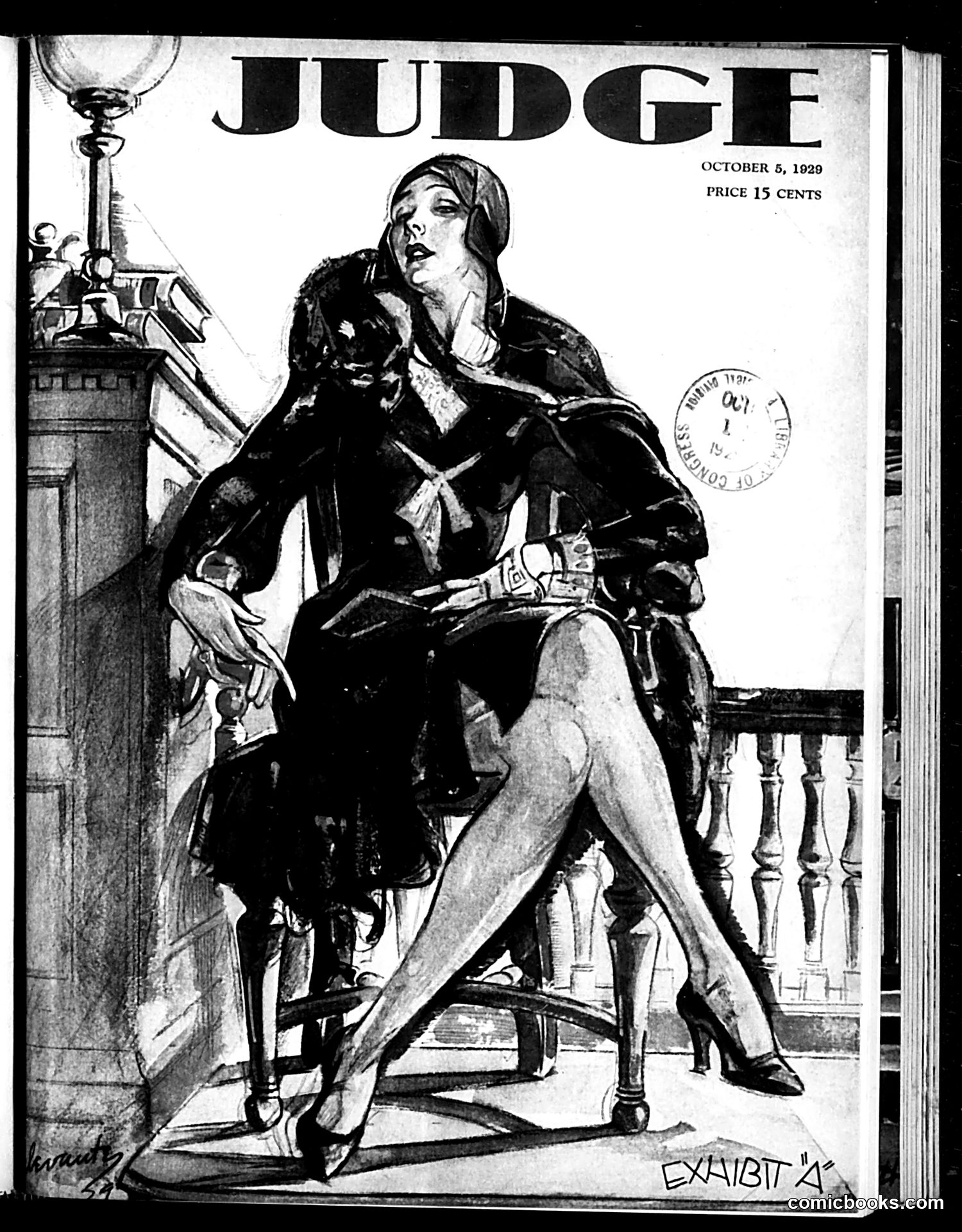
# Judge Magazine Cover Analysis - October 5, 1929 This cover depicts a fashionable woman in 1920s attire (cloche hat, short hemline, heeled shoes) seated on what appears to be a balcony or terrace overlooking a city. She gazes pensively skyward while holding a cigarette, dressed in an elegant dark coat. The satirical point likely concerns **the "modern woman" of the Jazz Age** — her newfound freedoms, independence, and social visibility. The pensive expression and upward gaze suggest contemplation or aspiration, possibly satirizing women's ambitions or social expectations during this era of rapid cultural change. The publication date (October 5, 1929) is just days before the stock market crash, though the cover's relevance to that event remains unclear without additional context.
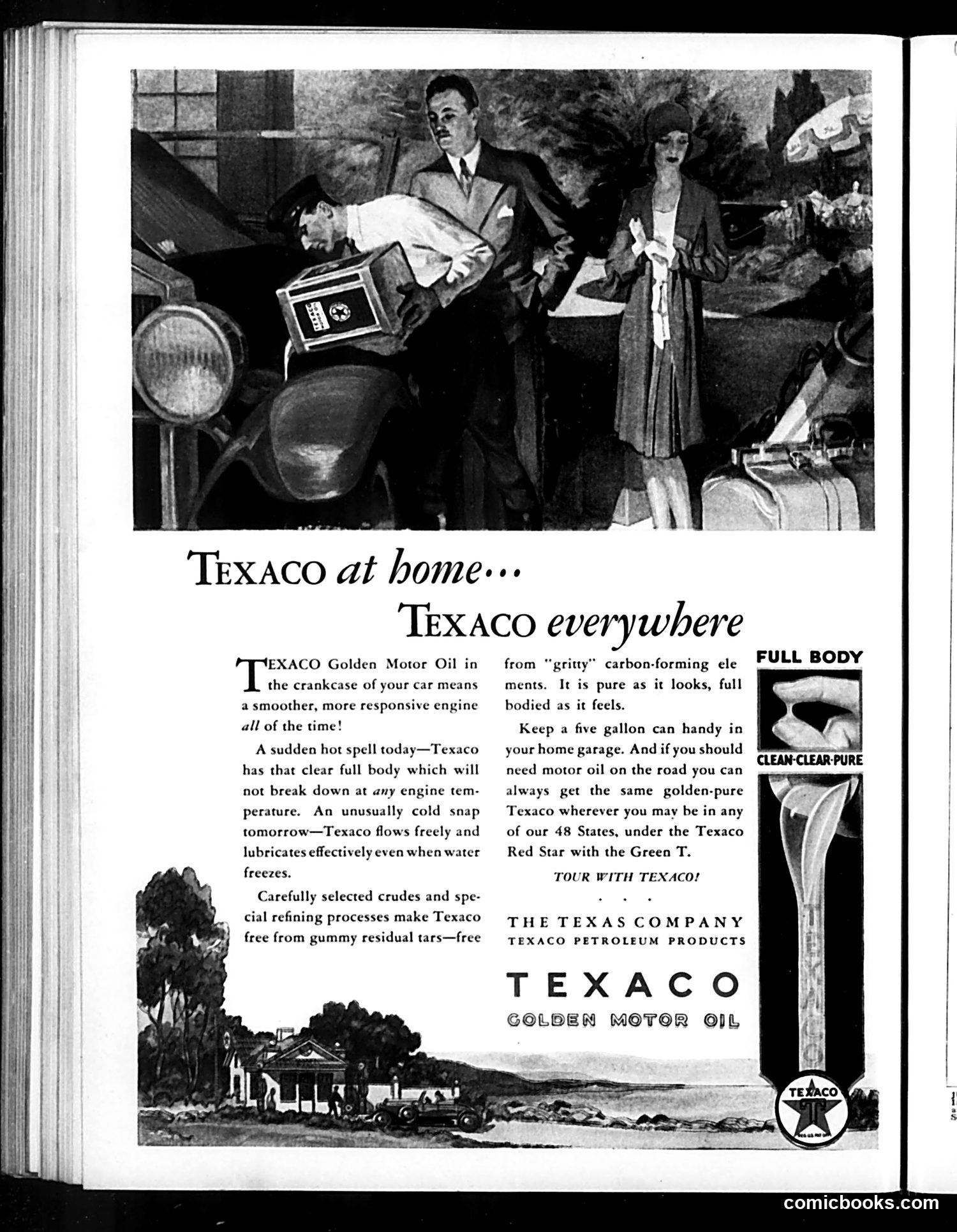
# Analysis This page is **primarily an advertisement** for Texaco Golden Motor Oil, not political satire. The image shows a domestic scene with well-dressed figures (a man in a suit holding what appears to be a portrait, a woman in 1920s-style clothing, and others) near an automobile, illustrating the product's use "at home" and "everywhere." The advertisement emphasizes Texaco's reliability across all temperatures and its availability nationwide through their Red Star with Green T logo. The "Full Body" diagrams on the right showcase the oil's purity and quality. While *Judge* was satirical, **this particular page contains no political commentary or caricature**—it's straightforward product marketing positioned within the magazine's pages.
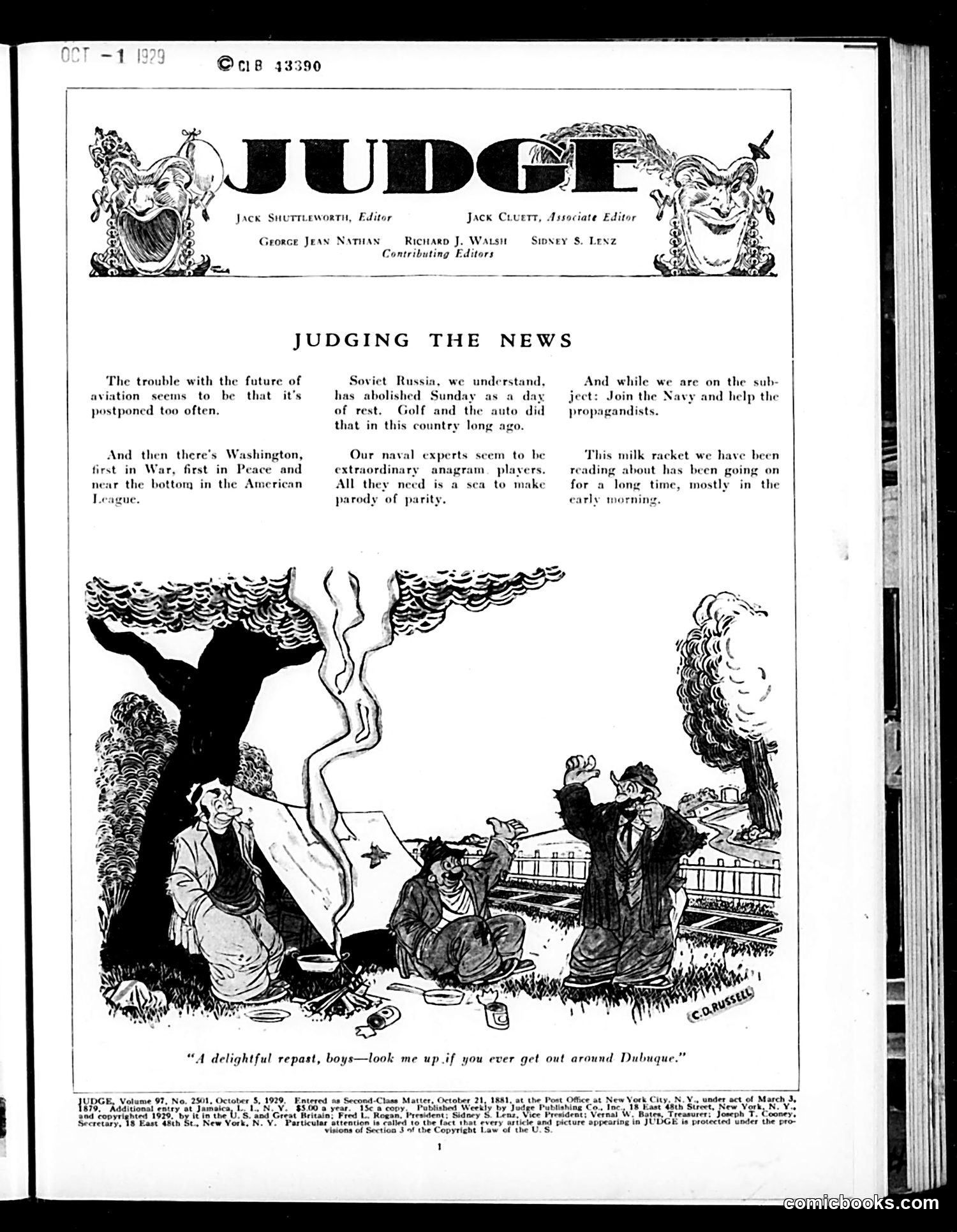
# "Judging the News" - October 1, 1929 This editorial cartoon page satirizes current events through brief commentary and illustration. The main cartoon depicts homeless or poor people camped outdoors near what appears to be Washington, D.C. buildings, with the caption "A delightful repast, boys—look me up if you ever get out around Dubuque." The accompanying text mocks various topics: aviation delays, Washington's status in American League baseball standings, Soviet Russia's abolition of Sunday rest days, naval officers' abilities, and a "milk racket" scandal. The cartoon likely critiques economic conditions and government indifference to poverty, though the specific historical context is somewhat unclear without additional sourcing. The date (October 1, 1929) places this just before the stock market crash.
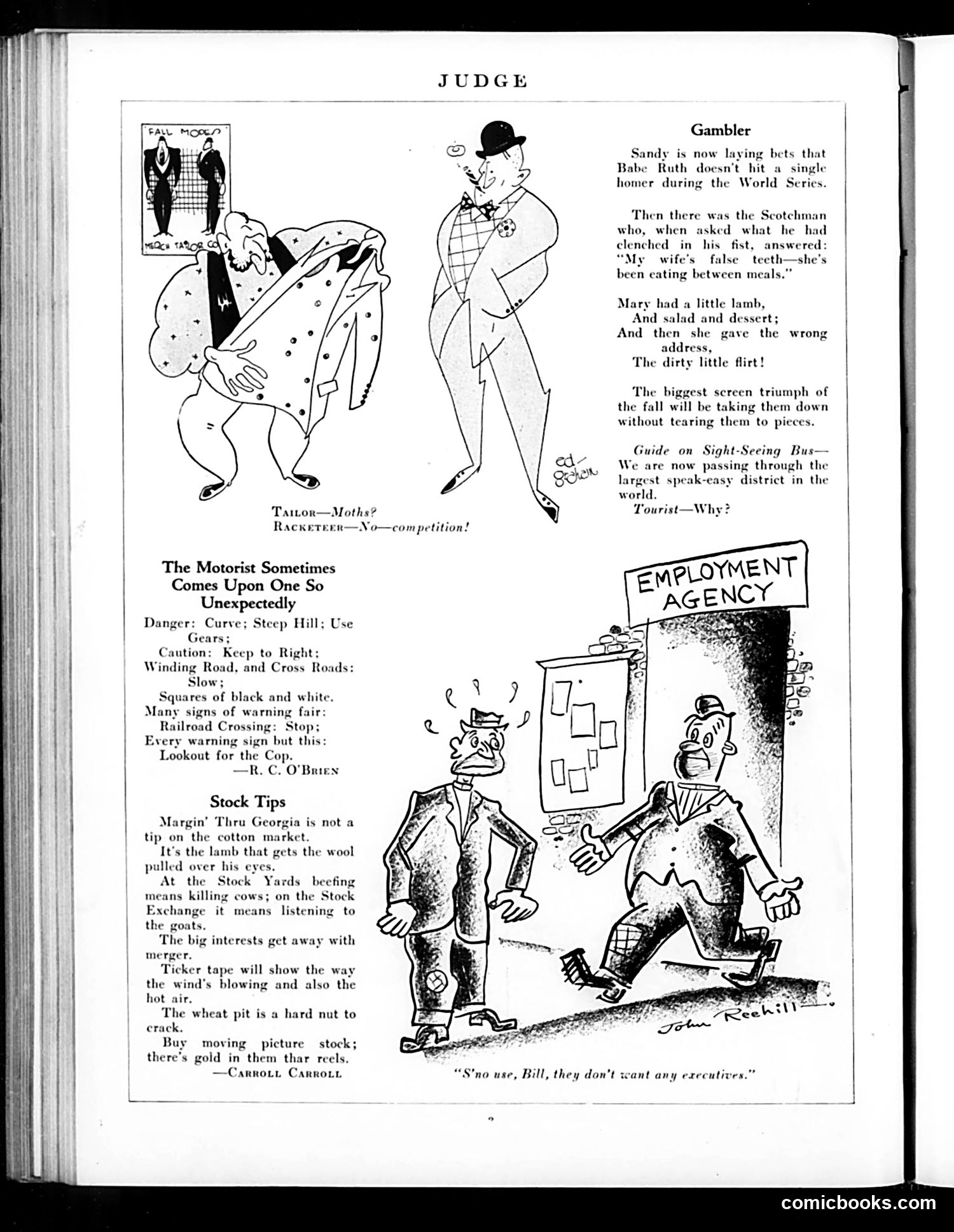
# Judge Magazine Page Analysis This page contains satirical humor about 1920s-era topics: **Top cartoon**: A tailor and heckler joke about moths eating clothes—likely referring to post-WWI fabric scarcity or rationing concerns. **"Gambler" section**: Jokes about Babe Ruth and the World Series, a Scotsman's false teeth, and "Mary" with a lamb. These reference contemporary celebrities and nursery-rhyme humor popular in the era. **"Motorist" section**: Driving safety warnings, suggesting early automobile culture anxieties about accidents and traffic dangers. **Employment Agency cartoon** (bottom): A man desperate for work approaches an agency, while the caption "So no use, Bill, they don't want any executives" suggests Depression-era unemployment and the difficulty of finding jobs even for skilled workers—likely reflecting 1920s economic instability. The page blends celebrity gossip, driving humor, and socioeconomic commentary typical of Judge's satirical approach.
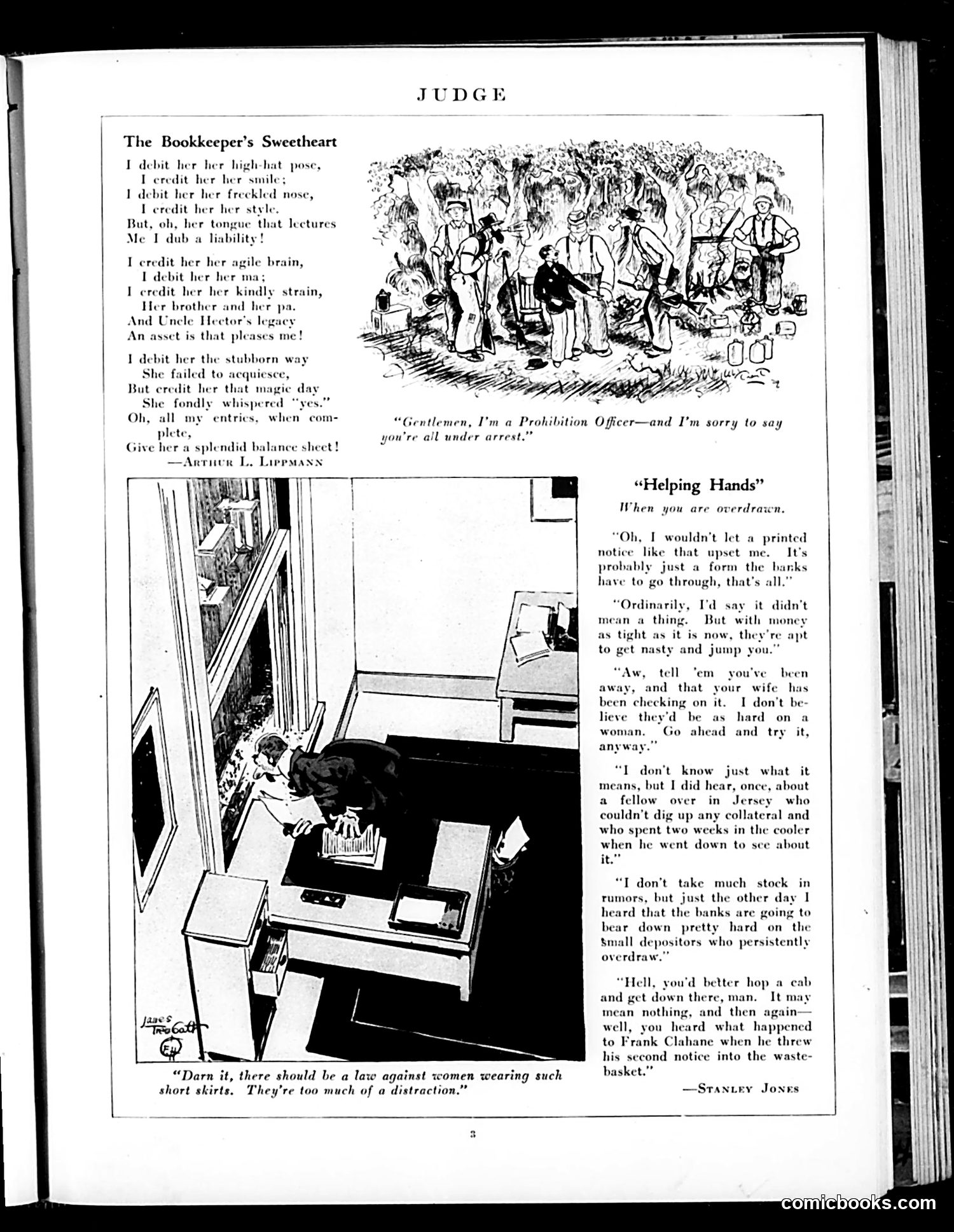
# Analysis of Judge Magazine Page This page contains two distinct pieces: **"The Bookkeeper's Sweetheart"** (top left): A poem by Arthur L. Lippmann praising a bookkeeper's romantic interest, crediting her with various positive qualities while humorously noting her tongue "lectures / Me like a bubble!" **"Helping Hands"** (right): A dialogue between an overdrawn bank customer and a banker. The customer claims ignorance about overdraft consequences, while the banker warns of banks "getting nasty" with persistent small depositors. References mention a "Frank Clahane" throwing a "notice into the waste basket," suggesting the dialogue satirizes banking practices and customer-banker tensions during what appears to be an economic strain period. **Bottom cartoon**: Shows a woman at a desk; the caption by Stanley Jones satirizes women's fashion, joking that short skirts are a workplace distraction requiring legal prohibition.
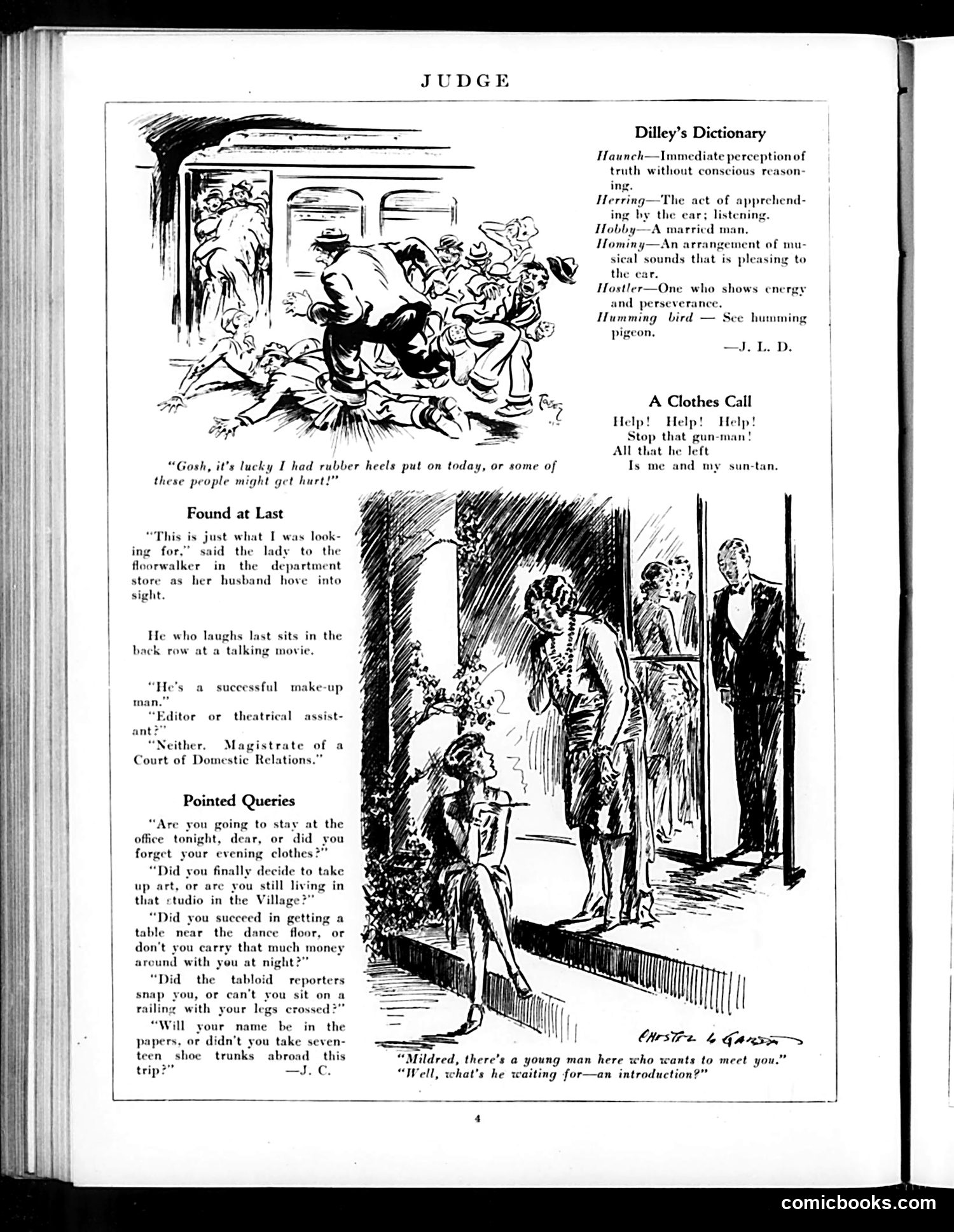
# Analysis of Judge Page This page contains three distinct humor sections: **"Gosh, it's lucky I had rubber heels..."** depicts a chaotic street scene where a man's sudden stop (due to rubber heels) prevents pedestrians behind him from colliding with him. The joke plays on practical fashion solving social problems. **"Found at Last"** offers sardonic definitions of common types—the successful makeup man, the theatrical editor, and a magistrate specializing in divorce cases. These are gentle social commentary on contemporary professions. **"A Clothes Call"** appears to be a brief humorous poem about someone stripped of possessions. **The main cartoon** shows a well-dressed couple greeting a young man at their doorway. The caption suggests he's seeking an introduction to "Mildred," implying he's a suitor or social climber. The satire likely targets dating customs or social pretension of the era.
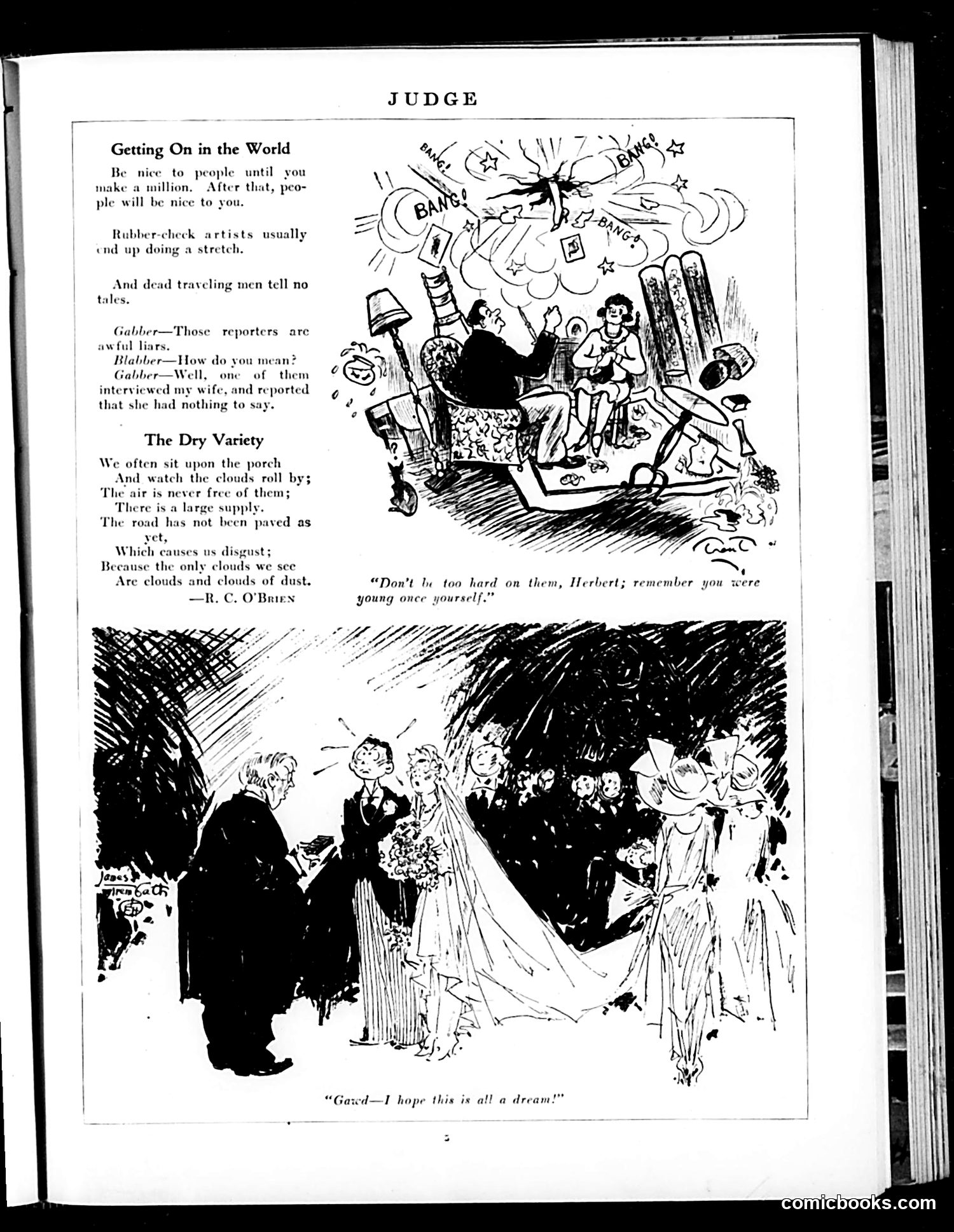
# Judge Magazine Page Analysis This page contains two distinct cartoons and some aphoristic text. The top cartoon depicts children playing with toy cannons and explosions, captioned "Don't be too hard on them, Herbert; remember you were young once yourself." This appears to be social commentary about parental discipline and youthful mischief—likely cautioning parents against excessive punishment. The bottom cartoon shows a formal wedding scene with the bride's dramatic train, captioned "Gawad—I hope this is all a dream!" This satirizes anxious grooms or the overwhelming nature of formal weddings, a timeless humor target. The left column contains brief humorous observations about social behavior: being nice to people before success, artists' physical toll, and traveling salesmen. These are generic satirical observations rather than references to specific events or political figures.
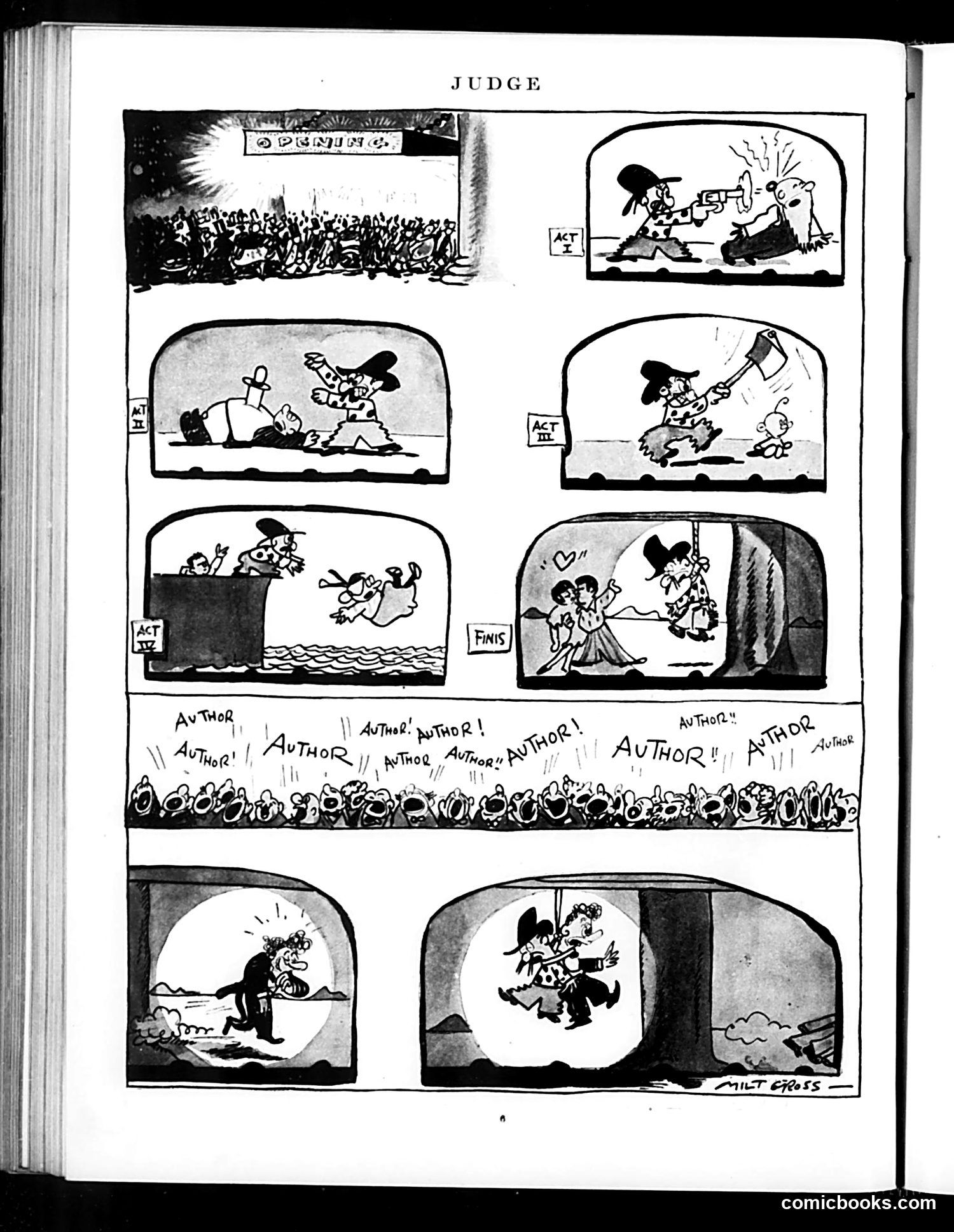
# Judge Magazine: "Judge" Comic Strip Analysis This appears to be a multi-act comic strip showing a theatrical performance. The narrative follows a character in a top hat (likely a theatrical figure or author) through various scenes: performing magic tricks, wielding an axe, and engaging in romantic or comedic situations. The strip culminates in a crucial panel where an audience demands "AUTHOR! AUTHOR!"—a common theatrical tradition where audiences call for the playwright to appear after a performance. The final panels show the author character appearing in spotlights, suggesting the strip satirizes theatrical vanity and the ego of playwrights who seek audience adulation. Without visible date or byline details, the specific production being lampooned remains unclear, though the satire targets showmanship and artistic pretension generally.
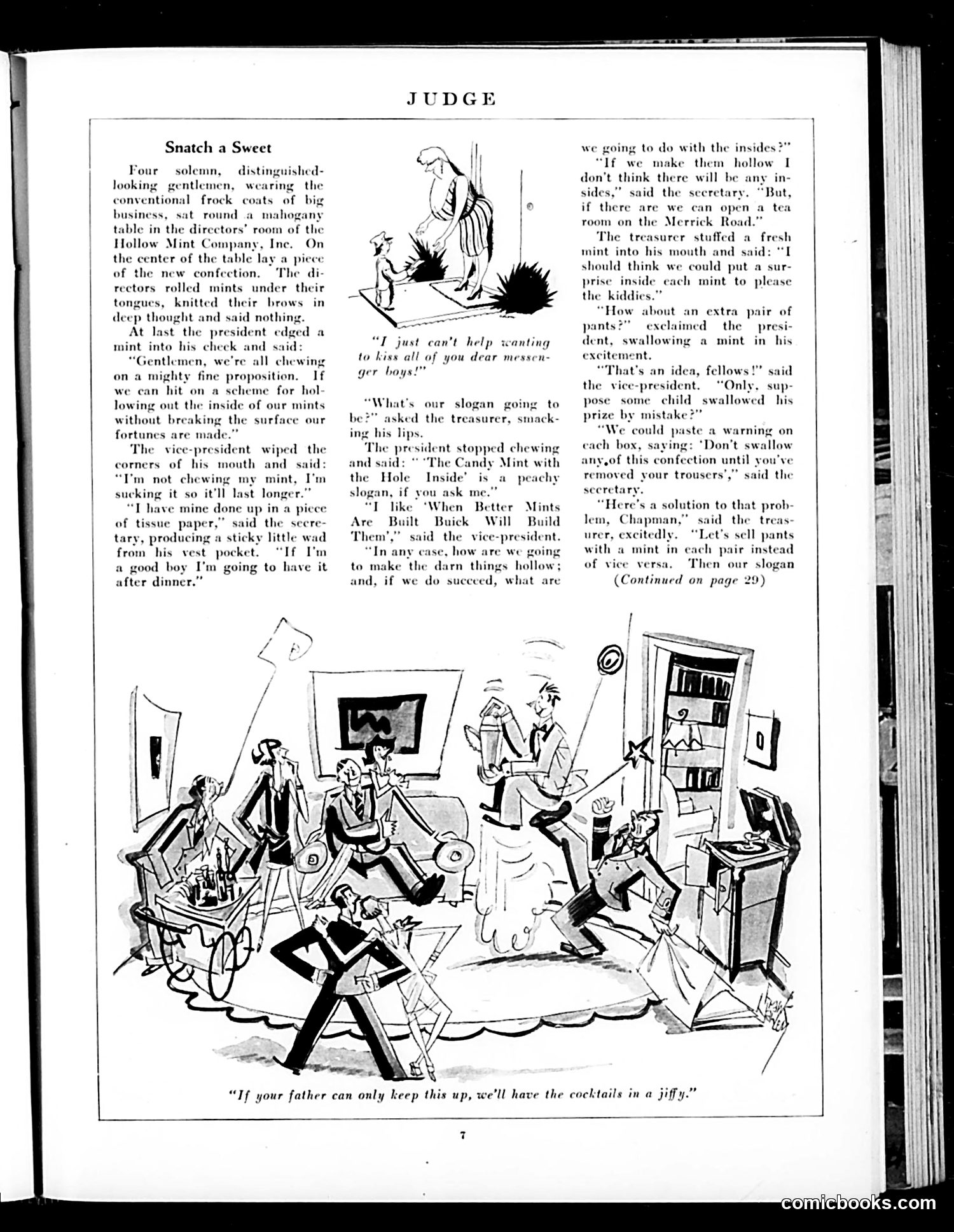
# Analysis of "Snatch a Sweet" This satirical story mocks early 20th-century business culture and advertising excess. Four conventionally-dressed businessmen at the "Hollow Mint Company" debate how to market a new hollow mint candy, their schemes becoming increasingly absurd. The satire targets corporate buzzwords and slogans—they adopt advertising catchphrases like "When Better Mints Are Built, Buick Will Build Them" (parodying Buick's actual slogan). Their "solutions" grow ridiculous: selling pants alongside mints, pasting warnings about removing trousers, or opening a tea room to dispose of hollow interiors. The bottom cartoon shows a chaotic party scene, with the caption "If your father can only keep this up, we'll have the cocktails in a jiffy"—referencing Prohibition-era anxiety about maintaining illegal liquor supplies. The overall joke critiques how businessmen take trivial products seriously, applying grandiose marketing language and interconnected business schemes to something as simple as candy, reflecting Judge's skepticism toward corporate capitalism and consumerism.
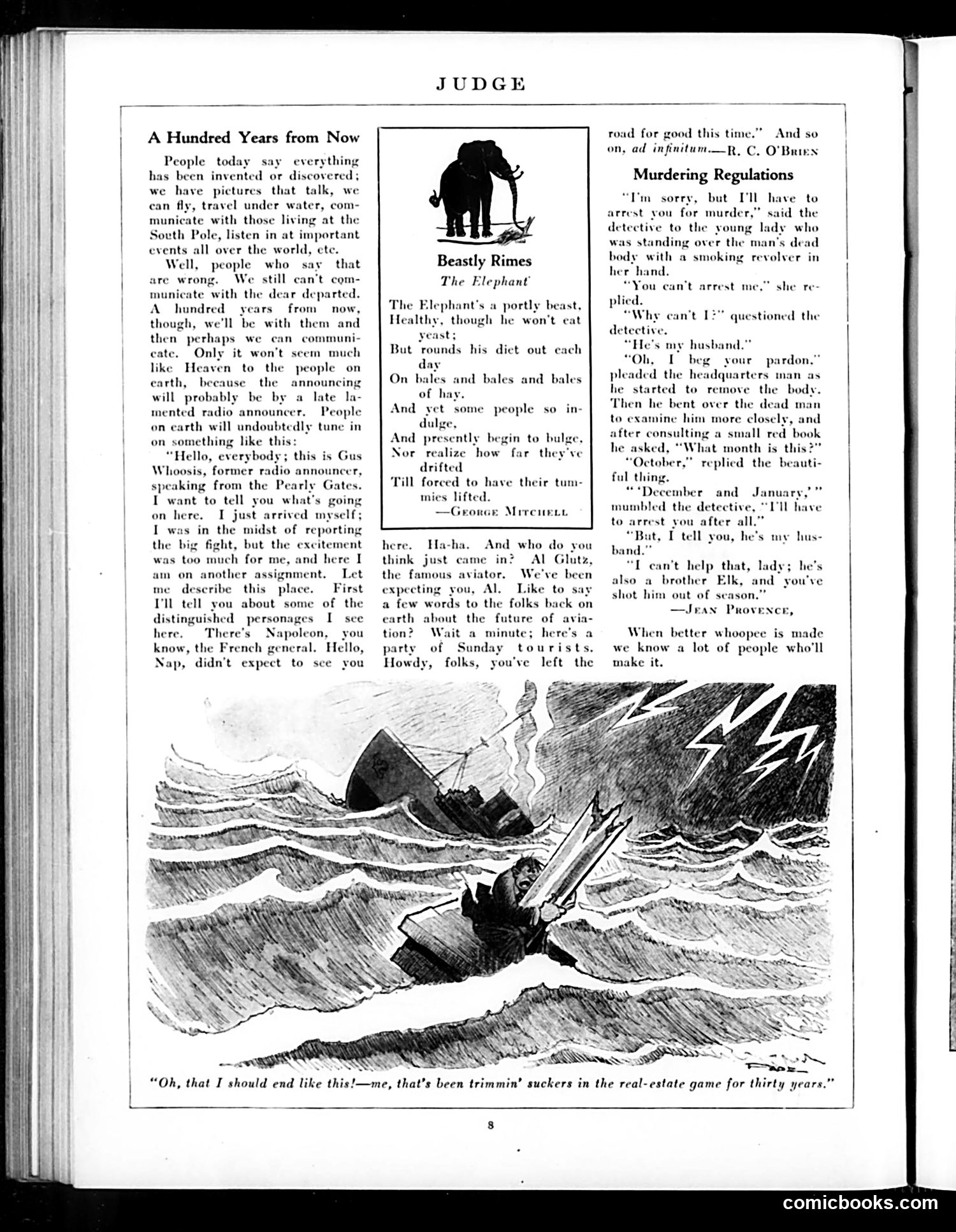
# Satire in Judge Magazine This page contains three distinct satirical pieces: **"A Hundred Years from Now"** imagines future radio broadcasts from heaven, hosted by deceased announcer Gus Whoosis. The joke: humanity will advance technologically but remain fundamentally unchanged—even the afterlife will have commercialized radio. The reference to Napoleon and aviator "Al Glut" (likely Al Glaize, an early aviator) grounds the satire in contemporary figures. **"Beastly Rimes: The Elephant"** is a light verse mocking obesity and overconsumption—people indulging without realizing they've "drifted" until they need their stomachs reduced. **"Murdering Regulations"** satirizes bureaucratic absurdity. A woman shoots her husband, but when the detective consults regulations, he discovers she's only violated hunting season rules because the victim was an Elk Lodge member. The satire mocks rigid rule-following that misses moral substance. The large illustration shows a shipwreck victim commenting wryly on losing thirty years of real-estate profits—satirizing greed and materialism's ultimate futility.
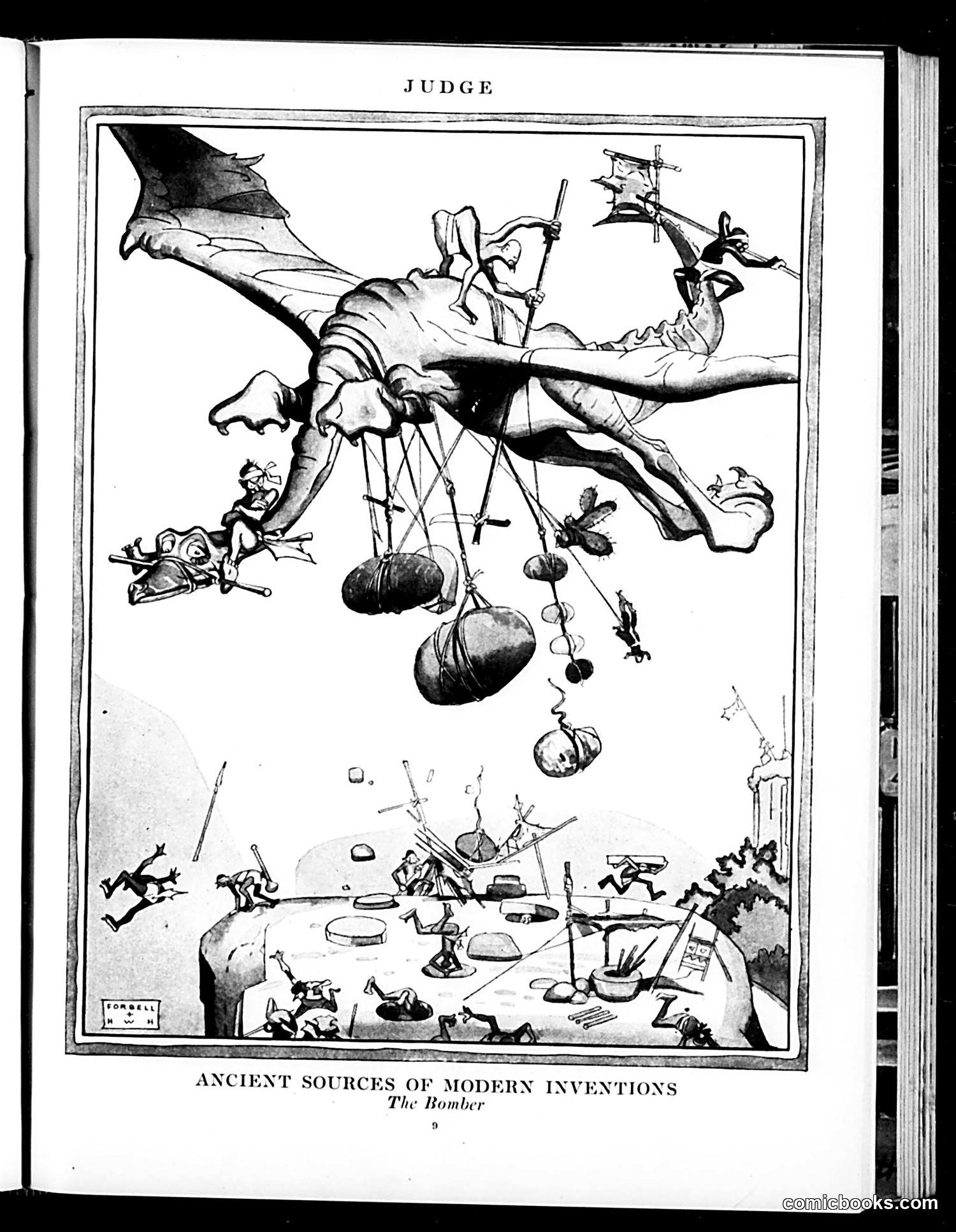
# Analysis The page title reads "ANCIENT SOURCES OF MODERN INVENTIONS: The Bomber," presenting a satirical illustration labeled "JUDGE." The cartoon depicts a giant figure (representing a judge or authority) suspended in air, juggling bombs and weapons while holding a sword and flag. Below, on ground level, tiny figures scatter in panic amid explosions and destruction. The satire appears to critique judicial or governmental authority as recklessly dangerous—suggesting those in power carelessly "juggle" weapons and bombs that devastate ordinary people below. The contrast between the elevated, detached figure above and the panicked civilians below emphasizes how distant leadership makes decisions affecting common people catastrophically. The "ancient sources" framing suggests this commentary on weaponry and judicial indifference has deep historical roots, critiquing timeless patterns of power misuse.