
Judge, 1929-10-05 · page 20 of 36
Judge — October 5, 1929 — page 20: what you’re looking at
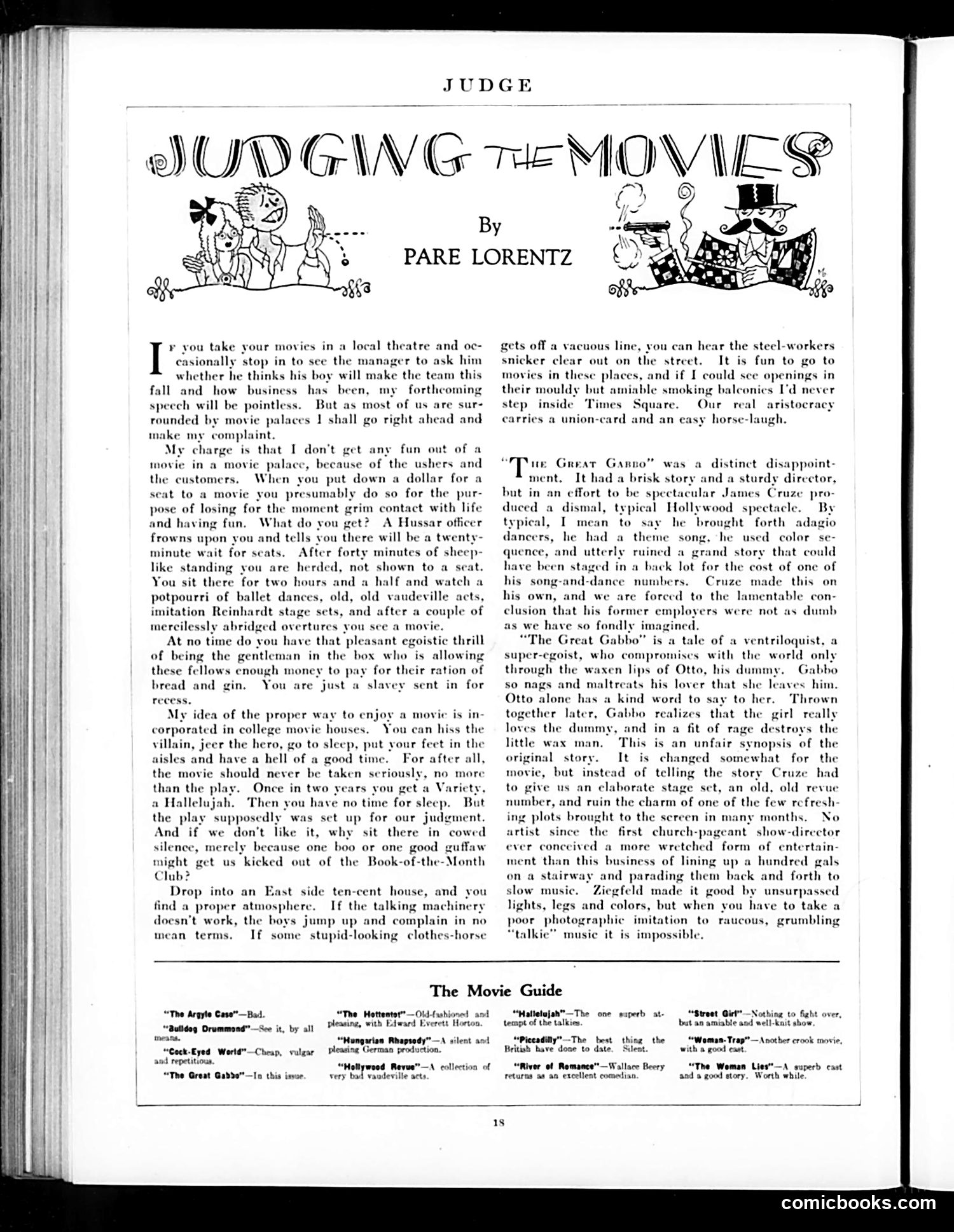
A restored page from Judge, 1929-10-05. Page through the whole issue in the reader above.
📄 Transcribed text from this page (OCR, searchable)
Machine-transcribed from the original scan — historical spelling and the odd misread are preserved.
JUDGE IMUVGI\NG THe MOV aes ey - pu ¥ you take your movies in a local theatre and oc- casionally stop in to see the manager to ask him whether he thinks his boy will make the team this fall and how business has been, my forthcomi speech will be pointless. But as most of us are sur- rounded by movie palaces 1 shall go right ahead and make my complaint. My charge is that I don’t get any fun out of a » in a movie palace, because of the ushers and the customers. When you put down a dollar for a rat to a movie you presumably do so for the pur- pose of losing for the moment grim contact with life and having fun. What do you ¢ A Hussar officer frowns upon you and tells you there will be a twenty- minute wait for seats. After forty minutes of sh like standing you are herded, not shown to a You sit there for two hours and a half and wate potpourri of ballet dances, old, old vaudevil ts, imitation Reinhardt stage sets, and after a couple of mercilessly abridged overtures you see a mov At no time do you have that pleasant egoistic thrill of being the gentleman in the box who is allowing these fellows enough moncy to pay for their ration of bread and gin. You are just a slavey sent in for PSs. My idea of the proper way to enjoy a movie is in- corporated in college movie houses. You can hiss the villain, jeer the hero, go to sleep, put your feet in the aisles and have a hell of a good tim For after all, the movie should never be taken seriously, no more than the play. Once in two years you get a Variety. a Hallelujah. Then you have no time for sleep. But y supposedly was set up for our judgment. f we don't like why sit there in cowed + merely because one boo or one good guffaw might get us kicked out of the Book-of-the-Month Club? Drop into an East side ten-cent house, and you find a proper atmosphere. If the talking machinery doesn’t work, the boys jump up and complain mean terms. mov n no If some stupid-looking clothes-horse gets off a vacuous line, you can hear the stecl-workers snicker clear out on the street. It is fun to go to s in these places, and if I could see openings in their mouldy but amiable smoking balconies I'd never step inside Times Square. Our real aristocracy carries a union-card and an easy horse-laugh. “Tu Great Ganno” was a distinct disappoint- ment. It had a brisk s but in an effort to be spectacular James Cruze pro- duced a dismal, typical Hollywood spectacle. By typical, I mean to say he brought forth adagio dancers, he had a theme song, he used color se- quence, and utterly ruined a grand story that could have been staged in ab: lot for the cost of one of his song-and-dance numbers. Cruze made this on his own, and we are forced to th nentable con- clusion that his former employers were not as dumb as we have so fondly imagined. “The Great Gs is a tale of a ventriloquist, a super-egoist, who compromises with the world only through the waxen lips of Otto, his dummy. Gabbo so nags and maltreats his lover that she leaves him. Otto alone has a kind word to say to her. Thrown together later, Gabbo realizes that the girl really loves the dummy, and in a fit of rage destroys the little wax man. This is an unfair synopsis of the original story. It is changed somewhat for the movie, but instead of telling the story Cruze had to give us an elaborate stage set, an old, old revue number, and ruin the charm of one of the few refresh ing plots brought to the screen in many months. No artist since the first church-pageant show-director ever conceived a more wretched form of entertain- ment than this business of lining up a hundred gs a stairway and parading them back and forth to slow musi feld made it good by unsurpassed lights, legs and colors, but when you have to take a poor photographic imitation to raucous, grumbling “talkie” music it is impossible. and a sturdy director, The Movie Guide “The Argyle Case”—Bad. “The Hettentet”—Old-fushione! and “-pethdog Drommont”—See it, by all Dieseine, with Edward Everett Horton. means, “Hungarian Rhapsody” —A silent and “Cock-Eyed Werld—Cheap, vulgar Pleasing German production. ppecheetticen tyweed Revue” —A collection of “The Great Gadd—"—I0 this isvoe A vandeville sets tempt of the talkies. “Halletujah”—The one superb at- “Street Girl”—Nothing to fight over, but an amiable and well-knit show “Woman-Trap”— Another crook movie, ba good east. “The Woman Lies”—A superb cast and a good story. Worth while. “Piceadily”——The best thing the British have done to date. Silent. “River of Romance” —Wallace Beery returns aa an excellent comedian. comicbooks.com