A complete issue · 36 pages · 1929
Judge — September 14, 1929
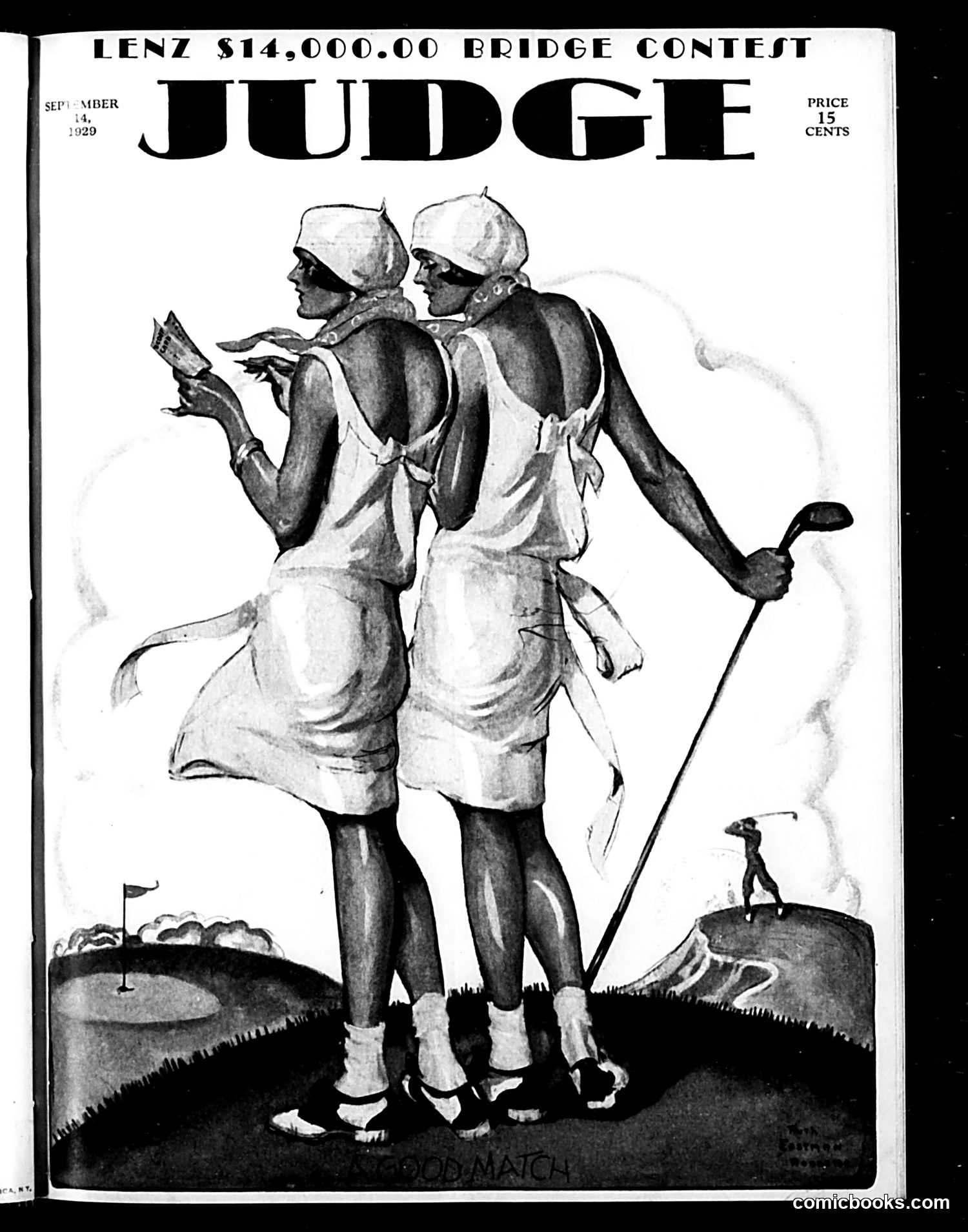
# Analysis of Judge Magazine Cover, September 14, 1929 This cover depicts two women golfers on a bridge, referencing the "Lenz $14,000.00 Bridge Contest" mentioned in the header. The satire appears to target women's golf participation during the 1920s leisure era. One woman holds money while both are dressed in period athletic wear (cloche hats, short dresses, athletic shoes). A small male golfer appears on the distant hill, seemingly excluded from the scene. The joke likely mocks either: (1) women's increasing participation in formerly male-dominated sports, or (2) the commercialization of women's golf through large prize contests. The "bridge" reference remains unclear—possibly alluding to a specific tournament venue or using "bridge" as a metaphor for women crossing into new recreational domains. The illustration style and casual athletic depiction reflect 1920s modernism regarding women's roles.
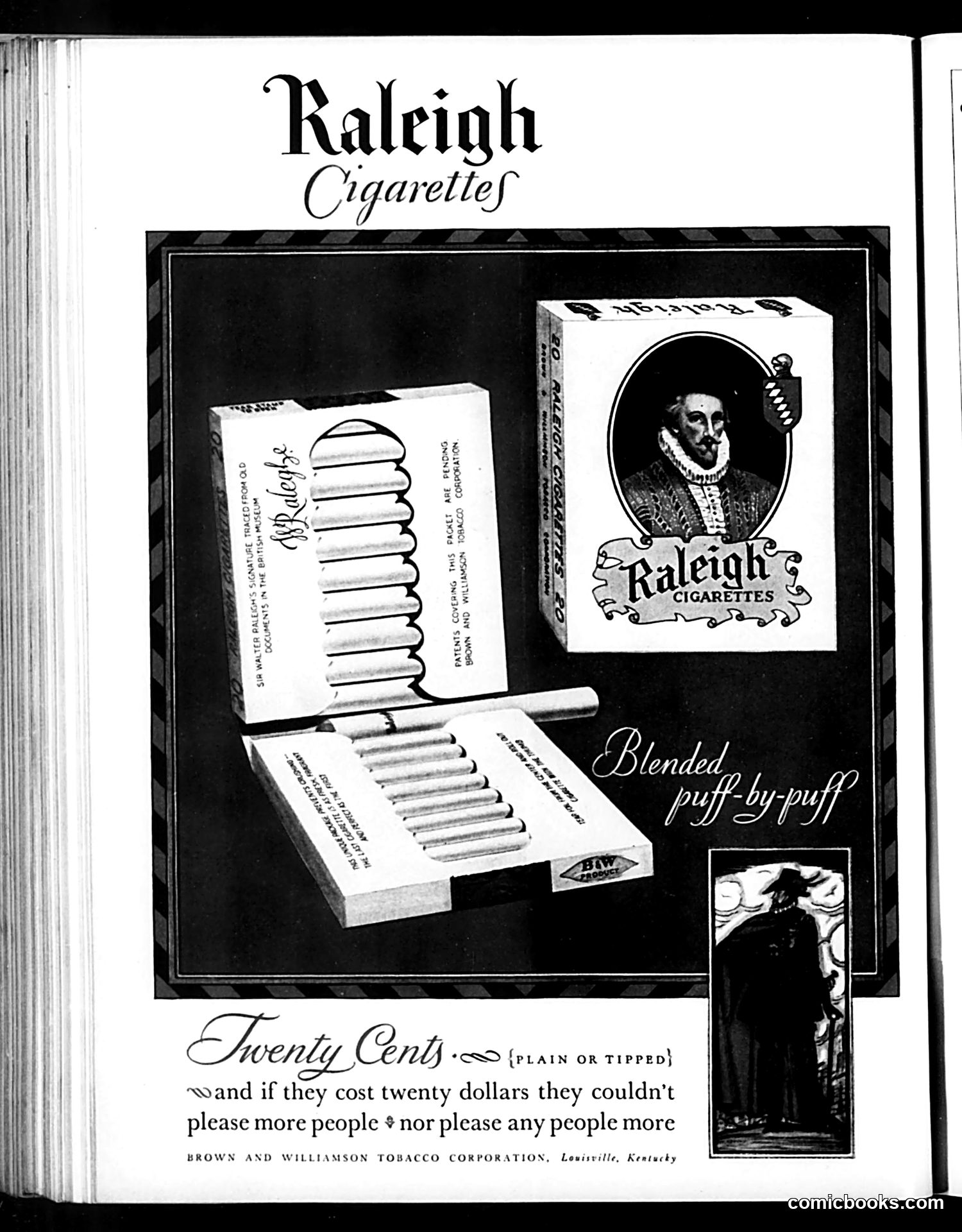
# Raleigh Cigarettes Advertisement This is primarily a **cigarette advertisement**, not political satire. It promotes Raleigh cigarettes at twenty cents per pack (plain or tipped), manufactured by Brown and Williamson Tobacco Corporation in Louisville, Kentucky. The advertisement features packaging imagery and a historical portrait—likely Sir Walter Raleigh, the Elizabethan explorer and colonizer for whom the brand is named. The phrase "Blended puff-by-puff" emphasizes the product's smoking quality. The tagline claims that at twenty dollars (presumably per carton), the cigarettes "couldn't please more people nor please any people more"—a paradoxical claim suggesting universal appeal or acceptance. This reflects early-to-mid 20th-century tobacco marketing before health warnings were required.
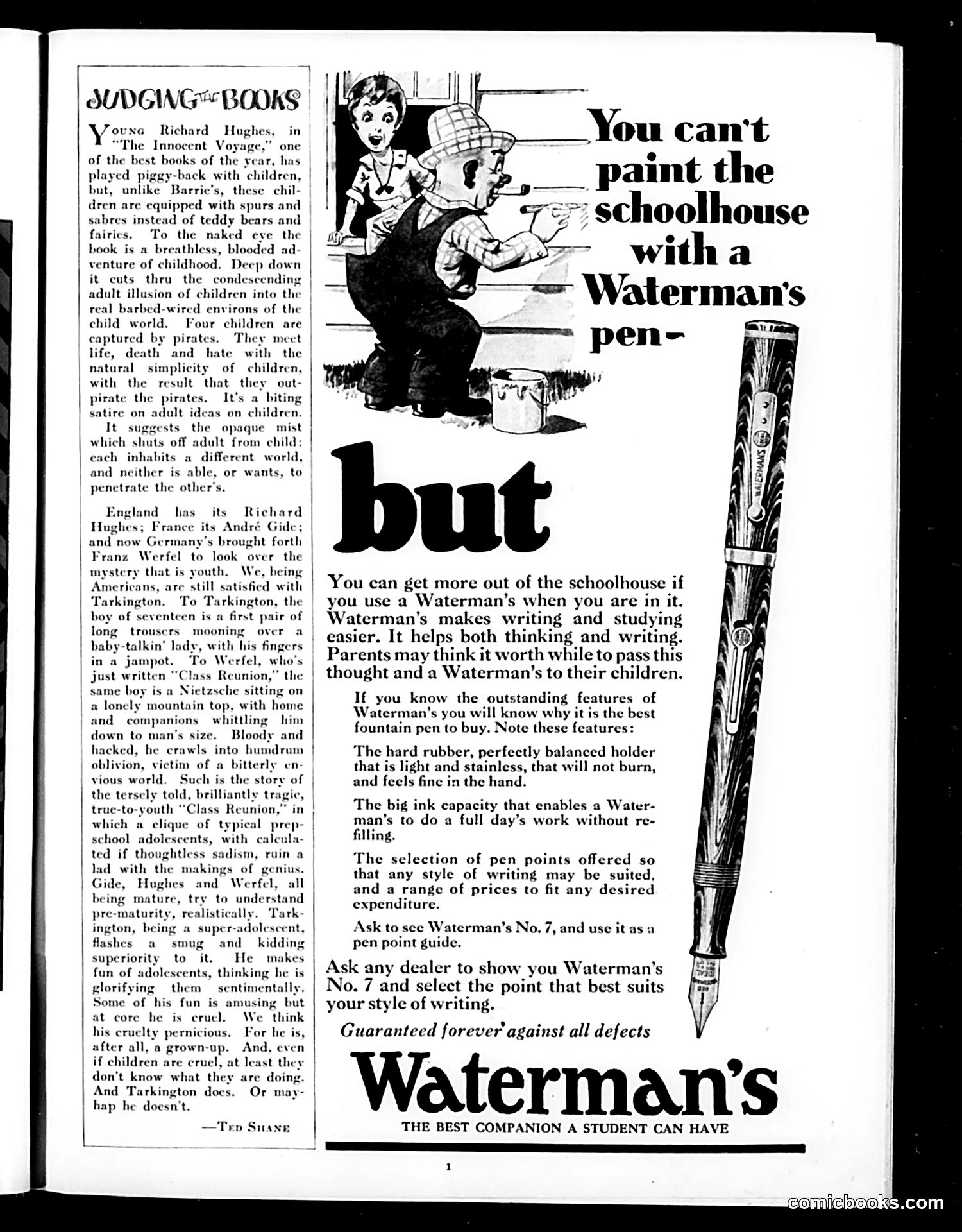
# Page Analysis This page contains a book review column ("Judging the Books") alongside a Waterman's fountain pen advertisement. The review critiques **"The Innocent Voyage"** by Richard Hughes, praising its raw depiction of childhood adventure—children captured by pirates who exhibit natural cruelty. The reviewer compares Hughes favorably to other national authors (England's Richard Hughes, France's André Gide, Germany's Franz Werfel), positioning him as America's answer to European literary sophistication. The **advertisement** uses satirical humor to sell pens: "You can't paint the schoolhouse with a Waterman's pen—but" you can accomplish actual schoolwork efficiently. The humor contrasts the pen's legitimate utility against destructive childhood impulses, aligning with the review's theme about children's natural inclinations toward mischief. Both elements reflect 1920s-30s attitudes toward childhood psychology and consumer goods marketing.
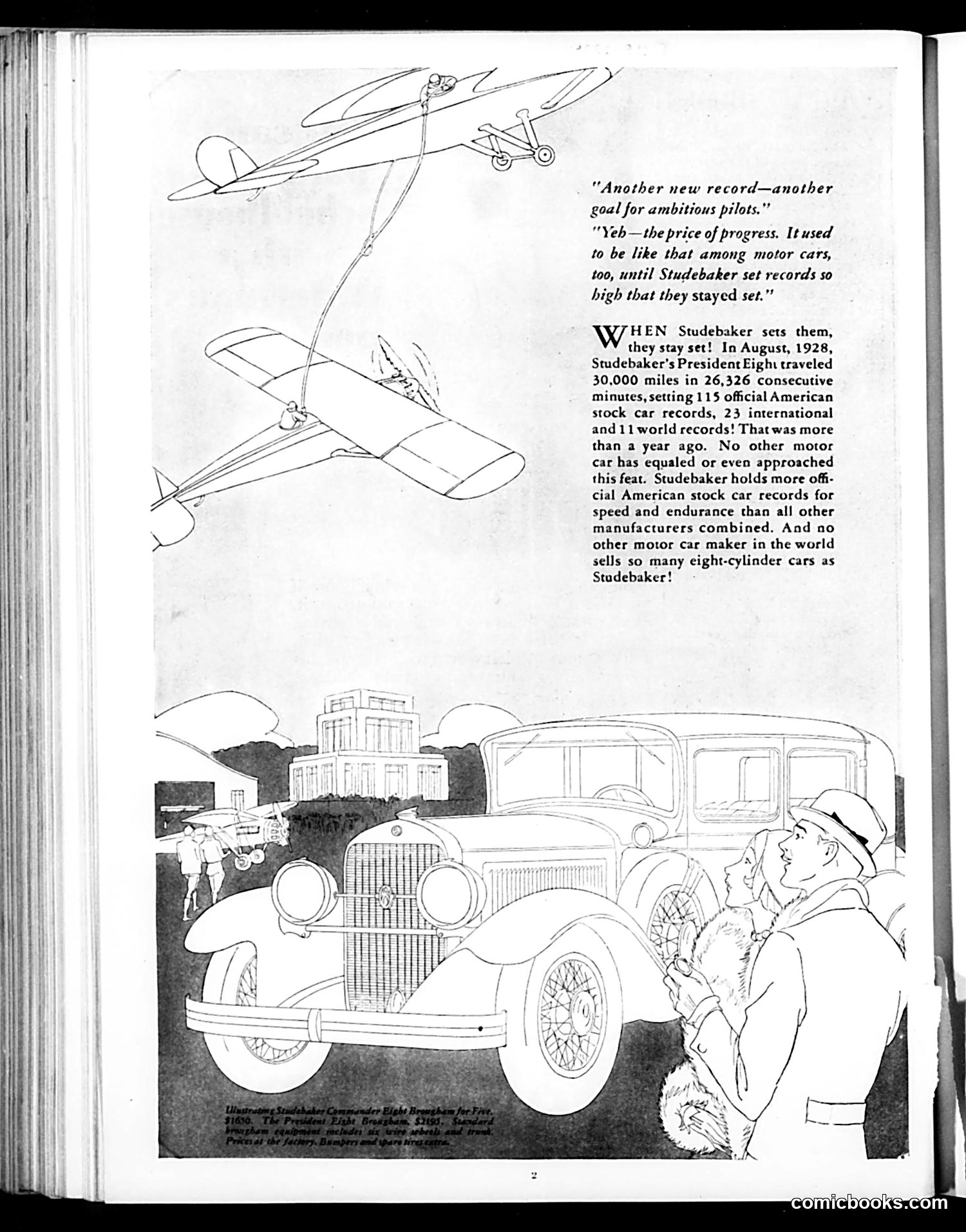
# Analysis This is a Studebaker automobile advertisement, not political satire. The page compares Studebaker's record-setting achievements to aviation progress. The text boasts that Studebaker's President Eight traveled 30,000 miles in August 1928, setting 115 American and 23 international records—claims no competitor had matched. The advertisement argues Studebaker dominates the eight-cylinder market. The sketches show gliders and aircraft above, symbolizing ambition and progress, while the lower illustration depicts Studebaker automobiles and enthusiastic observers. The visual metaphor equates automotive engineering with cutting-edge aviation technology. This represents typical 1920s advertising strategy: using technological achievement and competition records to position luxury cars as pinnacles of American industrial prowess and engineering excellence.
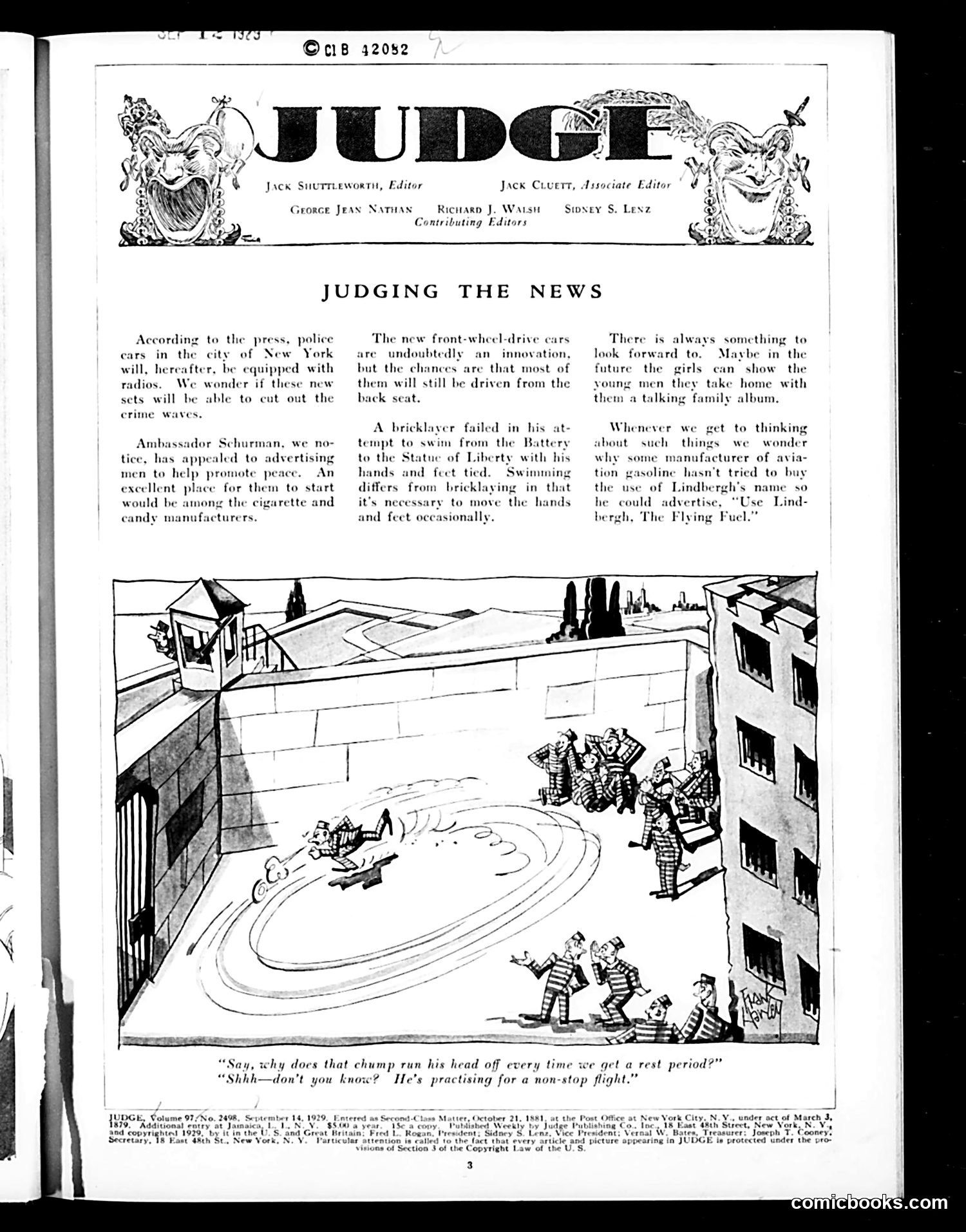
# "Judging the News" Analysis This satirical page from *Judge* magazine contains three brief commentary pieces mocking current events, plus a cartoon depicting prisoners exercising in a prison yard. The cartoon's caption—"Say, why does that chump run his head off every time we get a rest period? Shh—don't you know? He's practicing for a non-stop flight"—references Charles Lindbergh's famous 1927 non-stop transatlantic flight. The joke sarcastically suggests a prisoner obsessively running in circles is training for similar aviation feats, mocking both the prisoner's futility and perhaps Lindbergh's celebrity status. The text snippets satirize various topics: police radio cars in New York, front-wheel-drive automobiles, Ambassador Schurman's peace advocacy, and an anecdote about bricklaying versus swimming. The tone is lighthearted social commentary typical of *Judge's* satirical approach.
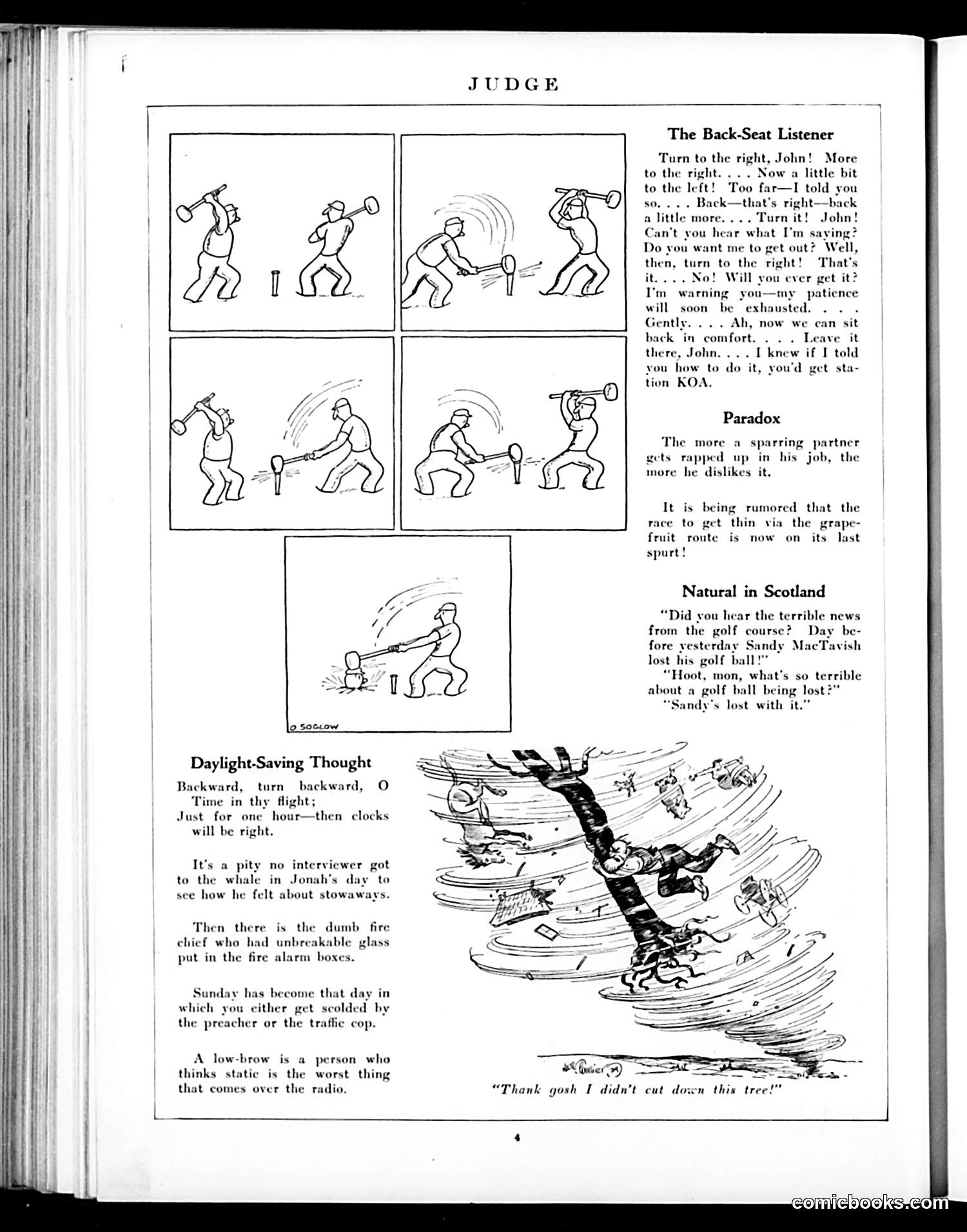
# Analysis of Judge Magazine Page This page contains several short humor pieces and comic strips, not political cartoons: **"The Back-Seat Listener"** depicts a man giving increasingly exasperated driving directions to a passenger named John who refuses to follow them, satirizing the annoyance of backseat passengers. **"Paradox"** presents a one-liner joke about job dissatisfaction. **"Natural in Scotland"** is a brief dialogue joke about losing a golf ball, playing on Scottish stereotypes. **"Daylight-Saving Thought"** offers humorous observations about daylight saving time and various absurd situations. The large illustration shows a figure falling from a tree with the caption "Thank gosh I didn't cut down this tree!"—a play on the George Washington cherry tree legend. These are gentle domestic humor pieces typical of Judge magazine's satirical approach to everyday American life, not focused on political commentary.
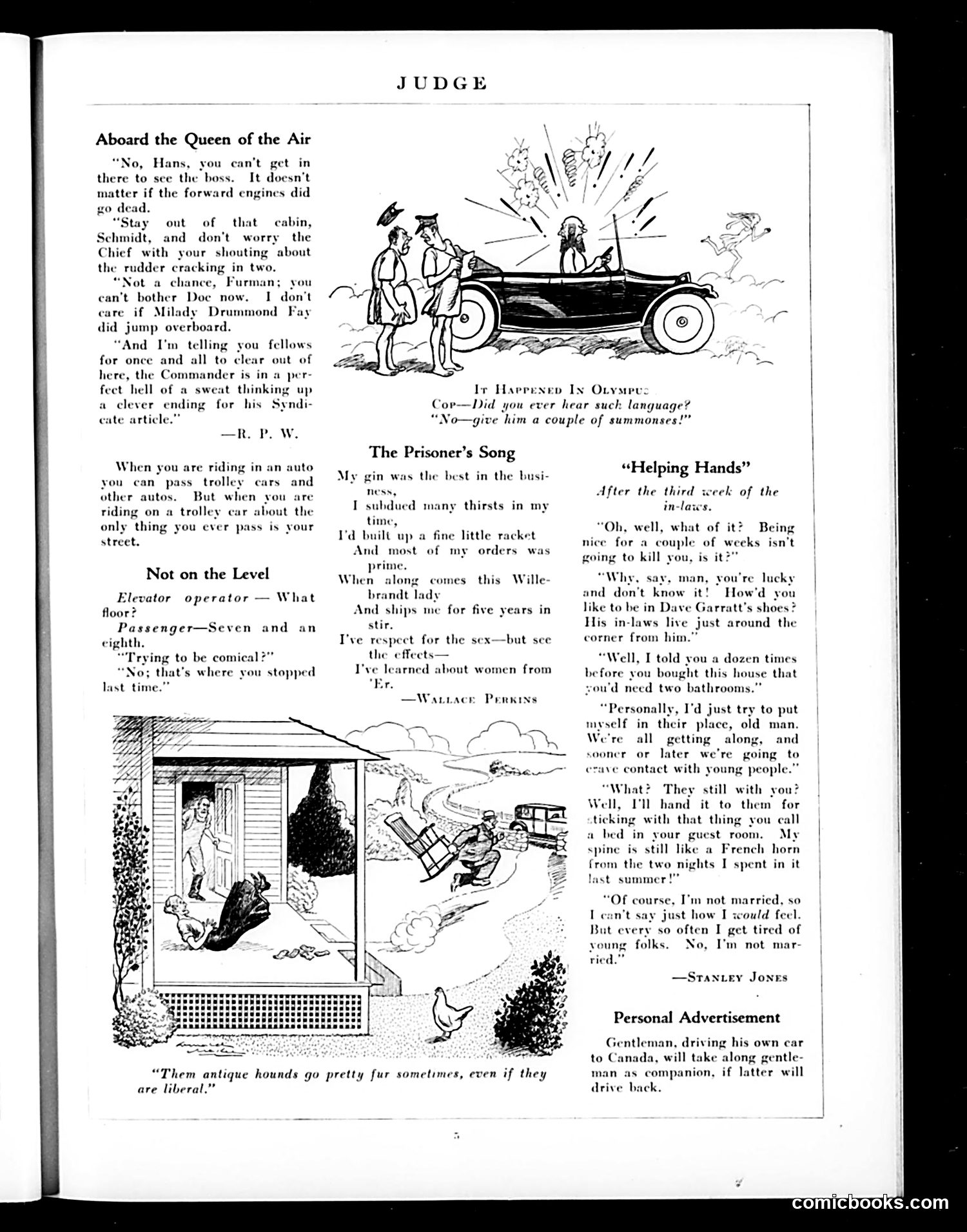
# Analysis of Judge Magazine Page This page contains several humorous pieces rather than political cartoons. The main illustration shows a couple observing an automobile accident, with the caption "Them antique hounds go pretty fur sometimes, even if they are liberal." This appears to be a joke about early automobiles' unreliability—"antique hounds" likely refers to old cars, with "liberal" meaning generous or excessive in some way. Other items include comedic dialogue pieces ("Aboard the Queen of the Air," "Not on the Level," "The Prisoner's Song," "Helping Hands") and a personal advertisement seeking a driving companion to Canada. The humor is primarily domestic and observational rather than explicitly political. Without clear dating or specific references, the exact historical context remains unclear, though the automobile references suggest early 20th century.
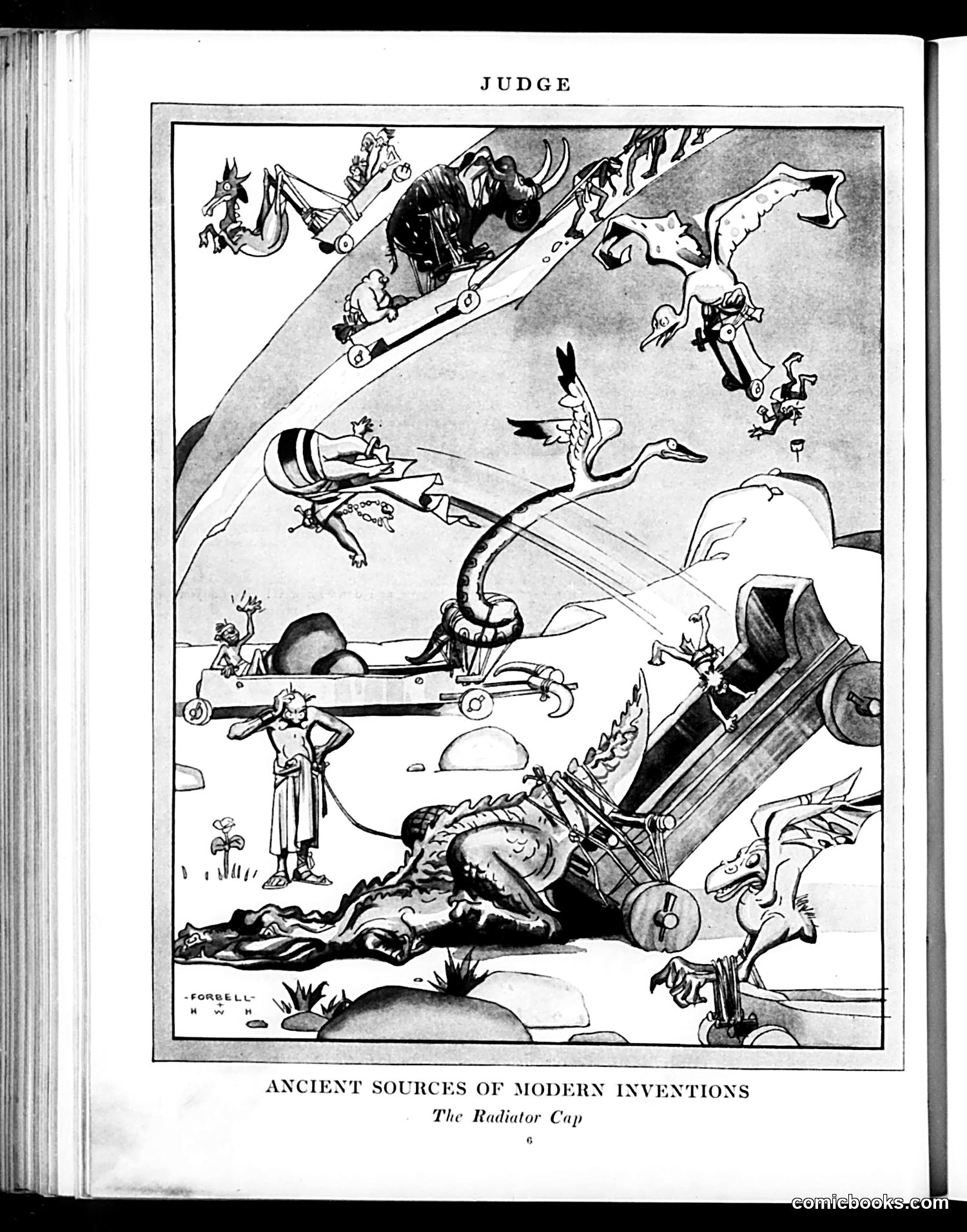
# "The Radiator Cap" — Judge Magazine Cartoon This is a humorous illustration titled "Ancient Sources of Modern Inventions," specifically about the radiator cap. The cartoon depicts a chaotic mythological or fantasy scene where various creatures (demons, monsters, fantastical beings) are engaged in what appears to be a primitive version of heat management or steam control. The joke satirizes the idea that modern inventions have ancient predecessors. The radiator cap—a practical automotive component—is humorously traced back to an imaginary ancient scenario of magical creatures managing fire or heat. The artist (signed "Forbell") uses surreal imagery to make the technological mundane seem absurdly grandiose by claiming mythic origins for something as ordinary as a car part.
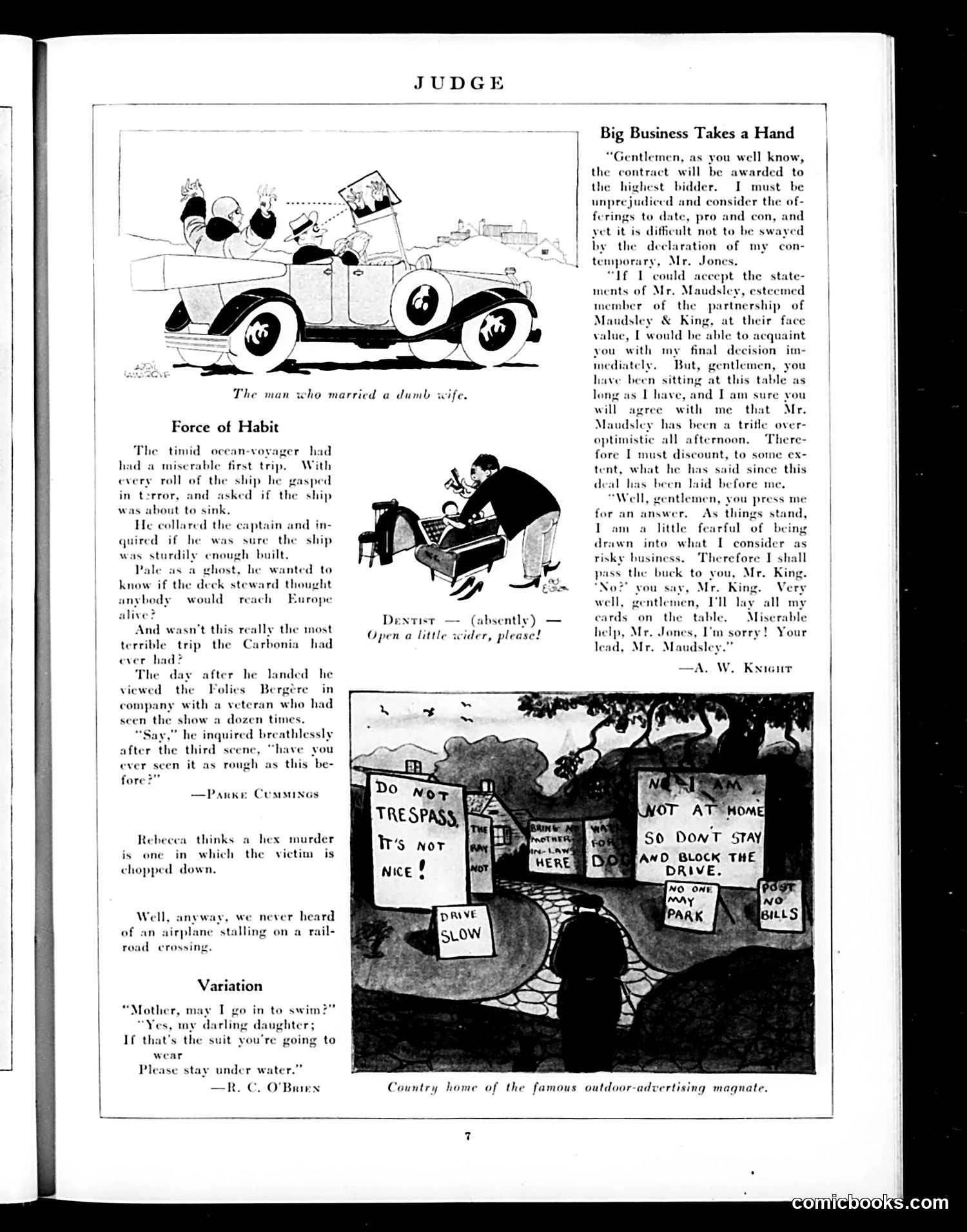
# Judge Magazine Page Analysis This page satirizes **business decision-making and corporate buck-passing**. The main cartoon "Big Business Takes a Hand" depicts a contract negotiation where a businessman refuses to make a decision, instead deferring responsibility to others. He acknowledges one partner (Maudsley) is "over-optimistic" but won't commit, ultimately passing "the buck" to Mr. King. The satire targets how executives in competitive bidding situations avoid accountability by shifting decisions elsewhere—a critique of corporate cowardice masquerading as prudence. The secondary cartoon shows a property owner surrounded by signs discouraging trespassing and parking, captioned as the "country home of the famous outdoor-advertising magnate"—ironic mockery of someone who profits from aggressive roadside advertising while forbidding others from using their own land. The page also includes unrelated humor pieces about habit, ocean voyages, and parental wit. The overall theme mocks corporate evasiveness and hypocrisy.
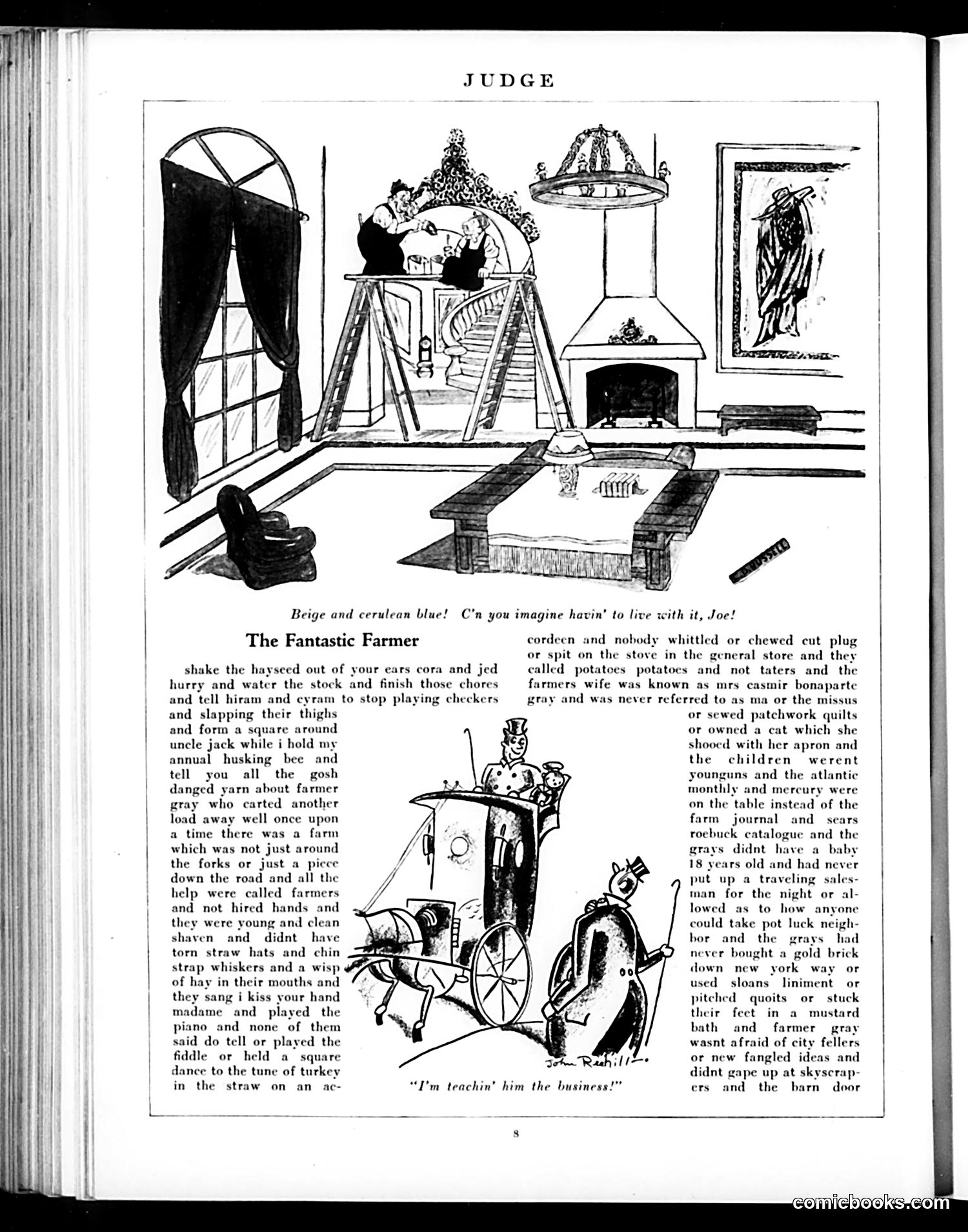
# Explanation for Modern Readers This page contains two satirical pieces from *Judge* magazine mocking rural American life and pretension. **Top cartoon ("Beige and cerulean blue!")**: Depicts an absurdly fancy, avant-garde modernist interior—with geometric furniture, abstract art, and bizarre sculptural elements—described in affected language. The joke is that someone is complaining about color schemes in this ridiculously over-designed space, highlighting how pretentious city aesthetes obsess over trivial design details. **"The Fantastic Farmer"**: A longer satirical narrative mocking both rural stereotypes and their opposite—an impossibly refined, cultured farmer family. The farmer describes an idealized version where "Farmer Gray" and his family have no rustic habits: they say "potatoes" not "taters," read *Atlantic Monthly* instead of *Sears* catalogs, play piano instead of fiddle, and reject all stereotypical rural behavior. The satire cuts both ways: it ridicules both the crude farmer stereotype *and* the snobbish notion that refinement requires rejecting rural identity. The bottom illustration shows the farmer "teaching" his son "the business"—presumably meaning actual farming versus pretentious affectation.
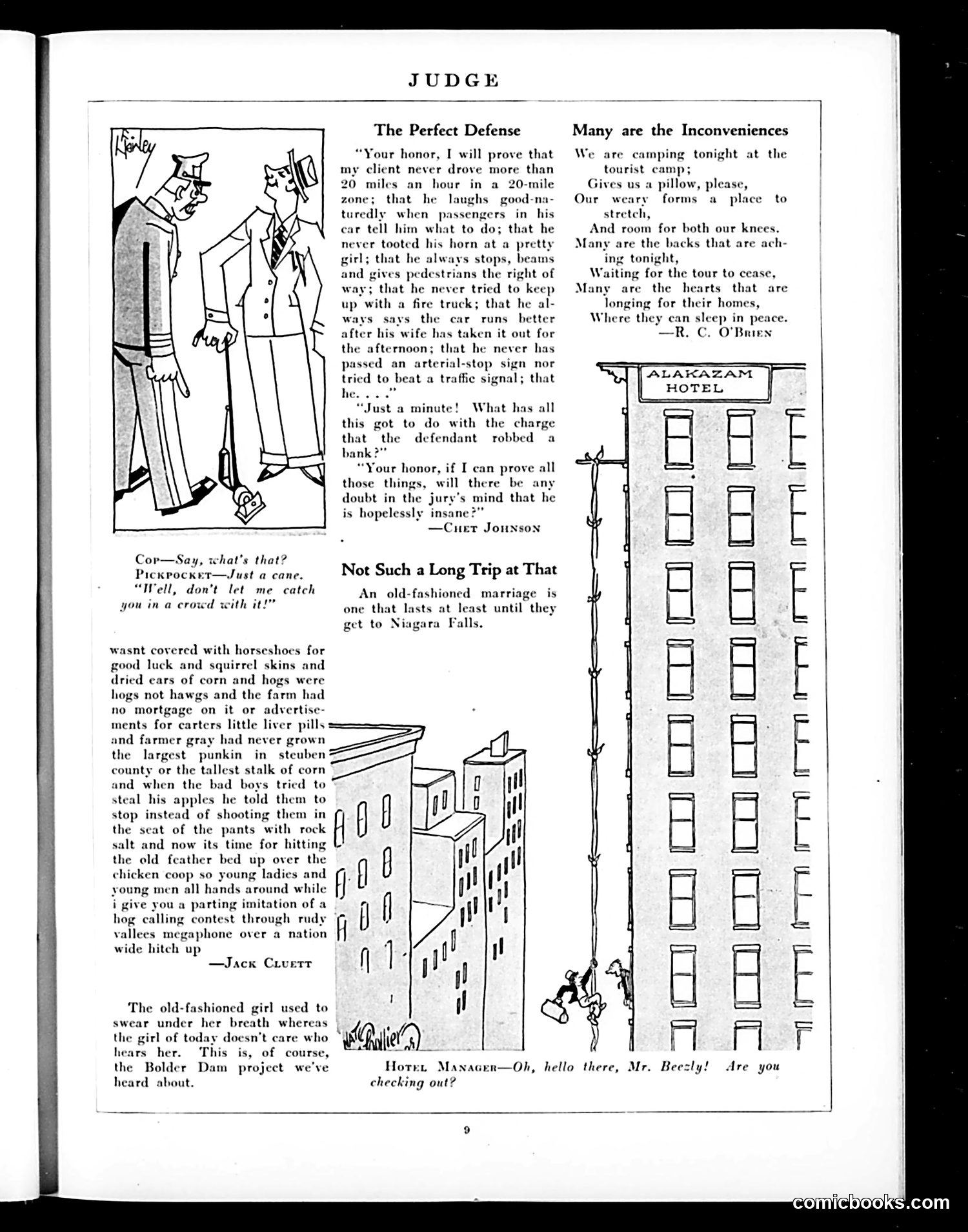
# Judge Magazine Page Analysis This page contains several satirical pieces typical of 1920s-30s American humor: **"The Perfect Defense"** mocks absurd legal arguments. A defense attorney argues his client is "hopelessly insane" by listing impossibly virtuous driving behaviors—never speeding, never honking at girls, always stopping for pedestrians. The joke: proving someone is a perfect driver proves they're mentally unfit, deflecting from the actual charge (bank robbery). **"Not Such a Long Trip at That"** jokes that old-fashioned marriages lasted "at least until they get to Niagara Falls"—the traditional honeymoon destination—implying modern marriages are even shorter-lived. **The pickpocket cartoon** shows a cop warning a pickpocket not to use a cane in crowds, apparently because concealing stolen goods in a cane made the theft too easy. **"Many are the Inconveniences"** sentimentalizes tourist camp discomforts. The Alakazam Hotel cartoon appears incomplete but shows a manager greeting a guest. These pieces satirize contemporary concerns: traffic lawlessness, declining marriage stability, and petty crime—all presented through lighthearted jokes typical of Judge's satirical approach.
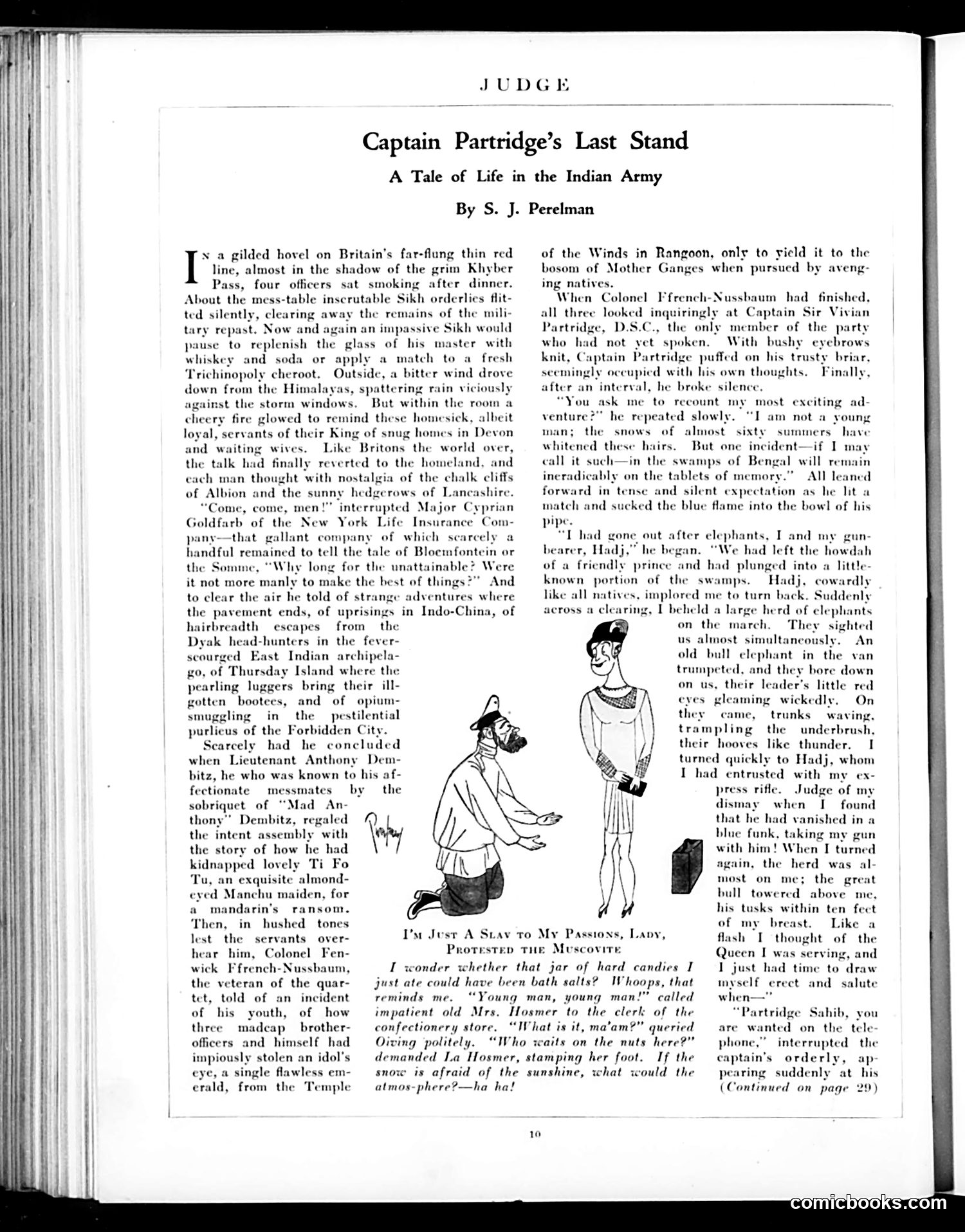
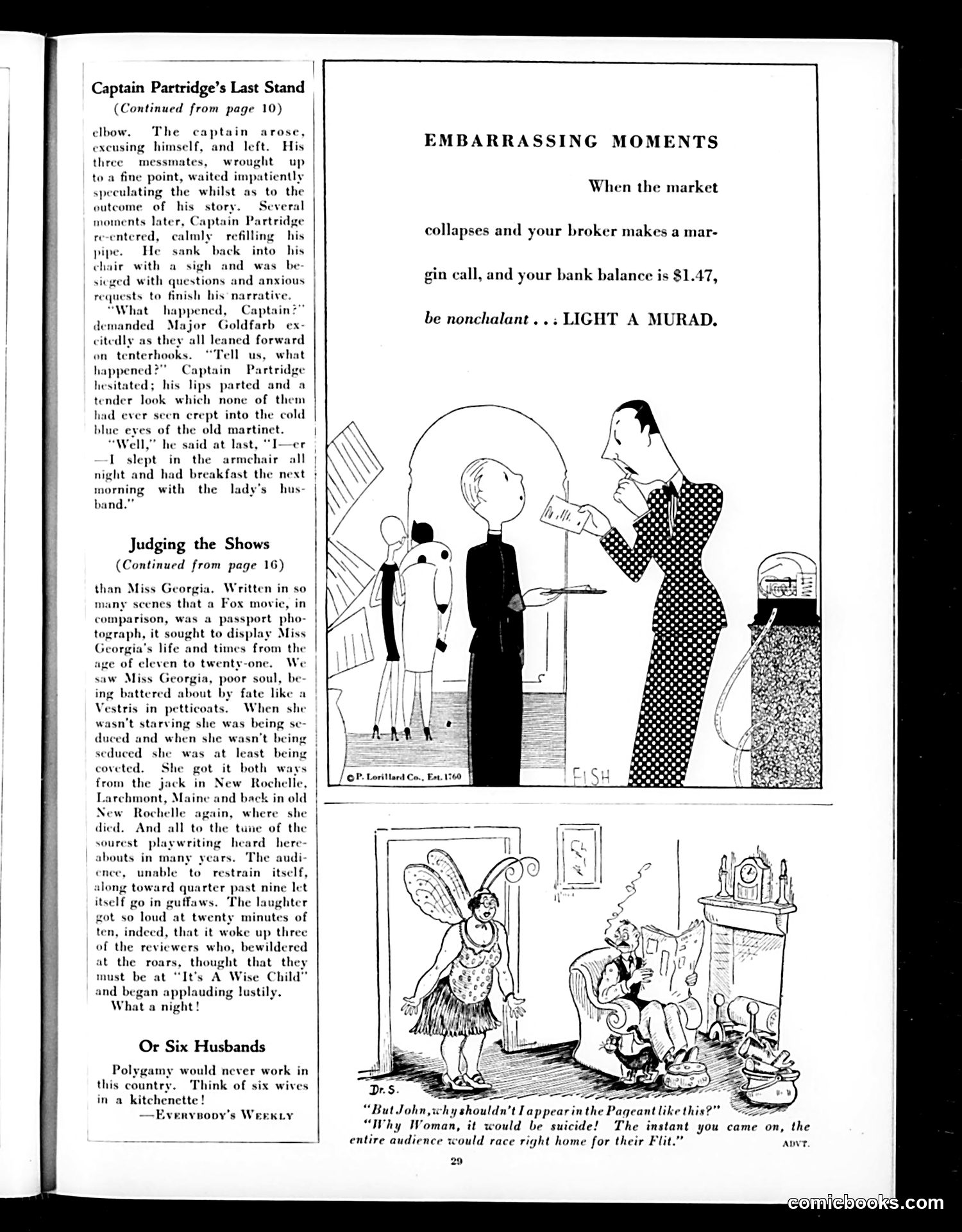
# "Captain Partridge's Last Stand" - Judge Magazine This page presents the opening of a humorous short story by S. J. Perelman set in the British Indian Army. The narrative parodies the imperialist adventure tales popular in early 20th-century literature—the kind where colonial officers swap increasingly outlandish stories of exotic exploits. The satire works by having four officers (with deliberately absurd names like "Major Cyprian Goldfarb" and "Colonel Fenwick Ffrench-Nussbaum") tell tall tales of adventure across the empire: kidnappings, temple robberies, elephant hunts. Perelman exaggerates the clichés of colonial romance fiction—the nostalgic homesickness, the "exquisite almond-eyed Manchu maiden," the dangerous encounters with natives. The accompanying cartoons appear to illustrate comedic moments from the text. The satire mocks both the adventure genre itself and British imperial attitudes, presenting these officers as self-important blusterers rather than genuine heroes.