
Judge, 1929-09-14 · page 12 of 36
Judge — September 14, 1929 — page 12: what you’re looking at
What you’re looking at
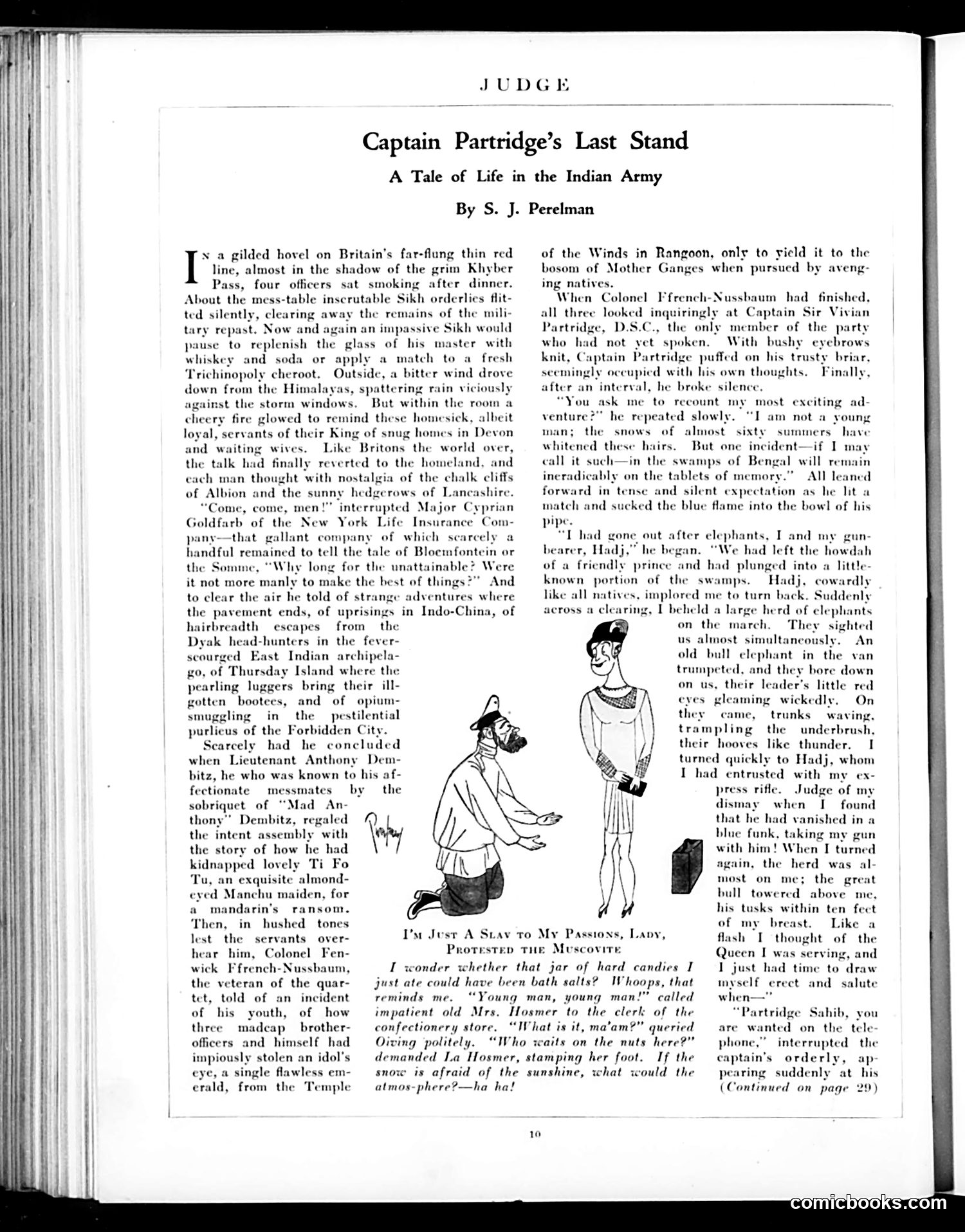
# "Captain Partridge's Last Stand" - Judge Magazine This page presents the opening of a humorous short story by S. J. Perelman set in the British Indian Army. The narrative parodies the imperialist adventure tales popular in early 20th-century literature—the kind where colonial officers swap increasingly outlandish stories of exotic exploits. The satire works by having four officers (with deliberately absurd names like "Major Cyprian Goldfarb" and "Colonel Fenwick Ffrench-Nussbaum") tell tall tales of adventure across the empire: kidnappings, temple robberies, elephant hunts. Perelman exaggerates the clichés of colonial romance fiction—the nostalgic homesickness, the "exquisite almond-eyed Manchu maiden," the dangerous encounters with natives. The accompanying cartoons appear to illustrate comedic moments from the text. The satire mocks both the adventure genre itself and British imperial attitudes, presenting these officers as self-important blusterers rather than genuine heroes.
📄 Transcribed text from this page (OCR, searchable)
Machine-transcribed from the original scan — historical spelling and the odd misread are preserved.
JUDG Captain Partridge’s Last Stand A Tale of Life in the Indian Army By S. J. Perelman line, almost in the shadow of the grim Khyber Pass, four officers sat smoking after dinner. About the mess-table inscrutable Sikh orderlies flit- ted silently, clearing away the remains of the mili- tary repast. Now and again an impassive Sikh would pause to replenish the glass of his master with whiskey and soda or apply a match to a fresh Trichinopoly cheroot. Outside, a bitter wind drove down from the Himalayas, spattering rain viciously against the storm windows. But within the room a cheery fire glowed to remind these homesick, albeit loyal, servants of their King of snug homes in Devon and waiting wives. Like Britons the world over, the talk had finally reverted to the homeland, cach man thought with nostalgia of the chalk cliffs of Albion and the sunny hedgerows of L. “Come, come, men!” interrupted Major Cyprian Goldfarb of the New York Life Insurance Com- pany—that gallant company of which scarcely a handful remained to tell the tale of Bloemfontein or the Somme, “Why long for the unattainable? Were it not more manly to make the best of things?" And to clear the air he told of strange adventures where the pavement ends, of uprisings in Indo-China, of hairbre escapes from the Dyak head-hunters in the fever- scourged East Indian archipela- go, of Thursday Island where the pearling luggers bring their ill- gotten bootees, and of opium- smuggling in the — pestilential purlicus of the Forbidden City. Scarcely had he concluded when Lieutenant Anthony Dem- bitz, he who was known to his af- fectionate messmates by the sobriquet of “Mad An- thony” Dembitz, regaled 4) the intent assembly with \ the story of how he had kidnapped lovely Ti Fo Tu, an exquisite almond- eyed Manchu maiden, for a mandarin’s ransom. Then, in hushed tones lest the servants over- hear him, Colonel Fen- wick Ffrench-Nussbaum, the veteran of the quar- tet, told of an incident of his youth, of how three madcap brother- officers and himself had impiously stolen an idol’s eye, a single flawless em- erald, from the Temple T a gilded hovel on Britain's far-flung thin red atmos-phere?—ha ha! I’m Just A Stav to My Passions, Lavy, flash I Prorestep tHe Muscovite I wonder whether that jar of hard candies I just ate could have been bath salts? Whoops, that reminds me. “Young man, young man!” called impatient old Mrs. Hosmer to the clerk of the confectionery store. “What is it, ma'am?” queried Oiving politely. “Who waits on the nuts here?” — phone demanded La Hosmer, stamping her foot. If the snow is afraid of the sunshine, what would the of the Winds in Rangoon, only to yield it to the bosom of Mother Ganges when pursued by aveng- ing natives. When Colonel Ffrench-Nussbaum had _ finished, all three looked inquiringly at Captain Sir Vivian Partridge, D.S.C., the only member of the party who had not yet spoken. With bushy eyebrows knit, Captain Partridge puffed on his trusty briar, seemingly occupied with his own thoughts. Finally, after an interval, he br silence: “You ask me to recount my most exciting ad- venture?” he repeated slowly. “Iam not a young man; the snows of almost. sixty summers” have whitened these hairs. But one incident—if I may call it such—in the swamps of Ben, will remain ineradicably on the tablets of memory. All leaned forward in tense and silent expectation as he ht a match and sucked the blue flame into the bowl of his pipe. “LT had gone out after elephants, I and my gun- bearer, Hadj,” he began. “We had left the howe of a friendly prince and had plunged into a little- known portion of the swamps. Hadj, cowardly like all natives, implored me to turn back. Suddenly across a clearing, I beheld a large herd of elephants on the march, They sighted us almost simultaneously. An old bull elephant in’ the van hore down on us, their Jer’s little red ming wickedly. On ame, trunks waving, trampling the underbrush, their hooves like thunder. I turned quickly to Hadj, whom IT had entrusted with my ex- press rifle. Judge of my dismay when I found that he had vanished in a bluc funk, taking my gun with him! When I turned in, the herd was al- most on me; the gre: bull ered above me, his tusks within ten feet of my breast. Like a thought of the Queen I was serving, and I just had time to draw wanted on the tele- interrupted the captain’s orderly, ap pearing suddenly at his (Continued on page 29) pee ere