
Judge, 1929-09-14 · page 18 of 36
Judge — September 14, 1929 — page 18: what you’re looking at
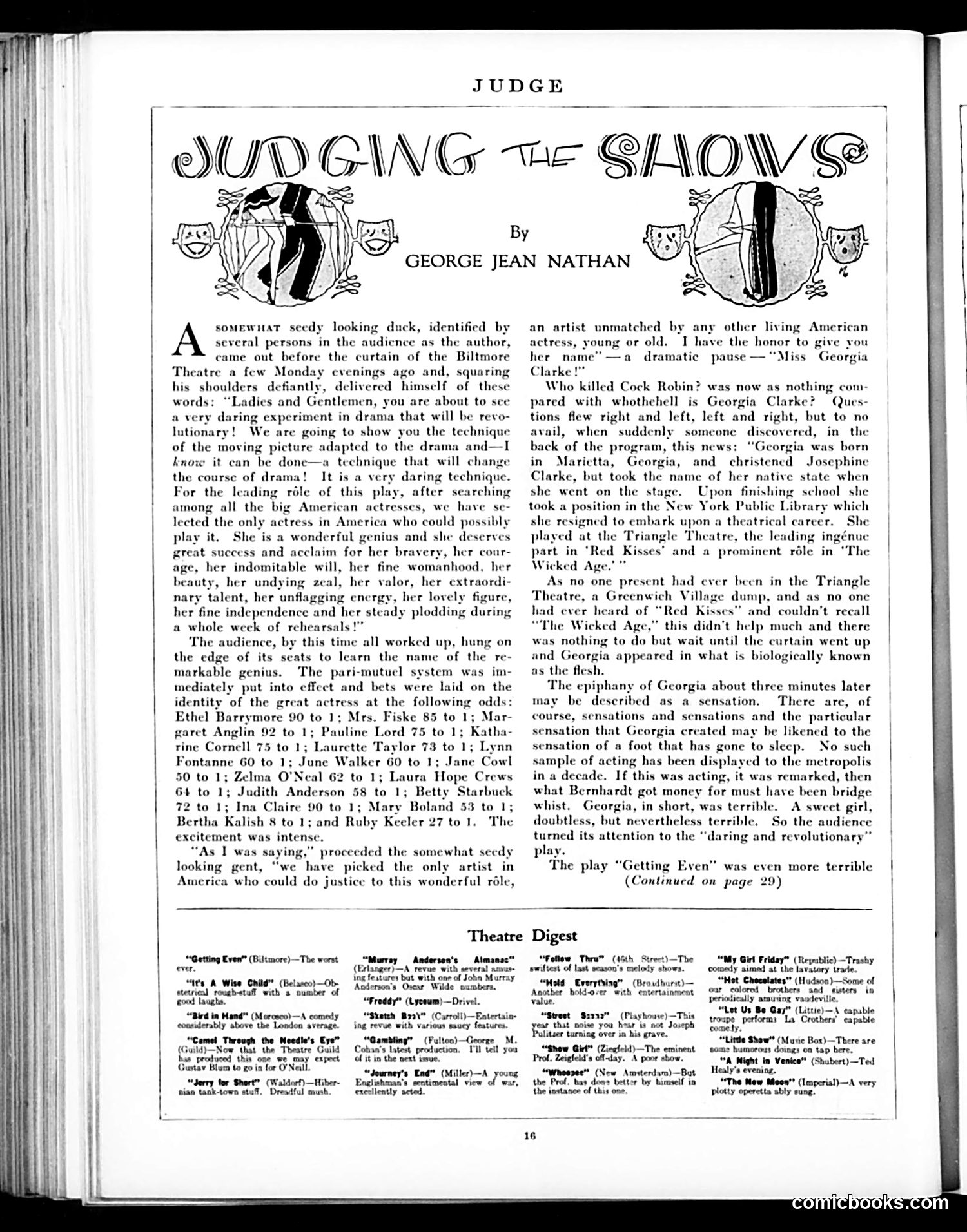
A restored page from Judge, 1929-09-14. Page through the whole issue in the reader above.
📄 Transcribed text from this page (OCR, searchable)
Machine-transcribed from the original scan — historical spelling and the odd misread are preserved.
JUDGE OURS GI WAI Gr THe SHOW Se IST GEORGE SEAN NATHAN somewnat seedy looking duck, identified by A several persons in the audience as the author, came out before the curtain of the Biltmore Theatre a few Monday evenings ago and, squaring his shoulders defiantly, delivered himself of these words: “Ladies and Gentlemen, you are about to see a very daring experiment in drama that will be revo- lutionary! We are going to show you the technique of the moving picture adapted to the dr: and—I know it can be done—a technique that will change the course of drama! It is a very daring technique. For the leading réle of this play, after searching among all the big American actresses, we have se- lected the only actress in America who could possibly play it. She is a wonderful genius and she deserves great success and acclaim for her bravery, her cour- age, her indomitable will, her fine womanhood, her beauty, her undying zeal, her valor, her extraordi- nary talent, her unflagging encrgy, her lovely figure, her fine independence and her steady plodding during a whole week of rehearsals!" The audience, by this time all worked up, hung on the edge of its seats to learn the name of the re- markable genius. ‘The stem was im- mediately put into effect and bets were laid on the identity of the great actress at the following odds: Ethel Barrymore 90 to 1; Mrs. Fiske 85 to 1; Mar- garet Anglin 92 to 1; Pauline Lord 75 to 1; Katha- rine Cornell 75 to 1; Laurette Taylor 73 to 1; Lynn Fontanne 60 to 1; June Walker 60 to 1; Jane Cowl 50 to 1; Zelma O'Neal 62 to 1; Laura Hope Crews 64 to 1; Judith Anderson 58 to 1; Betty Starbuck 72 to 1; Ina Claire 90 to 1; Mary Boland 53 to 1; Bertha Kalish 8 to 1; and Ruby Keeler 27 to 1. The excitement w. “As I was saying,” proceeded the somewhat seedy looking gent, e have picked the only artist in America who could do justice to this wonderful réle, intense. an artist unmatched by any other living American actress, young or old. I have the honor to give her name” —a dramatic pause — “Miss Clarke!" Who killed Cock Robin? was now as nothing com- pared with whothehell is Georgia Clarke? Ques- tions flew right and left, left and right, but to no avail, when suddenly someone discovered, in’ the back of the program, this news: “Georgia was born in Marietta, Georgia, and christened Josephine Clarke, but took the name of her native state when she went on the stag Upon finishing school she took a position in the New York Public Library which she resigned to embark upon reer. played at the Tr: © Theatre, the 1} part in ‘Red Kisses’ and a prominent réle in * Wicked Age.’ As no one present had ever been in the Triangle Theatre, a Greenwich Village dump, and as no one had ever heard of “Red Kisses” and couldn't recall “The Wicked Age,” this didn’t help much and there was nothing to do but wait until the curtain went up and Georgia appeared in what is biologically known as the flesh The epiphany of Georgia about three minutes later may be described as a sensation. There are, of course, sensations and sensations and the particular sensation that Georgia created may be likened to the sensation of a foot that has gone to sleep. No such sample of acting has been displayed to the metropolis in a decade. If this was acting, it was remarked, then what Bernhardt got money for must have been bridge whist. Georgia short, terrible. A sweet girl, doubtless, but nevertheless terrible. So the audience turned its attention to the “daring and revolutionary” play. The play “Getting Even” was even more terrible (Continued on page 29) you Georg The Theatre “Murray Andersen's Almanac” Digest “Fellow Thru” (4th Strect)—The “Rly Girt Friday” (Repablie) Ty —Trashy “Getting Even” (Biltmore) —The worst ever. “It's A Wise Child” (Belasco)—Ob- ttetrieal rougbetufl with a number of good laughs. “Bird in Hand” (Morosco)—A comedy coaiderably above the London average. jamel Through the Needle’s Eye” uild)—Now that the Theatre Guild has produced this one we may expect Gustav Blum to go in for O'Neill. “Jerry tor Short (Waldorf) —Hiber- nian tank-town stuf, Dreadful mush. (Erlanger)—A revue with several amus- tng festures bat with one of Jobn Murray Anderson's Osear Wilde numbers, “Freddy” (Lyceum) —Drivel. “$keteh Boot" (Carroll)—Fatertain- ing revue with various saucy features. “Gambling” (Fultoa)—George M. Coban’s latest production. I'll tell you of it in the next issue. “Journey's End” (Miller)—A Englishman's sentimental view o excellently acted. war, swiftest of Last season's melody shows. “Hold Everytiing” (Broudburst)— Another hold-over with entertainment value. Street Serax” (Playbouve) —This that noise you hear is not Joseph Pulitzer turning Over in bis grave. “Show Girt” (Ziegfeld) —The eminent Prof. Zeigfeld's off-day. \ poor show. (New Amsterdam)—Bat “Wiheapee” the Prof. hay dons better by himself in the instance of this one. comedy aimed at the lavatory trade. “Hot Choealates” (Hudsoa)—Some of our colored brothers and sisters in periodically amusing vaadeville, “Let Us Be Gay” (Littie)—\ capable trospe performs La Crothers’ capable comely. “Little Shaw" (Music Bor)—There are toms humorous doings oa tap bere. “A Might in Venice” (Shubert) —Ted Healy's evening. “The Mew Moon’ (Imperial) —A very plotty operetta ably sung.