A complete issue · 36 pages · 1929
Judge — August 24, 1929
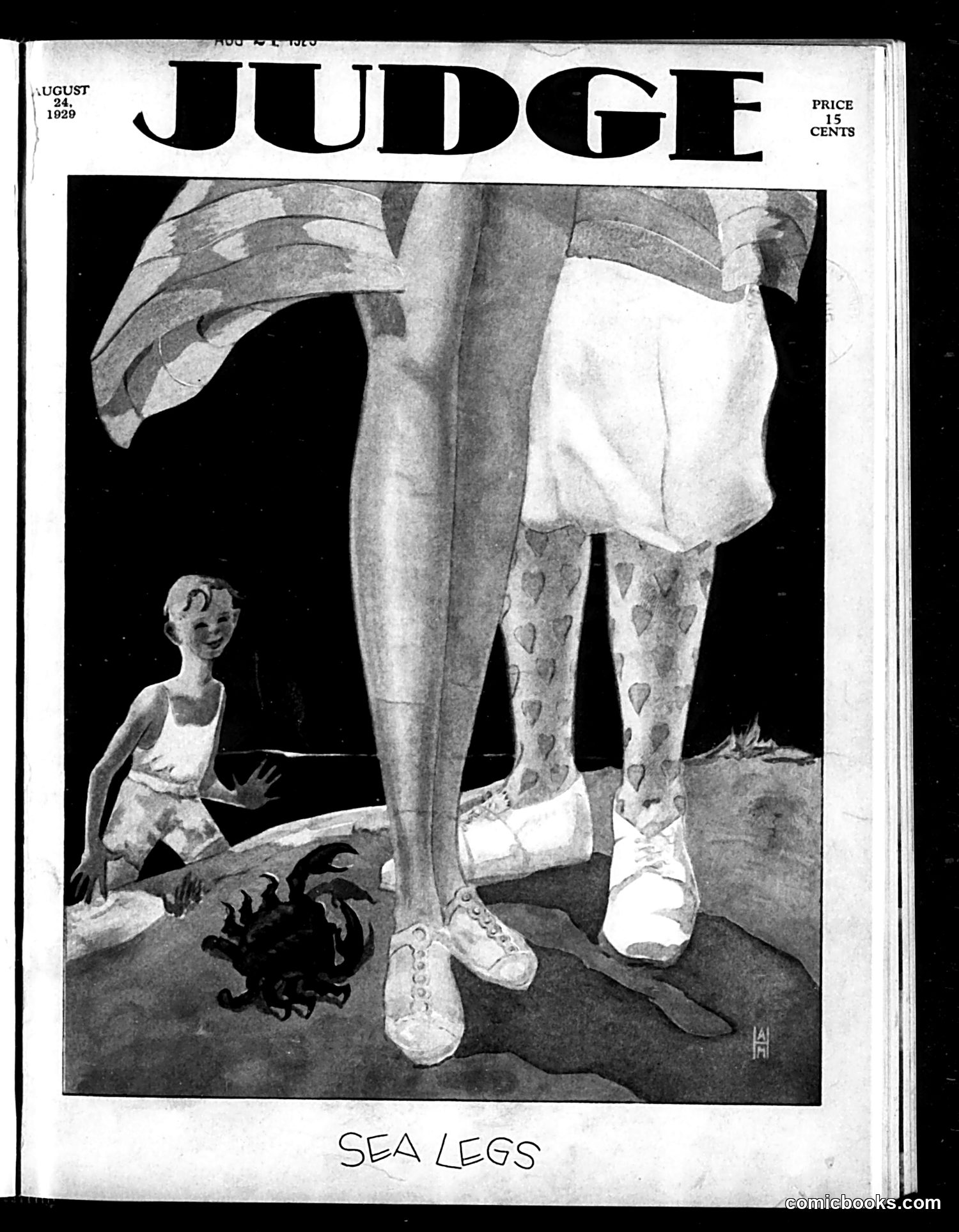
# "Sea Legs" - Judge Magazine, August 24, 1929 This cartoon satirizes inexperienced swimmers or beachgoers. The title "Sea Legs" (nautical confidence) is ironic, as the image shows an adult with comically tattooed legs wearing swimming attire, standing over a small child who appears distressed or startled by the adult's prominent leg tattoos—featuring heart designs. The satire likely mocks either: adults who lack actual swimming competence despite appearing confident, or the vanity of displaying tattoos at the beach. The child's shocked reaction emphasizes how ridiculous or unsightly the tattooed "sea legs" appear. This reflects 1929 attitudes toward tattoos as lowbrow or unseemly, particularly for public display at leisure venues. The humor derives from the gap between the confident stance and the absurd reality being exposed.
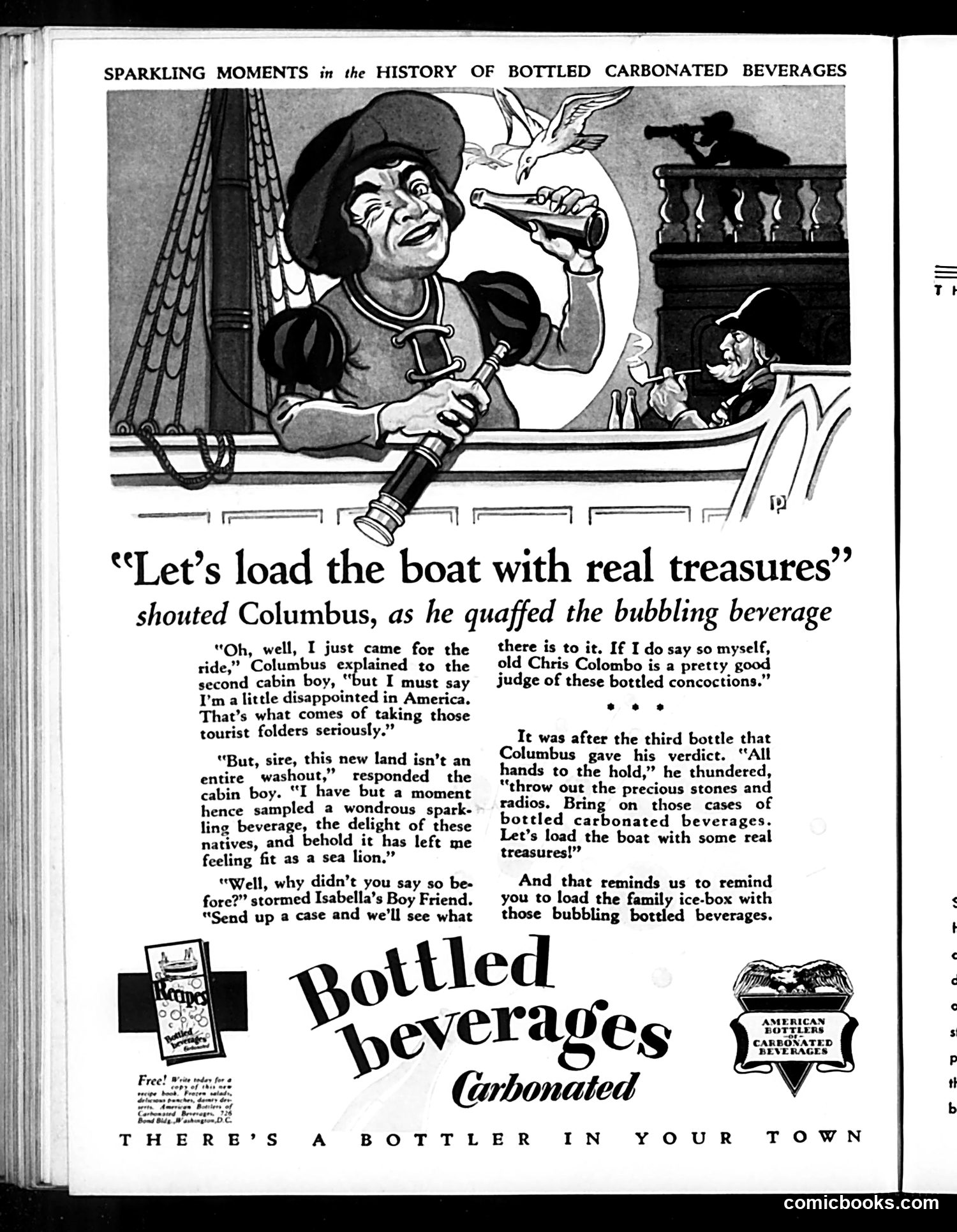
# Analysis This is primarily **advertising content** for bottled carbonated beverages, not political satire. The page uses a historical framing device: Columbus is depicted discovering carbonated beverages as a "real treasure," comparable to his voyage to America. The humor relies on Columbus's famous expedition (1492) as a metaphor—just as Columbus sought riches in the New World, the advertiser positions bottled sodas as valuable discoveries worth loading into your family's ice-box. The characters include Columbus himself and various period-dressed figures meant to evoke the Age of Exploration. The satire is gentle and commercial rather than political: it's essentially a joke advertisement suggesting carbonated beverages are as significant a "find" as Columbus's voyage. The "real treasures" tagline drives home this comparison.
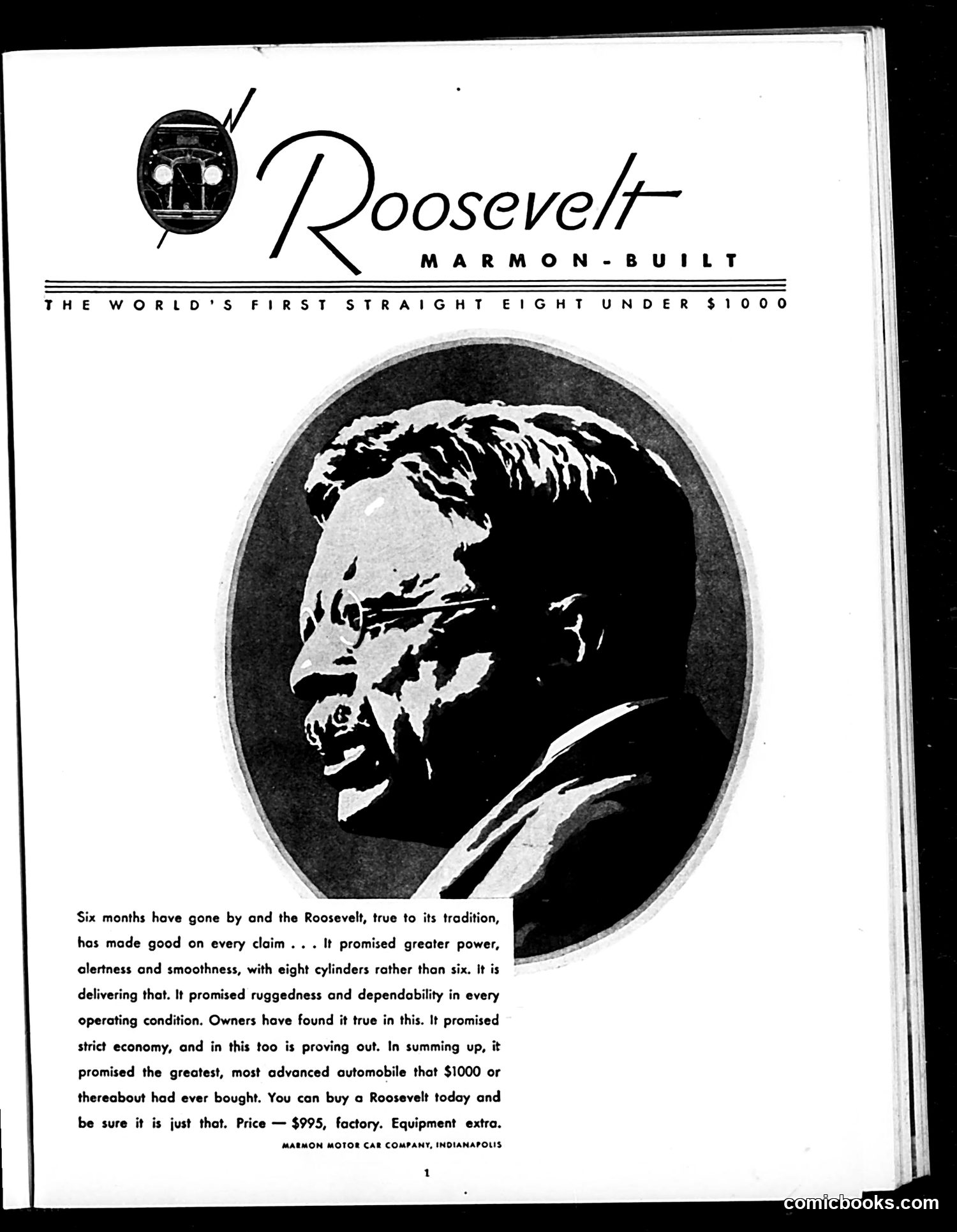
# Roosevelt Automobile Advertisement This is **not satire** — it's a straightforward advertisement for the Roosevelt automobile, manufactured by the Marmon Motor Car Company in Indianapolis. The profile portrait shows **Theodore Roosevelt**, the former president, used as the brand's namesake and mascot. The ad promotes the Roosevelt as "the world's first straight eight under $1000," emphasizing its eight cylinders, power, smoothness, and reliability. The text claims six months of sales have proven the car delivers on its promises of performance and economy. The price is listed at $995 (factory), positioning it as an affordable luxury vehicle for the era. This represents early 20th-century automotive marketing that capitalized on Roosevelt's fame and association with strength and durability to sell cars.
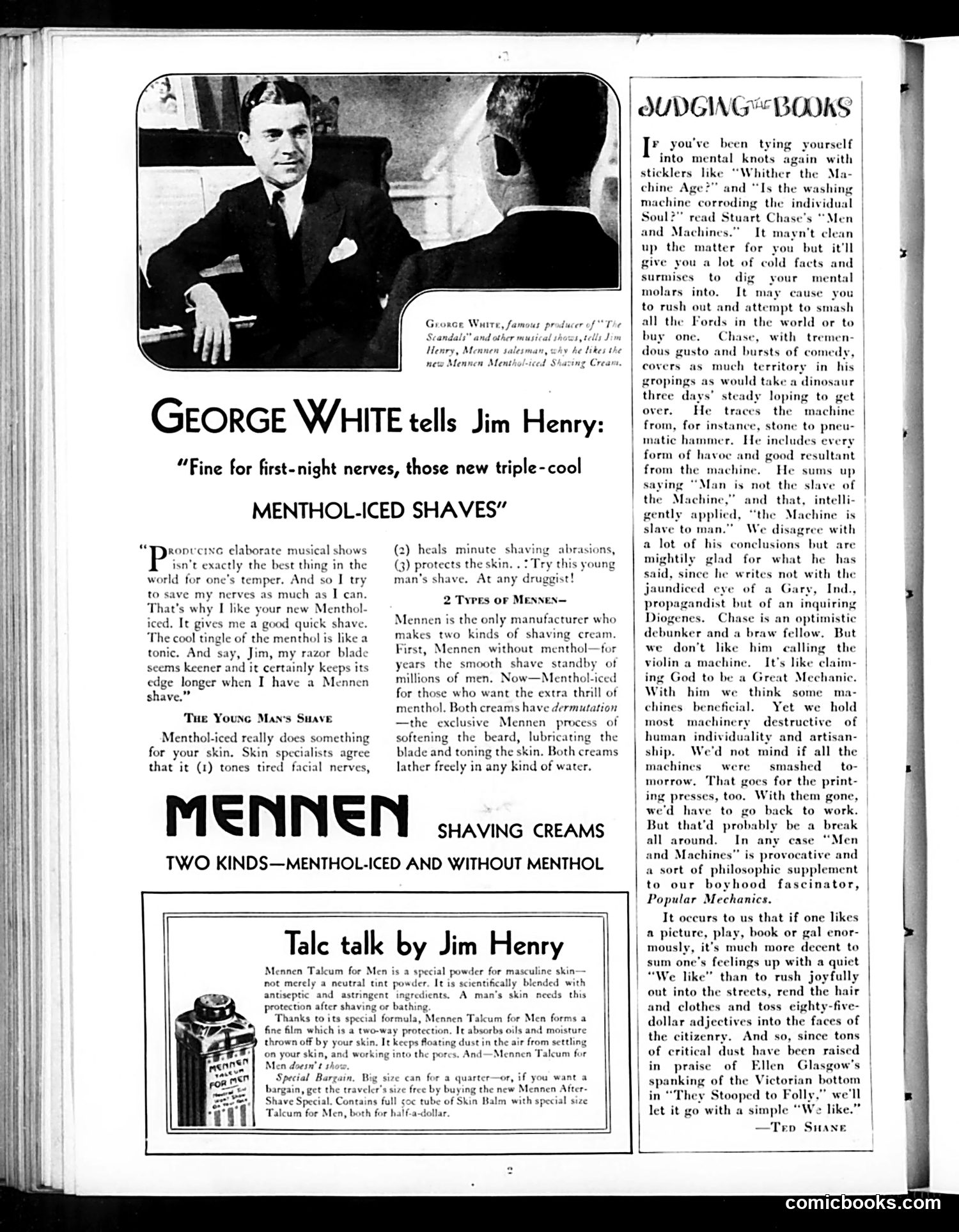
# Analysis This page is primarily **advertising**, not satire or political commentary. It contains two advertisements for Mennen shaving products, featuring testimonials from entertainers. The top ad uses **George White** (a famous theatrical producer of the era) giving a testimonial to "Jim Henry" about Menthol-iced shaves for "first-night nerves." This appears to be a fictional endorsement scenario rather than satire—using a real celebrity to pitch products was standard advertising practice. The lower ad features "Jim Henry" discussing Mennen Talcum Powder in similar fashion. The right column contains a book review section titled "Judging the Books" discussing Stuart Chase's "Men and Machines," which critiques mechanization's effects on society—this is the page's only substantive editorial content, separate from the advertisements.
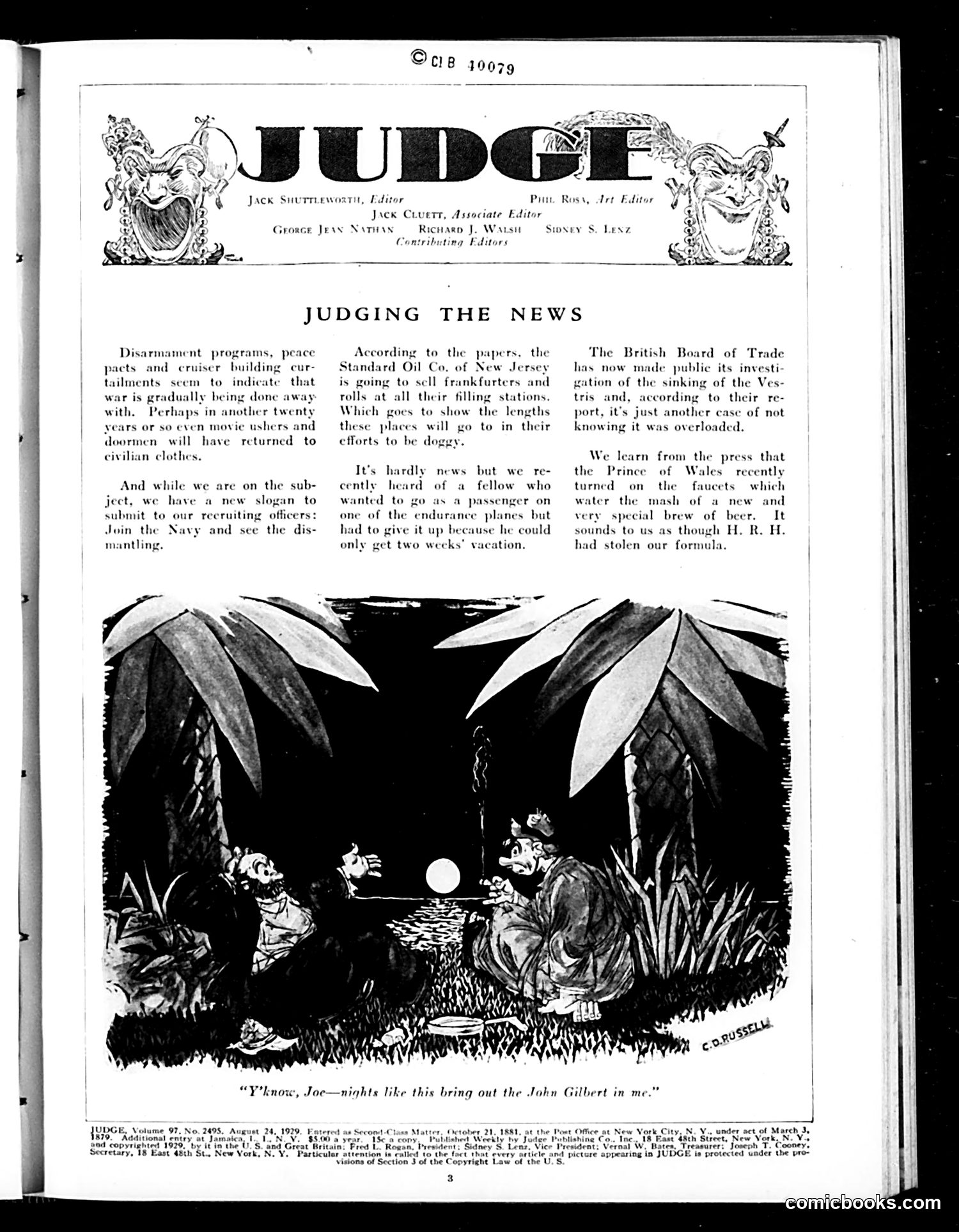
# Analysis of Judge Magazine Page This page contains a satirical editorial section titled "Judging the News" discussing early 1920s topics: disarmament programs, Navy recruitment, and industrial news about Standard Oil and the British Board of Trade. The main cartoon depicts figures in a tropical nighttime setting with large plants and a full moon. The caption reads: "Phone, Joe—nights like this bring out the John Gilbert in me." This references **John Gilbert**, a famous silent film actor known for romantic roles. The joke appears to satirize how moonlit tropical nights inspire romantic sentimentality in men—invoking Gilbert's screen persona as shorthand for exaggerated romantic behavior. The cartoon mocks this performative romanticism as absurd or affected. The overall page blends news commentary with humor typical of Judge's satirical approach to current events and popular culture.
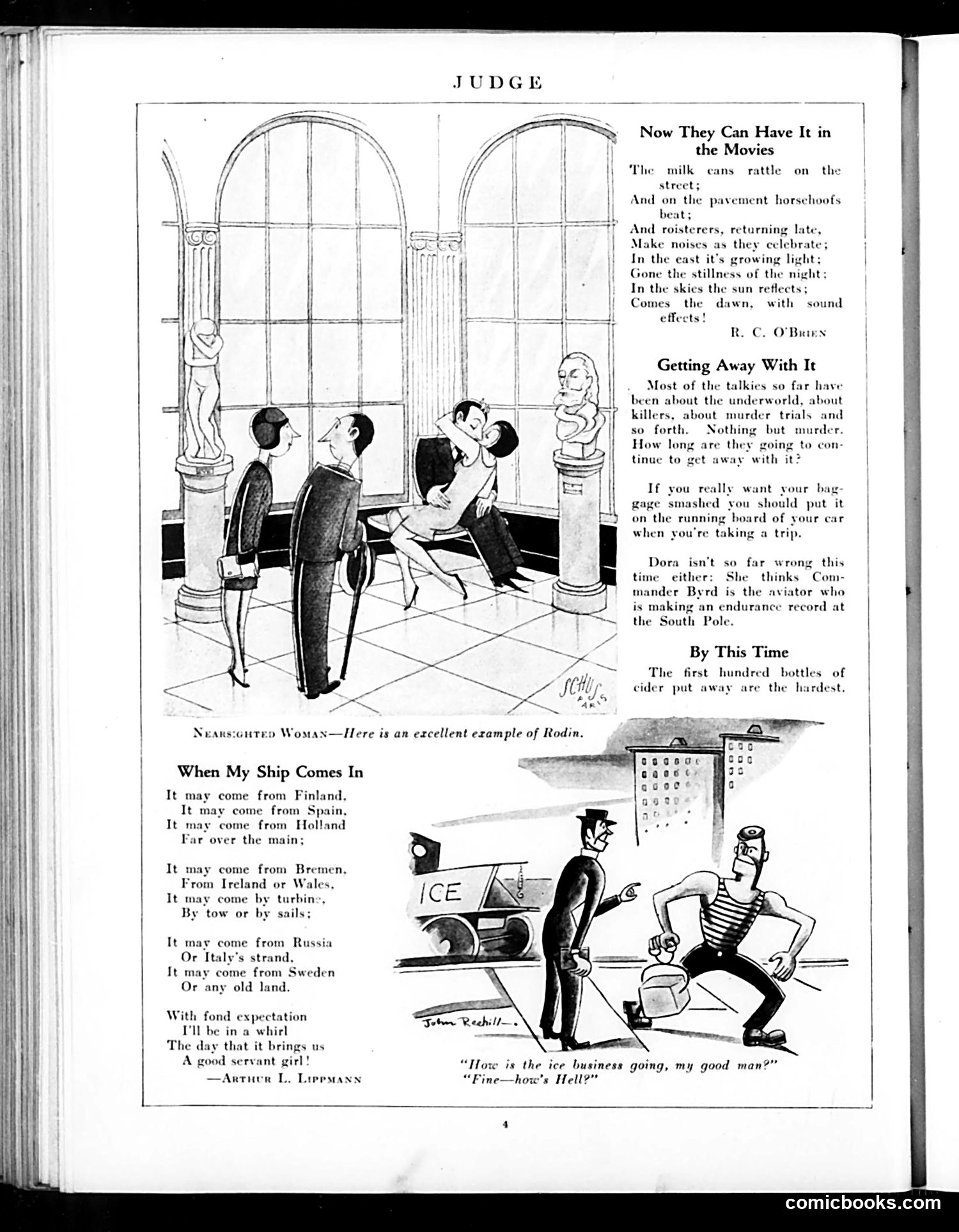
# Judge Magazine Page Analysis This page contains three separate humor pieces typical of 1920s Judge magazine: **"Nearsighted Woman"** (top): A cartoon mocking a woman's poor vision—she mistakes classical statues for real people at what appears to be an art gallery or museum, creating social awkwardness with male visitors. **"When My Ship Comes In"** (bottom left): A poem by Arthur L. Lippmann expressing hopeful anticipation of prosperity, listing various shipping routes. It reflects post-WWI optimism about international commerce and romantic fortune. **"Ice Business" cartoon** (bottom right): A man in formal dress asks an ice delivery worker how business is going during what appears to be economic hardship. The caption "Fine—here's Hell!" suggests dark humor about struggling industries during uncertain economic times, likely referencing the 1920s economic volatility. The overall tone is light social satire typical of Judge's middle-class audience.
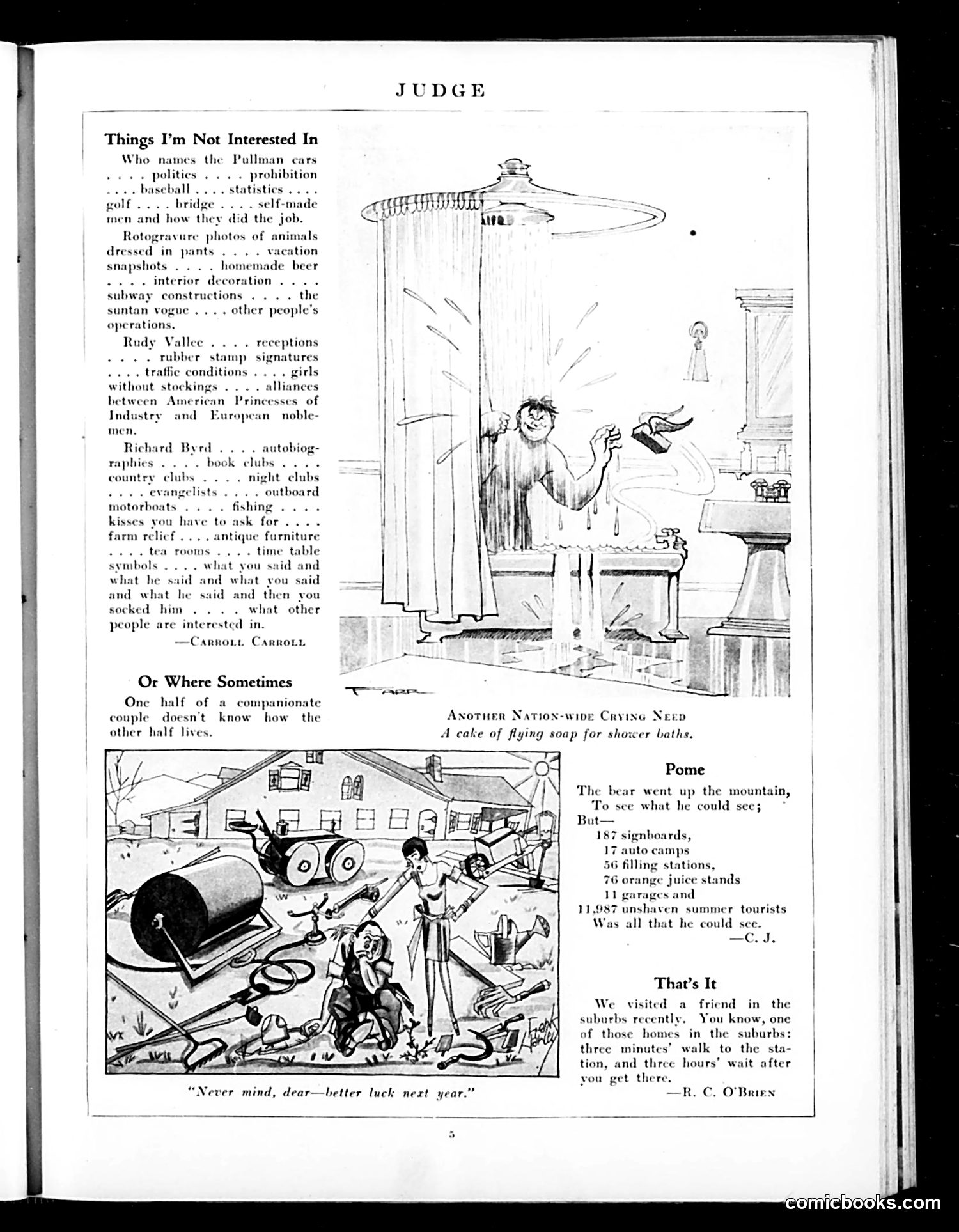
# Analysis of Judge Magazine Page This page contains three separate humorous pieces typical of 1920s Judge magazine: 1. **"Things I'm Not Interested In"** — A satirical list by Carroll Carroll mocking upper-class concerns (Pullman cars, golf, bridge, Rudy Vallée, country clubs, motorboats). 2. **"Another Nation-wide Crying Need"** — A cartoon satirizing modern consumer excess, depicting someone overwhelmed by flying soap for shower baths — mocking frivolous product innovation during the commercialization boom. 3. **"Pome" and "That's It"** — Light verse and observations about suburban overcrowding and poor infrastructure. The bottom cartoon shows domestic chaos ("Never mind, dear—better luck next year"), likely referencing housing shortages or neighborhood congestion issues of the era. The overall tone critiques 1920s consumerism, suburban expansion, and commercialism.
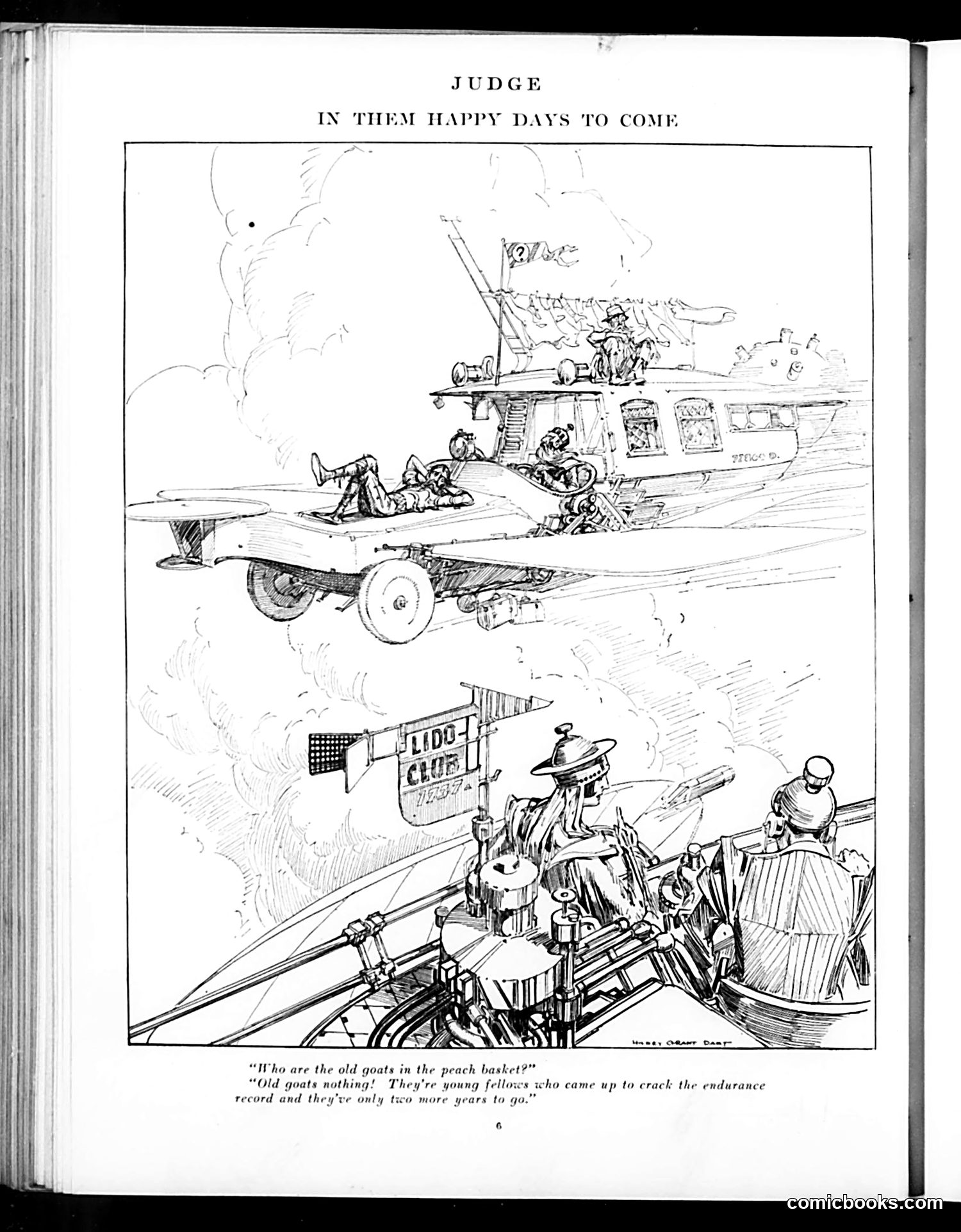
# "Judge in Them Happy Days to Come" This satirical cartoon depicts a futuristic racing scenario where old competitors ("old goats") attempt to break endurance records with only "two more gears to go." The illustration shows multiple vehicles—including what appears to be an early motorboat or speedboat at top and a racing car with a "Lido Club" banner at bottom—suggesting a competitive sporting event. The satire targets aging competitors trying to maintain relevance in modern racing. The phrase "old goats" dismissively characterizes these drivers, while the joke about "two more gears" implies they're mechanically outdated yet stubbornly persistent. This likely mocks real aging athletes or competitors of the era attempting to remain competitive in increasingly modern, speed-focused racing competitions.
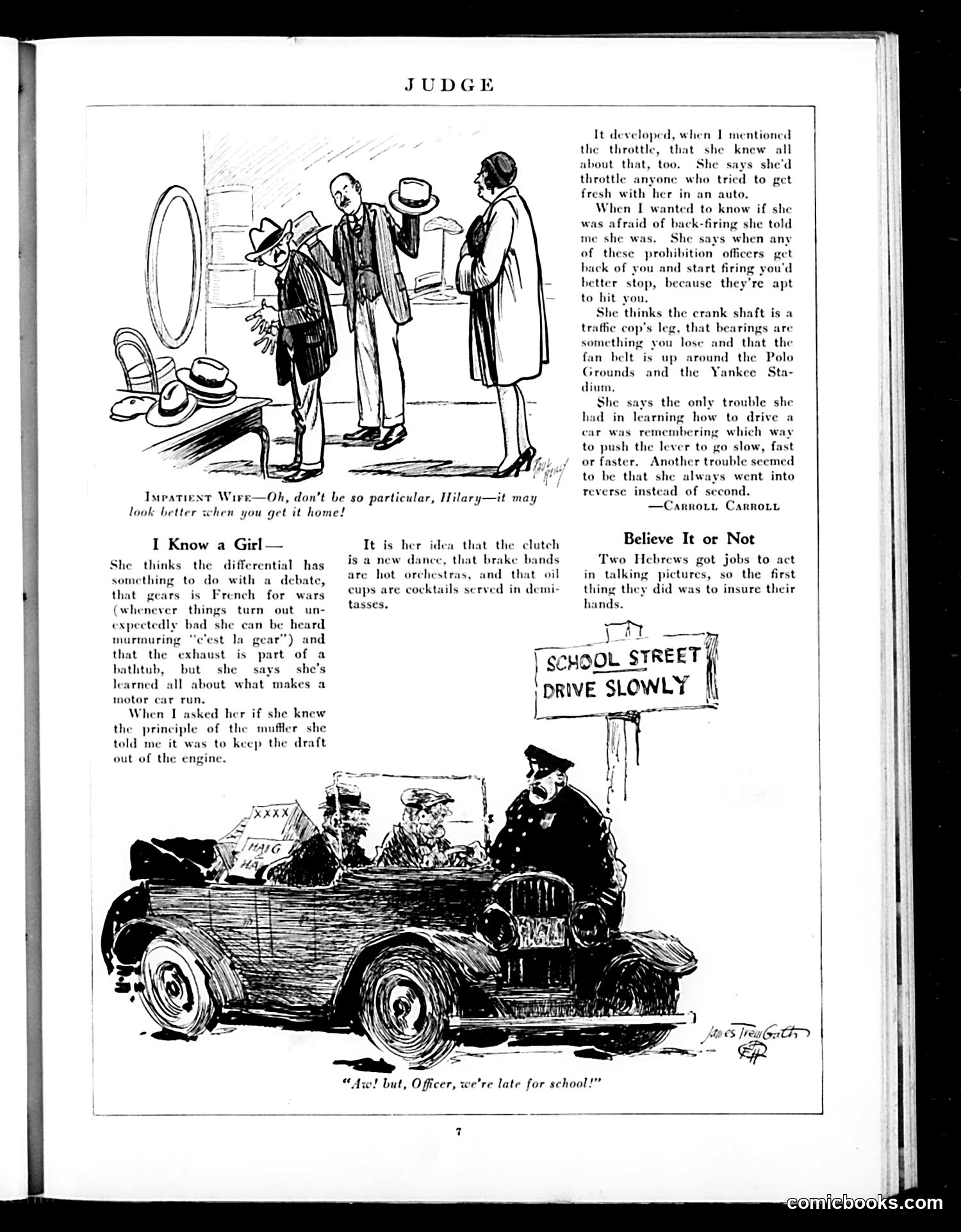
# Explanation for Modern Readers This 1920s-era Judge magazine page contains automotive humor satirizing women's ignorance about cars—a contemporary social anxiety as automobiles became common. **"I Know a Girl"** mocks a woman who confuses car parts with unrelated concepts: the differential with debate, "c'est la gear" (French wordplay), the clutch as a dance, brake bands as orchestras, and oil cups as cocktails. The humor relies on the premise that women mechanically incompetent, yet confident in their cluelessness. **"Impatient Wife"** shows a woman with an obviously broken-down vehicle, dismissing her husband's concerns—satirizing both marital tension and female disregard for practical maintenance. **"Believe It or Not"** features a traffic stop caption about being late for school, likely mocking reckless driving or traffic enforcement. The cartoons reflect 1920s anxiety about women entering the automotive world, presenting female drivers as comically uninformed rather than capable. This reflects the period's cultural resistance to women's independence and technological competence.
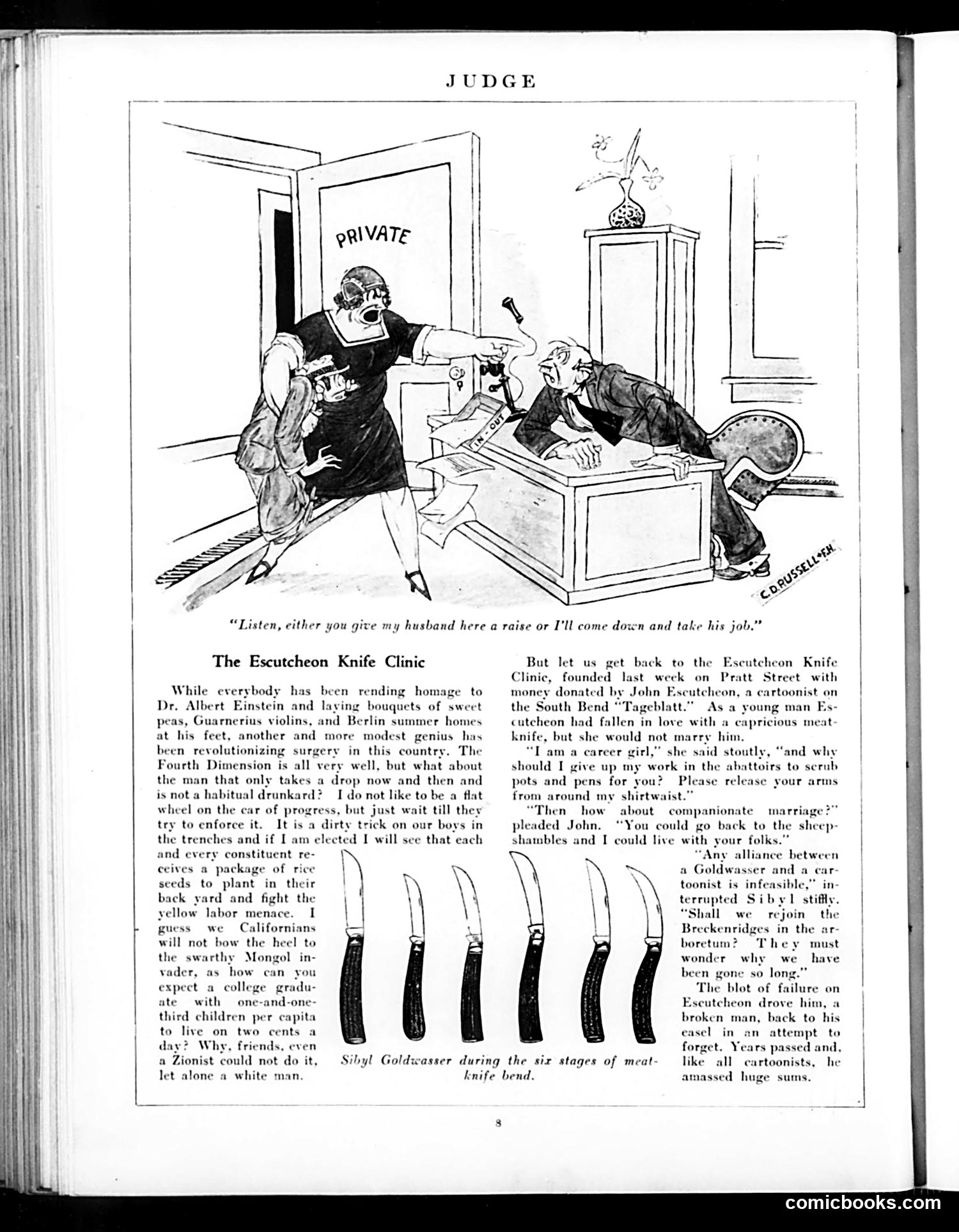
# Explanation for Modern Readers This Judge page contains two satirical pieces: **Top cartoon:** A woman threatens a judge, demanding her husband receive a raise or she'll take his job herself. This mocks traditional gender roles and women's increasing workplace presence post-WWI, suggesting wives as economic threats to men's employment. **"The Escutcheon Knife Clinic" article:** A rambling, nonsensical piece satirizing a failed romance between Sibyl Goldwasser (a cartoonist) and John Escutcheon (who works in meat production). The story parodies melodramatic "companionate marriage" debates—a 1920s concept where couples maintained separate lives and finances. The humor lies in the absurdity: she refuses domestic work, they discuss rejoining the "Breckenridges in the arboretum," and after years apart, he becomes a wealthy cartoonist. The piece mocks modern courtship debates, career women, and the pretensions of bohemian intellectuals, while the knife illustrations reference the meat industry setting.
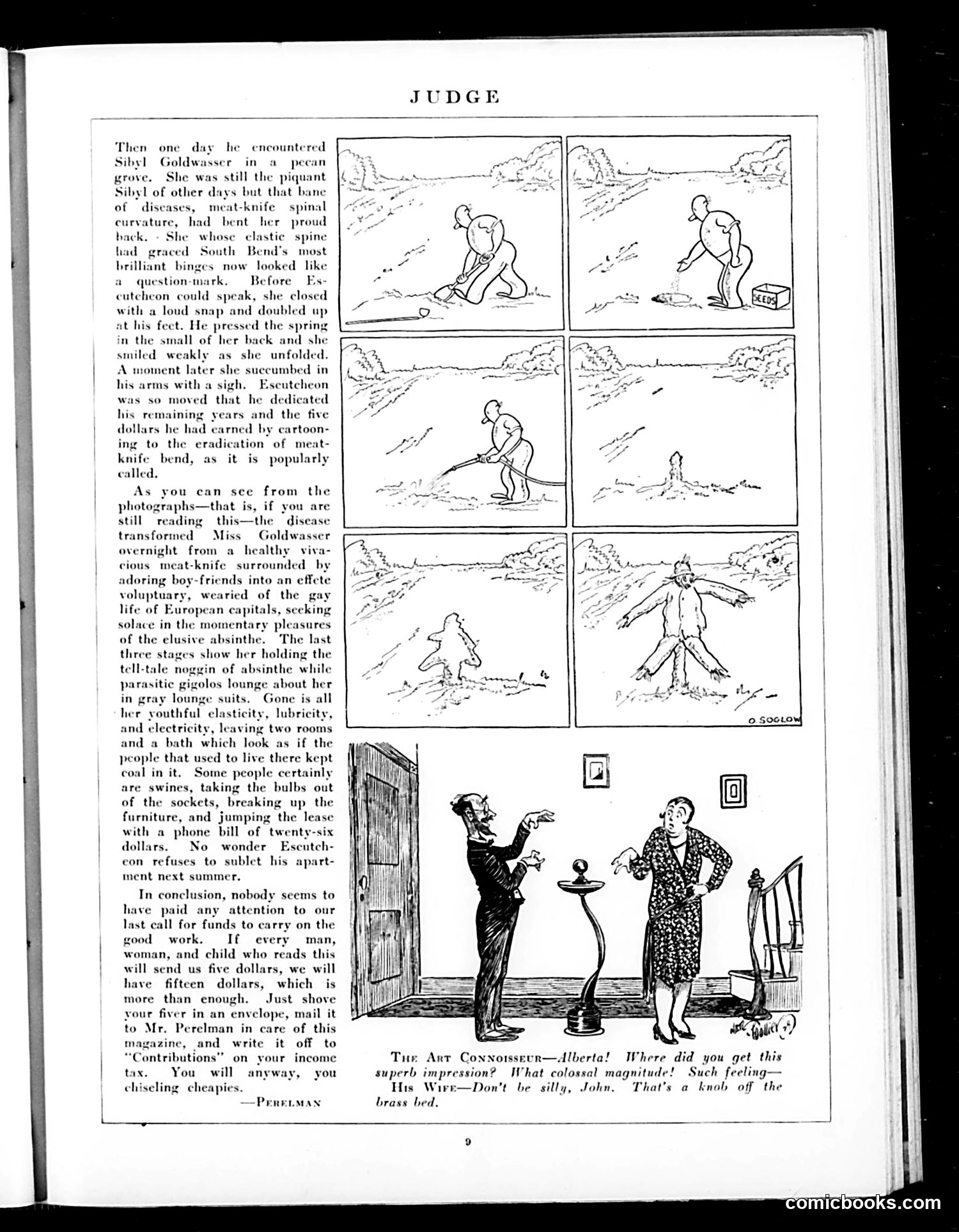
# Judge Magazine Satire Analysis This page contains two distinct satirical pieces: **Upper section**: A narrative about "Sibyl Goldwasser" suffering from "meat-knife bend"—a spinal curvature caused by excessive corset-wearing. The six-panel sequence illustrates her physical deterioration from this fashionable but dangerous practice. The story mocks both the vanity of women pursuing impossible beauty standards and the pseudo-medical consequences of tight-lacing corsets, which actually did cause skeletal deformation in the early 20th century. The protagonist's dramatic response satirizes sentimental male rescuer narratives. **Lower section**: A brief domestic comedy showing an "Art Connoisseur" admiring what he describes as an impressive sculpture, while his wife reveals it's simply "a knob off the brass bed." The joke mocks pretentious art appreciation and the gap between aesthetic pretension and mundane reality. Both pieces exemplify *Judge*'s trademark humor: satirizing contemporary fashion obsessions, gender dynamics, and social pretension through exaggerated illustration and ironic text.
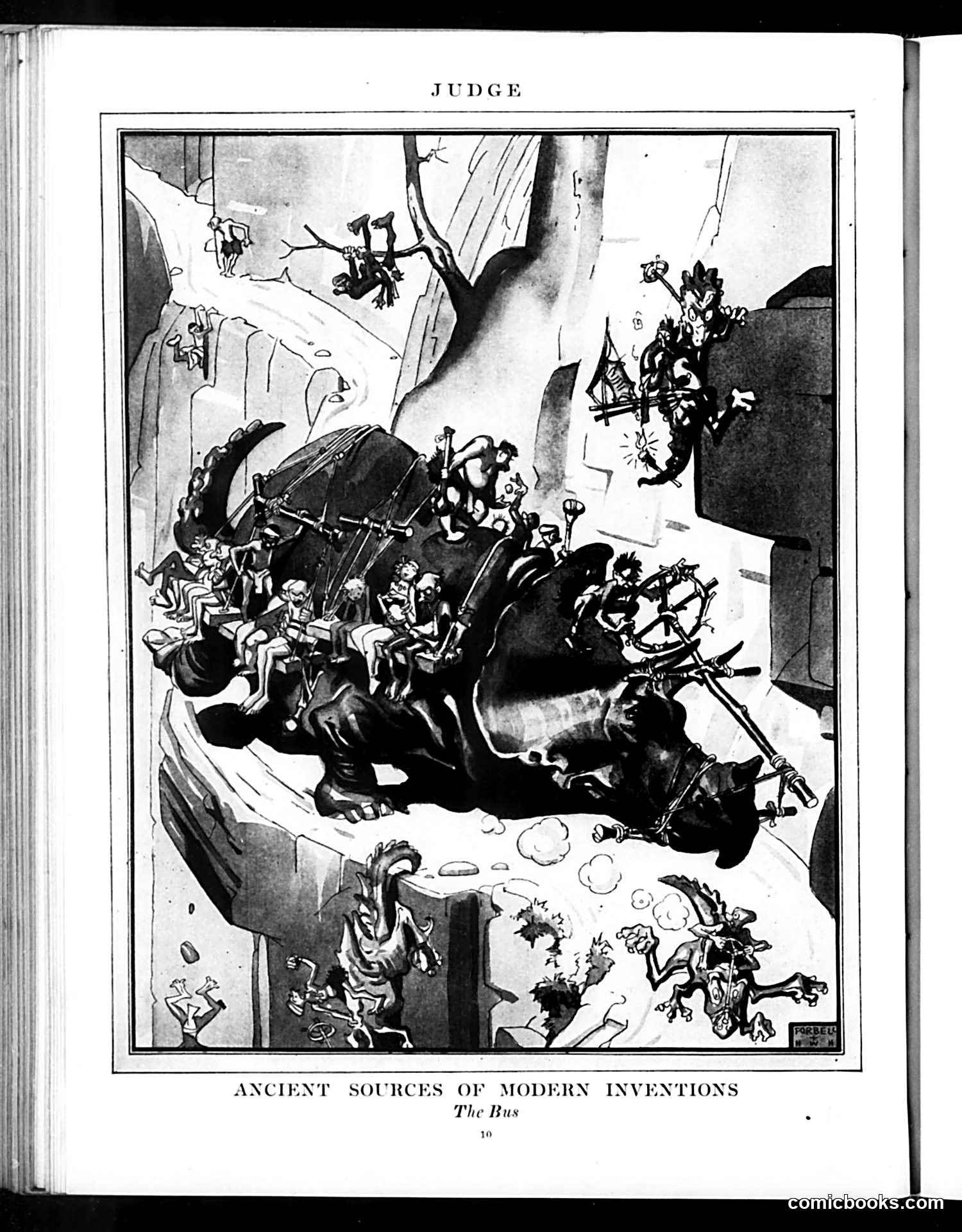
# "Ancient Sources of Modern Inventions: The Bus" This cartoon presents a humorous "historical origin" of the modern bus by depicting it as descended from ancient Roman chariots and conveyances. The image shows a crowded, chaotic scene with multiple figures packed into and atop a large vehicle navigating through what appears to be classical architecture. The satire works on two levels: it suggests that crowded public transportation is nothing new (mocking modern inconvenience as ancient), and likely comments on the uncomfortable, chaotic nature of contemporary bus travel—where passengers are crammed together much like soldiers or citizens in ancient times. The visual exaggeration emphasizes how little has truly improved in passenger comfort across millennia, offering social commentary on urban transportation's inherent discomforts.