
Judge, 1929-08-24 · page 15 of 36
Judge — August 24, 1929 — page 15: what you’re looking at
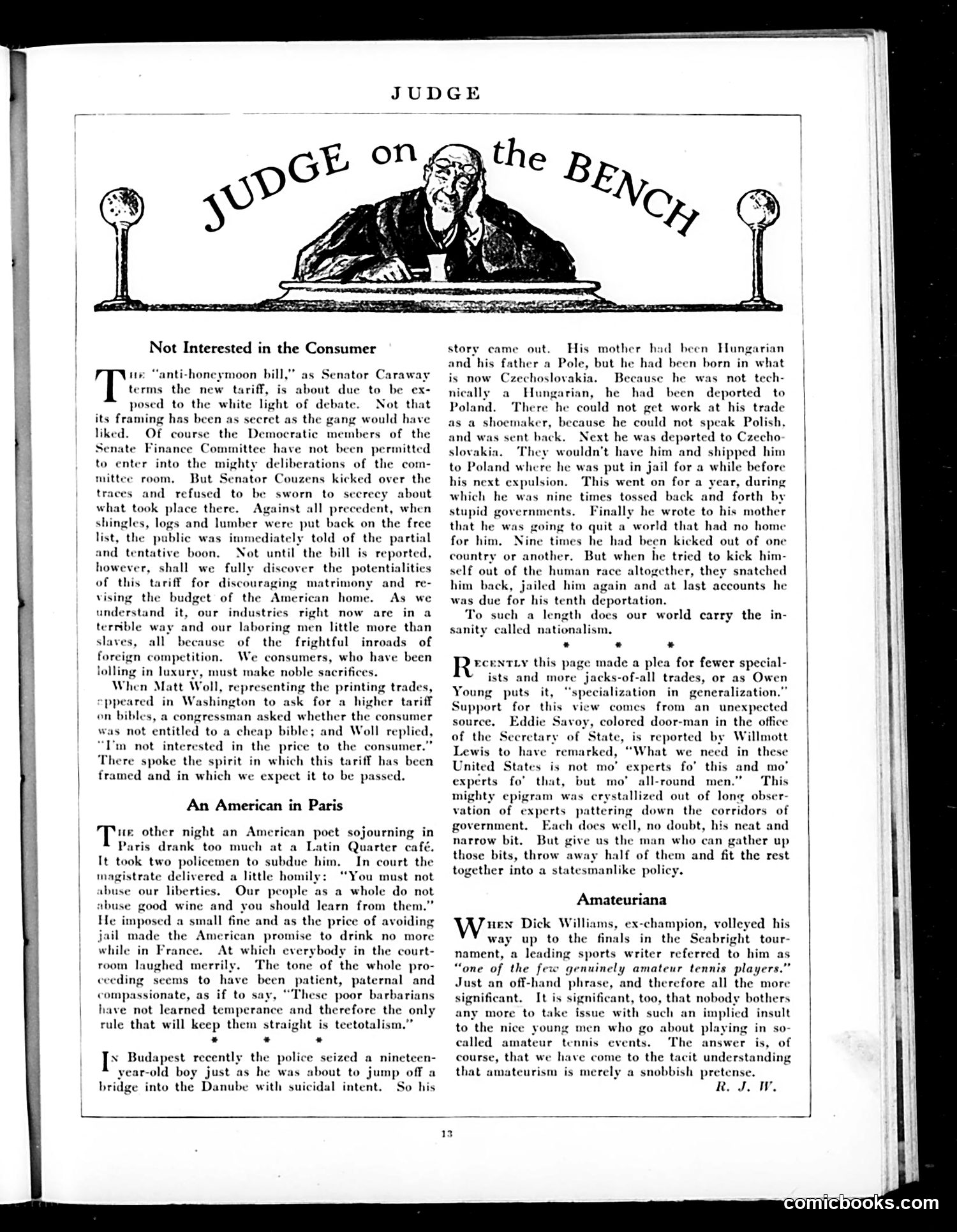
A restored page from Judge, 1929-08-24. Page through the whole issue in the reader above.
📄 Transcribed text from this page (OCR, searchable)
Machine-transcribed from the original scan — historical spelling and the odd misread are preserved.
Not Interested in the Consumer ie “anti-honeymoon bill,” as Senator Caraway terms the new tariff, about due to be ex- posed to the white light of debate. Not that its framing has been as secret as the gang would have liked. Of course the Democratic members of the ¢ Finance Committee have not been permitted nter into the mighty deliberations of the com- mittee room, But Senator Couzens kicked over the traces and refused to be sworn to secrecy about chat took place there. Against all precedent, when es, logs and lumber were put back on the free list, the public was immediately told of the partial and tentative boon, Not until the bill is reported, however, shall we fully discover the potentialities of this tariff for discouraging matrimony and. re- vising the budget of the American home. As we understand it, our industries right now are in a terrible way and our laboring men little more than all because of the frightful inroads of n competition. We consumers, who have been lolling in luxury, must make noble sacrifices. When Matt Woll, representing the printing trades, ppeared in Washington to ask for a higher tariff on bibles, a congressman asked whether the consumer was not entitled to a cheap bible; and Woll replied, “I'm not interested in the price to the consumer.” There spoke the spirit in which this tariff has been framed and in which we expect it to be passed. An American in Paris ue other night an American poet sojourning in Paris drank too much at a Latin Quarter café. It took two policemen to subdue him. In court the istrate delivered a little homily: “You must not abuse our liberties. Our people as a whole do not stbuse good wine and you should learn from them.” He imposed a small fine and as the price of avoiding jail made the American promise to drink no more while in France. At which everybody in the court- room laughed merrily. The tone of the whole pro- ceeding seems to have been patient, paternal and compassionate, as if to say, ‘These poor barbarians have not learned temperance and therefore the only rule that will keep them straight is teetotalism.” * * * [* Budapest recently the police seized a nineteen- year-old boy just as he was about to jump off a ge into the Danube with suicidal intent. So his story came out. His mother had been Hungarian and his father a Pole, but he had been born in what is now Czechoslovakia. Because he was not tech- nically Hungarian, he had been deported to Poland. There he could not get work at his trade as a shoemaker, because he could not speak Po and was sent back. Next he was deported to Cze slova They wouldn't have him and shipped him to Poland where he was put in jail for a while before his next expulsion. This went on for a year, during which he was nine times tossed back and forth by stupid governments. Finally he wrote to his mother that he was going to quit a world that had no home for him. Nine times he had been kicked out of one country or another. But when he tried to kick him- self out of the human race altogether, they snatched him back, jailed him again and at last accounts he was due for his tenth deportation. To such a length does our world carry the in- sanity called nationalism. * * * R ntLy this page made a plea for fewer special- ists and more jacks-of-all trades, or as Owen Young puts it, “specialization in generalization.” Support for this view comes from an unexpected source. Eddie Savoy, colored door-man in the office of the Scerctary of State, is reported by Willmott Lewis to have remarked, “What we need in these United States is not mo’ experts fo’ this and mo’ experts fo’ that, but mo’ all-round men.” — This mighty epigram was crystallized out of long obser- vation of experts pattering down the corridors of government. Each does well, no doubt, his neat and narrow bit. But give us the man who can gather up s, throw y half of them and fit the rest ther into a statesmanlike policy. Amateuriana Ws Dick Williams, ex-champion, volleyed his way up to the finals in the Seabright tour- nament, a leading sports writer referred to him as “one of the few genuinely amateur tennis players.” Just an off-hand phra and therefore all the more significant. It is significant, too, that nobody bothers any more to take issue with such an implied insult to the nice young men who go about playing in so- called amateur tennis events. The answer is, of course, that we have come to the tacit understanding that amateurism is merely a snobbish pretense. R. J. W.