
A complete issue · 36 pages · 1929
Judge — February 9, 1929
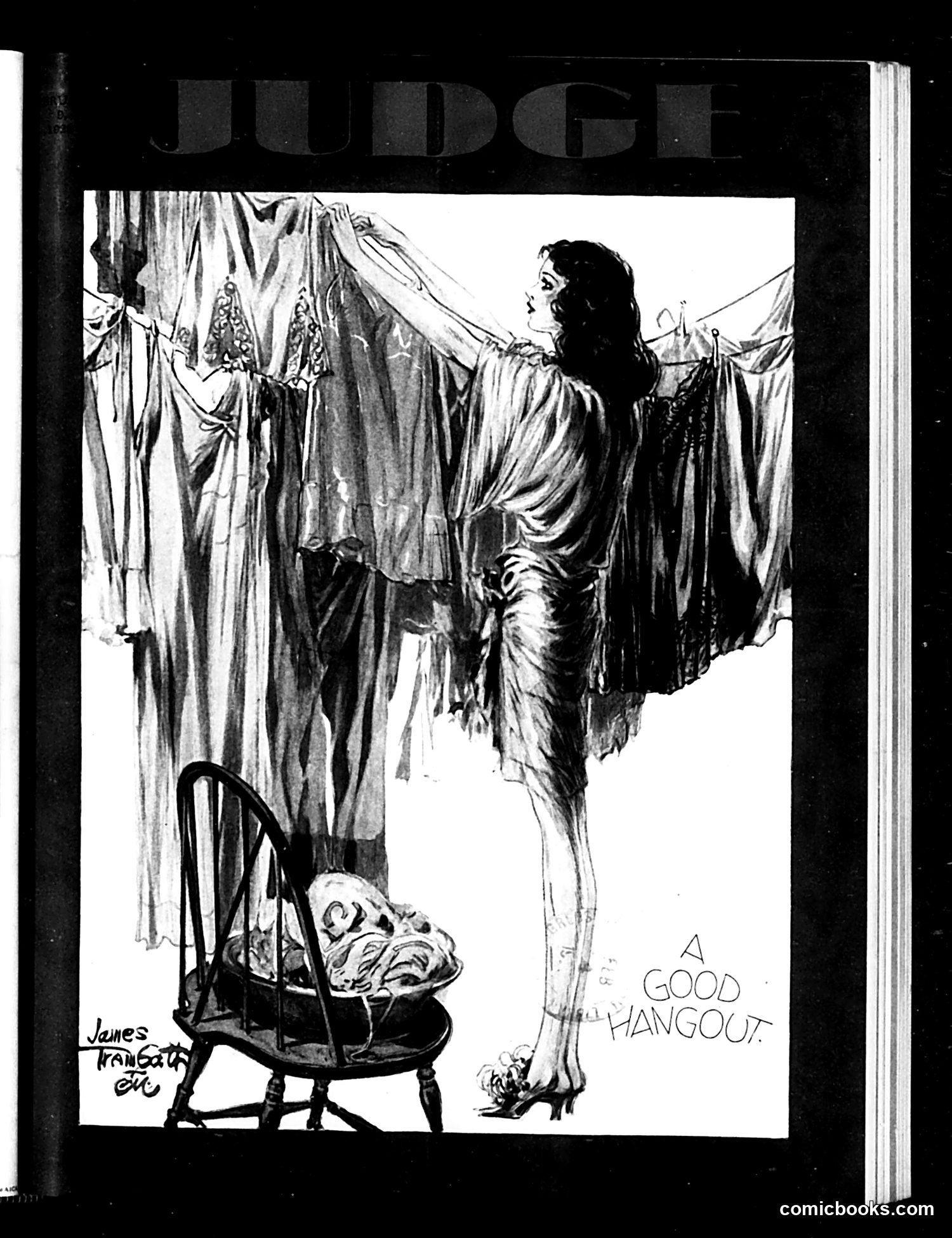
This Judge magazine illustration by James Montgomery Flagg depicts a woman hanging laundry while examining clothes, with the caption "A Good Hangout." The satire likely references domestic life and laundry work, common subjects in early 20th-century humor magazines. The pun on "hangout" (a gathering place) and literal hanging of clothes suggests the cartoon jokes about women's domestic sphere—their social lives centered on household tasks. The woman's fashionable appearance and the detailed rendering of the laundry implies commentary on domestic labor, possibly satirizing either the drudgery of housework or attitudes toward women's roles. Without additional context about Judge's publication date or broader contemporary issues, the specific political or social reference remains unclear, though the image reflects period attitudes toward gender and domesticity.
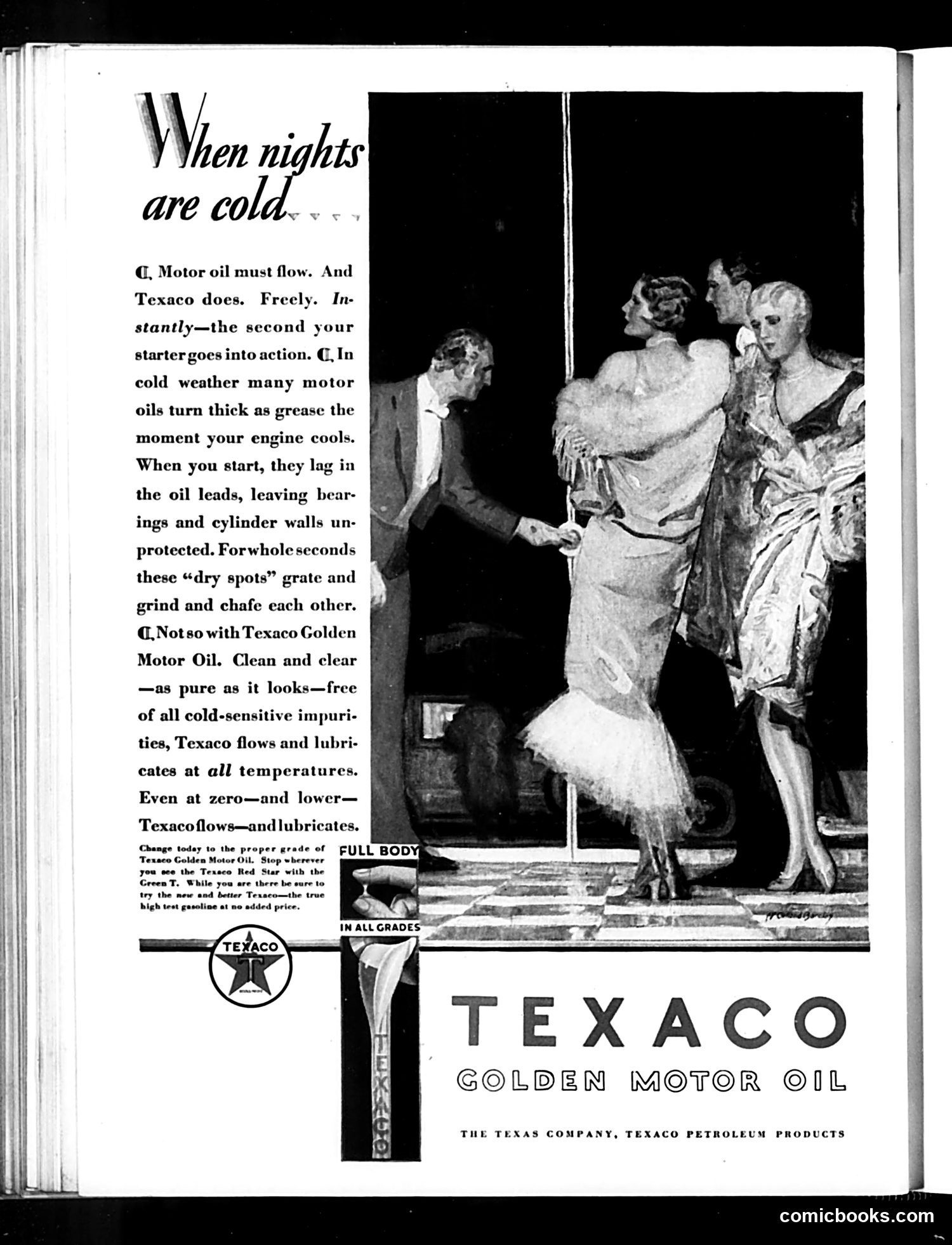
This is primarily a **Texaco Golden Motor Oil advertisement**, not satirical content. The ad uses a glamorous nightclub scene featuring elegantly dressed figures—likely dancers or entertainers—to associate the product with sophistication and modernity. The advertisement's appeal relies on luxury lifestyle imagery typical of 1920s-1930s advertising. The text emphasizes the oil's superior cold-weather performance, contrasting inferior oils that "turn thick as grease" in winter with Texaco's consistent flow at all temperatures. There is **no political satire or cartoon element** on this page. Judge magazine, while known for satirical content, was also a premium publication that carried luxury advertisements. This represents straightforward commercial marketing leveraging aspirational imagery rather than social commentary.
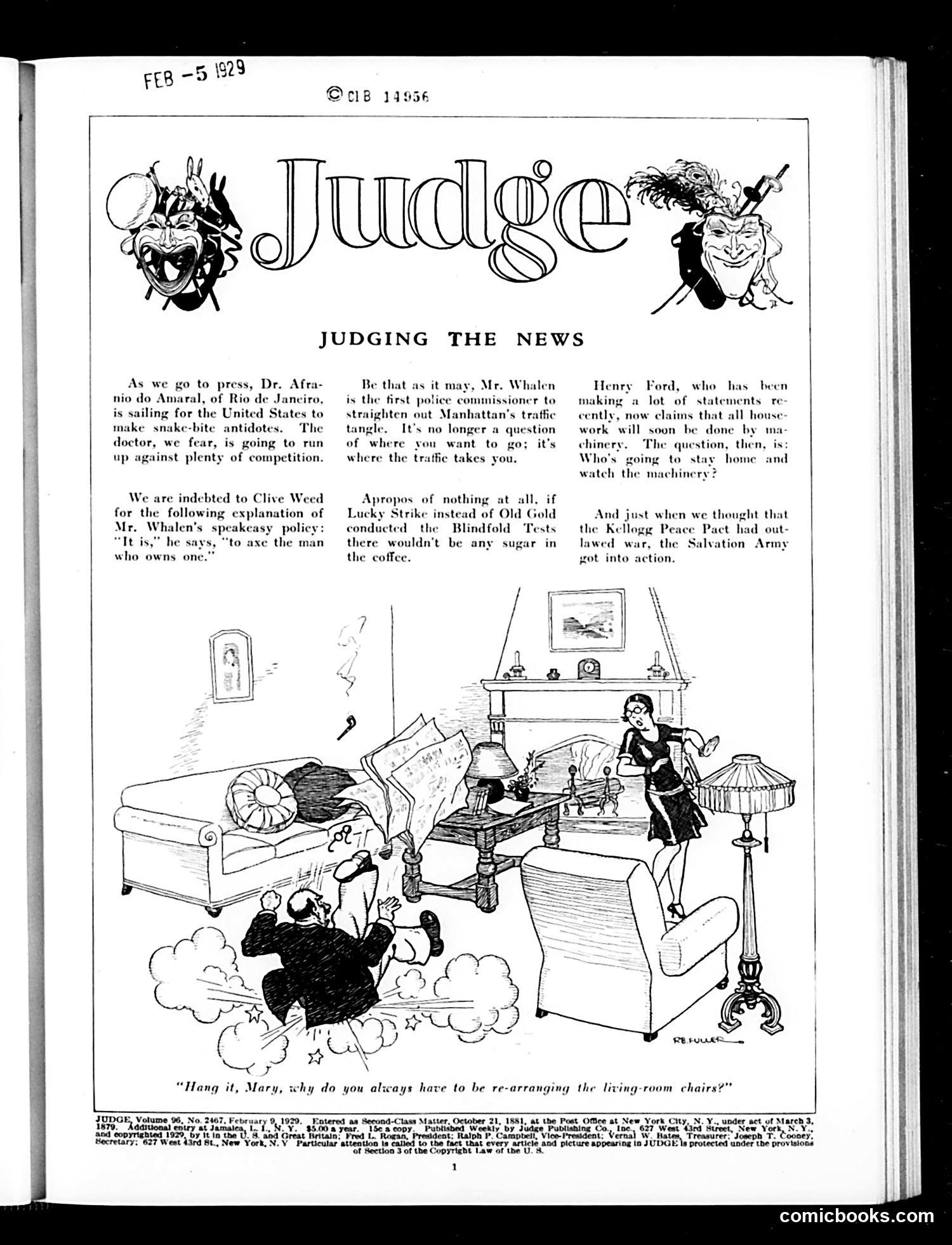
This satirical column comments on contemporary news items. The main cartoon depicts a domestic chaos scene with a woman exasperatedly asking "Hang it, Marg, why do you always have to be re-arranging the living room chairs?" The humor appears to satirize women's domestic habits and the exhaustion of husbands—a common 1920s trope. The accompanying text references police traffic enforcement (Commissioner Whalen straightening Manhattan's traffic), Henry Ford's factory production claims, and the Salvation Army taking action during an unspecified conflict. The specific news events are unclear without additional historical context, but the page exemplifies Judge's characteristic commentary mixing domestic comedy with contemporary events.
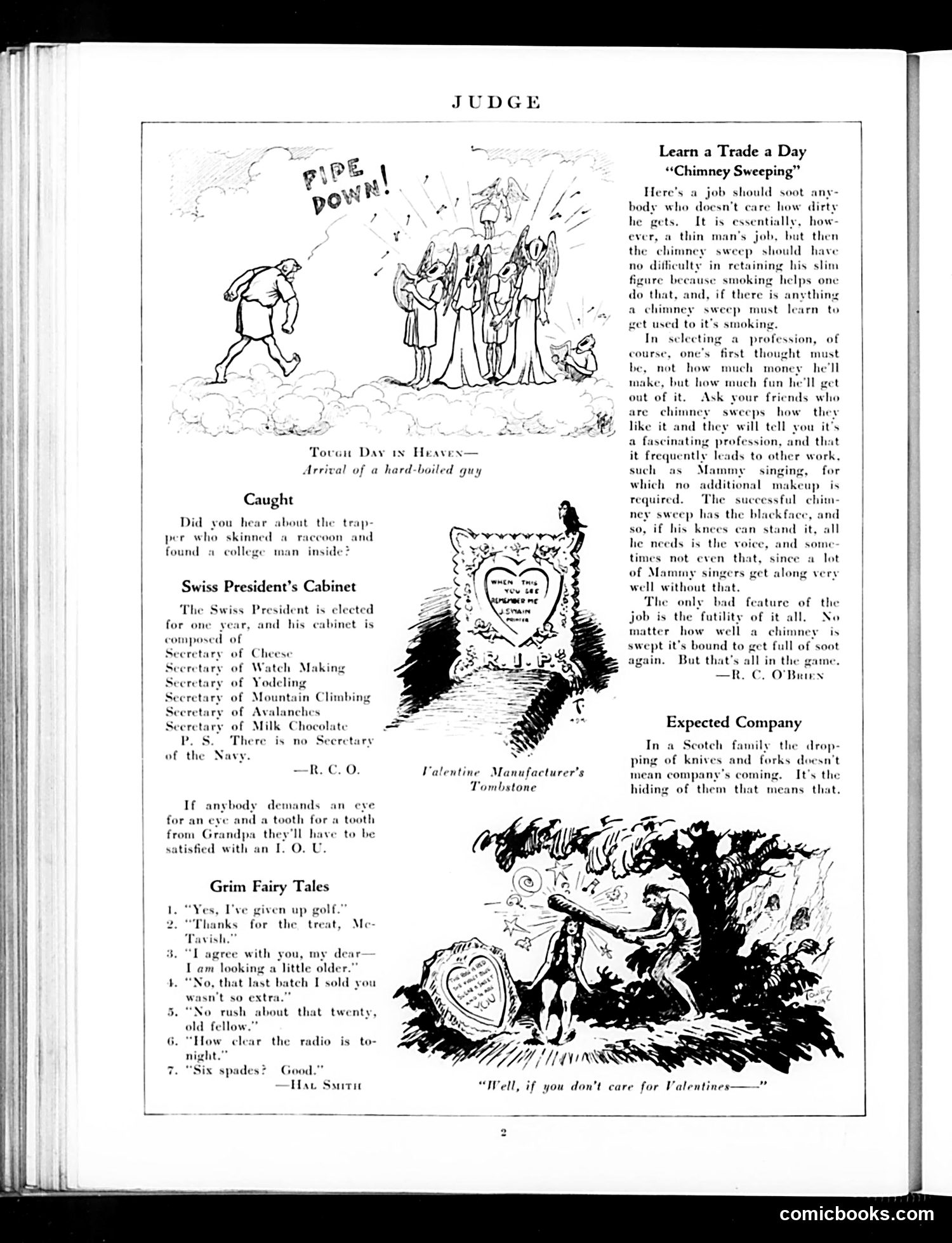
This satirical page from Judge magazine contains several unrelated humor pieces: **"Pipe Power!"** (top): A figure labeled "Torch Day is Heaven" sprays something at a group of people, likely satirizing a specific political figure or event, though the exact reference is unclear without dating information. **Swiss President's Cabinet**: A joke about Switzerland electing a president whose cabinet comprises officials overseeing stereotypical Swiss activities (cheese, yodeling, mountain climbing, milk chocolate). This mocks Swiss national stereotypes. **"Grim Fairy Tales"**: A series of cynical one-liners subverting familiar sayings—people abandoning hobbies, rejecting charity, and embracing materialism. The humor lies in deflating romantic ideals with modern cynicism. **Valentine Manufacturer's Tombstone & "Expected Company"**: These mock Valentine's Day sentimentality and Scottish hospitality customs, respectively. The page reflects 1920s-era American satirical sensibilities, mixing political commentary with social observation and ethnic humor typical of the period.
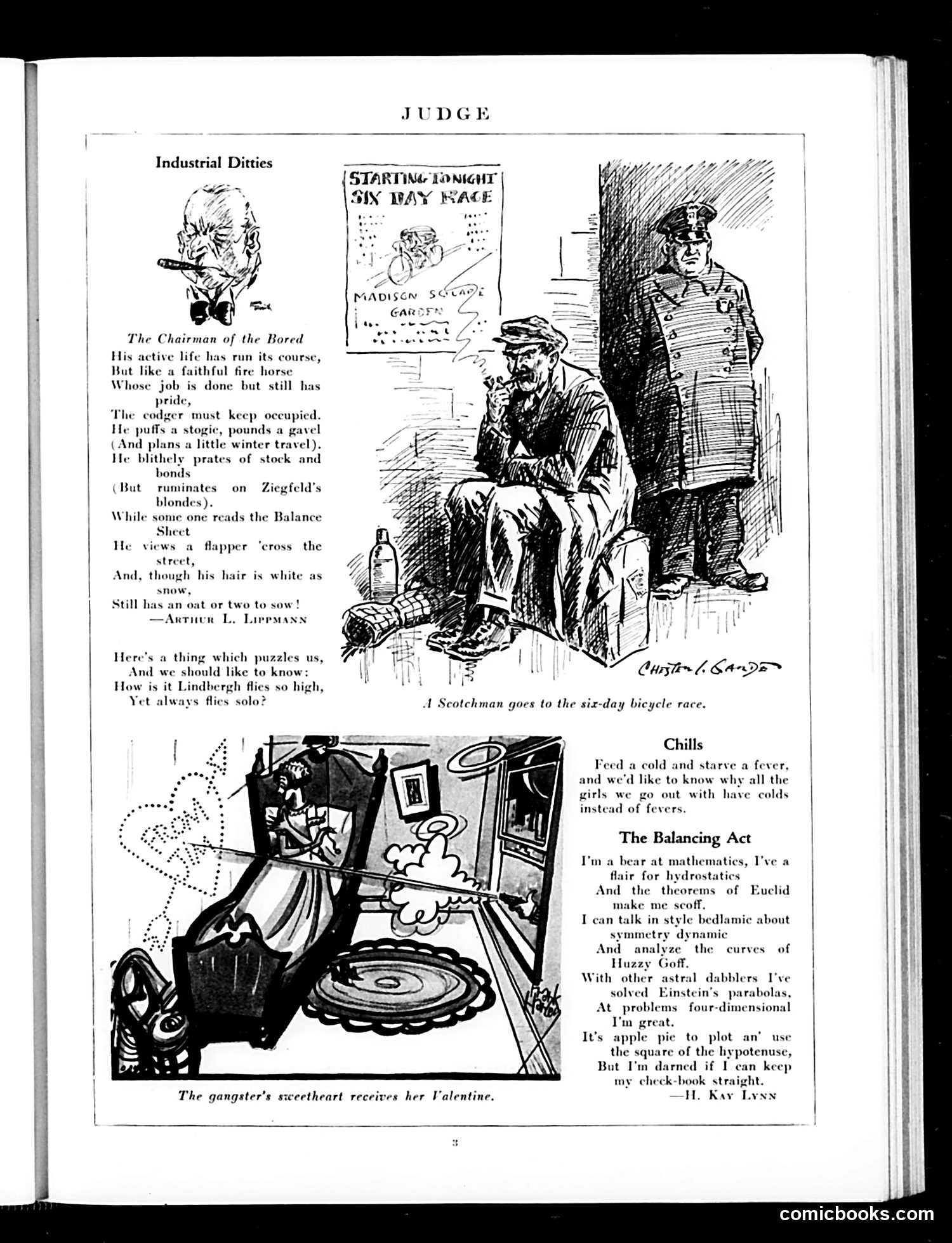
This page contains three satirical pieces: 1. **"Industrial Ditties"** (top left): A poem by Arthur L. Lippmann mocking a bored chairman who occupies himself with trivial activities while reading financial sheets—satirizing corporate executives disconnected from meaningful work. 2. **"A Scotchman goes to the six-day bicycle race"** (center): A cartoon showing what appears to be a Scottish man at a cycling event with a military figure, likely satirizing Scottish frugality or the incongruity of Scottish attendance at such events. 3. **"The gangster's sweetheart receives her Valentine"** (bottom): Shows a woman in a car receiving a Valentine, satirizing romantic gestures within criminal underworld culture—a topical reference to Prohibition-era organized crime and its social permeation. 4. **"Chills"** and **"The Balancing Act"** (right): Brief humorous verse pieces on unrelated topics.
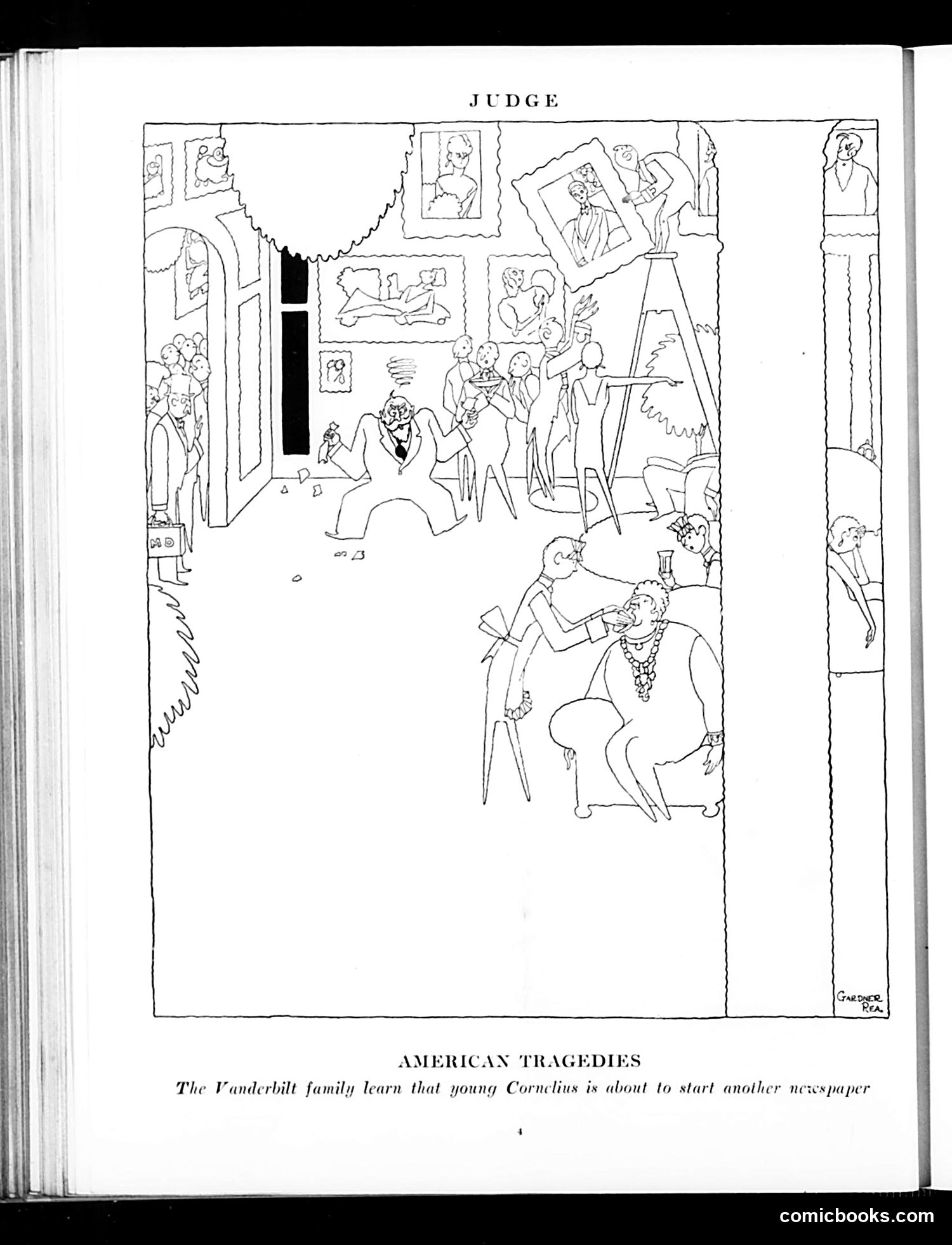
This cartoon depicts an art gallery or salon scene titled "American Tragedies." The caption states: "The Vanderbilt family learn that young Cornelius is about to start another newspaper." The satire mocks the Vanderbilt family's apparent distress upon learning that a young family member plans to launch yet another newspaper venture. The humor relies on the Vanderbilts' legendary wealth and the implication that starting newspapers was either a frivolous hobby for the ultra-rich or that the family was already burdened with too many such projects. The gathered crowd's dramatic reactions—shown through exaggerated gestures and expressions—parodies the theatrical nature of wealthy society's "tragedies," suggesting that wealthy families' problems are trivial compared to actual hardship. This satirizes both Gilded Age excess and media proliferation of the era.
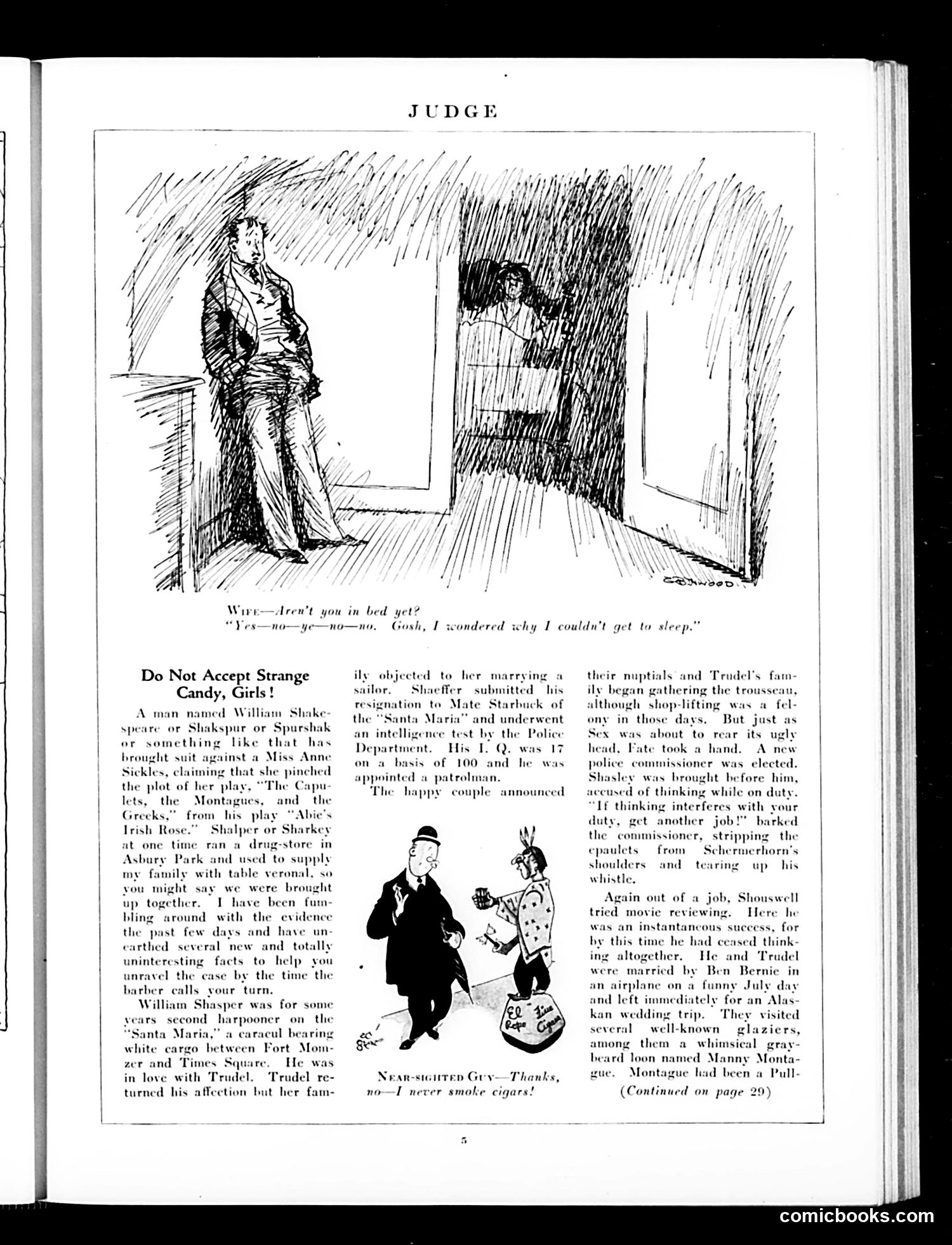
This page contains a domestic comedy story titled "Do Not Accept Strange Candy, Girls" about a man named William Shakespeare (or variations: Shakspure/Sparshak) who brought suit against Miss Anne Nichols, the playwright. The narrative appears to be a fictionalized satire referencing a real legal dispute. The two cartoons illustrate marital discord: the top shows a husband and wife's nighttime argument, while the lower cartoon ("Near-sighted Cry") depicts a man offering cigars to a woman with a baby carriage. The story describes a police intelligence test and romantic entanglements. However, without knowing the specific 1920s-era lawsuit details or identifying the real people behind these satirical names, the precise targets of this satire remain unclear.
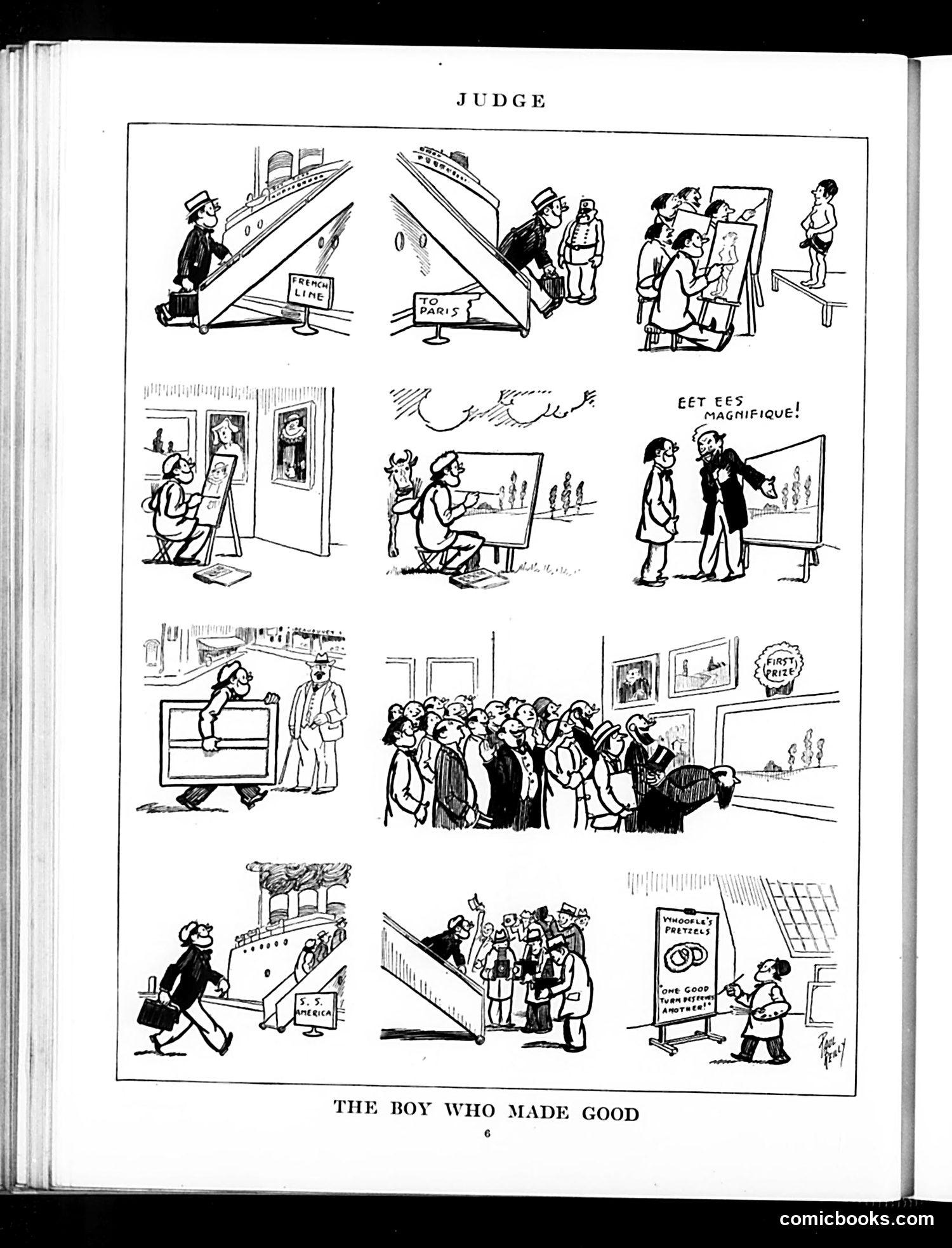
This multi-panel cartoon from *Judge* satirizes the art world's arbitrariness and commercialism. The narrative follows a young artist's path from struggling obscurity to celebrated success. Early panels show him painting landscapes while galleries reject his work. A turning point occurs when critics and society suddenly embrace his art—labeled "magnifique"—without apparent change in quality. The final panels depict crowded gallery openings and commercial triumph, including a "First Prize" ribbon. The satire suggests that artistic merit matters less than fashion, critical acclaim, and market forces. Success appears arbitrary: the same paintings rejected initially are celebrated later. The title's irony—"made good"—hints at commercial success replacing genuine artistic achievement as the measure of a painter's worth.
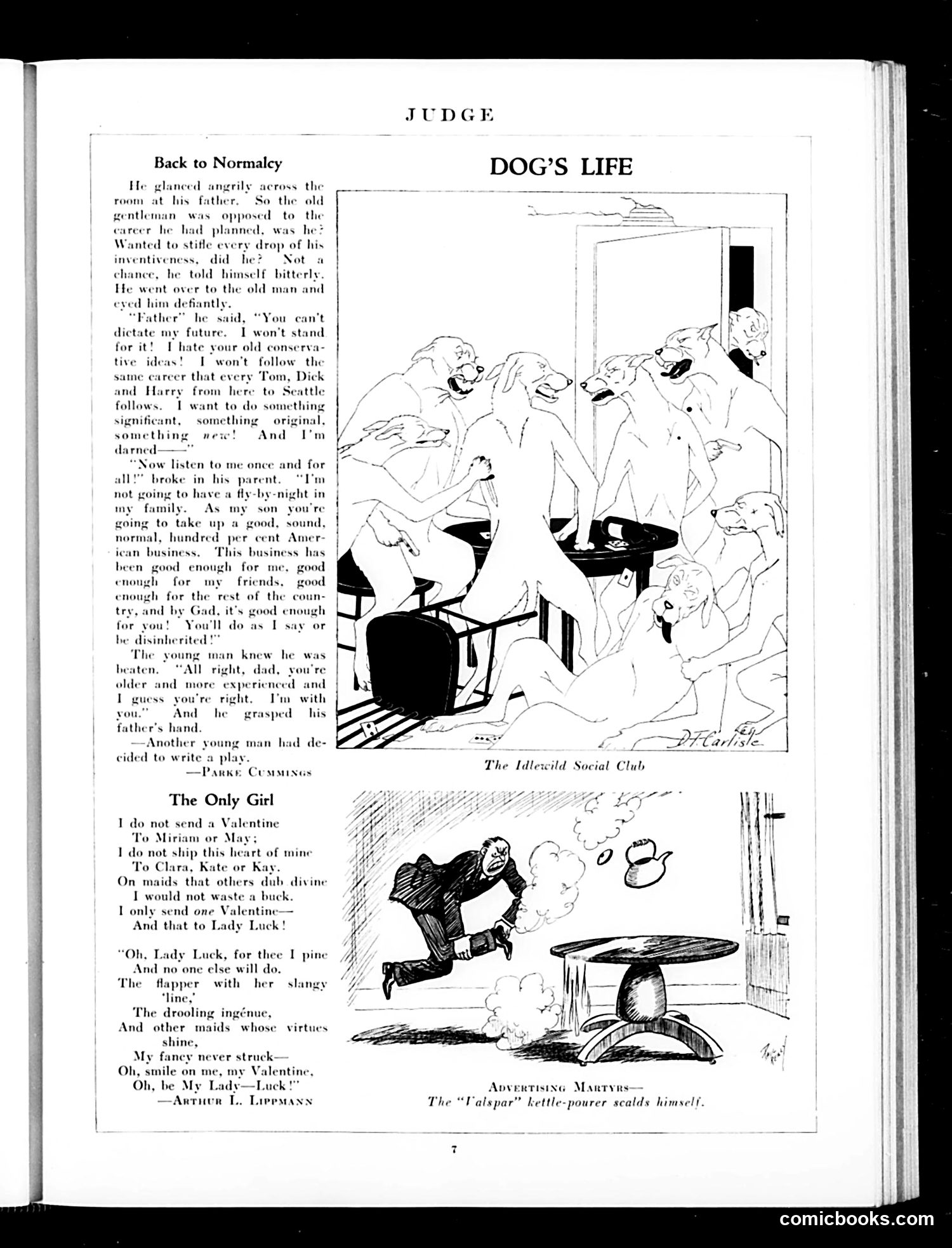
This page contains three satirical pieces typical of early 20th-century American humor: **"Back to Normalcy"** mocks the generational conflict of the post-WWI era. A rebellious young man declares he won't follow his father's conservative career path, wanting instead to do something "original" and "significant." His father threatens disinheritance, and the son immediately capitulates—the joke being that radical individualism crumbles instantly when money is threatened. The title references Warren Harding's 1920 campaign promise of "return to normalcy," suggesting American youth ultimately conform to business-as-usual. **"The Only Girl"** is a lighthearted poem by Arthur Lipmann about a man who sends a Valentine only to "Lady Luck"—rejecting flapper girls and ingénues for fortune itself. **"Dog's Life"** cartoons show domestic absurdities: dogs at a social club and an advertising kettle-pourer scalding himself. These are simple visual gags without deeper political meaning. The page reflects post-war anxieties about youth rebellion, conformity, and commercial culture.
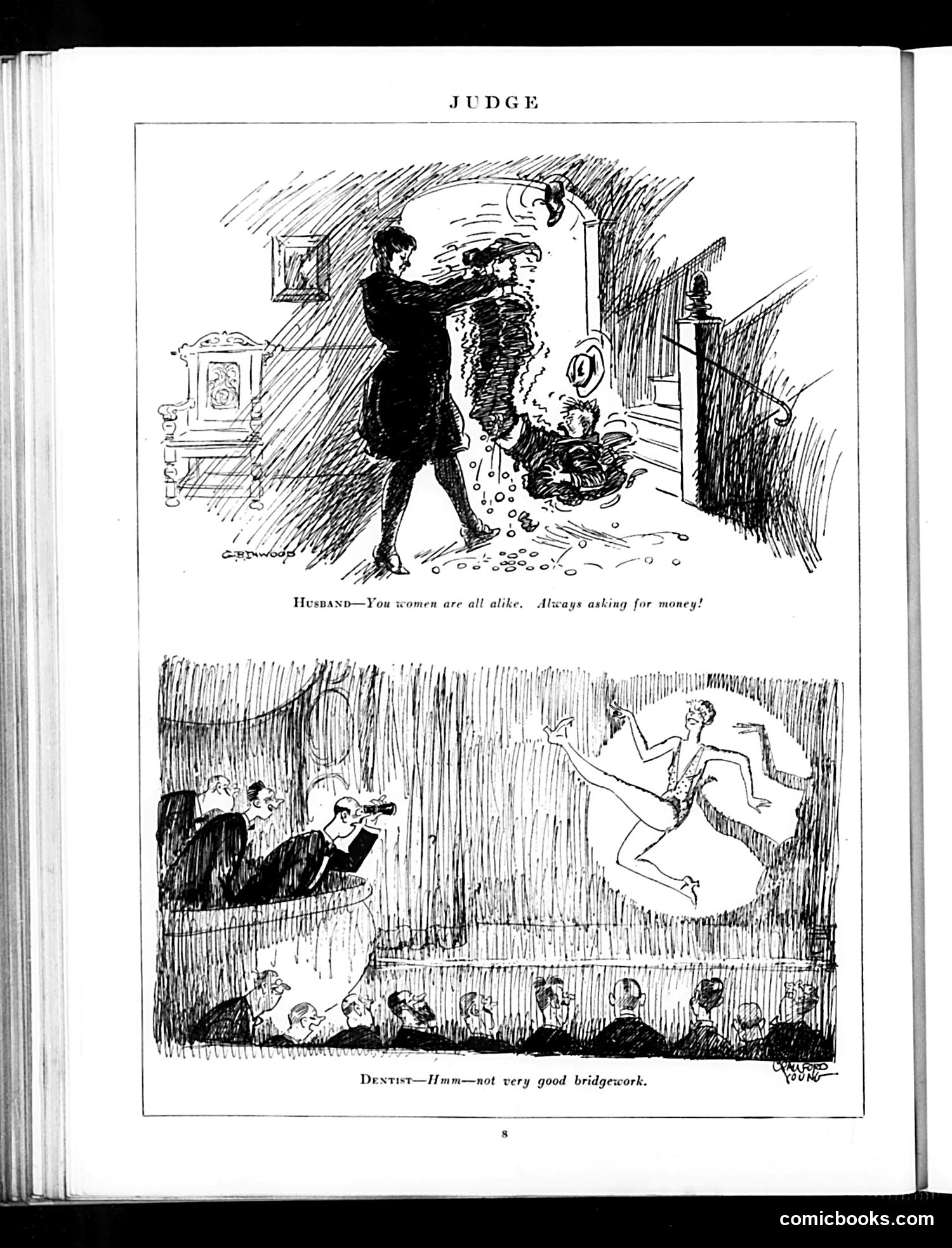
This page contains two satirical cartoons critiquing gender relations and social hypocrisy. **Top cartoon:** A husband shakes money from his wife in a judge's chamber, accusing women of always wanting money. The irony is obvious—he's literally extracting her funds while making this complaint. **Bottom cartoon:** At a theater, a dentist comments "Hmm—not very good bridgework" while watching an acrobatic female performer on stage. The humor lies in the double meaning: he's professionally evaluating her teeth/dental work while she performs, highlighting how men objectify women even in inappropriate contexts. Both cartoons satirize male hypocrisy regarding women and money—men simultaneously control finances while blaming women for financial dependence, and reduce women to objects for professional or sexual assessment. The satire targets outdated attitudes about gender, wealth, and women's autonomy in early-to-mid 20th century America.
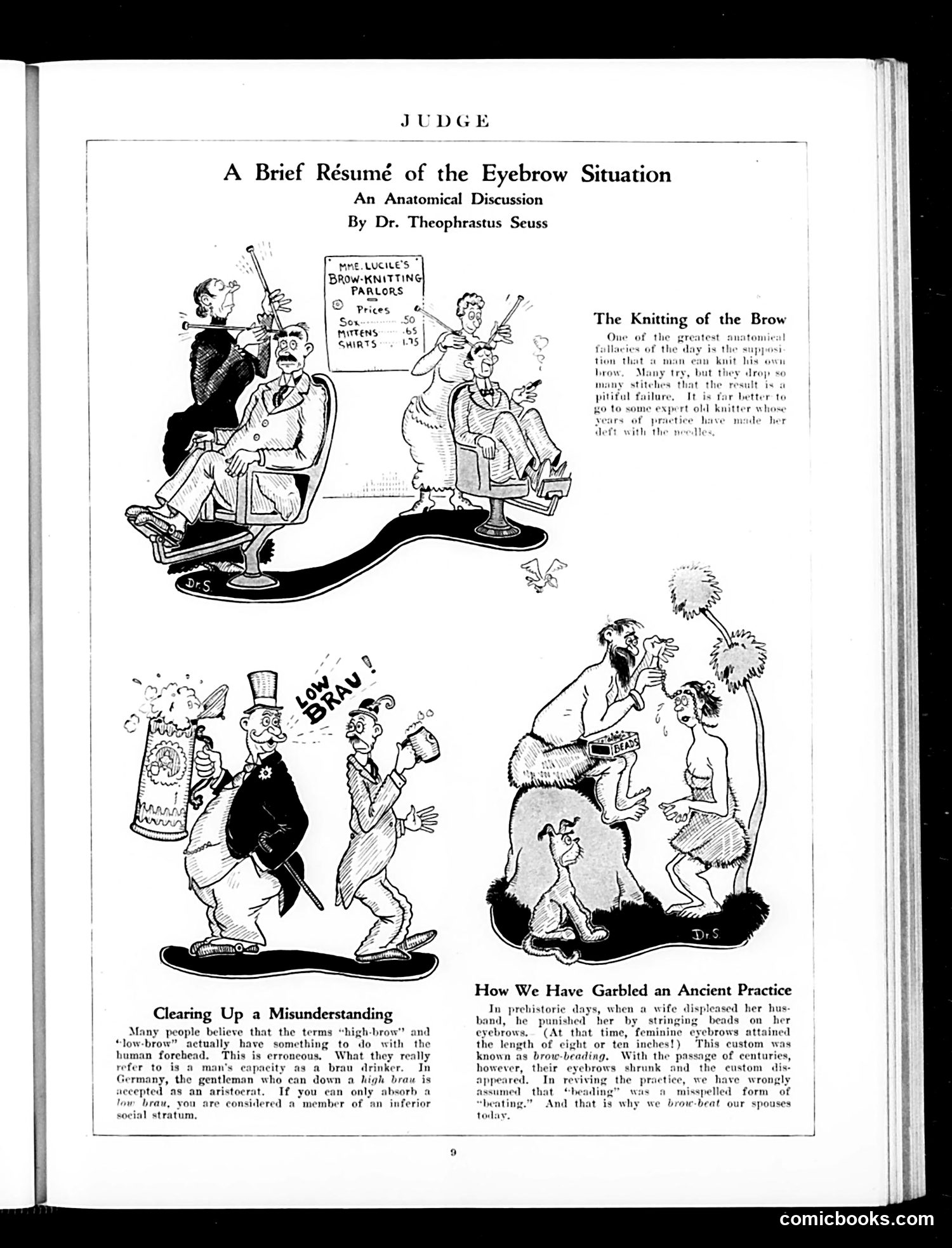
This Seuss-illustrated piece satirizes contemporary beauty and social customs through mock-anatomical humor. The three cartoons mock: 1. **"The Knitting of the Brow"**: Ridicules women attempting eyebrow grooming, suggesting they should leave it to experts rather than botch the job themselves—poking fun at 1920s-30s beauty culture obsessions. 2. **"Clearing Up a Misunderstanding"**: Makes a pun-based joke: "high brow" and "low brow" don't refer to eyebrow aesthetics but to a man's capacity as a beer drinker in German culture. Social status depends on alcohol tolerance, not appearance. 3. **"How We Have Garbled an Ancient Practice"**: Traces "brow-beating" spouses back to a misremembered ancient custom, humorously explaining modern marital dynamics through fabricated etymology. The satire targets both frivolous beauty standards and gender dynamics, using pseudo-scholarly language ("Dr. Theophrastus Seuss") to parody serious anatomical discussion of trivial matters.
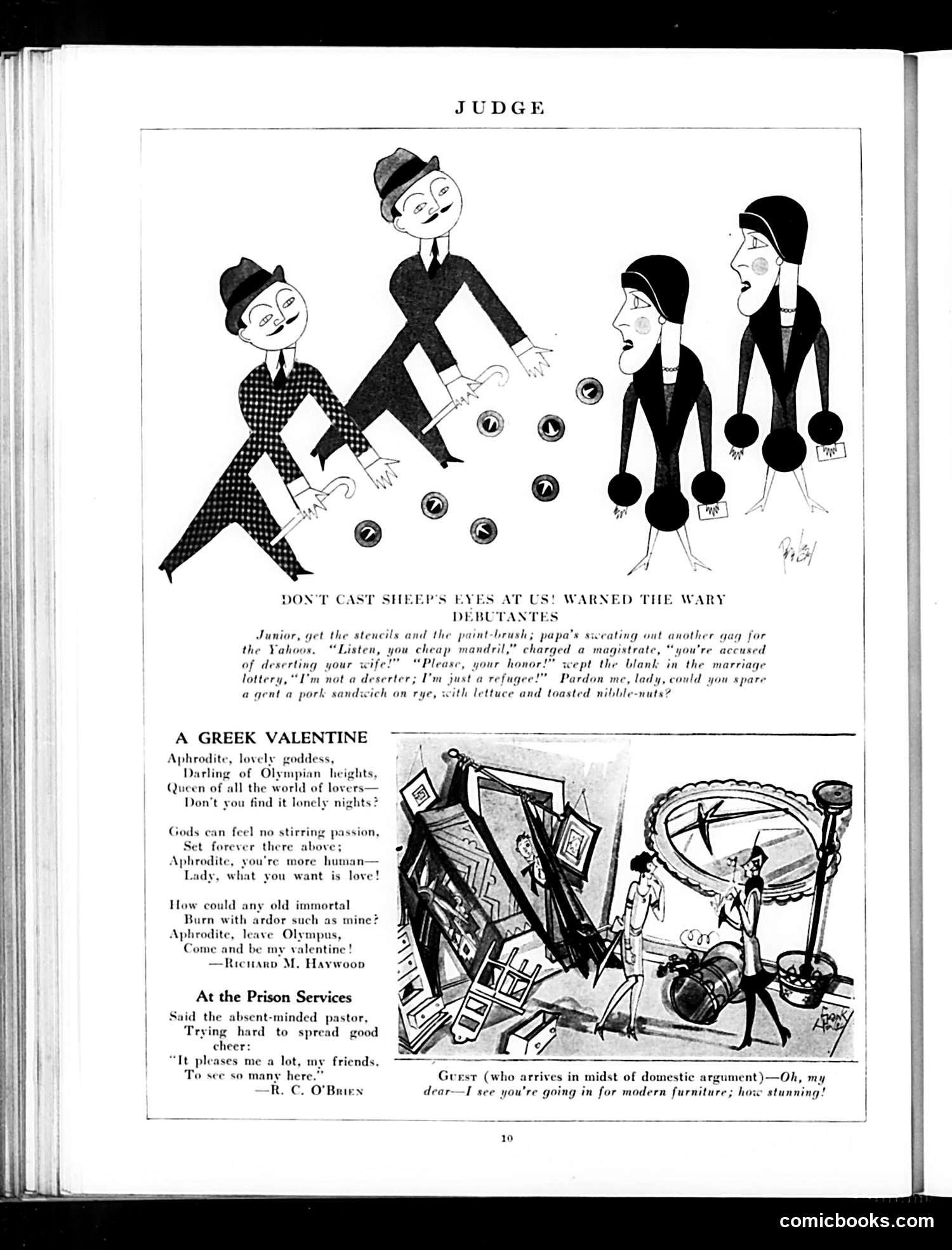
This page contains three separate satirical pieces: **Top cartoon**: "Don't Cast Sheep's Eyes at Us!" mocks young debutantes warning off suitors. The exaggerated male figures with hanging weights suggest fortune-hunters or undesirable matches pursuing wealthy young women. The absurdist dialogue fragments parody both courtship conventions and legal proceedings—references to "magistrates," "deserters," and ridiculous requests (pork sandwiches) suggest satirizing both marriage market desperation and bureaucratic absurdity. **Middle section**: "A Greek Valentine" is a poem playfully imagining seduction of the goddess Aphrodite, inverting classical mythology. It's lighthearted romantic satire using ancient references for comedic effect. **Bottom cartoon**: "At the Prison Services" satirizes an absent-minded pastor's tone-deaf comments at a prison chaplaincy service, oblivious to his inappropriate cheerfulness about the captive audience. A guest's comment about "modern furniture" arriving mid-domestic argument provides comedic contrast. The overall page reflects Judge's characteristic irreverent humor targeting social pretensions and human folly.
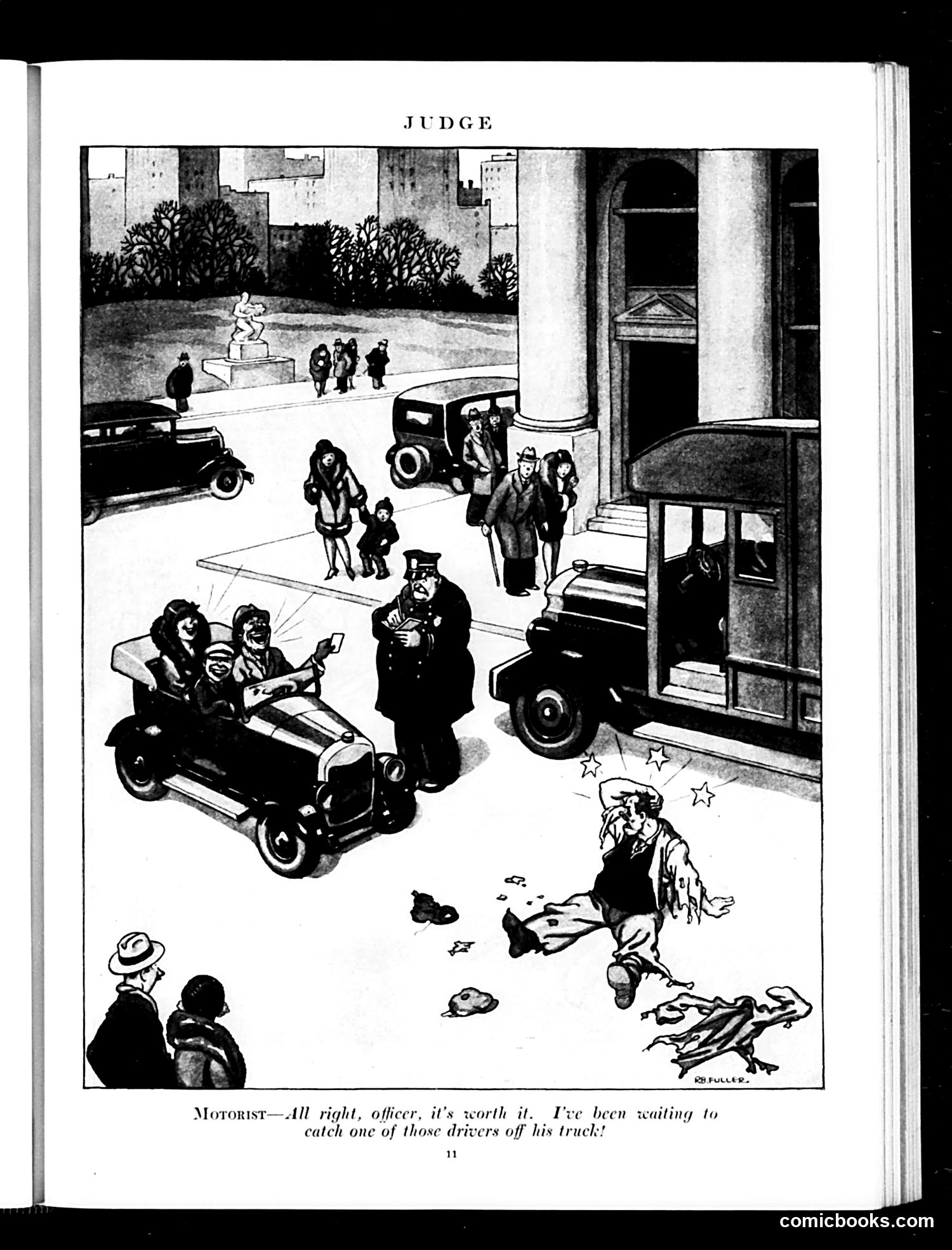
This single-panel cartoon satirizes traffic enforcement and vigilante justice. A motorist, having apparently caused an accident (indicated by a figure lying on the ground with scattered belongings), addresses a police officer. The motorist justifies the collision by claiming he deliberately waited to "catch one of those drivers off his truck"—suggesting he intentionally hit a truck driver, presumably to retaliate for previous traffic violations or reckless driving. The satire targets both aggressive motorists and the frustration with dangerous truck drivers of the era. The cartoon mocks the motorist's willingness to cause property damage and injury to punish traffic offenses, presenting his recklessness as darkly comedic "justice." The officer's response (or silence) implies tacit acceptance of this vigilante behavior, further satirizing law enforcement's inability or unwillingness to properly police traffic violators.
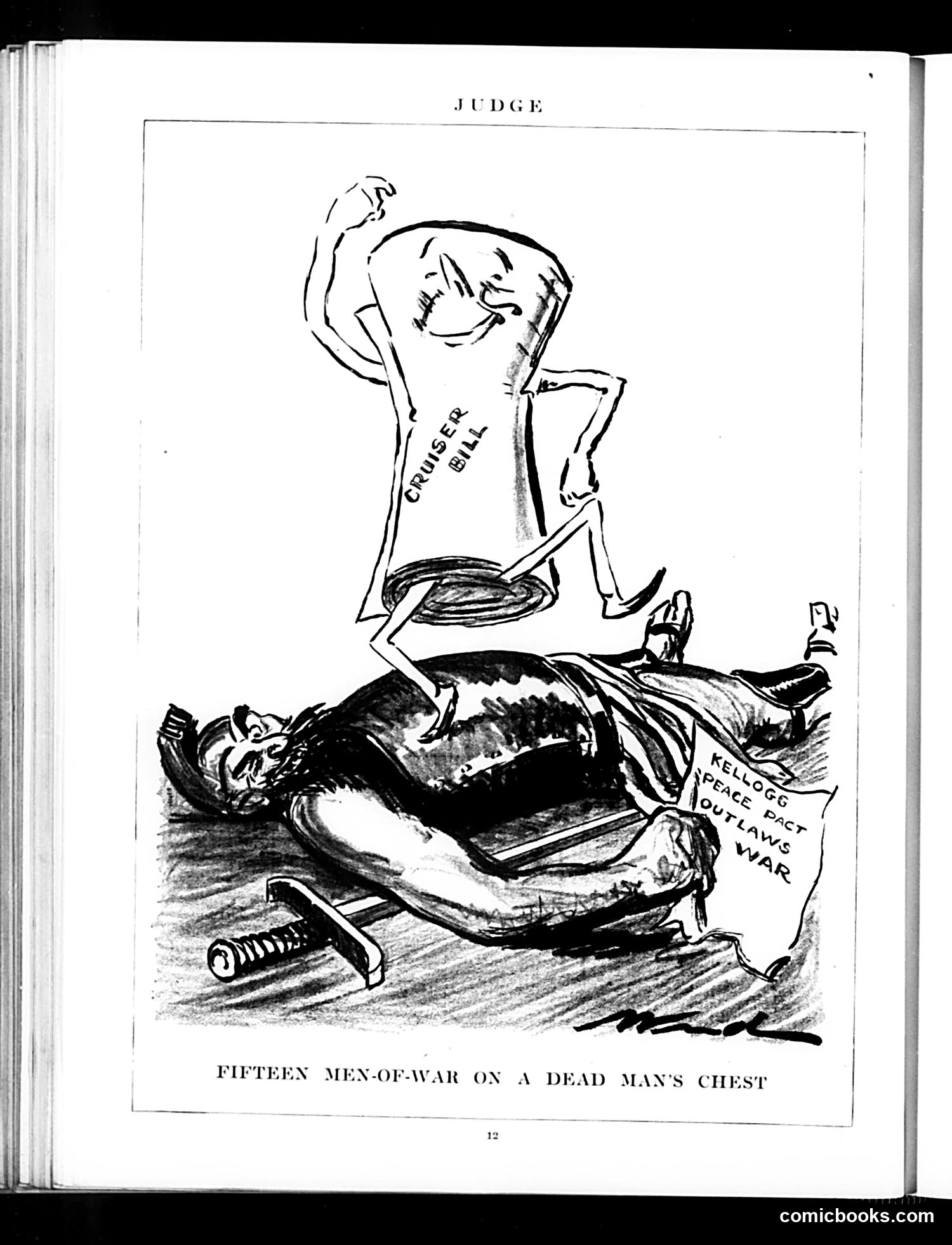
This Judge magazine cartoon satirizes political conflict over military policy. A skeletal judge figure labeled "Cruiser Bill" stands atop a prone, dead body labeled with references to the "Kellogg Peace Pact" and "Outlaws War." The cartoon critiques what appears to be inadequate enforcement or hypocrisy surrounding international peace agreements—specifically the 1928 Kellogg-Briand Pact, which outlawed war. The "fifteen men-of-war" reference alludes to the pirate song, suggesting those promoting peace treaties are actually engaged in warfare or military buildup. The dead man represents failed peace efforts, while the judge figure appears complicit in this failure despite official pacifist rhetoric. The satire mocks the contradiction between declared peace intentions and actual military expansion.
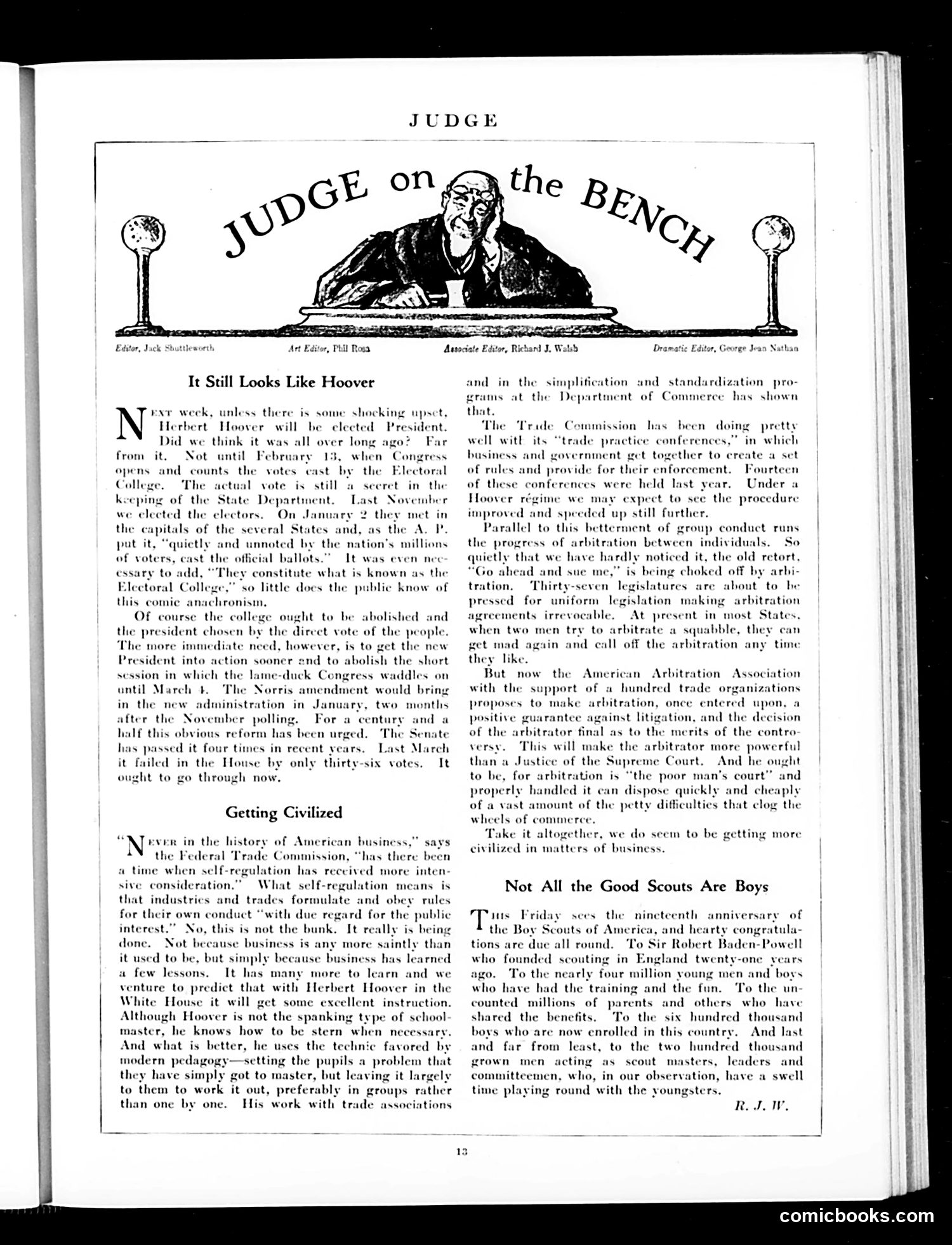
This editorial page from Judge magazine (likely 1928, based on context) contains political commentary supporting Herbert Hoover's presidential election. **Main Content:** The lead article, "It Still Looks Like Hoover," discusses the Electoral College system and the secretive nature of presidential elections. The author criticizes the anachronistic Electoral College while predicting Hoover's victory. It advocates for abolishing the "lame-duck" congressional session by implementing the Norris Amendment. **Key Political References:** - **Herbert Hoover**: Portrayed positively as a capable administrator who uses modern pedagogical methods to guide business self-regulation - **The Electoral College**: Mocked as an outdated "comic anachronism" that the public barely understands - **The Norris Amendment**: Progressive reform delaying lame-duck sessions until January **Satire/Advocacy:** The magazine endorses Hoover's business-friendly approach, emphasizing his role in promoting trade associations, standardization, and arbitration. The tone is optimistic about business "getting civilized" through voluntary regulation rather than harsh government enforcement—reflecting Judge's conservative business perspective.
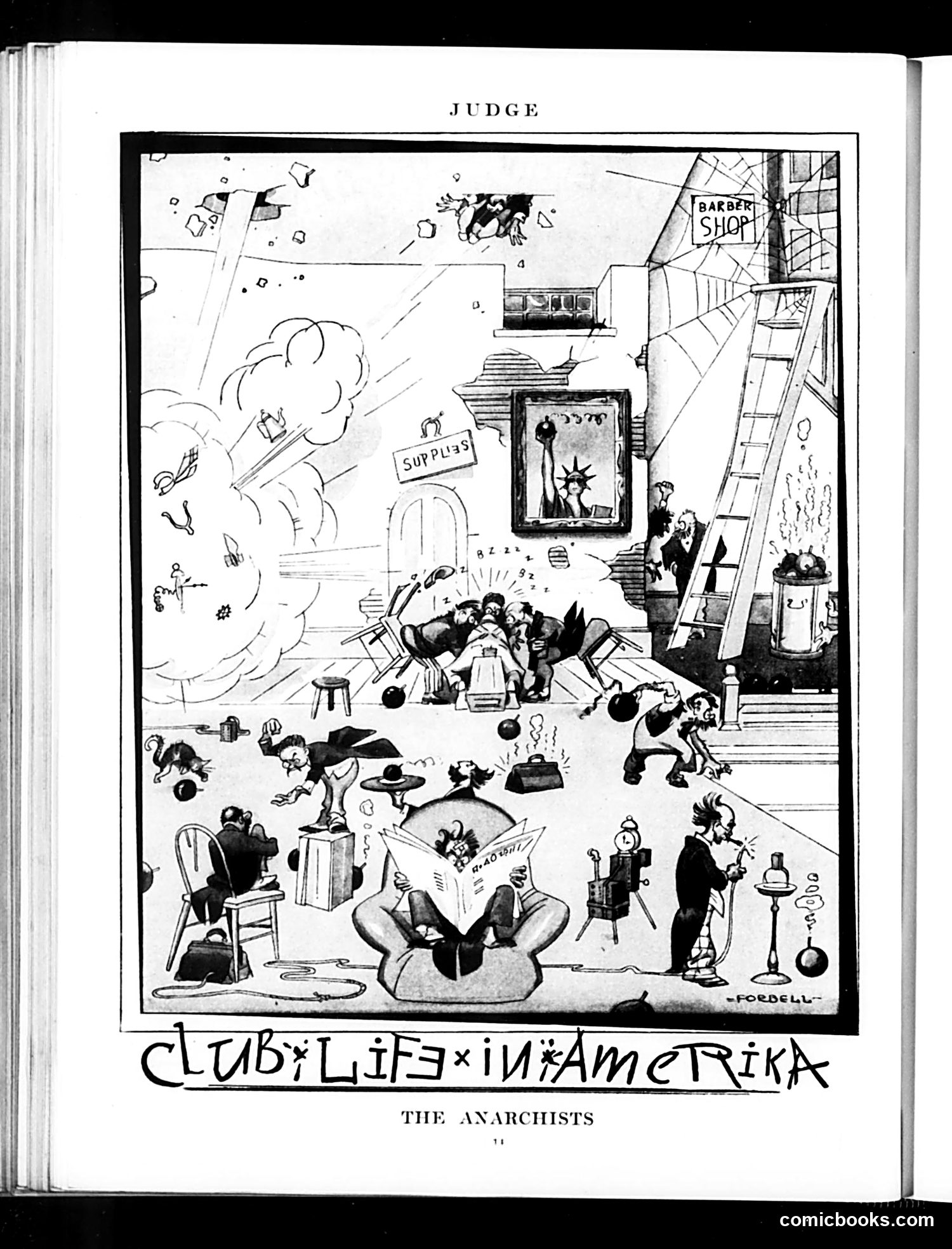
This satirical cartoon depicts a chaotic street scene labeled "Club Life in America," mocking anarchist activities and fears. The illustration shows numerous figures engaged in apparent disorder and violence—explosions, bombs, weapons, and general mayhem scattered throughout a urban setting with a barber shop and supplies store visible. The cartoon appears to be anti-anarchist political satire, likely from the early 20th century when anarchism was viewed as a serious threat in America. The exaggerated chaos and violence suggest Judge magazine's editorial position: portraying anarchists as inherently destructive and their "club life" as dangerous criminal activity rather than legitimate political organization. The satire conflates anarchist ideology with criminality and urban disorder, reflecting contemporary anxieties about immigrant radicalism.
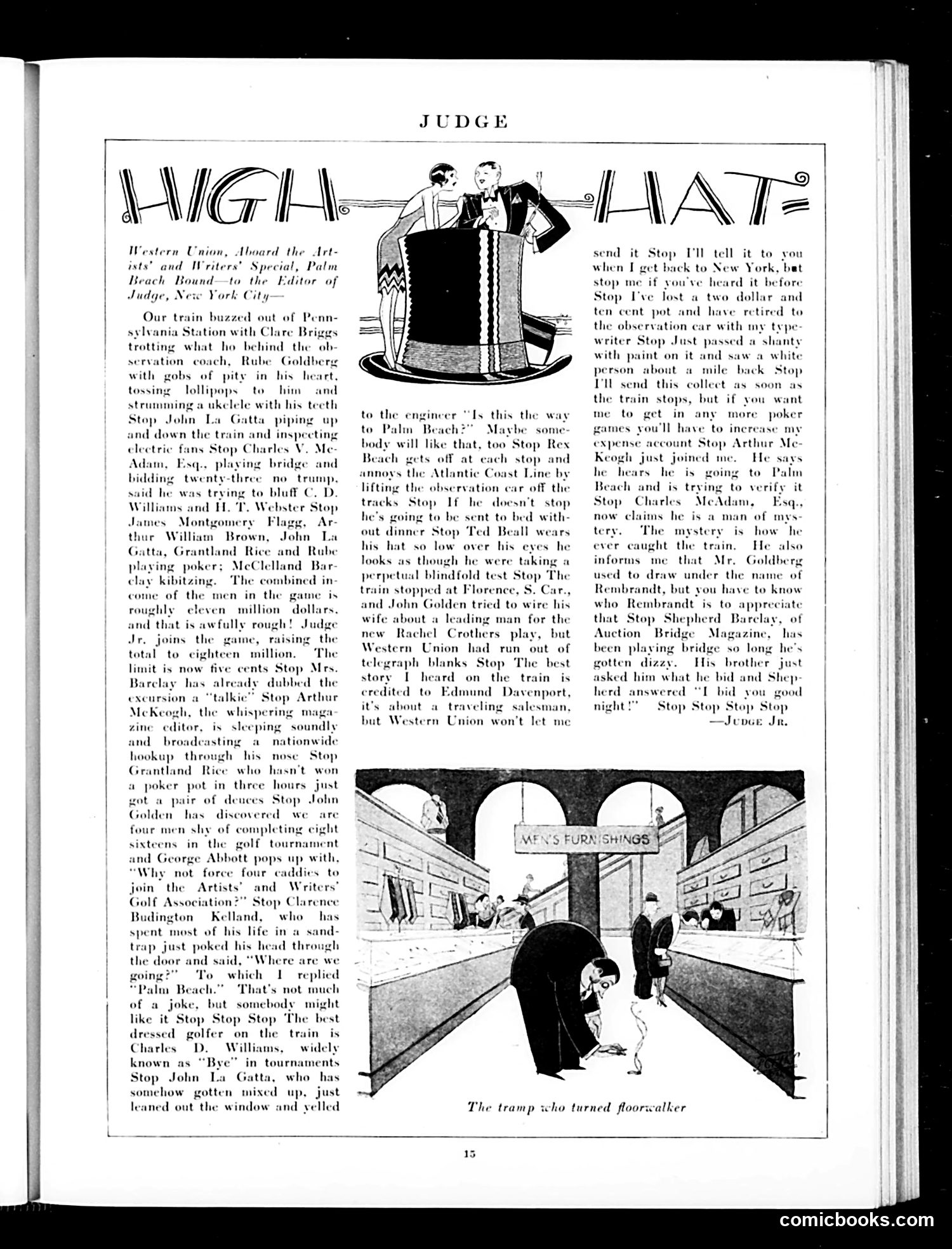
This page satirizes a luxury train excursion ("the Artists' and Writers' Special") to Palm Beach, featuring prominent early-20th-century illustrators, cartoonists, and writers—including Clare Briggs, Rube Goldberg, Grantland Rice, and James Montgomery Flagg. The humor centers on these celebrities' pretensions and vices during the trip: they play high-stakes poker (collectively worth ~$18 million), consume absurd amounts of candy, lose money, tell bad jokes, and obsess over bridge and golf. The satire gently mocks their vanity, gambling addiction, and self-importance while celebrating their fame. The cartoon below shows a "tramp who turned floorwalker"—likely a humorous scene from the journey depicting social role reversal. The overall tone is affectionate ribbing of the creative elite's foibles during leisure travel, typical of Judge's satirical approach to contemporary celebrities and social pretension.
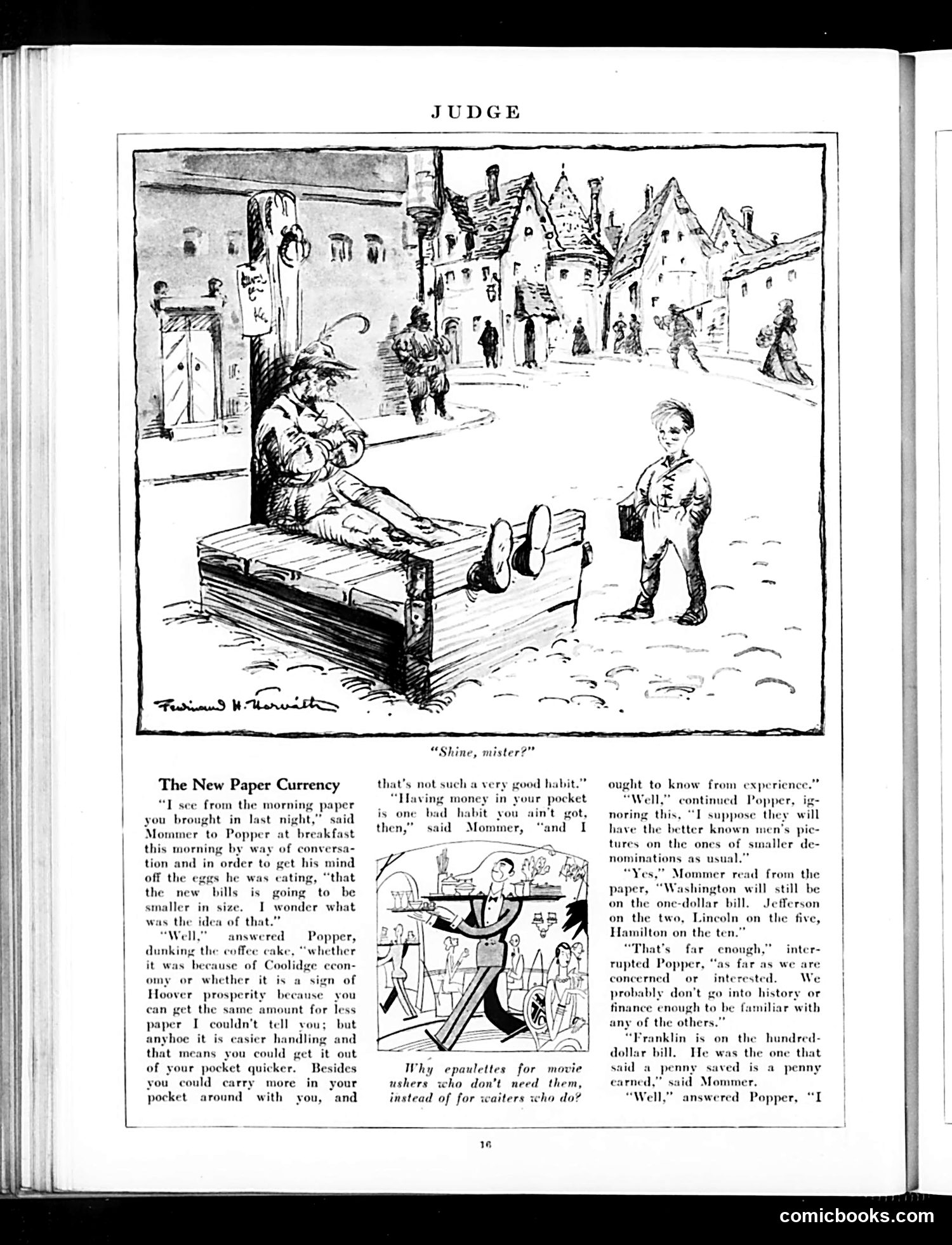
This page satirizes the U.S. government's introduction of smaller paper currency (likely the 1929 redesign). The main cartoon shows a child asking an adult about the practical purpose of reducing bill size. The dialogue humorously attributes the smaller currency to **President Coolidge's economy measures** or **Hoover's prosperity**—suggesting the government shrinks money when times are good (less paper needed) or bad (easier to carry what little you have). The satire mocks Depression-era anxiety about finances. The secondary joke questions why movie theater ushers receive decorative **epaulettes** when they "don't need them," while waiters—who actually do—receive nothing. This targets visible status symbols given to low-wage workers. The currency discussion references real figures: Washington, Jefferson, Lincoln, Hamilton, and Franklin on various denominations, poking gentle fun at how ordinary people ignore historical details beyond the most famous figures.
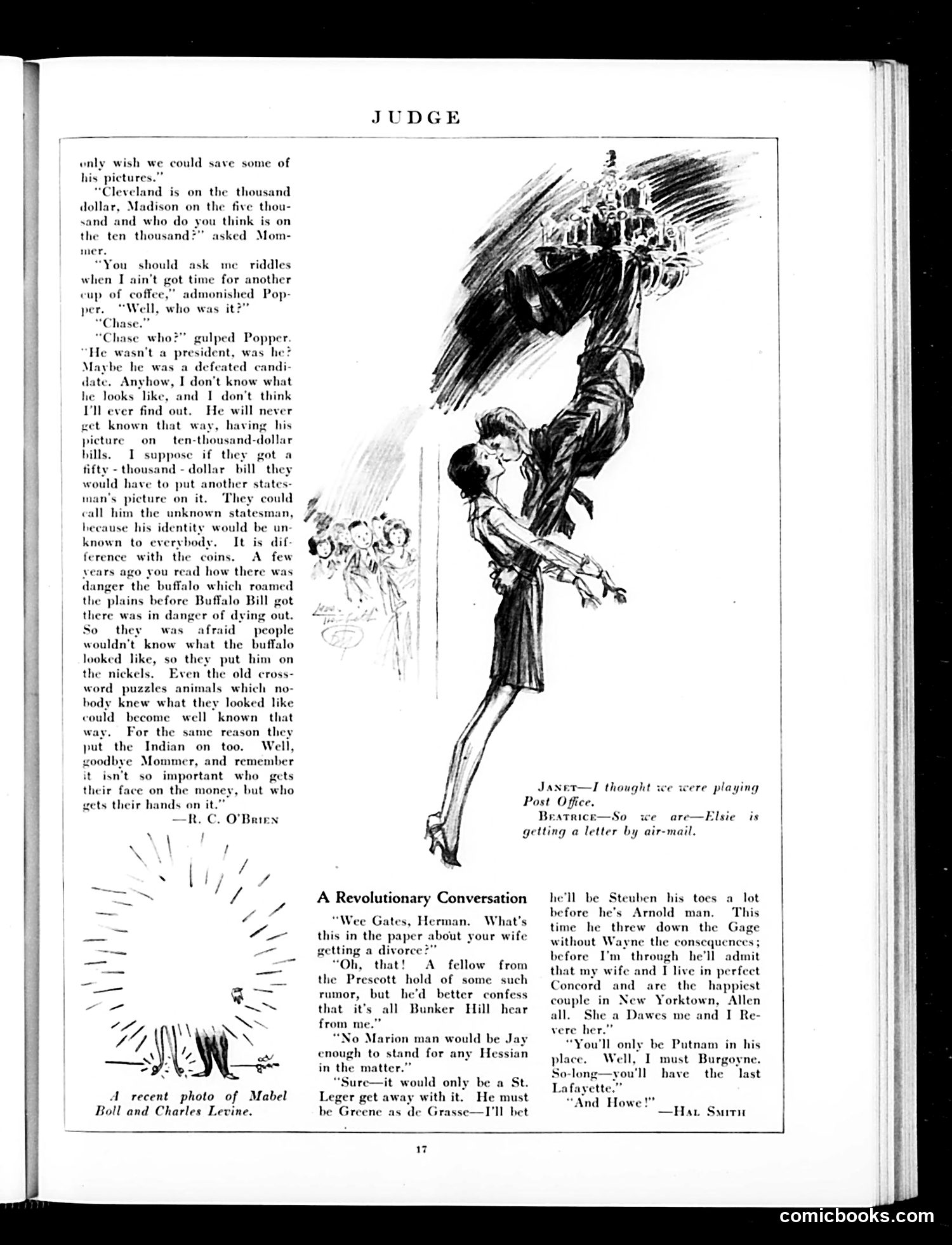
This page contains two distinct satirical pieces: **Main Article (by R.C. O'Brien):** A humorous conversation about U.S. currency features historical figures (Cleveland, Madison) on bills. The satire mocks the obscurity of who appears on higher denominations—suggesting ten-thousand-dollar bills feature unknown figures, making them effectively "unknown statesmen." O'Brien contrasts this with coins, where images of buffalo and Native Americans became recognizable through currency placement. The underlying joke: it's not *whose face* appears on money that matters, but *who controls it*. **"A Revolutionary Conversation":** A pun-heavy joke exploiting American Revolutionary War figures' surnames as verbs/predicates. Phrases like "Bunker Hill hear," "Wayne the consequences," "Greene as de Grasse" create forced double meanings using names like Steuben, Arnold, Gage, Burgoyne, etc. It's wordplay rather than substantive satire. **Upper Illustration:** Appears to reference Mabel Boll and Charles Levine, likely figures from contemporary scandal or celebrity news (unclear without additional context). The page reflects Judge's satirical style: political commentary mixed with puns and social observation.
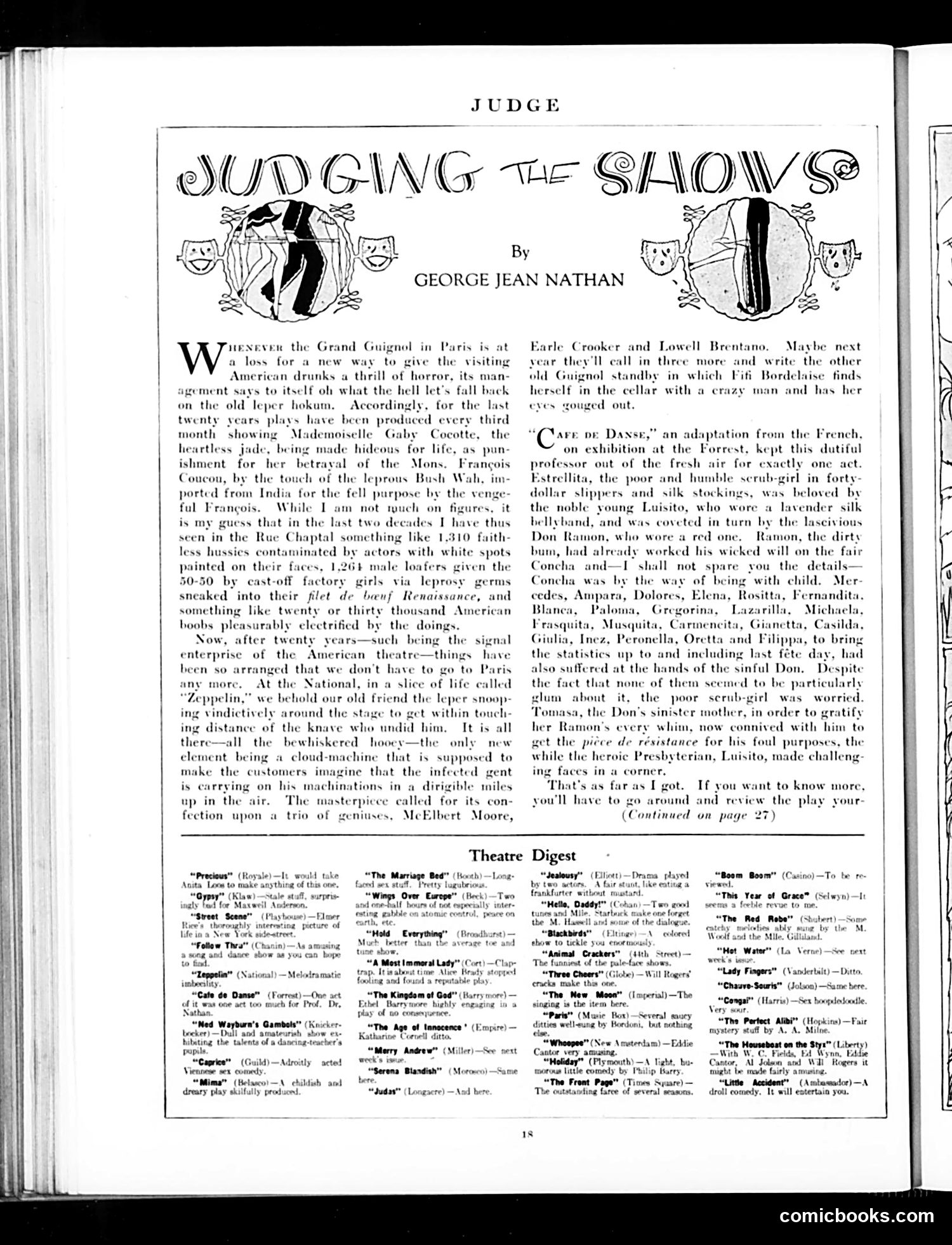
This is a theater review column by George Jean Nathan. The main illustrated article discusses how American theaters have begun copying the Grand Guignol in Paris—a theater known for sensationalized horror plays, particularly featuring leprosy narratives. Nathan satirizes this trend: for twenty years, Parisian audiences paid to watch the same repetitive melodrama of a woman punished with leprosy (performed roughly 1,310 times), attracting thousands of American tourists. Now, American theaters have imported this tired formula. The specific play under review appears to be "Zeppelin" at the National Theatre, a melodramatic piece featuring Spanish characters (Luisito, Ramón, Concha, etc.) and the now-familiar plot device of seduction, betrayal, and suffering—implying American theaters lack originality and simply recycle European sensationalism for paying audiences. The accompanying "Theatre Digest" lists brief reviews of contemporary plays, suggesting this was a regular column covering Broadway productions.
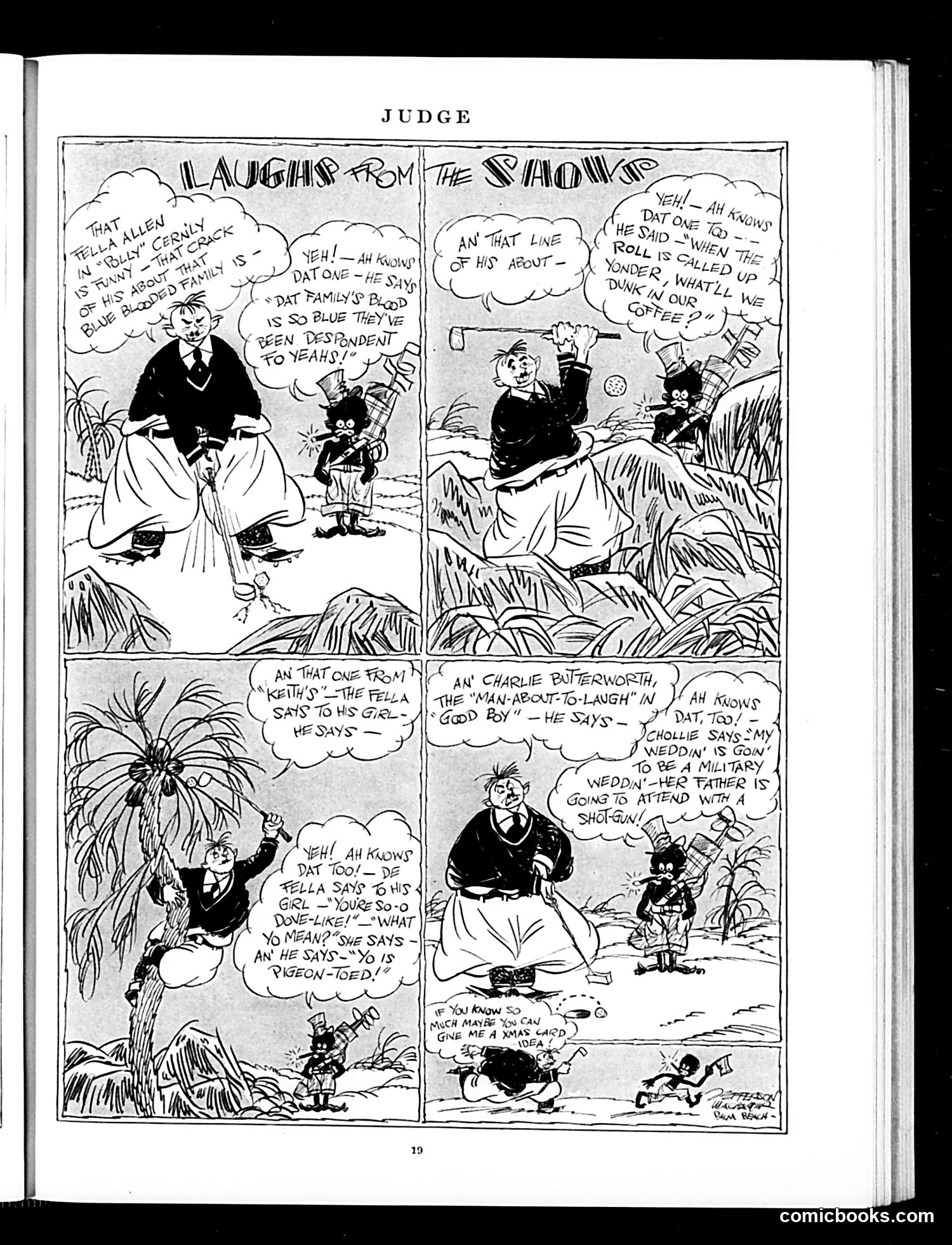
This is a humor comic from *Judge* magazine featuring a Jewish character (stereotypically drawn) telling jokes to a small boy. The jokes revolve around ethnic humor and social commentary typical of early 20th-century American satire. The character recounts various jokes, including references to "Charlie Butterworth" (likely the actor/comedian popular at the time) and his comedic one-liners. The humor relies on dialect humor and punch lines about family situations, military weddings, and romantic misunderstandings—common vaudeville material of the era. The satire targets both ethnic stereotypes and the entertainment industry's reliance on recycled jokes and comedians. The title "Laughs from the Saloon" suggests these are bar-room jokes, emphasizing their lowbrow, populist nature. By modern standards, the ethnic caricature and stereotypical dialect are offensive, reflecting the casual prejudices normalized in period humor publications.
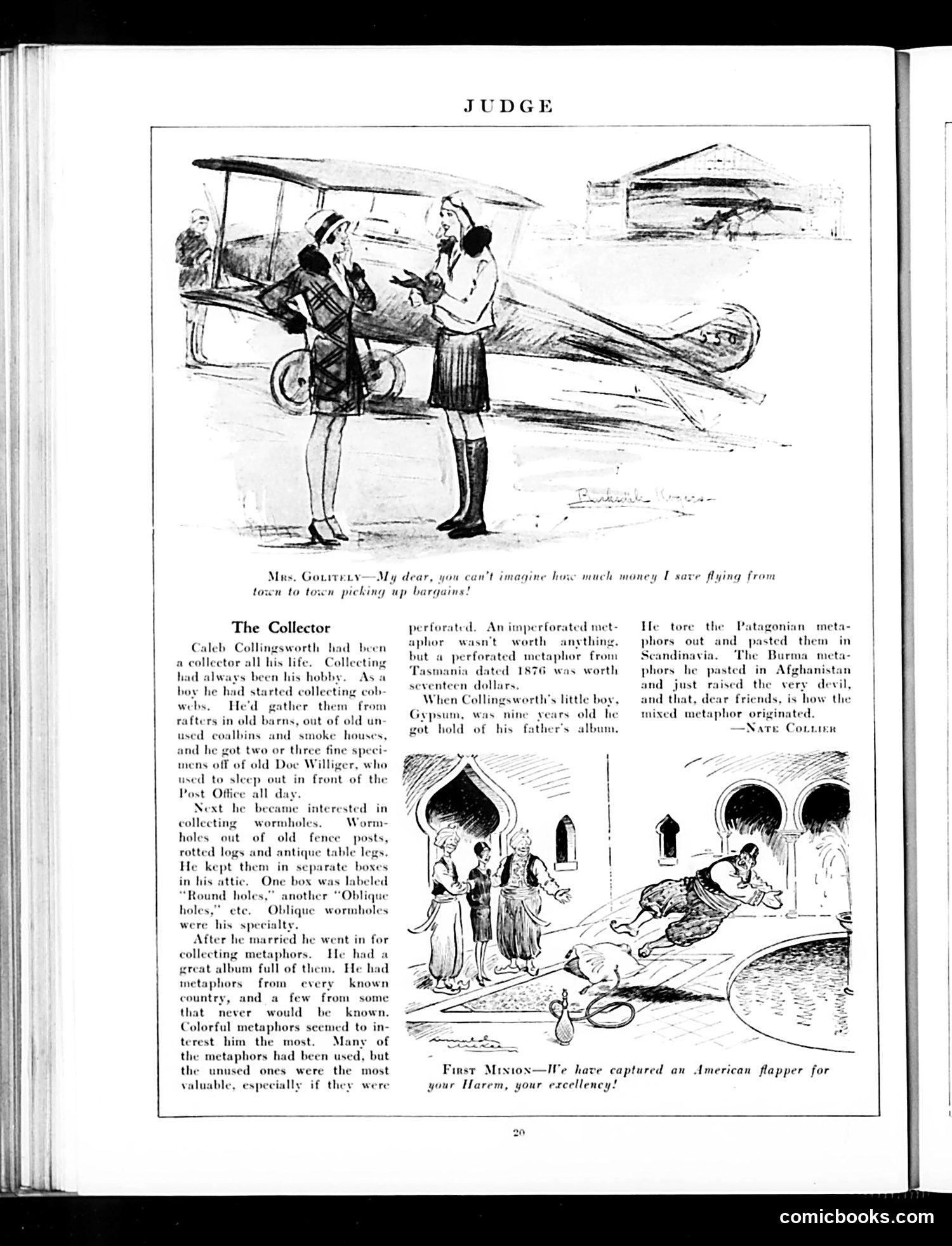
**Top cartoon:** A woman brags to Mrs. Golitely about saving money by traveling town-to-town shopping for bargains—satirizing the early 20th-century leisure activity of wealthy women who traveled extensively for shopping expeditions, presented as frivolous and extravagant despite claims of economy. **Main story:** A humorous tall tale about Caleb Collingsworth, a lifelong collector whose obsession escalates from cobwebs to wormholes to "metaphors." The joke peaks when his son Gypsum misplaces metaphors in wrong countries, creating "mixed metaphors"—a literary term for confused, incompatible comparisons. The story pokes fun at obsessive collecting as a hobby and uses the absurd premise (collecting abstract language constructions) for wordplay. **Bottom cartoon:** References a "First Mission" where an "American flapper" is captured for a harem, likely satirizing 1920s flapper culture (modern young women) or anxieties about Western women abroad, presented as exotic curiosities in Eastern contexts.
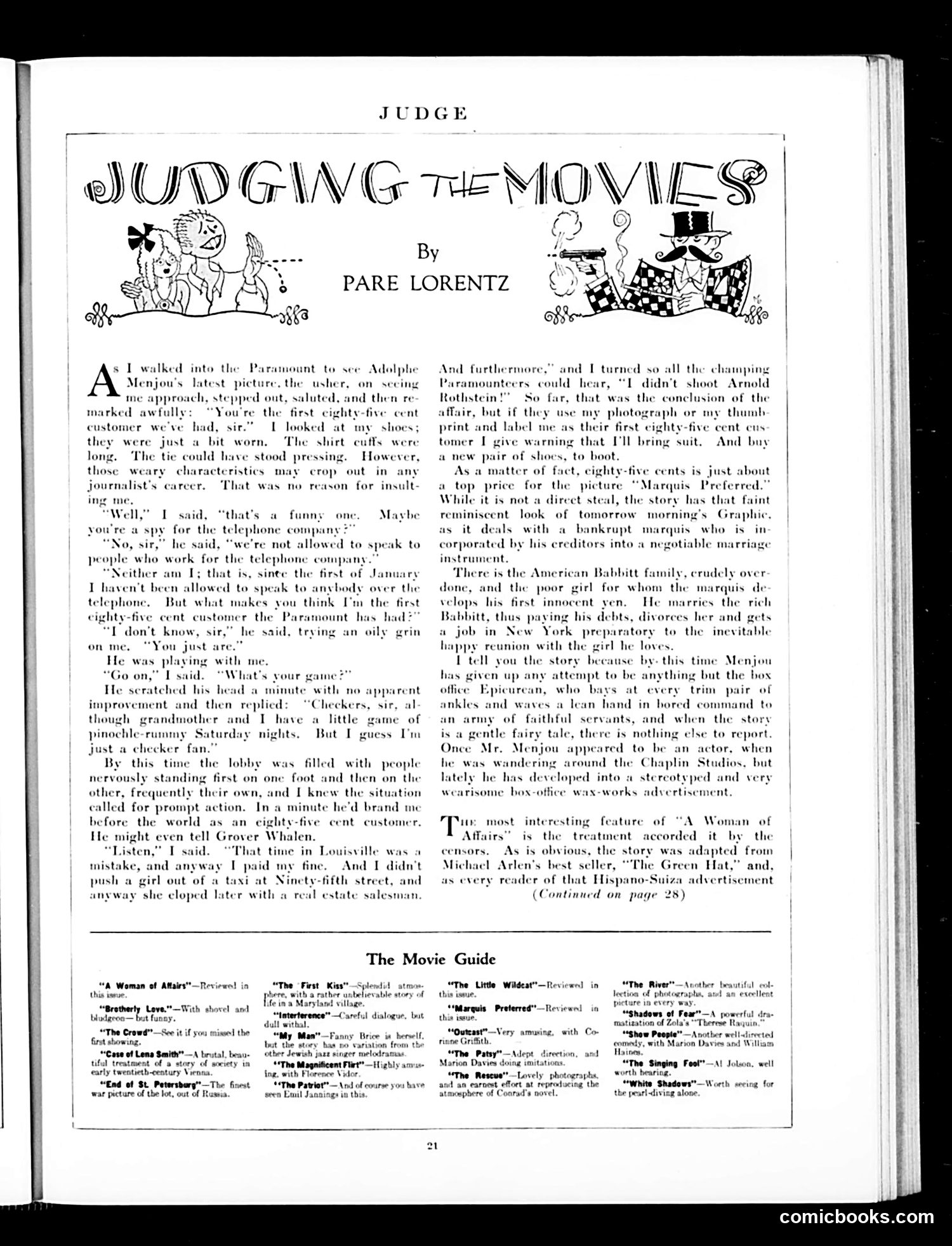
This is a film criticism column, not a political cartoon. Lorentz reviews Adolphe Menjou's "Marquis Preferred" and "A Woman of Affairs," offering satirical commentary on 1920s cinema culture. The humor centers on a dismissive theater usher who insults the narrator's shabby appearance, assuming he's a telephone company spy (apparently a contemporary reference to industrial espionage or labor disputes). Lorentz uses this absurd encounter to mock the pretension of movie palaces and the rigid class consciousness of their staff. He critiques Menjou as a formulaic "box office Epicurean" actor—essentially a handsome leading man with limited range who waves his hand in "bored command." The adapted story of "A Woman of Affairs" (from Michael Arlen's novel "The Green Hat") receives backhanded praise as a "gentle fairy tale" involving divorce and remarriage, with Lorentz sardonically noting the censors' treatment of this adapted material. The column reflects Jazz Age film criticism—witty, urbane, dismissive of commercial star machinery.
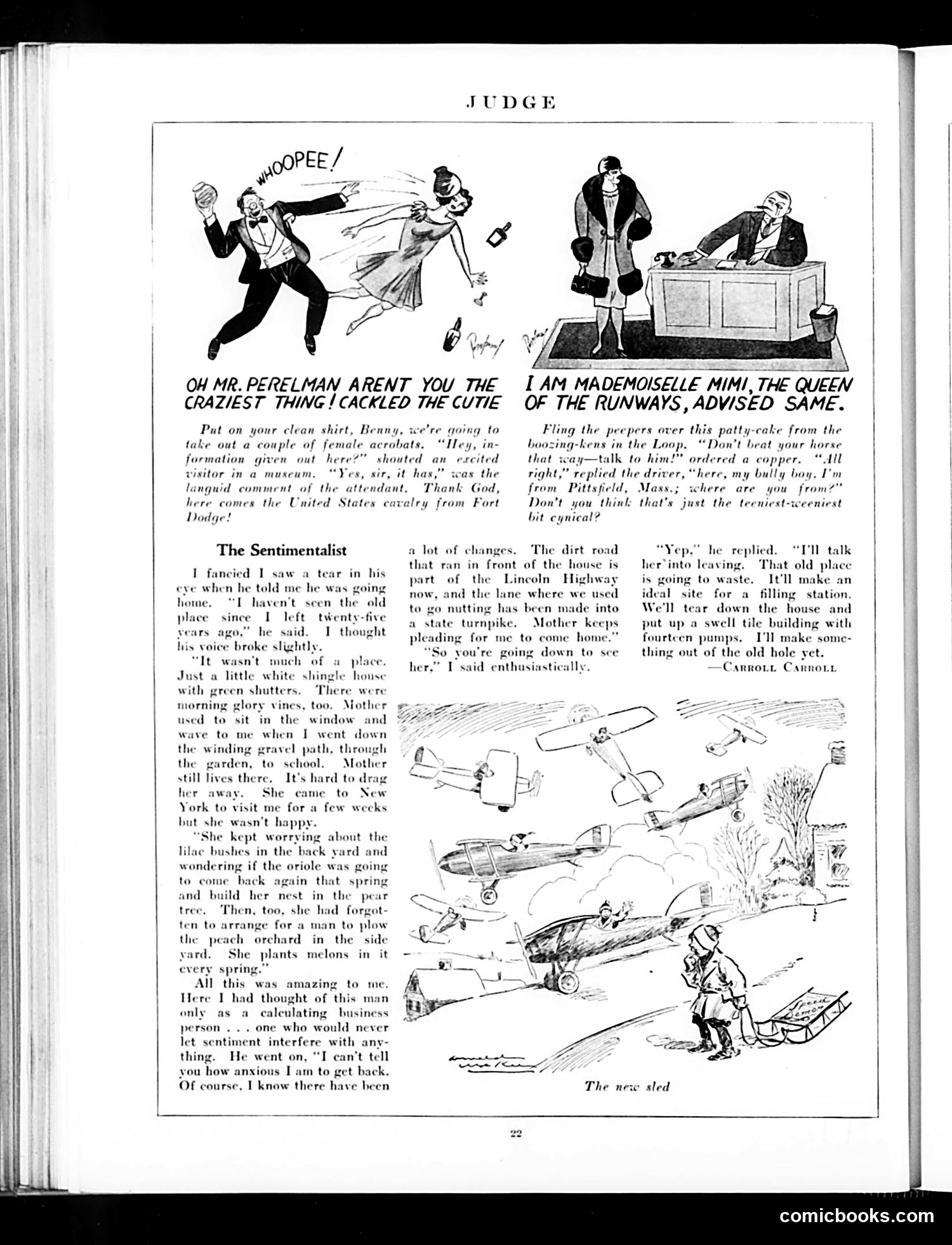
This page contains two main satirical pieces: **Top cartoons**: Mock fashionable society. The left cartoon ridicules a man named Perelman as overly affected or ridiculous ("craziest thing"). The right cartoon satirizes fashion industry pretension through "Mademoiselle Mimi, the Queen of the Runways"—likely mocking the emerging fashion modeling industry and its absurd self-importance. **"The Sentimentalist" story**: Satirizes American business pragmatism versus nostalgia. A businessman grows emotional recalling his childhood home and aging mother, describing idyllic rural memories (lilac bushes, orioles, peach orchards). However, the punchline reveals his true nature: he plans to demolish the family home and convert it into a gas station filling station with modern pumps—reducing sentimental family heritage to commercial real estate. The satire critiques how American capitalism and modernization ruthlessly destroy tradition and sentiment for profit, even among those who claim to value family and home.
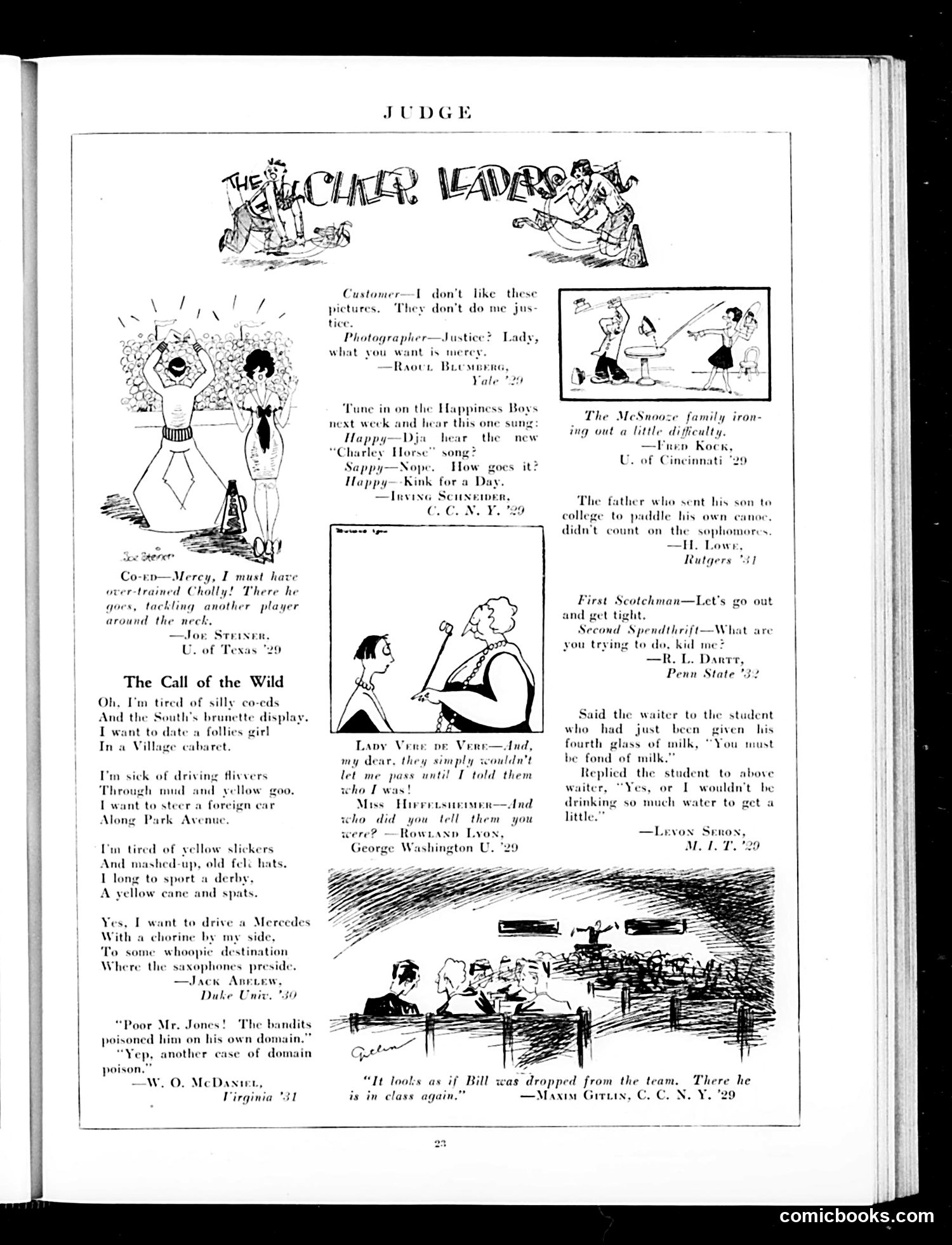
This 1929 page from Judge contains college humor jokes and cartoons reflecting Jazz Age anxieties. "The Call of the Wild" poem satirizes young men tired of modest living (flivvers, yellow slickers) yearning for urban sophistication—Mercedes cars, chorus girls, and saxophones on Park Avenue. It mocks the tension between campus life and Jazz Age materialism. Other jokes target college experiences: hazing ("didn't count on the sophomores"), athletic injuries ("over-trained Cholly"), and academic performance (the dropped football player returning to class). The photography complaint and milk jokes represent generic college humor. References to "Happiness Boys" and "Charley Horse" songs indicate contemporary radio entertainment the readership would recognize. Overall, the page captures early-1930s college culture's aspirations toward urban glamour and modern consumption, while gently mocking student pretensions and misadventures.
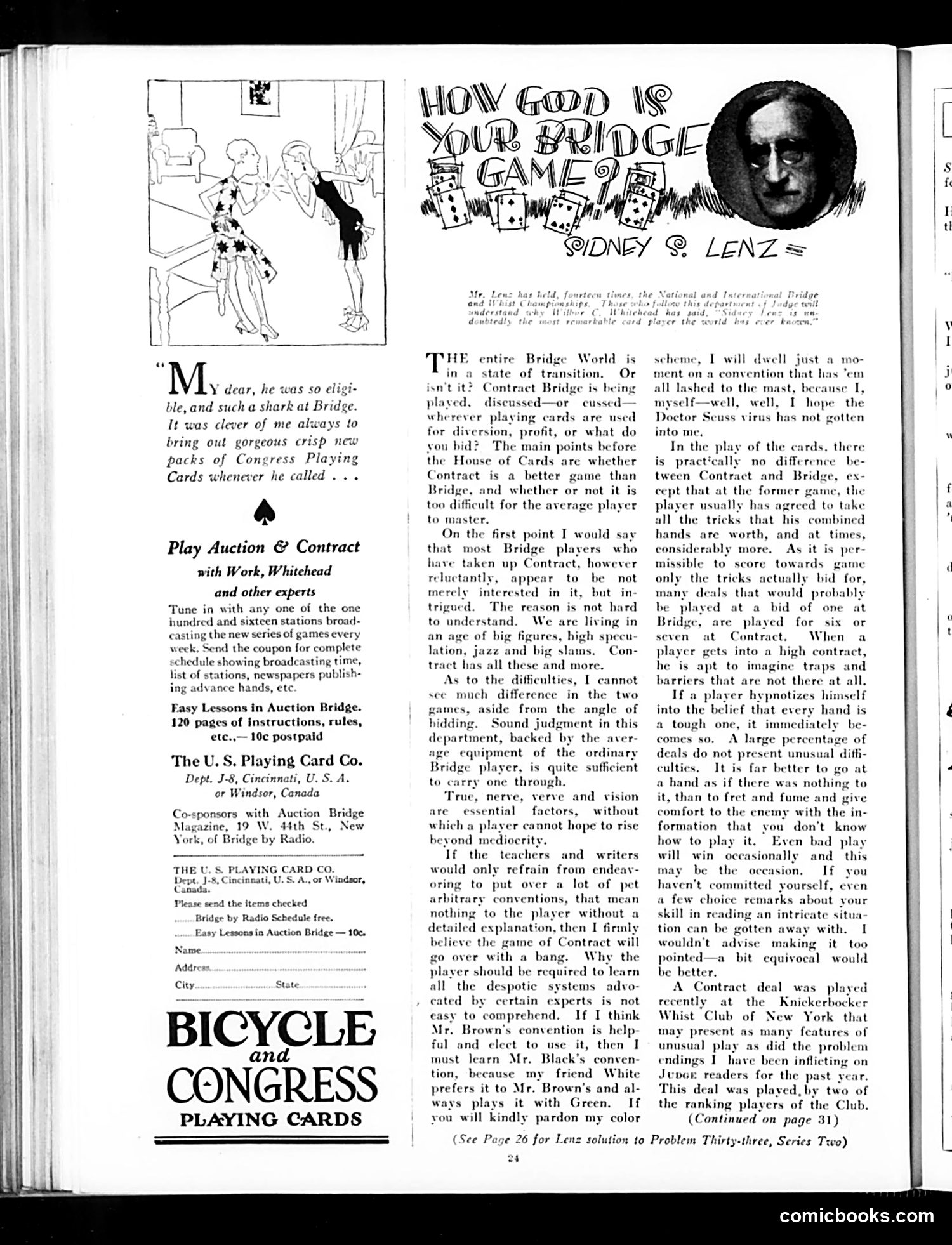
This page primarily contains **advertising and instructional content** about bridge card games, not political satire. The small cartoon at top left depicts a woman explaining she attracted a suitor by strategically producing new decks of "Congress Playing Cards" whenever he visited—a domestic humor joke about using bridge as a courtship tool. The bulk of the page advertises **bridge instruction materials and radio broadcasts** from the U.S. Playing Card Company, promoting both "Auction Bridge" and the newer "Contract Bridge." The article by Sidney S. Lenz (whose portrait appears) discusses the transition between these two card game variants. Lenz argues Contract Bridge is gaining popularity among players despite its complexity, and he critiques the arbitrary "conventions" (rule systems) different bridge experts were promoting—suggesting simplified teaching would help the game's adoption. This reflects **1930s American leisure culture**: bridge was enormously popular, and debates about standardizing rules were genuinely contentious. The page is essentially a sponsored feature promoting cards and instructional materials during bridge's peak popularity period.
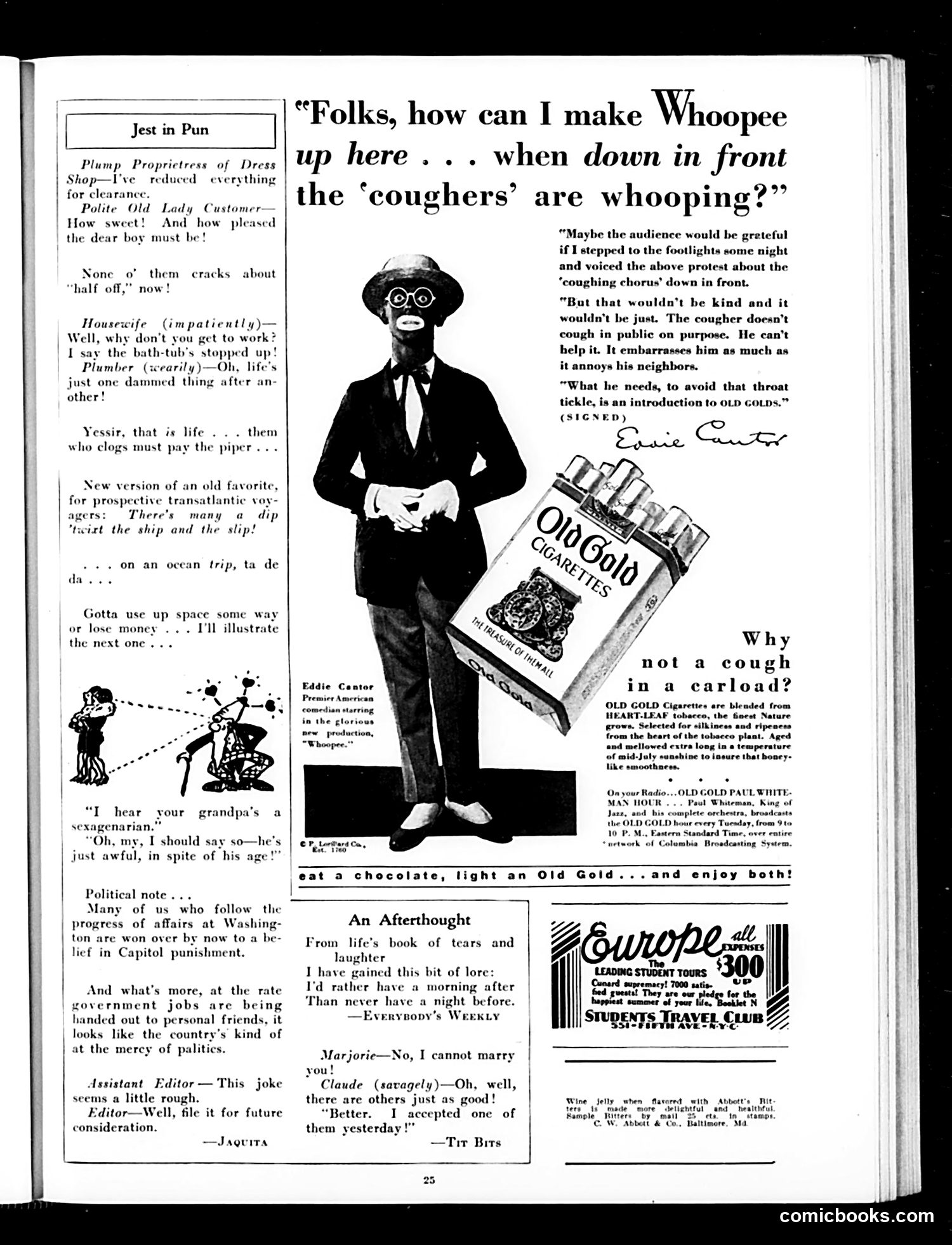
This page combines humor sections with a prominent **Old Gold cigarette advertisement** disguised as editorial content. The main satire features **Eddie Cantor**, a famous comedian of the era, addressing theater coughing—a genuine social annoyance during live performances. The advertisement cleverly positions Old Gold cigarettes as a solution: if audience members suck chocolates and smoke Old Golds instead, they'll avoid throat tickles causing disruptive coughs. This is darkly humorous marketing that exploits a real problem to sell cigarettes. The left column contains typical Judge content: brief puns and jokes (about plumbers, ocean trips, government jobs). One references "Whoopee," likely Cantor's contemporary theatrical production. The page reflects 1920s-30s attitudes where cigarette advertising appeared brazenly in editorial space, and linking smoking to health benefits (or preventing coughs) seemed acceptable marketing strategy.
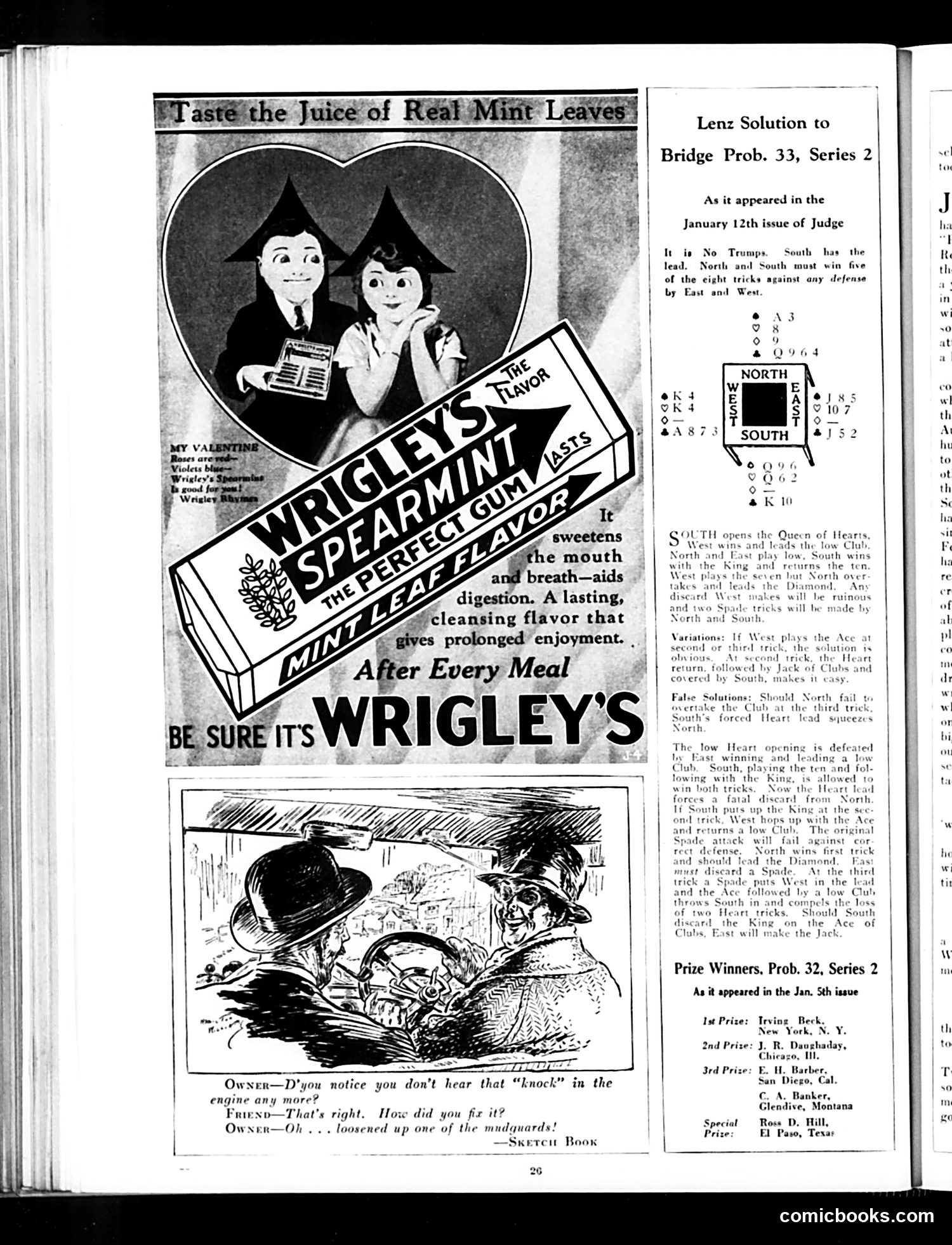
This page contains **mostly advertising and puzzles**, not political satire. The dominant content is a **Wrigley's chewing gum advertisement** (top left) featuring a romantic couple and promoting spearmint flavor as an aid to digestion and breath freshness—typical 1920s advertising claims. Below is a **brief humorous sketch** about a car owner and friend discussing engine noise. The owner jokes that he "fixed" the knocking sound by loosening a mudguard—clearly absurd logic that plays on car owners' frustrations with mechanical problems they don't understand. The **right side contains bridge card game problems and solutions**—Judge regularly featured such puzzles for readers. The "Prize Winners" section lists names of readers who solved previous problems correctly. This appears to be a **general interest/entertainment page** from the magazine, blending commercial advertising with recreational puzzles, rather than featuring the satirical political cartoons Judge was known for.
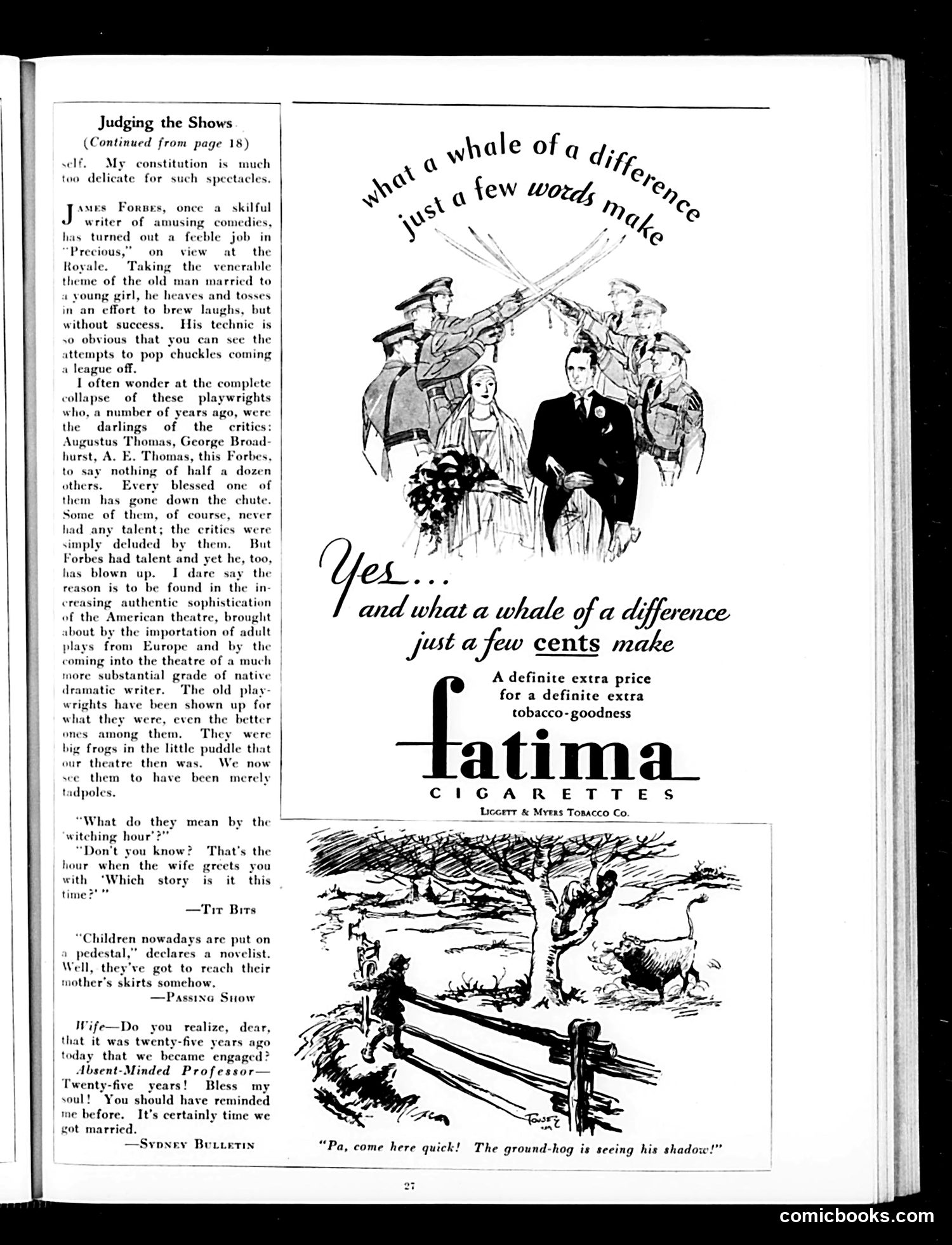
This page contains theater criticism and miscellaneous humor, centered around an advertisement for Latima cigarettes. **Main Content:** Critic James Forbes reviews "Precious" at the Royale, dismissing playwright James Forbes's attempt at comedy about an old man married to a young girl. The reviewer argues that older American playwrights (Augustus Thomas, George Broadhurst, A.E. Thomas, Forbes) have become obsolete due to increasing theatrical sophistication from imported European plays and rising quality of native drama. **The Humor Sections:** Brief jokes about marital life ("witching hour"), child-rearing, and a 25-year engagement—typical period humor about marriage and domestic situations. **Advertisement:** The Latima cigarettes ad uses a wedding scene illustration with the slogan that better tobacco makes "a whale of a difference" for just a few cents—a common advertising strategy of the era. **Bottom Cartoon:** A rural scene of someone chasing a groundhog, referencing Groundhog Day folklore (predicting spring). The page is primarily theater criticism with incidental advertising and light comic relief.
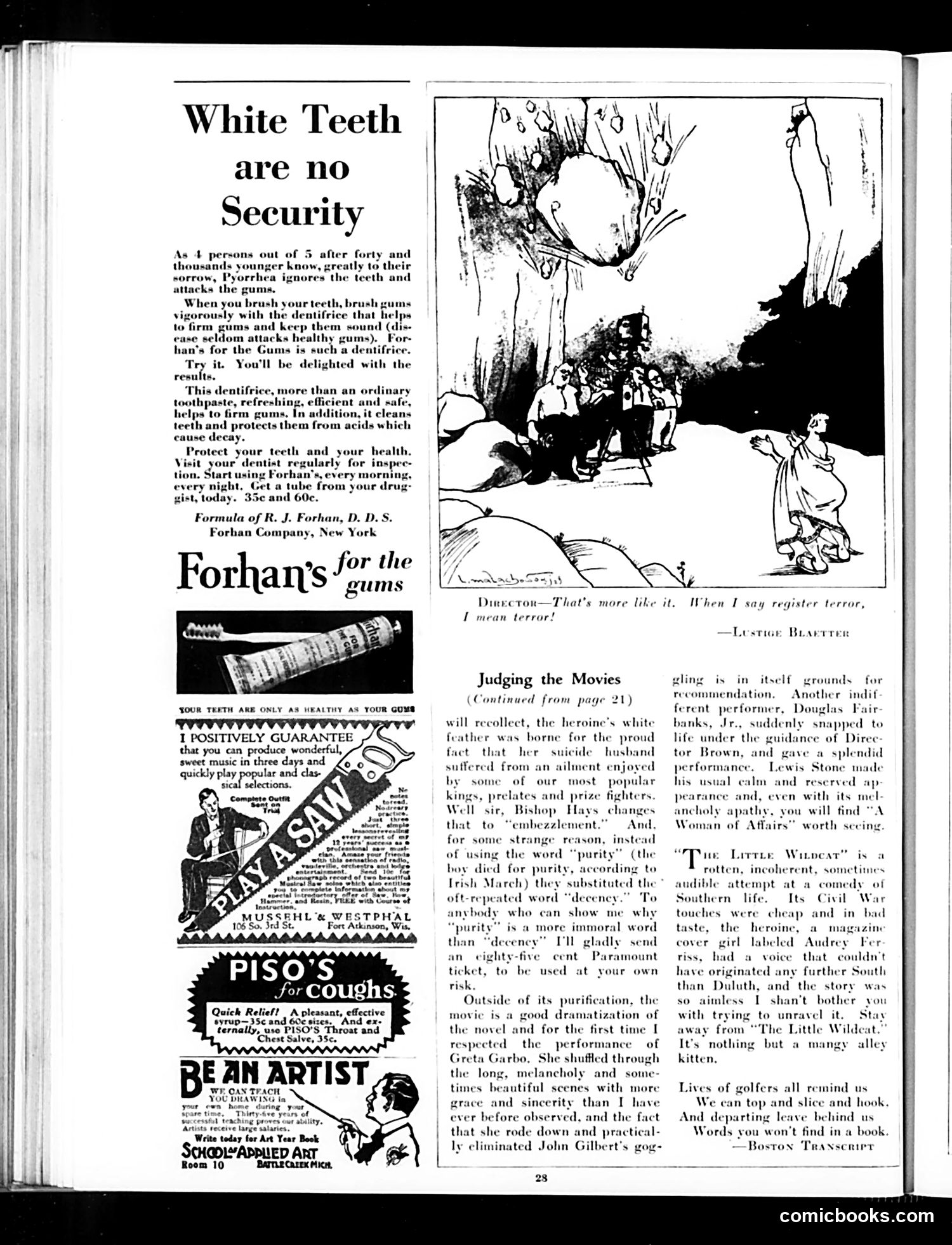
This page combines dental advertising with movie criticism. The top half promotes **Forhan's toothpaste for gums**, warning that white teeth alone don't guarantee dental health—gum disease affects "4 persons out of 5 after forty." The ad emphasizes brushing vigorously and using their dentifrice to prevent pyorrhea (gum disease). The bottom half reviews recent films. The cartoon caption references a **director and actor dialogue** about registering "terror" versus "terror"—likely a playful jab at acting quality or censorship. The main review discusses how **Bishop Hays' censorship board** altered a film's moral messaging, changing "suicide" motivations from disease to "embezzlement" and replacing "purity" with "decency." The critic finds this arbitrary sanitization absurd. Reviews of **Greta Garbo and other actors** follow, with mixed assessments. A brief poem jokes about golfers using profanity. The page reflects 1920s concerns: dental hygiene marketing and Hollywood's emerging moral regulation under religious pressure.
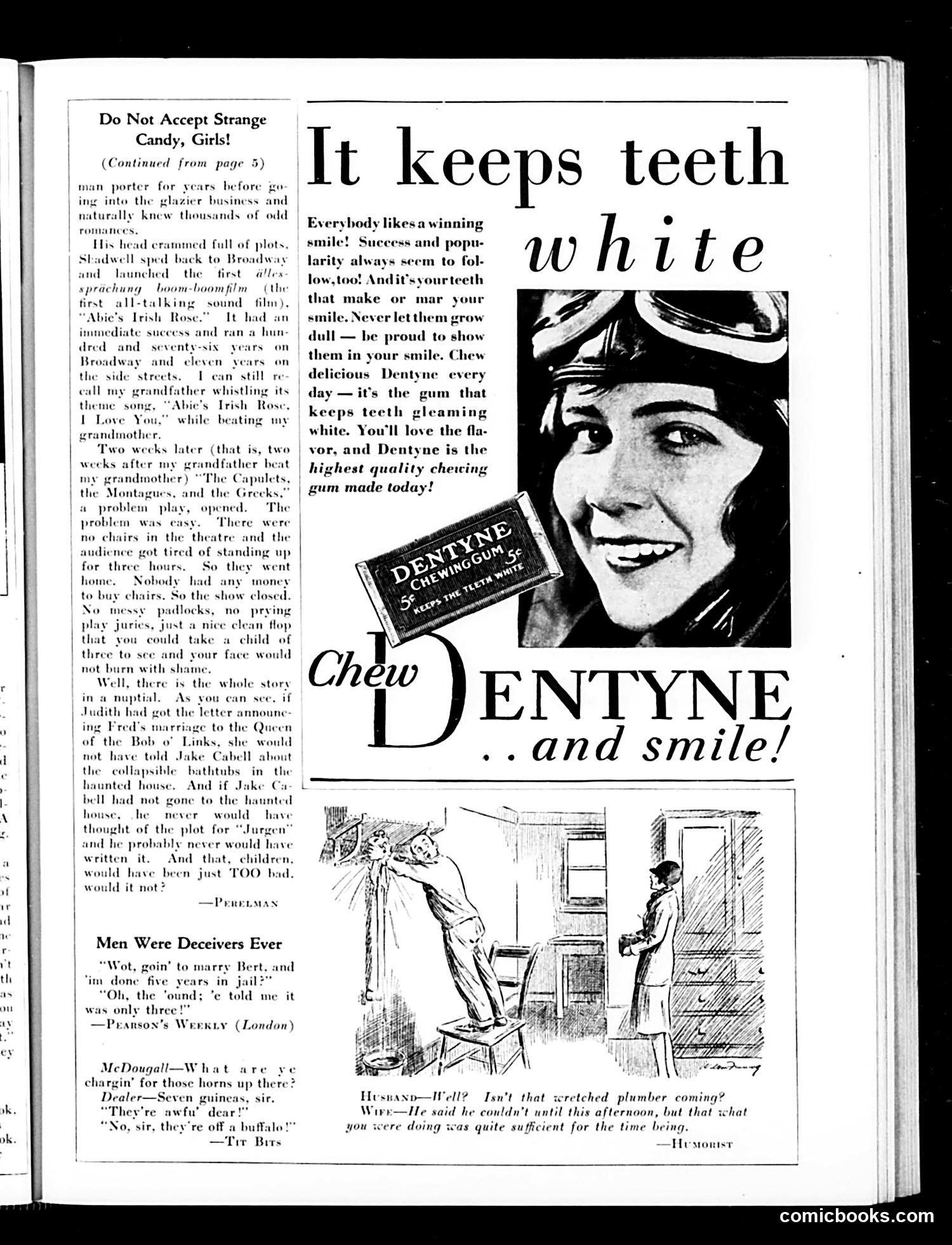
This page is **primarily advertising** for Dentyne chewing gum, occupying the right half with a large product pitch ("It keeps teeth white...and smile!") featuring a smiling woman's photograph and the product package. The left side contains three unrelated humor pieces typical of Judge's satirical content: 1. **"Do Not Accept Strange Candy, Girls!"** — A rambling anecdote about Broadway theater history, seemingly mocking overwrought storytelling itself. 2. **"Men Were Deceivers Ever"** — Three brief jokes about deception: a woman tricked about her fiancé's prison sentence, and haggling over horn prices. Standard period humor about dishonesty and marriage. 3. **Bottom cartoon** — A domestic joke: a wife tells her husband a plumber can't arrive until afternoon, but notes his current activity (unclear from image) is "quite sufficient" for now—likely implying he's doing inadequate household repairs. The page reflects early 20th-century Judge: mixing satirical commentary with commercial advertising, and featuring light domestic/social humor rather than political content.
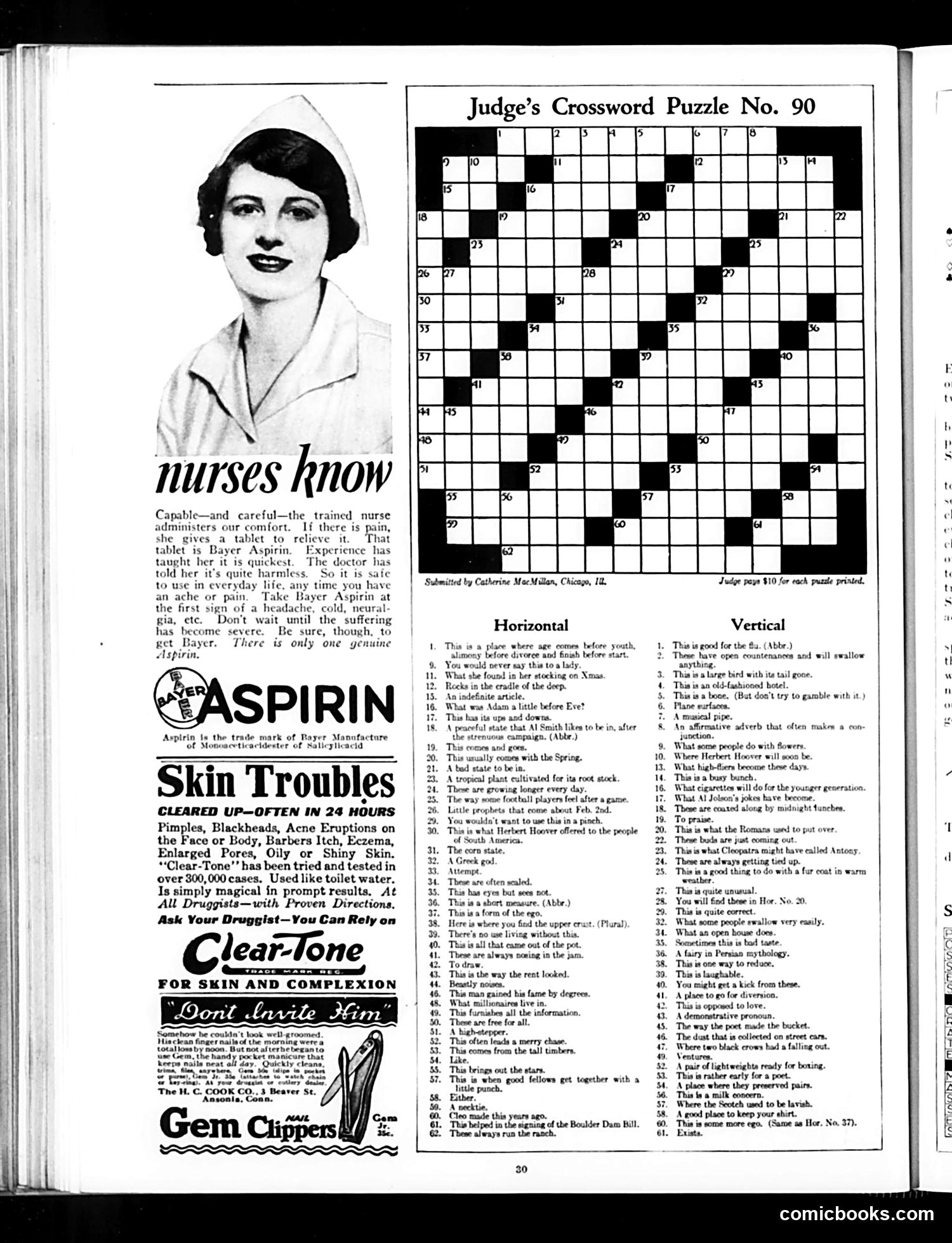
This page is primarily **advertising and entertainment content**, not political satire. The main elements are: 1. **Bayer Aspirin advertisement** featuring a nurse—capitalizing on medical authority to market the product as a trusted pain reliever. The ad emphasizes that nurses recommend it, linking the brand to professional credibility. 2. **Clear-Tone skin treatment ad** promising to cure acne and skin conditions in 24 hours—typical early 20th-century medical advertising with exaggerated claims. 3. **Gem Clippers advertisement** for a manicure tool, with a humorous caption about maintaining groomed appearance. 4. **Crossword Puzzle No. 90**—a standard entertainment feature with clues referencing contemporary topics (Herbert Hoover, Al Smith, Boulder Dam Bill), but designed purely for puzzlement-solving rather than commentary. The page reflects Judge magazine's dual function: satirical commentary in editorial content paired with period advertisements and puzzles for reader engagement. The crossword's casual references to current events served mainly as puzzle difficulty, not satire.
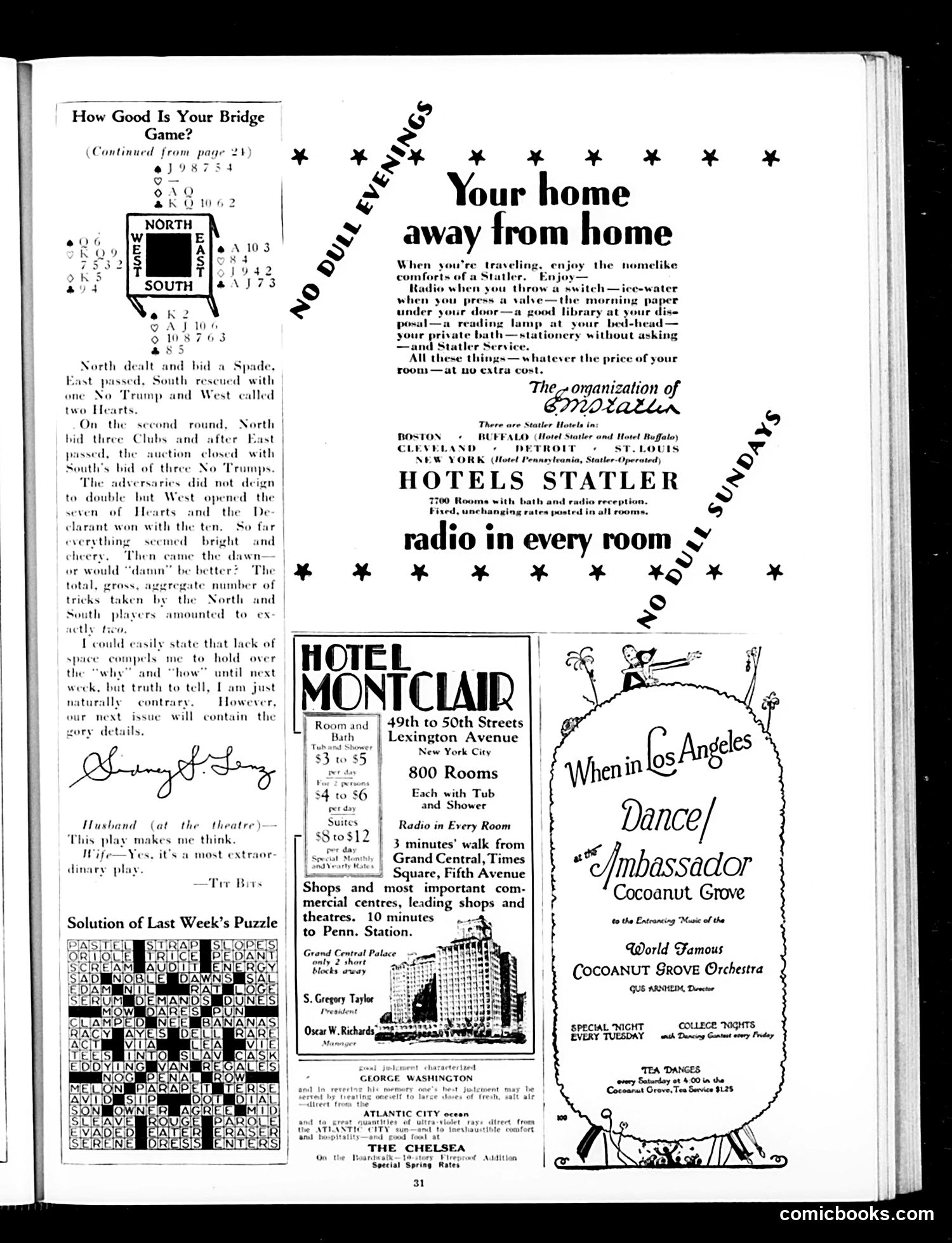
This page is primarily **advertisements and filler content** rather than satirical cartoons. The upper left contains a bridge game column ("How Good Is Your Bridge Game?"), which appears to be an ongoing instructional feature explaining bridge hands and strategy—not satire. Below that is a brief theater joke: a husband says a play "makes me think"; the wife calls it "extraordinary." The husband responds "Tir Bits"—suggesting the play is actually quite ordinary, just intellectually pretentious. This is gentle domestic humor, not political satire. The remainder of the page is **hotel and entertainment advertising**: the Statler Hotels chain promoting their amenities (radio in every room, no extra charges), the Hotel Montclair in New York, and the Ambassador Cocoanut Grove nightclub in Los Angeles advertising dance entertainment and tea dances. There is **no political cartoon or satirical content** on this page. It represents how Judge magazine (like most publications of this era) subsidized editorial content through substantial paid advertising.
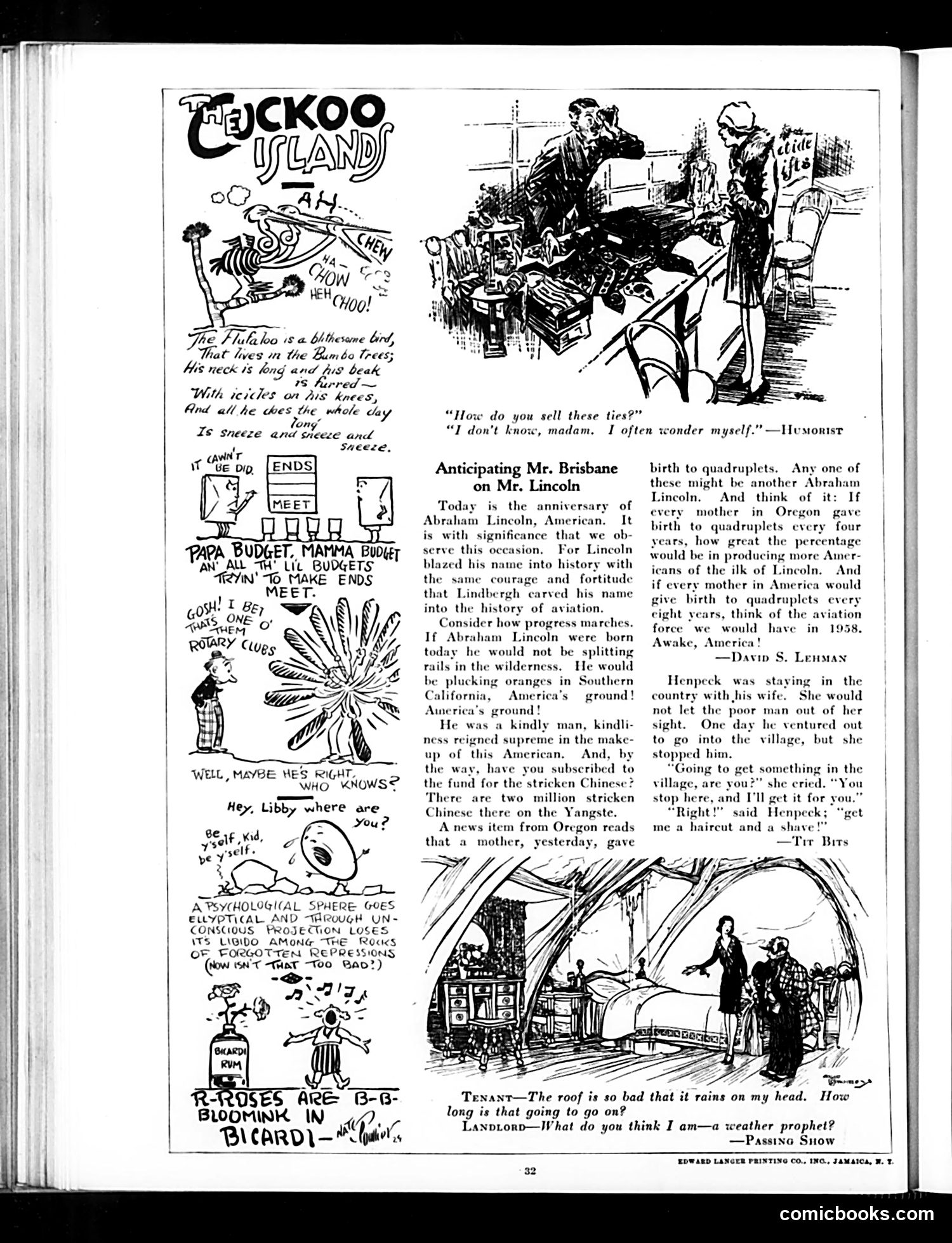
This page contains several distinct pieces of satirical humor typical of early 20th-century Judge magazine: **"The Cuckoo Islands"** (top left) is a nonsense poem about a fictional bird, likely parodying exotic travel literature popular at the time. **The main article, "Anticipating Mr. Brisbane on Mr. Lincoln,"** celebrates Lincoln's birthday while satirizing contemporary attitudes. It compares Lincoln's historical significance to Charles Lindbergh's aviation achievements, then mocks the era's obsession with eugenics and national productivity by proposing that if Oregon mothers produced quadruplets every four years, America could have many more "Lincoln-type" citizens by 1958. This reflects early 20th-century anxieties about population and national strength. **Three short joke panels** at bottom use wordplay and domestic humor: a tie salesman's existential confusion, a husband ("Henpeck") trying to escape his wife's control, and a landlord deflecting a tenant's complaint about a leaky roof. The cartoons employ visual gags typical of Judge's style—exaggerated expressions and situational comedy aimed at middle-class readers.
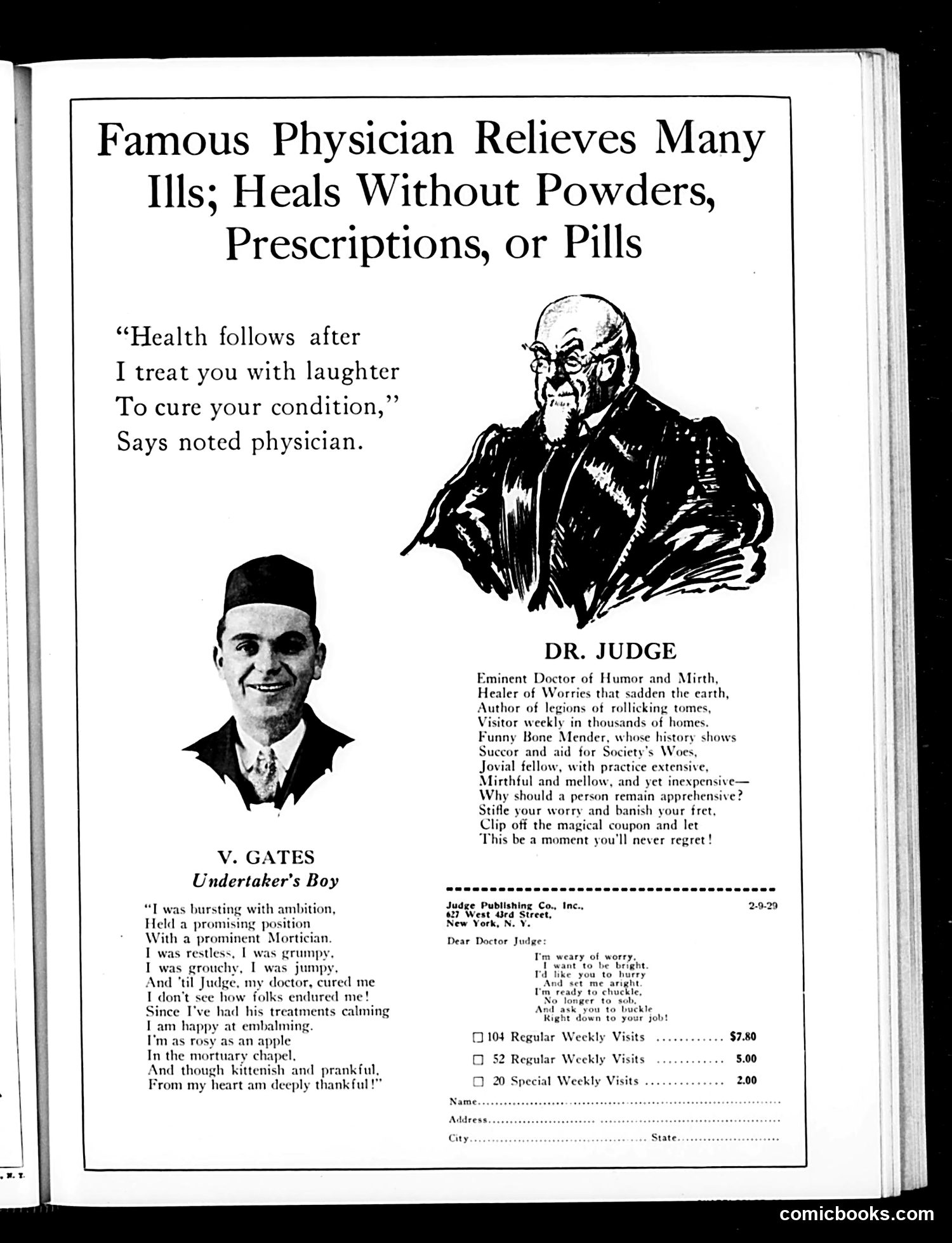
This is a satirical advertisement disguised as editorial content for "Judge" magazine itself—the publication is humorously promoting "Dr. Judge" as a quack physician whose cure is simply reading the magazine. The satire works on multiple levels: The headline mocks contemporary "miracle cure" advertisements (common in early 20th-century publications). "Dr. Judge" is presented as an absurd medical charlatan claiming to heal through laughter rather than medicine—which is the magazine's actual product. The testimonial from "V. Gates, Undertaker's Boy" reinforces the joke: even someone in the morbid profession of embalming finds happiness through Judge's humor. The pricing structure at bottom (subscription options at $7.80, $5.00, or $2.00) completes the parody of fraudulent medical offers. This is self-promotional satire typical of Judge magazine, which positioned humor and comedy as genuinely therapeutic—a clever marketing strategy wrapped in the era's familiar snake-oil advertising language.
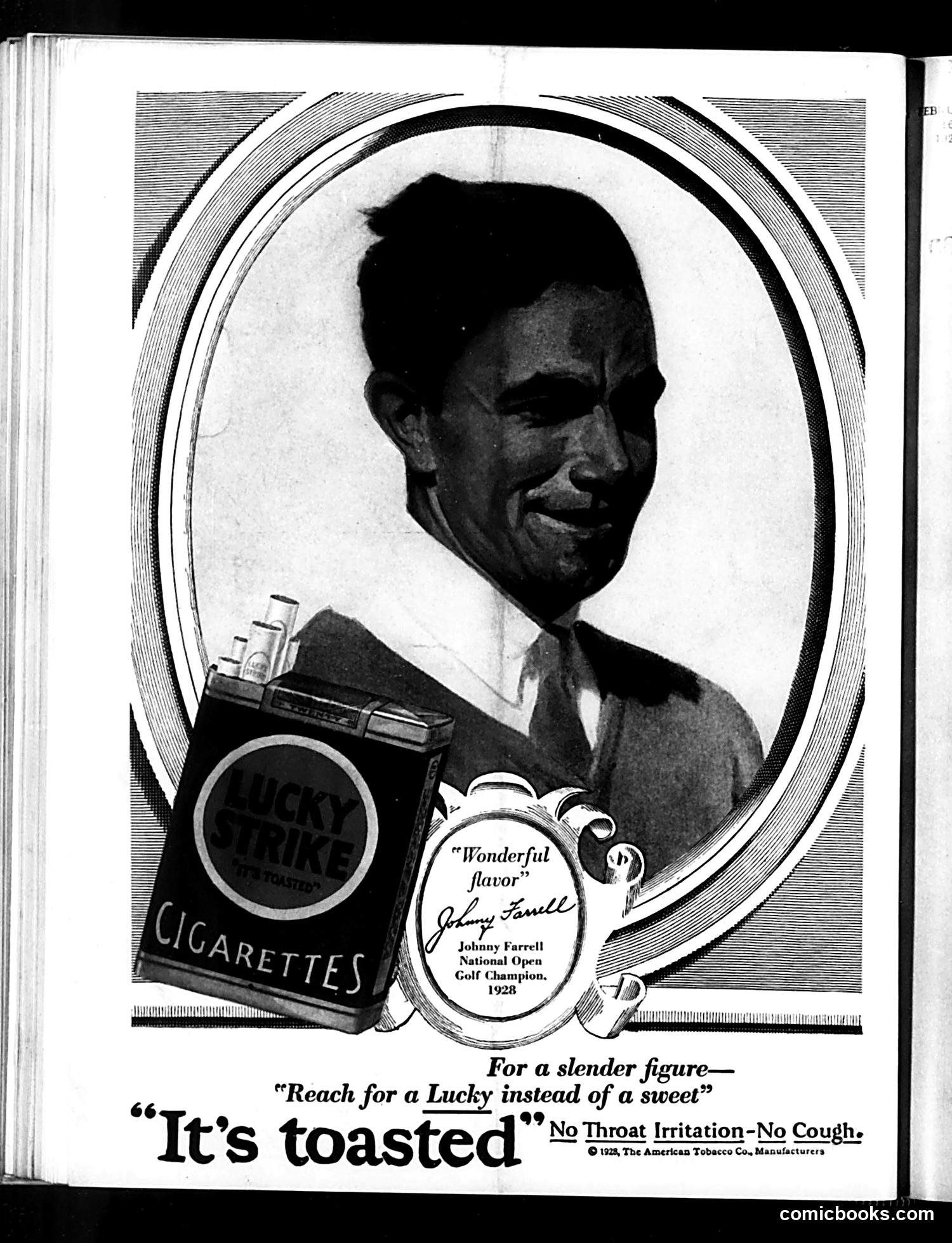
This is a Lucky Strike cigarette advertisement rather than political satire. It features an endorsement from Johnny Farrell, identified as the 1928 National Open Golf Champion, whose portrait appears in an oval frame. The ad promotes cigarettes as a weight-management alternative, using the slogan "Reach for a Lucky instead of a sweet"—a marketing strategy that positioned smoking as preferable to eating candy for maintaining a slim figure. The tagline "It's toasted" and "No Throat Irritation—No Cough" were Lucky Strike's standard health claims from this era. This represents a historical example of tobacco advertising that exploited both celebrity endorsement and social anxieties about body image—tactics now recognized as predatory marketing practices.