
A complete issue · 36 pages · 1928
Judge — May 5, 1928
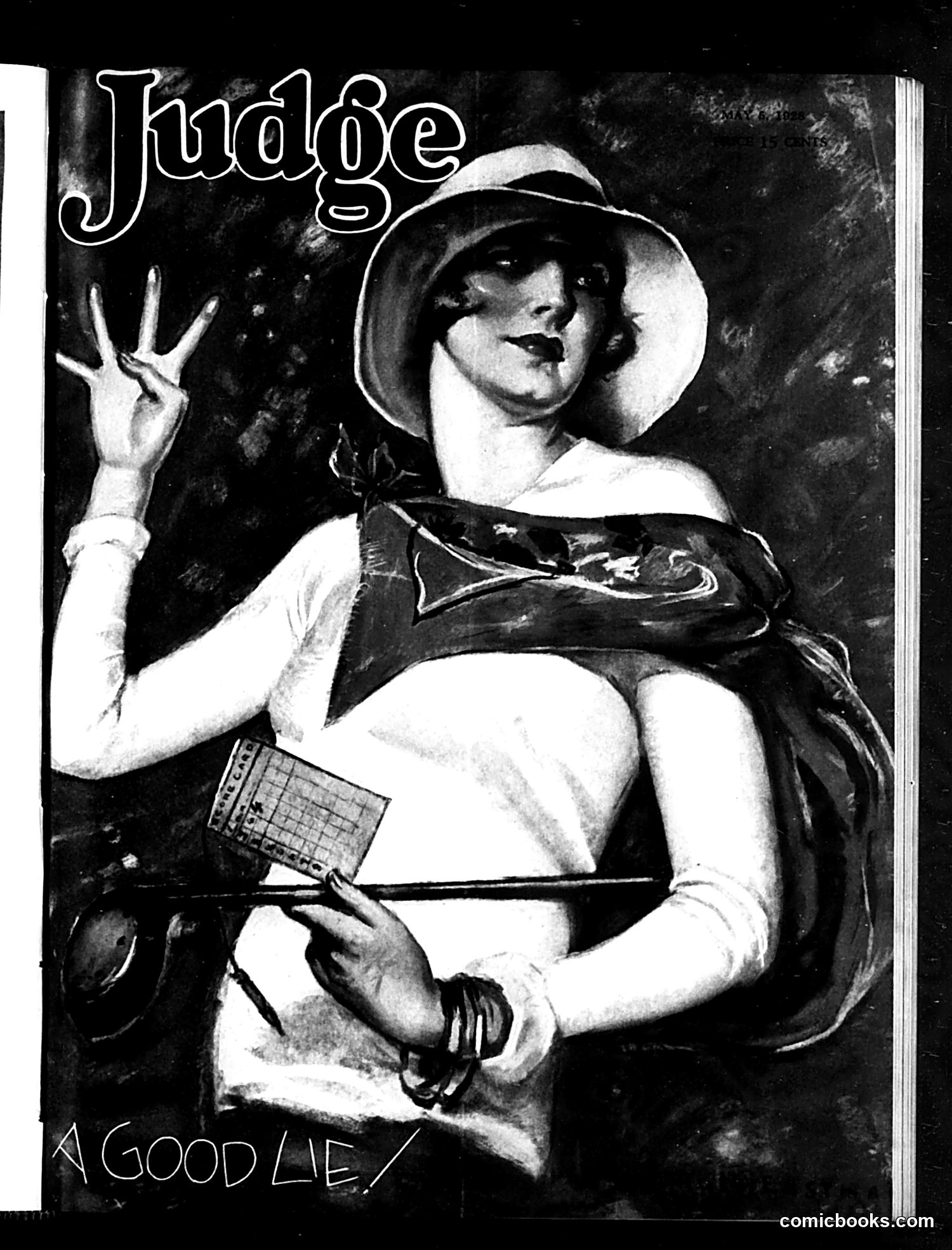
This satirical illustration depicts a fashionable woman in 1920s attire—wide-brimmed hat, elegant dress, and jewelry—holding a judicial gavel and legal pad. The title "A Good Lie" paired with her appearance suggests commentary on courtroom testimony or legal proceedings, likely satirizing women's increasing participation in legal/judicial matters during the era. The woman's composed, confident demeanor while holding judicial instruments implies irony about the reliability of female witnesses or participants in court. The satire likely reflects contemporary anxieties about women's expanding social roles following suffrage (1920), poking fun at whether women could be trusted in traditionally male-dominated legal institutions. The specific case or incident referenced is unclear without additional context.
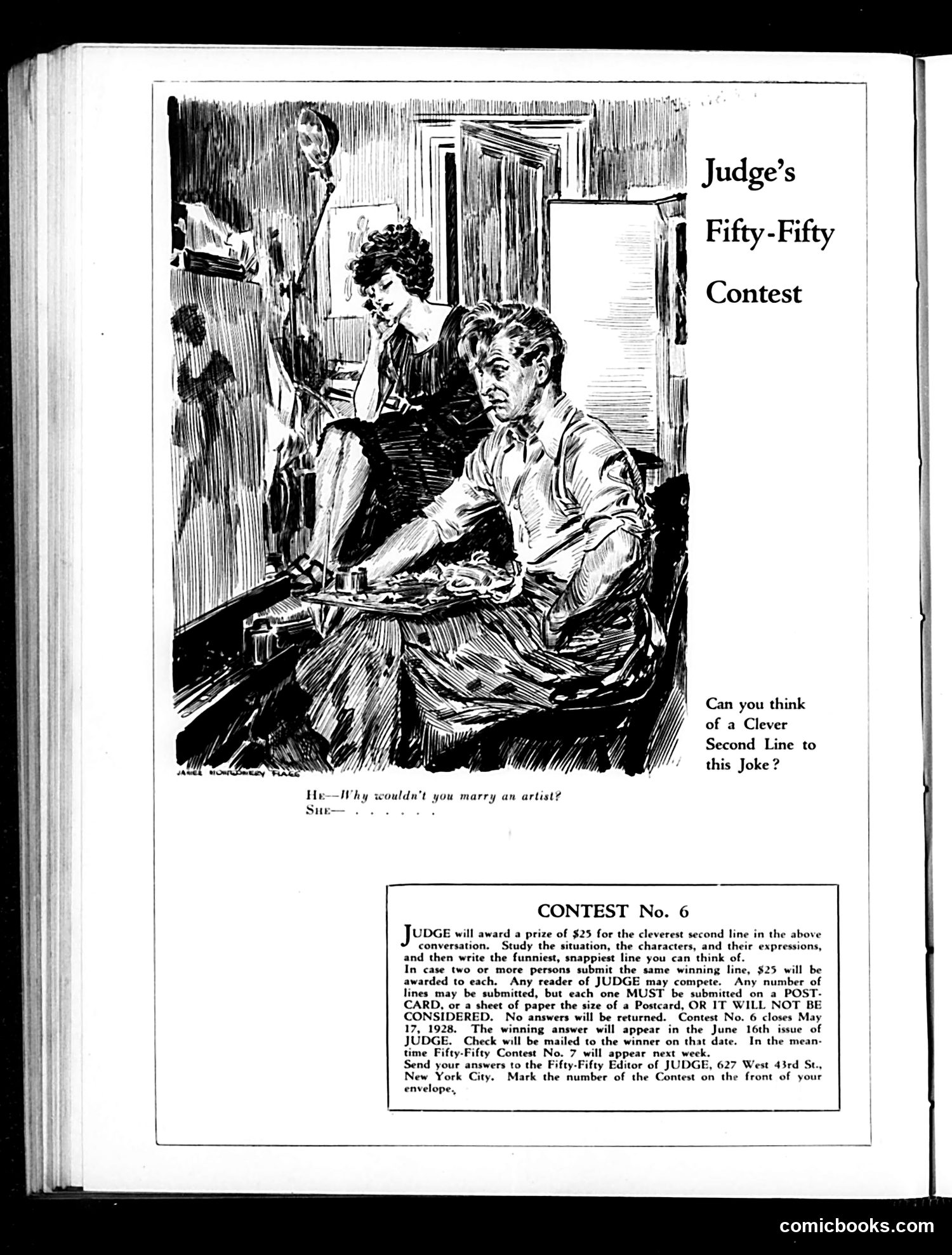
This page presents a reader-participation contest from *Judge* magazine. The cartoon shows a man and woman in what appears to be an interior domestic scene. The man asks, "Why wouldn't you marry an artist?" and the woman's response is deliberately cut off with ellipses. Readers are invited to submit the cleverest possible second line to complete the woman's reply, with a $25 prize for the winner. The contest encourages satirical or witty responses to what was likely a common romantic or social objection to marrying an artist—possibly referencing stereotypes about artists' financial instability, bohemian lifestyles, or social standing. This represents *Judge*'s interactive humor format, engaging readers as comedy collaborators.
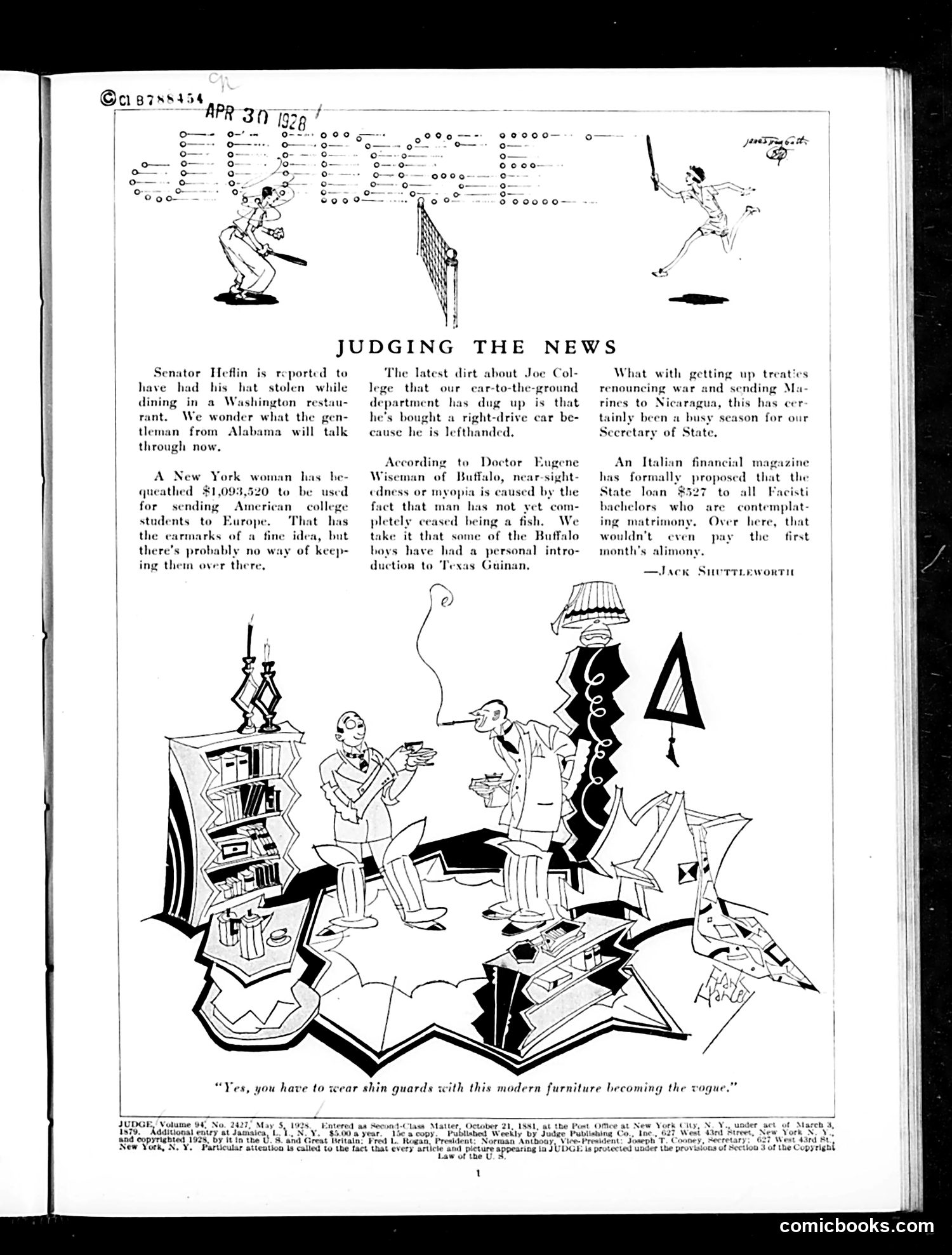
This satirical column mixes brief news commentary with a cartoon below. The main joke concerns modern furniture becoming fashionable: a couple sits surrounded by angular, geometric Art Deco-style pieces, with the woman telling her husband, "Yes, you have to wear shin guards with this modern furniture becoming the vogue." The satire targets the then-trendy Art Deco/modernist design movement—sharp angles and geometric forms were impractical and physically uncomfortable compared to traditional furnishings. The cartoon mocks how people adopted fashionable design despite obvious drawbacks. Above are brief gossipy news items about Senator Heflin, Joe Colver's driving, and an Italian proposal regarding Fascist bachelors—typical Judge humor combining politics, sports, and social commentary.
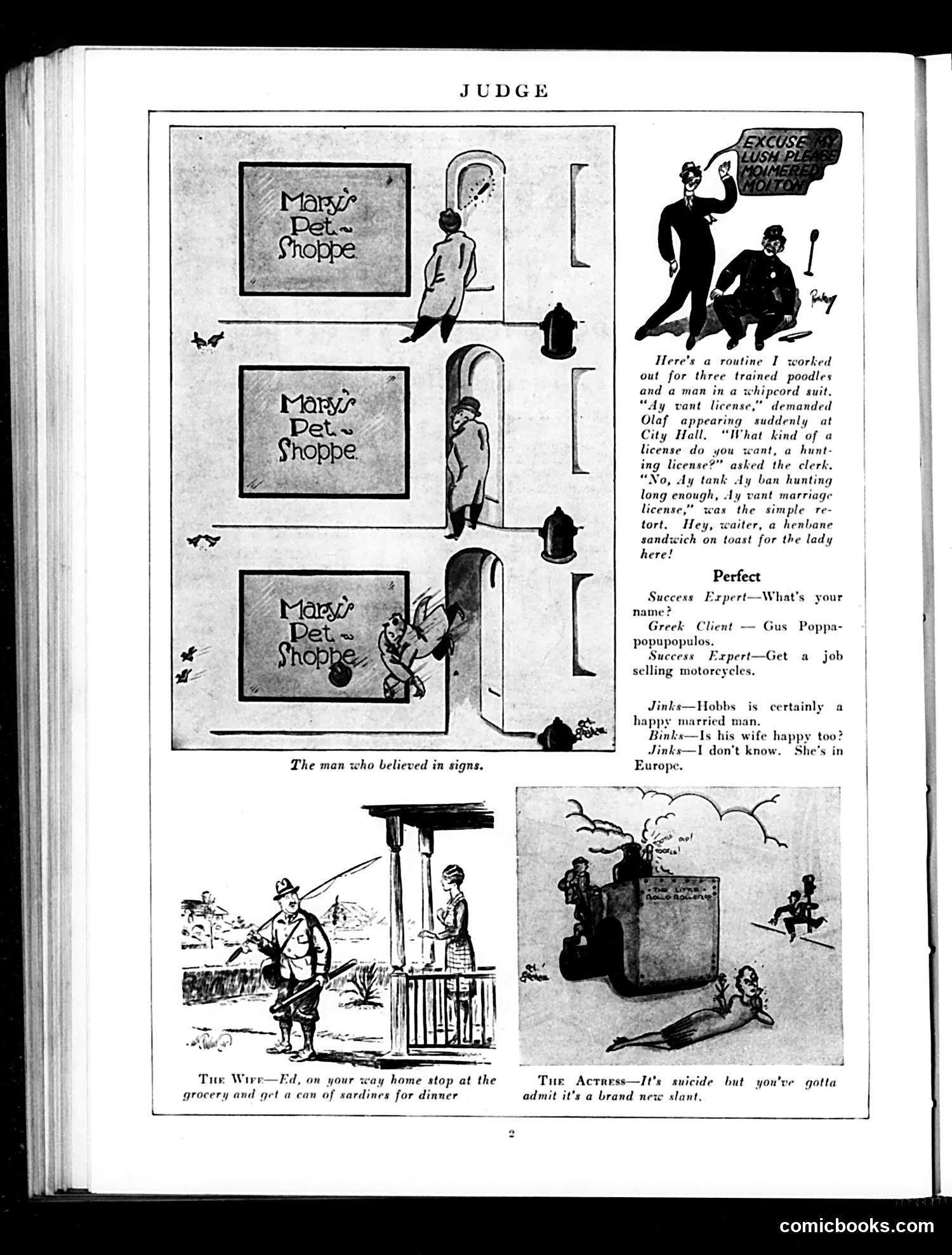
**Top Cartoon - "The man who believed in signs":** This satirizes someone who religiously follows storefront signs. A man repeatedly enters "Mary's Pet Shoppe" on different floors, apparently expecting different businesses, until he encounters actual animals. The joke mocks literal-mindedness and misplaced trust in signage. **Bottom Left - "The Wife":** A domestic humor strip where a wife instructs her husband to buy canned sardines for dinner while returning home—a working-class economy joke. **Bottom Right - "The Actress":** Dark humor about an actress attempting suicide but framing it as an artistic "stunt" for publicity—satirizing entertainment industry sensationalism and performers' desperation for attention. All three pieces mock everyday foolishness and social pretension typical of Judge's satirical approach.
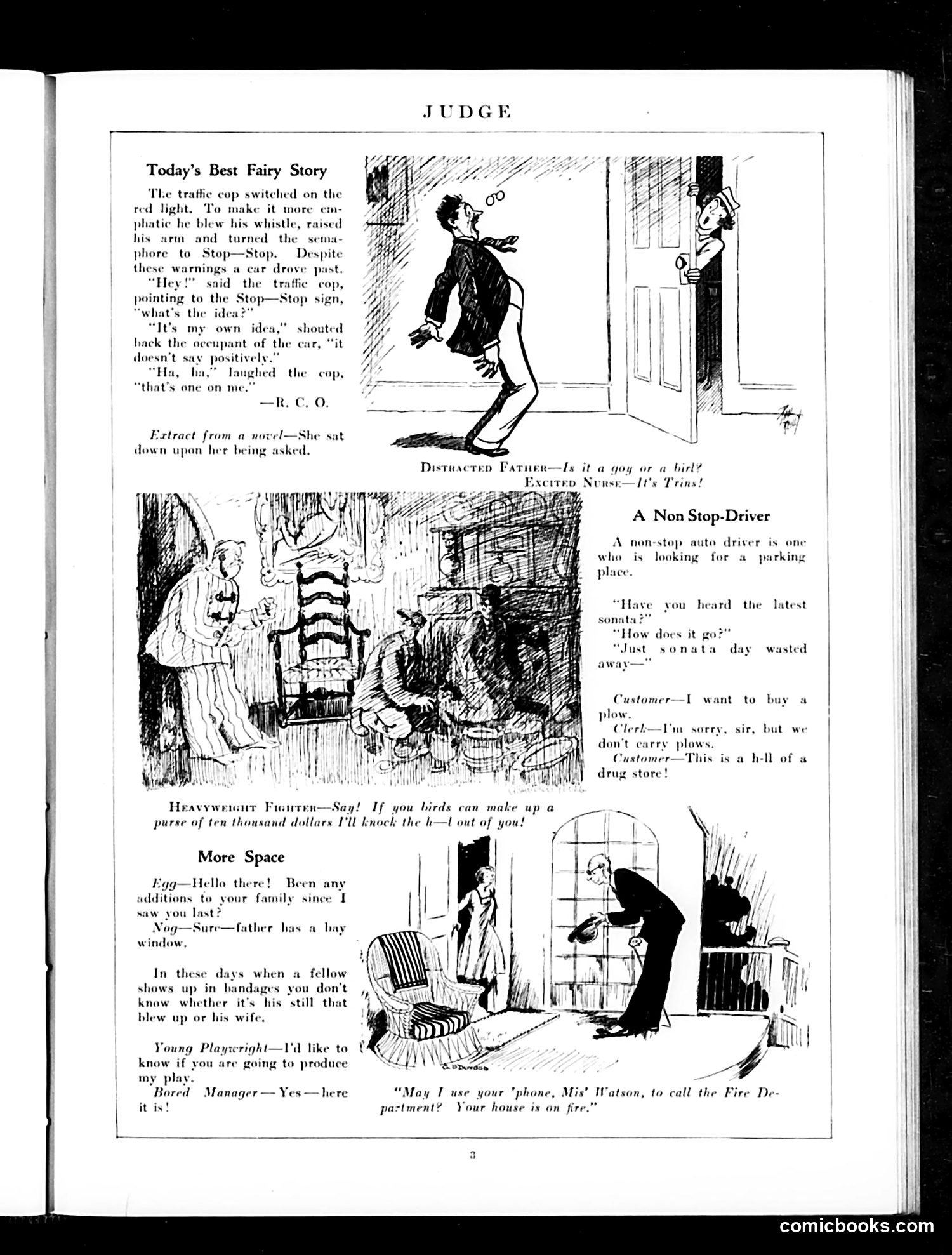
This page contains three separate satirical pieces from Judge magazine, a humor publication: 1. **"Today's Best Fairy Story"**: Mocks a traffic cop who stops a car for running a red light, then admits the stop sign "doesn't say positively" when challenged—absurd bureaucratic logic. 2. **"A Non-Stop Driver"**: Satirizes drivers endlessly circling to find parking spots. The humor involves a customer asking a clerk about "the latest sonata" and the clerk mishearing it as "sonata day wasted away." 3. **"More Space"** and **"Heavyweight Fighter"**: Brief comedic sketches about family overcrowding and a playwright's frustration with a theater manager. The page exemplifies Judge's style: gentle, domestic humor targeting middle-class American life, particularly frustrations with urban driving, commerce, and daily annoyances rather than political commentary.
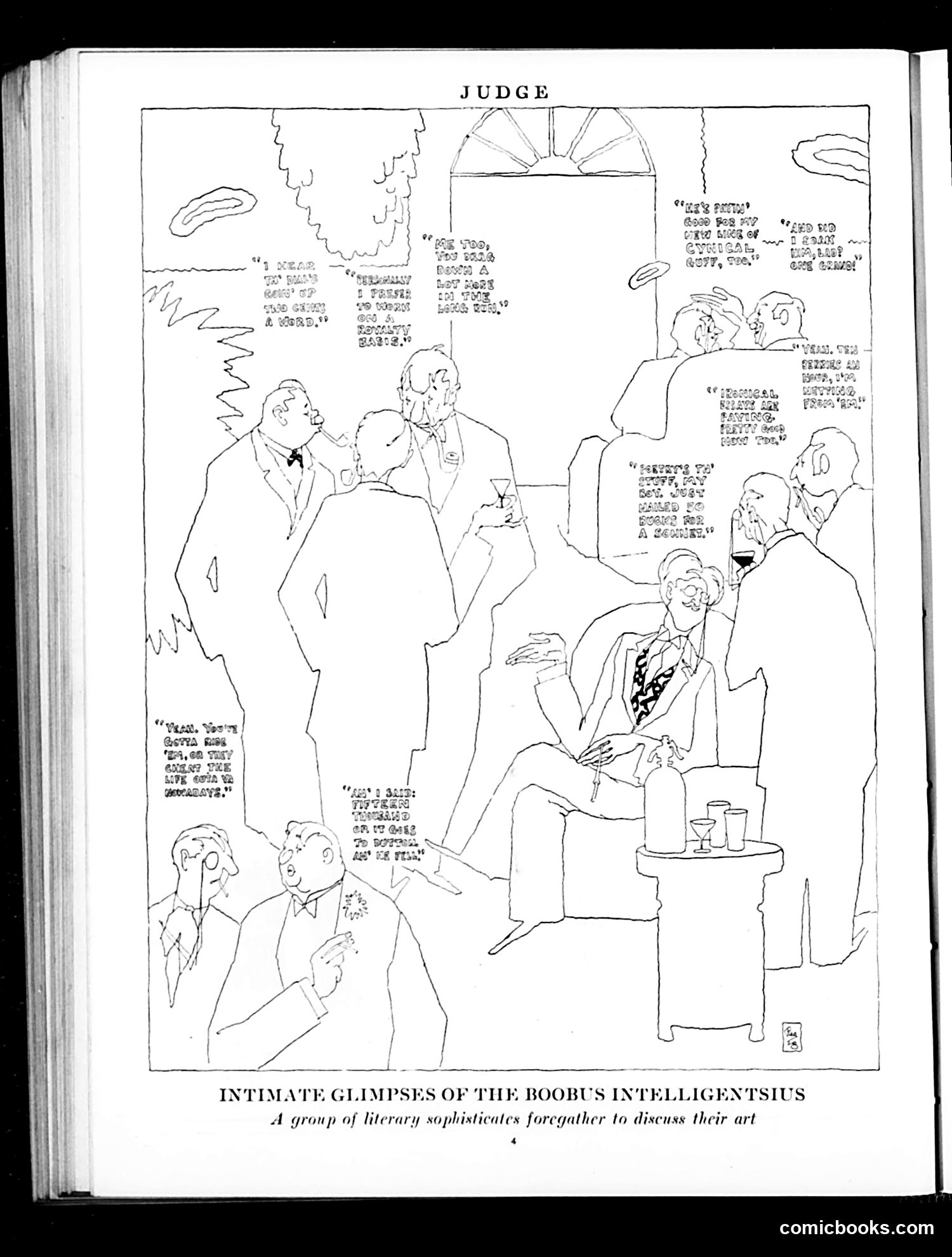
This page from *Judge* magazine presents a satirical cartoon titled "Intimate Glimpses of the Booby's Intelligentsius" — subtitled "A group of literary sophisticates foregather to discuss their art." The cartoon depicts well-dressed men at what appears to be a social gathering or literary salon, engaged in conversation. The satirical point targets intellectual pretension: the title's use of "Booby's Intelligentsius" (combining "booby" meaning fool with faux-Latin) mocks these men as pseudo-intellectuals or poseurs. The various speech bubbles contain dialogue that likely ridicules their affected conversation about literature and art. The cartoon exemplifies *Judge's* tradition of lampooning American cultural figures and social pretension, particularly the affectations of would-be literary sophisticates of the era. The specific identities of the figures remain unclear from the image alone.
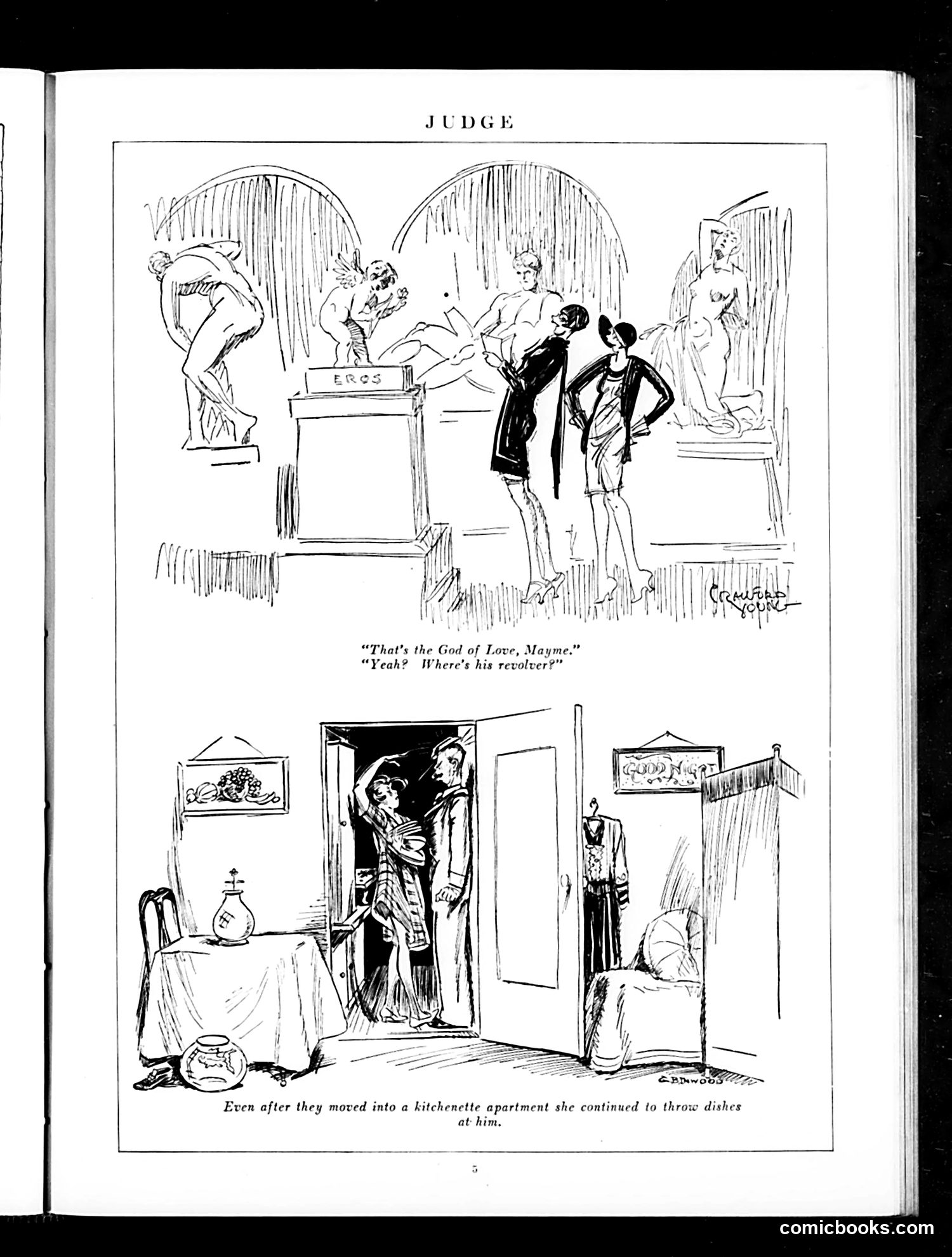
This page contains two cartoons satirizing relationship dynamics and marital discord. **Top cartoon:** Shows a couple viewing classical statuary in what appears to be a museum or gallery. The woman says "That's the God of Love, Mayme" and the man responds "Yeah? Where's his revolver?" The joke suggests that love requires weapons—implying relationships need conflict or defensive measures. **Bottom cartoon:** Depicts domestic strife in a modest apartment, showing a woman throwing dishes at a man in a doorway. The caption reads: "Even after they moved into a kitchenette apartment she continued to throw dishes at him." Both cartoons humorously depict marital violence and discord as mundane aspects of 1920s-30s relationships, reflecting period attitudes toward domestic conflict that modern audiences would find troubling rather than funny.
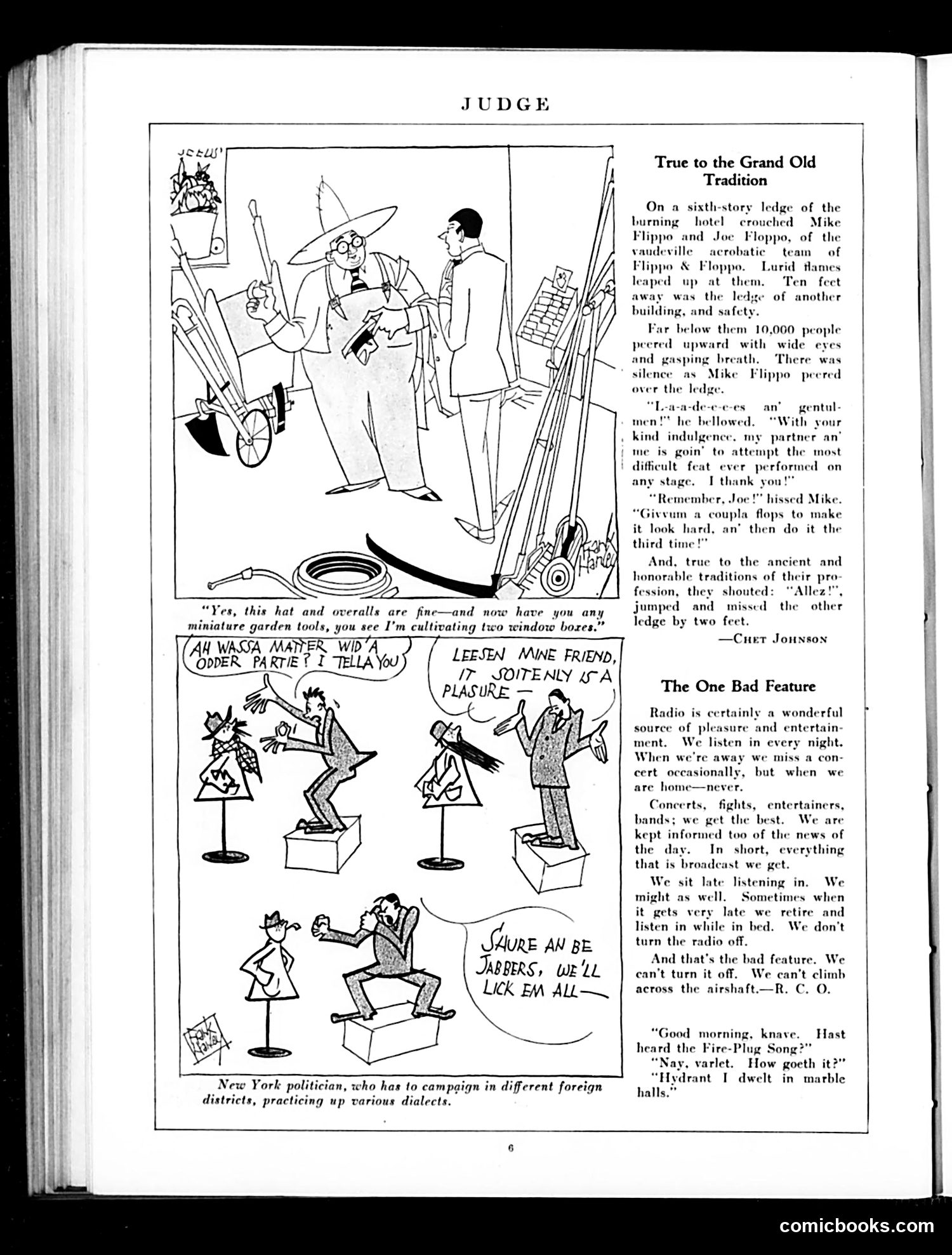
This page contains three distinct satirical pieces: **Top Cartoon**: A man purchases miniature garden tools while wearing a hat and overalls, joking he's "cultivating two window bores"—a pun on window boxes, satirizing pretentious urban gardening. **Middle Cartoon**: Depicts a New York politician practicing different ethnic dialects and accents while campaigning in foreign immigrant districts. He's shown adopting exaggerated speech patterns ("Ah wassa matter," "Leesen mine friend") to appeal to voters in various ethnic neighborhoods. This mocks politicians' pandering to immigrant communities through stereotyped dialect mimicry. **Right Column**: "The One Bad Feature" critiques radio's addictive quality—listeners can't turn it off, even late at night, making it impossible to escape. Below that, a brief dialogue plays on the phrase "marble halls," suggesting an old-fashioned, aristocratic tone. The page satirizes early 20th-century urban life: superficial consumption, political opportunism targeting immigrants, and modern technology's grip on behavior.
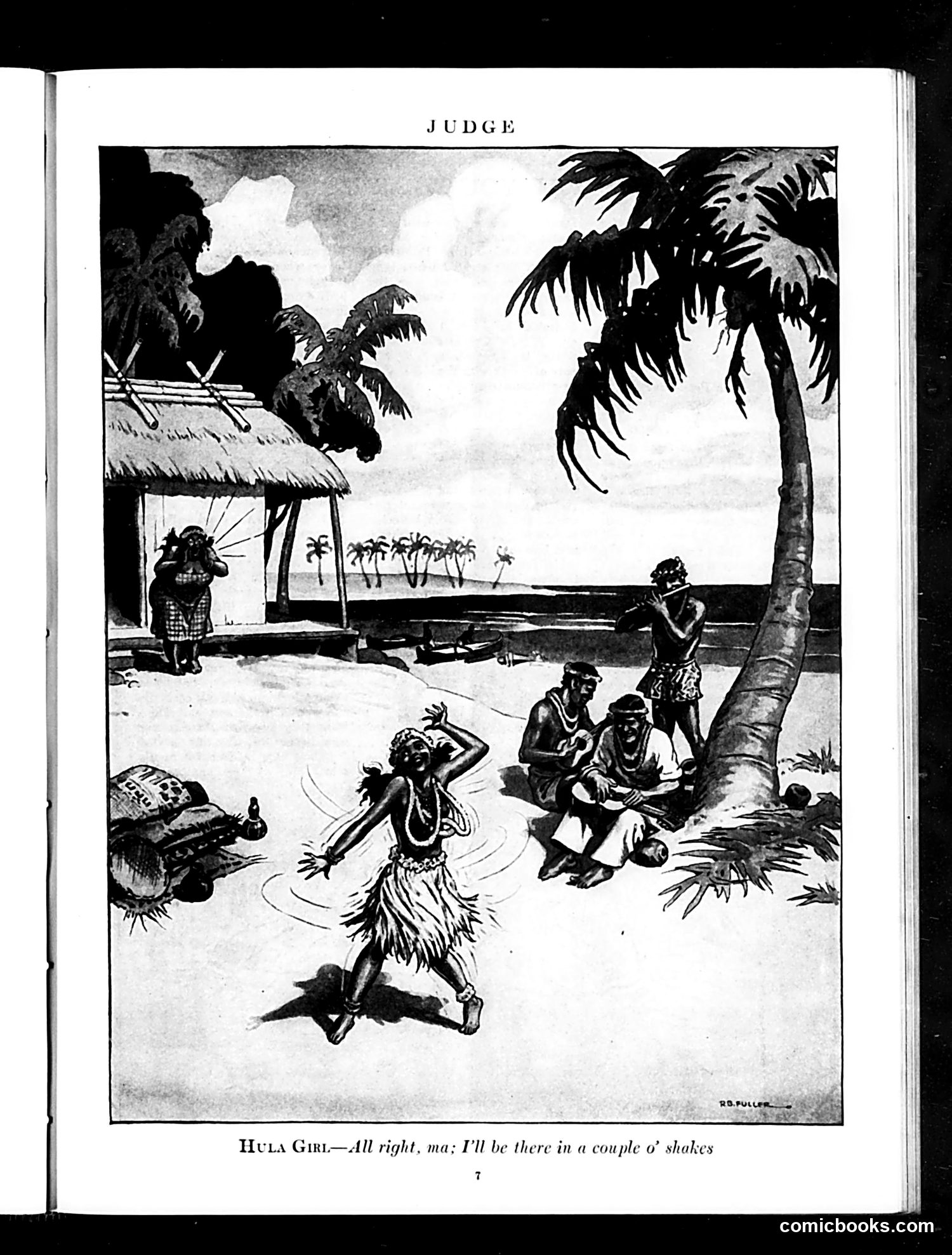
This cartoon depicts a tropical beach scene with racial caricature stereotypes typical of early-to-mid 20th century American satire. A figure labeled "Hula Girl" performs a hula dance while others watch from beneath a palm tree and thatched structure. The caption—"All right, ma; I'll be there in a couple o' shakes"—appears to be a pun connecting the hula dancer's hip movements ("shakes") to a casual, colloquial promise of arrival. The humor relies on visual wordplay rather than explicit social commentary. The cartoon reflects period attitudes toward Hawaiian and Pacific Islander cultures as exotic entertainment subjects for American audiences. The exaggerated artistic style and racial caricatures represent how such communities were routinely depicted in American popular media for comedic effect, often dehumanizing or trivializing their actual cultures.
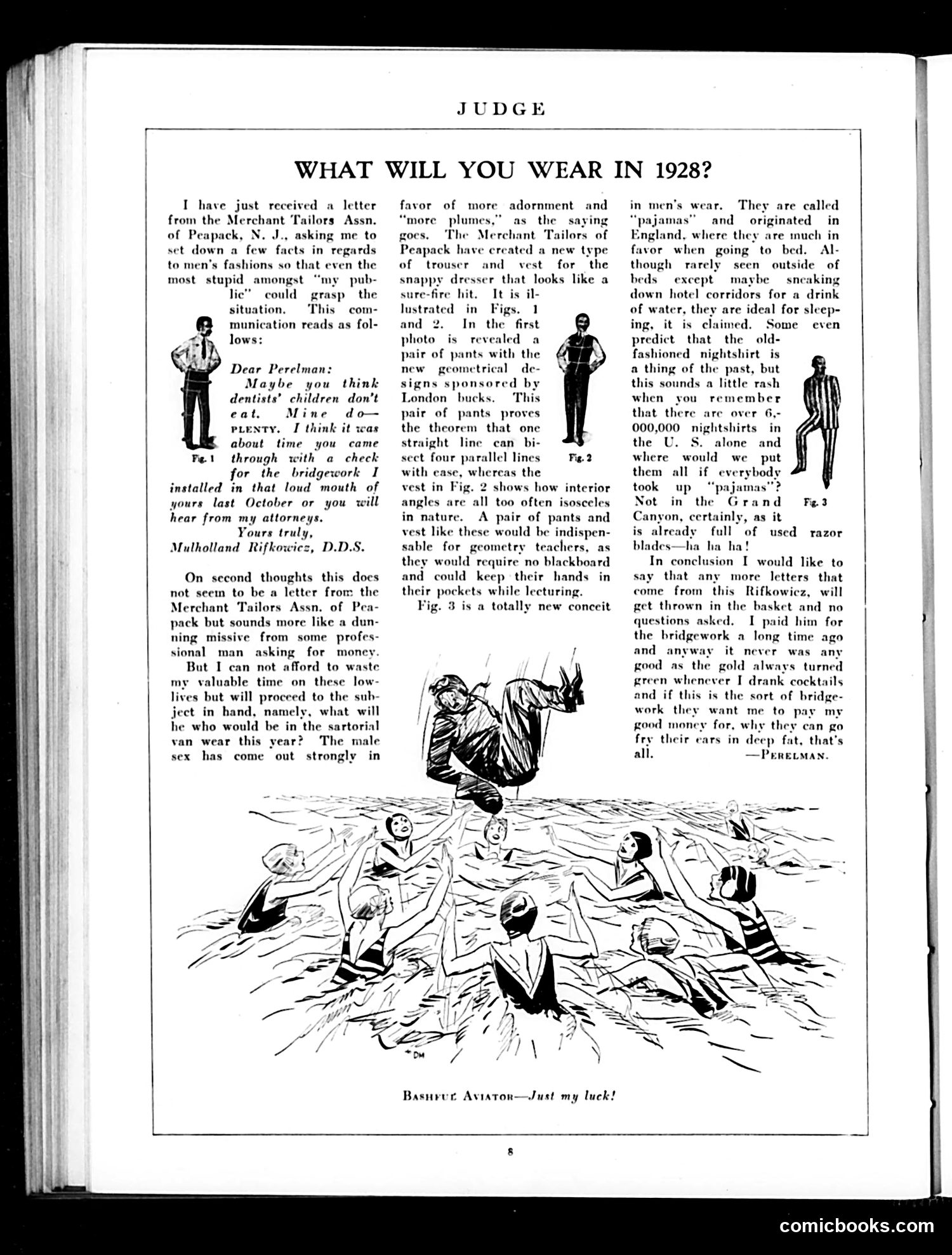
This 1928 *Judge* article satirizes men's fashion predictions through humor disguised as fashion advice. The main joke is that the "Merchant Tailors Association" letter is actually a dentist's dunning notice, establishing that the author (Perelman) is unreliable and dismissive of authority. The fashion recommendations themselves are absurd: geometrically patterned pants designed for geometry teachers to lecture without blackboards, and pajamas presented as revolutionary sleepwear despite 6 million nightshirts already existing in America. The cartoon below shows people in elaborate pajamas at a beach, highlighting the ridiculousness. The satire mocks both high fashion's pretensions and marketing hype. The closing complaint about bridgework turning green from cocktails reinforces the comedic tone—this is entertainment disguised as advice, poking fun at 1920s consumer culture and fashion industry claims.
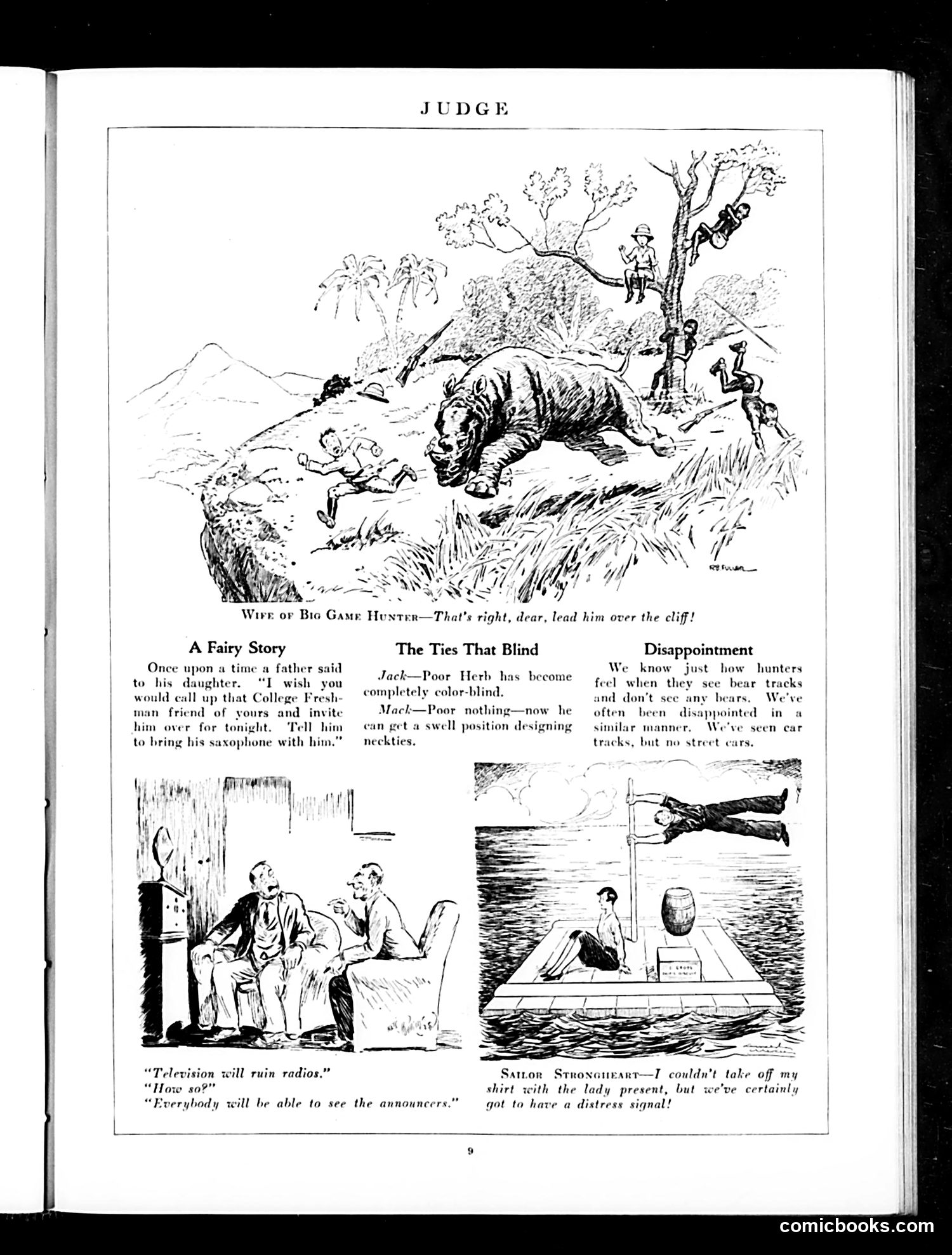
This page contains three separate comic vignettes satirizing early 20th-century American life: **"A Fairy Story"** mocks the prediction that television will revolutionize broadcasting and make radio obsolete. The joke is that everyone will be able to see radio announcers—implying the absurdity of this claim since radio was fundamentally audio-based. **"The Ties That Blind"** jokes about color-blindness. A man named Herb has become completely color-blind, but his friend Mack jokes that Herb can still get work designing neckties since he "can't see" anything anyway—dark humor about employment opportunities for disabled people. **"Disappointment"** depicts hunters disappointed by finding only animal tracks rather than actual bears to hunt, mirroring a broader complaint about seeing evidence (streetcar tracks) without the actual thing (streetcars). The top illustration shows a woman encouraging a hunter to lead a large bear off a cliff—a "fairy story" scenario. These represent typical *Judge* magazine satire: commentary on technology, social awkwardness, and everyday frustrations rendered through gentle mockery.
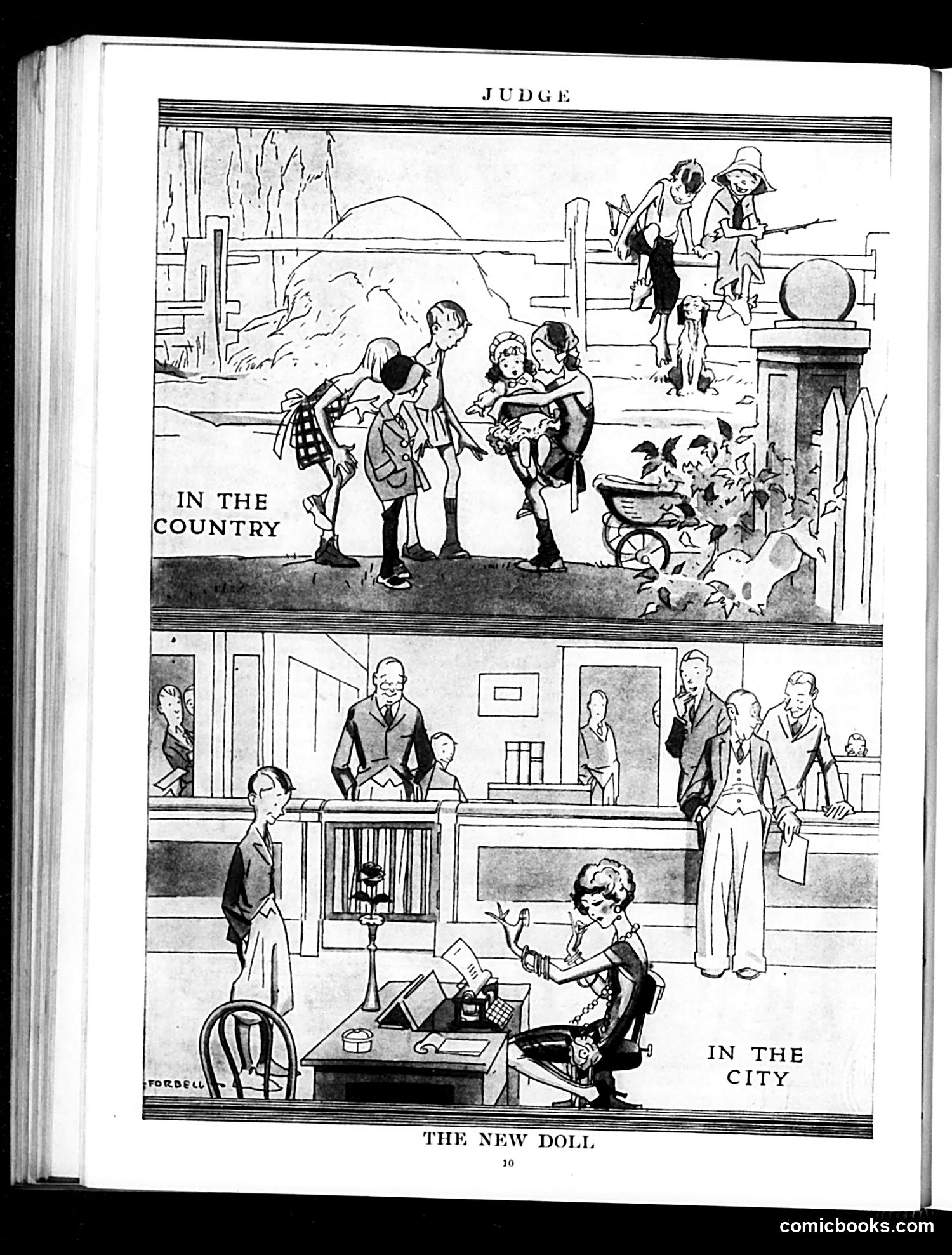
This two-panel satirical cartoon contrasts childhood play in rural versus urban settings. The top panel shows country children playing freely outdoors with toys and animals near a farmhouse. The bottom panel depicts a city child sitting alone at a desk in what appears to be a courtroom or formal institutional setting, surrounded by stern adult figures in business attire. The satire critiques urban life's formality and constraint compared to rural freedom. The "new doll" likely refers ironically to the city child, who appears to have become a miniature adult confined by legal/institutional structures rather than experiencing genuine childhood play. The cartoon suggests urbanization and formal institutions have replaced authentic childhood with rigid conformity.
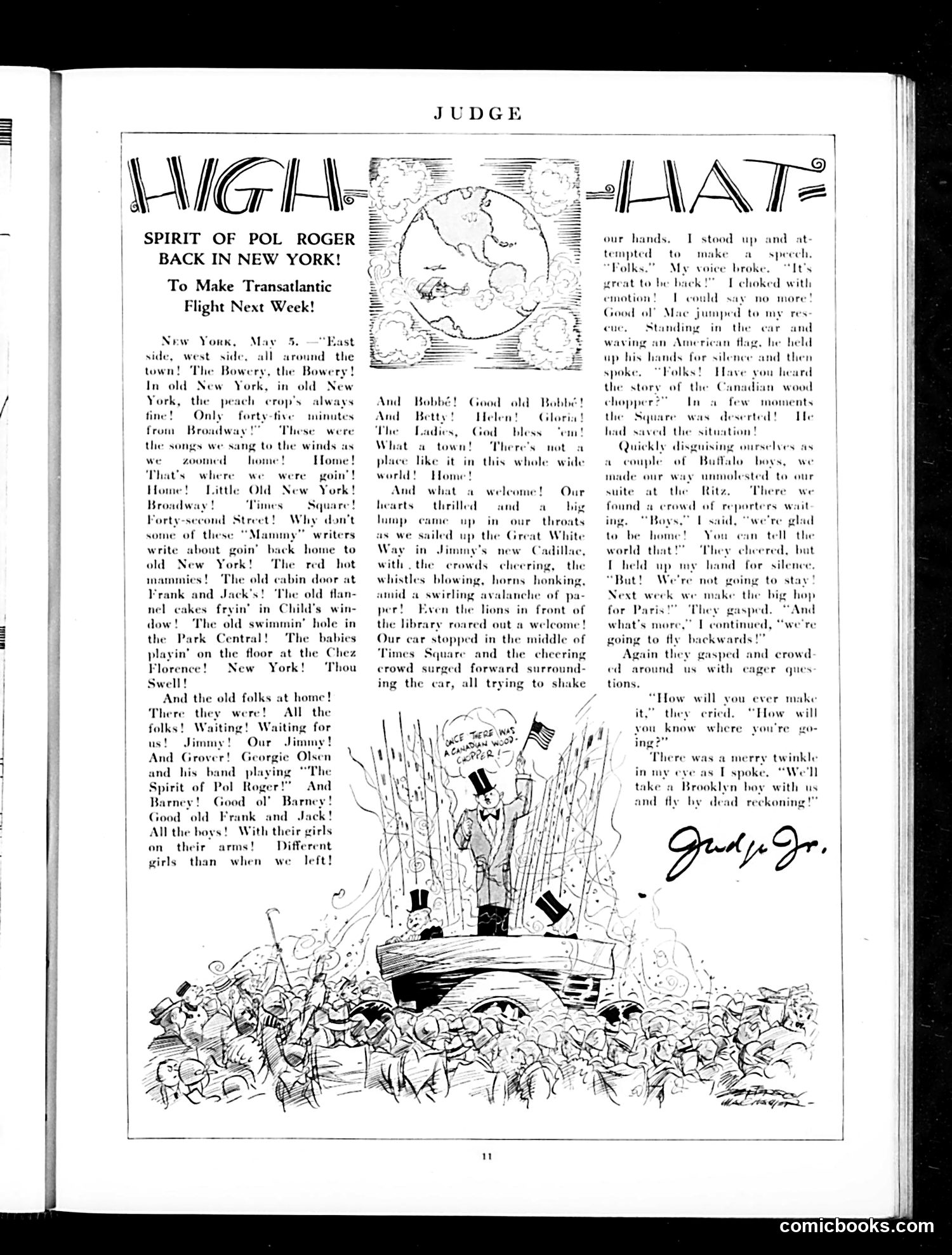
This page celebrates the return of **Pol Roger** (likely a popular aviator or public figure of the era) to New York, with plans to attempt a transatlantic flight the following week. The satire mocks New York nostalgia and civic boosterism. The cartoon depicts an enthusiastic crowd welcoming the aviator back to Times Square, with the text ironically listing sentimental New York touchstones ("the Bowery," "Child's," "Park Central"). The humor lies in the contrast between the emotional homecoming celebration and the protagonist's immediate announcement that he's leaving again for Paris—making the grand welcome party comically pointless. The satire gently ridicules both New York's self-mythologizing pride and the era's obsession with transatlantic aviation stunts. The final joke about navigating "by dead reckoning" mocks the primitive navigation methods of early aviation. The crowd's desperate attempts to prevent his departure and the protagonist's escape disguised as "Buffalo boys" heighten the comedic absurdity.
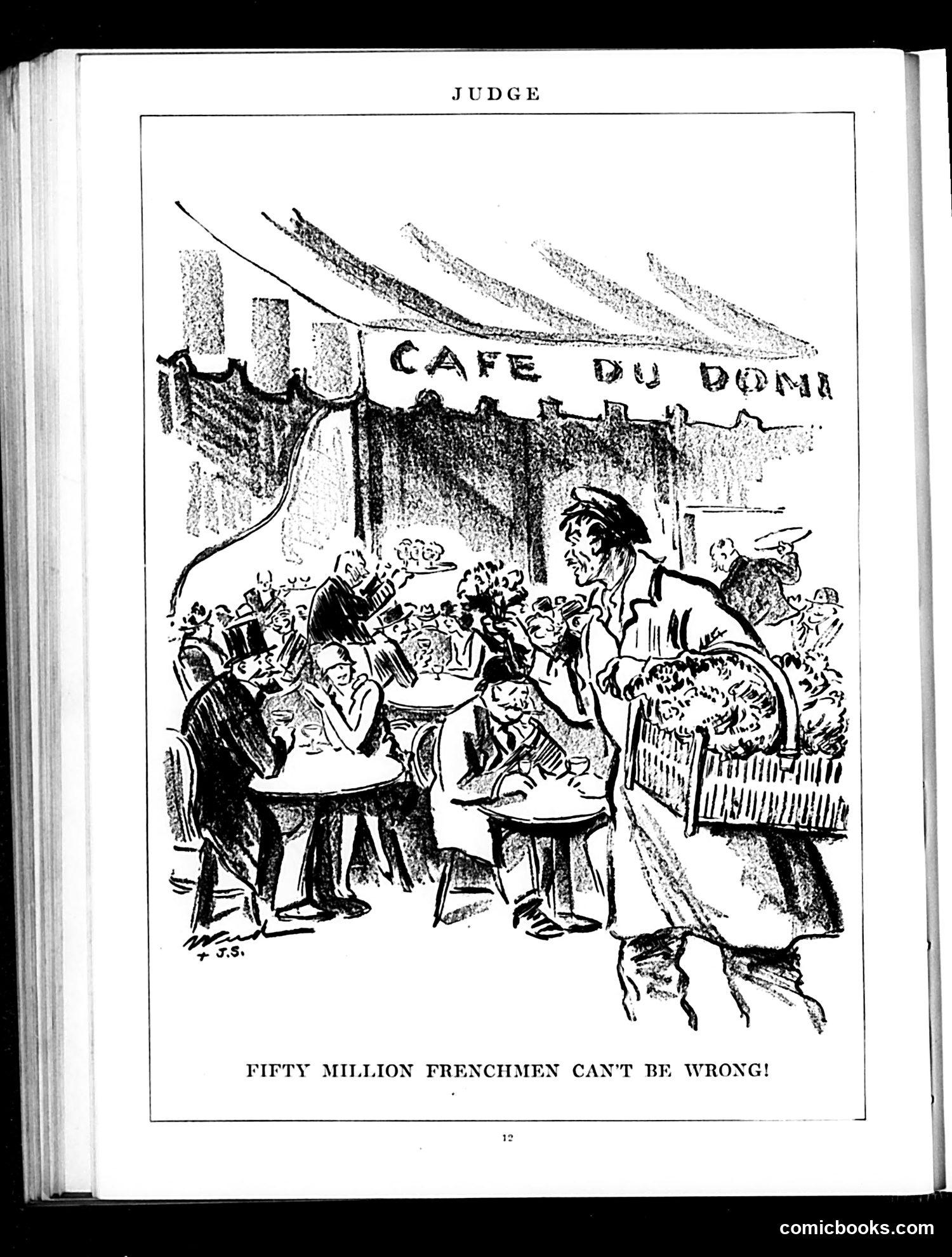
This cartoon satirizes the phrase "Fifty million Frenchmen can't be wrong"—a popular American idiom of the 1920s-30s suggesting French cultural superiority or taste. The scene depicts a crowded Parisian café (labeled "CAFE DU DOMI") where patrons appear to be engaged in animated, possibly frivolous activity. The cartoon suggests that despite France's reputation for sophistication, these "fifty million Frenchmen" may actually *be* wrong—mocking both uncritical American Francophilia and French behavior itself. The satire targets American cultural deference to France while simultaneously critiquing French society as foolish or pretentious. The crowded, chaotic scene emphasizes absurdity over elegance, undercutting the glamorous image of French culture that the idiom invokes.
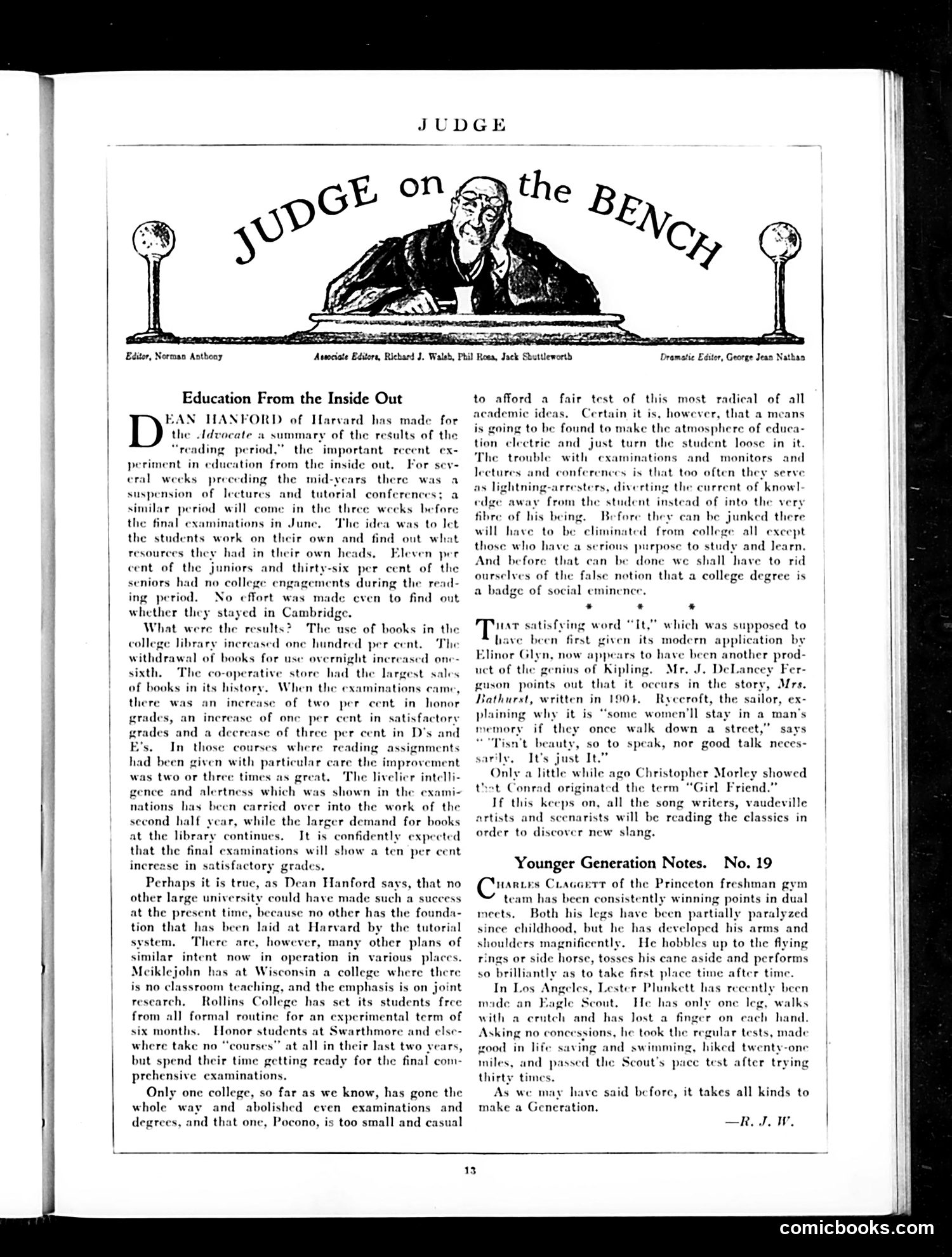
This page from *Judge* presents satirical commentary on educational reform. The header illustration shows a stern judge at a bench—typical Judge magazine iconography emphasizing judgment and criticism. The main article discusses Harvard Dean Hanford's "reading period" experiment, where students received no lectures or tutoring for weeks before exams, forced to study independently. The piece uses data (library usage up 100%, grade improvements modest at 2-10%) to suggest the experiment shows promise, though results are mixed. The satire lies in the *contradiction* between educational theory and practice: removing formal instruction reveals most students lack self-direction, yet the article frames this as success. The subtext critiques elite university pretension—only Harvard could attempt this due to its tutorial foundation, and most students will never study seriously without external pressure. The second section humorously traces the word "It" (in the Elinor Glyn sexual sense), claiming Kipling used it earlier in 1904, mocking contemporary claims of originality.
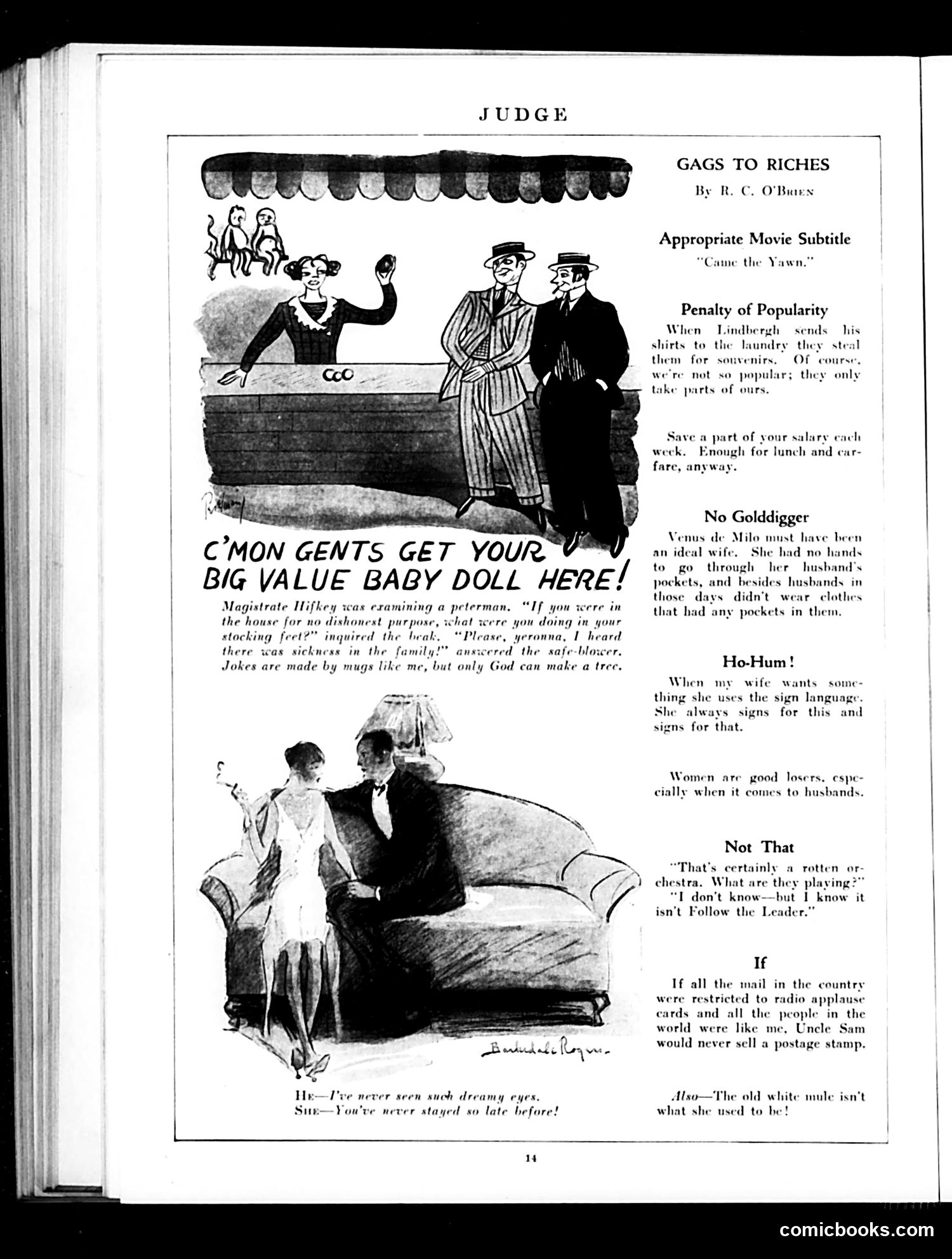
This is a humor collection page from Judge, a satirical magazine. The content comprises several short jokes and gags rather than a single unified cartoon: **"Gags to Riches"** by R.C. O'Binns offers one-liners on contemporary topics: - **Lindbergh reference**: Alludes to Charles Lindbergh's extreme fame (post-1927 transatlantic flight), joking that his laundry gets stolen as souvenirs - **Venus de Milo joke**: Satirizes marriage and women as gold-diggers by claiming the armless statue was an "ideal wife" with no access to pockets - **Radio and mail humor**: Mocks 1920s-30s radio advertising (applause cards) and suggests if everyone were like the author, the postal service would collapse - **Marriage jokes**: Standard period humor about wives' materialism and nagging ("sign language") The two cartoon illustrations show 1920s-era domestic and commercial scenes. The overall tone reflects common interwar American satire: skepticism toward marriage, consumer culture, celebrity excess, and modern conveniences.
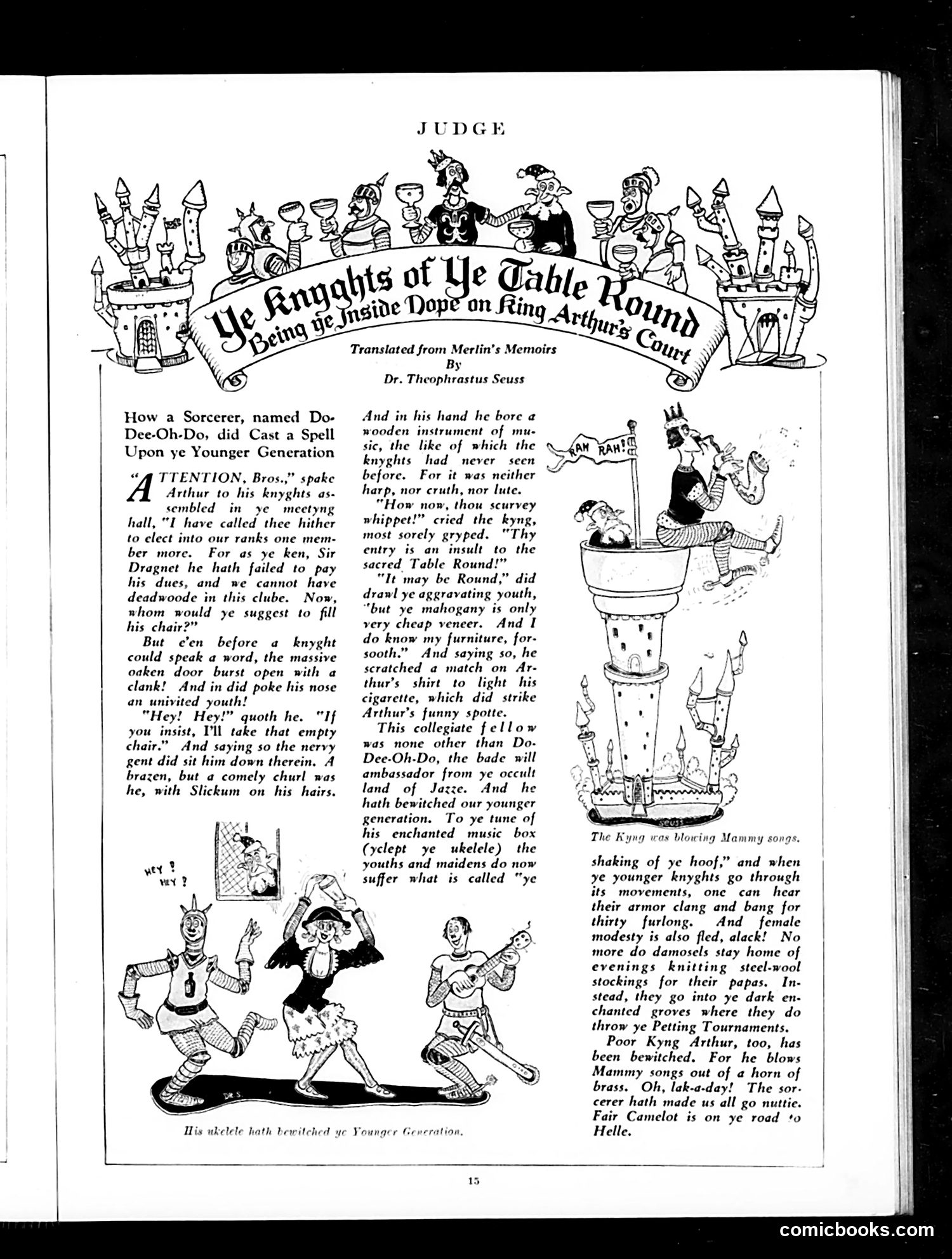
This Judge magazine piece, attributed to "Dr. Theophrastus Seuss" (Dr. Seuss), satirizes 1920s anxieties about jazz and modern youth. **The Setup:** King Arthur's knights debate filling a vacant chair when an uninvited, slicked-back youth crashes the meeting. He's Do-Dee-Oh-Do, a sorcerer from the "occult land of Jazze," carrying a ukulele—an instrument the medieval knights have never seen. **The Satire:** The youth represents jazz culture itself, corrupting Arthurian tradition (and by extension, American values). His casual disrespect—insulting Arthur's furniture, lighting cigarettes on his shirt—embodies perceived jazz-age rudeness. The "enchanted music" causes youth to perform the "shaking of ye hoof" (dancing), while girls abandon domesticity ("knitting steel-wool stockings") for "Petting Tournaments" (unchaperoned dating). **The Point:** Even dignified King Arthur succumbs, blowing "Mammy songs" on a horn. The conclusion: "Fair Camelot is on ye road to Helle"—a mock-serious lament that jazz is destroying civilization itself. This reflects genuine 1920s moral panic about jazz's influence on youth behavior and sexual mores.
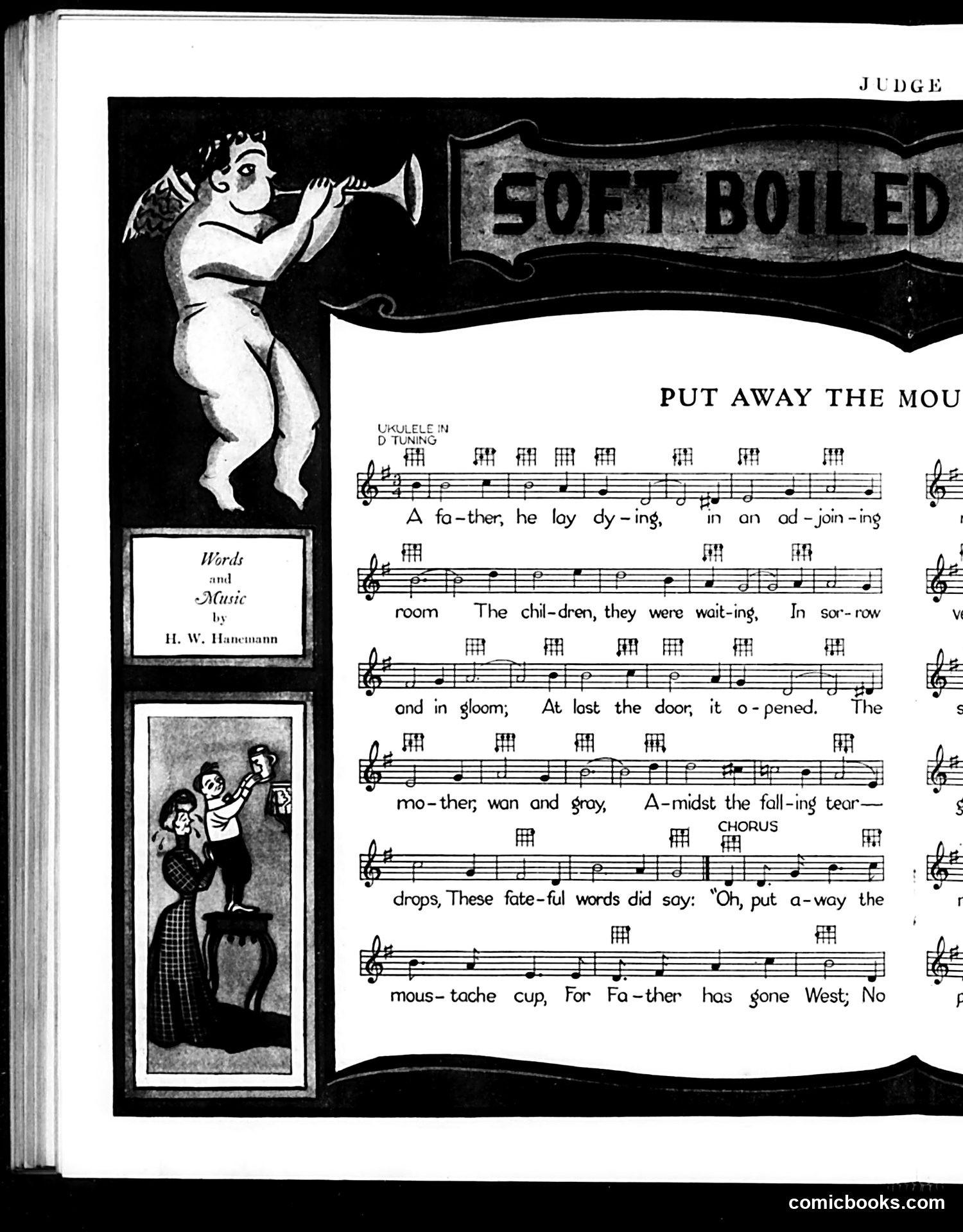
This is a sentimental song page with humor based on a now-obsolete household item. A "moustache cup" was a specialized drinking vessel with a guard to keep facial hair dry while drinking—common in the late 19th/early 20th centuries when prominent moustaches were fashionable. The satire works through mock-dramatic melodrama: the song depicts a dying father's final words to his family about discarding this grooming accessory, treating a trivial domestic object with the gravity of Shakespearean tragedy. The illustration shows a grieving family in theatrical poses. The joke targets both the absurdity of the moustache cup itself (already becoming quaint) and the era's taste for overwrought, sentimental songs. "Gone West" (died) provides the punchline—the father is dead, so obviously his specialized moustache cup is no longer needed. Judge uses this to gently mock outdated fashions and the melodramatic popular songs of the day.
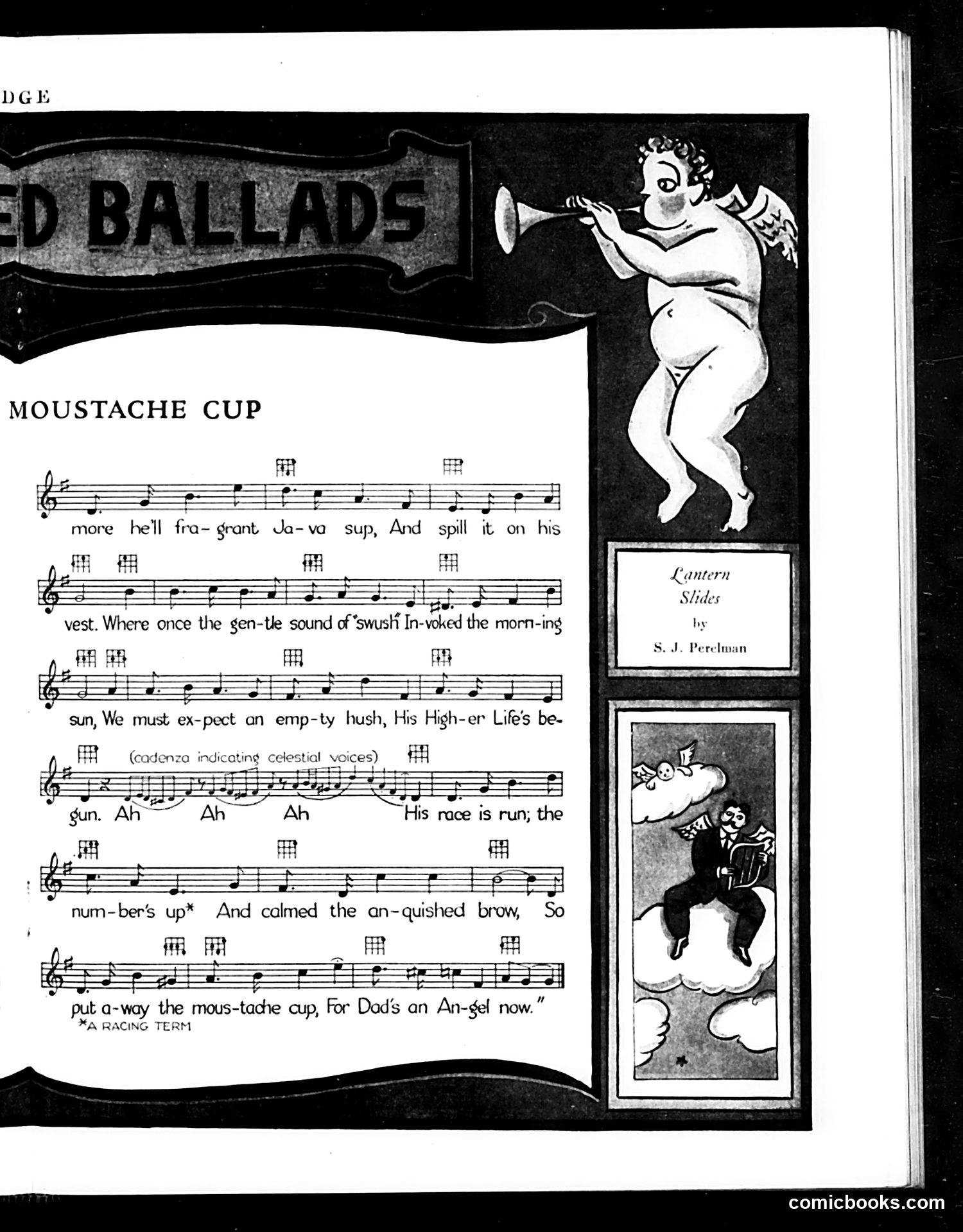
This is a humorous song mourning the death of a father, presented as sheet music. The joke centers on the "moustache cup"—a real Victorian-era novelty item with a guard to keep mustache hair dry while drinking. The satire mocks sentimental Victorian death rituals. The song describes replacing the father's morning coffee routine (where he'd spill Java on his vest) with his ascension to heaven as an "angel." References to "his race is run" and "the number's up" use gambling/racing terminology to reduce death to sporting terms, adding irreverent humor. The accompanying cherub illustration underscores the saccharine imagery. The overall effect ridicules excessive mourning customs and the gap between dignified death expectations and messy human reality—the stained vest being the mundane truth beneath the sentimentality.
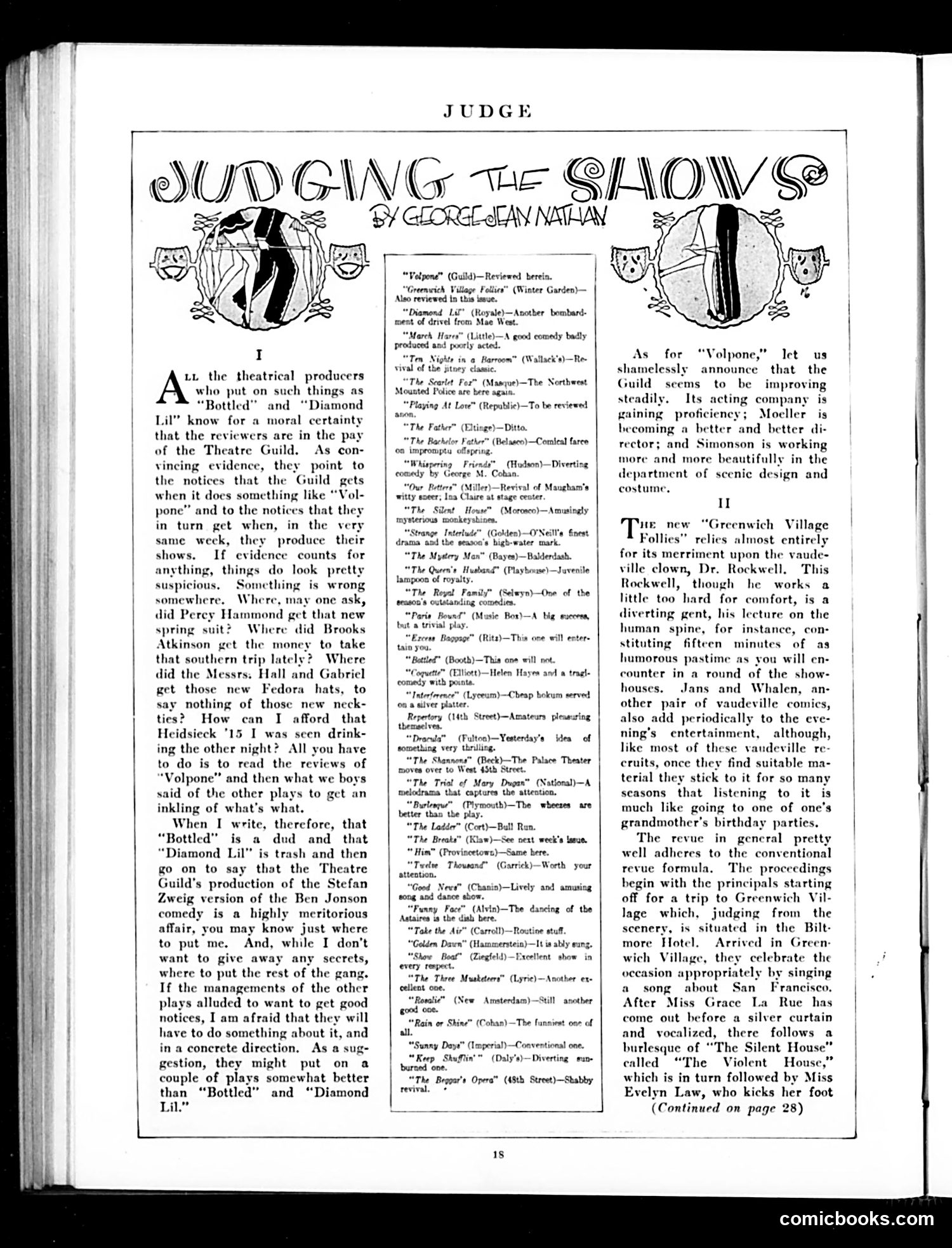
This page satirizes theater critics' apparent bias toward the Theatre Guild. The author claims reviewers give glowing notices to Guild productions (like "Volpone") while harshly panning competing plays ("Bottled," "Diamond Lil") opening the same week—suggesting critics have been bribed with luxuries (new suits, spring trips, expensive champagne). The satire is bitter rather than humorous: the writer argues that if other producers want good reviews, they should either improve their plays or resort to bribery themselves. The piece cynically assumes corruption is endemic to theater criticism during this period. The accompanying theater listings document Broadway productions, allowing readers to verify the disparity in reviews the author describes. This appears to be a commentary on perceived favoritism in 1920s theater criticism rather than a joke or cartoon—the satire is straightforward complaint about institutional corruption.
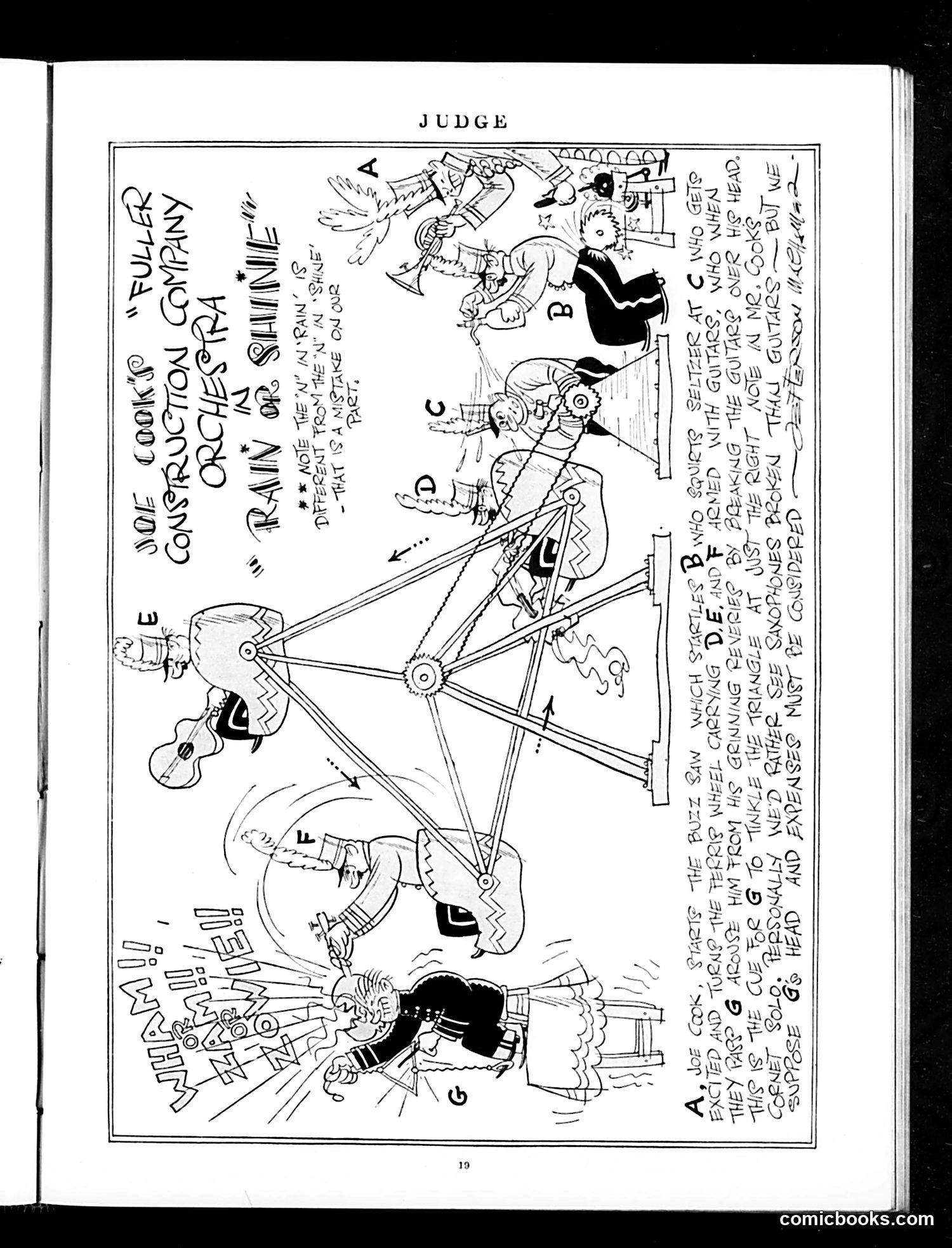
I cannot reliably read the OCR text on this page—it appears severely corrupted or garbled. However, examining the IMAGE itself: This is a political cartoon titled "JUDGE" showing what appears to be a complex mechanical or structural diagram with multiple labeled figures (A through G visible) positioned at different points. The figures seem to be operating or supporting some kind of framework or system, with text annotations throughout describing their roles or actions. The style suggests early-to-mid 20th century American political satire, likely commenting on government structure, institutional organization, or political mechanics. Without legible text identifying the specific figures or historical context, I cannot definitively explain what political situation or figures are being satirized here. The cartoon's exact meaning requires readable captions or clearer source material.
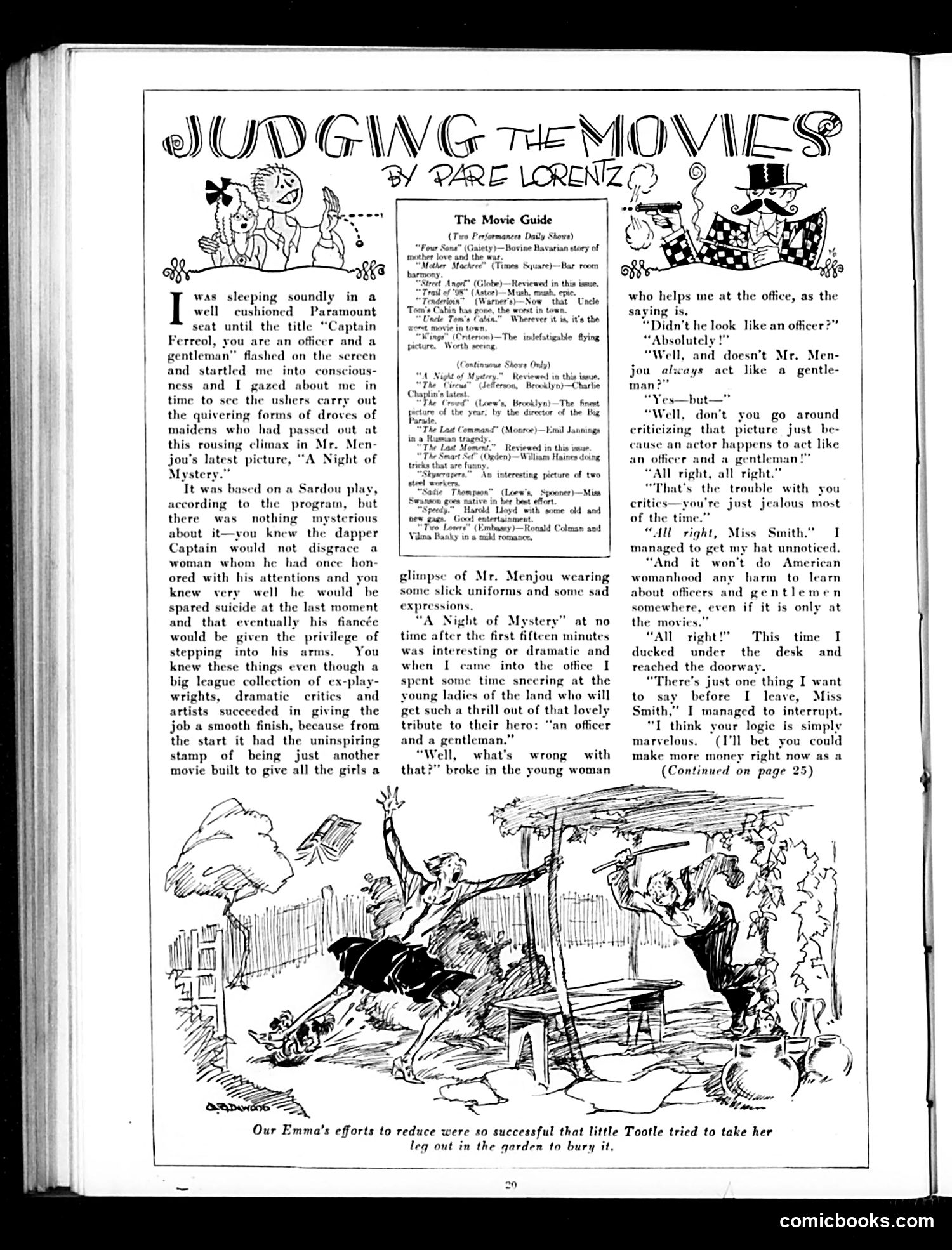
This is a film review column satirizing both silent cinema and audience taste. The critic reviews Adolphe Menjou's "A Night of Mystery," a romantic drama where Menjou plays a dapper military officer. The satire targets: **The Film:** A predictable melodrama marketed on Menjou's glamorous uniform and gentleman persona rather than actual plot or drama. Women in the audience faint at his appearance. **The Audience:** Young women who swoon over the fantasy of "an officer and a gentleman" rather than seeking substantive entertainment. **The Debate:** When the female office assistant defends the film, the critic surrenders—she argues the fantasy harms no one and might even encourage American women to admire gentlemanly conduct. The cartoon below jokes about extreme dieting fads. The piece mocks both Hollywood's manipulation of female audiences through romance and glamour, and the critic's inability to convince anyone that substance matters more than spectacle.
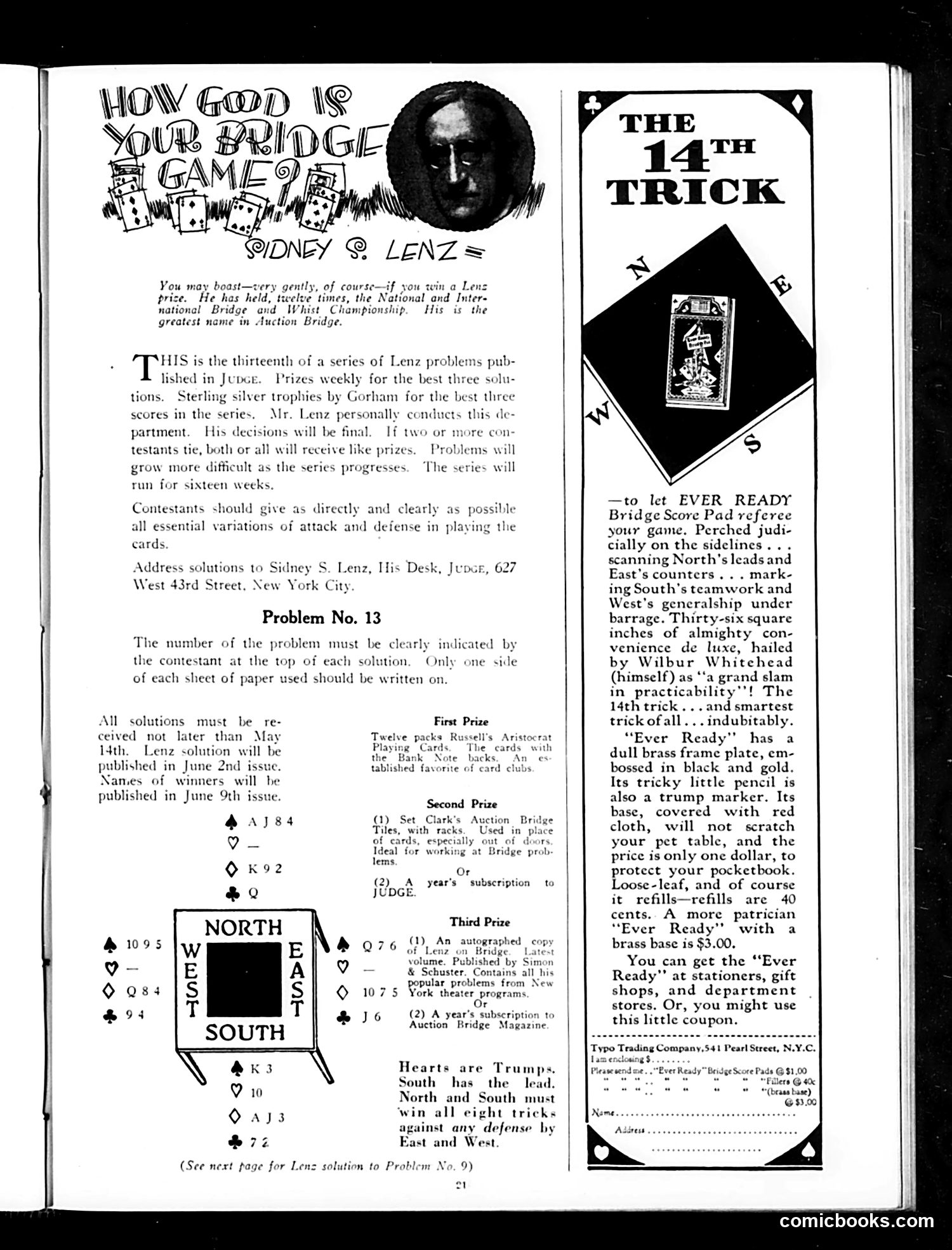
This page features a bridge card game problem series by **Sidney S. Lenz**, a famous bridge champion of the era. The content is not satirical but rather instructional entertainment—Judge magazine ran weekly bridge puzzles with prizes (sterling silver trophies, card sets, and magazine subscriptions). The left side presents "Problem No. 13," a competitive bridge scenario where contestants must solve how North and South can win all eight tricks against any defense. Solutions were judged by Lenz himself, with results published weekly. The right side advertises "The 14th Trick," a bridge score pad product called "Ever Ready." The ad uses bridge terminology ("grand slam in practicability") to humorously market the practical scoring tool as essential equipment for serious players. This reflects bridge's status as a popular, intellectually respectable parlor game among educated middle and upper classes in early 20th-century America.
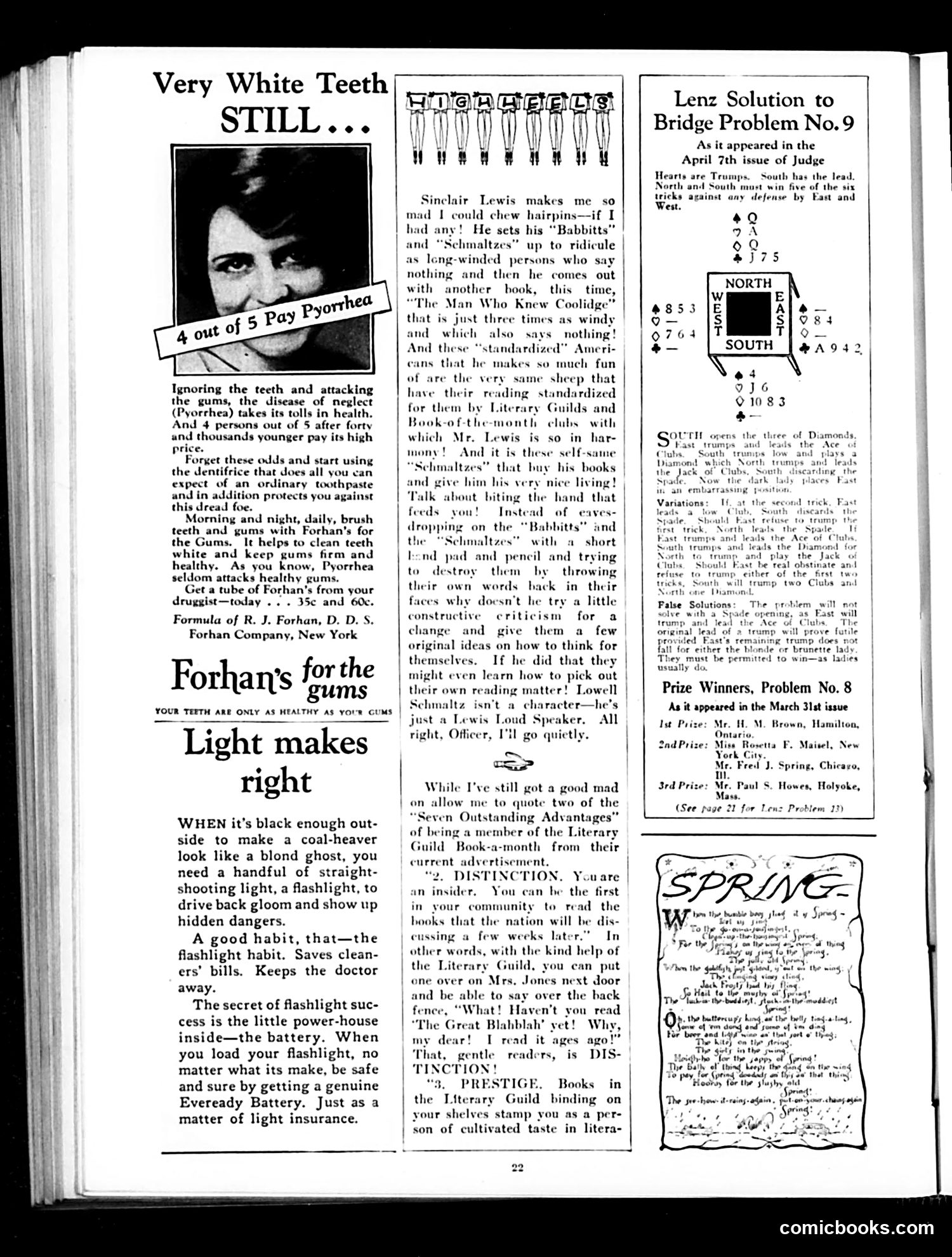
This page from *Judge* magazine contains primarily advertisements (Forhan's toothpaste, Eveready batteries) and miscellaneous editorial content rather than a unified political cartoon. The notable satirical piece is a reader's complaint about author **Sinclair Lewis**. The writer attacks Lewis for mocking "Babbitts" and "Schmaltzes"—his characters representing conformist, verbose Americans—while simultaneously benefiting from the very "standardized" readers (via Literary Guilds and Book-of-the-Month clubs) he ridicules. The satire points out Lewis's hypocrisy: he profits from the sheep-like readers he claims to despise, yet offers no constructive ideas for improvement. The phrase "biting the hand that feeds you" encapsulates the critique. This reflects 1920s literary debates about modernist authors' complicated relationship with mass-market publishing and middlebrow culture.
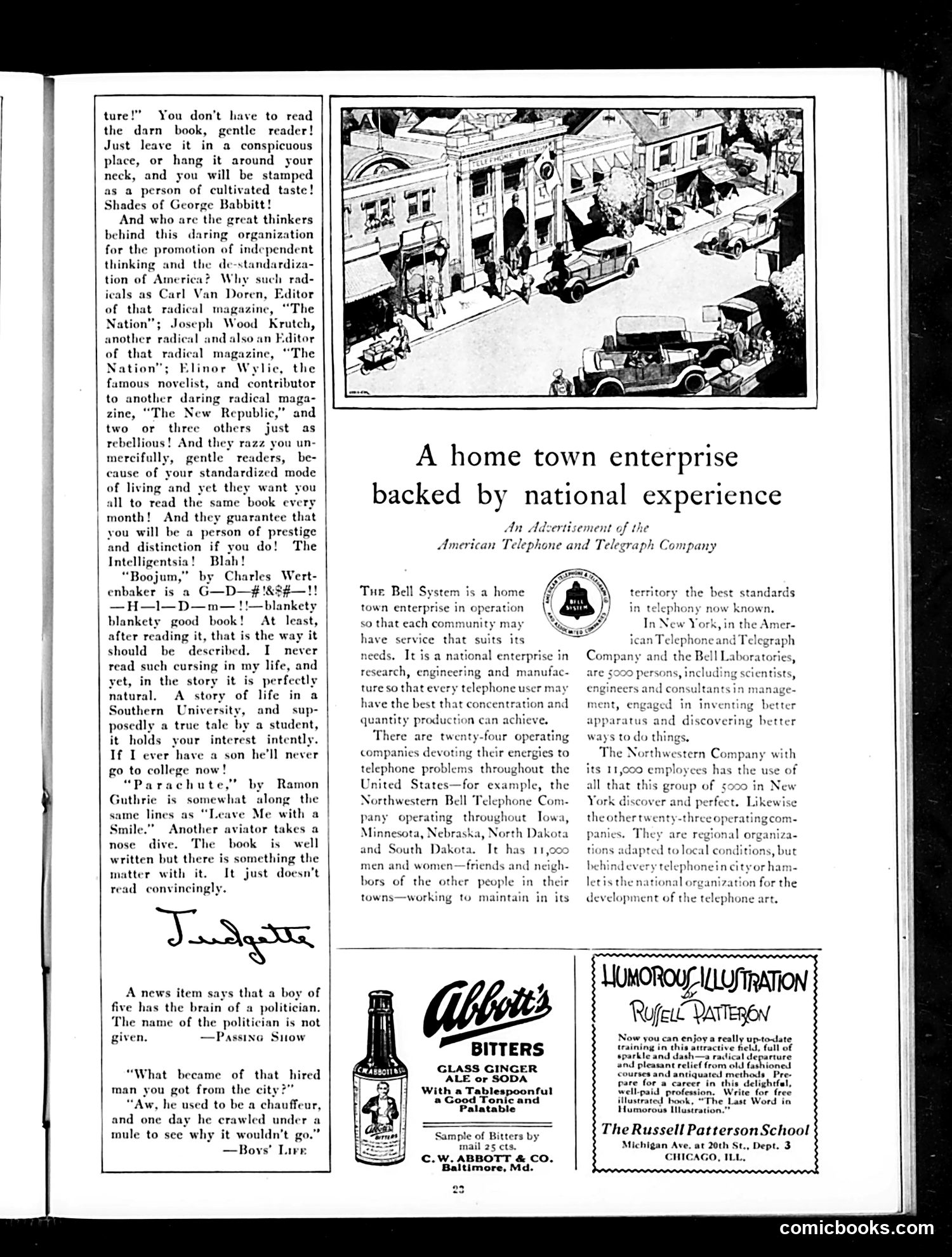
This page contains book reviews and advertising rather than political cartoons. The main satirical content critiques an intellectual "Book-of-the-Month Club" type organization. The unnamed critic mocks how members—described as "the Intelligentsia"—display books as status symbols without truly reading them, suggesting they achieve prestige simply by leaving the book visible. The satire targets prominent intellectuals and editors associated with *The Nation* and *The New Republic* (Carl Van Doren, Joseph Wood Krutch, Elinor Wylie) as hypocritical "radicals" who promote independent thinking yet want everyone reading the same book monthly—thus standardizing rather than liberalizing taste. The implied irony: these champions of individualism are conformity-peddlers. George Babbitt, referenced, was Sinclair Lewis's symbol of shallow conformist materialism, reinforcing this critique.
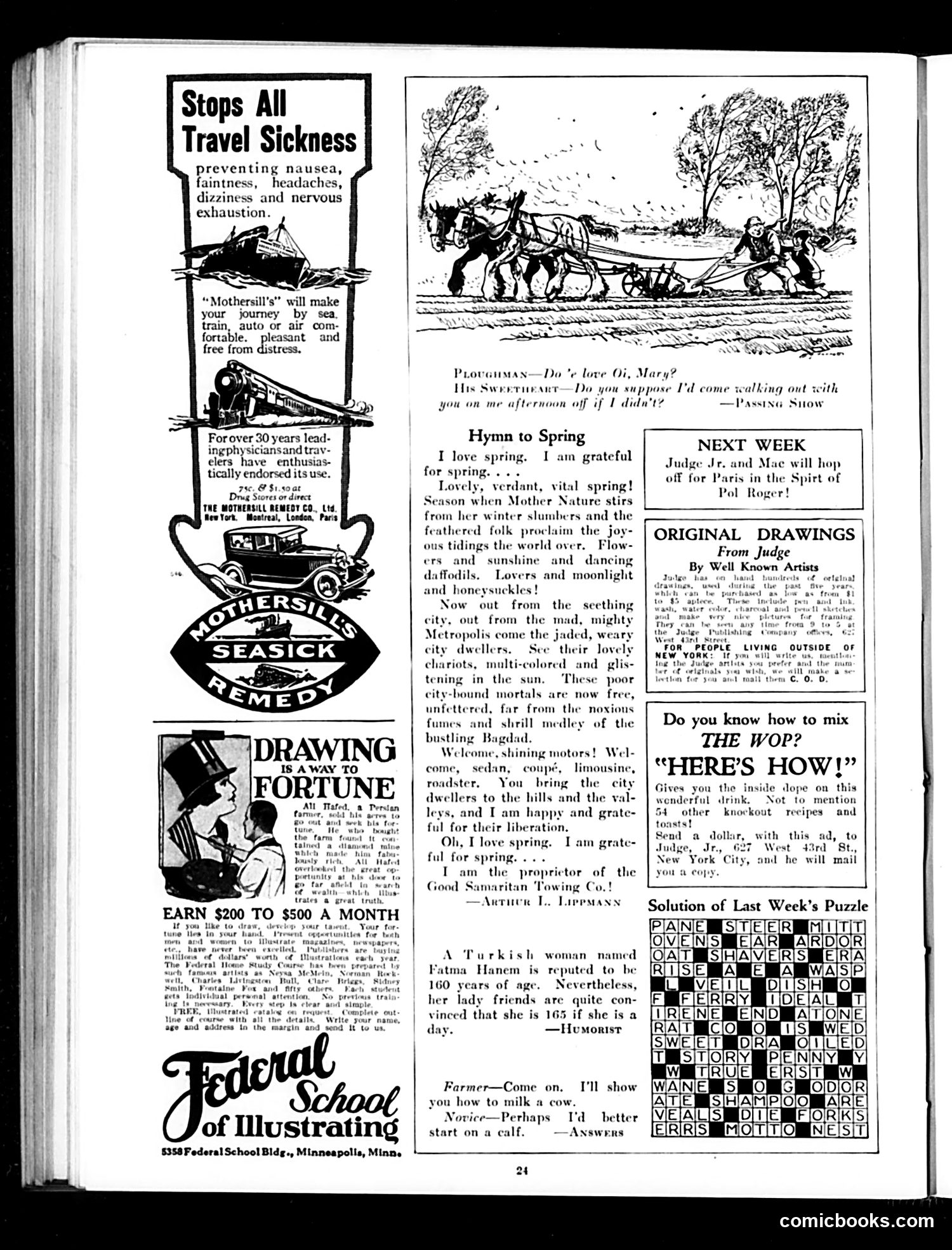
This page from Judge (a satirical American magazine) contains mostly **advertisements and filler content** rather than political cartoons with substantive satire. The main elements are: **Advertisements:** Mothersill's seasickness remedy dominates the left side, promoting travel comfort via sea, train, auto, or air—reflecting early 20th-century transportation options. **"Hymn to Spring":** Arthur L. Lipmann's poem celebrates spring's liberation from city life, but contains a satirical twist: the narrator is revealed as proprietor of the "Good Samaritan Towing Co."—implying he profits from accidents caused by drivers rushing to the countryside in their new automobiles. This mocks commercialized sentiment. **Mild Humor:** A farmer-and-novice exchange about milking cows, and a dated romantic dialogue represent light domestic humor typical of the era. **"The Wop" Cocktail Ad:** References a drink recipe, using period terminology that would be considered offensive today. Overall, the page reflects early automotive culture, travel concerns, and genteel humor rather than sharp political satire.
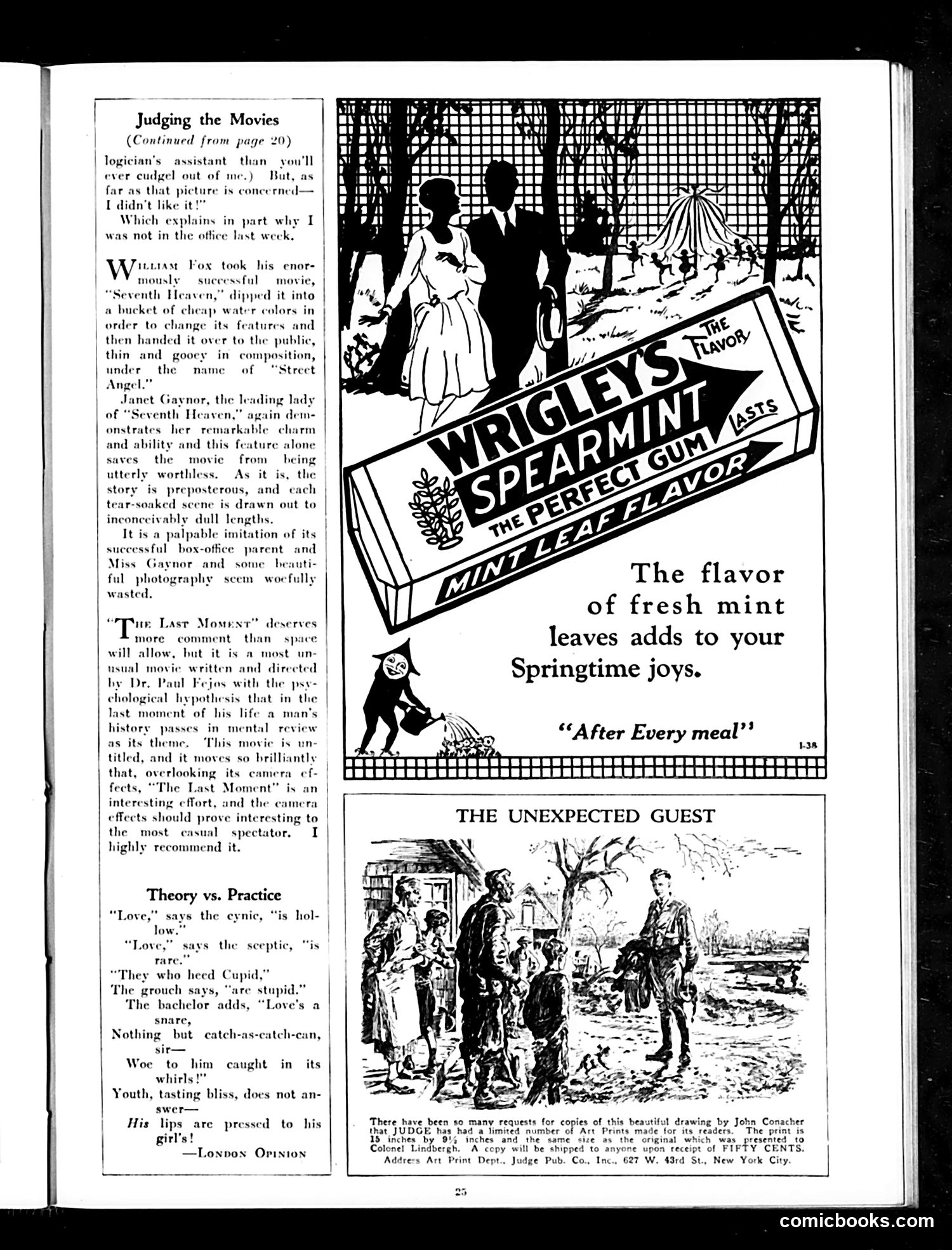
This page contains **movie reviews** and **advertising**, not political satire. The **film criticism** section critiques contemporary movies: William Fox's "Street Angel" (a colorized remake of the successful "Seventh Heaven") is dismissed as diluted and poorly composed, though actress Janet Gaynor's charm partly salvages it. "The Last Moment," directed by Dr. Paul Fejos, receives praise for its innovative psychological premise—depicting a dying man's life flashing before him—despite unconventional camera work. The **"Theory vs. Practice"** poem is a lighthearted commentary on love: cynics, skeptics, and bachelors all claim love is foolish or a trap, yet young lovers don't answer—they're too busy kissing. The **Wrigley's Spearmint advertisement** promotes the gum's fresh mint flavor for "Springtime joys" and post-meal freshness. The **bottom section** advertises art prints of an illustration by John Conacher (presented to Colonel Lindbergh), available for fifty cents—reflecting 1920s celebrity merchandising.
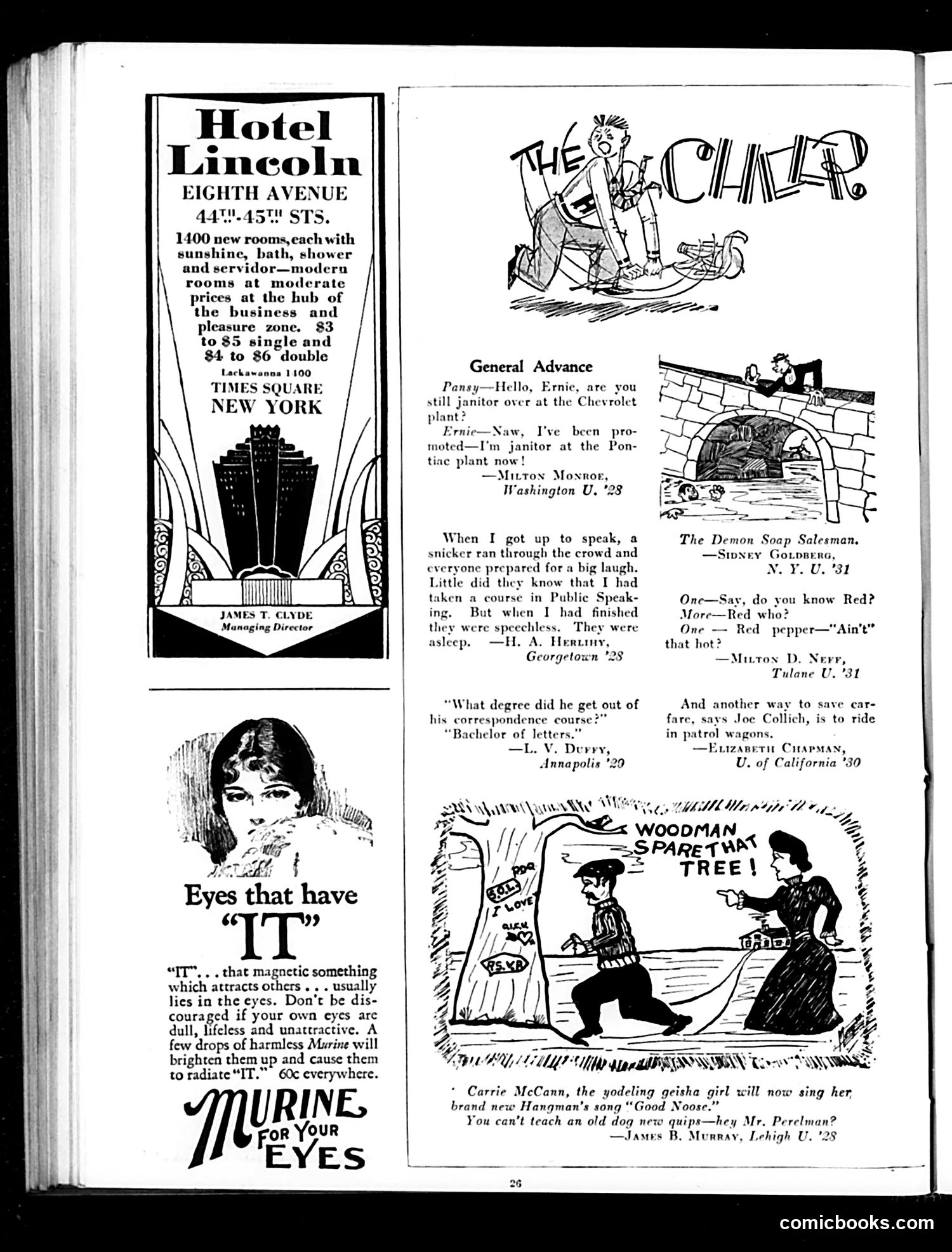
This page combines advertisements with humor submissions from college readers, typical of Judge's format in the late 1920s. **The cartoons** are student-submitted jokes, not political satire: - "The Chop" shows slapstick humor about occupational advancement (promotion from janitor at Chevrolet to janitor at Pontiac) - A public speaking course backfires when the speaker puts the audience to sleep - Jokes about correspondence degrees, soap salesmen, and police wagons reference everyday life **The "Eyes that have 'IT'" advertisement** sells Murine eye drops using the period's slang term "IT"—meaning charisma or magnetism popularized in 1920s culture. **The Woodman cartoon** shows children playing, with one warning another to spare a tree—likely environmental or conservation humor. **Context for modern readers:** Judge functioned partly as a humor magazine where college students submitted jokes for publication credit. The page reflects 1920s concerns (job mobility, education) and contemporary slang, with no significant political content—just commercial advertising mixed with collegiate humor.
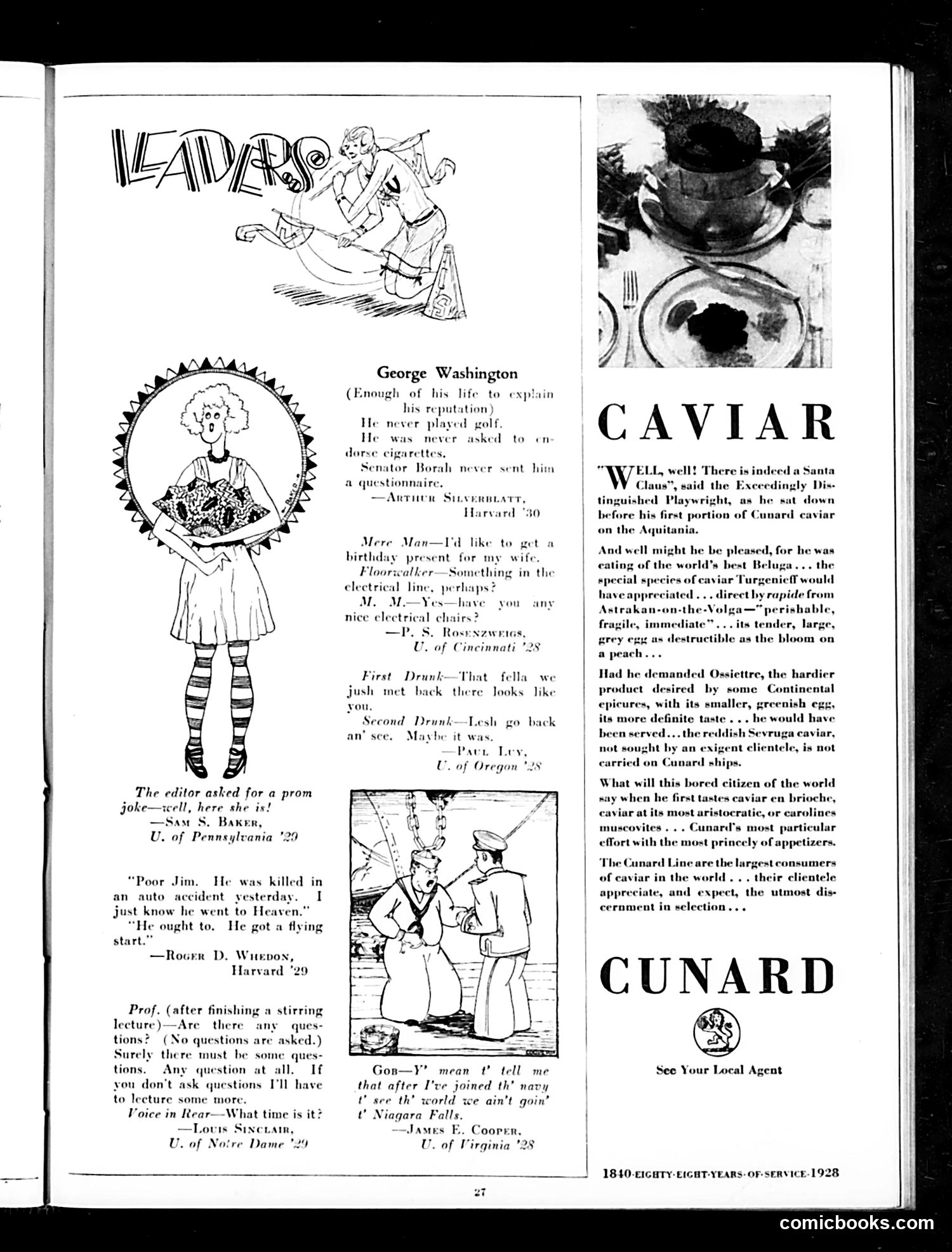
This page combines humorous student submissions with a Cunard steamship advertisement. **The Jokes:** College students submitted one-liners mocking various social situations—a prom girl, a deadly car accident played for laughs, a professor desperate for classroom questions, drunk men, and a Navy recruit disappointed that shore leave means Niagara Falls rather than exotic ports. The humor is period-typical: dark, irreverent, and aimed at the college-educated readership. **The Advertisement:** The right side advertises Cunard's caviar service aboard their luxury ocean liners. It's tongue-in-cheek marketing, imagining a "bored citizen" encountering fine dining—specifically discussing different caviar types (Beluga, Oscietra, Sevruga) served various ways. The ad emphasizes exclusivity and sophistication to appeal to wealthy travelers. **Context:** This reflects 1920s Judge's dual nature: satirical humor for educated readers mixed with luxury advertising targeting the same affluent audience.
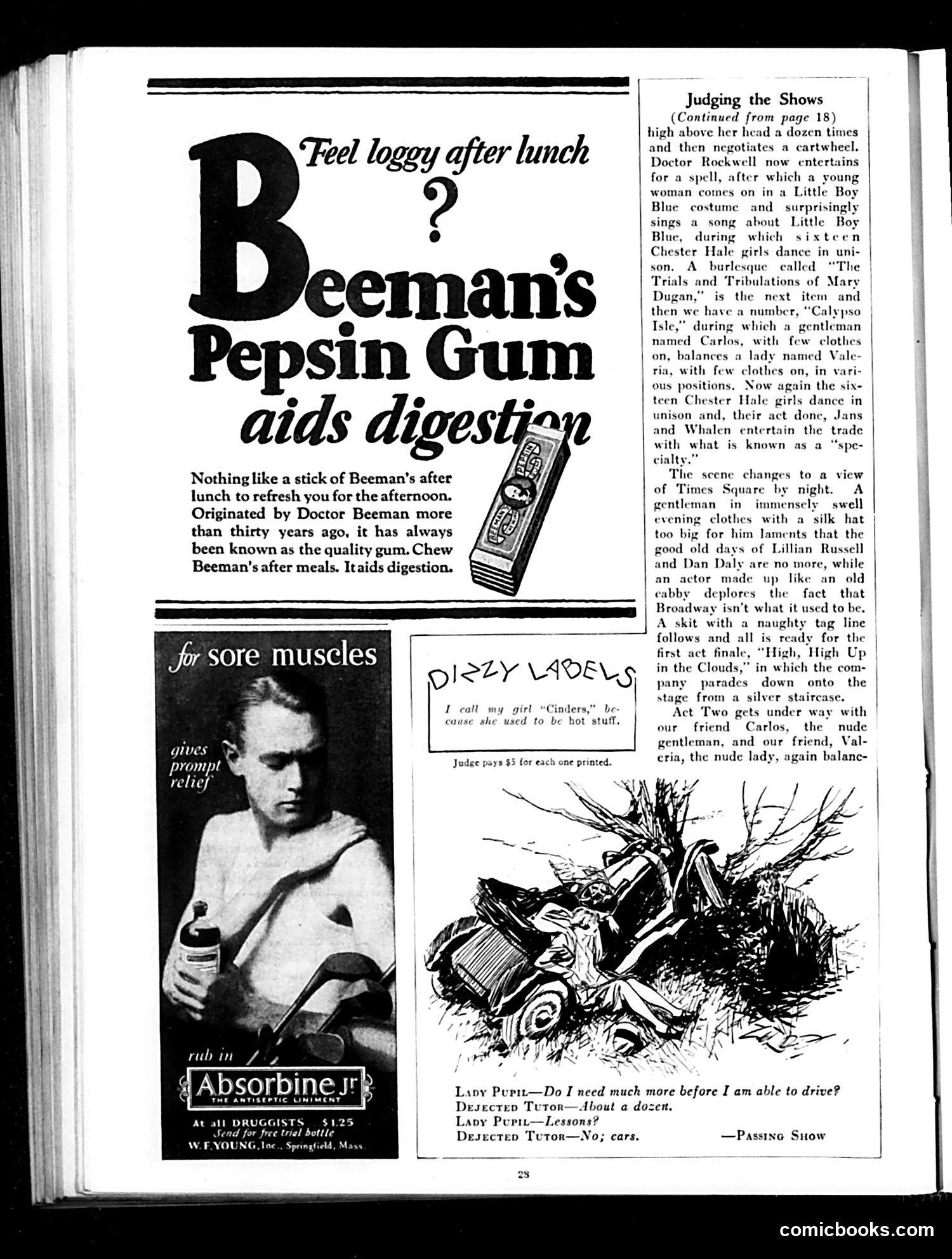
This page contains **primarily advertisements** rather than political satire. The dominant content is a Beeman's Pepsin Gum ad claiming digestive benefits, plus an Absorbine liniment ad for sore muscles—typical patent medicine marketing from this era. The right column continues a theater review titled "Judging the Shows," discussing Broadway productions. It mentions performers, choreography (Chester Hale girls), and specific acts, including a burlesque of "The Trials and Tribulations of Mary Dugan." The writing is gossipy commentary on contemporary theater rather than political satire. At the bottom, a small joke labeled "Dizzy Ladyus" plays on gender stereotypes: a woman asks a driving instructor how many more lessons she needs; he replies "about a dozen," then clarifies "No; cars"—implying she's a reckless driver who will wreck many vehicles. **This is entertainment/consumer advertising content, not political commentary.**
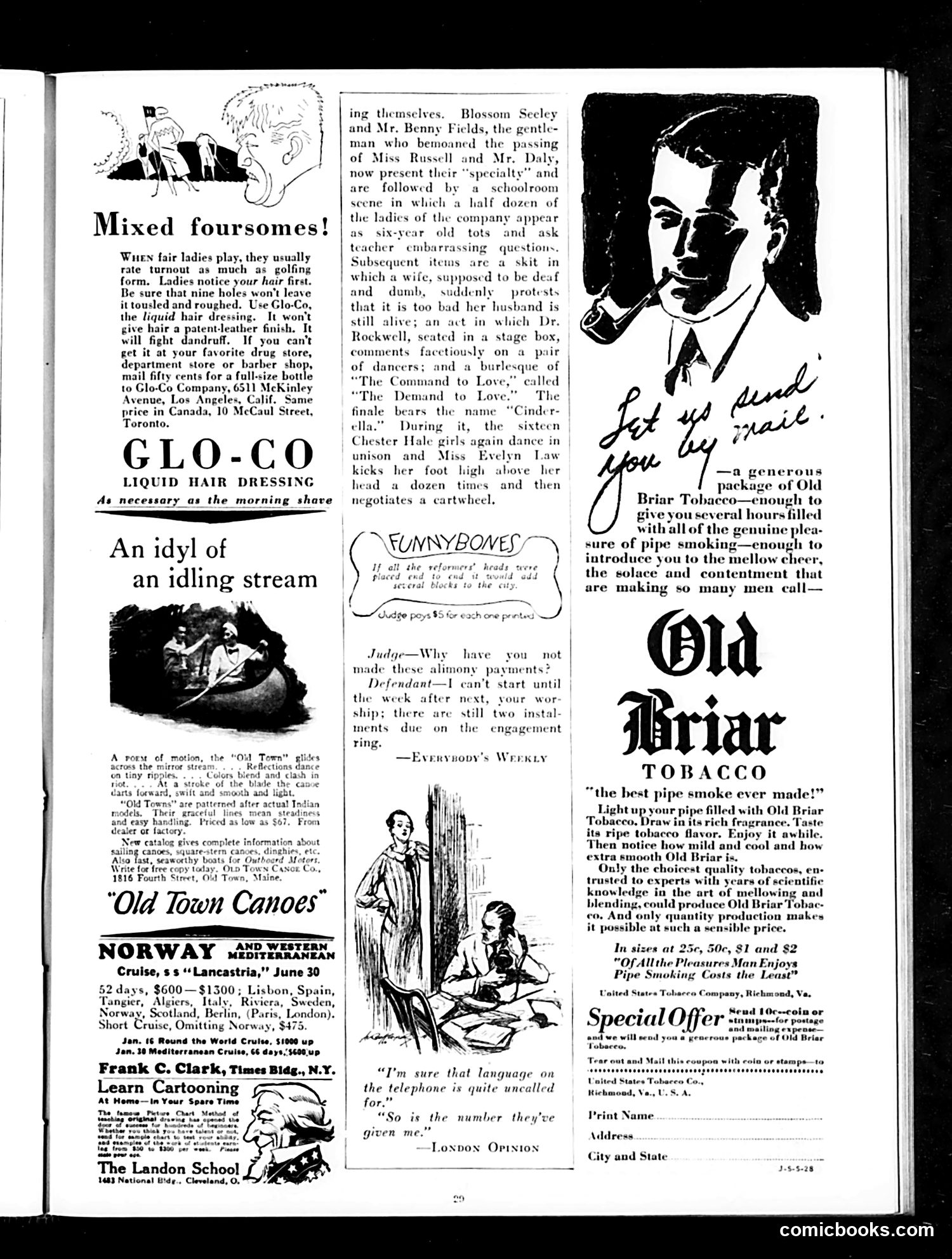
This page is primarily **advertising with minimal editorial content**. The main satirical elements are brief: **"Mixed Foursomes" (top)**: A gentle joke about women golfers prioritizing appearance over performance. The humor relies on the stereotype that ladies care more about how their hair looks than their golf game—hence the Glo-Co hair dressing ad. **"Funnybones" (center)**: Two short joke items: 1. A judge questioning a defendant about unpaid alimony; the defendant claims he can't pay until installments on the engagement ring are finished—satirizing the financial burden of courtship and divorce. 2. A dialogue about telephone etiquette being "uncalled for," with the response that so is the phone number given—a mild pun about rude behavior. **The rest**: Cruise ship ads, canoe promotions, cartooning school advertisement, and extensive **Old Briar Tobacco advertising** dominating the right column. The page reflects 1920s consumer culture and gender stereotypes typical of Judge's light satirical approach—humor aimed at middle-class anxieties rather than hard-hitting political commentary.
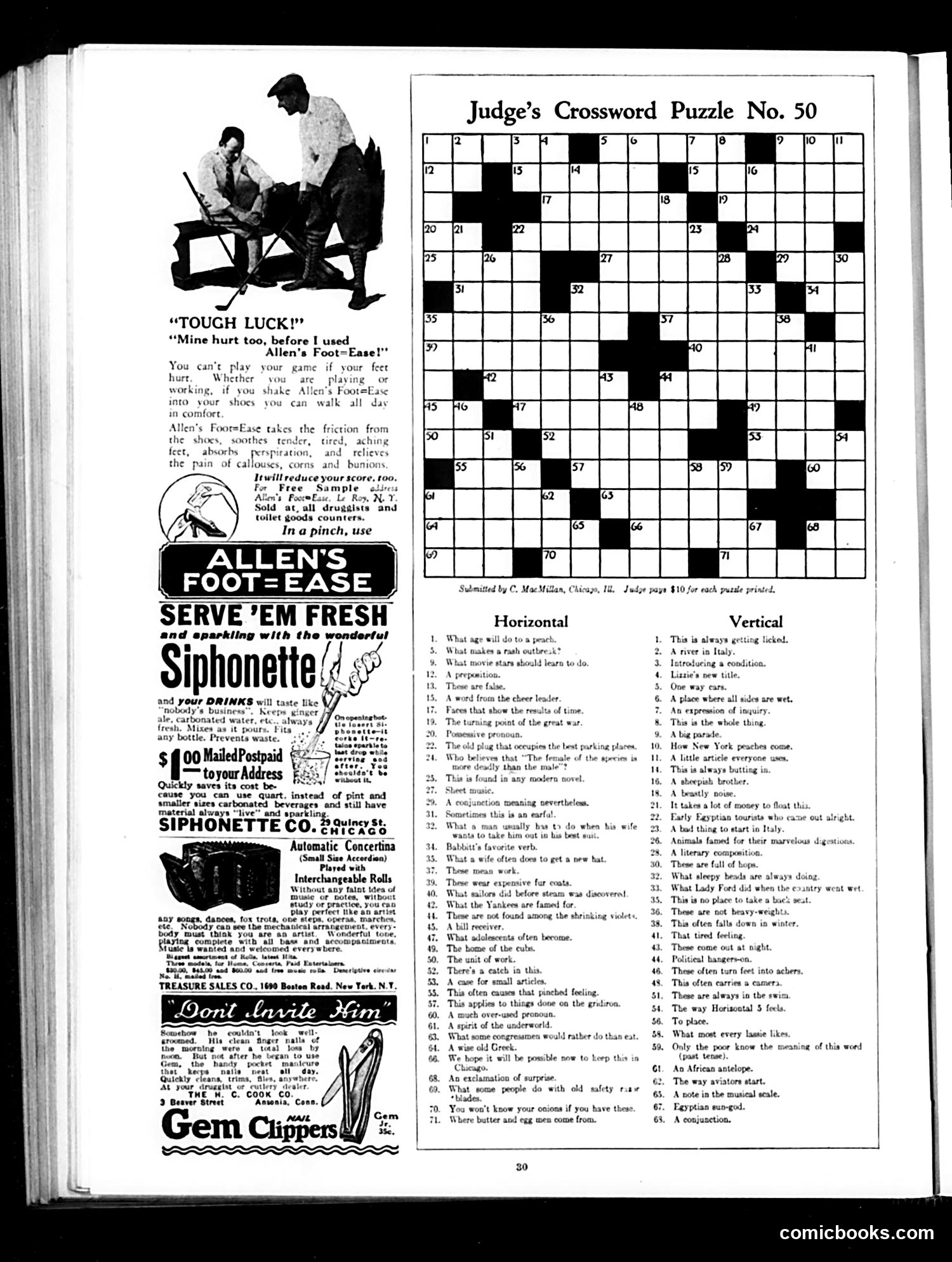
This page is primarily **advertising**, not political satire. The main cartoon depicts two men discussing foot pain—one saying "Mine hurt too, before I used Allen's Foot-Ease!"—introducing a product advertisement. The page showcases vintage early-20th-century patent medicines and consumer goods typical of Judge magazine's revenue model: - **Allen's Foot-Ease**: A medicated foot powder claiming to reduce pain, absorb perspiration, and even improve golf scores - **Siphonette**: A carbonated beverage dispenser device - **Automatic Concertina**: A mechanical accordion with interchangeable rolls - **Gem Clippers**: A grooming tool The crossword puzzle (No. 50) appears standard for the era. These ads reflect contemporary consumer culture and the era's widespread promotion of patent medicines—many making dubious health claims that would face modern FDA regulation. The cartoon's gentle "tough luck" framing serves merely as a sales hook, not social commentary.
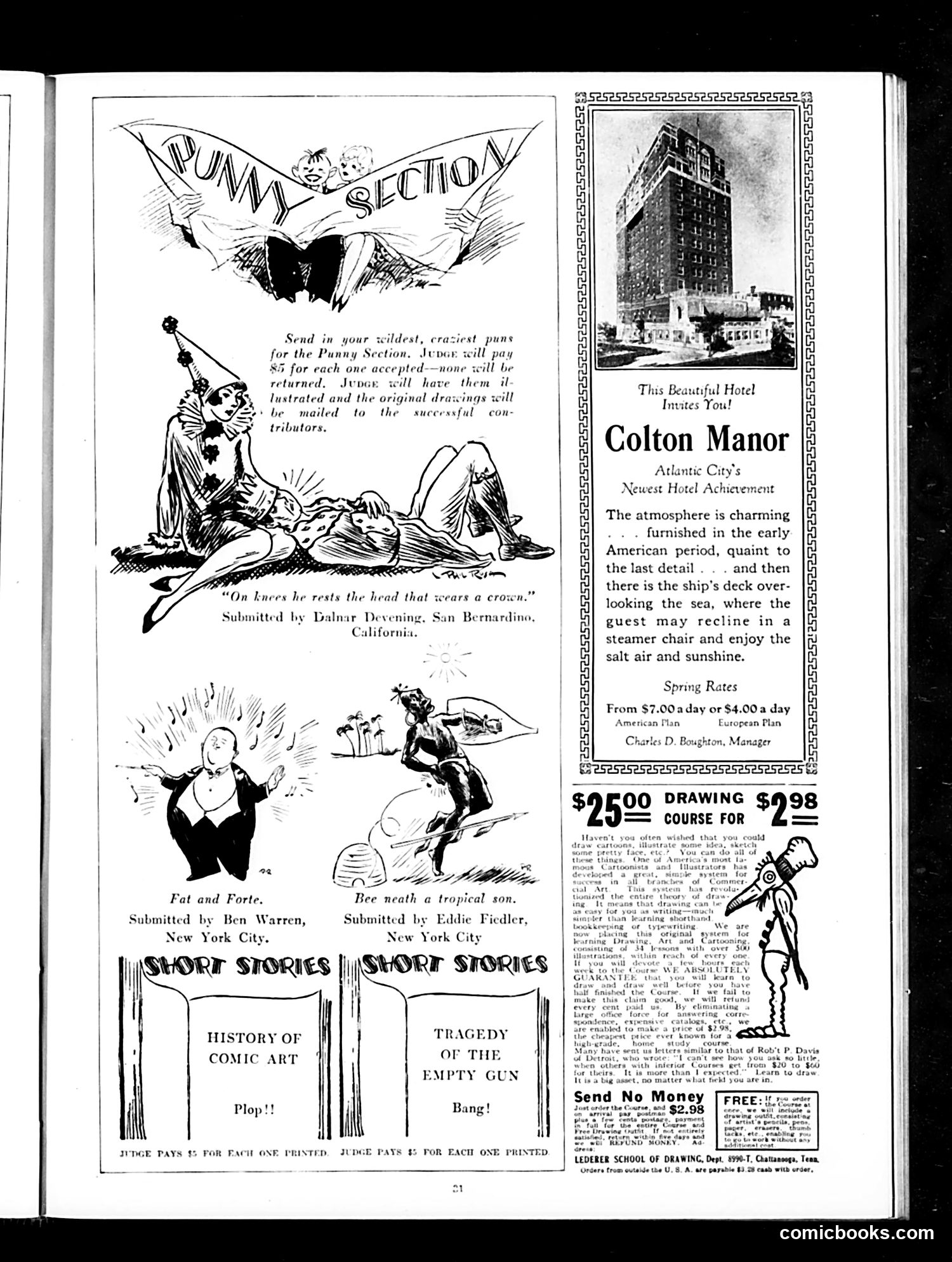
This is primarily a **humor submission page and advertising section**, not a political cartoon. The left side features Judge's "Punny Section"—a reader-submitted joke contest paying $5 per accepted pun. Three illustrated examples are shown: "On knees he rests the head that wears a crown" (a king kneeling), "Fat and Forte" (a portly man), and "Bee neath a tropical sun" (a person under palm trees). These are visual puns relying on wordplay. Below are two "Short Stories" advertised—"History of Comic Art" and "Tragedy of the Empty Gun"—both priced at $5 per printed entry, with onomatopoeia ("Plop!!" and "Bang!") suggesting their comedic content. The right side contains hotel and drawing course advertisements typical of 1920s-30s magazine advertising. **No political satire or caricature is present on this page.** It's a straightforward humor competition and advertising layout showcasing Judge's focus on visual wordplay and reader participation.
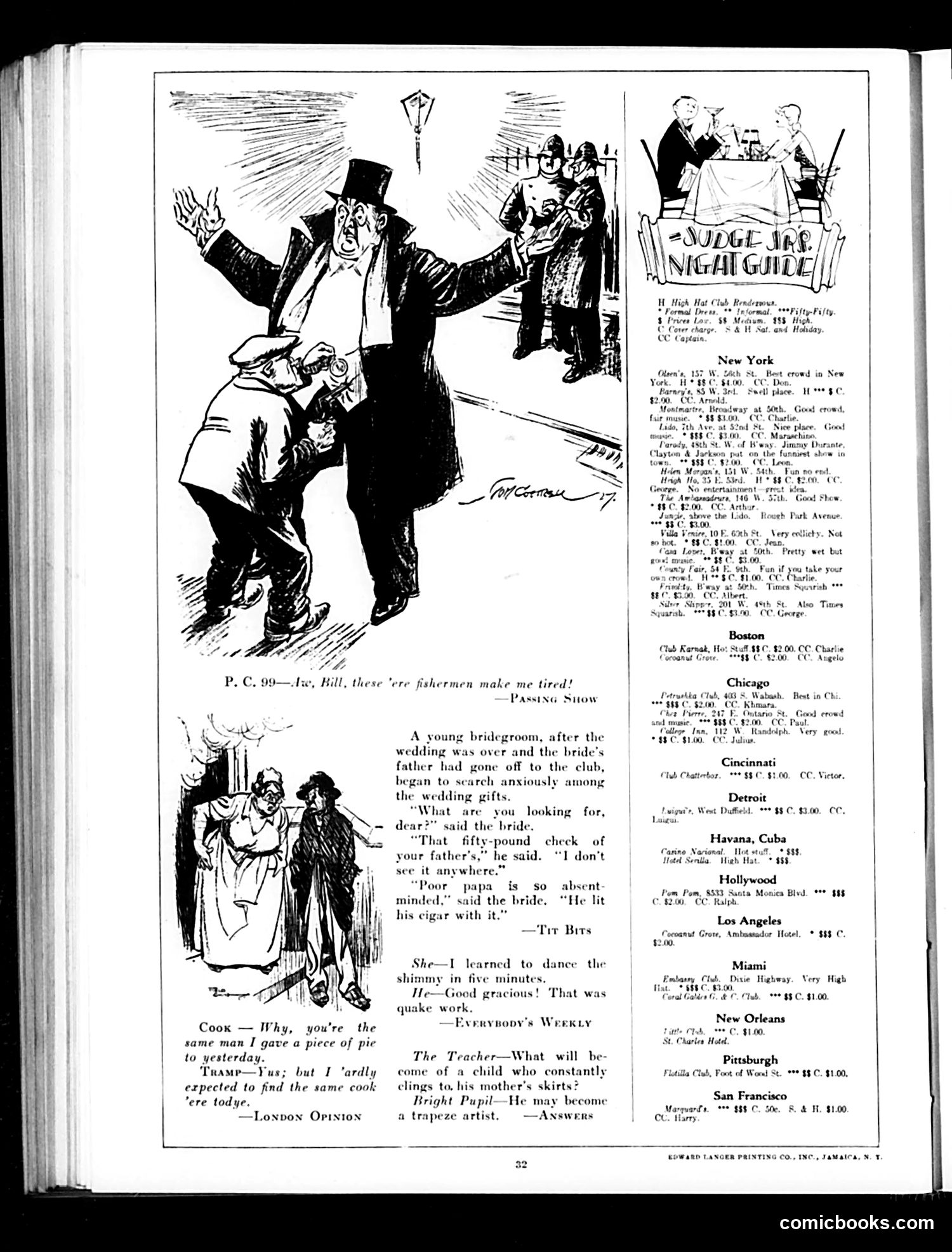
This page contains **humorous short jokes and anecdotes** rather than political cartoons. The main content includes: **The jokes** play on situational humor and wordplay common to early 20th-century magazine humor: - A tramp and cook recognize each other (class/poverty angle) - A newlywed searches for a missing check his absent-minded father-in-law used to light a cigar - A woman learns the "shimmy" dance quickly; the punchline puns on "quake work" - A school riddle about a child clinging to mother's skirts becoming a trapeze artist **The right side is a "Night Guide"** — advertising listings for nightclubs and entertainment venues across major American cities (New York, Boston, Chicago, Miami, etc.), each with admission prices and dress code requirements. This reflects **Jazz Age leisure culture** of the 1920s-30s, when urban nightlife and dancing were increasingly popular. The page captures entertainment-focused magazine content typical of the era.
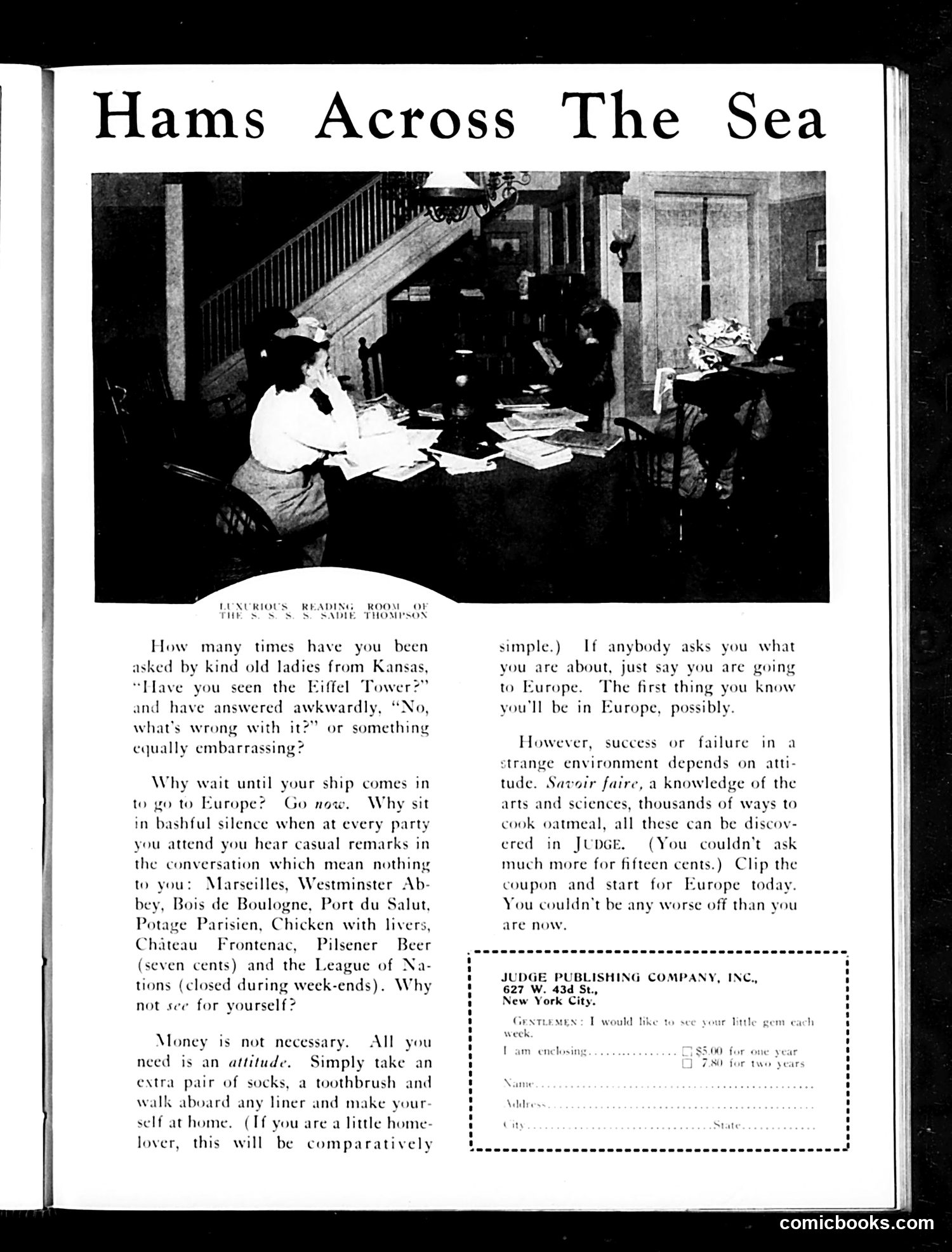
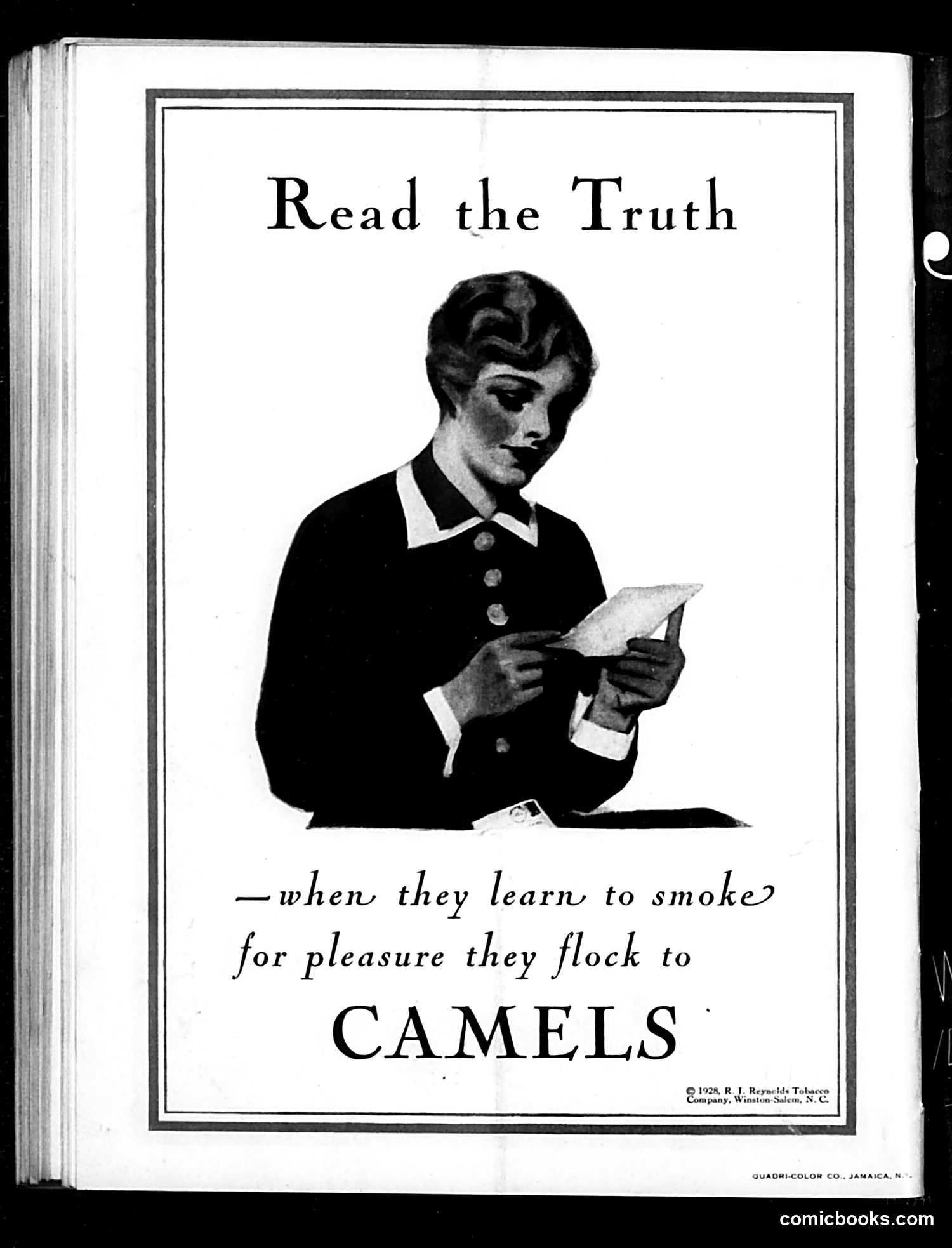
This is a **Camel cigarette advertisement**, not political satire. The image shows a young boy in formal attire reading a document, with text suggesting that once people "learn to smoke for pleasure they flock to Camels." The ad's jarring implication—that children learning to smoke is normal and desirable—reflects early 20th-century cigarette marketing practices that are now recognized as unethical. Modern readers would find this deeply disturbing, as it openly targets youth addiction. The copyright mark shows "1928, R. J. Reynolds Tobacco Company, Winston-Salem, N.C." This represents an era when tobacco companies faced minimal regulation and openly advertised cigarettes without health warnings, even to young audiences. Such advertising would be illegal today.