
A complete issue · 16 pages · 1909
Judge — May 22, 1909
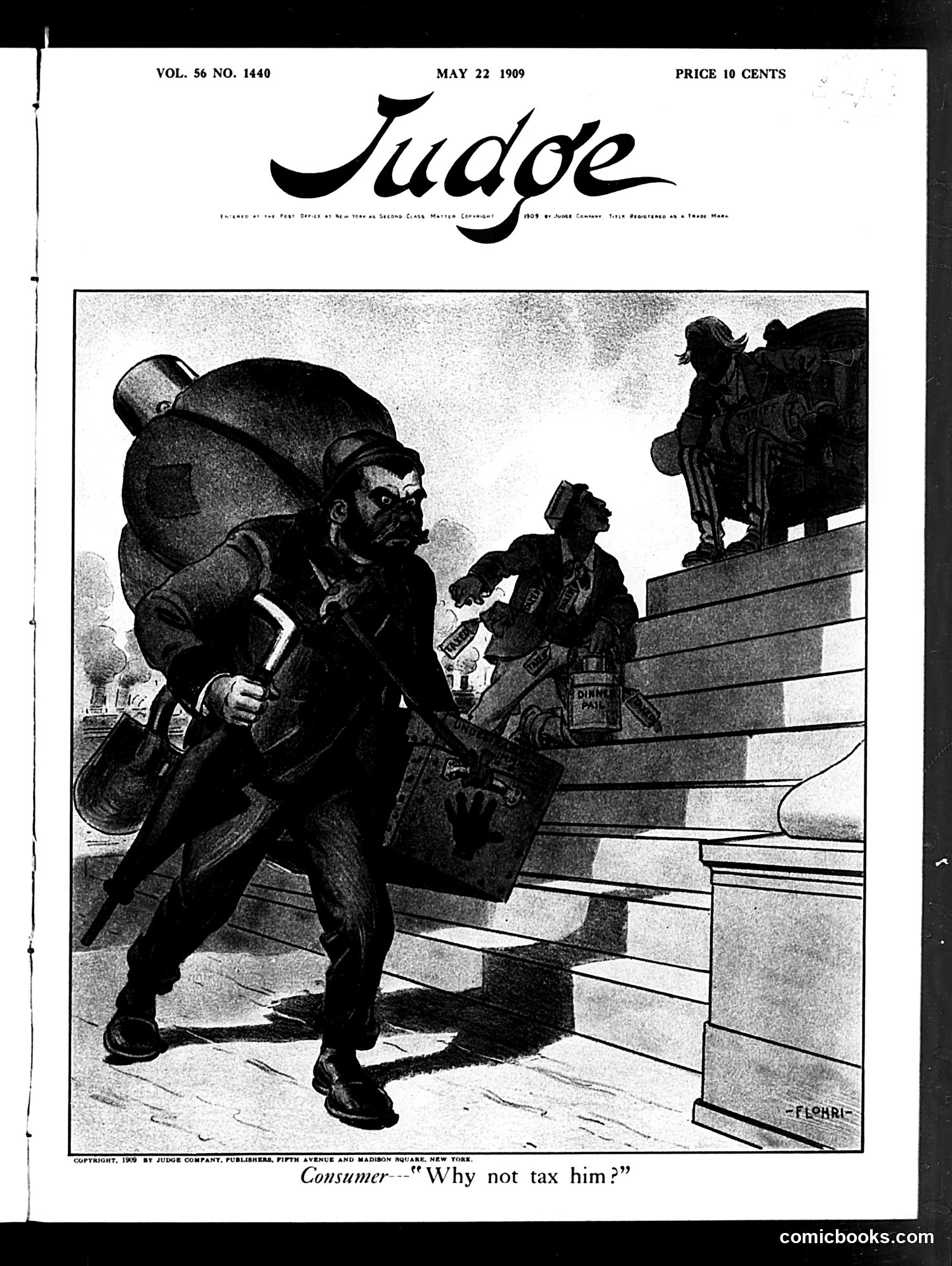
This political cartoon satirizes wealthy industrialists and their tax obligations. The caricatured figure on the left—depicted with exaggerated features and carrying a large bag (presumably representing accumulated wealth)—appears to be a robber baron or monopolist. The caption "Consumer—'Why not tax him?'" expresses public frustration that wealthy businessmen avoid taxation while ordinary citizens bear the tax burden. The figure's grotesque appearance and the "robber" imagery reference the Progressive Era's widespread criticism of unregulated industrial wealth and monopolies. The cartoon advocates for stronger taxation of the wealthy, reflecting early 20th-century calls for economic reform and wealth redistribution that would eventually lead to income tax legislation.
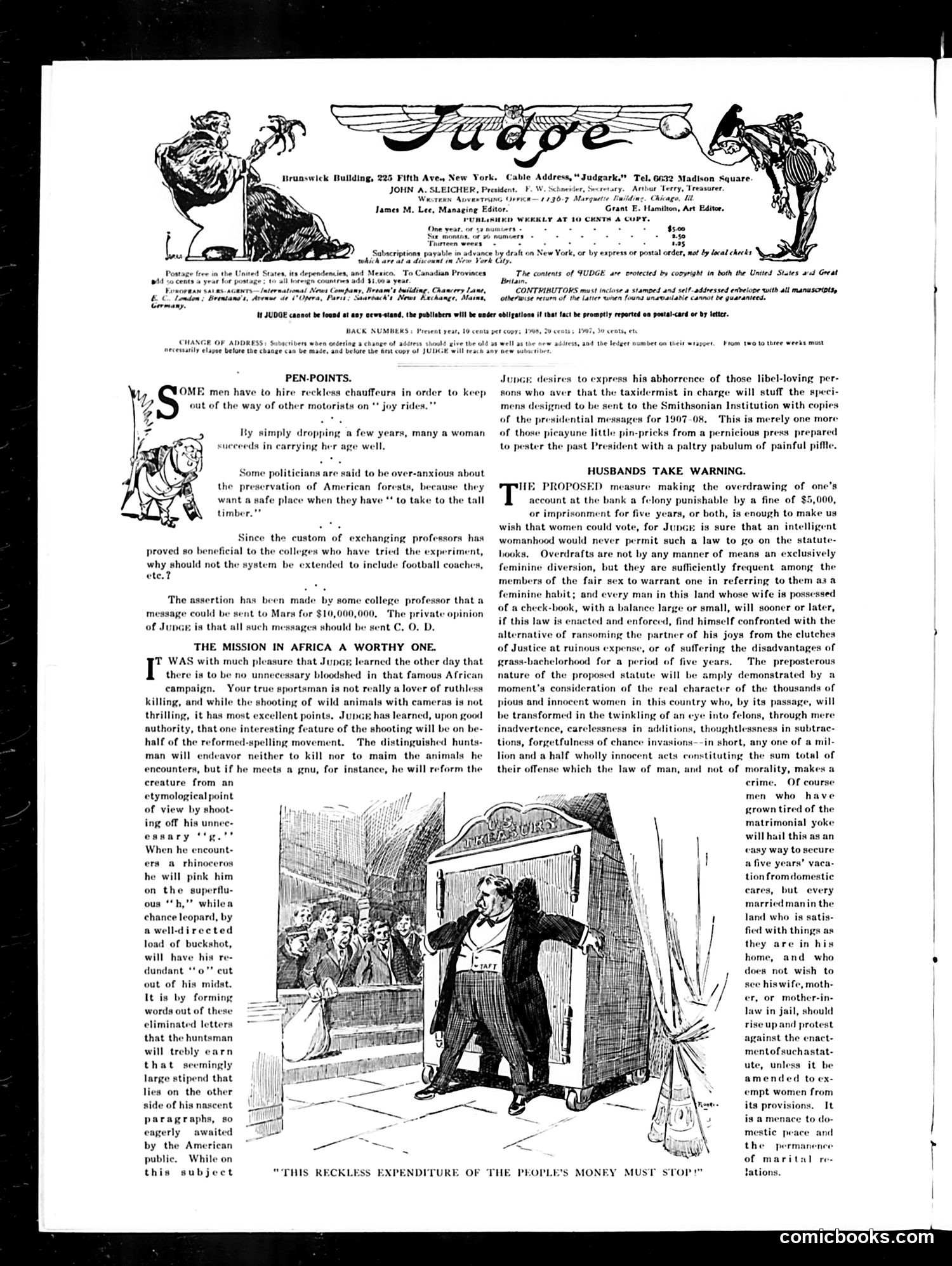
This page contains several distinct editorial pieces criticizing government spending and proposed legislation: **"Pen-Points"** section presents brief satirical commentary on topics like preserving American forests and extending the professorial exchange system to football coaches. **"Husbands Take Warning"** attacks a proposed law allowing women to overdraw bank accounts up to $5,000 without spousal consent or face imprisonment. The editorial argues this threatens domestic stability and male authority, claiming it would enable wives to escape accountability. **"The Mission in Africa"** praises hunting expeditions as superior to bloody military campaigns. The largest cartoon shows a man at a doorway with the caption **"This Reckless Expenditure of the People's Money Must Stop,"** likely satirizing government waste. The magazine's tone reflects early 20th-century conservative concerns about women's independence, government fiscal policy, and American imperialism.
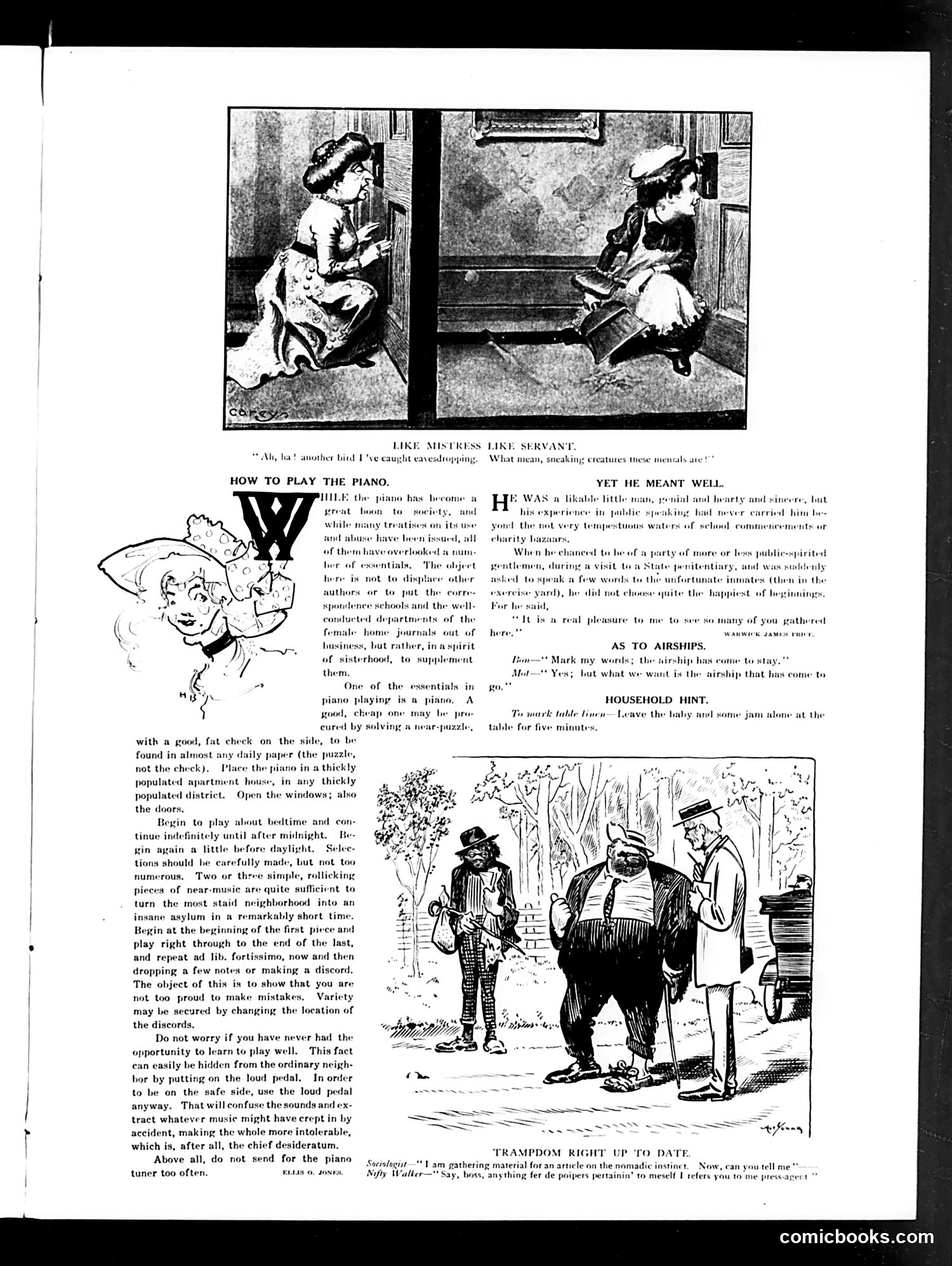
This page combines humor columns with instructional and satirical content. The top panel titled "Like Mistress Like Servant" depicts two women in similar poses, satirizing class mimicry—the servant aping her employer's mannerisms. "How to Play the Piano" is a tongue-in-cheek instructional piece mocking amateur pianists, suggesting piano-playing was a common but often poorly-executed domestic pursuit among middle-class women. The bottom cartoon, "Trampdom Right Up to Date," shows two vagrants discussing airship travel, satirizing how quickly new technologies (early aviation) permeated popular culture and conversation, even among society's lowest classes. The joke is the anachronistic contrast between poverty and futuristic technology. These pieces reflect early 20th-century class anxieties and technological fascination.
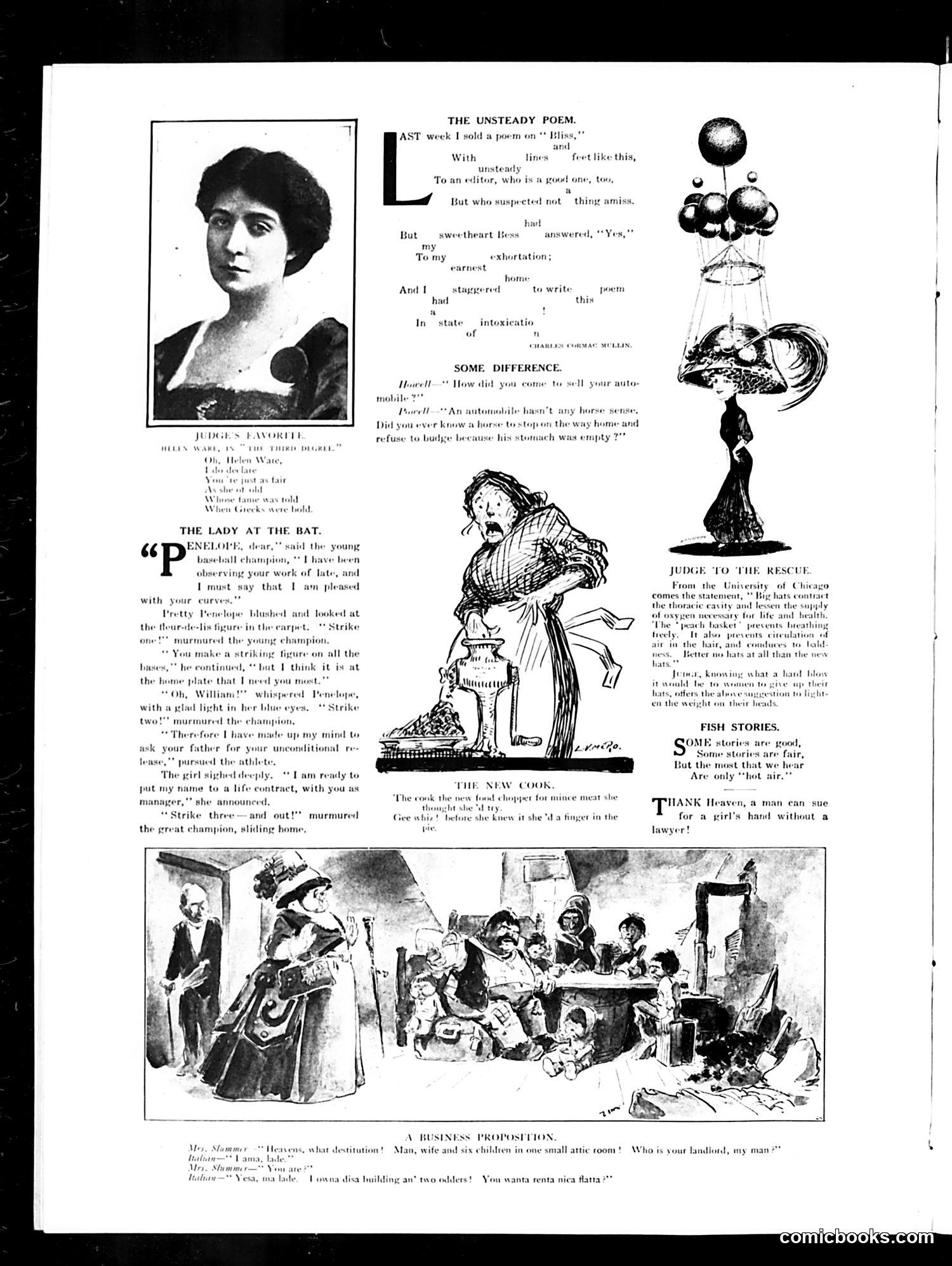
This page contains several humorous sketches and jokes typical of early 20th-century American satire: **"The Lady at the Bat"** depicts a young female baseball enthusiast negotiating with a male "great champion" for hitting instruction. The satire plays on emerging women's athletic participation and gender role tensions of the era. **"Some Difference"** jokes about automobile sales, with a horse refusing to move—contrasting old and new transportation technologies. **"The New Cook"** and **"Judge to the Rescue"** appear to be domestic humor targeting servants and household management. **"A Business Proposition"** (bottom) shows a landlord confronting poor tenants in cramped housing, satirizing urban poverty and exploitative rental practices. The overall tone reflects period anxieties about modernization, gender boundaries, and class relations.
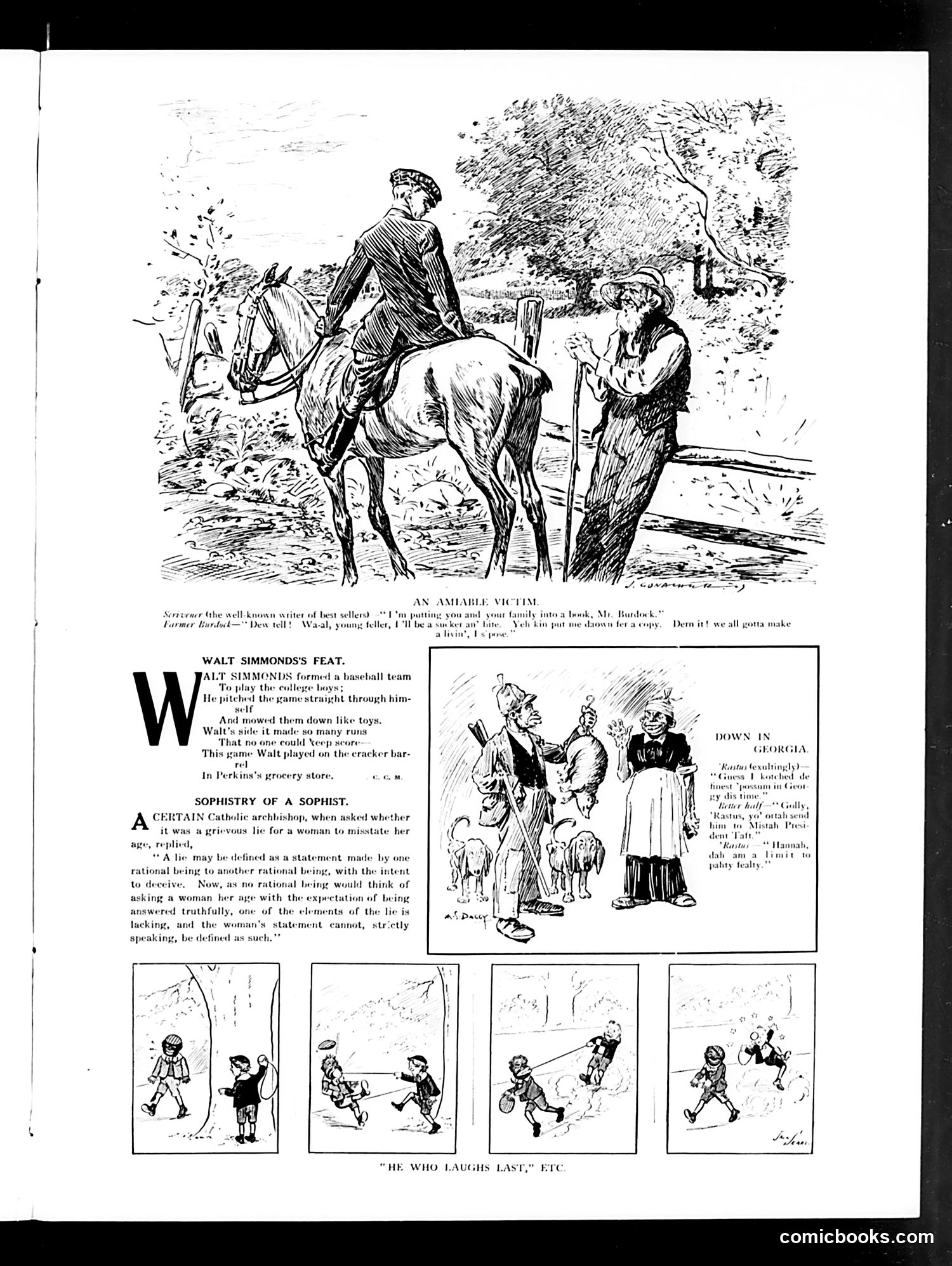
The page contains three distinct pieces: 1. **"An Amiable Victim"** (top): A satirical sketch showing a man on horseback being approached by a farmer. The caption suggests the rider is being solicited for money ("I'm pulling into a bank, Mr. Burdick") — likely mocking a wealthy person's predictable generosity or gullibility. 2. **"Walt Simmonds's Feat"** (middle): A humorous anecdote about forming a baseball team that plays so poorly they "knocked them down like toys," satirizing amateur athleticism and misplaced confidence. 3. **"He Who Laughs Last, Etc."** (bottom): A four-panel comic strip showing children playing, with the final panel suggesting comeuppance or reversed fortune — illustrating the proverb that ultimate victory belongs to the patient. The overall tone is lighthearted social humor typical of early Judge satire.
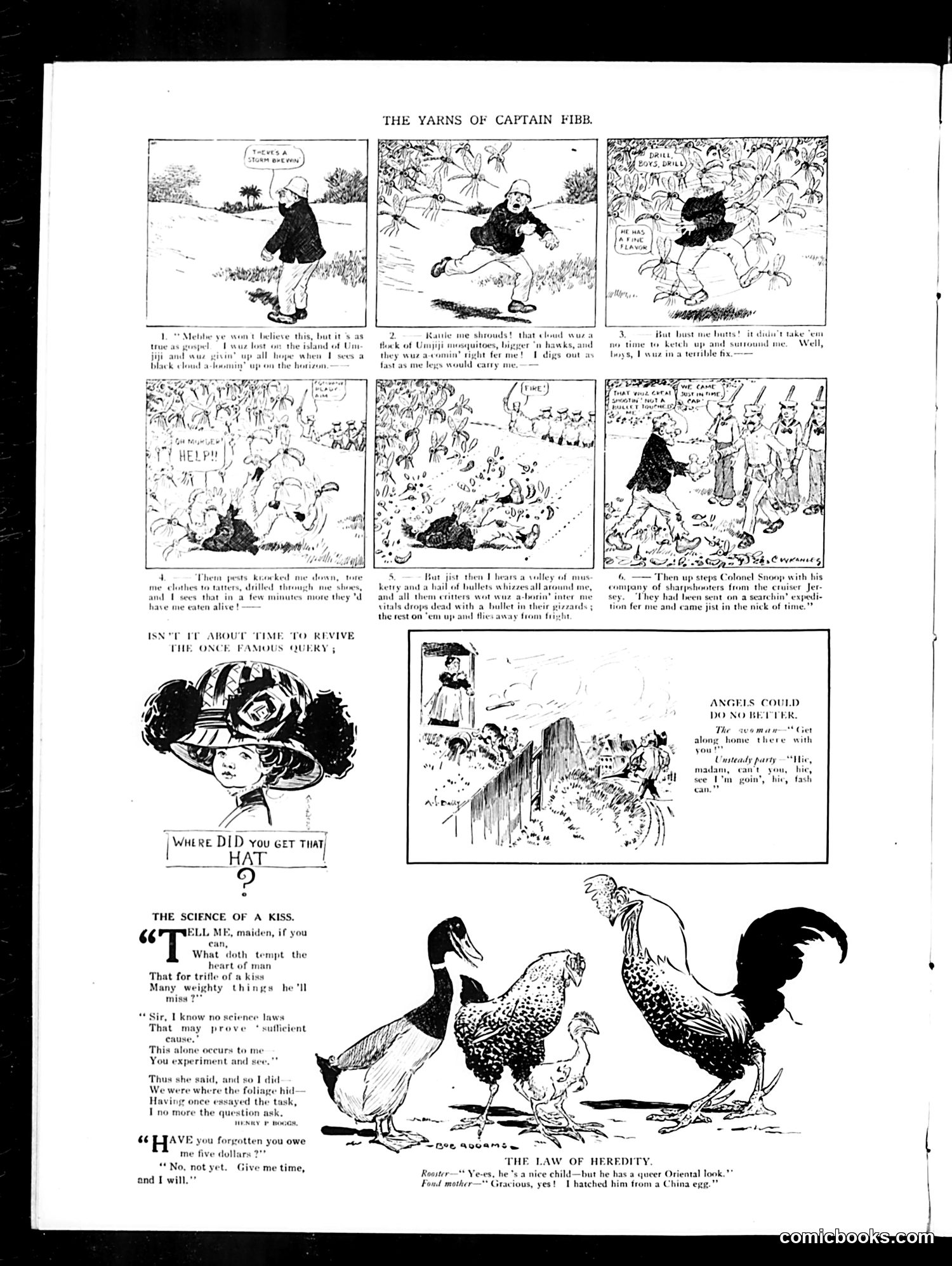
This page contains three separate humorous features typical of early 20th-century Judge magazine: **"The Yarns of Captain Fibb"** (top) is a tall-tale comic strip where the exaggerating Captain recounts implausible adventures—being chased by "Umiak mosquitoes" and attacked by aggressive animals—in classic frontier-humor style. **"The Science of a Kiss"** (middle-left) is a comedic poem about romantic temptation, using Victorian-era rhetoric about "weighty things" that tempt man's heart. **"The Law of Heredity"** (bottom) is a visual joke about a woman who claims her child has "a queer Oriental look" despite having European parents, with the punchline that she "hatched him from a China egg"—playing on period stereotypes and absurdist humor about racial appearance. These pieces represent Judge's typical blend of slapstick, romantic comedy, and ethnic humor common to American satirical magazines of that era.
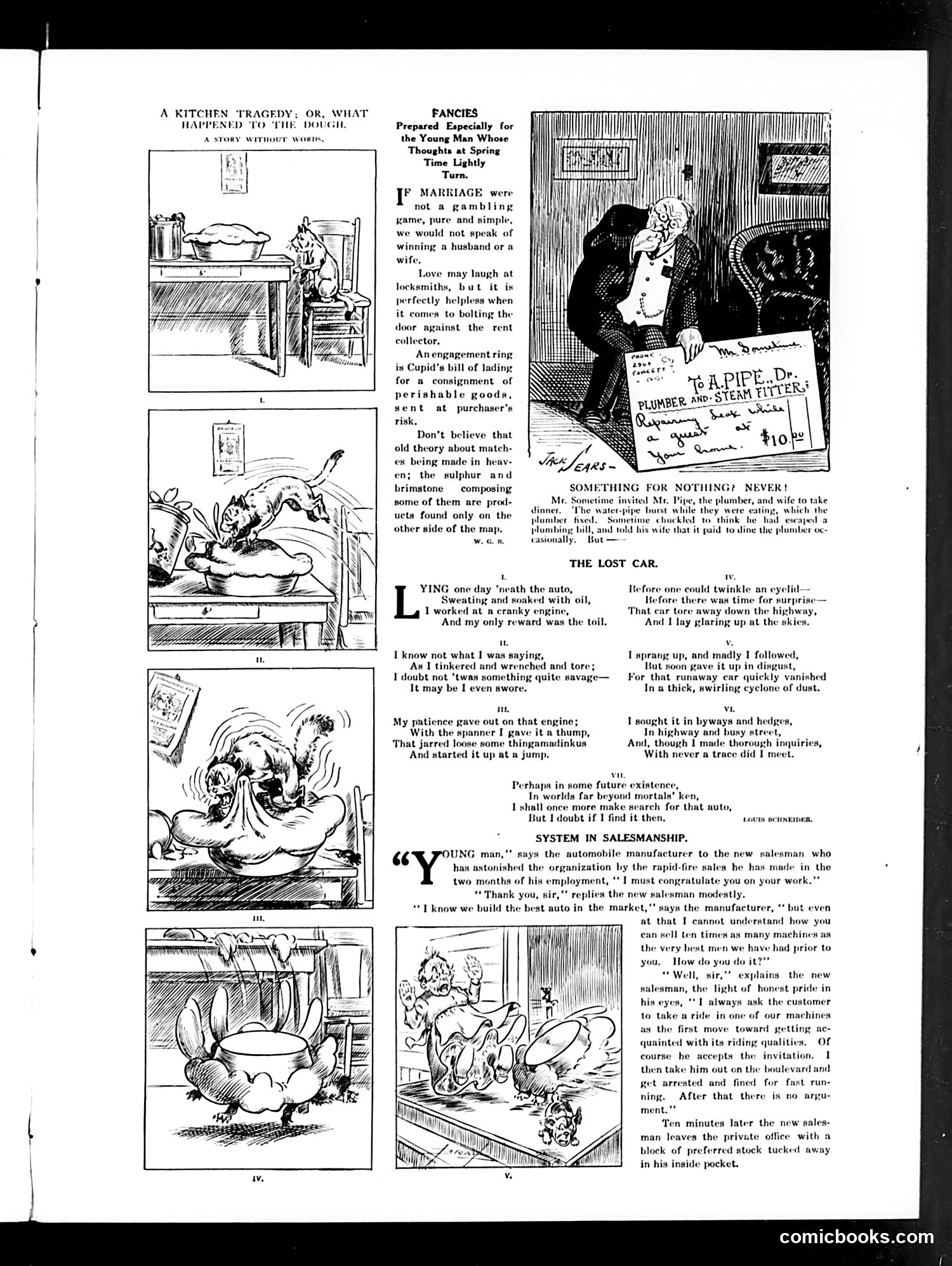
This Judge magazine page contains three unrelated pieces of early 20th-century humor: **"A Kitchen Tragedy"** (top left): A wordless comic strip showing domestic chaos—a wife apparently destroys the kitchen while cooking, suggesting incompetence or marital discord. The accompanying "Fancies" section sarcastically defines marriage as a gambling game where love cannot protect against practical failures like unpaid rent. **"The Lost Car"** (center/right): A poem about a man who loses control of his automobile while cranking it, leading to its mysterious disappearance. This satirizes early motorcar unreliability and the physical dangers of hand-cranking engines—a genuine hazard of 1910s automobiles. **"System in Salesmanship"** (bottom): A humorous anecdote where a successful car salesman reveals his sales trick: taking customers on test drives, deliberately getting arrested for speeding, then claiming "no argument" needed afterward. The joke satirizes aggressive sales tactics and corrupt complicity between salesmen and police through traffic violations.
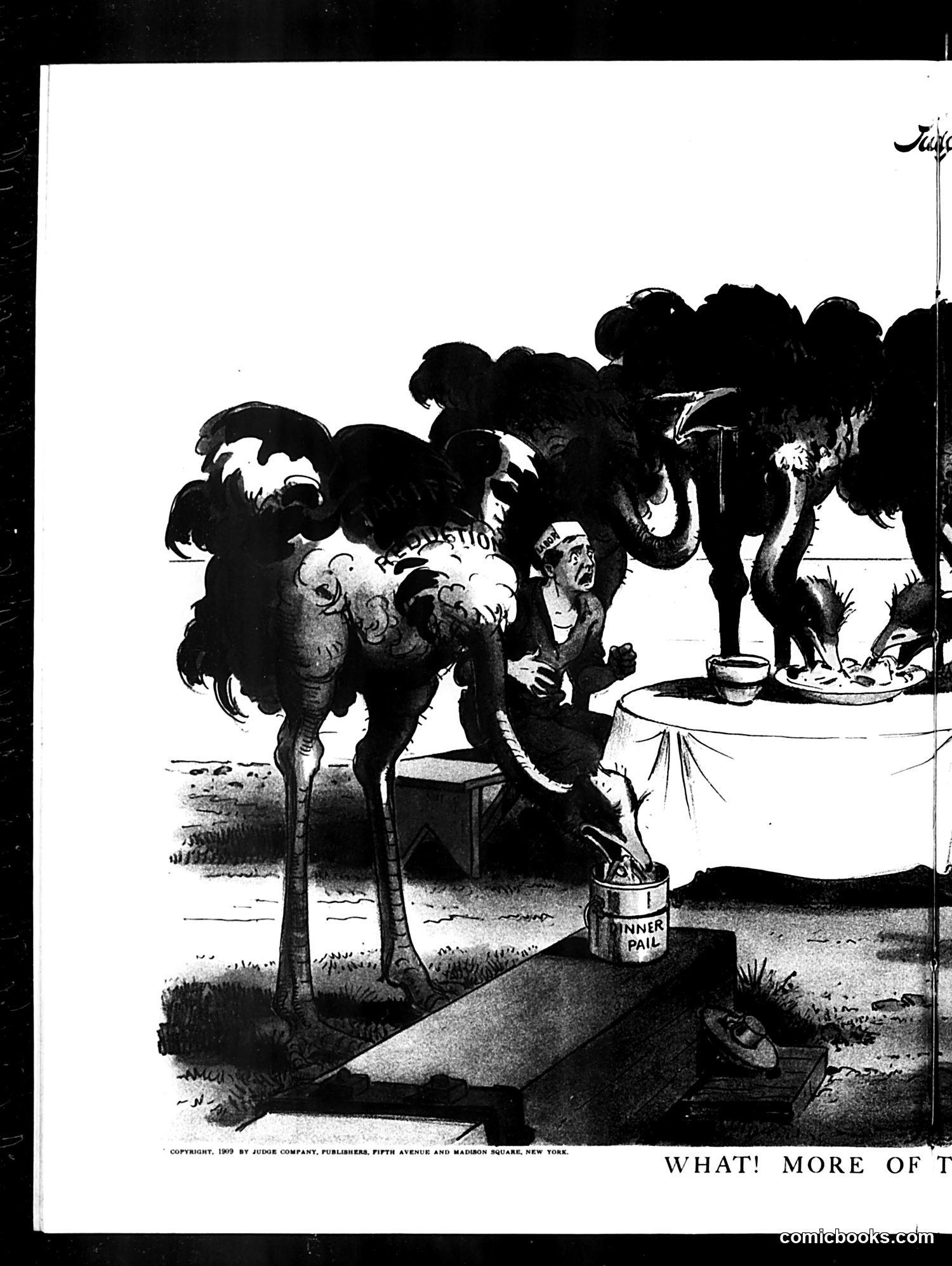
This 1909 Judge magazine cartoon depicts grotesque caricatures of what appear to be politicians or public figures gathered around a dining table. The exaggerated facial features and body proportions are characteristic of early 20th-century satirical caricature style. The partially visible caption "WHAT! MORE OF T[...]" suggests the cartoon criticizes some repetitive political phenomenon—likely referring to continued scandals, corruption, or unwanted policies. The dinner setting implies these figures are profiting from or indulging in something at the public's expense. Without the complete caption, the specific target remains unclear, though the visual contempt is unmistakable. The artistic style uses distortion to express moral judgment about the subjects, a common Judge magazine approach to political satire of this era.
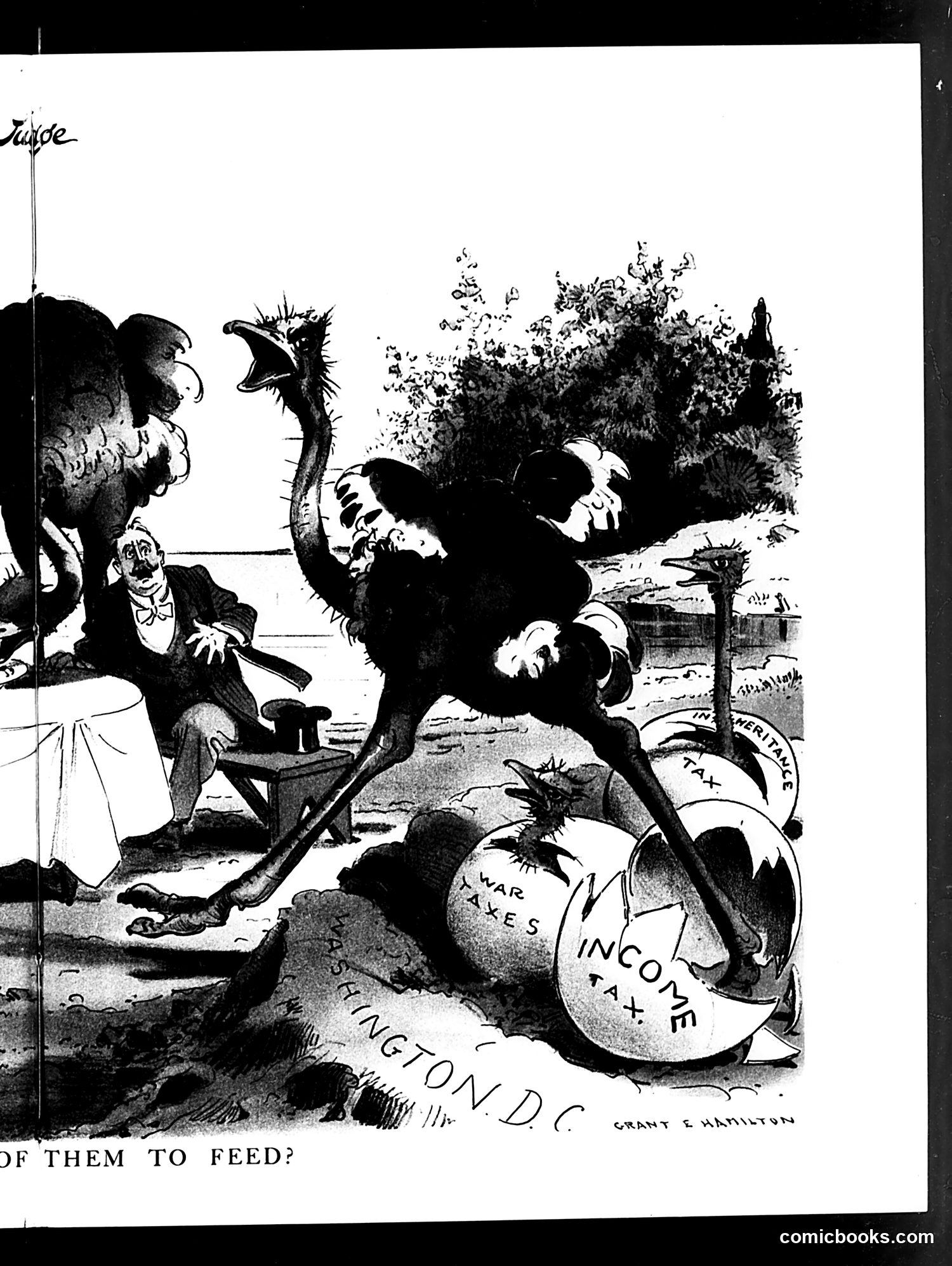
This political cartoon depicts a caricatured figure (appearing to represent a wealthy or political elite) confronting a grotesque demon or monster labeled with references to war expenses and taxation. The labeled spheres/objects mention "WAR EXPENSES," "INCOME TAX," and "WASHINGTON D.C." The cartoon's satire critiques the burden of wartime taxation and government spending on ordinary citizens. The demon-like creature symbolizes the overwhelming financial demands of war and government, while the frightened figure suggests public anxiety about these mounting costs. The question "OF THEM TO FEED?" (partially visible) implies criticism of whether citizens can afford to sustain such governmental and military expenditures. This likely references American wartime taxation, though the specific conflict and date remain unclear from the visible text alone.
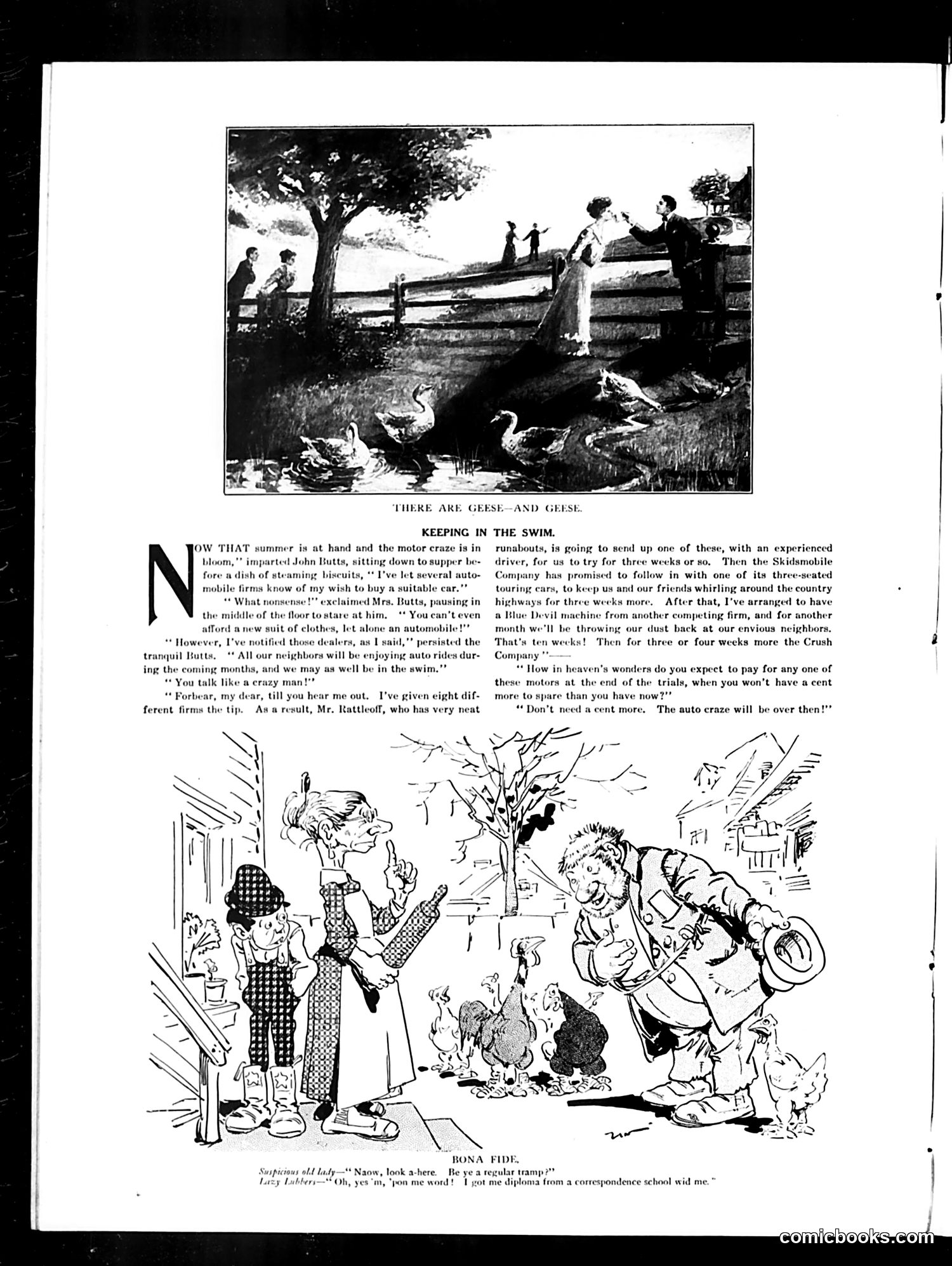
This page satirizes the early automobile craze and consumer debt culture of the early 1900s. The top illustration shows genteel people observing geese by a fence—a contrast to the chaos below. The main story concerns John Butts, a financially struggling man who writes to automobile manufacturers claiming he wants to buy a car. His actual scheme: secure free trial vehicles from competing firms for weeks at a time, allowing him and his neighbors to enjoy rides without purchasing anything. His wife correctly identifies the absurdity—he can't afford a suit, yet expects to use luxury automobiles. The joke's satire targets both the automobile industry's aggressive marketing tactics and consumer irresponsibility. Butts exploits manufacturers' competition and desperation to place vehicles. The punchline—"the auto craze will be over then!"—mocks the speculative bubble mentality: he assumes the fad will collapse before payment is due, making his scheme consequence-free. The bottom cartoon ("Bona Fide") appears unrelated, showing a suspicious interaction with a tramp claiming credentials from a "correspondence school."
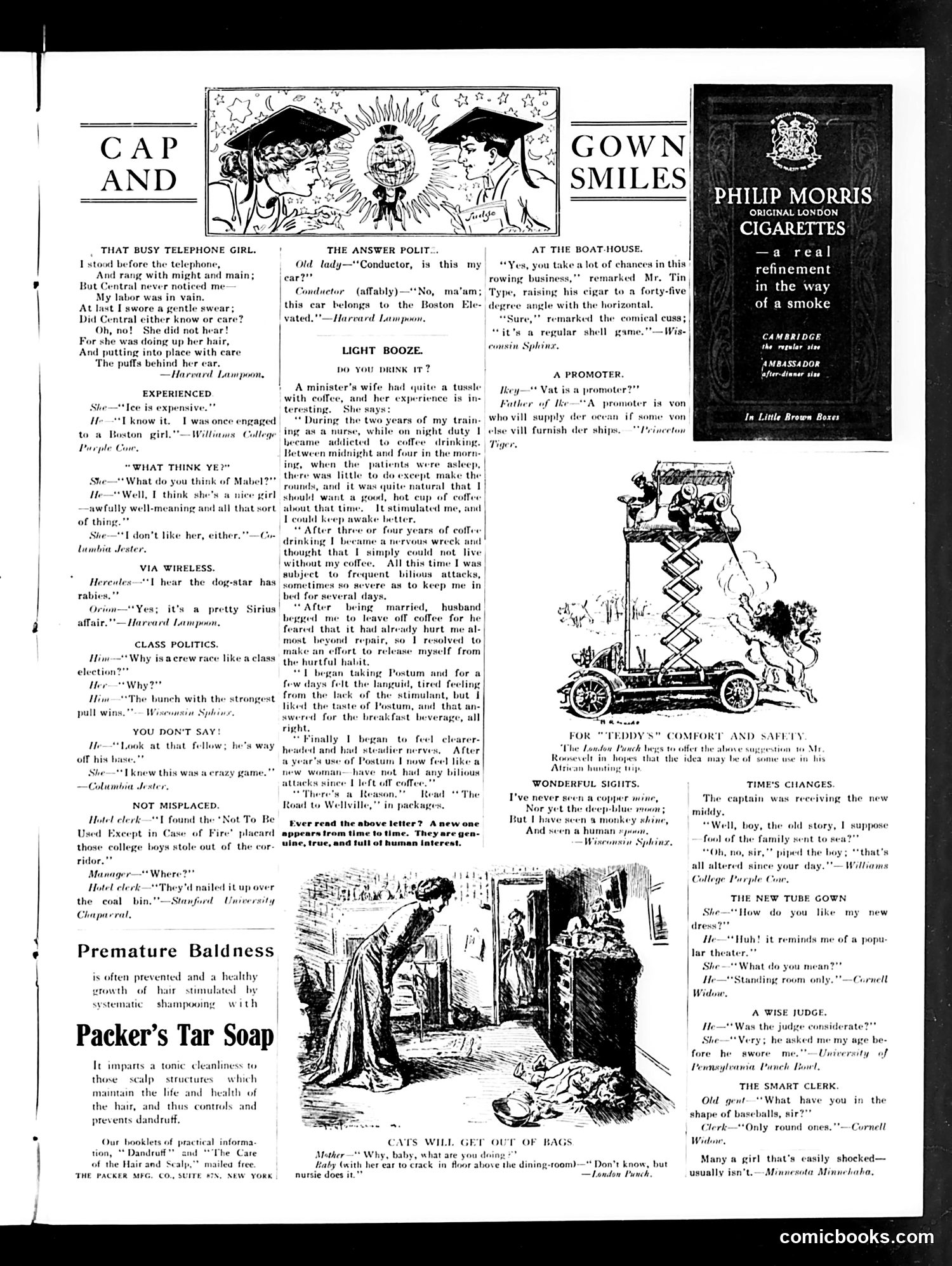
This page from *Judge* magazine combines humor columns, jokes, and advertisements typical of early 20th-century satirical publications. **"Cap and Gown Smiles"** section contains college humor: jokes about telephone operators neglecting callers to do their hair, puns (the "dog-star has rabies" / "Sirius" wordplay), and observations about class politics and social mishaps. **The "Light Booze" section** features a testimonial about replacing coffee addiction with Postum (a caffeine-free substitute), reflecting period anxieties about health and substance dependency—presented as genuine reader mail, a common advertising technique. **The cartoon "Cats Will Get Out of Bags"** shows a child eavesdropping on adult conversation through a floor crack—a visual joke about discovering secrets. **Lower cartoons** reference "Teddy" (Theodore Roosevelt) and naval/military life, reflecting contemporary interests. **Packer's Tar Soap advertisement** promotes hair health, addressing premature baldness concerns. The page reflects early 1900s college culture, advertising practices, and period anxieties about modernity, health, and propriety.
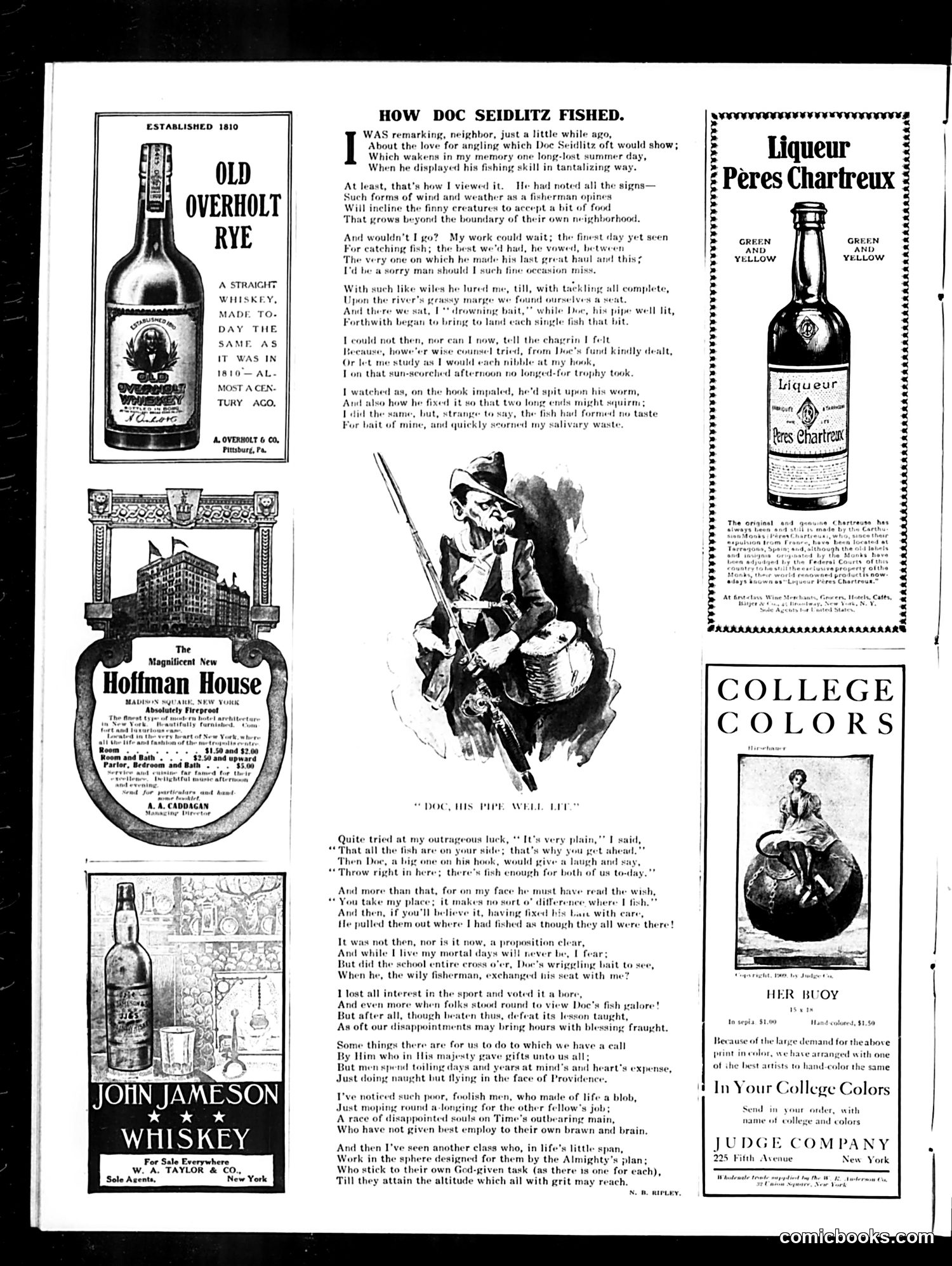
This page is primarily **advertising** for liquor and other products (Old Overholt Rye, Liqueur Peres Chartreux, John Jameson Whiskey, the Hoffman House hotel, and college merchandise), interspersed with a narrative poem. The central illustrated story, "How Doc Seidlitz Fished," appears to be a humorous anecdote rather than political satire. The poem describes a fishing trip where the narrator repeatedly fails to catch fish while his friend Doc succeeds, apparently due to Doc's superior skill and patience. The accompanying sketch shows a fisherman in period dress. The narrative's moral—suggested by the final stanzas—concerns virtue, hard work, and divine providence. Some men waste effort on fruitless pursuits; others succeed through diligence and proper use of God-given talents. Doc represents the latter type. **There is no discernible political satire or commentary on this page.** It functions as entertaining filler content between advertisements in this 1910s-era *Judge* magazine issue.
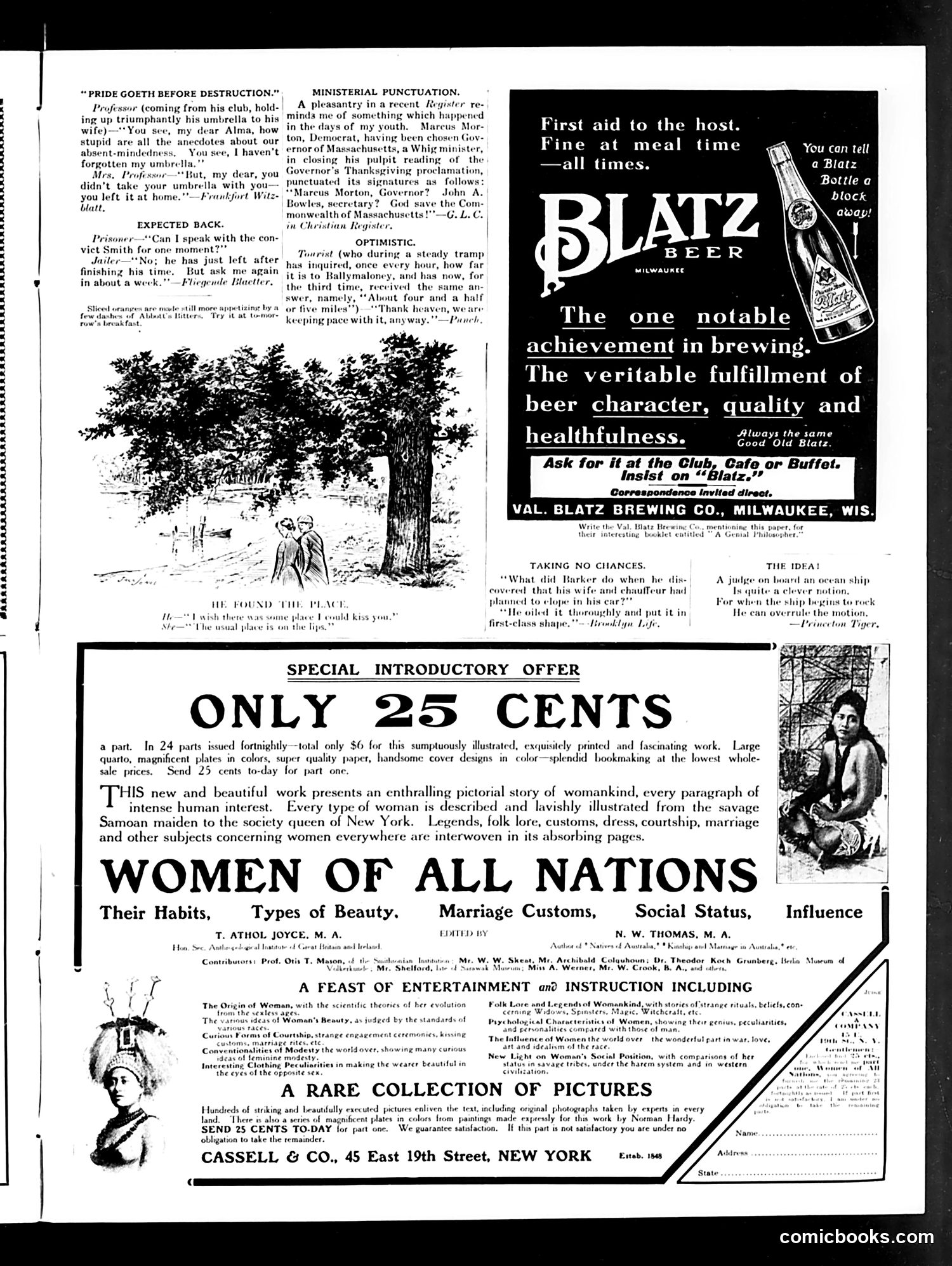
This page mixes short comic anecdotes with advertisements. The cartoons are brief, genteel humor typical of early 20th-century Judge magazine: **Top comics** feature domestic/romantic scenarios: a professor's wife needles him about forgetting his umbrella; a tourist optimistically asks repetitive questions on a hike; a couple playfully negotiates where to kiss. **Center**: A Blatz beer advertisement emphasizing quality and respectability ("first aid to the host"). **Bottom section**: The dominant content is a 25-cent introductory offer for "*Women of All Nations*"—a 24-part illustrated book series documenting women's customs, dress, courtship, and social status across cultures, from "savage Samoan maiden to the society queen of New York." This reflects period ethnographic curiosity and Victorian-era hierarchies of "civilization." The page is primarily **advertising-driven**, with lightweight humor serving as editorial filler around commercial promotions targeting middle-class readers interested in illustrated educational materials and branded consumer goods.
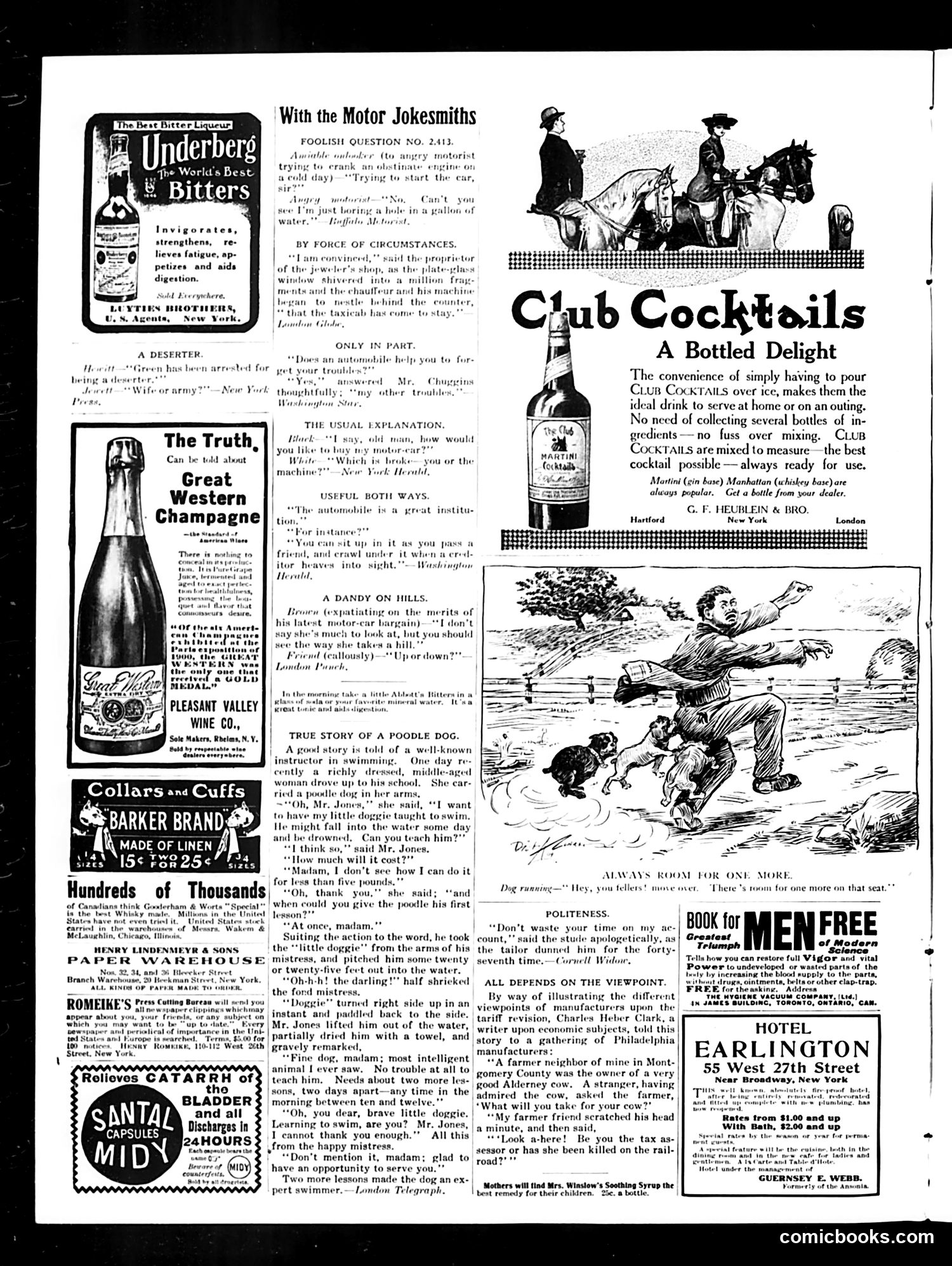
This page consists primarily of **advertisements and light humor** rather than political satire. The content includes: **"With the Motor Jokesmiths"** — A collection of brief jokes mocking early automobile owners and drivers, reflecting common frustrations with newfangled cars (difficulty starting engines, mechanical breakdowns). **Main cartoon**: Shows a man teaching a poodle dog to swim by throwing it into water while its owner protests. The joke satirizes the swimming instructor's literal interpretation of her request—she wanted him to *teach* the dog, not simply demonstrate it could swim. **Advertisements**: The page features liquor ads (Underberg Bitters, Great Western Champagne, Club Cocktails), men's clothing (Barker Brand collars), and a hotel ad—typical of Judge's commercial content. **Context**: These are genteel, mainstream humor pieces aimed at middle-class readers. The automobile jokes reflect the novelty and unreliability of early motorized vehicles, while the poodle story exemplifies the period's preference for absurdist humor over political commentary.
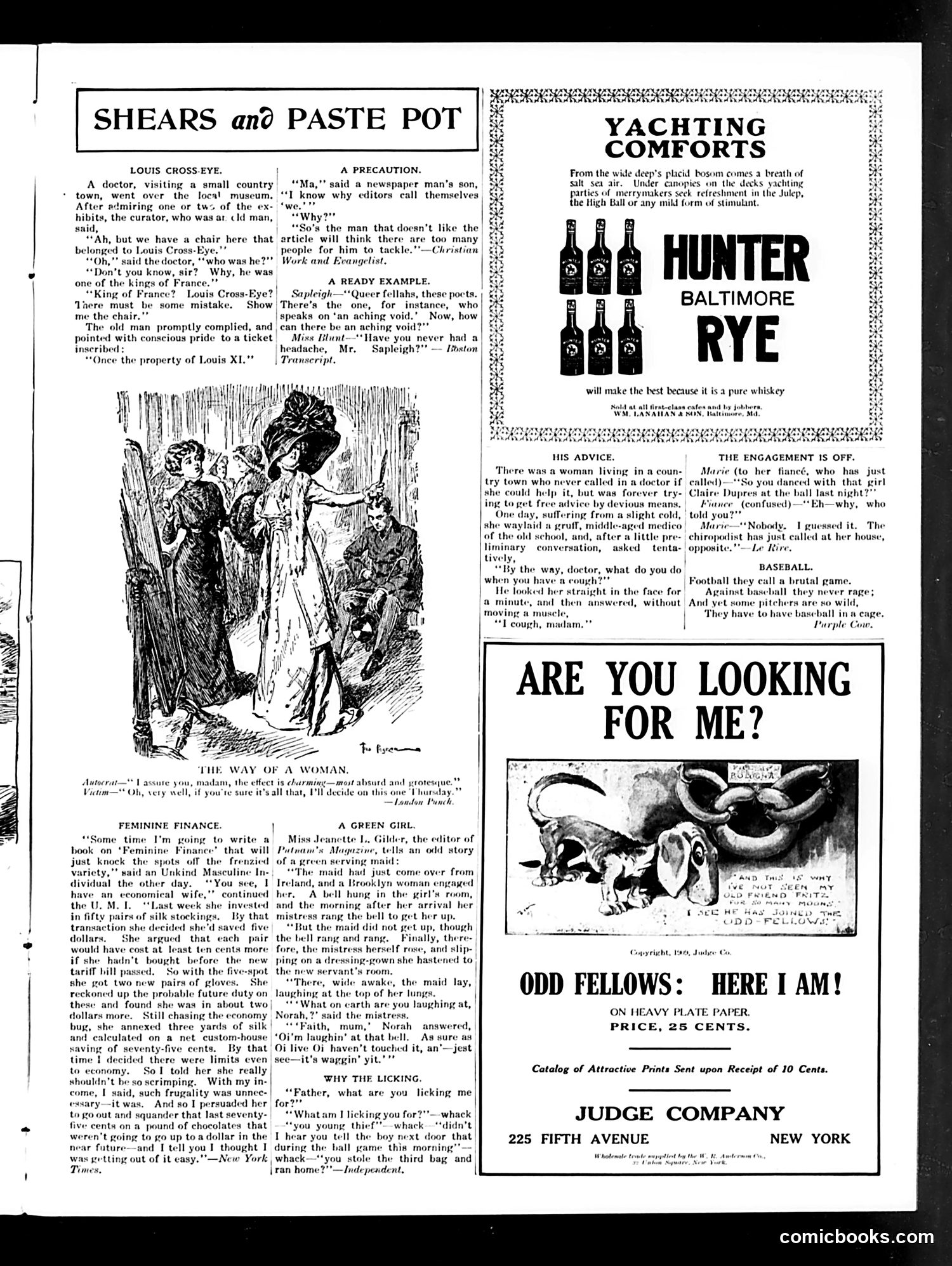
This is a **humor and satire page** from Judge magazine featuring several short comedic pieces: **"Louis Cross-Eye"**: A joke about a museum curator who claims to have a chair belonging to "Louis Cross-Eye, King of France." The humor lies in the absurd conflation—there was no such king; the curator appears to be either ignorant or pulling the visitor's leg with an obviously fabricated historical "fact." **Other sections** include light domestic humor: a newspaper editor's son explaining why editors call themselves "we," a joke about poets discussing "aching voids," and a woman consulting a doctor about a cold. The **Hunter Baltimore Rye advertisement** occupies the right column, promoting whiskey as "yachting comfort." **Lower sections** contain brief anecdotes about feminine finance, relationship misunderstandings, and baseball—typical Judge magazine fare of gentle, family-appropriate satire poking fun at social conventions, gender relations, and everyday absurdities rather than political topics. The page represents early-20th-century American magazine humor: observational, sometimes silly, occasionally mildly risqué.
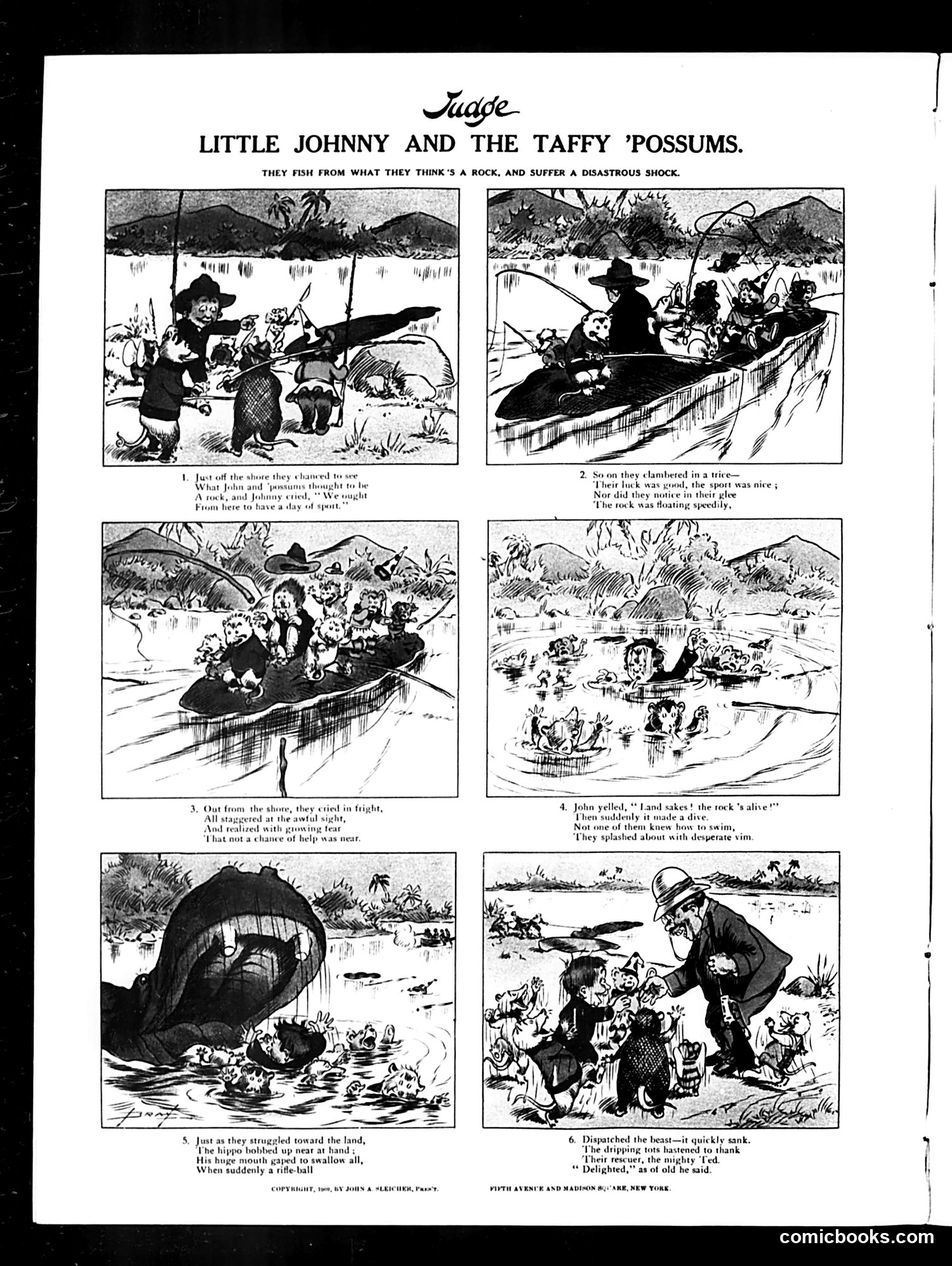
This is a humorous children's story comic, not political satire. It depicts "Little Johnny" and companions mistaking a hippopotamus for a rock while fishing. When they attempt to fish from it, the animal suddenly dives, creating chaos. The narrative follows their disastrous encounter: the children nearly drown, a mysterious rescuer (identified as "the mighty 'Ted'") appears to save them, and the hippopotamus sinks away. The story plays on slapstick comedy and the absurdity of mistaking a large animal for terrain. The "taffy 'possums" in the title likely refers to the children's sticky situation rather than actual possums. This appears to be typical Judge magazine fare—lighthearted, illustrated humor for family audiences—rather than the political commentary the magazine was known for. The copyright indicates it's from 1905.