
A complete issue · 16 pages · 1909
Judge — April 17, 1909
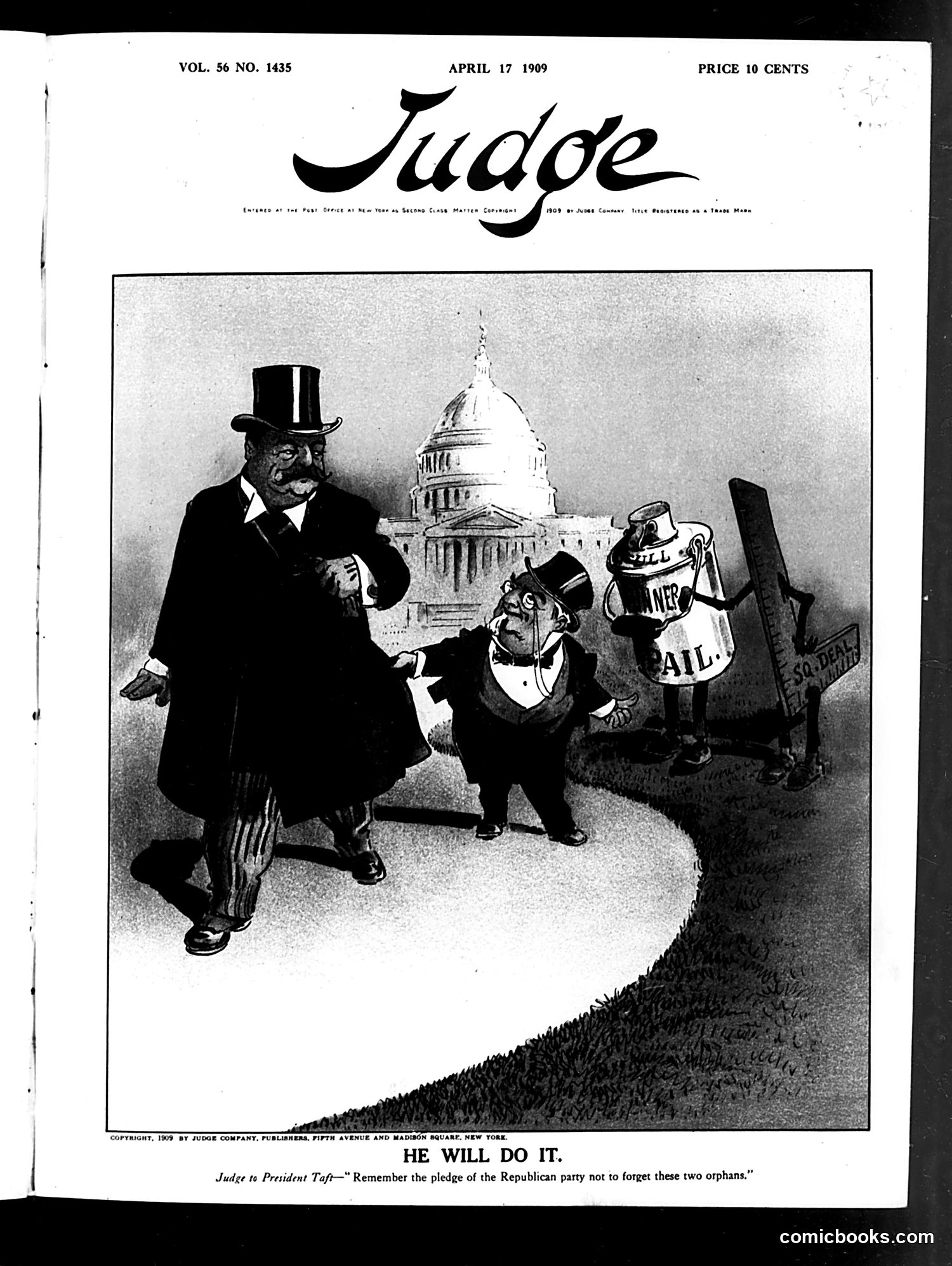
This political cartoon satirizes President William Howard Taft's campaign promises regarding Republican Party welfare programs. The large figure in formal dress (Taft) is shown with two smaller caricatured figures labeled as "orphans"—likely representing vulnerable constituencies or neglected Republican party obligations. The Capitol Building looms in the background, emphasizing the political context. The caption "HE WILL DO IT" and the subtitle quoting Judge to Taft—"Remember the pledge of the Republican party not to forget these two orphans"—suggests Taft had made campaign promises to support certain groups or policies that critics feared he might abandon. This reflects early criticism of Taft's presidency for potentially abandoning Progressive Republican commitments.
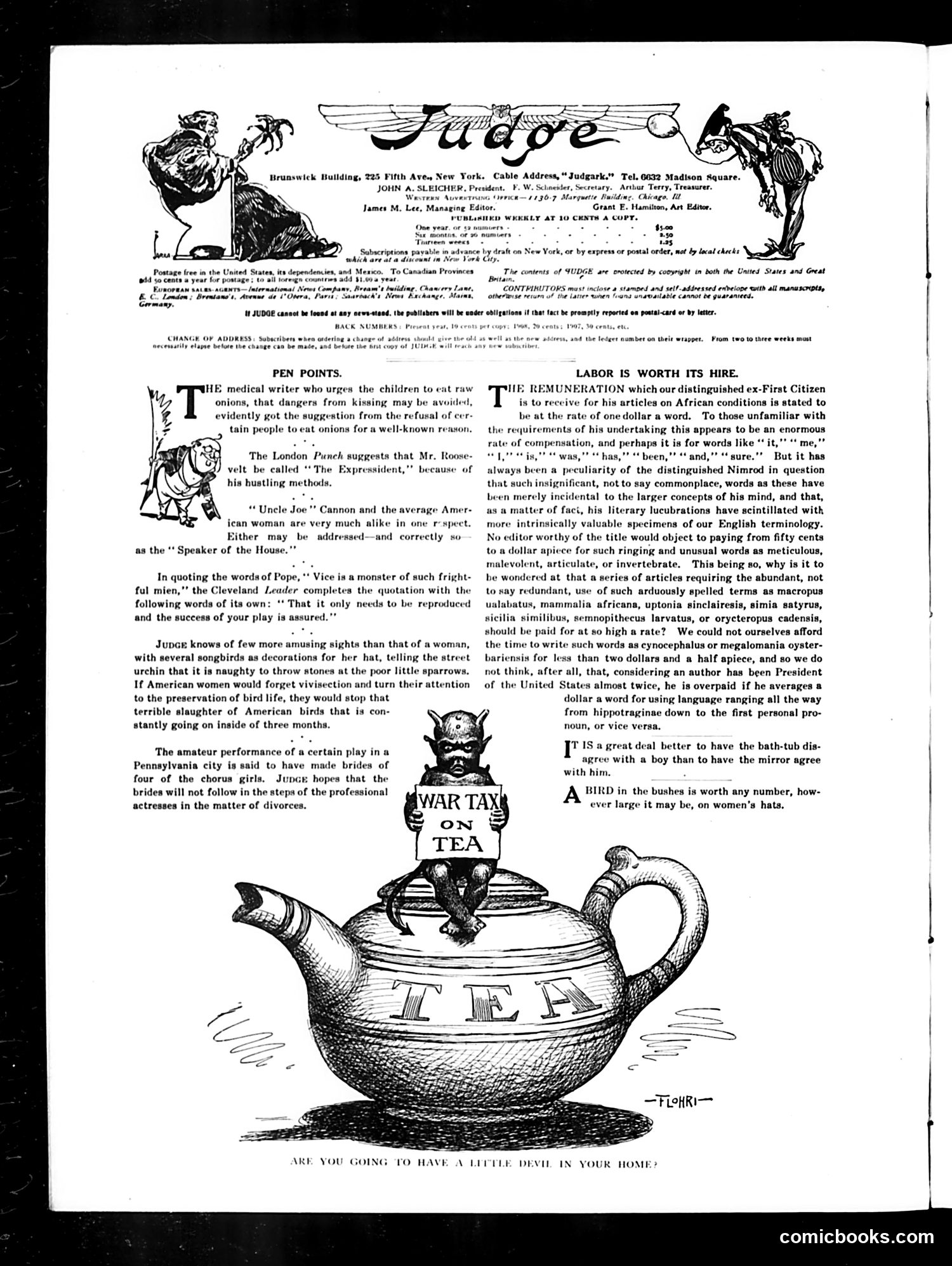
This page features political satire from Judge magazine's "Pen Points" section. The main cartoon depicts a teapot labeled "TEA" with a devil figure perched atop holding a "WAR TAX ON TEA" sign, captioned "ARE YOU GOING TO HAVE A LITTLE DEVIL IN YOUR HOME?" The satire references a wartime tax on tea—likely from WWI era based on the "war tax" reference. The devil imagery suggests the tax is portrayed as morally corrupt or devilish. The accompanying text discusses various social commentary including observations about onions, American women's behavior, and editorial standards for publishing. The overall message appears critical of wartime taxation, using the devil as a symbol to suggest such taxes introduce corruption into everyday domestic life.
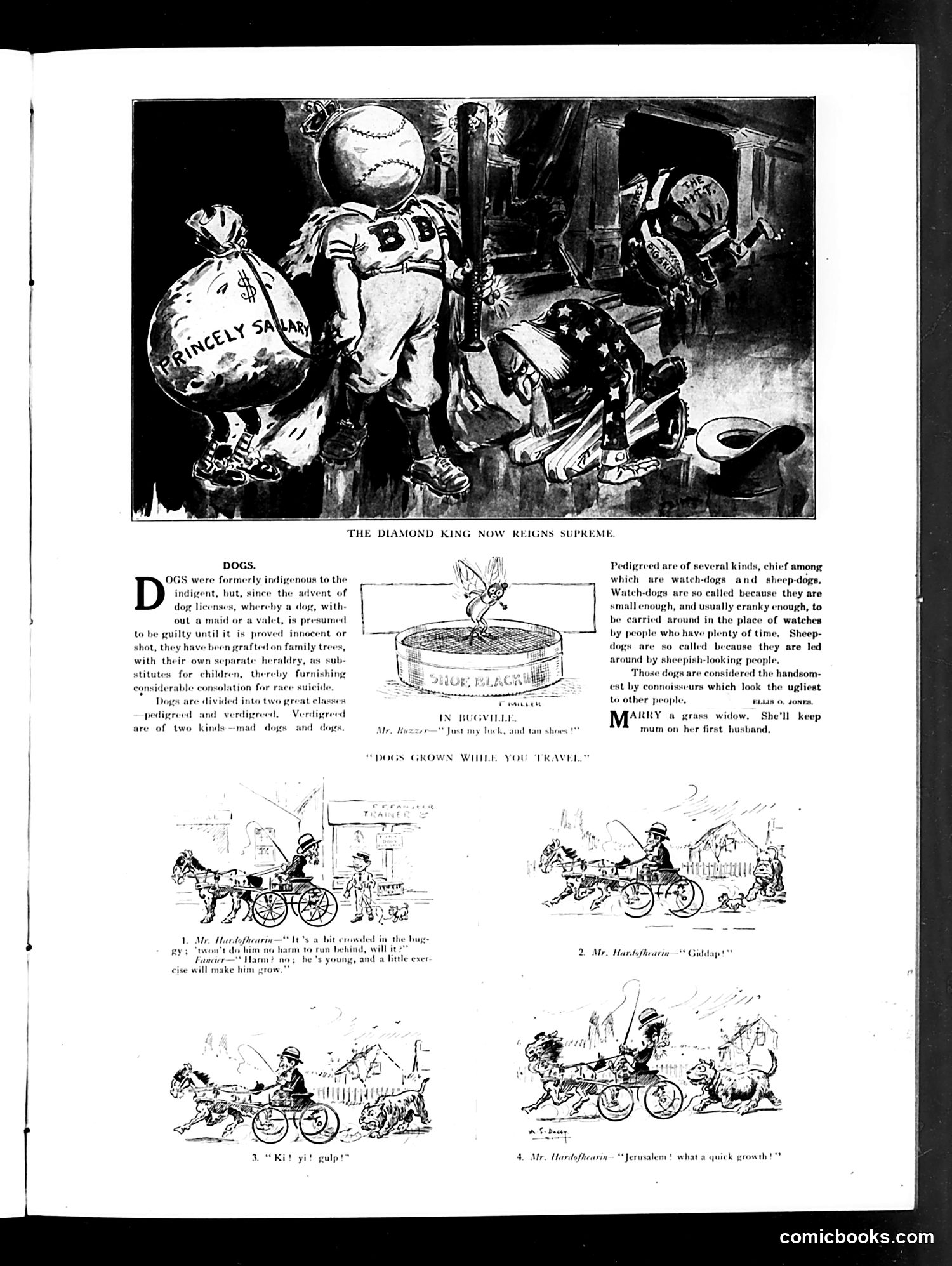
The top cartoon "The Diamond King Now Reigns Supreme" depicts a baseball player labeled "B.B." (likely a baseball star of the era) surrounded by money bags labeled "princely salary," with various American symbols and sporting equipment. This satirizes the enormous wealth commanded by professional baseball players—a relatively new phenomenon in early 20th-century America. The lower section about dogs discusses breeds and their uses, illustrated with comic scenes of Mr. Hardstains traveling with horses and children. This appears to be educational/humorous content about dog breeds rather than political satire. The overall page mixes sports satire critiquing athletes' inflated salaries with light humor about domestic animals and travel.
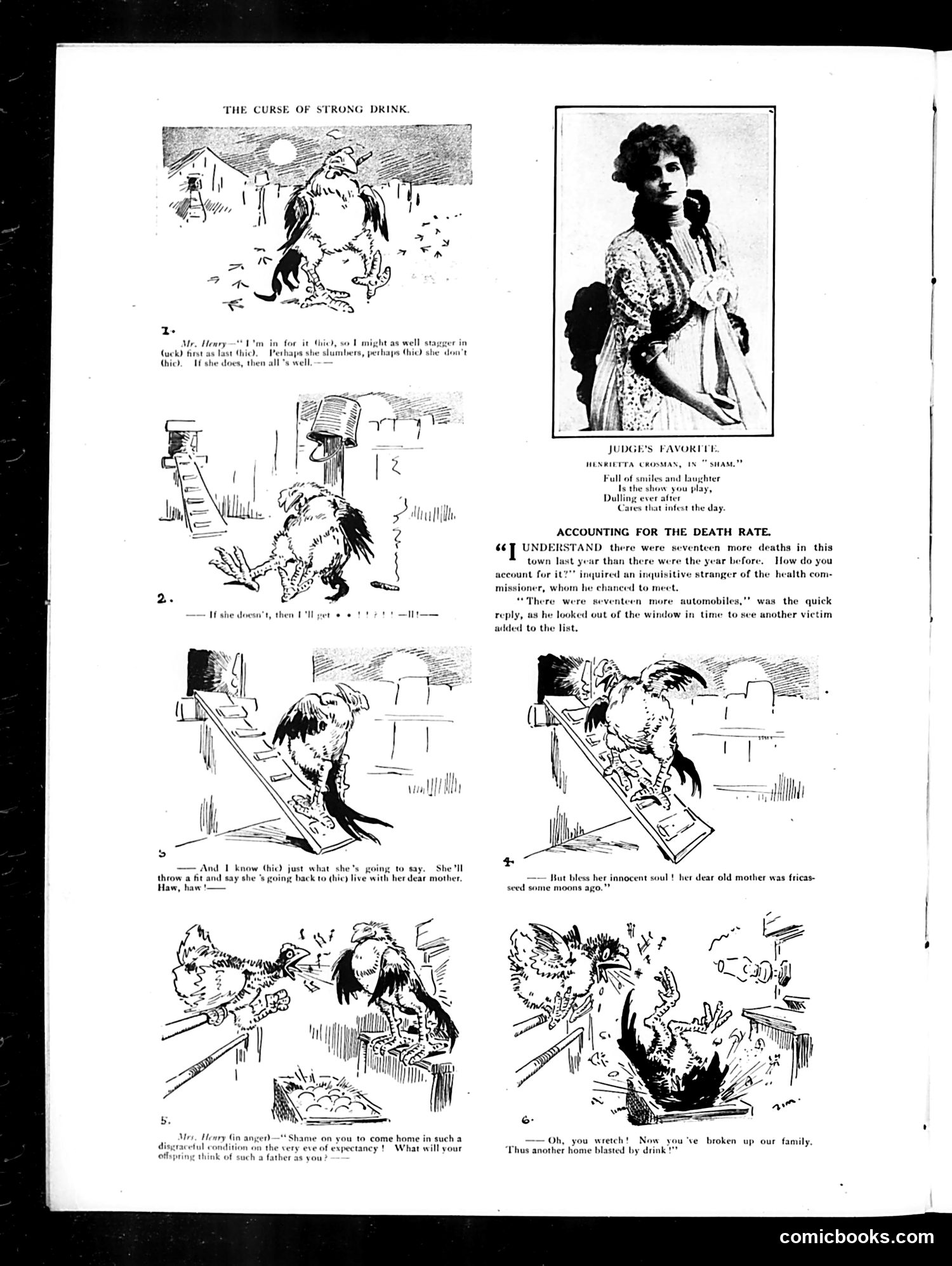
This is a social-reform comic strip illustrating alcohol's destructive effects on families, a major concern during the temperance movement era. The narrative follows a man's deterioration through drink: 1. He's "in for a bird" (arrested/drunk) 2. He staggers home 3. His wife confronts him about his condition 4. He's shown dead or dying 5. His grieving mother laments his fate 6. The final panel shows the family destroyed: "Thus another home blasted by drink!" The accompanying article "Accounting for the Death Rate" connects excessive mortality in the town to alcohol consumption. The portrait of "Henrietta Crosman in 'Sham'" represents theatrical morality entertainment—performances promoting sobriety that were popular during this period.
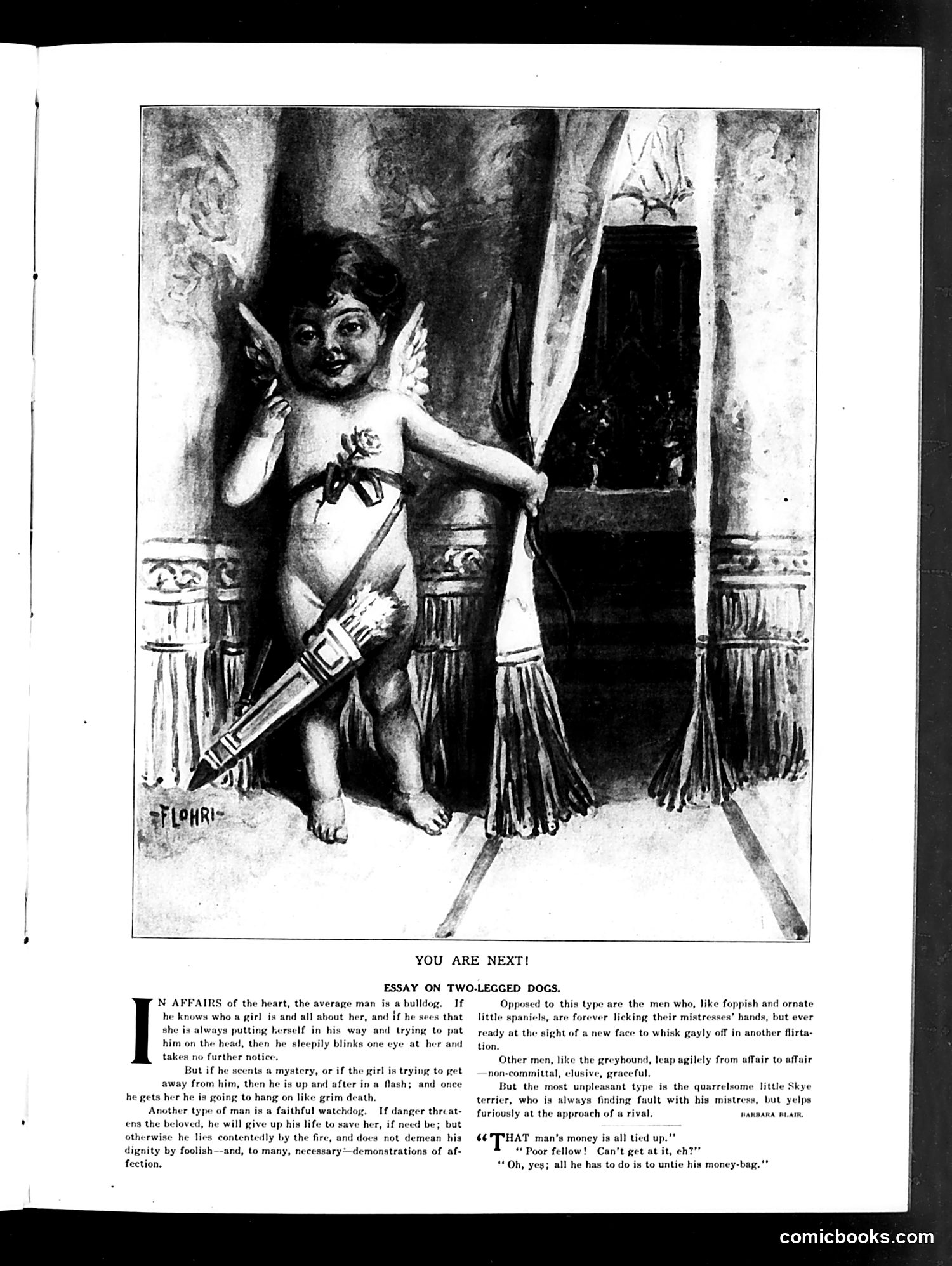
The main illustration shows a cherub or cupid (labeled "YOU ARE NEXT!") holding a rifle, standing before a door. This accompanies an essay titled "ESSAY ON TWO-LEGGED DOGS." The text discusses types of men in romantic relationships: those devoted to their girlfriends, unfaithful men, and particularly "greyhound" types who are graceful but emotionally distant. It criticizes "the most unpleasant type"—a jealous, fault-finding man (appearing to reference a "Skye terrier" breed metaphor). The satirical dialogue at the bottom depicts a man complaining his money is "all tied up," unable to access his cash. **The satire:** The page mocks various male personality types and behaviors in relationships, using dog breed metaphors to criticize men's romantic failings and financial irresponsibility. The cupid illustration likely warns husbands they're "next" targets for romantic/marital complications.
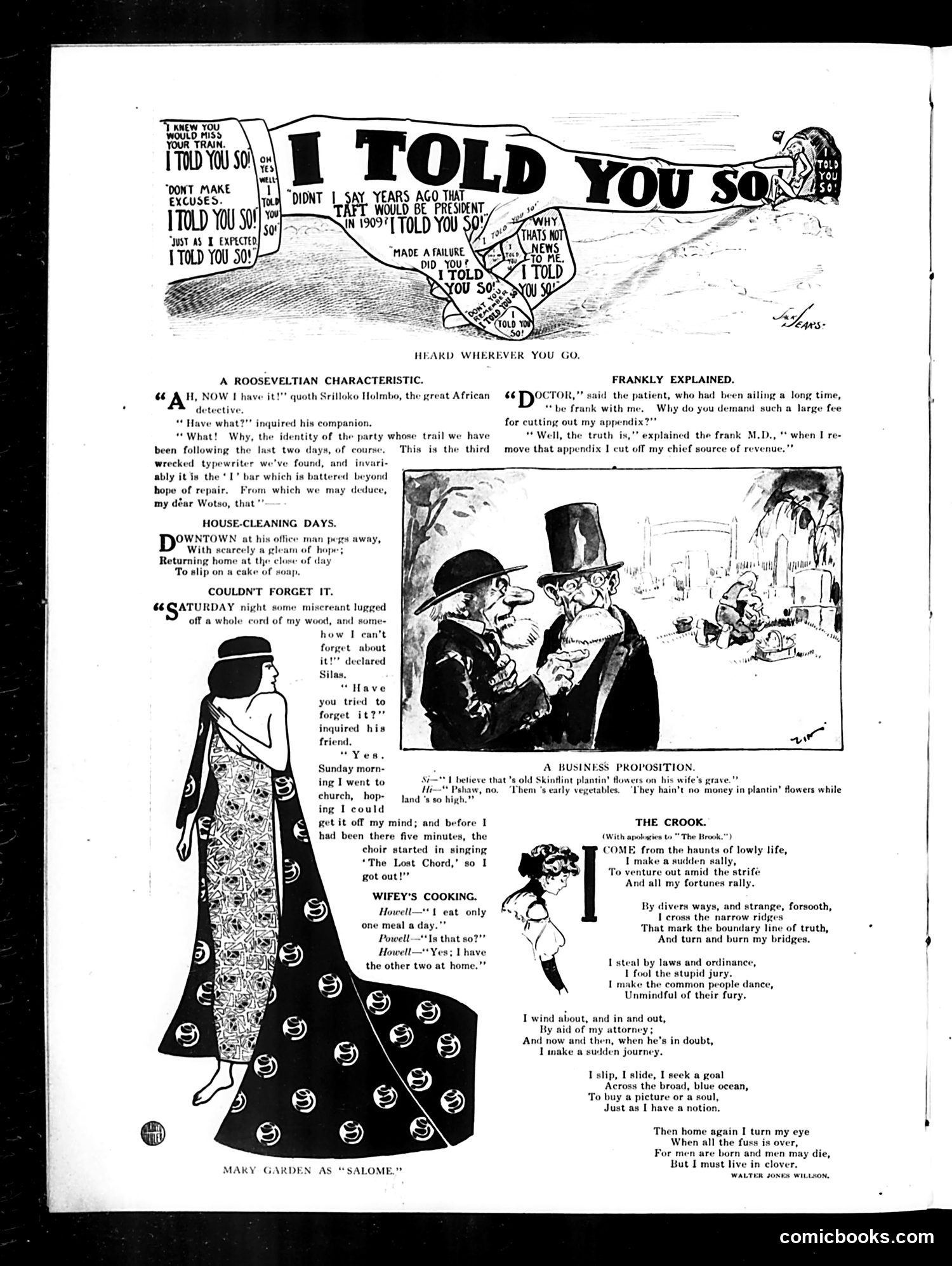
**Top Cartoon:** This satirizes Theodore Roosevelt's famous habit of saying "I told you so." The exaggerated map shows Roosevelt's voice literally everywhere, with repeated declarations of past predictions. The phrase "heard wherever you go" captures the satirical point: Roosevelt constantly reminded the public of his earlier correct forecasts, a trait Judge found annoyingly characteristic of him. **Subheadings Below:** - "A Rooseveltian Characteristic" mocks Roosevelt's predictive boasting - "Frankly Explained" shows a doctor justifying high surgical fees by admitting appendix removal is his income source—satirizing professional self-interest - "House-Cleaning Days" and "Couldn't Forget It" are brief humorous anecdotes about domestic life - "The Crook" is a poem personifying a criminal character **Bottom:** An illustration of "Mary Garden as Salome" references the famous opera/biblical character, likely commenting on theatrical culture or a contemporary performance. The page mixes political satire (Roosevelt) with general humor and literary content typical of Judge's format.
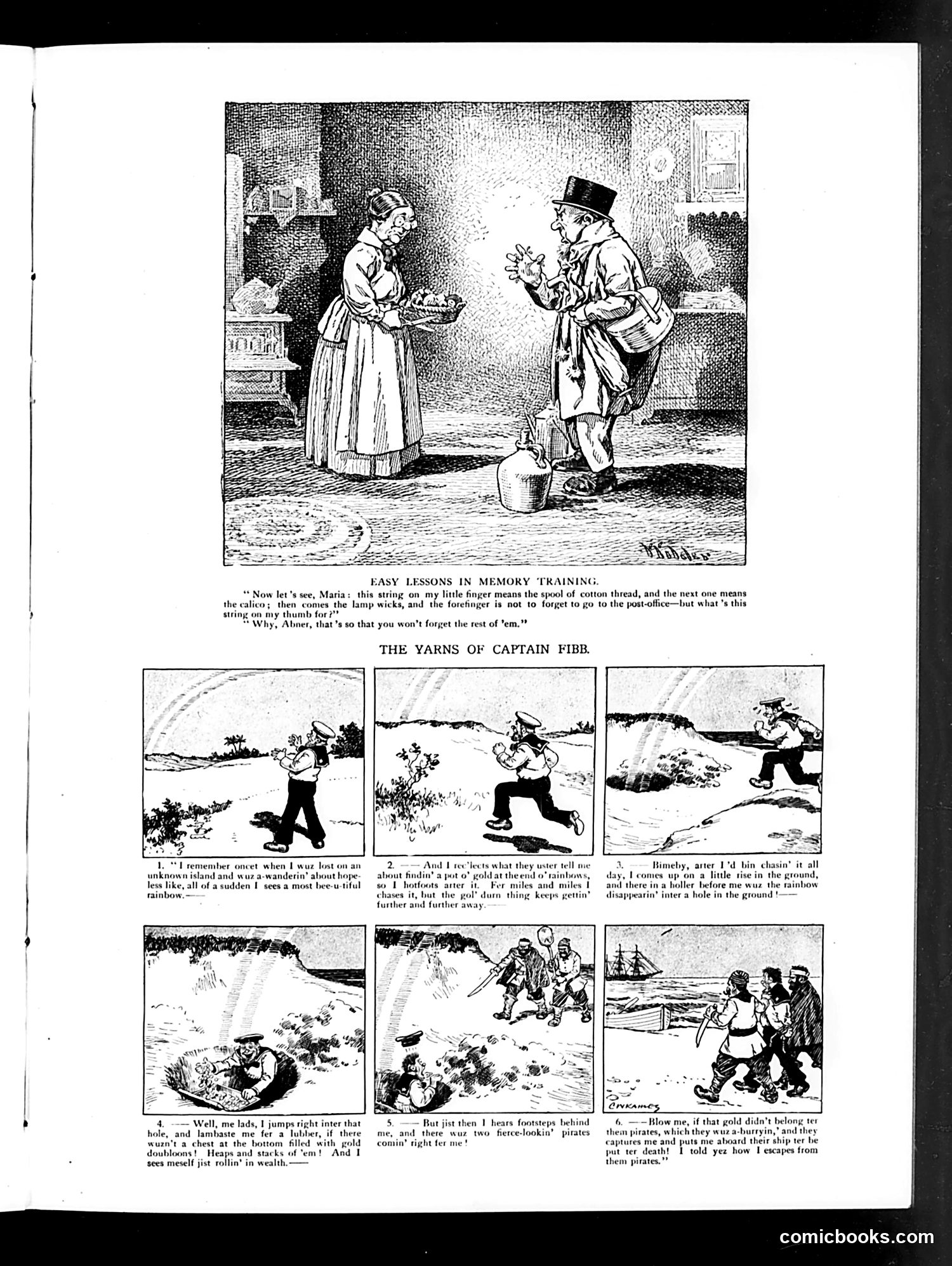
This page contains two unrelated items: **Top: "Easy Lessons in Memory Training"** — A brief satirical sketch mocking mnemonic devices (tying strings on fingers to remember tasks). A woman asks a man about his memory aid system, but his explanation becomes increasingly absurd and nonsensical, suggesting such tricks are worthless. **Bottom: "The Yarns of Captain Fibb"** — A six-panel comic strip depicting an old sailor's tall tale. The captain claims to have discovered a rainbow's end on an island, chased it, found buried pirate treasure, was captured by pirates, and escaped. The exaggerated adventure story parodies classic seafaring yarns and the tendency of elderly sailors to tell increasingly implausible stories to listeners. The humor relies on the audience recognizing this as obvious fiction passed off as fact. Both pieces use gentle satire rather than political commentary.
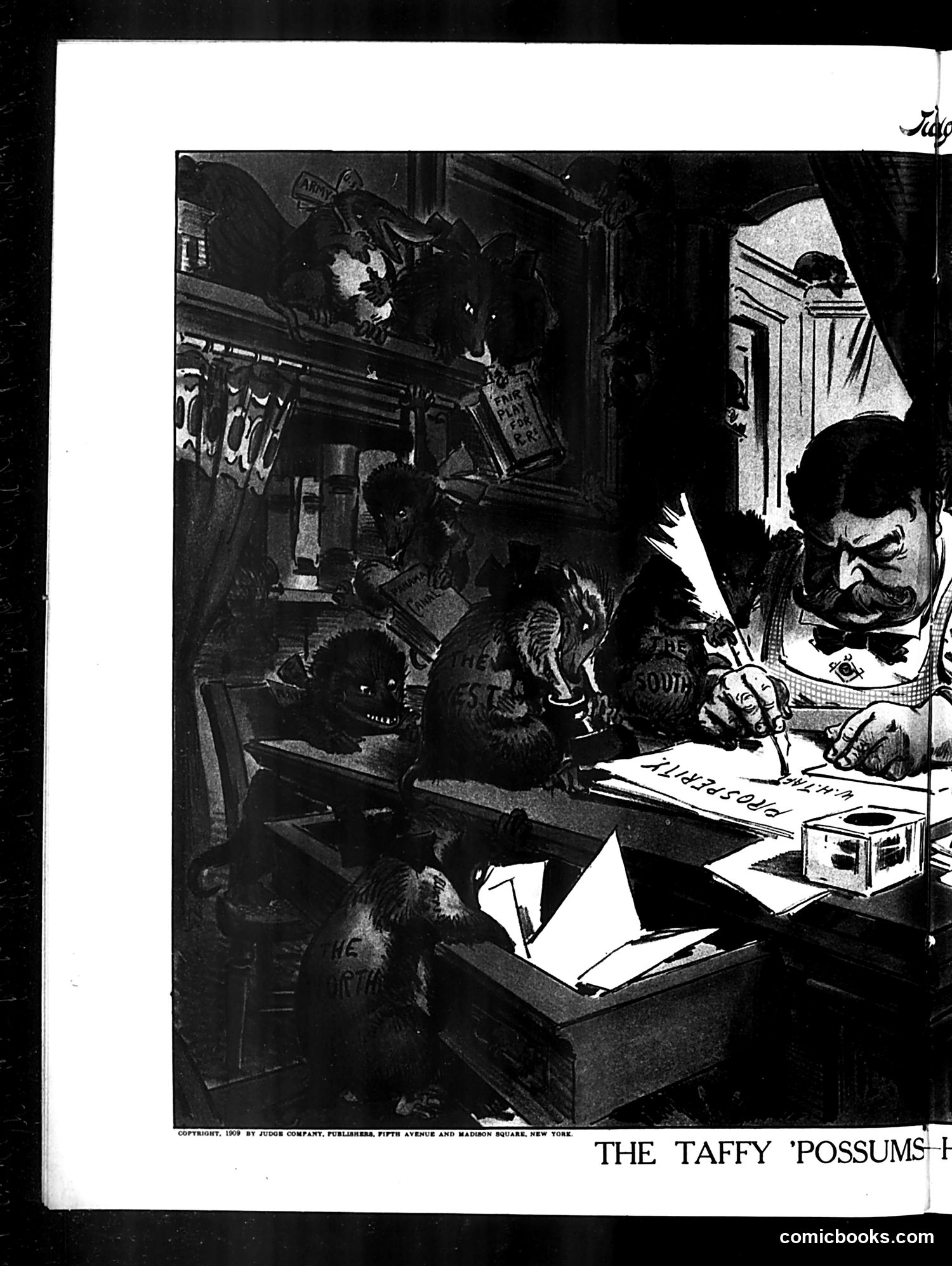
This appears to be a satirical cartoon from Judge magazine (copyright 1909) depicting anthropomorphized possums in what looks like a shop or office setting. The possums appear to be engaged in some kind of commercial transaction or negotiation, with papers and writing materials visible on a desk. One figure on the right wears a hat and appears to be in a position of authority or business dealings. The title "Taffy 'Possums" suggests satire about flattery or insincerity ("taffy" being slang for flattery or nonsense). The specific political or social references are unclear without additional context, but the cartoon likely mocks contemporary business practices, social climbing, or deceptive behavior through animal caricature—a common Judge magazine technique.
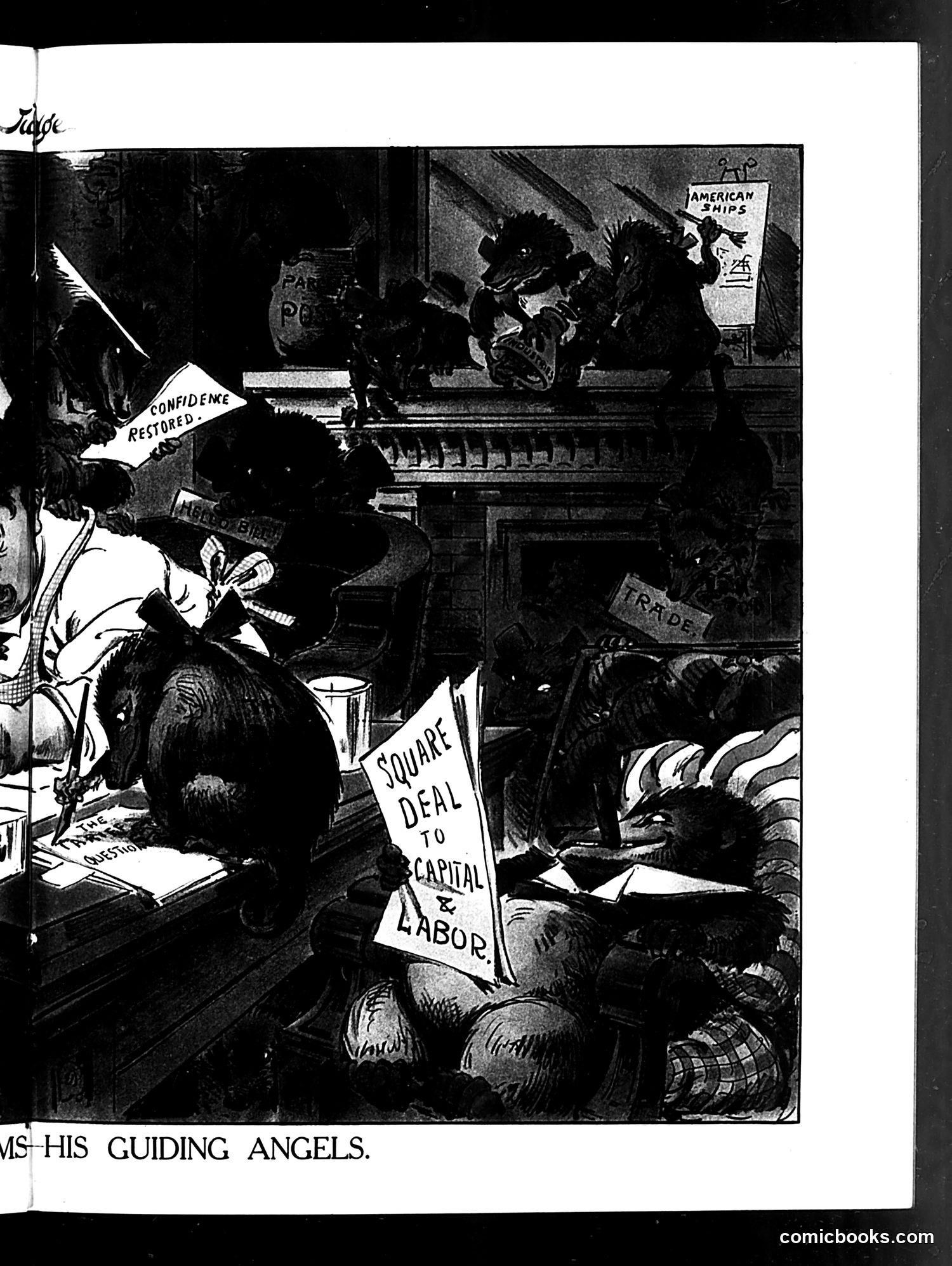
This political cartoon depicts anthropomorphized animals (appearing to be bears or similar creatures) as "guiding angels" overseeing human labor and capital negotiations. Visible signs read "SQUARE DEAL TO CAPITAL & LABOR" and "CONFIDENCE RESTORED," referencing Theodore Roosevelt's Progressive Era policies. The satire appears to criticize Roosevelt's mediation between business and workers as paternalistic—depicting him (or his ideology) as an animal overseer managing both capital and labor interests. The "guiding angels" framing is ironic, suggesting the cartoon questions whether such intervention actually serves workers' interests or merely maintains control. References to "American Ships" and business dealings suggest concerns about labor conditions in shipping or maritime industries. The overall message critiques the notion that government arbitration genuinely protects workers.
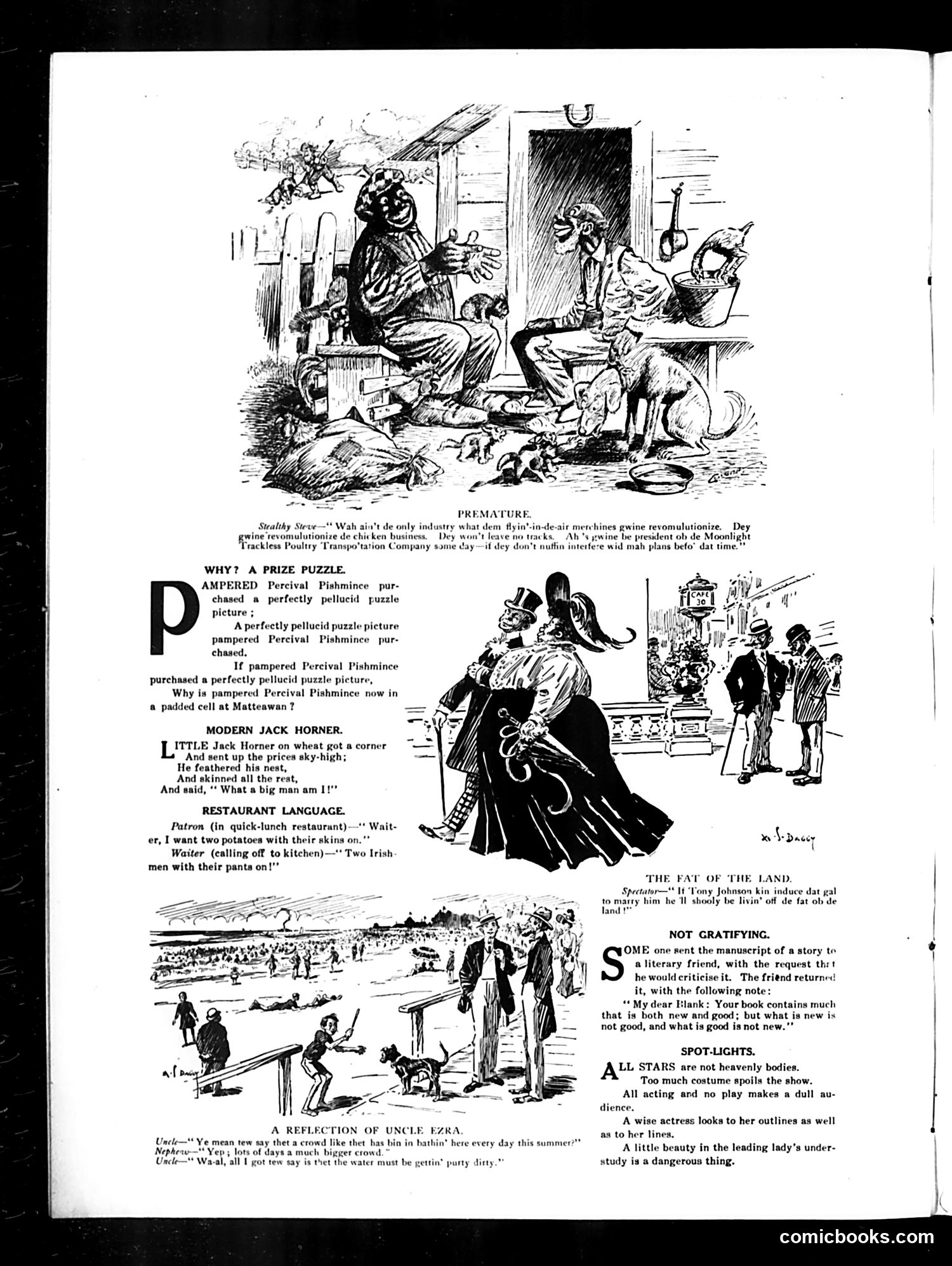
This page contains several satirical pieces typical of early 20th-century American humor: **"Modern Jack Horner"** mocks wheat speculators who cornered the market, driving up prices while enriching themselves—a jab at financial manipulation and greed. **"Restaurant Language"** plays on ethnic stereotyping, using a pun where "Irish men with their pants on" substitutes for potatoes with skins. This reflects period attitudes toward Irish immigrants. **"Why? A Prize Puzzle"** is wordplay about alliteration ("pampered Percival Pishmince"), suggesting obsession with such linguistic games drove someone to madness. **"Not Gratifying"** offers a literary joke: a critic's backhanded compliment that nothing in the manuscript is both original AND good. **"Spot-Lights"** provides brief theatrical observations about acting and appearance. The top cartoon (partially visible) appears to satirize industrial or labor concerns, though details are unclear from this excerpt.
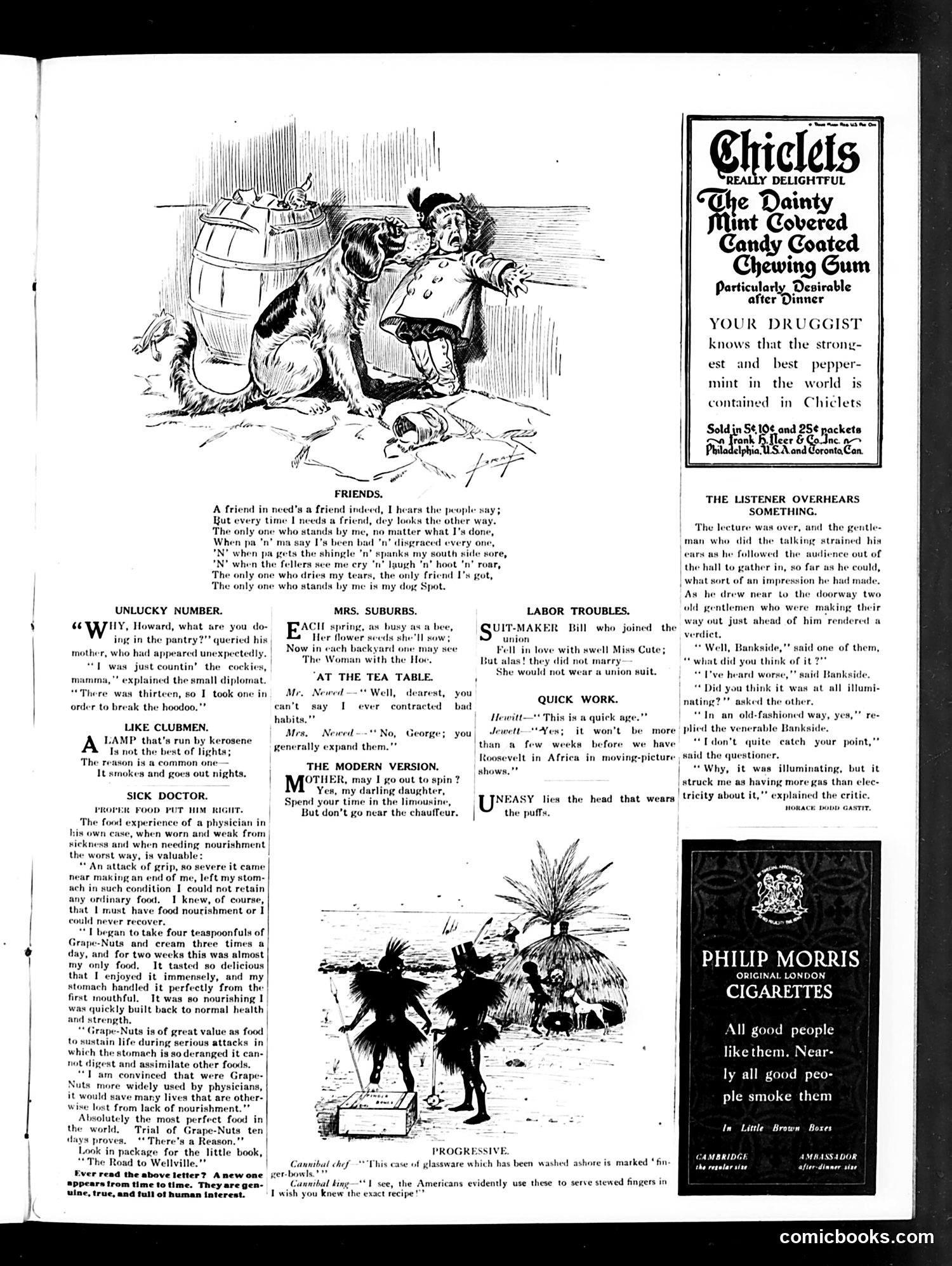
This page contains several short humorous pieces typical of early 20th-century satirical magazines: **"Unlucky Number"** mocks superstition—a boy counts thirteen cookies and removes one to "break the hoodoo" (bad luck). **"Like Clubmen"** is a simple joke: kerosene lamps smoke and go out at night, like clubmen. **"Sick Doctor"** features a physician's testimonial praising Grape-Nuts cereal for recovery from illness—this is a **Grape-Nuts advertisement** dressed as editorial content, common in the era. **"The Listener Overhears Something"** depicts theater-goers critiquing a lecture as having "more gas than electricity"—likely mocking verbose speakers. The page is heavily advertisement-driven, with prominent ads for **Chiclets gum**, **Philip Morris cigarettes**, and **Grape-Nuts**. The humor pieces serve largely as filler between ads. The social commentary is mild: superstition, class observations about clubmen, and mild theatrical criticism. Nothing overtly political appears here.
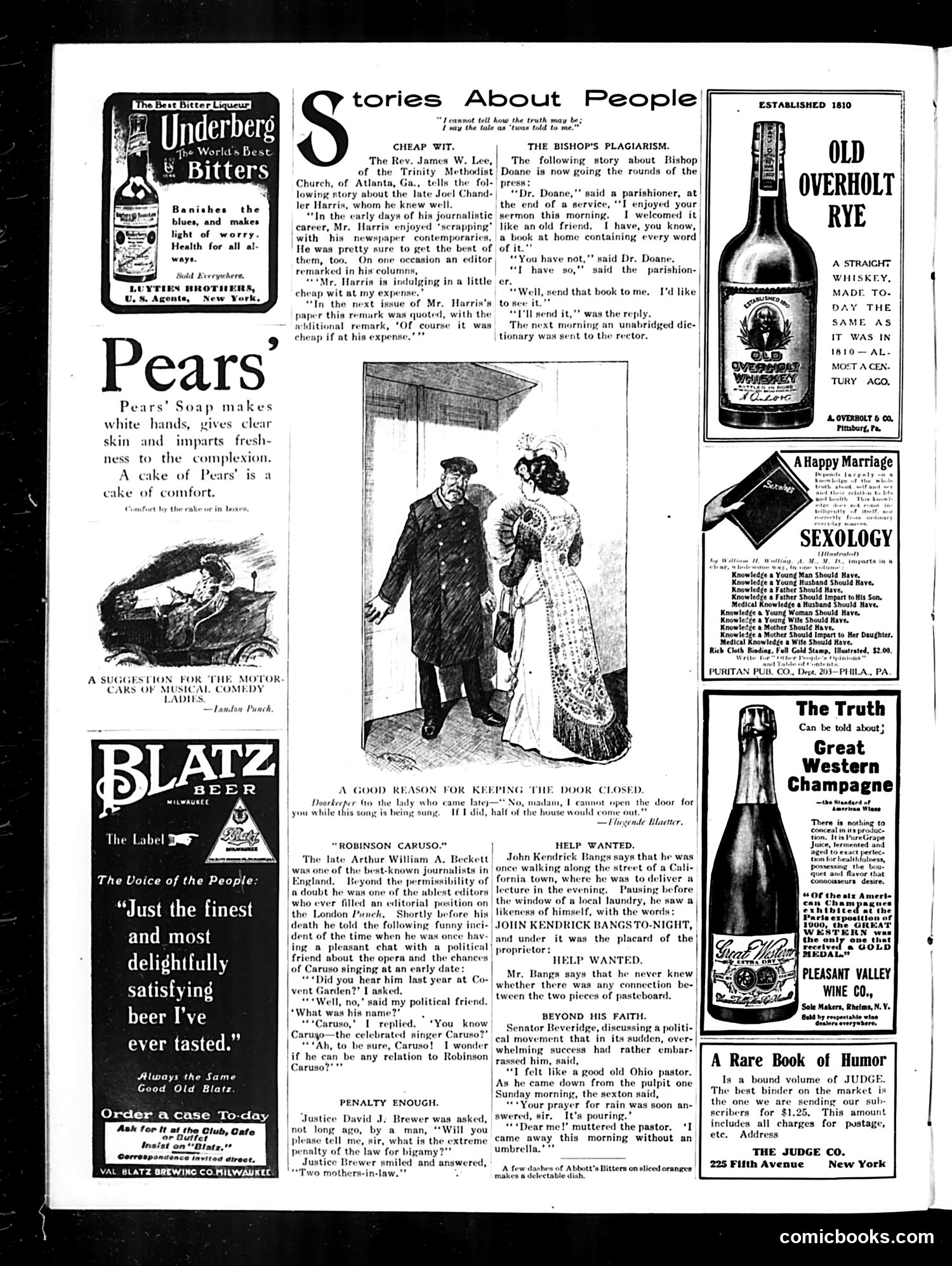
This page from Judge magazine contains several brief satirical anecdotes about notable figures, presented as "Stories About People." **"Cheap Wit"** mocks journalist Joel Chandler Harris for his relentless newspaper humor, recounting how an editor publicly called out Harris's "cheap wit" in print—only for Harris to quote that very criticism back at him, turning the editor's complaint into another joke. **"The Bishop's Plagiarism"** describes Bishop Doane being complimented on a sermon, only to have the parishioner reveal he was reading from a book at home containing "every word" of it. The bishop's response—to request that same book—is satirical commentary on clerical intellectual dishonesty or carelessness. These anecdotes exemplify Judge's satirical approach: exposing hypocrisy and pretension among public figures through brief, pointed stories. The surrounding advertisements (Pears' Soap, Blatz Beer, Old Overholt Rye) are period marketing, not editorial content. The page primarily functions as humor about recognizable contemporary personalities rather than political commentary.
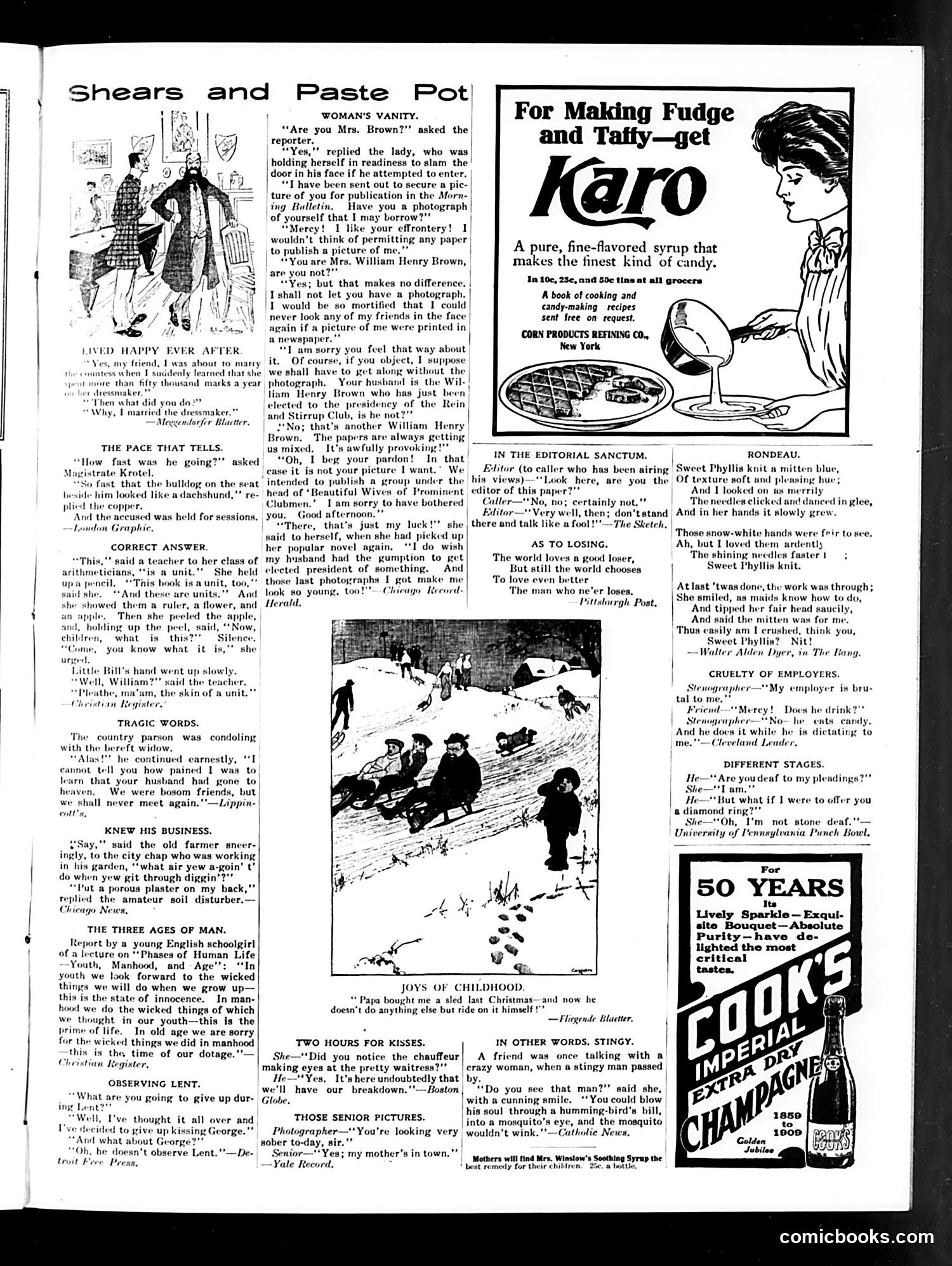
This page contains several brief humorous anecdotes and advertisements typical of early 20th-century American satirical journalism. The cartoons mock social pretensions and gender stereotypes. "Woman's Vanity" satirizes a society woman who refuses a newspaper photographer permission to publish her portrait—then eagerly reveals her husband's prominence, contradicting her claim of modesty. The joke exposes female vanity and status-consciousness. Other pieces target obtuse authority figures: a teacher asking children to identify a peach as "the skin of a unit" (playing on rigid mathematical instruction), and an editor dismissing a visitor with "don't stand like a fool." "The Three Ages of Man" presents cynical commentary on human nature through a schoolgirl's innocent misunderstanding: youth = innocence of anticipated wickedness, manhood = committing those wickedness, age = regret. The page also includes period advertisements for Karo syrup and Cook's Champagne, standard commercial content. Overall, the humor relies on revealing human folly—vanity, pomposity, pedantry—through everyday social interactions.
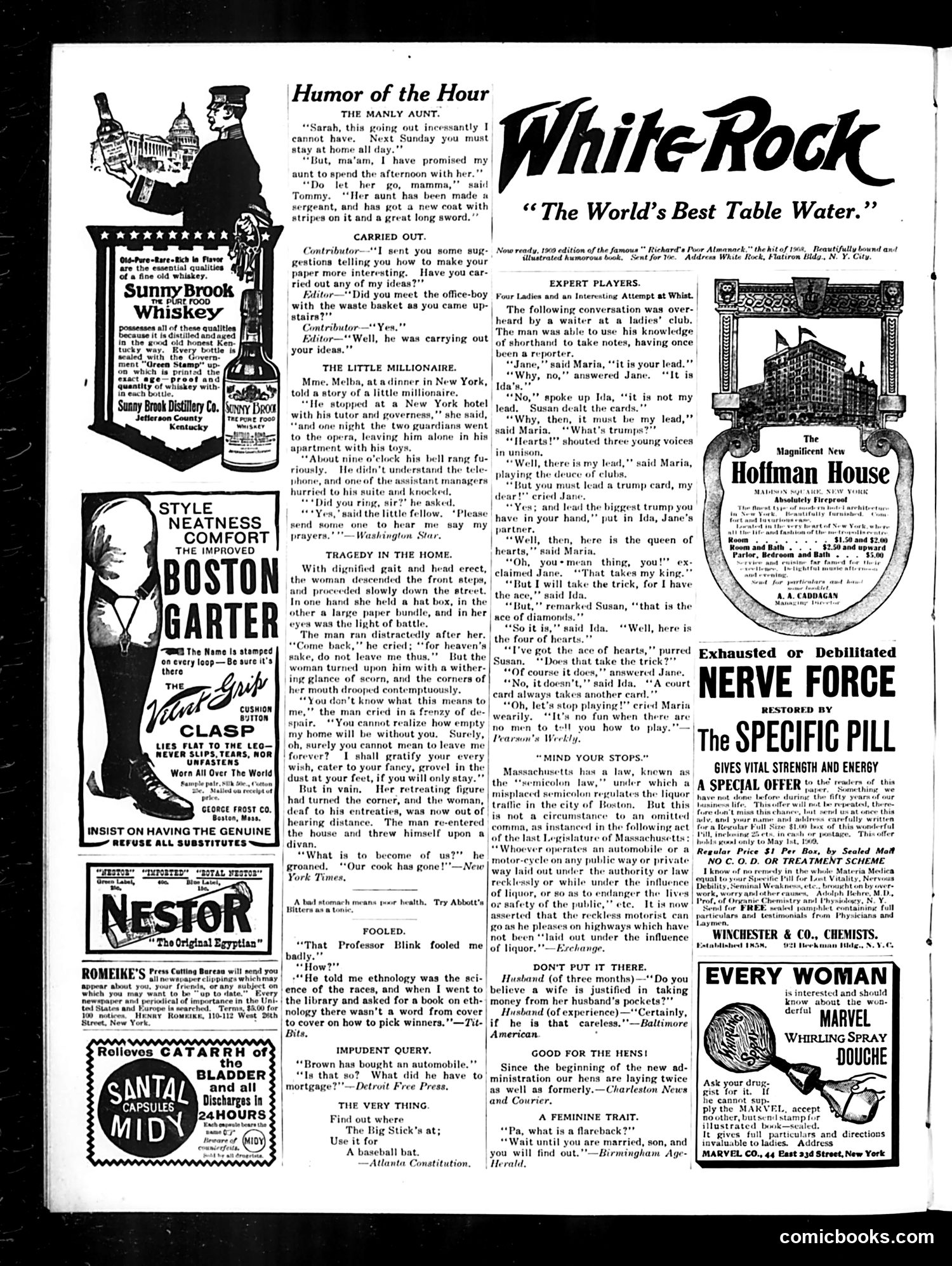
This page from *Judge* magazine contains several satirical pieces reflecting early 20th-century American social attitudes: **"The Manly Aunt"** jokes about changing gender roles. A young boy admires his aunt's military rank and uniform (she's become a sergeant), representing anxiety about women entering traditionally male-dominated spaces like the armed forces. **"The Little Millionaire"** depicts a wealthy child left alone at a hotel, humorously showing parental neglect among the wealthy class. **"Tragedy in the Home"** satirizes domestic drama: a woman leaves her husband over an unspecified grievance, suggesting either marital discord or commentary on women's independence—she exits "deaf to his entreaties." **"Expert Players"** presents a card game where women confuse trump rules, stereotyping female incompetence at competitive games. The page also contains period advertisements for whiskey, garters, and patent medicines, typical of *Judge's* commercial content. Overall, the humor reflects contemporary anxieties about shifting gender roles and class dynamics in Progressive Era America.
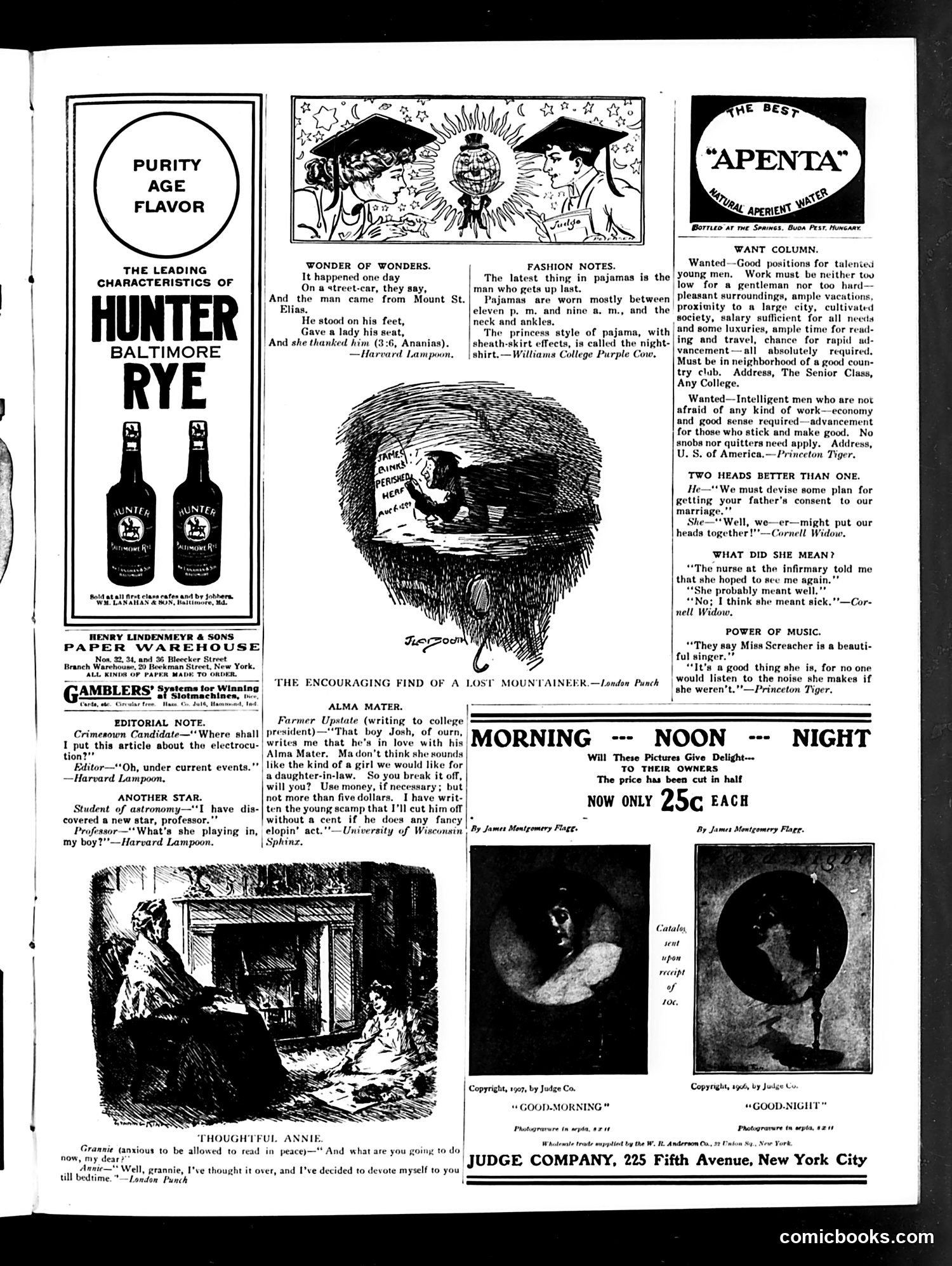
This page from **Judge** magazine is primarily **advertisements and humor fillers** rather than political satire. Key content: **Advertisements**: Hunter Rye whiskey, Apenta mineral water, paper warehouse, and Judge Company's photo products dominate the layout. **Humor**: Multiple short jokes from college humor magazines (Harvard Lampoon, Cornell Widow, Princeton Tiger) about courtship, work-seeking, and college life. These reflect early 1900s concerns: young men seeking genteel employment, romantic entanglement with disapproving parents, and the "Alma Mater" joke satirizing a farmer's misunderstanding of the phrase as a romantic rival rather than one's college. **Notable cartoon**: "The Encouraging Find of a Lost Mountaineer" depicts a bearded man in a cave—likely referencing Appalachian folklore or frontier themes popular in period humor. **Context**: The tone reflects Progressive Era anxieties about social class, propriety, courtship rituals, and rural versus urban sensibilities. The repeated "want ads" jokes mock young men's entitled expectations about employment.
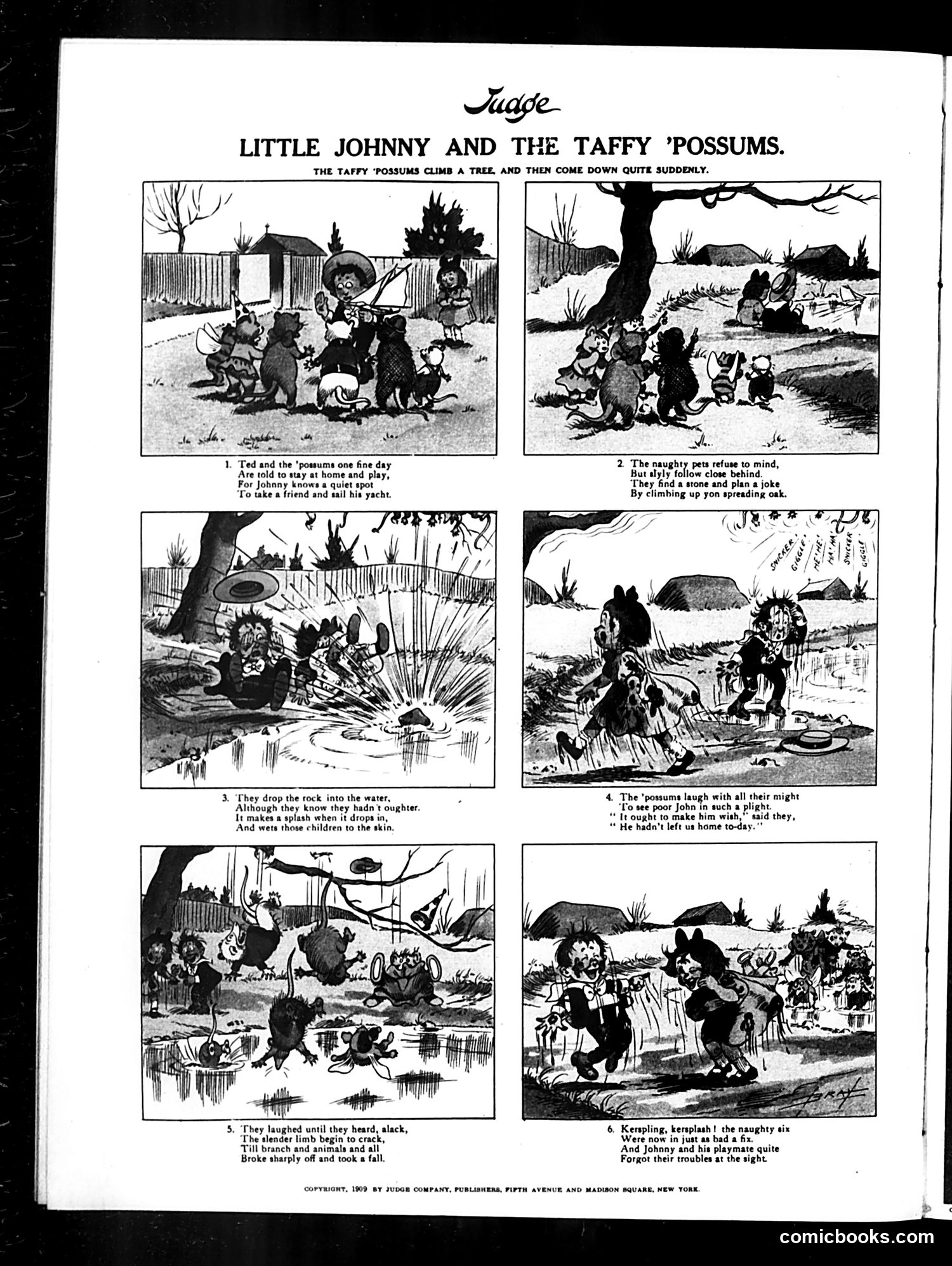
This is a children's humorous comic strip with no political satire. It tells a straightforward narrative: Johnny and a friend take pet possums to a tree. The mischievous animals refuse to obey and lead the boys into pranks—dropping rocks in water that splash them, climbing an oak tree. When the branch breaks under the combined weight, all six creatures (the possums and children) tumble down together. The final panel shows Johnny and his friend laughing at the possums' predicament, having forgotten their own troubles in the amusement. The humor derives from slapstick: disobedient pets causing chaos, unexpected consequences, and physical comedy. The title's reference to "taffy" likely means the possums are playful or sticky troublemakers. There is no social commentary—it's simply light entertainment for Judge's readers, featuring anthropomorphized animals and children in a pastoral setting.