
A complete issue · 16 pages · 1909
Judge — April 10, 1909
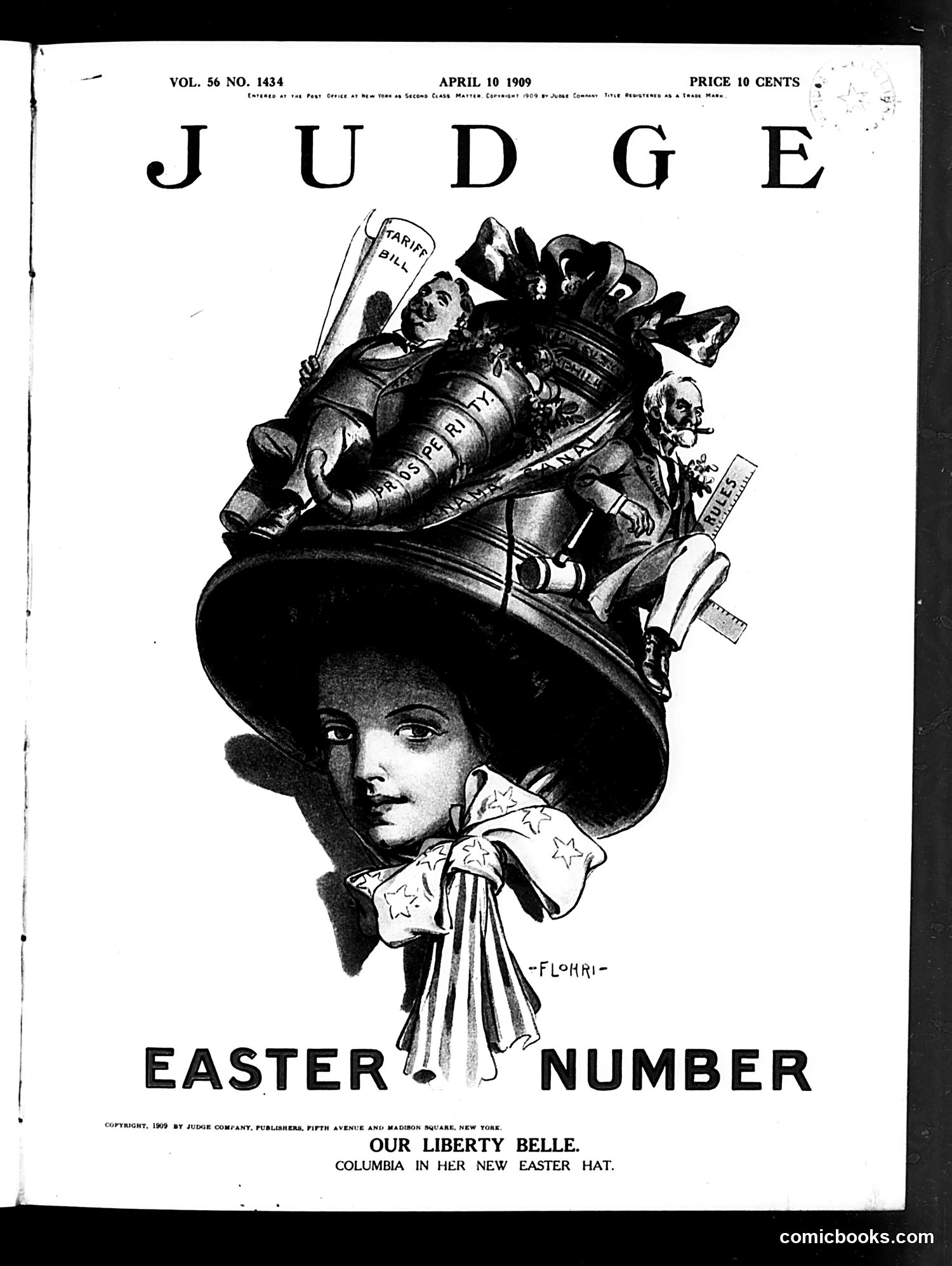
This is the cover of Judge's Easter issue, featuring an elaborate allegorical hat atop a woman's head. The woman represents Columbia (the personification of America), identified in the caption as "Our Liberty Belle." The hat is overloaded with symbolic cargo: figures labeled with words like "Tariff Bill" and "Currency Bill," politicians, and what appears to be congressional business. The satirical point suggests that America's political leadership is burdening the nation with excessive legislative baggage—particularly tariff and currency legislation—piled absurdly onto the country itself. The Easter theme likely provides seasonal timing for this commentary on spring legislative sessions. The artist Flohr uses visual exaggeration to mock governmental overreach and political excess during this period.
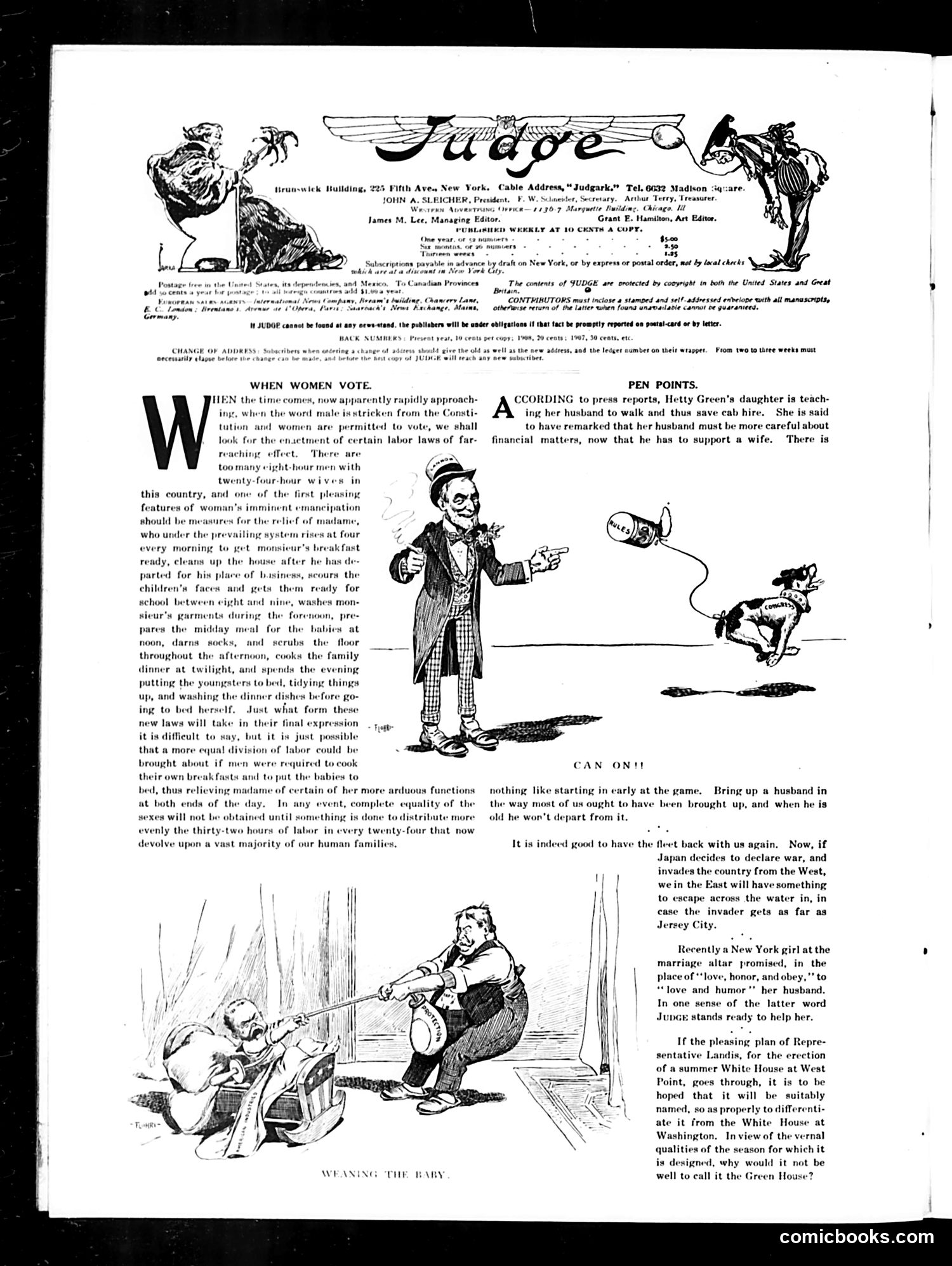
This page contains three distinct sections: an editorial essay "When Women Vote," two related cartoons, and a "Pen Points" column with accompanying illustrations. The main article argues for women's suffrage, claiming equal labor division would benefit families. The cartoons illustrate this through domestic scenes: one shows a man pouring liquid on a child (titled "Weaning the Baby"), satirizing male incompetence at childcare. "Pen Points" discusses Hetty Green's daughter teaching her husband financial responsibility, suggesting women possess superior economic judgment. A final cartoon depicts a man being poured upon by a woman, inverting traditional power dynamics. The satire uses exaggerated male incompetence to argue women deserve voting rights and greater household authority. The tone is pro-suffrage, though it relies on gender stereotypes about women's "natural" domestic superiority.
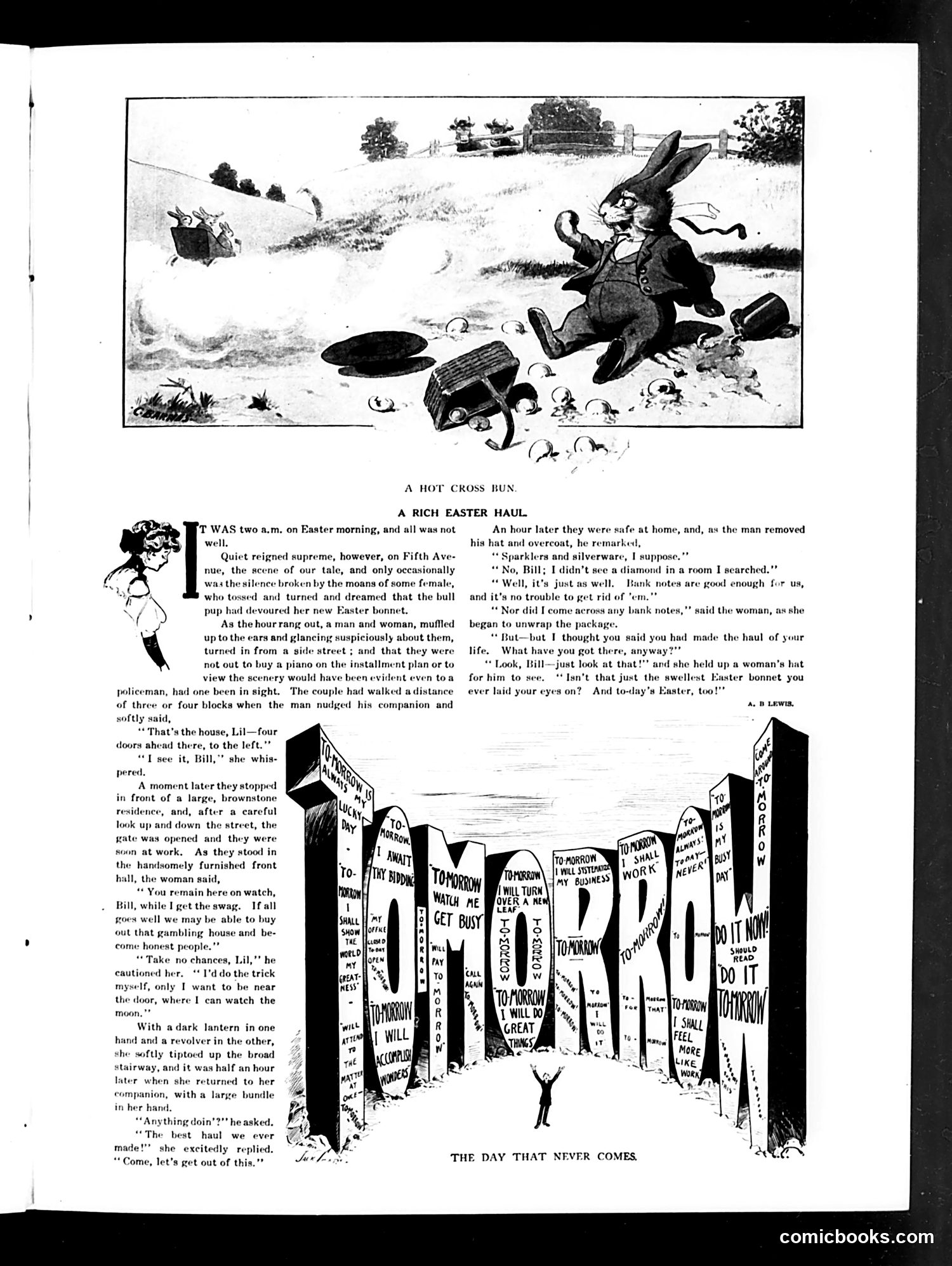
This page contains two cartoons with Easter themes, likely from early 20th-century Judge magazine. **"A Hot Cross Bun"** (top): Shows an anthropomorphic rabbit in clothes being chased, surrounded by scattered items. The accompanying story describes a couple's Easter morning discovery of burglary—the "haul" being precious items stolen from their home. The rabbit illustration appears to be decorative rather than satirical commentary. **"The Day That Never Comes"** (bottom): A surreal illustration showing a tiny figure dwarfed by enormous buildings covered in procrastination messages ("TOMORROW," "I WILL," "NEXT WEEK," "LATER," "DO IT NOW," etc.). This is social satire about chronic procrastination—the commentary criticizes humanity's tendency to perpetually delay action, with "the day that never comes" being when people actually follow through on intentions. Both cartoons use Easter imagery for topical humor.
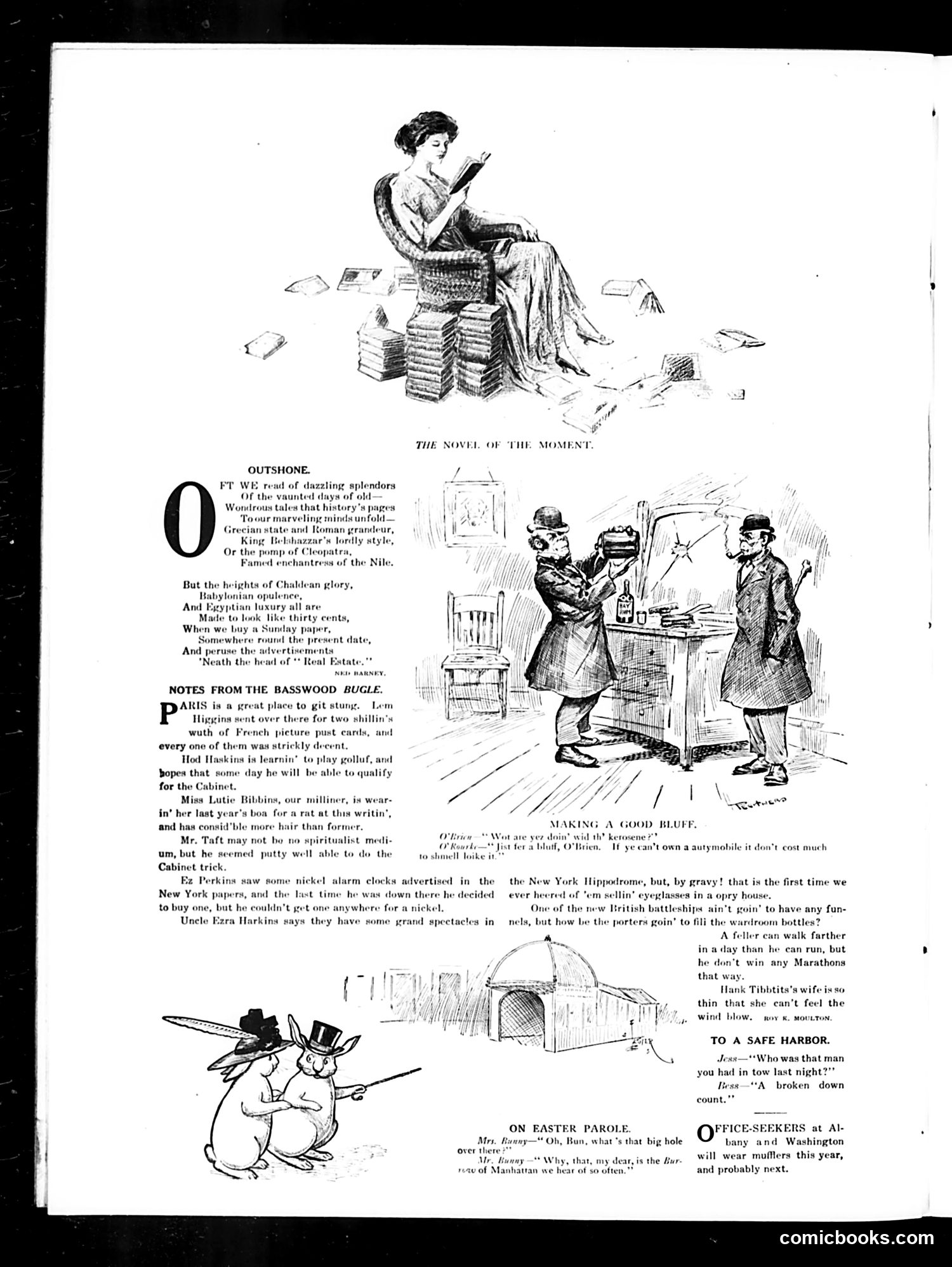
**"The Novel of the Moment"** (top): Depicts a woman reading atop stacked books, satirizing popular fiction of the era—likely contemporary bestsellers that Judge's editors considered lightweight or sensational. **"Notes from the Basswood Bugle"**: Humorous rural dispatches mocking small-town life and gossip, a common Judge feature poking fun at provincial America. **"Making a Good Bluff"** (center cartoon): Two men in bowler hats discuss automobiles. One boasts about owning one; the other suggests lying about it since cars are expensive. The satire targets early automotive culture and 1910s-era social pretension—the nouveau riche claiming wealth they don't possess. **"On Easter Parole"** (bottom): A dialogue joke about Easter amnesty or leniency, likely referencing prison releases during holidays. The page reflects Judge's typical mix: literary satire, social commentary on class aspiration, and topical humor.
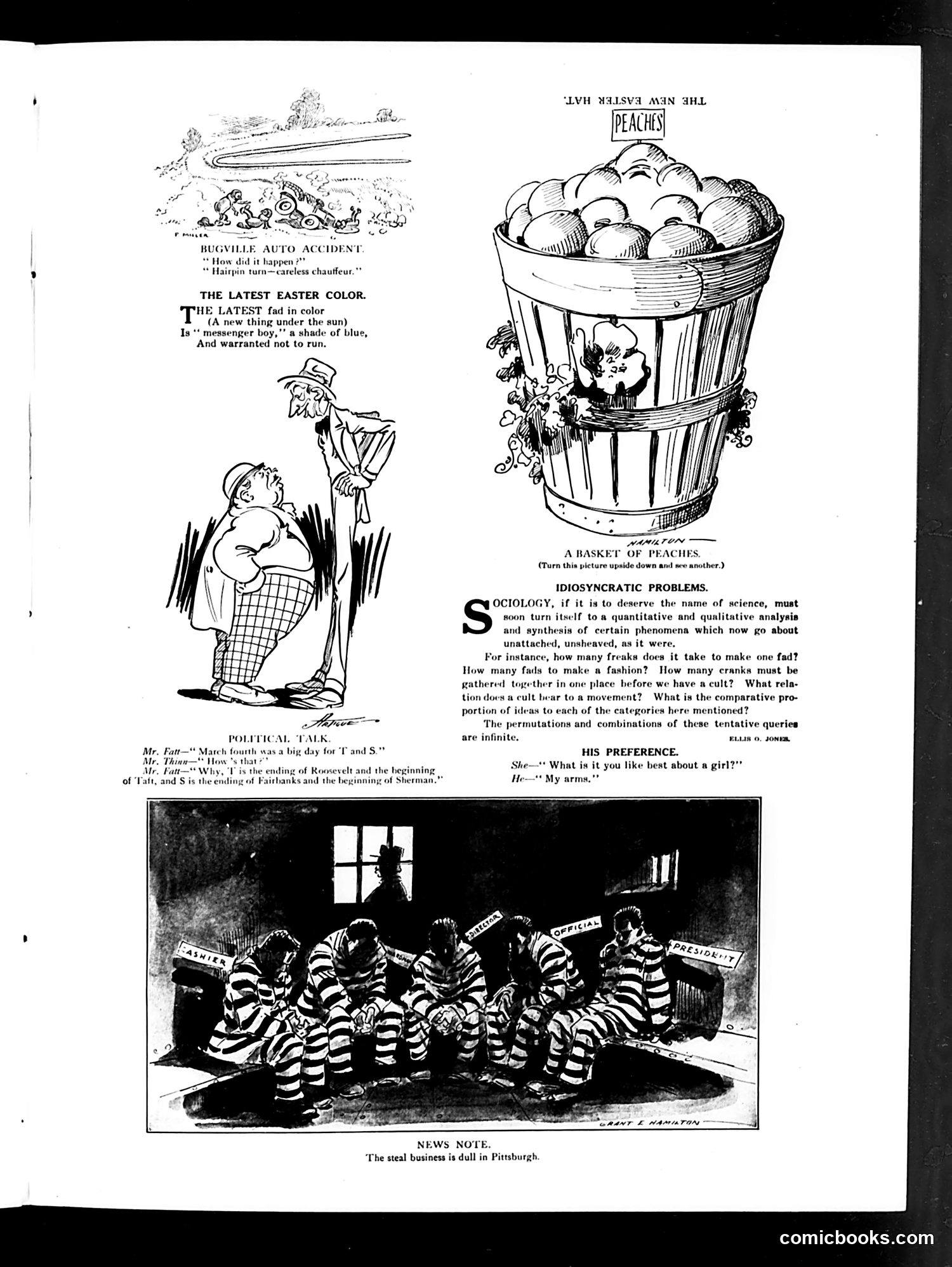
**"Political Talk"** (top left): A caricatured figure in a top hat addresses a rotund man. The dialogue references "March fourth," "T and S," and mentions Roosevelt, Sherman, and Taft—likely commenting on early 1900s presidential politics, possibly regarding succession or campaign rhetoric. **"The Latest Easter Color"** (text): Satirizes fashion trends, suggesting parasols and hats in blue were the new Easter fashion. **"Idiocyncratic Problems"** (right): A sociological piece about quantifying social phenomena—how many freaks, fashions, or ideas exist—suggesting absurdity in categorizing human behavior. **Bottom cartoon**: Six figures in striped prison uniforms labeled with political positions (Lawyer, Doctor, Officer, President) sit together. Caption reads "The steal business is dull in Pittsburgh," satirizing corruption among Pittsburgh's professional and political classes.
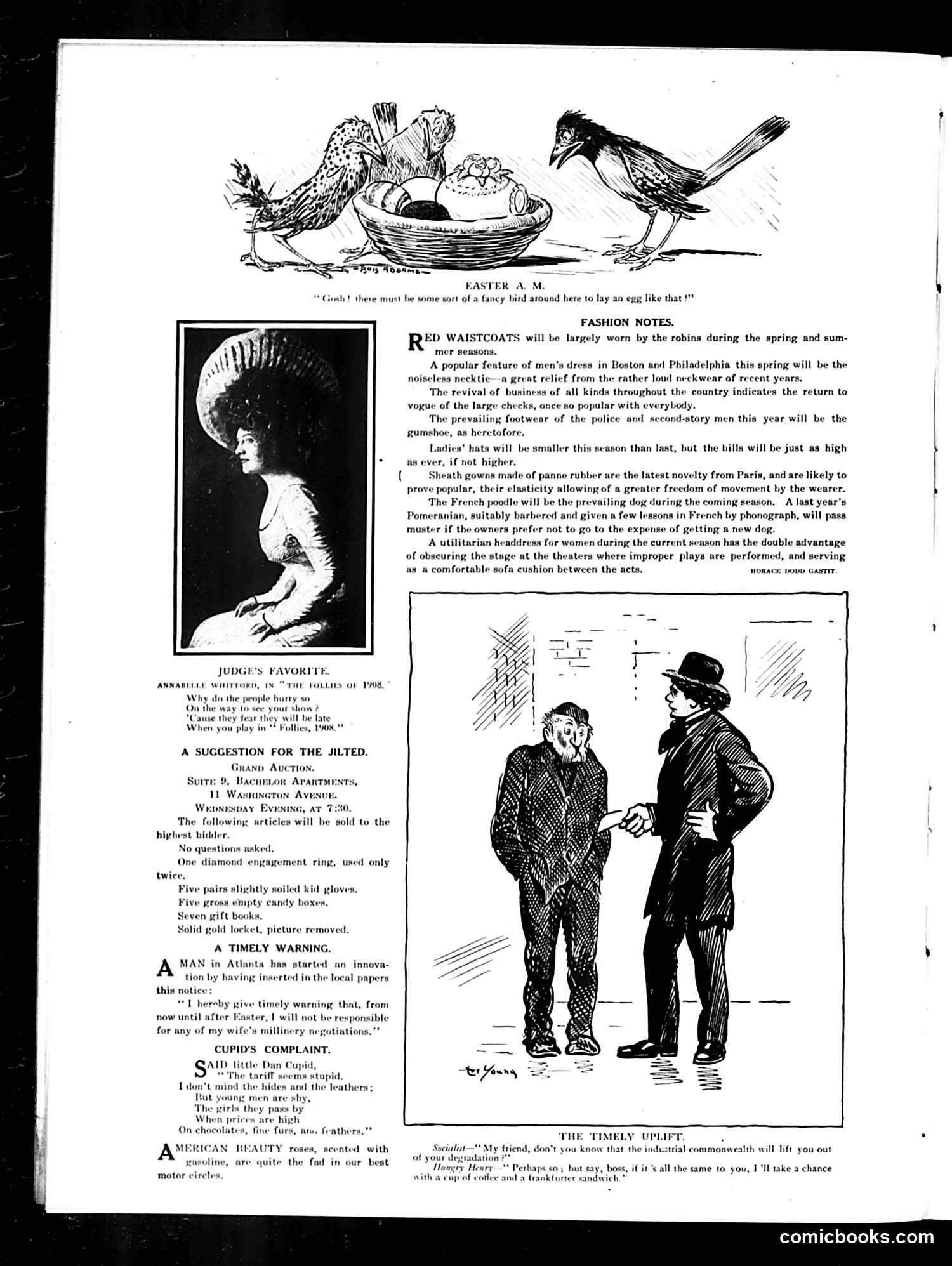
This Judge magazine page is primarily **fashion satire and humor**, not political commentary. The main cartoon shows two men, one shabby and one well-dressed, discussing economic uplift—the poor man declines the "industrial commonwealth" concept, preferring coffee and a sandwich instead. It mocks idealistic economic rhetoric as disconnected from working-class reality. The "Fashion Notes" section uses absurdist humor: robins wearing red waistcoats, police wearing gumshoes (a pun on both footwear and slang for detectives), and women's theater hats large enough to serve as sofa cushions. These mock both fashion pretension and current social preoccupations. Other brief items satirize common complaints: a jilted man auctioning engagement gifts, a husband's public notice disclaiming his wife's millinery debts, and Cupid complaining about inflation. The tone is lighthearted domestic and social satire typical of early 1900s American humor magazines.
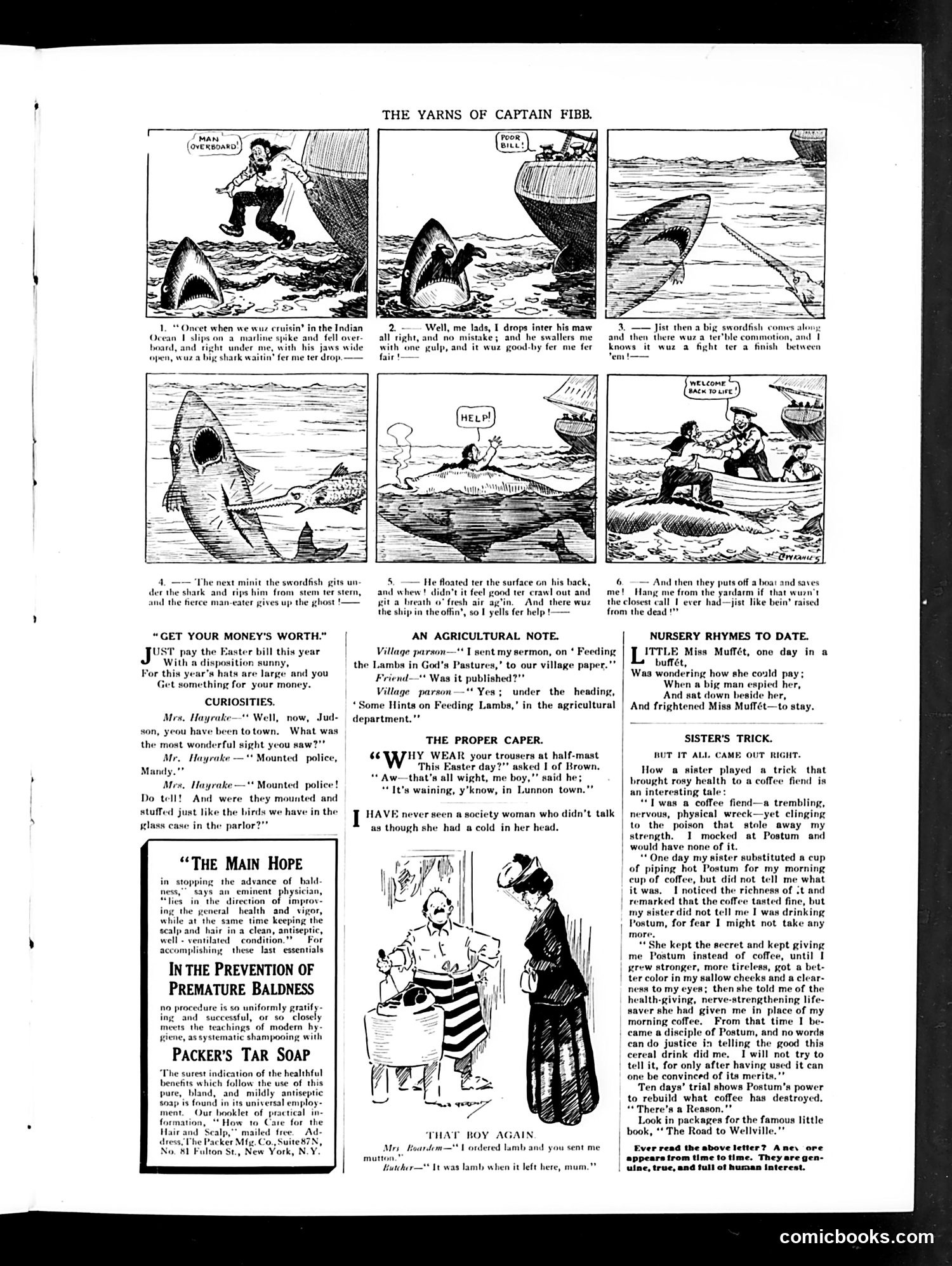
This page presents humor typical of early 20th-century Judge magazine. The main feature, "The Yarns of Captain Fibb," is a serialized tall-tale comic strip where a seafaring character recounts exaggerated adventures—being swallowed by a swordfish, rescued from drowning. The humor relies on absurd maritime mishaps and the captain's implausible survival stories. Surrounding content includes: brief social satire ("The Proper Caper" mocks Irish dialect and weather complaints); domestic humor ("Sister's Trick," promoting Postum coffee substitute through anecdote); and nostalgic verse ("Nursery Rhymes to Date," updating nursery rhymes with contemporary references). The advertisements for Packer's Tar Soap and discussions of baldness prevention reflect period health concerns. Overall, the page mixes lowbrow comic adventure, domestic comedy, and consumer advertising—standard Judge fare prioritizing entertainment over political commentary.
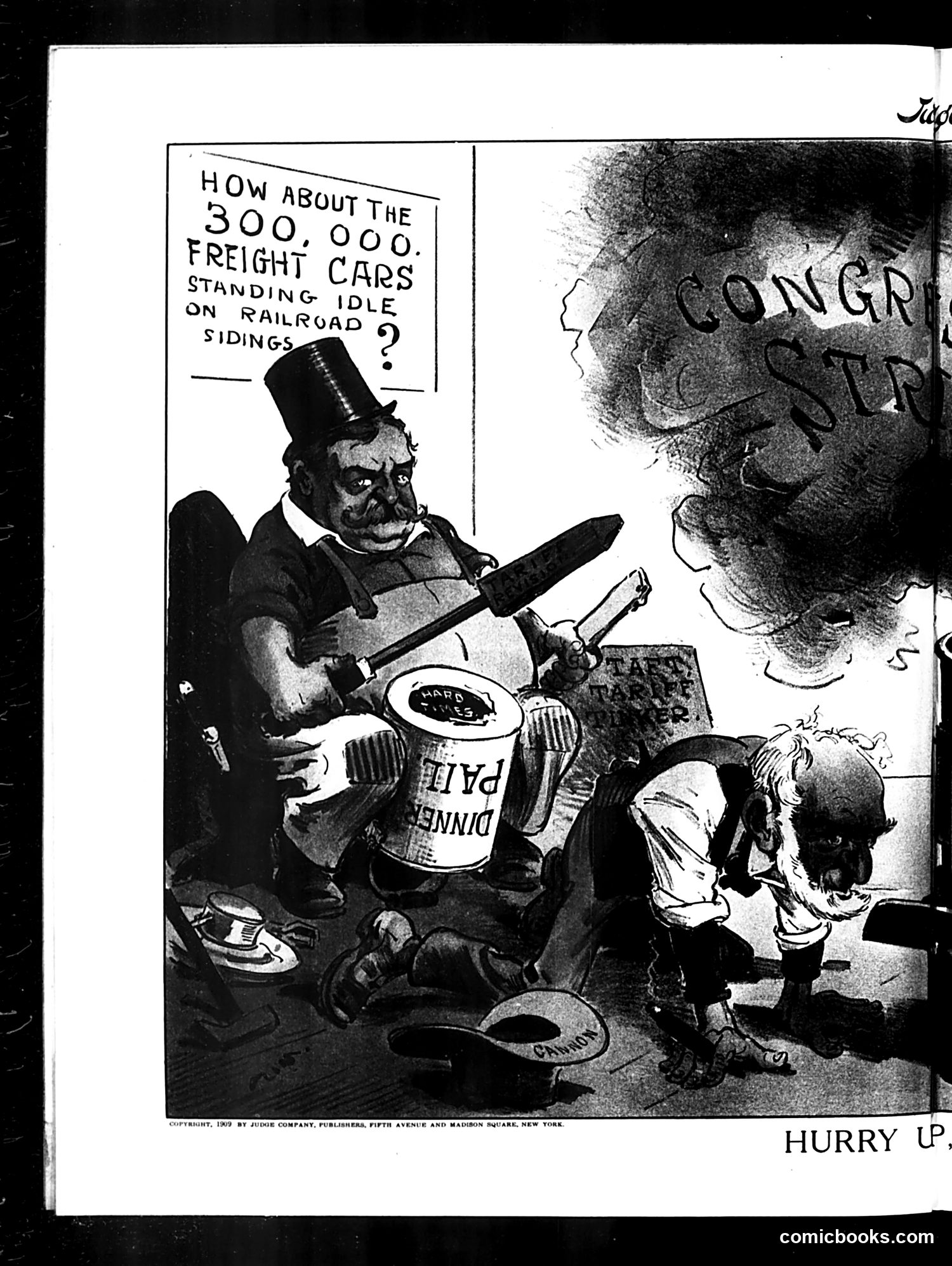
This political cartoon from Judge (copyright 1909) satirizes railroad freight-car congestion. A figure in formal dress with a top hat—apparently a railroad executive or politician—sits atop a large tin of "Canned Dinners," wielding a knife and fork while asking "How about the 300,000 freight cars standing on railroad sidings?" The satire criticizes how railroad management prioritizes their own interests (symbolized by dining/consumption) while ignoring the serious logistical problem of idle freight cars. Two smaller figures below appear to be workers or common citizens affected by this inefficiency. The cartoon suggests corporate negligence or indifference toward practical business problems and their impact on everyday people.
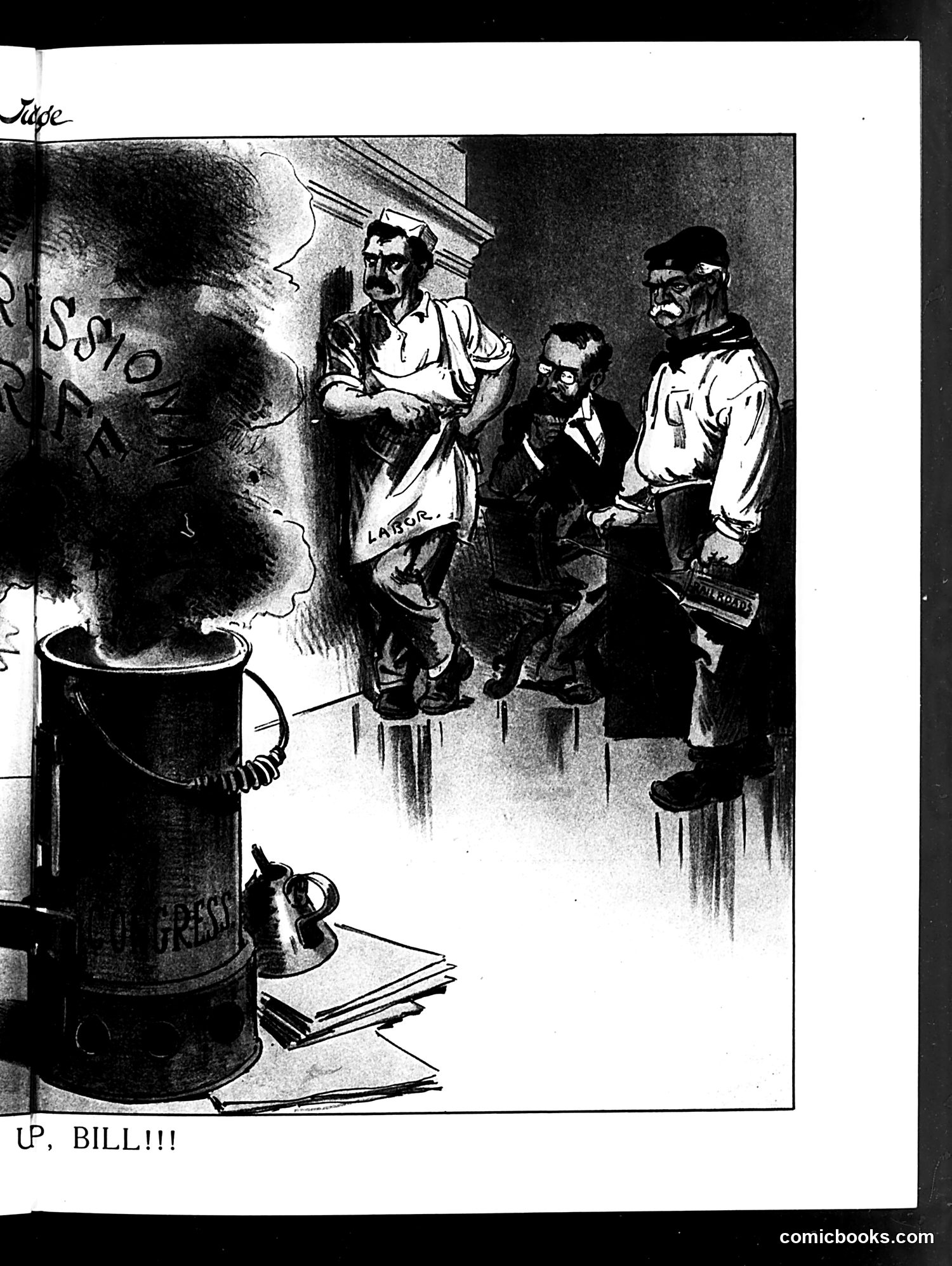
This appears to be a labor-related political cartoon from Judge magazine. The image shows three caricatured figures (depicted with exaggerated facial features typical of period satire) standing near a large cylindrical object labeled "LABOR" with smoke or steam rising from it. The caption reads "UP, BILL!!!" The cartoon likely satirizes labor issues or a specific labor leader or politician nicknamed "Bill." The caricatures and their confrontational stance suggest commentary on labor disputes, strikes, or political maneuvering around labor policy. The "up" in the caption implies either escalation or a call to action. Without clearer identification of the specific historical moment or individuals depicted, the precise political target remains unclear, though the cartoon clearly comments critically on labor-related controversy.
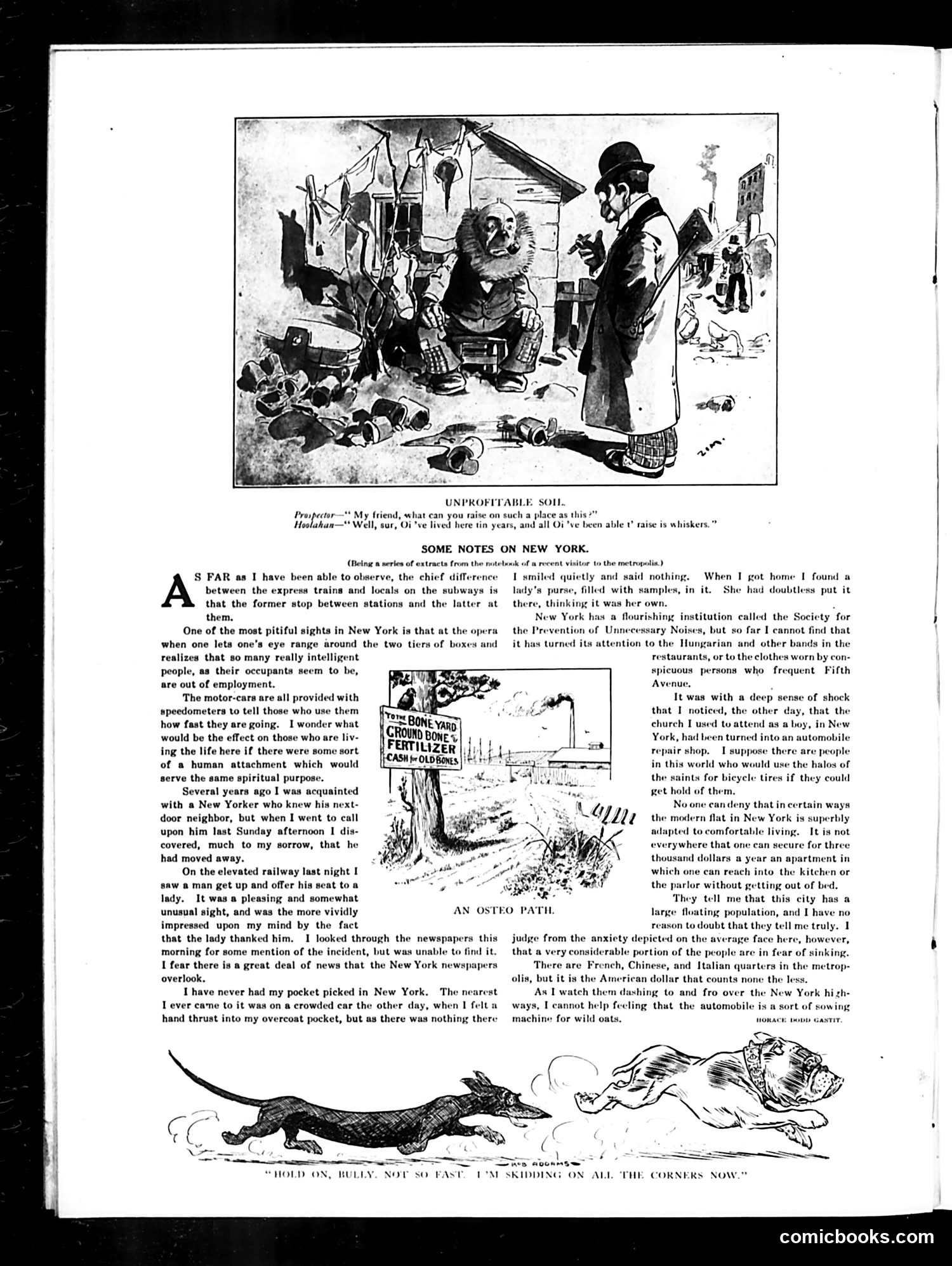
This page contains two distinct satirical pieces about New York City life, typical of Judge magazine's social commentary. **Top cartoon:** A dialogue between a "Prospector" and "Hoolahan" (an Irish character, indicated by dialect) mocks poverty and failed ambition. The prospector asks what can be "raised" on such worthless land; Hoolahan replies he's lived there ten years and can only "raise whiskers"—a joke about destitution and the futility of trying to improve one's circumstances in New York's slums. **Main article:** The author presents sardonic observations about Manhattan life: the absurdity of wealthy opera-goers being unemployed, the rarity of subway courtesy, pocket-picking, and the conversion of churches into auto repair shops. The humor relies on exaggerating New York's perceived spiritual emptiness and commercial obsession. **Bottom cartoon:** Shows dogs "skidding on all the corners," likely satirizing reckless automobile driving in the city. The satire targets urban modernization, commercialism, class inequality, and immigrant communities.
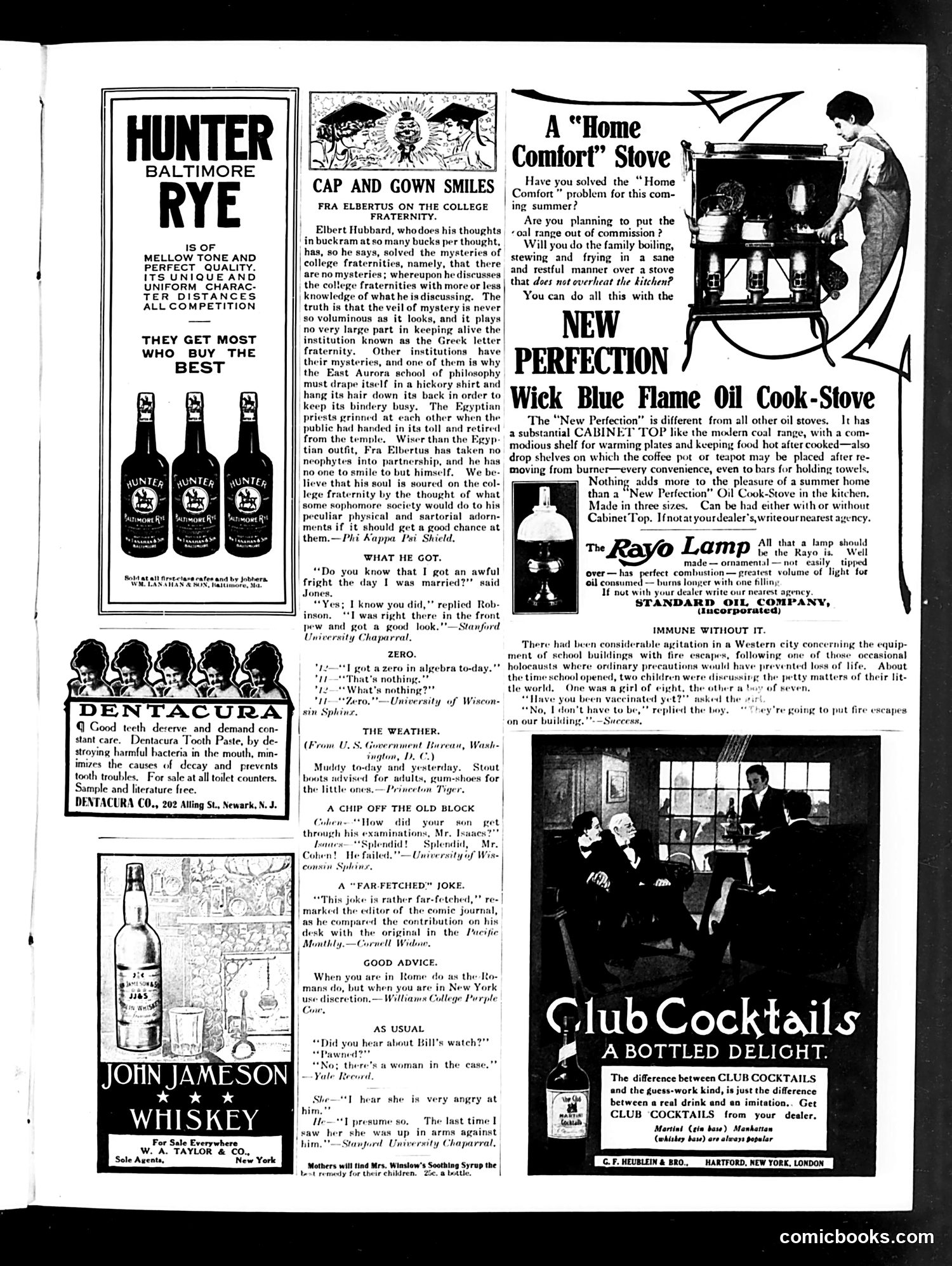
This is primarily an **advertising page** from Judge magazine, with scattered humor pieces interspersed. The main content consists of advertisements for consumer products (Hunter Rye whiskey, Dentacura tooth paste, John Jameson whiskey, oil cook-stoves, lamps, and Club Cocktails). The limited satirical content includes: **"Cap and Gown Smiles"**: A brief commentary on Elbert Hubbard and college fraternities, poking fun at the mystique surrounding Greek letter organizations while suggesting Hubbard's philosophical pretensions mask practical hypocrisy. **Short humor vignettes**: Various jokes about marriage, school, and domestic life—typical light magazine filler of the era. **A fire escape anecdote**: Dark humor about school safety, where children discuss fire escapes in a newly dangerous building. The page reflects early 20th-century concerns (fraternity culture, domestic conveniences, tooth care) more than sustained political satire. Most space serves commercial purposes.
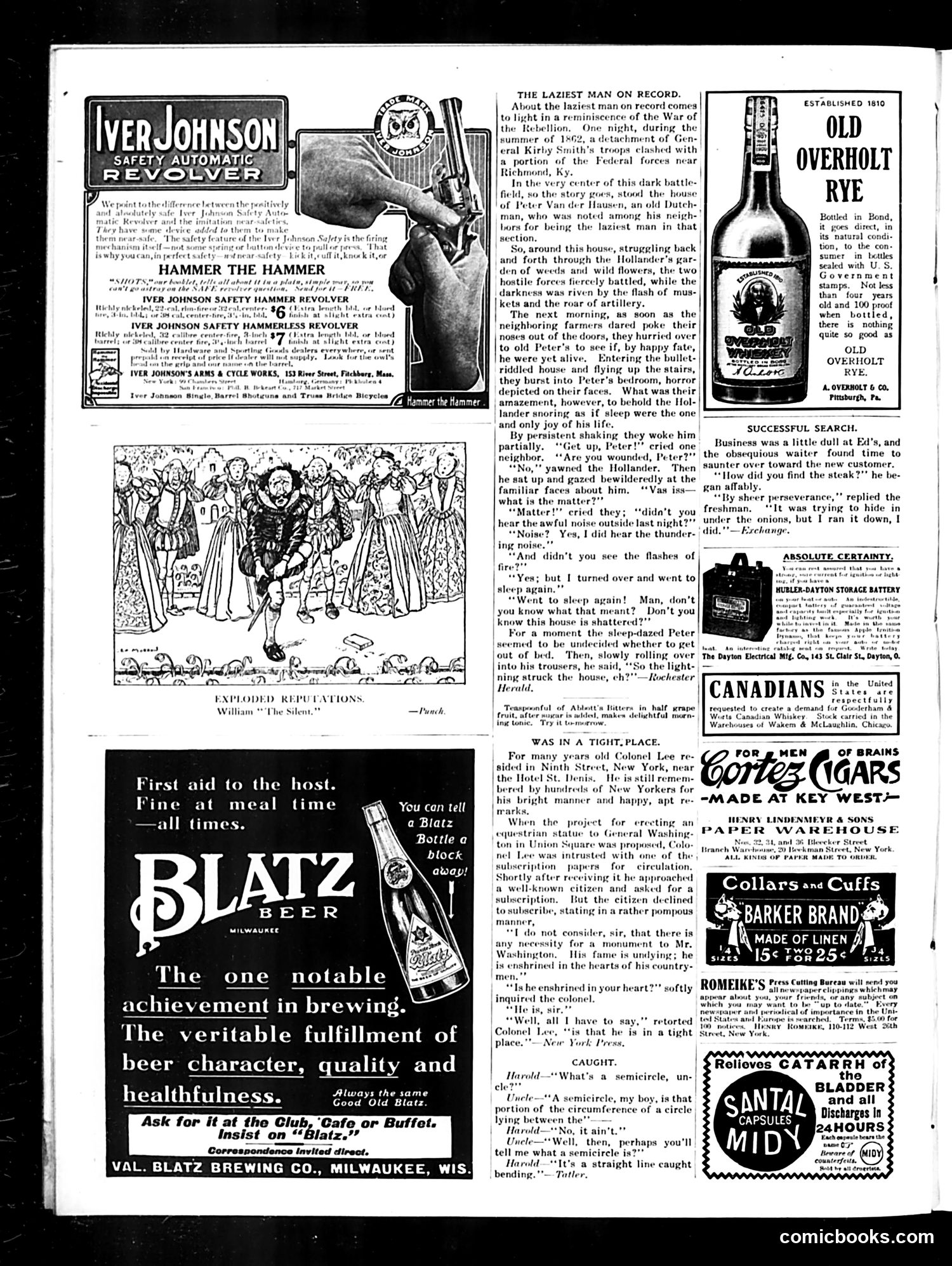
This page contains **multiple unrelated items** typical of Judge magazine's format: advertisements, short humorous anecdotes, and product promotions. The main cartoon narrative, titled "Exploded Reputations," depicts **Peter Van der Hausen, a notoriously lazy Dutch farmer** during the American Civil War. The joke: while a fierce battle rages around his house—with artillery fire and gunfire—Peter sleeps through it all. When neighbors frantically wake him the morning after, he admits he heard noise but simply "went back to sleep." The humor lies in his extreme laziness overriding any reasonable human response to danger. The page also contains numerous **period advertisements** (Iver Johnson revolvers, Blatz beer, Old Overholt rye whiskey, cigars, collars) and brief **jokes** about trivial matters (a waiter finding a steak hiding under onions; a definition of "semicircle"). The satirical target appears to be **human indifference or apathy**—whether to danger or basic effort—presented through exaggerated character types typical of 19th-century humor.
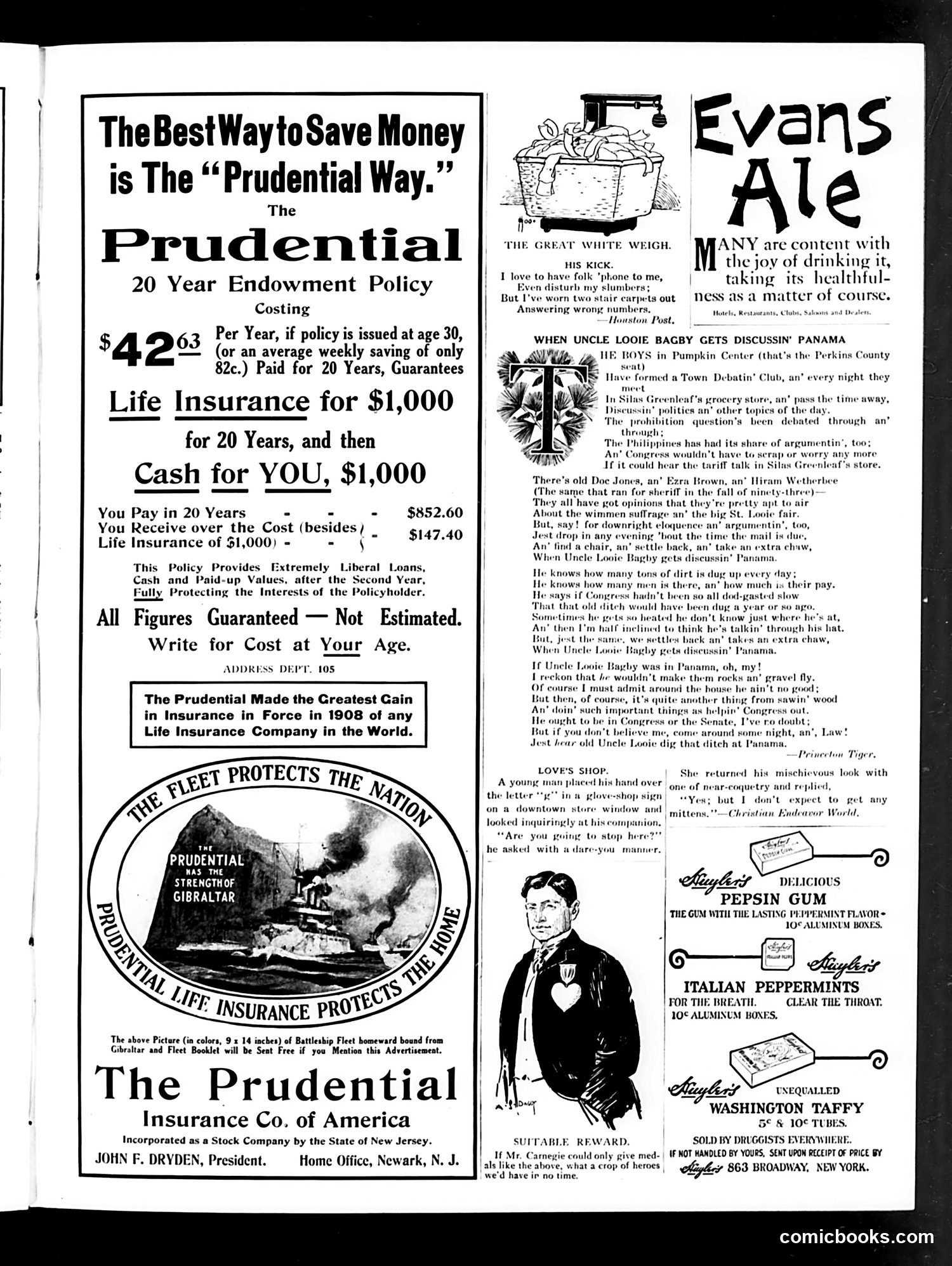
This is primarily an **advertising page** from Judge magazine, dominated by a Prudential Life Insurance pitch. The main insurance ad uses patriotic imagery—a battleship labeled "Strength of Gibraltar"—to suggest financial security and national protection. The page includes several humor pieces: - **"When Uncle Looie Bagby Gets Discussin' Panama"**: A dialect piece mocking rural Americans' opinions on the Panama Canal. The joke is that Uncle Looie, an ordinary farmer with no expertise, holds forth confidently on this major political topic, comparing his importance to congressmen—satirizing the contrast between common folk's self-importance and their actual influence. - **"The Great White Weigh"** and **"Love's Shop"**: Brief, mild jokes about phone mix-ups and romantic miscommunication. The remainder consists of product advertisements (Saylor's candies/gum). The satire targets American small-town pomposity and the gap between ordinary people's opinions and their actual knowledge of national affairs. The Panama Canal was a major contemporary political issue (construction began 1907).
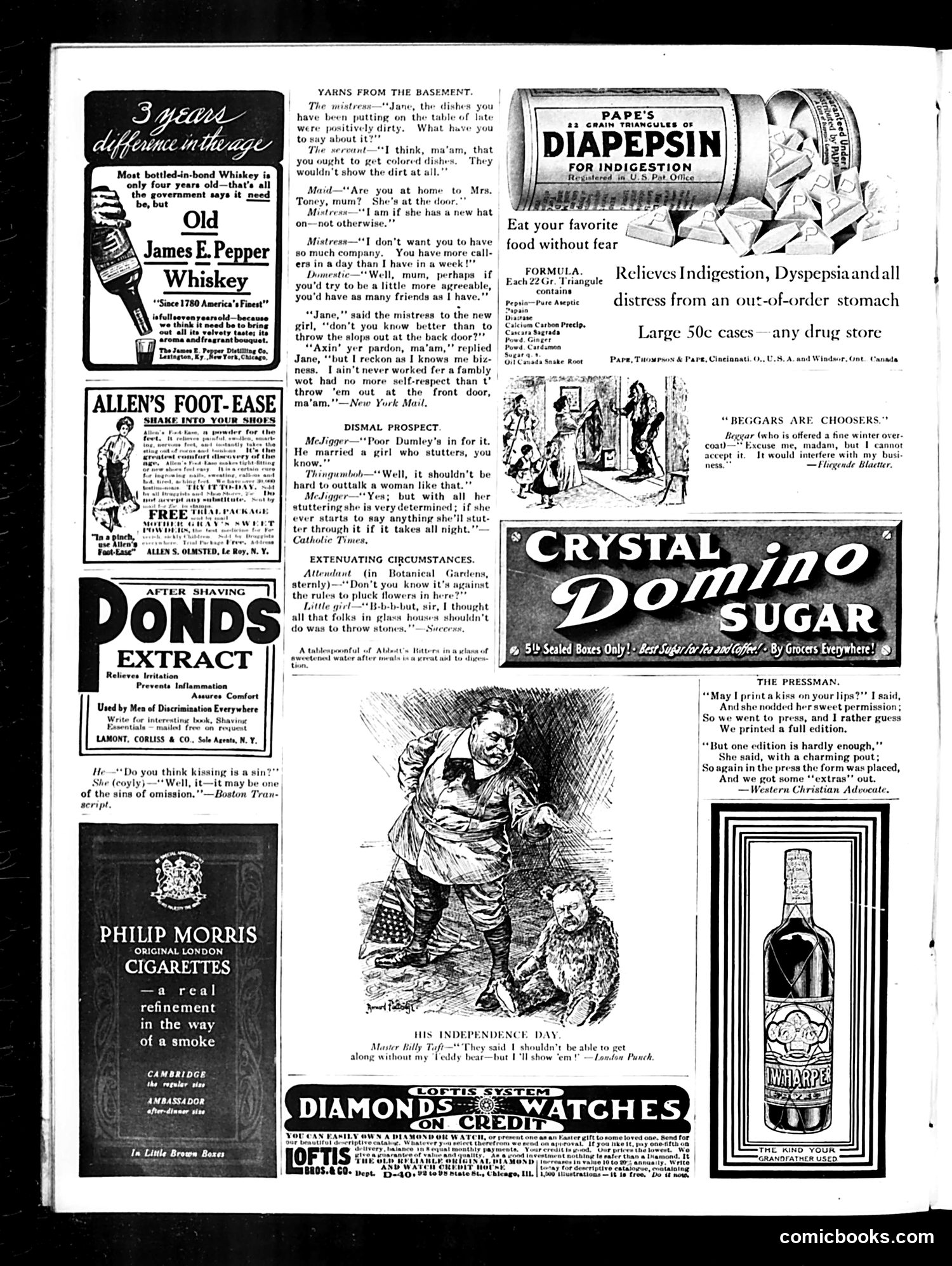
This is primarily a **advertisements and humor page** from Judge magazine, not a political cartoon. The page contains several distinct elements: **Main Content:** The "Yarns from the Basement" section presents humorous domestic dialogues between mistresses and servants—reflecting early 20th-century class dynamics. The jokes mock servant speech patterns and showcase the social hierarchy of the era. One exchange satirizes a servant's pride in proper etiquette (throwing slops at the back door rather than front). **The Humor:** Other snippets mock marriage (a woman who stutters), romantic conventions ("The Pressman" poem about printing a kiss), and social expectations (beggars being "choosers"). **Advertisements:** The page is dominated by product ads—whiskey, digestive aids (Diapepsin), cigarettes, watches—typical of the period's magazine monetization. **Historical Context:** The servant/mistress dialogue format reflects a society with distinct class divisions and domestic staff, now largely obsolete. The humor relies on accents and social presumption that would be considered offensive today.
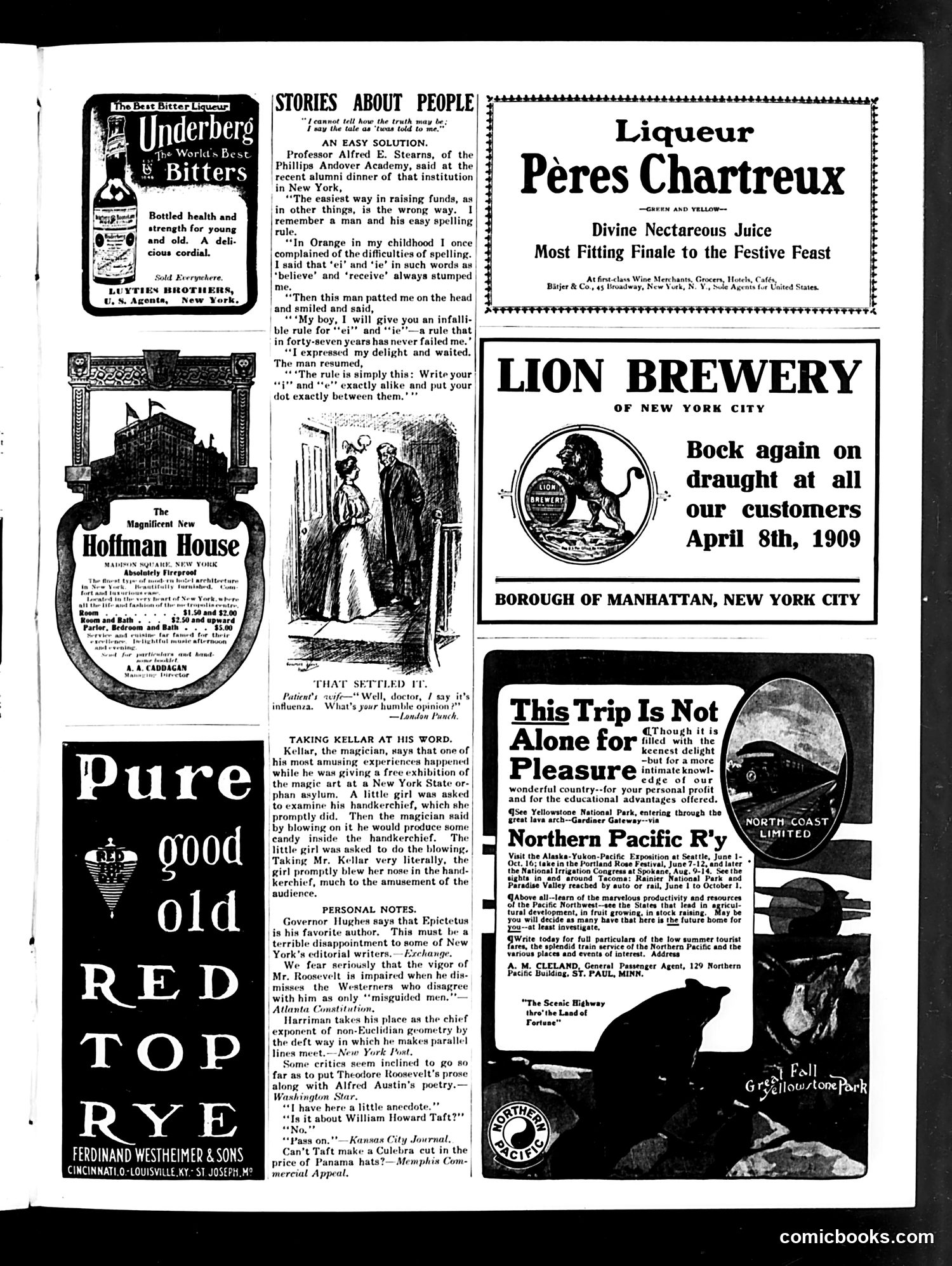
This page is primarily **advertisements and filler content** rather than political satire. It consists largely of period ads for liqueurs, breweries, hotels, and railways. The "Stories About People" section contains brief anecdotes and humorous observations rather than political cartoons. These include: - A joke about an "easy spelling rule" that sidesteps proper learning - An anecdote about magician Kellar at an orphan asylum where a child literally blows her nose into a handkerchief - "Personal Notes" offering light jabs at public figures: Governor Hughes, Theodore Roosevelt (criticized for dismissing disagreeing "Westerners"), and William Howard Taft The references suggest this is from **1909** (mentioned in the Bock beer ad). The humor is gentle social commentary rather than sharp political satire—poking fun at prominent men's quirks and public statements rather than serious critique. Overall, this appears to be a typical Judge magazine page mixing advertising with light entertainment and gossip rather than the magazine's more famous satirical editorial cartoons.
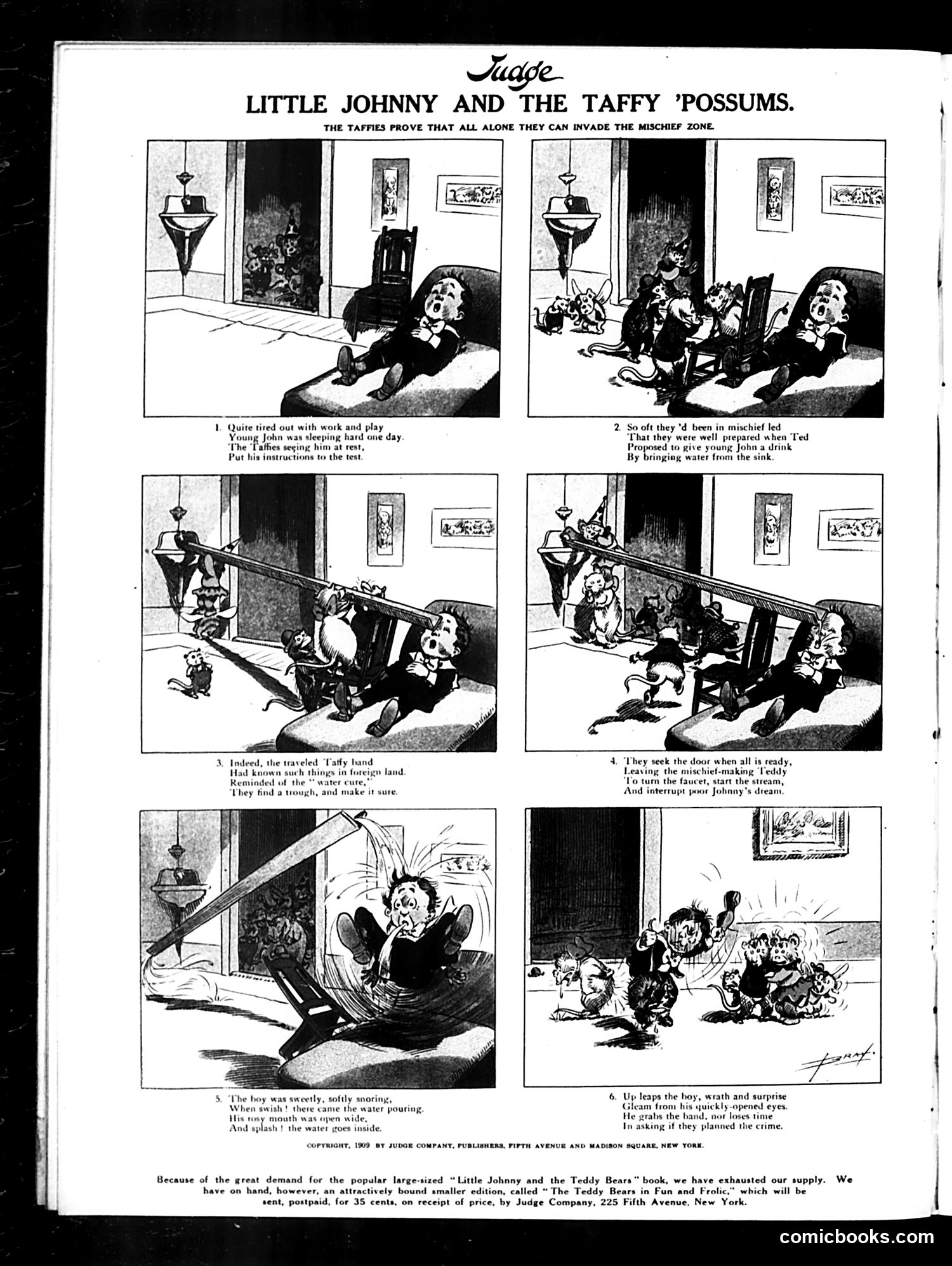
This is a humorous children's comic strip from Judge magazine (1909) depicting mischievous animal characters—the "Taffies" (possum characters)—playing a prank on a sleeping boy named Johnny. The narrative is straightforward slapstick: while Johnny naps, the Taffies decide to test his instructions by turning on a water faucet to drench him. They succeed in their mischief-making, startling Johnny awake in surprise and annoyance. The comic plays on turn-of-the-century American humor about animal trickery and childish pranks. The "Taffies" appear to be characters from popular children's literature of the era (referenced in the advertisement for "Teddy Bears in Fun and Frolic"). There is no discernible political satire—this is straightforward entertainment, likely appealing to young readers through relatable scenarios of animals causing harmless domestic chaos.