
Judge, 1909-04-10 · page 10 of 16
Judge — April 10, 1909 — page 10: what you’re looking at
What you’re looking at
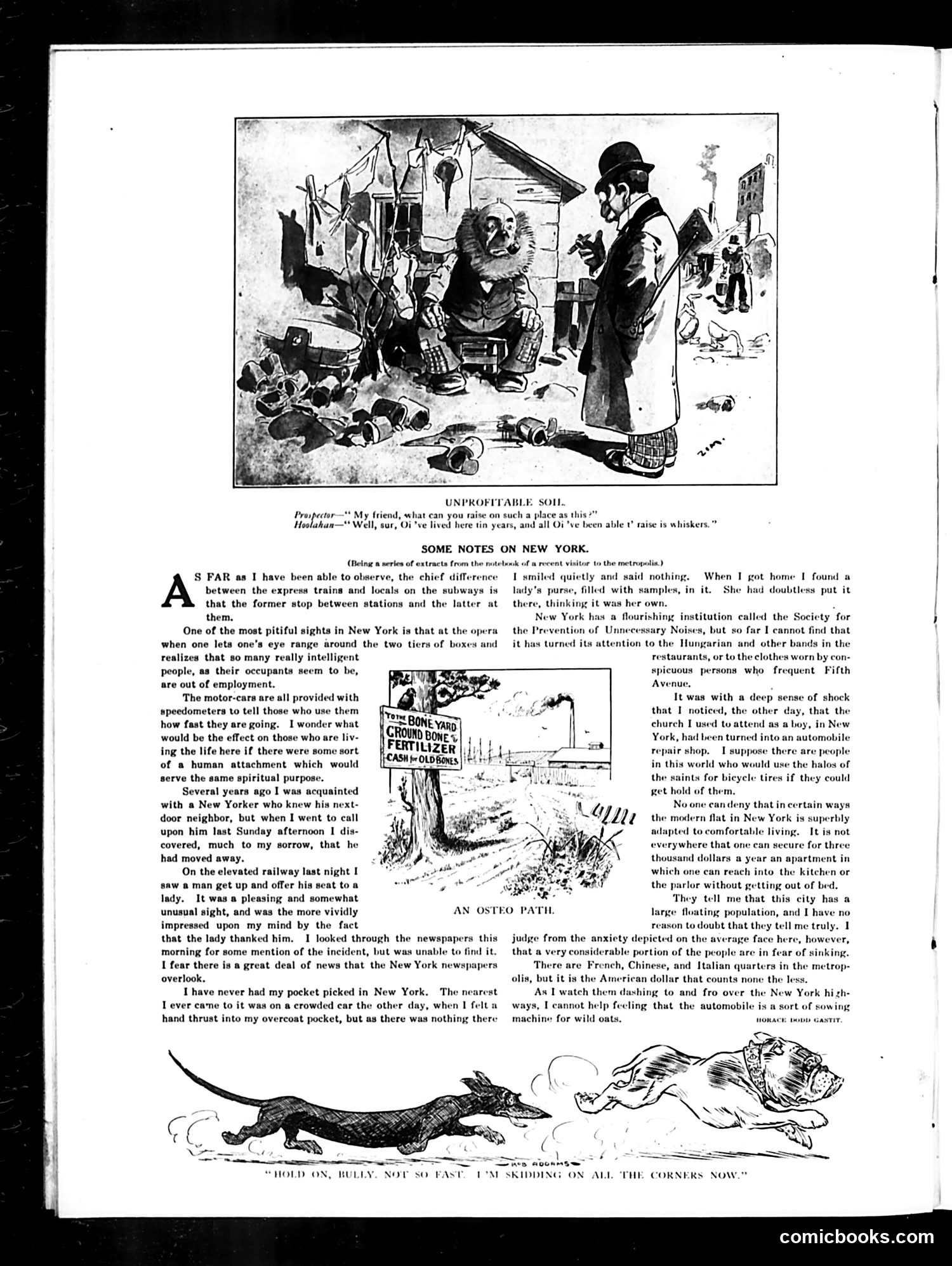
This page contains two distinct satirical pieces about New York City life, typical of Judge magazine's social commentary. **Top cartoon:** A dialogue between a "Prospector" and "Hoolahan" (an Irish character, indicated by dialect) mocks poverty and failed ambition. The prospector asks what can be "raised" on such worthless land; Hoolahan replies he's lived there ten years and can only "raise whiskers"—a joke about destitution and the futility of trying to improve one's circumstances in New York's slums. **Main article:** The author presents sardonic observations about Manhattan life: the absurdity of wealthy opera-goers being unemployed, the rarity of subway courtesy, pocket-picking, and the conversion of churches into auto repair shops. The humor relies on exaggerating New York's perceived spiritual emptiness and commercial obsession. **Bottom cartoon:** Shows dogs "skidding on all the corners," likely satirizing reckless automobile driving in the city. The satire targets urban modernization, commercialism, class inequality, and immigrant communities.
📄 Transcribed text from this page (OCR, searchable)
Machine-transcribed from the original scan — historical spelling and the odd misread are preserved.
“My fr what can you ra UNPROFITABL on such a place as SOUL. i Hoolahan—"* Well, sur, Oi "ve lived here tin years, and all Oi 've been able t” raise is whiskers.” SOME NOTES ON NEW YORK. (Being a series of extracts from th S FAR as I have been able to observe, the chief diff 5 A between the express trains and locals on the subways is that the former stop between stations and the latter at them. One of the most pitiful sights in New York is that at the opera when one lets one’s eye range around the two tiers of boxes and realizes that so many really intelligent people, as their occupants seem to be, are out of employment. The motor-cars are all provided with speedometers to tell those who use them how fast they are going. I wonder what would be the effect on those who are liv- ing the life here if there were some sort of a human attachment which would serve the same spiritual purpose. Several years ago I was acquainted with a New Yorker who knew his next- door neighbor, but when I went to call upon him last Sunday afternoon I dis- covered, much to my sorrow, that he had moved away. On the elevated railway last night I saw a man get up and offer his seat to a lady. It was a pleasing and somewhat unusual sight, and was the more vividly impressed upon my mind by the fact that the lady thanked him. I looked through the newspapers this morning for some mention of the incident, but was unable to find it. I fear there is a great deal of news that the New York newspapers overlook. Ihave never had my pocket picked in New York. The nearest lever came to it was on a crowded car the other day, when I fi hand thrust into my overcoat pocket, but as there was nothing there ta ebook of a re Jor to the metropolis.) I smiled quietly and said nothing. When I got home I found a lady’s purse, filled with samples, in it. She had doubtless put it cre, thinking it was her own. . New York has a flourishing institution called the Society for Prevention of Unne ry N but so far I cannot find that as turned its attention to the Hungarian and other bands in the or to the clothes worn by ¢¢ spicuous persons who frequent Fifth Avenue, It was with a deep sense of shock that I noticed, the other day, that the church I used tu attend as a boy, in New York, had been turned into an automobile repair shop. I suppose there are people in this world who would use the the saints for bicycle tires if they could get hold of them, No one candeny that in certain ways the modern flat in New York is superbly adapted to comfortable living. It is not srywhere that one can secure for three thousand dollars a year an apartment in wh into the kitchen or the parlor without getting out of bed. They tell me that this city has a jation, and I h no son to doubt that thi me truly. 1 judge from the anxiety depicted on the ave . however, that a very considerable portion of the people are in fear of sinking. There are French, Chinese, and Italian quarters in the metrop- olis, but it is the A: ‘an dollar that counts none the less. As watch them dashing to and fro over the New York hizh- ways, I cannot help feeling that the automobile is a sort of sowing for wild oats. nonact os of PATH, large floating. pop r “HOLD ON, BULLY. NOT SO FAST 1°M SKIDDING ON ALL THE CORNERS NOW.” comicbooks.com