
A complete issue · 16 pages · 1909
Judge — February 6, 1909
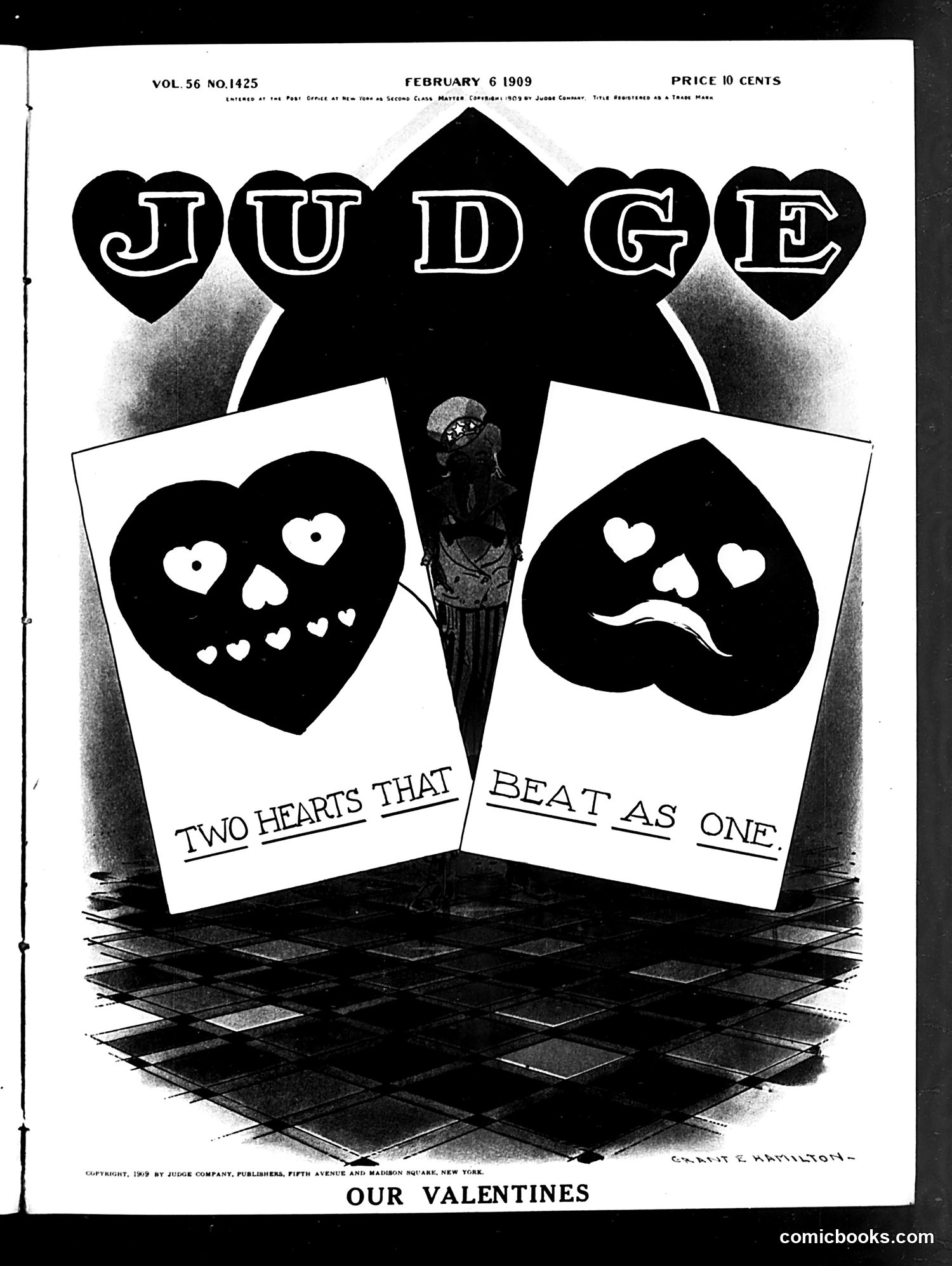
This Valentine's Day satire presents two contrasting heart-shaped faces. The left shows a joyful heart with multiple small hearts as eyes and mouth, labeled "TWO HEARTS THAT / BEAT AS ONE"—representing romantic love and marital harmony. The right depicts a melancholic heart with tear-filled eyes and a downturned mouth, also labeled part of the same phrase. This creates dark humor by juxtaposing idealized romance against romantic disappointment or marital discord. A skeletal or death-like figure presides above, suggesting either the grim reality underlying romantic fantasy or perhaps commenting on love's mortality. The contrasting emotions—bliss versus sorrow—satirize the gap between Valentine's Day sentimentality and actual relationship experiences, a perennial target of satirical magazines.
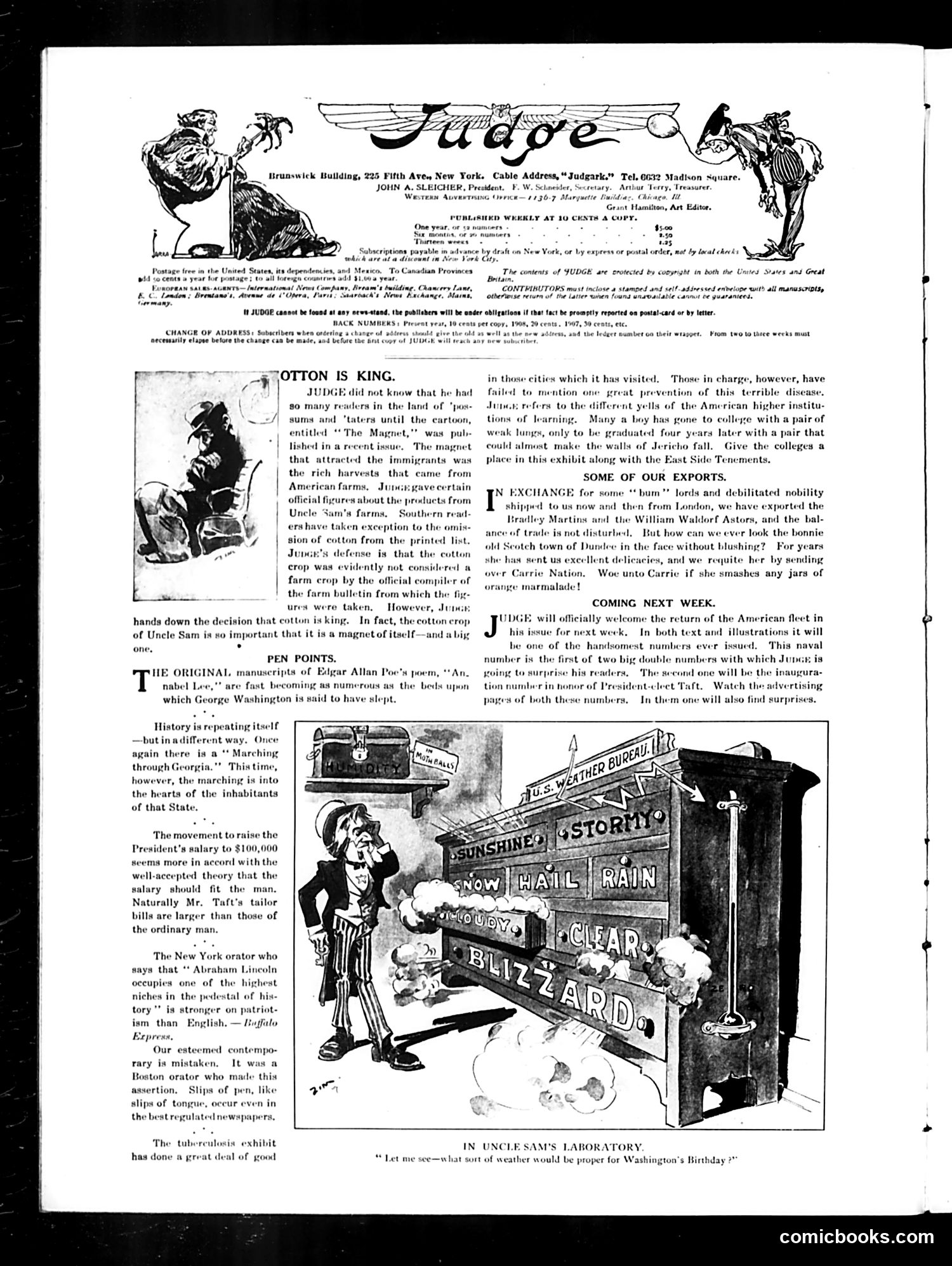
This page contains several satirical pieces. The main cartoon "Cotton Is King" appears to critique American agricultural and economic priorities—likely referencing pre-Civil War Southern economic dominance based on cotton production. The "In Uncle Sam's Laboratory" cartoon at bottom satirizes weather prediction or government forecasting, showing Uncle Sam (the bearded figure representing the U.S. government) attempting to manipulate or control weather patterns. The caption's reference to "Washington's birthday" suggests this is political satire about government capabilities or pretensions. Other sections discuss exports, an upcoming American Fleet return, and Pen Points—a literary/editorial feature. The overall page mixes political commentary with humor typical of Judge magazine's satirical approach to American politics and society.
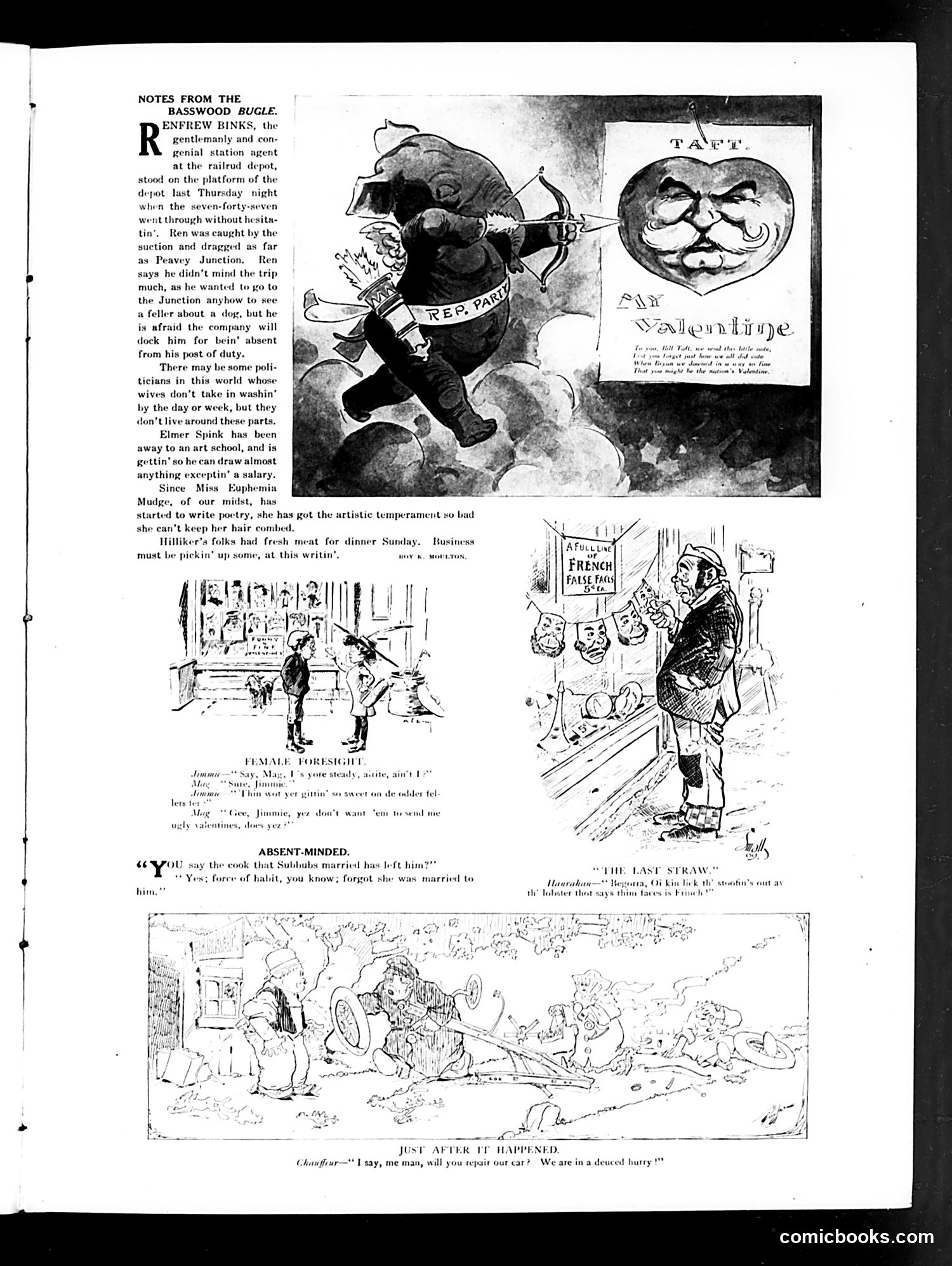
**Top cartoons:** The "Rep. Dark" elephant with bow and arrow satirizes Republican Party politics. The adjacent "Taft" face caricature likely references President William Howard Taft, using exaggerated facial features typical of period political satire. **Middle section:** "Female Foresight" and "Absent-Minded" sketches appear to be domestic humor about married couples—common Judge content mocking gender relations and forgetfulness. **Bottom cartoon:** "Just After It Happened" shows what appears to be a car accident, with dialogue about repair costs. This reflects early 1900s anxieties about automobiles as new, dangerous technology. The page mixes political commentary with gentler social satire about everyday American life, characteristic of Judge's editorial approach during the Progressive Era.
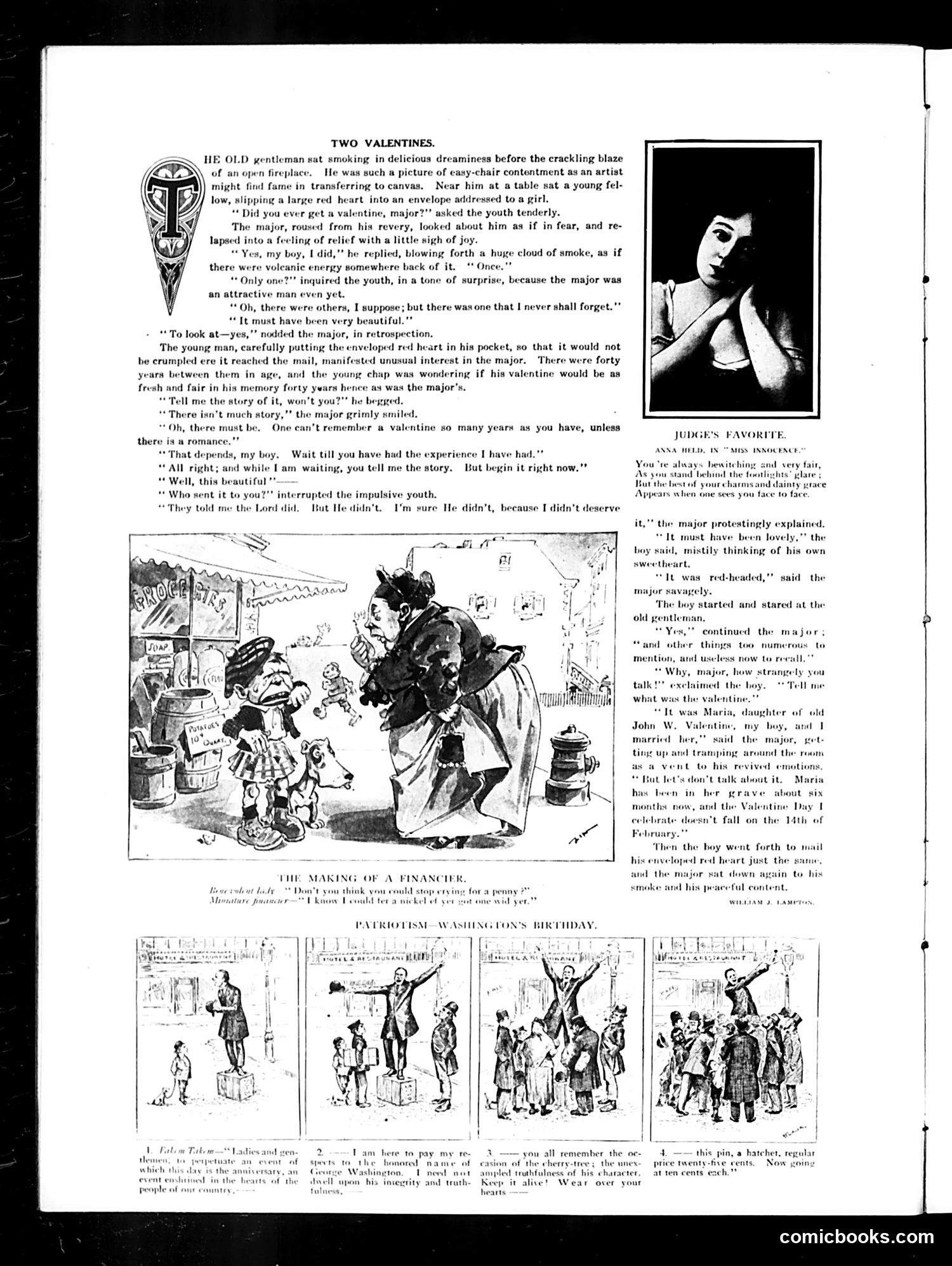
This page contains three distinct pieces: **"Two Valentines"** (top): A sentimental story about an old gentleman and young man exchanging Valentine's Day memories. The major character recalls a beautiful Valentine from decades past—a red heart—while the youth seeks romantic advice. This is a nostalgic narrative, not political satire. **"The Making of a Financier"** (middle): A cartoon satirizing financial ambition, showing what appears to be a street hustler or con artist teaching a child how to manipulate money—likely critiquing either corrupt business practices or the transmission of unethical financial values to the next generation. **"Patriotism: Washington's Birthday"** (bottom): A four-panel comic about civic duty and patriotic observance on Washington's birthday, emphasizing honor and integrity. The page mixes sentimental fiction with social/financial satire typical of Judge's editorial approach.
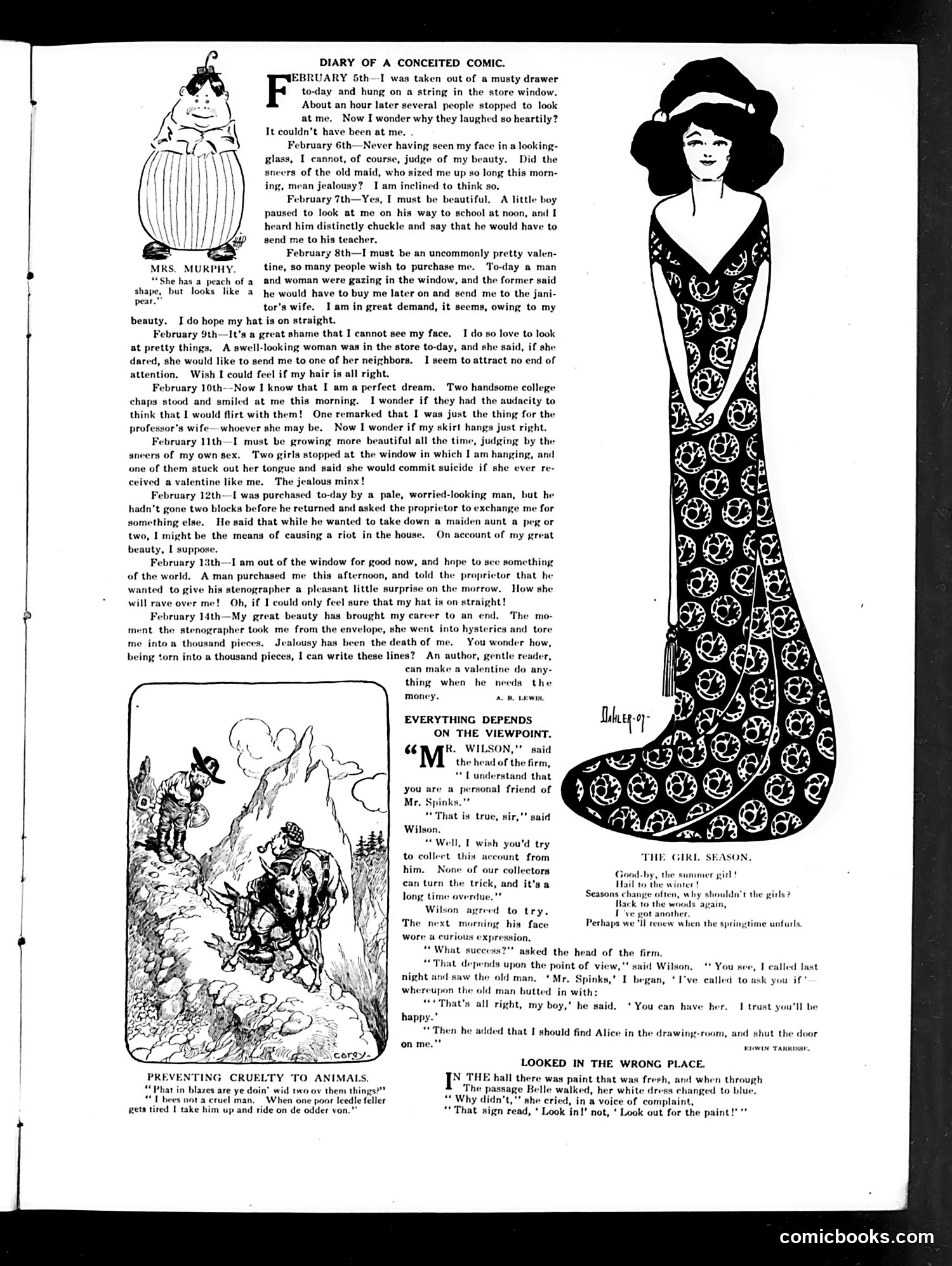
This page contains three distinct satirical pieces: 1. **"Diary of a Conceited Comic"** (left): A humorous first-person account of Mrs. Murphy, a homely woman displayed in a store window, whose appearance attracts unwanted attention and ridicule. The satire mocks vanity and self-delusion. 2. **"The Girl Season"** (right): A poem about summer, accompanied by an illustration of an elegantly dressed woman. This appears to be straightforward seasonal content rather than satire. 3. **"Everything Depends on the Viewpoint"** and **"Preventing Cruelty to Animals"** (bottom): Brief anecdotes satirizing perspective and moral hypocrisy regarding animal treatment, featuring dialogue about practical justifications for questionable behavior. The overall page reflects early 20th-century humor targeting vanity, social pretension, and moral inconsistency.
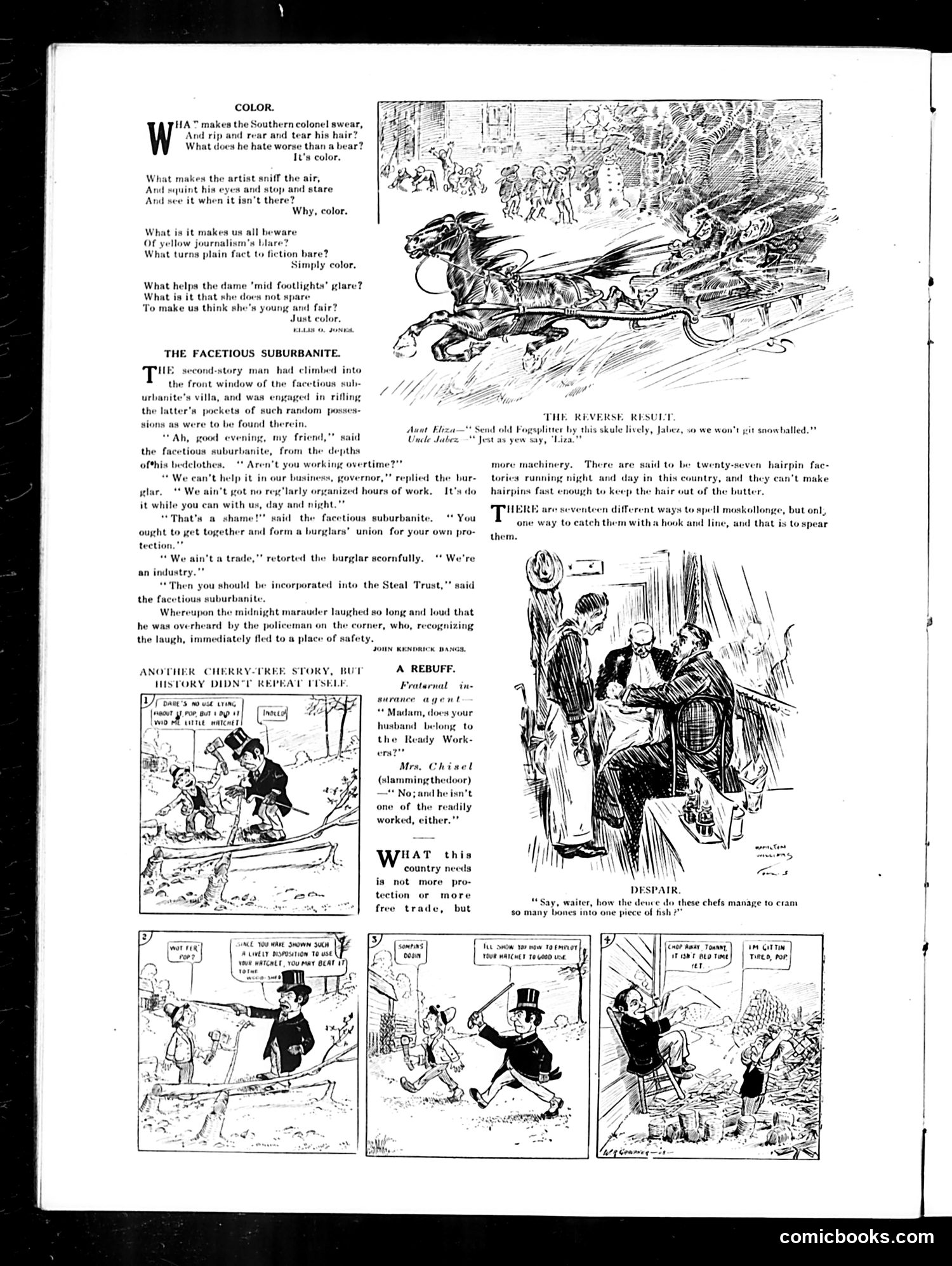
This page contains several unrelated satirical pieces typical of Judge magazine's format: **"COLOR"** (top): A poem satirizing the obsession with "color" in American society—likely referencing yellow journalism's sensationalism, theatrical makeup, and possibly racial anxieties of the era. The repeated refrain critiques how color (literal and figurative) distorts truth and reality. **"The Facetious Suburbanite"** (middle left): A humor piece where a suburban character jokes with a burglar about forming a "burglars' union" or incorporating into a "Steal Trust." The satire targets both labor unionization and corporate monopolies ("trusts"), treating criminal enterprise and big business as morally equivalent. **"Another Cherry-Tree Story"** and **"A Rebuff"** (center/right): Brief comic exchanges—one where an insurance agent is rejected by a skeptical housewife. These appear to be quick gags rather than political commentary. **"The Reverse Result"** (bottom): A rural dialogue suggesting unintended consequences of policy (possibly tariff-related, given the page's opening reference to "free trade"). The page mixes social satire with light humor, typical of Judge's eclectic content.
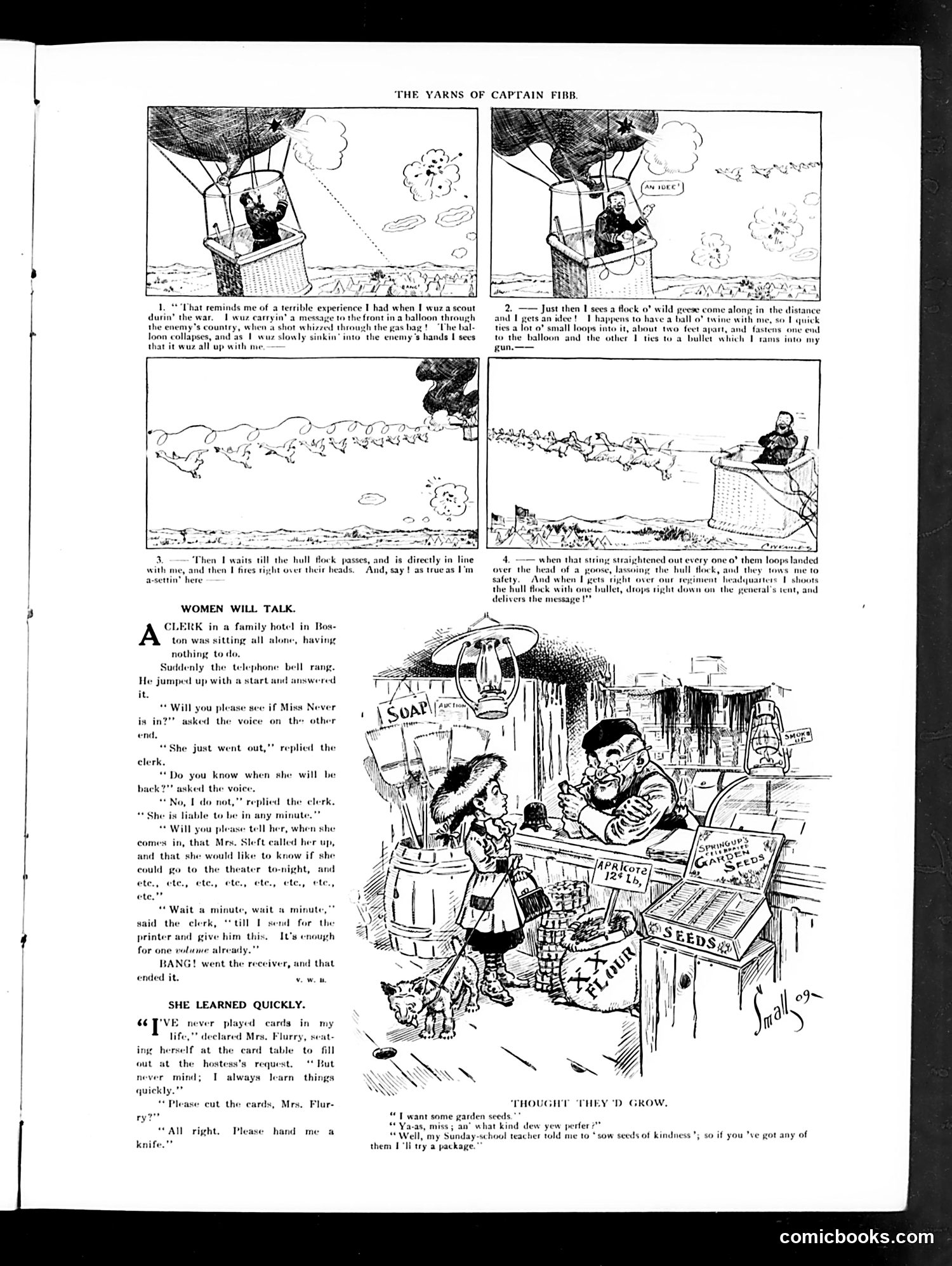
**Top Section:** A tall-tale comic strip mocking boastful storytelling. Captain Fibb claims he shot down an entire flock of geese while falling from a shot-down WWI balloon, using the dead birds' bodies as a cushion and their loops to signal for rescue. The joke is the absurd escalation of a soldier's exaggerated war story—the kind of implausible narrative common in period humor. **Bottom Section:** Two brief comedies about gender stereotypes. "Women Will Talk" depicts a hotel clerk overwhelmed by a woman's endless message to relay to another guest, suggesting women are verbose gossips. "She Learned Quickly" shows a child misunderstanding her Sunday school lesson about "sowing seeds of kindness" as literal gardening instructions—innocent humor about childhood confusion rather than satire. The page exemplifies *Judge* magazine's light domestic and military humor targeting early 20th-century American audiences.
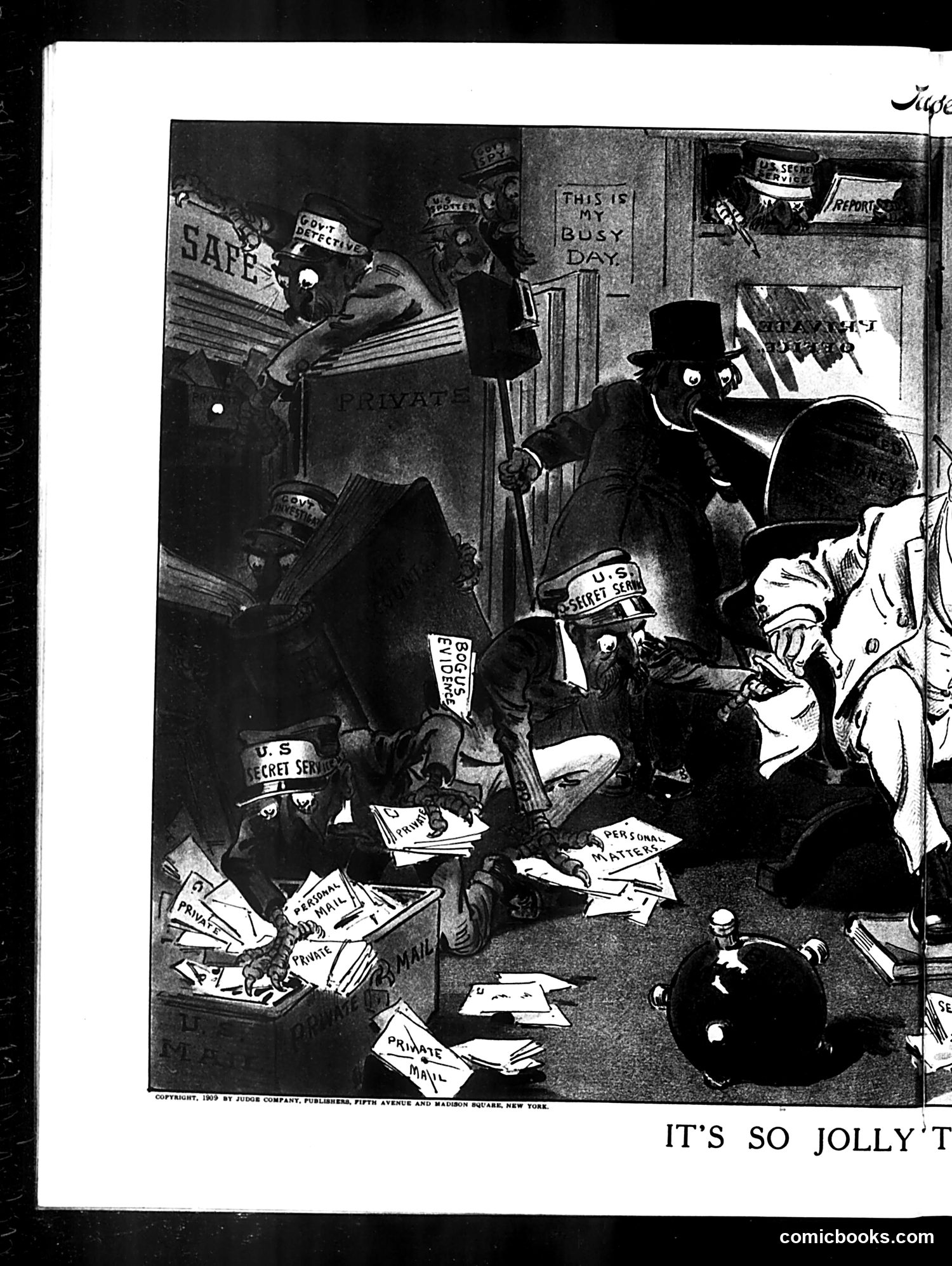
This Judge magazine cartoon satirizes government bureaucracy and espionage concerns, likely from the early 20th century (copyright 1903 visible). The scene depicts U.S. Secret Service agents raiding what appears to be a government office marked "STAFF" and "PRIVATE." Papers labeled "PRIVATE MAIL" and "SECRET" are scattered across the floor, suggesting the agents are conducting an aggressive investigation or search. The sign reading "THIS IS MY BUSY DAY" indicates official business being disrupted. The satire appears to criticize either: - Overzealous government surveillance and privacy violations - Bureaucratic inefficiency and chaos - Concerns about secret service overreach during an era of espionage fears The cartoon's title, "IT'S SO JOLLY," suggests ironic commentary on the chaotic scene.
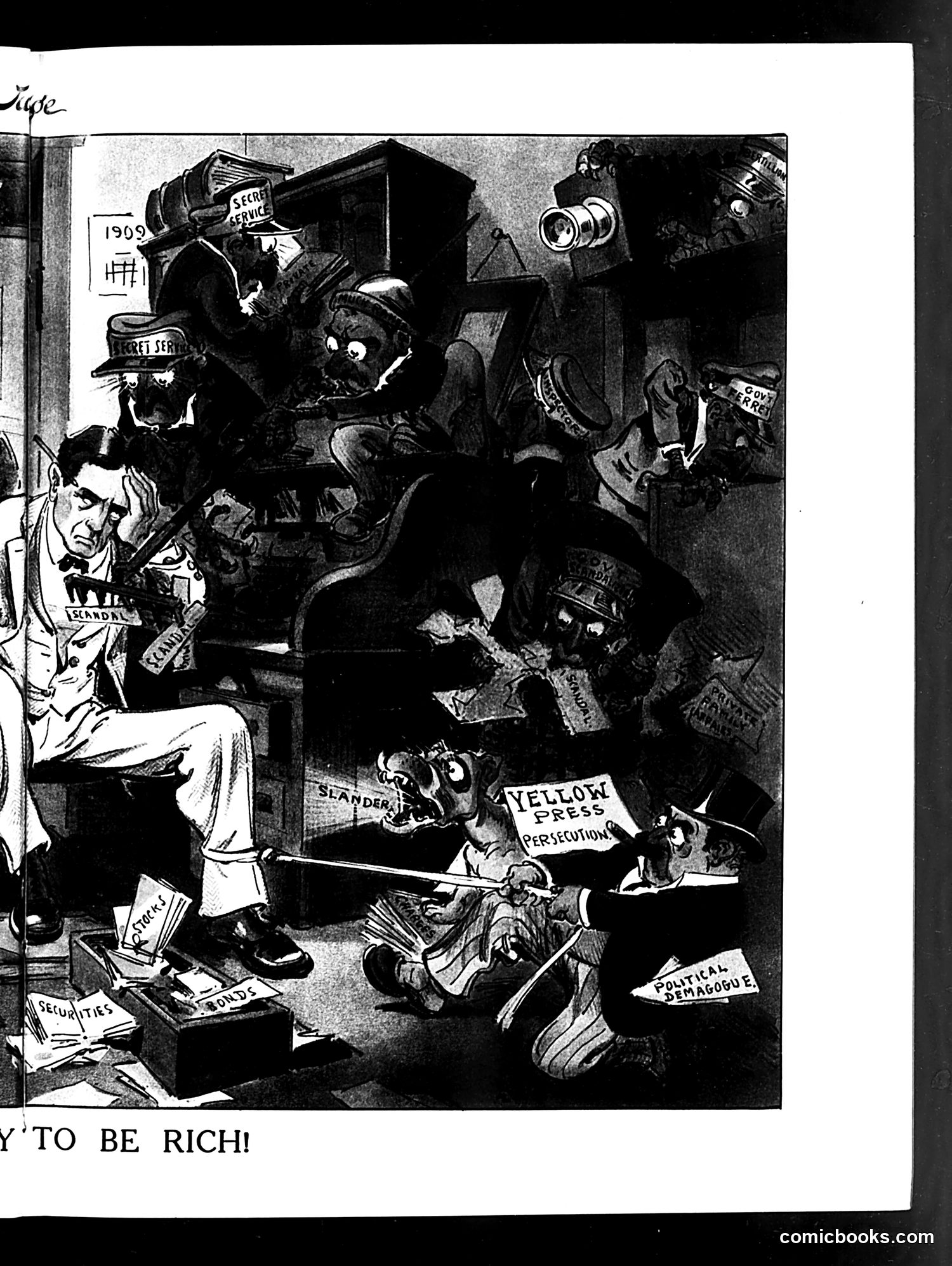
This political cartoon satirizes early 1900s wealth accumulation and press corruption. The scene depicts a chaotic interior where various labeled figures—including "Yellow Press," "Slander," "Securities Fraud," and "Political Demagogue"—operate like a machine generating wealth. A well-dressed man (likely representing a wealthy industrialist or robber baron) sits calmly at left, while others frantically manipulate scandals, false reporting, and political corruption to feed the system. The cartoon's message: legitimate riches come through unethical means—yellow journalism sensationalism, stock manipulation, slander, and political corruption all work together. The date "1909" and various labels indicate this reflects Progressive Era anxieties about monopolies, press ethics, and how the wealthy maintained power through morally dubious methods.
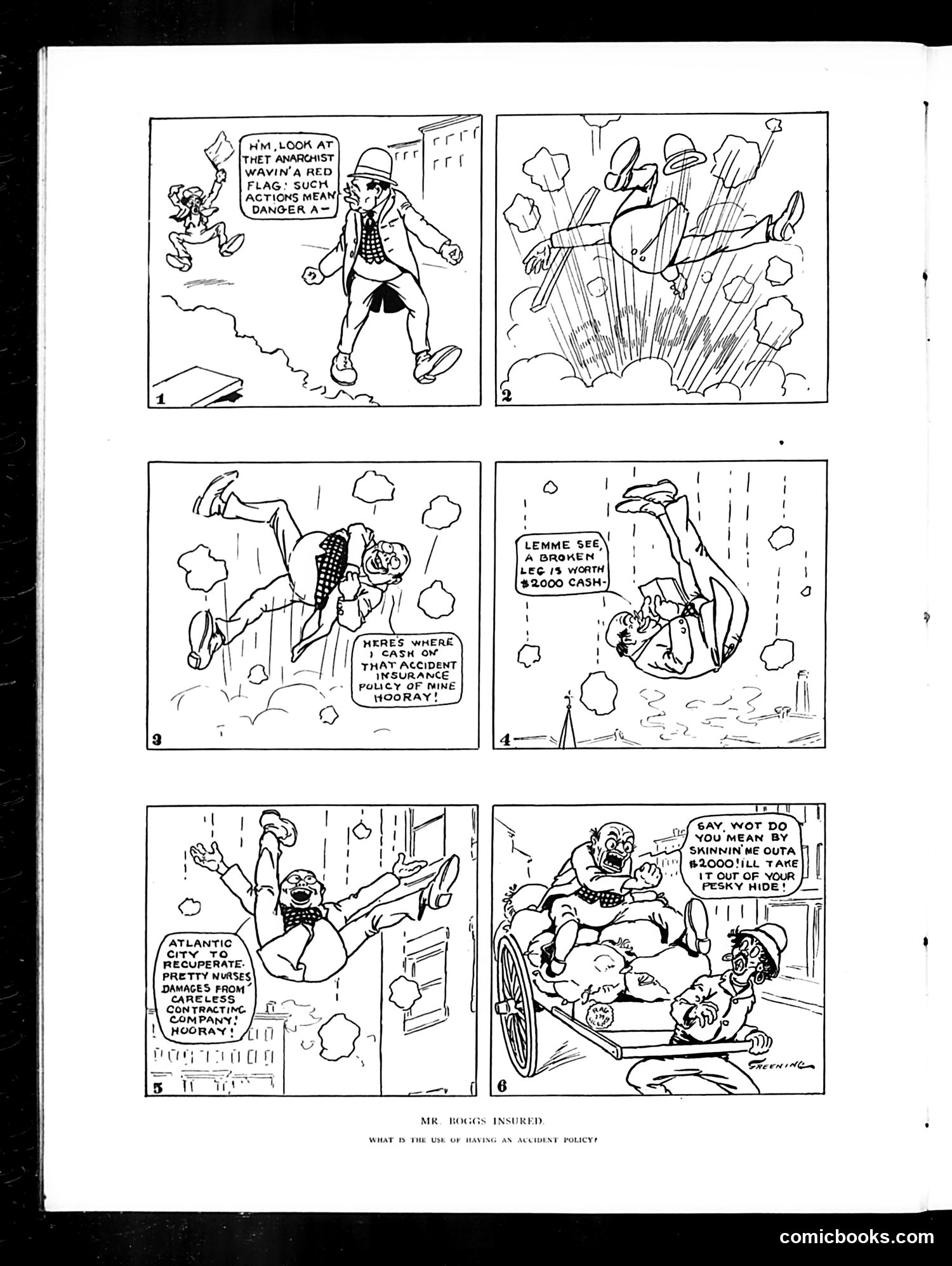
This satirical comic from *Judge* magazine depicts a man named Mr. Boggs exploiting accident insurance policies through deliberate self-injury. Panel 1 shows him reasoning that a broken leg is worth $2,000 cash. Subsequent panels show him orchestrating increasingly dangerous "accidents"—explosions, falls from buildings—to collect insurance payouts. The final panels reveal the scam: other criminals discover his scheme and threaten violence to steal his insurance money ("I'll take it out of your pesky hide"). The satire critiques both insurance fraud and the moral hazard such policies create—the perverse incentive for people to cause themselves harm for profit. The cartoon suggests that easy insurance payouts attract dishonest schemes and criminal opportunism, making the system vulnerable to exploitation.
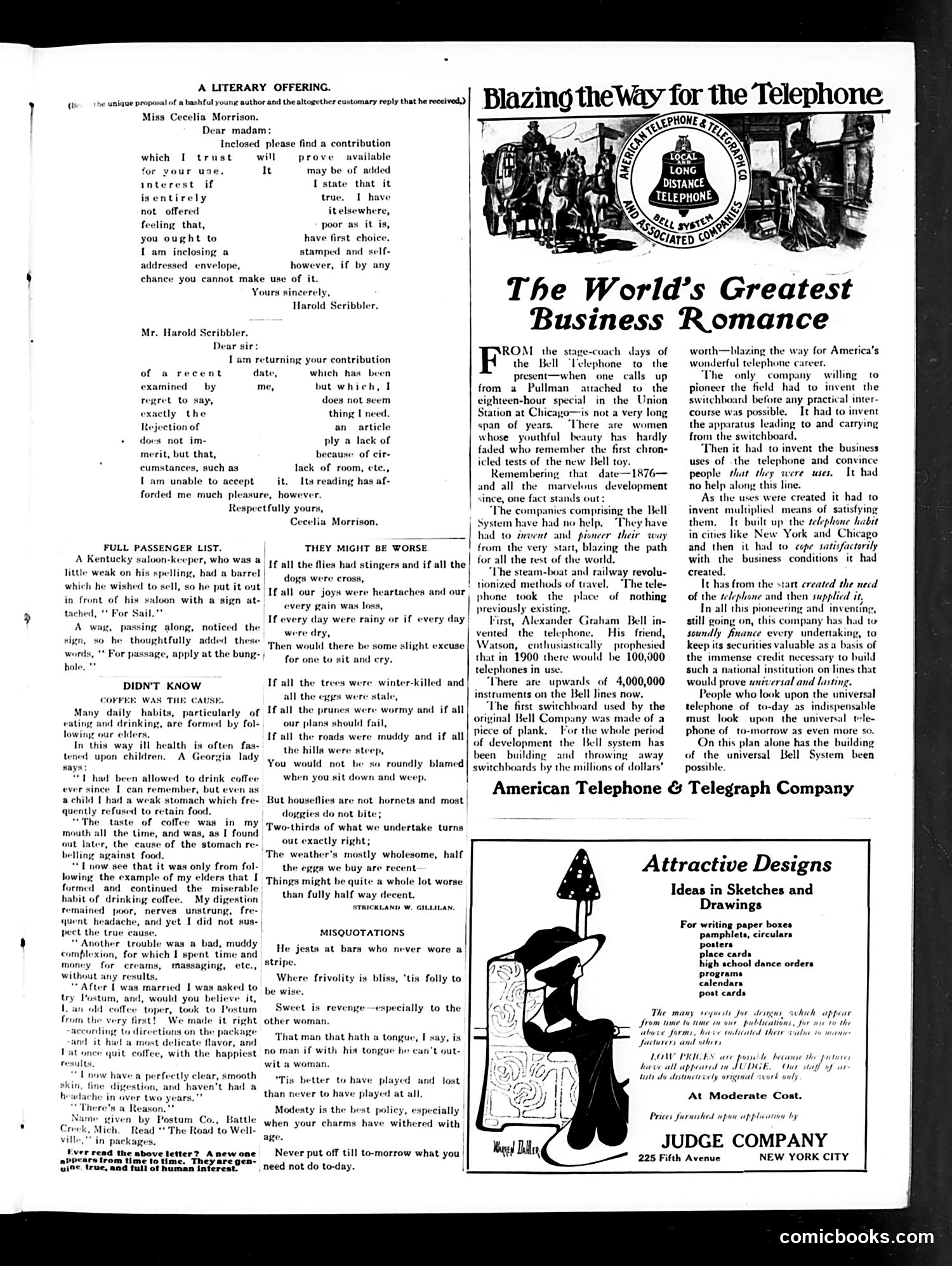
**Left Side - Literary Satire:** This section mocks the predictable rejection letter exchange between aspiring writers and magazine editors. Harold Scribbler submits an unsolicited manuscript to editor Cecelia Morrison; she politely declines it, citing lack of merit and overcrowding. The satire lies in the ritualistic formality and mutual pretense—the author claims originality while the editor offers stock excuses. This reflects the common publishing gatekeeping of the era. **Right Side - Telephone Company Advertisement:** Disguised as editorial content with the headline "The World's Greatest Business Romance," this is actually a lengthy advertorial for American Telephone & Telegraph Company. It celebrates the Bell System's pioneering role, claiming the company "invented and pioneered" the telephone business with no outside help. It emphasizes growth from 1876 to 4,000,000 instruments and boasts of inventing both technology and consumer demand. This self-congratulatory corporate narrative represents early corporate PR masquerading as journalism—a practice Judge's satirical readership would recognize as absurd propaganda.
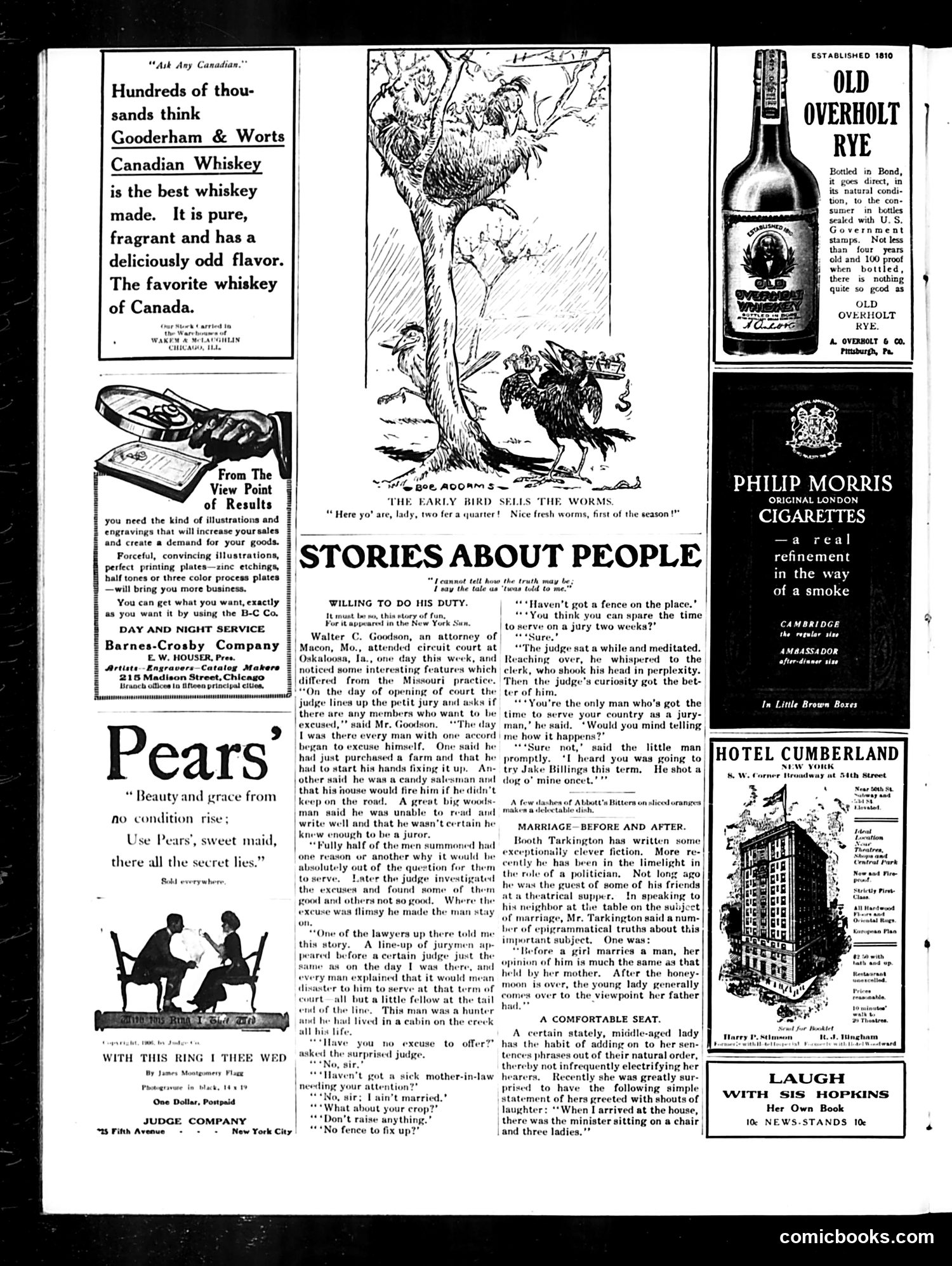
This page is primarily **advertising and filler content** rather than political satire. The main elements are: **Central Cartoon**: "The Early Bird Sells the Worms" depicts a street vendor hawking worms to birds—a straightforward visual pun with no political meaning. **"Stories About People"**: A collection of anecdotes by various authors (including Booth Tarkington), mostly humor pieces about everyday situations: a judge frustrated with jury duty excuses, and observations about marriage. These are light social commentary rather than satire—poking gentle fun at human nature and social conventions. **Advertisements**: The page is heavily laden with ads for whiskey (Gooderham & Worts), printing services (Barnes-Crosby), soap (Pears'), Philip Morris cigarettes, and Hotel Cumberland—typical of Judge's revenue model. **Context**: This represents Judge's typical format: light satirical humor mixed with substantial advertising to subsidize publication.
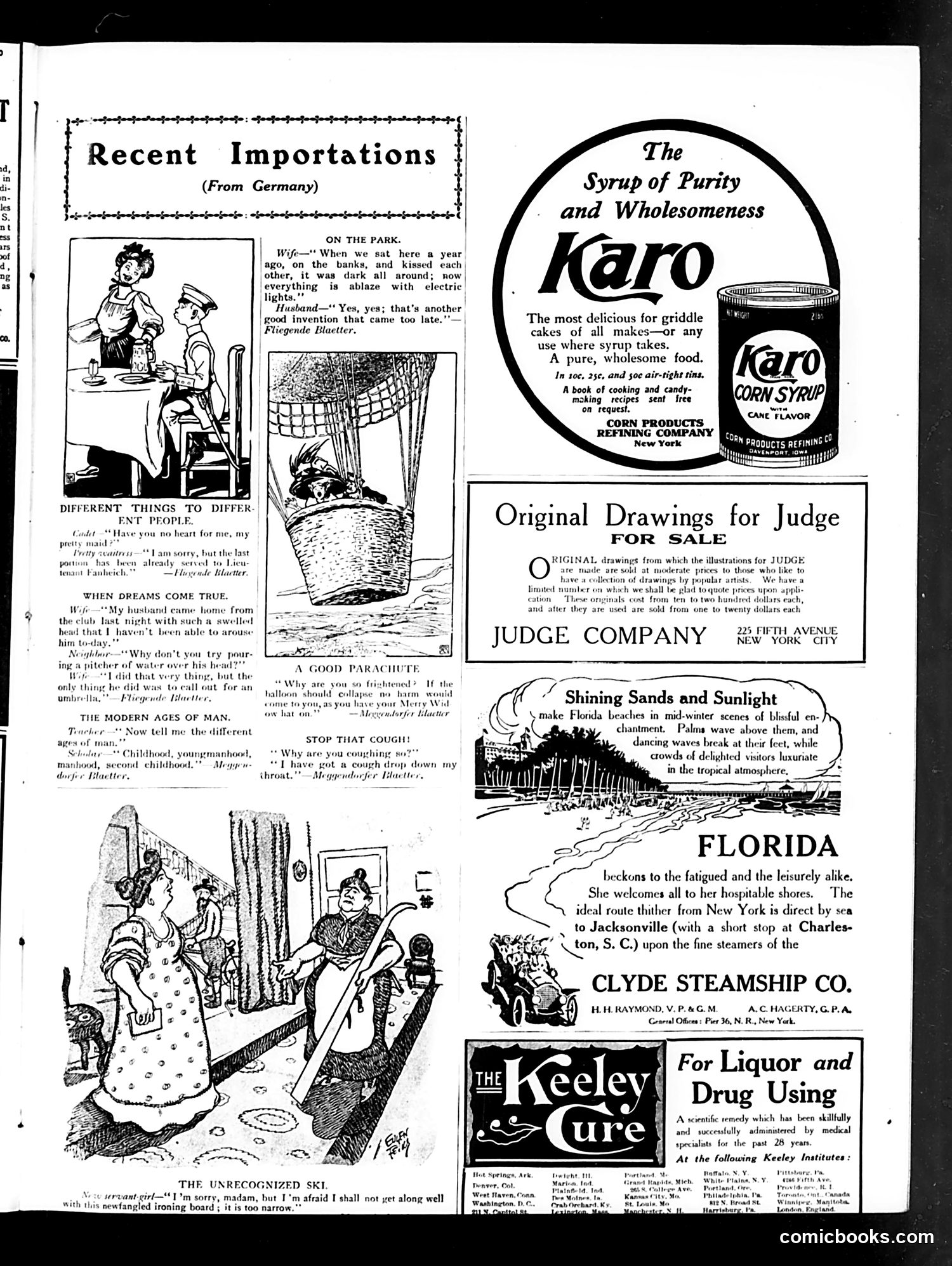
This page from Judge magazine (American satirical publication) mixes advertising with satirical humor typical of early-20th-century comedy: **The cartoons satirize:** - German imports and their cultural lag ("Recent Importations from Germany")—jokes about electric lights arriving too late for romance, depicting outdated European sensibilities - Modern conveniences and their unintended consequences (electric lights ruining spontaneity) - Domestic discord over new technologies (the ironing board joke at bottom) - A servant girl struggling with modern appliances **The advertisements reflect period concerns:** - Karo corn syrup marketed as "pure" and "wholesome" (purity was a major selling point then) - Florida tourism promoting leisure travel by steamship - The Keeley Cure—a real, now-infamous "treatment" for alcoholism and drug addiction (operated 1879-1960s), presented matter-of-factly as legitimate medicine The page is largely **commercial**, with satirical content serving as filler. The humor assumes readers share assumptions about German backwardness, marital tensions over modernity, and acceptance of dubious medical remedies—all period-specific attitudes that require historical context.
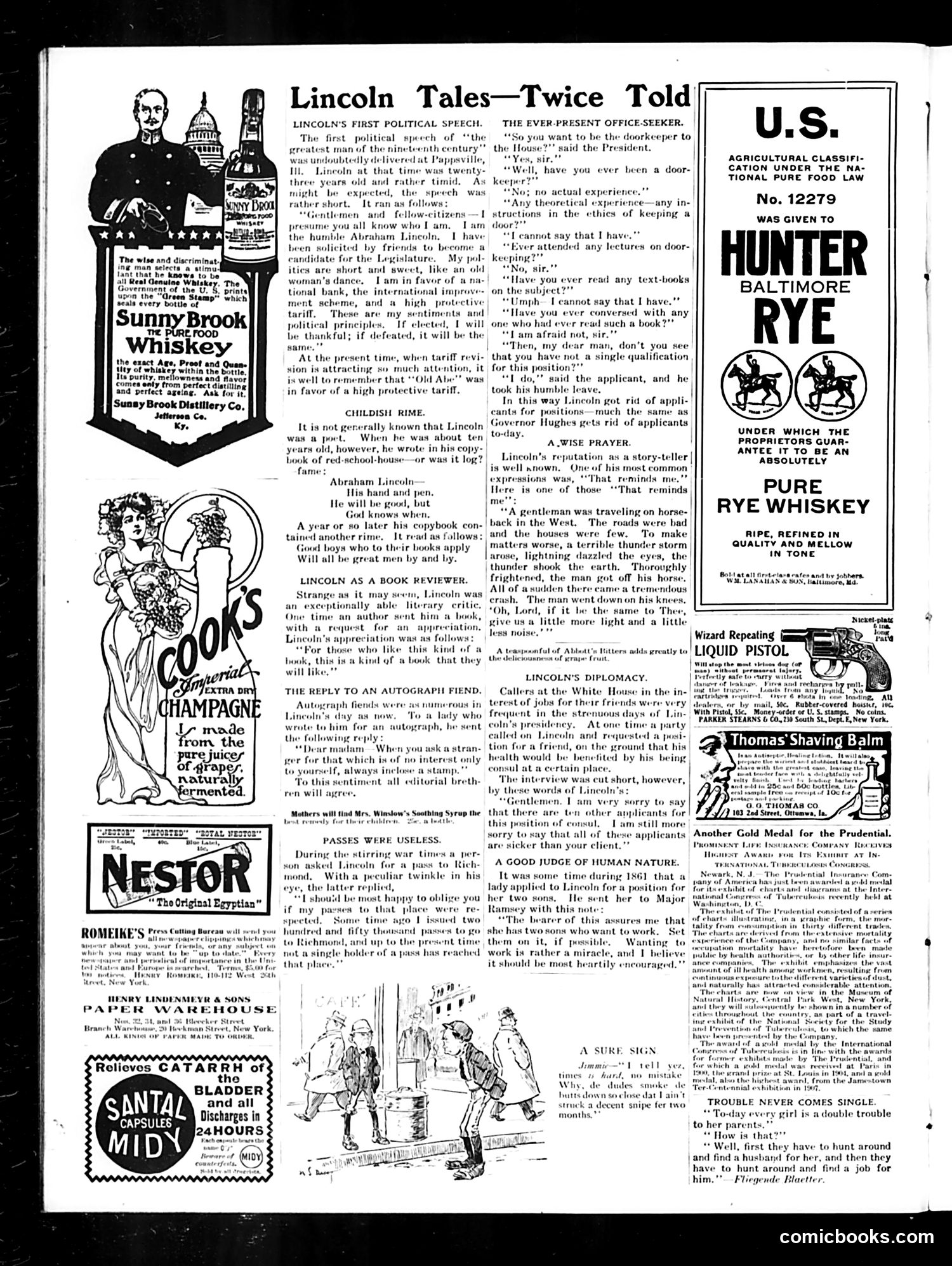
This page from *Judge* magazine presents humorous anecdotes about Abraham Lincoln, presented as historical reminiscences. The cartoons satirize Lincoln's character through invented stories: **"Lincoln's First Political Speech"** mocks his humble origins by depicting him giving an awkwardly short, simple campaign speech as a young man—playing on the myth of Lincoln as an unsophisticated frontier figure. **"The Ever-Present Office-Seeker"** ridicules job applicants pestering Lincoln, with the punchline that he dismisses an unqualified man by pointing out his complete lack of qualifications—a dig at political patronage and incompetent appointees. Other segments ("Lincoln as Book Reviewer," "Lincoln's Diplomacy") continue this pattern: portraying Lincoln as cleverly deflecting unwanted requests through witty responses. The page is primarily **nostalgic humor** using Lincoln as a folk hero figure, rather than sharp political satire. The advertisements surrounding the content indicate this is entertainment for general readers, mining Lincoln's legend for humor about universal problems: job-seeking, incompetence, and political favor-trading.
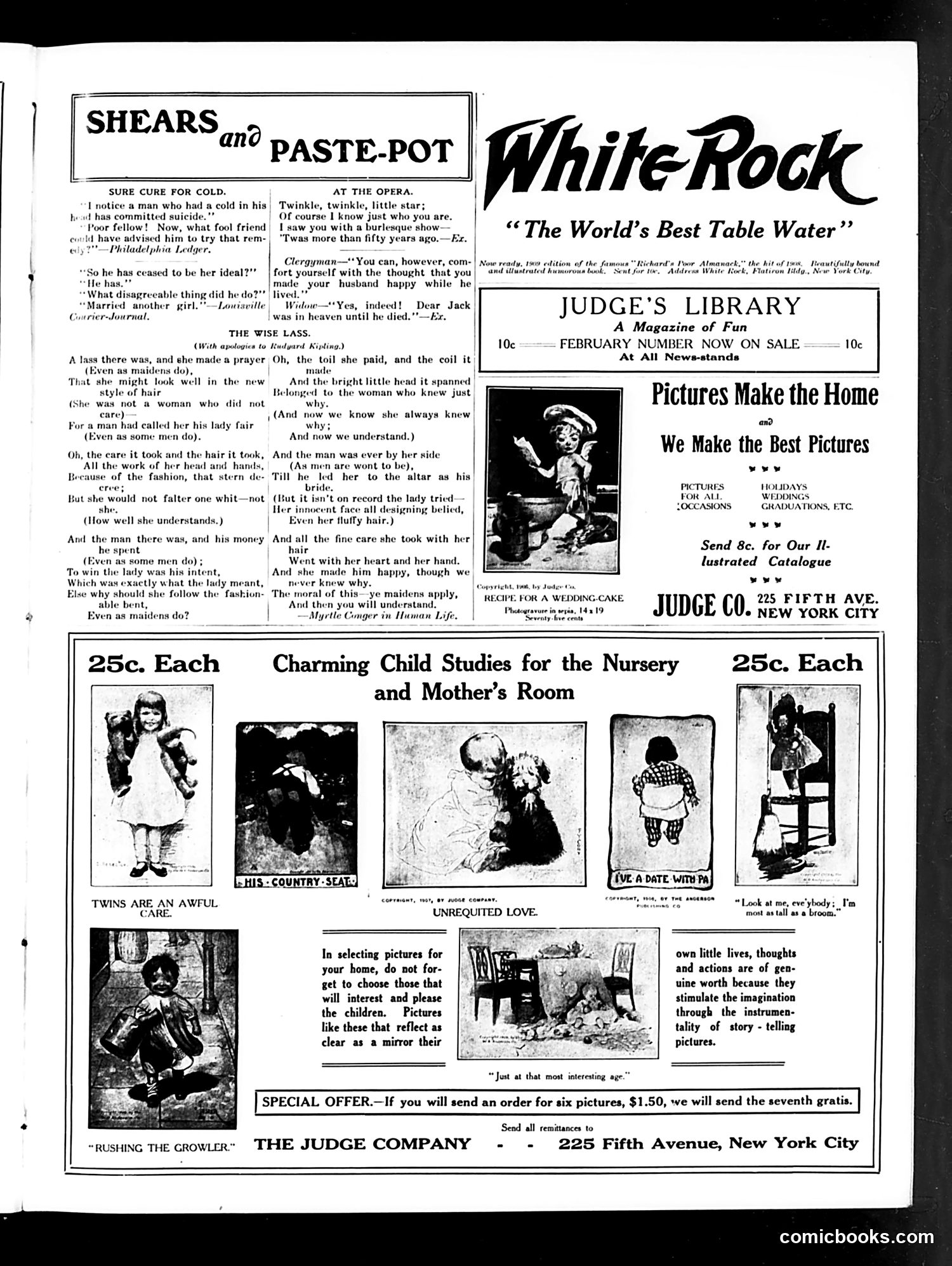
This page contains **primarily advertisements** rather than political satire. The dominant content is a large ad from The Judge Company promoting affordable child portraits and nursery pictures (25¢ each). The upper portion includes several **brief humorous anecdotes** typical of Judge's satirical style: - A joke about a man with a cold at the opera who's spotted with a woman from a burlesque show he knew fifty years prior - A clergyman comforting a woman about her husband's infidelity by noting he made him happy - A poem titled "The Wise Lass" (parodying Rudyard Kipling) about a woman who strategically married a man for his money while maintaining her virtue These pieces mock **Victorian social hypocrisy**—particularly around marital fidelity, class pretense, and women's calculated pursuit of wealthy husbands. The humor targets the gap between public morality and private behavior. The page also advertises **White Rock water** and Judge's Library magazine, but these are straightforward commercial notices without satirical content.
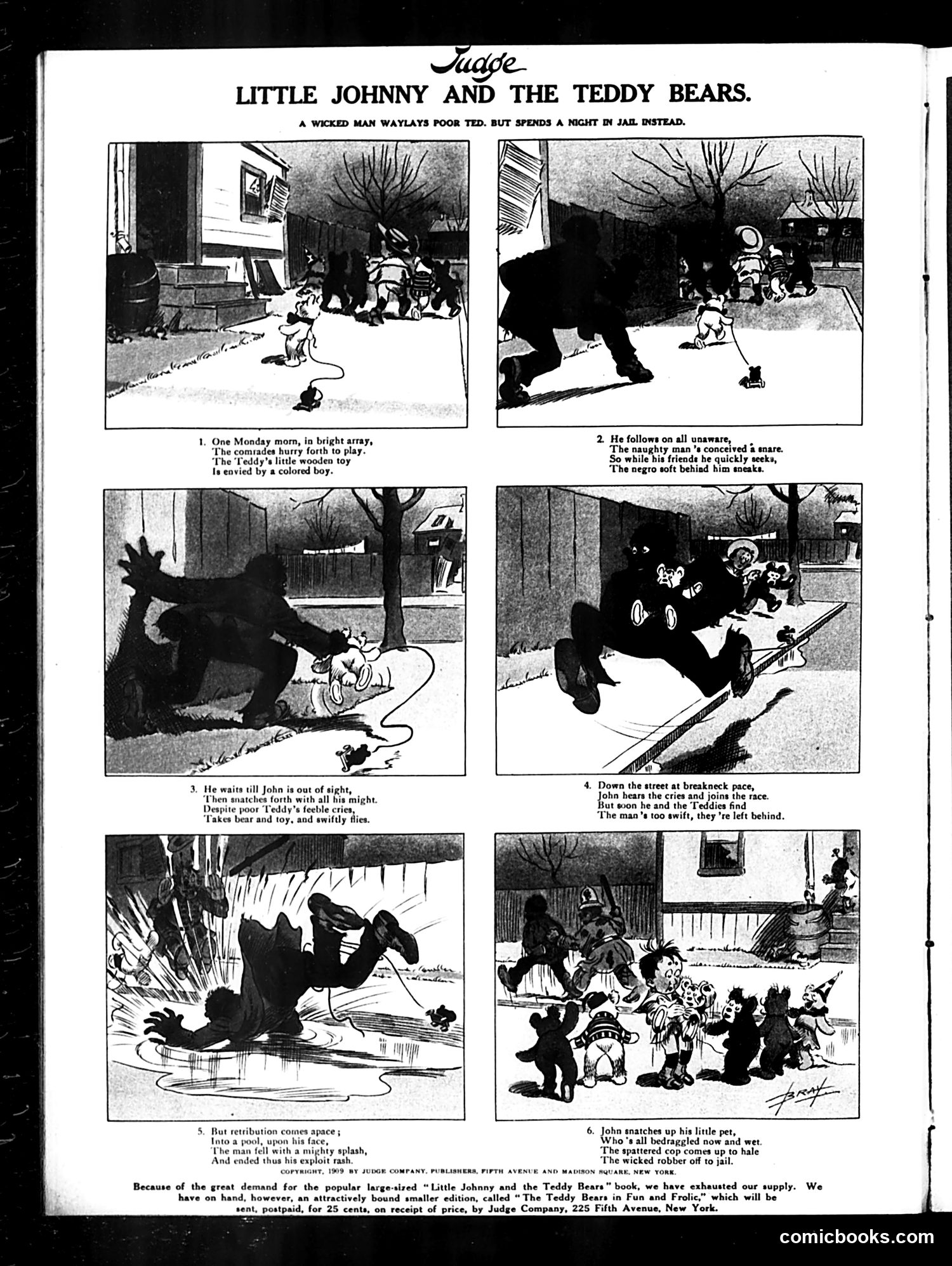
This is a 1909 children's comic strip from *Judge* magazine depicting a racial caricature stealing a toy from a white child named Johnny. The narrative frames a Black man ("the negro," in the text's language) as a criminal who waylay's the boy and steals his teddy bear toy. The "joke" or moral lesson relies on period racism: it presents a Black person as inherently criminal and dishonest. The story's resolution—the thief ending up in jail—was meant to be satisfying to contemporary readers, reinforcing stereotypes about Black criminality. By modern standards, this is overtly racist propaganda. The caricature, dehumanizing language, and criminal stereotype represent the casual bigotry embedded in early 20th-century popular media. The comic serves as a historical document of American racial attitudes rather than entertainment.