
A complete issue · 16 pages · 1909
Judge — January 23, 1909
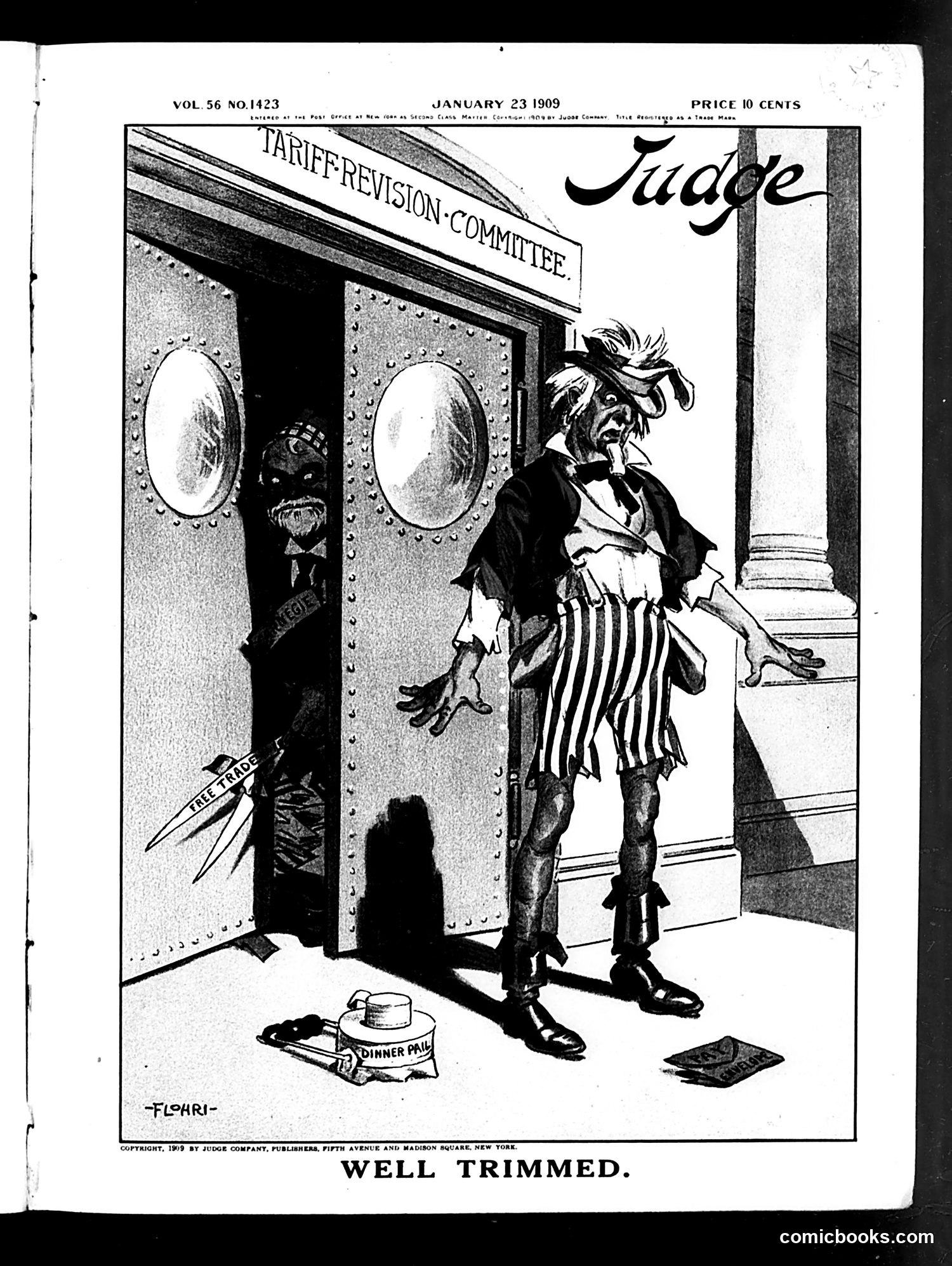
This political cartoon satirizes the **Tariff Revision Committee**. A disheveled figure labeled "Free Trade" emerges from the committee's office looking battered and defeated, having been "well trimmed" (trimmed back/cut down). The figure carries a dinner pail and appears to be a working-class character, suggesting the cartoon critiques how tariff revision—likely protective tariffs favored by Republicans—disadvantaged free trade advocates and ordinary workers. The two blank-faced committee members visible in the doorway appear smug and unmoved. The satire mocks the committee's actions as harmful to free trade principles and working people's interests, presenting the outcome as a decisive defeat for pro-trade forces.
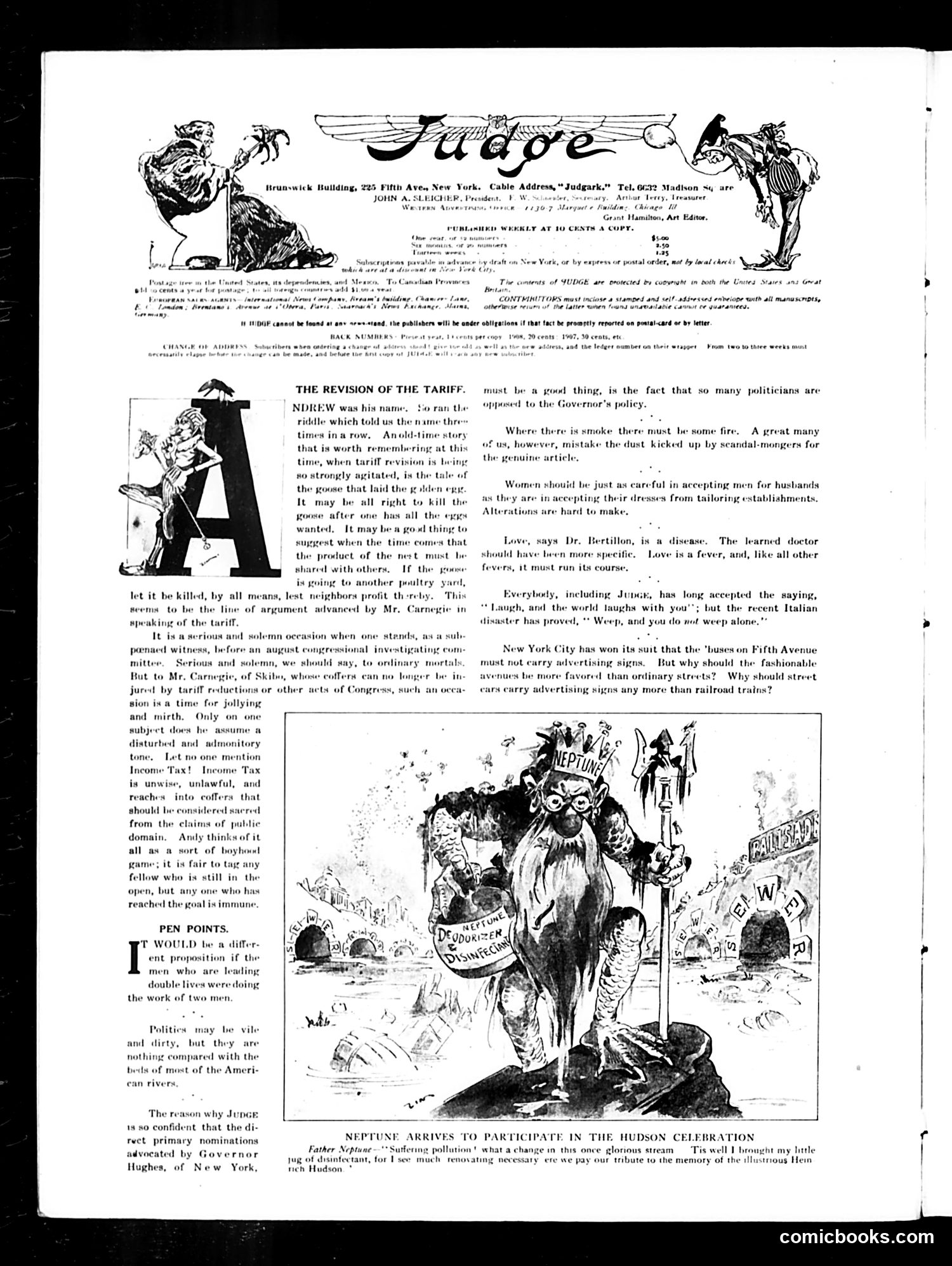
This page contains **"Neptune Arrives to Participate in the Hudson Celebration"** — a political cartoon satirizing the Hudson-Fulton Celebration (a major 1909 New York event commemorating Hudson's exploration and Fulton's steamboat). The cartoon depicts Neptune, the Roman god of the sea, arriving amid industrial pollution and urban decay. The satire's point appears to be **ironic**: while New York celebrates the Hudson River's historical significance, the actual river has become filthy and degraded by modern industry and "dumpster" waste (visible in the cartoon). The caption's mention of "sufferin' pollution" confirms the target—the contrast between celebrating the river's glorious past while ignoring its present contamination. It's environmental satire critiquing New York's hypocrisy about honoring a natural resource it has ruined.
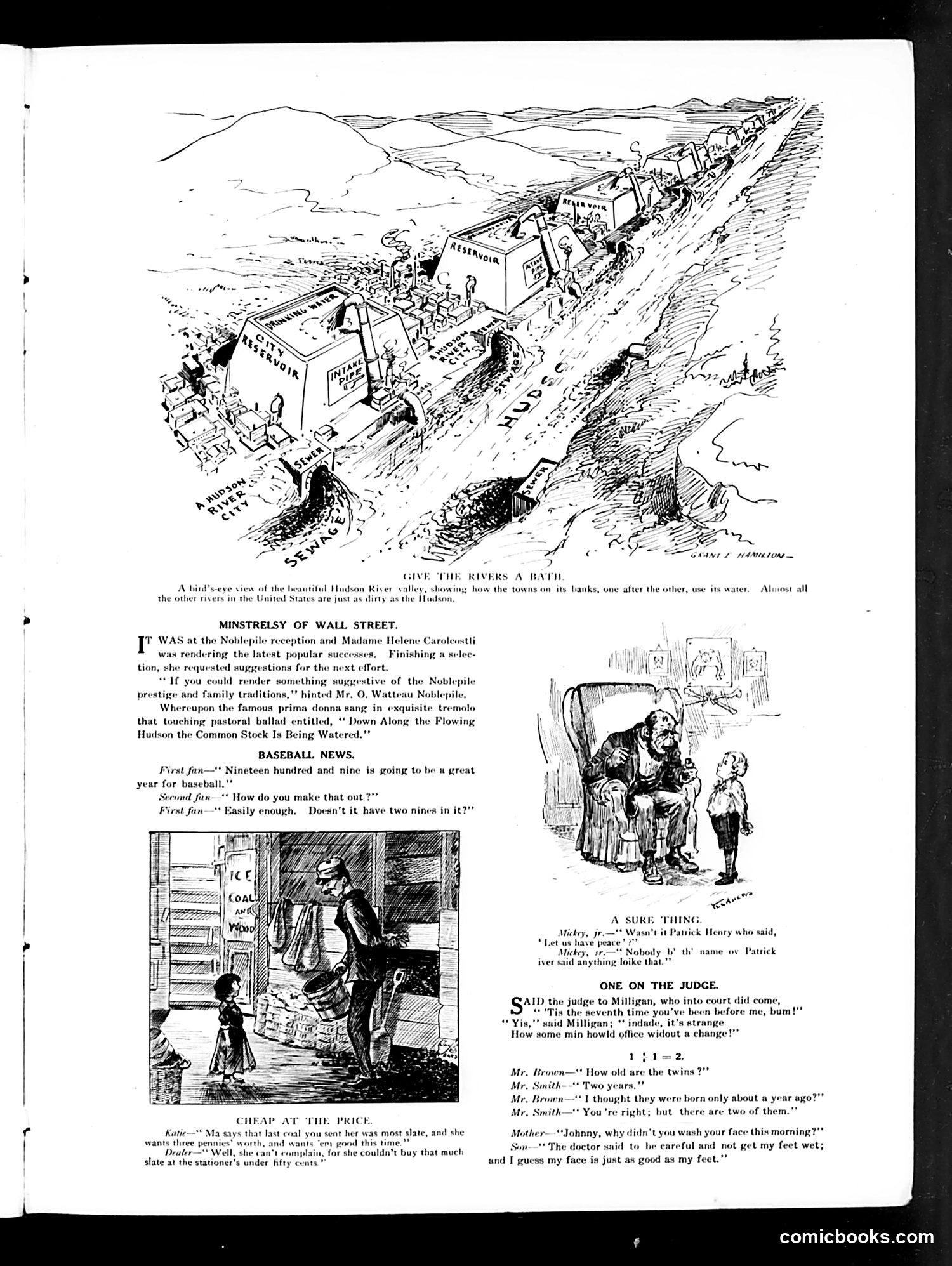
The page contains several unrelated humor pieces typical of Judge magazine's format: **"Give the Rivers a Bath"** (top): A satirical cartoon showing municipal water systems servicing Hudson River towns. The joke appears to critique inadequate public water infrastructure—the caption suggests towns need to "bathe" or clean up their river water supplies, implying the Hudson was polluted and unsuitable for use. **"Minstrelsy of Wall Street"** and **"Baseball News"**: Brief comedic exchanges with no clear political content—standard wordplay humor. **Lower sections** ("Cheap at the Price," "One on the Judge," "A Sure Thing"): Brief domestic humor and anecdotes, typical filler content for the magazine. The page is primarily entertainment rather than pointed political satire, mixing social observation (water pollution concerns) with everyday humor pieces common to Judge's format.
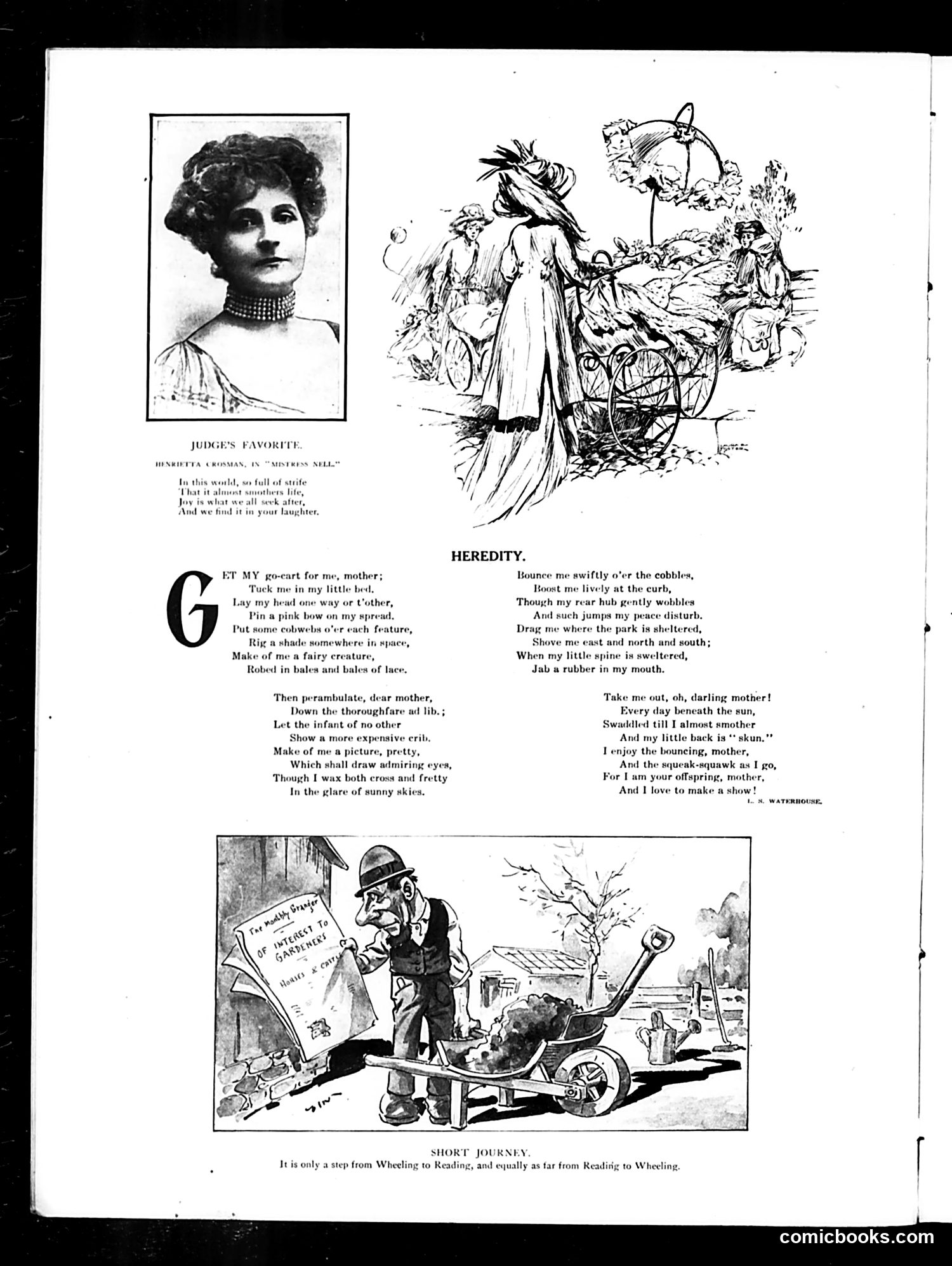
This page contains three distinct elements: 1. **"Judge's Favorite"** – A photograph of a woman labeled Henrietta Croker in "Midsummer Silk," with accompanying light verse praising her appearance. 2. **"Heredity"** – A poem by I.S. Waterhouse depicting a mother's humorous wishes for her child, hoping the baby will inherit desirable traits (beauty, athleticism) while avoiding undesirable ones (slouching, jumping). 3. **"Short Journey"** – A cartoon showing a man with a wheelbarrow on a road sign reading "Distance to Gairloch." The caption states it's "only a step from Wheeling to Reading, and equally as far from Reading to Wheeling." The last cartoon appears to be a geography pun, likely referencing American towns (Wheeling, Reading, Gairloch), though the specific satirical target remains unclear without additional historical context.
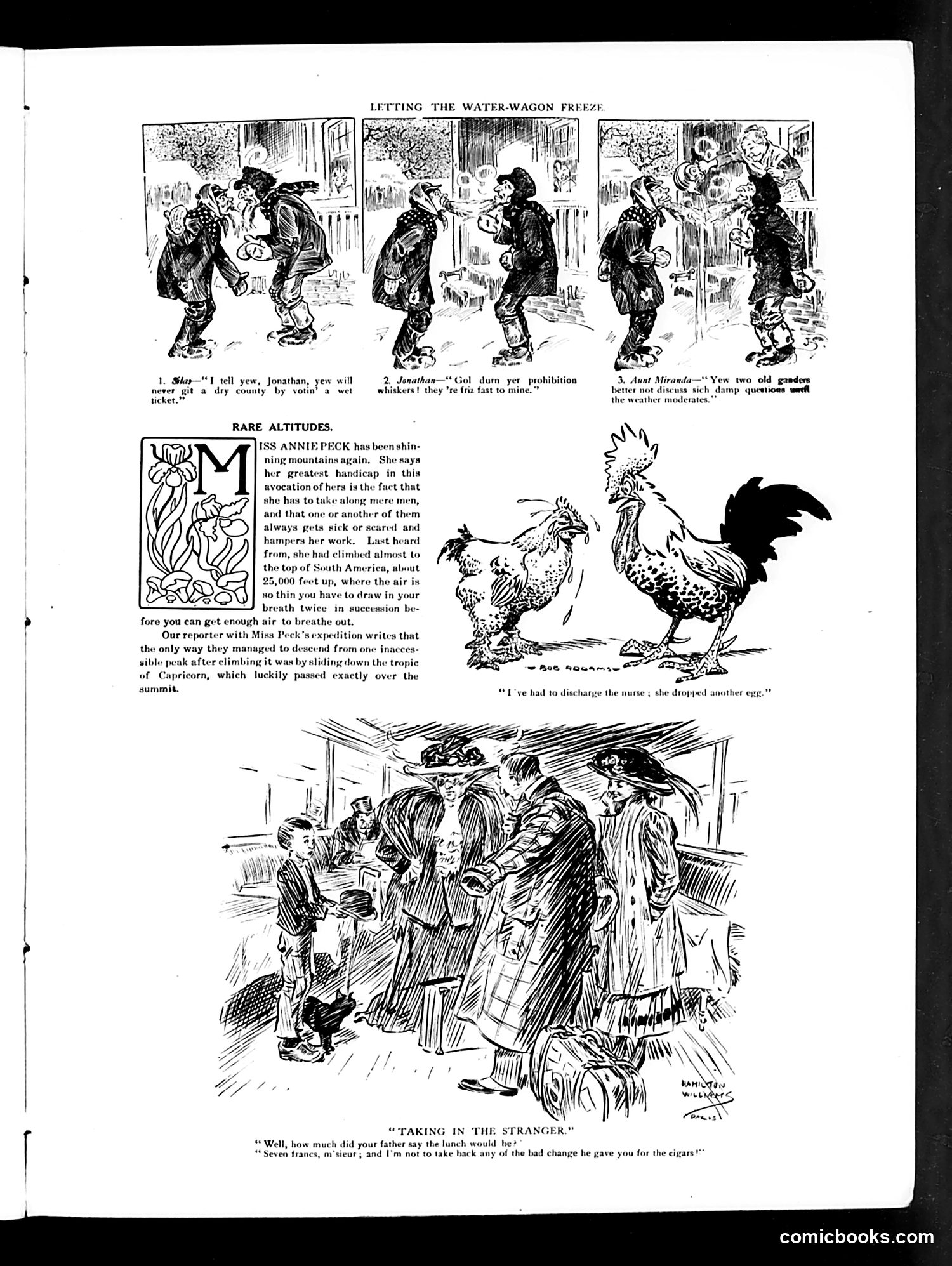
The top section, "Letting the Water-Wagon Freeze," shows a comic sequence about winter and temperance. Characters discuss a "water-wagon" (slang for abstinence from alcohol), with jokes about staying dry in winter and prohibitions on whiskey. The "Rare Attitudes" section features Miss Annie Peck, a mountaineer who climbed high peaks. The text humorously notes she works without male climbers and breathes thin air by drawing breath twice—satirizing both her mountaineering achievements and perhaps contemporary attitudes toward women in physically demanding pursuits. "Taking in the Stranger" depicts a street scene where a child asks about his father's lunch money (seven francs), with cynical humor about poverty and financial hardship—likely referencing working-class struggles in the period.
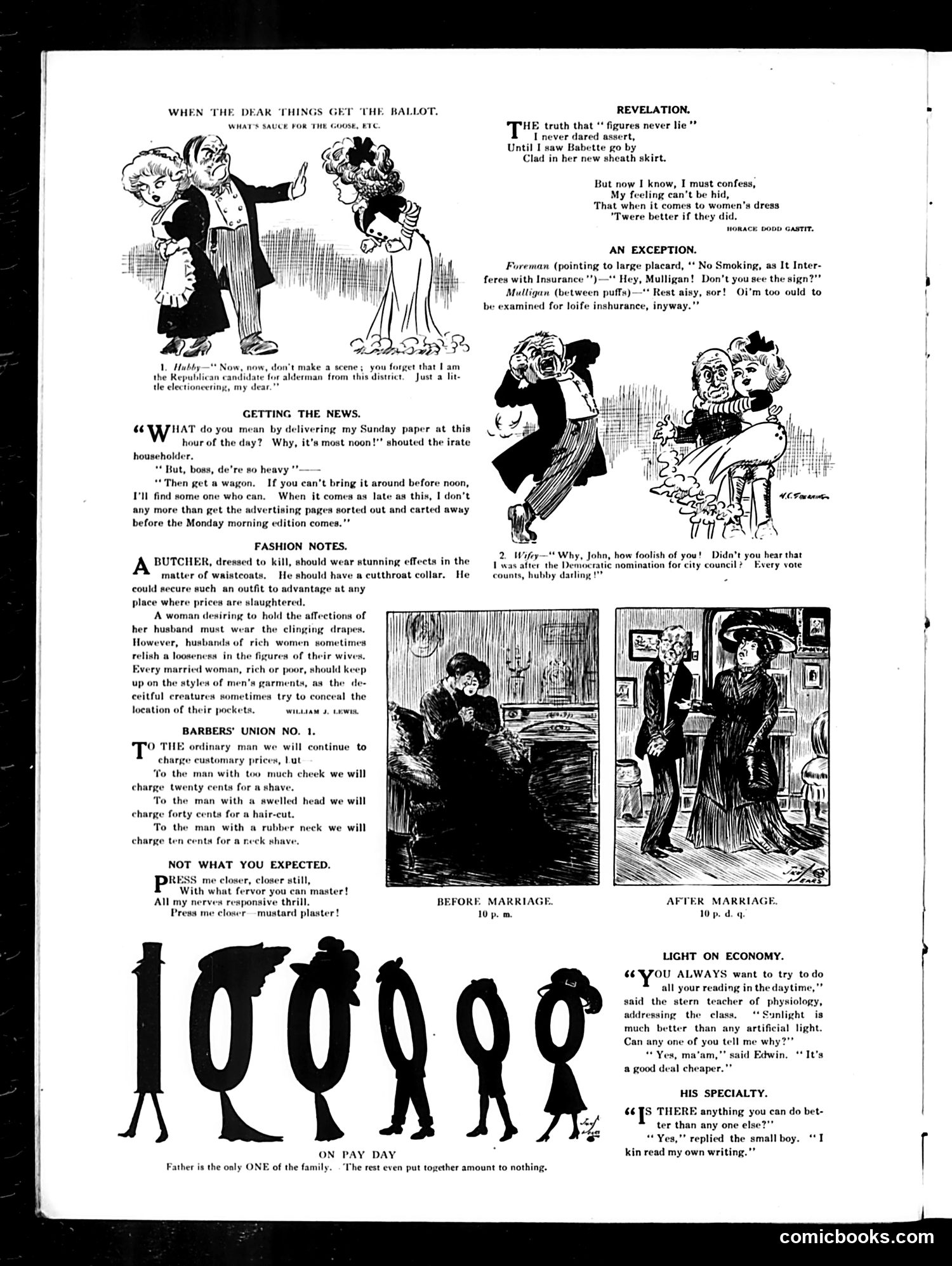
This page from Judge contains multiple satirical vignettes targeting early 20th-century social issues: **"When the Dear Things Get the Ballot"** mocks women's suffrage through a husband using his wife's political candidacy for "electioneering"—treating her ambitions cynically. **"Getting the News"** jokes about Sunday newspapers arriving too late, with the householder complaining that advertising gets discarded before the actual news content arrives. **"Fashion Notes"** uses puns to mock fashion pretensions—"butcher dressed to kill" with "cutthroat collar," and jibes at wealthy women for concealing their bodies' flaws under loose clothing while hiding their "pockets" (implying hidden wealth or infidelity). **"Barbers' Union No. 1"** satirizes labor unions by charging premium rates for customers with "too much cheek," "swelled head," or "rubber neck"—personality insults disguised as union pricing. **"Before/After Marriage"** depicts the stark contrast between courtship and married life through contrasting domestic scenes. **"On Pay Day"** cruelly suggests only the father matters financially; the rest of the family "amount to nothing." The overall tone reflects period anxieties about changing social structures, women's rights, and labor organization.
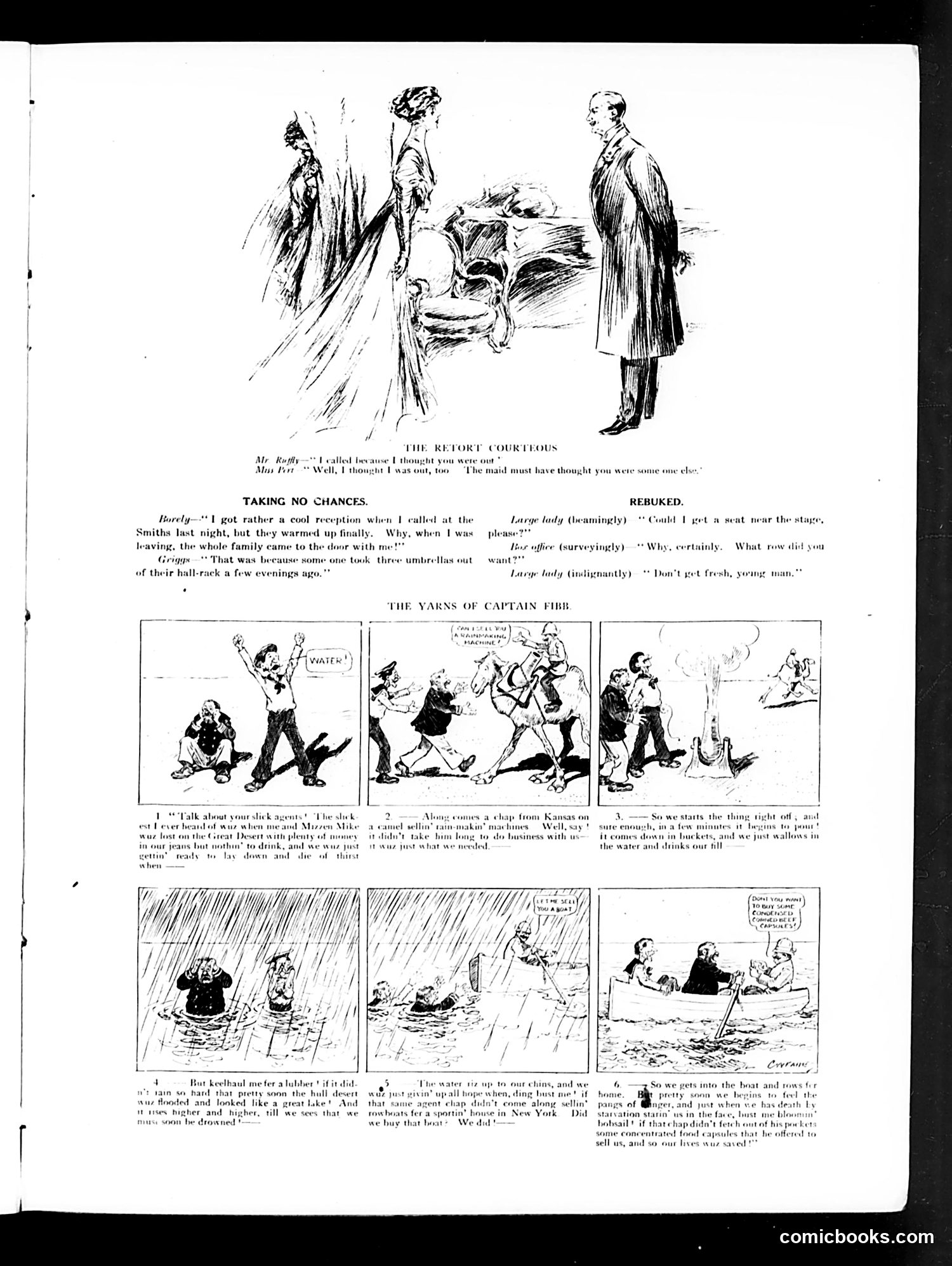
This page contains three separate humor pieces typical of *Judge* magazine's early 20th-century satirical style: **"The Report Courteous"** and **"Taking No Chances"**: Brief comedic vignettes about social awkwardness—a maid confusing visitors, and a man paranoid enough to borrow three umbrellas to avoid being recognized during a visit. **"Rebuked"**: A woman asking an usher for a seat near the stage; he responds cheekily; she insults him for impertinence. The humor relies on class dynamics and servant rudeness. **"The Yarns of Captain Fibb"** (main feature): A multi-panel comic strip depicting a sea captain telling tall tales. The narrative involves exaggerated nautical mishaps—a ship flooding, crew members in water—rendered in slapstick visual style. The humor comes from absurdist disaster scenarios and the captain's implausible storytelling tradition. These pieces reflect period attitudes about social hierarchy, maritime adventure tales, and slapstick comedy conventions popular in early American humor magazines.
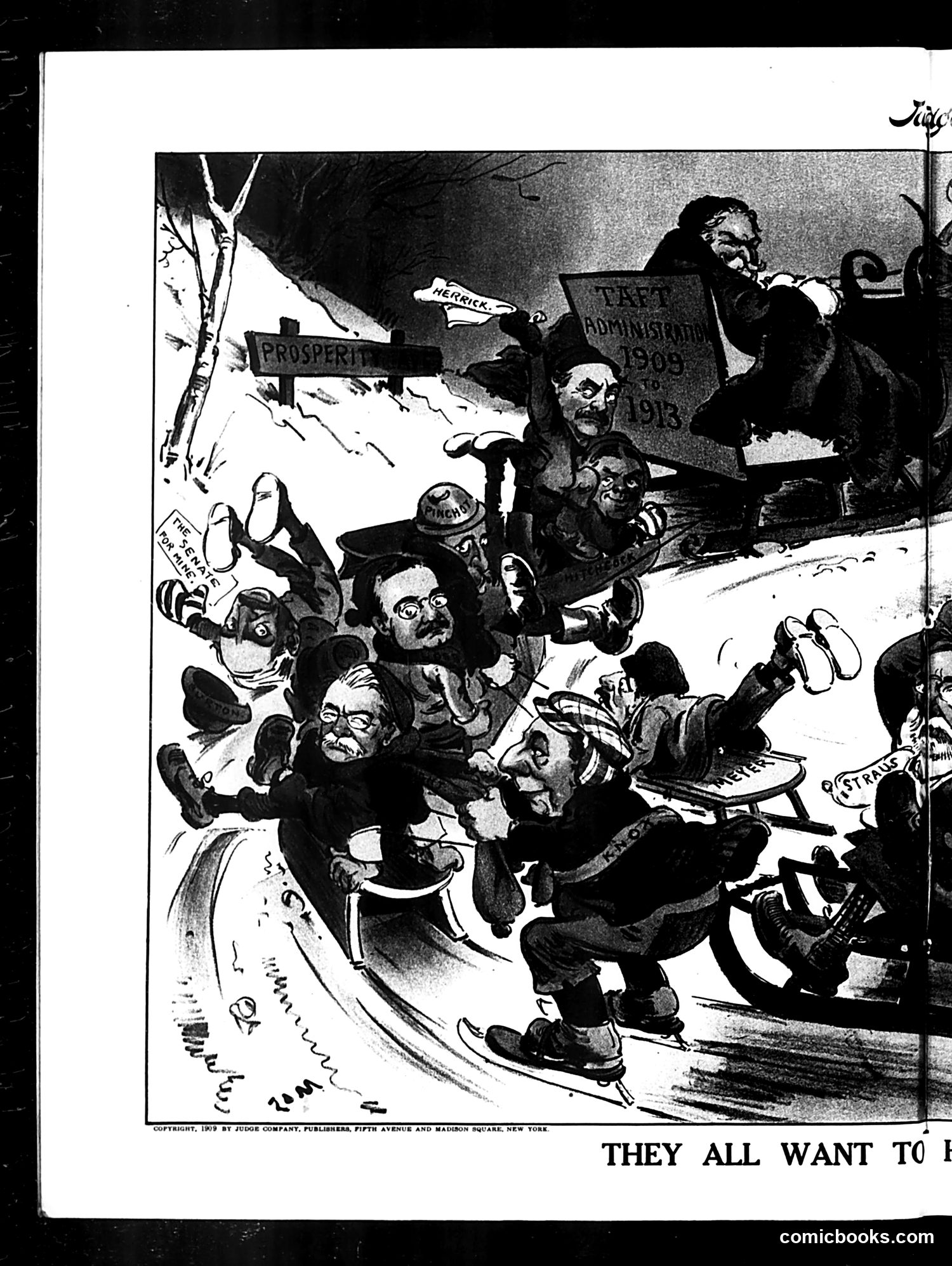
This 1909 *Judge* magazine cartoon titled "They All Want to..." depicts caricatured figures sledding down a snowy slope toward graves marked with dates (1909, 1913 visible). The figures appear to be political or social figures of the era, characterized with exaggerated features typical of period satirical art. The cartoon satirizes competitive ambition or a rush toward death/downfall among prominent contemporaries. The graves suggest inevitability of mortality or political demise. Without clearer identification of specific individuals or the complete caption, the precise targets remain unclear, though the sledding metaphor suggests an uncontrolled, perhaps foolish descent into consequences. The copyright indicates *Judge Company*, Fifth Avenue, New York.
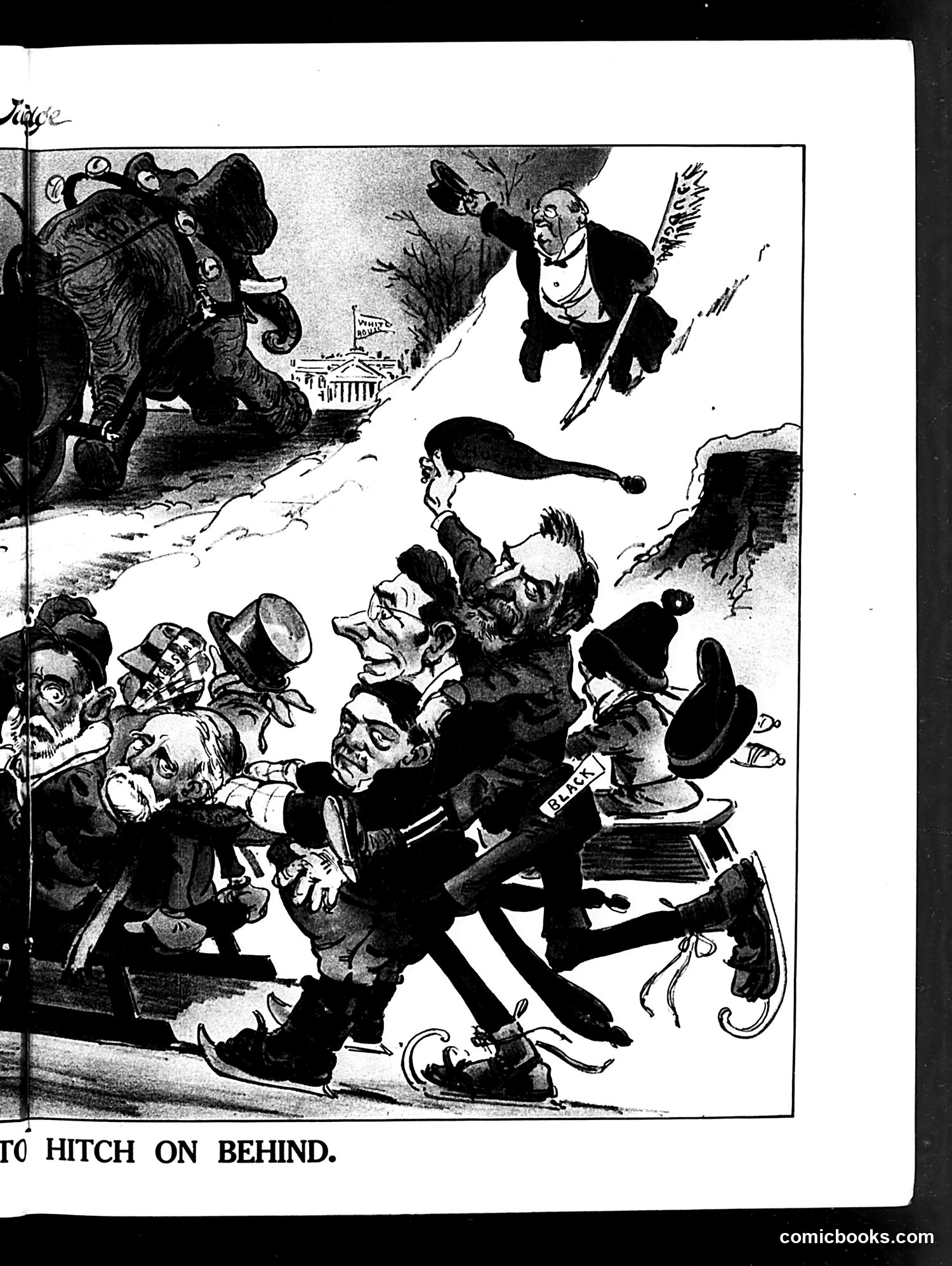
This Judge magazine cartoon depicts a chaotic scene where multiple figures appear to be hitching a ride on or clinging to a central character in formal dress. The composition suggests political opportunism—various individuals desperately grasping onto someone perceived as powerful or advantageous. The elephant visible in the upper left suggests Republican Party politics. The well-dressed figure being mobbed likely represents a political leader or policy the cartoonist views as attractive to self-interested parties. The "hitch on behind" caption emphasizes the parasitic nature of the depicted behavior. Without visible dates or clearer labels, the specific political moment remains unclear, but the satire targets opportunistic political actors exploiting a popular figure or initiative for personal gain.
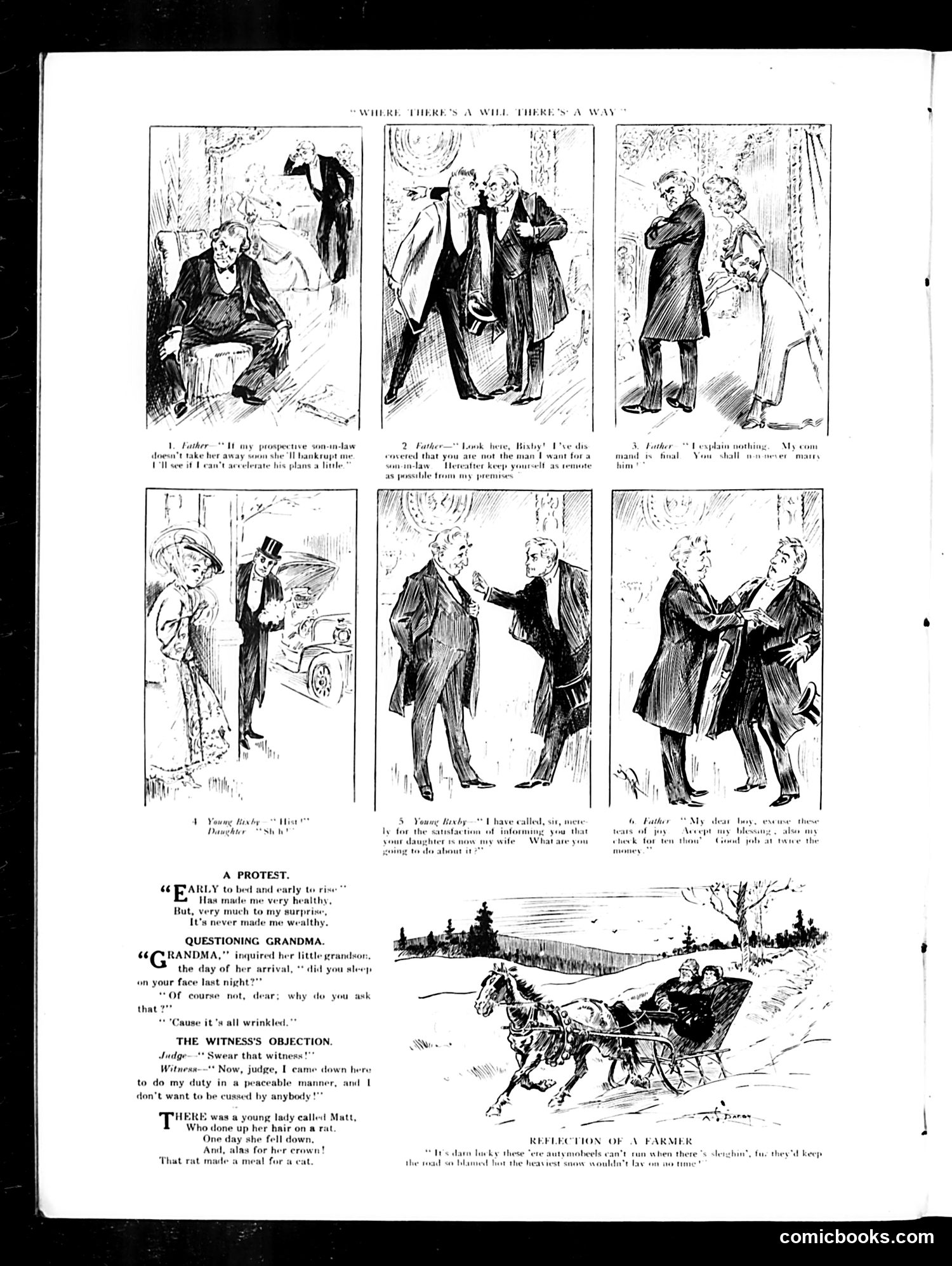
This comic strip depicts a father preventing his daughter's marriage. The narrative shows a father discovering his daughter's romantic plans, confronting her suitor, and ultimately forbidding the union—illustrating the paternal authority common in early 20th-century courtship narratives. Below are three separate jokes: **"A Protest"** satirizes the saying "early to bed, early to rise makes one healthy, wealthy, and wise"—the speaker notes it made him healthy but surprisingly *not* wealthy, questioning folk wisdom. **"Questioning Grandma"** is a children's joke where a grandson innocently asks if grandmother slept on her face, then observes her wrinkled skin, implying causation through crude child logic. **"The Witness's Objection"** jokes about courtroom decorum: a witness objects to being sworn in because he came "in a peaceable manner" and doesn't want to be "cussed by anybody"—playing on the formal language of oaths.
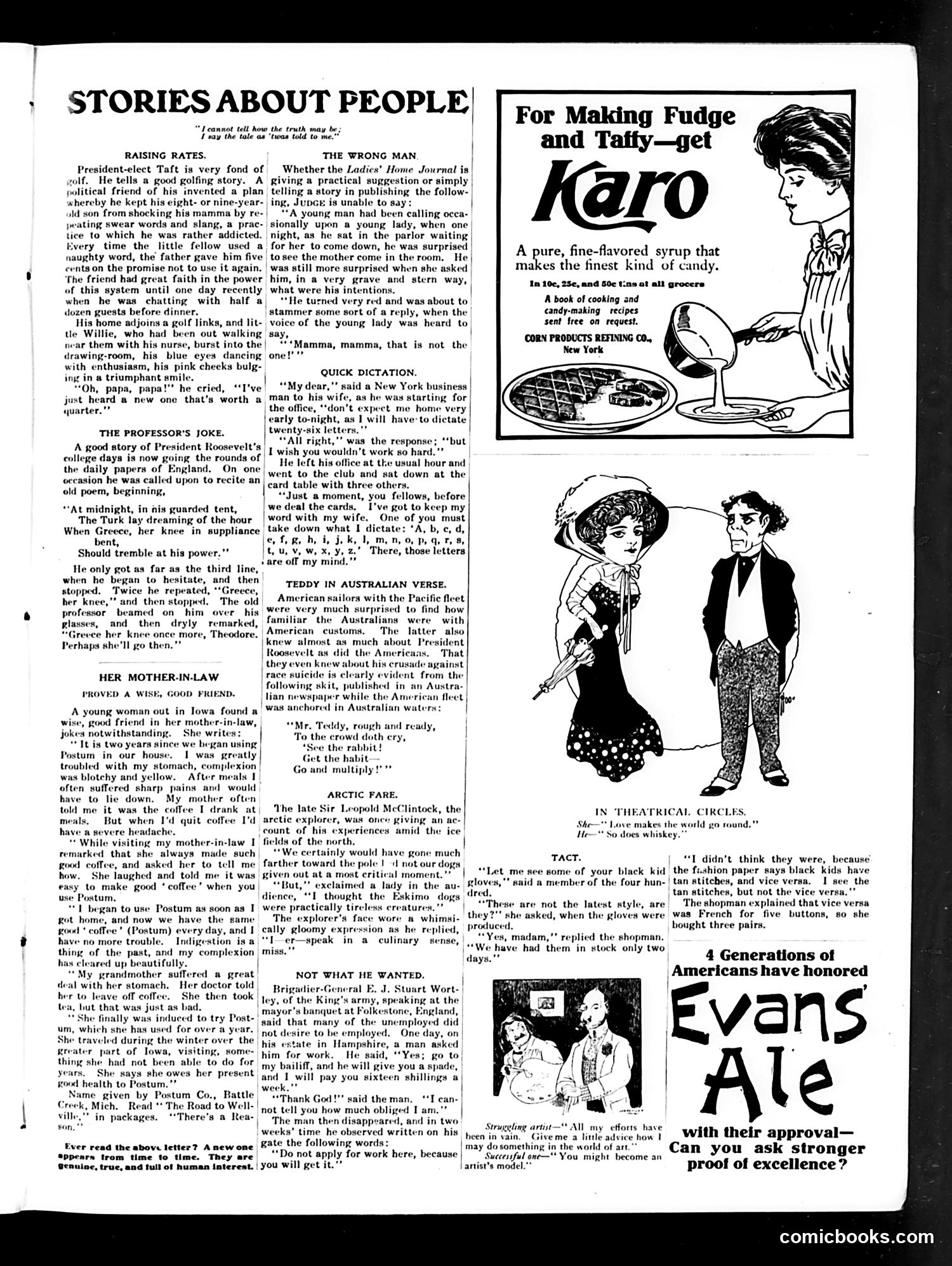
This page from *Judge* magazine (early 1900s) contains several satirical stories and an advertisement: **"Raising Rates"** mocks President-elect Taft's parenting strategy: paying his young son five cents not to swear. The joke's punchline arrives when the boy, having learned more profanity from his nurse, tries to "sell" this new vocabulary back to his father—implying the economic incentive has backfired spectacularly. **"The Wrong Man"** satirizes a young suitor confronted by his girlfriend's mother asking about his intentions. The interruption by the couple's young child repeating alphabet letters (the wife's "dictation" from her husband at his club) creates confusion about whose intentions are being questioned. **"The Professor's Joke"** depicts a professor's amusement when a student repeatedly stumbles reciting a poem beginning "Greece, her knee"—a mild sexual innuendo joke playing on the student's embarrassment. The remaining brief anecdotes employ similar gentle, domestic humor typical of early-1900s middlebrow American satire. The **Karo syrup advertisement** uses a woman demonstrating candy-making, appealing to domestic housewives.
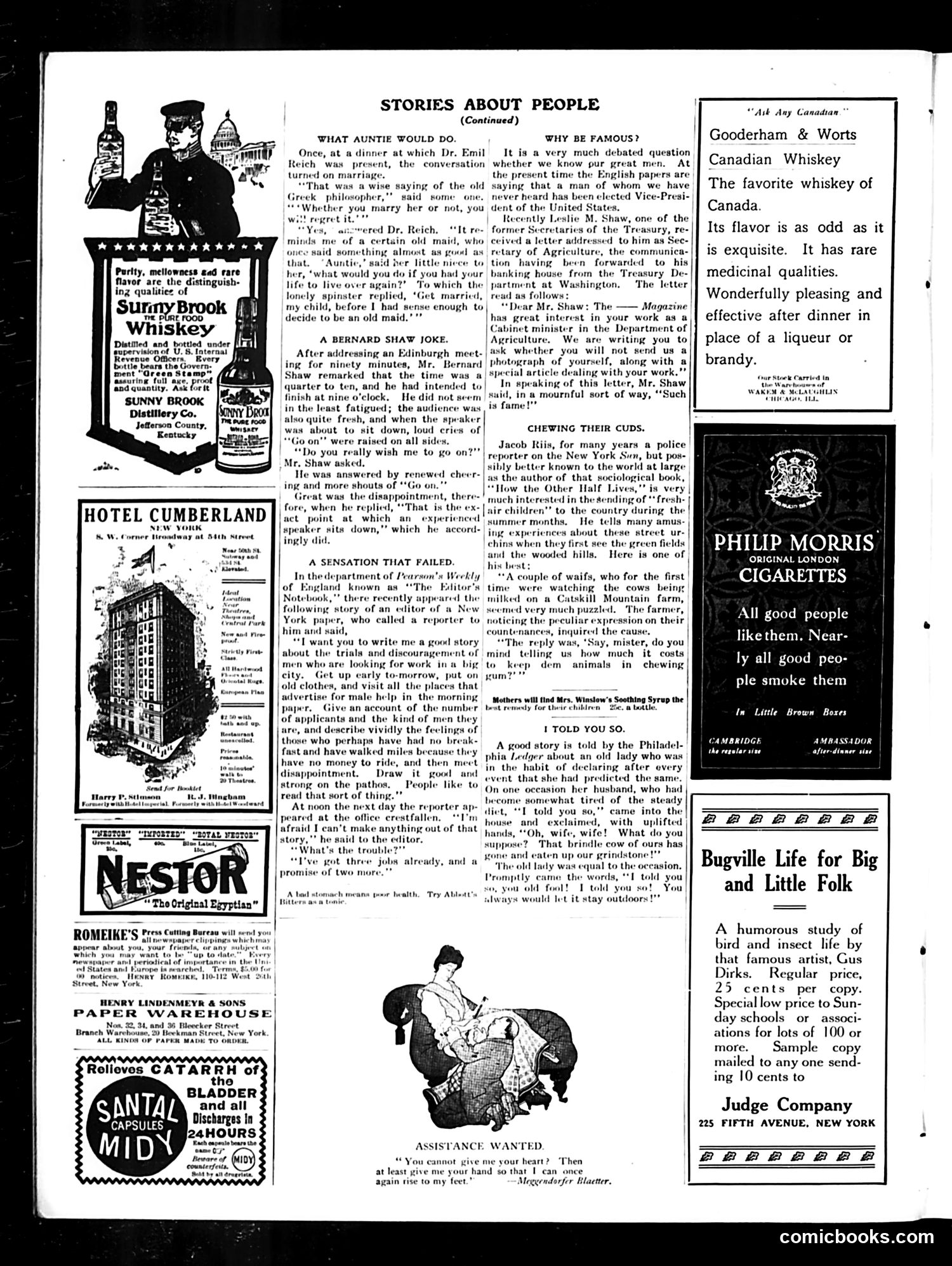
This page from the satirical magazine Judge contains several humorous anecdotes mocking American social pretensions and bureaucratic incompetence. **"What Auntie Would Do"** presents a dated joke about unmarried women, presenting spinsterhood as inherently regrettable—reflective of early 20th-century attitudes dismissing women's autonomy. **"A Bernard Shaw Joke"** satirizes the famous playwright's long-windedness: after speaking ninety minutes, Shaw ironically refuses audience requests for more, suggesting his self-importance exceeds his actual contribution. **"Chewing Their Cuds"** mocks rural innocence through city children's confusion about farm economics, implying urban sophistication versus rural simplicity. **"A Sensation That Failed"** ridicules newspaper editors' manipulative assignment of "human interest" stories—an early critique of sensationalist journalism. The page is primarily advertisements (Sunny Brook Whiskey, Hotel Cumberland, Philip Morris Cigarettes) interspersed with these brief satirical pieces targeting pretension, gender expectations, and media exploitation typical of Judge's social commentary.
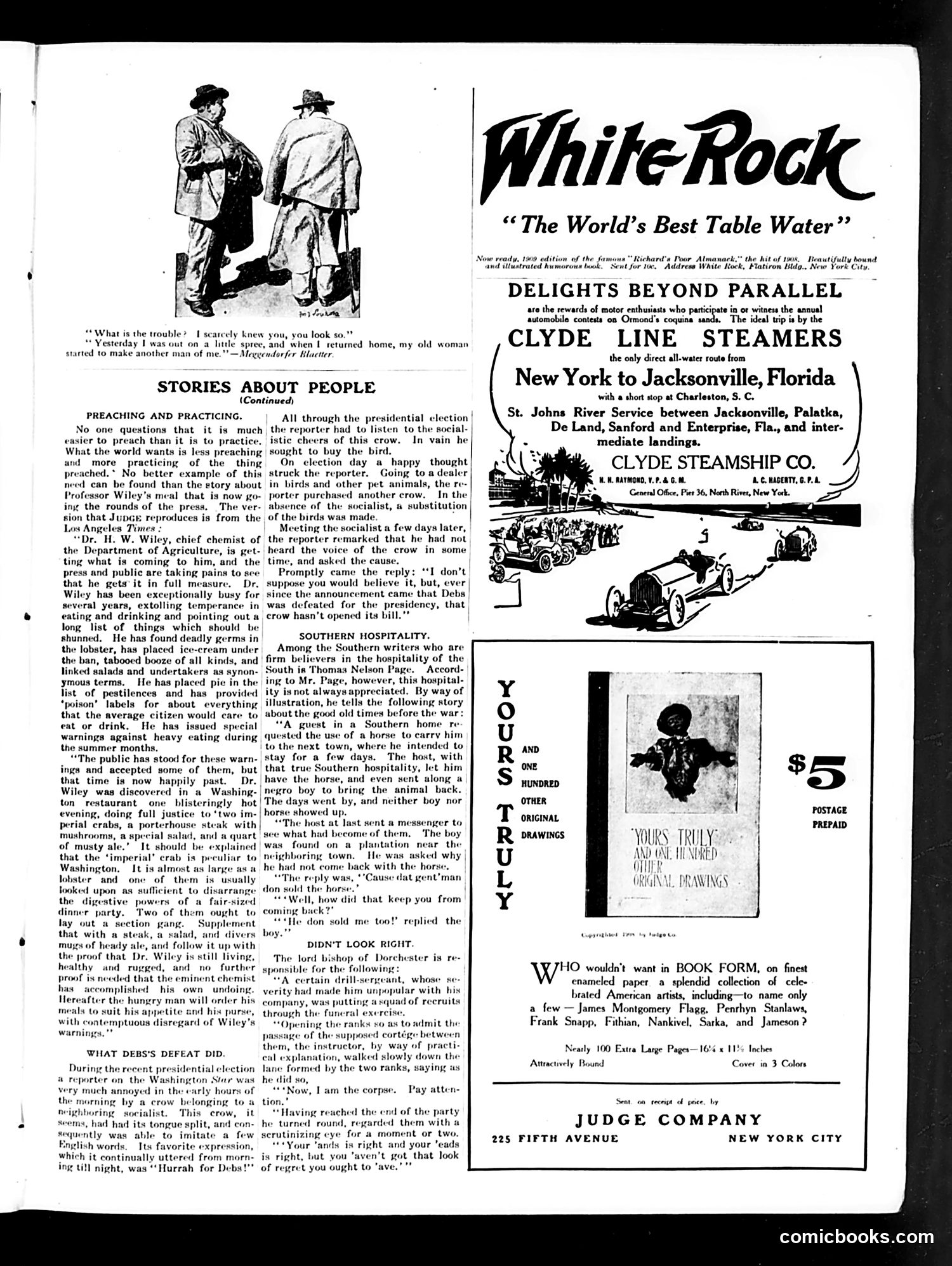
This page contains three distinct satirical pieces: 1. **"Preaching and Practicing"**: A joke about a socialist who owns a crow that stops singing after learning Eugene Debs lost the presidential election. The satire mocks socialists' emotional investment in politics. 2. **"Southern Hospitality"**: A Thomas Nelson Page story satirizing antebellum Southern hospitality myths. A guest's borrowed horse and enslaved boy never return; the boy was sold along with the horse. The dark humor critiques romanticized portrayals of the "Old South" by exposing slavery's brutal reality beneath the hospitality facade. 3. **"What Debts Defeat Did"**: A brief anecdote about a crow-owning politician's embarrassment when his bird mimics his political rhetoric. The overarching theme: **hypocrisy between stated values and actual behavior**—whether political sincerity, regional courtesy, or dietary preaching. The advertisements (White Rock water, Clyde steamships, Judge Company books) are secondary content on this page.
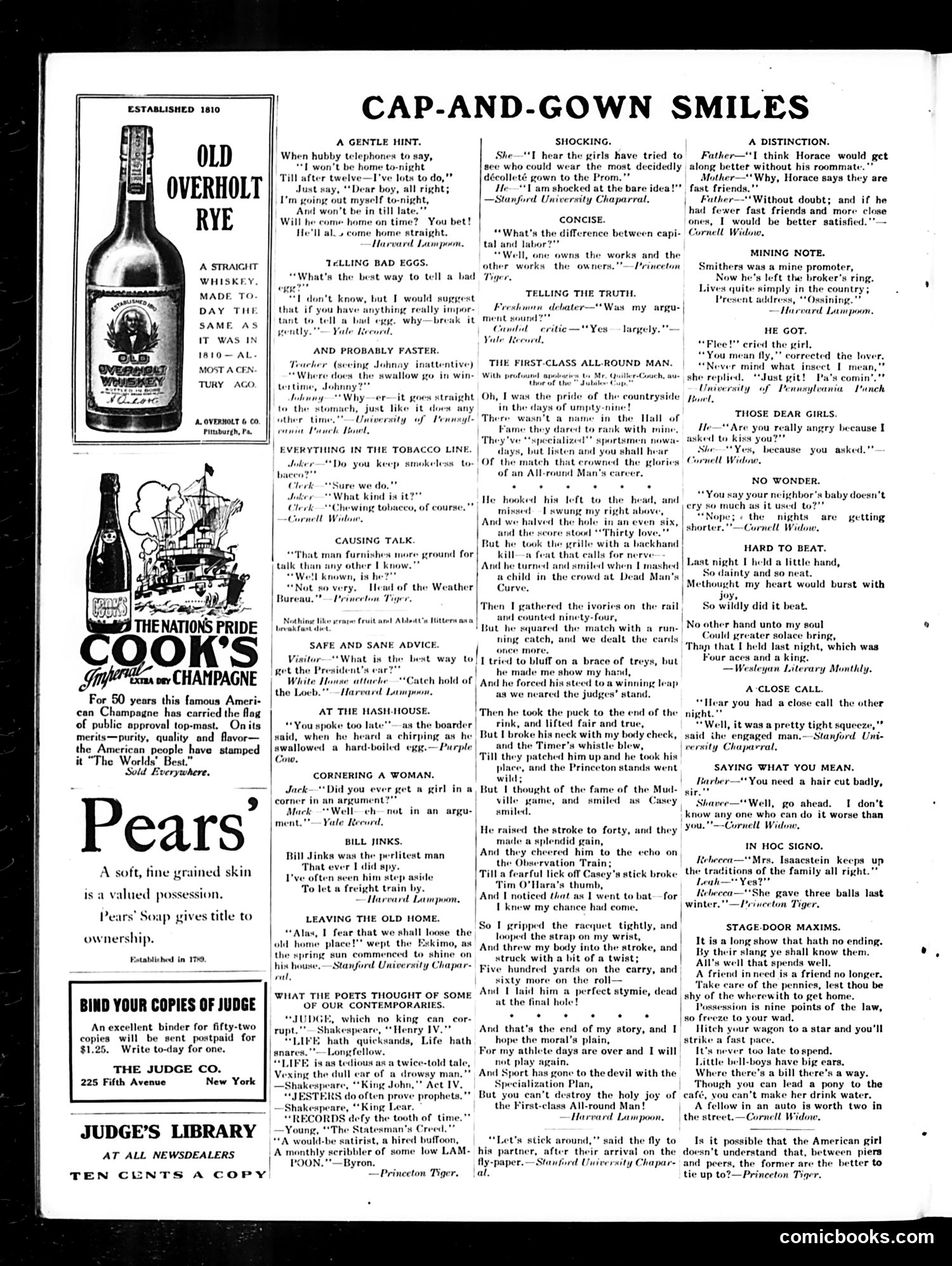
This page from *Judge* magazine consists primarily of **humorous one-liners and short jokes** rather than political cartoons. The content targets college and university life, appearing to compile jokes from various campus publications (Stanford Chaparral, Yale Record, Princeton Tiger, Harvard Lampoon, Cornell Widow, etc.). The humor reflects early 20th-century collegiate concerns: romantic entanglements, academic performance, gender relations, and social etiquette. Jokes about "décolleté gowns" at proms, debate club arguments, and golf outings reflect upper-class student life. The repeated references to universities suggest this was aimed at educated, affluent readers familiar with Ivy League culture. The sidebar advertisements for Old Overholt Rye, Cook's Champagne, and Pears Soap indicate the magazine's upscale audience. There is **no overt political satire** on this particular page—the humor is social and romantic rather than topical or partisan.
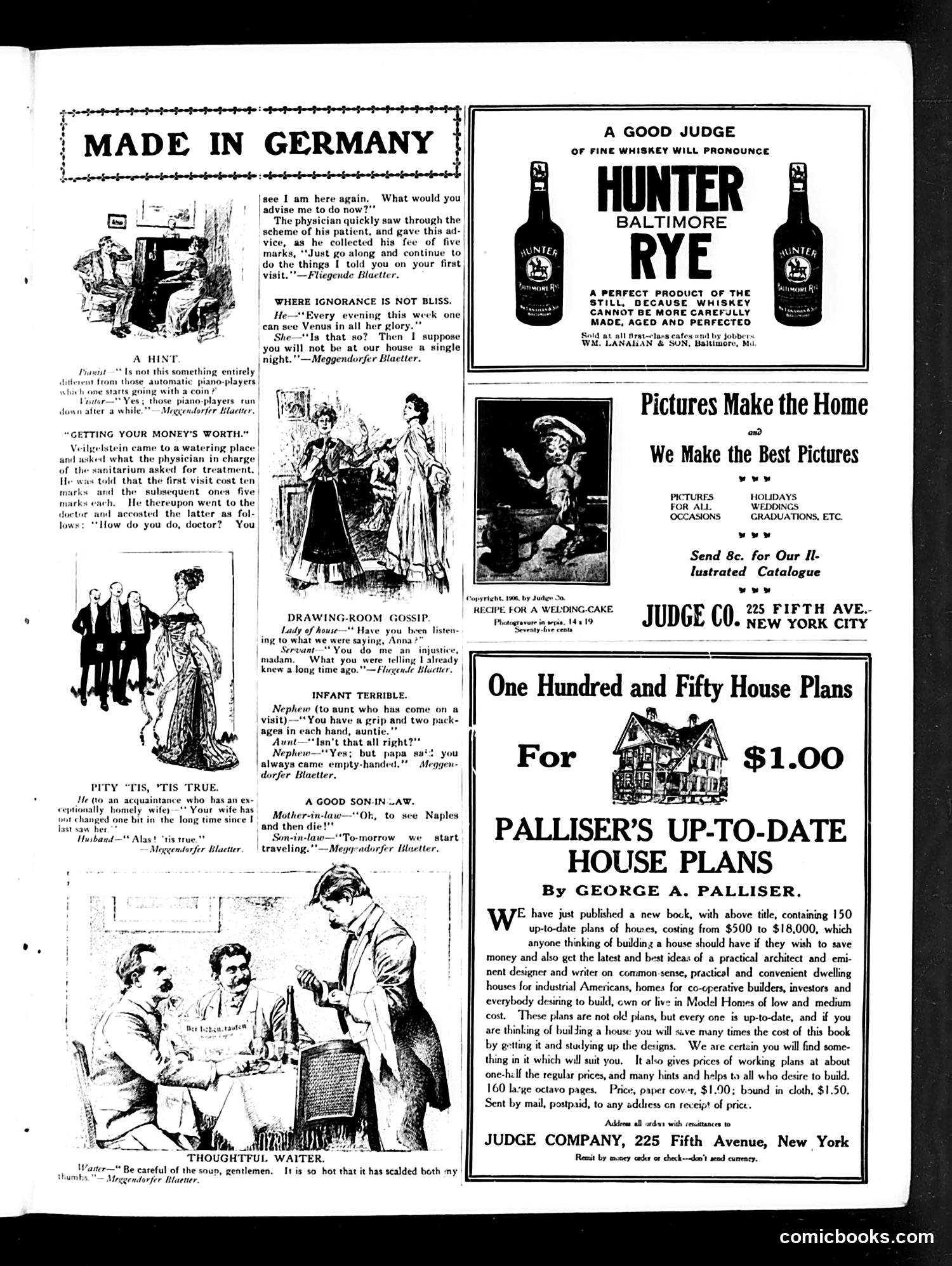
This page from *Judge* (a satirical weekly) mixes short humor pieces with advertisements. The left side contains reprinted jokes from *Fliegende Blätter*, a German humor magazine—indicated by the "MADE IN GERMANY" header. These brief comedic anecdotes mock human foibles: a patient seeking free medical advice, a couple's misunderstanding about seeing Venus, servants who overhear gossip, and social pretensions. The right side features advertisements for Hunter Baltimore Rye whiskey, Judge Company's picture frames, and Palliser's house-plan books ($1.00)—typical commercial content for the era. The satire is gentle rather than political, targeting universal human behaviors: medical consultation schemes, domestic awkwardness, class dynamics between employers and servants, and consumer culture. The German reprints suggest early 20th-century transatlantic cultural exchange in humor publications. The overall page reflects *Judge*'s typical format: light social comedy paired with commercial appeals to middle-class readers.
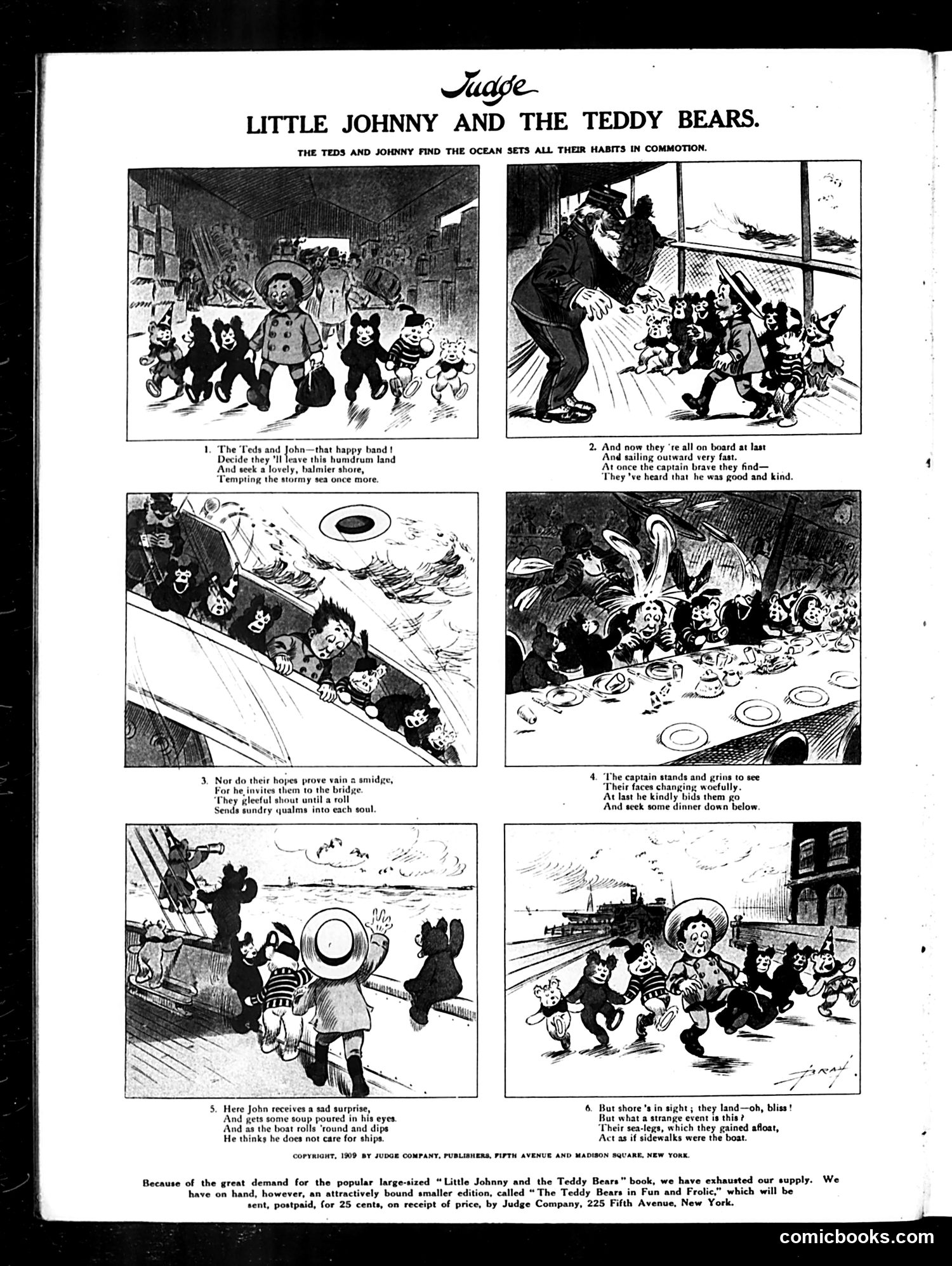
This 1909 Judge comic strip depicts a boy named Johnny and anthropomorphic teddy bears embarking on a seaside adventure. The narrative follows their boat journey: they leave home for the ocean, board a ship, meet a kind captain, experience seasickness and dining mishaps below deck, and finally arrive ashore where their "sea-legs" cause them to stumble on solid ground. The humor relies on physical comedy and the contrast between the characters' expectations and reality—seasickness, soup accidents, and the disorienting effects of sea travel. The "teddy bears" reference likely alludes to the popular stuffed toy craze of the early 1900s (named after President Theodore Roosevelt). There's no apparent political satire here; this appears to be straightforward children's entertainment comic strip with gentle, slapstick humor. The page also advertises a smaller, bound edition of the story available for 25 cents.