
A complete issue · 17 pages · 1908
Judge — December 26, 1908
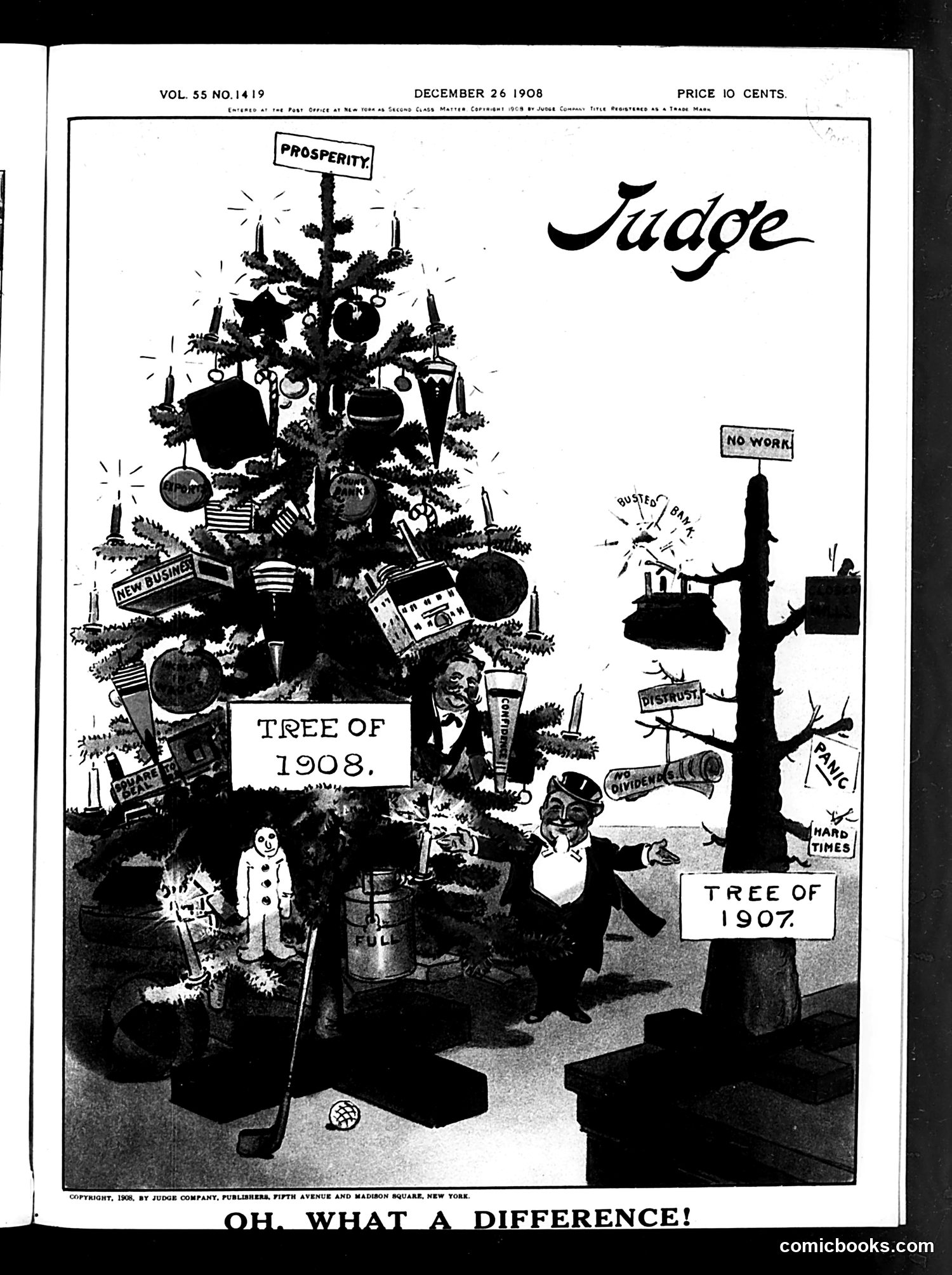
This two-panel cartoon compares prosperity in 1908 versus 1907, using Christmas trees as metaphor. The **left panel ("Tree of 1908")** shows a flourishing tree laden with ornaments labeled "New Business," "Dividends," "Prosperity," and other positive economic indicators, decorated with figures enjoying abundance. The **right panel ("Tree of 1907")** depicts a bare, dead tree bearing labels for "No Work," "Busted," "Panic," "Hard Times," and "Distrust." It's barren and desolate. The caption "Oh, What a Difference!" emphasizes the stark contrast. This reflects the **1907 financial panic and subsequent recovery**, celebrating 1908's economic improvement. The cartoon presents an optimistic view of American economic conditions as the year ends.
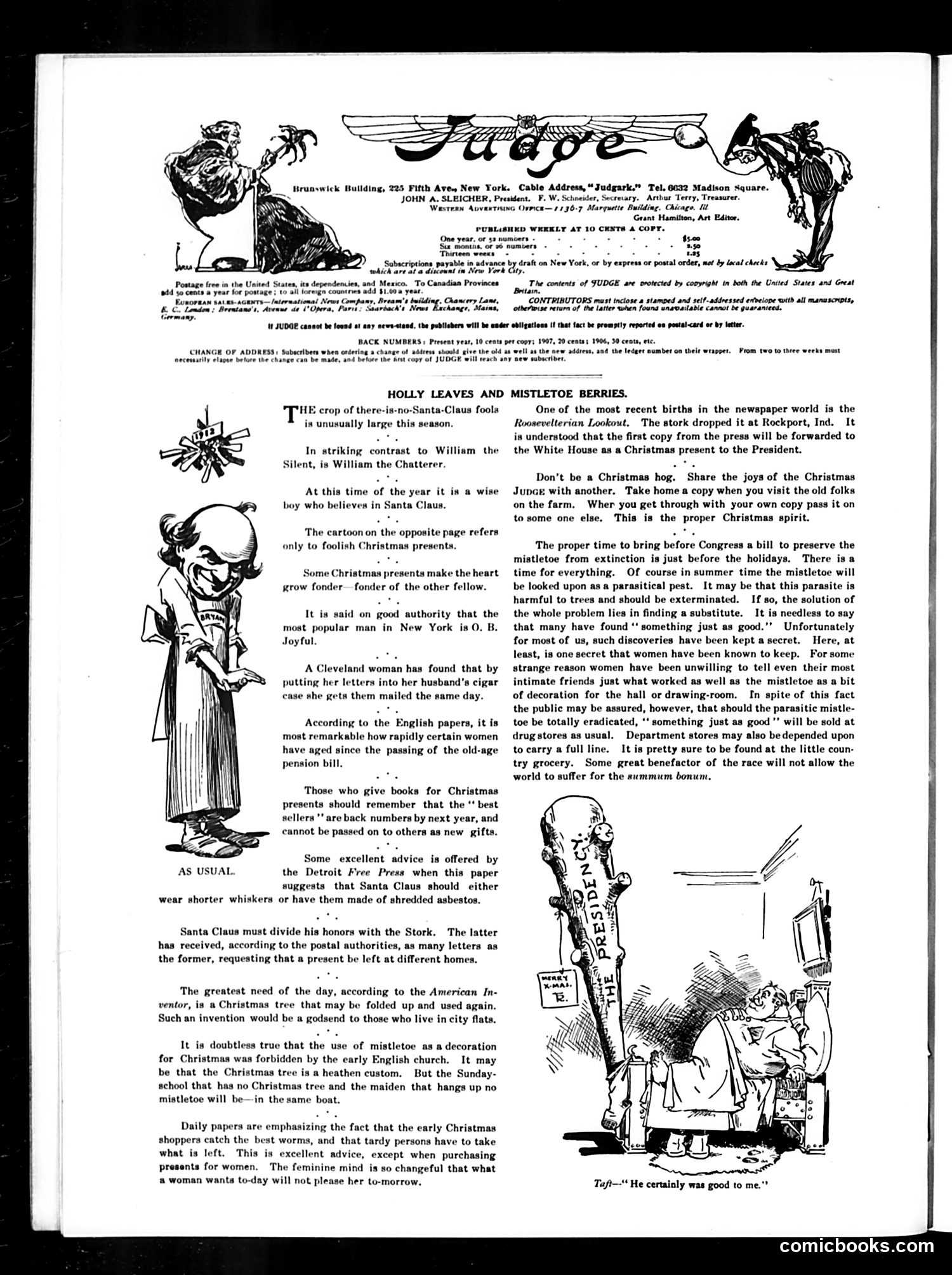
This page offers seasonal social commentary through humorous vignettes. The main article satirizes Christmas customs and gift-giving practices of the era, with particular jabs at: - **Santa Claus mythology** - advising skepticism about belief in Santa - **Gift-giving absurdities** - criticizing impractical presents and "best sellers" that won't appeal next year - **Mistletoe tradition** - suggesting it's parasitic and should be eradicated, though acknowledging its persistent social use - **Gender dynamics** - mocking women's changing preferences in gifts and fashion whims - **Urban life** - commenting on Christmas shopping challenges in city flats The accompanying illustrations feature caricatured figures, including what appears to be a tall, skeletal character labeled "He certainly was good to me," likely representing hardship or misfortune personified during the holiday season.
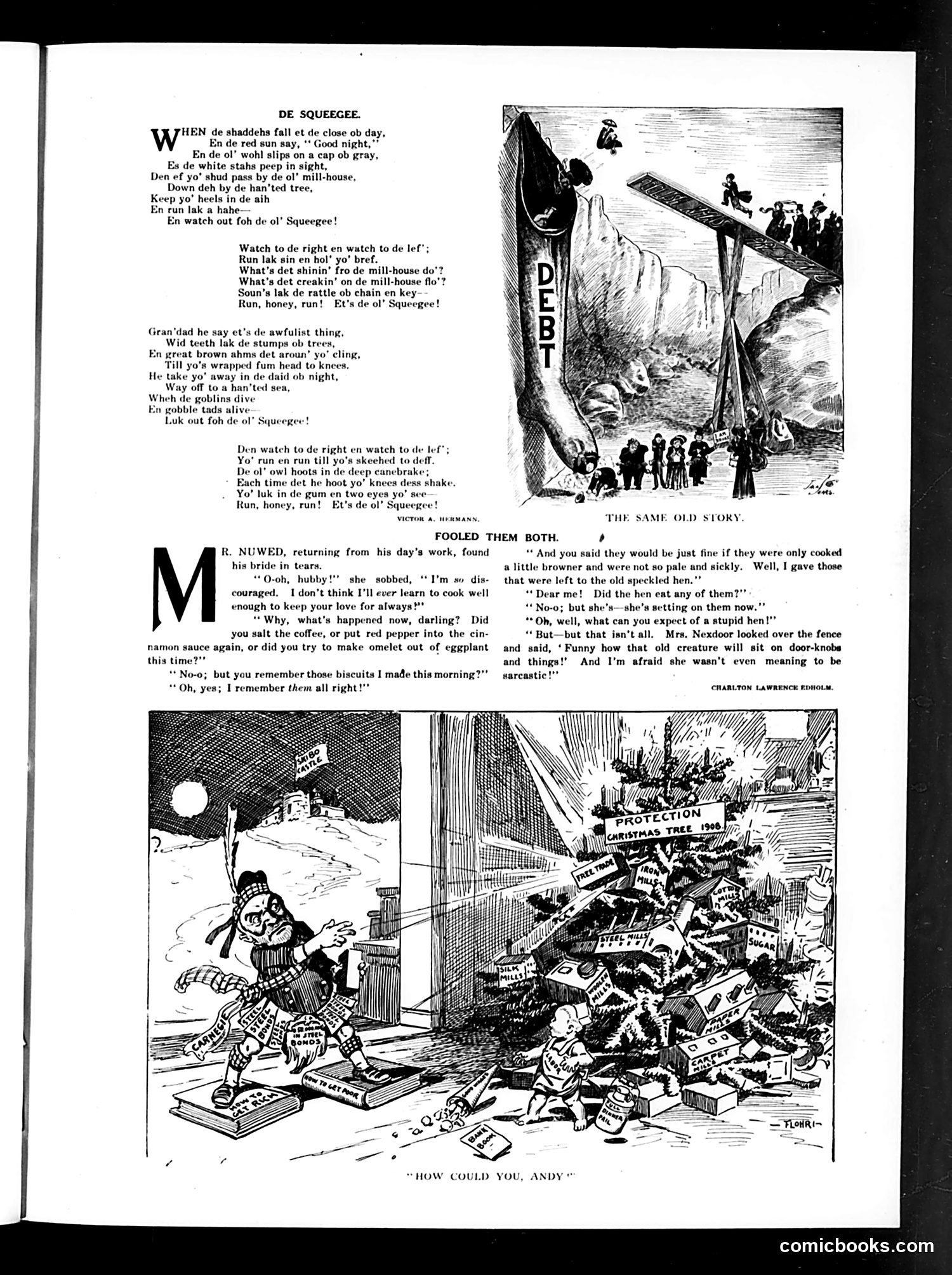
This page contains a poem "De Squeegee" (top left) and two cartoons satirizing domestic incompetence. **"Fooled Them Both"** (center) depicts a husband returning home to find his bride in tears over failed cooking—she burned eggplant and couldn't make biscuits. The joke hinges on the wife's admitted incompetence at household tasks, with the husband sarcastically suggesting she's "stupid" for basic cooking failures. This reflects early-20th-century domestic humor mocking women's housekeeping abilities. **"How Could You, Andy?"** (bottom) appears to show someone (possibly labeled "Andy") amid scattered toys and Christmas items, suggesting domestic chaos or parental negligence regarding child safety or gift organization. Both cartoons target domestic life humor common to Judge's readership, though the specific topical references are unclear without additional context.
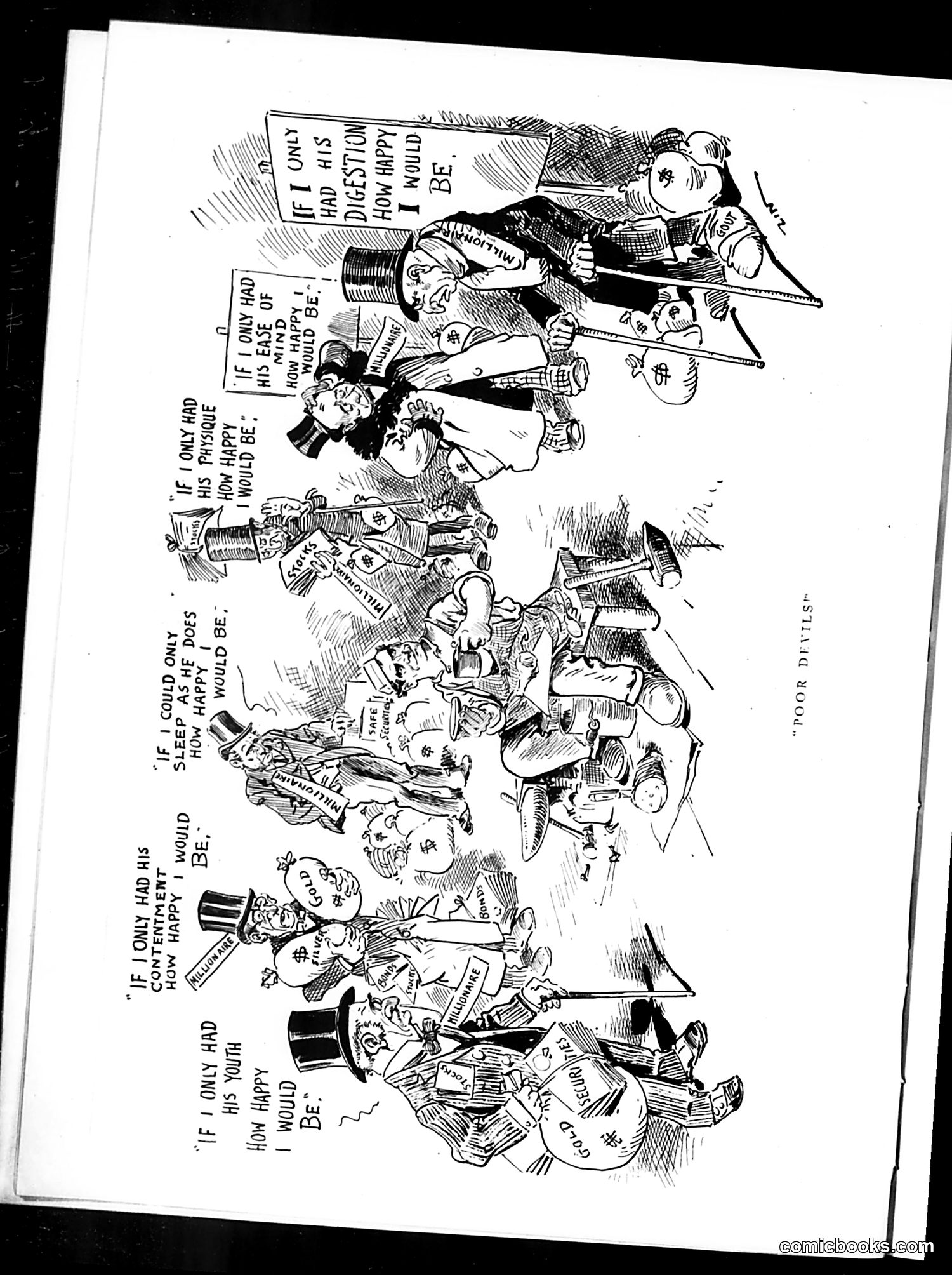
This is a satirical cartoon criticizing wealthy industrialists and financiers during the Gilded Age. The title "Poor Brittle" appears to reference a prominent figure (likely a businessman or financier, though the specific identity isn't entirely clear from the image alone). The cartoon depicts a top-hatted wealthy man surrounded by various social problems and needy figures—poor children, unemployed workers, and others in distress. The satire contrasts the man's wealth (shown through his fine clothing and money bags) with the poverty surrounding him, suggesting indifference to or responsibility for social inequality. The repeating conditional statements ("If I only had," "If I could only," etc.) likely mock his claimed inability to help despite obvious wealth, satirizing the rationalization wealthy individuals used to justify not addressing poverty during this era.
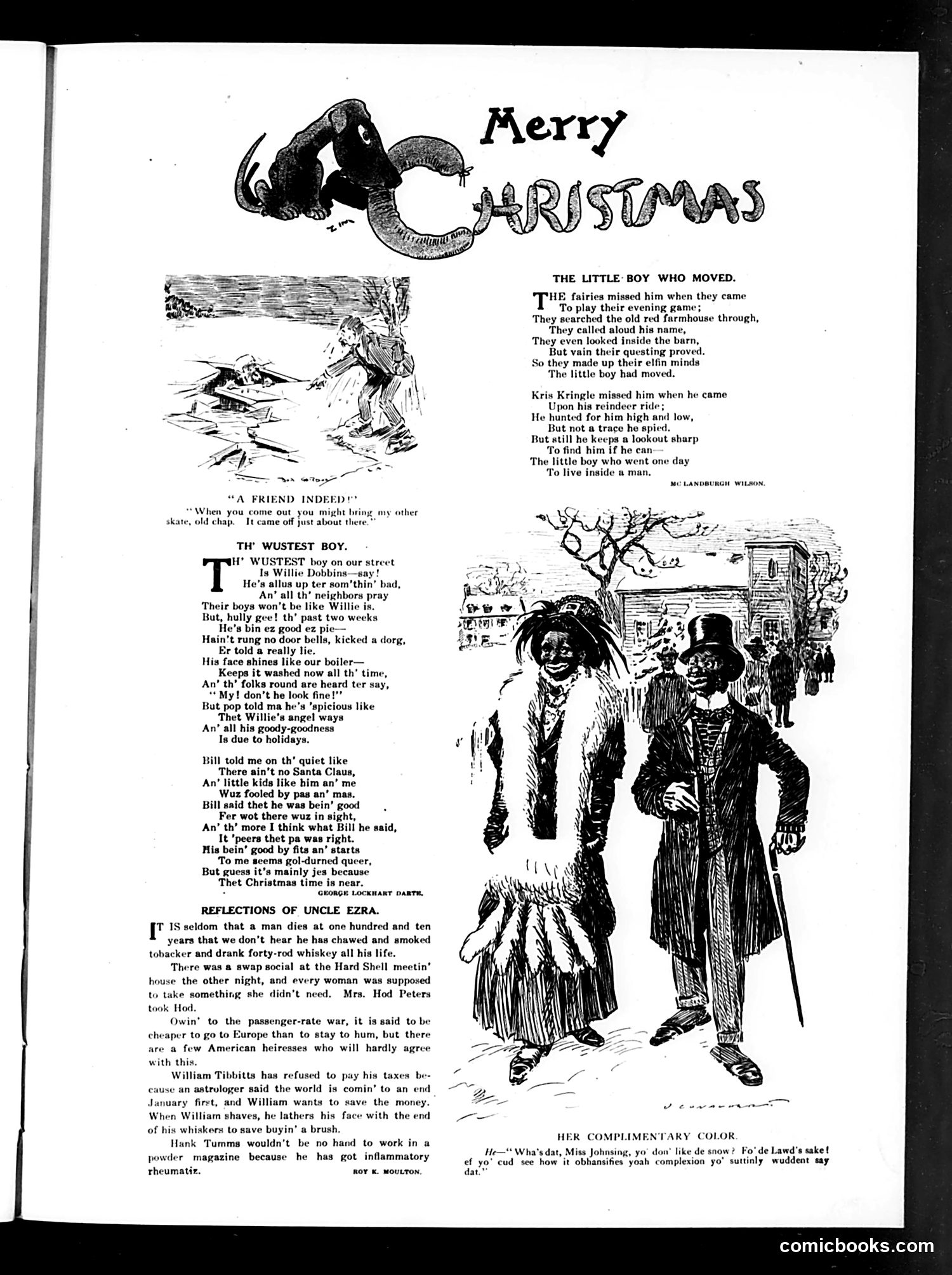
This appears to be a Christmas-themed editorial page from Judge magazine, featuring several pieces of satirical content: **"The Little Boy Who Moved"** and **"The Wustest Boy"** are sentimental poems with accompanying illustrations—likely gentle social commentary on childhood behavior and family dynamics rather than sharp political satire. **"Reflections of Uncle Ezra"** contains social commentary on contemporary issues: men dying at 110 after lives of tobacco and whiskey; the passenger-rate war (likely referring to shipping/railroad competition); William Tibbits refusing taxes because the world is ending; and Hank Tumma's inflammatory rheumatism preventing magazine work. **"Her Complimentary Color"** appears to be a racist dialect joke about skin tone. The page mixes sentimental holiday content with period-typical crude social commentary and ethnic humor.
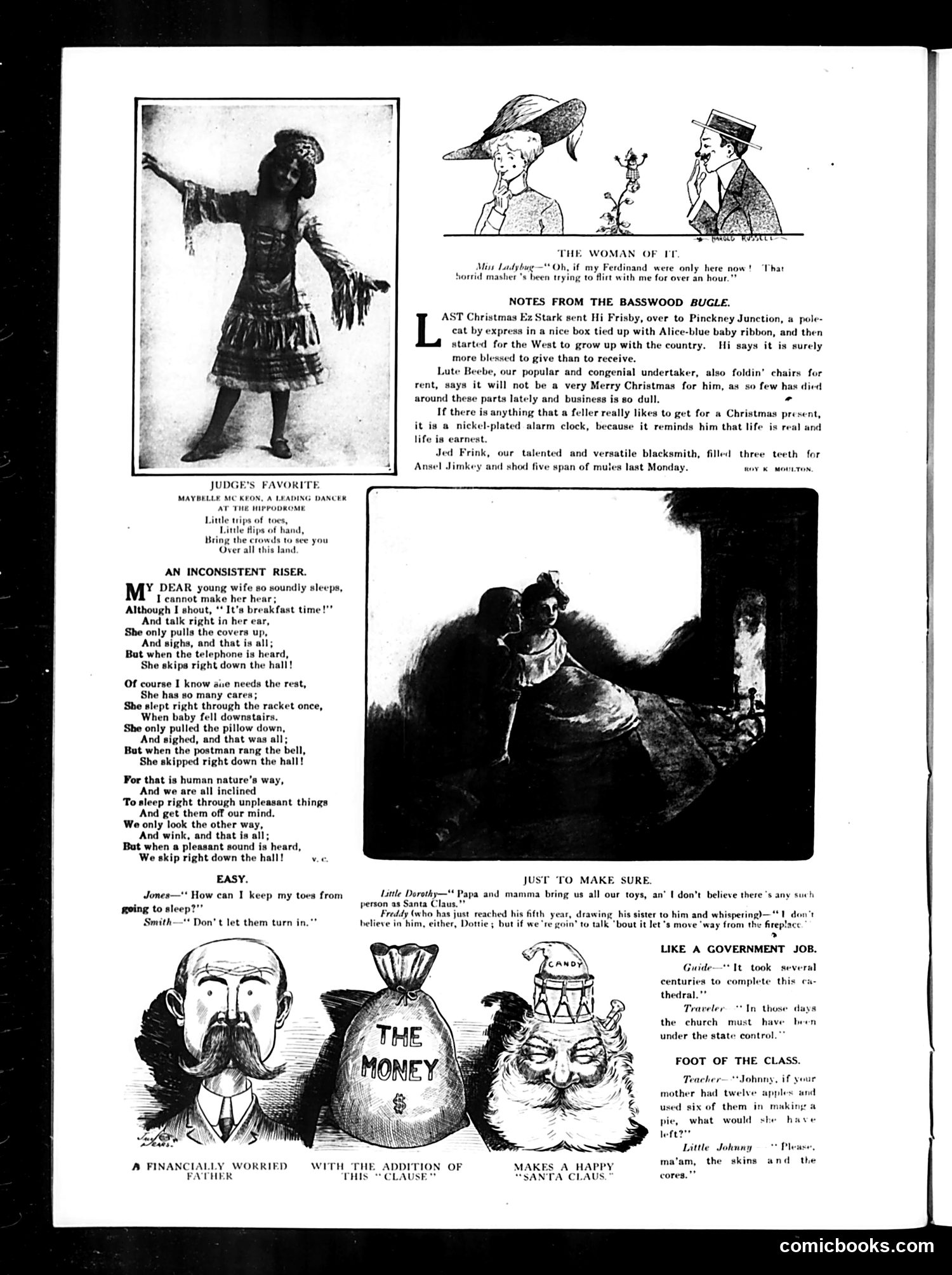
This page from the satirical magazine *Judge* contains several humor pieces and cartoons typical of early 20th-century American comedy: **"The Woman of It"** satirizes flirtation and social etiquette—a woman complains about an unwanted "masher" (aggressive suitor) pestering her. **"Notes from the Basswood Bugle"** presents rural Americana humor: small-town gossip about locals like an undertaker whose business is slow, and a polecat gift sent west. **"An Inconsistent Riser"** mocks wives who sleep through domestic chaos (babies falling downstairs, babies crying) but wake instantly for pleasant sounds—critiquing selective female attention and priorities. The cartoon trio at page bottom uses exaggerated facial features to joke about financial worry, adding a "money clause" to marriage, and Santa Claus—likely commenting on commercialization and economic anxieties of the era. **"Foot of the Class"** contains a children's joke about apple pie remnants. The overall tone reflects period attitudes toward gender, rural life, and consumer culture.
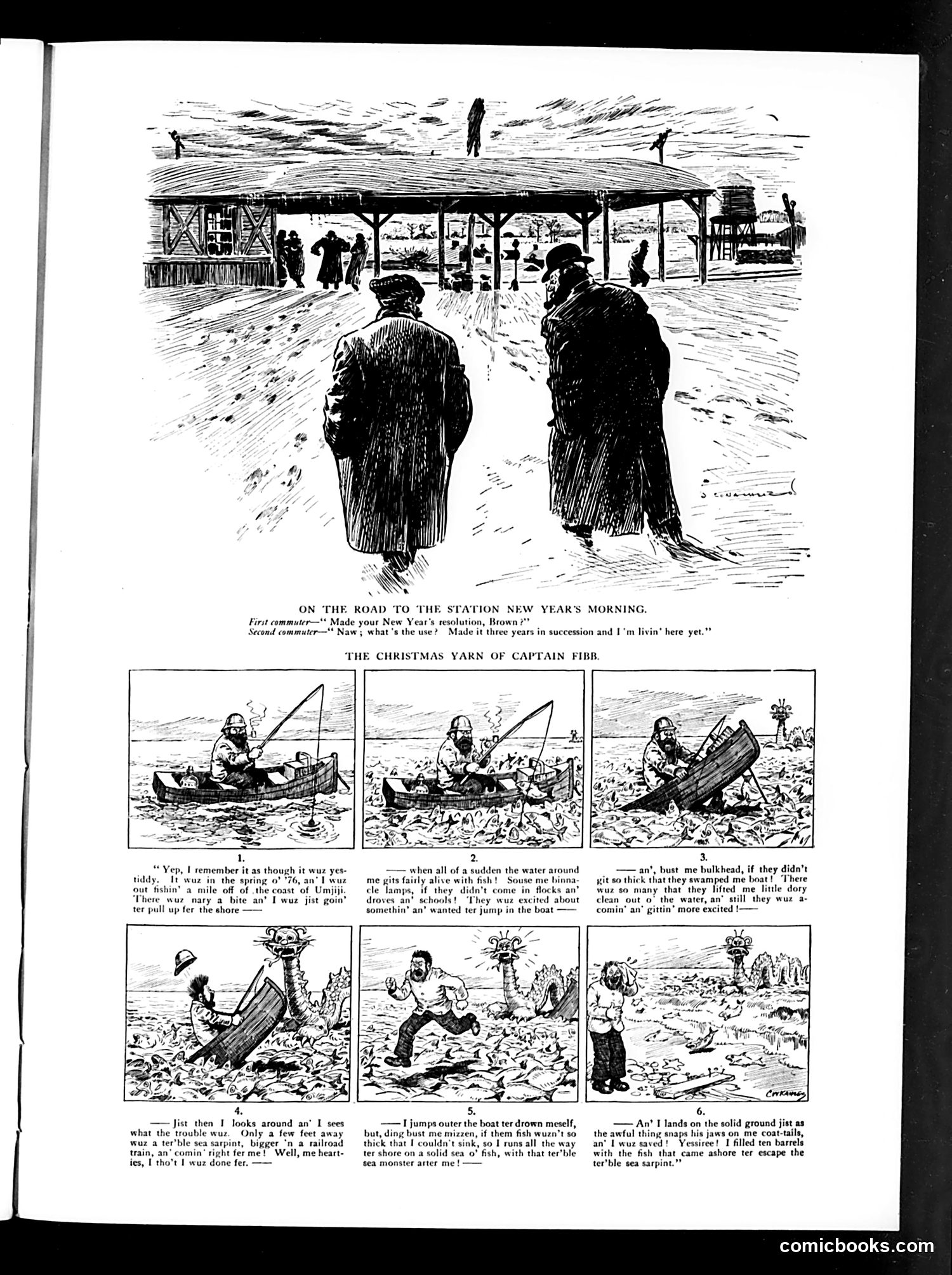
This Judge page contains two distinct pieces: **Top cartoon**: Two commuters walking to the station on New Year's morning. The joke satirizes the futility of New Year's resolutions—one commuter admits he's made the same resolution three years running without success, implying the grim routine of commuter life makes self-improvement impossible. This reflects early-20th-century urban anxiety about monotonous, soul-crushing commuting. **Bottom feature**: "The Christmas Yarn of Captain Fibb" is a tall tale told in six illustrated panels. An old sea captain recounts an exaggerated fishing story involving impossible catches, a sea serpent, and fish so numerous they form a solid path to shore. This is pure comic exaggeration—a humorous maritime tall tale in the tradition of American frontier storytelling, with no political message intended.
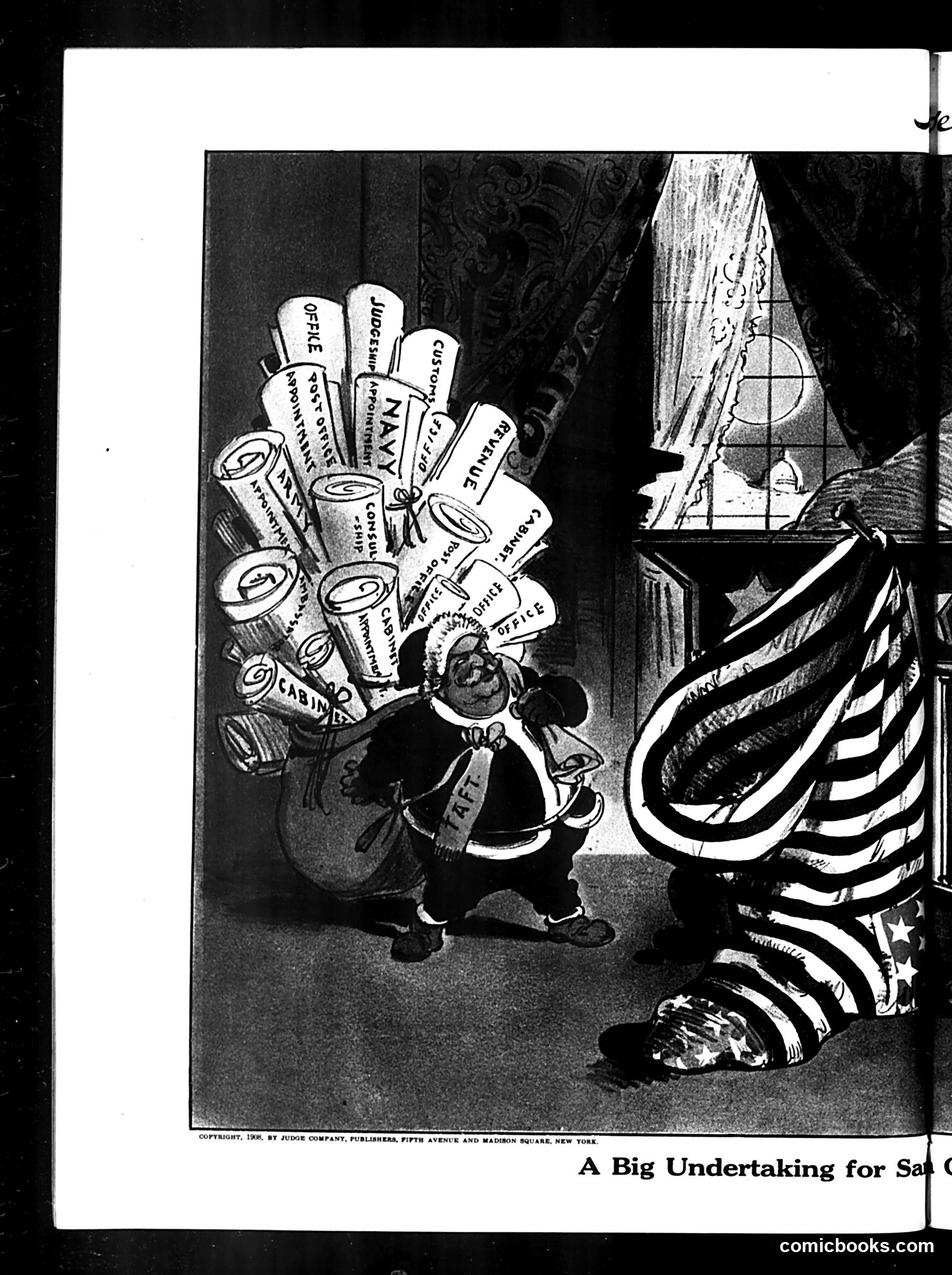
This 1908 Judge magazine cartoon depicts a small figure (appearing to be Uncle Sam, identifiable by the top hat) confronting an enormous hand emerging from what looks like a government building or office. The hand is labeled with various government departments and offices (visible text includes "NAVY," "OFFICE," "CARE," and others), suggesting bureaucratic overwhelm. The title "A Big Undertaking for Sa[m]" (Sam being Uncle Sam) suggests the cartoon satirizes the difficulty of managing or controlling the sprawling federal government apparatus. The small figure dwarfed by the giant bureaucratic hand represents how unwieldy American government had become by the early 1900s—a common Progressive Era critique. The joke mocks the challenge of governmental oversight and efficiency during this period of institutional expansion.
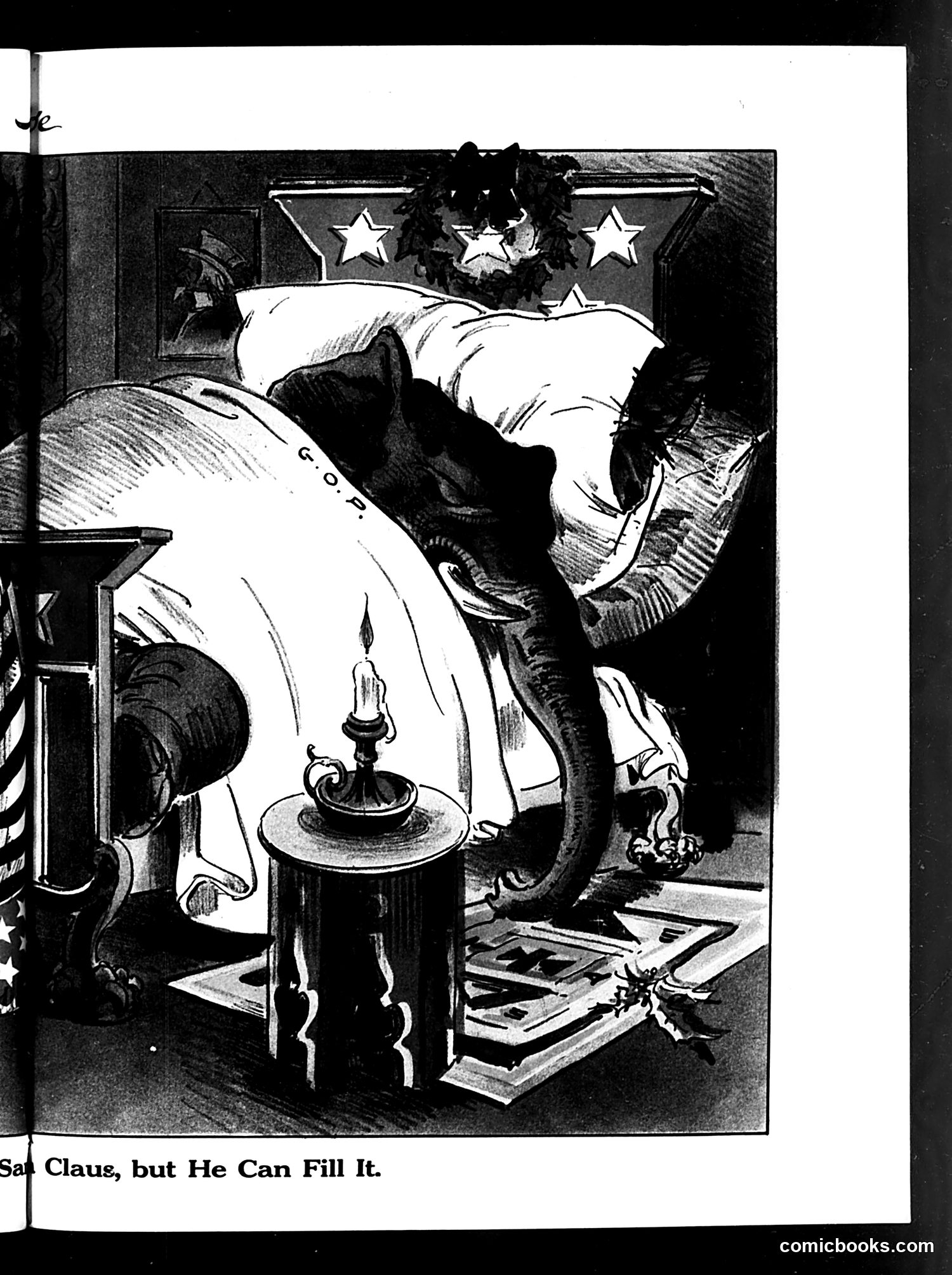
This political cartoon depicts Santa Claus bending over a bed decorated with patriotic stars and a wreath, filling what appears to be a Christmas stocking or similar item by candlelight. The caption reads "Claus, but He Can Fill It" (likely "Santa Claus, but He Can Fill It"). The cartoon appears to be commentary on wartime scarcity or deprivation—possibly from WWI or WWII era. The joke suggests that while Santa Claus may face limitations or empty coffers during wartime, he can nonetheless fulfill Christmas wishes despite material constraints. The patriotic imagery (stars, wreath) reinforces the wartime/patriotic context. The satirical point is likely that American generosity and Christmas spirit persist even amid national hardship.
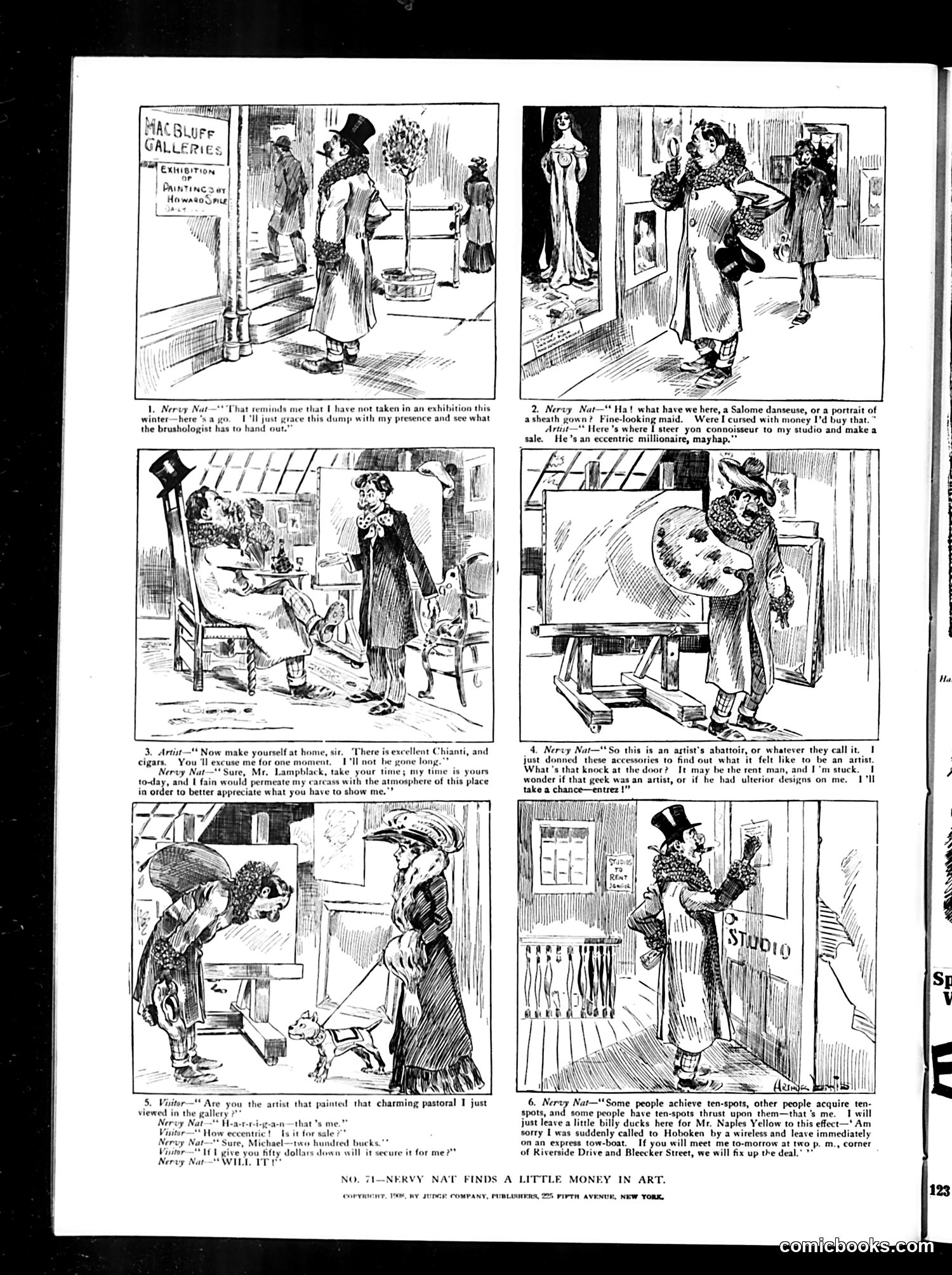
This six-panel comic strip satirizes both pretentious art world hustlers and a con-artist protagonist. "Nervy Nat" (the main character) infiltrates a gallery and artist's studio, posing as a wealthy patron interested in purchasing art. He manipulates an actual artist into showing him his work, then dons artistic accessories to appear legitimate himself. The satire targets: (1) credulous wealthy collectors easily fooled by appearance and artist mystique; (2) struggling artists desperate enough to deceive potential buyers; (3) the pretension surrounding modern art criticism ("brushologist," "eccentric millionaire"). Nat's ultimate scheme involves abandoning the artist after arranging a meet-up, leaving only a note claiming urgent business in Hoboken—a classic con. The humor lies in how easily the entire art establishment can be manipulated through mere costume and confidence, suggesting the art world operates on bluff rather than genuine merit or knowledge.
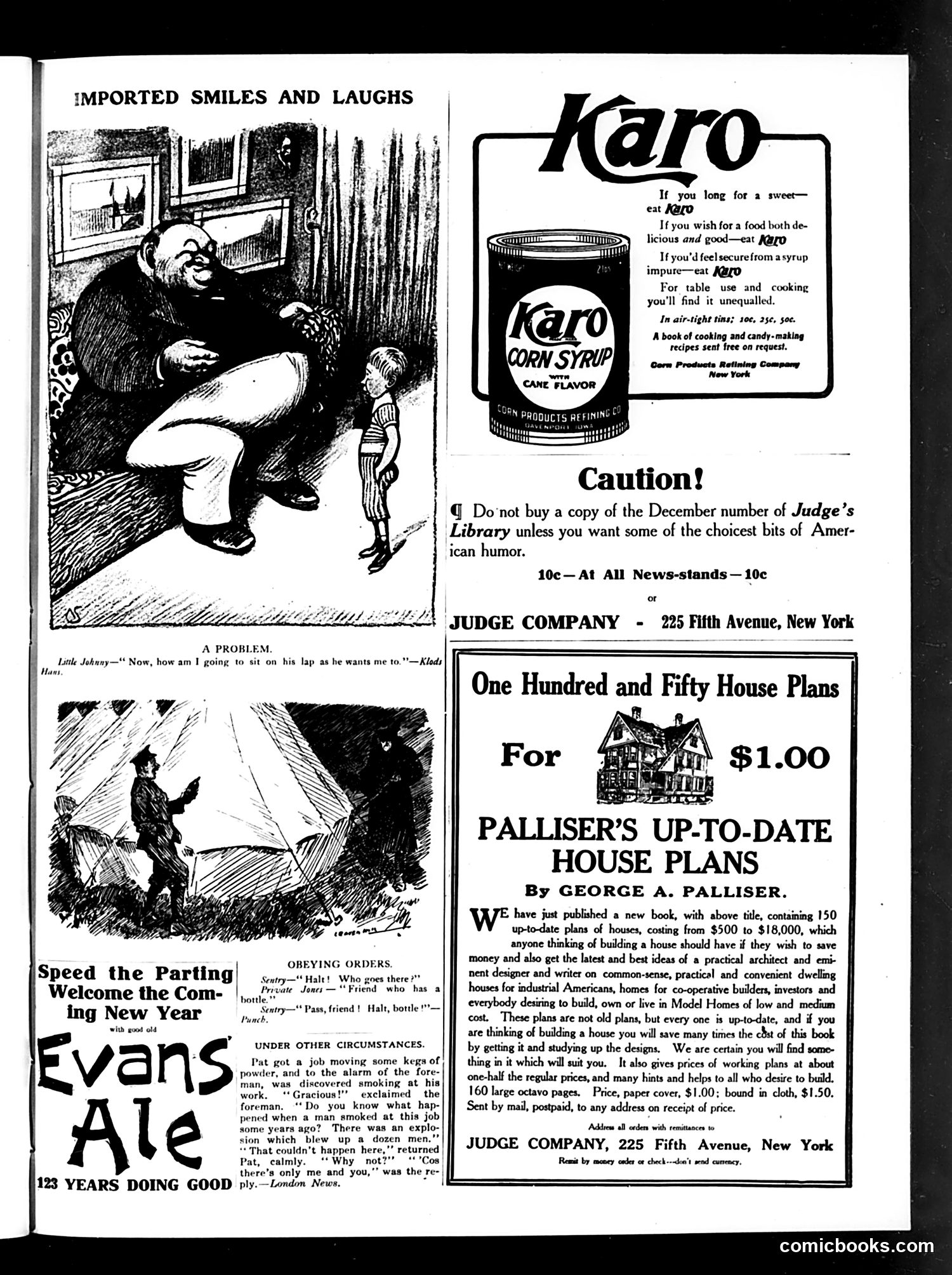
This page contains three short satirical comics typical of early 20th-century humor magazines: **"A Problem"**: Shows an adult man with a child on his lap, presenting the joke that the child cannot sit on his lap as requested because the man is already sitting down—a play on literal versus intended meanings. **"Obeying Orders"**: A sentry stops a soldier carrying a bottle of alcohol. The joke plays on military obedience: the sentry lets the "friend" pass but halts the "bottle," treating them as separate entities. **"Under Other Circumstances"**: An Irish worker (Pat) is caught smoking near gunpowder kegs. When the foreman warns that someone was killed in a similar incident years ago, Pat jokes there's no danger because only the two of them are present—implying he'd survive the explosion. The humor relies on Irish stereotypes common in period publications. The page also contains advertisements for Karo corn syrup, Evans Ale, and house plan books—typical commercial content for such magazines.
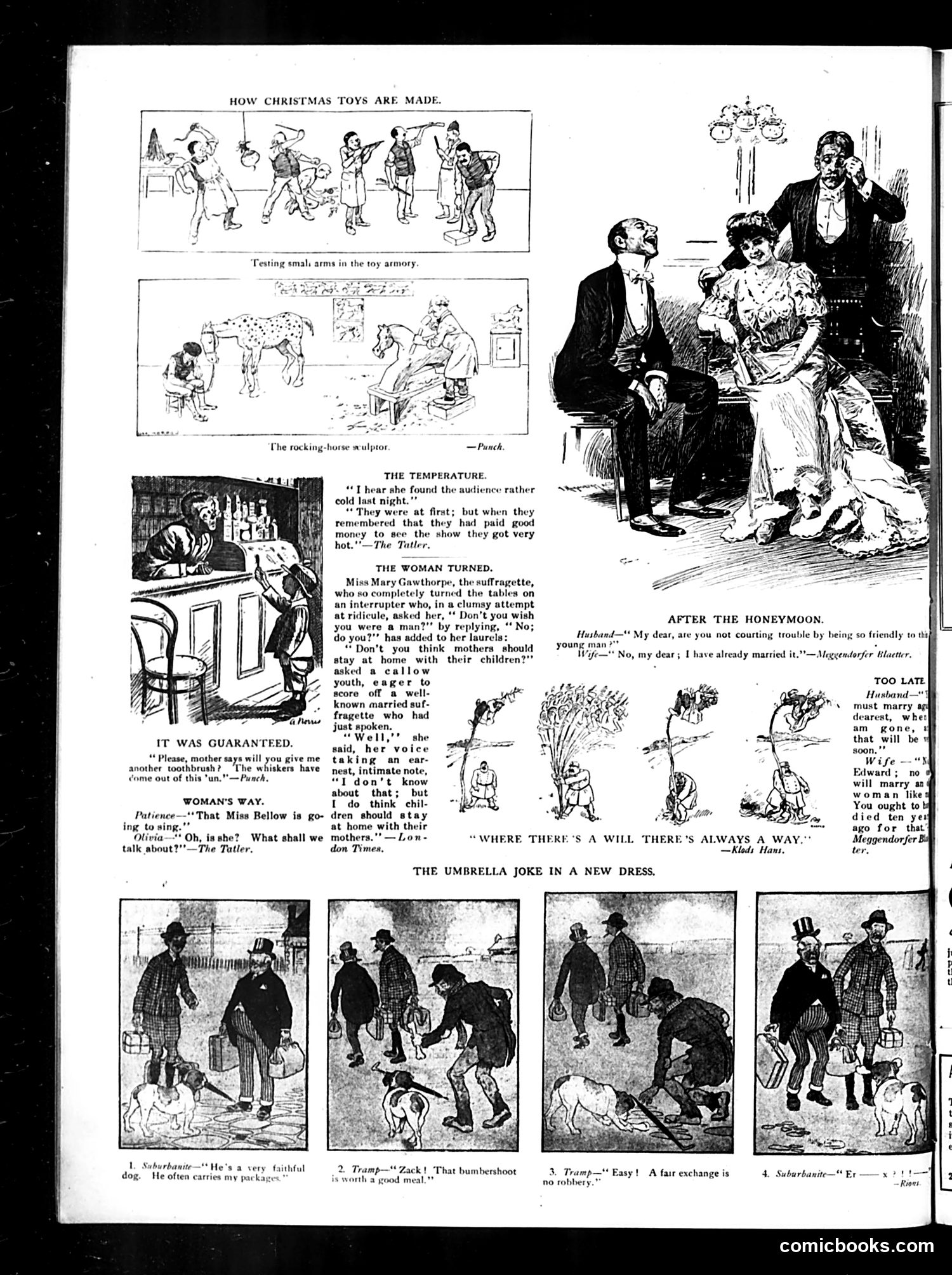
This page from *Judge* magazine contains several satirical pieces targeting early 1900s social issues: **Top section**: "How Christmas Toys Are Made" mocks toy manufacturing quality—children test defective products, and a rocking horse falls apart, suggesting toys were poorly made or fraudulently "guaranteed." **Middle content**: Multiple brief jokes on social topics: - "The Woman Turned" celebrates Miss Mary Gawthorpe, a real suffragette, who cleverly retorted to sexist hecklers asking if she wished to be a man. The satire approves her quick wit. - "After the Honeymoon" and "Too Late" are standard marital-discord jokes—wives as burdens. - Other pieces mock theater audiences and mothers. **Bottom**: "The Umbrella Joke in a New Dress" shows a recurring tramp joke: two vagrants exchange a stolen umbrella for food, framed as "fair exchange." The page blends political commentary (supporting women's suffrage wit) with conventional domestic humor and working-class satire typical of the era's illustrated magazines.
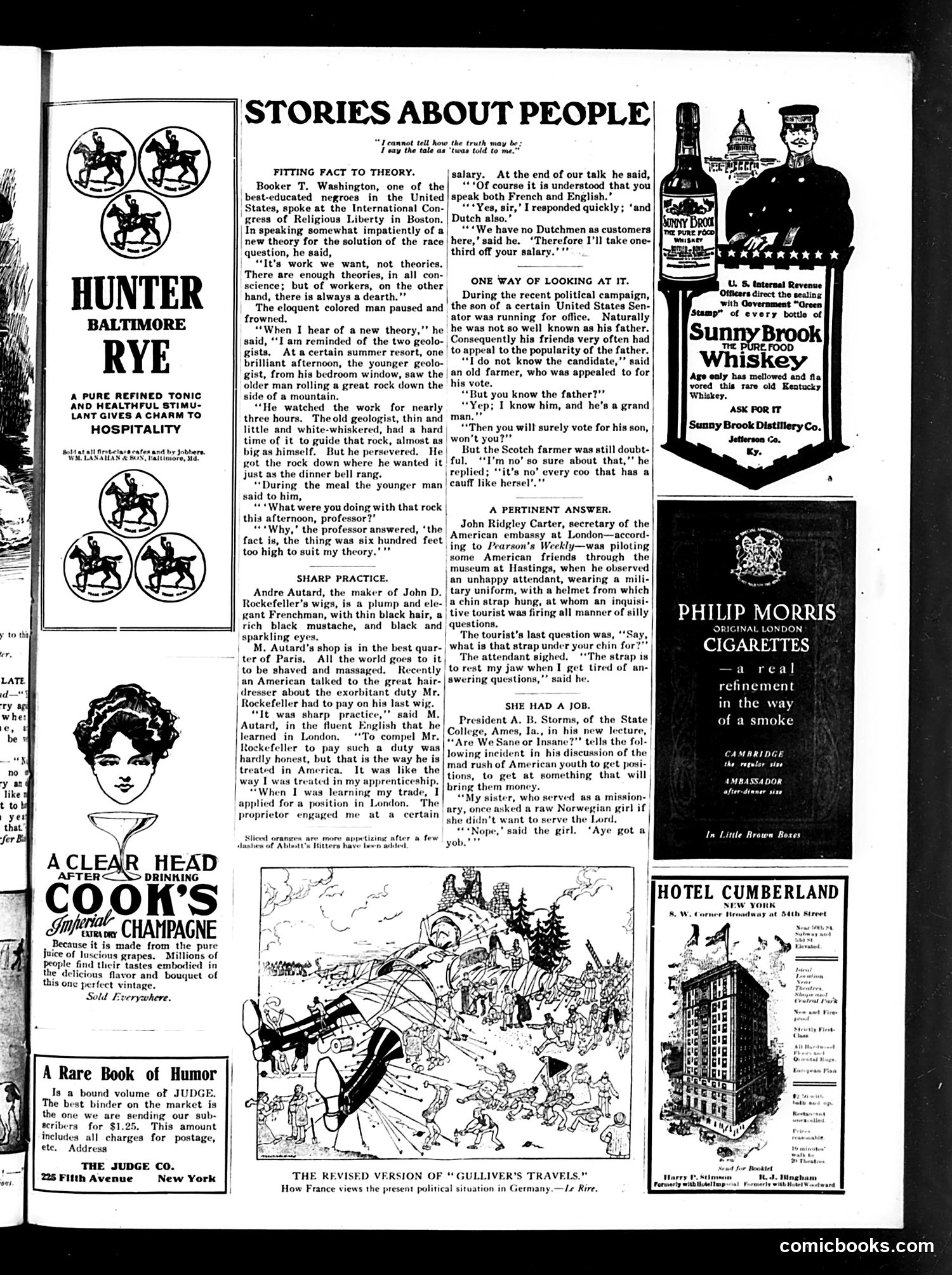
This page mixes advertisements with satirical stories about prominent figures and social situations. **Main Content:** The "Stories About People" section includes an anecdote about **Booker T. Washington**, the prominent African American educator, who criticized theoretical solutions to racial problems, advocating instead for practical work. The accompanying story about geologists illustrates his point: a professor moves a rock "six hundred feet" to fit his theory rather than adjusting his theory to reality—satirizing impractical theorizing. **Secondary Stories:** Other pieces mock sharp business practices (a French hairdresser's duty negotiations with Rockefeller) and political campaigning (where a senator's son relies on his father's name recognition, which even Scottish farmers find insufficient reason to vote for him). **Advertisements:** The page features period liquor and tobacco ads (Hunter Baltimore Rye, Sunny Brook Whiskey, Philip Morris cigarettes, Cook's Champagne) and hotel/book promotions—typical of Judge's revenue model. The satirical tone targets both theoretical abstraction and opportunistic commercialism.
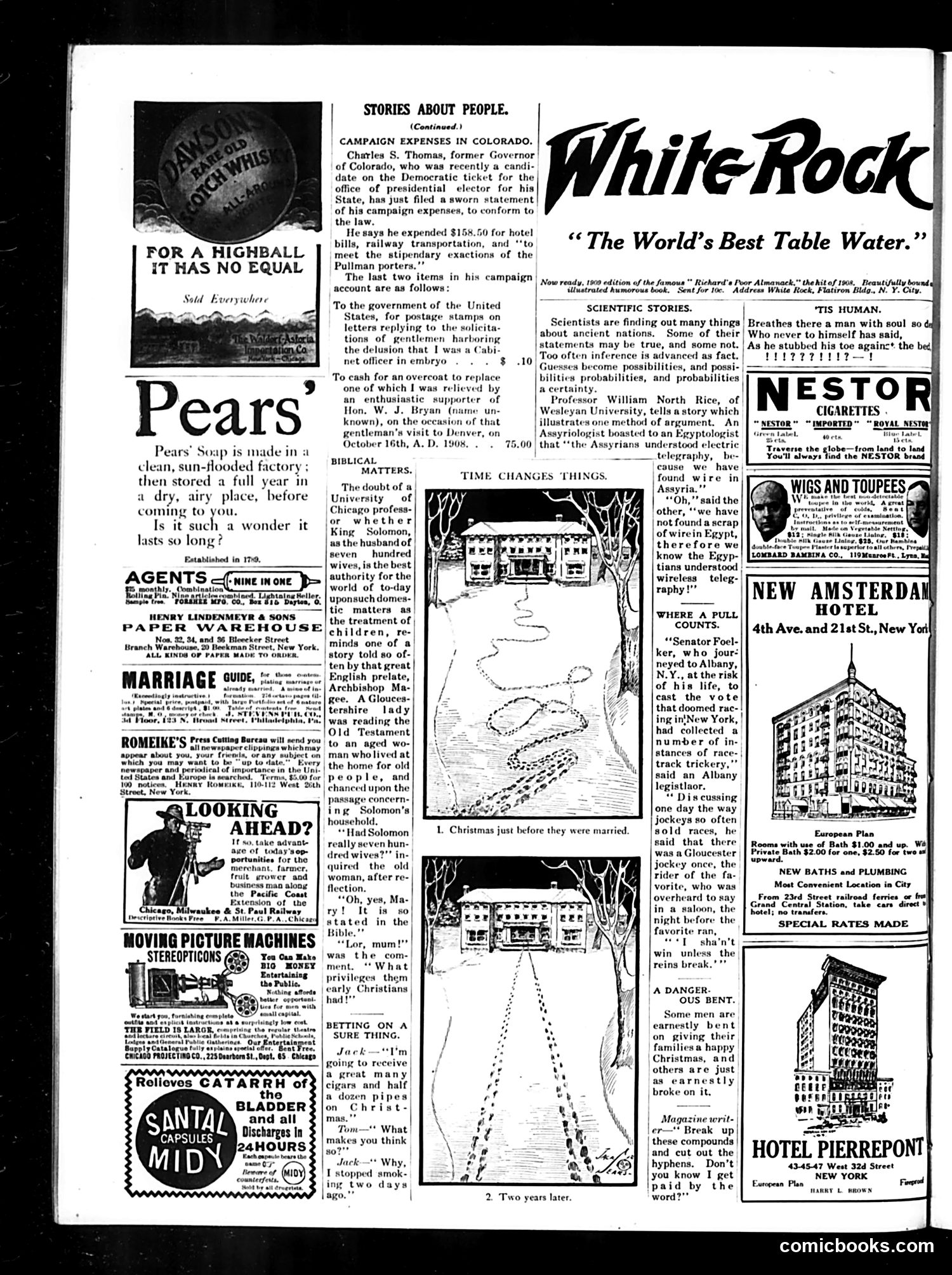
This page from Judge primarily consists of advertisements and humorous "Stories About People" sections rather than political cartoons. The main satirical content includes: **"Campaign Expenses in Colorado"**: A joke mocking former Governor Charles S. Thomas's minimal campaign spending ($158.50), which included absurdly petty expenses like replacing an overcoat "relieved by an enthusiastic supporter of Hon. W. J. Bryan." This satirizes both the governor's unsuccessful candidacy and political corruption/bribery disguised as campaign costs. **"Scientific Stories"**: A satirical piece about academics making unfounded inferences, using Assyriologists and Egyptologists claiming technological knowledge based on absence of evidence—mocking scholarly pretension. **"Biblical Matters"**: Humorous dialogue about King Solomon's many wives, suggesting modern marriage advice should ignore biblical precedent. The page is otherwise dominated by period product advertisements (Pears' Soap, White Rock water, hotels, moving pictures), typical of Judge's format as a commercially-supported satirical weekly.
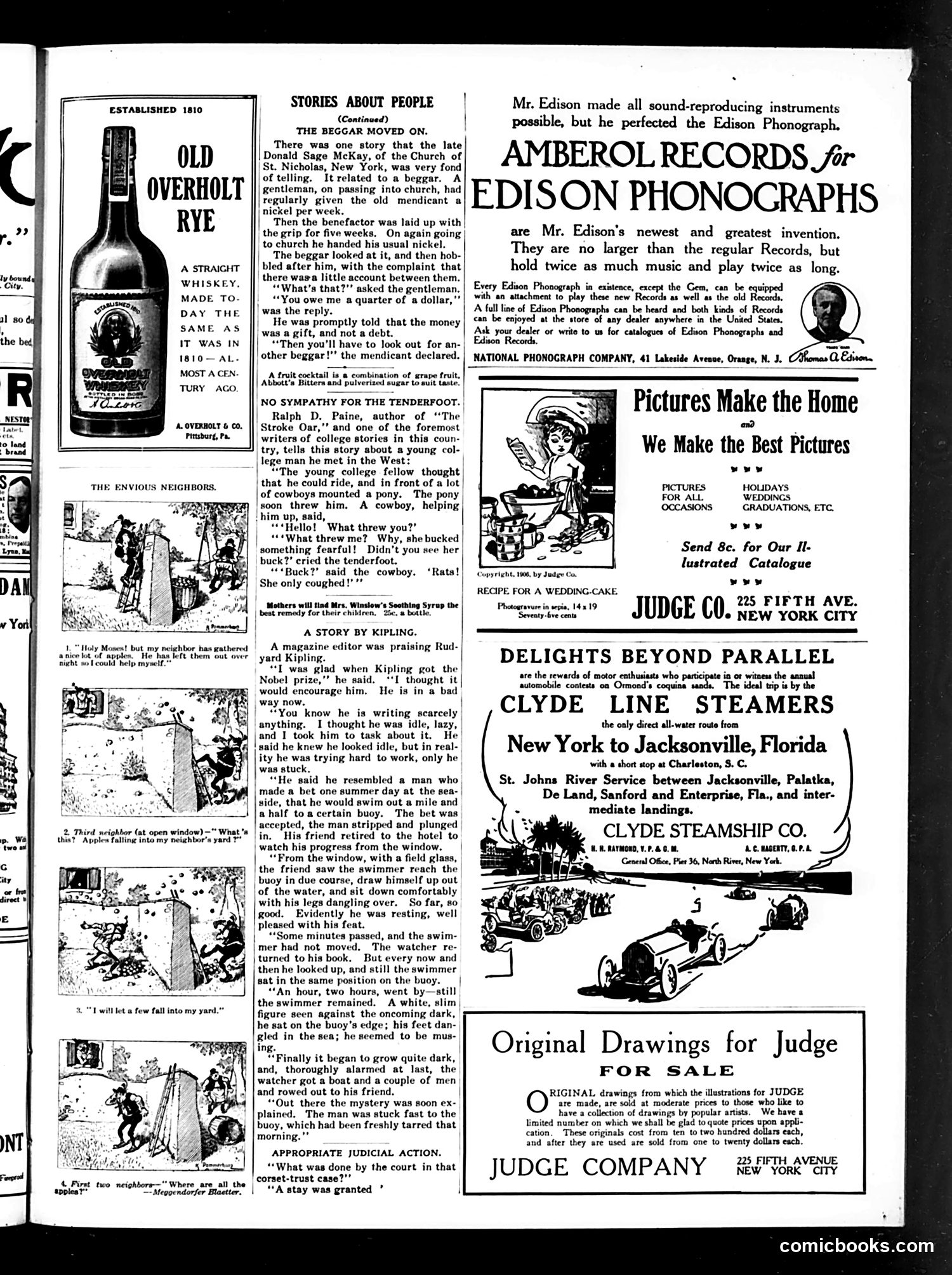
This page is primarily **advertising and filler content** rather than political satire. The left column contains three anecdotal stories: a beggar's entitled complaint about unpaid "debt," a cowboy mocking a college tenderfoot for being thrown by a horse that merely "coughed," and Rudyard Kipling's struggle with writer's block (illustrated via an anecdote about a man stuck to a tar-covered buoy). These pieces use gentle humor to mock **social pretension and Eastern naïveté**—the beggar's ingratitude, the city boy's incompetence at ranch life, and the writer's paralysis. The right side features advertisements for Edison phonographs, Judge Company photographs, Clyde Line Steamships, and other commercial products—typical magazine revenue generators. The single "judicial" joke at bottom plays on "stay" (legal restraint vs. corset support), typical light wordplay of the era. **No clear political message or significant historical reference appears present.**
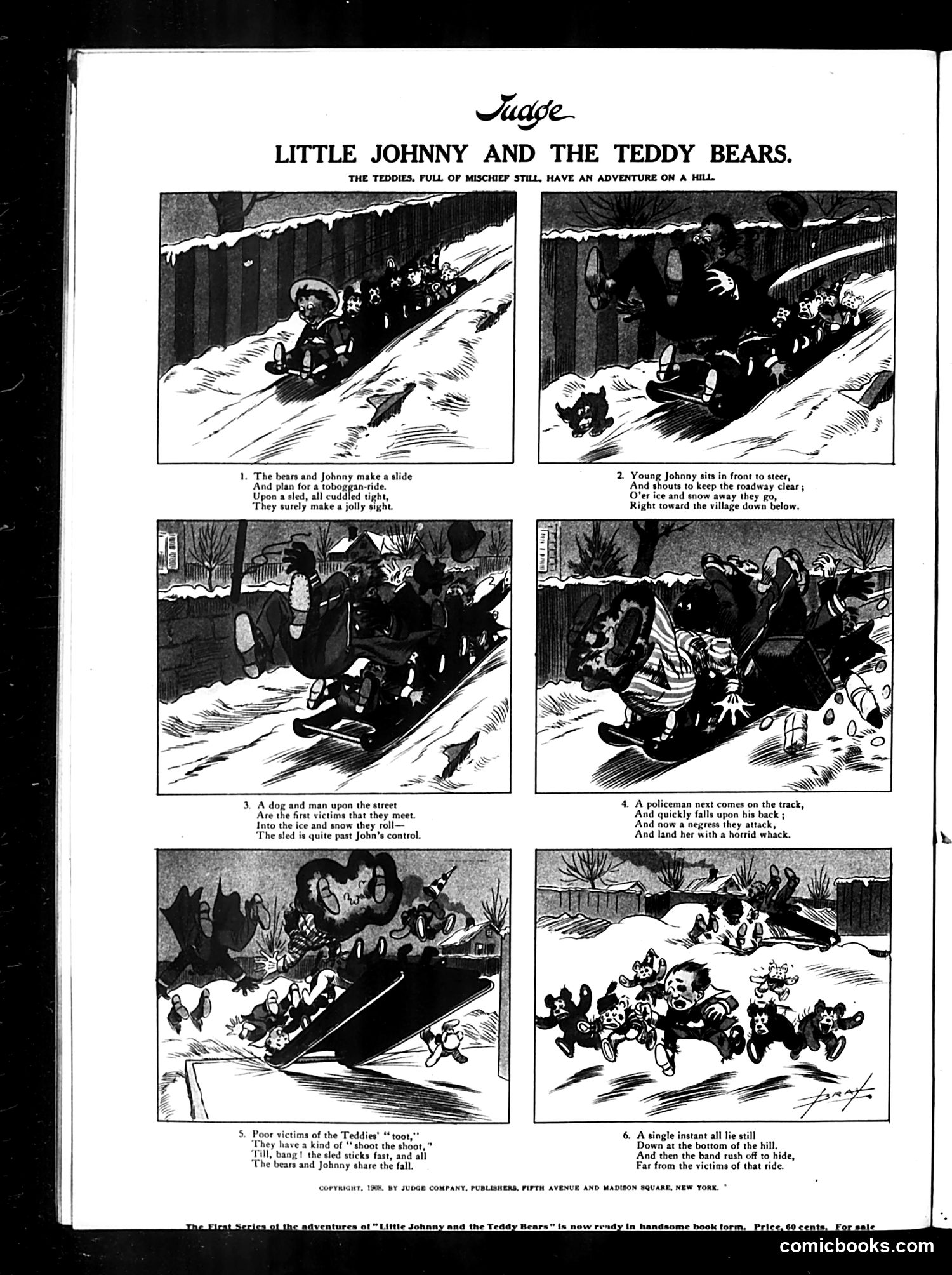
This is a children's comic strip, not political satire. It tells a slapstick story: Johnny and anthropomorphic teddy bears go sledding down a snowy hill, lose control, and collide with various people—a dog and man, a policeman, and a Black woman—causing chaos. Everyone falls, then the bears scatter. The strip trades on early-1900s humor: rambunctious children causing mayhem, authority figures (the policeman) made foolish, and crude racial caricature. The "Teddy Bears" reference likely alludes to the toy craze following President Theodore Roosevelt's 1902 bear-hunting incident. The humor is purely physical comedy and mischief, reflecting period attitudes toward both childhood pranks and racial depiction that modern readers would find offensive.

I can see this is a page from Judge magazine (as indicated by the watermark "comicbooks.com" at the bottom), but the image appears to be almost entirely blank or extremely faded, with no clearly visible cartoon, illustrations, text, or content that I can read with confidence. Without being able to discern the actual satirical content, figures, captions, or political references on this particular page, I cannot accurately identify what is being satirized or explain the joke to a modern reader. To provide a meaningful historical analysis as requested, I would need a clearer or higher-resolution image where the cartoon artwork and text are legible.