
A complete issue · 16 pages · 1908
Judge — August 29, 1908
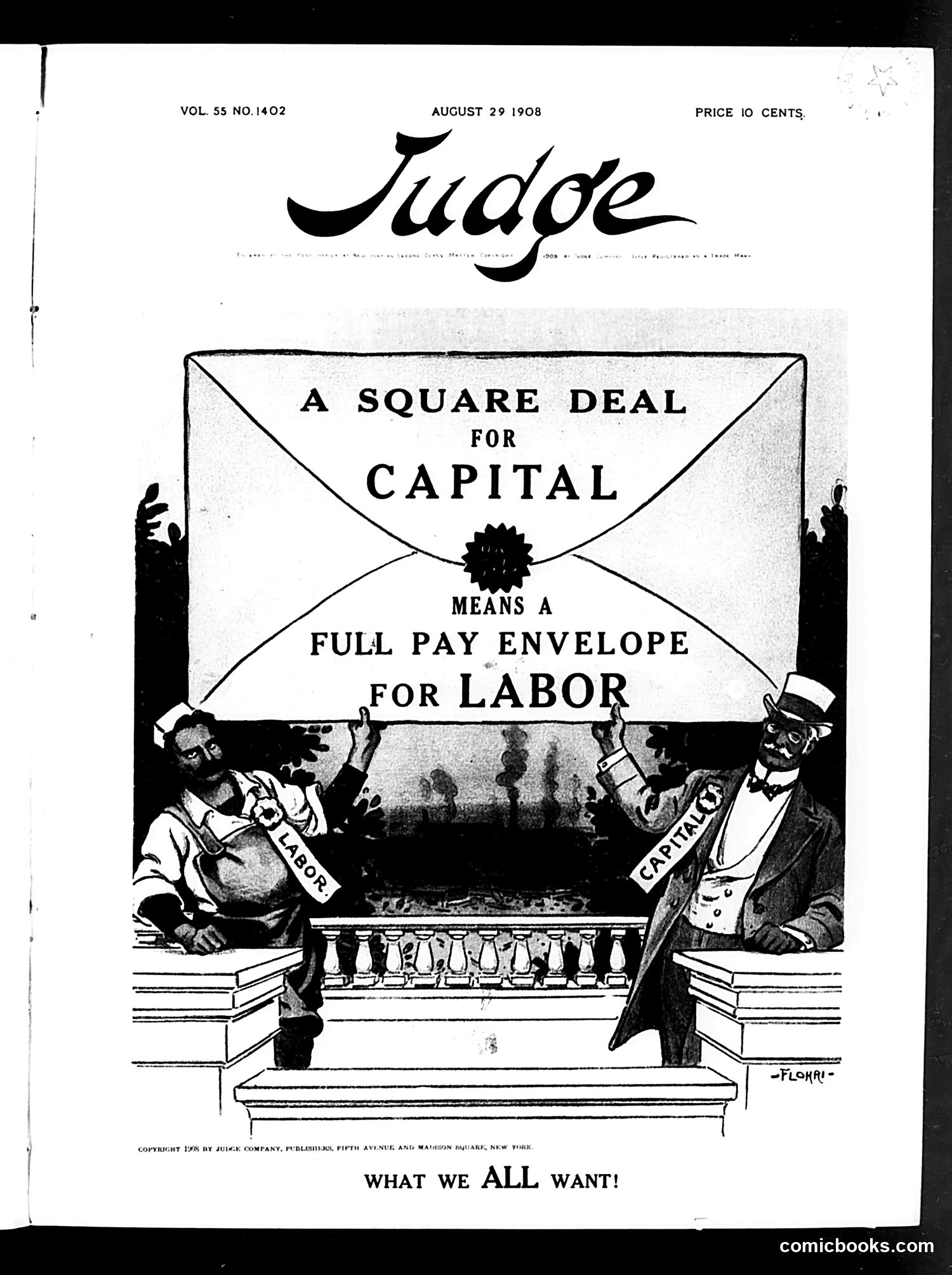
This 1908 *Judge* cartoon satirizes President Theodore Roosevelt's famous "Square Deal" domestic policy. Two figures—labeled "Labor" (left) and "Capital" (right)—hold an envelope representing workers' wages. The caption cynically suggests that a "square deal for capital means a full pay envelope for labor"—implying the opposite of what Roosevelt promised. The satire critiques the perceived gap between Roosevelt's pro-labor rhetoric and actual outcomes favoring big business. The ornate Capitol building backdrop emphasizes government's role. The cartoon suggests that capital interests ultimately control labor policy despite presidential promises of fairness. The bottom text, "WHAT WE ALL WANT," adds ironic commentary on universal desires for economic justice.
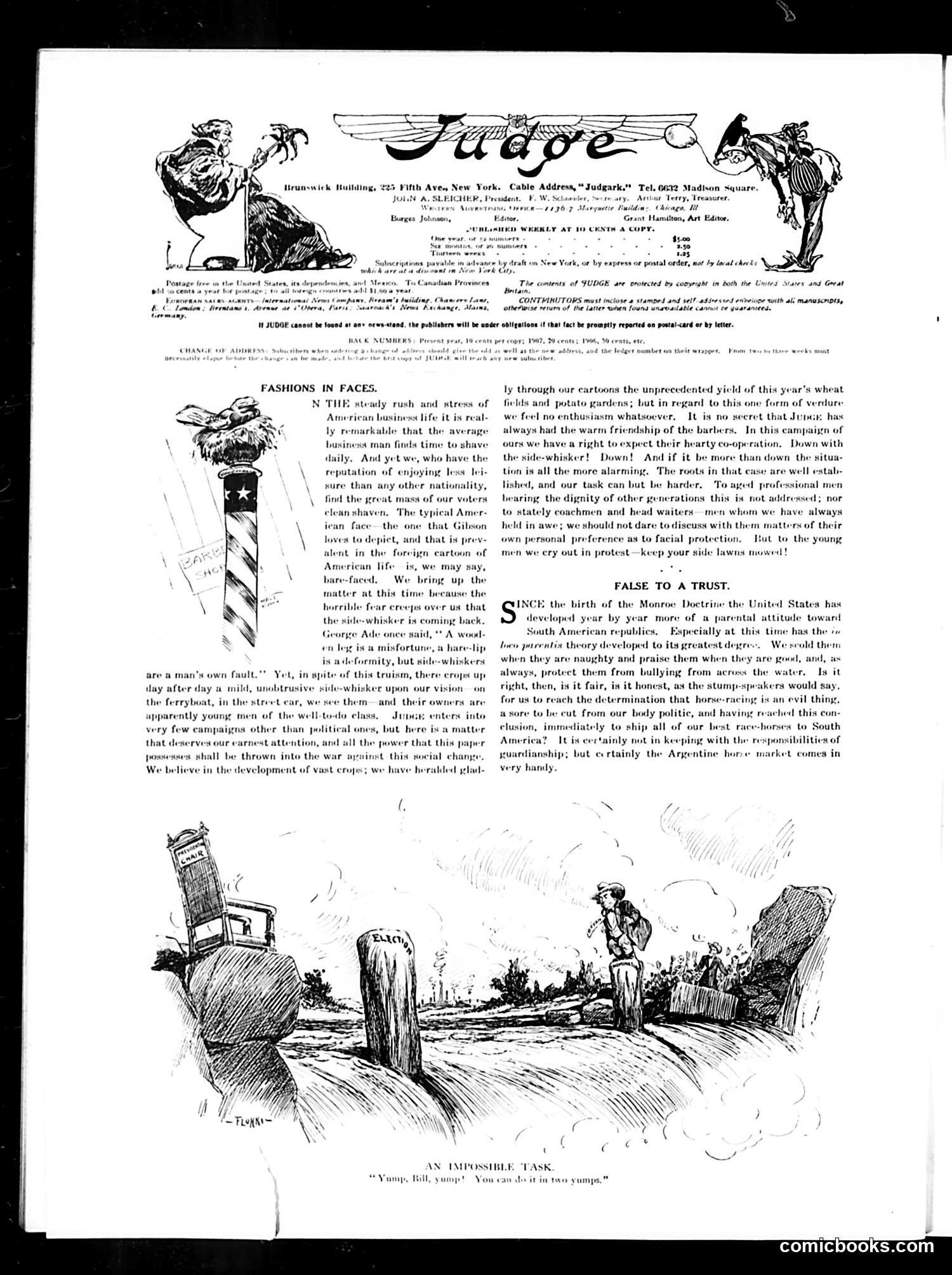
This page contains two distinct editorial pieces from Judge magazine critiquing American politics and social attitudes. **"Fashions in Faces"** satirizes changing American voter preferences, noting the "side-whisker" style is disappearing from politics. The barber shop analogy suggests voters are "shaving off" old political styles, with particular criticism of how young men lack concern for facial hair grooming standards—reflecting broader anxieties about declining social decorum. **"False to a Trust"** addresses the Monroe Doctrine, criticizing American hypocrisy regarding South American republics. The piece argues the U.S. wrongly interferes with Latin American horse-racing (likely a metaphor for economic/political control) while claiming to protect these nations from European bullying. The bottom cartoon **"An Impossible Task"** depicts a figure attempting something clearly futile, though the specific reference is unclear from context provided.
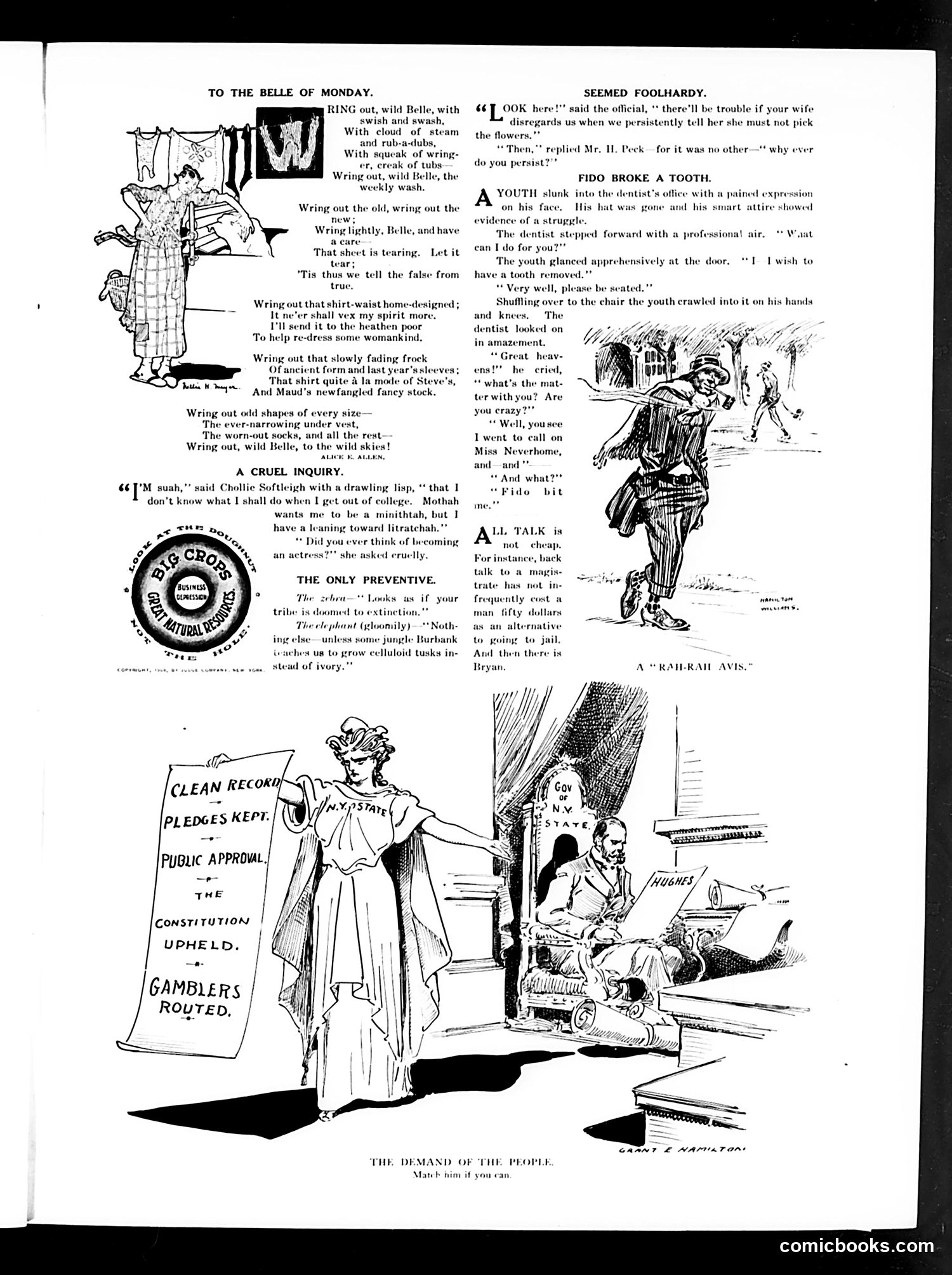
The bottom cartoon, "The Demand of the People," depicts Lady Justice holding a scroll reading "Clean Record Pledges Kept / Public Approval / The Constitution Upheld / Gamblers Routed." She confronts a corrupt politician (labeled "Hughes") who sits disheveled at a desk, apparently caught violating these pledges. This appears to reference a political candidate or official named Hughes who promised reform—particularly against gambling and corruption—but failed to deliver. The satire mocks the gap between campaign promises and actual governance. The upper section contains miscellaneous humor pieces unrelated to the main cartoon, including verses about laundry and anecdotes about dentistry and theatrical ambitions. These filler items were typical of Judge magazine's format.
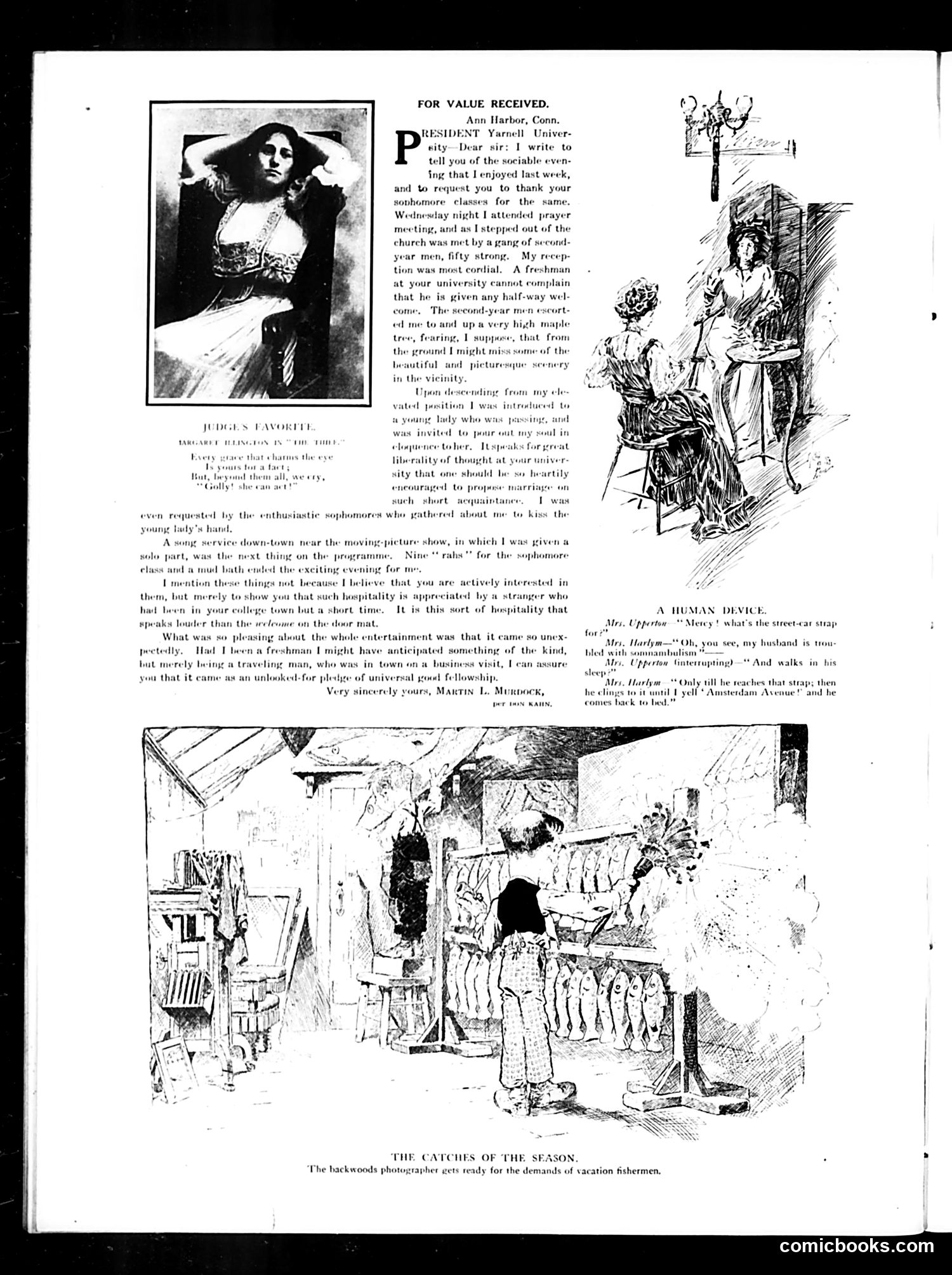
This page contains three distinct elements: 1. **"Judge's Favorite"** (top left): A portrait labeled as featuring "Every grace that charms the eye" and commentary about being "requested by enthusiastic sophomores who gathered about me to kiss the young lady's hand." 2. **"For Value Received"** (top right): A letter from Ann Harbor, Connecticut, describing a social evening at a university involving second-year men and a freshman, with veiled references to courtship and propriety concerns. 3. **"A Human Device"** (middle right): A domestic dialogue between Mr. and Mrs. Upperton about a "street-car strap" and marriage compromises. 4. **"The Catches of the Season"** (bottom): An illustration showing a woman at what appears to be a fishery or market, with a caption about "backwoods photographer gets ready for the demands of vacation fishermen." The page satirizes college social dynamics, gender relations, and domestic life through humor typical of early 1900s American magazine satire.
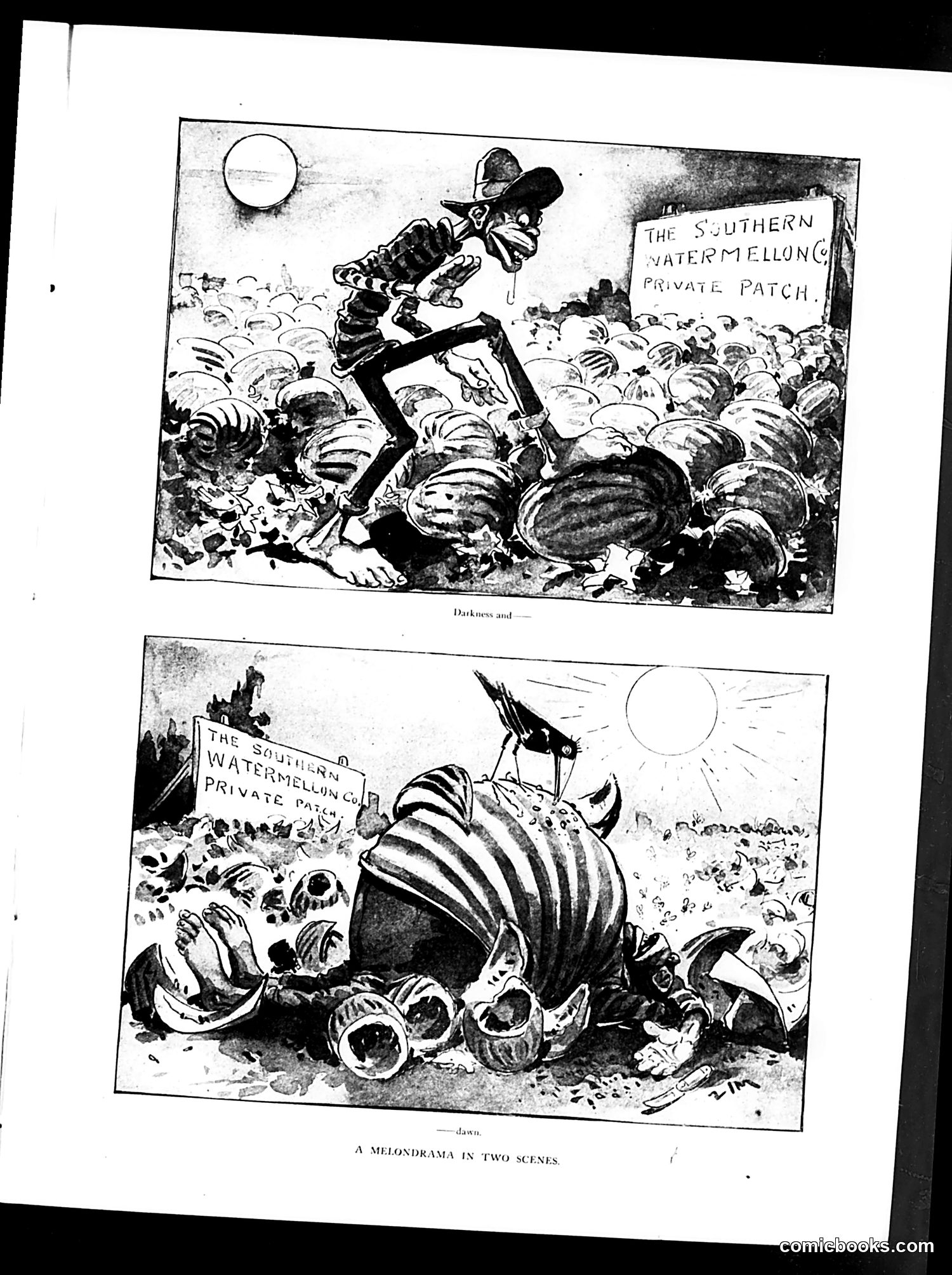
This satirical cartoon critiques what appears to be a watermelon monopoly or price-gouging scheme by "The Southern Watermelon Co." In the top panel (Darkness), a caricatured figure in a top hat stands atop massive watermelons, suggesting greed or theft of the crop. The "Private Patch" sign indicates exclusionary control. In the bottom panel (Dawn), the watermelons have multiplied enormously, with a flag planted atop the pile—suggesting either triumph or an invasion/takeover of the market. The "melodrama" structure mocks the situation as theatrical exaggeration. The satire likely targets Southern agricultural monopolies or price manipulation during an era of agricultural consolidation. The watermelon imagery carries racial undertones typical of Gilded Age Judge magazine's sometimes crude editorial stance.
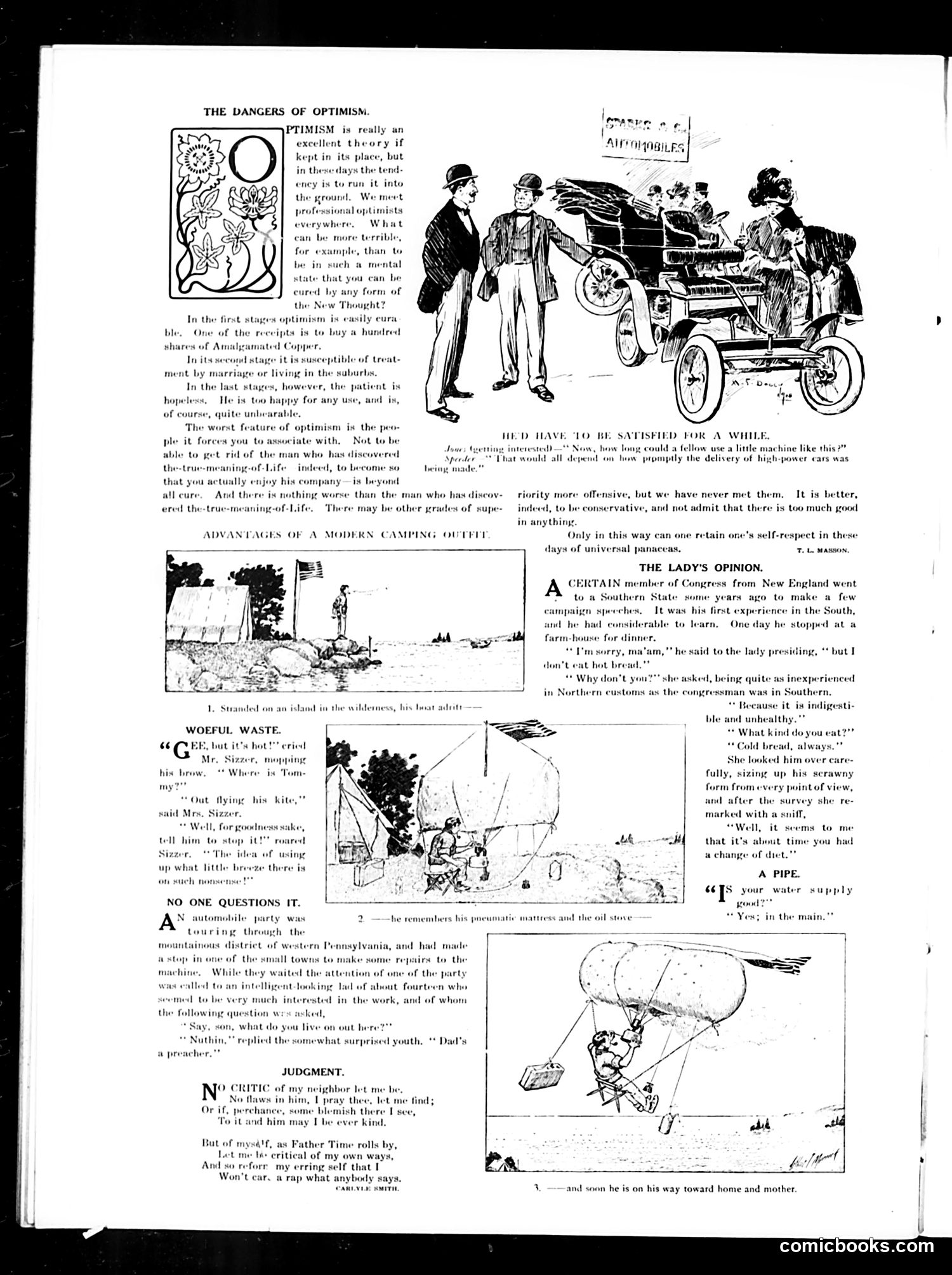
This page satirizes early-20th-century American attitudes and pastimes through multiple vignettes. **"The Dangers of Optimism"** critiques excessive optimism as a social disease progressing through stages—from buying stocks to marriage to becoming unbearably cheerful. The satire warns that relentless optimism prevents genuine self-awareness and makes people insufferable companions. **"Advantages of a Modern Camping Outfit"** and accompanying illustrations mock camping culture, showing people stranded or struggling with equipment—mocking the era's enthusiasm for outdoor recreation. **"The Lady's Opinion"** humorously depicts a Northern congressman visiting the South, where a farmer's wife criticizes his refusal of hot bread as unhealthy and marks him as culturally ignorant about Southern diet customs. **"No One Questions It"** presents a rural youth unfazed by city visitors, deflating pretentious urban assumptions about rural simplicity. The page reflects Judge's typical satirical stance toward contemporary American fads, regional differences, and social pretension, using class and cultural stereotypes common to early-1900s American humor.
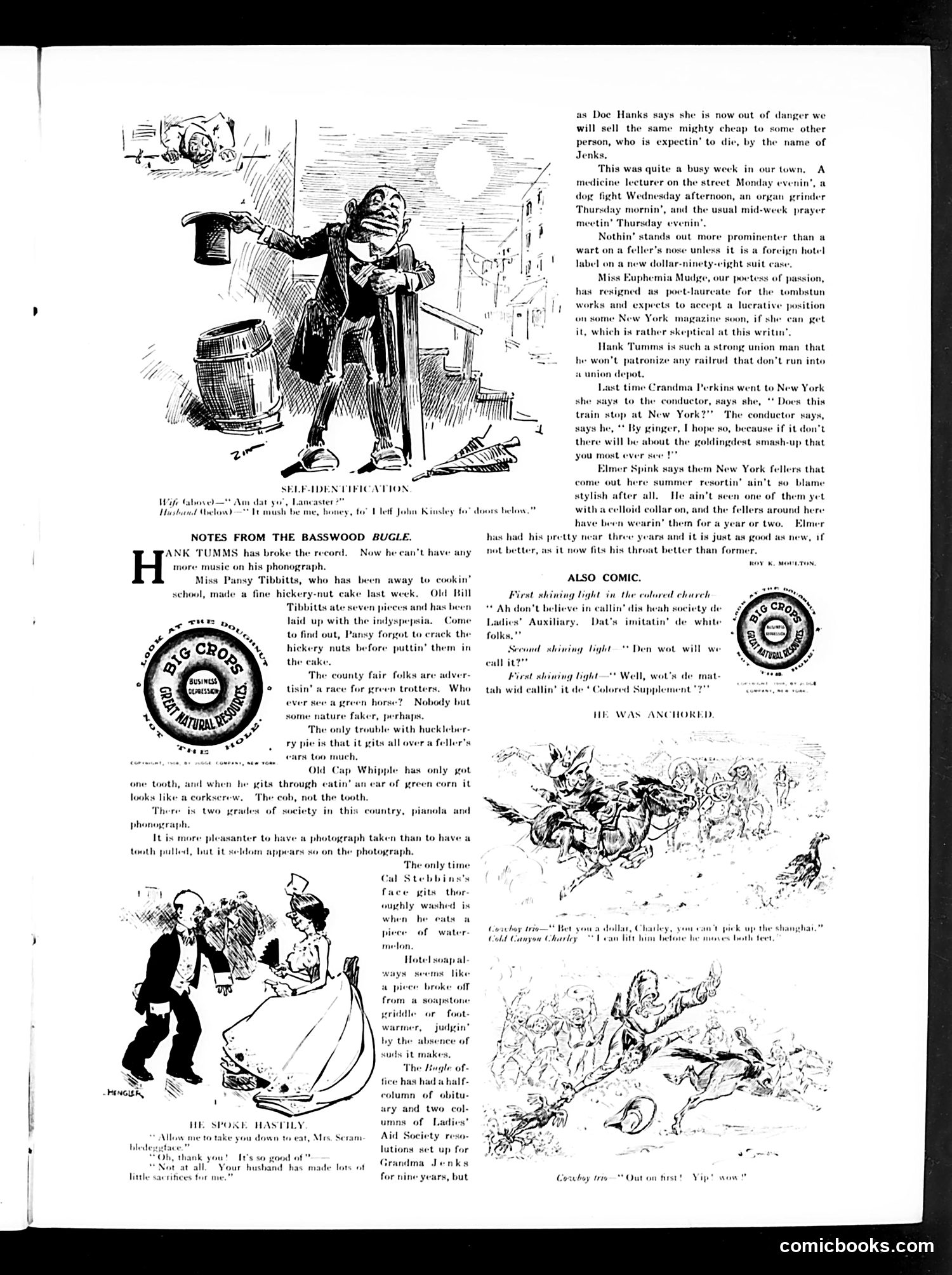
This page satirizes small-town American life through fictional rural gossip. The "Basswood Bugle" section mocks provincial characters and their trivial concerns: Hank Tumms breaking records, Miss Euphemia Mudge's poetic ambitions, complaints about huckleberry pie consistency, and county fair gossip. The cartoons include domestic humor ("He Spoke Hastily") and racial comedy typical of the era—the "Also Comic" section features dialect humor about Black church members debating terminology ("Colored church" vs. alternatives), reflecting period stereotypes. The recurring joke is contrasting small-town mundanity with aspirations: locals obsessing over minor incidents while someone like Miss Mudge dreams of New York success. The satire targets both rural naiveté and small-town preoccupation with neighbors' affairs. The page blends local-interest humor with broader American class and regional stereotypes common to Judge magazine's satirical approach.
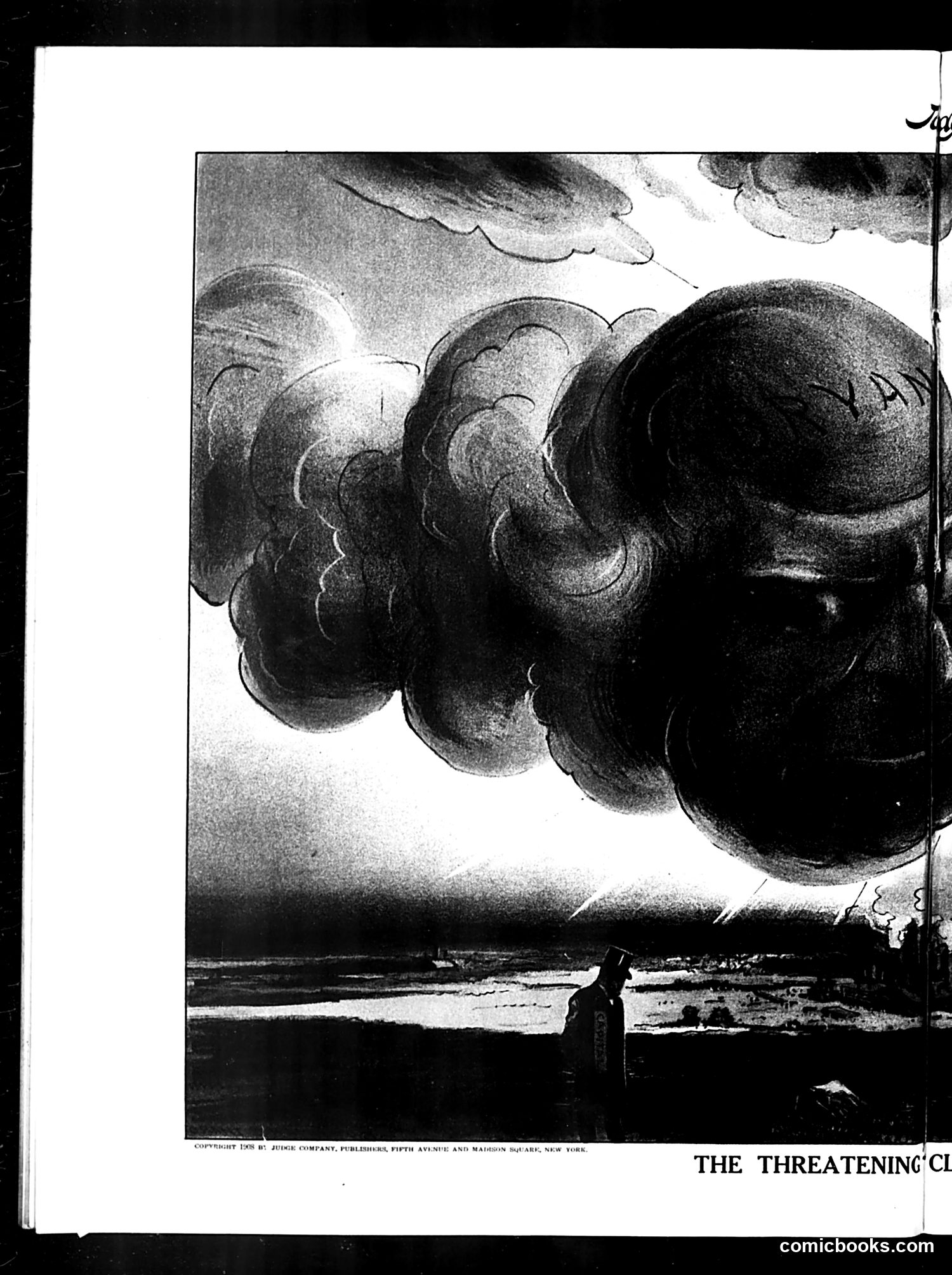
This appears to be a political cartoon from *Judge* magazine (copyright 1909 by Judge Company). The image shows a solitary figure in a top hat standing before an ominous landscape, gazing up at dark, roiling storm clouds that dominate the sky. The threatening clouds likely represent impending political or social danger. The title "THE THREATENING C[...]" (text cut off) suggests the cartoon warns of a specific threat beginning with "C"—possibly referring to corruption, crisis, or another contemporary concern of 1909 America. The lone observer's posture conveys apprehension or helplessness before this looming danger. Without the complete title or additional context, the specific political reference remains unclear, though the imagery effectively uses meteorological symbolism for societal peril.
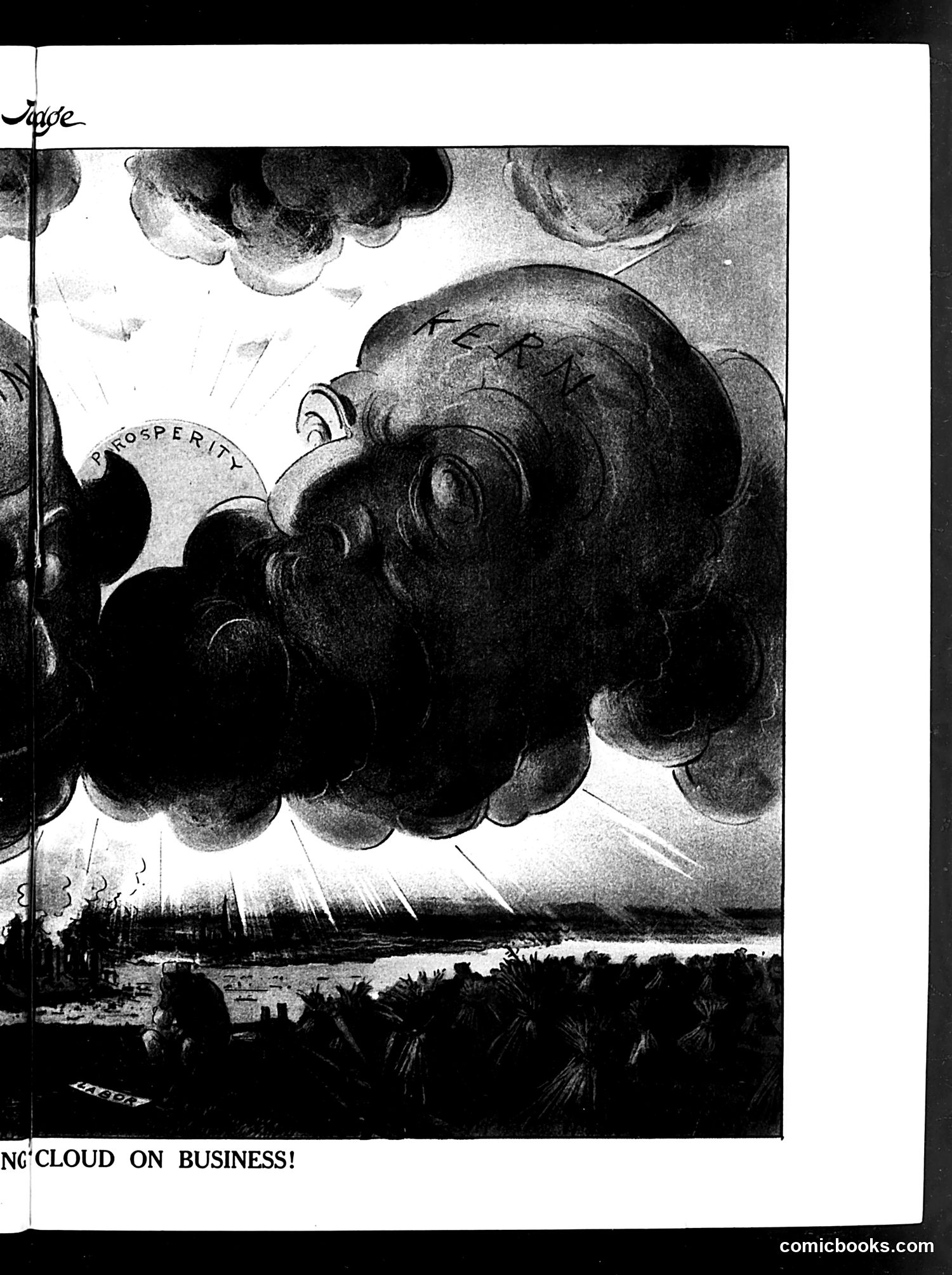
This political cartoon depicts a large, threatening storm cloud labeled "PROSPERITY" looming over an industrial landscape with factories and waterways. The irony is sharp: despite the label claiming prosperity, the ominous dark cloud—complete with what appears to be a menacing face or skull-like features—suggests economic danger rather than good fortune. The cartoon likely critiques either false claims of economic well-being during an actual downturn, or warns that apparent prosperity masks underlying threats to business stability. The contrast between the reassuring label and the ominous visual imagery creates the satirical point: prosperity is merely a façade covering genuine economic peril. Without a visible date, the specific historical context remains unclear, but this reflects Judge magazine's typical skepticism toward political and economic claims.
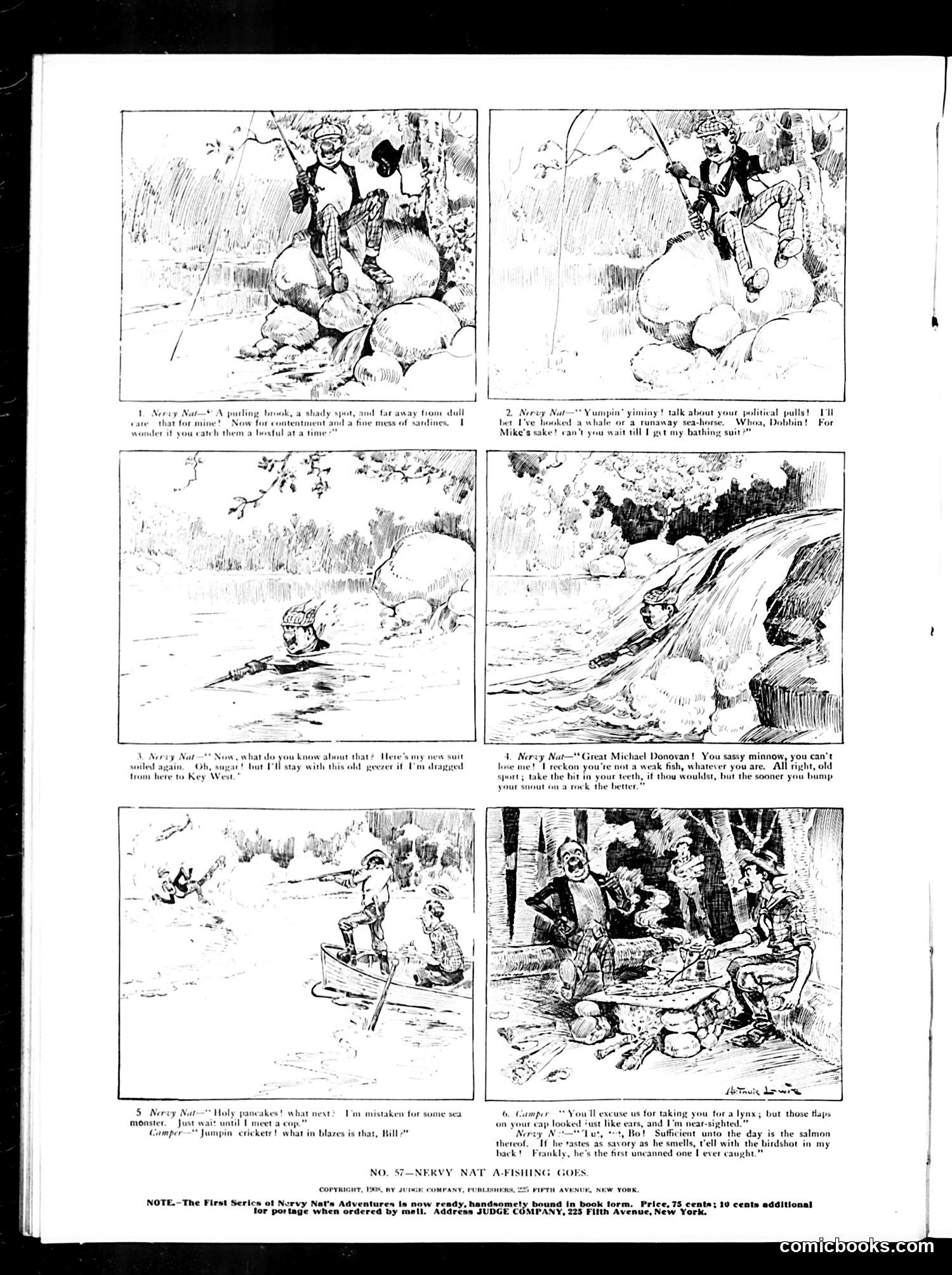
This is a comic strip following "Nervy Nat," an apparent character series in Judge magazine. The six-panel narrative depicts Nat and a companion (Camper/Bill) on a fishing expedition that devolves into absurdist chaos. The humor relies on slapstick and wordplay rather than political satire. Nat encounters increasingly implausible creatures—claiming to spot a "whale or runaway sea-horse," then a "sea monster"—that the skeptical Camper dismisses as actual fish. The strip culminates in them accidentally catching something that appears game-like, with dark jokes about it being "uncanned" (freshly killed) rather than canned. The satire, if any, targets pretentious outdoor sportsmen who exaggerate their catches and encounters. The "political pulls" reference in panel 2 appears incidental wordplay rather than topical commentary. This represents Judge's lighter entertainment content alongside its more pointed satirical cartoons.
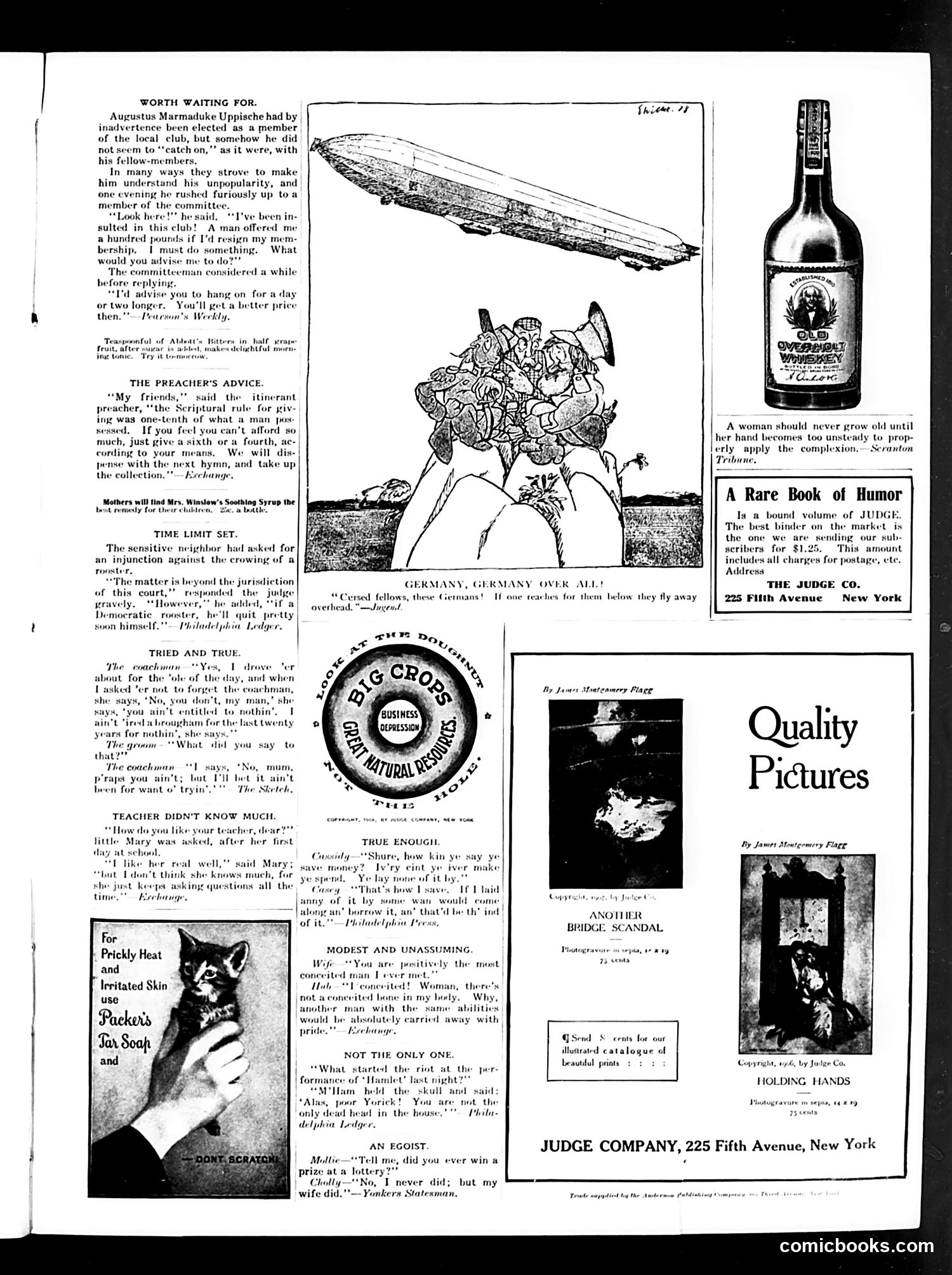
This page contains multiple brief satirical pieces typical of Judge magazine's format: **"Worth Waiting For"**: A joke about an unpopular club member offered money to resign. The committee advises patience—he'll fetch a better price if he waits longer. The satire targets social climbing and the transactional nature of club membership. **"The Preacher's Advice"**: Mockery of a minister's sermon about charitable giving, where he tells poor parishioners to give what they can afford—which amounts to virtually nothing. **"Time Limit Set"**: Political satire suggesting a Democratic rooster (metaphor for Democratic politicians) will "quit pretty soon" on its own, implying Democrats lack staying power or are self-defeating. **"Germany, Germany Over All!"**: A wartime cartoon (unclear exact date, but likely WWI-era based on the martial imagery) depicting Germany as an aggressive, overreaching entity. The page also includes various brief anecdotes mocking Irish servants, miserly characters, and social pretension—typical Judge humor targeting working-class immigrants and the wealthy alike.
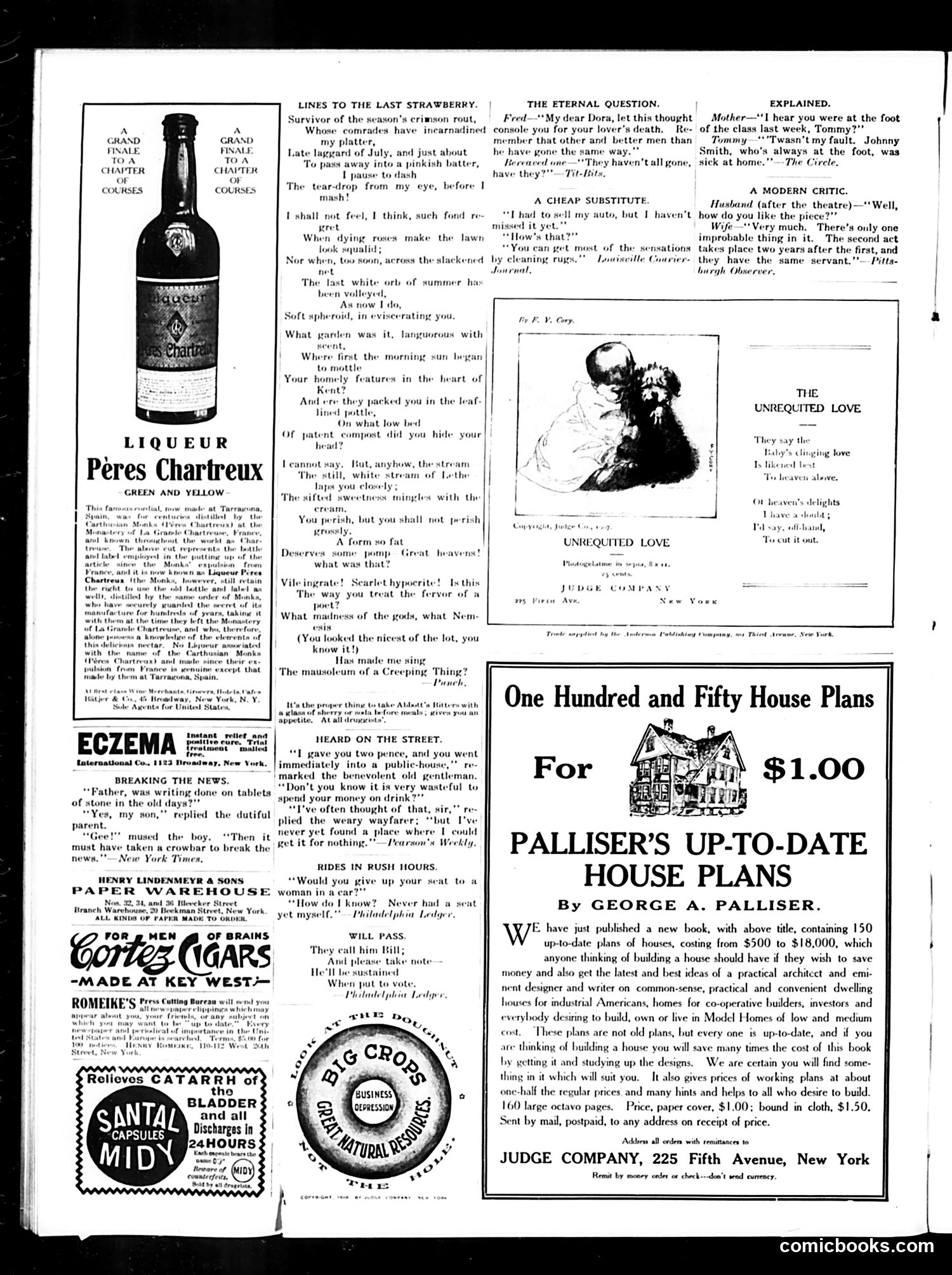
This page is primarily **advertising and light humor** rather than political satire. The main content includes: **Cartoons/Humor Sections:** - "Lines to the Last Strawberry"—a romantic poem mourning the season's end - "The Eternal Question," "A Cheap Substitute," and "A Modern Critic"—brief domestic comedy sketches about relationships and theater, using the question-and-answer format common to humor magazines - "Heard on the Street"—street conversations featuring wordplay about drinking and poverty **Visual Elements:** - An illustration titled "Unrequited Love" showing a man with a small dog - A liqueur bottle advertisement for Pères Chartreux **Advertisements:** The page is dominated by product ads (eczema remedy, cigars, santal capsules) and notably a large advertisement for house plans by George A. Palliser (150 designs, $1.00). The humor is genteel and domestic rather than politically pointed—typical of Judge's lighter content aimed at middle-class readers interested in consumer goods and domestic situations.
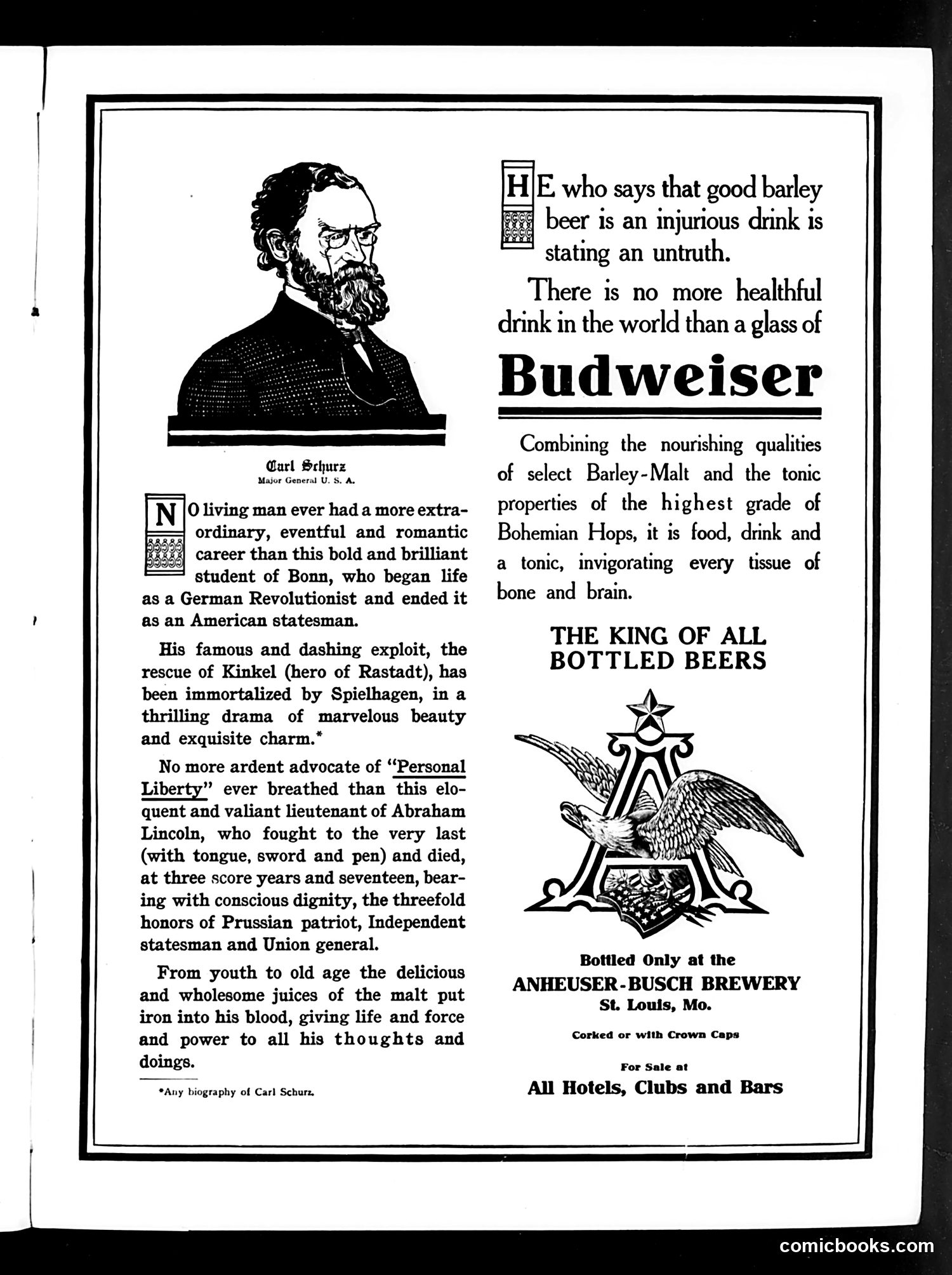
This page is primarily a **Budweiser beer advertisement** using editorial praise of Carl Schurz—a real German-American Civil War general and statesman (1829-1906)—as marketing cover. The biographical text celebrates Schurz's revolutionary background, Lincoln service, and advocacy for "Personal Liberty," then crucially claims that beer-drinking gave him vigor throughout life. This segues into the right-column advertisement claiming Budweiser is health-promoting rather than injurious. The strategy exploits Schurz's German heritage and credibility to endorse the product to German-American readers. By attributing Schurz's success partly to malt consumption, the ad conflates patriotic virtue with beer-drinking—a common advertising tactic in the early 1900s when medicinal claims for alcohol were legally permissible and ethnic marketing was standard practice.
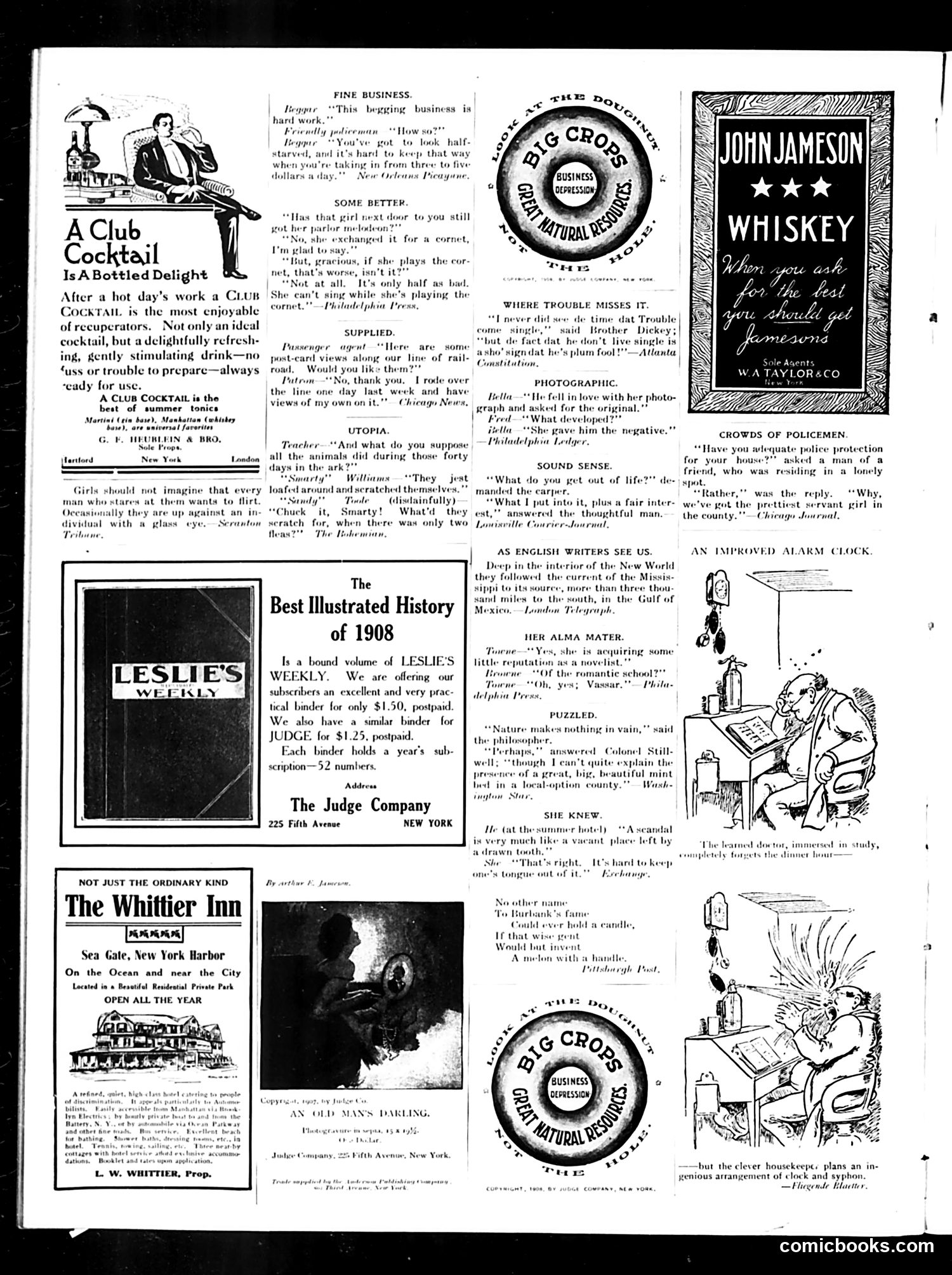
This page from *Judge* (circa 1908) contains multiple short humorous items typical of the satirical magazine format: **"A Club Cocktail Is a Bottled Delight"** — An advertisement disguised as humor, promoting pre-made cocktails as convenient refreshment for working men. **"Fine Business"** — A brief joke about beggars: one remarks that maintaining an appropriately starved appearance for panhandling is exhausting work, especially when forced indoors during business hours. **"Some Better"** — Social humor about a woman replacing her corset with a cornet (musical instrument), suggesting both are equally uncomfortable constraint devices. **"Utopia"** — A joke about animals during the "forty days" (Noah's flood reference), suggesting they merely "watched themselves" — likely mocking both religious literalism and animal behavior. The page primarily consists of **advertisements** (Leslie's Weekly binders, The Whittier Inn, John Jameson Whiskey) interspersed with **short joke columns** covering courtship, class relations, and domestic life — typical *Judge* content mixing consumer culture with gentle social satire.
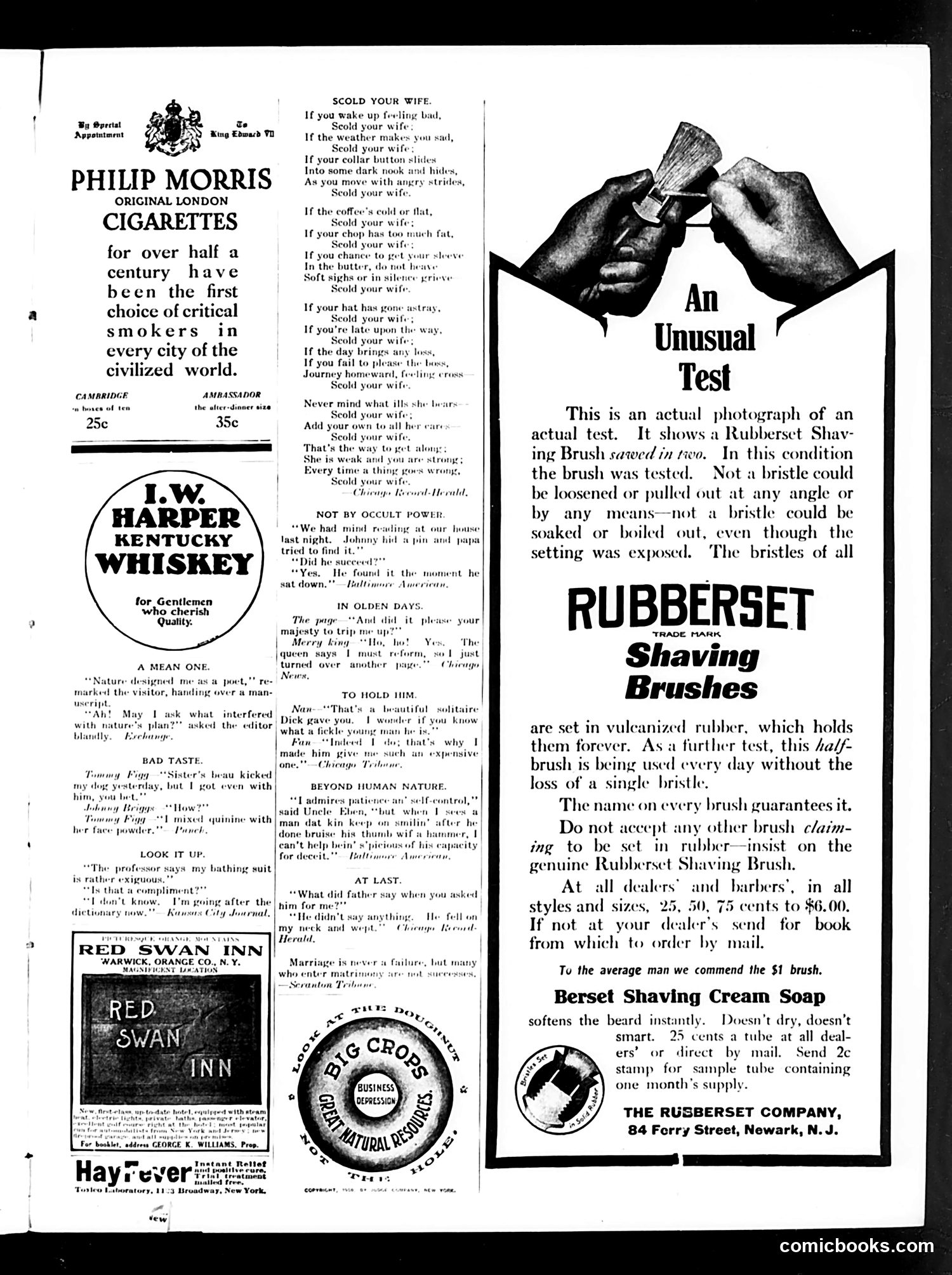
This page contains mostly **advertisements and brief humor columns**, not political cartoons. The main content includes: **Advertisements**: Philip Morris cigarettes, I.W. Harper whiskey, Red Swan Inn hotel, and prominently a full-page Rubberset Shaving Brush ad featuring an actual photograph of a brush sawed in half to demonstrate bristle retention. **Humor columns**: Several short jokes and anecdotes, including: - "Scold Your Wife" — a satirical list of domestic grievances humorously suggesting wives should be scolded for weather, lost buttons, cold coffee, etc. This reflects early-20th-century gender attitudes treating wives as household servants. - Brief miscellaneous jokes about mind-reading, marriage, and domestic life from *Punch* and other sources. **Social context**: The "Scold Your Wife" piece is notably misogynistic by modern standards, using humor to reinforce male domestic authority. The overall tone reflects period attitudes toward gender roles and marriage. The page is primarily commercial rather than satirical or politically engaged.
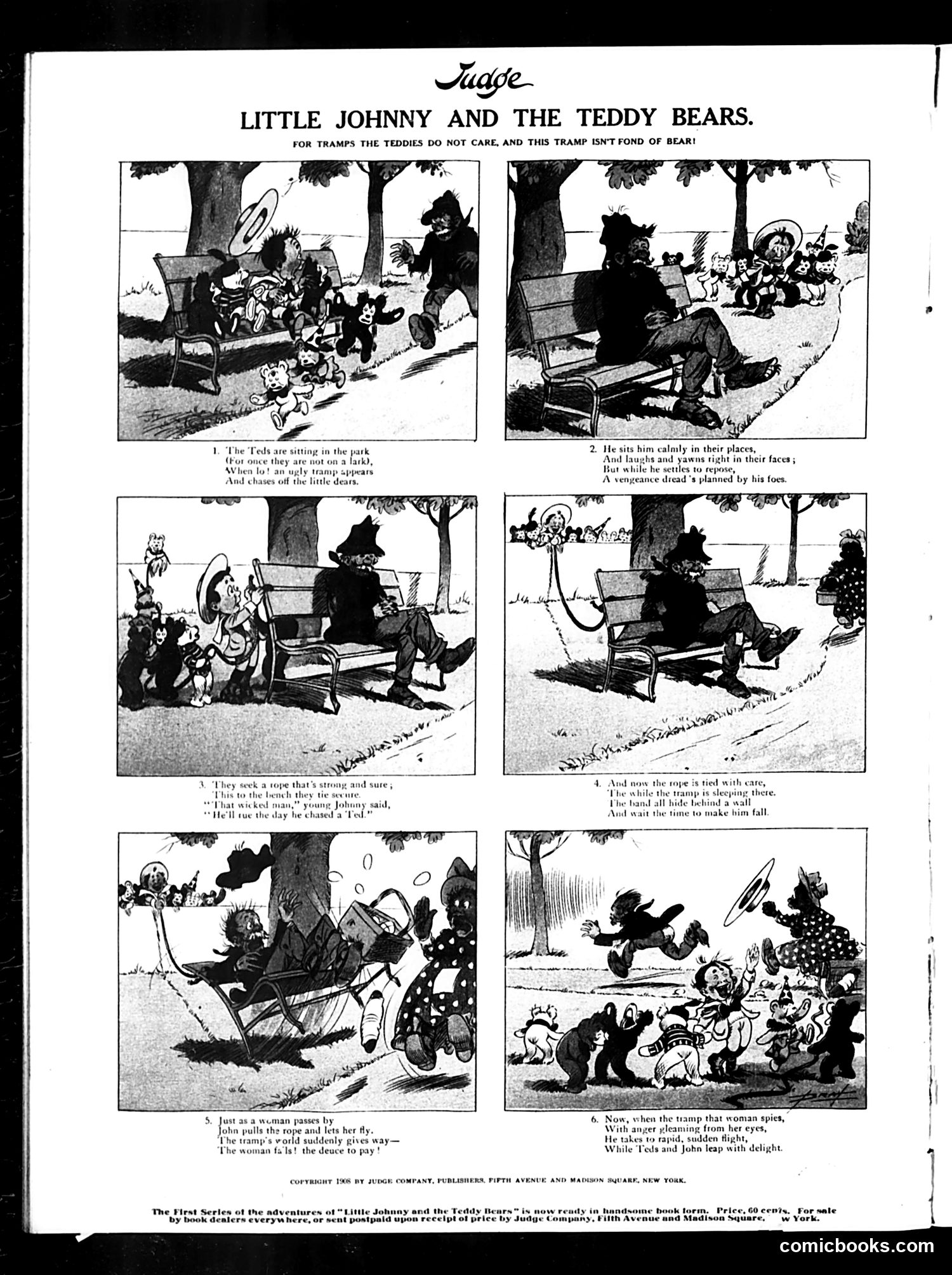
This 1908 Judge comic strip satirizes both childhood mischief and the "Teddy Bear" craze. "Teddy Bears" refers to stuffed toys named after President Theodore Roosevelt, wildly popular at the time. The narrative follows a vagrant ("tramp") who encounters Little Johnny and his toy bears in a park. The tramp is depicted as unafraid of the bears—dismissing them as harmless—and proceeds to cause chaos: he sits among them indifferently, then orchestrates a trap that makes a passing woman fall, seemingly for amusement. The satire works on multiple levels: it mocks the tramp's contempt for children's toys while portraying him as a threat to public safety. The subtitle's pun ("this tramp isn't fond of bear") suggests the vagabond's indifference or hostility contrasts with the innocent teddy-bear culture. The strip reflects early 1900s anxieties about urban vagrants while celebrating children's popular culture and the Roosevelt-associated toy phenomenon.