
A complete issue · 16 pages · 1908
Judge — August 8, 1908
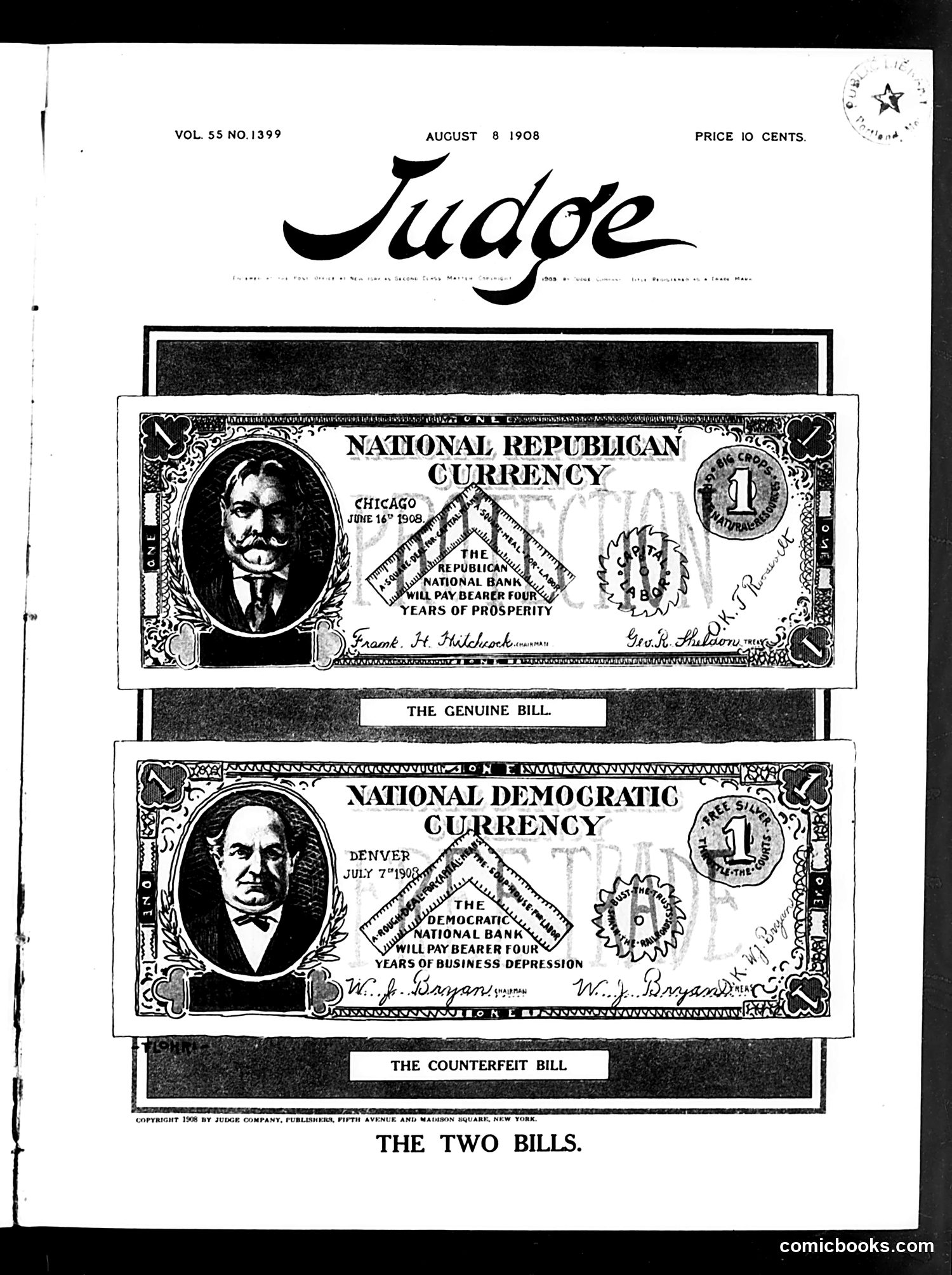
This Judge magazine page from August 8, 1908 uses mock currency to satirize the competing visions of Republicans and Democrats during that election year. The top bill depicts **Republican currency** promising "four years of prosperity," featuring a man with a distinctive mustache (likely President Theodore Roosevelt or a Republican candidate). The bottom bill shows **Democratic currency** promising "four years of business depression," with a different portrait (likely William Jennings Bryan, the Democratic candidate). The satire's point: Judge magazine is mocking Democratic pessimism by suggesting they campaign on economic gloom, while Republicans promise growth. The label "THE GENUINE BILL" for the Republican version and "THE COUNTERFEIT BILL" for the Democratic one makes the magazine's partisan position explicit—treating Democratic economic predictions as false or fabricated.
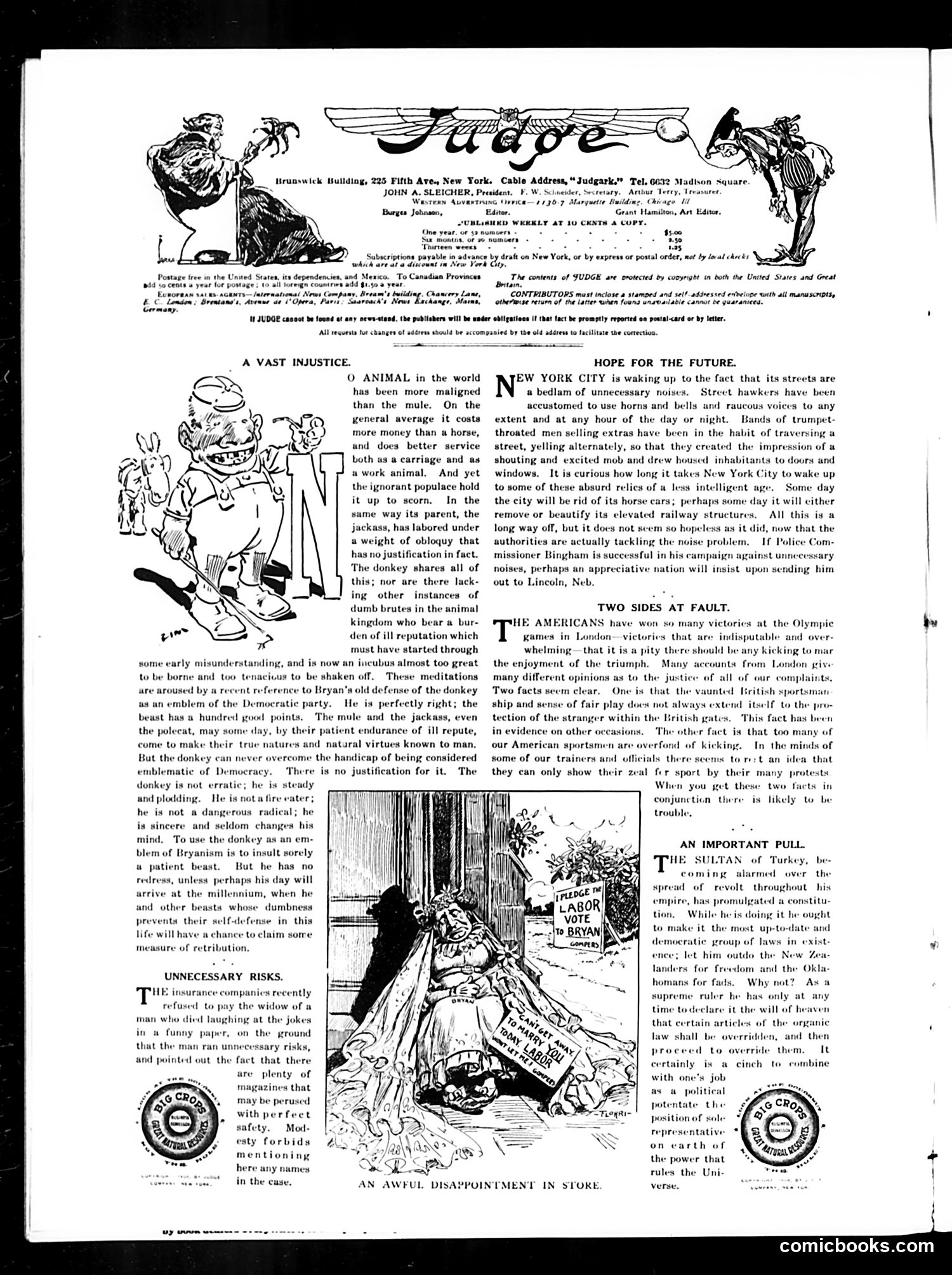
This page contains four political opinion pieces with illustrations, likely from the early 1900s based on style. **"A Vast Injustice"** criticizes the Democratic Party through a donkey caricature (the Democratic symbol), arguing donkeys are unfairly maligned as stupid when they're actually patient and hardworking—a backhanded defense of the party itself. **"Hope for the Future"** addresses New York City's noise pollution from street vendors and elevated railways, advocating for municipal reform. **"Two Sides at Fault"** discusses American Olympic victories and disputes about fair play in international competition. **"An Awful Disappointment in Store"** shows a political figure (possibly Bryan, based on visible text) concerning Turkey's constitutional crisis, suggesting disillusionment with political outcomes. The cartoons employ satirical animal symbolism and caricature typical of progressive-era American political commentary.
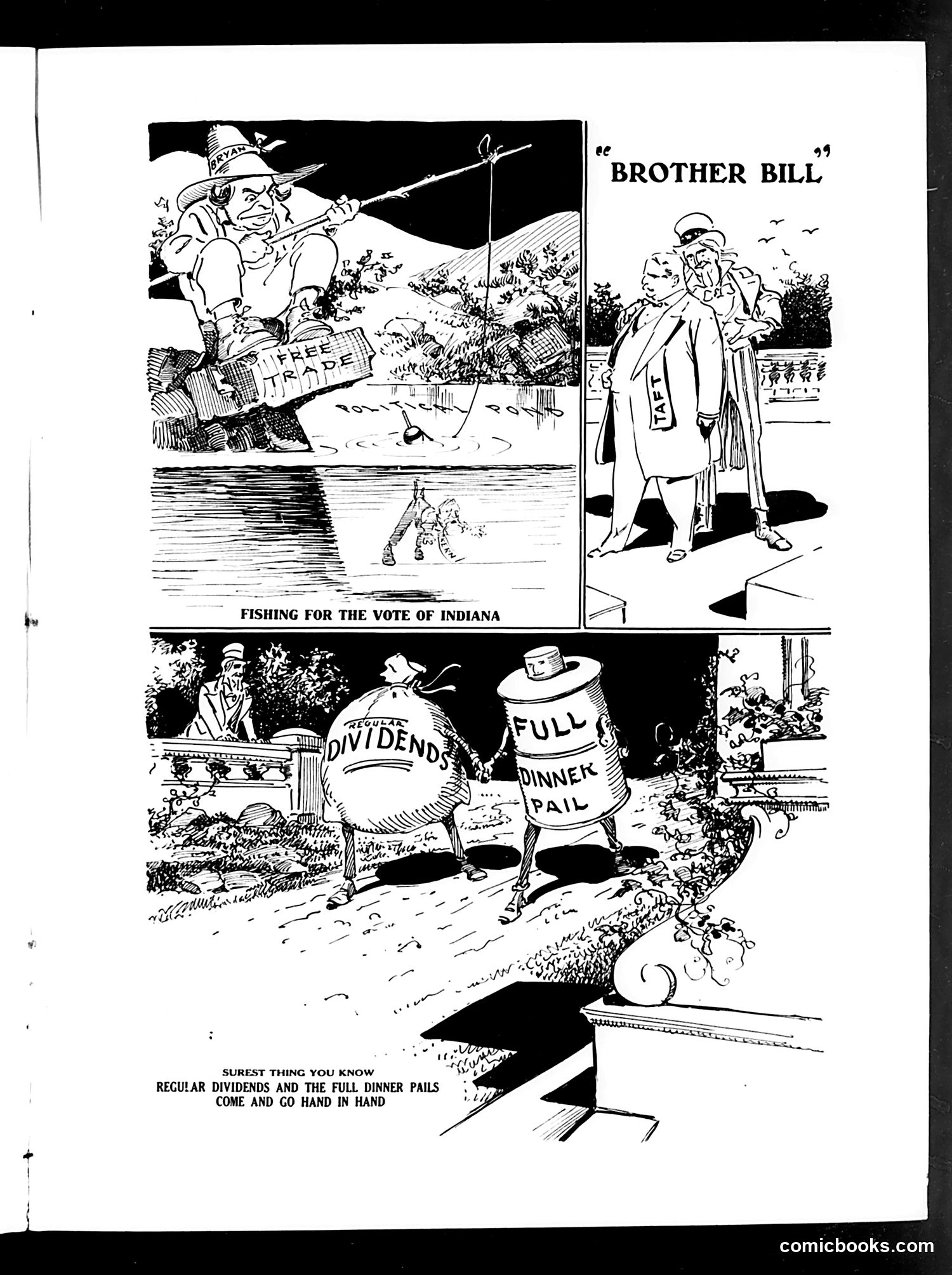
This Judge magazine cartoon satirizes political campaigning, likely from the early 20th century. The top panel shows a figure labeled "FREE TRADE" fishing for "the vote of Indiana," using money as bait. The bottom panel depicts "REGULAR DIVIDENDS" and "FULL DINNER PAIL" as companion figures walking together, suggesting these economic promises went "hand in hand" in political messaging. The satire criticizes how candidates used economic incentives—promises of dividends and full employment—to secure votes from Indiana voters. The fishing metaphor suggests voters were being manipulated or "caught" through appeals to material self-interest rather than genuine policy substance. The cartoon mocks the cynical transactional nature of turn-of-the-century American politics.
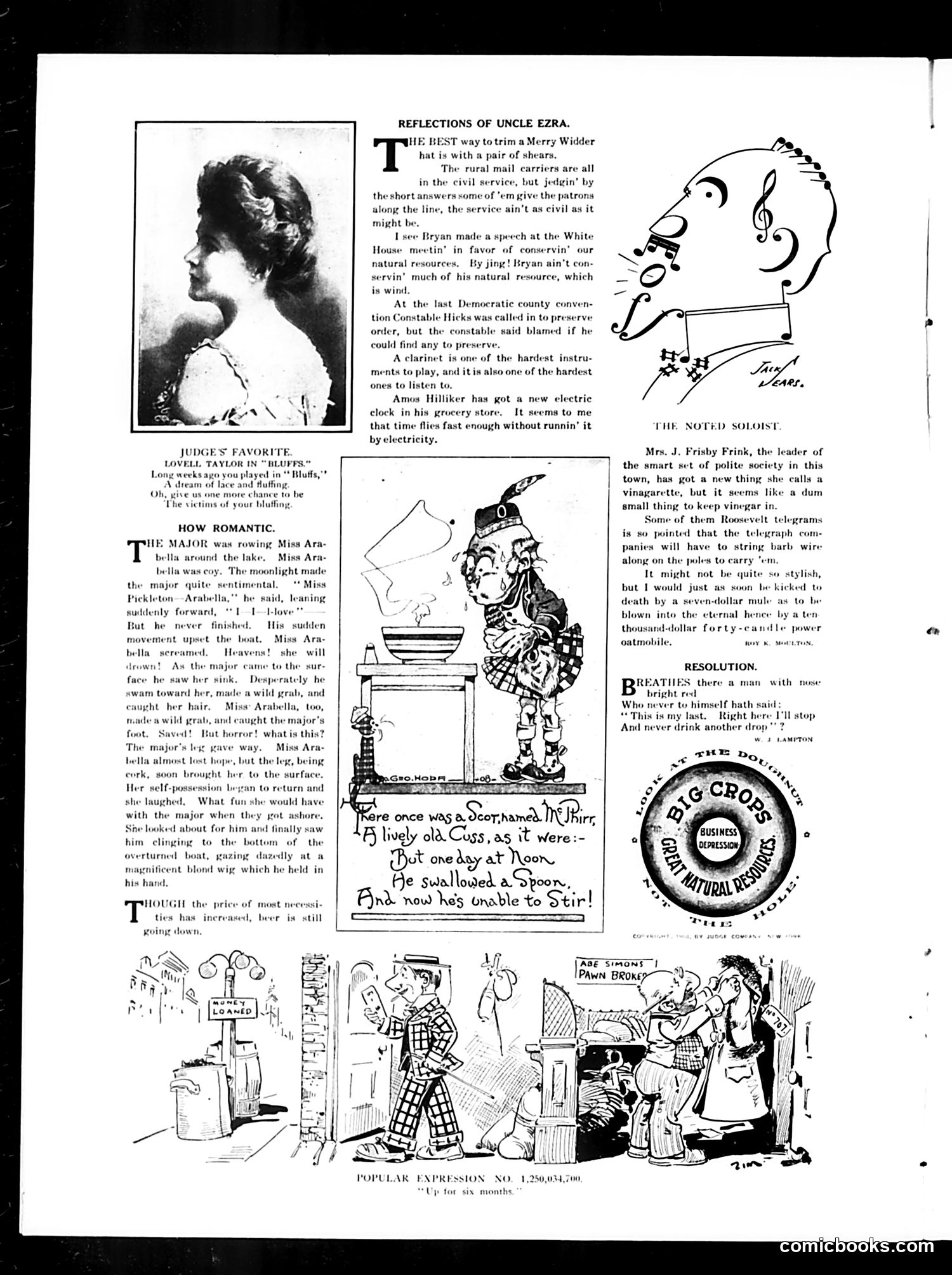
This page combines social satire with humor pieces. "Reflections of Uncle Ezra" presents rural commentary on contemporary issues—Bryan's political speechmaking, the civil service, and new technologies like electric clocks and vinaigrettes. The central cartoon titled "How Romantic" mocks sentimental courtship, showing a major pursuing Miss Arabella through elaborate, failing romantic gestures that increasingly humiliate both parties. "The Noted Soloist" caricatures musical pretension, while the bottom cartoon "Popular Expression No. 1,296,034.00" satirizes urban working-class life and behavior. The recurring theme is deflating pretense—whether political oratory, romantic fantasy, or social aspiration—through gentle ridicule. The magazine targets educated, middle-class readers familiar with contemporary reference points about governance, courtship customs, and class dynamics of the Gilded Age/Progressive Era.
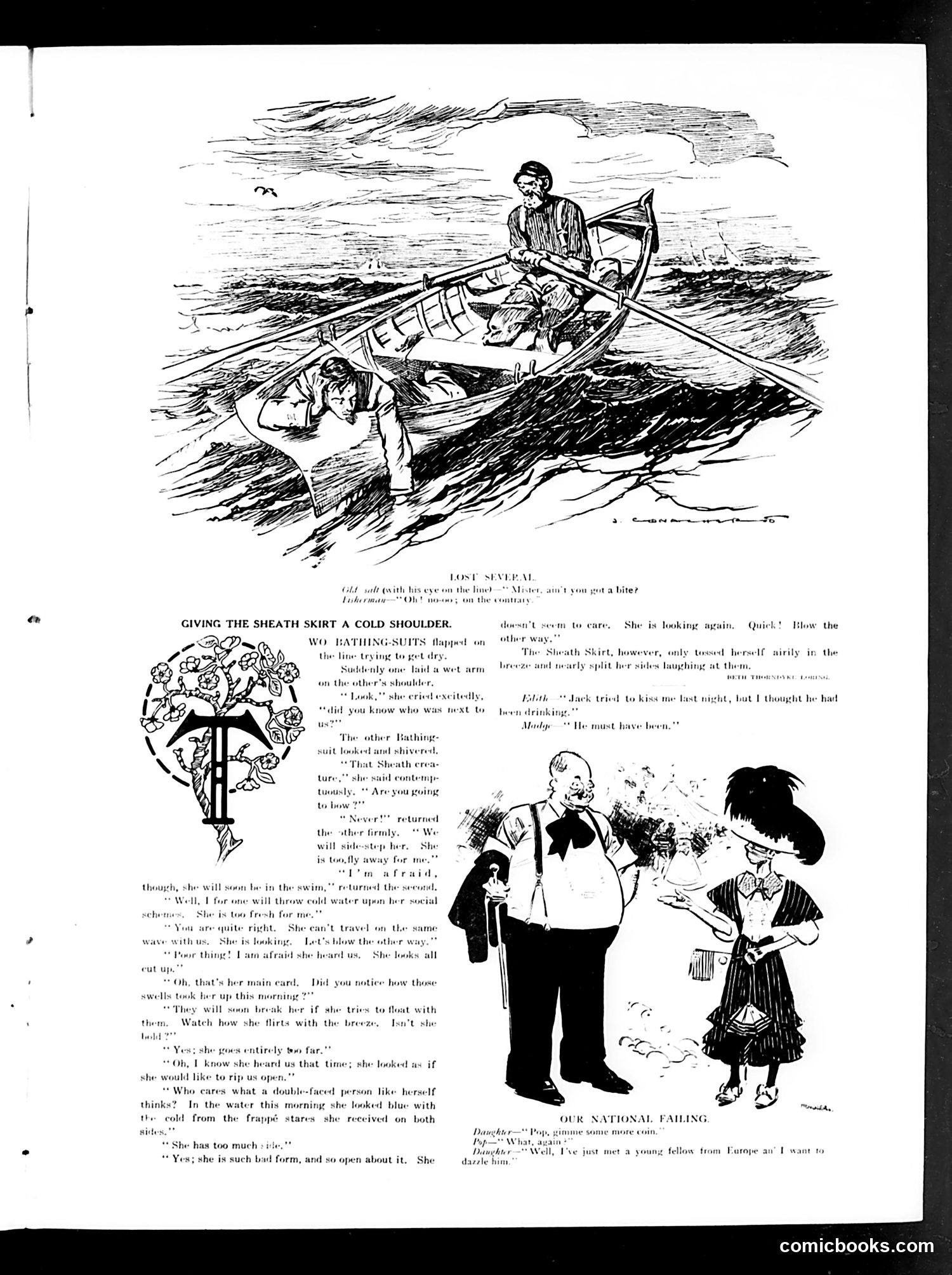
This page contains two satirical cartoons about social embarrassment and romantic rejection. **"Lost Sheath"** (top): A boatman and child discover a woman in the water. The dialogue suggests she's attempting suicide over romantic disappointment, with the boatman remarking she lacks a "biter" (likely slang for romantic appeal). **"Giving the Sheath Skirt a Cold Shoulder"** (bottom): Two women in bathing suits discuss another woman's outfit. The "Sheath Skirt" was a controversial 1910s-era women's fashion known for its restrictive, body-hugging silhouette. The satire mocks both the impractical garment and women's competitive social dynamics around fashion choices and romantic desirability. Both cartoons ridicule contemporary courtship anxieties and women's fashion trends through exaggerated scenarios of romantic failure and social one-upmanship.
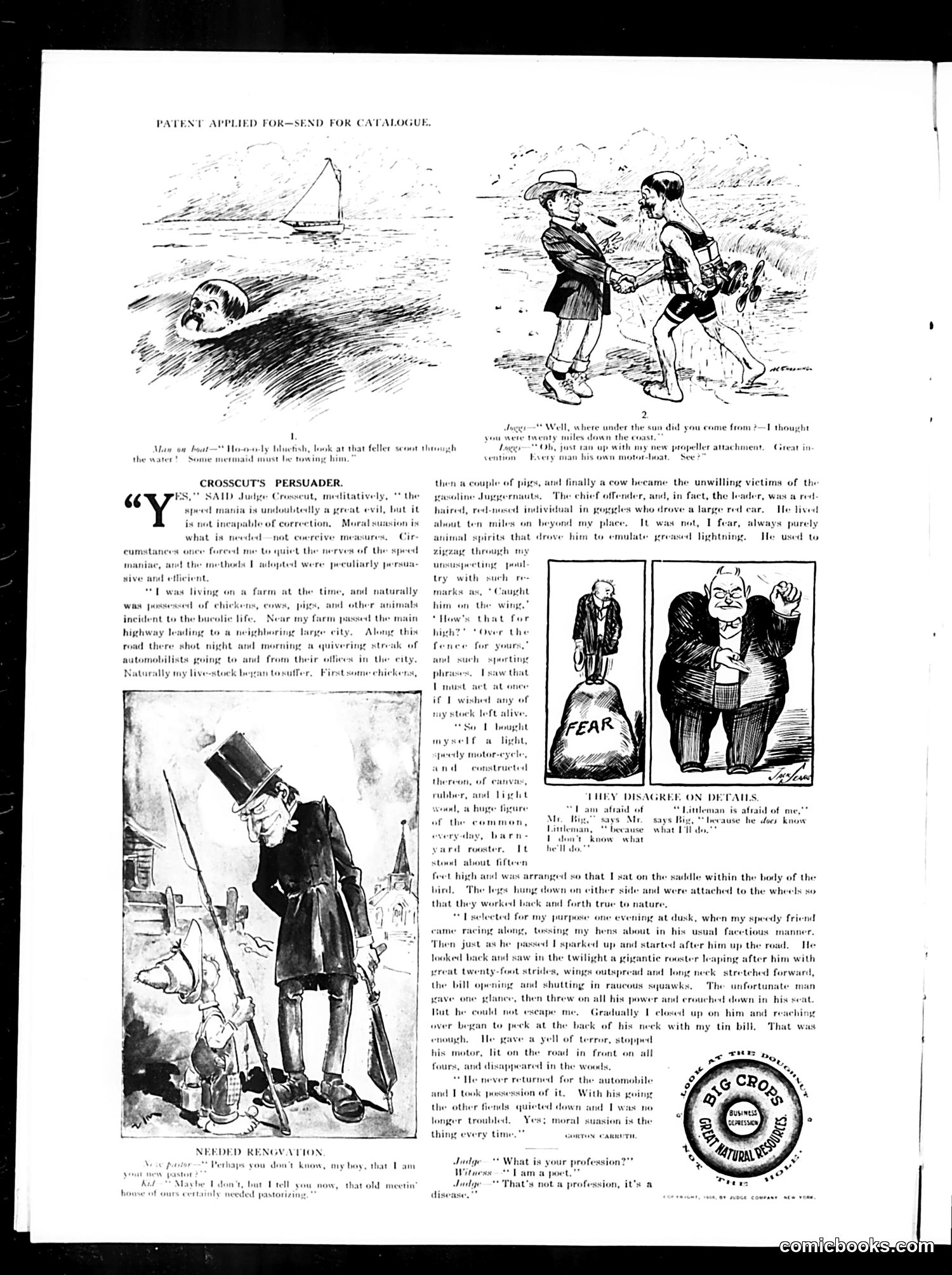
This page satirizes early 20th-century **automobile culture and its dangers to rural life**. The main story, "Crosscut's Persuader," depicts a farmer's struggle against reckless motorists destroying his livestock. The narrative voice describes constructing an elaborate mechanical device—a "persuader"—triggered when a speeding automobile passes. The contraption launches the farmer's rooster (or possibly cow) at the vehicle to deter the driver. The cartoons illustrate the conflict: two figures arguing about the encounter, and a portly gentleman labeled "FEAR" confronting another man, likely representing the motorist's terror after being attacked by the flying rooster-projectile. **The satire targets**: wealthy city motorists' callous indifference to rural property damage, the farmer's ingenious but absurd solution, and the broader clash between industrial progress (automobiles) and traditional agrarian society. The humor suggests readers' ambivalence about automotive "progress"—sympathizing with the farmer's desperation while mocking his retaliatory violence.
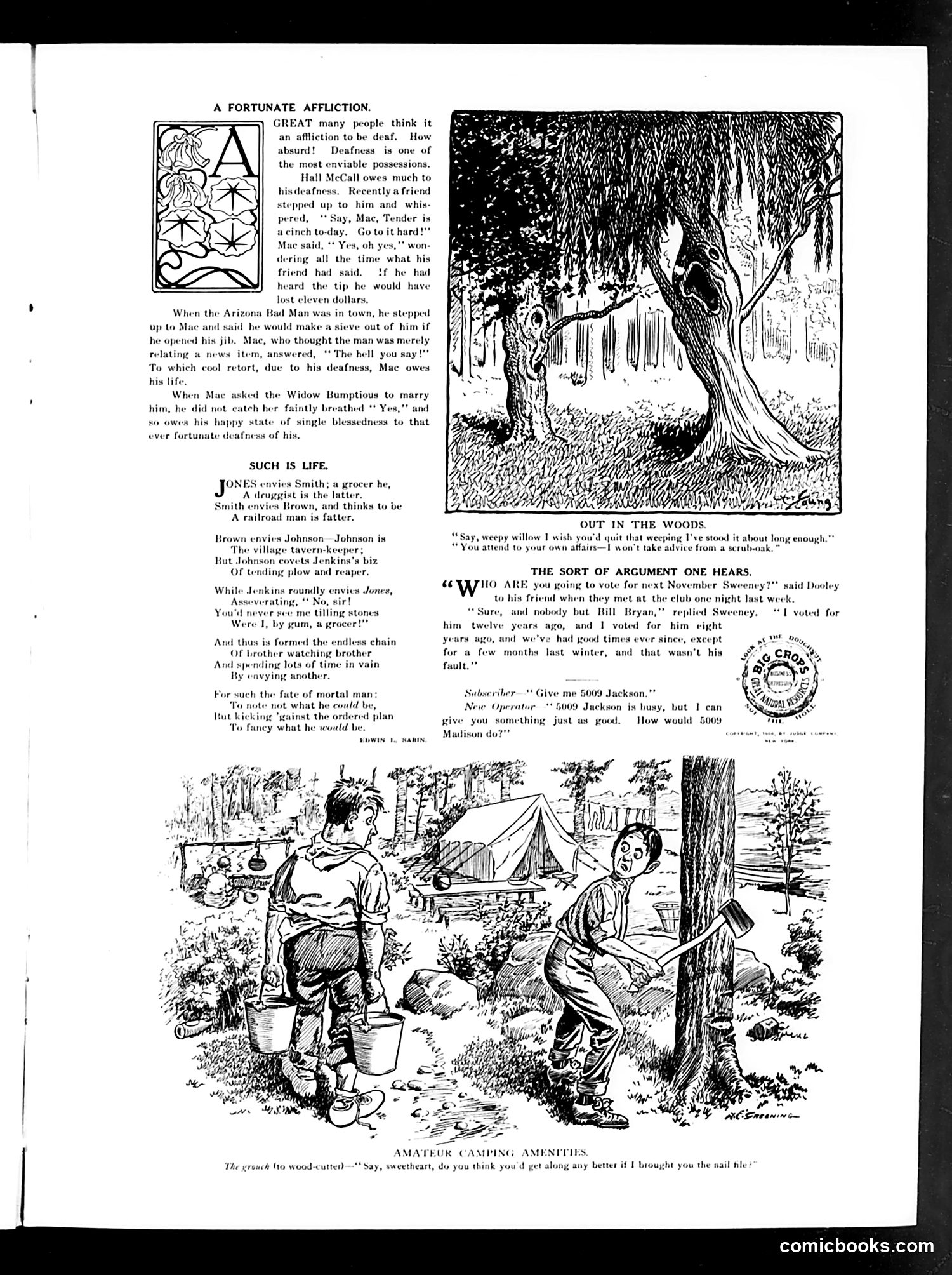
This page from the satirical magazine *Judge* contains several humor pieces mocking everyday social situations rather than specific political figures. **"A Fortunate Affliction"** jokes that deafness is actually advantageous—Hall McCall avoided losing money on a bad stock tip and accepted a marriage proposal he didn't fully hear, both outcomes benefiting him through his inability to hear advice. The satire targets gullible investors and hasty romantic decisions. **"Such Is Life"** presents short verses about occupational envy (a grocer envies a railroad man for being fatter/more prosperous), mocking the human tendency to covet others' circumstances. **"The Sort of Argument One Hears"** satirizes unsophisticated political reasoning—a voter supports Bryan simply because he voted for him before and "had good times," ignoring actual policy. **"Amateur Camping Amenities"** shows a couple arguing during camping, with the wife sarcastically asking if a nail file would improve their situation. The page satirizes common American follies: financial naïveté, romantic impulsiveness, occupational dissatisfaction, unreasoned politics, and domestic discord—all presented as humorous observations of contemporary life rather than topical commentary.
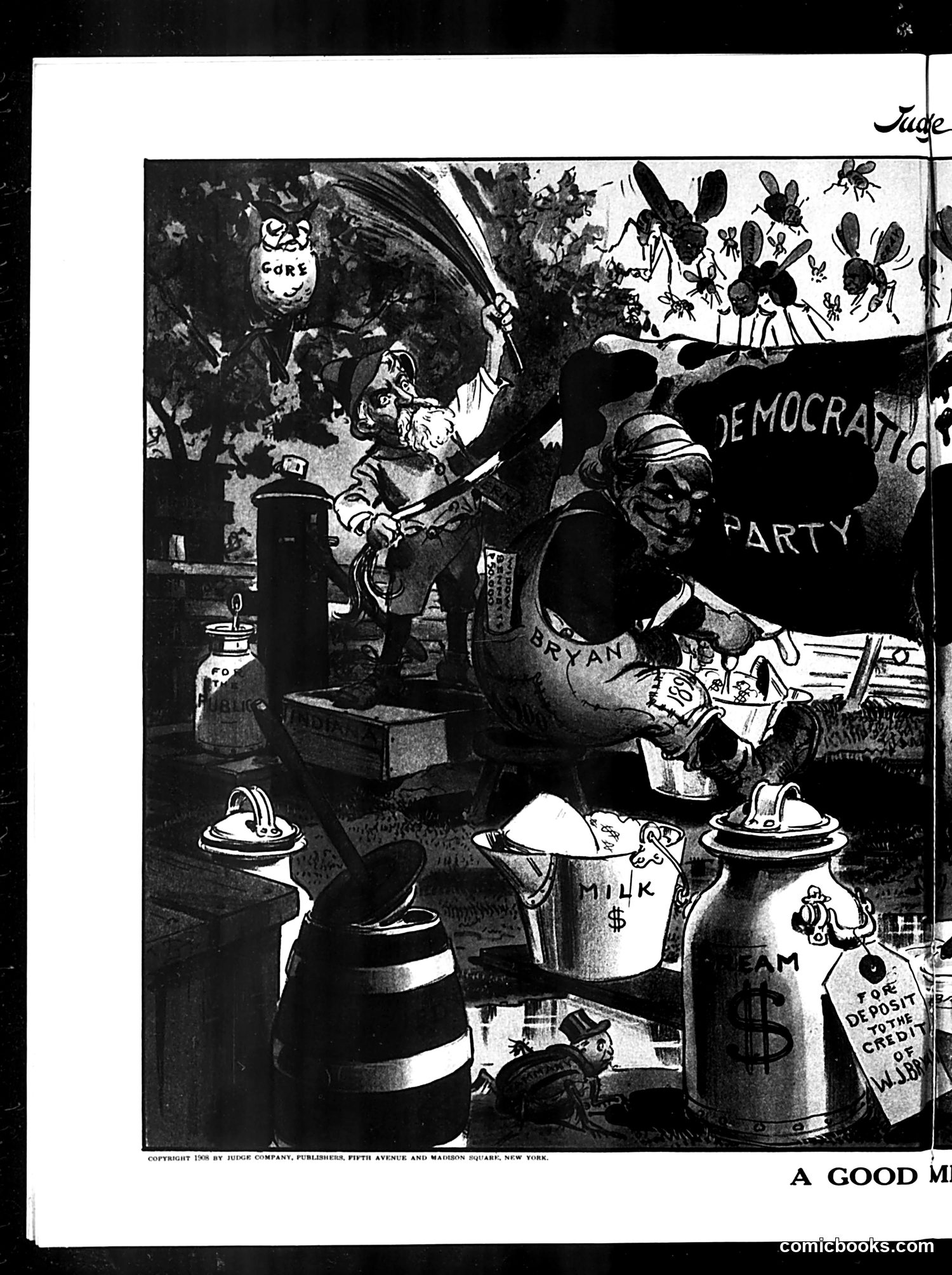
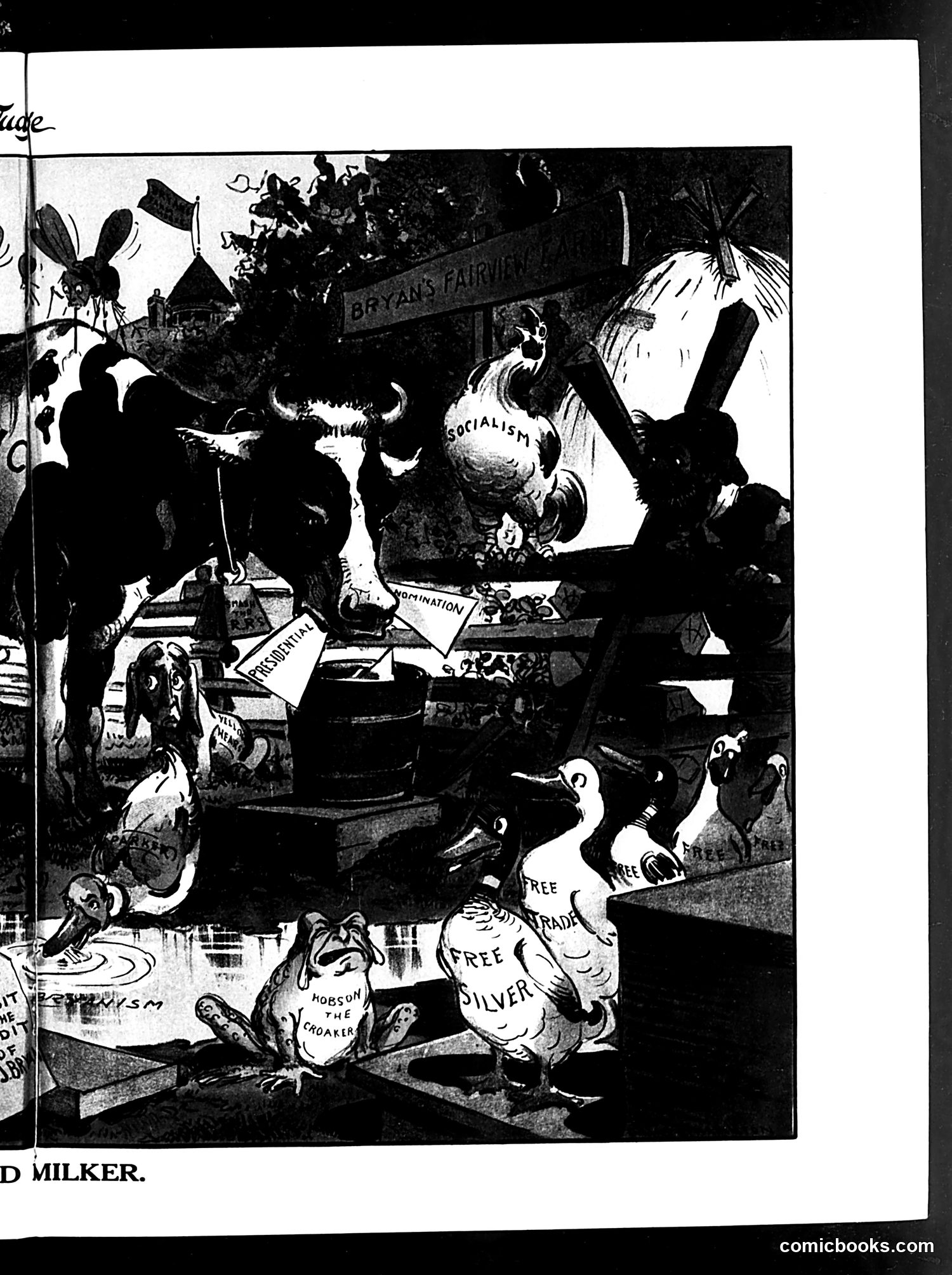
This Judge magazine cartoon satirizes the Democratic Party's financial management during what appears to be the early 20th century. The central figure labeled "DEMOCRATIC PARTY" is depicted as a disheveled character surrounded by overflowing milk cans marked with dollar signs, labeled "MILK" and referencing deposits and credit. The imagery suggests the Democrats are mismanaging public funds—the spilled milk is a visual pun implying wasted resources. Additional elements include a character labeled "BRYAN" (likely William Jennings Bryan, a prominent Democratic figure), propaganda-like imagery in the background, and cacti representing barren or wasteful conditions. The satirical point criticizes Democratic fiscal irresponsibility and financial mismanagement of government resources.
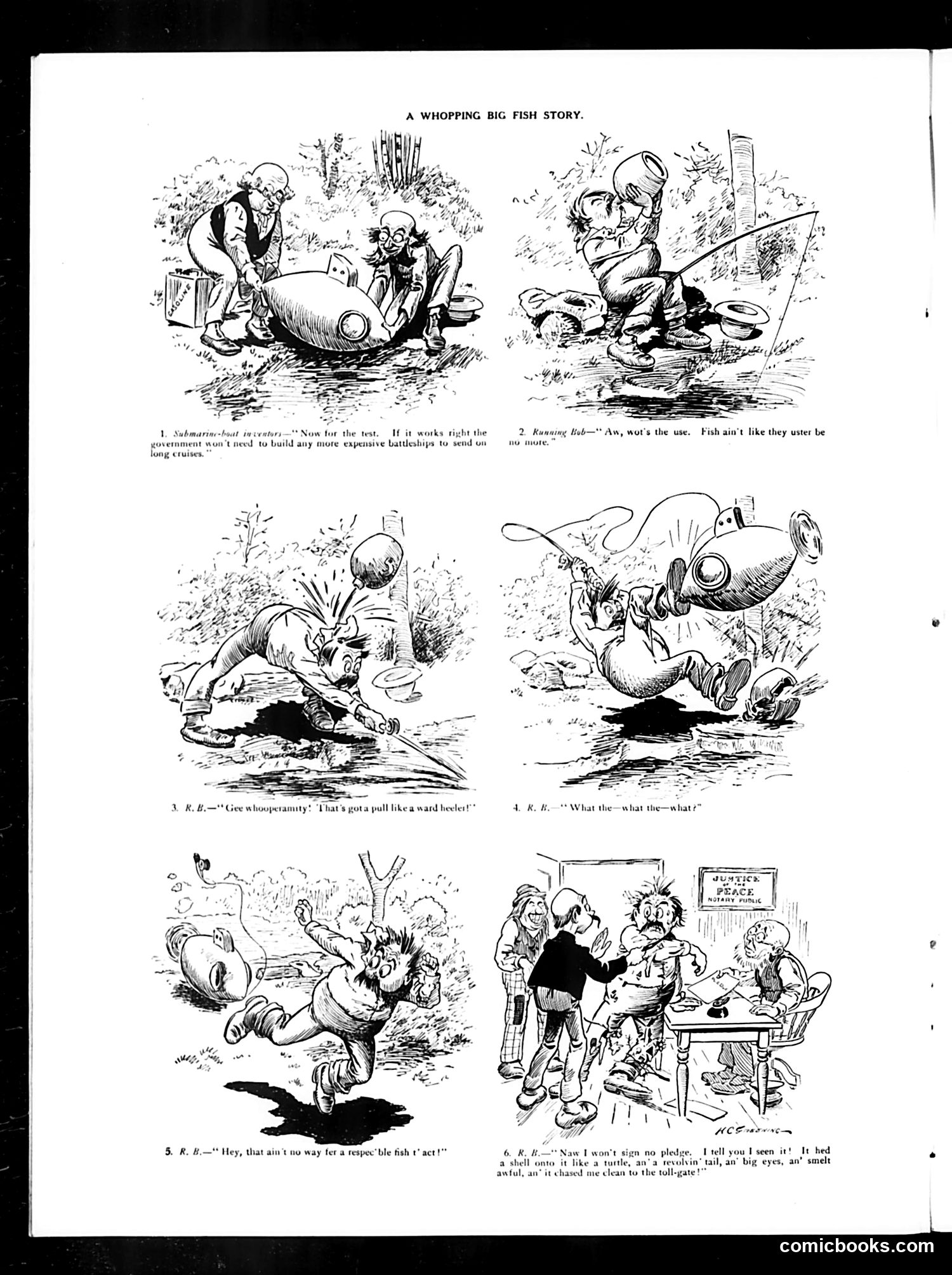
This comic strip satirizes exaggerated fishing tales—a time-honored tradition of fishermen lying about their catches. The narrative follows characters discussing an implausibly large fish, with escalating absurdity: the submarine-boat inventor pitches it as a "battleship" test; subsequent panels show increasingly ridiculous descriptions (the fish has a shell, a tail, giant eyes, chased someone to a toll-gate). The satire targets both fishing culture's tall tales and possibly contemporary naval anxieties—the reference to "expensive battleships" suggests early-20th-century concerns about military spending. The final panel shows the fisherman at a tavern ("Hunter's Peace") where his obviously false story meets skepticism, mocking how such exaggerations persist despite their transparency. The humor relies on the reader recognizing the universal trope of unbelievable fishing stories.
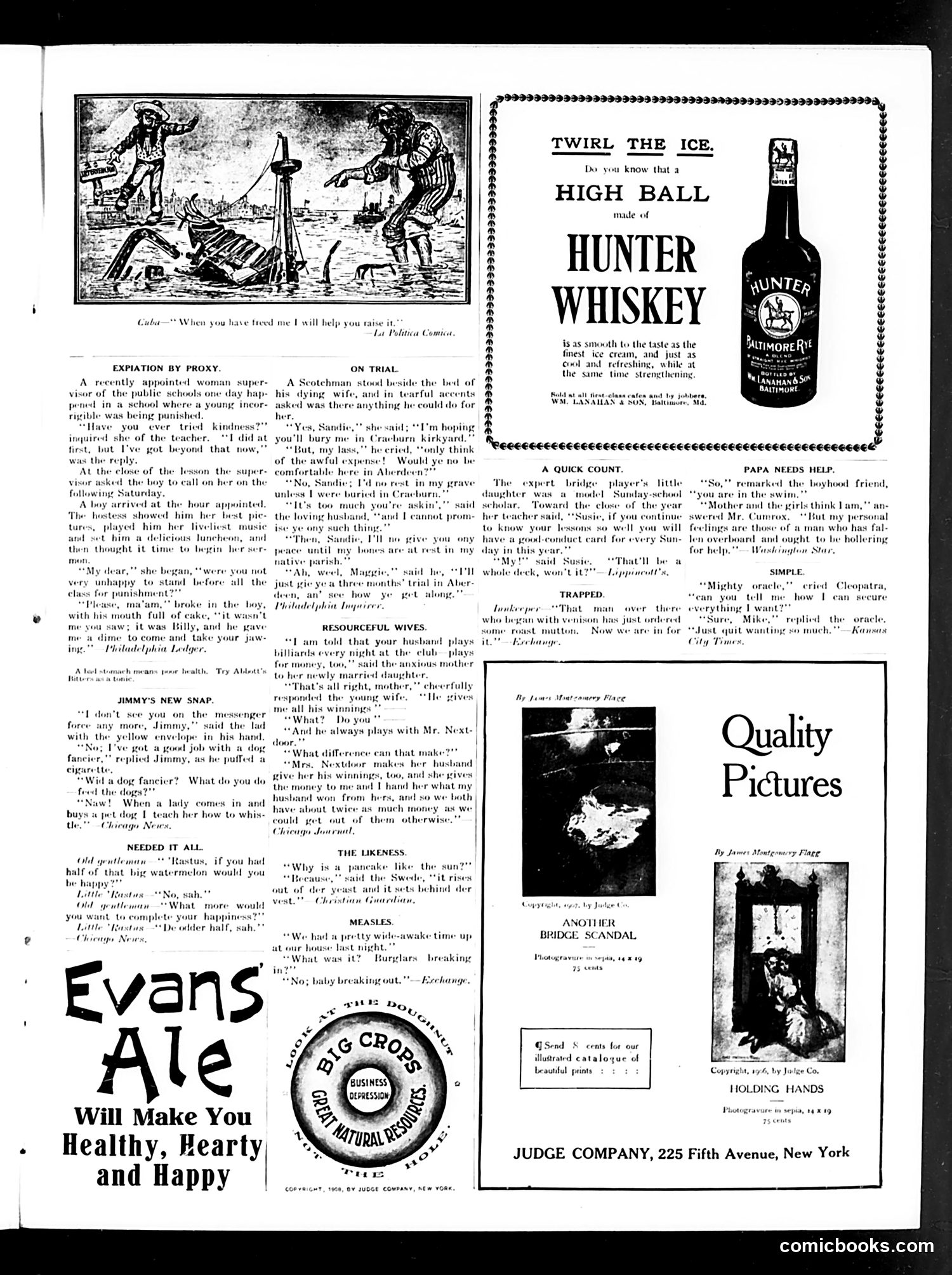
This page is primarily **advertising and humor content** rather than political satire. The layout mixes short jokes, advertisements, and illustrated humor pieces typical of Judge magazine. The main illustrated cartoon (upper left) shows two figures with a caption referencing "La Política Cómica" (Comic Politics), though the image itself appears to depict a classical or mythological scene rather than contemporary political commentary. The bulk of the page consists of **brief humorous anecdotes** with ethnic and regional humor common to the era: Scottish dialect jokes ("Sandie"), African American dialect humor ("Old gentleman" and "Rastus"), and domestic comedy. These reflect early-20th-century American magazine conventions of ethnic stereotyping for comedic effect. **Advertisements** dominate the right side: Hunter Whiskey, Evans Ale, Big Crops fertilizer, and Judge Company's own "Quality Pictures" prints for sale. The humor relies on wordplay, misunderstandings, and character types (shrewd wives, penny-pinching husbands) rather than political content. This appears to be a typical issue blending light entertainment with commercial promotion.
This page from *Judge* magazine (a major American satirical publication) contains multiple short humor pieces typical of early 20th-century comedy, plus advertisements. The cartoons mock domestic life and social pretension. "Making a Diagnosis" jokes about a physician's uncertainty—the doctor suspects the patient's sore throat may actually be from marital discord with a clergyman, then backtracks. "A Business Deal" satirizes fortune-hunting: a "homely heiress" expects suitors won't care about her appearance if she's wealthy. "Feminine Logic" mocks women's reasoning about marriage proposals. "Did He Do It?" plays on spousal quarrels and public kissing. "Cut Off the Allowance" depicts marital conflict over finances. These pieces reflect period anxieties about marriage, gender roles, and class aspiration. The humor targets both men and women—wives are depicted as illogical, husbands as unfaithful or irresponsible. The tone is lighthearted rather than mean-spirited, assuming audiences shared these stereotypes about domestic life. The advertisements (whiskey, real estate, house plans, eczema treatment) represent typical *Judge* revenue sources targeting affluent readers.
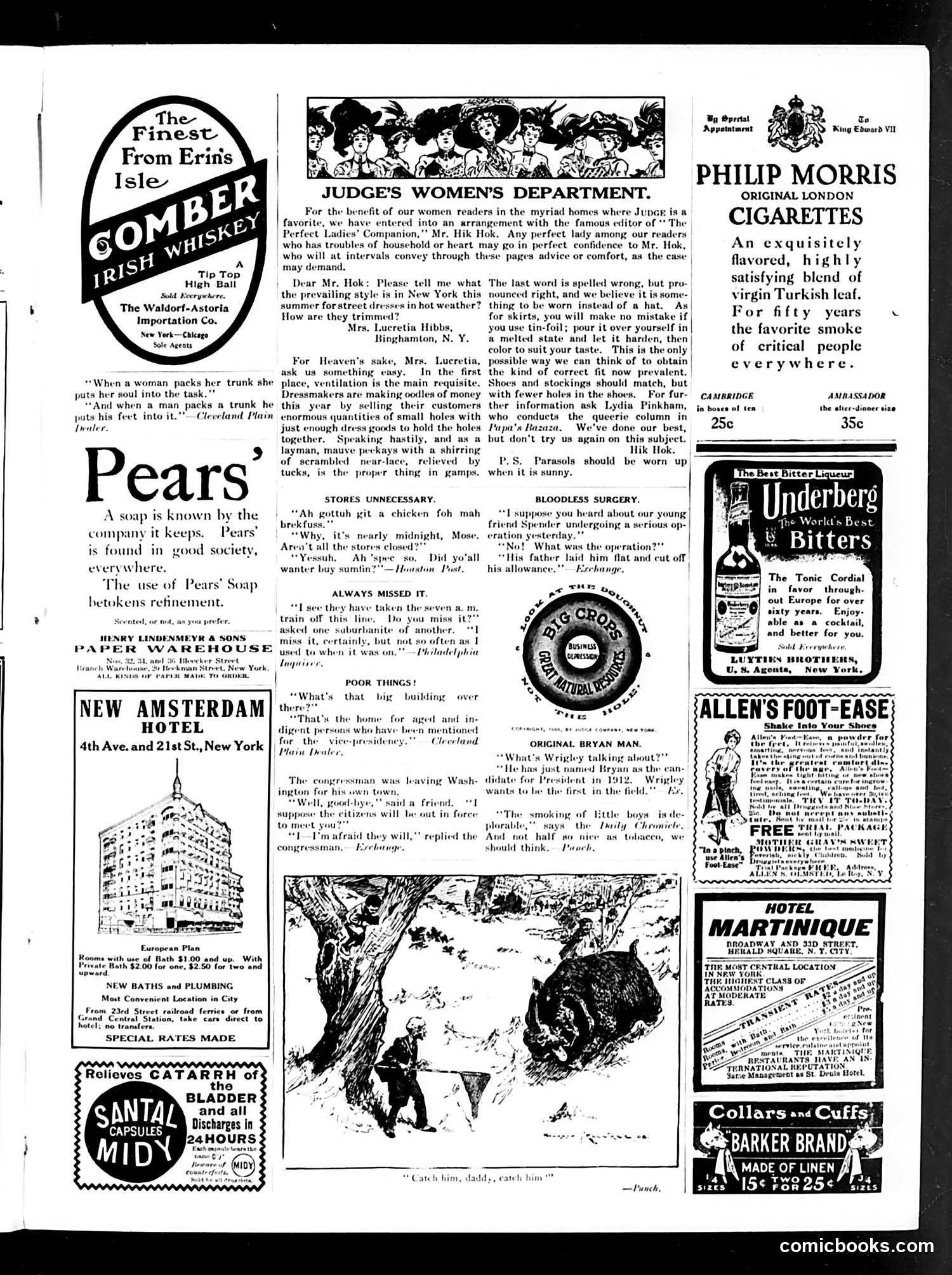
This page from Judge magazine is primarily **advertising and advice columns**, not political satire requiring historical context. The main content is "Judge's Women's Department," featuring Q&A advice from "Mr. Hik Hok" on fashion, etiquette, and household matters. The humor relies on gentle period stereotypes: a question about summer dress styles, tin-foil fashion suggestions, shoe-matching advice. Scattered throughout are brief comic anecdotes (untitled, unsigned), including dialogue between characters with dialect writing—one featuring African American vernacular ("Ah 'spec so," "Yessuh"). These appear to be generic humor pieces rather than commentary on specific events or figures. There's a reference to "Bryan" in "Original Bryan Man," but without fuller context visible, I cannot definitively identify which Bryan is meant or what political point is being made. The page is dominated by period product advertisements (Pears' Soap, Philip Morris cigarettes, hotels, foot powder) typical of magazine monetization. The cartoons and jokes are lightweight domestic humor, not serious political commentary.
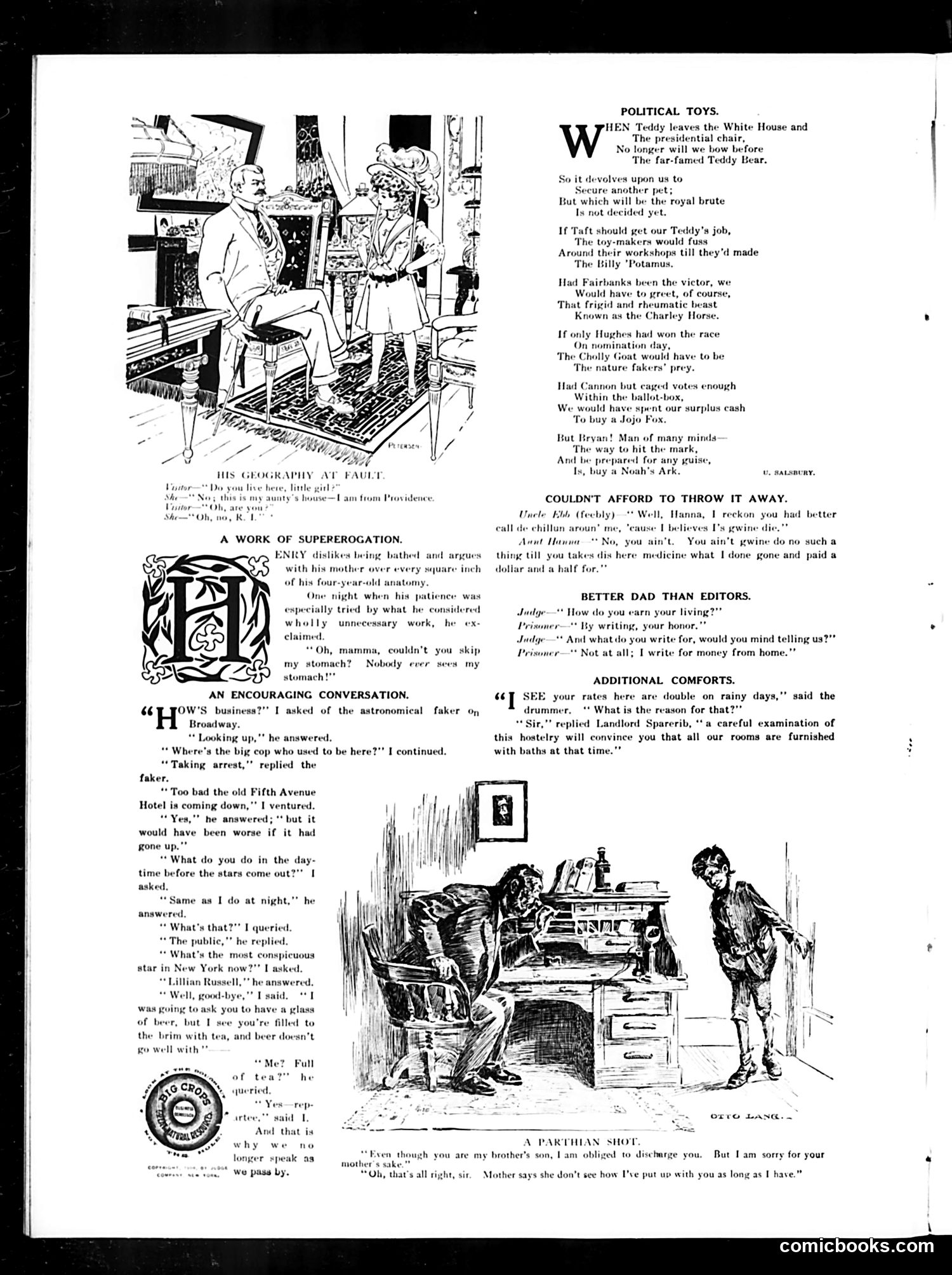
This page satirizes early 1900s American politics through multiple cartoons and jokes. **"Political Toys"** (main poem, top right) mocks the upcoming presidential succession after Theodore Roosevelt. It jokes that if various candidates won—Taft, Fairbanks, Hughes, Cannon, or Bryan—toy manufacturers would create corresponding novelty toys to capitalize on public enthusiasm. The "Teddy Bear" reference shows how Roosevelt's popularity had literally created merchandise. Each candidate gets a ridiculous toy name (Billy "Potamus," Cholly Horse, Jojo Fox, Noah's Ark), satirizing how political fervor drives commercial exploitation. The smaller cartoons are unrelated humor pieces about family arguments, con artists, and boarding-house complaints—typical Judge filler content. The overall message: American politics and commerce are intertwined, with citizens treated as consumers to be marketed to rather than voters with genuine choices.
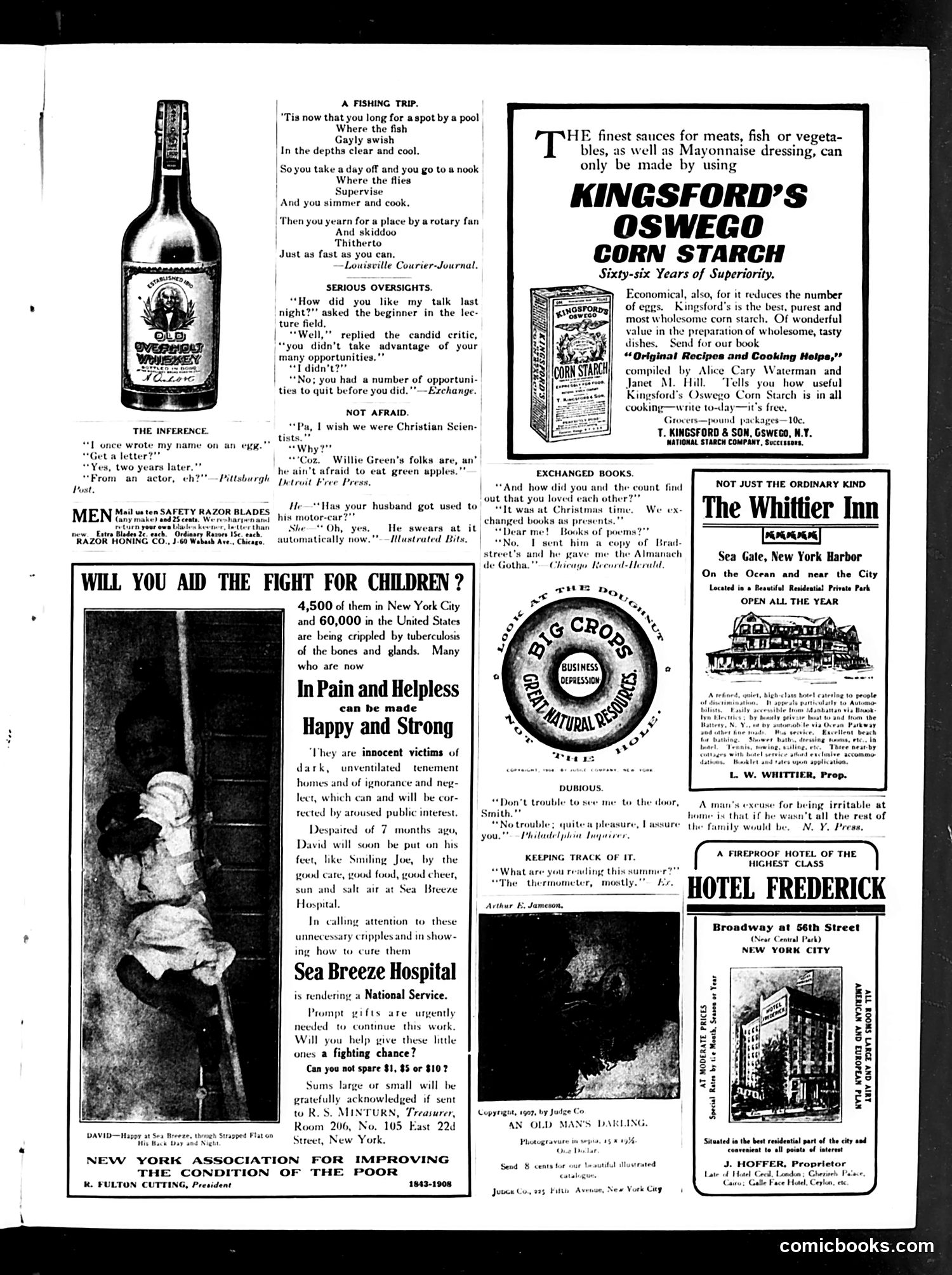
This page is primarily **advertising and filler content** rather than political satire. It contains multiple brief humorous items and advertisements typical of early 1900s magazines. The main items include: - **"The Inference"**: A joke about an actor claiming to have written his name on an egg, with the punchline that this is unremarkable - **"A Fishing Trip"**: Lighthearted verse about summer recreation - **"Will You Aid the Fight for Children?"**: A serious charitable appeal for the Sea Breeze Hospital, featuring a photograph of a child (David) being helped by the organization to recover from tuberculosis of the bones and glands The page also contains period advertisements for Kingsford's Oswego Corn Starch, The Whittier Inn hotel, and Hotel Frederick, along with several other brief joke items. The Sea Breeze Hospital appeal is the most substantive content, addressing tuberculosis affecting poor children in early 20th-century New York City—a genuine public health crisis of the era.
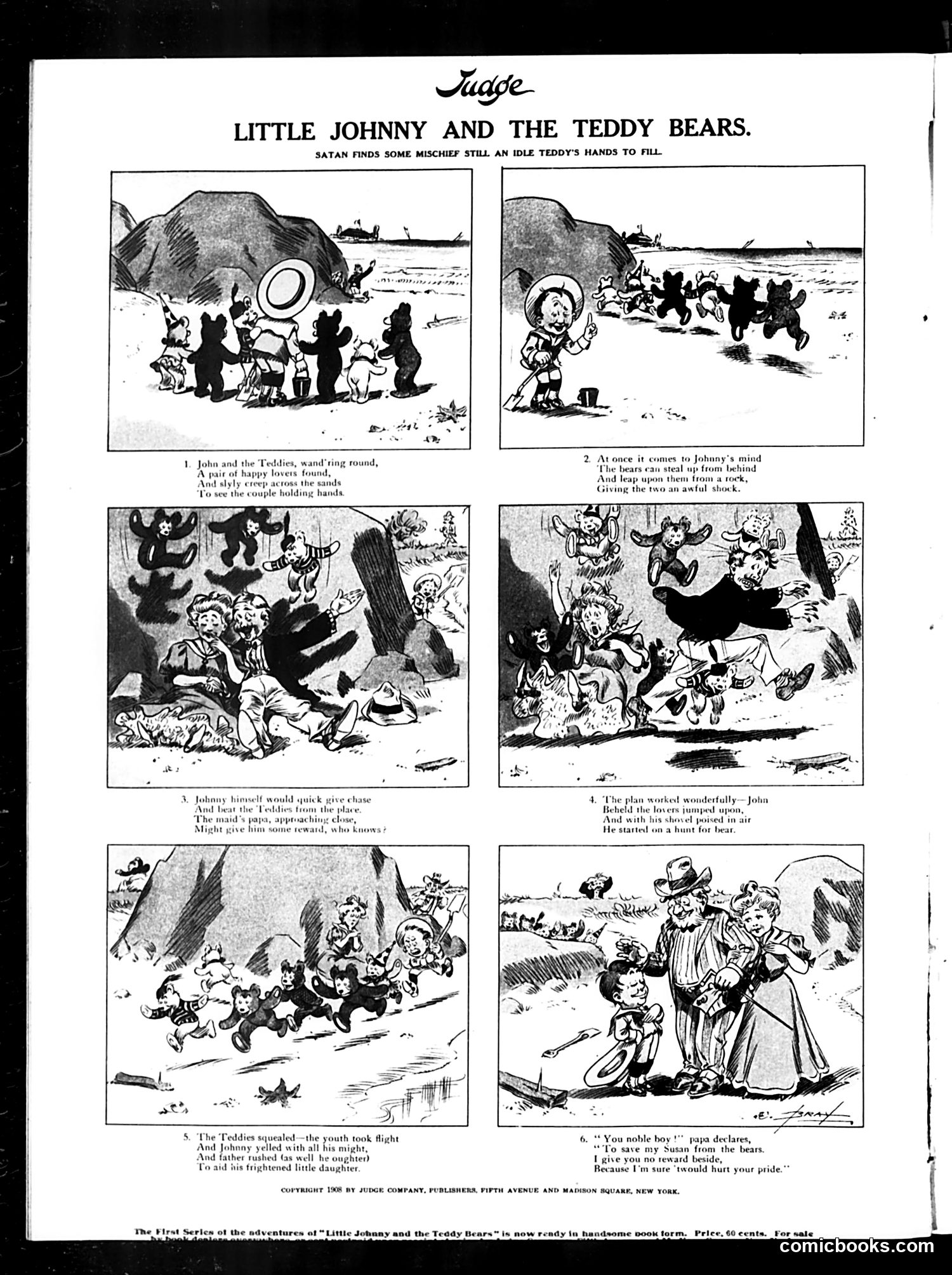
This is a six-panel comic strip story rather than political satire. It depicts a boy named Johnny and anthropomorphic teddy bears at the beach. The narrative follows Johnny's scheme to ambush the bears by hiding behind a rock, then executing a surprise attack. The bears retaliate, leading to a chaotic chase sequence where Johnny flees. The final panel shows an adult figure (appearing to be a parent or authority figure) scolding Johnny with the caption about "noble boys" and giving reward bonds—seemingly ironic given Johnny's mischievous behavior. The subtitle "Satan Finds Some Mischief Still an Idle Teddy's Hands to Fill" references the famous hymn "Idle Hands" (or "Satan Finds Work"), moralizing about idleness. The strip presents comedic consequences for bad behavior rather than social commentary.