
A complete issue · 16 pages · 1908
Judge — May 30, 1908
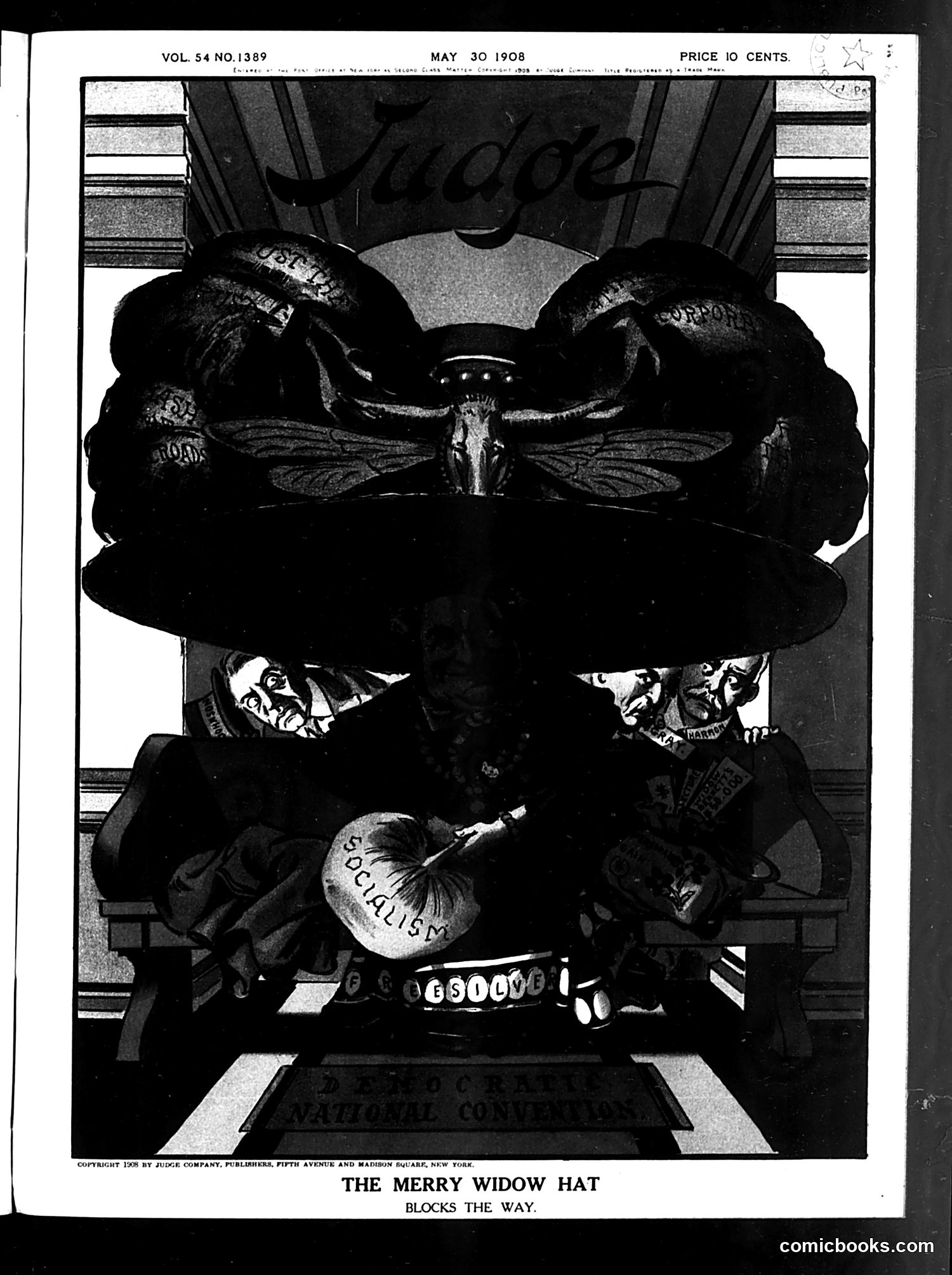
This 1908 Judge cartoon satirizes the enormous popularity of the "Merry Widow" hat—a massive, heavily decorated wide-brimmed style that became a craze following the 1905 operetta "The Merry Widow." The image shows two small figures (appearing to be businessmen or officials) completely obscured and blocked by an oversized hat topped with enormous plumes, a dragonfly ornament, and decorative elements. The hat is so large it dominates the entire composition, rendering the figures beneath it nearly invisible. The satire mocks how this fashion trend had become so widespread and exaggerated that it literally "blocked the way"—interfering with normal public life and commerce. The cartoon criticizes the absurdity of women wearing such impractically large hats in everyday situations.
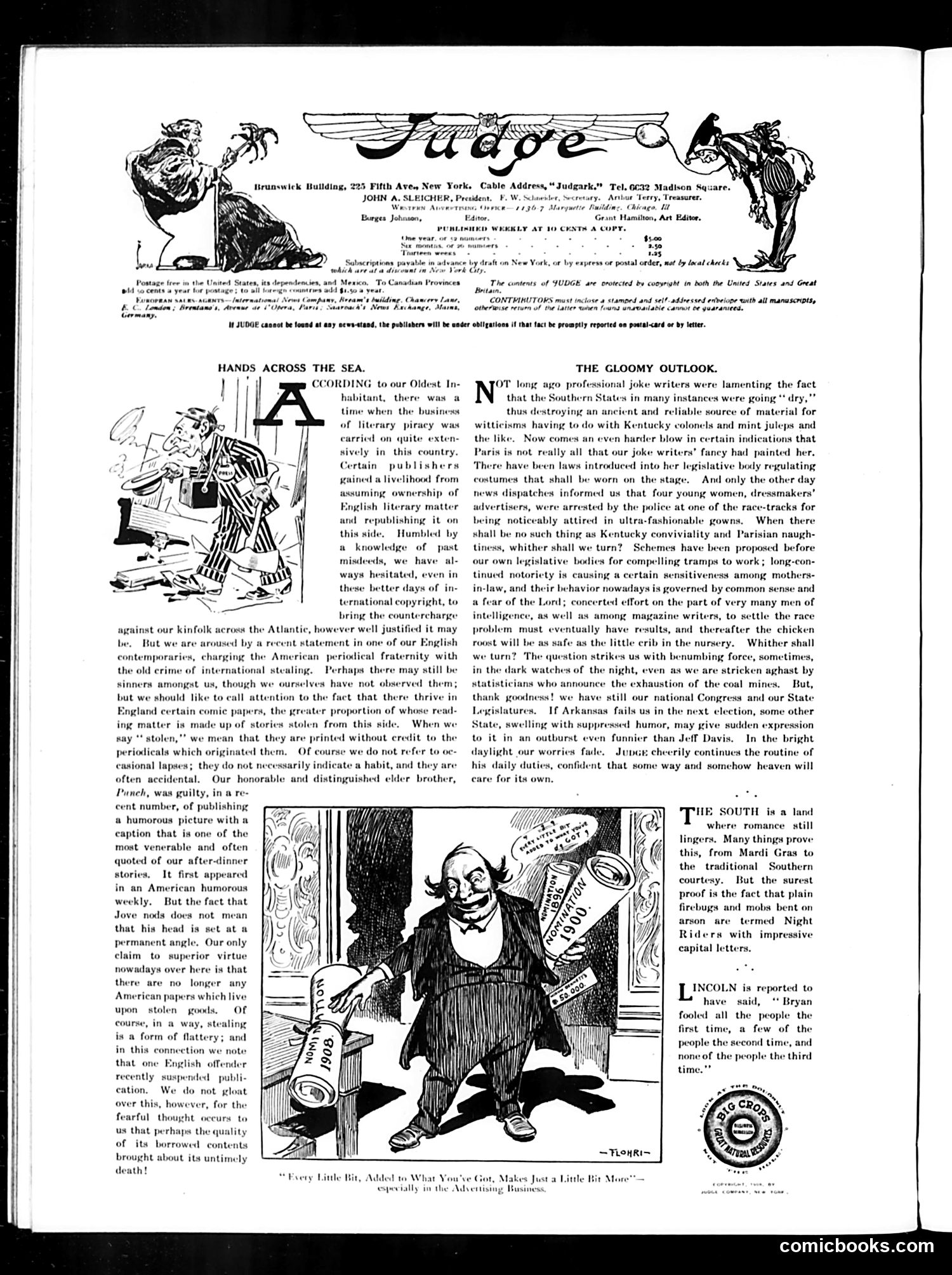
This page contains two satirical articles about literary and political issues of the era. **"Hands Across the Sea"** criticizes English publishers for reprinting American literary works without authorization or payment—essentially theft disguised as "international" cooperation. The article argues this practice is widespread and damages American authors. **"The Gloomy Outlook"** discusses Southern States potentially going "dry" (prohibition), lamenting the loss of Kentucky bourbon and mint juleps. It mocks restrictive moral legislation and references political figures like Bryan and Jeff Davis, suggesting anxiety about religious movements restricting alcohol sales. The central cartoon (by Florine) depicts a portly figure with advertising materials, illustrating the advertising industry's exaggerated claims—"Every Little Bit Added to What You've Got, Makes Just a Little Bit More." The page reflects Progressive Era concerns about copyright protection, temperance movements, and advertising ethics.
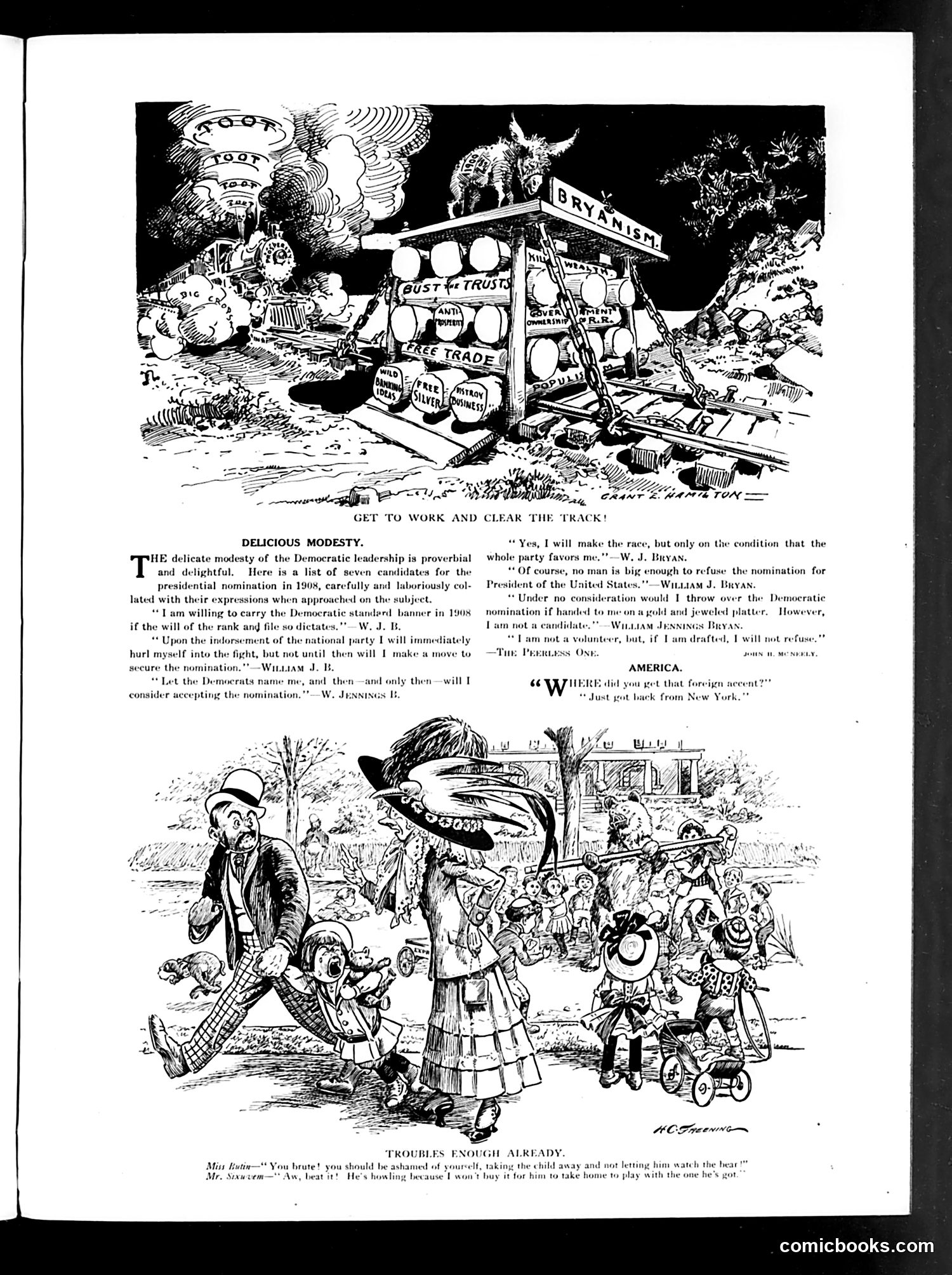
The top cartoon, "Get to Work and Clear the Track," depicts a derailed Democratic Party locomotive amid chaos. Labeled elements include "Bust in Trust," "Free Trade," and "Silver Question"—major party divisions of the era. The imagery suggests internal party dysfunction preventing forward progress. The bottom cartoon, "Troubles Enough Already," shows a woman (likely representing America or a citizen) frustrated with a vagrant and children, saying she shouldn't have to manage domestic chaos while also dealing with foreign concerns. The dialogue references someone "just got back from New York." Both cartoons satirize Democratic Party troubles and domestic American problems, likely from the 1908 election period when party leadership faced succession questions and ideological rifts.
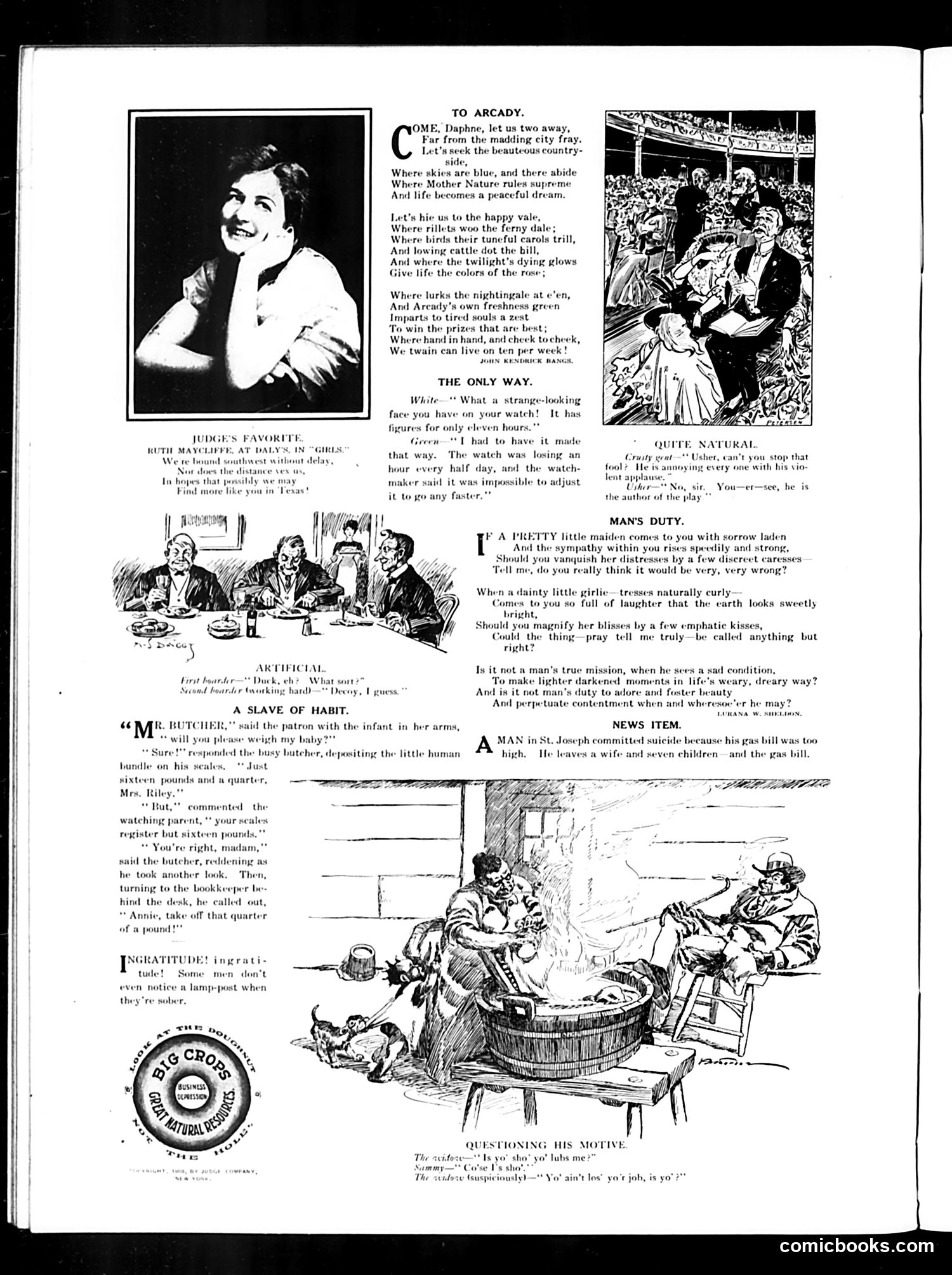
This page contains primarily humorous sketches and poems rather than political cartoons. "To Arcady" is a nostalgic poem about rural escape. "The Only Way" depicts a comedy dialogue about a malfunctioning watch. "Man's Duty" offers satirical verse about romantic relationships and gender dynamics—suggesting men should manage women's emotions rather than actually solve their problems. "A Slave of Habit" presents a domestic comedy where a butcher's scales consistently show one-quarter pound overweight, which he blames on habit rather than dishonesty. The bottom illustration "Guessing His Motive" depicts working-class men in what appears to be a bathhouse, with dialogue about employment status. Overall, this page emphasizes social humor and domestic comedy rather than topical political satire.
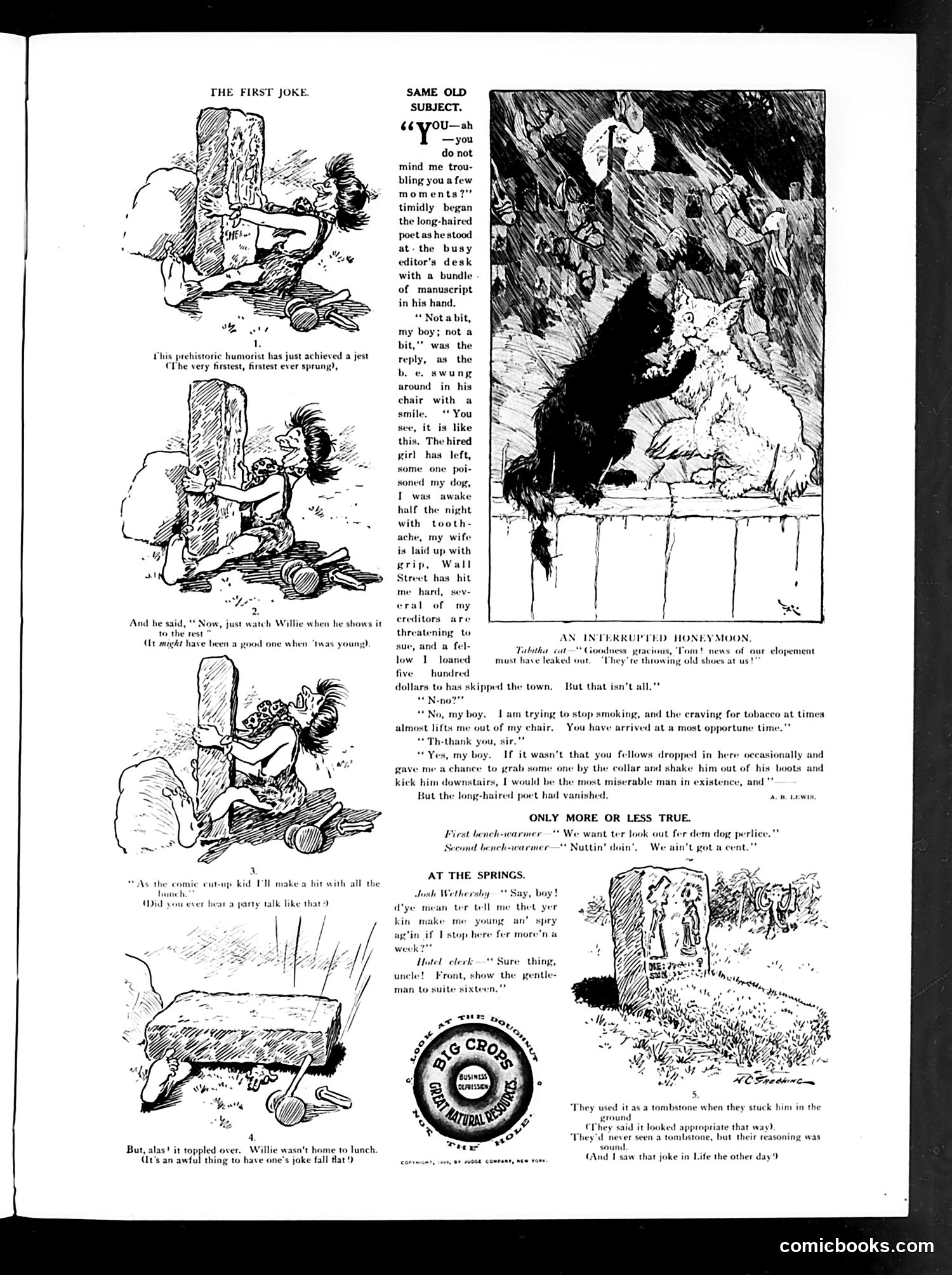
This page contains several humorous vignettes rather than political cartoons. "The First Joke" depicts a prehistoric man attempting to make his son laugh by hitting himself with a club—suggesting humor's ancient origins. The comic concludes that this "might have been a good one when 'twas young." "Same Old Subject" features an editor rejecting a manuscript about a hired girl leaving, a dog with toothache, Wall Street troubles, and creditors—all supposedly tired plot devices. "An Interrupted Honeymoon" shows a tabby cat interrupting newlyweds, with the husband humorously blaming the cat for his wife's various ailments. The remaining sections—"Only More or Less True," "At the Springs"—contain brief anecdotes about dogs and hotel life, with social commentary on leisure-class behavior typical of Judge's satire.
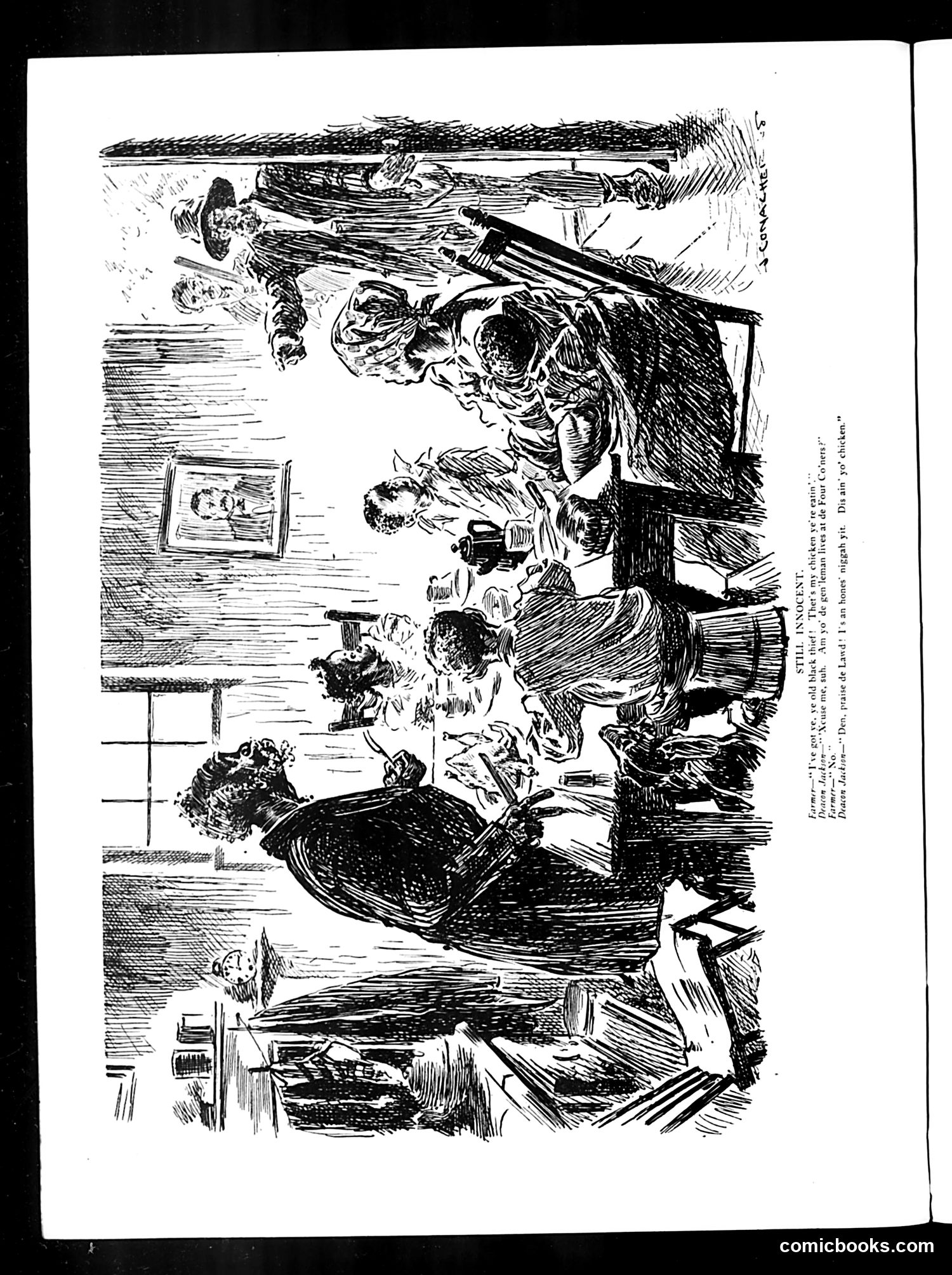
The image is a satirical illustration printed upside-down (requiring rotation to read properly). It depicts what appears to be a chaotic domestic or social scene with multiple figures in period dress, rendered in Judge magazine's characteristic sharp, expressive line work. However, I cannot reliably identify the specific figures, political figures being caricatured, or the particular event or issue being satirized from the image alone. The OCR text provides only a source attribution and no caption or explanatory text. To accurately explain this cartoon's meaning to a modern reader, I would need either: the original caption identifying the figures or situation, the publication date, or additional contextual text from the magazine. Without these, any interpretation would be speculation rather than fact-based analysis.
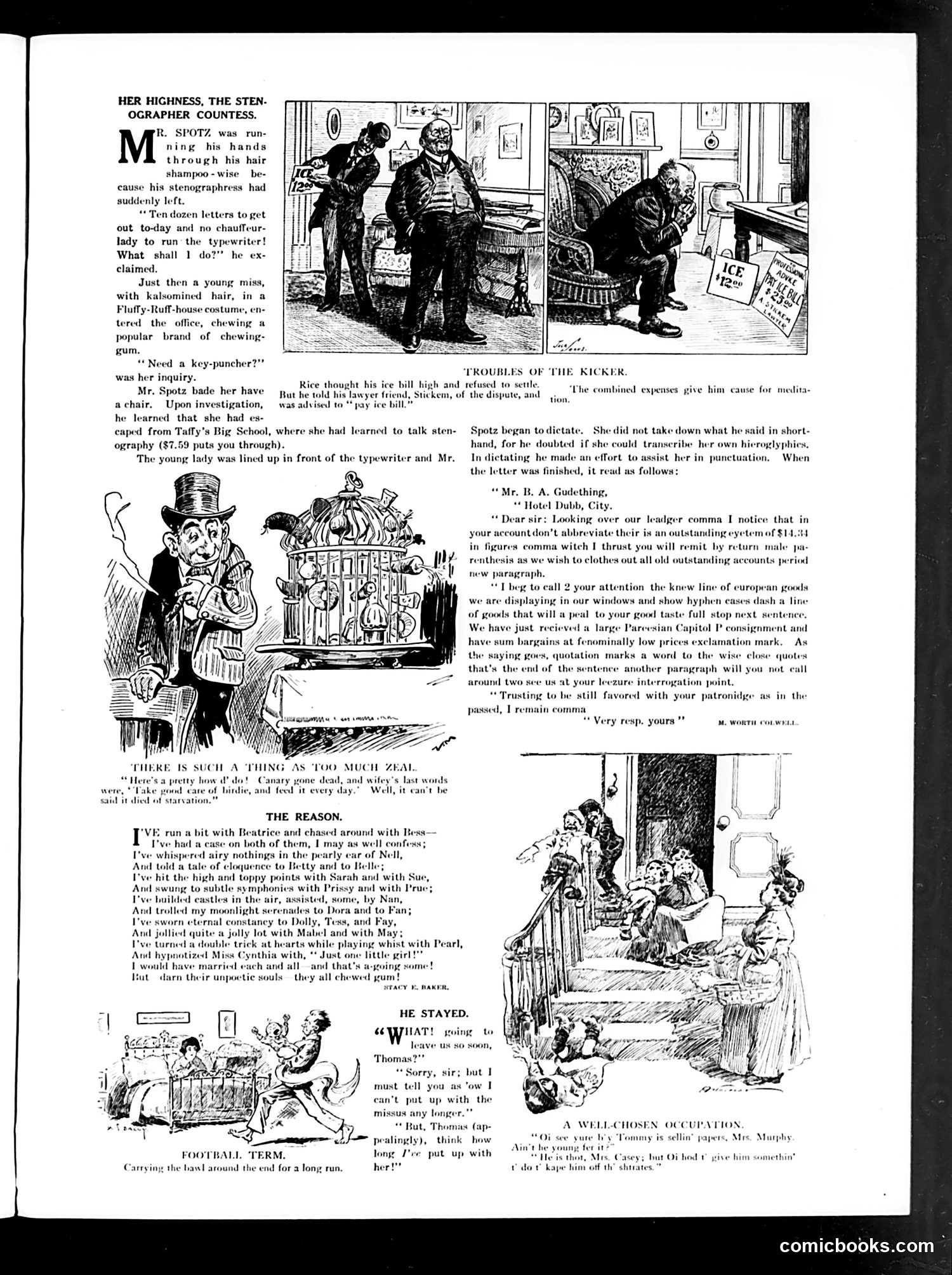
This page from *Judge* contains several satirical sketches mocking early 20th-century workplace and social situations: **"Her Highness, the Stenographer Countess"** ridicules the new phenomenon of young female stenographers entering offices. A desperate businessman hires a gum-chewing girl from "Taffy's Big School" who can barely transcribe properly. The dictated letter she produces is garbled nonsense—commas become written words ("comma"), punctuation marks appear as text ("quotes")—satirizing both incompetent stenographers and the chaos of modern office work. **"Troubles of the Kicker"** shows a man complaining about ice delivery bills while a lawyer advises payment, the joke being about frivolous legal disputes. **"The Reason"** is a humorous poem about a man's romantic history with multiple women. The other sketches ("There is Such a Thing as Too Much Zeal," "Football Term," "He Stayed," "A Well-Chosen Occupation") appear to be brief gags about employment, romance, and domestic life. The satire reflects anxieties about women entering the workforce and the perceived incompetence of untrained workers during industrial modernization.
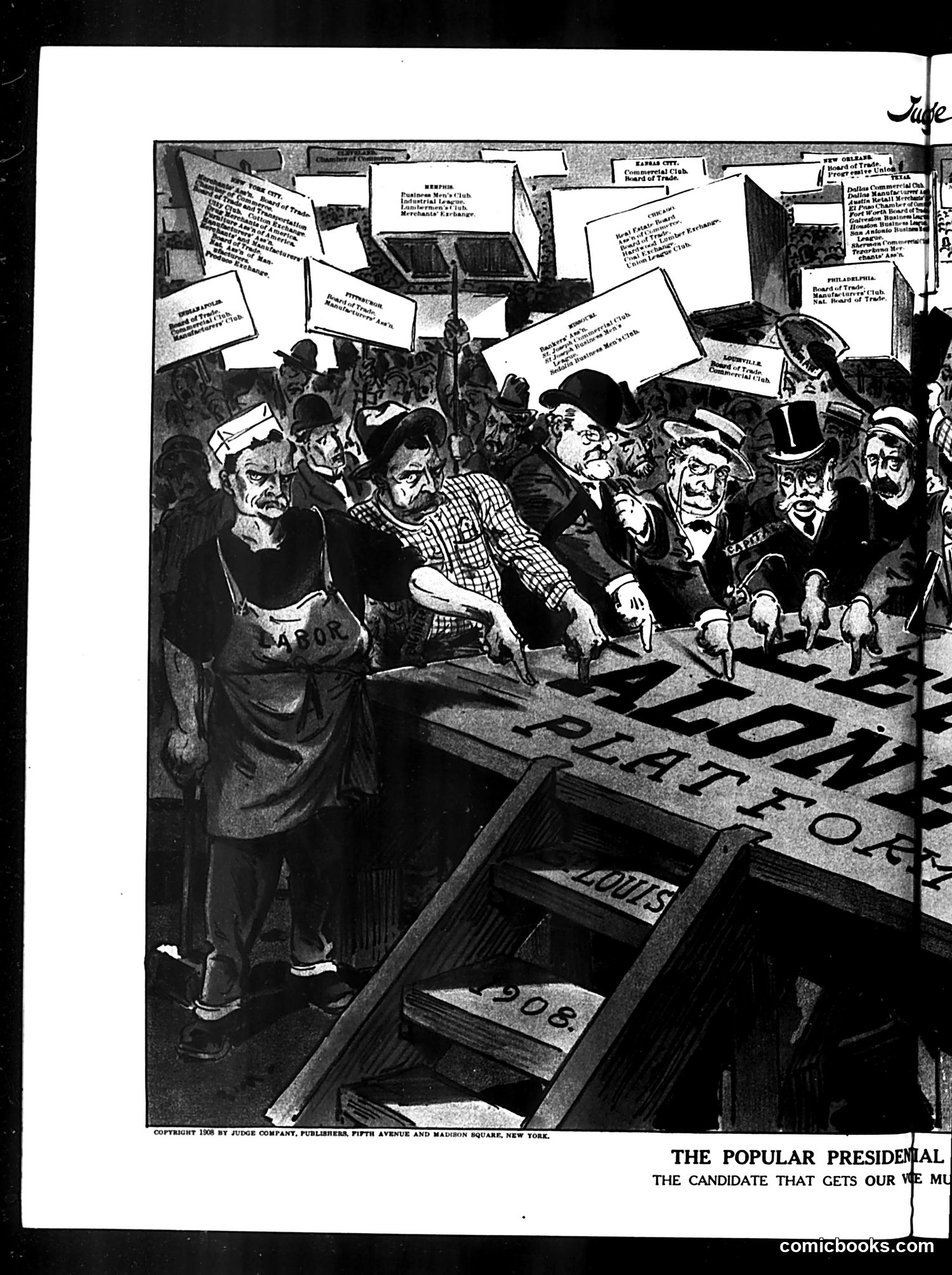
This 1908 political cartoon satirizes the presidential election process. It depicts a crowd of working-class men (caricatured with exaggerated features typical of the era) gathered around what appears to be a voting mechanism or ballot box labeled with numbers. Multiple figures hold signs representing various interest groups and organizations—visible text suggests labor unions, commercial clubs, and trade associations. The cartoon's title, "The Popular Presidential [Candidate]," suggests ironic commentary on how different constituencies vie to influence which candidate receives support. The mechanical voting apparatus implies the election outcome is predetermined or manipulated by special interests rather than genuine popular will. The satire critiques the tension between democratic rhetoric and the actual influence of organized groups on electoral outcomes during the Progressive Era.
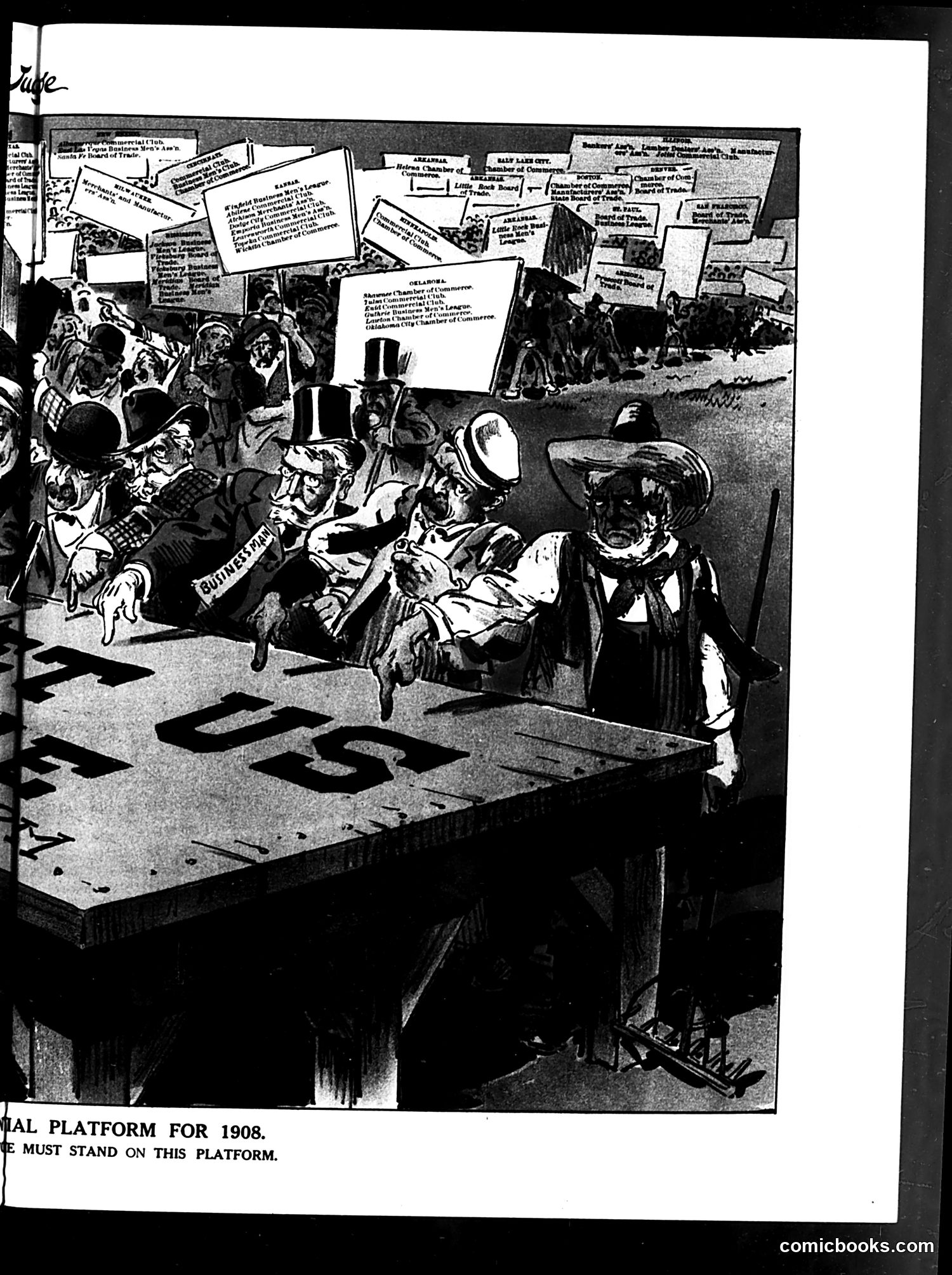
This Judge magazine cartoon satirizes the 1908 presidential election platforms. The image shows caricatured political figures crowded onto a wooden platform labeled with various planks (policy positions). The exaggerated ethnic and stereotypical depictions were typical of early-20th-century American political cartoons. The caption "MUST STAND ON THIS PLATFORM" mocks how candidates must publicly commit to their party's stated positions, even when those positions may be contradictory or unpopular. The cramped, chaotic composition suggests the absurdity of candidates trying to maintain multiple conflicting stances simultaneously. Without clearer visibility of all labels, specific party affiliation remains unclear, though the 1908 date and platform format indicate this addresses that year's presidential campaign rhetoric and party platform contradictions.
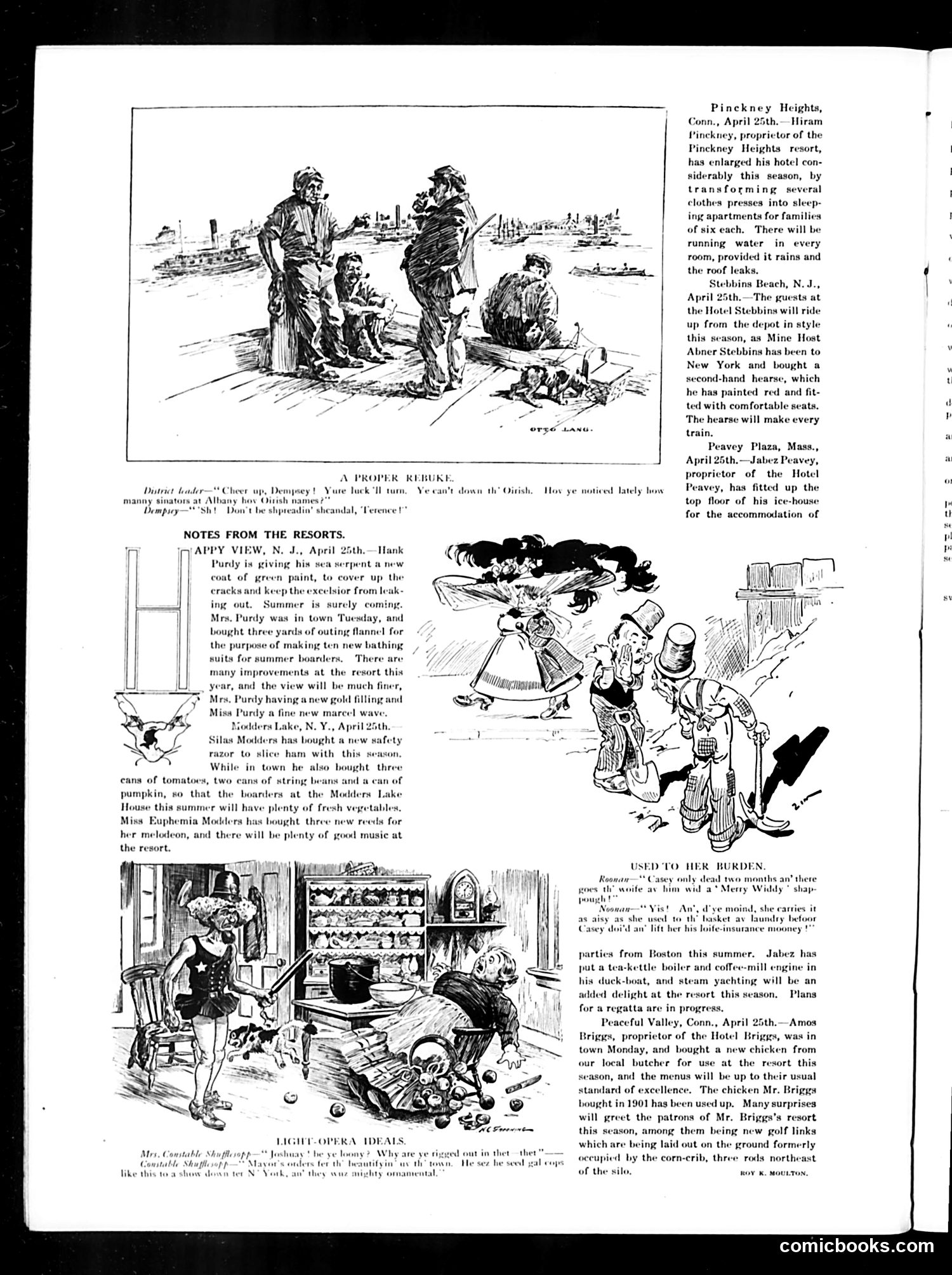
This page satirizes cheap, run-down resort hotels and their penny-pinching proprietors during the spring 1902 season. The humor relies on absurd cost-cutting measures presented deadpan: - **Pinckney Heights**: Converting closets into bedrooms; running water only if it rains and roof leaks - **Stebbins Beach**: Using a painted hearse as guest transportation - **Peavey Plaza**: Converting an ice-house top floor into guest quarters - **Modders Lake & others**: Resort owners buying minimal supplies (three reeds for a melodeon, 1901 chicken still in use) The satire targets both the proprietors' miserliness and the gullible tourists willing to pay for such accommodations. Each entry mocks the gap between resort pretensions and squalid reality—a common theme in Gilded Age humor about American hospitality and the leisure industry's shortcuts.
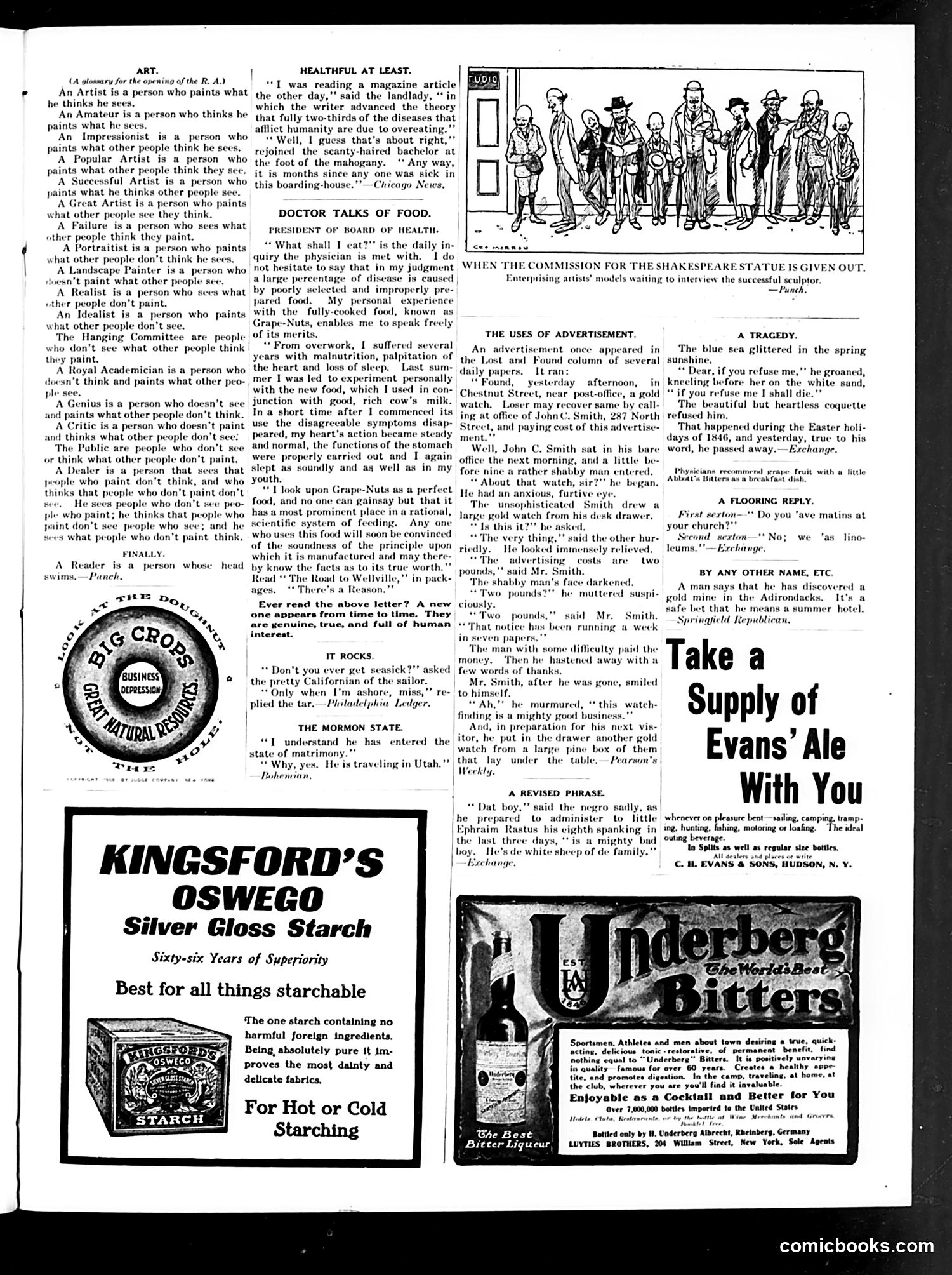
This page is primarily **advertising and humorous definitions**, not political satire. The main feature is a satirical glossary titled "ART," defining various artist types through circular logic—an "Artist" paints what he thinks; an "Amateur" thinks he paints what he sees; etc. It's gentle mockery of pretension in the art world and critic-speak, playing on the contradiction between what artists intend versus what viewers perceive. Below are shorter jokes: a landlady's comment on overeating causing disease; a doctor praising "Grape-Nuts" cereal for curing malnutrition; and two brief quips about California and Utah. These are simple conversational humor, not pointed social criticism. The page is dominated by **period advertisements** for Kingsford's starch, Evans' ale, and Underberg bitters—typical magazine filler of the era. The small illustration at top shows "artists' models waiting to interview the successful sculptor"—depicting the competition among models for work, a lightweight commentary on art-world employment. Nothing here appears to reference specific current events or political figures.
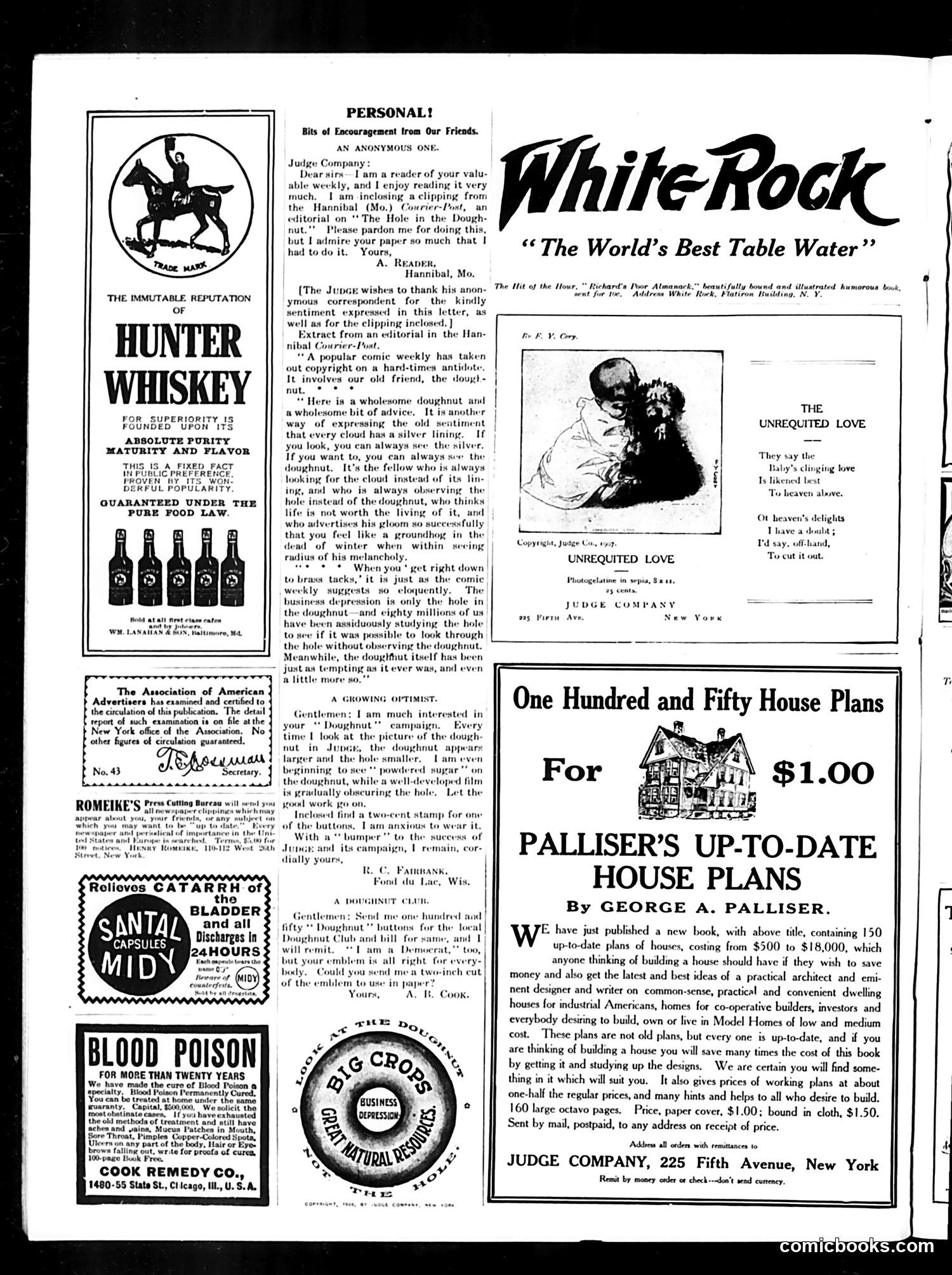
This page is primarily **advertising and reader correspondence**, not political satire. The main elements are: **"Personal" Section**: Reader letters praising Judge magazine, including one discussing an editorial about "the hole in the doughnut"—a metaphor for pessimism versus optimism during economic hardship. The doughnut represents life's good aspects; focusing on the hole represents dwelling on problems. This appears to reference Depression-era economic anxiety. **Visual Content**: A sentimental illustration titled "The Unrequited Love" shows a romantic couple, accompanied by melancholic verse—typical of Judge's lighter content. **Advertisements**: The page features period product ads (Hunter Whiskey, blood poison cures, house plans), which were standard revenue sources for magazines. **No political cartoon appears on this page.** It's a typical interior page mixing reader mail, sentimental illustrations, and commercial advertisements—reflecting Judge's role as both satirical magazine and general-interest publication for middle-class readers.
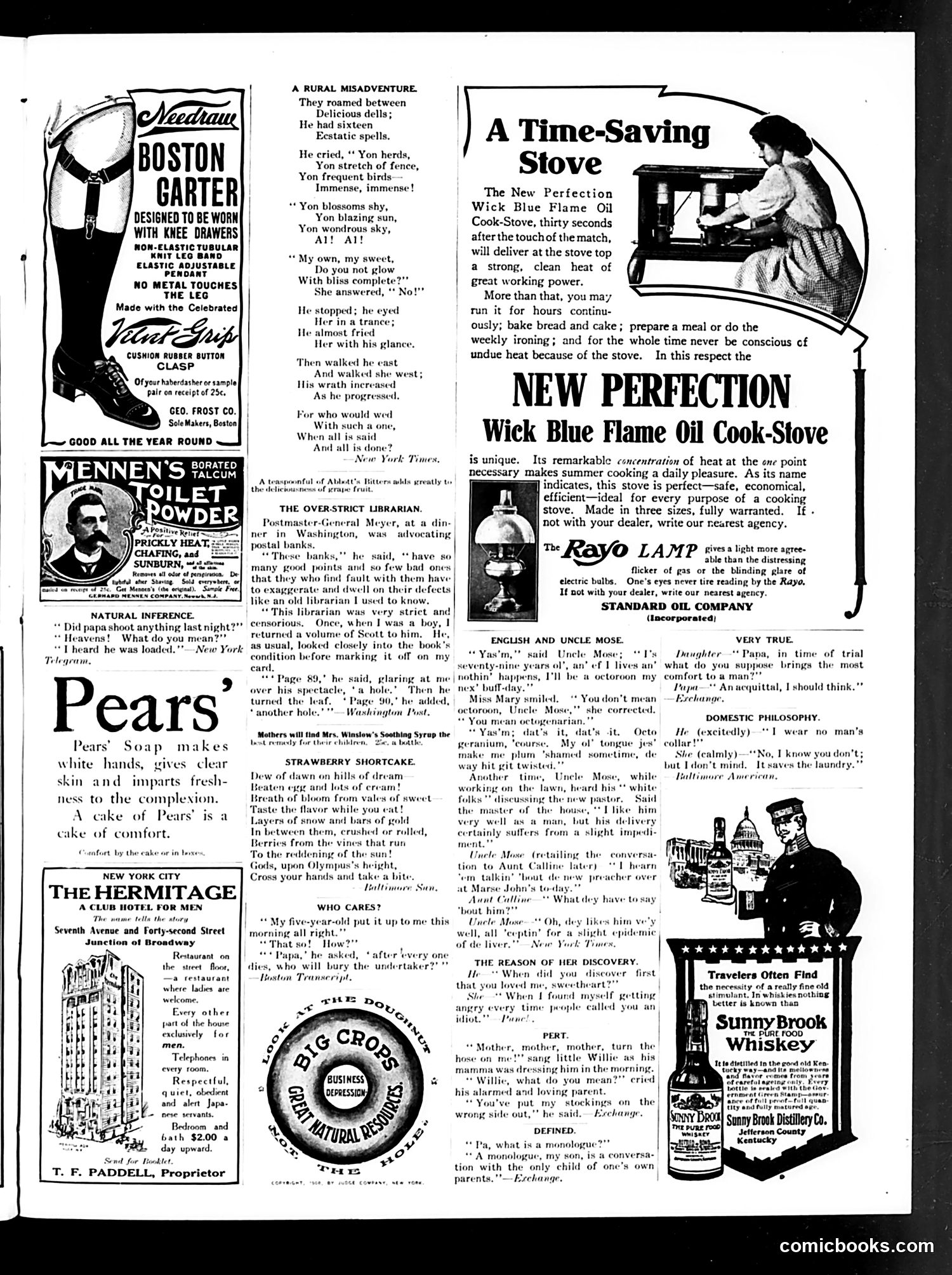
This page is primarily **advertising** with decorative filler content rather than political satire. The dominant content includes ads for Boston Garters, Pears' Soap, The Hermitage Hotel, and notably a large advertisement for the "New Perfection Wick Blue Flame Oil Cook-Stove." The few comic pieces are lighthearted domestic humor rather than political commentary: - "A Rural Misadventure" depicts a young man's romantic overtures rejected by an unimpressed woman - "The Over-Strict Librarian" humorously recounts a librarian's obsessive book inspection - "Who Cares?" presents a child's innocent misunderstanding about burial arrangements There are short humorous dialogues labeled "English and Uncle Mose" and "Very True," featuring what appear to be working-class or rural characters in dialect. The page reflects early 20th-century American consumer culture and domestic life, with advertising occupying far more space than satirical content.
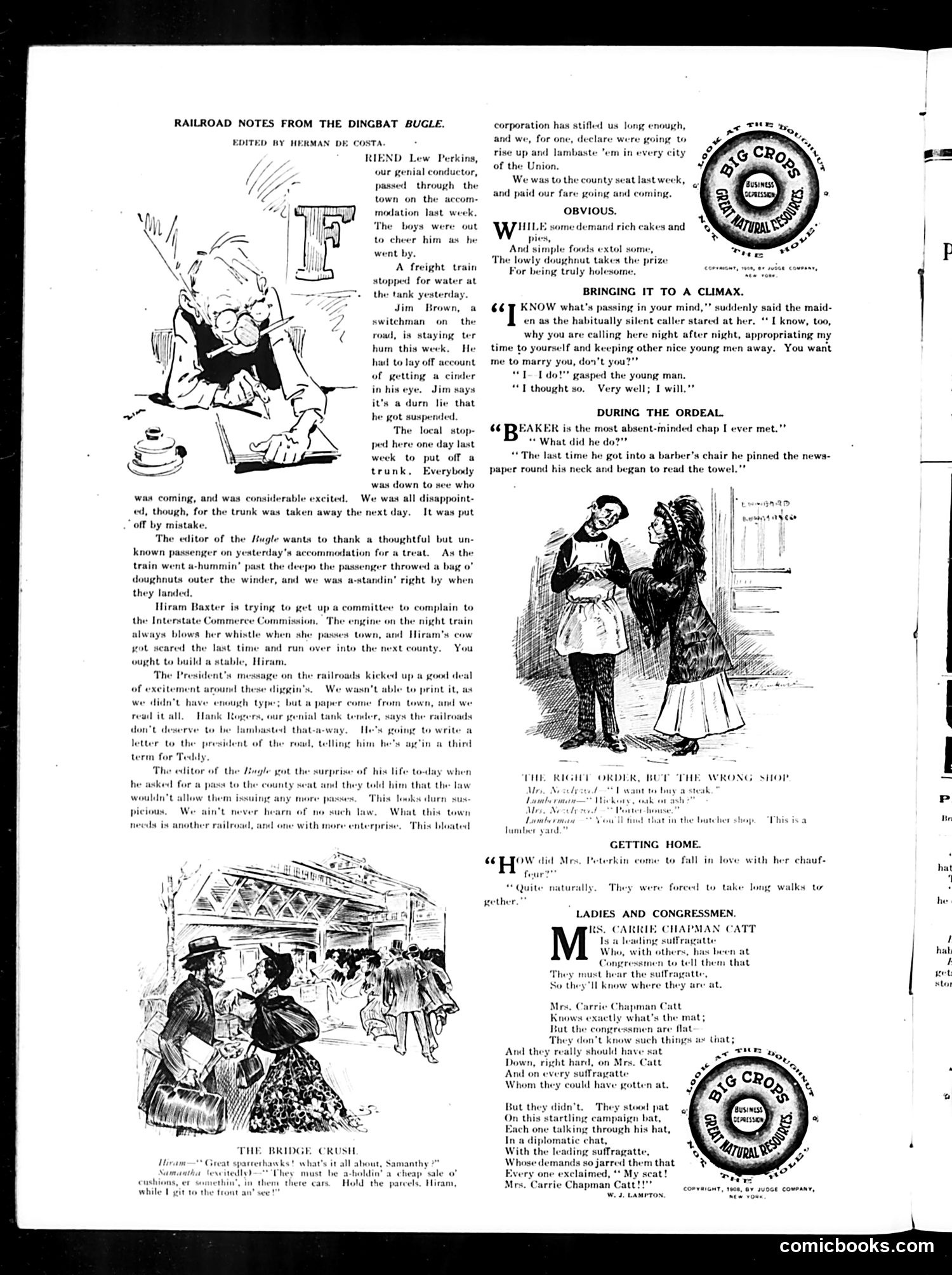
This page from *Judge* magazine contains several humorous vignettes satirizing rural/small-town life and contemporary social issues around 1910. **"Railroad Notes from the Dingbat Bugle"** mocks rural complaints about railroad corporations—locals grumble about fares and service while the editor plans to write protest letters to the president. **"Bringing It to a Climax"** is a romantic sketch where a persistent suitor is called out by the woman he visits nightly; she correctly guesses he wants marriage. **"Ladies and Congressmen"** references **Carrie Chapman Catt**, the famous suffragette leader. The joke ridicules congressmen's ignorance about women's suffrage activism, suggesting they don't understand what suffragettes are doing or "where they are at." The other sketches mock small-town confusion and misadventure (wrong shops, barbers, railroad mishaps). The satire targets rural naïveté, railroad monopolies, and male politicians' obliviousness to the suffrage movement—a live political issue of the era.
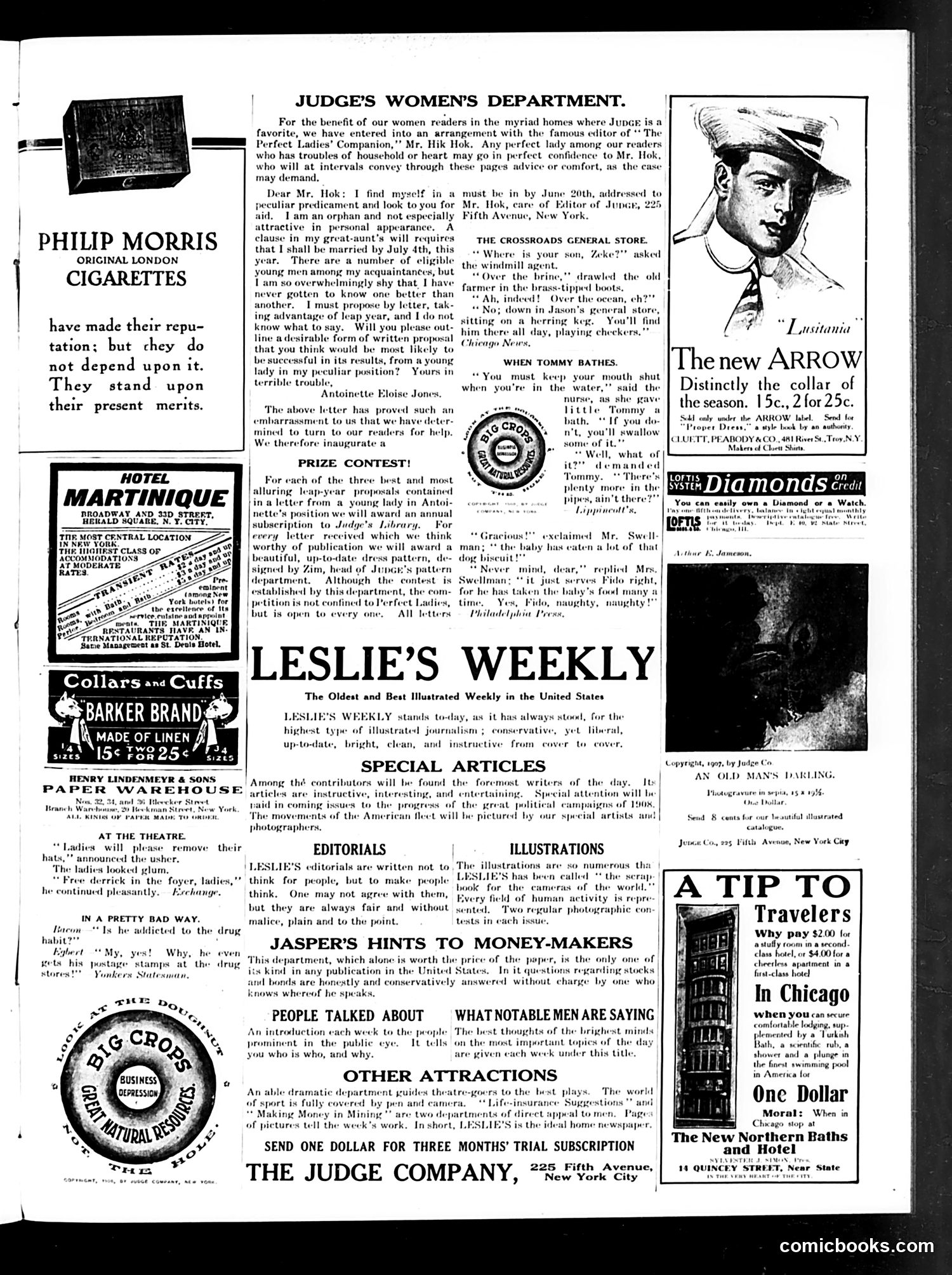
This is primarily a **magazine advertisement and editorial page**, not a political cartoon. The page features: **Main Content:** - The masthead for *Leslie's Weekly*, a legitimate illustrated news magazine (not satirical like *Judge*), with descriptions of its editorial approach and content types - Various product advertisements (Philip Morris cigarettes, Arrow shirt collars, hotel ads) - A humor section titled "Judge's Women's Department" offering relationship advice from a character called "Mr. Hik Hok" **The Humor/Satire:** The brief comic pieces are lighthearted domestic humor about common situations—a woman writing in for marriage proposal advice, a joke about a man addicted to buying postage stamps at a drugstore. These are gentle, period-appropriate gags rather than political satire. **Context:** This appears to be a *Judge* magazine page advertising *Leslie's Weekly* to readers. The "women's department" reflects early 1900s gender conventions where such magazines offered advice to female readers on household and romantic matters.
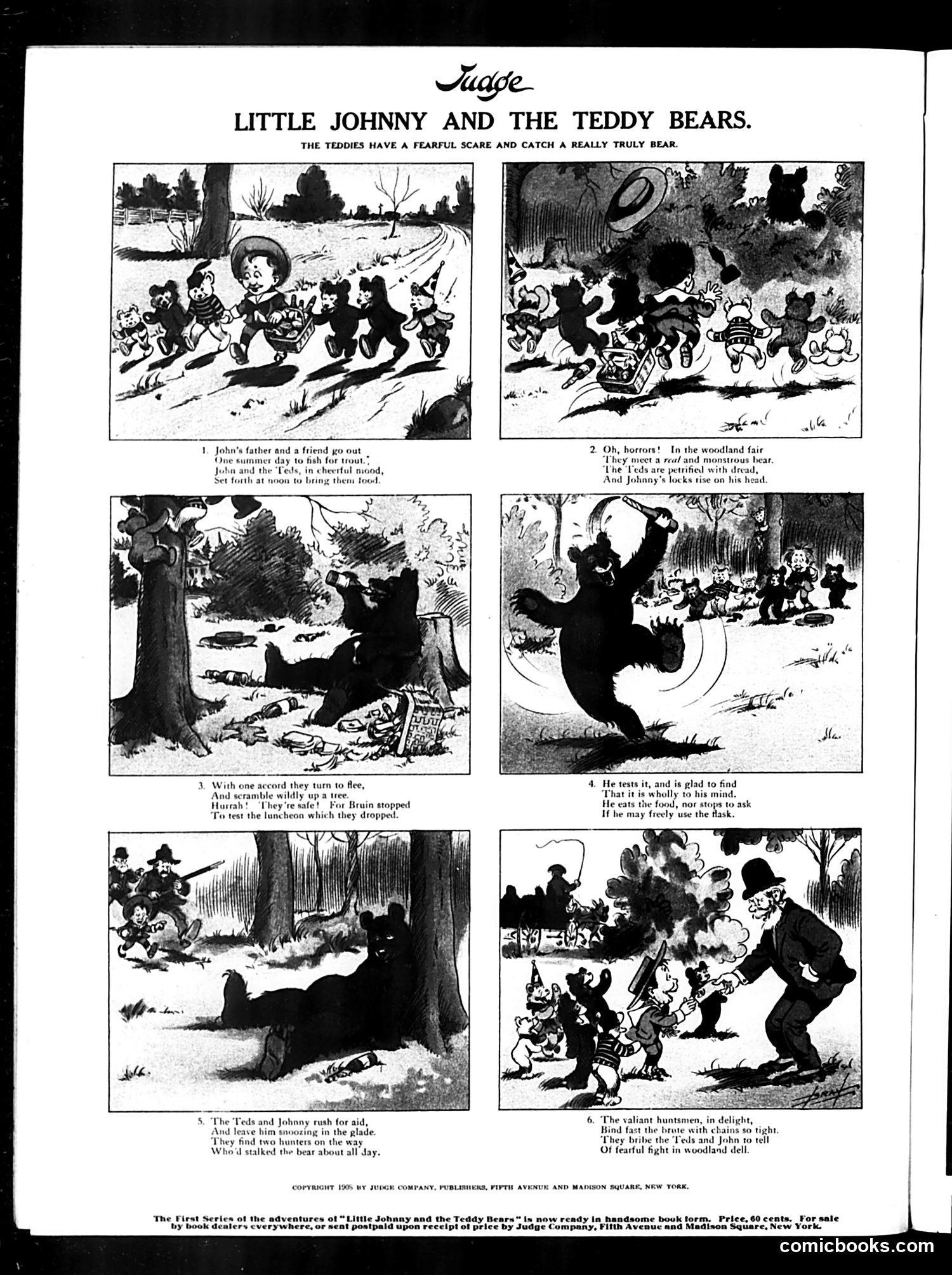
This is a children's adventure comic strip, not political satire. The narrative follows Little Johnny and his toy teddy bears encountering a real bear in the woods. The "teddy bears" reference reflects the early-1900s craze for teddy bear toys, which became popular after President Theodore Roosevelt's hunting exploits. The plot: Johnny's father and friend go fishing; Johnny brings toy teddy bears. They meet an actual bear, which the toys fear. The real bear eats their dropped lunch. Johnny and the bears manage to capture the bear with chains and bring it back. The humor derives from the contrast between the fearless toy bears and their terror of a real animal, and Johnny's unexpected bravery. This appears to be promotional material for an upcoming book collection, advertising the series as family entertainment aimed at children interested in adventure and animals rather than as social commentary.