
A complete issue · 16 pages · 1908
Judge — May 2, 1908
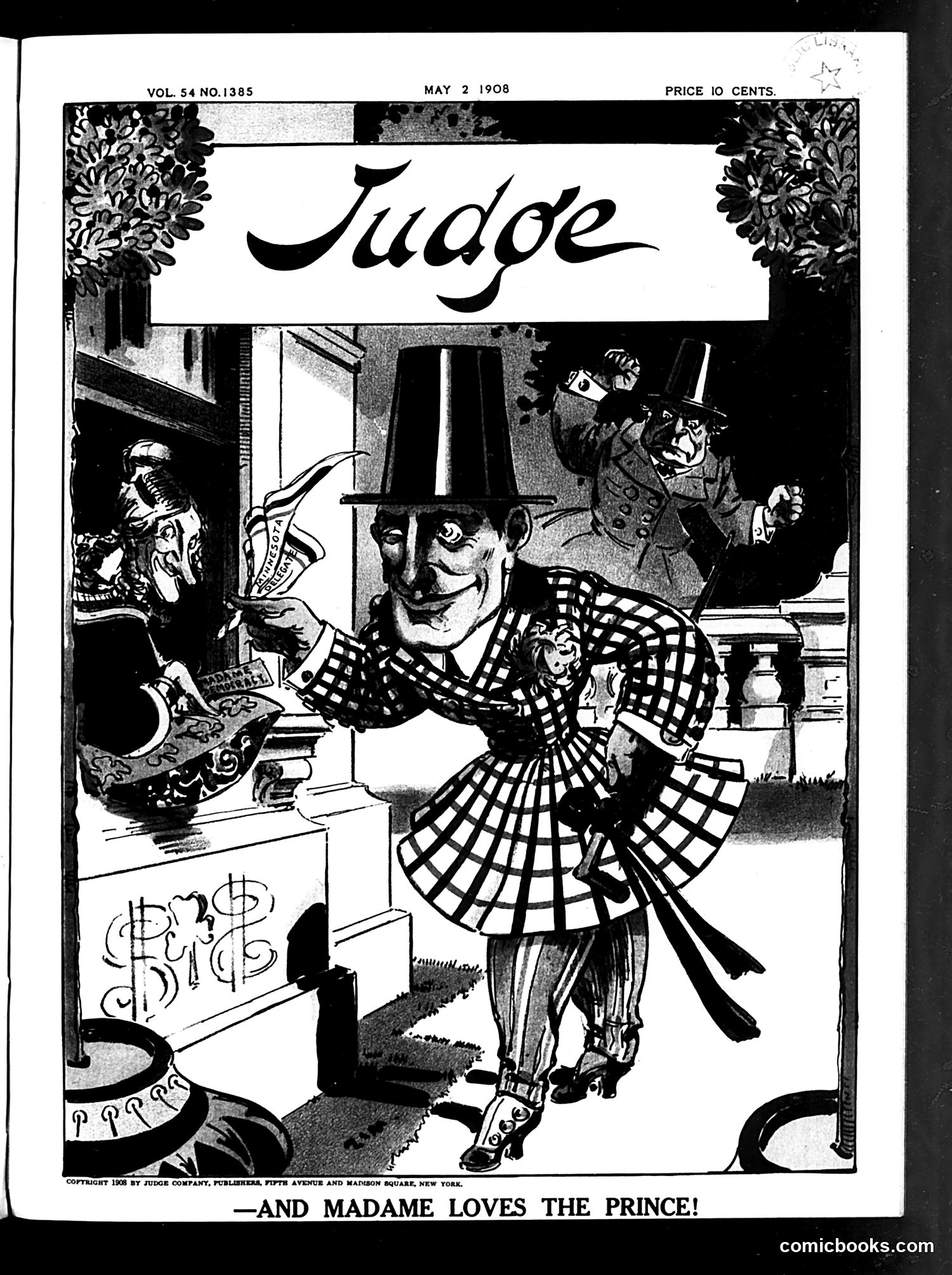
This satirical cartoon depicts a well-dressed man in checkered clothing and a tall hat, appearing to be a wealthy or aristocratic figure, presenting money or valuables to a woman (likely represented by the figure on the left). The caption "And Madame Loves the Prince!" suggests commentary on romantic or financial entanglement between the wealthy and nobility. The cartoon likely satirizes either a contemporary European scandal involving aristocratic romance and money, or it comments on American fascination with European nobility and the financial arrangements sometimes accompanying such affairs. Without more specific historical context, the exact figures or events referenced remain unclear, though it appears to mock the transactional nature of high-society relationships.
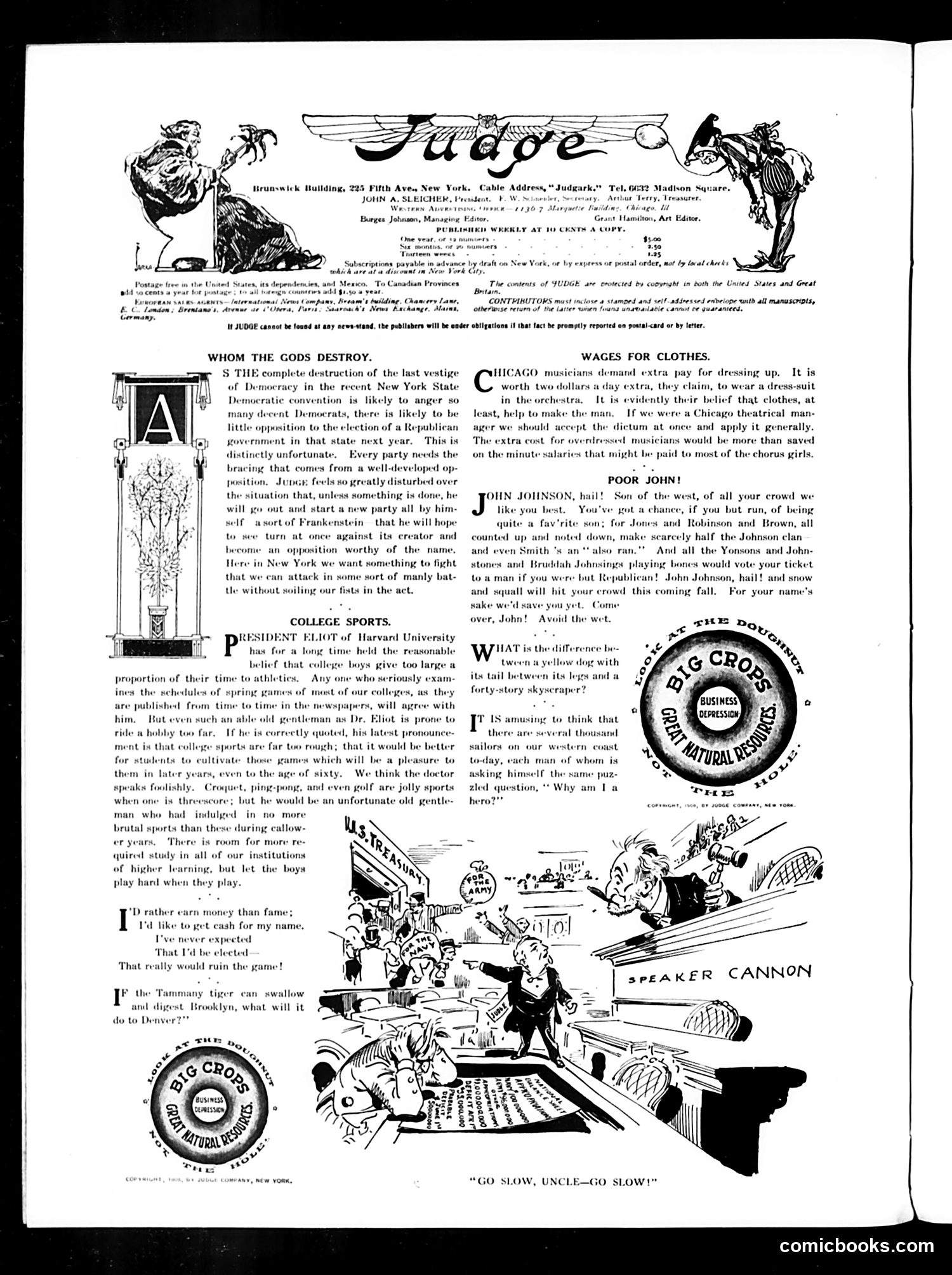
This page combines satirical commentary with advertisements and humor typical of Judge magazine. **"Whom the Gods Destroy"** critiques the Democratic National Convention's likely nomination of a Republican candidate, arguing this self-destructive choice will energize Republican opposition and harm Democratic prospects. **"College Sports"** references Harvard President Eliot's documented concerns about college athletics consuming excessive student time, advocating for sports reform rather than elimination. **"Poor John!"** mocks John Johnson (likely a theatrical figure), warning he'll become a laughingstock if he performs in a wet costume—a theatrical in-joke about staging mishaps. The **"Big Cross" advertisement** promotes a patent remedy, while the **"Speaker Cannon"** cartoon satirizes Congressional Speaker Joseph Cannon as an explosive device threatening political opponents—a common metaphor for his political power during the Progressive Era.
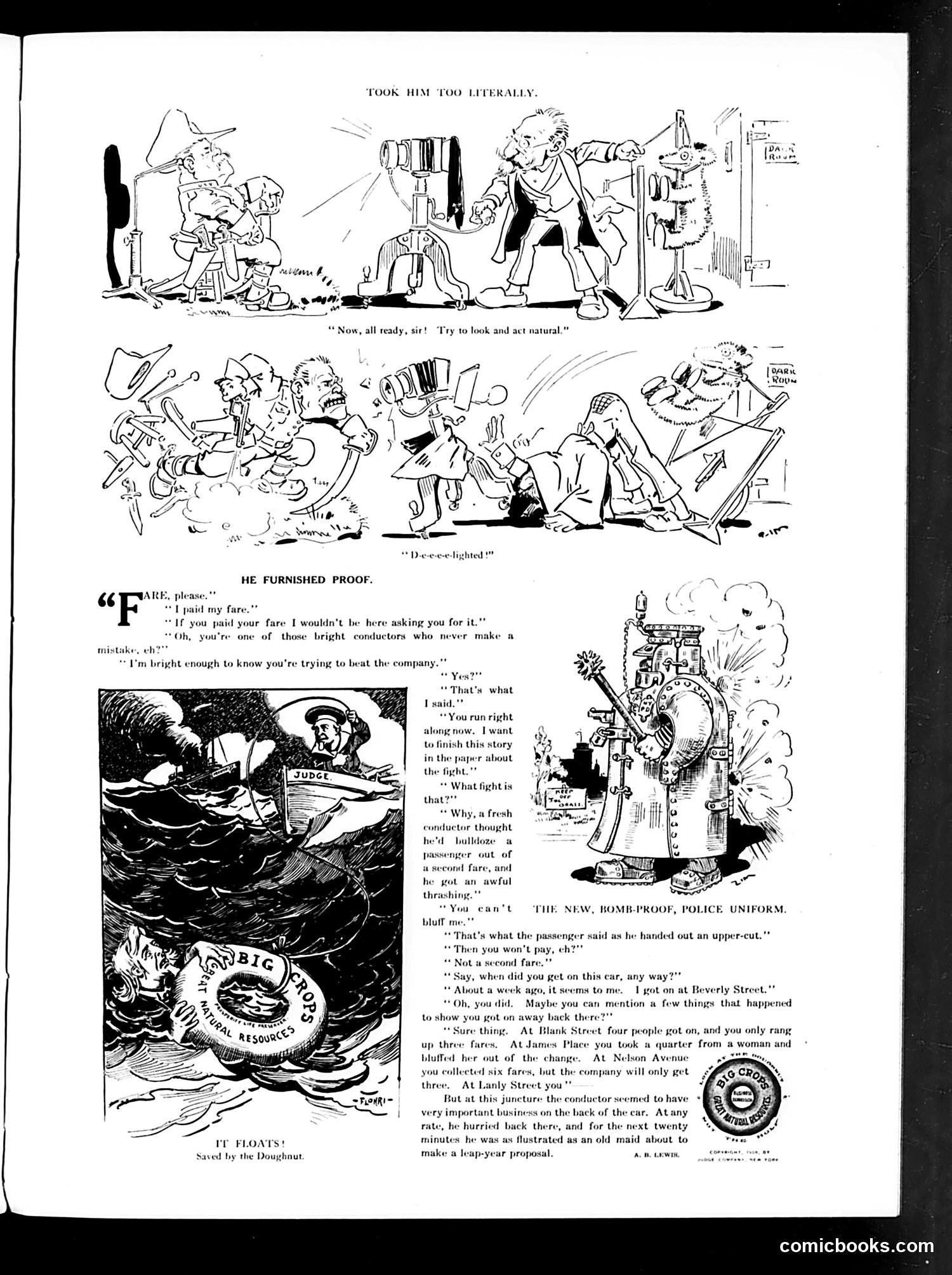
This page satirizes incompetence in public transportation, likely early 20th century. **Top panels ("Took Him Too Literally"):** A photographer attempts to photograph a conductor, who misinterprets instructions to "look natural" by becoming increasingly chaotic and violent, culminating in physical destruction. **Middle section ("He Furnished Proof"):** A dialogue between a conductor and passenger about repeated fare disputes. The conductor claims he's never made mistakes; the passenger counters with specific instances of overcharging across different streets and locations, proving the conductor's dishonesty. **Bottom left ("It Floats!"):** A satirical "Big Dough" logo (possibly referencing the company or management) depicted as bloated/corrupt, "saved by the doughnut"—suggesting financial impropriety. **Right image:** A "homeproof police uniform" for conductors, humorously suggesting they need protective equipment—implying conductors were violent or problematic. The overall message critiques crooked transit workers and negligent management.
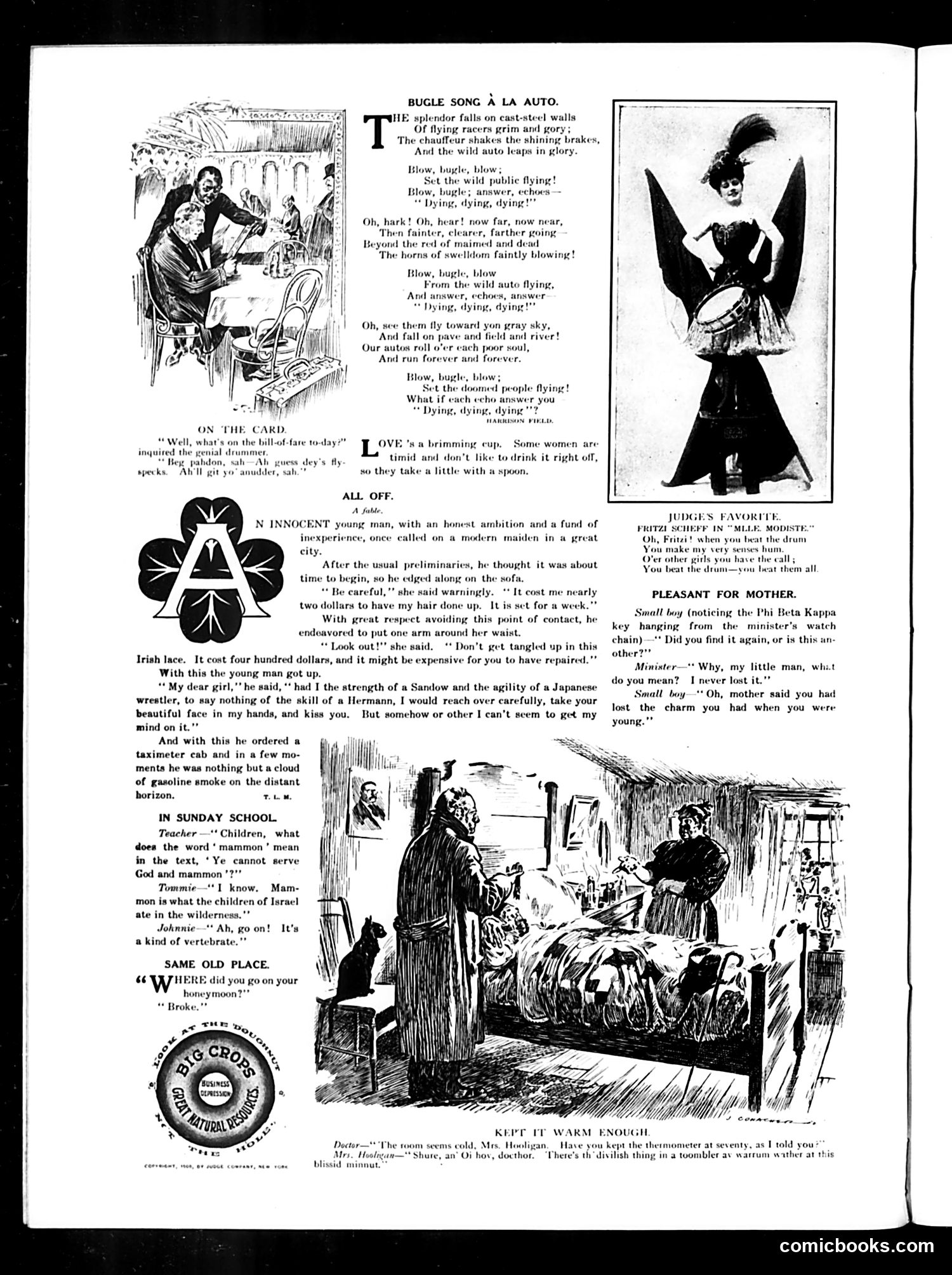
This page contains several satirical pieces and illustrations typical of early 20th-century American humor: **"Bugle Song à la Auto"** mocks the noise and chaos of automobiles, portrayed as disruptive to urban life—a common complaint as cars became prevalent. **"On the Card"** and other brief comedic snippets appear to be social humor about dating and etiquette rather than political satire. **"All Off"** describes a young man's awkward interaction with a woman, satirizing modern courtship difficulties. The sketched illustrations show period domestic and social scenes rendered in characteristic Judge style—visual humor about everyday situations. **"Kept It Warm Enough"** depicts a sickroom scene with medical humor about temperature management. Overall, this page reflects early automotive-age anxieties and social comedy rather than explicit political commentary. The satire targets modern life's inconveniences and social awkwardness among the leisured classes.
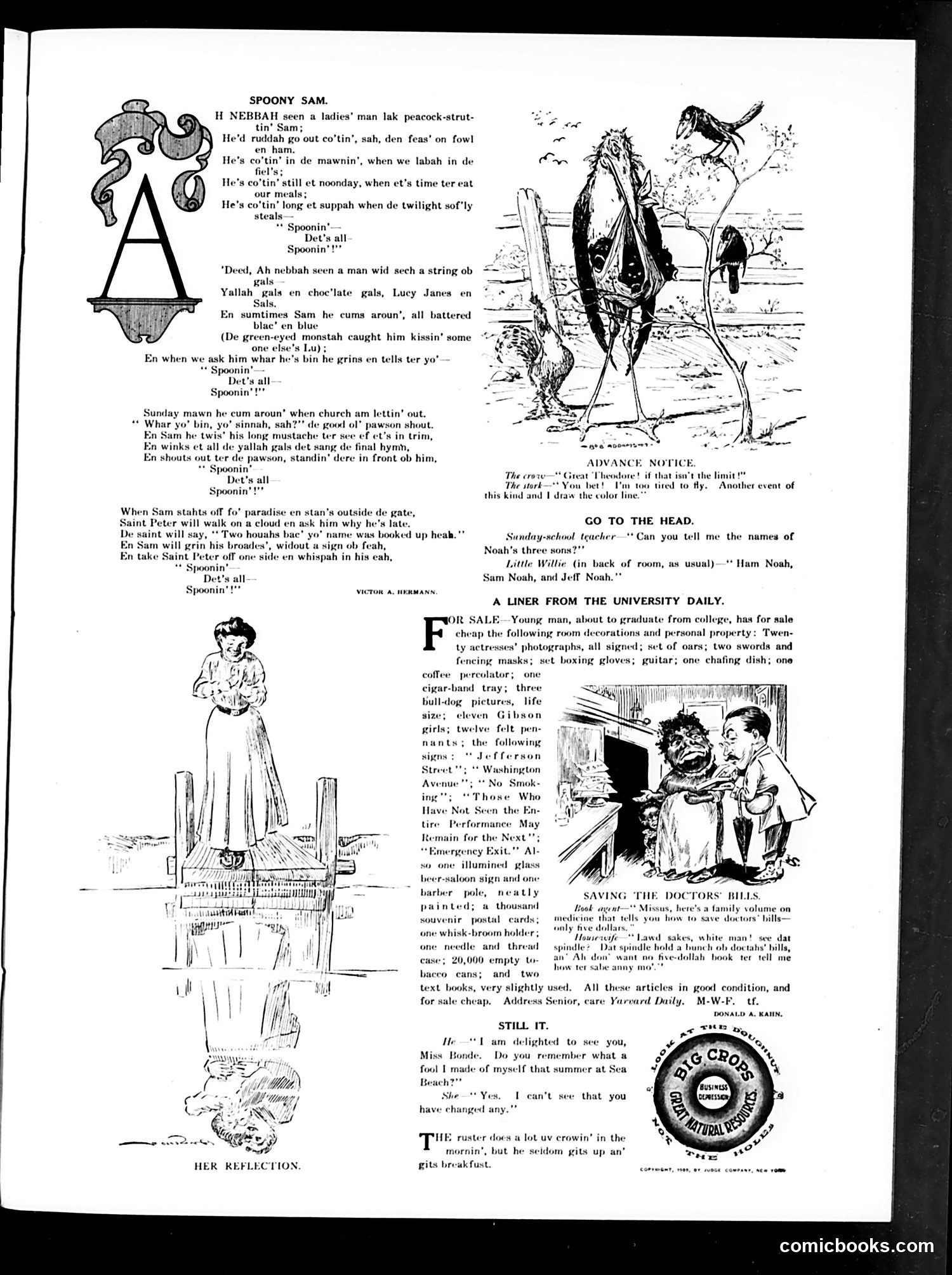
This page contains primarily **humorous sketches and advertisements** rather than political cartoons. **"Spoony Sam"** is a dialect poem about a man obsessed with courting women—he frequents church, shows off, and pursues multiple romantic interests (Lucy James, chocolate girls, etc.). The accompanying camel illustration serves as humorous decoration. **"Go to the Head"** is a joke about a schoolteacher asking for Noah's sons' names. **"Her Reflection"** shows a woman admiring herself in a mirror—a commentary on vanity. The remaining content consists of **classified advertisements** (room furnishings for sale, doctor's services, etc.) and small humorous anecdotes typical of Judge's format. The page reflects early 20th-century American humor focused on everyday social situations and courtship rather than political satire.
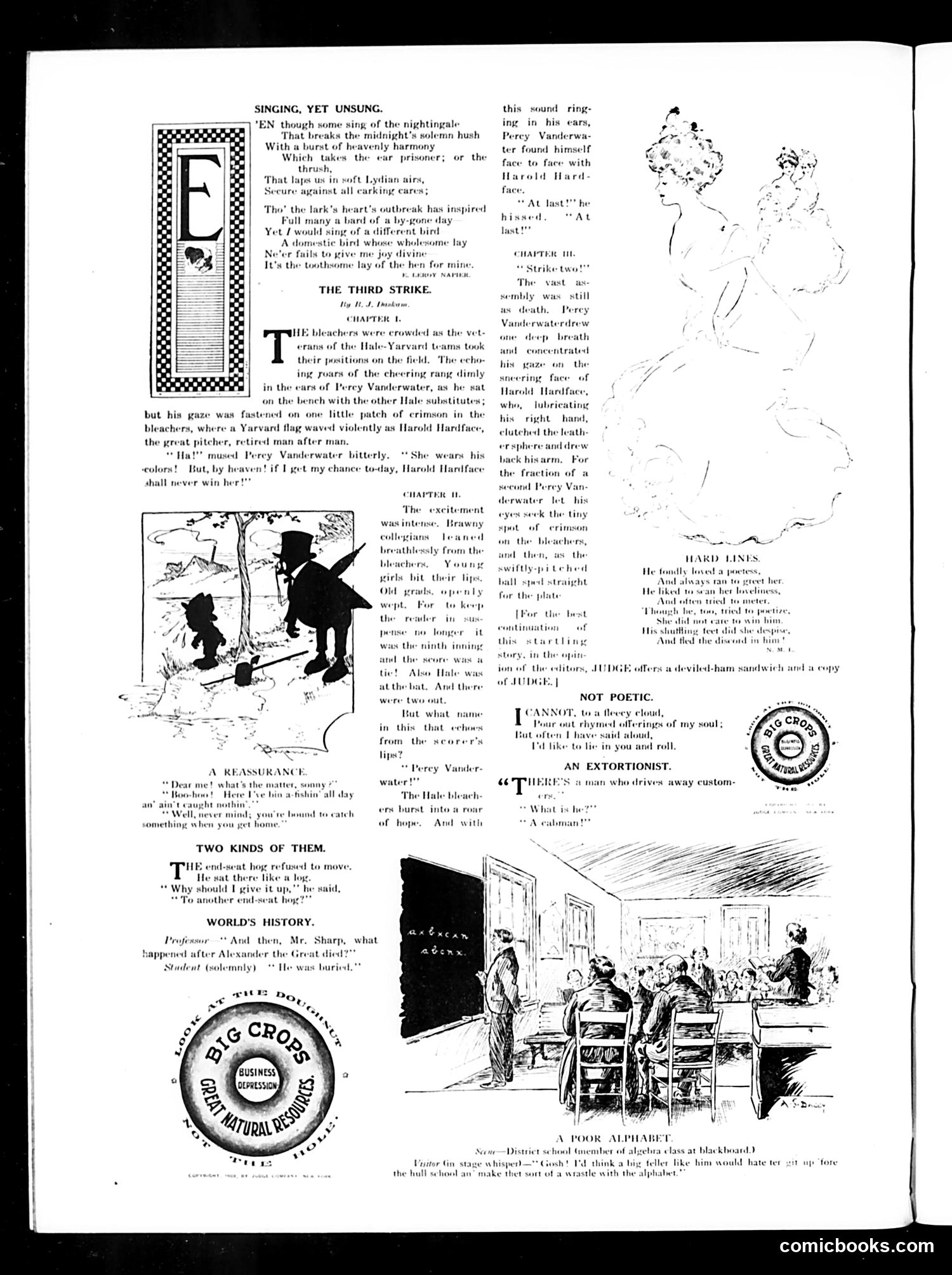
This page from the satirical magazine **Judge** contains several unrelated humorous pieces typical of early 20th-century American humor magazines. **"The Third Strike"** is a serialized sports comedy about a baseball game between Hale and Harvard, featuring romantic rivalry between characters Percy Vanderwater and Harold Hardface competing for a woman's affection. The narrative builds tension around a ninth-inning at-bat, mixing sports drama with melodrama—likely satirizing both baseball's cultural importance and overwrought romantic fiction. The shorter pieces mock everyday annoyances: "Two Kinds of Them" jokes about inconsiderate "end-seat hogs" on public transportation; "World's History" presents a tired professor joke about student ignorance; "An Extortionist" ridicules taxi drivers; and "A Poor Alphabet" mocks struggling schoolchildren. These are gentle social observations rather than political satire—typical of Judge's blend of sports humor, domestic comedy, and light mockery of contemporary manners and institutions.
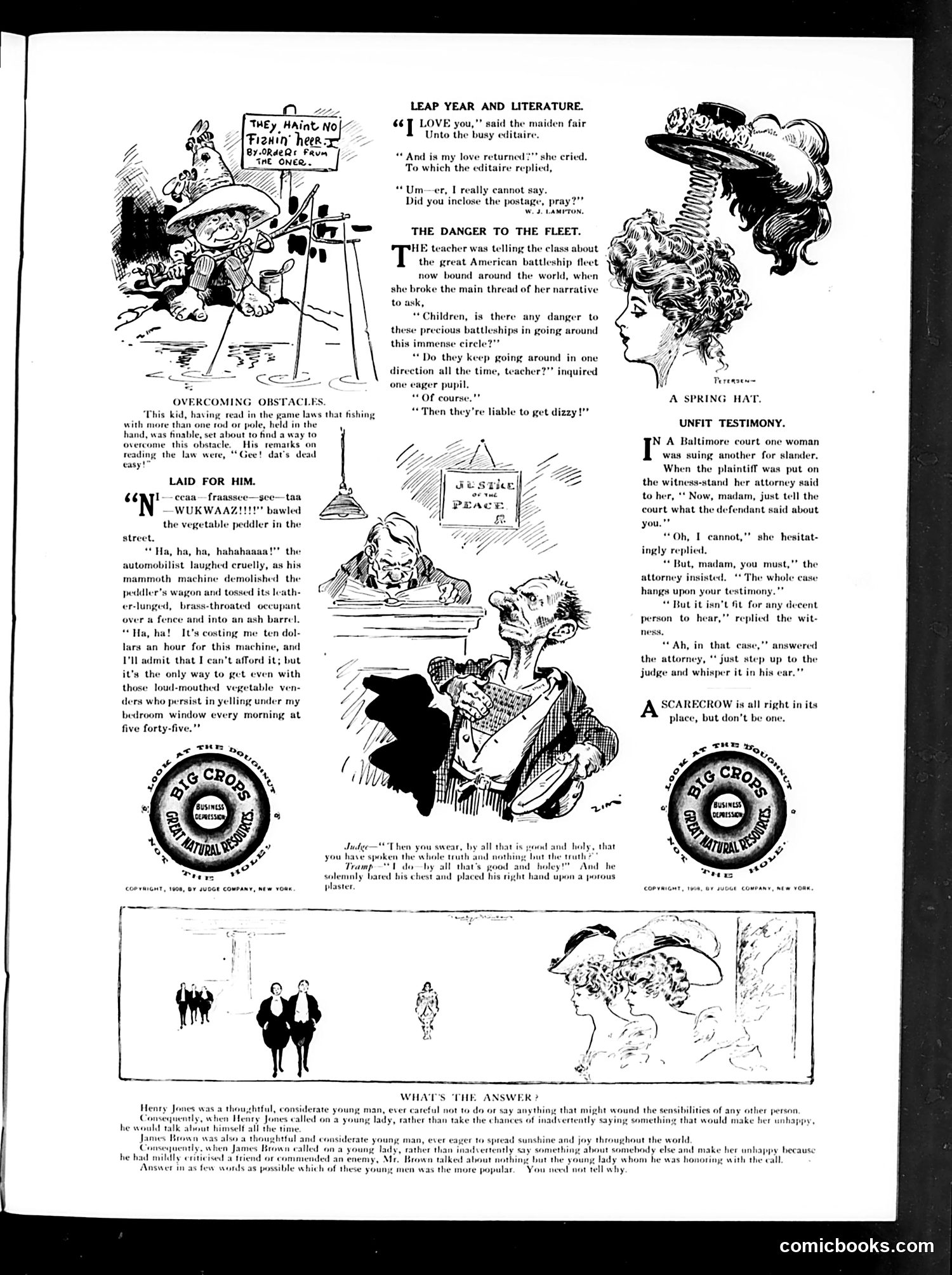
This page contains several satirical cartoons mocking contemporary social situations: **"Leap Year and Literature"**: Jokes about a woman declaring love to a magazine editor, who pedantically asks if she enclosed postage—satirizing the indifference of editors and the formality of postal submissions. **"The Danger to the Fleet"**: A schoolteacher discusses the American battleship fleet's world voyage; a student worries the ships will "get dizzy" going in circles—mocking both overeager patriotic lessons and childish reasoning. **"Laid for Him"**: An automobilist intentionally hits a vegetable peddler's cart to retaliate for early-morning street noise, then admits the car costs ten dollars hourly—satirizing urban class tensions and absurd revenge logic. **"Unfit Testimony"**: A court scene where a woman refuses to repeat slanderous statements as "unfit for decent ears," prompting the attorney to suggest she whisper it privately to the judge—mocking prudish hypocrisy about propriety. **"What's the Answer?"**: Contrasts two young men's consideration for women's feelings, suggesting thoughtfulness prevents unhappiness—a morality lesson about courtesy.
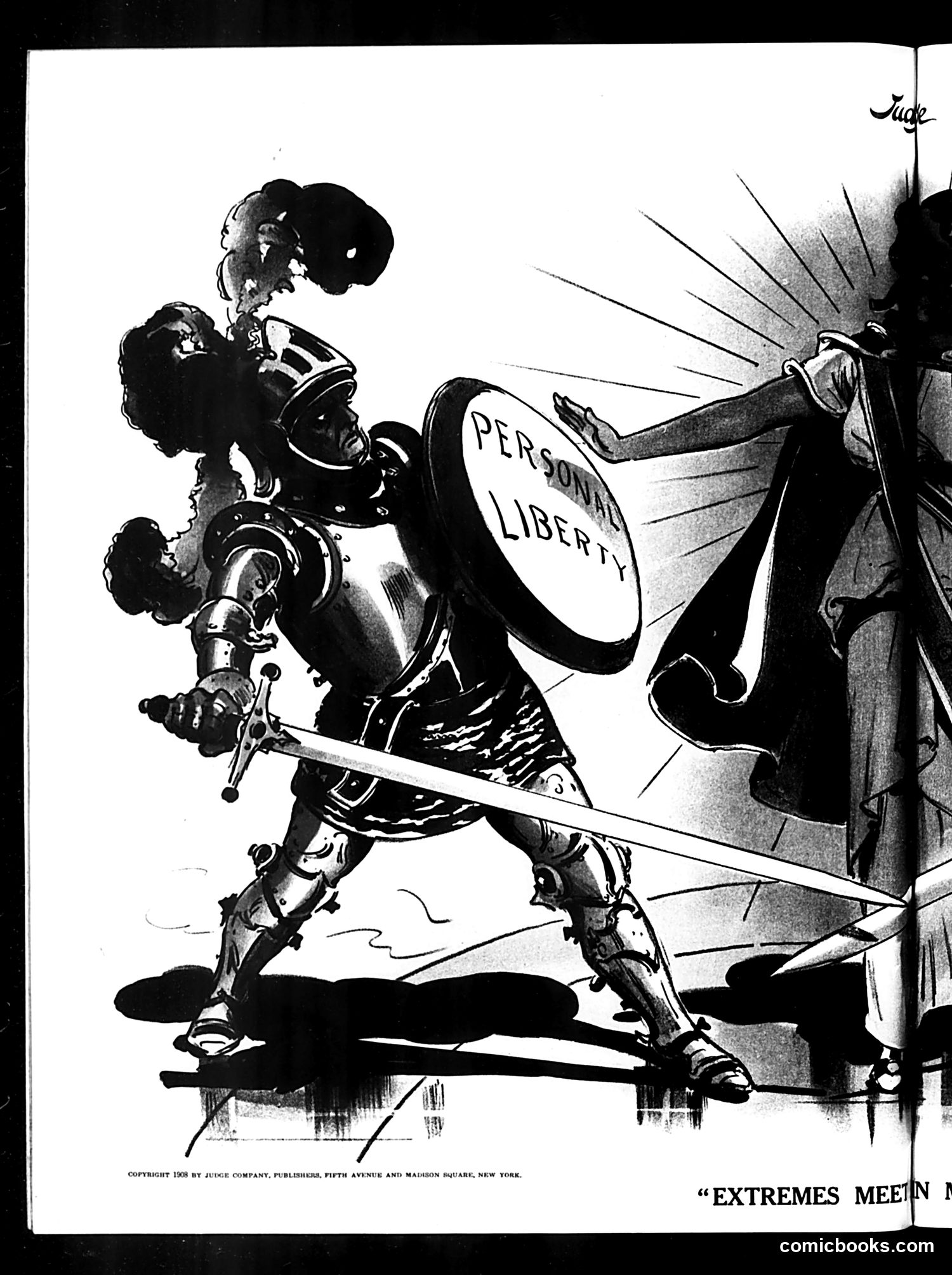
This appears to be a political cartoon titled "Extremes Meet in..." (text cut off). The image depicts a figure in military/knightly armor wielding a sword and holding a megaphone labeled "PERSONAL LIBERTY." The figure confronts what appears to be a shadowy authority figure on the right. The cartoon likely satirizes debates over personal liberty versus state authority—a recurring tension in early-20th-century American politics. The armored knight imagery suggests idealistic defense of individual freedoms, while the megaphone emphasizes public proclamation of these rights. The dramatic confrontation suggests the cartoonist viewed this conflict as fundamental. Without the complete caption or date visible, the specific political context remains unclear, though it likely addresses contemporary civil liberties debates from Judge's publication era.
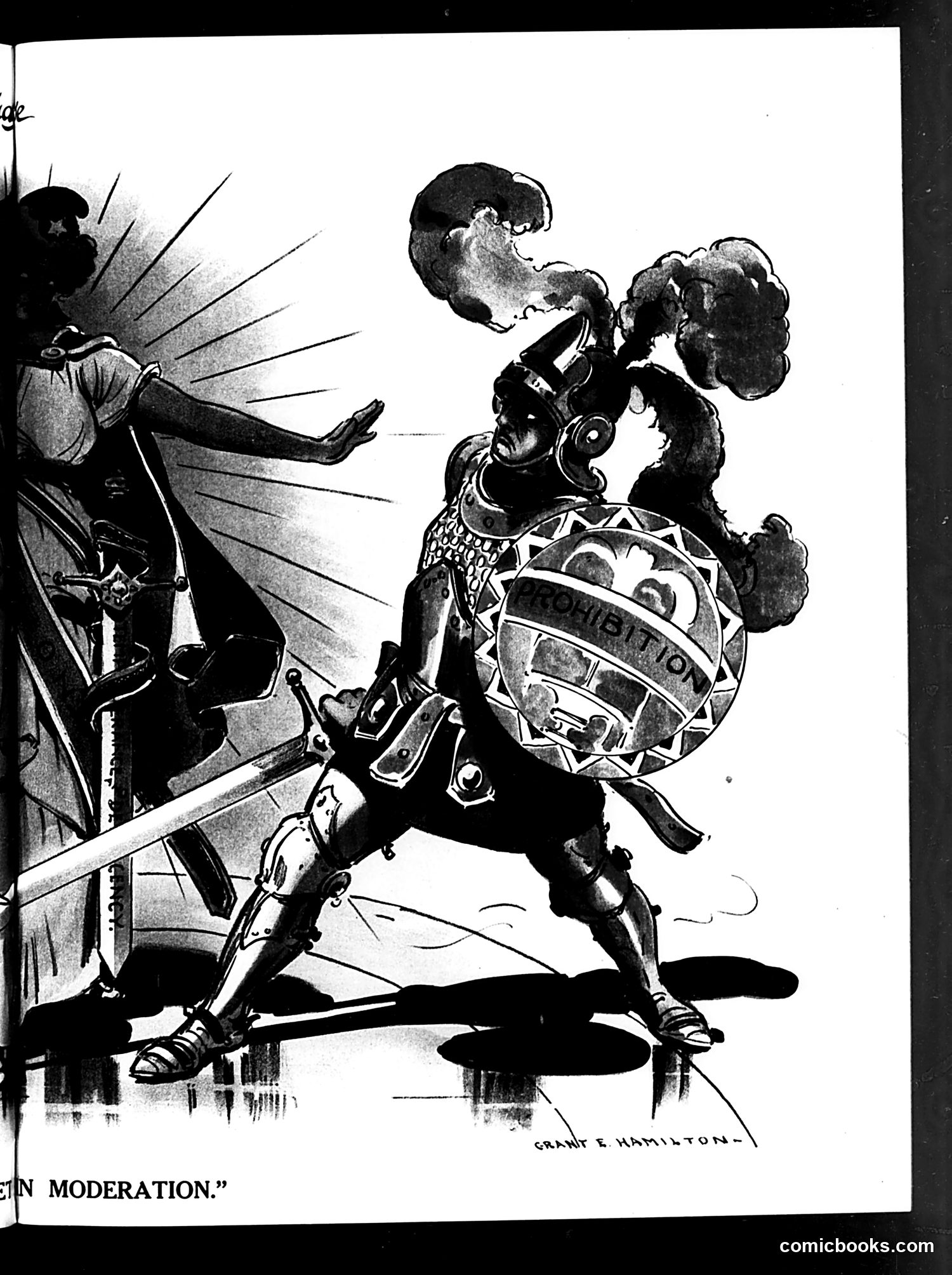
This political cartoon by Grant E. Hamilton depicts a figure in military/formal dress being restrained by two others from an aggressive action toward a figure on the left who appears to be defending themselves with raised hands and radiating lines suggesting forceful rejection. The title "In Moderation" suggests ironic commentary on restraint or self-control. The ornate shield/breastplate worn by the central figure bears text that's partially legible but unclear in reproduction. Without clearer identification of the specific historical moment or figures involved, the precise political reference remains uncertain—though the imagery suggests conflict between parties where one is being urged toward measured behavior rather than escalation. The cartoon likely comments on a contemporary political or military dispute requiring restraint.
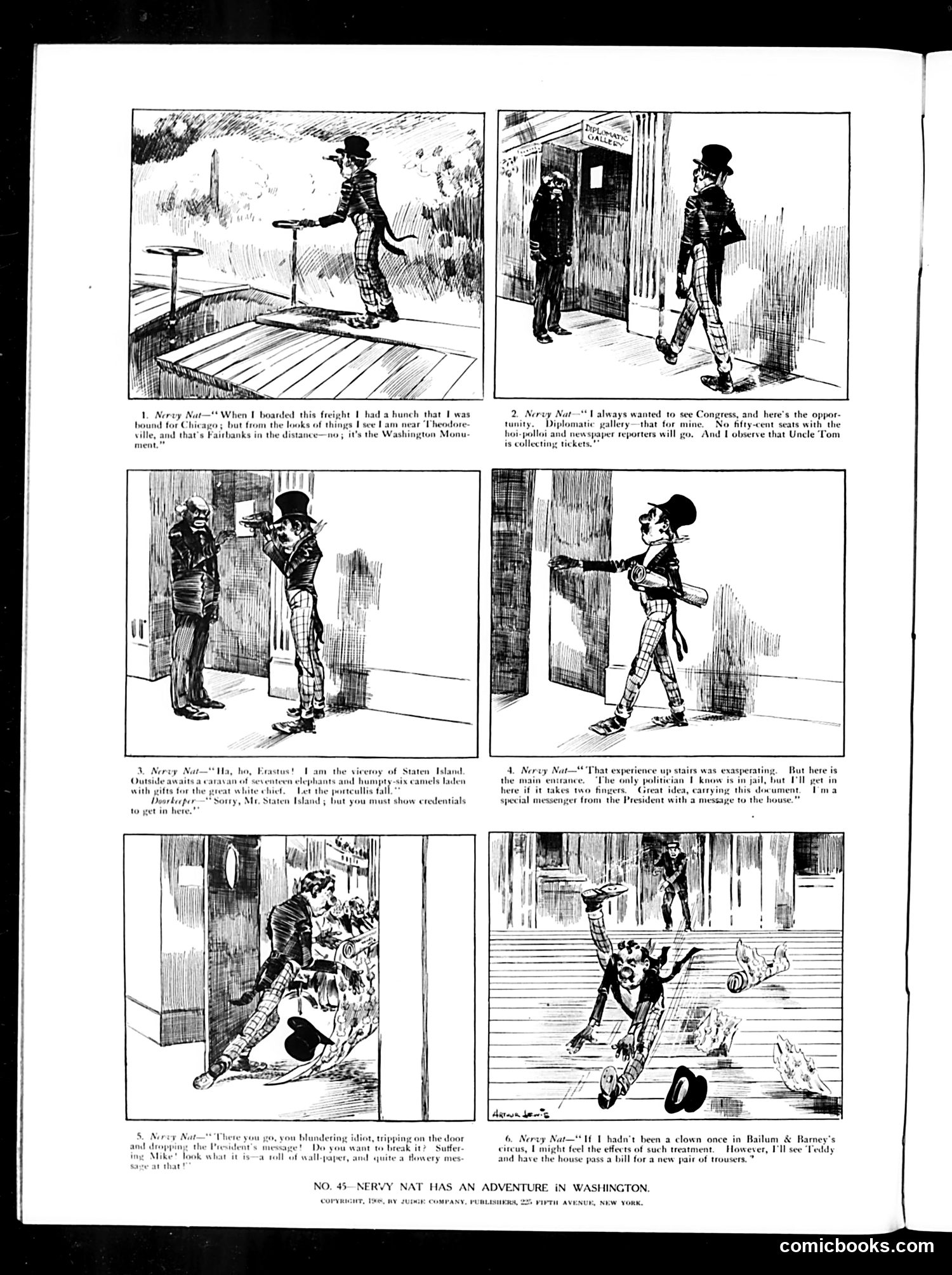
This is a six-panel comic strip following a character named "Nervy Nat" as he attempts to visit Congress in Washington, D.C. The satire targets both Nat's audacious social climbing and the bureaucratic gatekeeping of government institutions. Nat, dressed in shabby checked clothes and a top hat, schemes to gain access to the congressional gallery without paying the standard fifty-cent admission fee. He poses variously as a constituent with complaints, a messenger from "the President," and claims prior circus experience (referencing Barnum & Bailey) to justify his presence. The joke operates on multiple levels: Nat's desperation to see Congress reflects public curiosity about government, while his repeated failures mock both his presumption and the arbitrary authority of congressional doorkeepers. The final panel suggests his complete humiliation—he's literally knocked down the stairs. The comic gently satirizes American democratic ideals versus practical access to power.
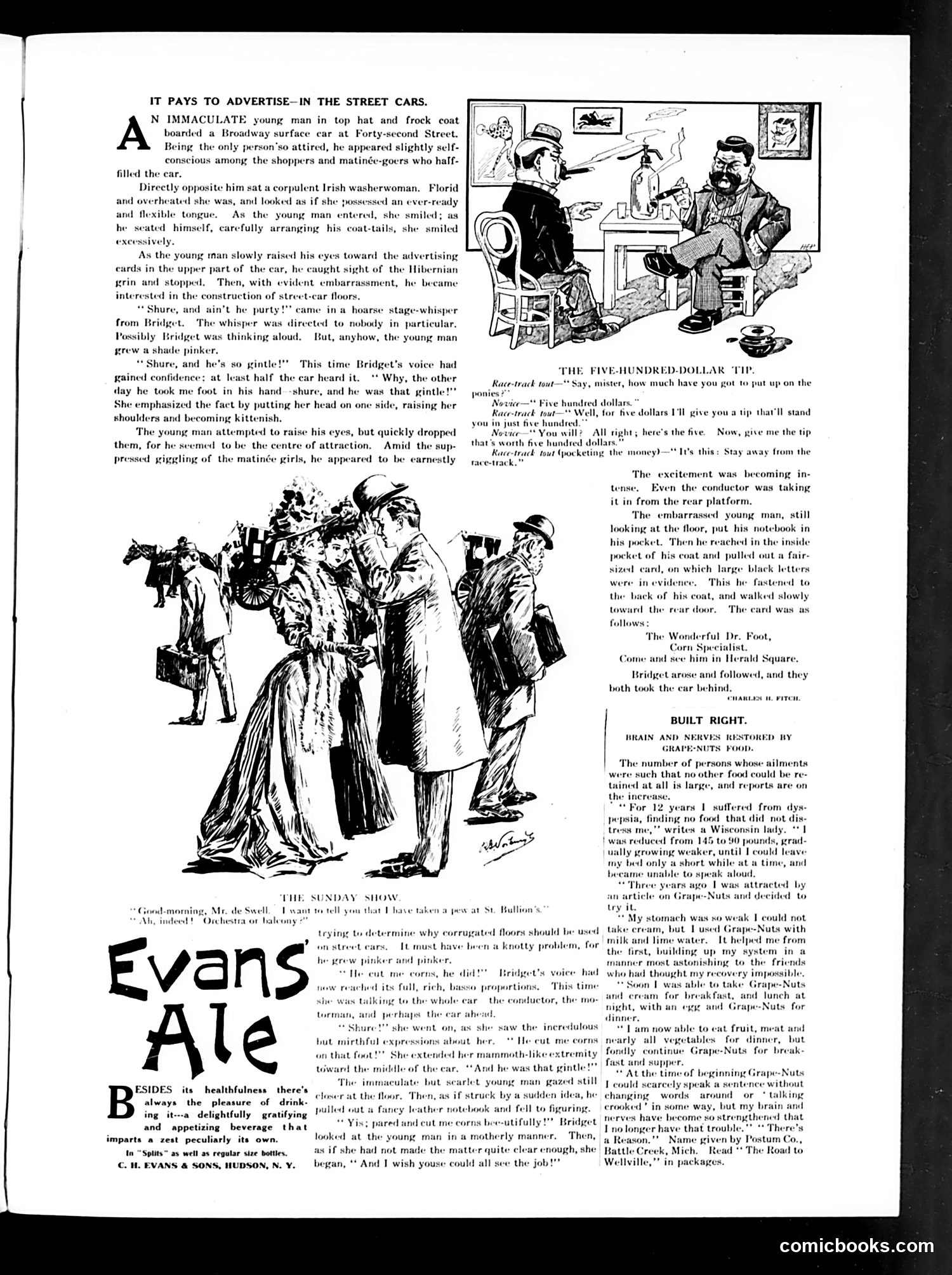
This satire mocks advertising through an encounter on a Broadway trolley car. A well-dressed young man in formal attire (top hat, frock coat) becomes the unwilling subject of an Irish washerwoman's loud, public commentary. She repeatedly praises his appearance—"ain't he purty," "so gintle"—to other passengers, embarrassing him. The joke targets both advertising's invasiveness and class dynamics. The washerwoman's exaggerated Irish dialect and unselfconscious behavior contrast sharply with the gentleman's refined mortification. By using him as an unwitting "advertisement" through her commentary, the cartoon satirizes how advertising exploits public spaces and people for attention. The companion piece, "The Five-Hundred-Dollar Tip," mocks a gullible racetrack bettor. The page also includes an Evans Ale advertisement and testimonial about Grape-Nuts food.
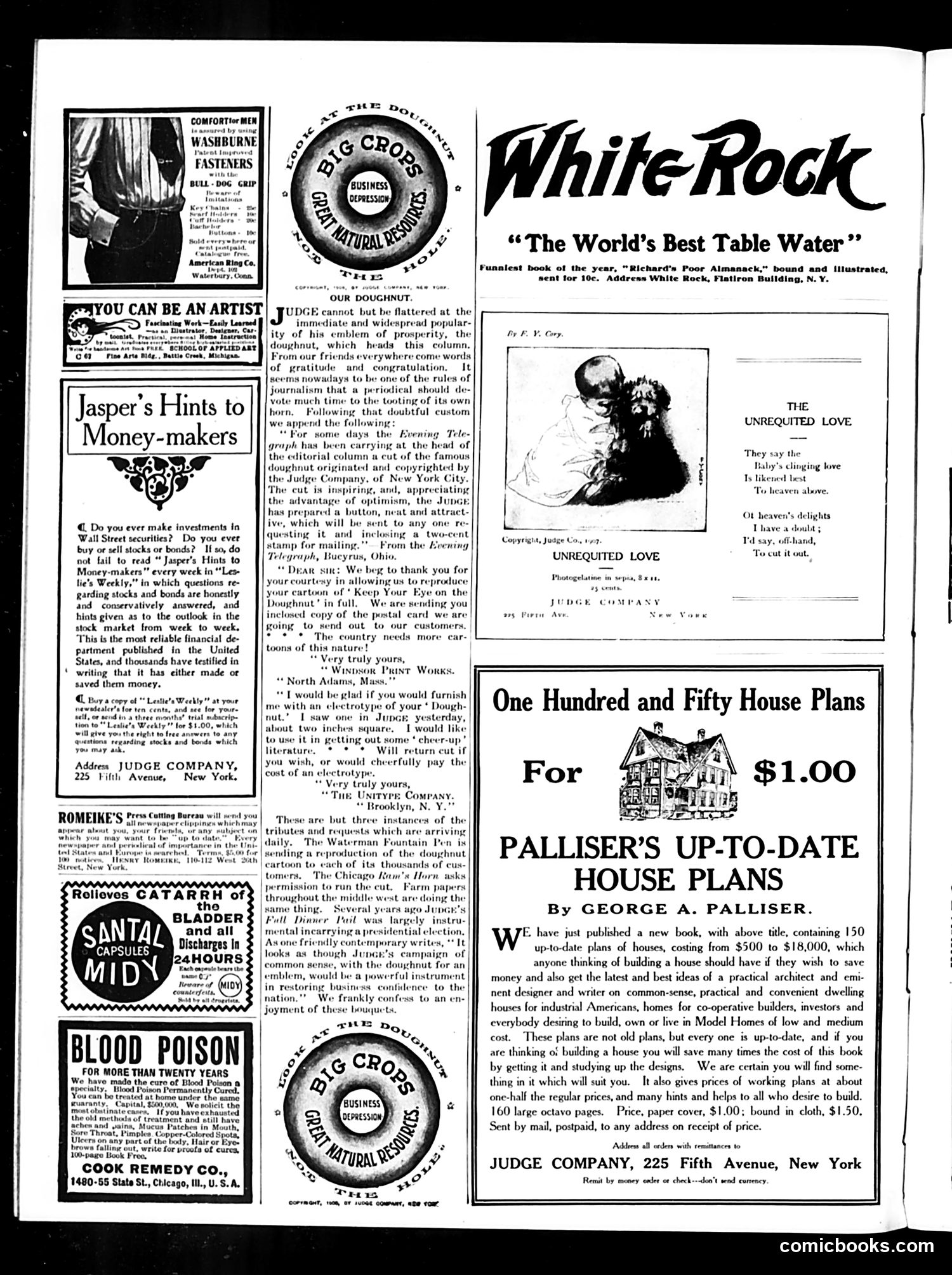
This page is primarily **advertising and promotional content** rather than political satire. The main elements include: **"Our Doughnut"** (center): Judge magazine celebrates its own doughnut logo/mascot with letters of praise from readers and businesses requesting to use the image in their own promotional materials. This is essentially self-congratulatory house advertising. **Side advertisements** promote various products typical of the era: financial advice ("Jasper's Hints to Money-makers"), medical treatments ("Blood Poison" cure, "Santal Capsules"), and household goods (White Rock table water, house plans). **"The Unrequited Love"** (right): A sentimental illustration with accompanying verse comparing a baby's love to heavenly affection—typical saccharine sentiment of early 1900s popular magazines. The page reflects **Judge's business model**: mixing satirical content with lucrative advertising and self-promotion. There is **no significant political satire** visible here—it's primarily a commercial publication page showcasing the magazine's brand and revenue sources.
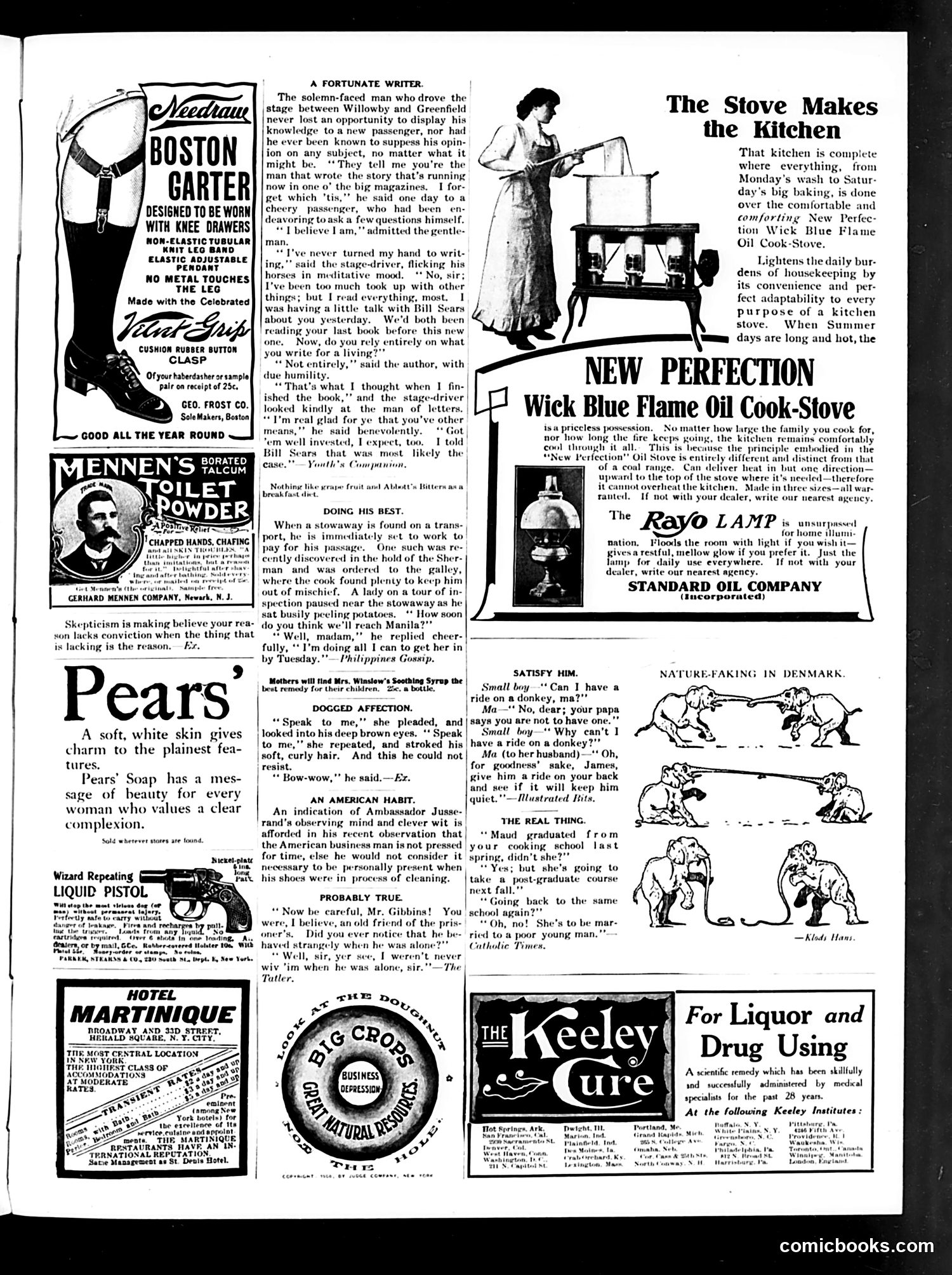
This page is primarily **advertising**, not political satire. The dominant content features product ads for consumer goods: an oil cook-stove, a kerosene lamp, toilet powder, and a "cure" for liquor/drug addiction. The only substantial text content is "A Fortunate Writer"—a humorous anecdote about a stage-coach driver who meets an author. The joke hinges on the driver's assumption that the author must be successful and wealthy, only to learn the man supports himself through other work. The satire gently mocks the driver's garrulous, opinionated nature and his misconceptions about literary success. The punchline involves the author deflecting the driver's questions with dry wit. The remaining text fragments include minor jokes ("Doing His Best," "Satisfy Him") typical of period humor magazines—observational comedy about domestic life and children. There are no identifiable political figures or references; this appears to be a typical early-20th-century magazine page blending light entertainment with consumer advertising.
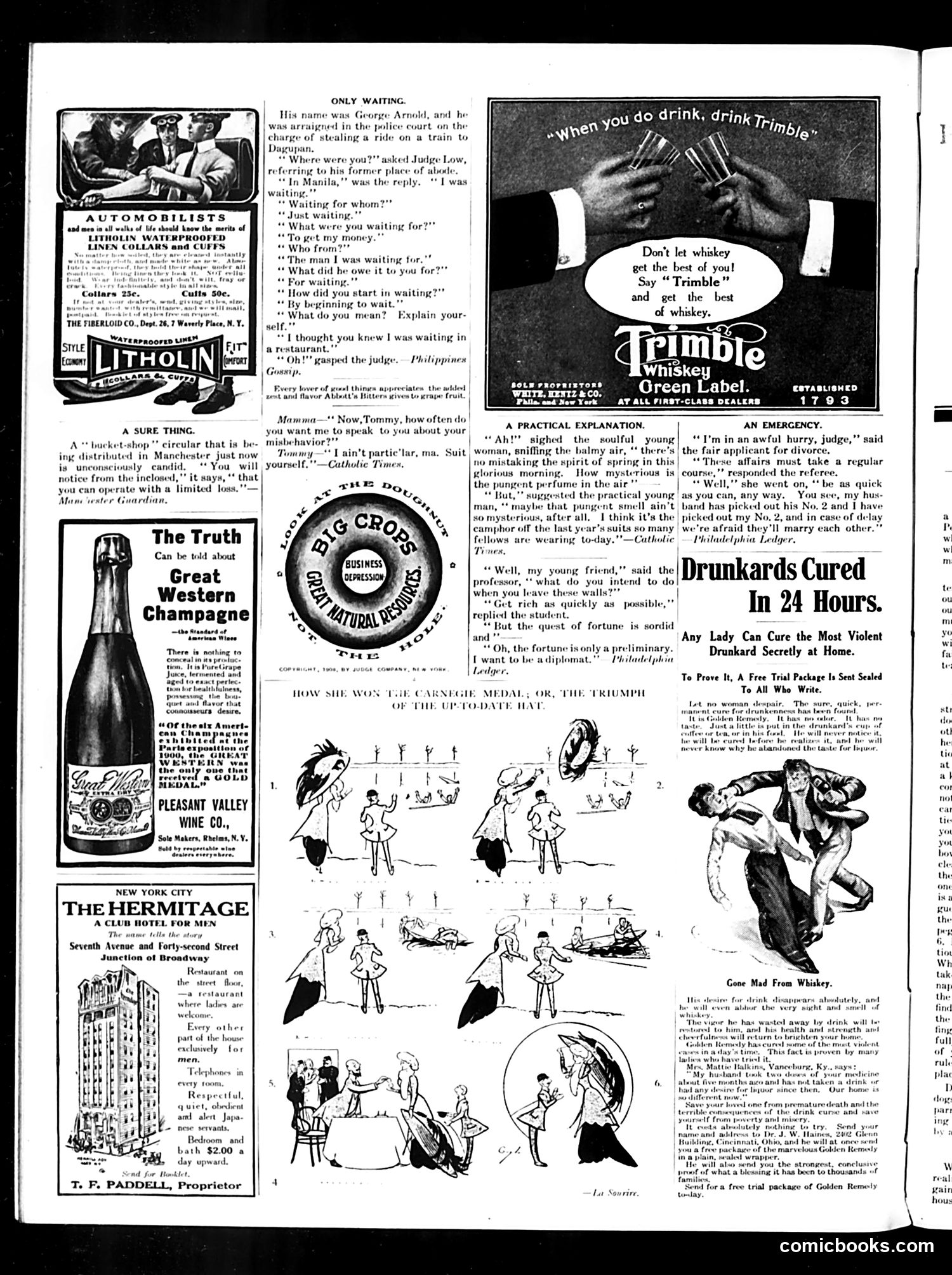
This page from *Judge* magazine contains multiple satirical pieces and advertisements typical of early 20th-century American humor: **Main Cartoon ("Only Waiting")**: A brief police court sketch where a man named George Arnold is charged with stealing a train ride. His responses of "I was waiting" to various questions create absurdist humor—the judge eventually grasps he was literally waiting in a restaurant, making the charge nonsensical. **Other Humor Pieces**: Short comic anecdotes about mothers scolding children, professors discussing fortune-seeking, and marital disputes—typical drawing-room humor of the era. **Advertisements**: The page heavily features period ads for alcohol (champagne, whiskey) and the "Golden Remedy" for curing drunkenness "secretly at home"—ironic given the alcohol promotions. Hotels and other services are advertised. **Social Context**: The humor reflects turn-of-the-century middle-class concerns: propriety, divorce, wealth-seeking, and drinking culture. The advertisements reveal contemporary attitudes toward both substance use and pseudo-medical "cures."
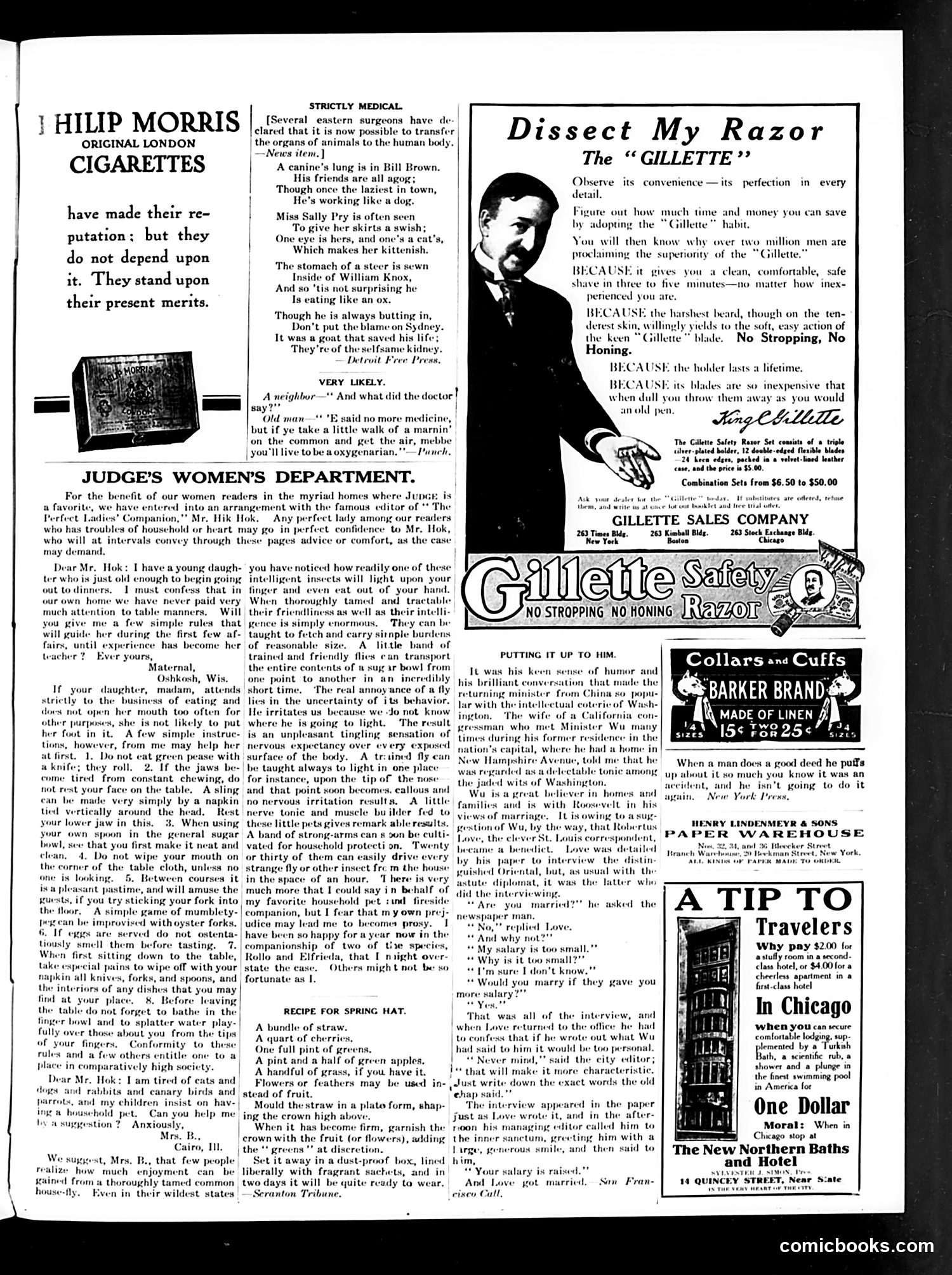
This page from *Judge* magazine contains three distinct sections: ## "Strictly Medical" Verse A satirical poem joking about early 20th-century organ transplant claims. It humorously imagines people receiving animal organs—a man with a dog's lung "working like a dog," another with a steer's stomach "eating like an ox." The satire mocks both the implausibility of such procedures and people's literal behavioral transformation afterward. This reflects public fascination (and skepticism) about emerging surgical possibilities. ## "Very Likely" Joke A brief anecdote mocking folk medical remedies—an elderly man claims that adding "a little walk of a marnin'" to one's routine will extend life to extreme old age. The satire targets outdated, superstitious health advice. ## Judge's Women's Department An advice column offering tongue-in-cheek etiquette guidance for dinner behavior. The humor lies in increasingly absurd rules (using napkins as jaw-slings, the suggestion to adopt house-flies as pets). It gently satirizes rigid upper-class dining formality while mocking readers who take such conventions too seriously. The page is primarily humorous/satirical rather than politically charged.
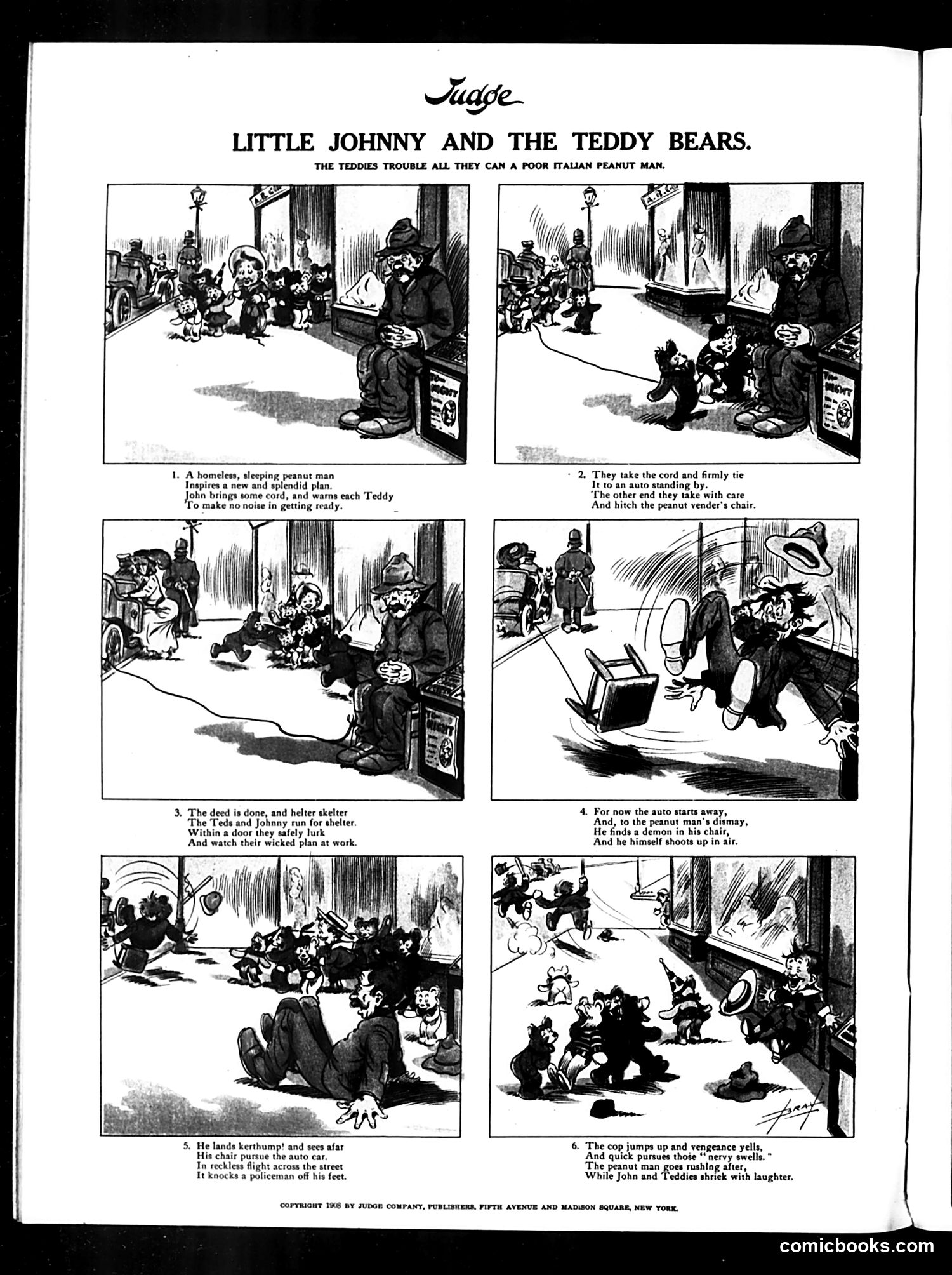
This is a slapstick comic strip satirizing "Teddy Bears"—the popular toy craze inspired by President Theodore Roosevelt's 1902 bear-hunting incident. The strip depicts mischievous children playing with toy bears who help them prank a poor Italian peanut vendor. The humor targets both the children's destructive behavior and the immigrant vendor's misfortune. The "Teddies" tie a cord from the sleeping peddler's chair to a moving automobile, launching him skyward when the car accelerates. The chaos that follows—including a police officer knocked down—becomes the joke's payoff. For 1908 readers, this reflected period anxieties about immigrant street vendors and unruly youth, while exploiting the Teddy Bear toy's cultural moment. The satire's tone suggests Judge magazine found such pranks mockingly amusing rather than genuinely cruel, typical of era's casual comedic attitudes toward vulnerable populations.