
A complete issue · 18 pages · 1908
Judge — April 18, 1908
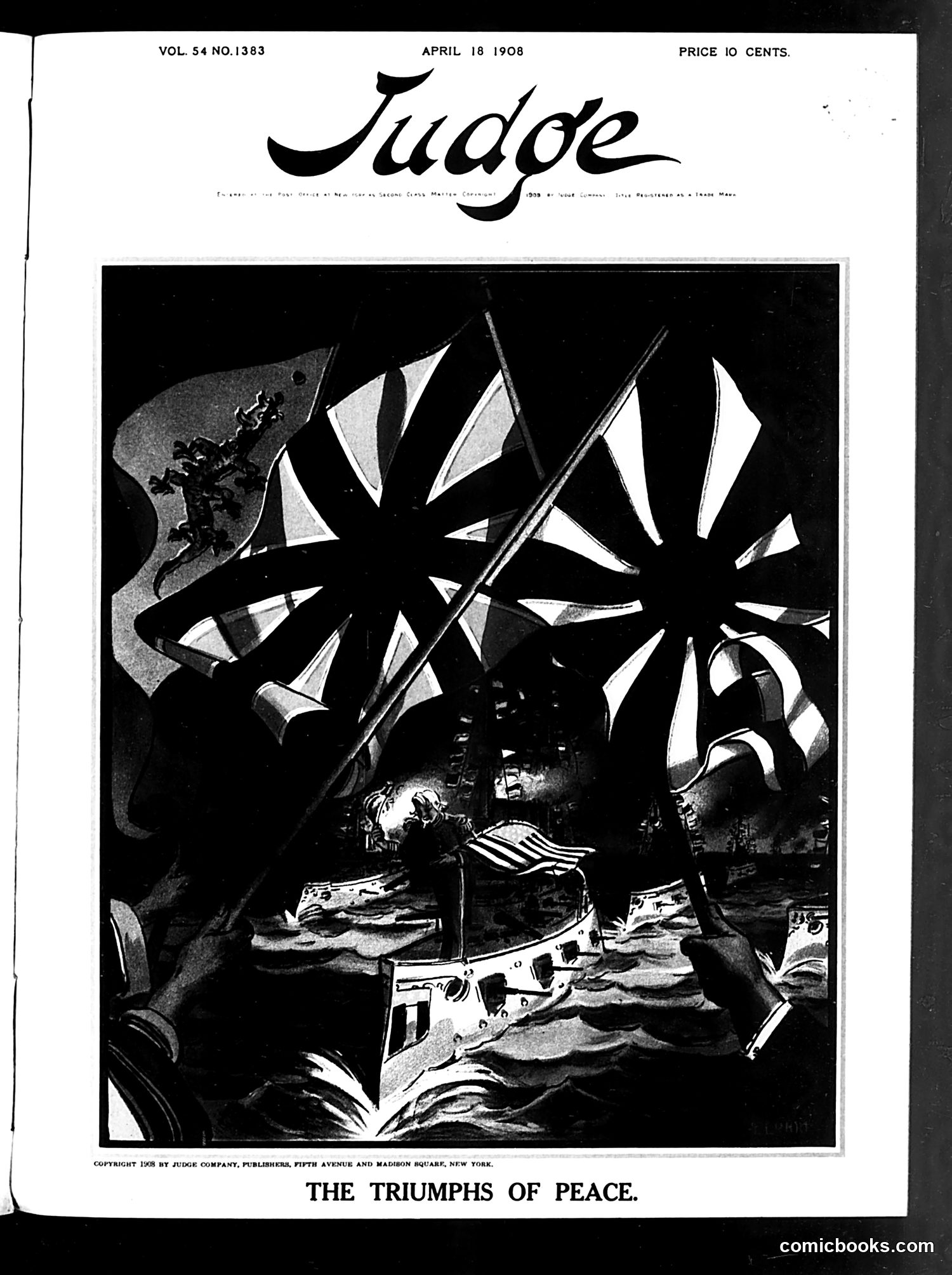
This Judge magazine cover from April 18, 1908 depicts an allegorical celebration of peace, showing figures (likely representing nations or peace advocates) gathered around what appears to be military weapons and equipment being laid down or dismantled. The white star-burst shapes suggest fireworks or celebratory explosions, while the American flag is visible among the gathered items. The satirical title "The Triumphs of Peace" likely critiques the era's peace movement or international disarmament discussions. The contrast between the celebratory imagery and the prominent display of weapons suggests Judge's skepticism about whether genuine peace—or merely theatrical posturing about peace—was actually being achieved. The cartoon appears to mock the optimism of early 1900s peace conferences.
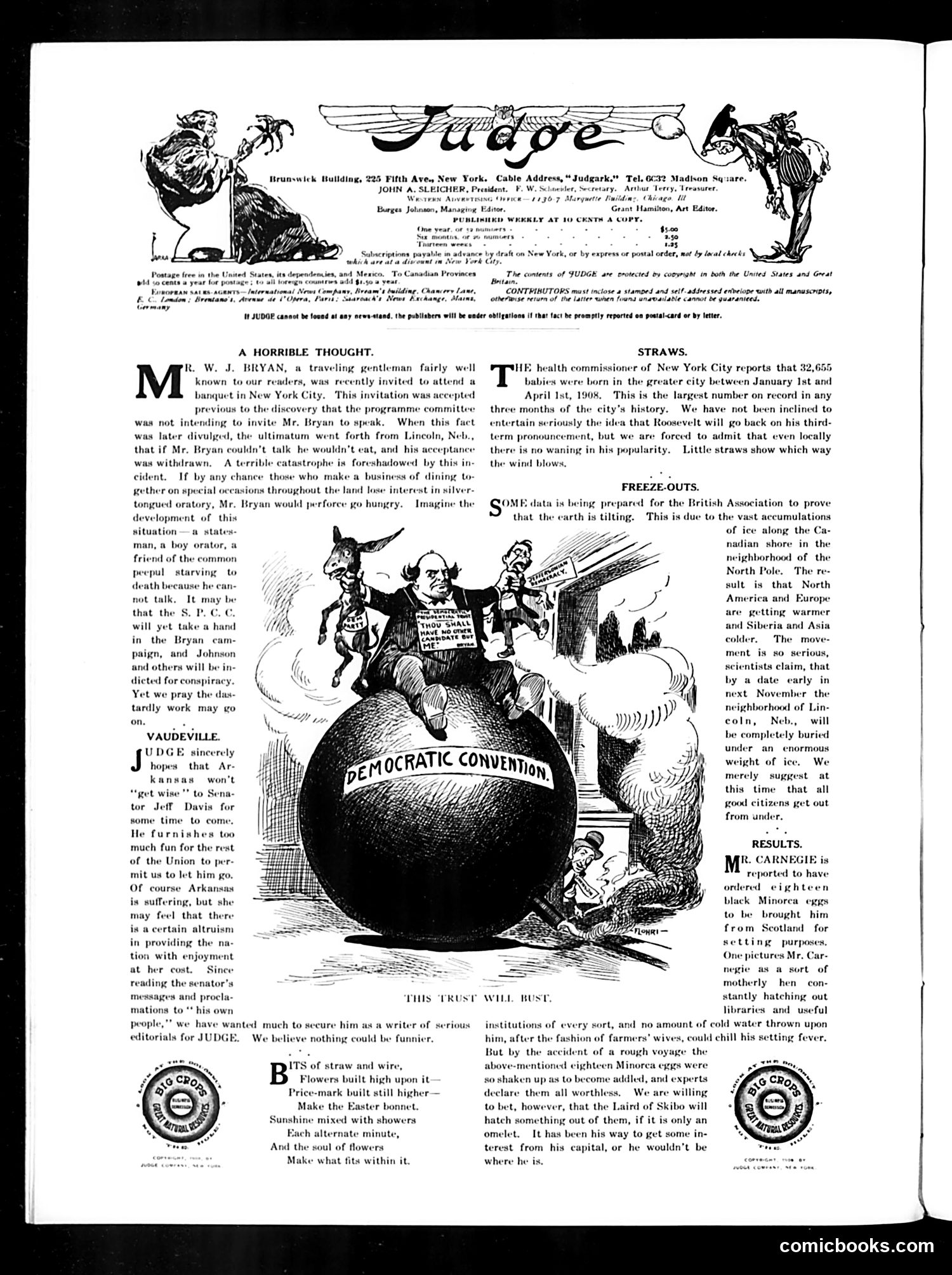
The central cartoon, "THIS TRUST WILL BUST," depicts figures riding atop a large spherical bomb labeled "DEMOCRATIC CONVENTION," suggesting the convention itself is volatile and unstable. The satirical point is that the Democratic party is internally fractious—the gathering represents dangerous, explosive conflict rather than unity. The surrounding text columns ("A HORRIBLE THOUGHT," "STRAWS," "VAUDEVILLE," "FREEZE-OUTS," "RESULTS") appear to be satirical commentary on various political and social topics of the era, though specific references require clearer context. Without knowing the exact publication date, the cartoon likely mocks Democratic Party divisions during a particular convention period, suggesting the party contains irreconcilable factions that threaten its stability.
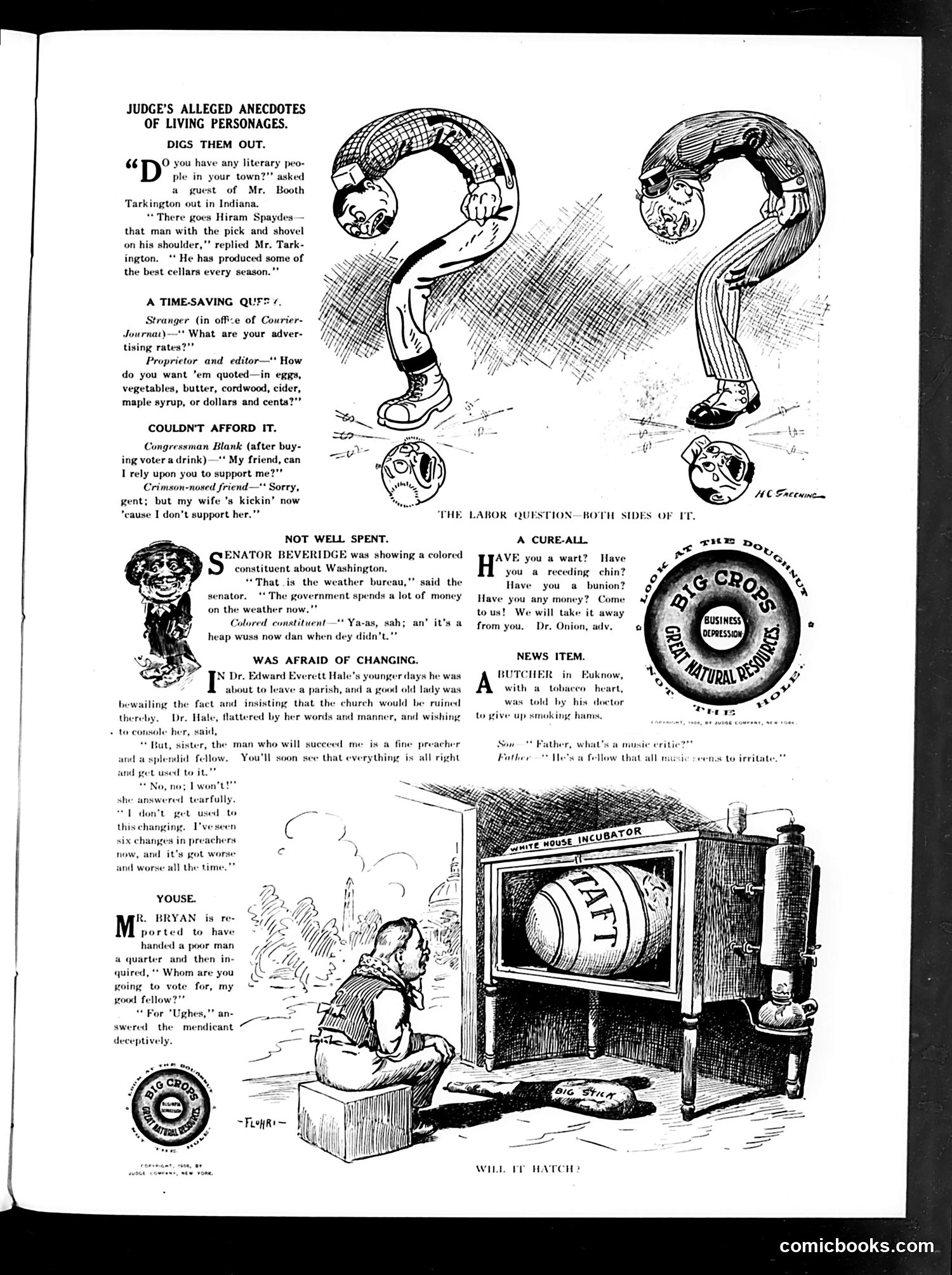
This page contains several brief humorous anecdotes and cartoons typical of Judge's satirical style. The main content includes: **"The Labor Question—Both Sides of It"**: Two anthropomorphized question marks debate advertising rates, with one character unable to afford quoted prices. This satirizes disputes between labor and business over fair compensation. **"Was Afraid of Changing"**: A story about Dr. Hale resisting church modernization, mocking conservative resistance to social progress. **"A Cure-All"**: A Dr. Onion advertises dubious medical treatments, satirizing patent medicine fraud—a common Judge target. **"Will It Hatch?"**: The bottom cartoon shows a "White House Incubator" with "Taft" inside, likely referencing President William Howard Taft (1909-1913) and political uncertainty about his administration's direction or policies. The page reflects Progressive Era concerns about labor disputes, outdated institutions, medical quackery, and political unpredictability.
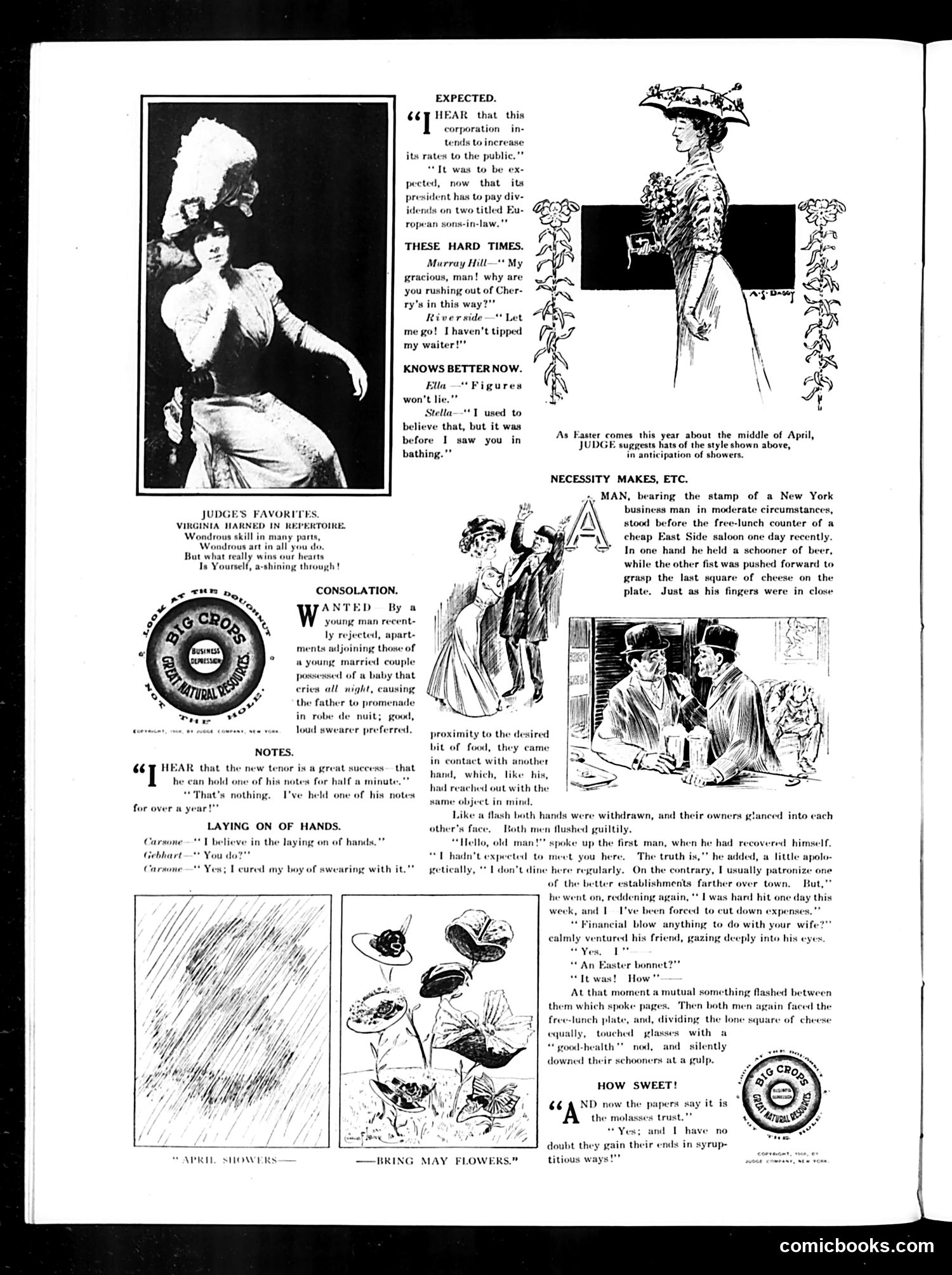
This page contains several unrelated satirical pieces typical of early 20th-century Judge magazine. **Top section** features what appears to be social commentary about corporate rate increases and domestic life ("These Hard Times," "Knows Better Now"), presented through dialogue snippets—likely observations about economic hardship affecting ordinary people. **"Necessity Makes, Etc."** depicts two working-class men at a cheap saloon fighting over a piece of cheese, illustrating how economic desperation forces people into undignified behavior. The satire critiques poverty rather than the poor themselves. **"April Showers" and "Bring May Flowers"** are seasonal illustrations with minimal text, appearing decorative rather than satirical. The page lacks explicit political figures or identifiable caricatures. Instead, it offers broad social satire about class economics and domestic relations during economically difficult times.
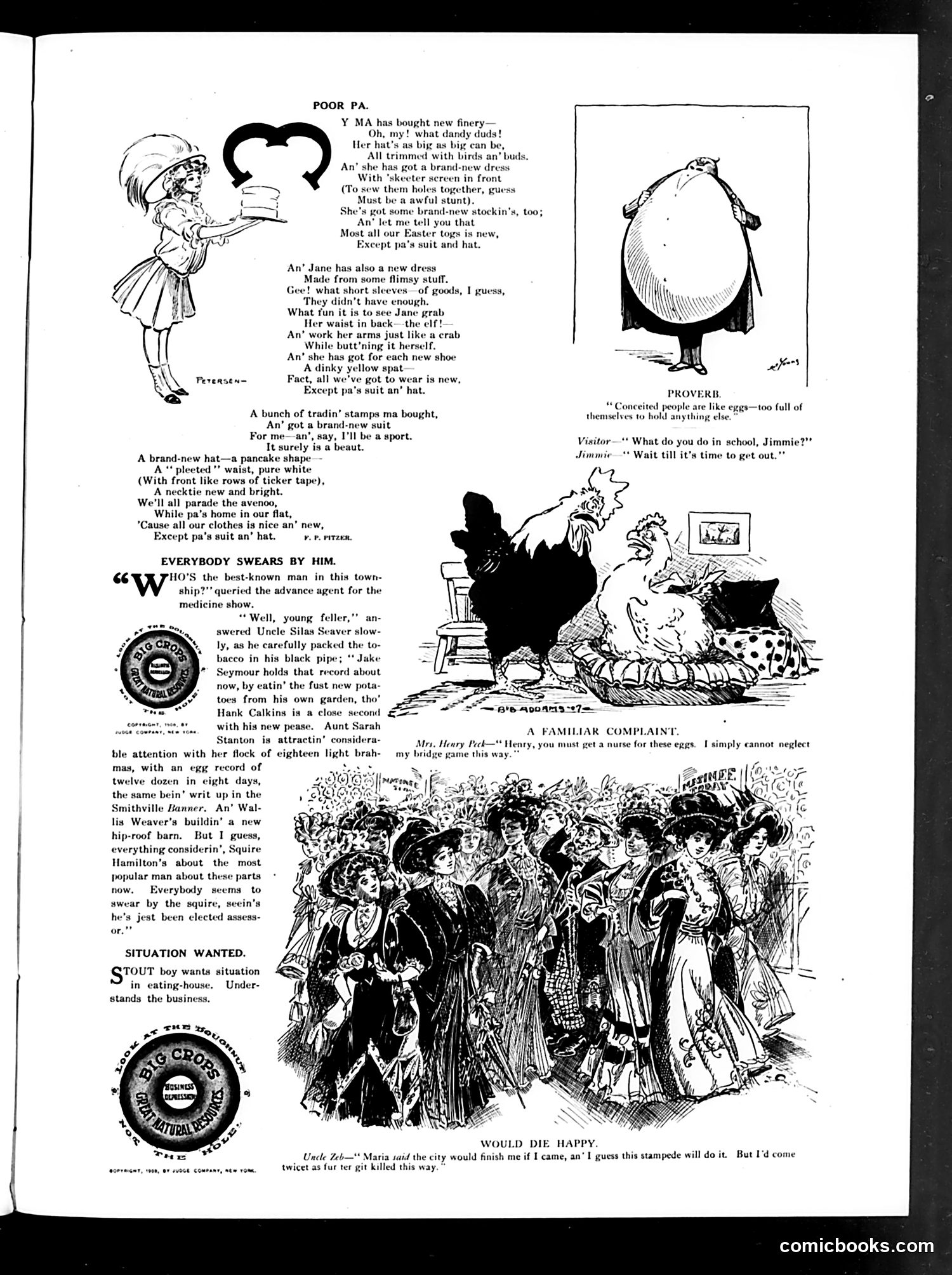
This page satirizes the economic burden of daughters' fashion expenses on fathers. The poem "Poor Pa" describes a man whose wife and daughters have purchased expensive Easter clothing—new hats trimmed with birds, stockings, dresses with short sleeves, and shoes—leaving him financially strained. The cartoon titled "Everybody Swears By Him" discusses Uncle Silas Seymour, apparently a well-known local figure who attracts attention through his garden produce and recent barn construction. The piece mocks small-town gossip and reputation-building. "A Familiar Complaint" shows a woman demanding a nurse for eggs, and "Would Die Happy" depicts an crowded social scene, likely satirizing urban life or social climbing. The page primarily uses domestic humor to critique excessive consumer spending and class aspirations in early 20th-century America.
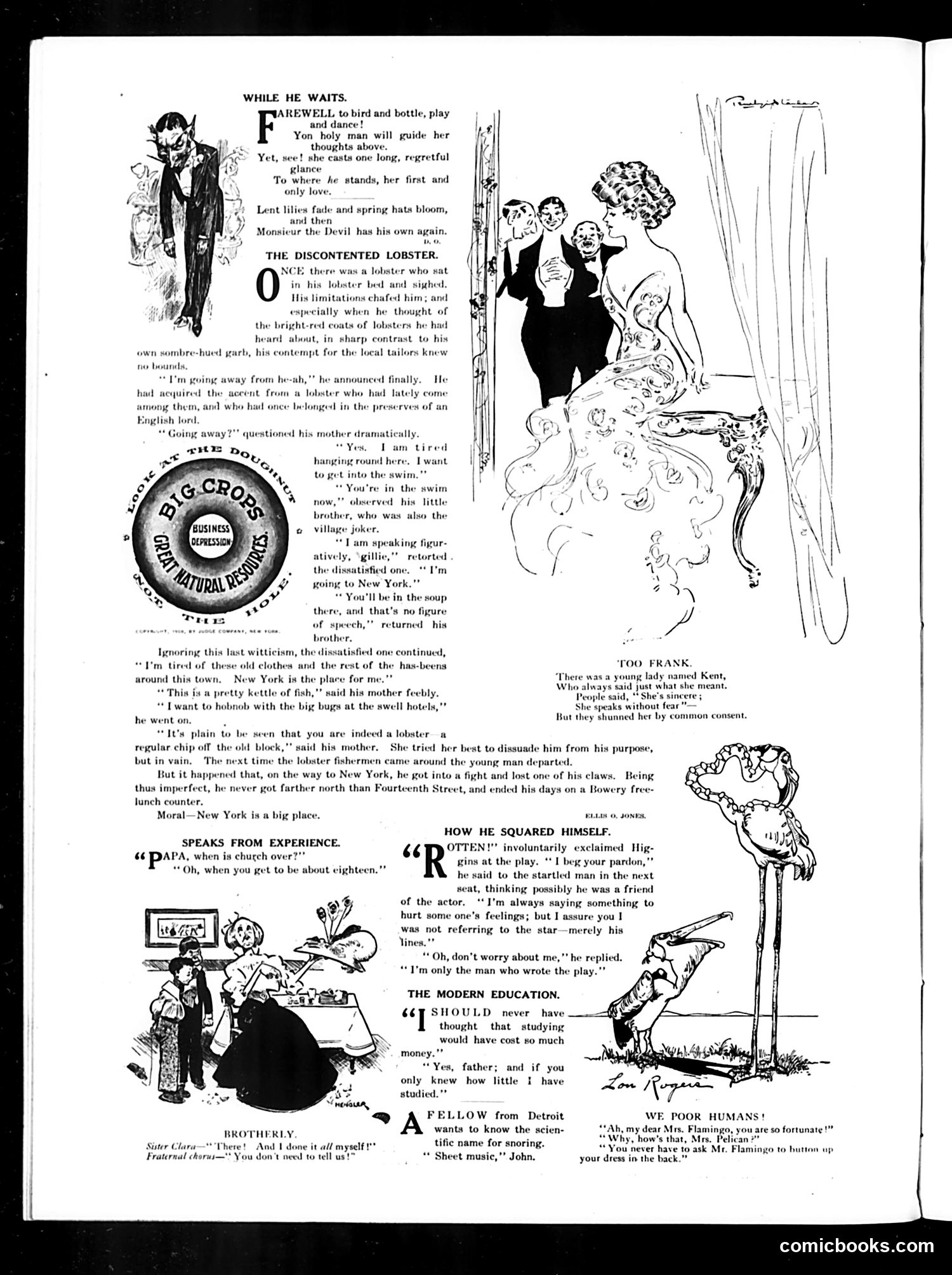
This page contains multiple satirical vignettes typical of early 20th-century Judge magazine humor: **"The Discontented Lobster"** mocks social climbing and aspirational immigrants. A lobster dreams of abandoning his "contempt for local tailors" to hobnob with "big bugs at swell hotels" in New York. The moral: his ambition literally costs him a claw in a fight, and he ends poverty-stricken on the Bowery—satirizing how New York promises exceed reality for the working-class ambitious. **"Too Frank"** and other brief pieces use wordplay and social awkwardness for humor—a woman speaking "without fear" is shunned; a playwright confronts an actor's ad-libbed criticism. **"How He Squared Himself"** plays on stage etiquette and the writer's fragile ego—a heckler apologizes, revealing he's the playwright himself. The cartoons throughout feature exaggerated characters in social situations, using physical comedy and dialogue-based jokes typical of the era's genteel satire targeting middle-class pretension and social missteps.
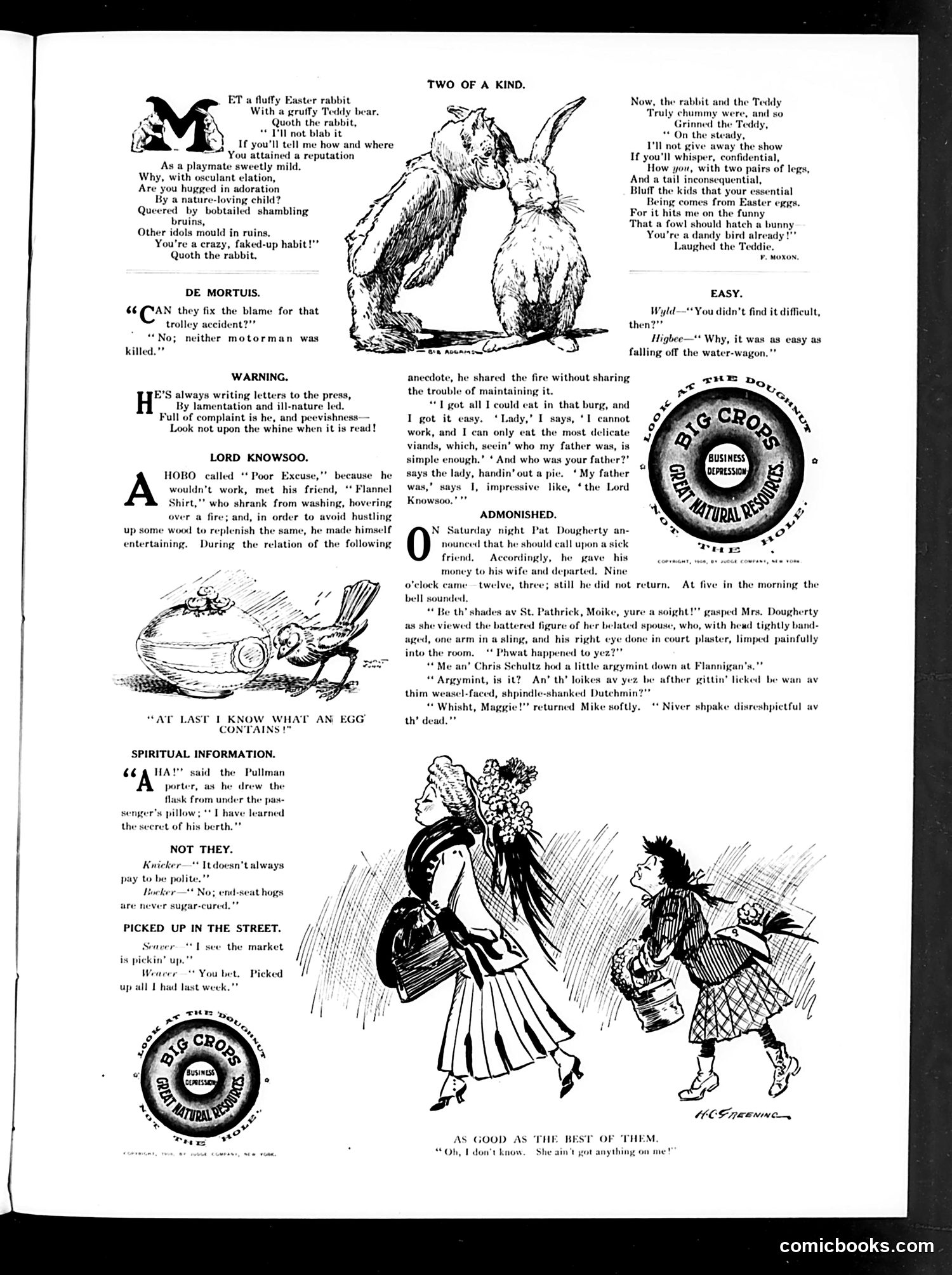
This page contains several brief satirical pieces typical of *Judge* magazine's style. The main cartoon "Two of a Kind" presents a dialogue between an Easter rabbit and a Teddy bear, each questioning how the other maintains credibility with children. The rabbit asks how the bear convinced children it's "naturally mild"; the bear counters by asking how a rabbit convinces children it comes from Easter eggs. The satire mocks how commercial mascots and holiday traditions rely on accepted fictions that don't withstand logical scrutiny. Other pieces target common social frustrations: a complainer always writing letters to the press; a hobo fabricating a distinguished father ("the Lord Knowsoo") to justify eating only "delicate viands"; and a domestic dispute where an unfaithful husband returns late from a bar fight, met with his wife's sarcasm. The humor relies on wordplay, Irish-dialect humor (popular period stereotyping), and satirizing everyday social pretense and dishonesty.
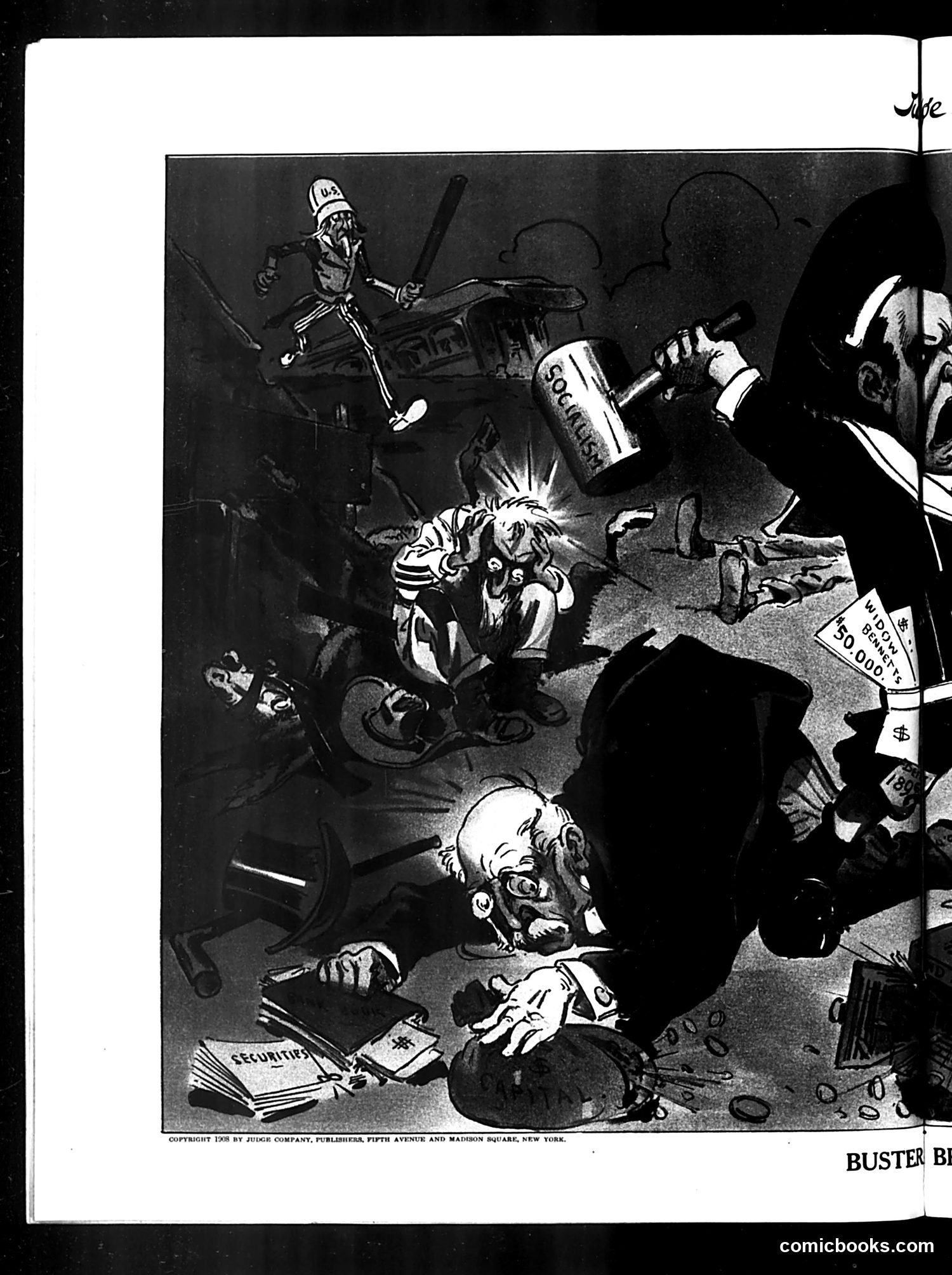
This appears to be a Judge magazine satirical cartoon depicting financial chaos and corruption. The image shows caricatured figures in what seems to be a violent or chaotic financial scene, with references to "Securities" visible on documents at the bottom. A military or uniformed figure wielding a club stands above, suggesting government force or intervention in financial matters. The cartoon likely comments on stock market speculation, financial fraud, or economic instability—possibly referencing the 1920s or early 1930s given the style. The scattered money, documents, and aggressive imagery suggest criticism of financial manipulation or market collapse. The uniformed figure may represent government regulation or police action against financial crimes. Without a visible date or title, the exact historical event referenced remains unclear, though the overall message critiques financial misconduct and its consequences.
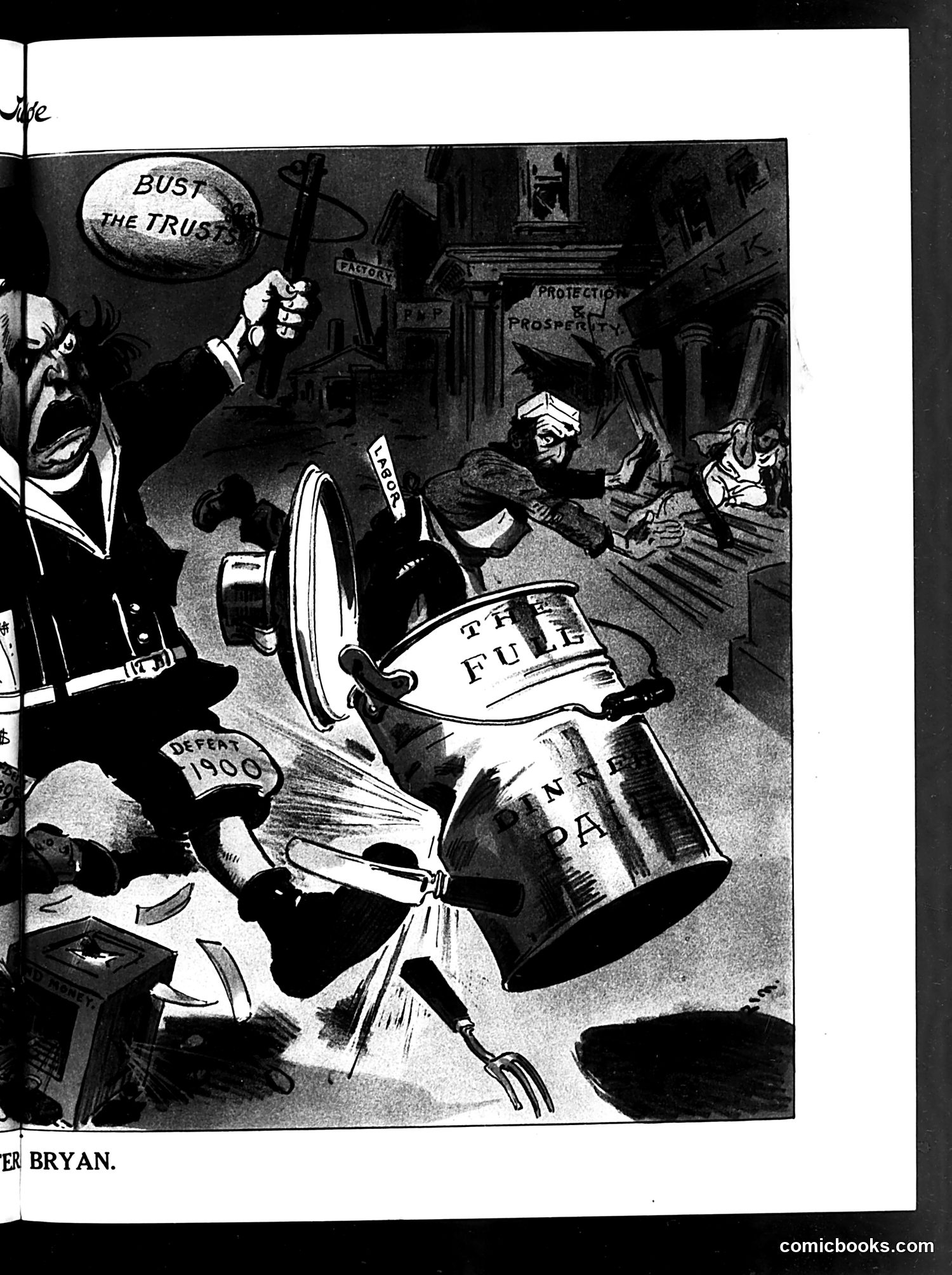
This is a satirical cartoon from *Judge* magazine depicting financial panic and economic collapse. A figure on the left holds a club labeled "BUST THE TRUST," while other figures appear to be destroying or dismantling financial institutions. Visible text includes "PROTECTION," "PROSPERITY," "THE RULE," and "DEFEAT 1900." The cartoon critiques anti-trust efforts and their economic consequences. It suggests that aggressive trust-busting—a major political issue of the early 20th century—is destroying confidence in financial systems and causing economic ruin. The chaotic scene with overturned vessels and destruction symbolizes market instability allegedly caused by regulatory intervention. The reference to "1900" and "BRYAN" (visible at bottom) suggests this relates to William Jennings Bryan's presidential campaigns, which opposed corporate monopolies but concerned business interests about economic disruption.
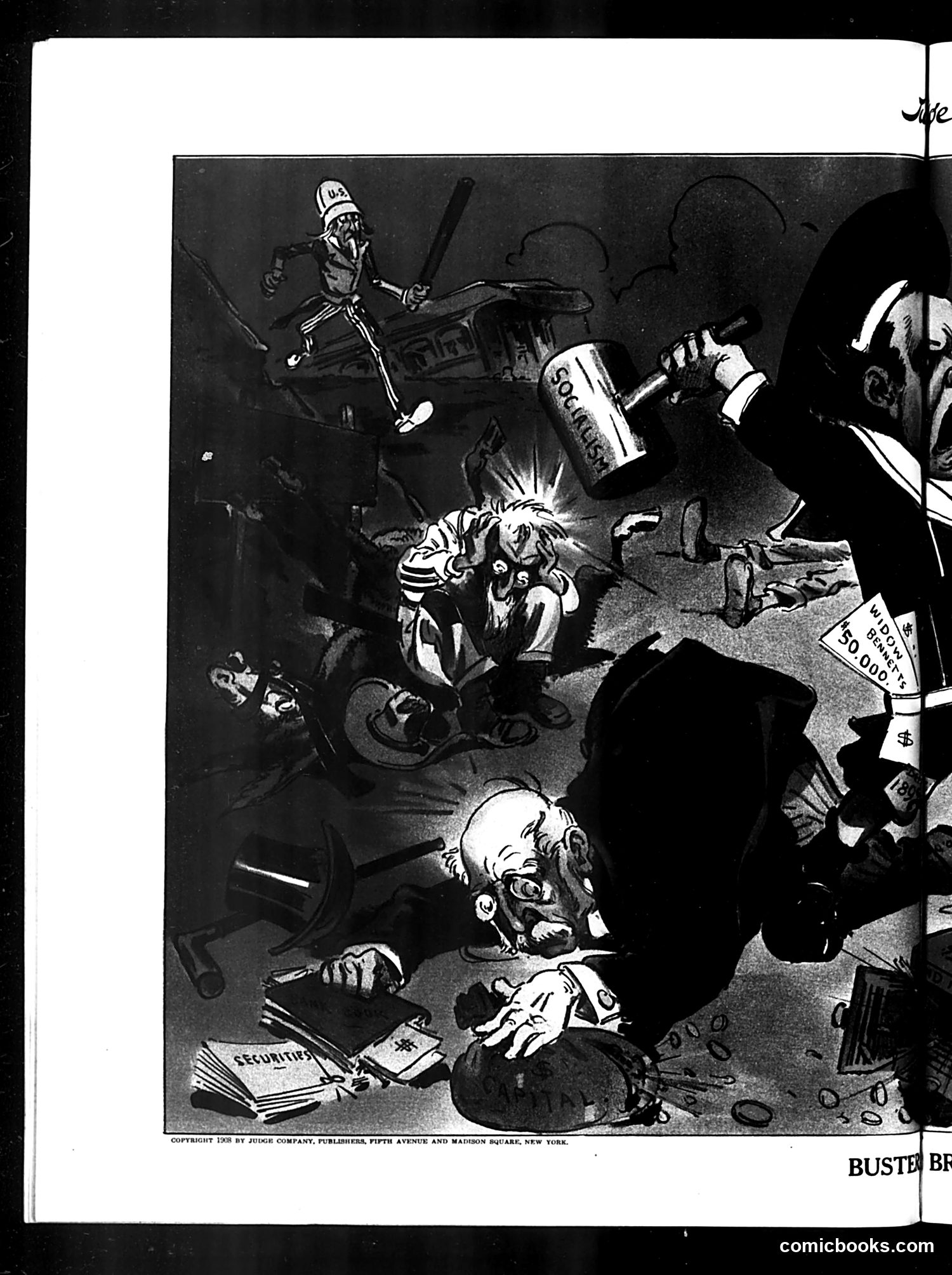
This is a political cartoon from *Judge* magazine (copyright 1920, per the caption) depicting what appears to be violent labor unrest or revolutionary activity. The cartoon shows armed figures attacking or subduing caricatured men labeled with references to "Securities" and financial documents. A barrel labeled "Dynamite" is prominently featured, suggesting anarchist or radical violence. The grotesque facial caricatures of the men being attacked likely represent wealthy capitalists or financial interests. The satire appears critical of violent labor extremism or anarchist movements of the post-WWI era, when such concerns were high in American public discourse. The cartoon uses exaggerated visual language to warn against—or mock—radical threats to the established financial order, reflecting contemporary anxieties about Bolshevism and labor violence in early 1920s America.
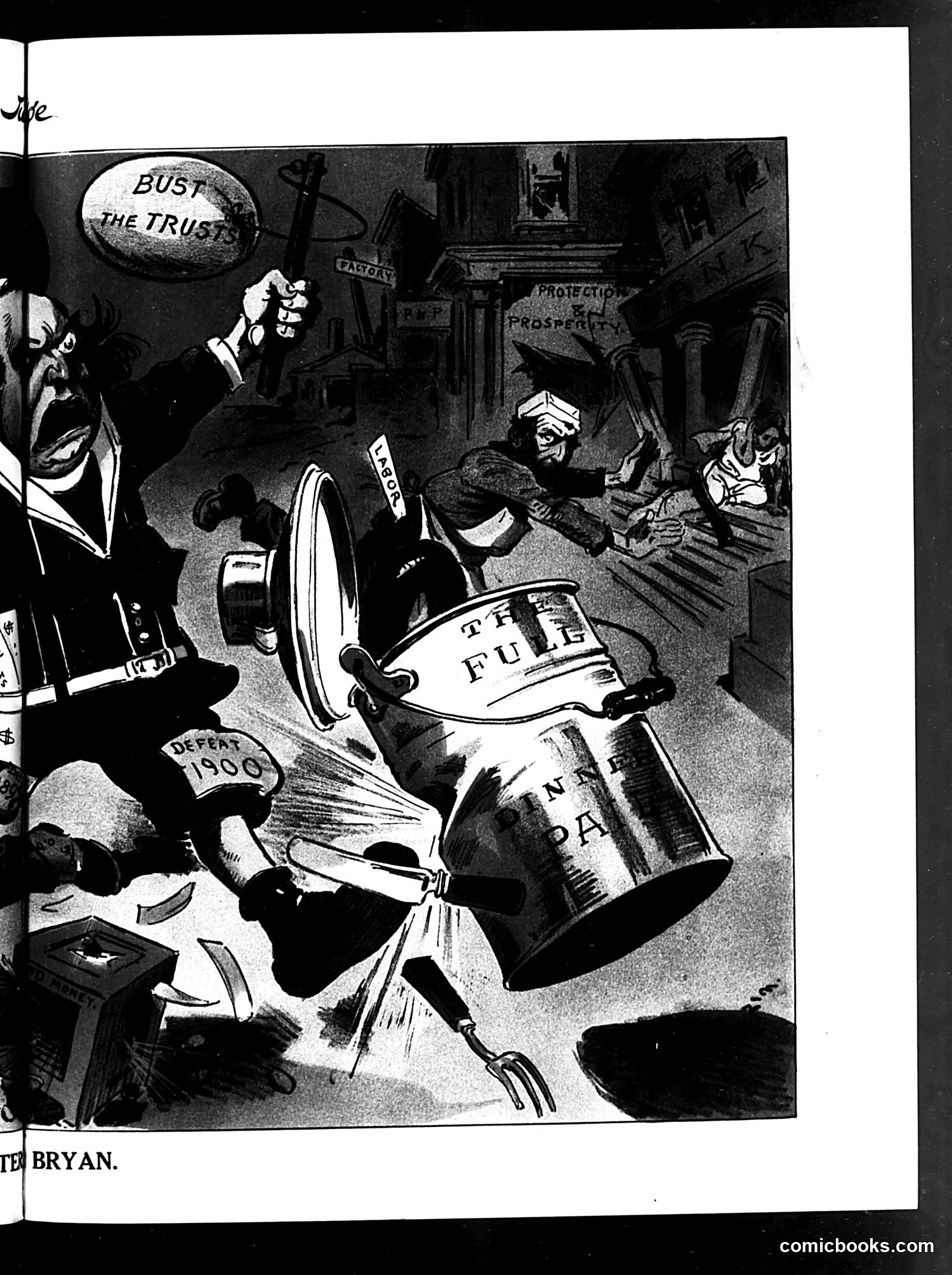
This appears to be a **Populist-era critique of financial trusts and monopolies**, likely from around 1900 (based on "Defeat 1900" visible on a sign). The cartoon depicts a figure on the left holding a club labeled "BUST THE TRUST" confronting what appears to be a **bloated monopoly personified as various industrial/financial symbols** in a street scene. Signs reference "Protection" and "Prosperity," suggesting irony about how protective tariffs benefited large trusts while harming ordinary citizens. The scene shows chaos and conflict, with the trust-buster attempting to demolish concentrated economic power. This reflects genuine political debate of the era: whether trusts should be broken up to restore fair competition and protect consumers and small businesses. The cartoonist (credited "Bryan" at bottom) likely supported antitrust action, a major political issue during William Jennings Bryan's era.
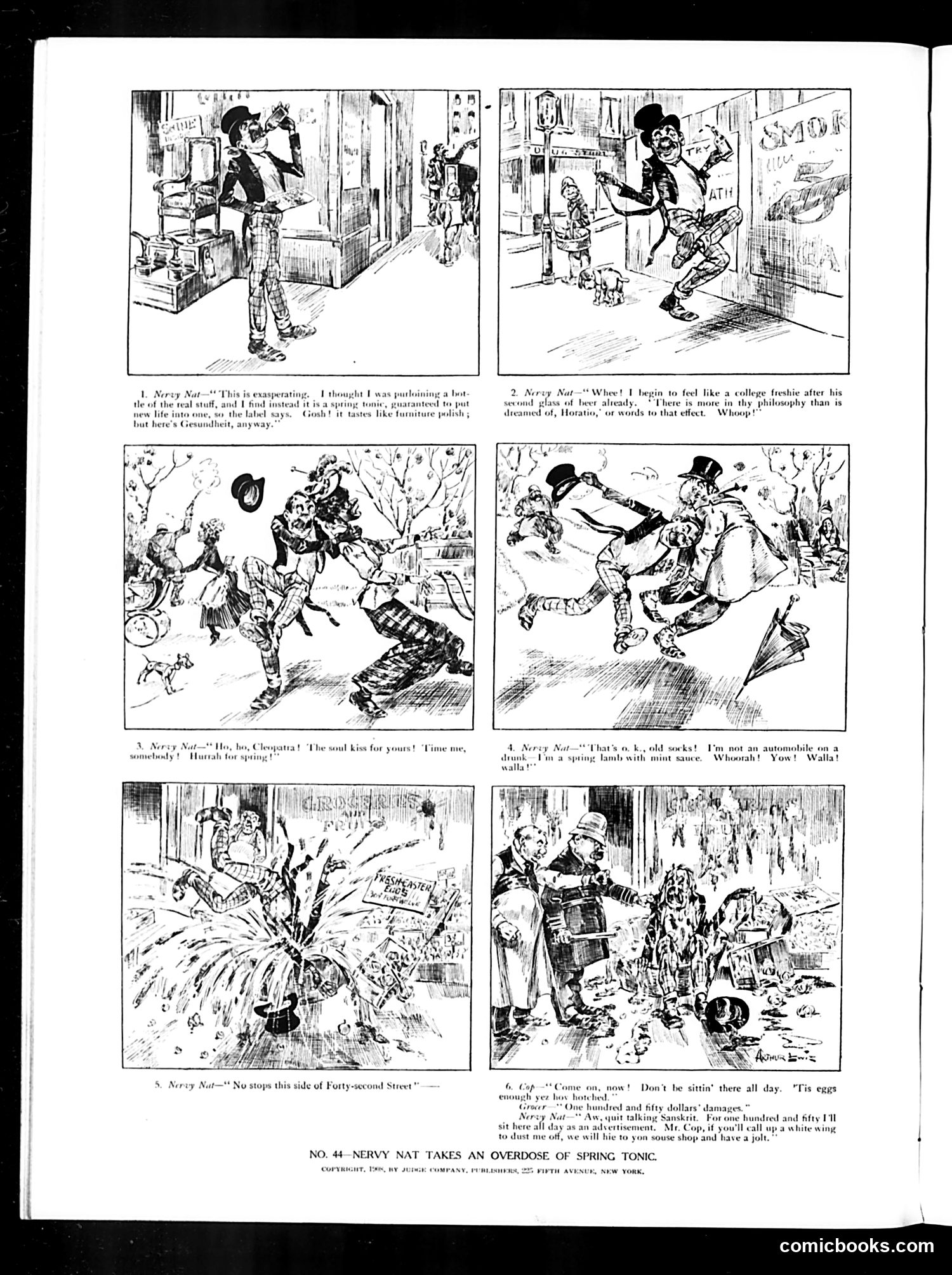
This comic strip satirizes the intoxicating effects of spring on young men, particularly college freshmen. "Nervy Nat," a recurring character, becomes increasingly drunk and reckless after consuming "spring tonic"—likely a patent medicine or alcoholic beverage. The humor relies on early 20th-century stereotypes: the naive college boy, excessive romanticism ("soul kiss for Cleopatra"), slapstick chaos, and references to contemporary New York locations (Forty-second Street). The "spring tonic" concept mocks both the patent medicine craze and the notion that spring causes youthful delirium. The final panels show Nat's escalating mayhem affecting the neighborhood—presumably damaging property and disturbing a cop who threatens arrest. The joke is that spring makes young men dangerously uninhibited and destructive, a common Judge magazine theme blending social commentary with broad physical comedy.
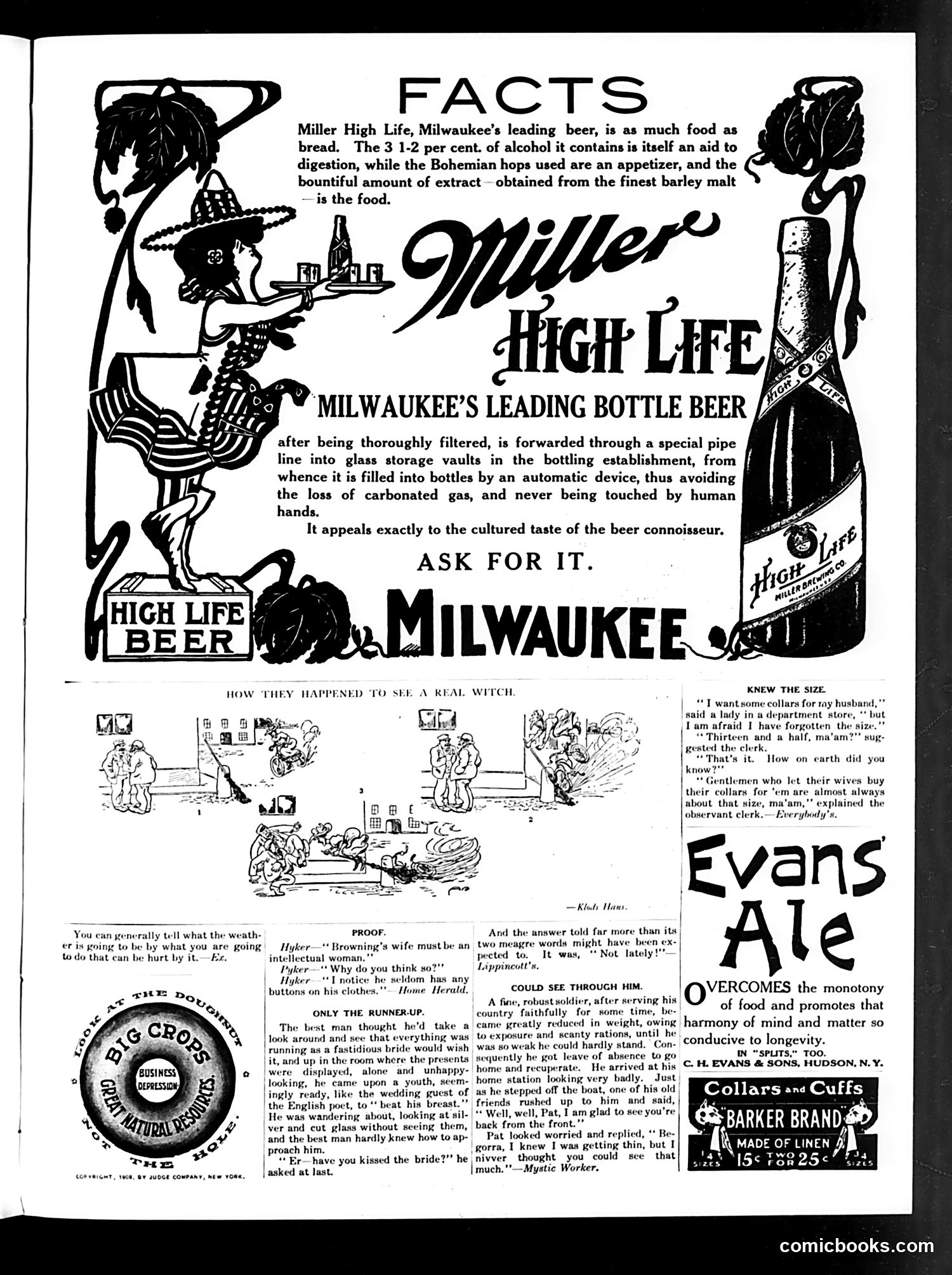
This page is primarily **advertising**, dominated by a large Miller High Life beer advertisement at the top featuring a decorative figure holding beer bottles and hops. The ad uses health claims common to early 1900s marketing—asserting beer is "as much food as bread" and aids digestion. Below the main ad are several brief **humorous anecdotes** typical of Judge's satirical humor: - "How They Happened to See a Real Witch" plays on a woman's sarcastic response ("Not lately!") when asked if she's kissed the bride - "Proof" jokes about an intellectual wife whose husband lacks buttons - "Only the Runner-Up" depicts a groom's disappointed groomsman - "Knew the Size" features a clerk deducing collar size from wives' shopping habits - "Could See Through Him" uses wordplay about a thin soldier These are genteel, domestic humor pieces reflecting early-20th-century assumptions about gender roles and marriage. The page also includes advertisements for **Evans Ale** and **Barker Brand collars**, typical period marketing.
This page contains mostly **advertisements and filler content** rather than political satire. The main editorial material includes: **"The Fatal Gift of Beauty"** — A brief literary satire about a novel-reader demanding the author write about an ugly heroine instead of beautiful ones. The novelist complies, yet still describes her as radiantly beautiful ("roses bepowdered with gold"). The joke mocks the impossibility of truly depicting plainness in romantic fiction. **"Passing Strange"** — A theater joke about an actress needing to understand how a "broken heart" behaves, with the manager suggesting she study the playwright's own emotional state after seeing the rehearsal — implying the playwright will be heartbroken by the poor performance. The rest is **period advertising**: Hunter Rye whiskey, Grape-Nuts cereal (with testimonial), White Rock table water, Palliser house plans, asthma treatments, and various patent medicines. These ads reveal common early-20th-century consumer concerns and marketing tactics rather than social commentary. The page lacks recognizable political figures or significant satirical content.
This page is primarily **advertising**, not political satire. It contains product ads (Boston Garter suspenders, Mennen's toilet powder, New Perfection oil stoves, Rayo lamps) and promotional content for Judge Company magazines. The small humorous pieces embedded among ads are light social comedy, not political cartoons: - **"Magazine Astronomy"**: Jokes that magazine rates are so expensive that even astronomers rely on imagination rather than telescopes. - **"No Need for Worry"**: Filipino colonial-era humor playing on stereotypes about train schedules. - **Philippine Student Essay**: Satirizes overwrought, pretentious writing by a Filipino student using flowery language ("Noxealm, daughter of Chaos") when plain English would suffice. - **"Rid of It at Last"**: A domestic humor bit about a burglar bumping the piano. These are gentle, era-appropriate jokes reflecting early 20th-century attitudes. The page's main purpose is showcasing Judge's circulation (over one million) to attract advertisers.
This page is primarily **advertisements and short humor pieces** rather than political cartoons. The main illustrated story, "Truthful Boy," depicts a common early-20th-century humor trope: a child caught in a lie uses literal sophistry to evade punishment. The boy claims he "never touched" the one peach in the cupboard—the implication being he ate the *other* peaches whose stones he hid. The joke relies on the father's exasperation at such technically truthful but deceptive reasoning. The other brief anecdotes ("Cutting Friends," "Old-Fashioned," "Near Her Finish") follow similar patterns of wordplay and social observation typical of *Judge*'s satirical humor—poking gentle fun at courtship, marriage, affectation, and pretense among middle and upper-class Americans. The page is dominated by period **product advertisements** (cigarettes, foot powder, hotels, cocktails), reflecting the magazine's primary revenue model.
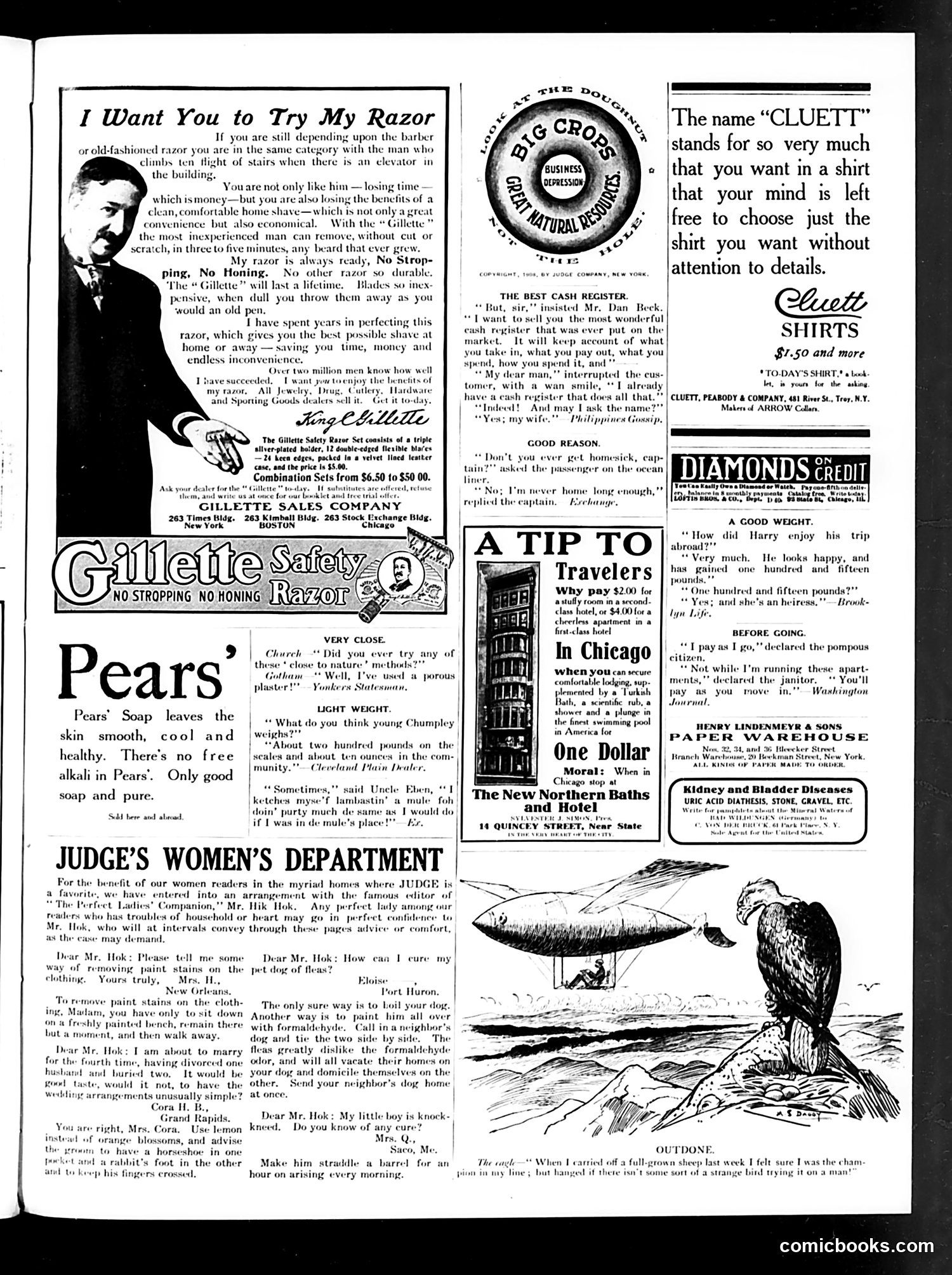
This page is primarily **commercial advertising** from an early 20th-century Judge magazine, not political satire. The main content consists of product advertisements: **Key Ads:** - **Gillette Safety Razor**: A testimonial ad (signature appears to be from the razor's inventor) promoting the convenience of home shaving over barbershops—positioning electric/safety razors as modern progress - **Pears' Soap**: Emphasizes purity and lack of harsh chemicals - **Judge's Women's Department**: Advice column addressing domestic problems (stains, pet fleas, knocked-kneed children) - **Chicago hotels and baths**: Budget lodging advertisement - **Cluett Shirts**: Emphasizes quality so reliable customers needn't worry about details **The Social Context:** These ads reflect early 1900s consumer culture, positioning modern conveniences (safety razors, quality goods) as time-saving and economical improvements over older methods. The women's advice column reflects period attitudes toward gender roles and domesticity. There is no identifiable political cartoon or satire on this page.
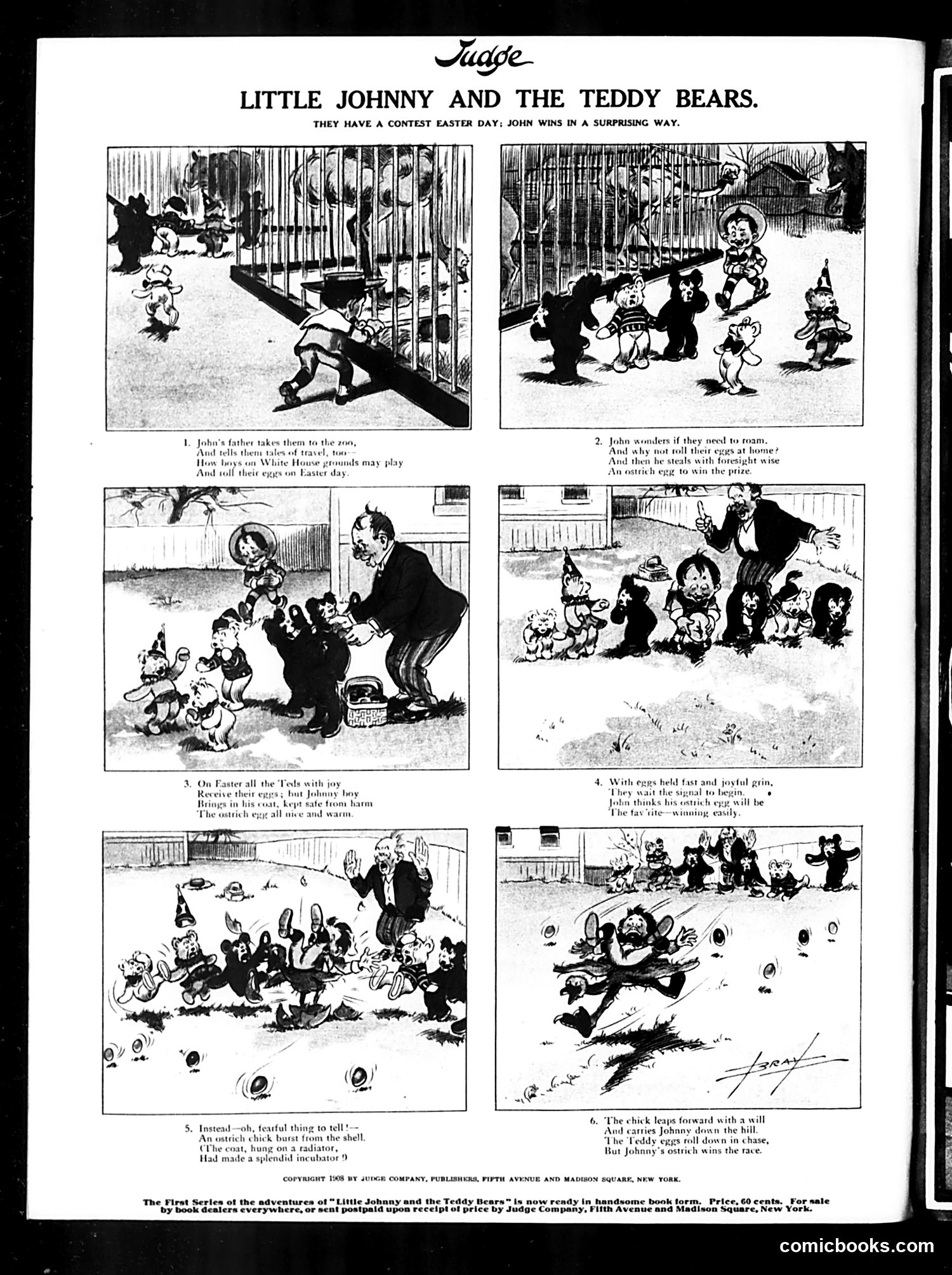
This is a six-panel comic strip featuring a boy named Johnny competing against anthropomorphic teddy bears in an Easter egg hunt. The bears are depicted as dressed-up characters (wearing hats and formal clothing), suggesting they represent human competitors rather than actual animals. The joke centers on Johnny's unexpected victory: while the bears search conventionally, Johnny uses an ostrich egg as his entry. The narrative explains that the ostrich egg, kept warm in a coat like an incubator, hatches during the race—giving Johnny an "unfair" advantage that proves decisive. This appears to be pure whimsy and children's entertainment rather than political satire. The "teddy bears" reference likely capitalizes on the popularity of teddy bear toys (named after President Theodore Roosevelt). The comic advertises an available book collection, indicating this was part of an established series.