
A complete issue · 16 pages · 1908
Judge — April 11, 1908
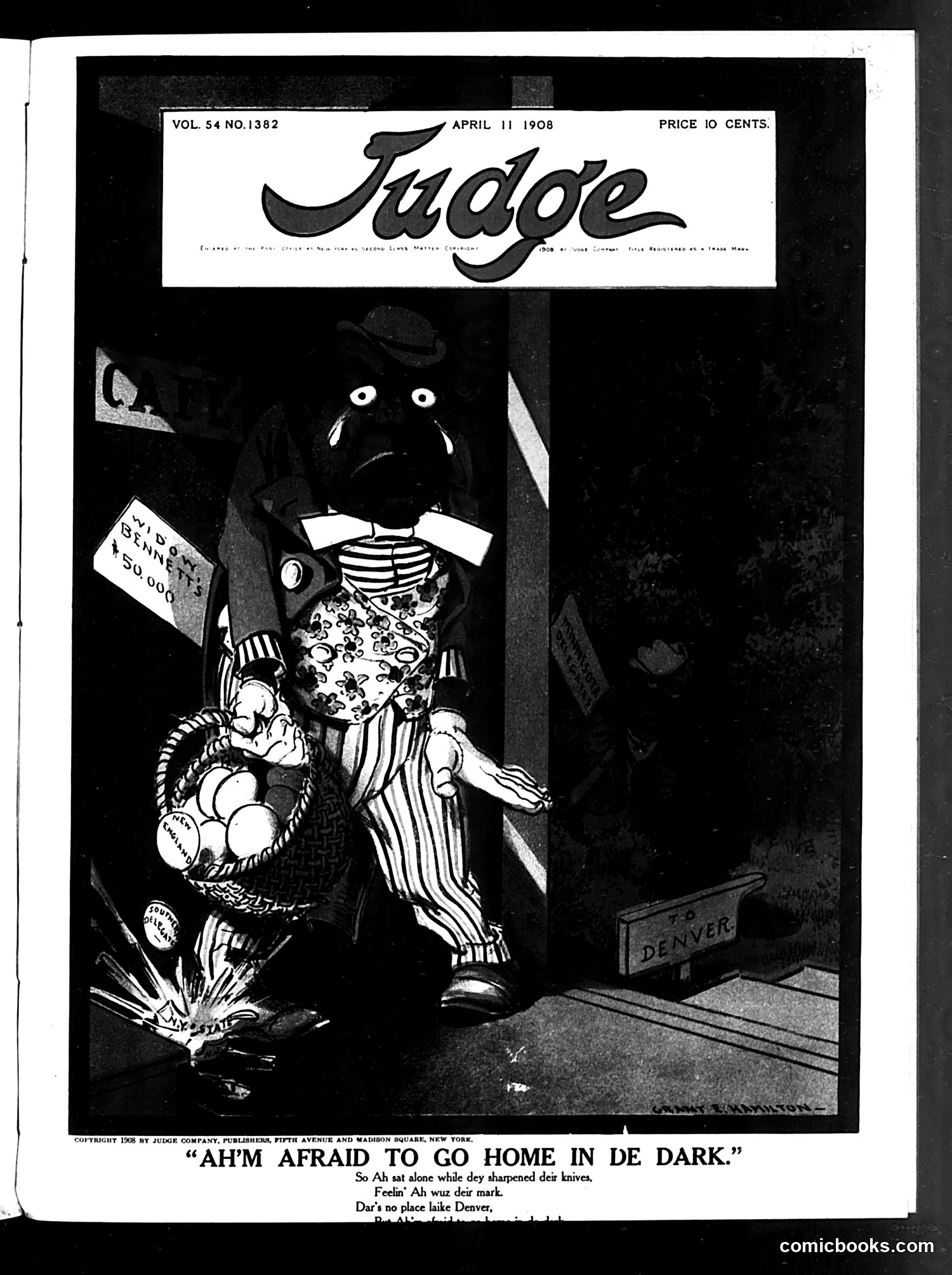
This cover satirizes fears about Denver, Colorado as a dangerous frontier town. The central figure appears to be a caricatured Black man depicted in exaggerated, racist style—standard for 1908 satirical magazines. He's shown as menacing, holding a knife and a basket of victims' severed heads, with a sign reading "KIDNEY SOUP $50,000." The caption "Ahm Afraid to Go Home in De Dark" mocks both the figure and urban crime anxieties of the era. References to "knives" and Denver suggest this commentary targets contemporary perceptions of violence in that city. The imagery reflects deeply racist stereotyping conventions of early 20th-century American satire, presenting violence through a racialized lens that was common but offensive by modern standards.
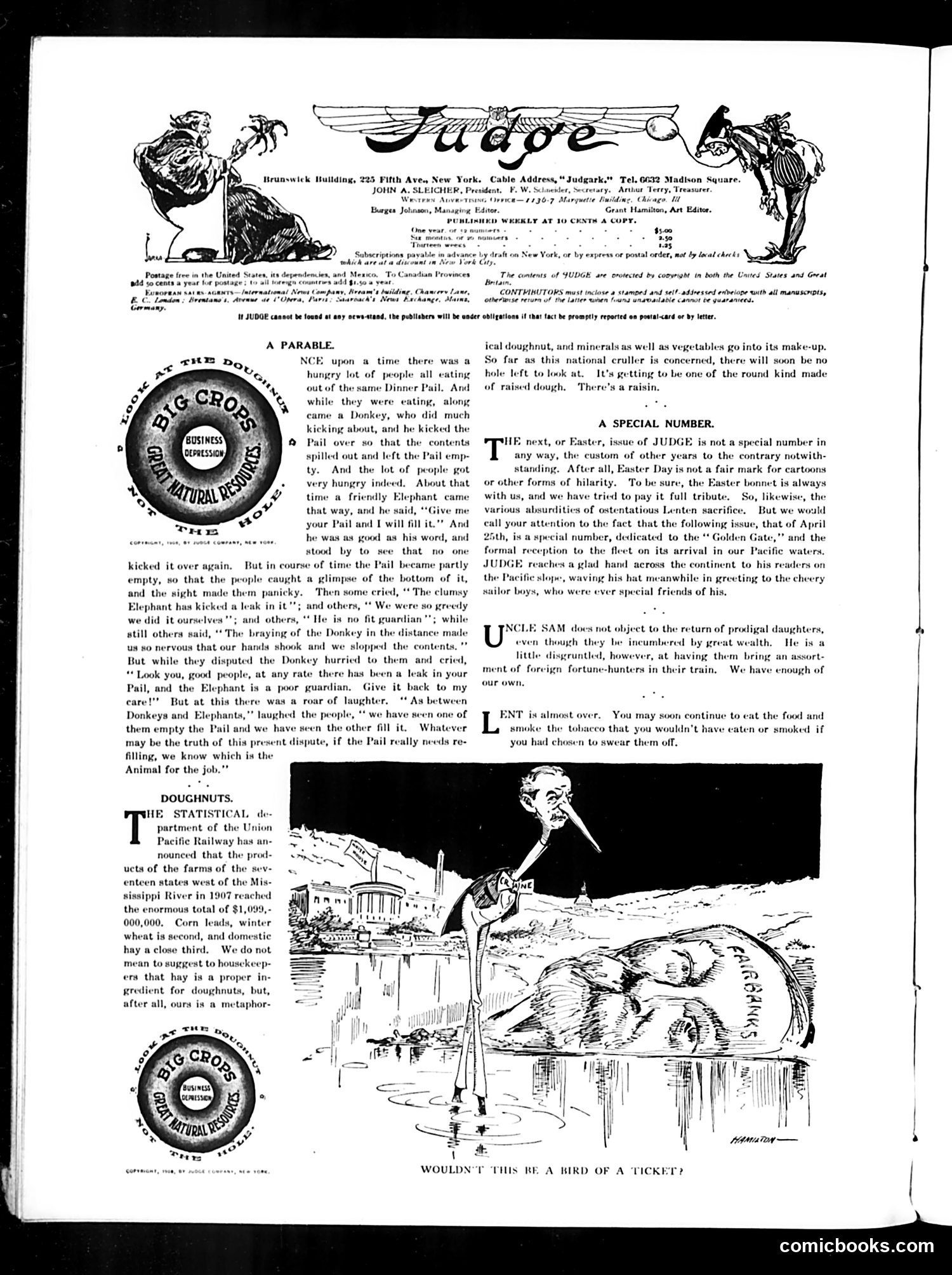
This page contains satirical content and advertisements from Judge magazine. The main cartoon, titled "Wouldn't This Be a Bird of a Ticket?," depicts a caricatured figure (likely a political candidate or public figure, though specific identity isn't clear from context alone) standing over what appears to be a barrel or container labeled with text suggesting corruption or misconduct. The accompanying text discusses doughnuts and farming statistics, which appears to be satirical commentary—likely mocking political promises or candidates who made grandiose claims about agricultural prosperity or economic benefit to common people. The "Big Crops" circular seal and references to a national record suggest this satirizes inflated campaign rhetoric about American agricultural output or economic advancement, a common Judge magazine target during the progressive era.
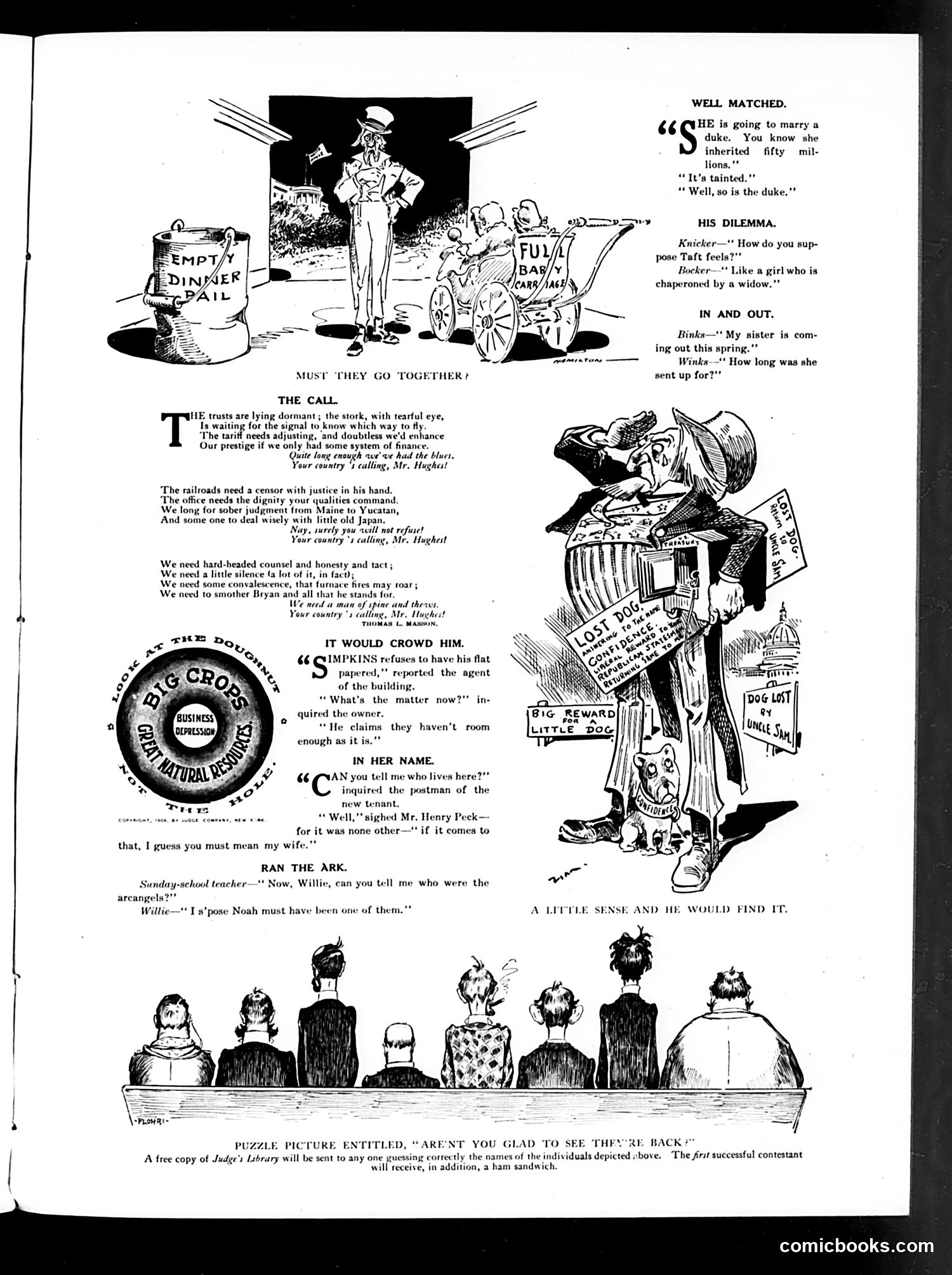
This page contains multiple brief satirical jokes and cartoons typical of Judge's format. The top cartoon "Must They Go Together?" depicts an "Empty Dinner Pail" (symbolizing economic hardship) alongside a well-dressed woman, likely referencing debates about poverty and class. "The Call" is a poem criticizing railroad industry practices and calling for reform leadership—references to "Bryan" suggest this dates to William Jennings Bryan's era (1890s-1900s), when railroad regulation was a major political issue. Other sections include short humorous anecdotes with titles like "His Dilemma," "In and Out," and "It Would Crowd Him." The bottom features a puzzle picture asking readers to identify individuals shown from behind, offering Judge's Library as a prize. The overall tone mixes political/social commentary with entertainment.
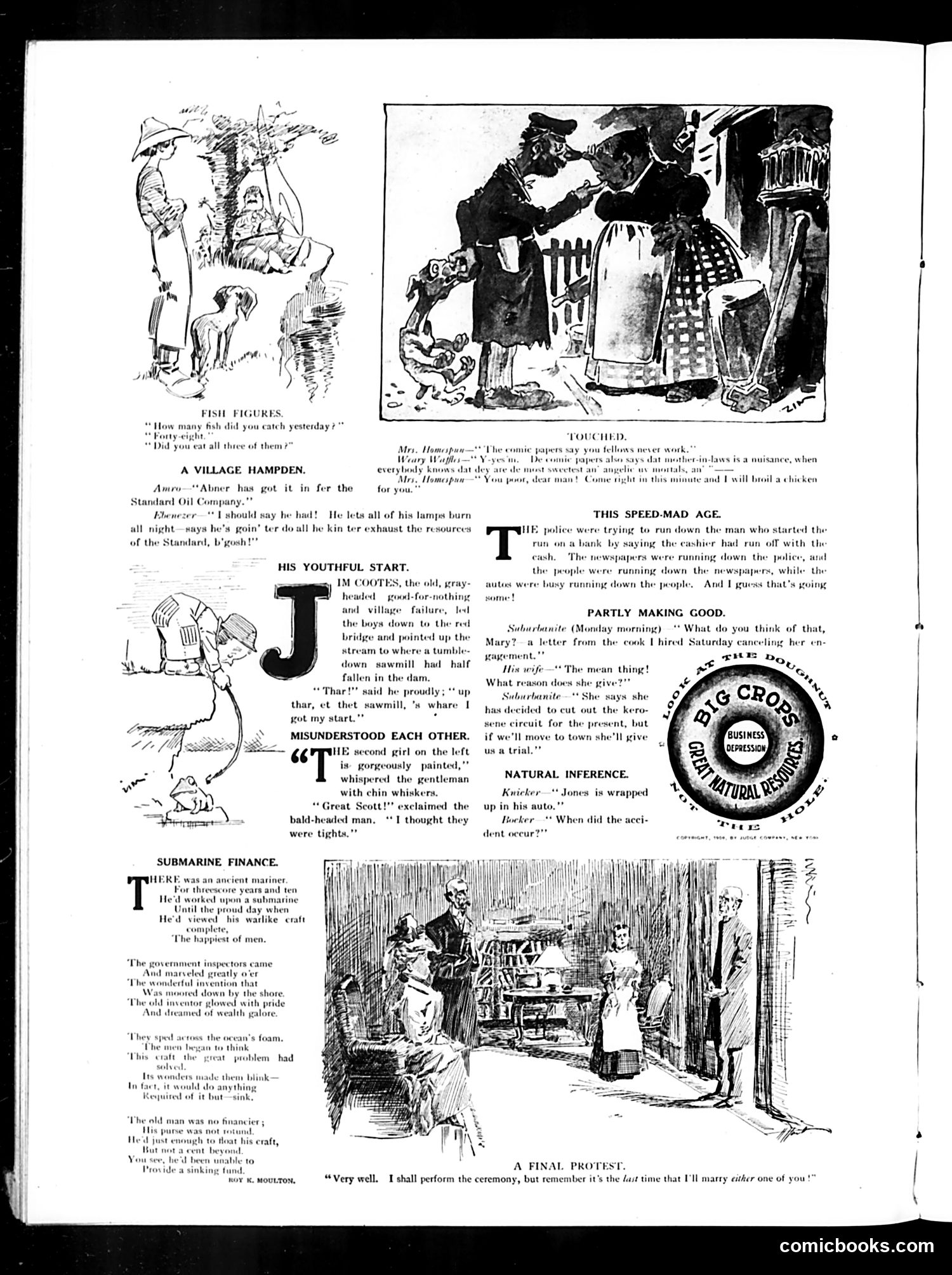
This page contains several unrelated humorous pieces typical of early 20th-century Judge magazine: **"Fish Figures"** and **"A Village Hampden"** are brief joke dialogues with accompanying illustrations, featuring rural or working-class characters in domestic situations. **"His Youthful Start"** appears to be a narrative poem with illustration about someone's early life ambitions, though details are unclear from the OCR. **"Submarine Finance"** is a longer poem about an ancient mariner who invested in a submarine, lost money, and went bankrupt—likely satirizing speculative investment crazes or foolish financial schemes. **"Touched"** depicts what appears to be a domestic dispute over household finances and responsibilities. **"A Final Protest"** shows a reluctant groom at an altar making objections about marriage. The page primarily features satirical humor about class, money, relationships, and human folly rather than specific political content.
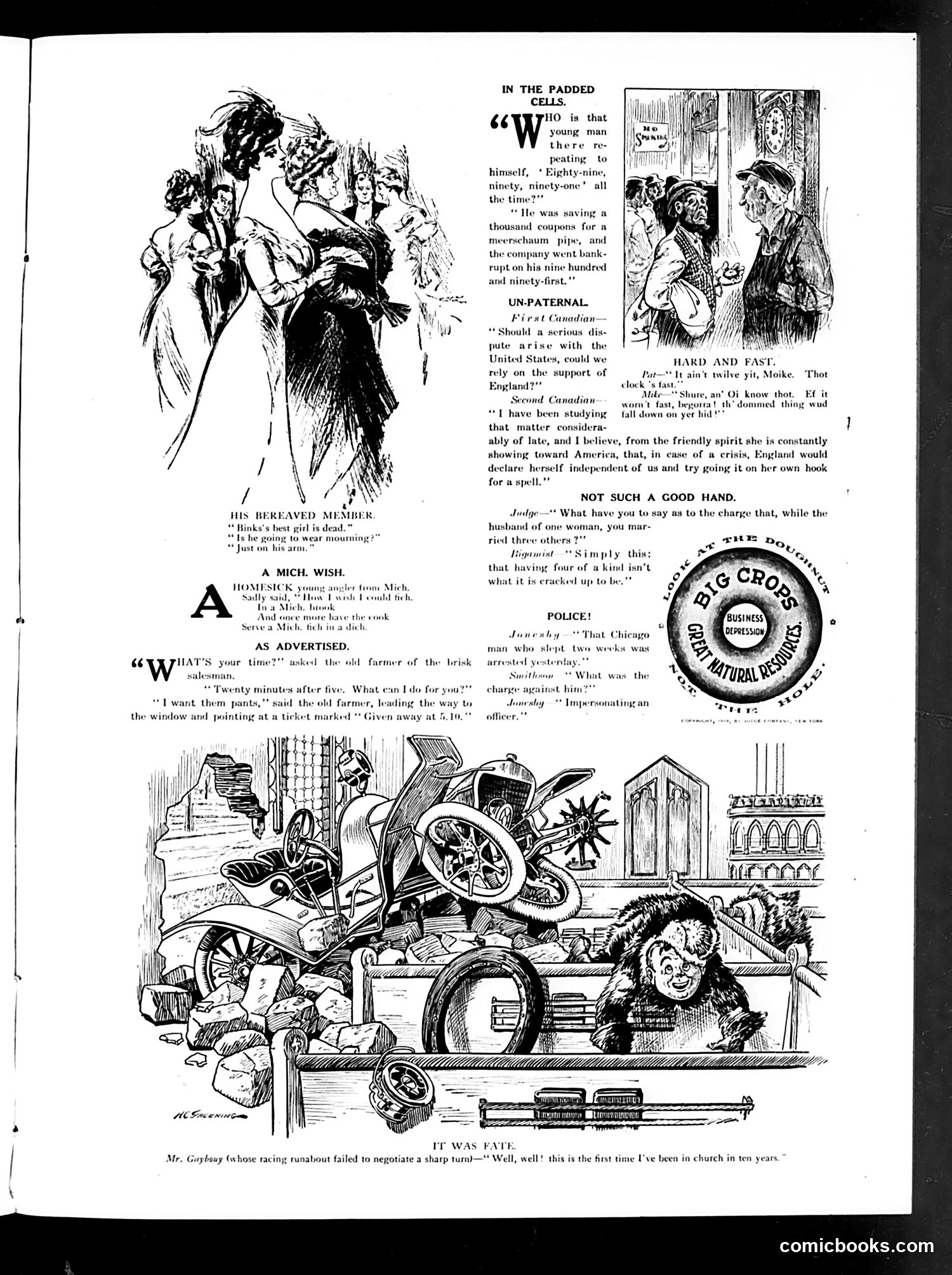
This page contains several unrelated satirical pieces typical of Judge magazine's format: **"His Bereaved Member"** mocks a politician's insincere condolences about a colleague's death. **"A Mich. Wish"** jokes about a Michigan farmer wanting better cooking. **"As Advertised"** satirizes a farmer haggling over produce prices, playing on rural stereotypes. **"In the Padded Cells"** appears to mock discussions between inmates about political topics—likely commentary on political discourse as absurd or "insane." **"Not Such a Good Hand"** depicts a judge questioning a man accused of bigamy. The large political cartoon at bottom mocks someone (Mr. Guylass) failing to navigate a sharp turn in a runabout—likely satirizing a public figure's political or social misstep using vehicular chaos as metaphor.
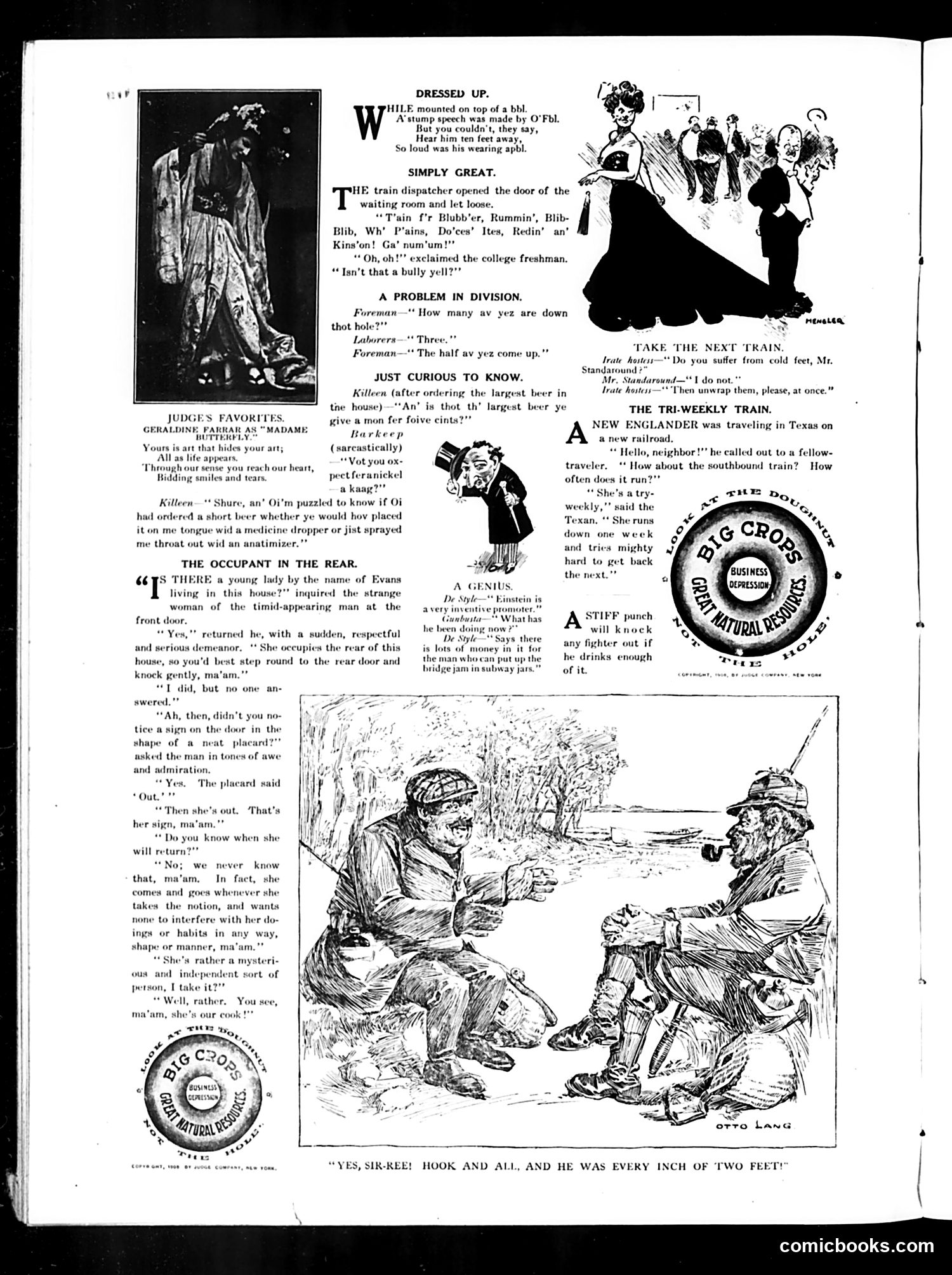
This page contains multiple brief humorous sketches typical of early 20th-century American satirical magazines: **"The Occupant in the Rear"**: A domestic comedy about a mysterious female lodger who comes and goes freely, violating Victorian expectations of proper female behavior. The joke mocks rigid social conventions by portraying her independence as shocking to respectable landlords. **"Simply Great"**: Mocks a politician (O'Fbl, likely a garbled name) making an incoherent stump speech—incomprehensible despite loud delivery. Satirizes political oratory as bombastic nonsense. **"A Problem in Division"**: Irish laborers joke about arithmetic, playing on ethnic stereotypes common in period humor. **"The Tri-Weekly Train"**: A New Englander and Texan joke about unreliable rural train service, poking fun at regional differences. **Other brief jokes** target Irish immigrant speech patterns, drunkenness, and variations on courtship/marriage scenarios. The page is primarily **humor and advertising**, reflecting Judge's blend of social satire and commercialism.
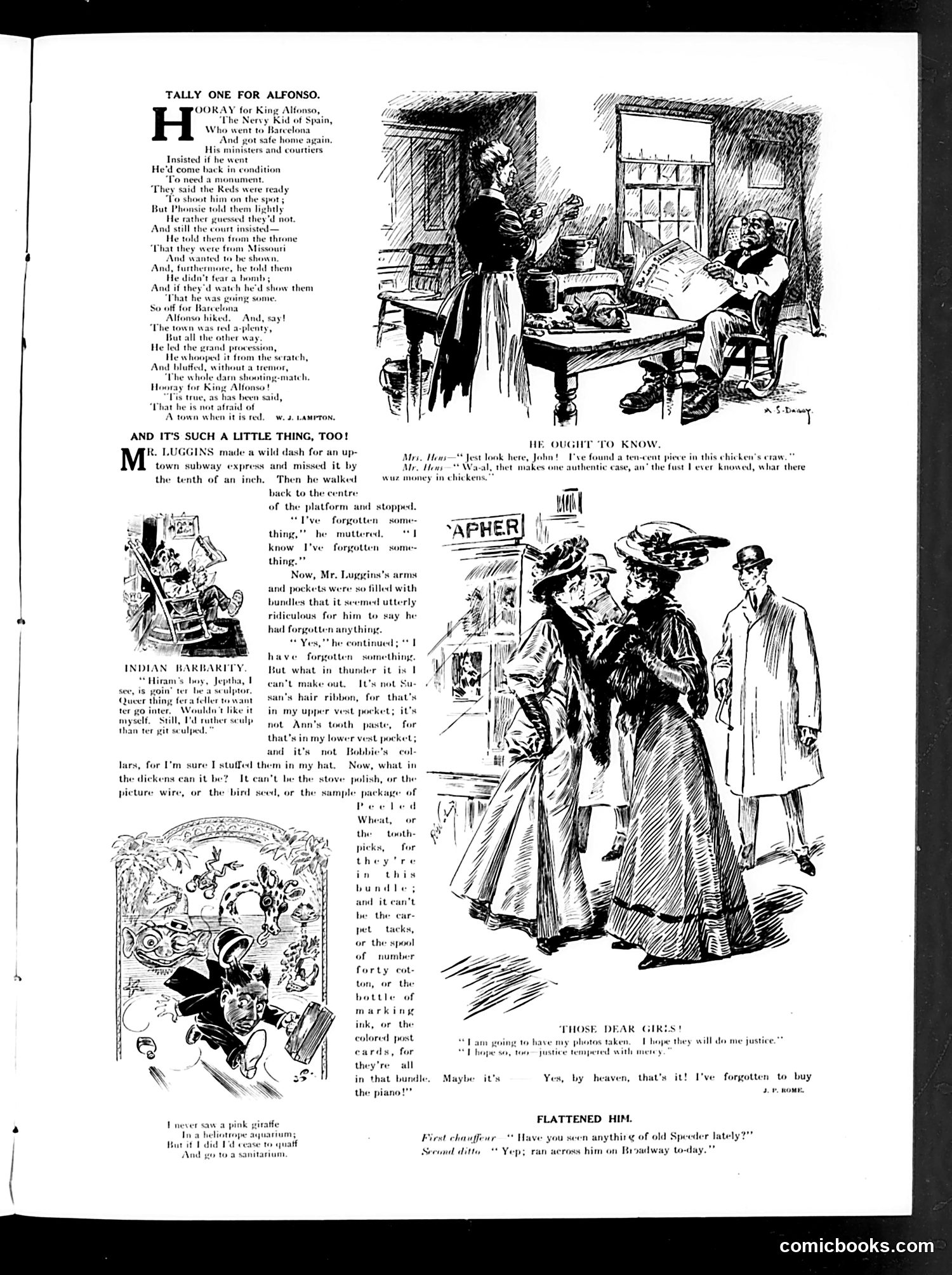
This page from Judge magazine contains several separate comic vignettes rather than a unified political cartoon. **"Tally One for Alfonso"** (top) appears to reference King Alfonso of Spain (suggested by the title and opening verse), though the satirical point is unclear from the visible text. **"And It's Such a Little Thing, Too!"** depicts Mr. Luggins frantically searching his pockets on a subway platform—a relatable comedy about forgetfulness. The humor lies in his accumulating list of forgotten items (toothpicks, marking ink, etc.) and his resigned acceptance that he'll be "sculped" (deceived/tricked) anyway. **"He Ought to Know"** and **"Those Dear Girls!"** show domestic scenes with wordplay—one involving chickens and money, another about having photographs taken with "justice tempered with mercy." **"Flattened Him"** is a brief joke about spotting someone on Broadway. The page is primarily **humorous domestic and everyday scenarios** rather than serious political satire—typical of Judge's lighter content.
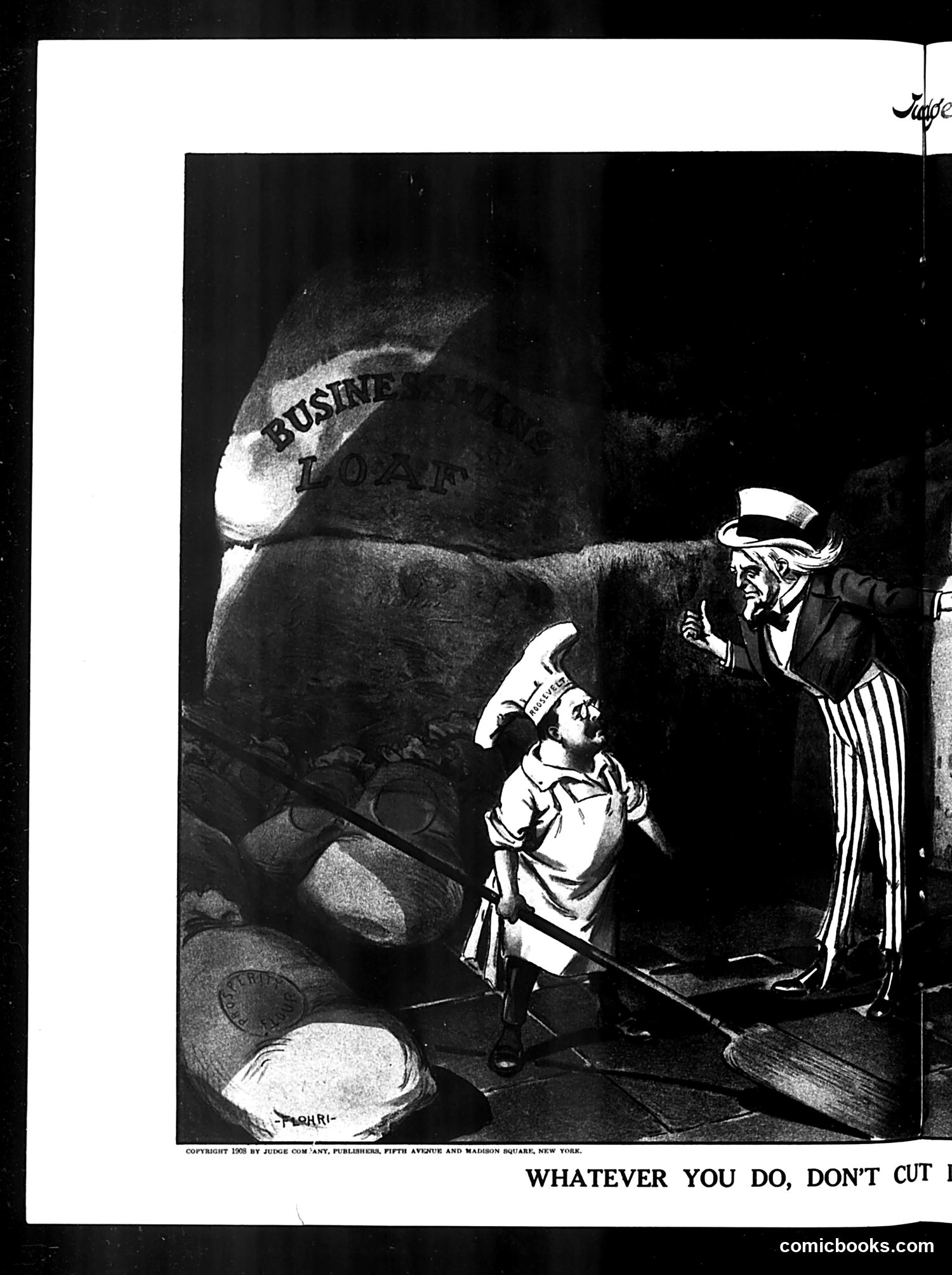
This 1908 Judge magazine cartoon depicts a large, menacing figure labeled "BUSINESS LOAF" (visible on the shoulder) towering over two smaller men—one appears to be a laborer or worker, the other a figure in patriotic attire (Uncle Sam style, with striped pants and hat). The caption "WHATEVER YOU DO, DON'T CUT" warns against cutting something, likely referring to wages or workers' rights during the Progressive Era. The cartoon satirizes how large business interests ("Business Loaf") threaten working people and American values. It critiques corporate power and warns politicians/the public about the dangers of allowing business to exploit workers without restraint—a common Progressive-era concern about monopolies and labor conditions.
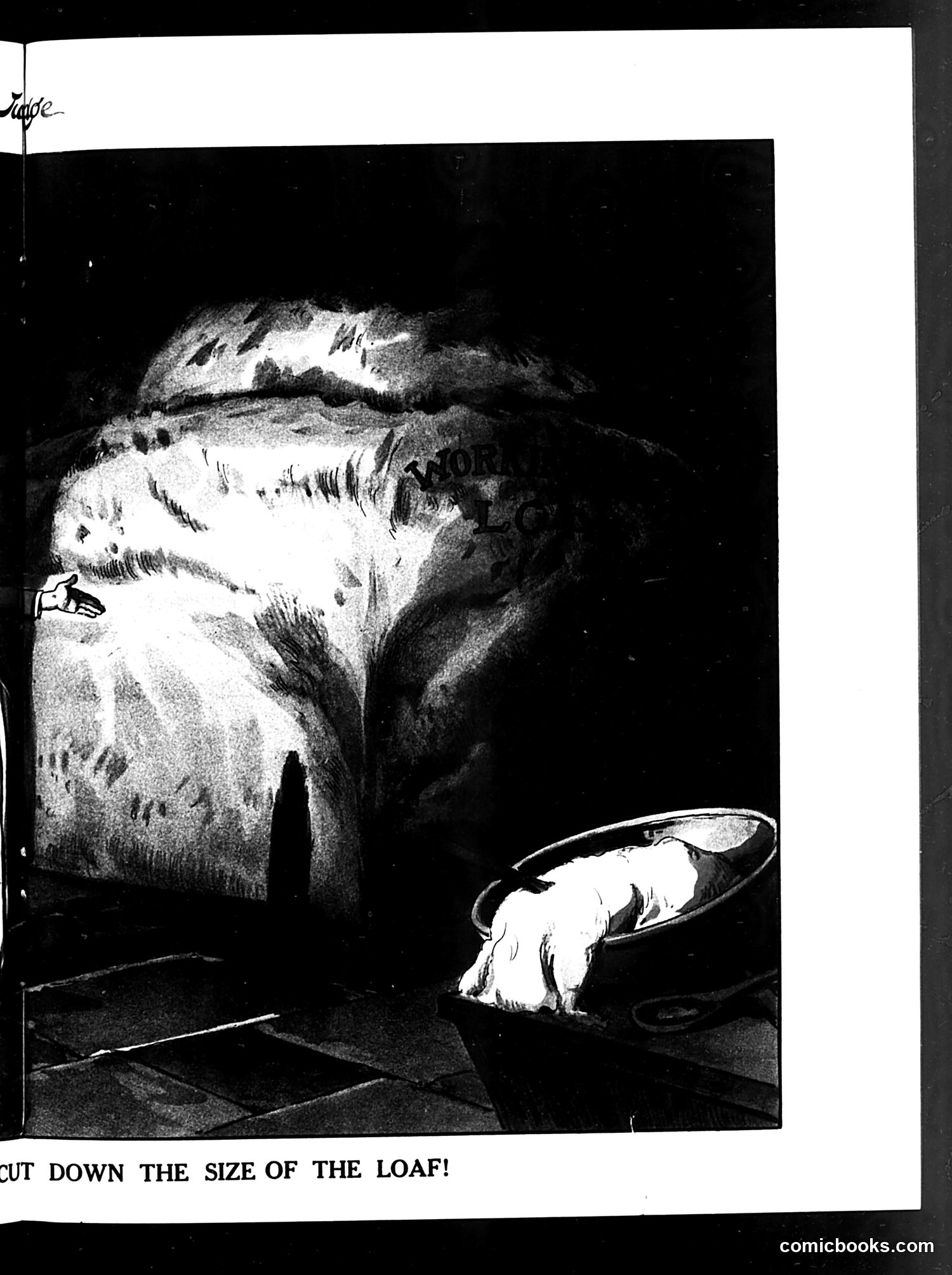
This appears to be a wartime rationing cartoon, likely from WWI or WWII era. The image shows a large loaf of bread and a hand (belonging to what appears to be a government or authority figure) pointing to reduce its size. The satire criticizes bread rationing policies during wartime. The caption's imperative tone suggests government mandates to decrease loaf sizes, presumably to stretch limited grain supplies for the war effort. The contrast between the substantial loaf and the demand to shrink it mocks the absurdity of the rationing scheme—maintaining the appearance of supply while actually reducing citizens' access to food. The cartoon likely represents public frustration with wartime food restrictions and government control over everyday commodities.
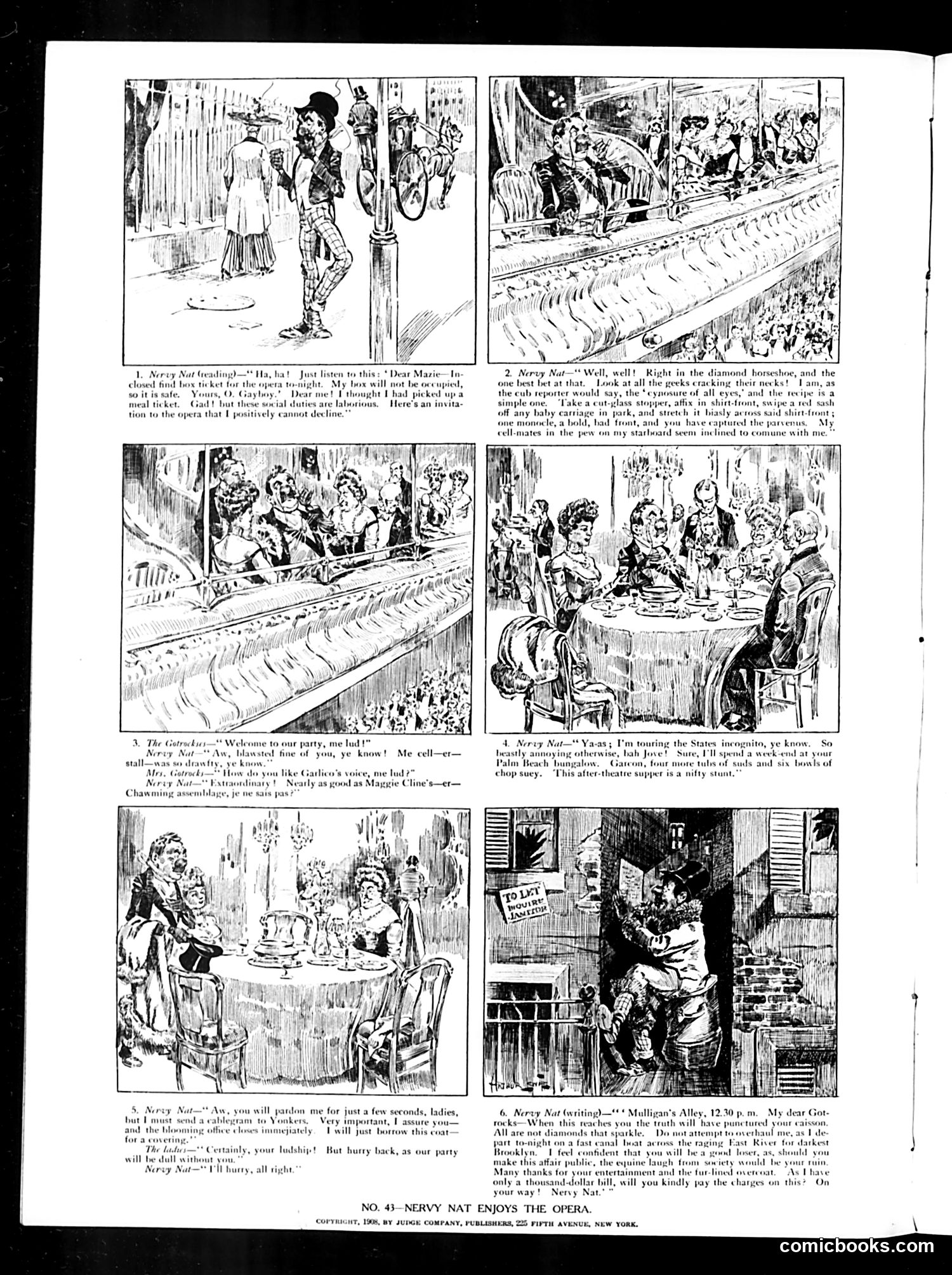
This is a six-panel comic strip from Judge magazine (1908) following a character called "Nervy Nat" through an opera outing. The humor centers on Nat's brazen social climbing and audacious behavior: he crashes a society party, invents elaborate lies to gain entry to exclusive venues, and attempts to con people out of money—including a scheme involving a fake "thousand-dollar bill" at the opera. The satire targets early 20th-century social pretension and the con-artist mentality. "Nervy" Nat represents the brash opportunist exploiting wealthy society's gatekeeping through shameless charm and fabrication. The repeated phrase "Nervy Nat" emphasizes his defining trait: unabashed audacity in pursuing upward mobility through deception rather than legitimate means.
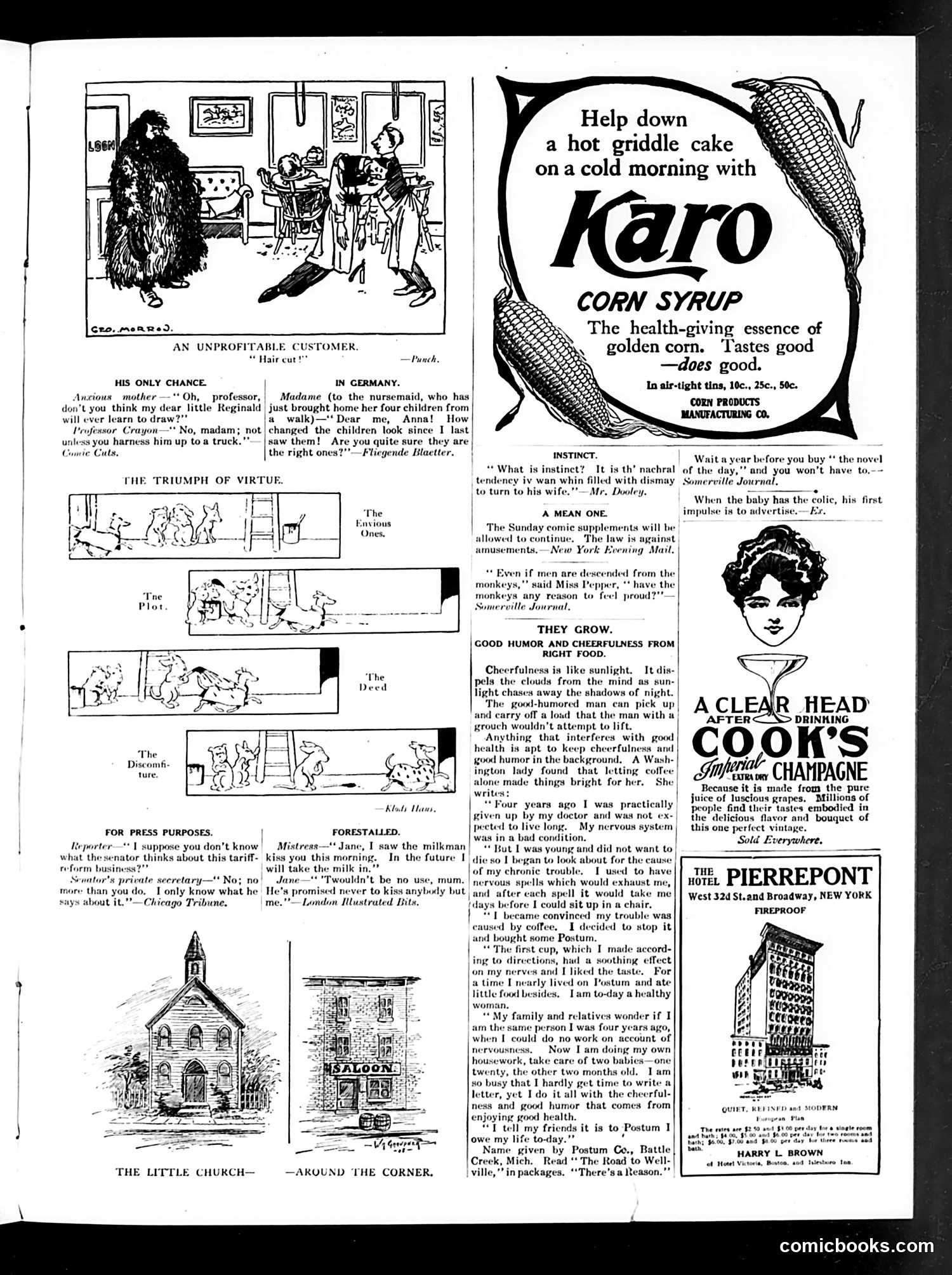
This Judge magazine page combines satirical cartoons with period advertisements from approximately the early 1900s. **"An Unprofitable Customer"** satirizes a barber's frustration: a customer requests a haircut, but the barber (Professor Crayon) suggests the boy is unteachable—so hopeless he should be "harnessed like a truck." The joke mocks both the barber's harsh assessment and parental anxiety about children's abilities. **"His Only Chance in Germany"** jokes about a nanny returning children who look completely transformed. The mother questions whether these are even her own children, satirizing German discipline and suggesting the nanny improved them unrecognizably—commentary on perceived German strictness. **"The Triumph of Virtue"** appears to be a wordless comic strip showing moral lessons through sequential scenes. The remaining items are period advertisements (Karo Corn Syrup, Cook's Champagne, Postum coffee substitute, and the Pierrepont Hotel) and filler humor pieces, typical of Judge's mixed editorial-commercial format. The magazine mixed sophisticated satire with commercial content for middle-class readers.
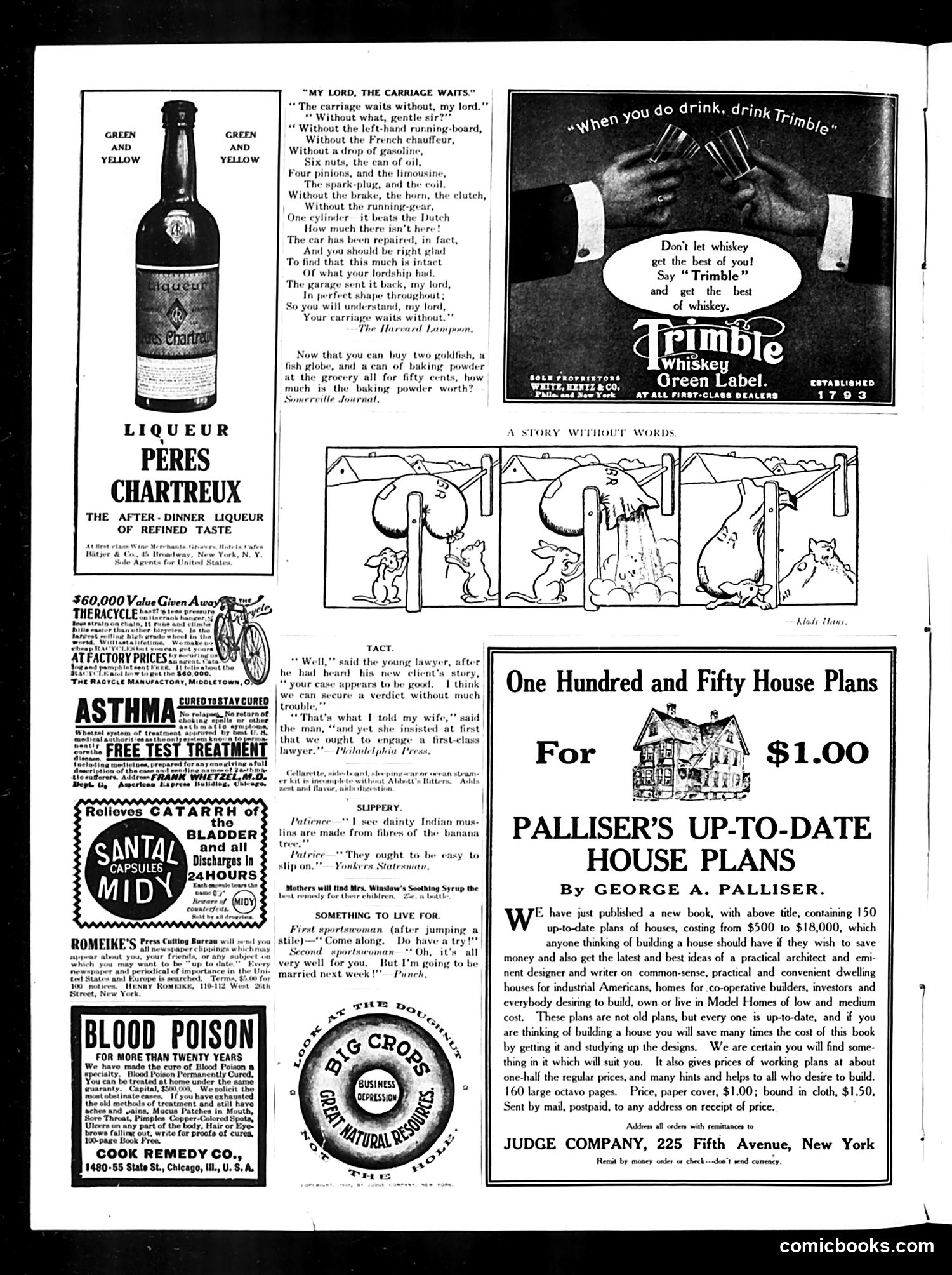
This page contains primarily **advertisements and miscellaneous content** rather than political satire. The main items include: **"My Lord, the Carriage Waits"** — A humorous poem (credited to *Harvard Lampoon*) satirizing the absurdity of automobiles: a servant catalogs all the modern mechanical parts required for a car to function, contrasting sharply with the simplicity of an actual carriage waiting outside. **Visual comic strip** titled "A Story Without Words" — A wordless narrative (artist credited as Klods Hans) depicting what appears to be anthropomorphic animals in comedic situations involving a structure or contraption. **Period advertisements** for liqueur, whiskey, medicinal products (Santal capsules for catarrh, blood poison remedies), bicycles, and house plan books. **"Tact" anecdote** — A brief joke about a lawyer and his wife's expectations. The page reflects early 20th-century concerns: automobile novelty, patent medicines, home ownership, and domestic humor. No identifiable political figures or events are present.
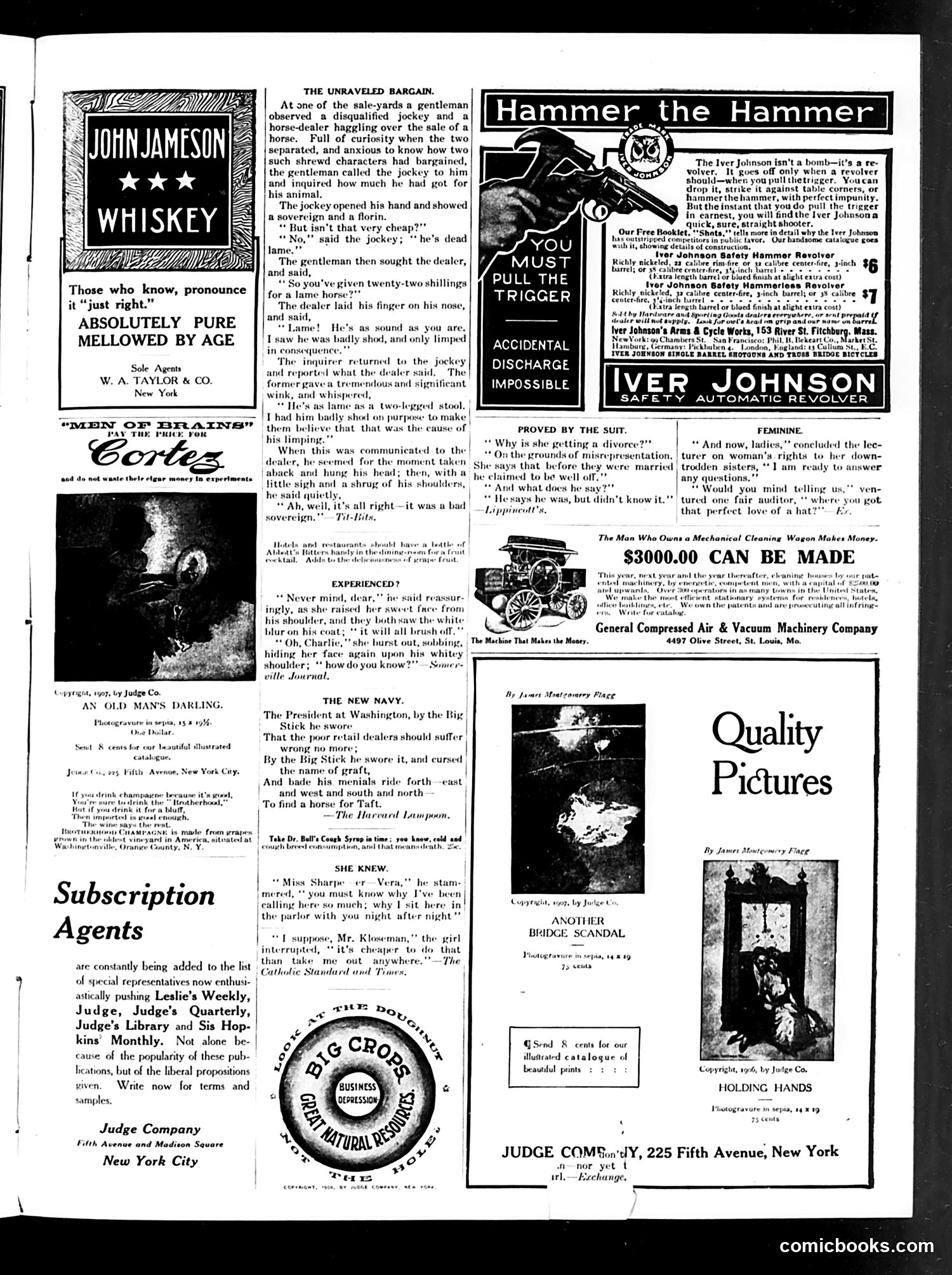
This page is primarily **advertising**, with several distinct sections: **Main Advertisements:** - John Jameson Whiskey (top left): Promotes "absolutely pure" whiskey "mellowed by age" - Iver Johnson Safety Automatic Revolver (center/right): Emphasizes the gun won't accidentally discharge—you must deliberately "pull the trigger." The marketing point: it's safe from mishap but deadly when intentional - General Compressed Air & Vacuum Machinery (bottom): Promises $3,000 annual income for operators **Editorial Content:** Several short satirical pieces, including: - "The Unraveled Bargain": A horse-trading anecdote about a jockey and dealer - "The New Navy": Appears to reference President Theodore Roosevelt ("Big Stick"), criticizing his naval policies - Romance/relationship humor pieces **Subscription Agents Section:** Promotes Judge Company's publications and seeks sales representatives. The page reflects early 1900s consumer culture, with product safety claims (revolver) and business opportunity pitches alongside light satirical commentary on contemporary politics and social situations.
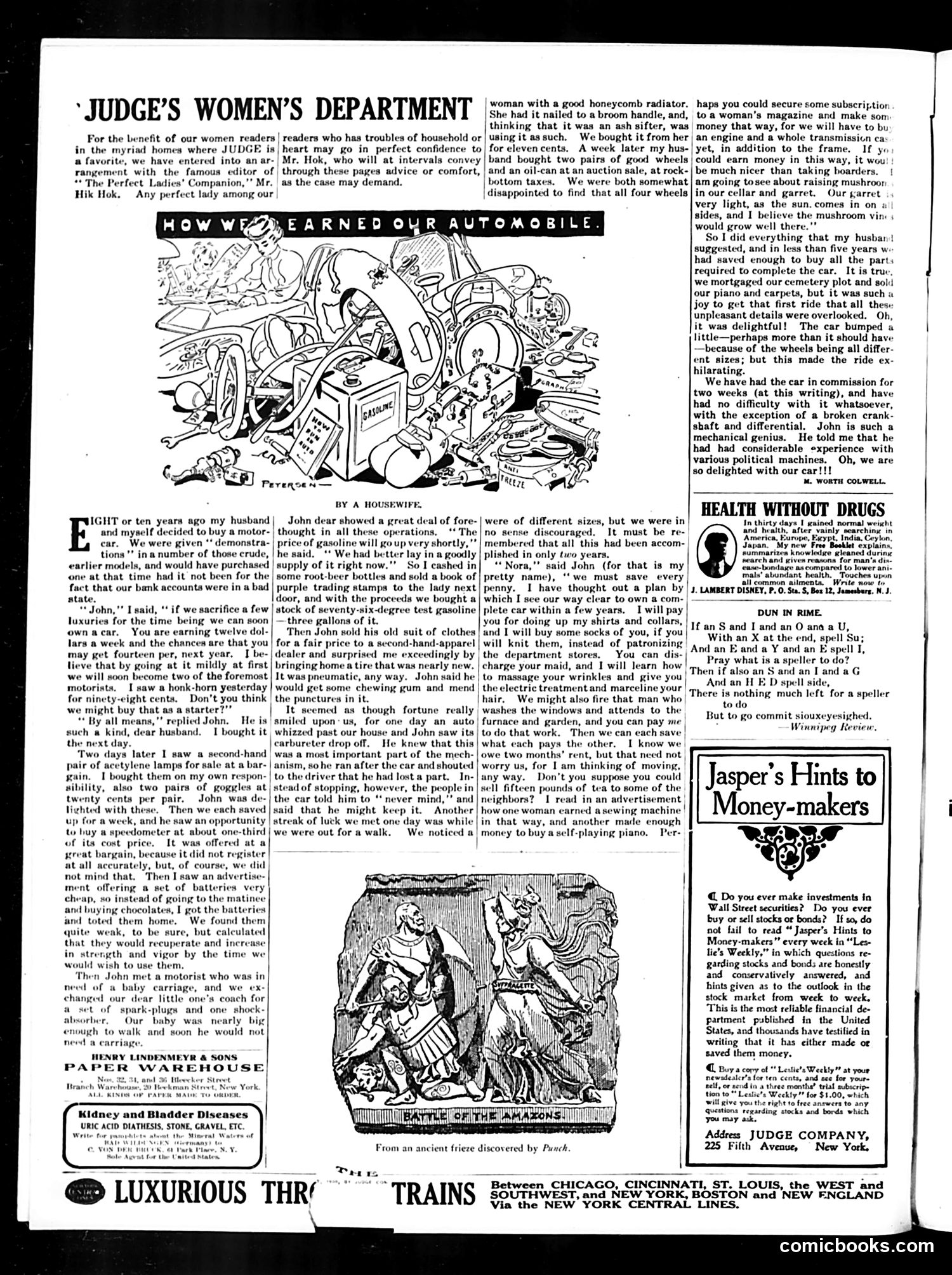
This page from *Judge* magazine presents a humorous domestic narrative titled "How We Earned Our Automobile," written by "A Housewife." The story satirizes early-1900s middle-class aspirations and the emerging automobile culture. A couple decides to purchase a car through aggressive penny-pinching and scavenging—selling trading stamps, buying used parts at auctions, and collecting discounted batteries and speedometers. The humor lies in their comical desperation: they accumulate mismatched automobile components (wheels of different sizes, a pneumatic tire with punctures) while making personal sacrifices. The accompanying cartoon illustration depicts the chaotic jumble of automobile parts and accessories they've assembled. The satire targets both automobile enthusiasm and domestic frugality culture of the era. It mocks how middle-class families obsessively saved for modern conveniences (the automobile being the ultimate status symbol), often with questionable judgment about what they were purchasing. The page includes period advertisements unrelated to the main narrative, as was typical for *Judge*.
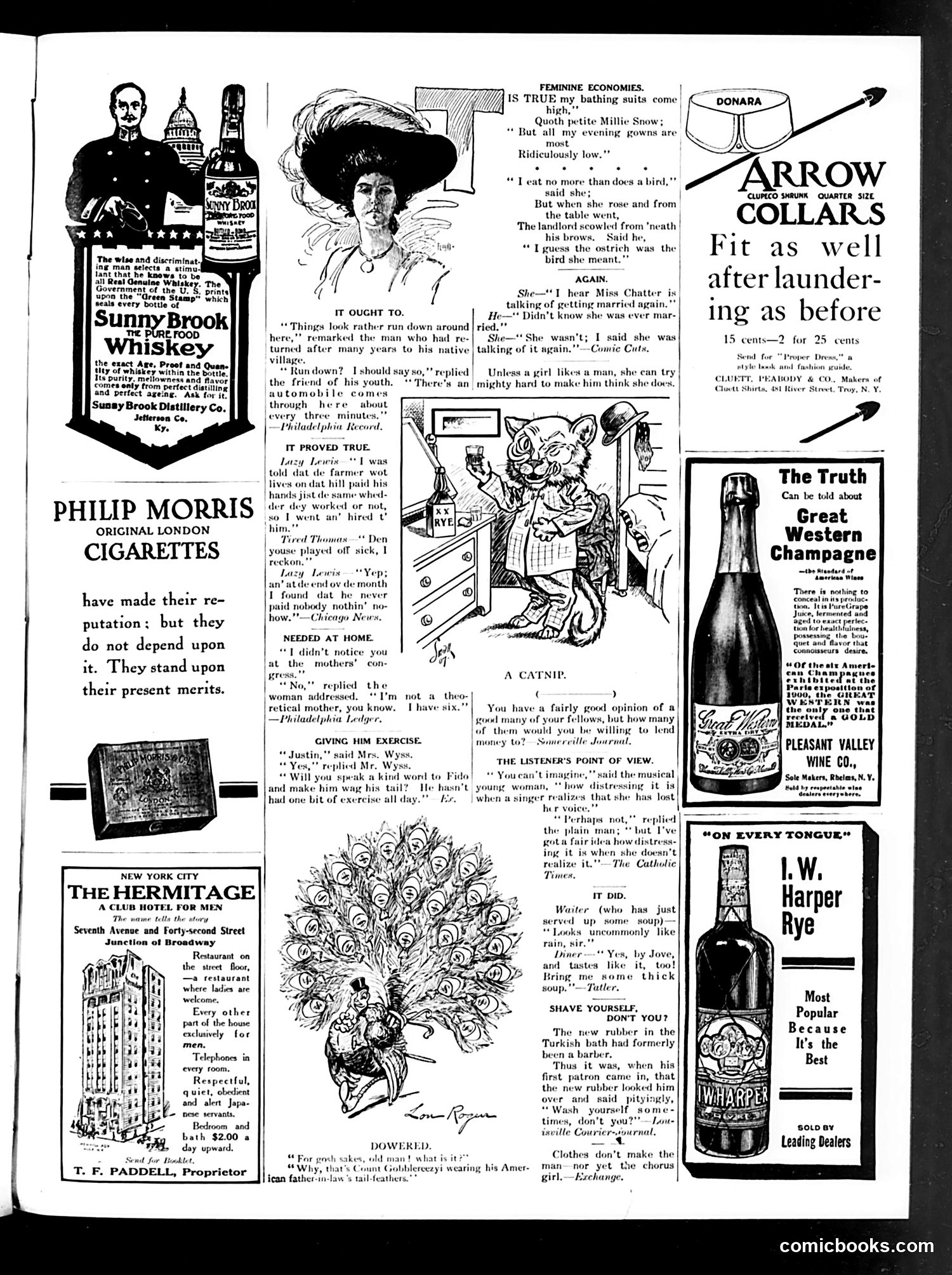
This is primarily a **page of advertisements and humor columns** rather than political satire. The main content includes: **Advertisements:** Whiskey (Sunny Brook), cigarettes (Philip Morris), a men's club in New York, wine, rye whiskey, and shirt collars dominate the page. **Humor Columns:** The central text features short anecdotes and jokes on topics like: - Women's fashion economy (spending on evening gowns) - Romance and courtship ("Unless a girl likes a man, she can try mighty hard to make him think she does") - Domestic life and automobiles - A barber/bath-house worker conversation **The Cartoon:** A notable illustration shows a peacock with human face, captioned "A CATNIP"—likely mocking vanity or superficiality. The overall tone is light domestic humor typical of early 20th-century magazines. There's no clear political messaging—this appears to be a standard issue mixing commercial advertisements with gentle social comedy about gender relations, class, and everyday life.
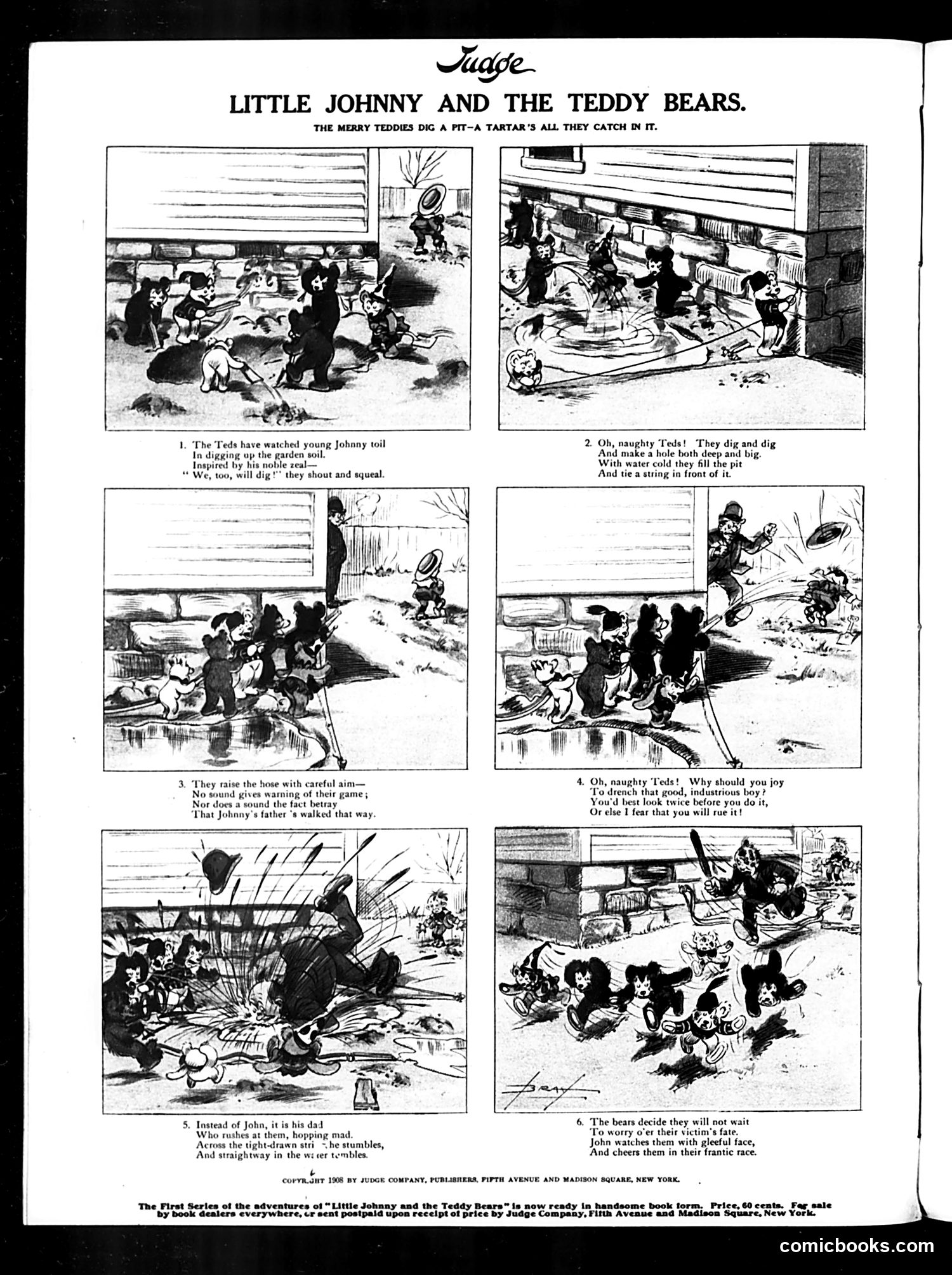
This is a children's comic strip from *Judge* magazine (1908) with no political satire—it's simply a humorous narrative about mischief. The plot: Teddy bears dig a pit, fill it with water, and set a trap with a string. They intend to catch Little Johnny, but his father walks into the trap instead, getting drenched. Johnny finds this hilarious and cheers as the bears panic and flee. The "teddy bears" reference is likely connected to President Theodore Roosevelt's popularity and the commercial "teddy bear" toy craze that followed a famous 1902 hunting incident. However, these bears appear to be generic cartoon characters rather than political caricatures. The humor relies on slapstick: the bears' trap backfires, catching the wrong person, and the child's amusement at his father's mishap—standard comedy for early 1900s children's entertainment.