
A complete issue · 16 pages · 1908
Judge — April 4, 1908
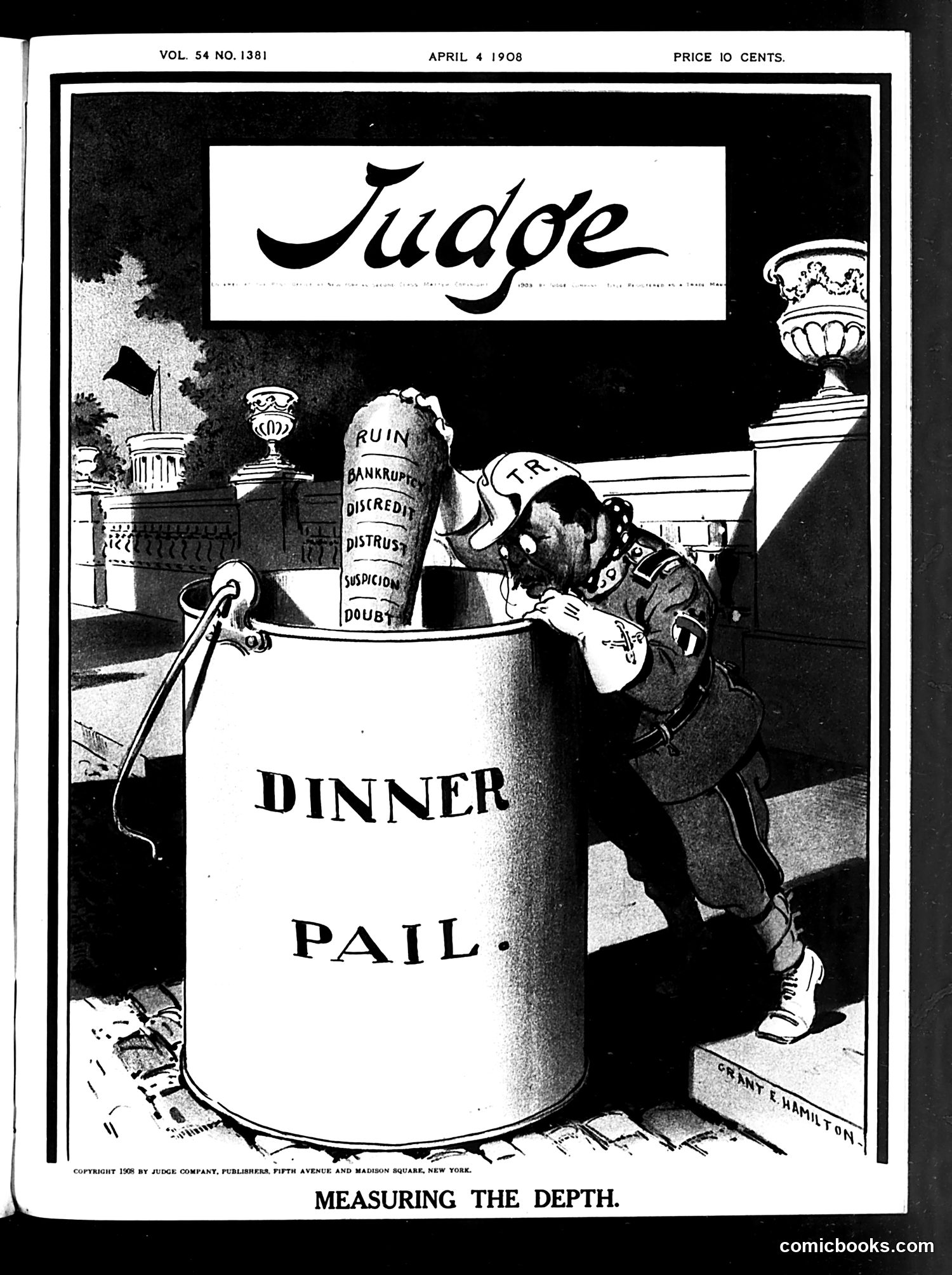
This political cartoon satirizes the severity of America's economic crisis. A figure labeled "TR" (President Theodore Roosevelt) stands beside an enormous pot labeled "DINNER PAIL" — a metaphor for working-class economic security. He measures the depth of this pot, which contains a stack of troubling labels: "RUIN," "BANKRUPTCY," "DISCREDIT," "DISTRUST," "SUSPICION," and "DOUBT." The cartoon critiques the financial panic of 1907-1908, suggesting that despite Roosevelt's presidency, the working person's economic well-being had deteriorated significantly. The "dinner pail" reference evokes the promise of prosperity; here it's shown as dangerously depleted. The formal government buildings in the background emphasize that this crisis occurs at the seat of power.
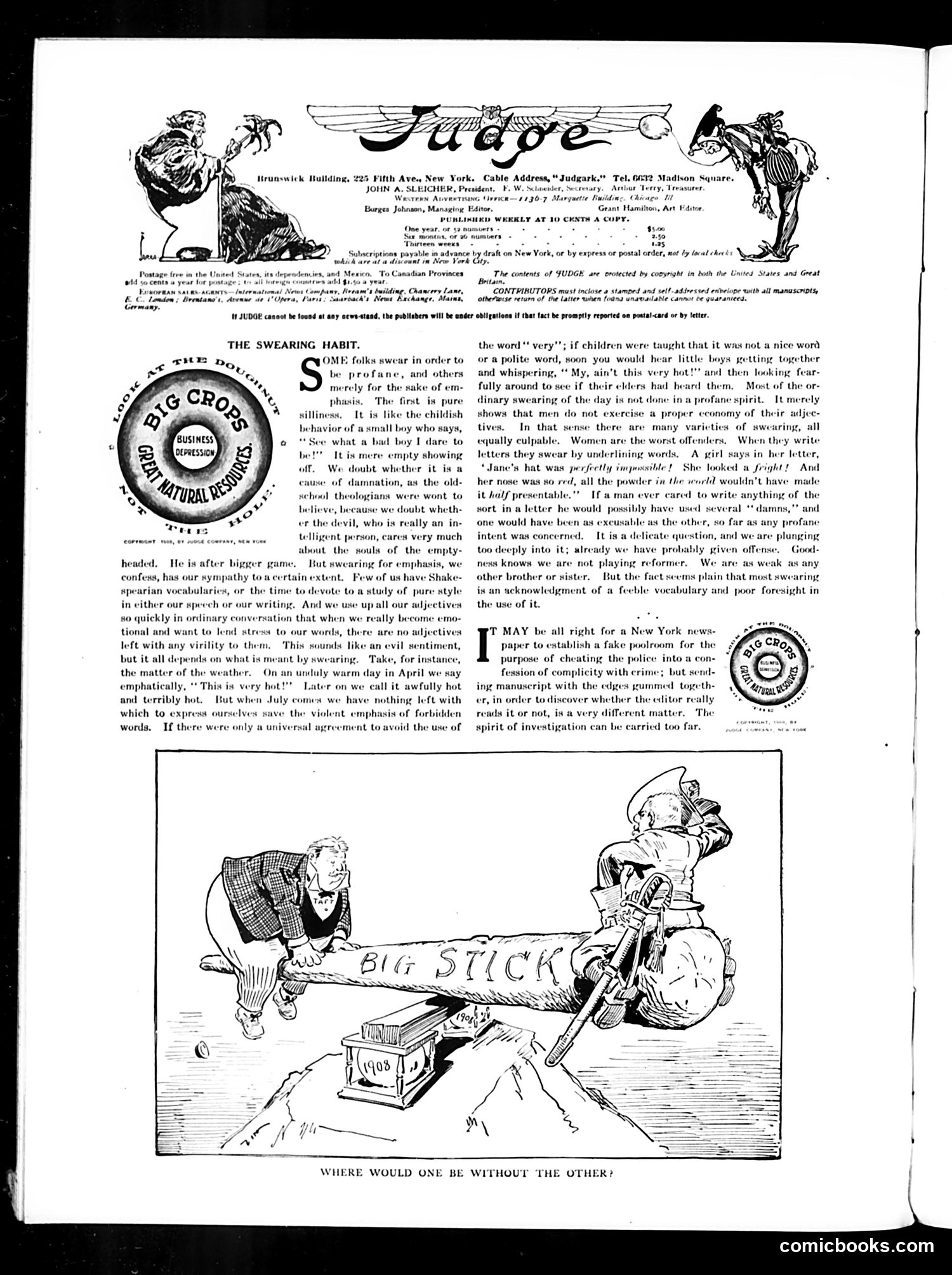
This page contains two distinct elements: 1. **"The Swearing Habit" article**: A moralistic essay arguing that profanity reflects poor character and lazy language use. It distinguishes between emphatic swearing and true profanity, suggesting both are signs of inadequate vocabulary and self-control. The piece advocates for universal agreement to avoid profane language. 2. **Political cartoon "Where Would One Be Without the Other?"**: The central illustration depicts two figures on a seesaw labeled "Big Stick," balanced on a box marked "1908." This appears to reference Theodore Roosevelt's presidency and the upcoming 1908 election. The figures likely represent competing political interests or candidates, suggesting their interdependence or mutual reliance during this election cycle. The cartoon's meaning depends on identifying the specific figures, which is unclear from the image alone.
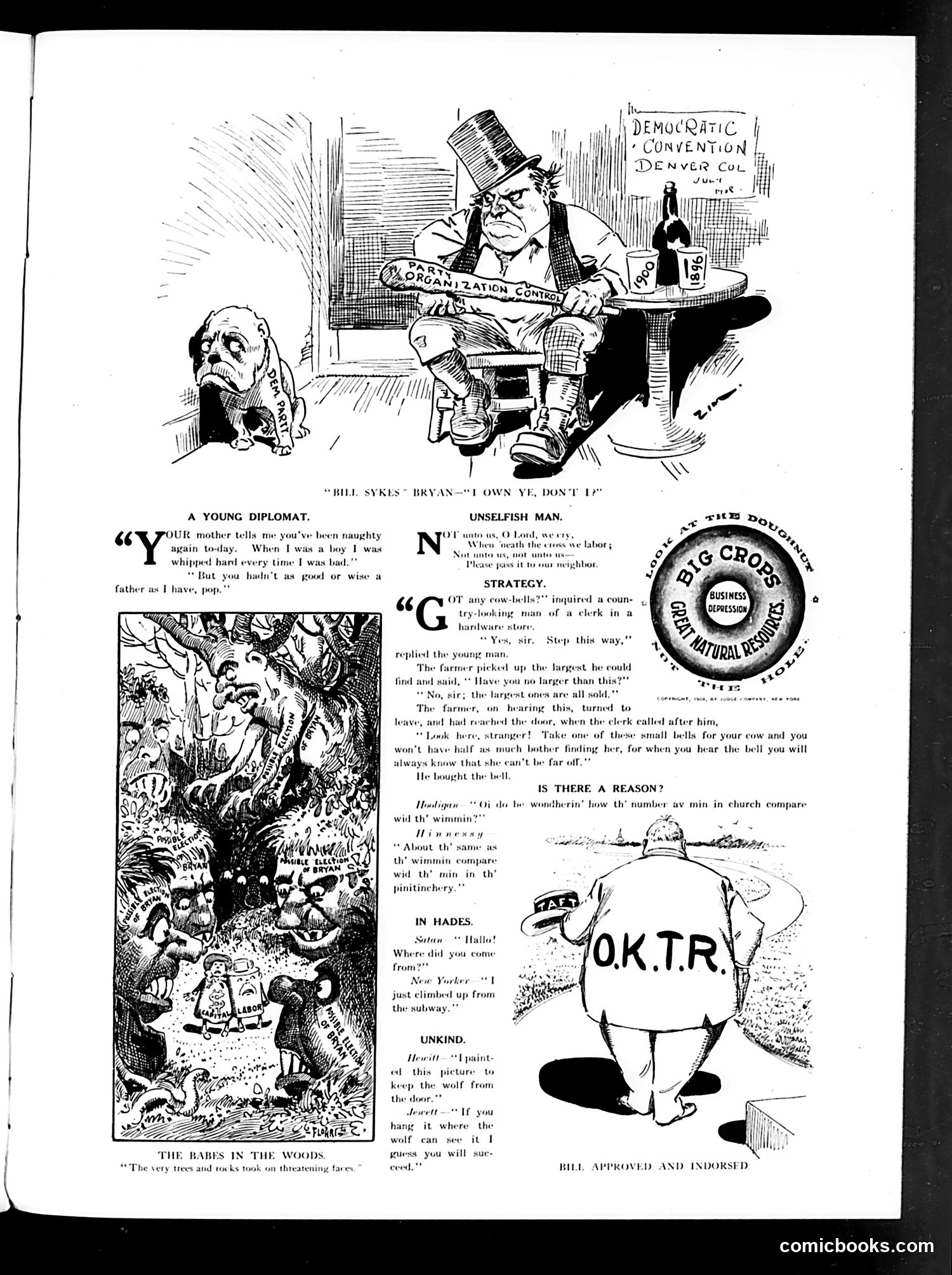
**Top Cartoon:** A figure labeled "Bill Sykes" Bryan appears to control a Democratic National Convention (Denver, Colorado) like a puppet master. He sits at a table with "Organization Control" written on his clothing, suggesting William Jennings Bryan's dominating influence over the Democratic party machinery. The satire criticizes Bryan's alleged authoritarian grip on party proceedings. **Lower Cartoons:** Separate humorous vignettes ("A Young Diplomat," "Unselfish Man," "In Hades," "Unkind") feature brief comedic dialogues with accompanying illustrations—typical Judge magazine filler content mixing social commentary with general humor. **Bottom Right:** A figure labeled "O.K.T.R" (unclear reference) is "Bill Approved and Indorsed." The page primarily satirizes Bryan's political power and influence circa this Democratic convention period.
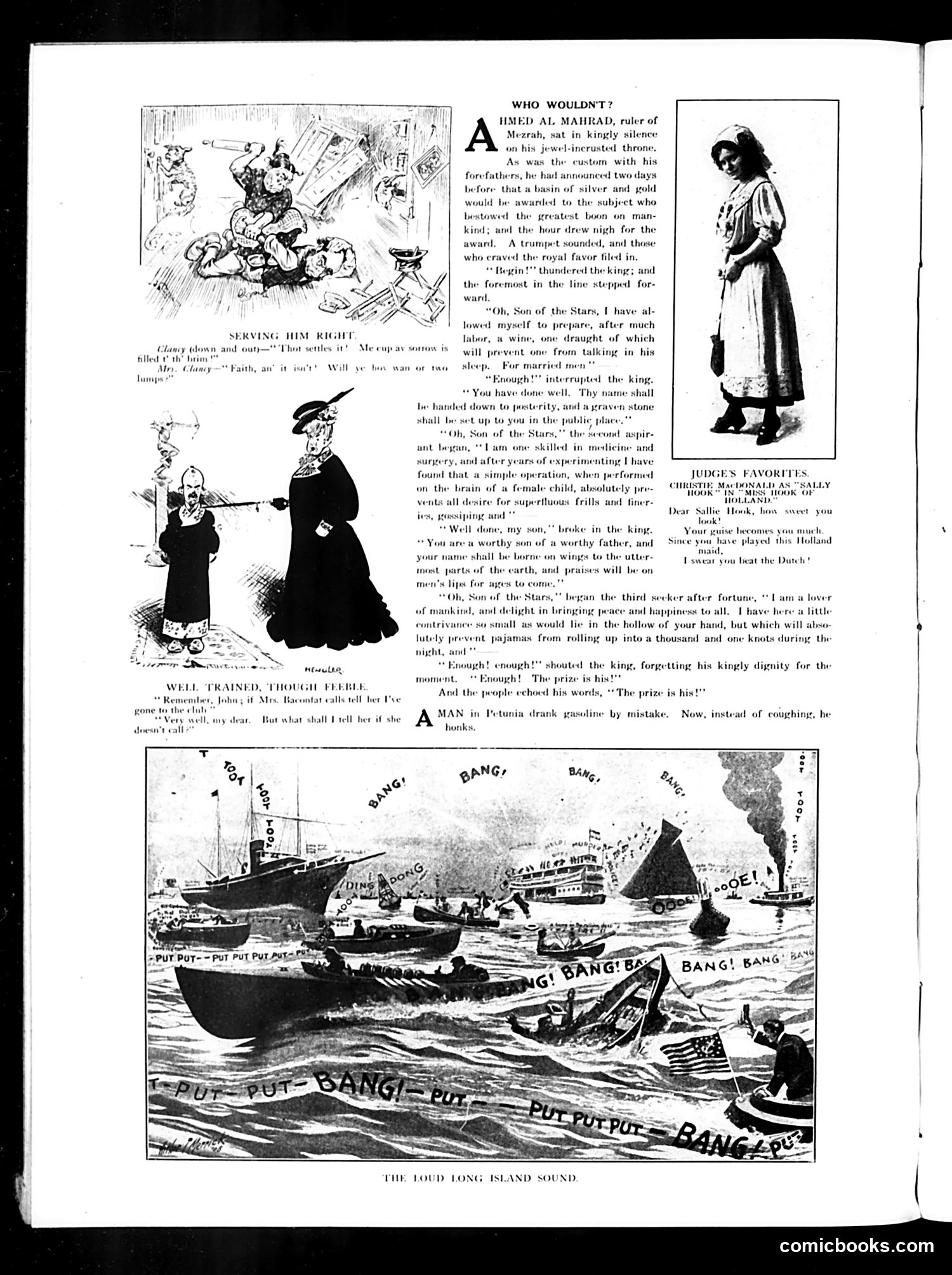
This page contains a fictional story titled "Who Wouldn't?" about Ahmed Al Mahrad, ruler of Mecca, who offers a basin of silver and gold to whoever performs the greatest boon for mankind. Multiple aspirants present their contributions—a wine merchant, a physician, and others—each claiming their work deserves the prize. The satirical point appears to mock self-aggrandizing claims of public service and the difficulty of objectively measuring human contribution. The various petitioners' boasts—from medicine to commerce—suggest contemporary debates about whose profession most benefits society. The bottom illustration, "The Loud Long Island Sound," depicts chaotic maritime activity with repeated "BANG!" and "PUT-PUT" sounds, likely satirizing noisy recreational boating or commercial shipping on Long Island Sound, a then-popular resort area.
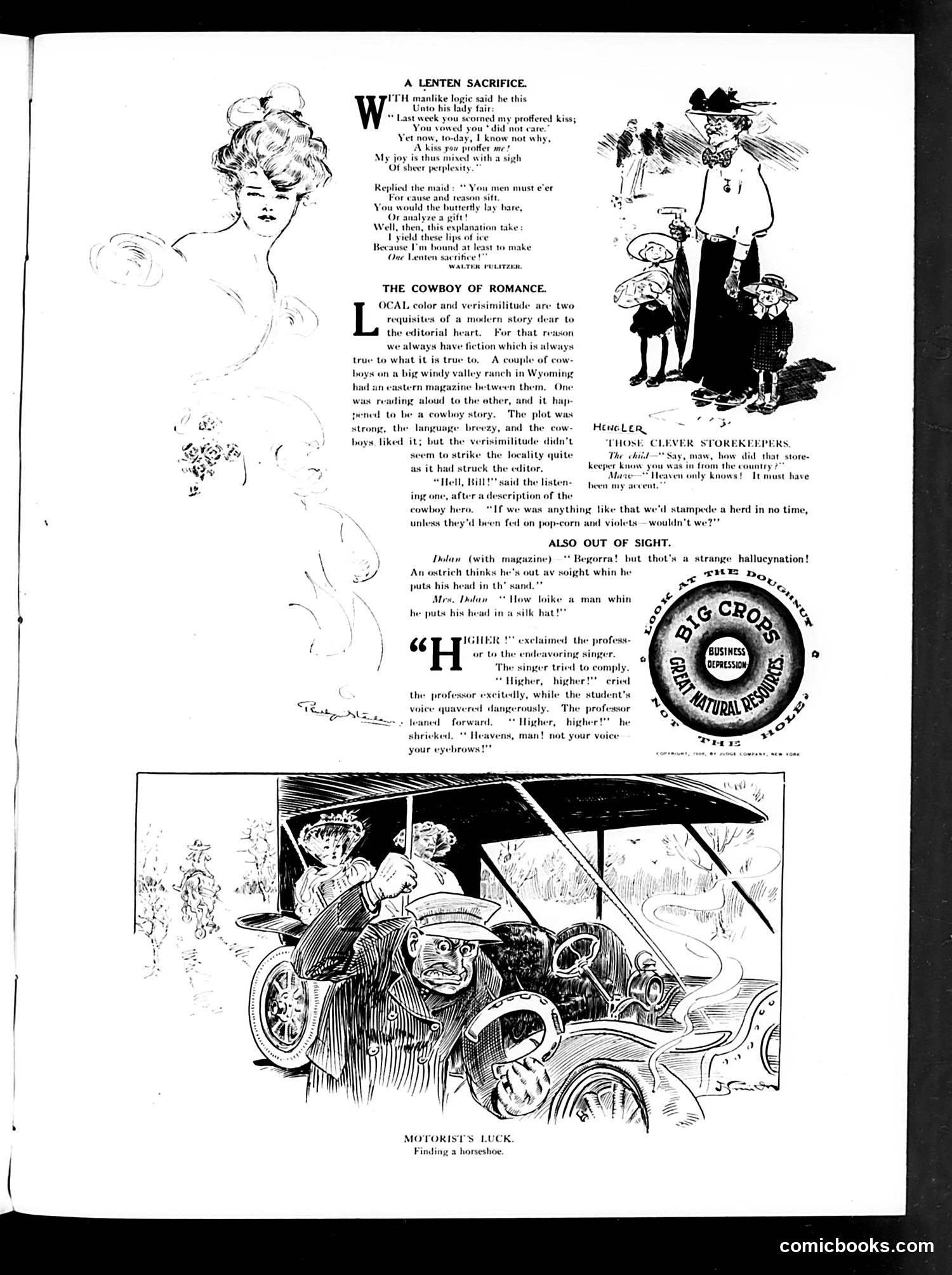
This page contains several satirical pieces typical of early 20th-century humor magazines: **"A Lenten Sacrifice"** (top) is a poem about romantic rejection during Lent, using religious observance as metaphor for romantic denial. **"The Cowboy of Romance"** critiques a magazine story about Wyoming cowboys, mocking its implausibility and poor execution. The editorial commentary suggests the story failed to capture authentic cowboy experience. **"Those Clever Storeekeepers"** (right illustration) appears to joke about rural merchants' cunning. **"Also Out of Sight"** mocks someone's singing voice through a conversation about vocal range. **"Motorist's Luck"** (bottom) shows a motorist discovering a horseshoe, playing on superstition about luck and the contrast between modern automobiles and traditional good-luck charms. The page is primarily literary/humorous content with supporting illustrations rather than political commentary.
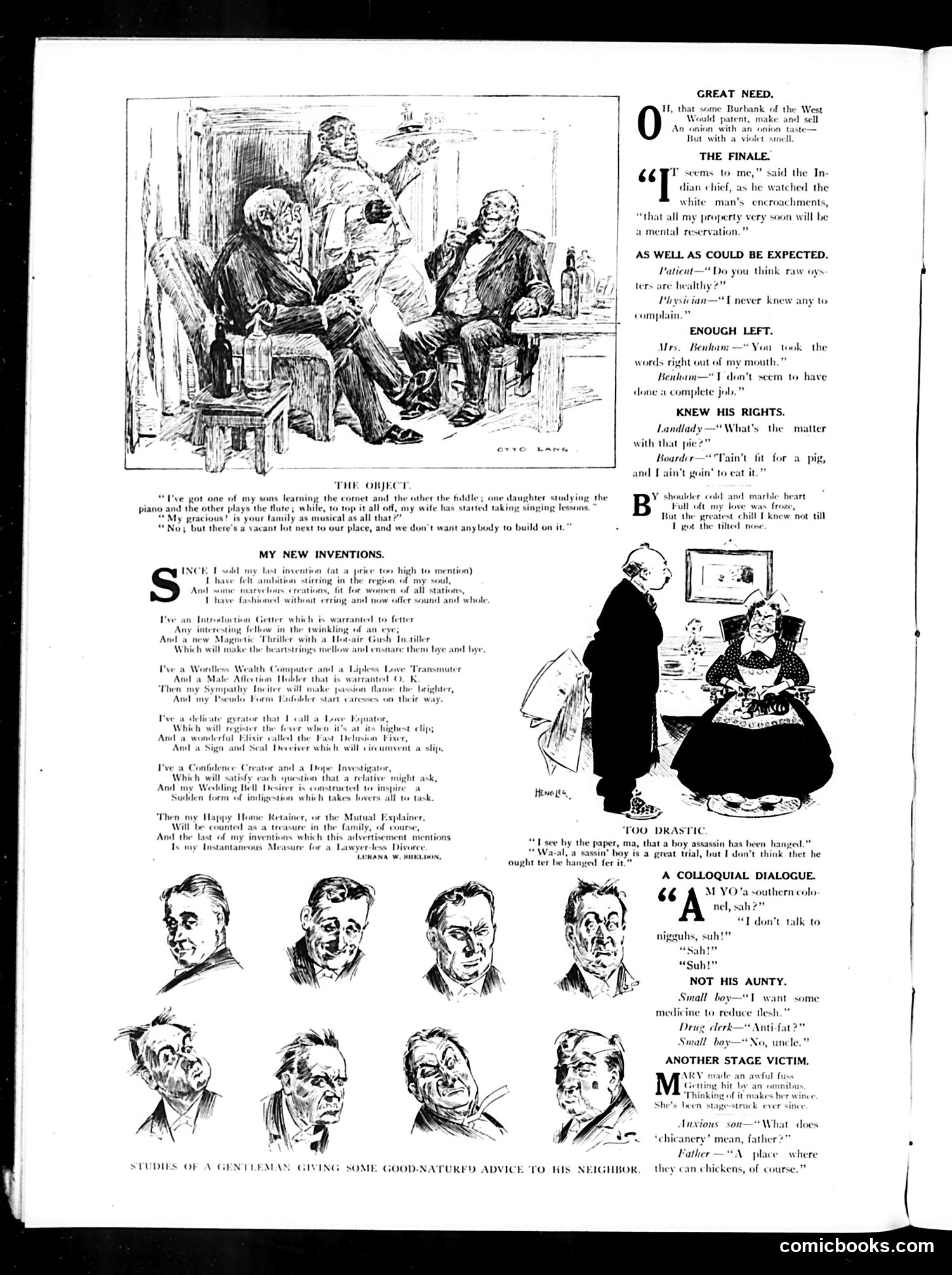
This page contains multiple brief satirical sketches typical of late 19th-century American humor magazines. **"The Object"** mocks aspirational middle-class pretension: a man whose family makes noise with various instruments claims this prevents neighbors from building on an adjacent lot—suggesting the "music" is intentionally terrible, used as a deterrent rather than genuine cultural refinement. **"My New Inventions"** parodies the patent-obsessed Gilded Age by listing absurd devices with grandiose names that solve non-problems or promise impossible results. **"Great Need"** expresses a common complaint about onions' pungent smell through whimsical verse, invoking Luther Burbank (famous plant breeder) as a reference point. **"The Finale"** appears to reference Native American displacement, with an Indian chief observing white encroachment and mentally reserving his rights—satirizing both dispossession and legal futility. Remaining sketches mock doctors, landlords, racial attitudes (the "colloquial dialogue" employs period racial dialect), and other social types. The tone is gentle mockery of ordinary life's absurdities.
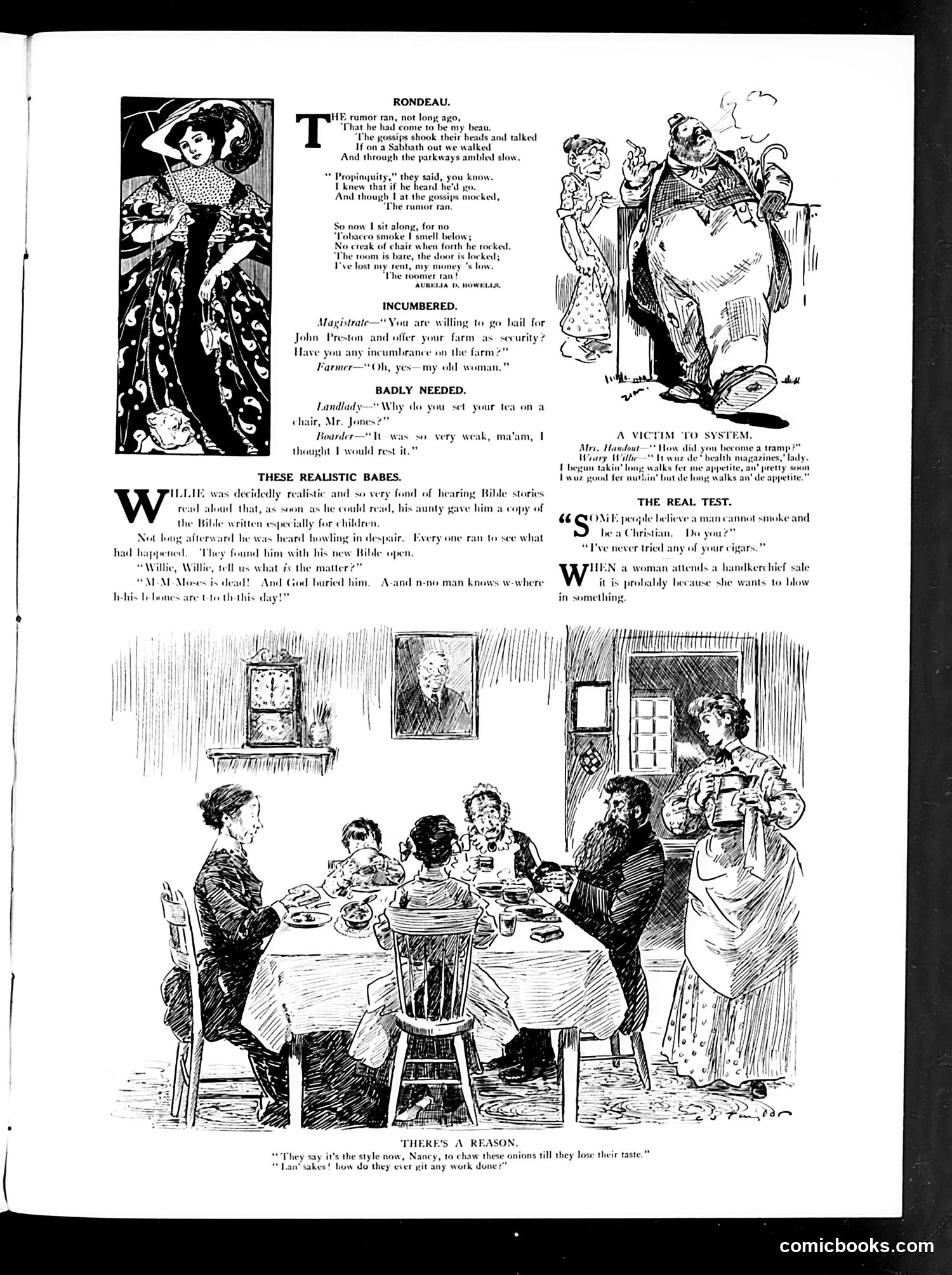
This page contains several brief satirical pieces typical of early 20th-century humor magazines: **"RONDEAU"** is a poem mocking romantic gossip—a woman's reputation suffers when she's seen walking with a man, so she isolates herself to avoid scandal. The satire targets rigid social conventions about unmarried women's conduct. **"INCUMBERED"** jokes about a farmer offering his wife as collateral, playing on the double meaning of "incumbrance" (legal burden/wife as burden). **"BADLY NEEDED"** is a quick pun: a weak boarder sets tea on a chair to let it rest, misunderstanding the phrase. **"THESE REALISTIC BABES"** satirizes a child reading the Bible literally, finding the violence disturbing—mocking both overly literal interpretation and the gap between children's innocence and biblical content. **"THE REAL TEST"** and **"A VICTIM TO SYSTEM"** are brief social commentary pieces on hypocrisy and materialism. The cartoons throughout use exaggerated drawings typical of the era to lampoon middle-class social pretensions and domestic life.
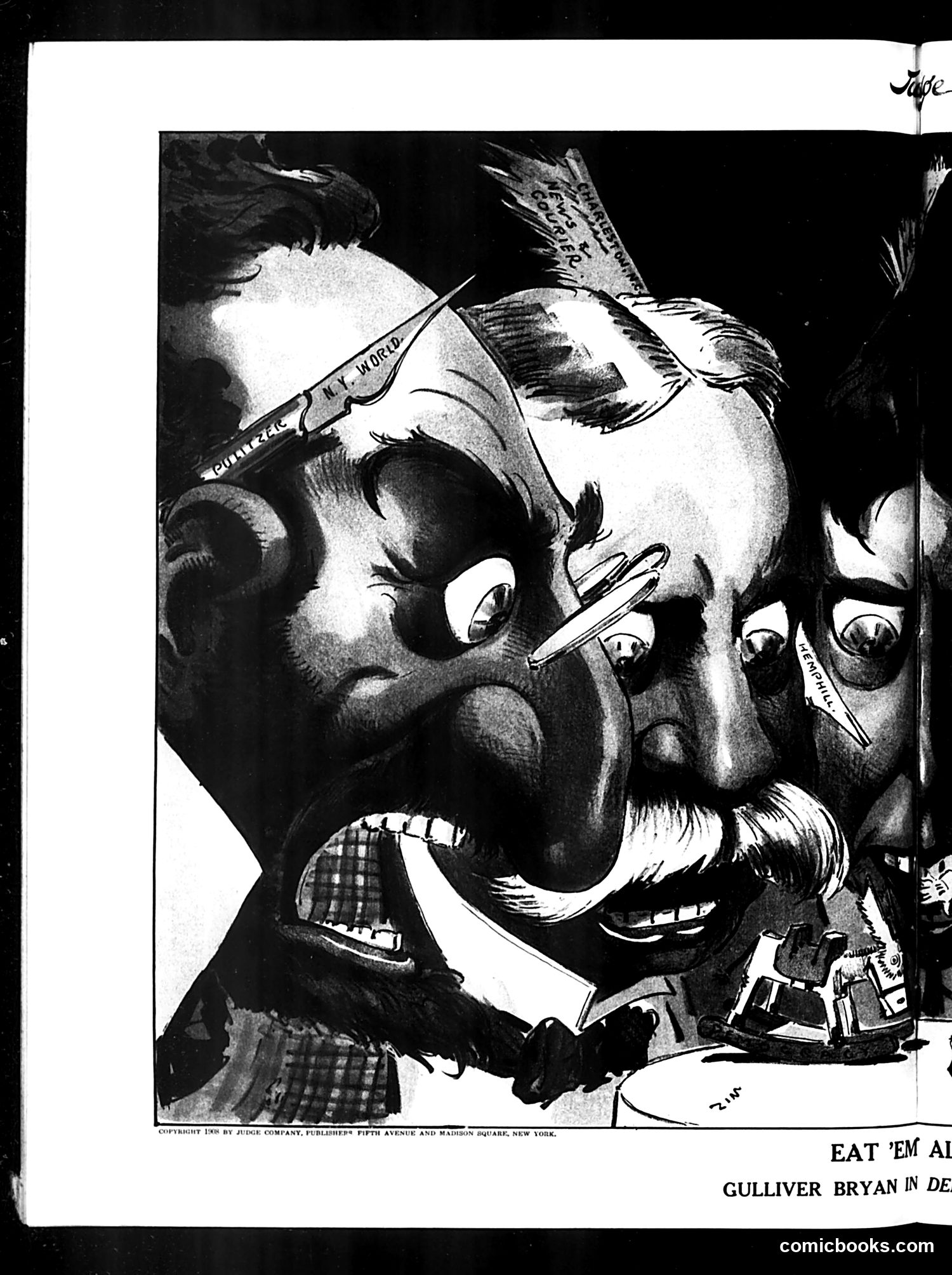
This appears to be a satirical cartoon from *Judge* magazine referencing William Jennings Bryan, the three-time presidential candidate known for his 1896 "Cross of Gold" speech and agrarian populist politics. The cartoon depicts caricatured figures in an exaggerated, grotesque style typical of early 20th-century political satire. The title "Gulliver Bryan in De[fault]" (text cuts off) likely invokes Jonathan Swift's *Gulliver's Travels* to mock Bryan as a foolish traveler or deluded figure—a common satirical comparison of the era. The leering, distorted faces and theatrical presentation suggest the cartoon ridicules Bryan's political positions or public persona, though without the full page context and complete text, the specific satirical target remains unclear.
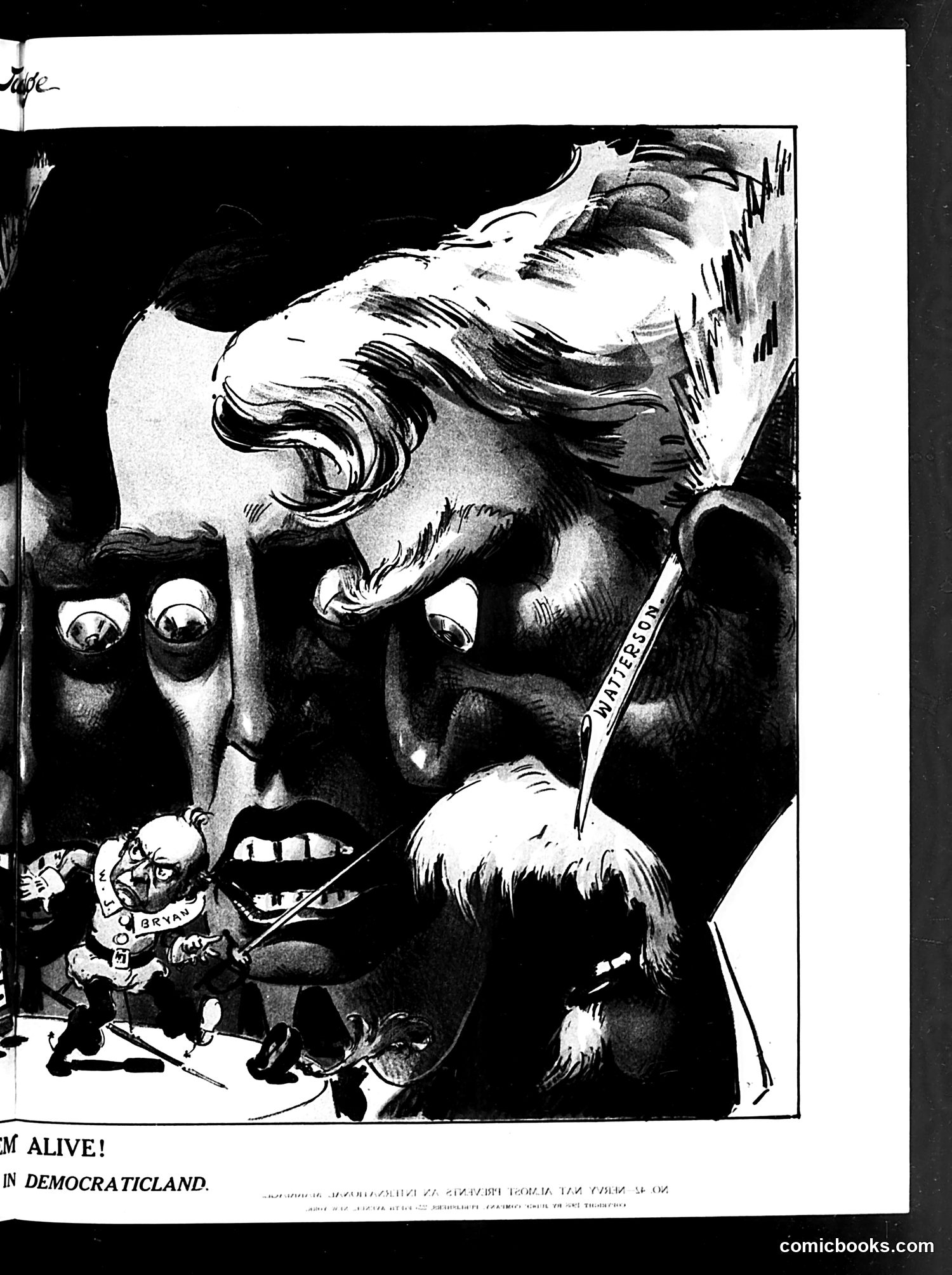
This appears to be a satirical cartoon from *Judge* magazine criticizing Democratic politics. The image shows grotesque, caricatured figures with exaggerated facial features looming over smaller figures below labeled "BRYAN" (likely William Jennings Bryan, a prominent Democratic politician). The title "ALIVE! IN DEMOCRATICLAND" suggests the cartoon is mocking the Democratic party as a dangerous or monstrous place. The enormous heads with menacing expressions and the tiny, vulnerable figures below create a power dynamic commentary—possibly critiquing how Democratic leadership exploited or dominated party members. The style and subject matter suggest this is from the late 19th or early 20th century, when Bryan was politically active, but the specific satirical point requires additional historical context to confirm with certainty.
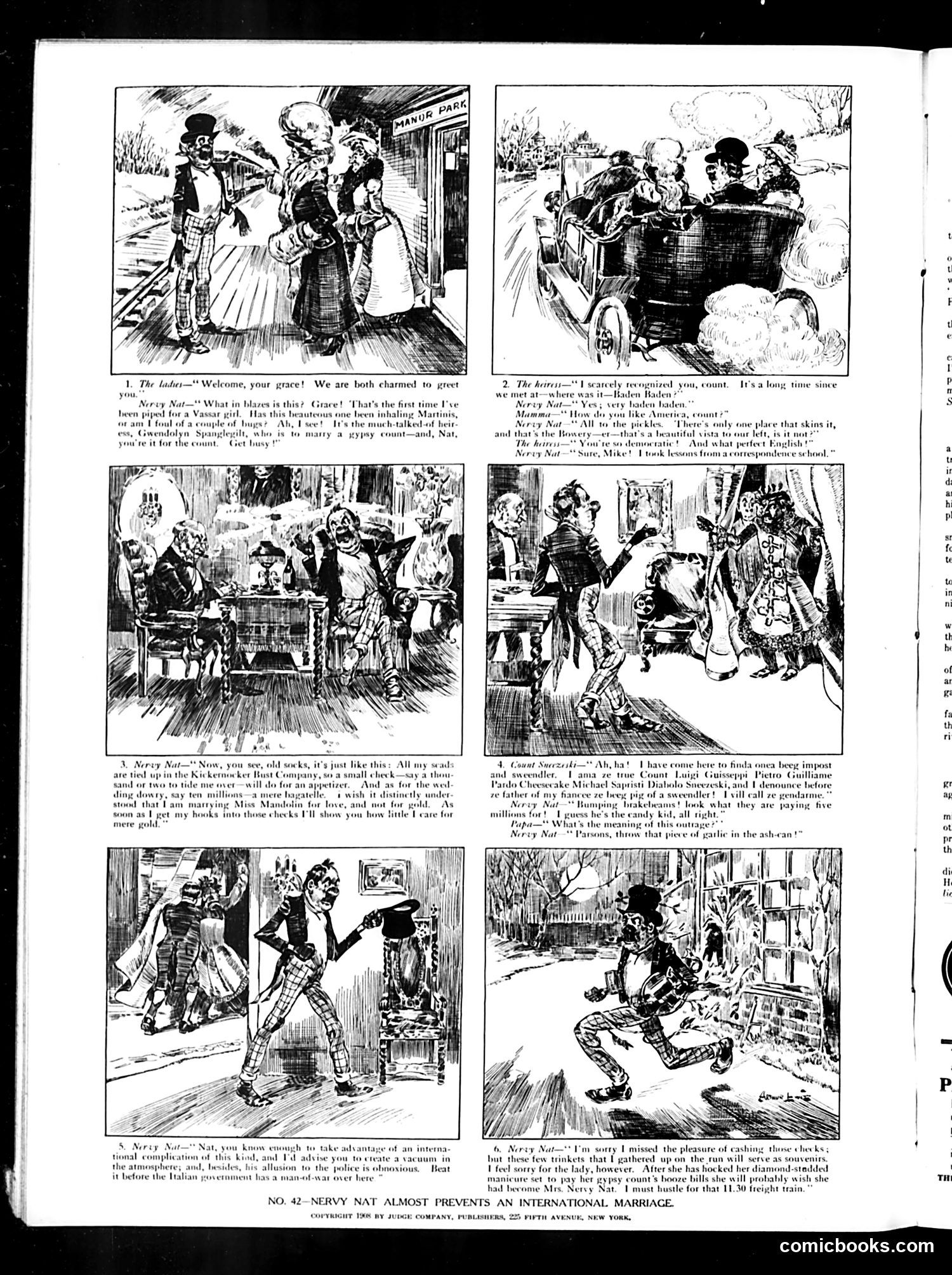
This is a six-panel comic strip featuring "Nervy Nat," a character appearing to be an Italian immigrant (indicated by dialect and references to Italian government). The narrative follows Nat's misadventures attempting to prevent a marriage—likely involving European characters given the "international" reference in the title. The strip satirizes Italian immigrants through stereotypical characterization: exaggerated dialect, lower-class behavior, and scheming. The "international marriage" plot suggests anxieties about immigration and cross-cultural unions common in 1908 America. Nat's bumbling interference serves as comedic fodder while reinforcing period stereotypes about Italian newcomers as disruptive outsiders. The satirical edge targets both immigrant behavior and American anxieties about assimilation and intermarriage during the peak immigration era.
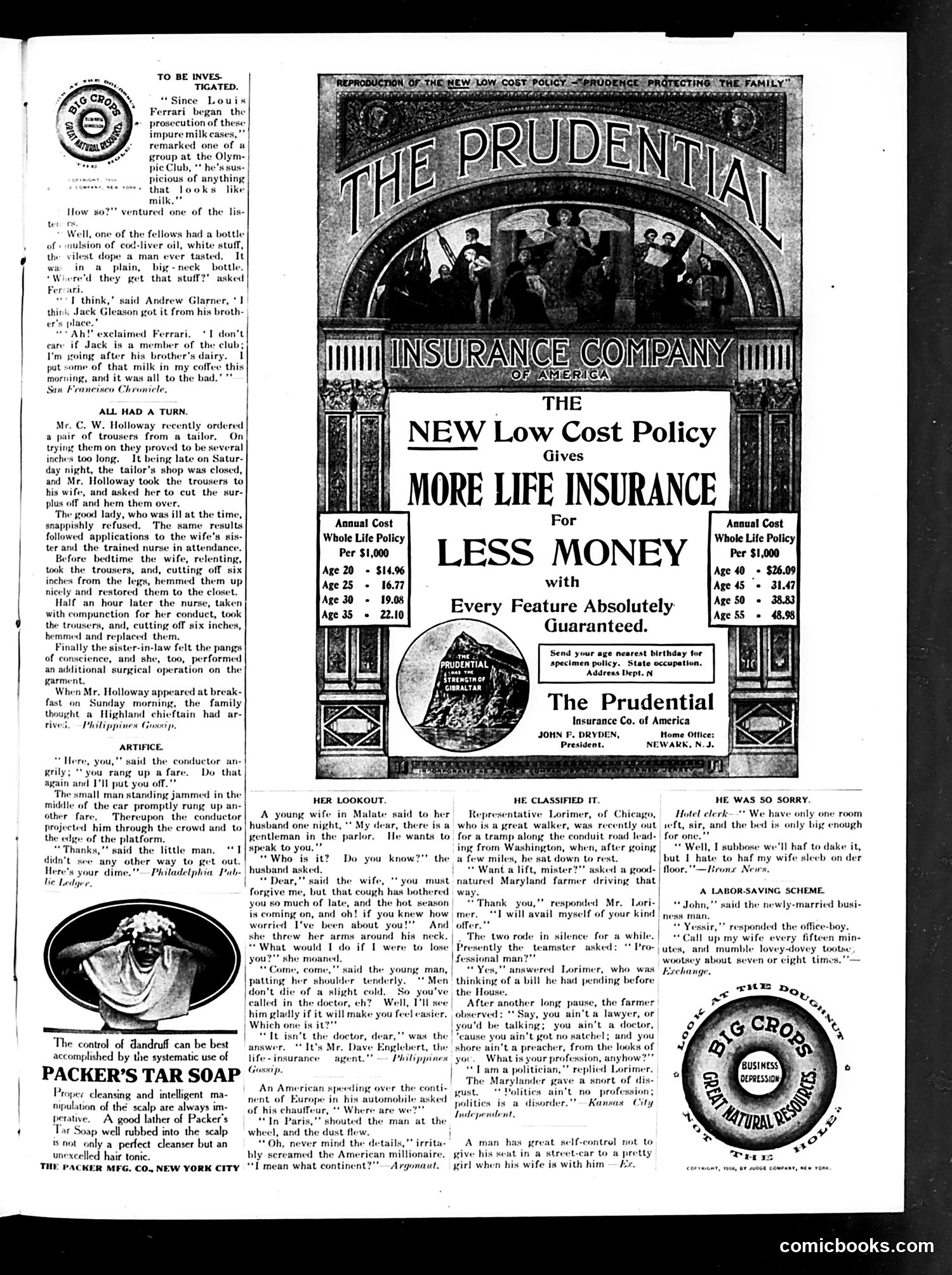
This page from **Judge** magazine contains primarily **advertising and humorous anecdotes**, not political cartoons. The dominant feature is a **Prudential Insurance Company advertisement** promoting affordable life insurance with guaranteed features. The scattered jokes are social humor rather than satire: - **"To Be Investigated"**: A riff on food safety scandals (Louis Ferrari's milk prosecutions), joking that inspectors become paranoid about all dairy products. - **"All Had a Turn"**: Slapstick humor about a wife, sister, and nurse each secretly shortening the same pair of trousers, progressively ruining them. - **"Artifice"**: A passenger rings the bell twice to trick the conductor into moving him forward. - **"HER LOOKOUT," "HE CLASSIFIED IT," etc.**: Brief domestic and professional misunderstandings. The only identifiable reference is to **Louis Ferrari** and milk-purity investigations, reflecting Progressive Era food-safety concerns. Otherwise, these are generic situational jokes typical of early-20th-century humor magazines, with no major political significance.
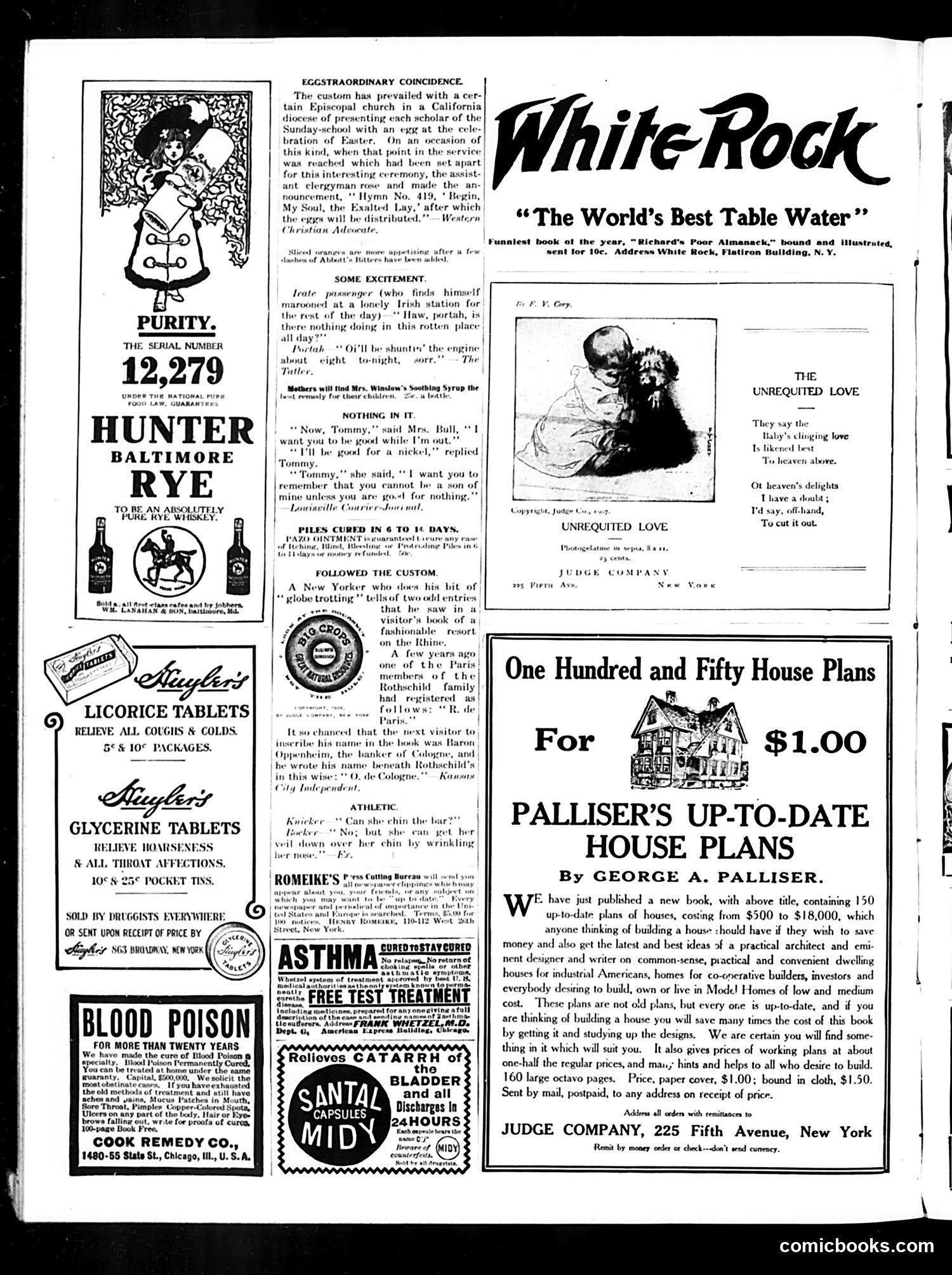
This page is primarily **advertising content** with minimal satirical cartoons. The main notable element is the opening section titled "EGGSTRAORDINARY COINCIDENCE," which describes a California Episcopal church custom of presenting scholars with decorated eggs during Easter celebrations. The joke appears to hinge on an ironic timing: when the clergyman announces "the eggs will be distributed," a man coincidentally stands to leave, creating an unintended double meaning. The remainder of the page consists entirely of **patent medicine and product advertisements** typical of early-20th-century magazines: cough remedies, blood poison cures, licorice tablets, and house plan books. There is a small illustration labeled "UNREQUITED LOVE" showing a sentimental domestic scene. The page reflects Judge's mixed format of light satire with heavy advertising revenue, rather than substantive political commentary. Without clearer identification of the figures in illustrations or additional context, specific satirical targets remain unclear.
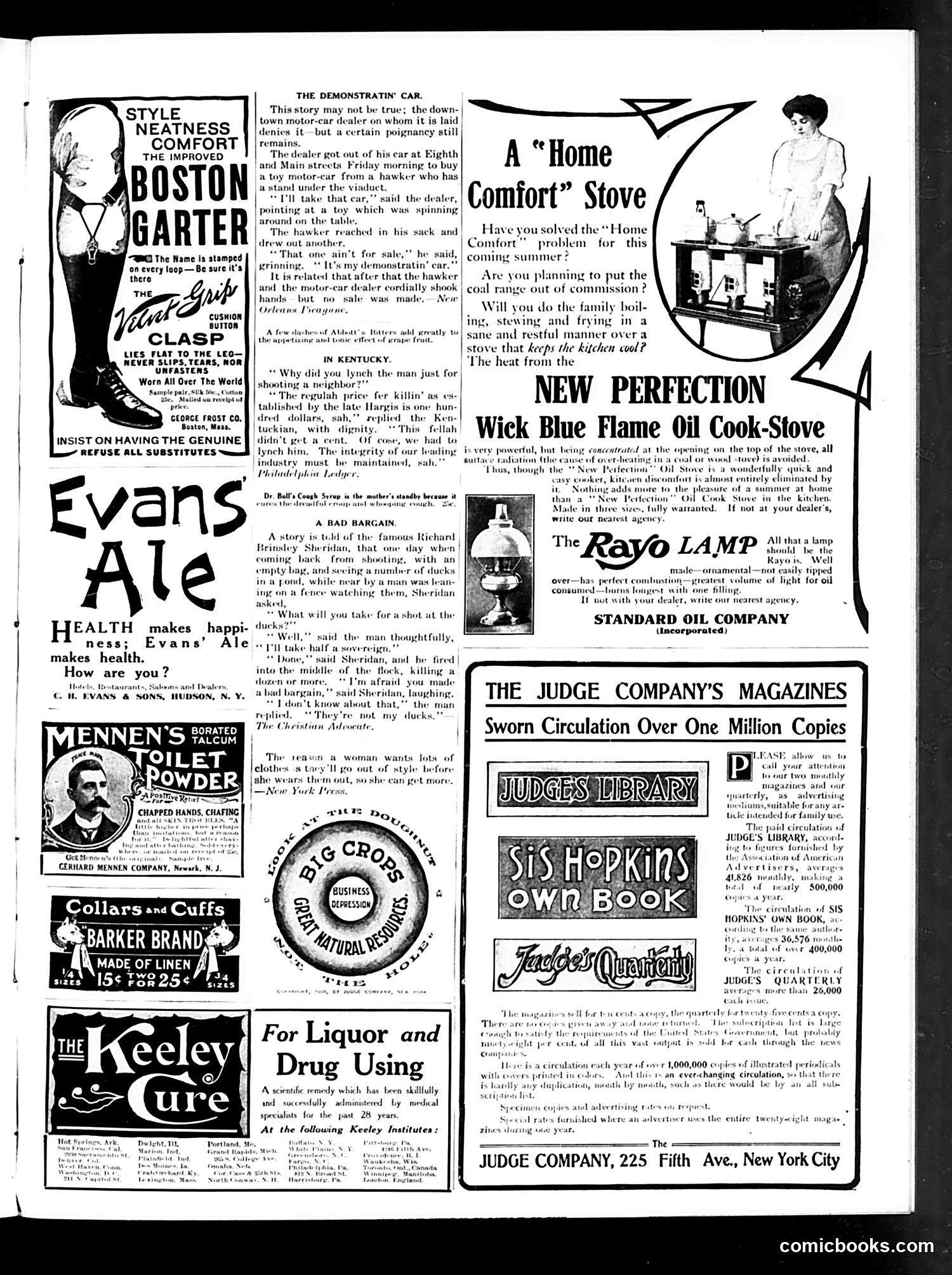
This page is primarily **advertising**, with one satirical article. The main cartoon/story is "The Demonstratin' Car," which depicts a downtown motor-car dealer trying to sell a toy car to a street hawker. The dealer claims the toy is a "demonstration car"—a sales pitch the hawker sees through immediately, rejecting multiple identical toys. The satire mocks deceptive sales tactics and the term "demonstration model" as marketing sophistry. The page otherwise features period advertisements for consumer goods (Boston Garter suspenders, Evans' Ale, Mennen's toilet powder, Keeley Institutes for addiction treatment) and prominently promotes Judge Company's own magazines, boasting over one million circulation. A brief anecdote about shooting ducks (attributed to Richard Brinsley Sheridan) appears as filler content—typical of early 20th-century magazine padding.
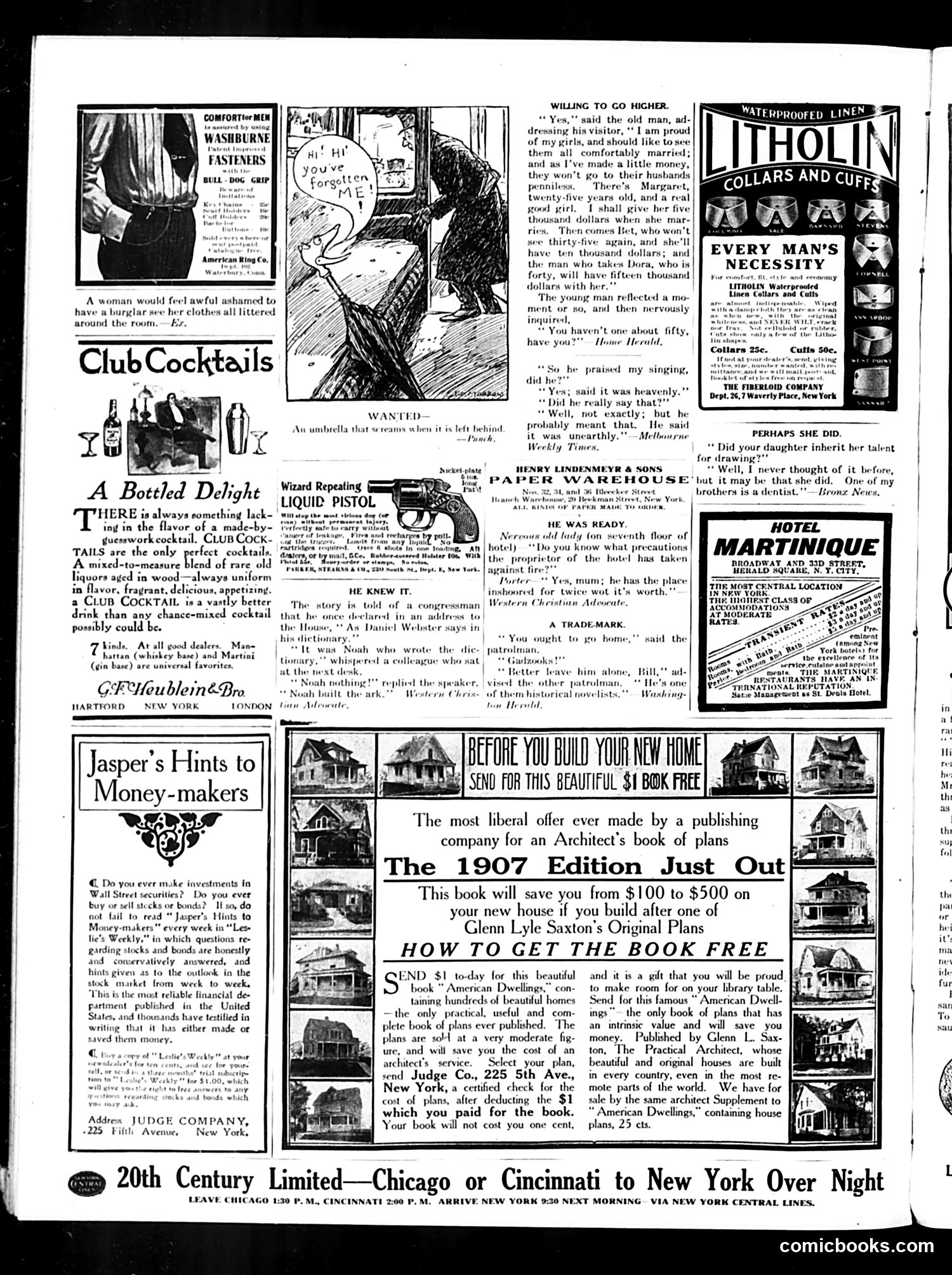
This page is primarily **advertising-heavy**, with minimal cartoon content. The main satirical piece is a brief, untitled comic strip (upper center) depicting an old man negotiating dowries for his daughters—a social commentary on marriage as a financial transaction. The joke turns on the father's escalating demands: each daughter requires increasingly larger dowries, and when asked about a final daughter, he's "willing to go higher," suggesting her unmarriageability makes her an even greater financial burden. This mocks Victorian-era marriage customs where fathers essentially sold daughters to husbands. The rest of the page consists of period advertisements for cocktails, collars, hotels, investment advice, and architectural house plans—typical Judge magazine filler. The magazine itself was a humor and satire publication for educated, middle-class readers interested in current events and social commentary.
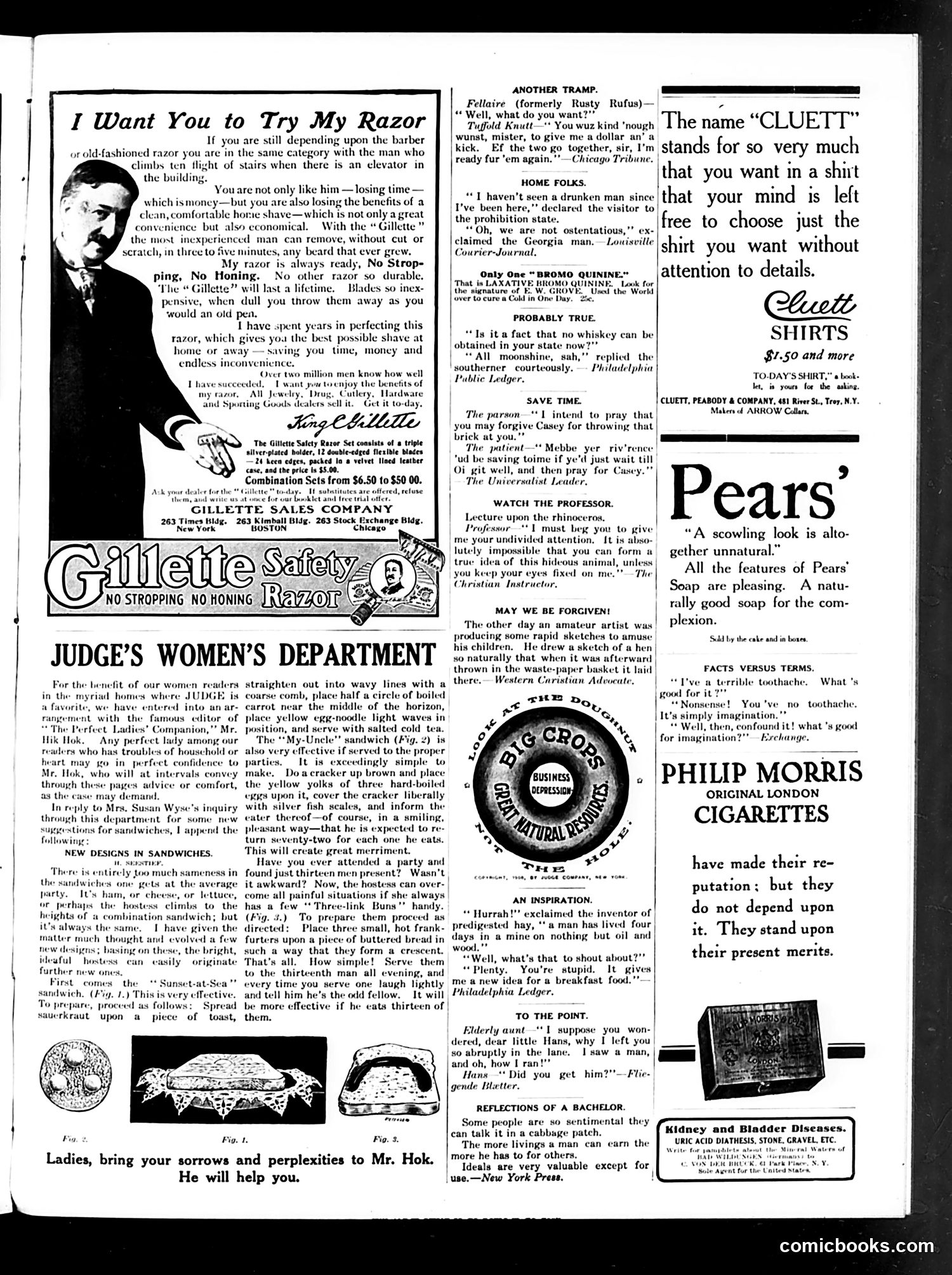
This page contains **advertisements and satirical advice columns** rather than political cartoons. The **Gillette Safety Razor ad** features the company's founder pitching his innovation as superior to barber visits—emphasizing convenience, time-saving, and economy. This reflects early 1900s consumer culture promoting mass-produced home products over traditional services. The **"Judge's Women's Department"** is satirical advice. "Mr. Hok" offers absurd sandwich recipes (boiled carrot, egg noodles, fish scales on crackers) presented as serious household guidance. The humor lies in treating ridiculous, inedible "dishes" as legitimate domestic science—satirizing the era's earnest, often peculiar women's magazines and their condescending advice to housewives. The small **tramp cartoon** shows working-class humor: a vagrant asks for both money and a kick together, having received them separately before. Overall, the page reflects **early 1900s consumer advertising, gender roles, and class-based humor** typical of Judge's satirical approach.
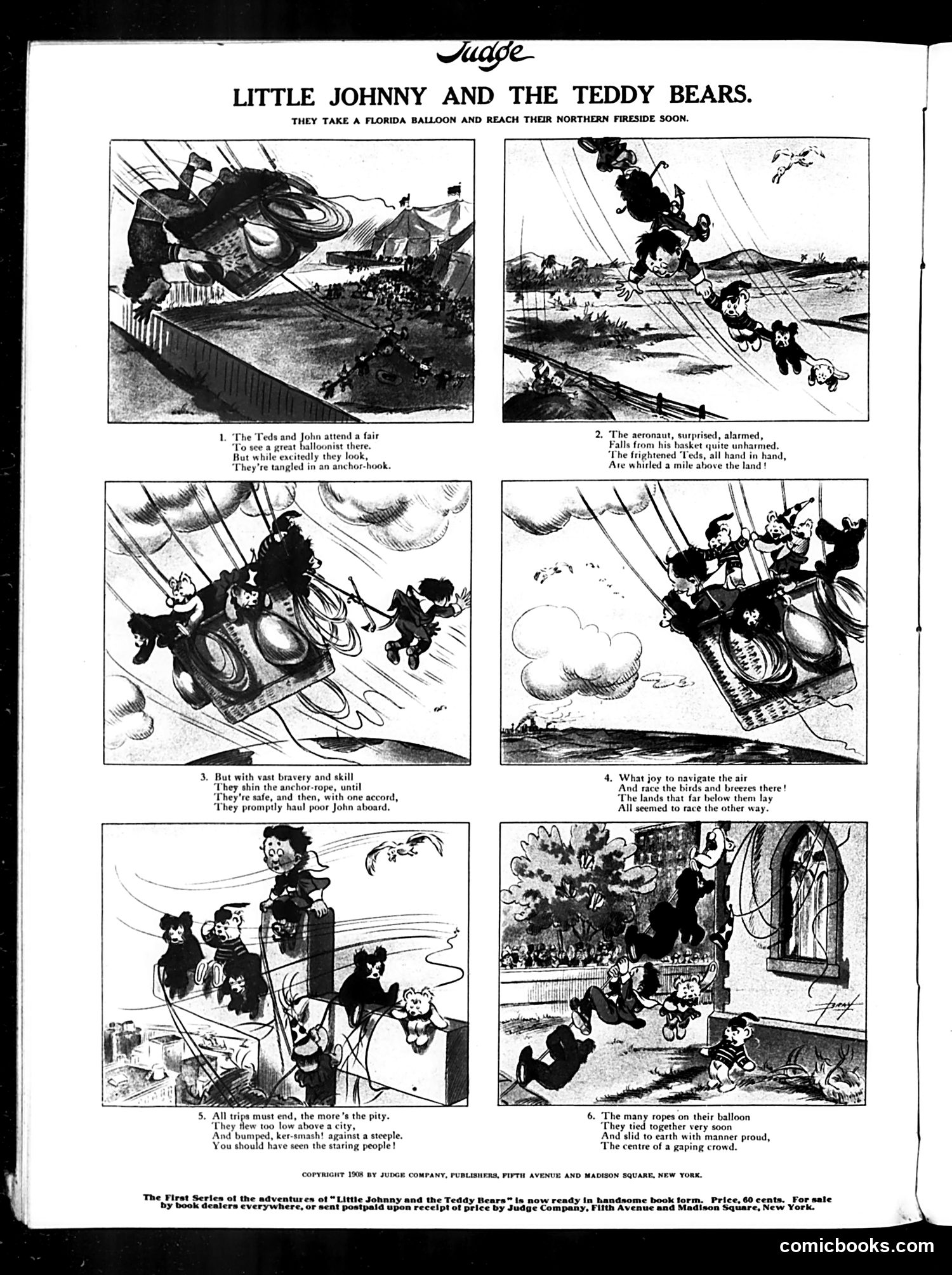
This is a six-panel children's adventure story published in *Judge* magazine (1908). "Little Johnny" and anthropomorphic teddy bears accidentally become entangled in a hot-air balloon at a fair, then embark on an aerial journey northward toward their home. The narrative follows their mishaps: they're caught in an anchor-rope, the aeronaut falls (but survives), they navigate the sky, narrowly avoid a church steeple by flying too low over a city, and finally land safely to a crowd's amazement. The "Teddy Bears" reference likely evokes the then-popular stuffed toys named after President Theodore Roosevelt. This appears to be promotional material for a forthcoming book collection of the series. The humor relies on slapstick peril and the whimsical premise of toy bears as adventuring companions—typical early-1900s children's entertainment, with no apparent political satire.