
A complete issue · 16 pages · 1908
Judge — March 7, 1908
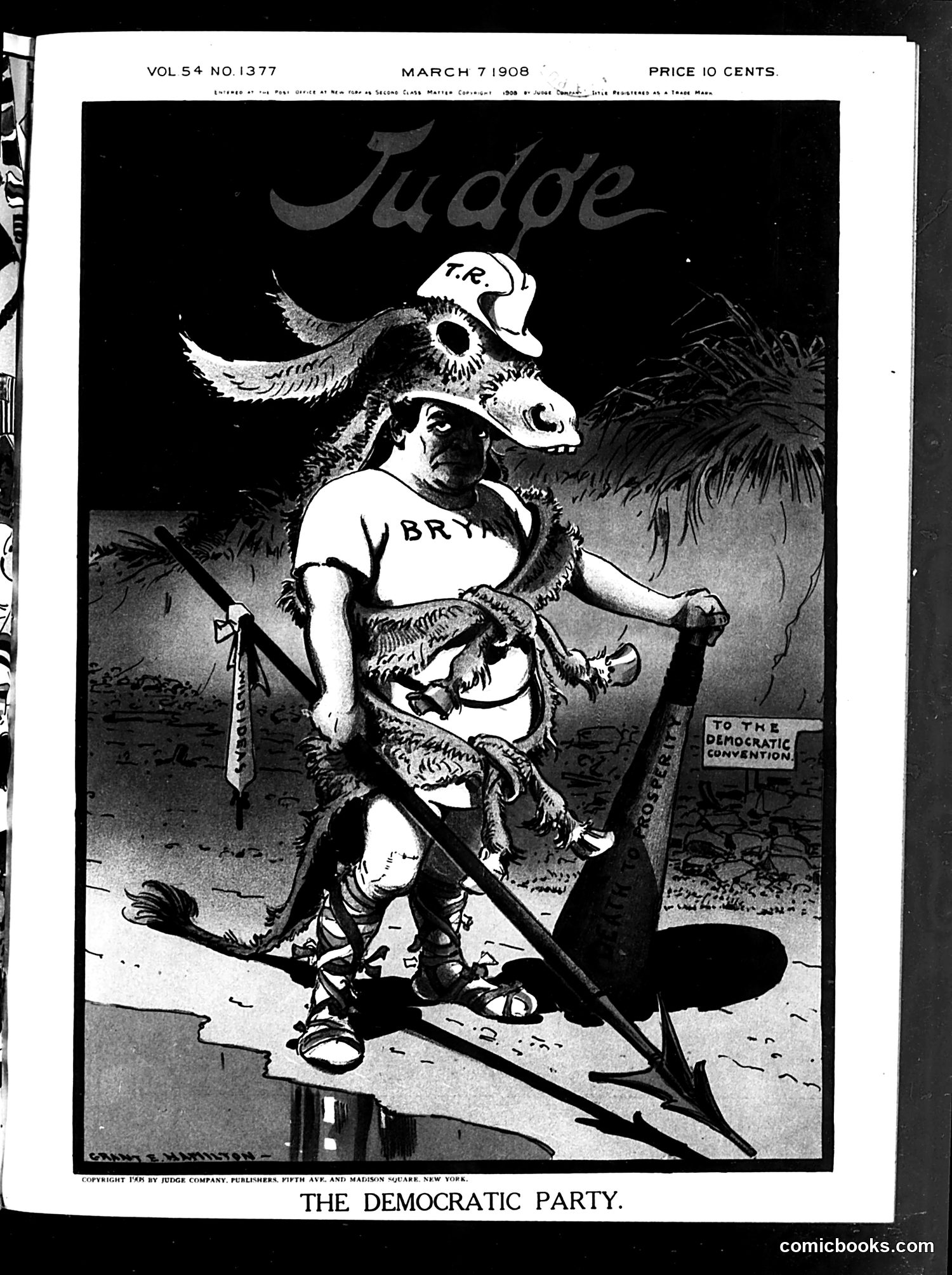
This political cartoon satirizes the Democratic Party as a chaotic, unwieldy beast—literally a multi-headed creature that the party's leadership struggles to control. The figure labeled "BRYAN" (likely William Jennings Bryan, the party's three-time presidential candidate) attempts to manage this monstrous entity with reins and a whip, but clearly cannot command it. The cartoon reflects the Democratic Party's internal divisions in 1908, particularly surrounding Bryan's ongoing influence and the party's direction. The multiple heads represent competing factions, ideologies, or regional interests within the party that resist unified control. The "Judge" publication uses grotesque imagery to mock Democratic disorganization as the 1908 presidential election approaches.
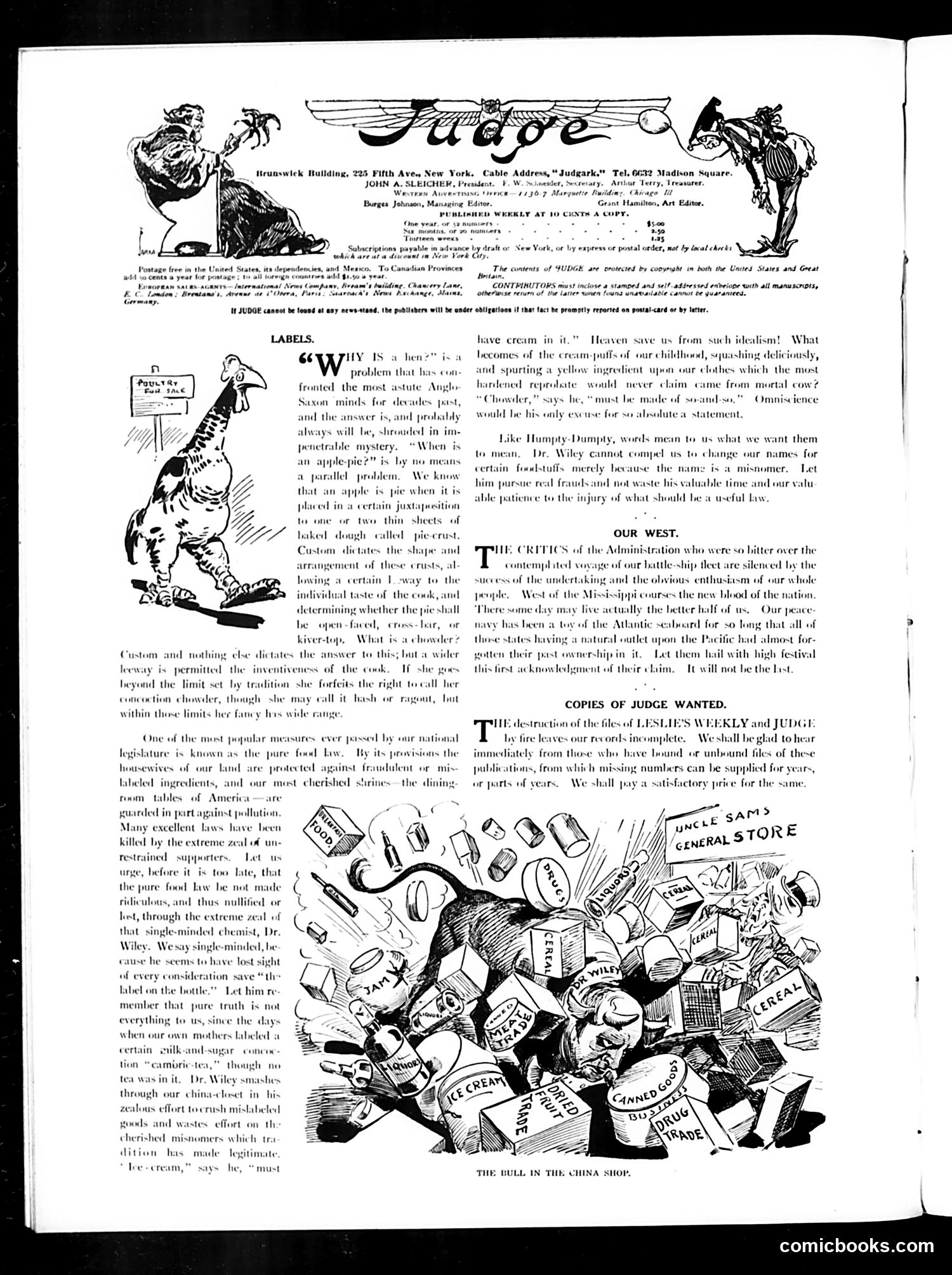
This page contains two distinct sections: **"Labels" (left):** A cartoon depicting a hen struggling with a pie crust, illustrating the ambiguity of names versus reality. The joke appears to be that naming something doesn't change its nature—calling a hen an "apple pie" won't make it one, just as labeling ingredients doesn't guarantee quality. This satirizes misleading product labeling practices. **"The Bull in the China Shop" (bottom right):** An illustration showing Uncle Sam's General Store overwhelmed with poorly labeled goods and products in disarray. This appears to critique unregulated commerce and mislabeled food products entering American markets, reflecting Progressive Era concerns about food safety and consumer protection before modern FDA regulations existed. Both pieces advocate for truth in labeling and consumer protection.
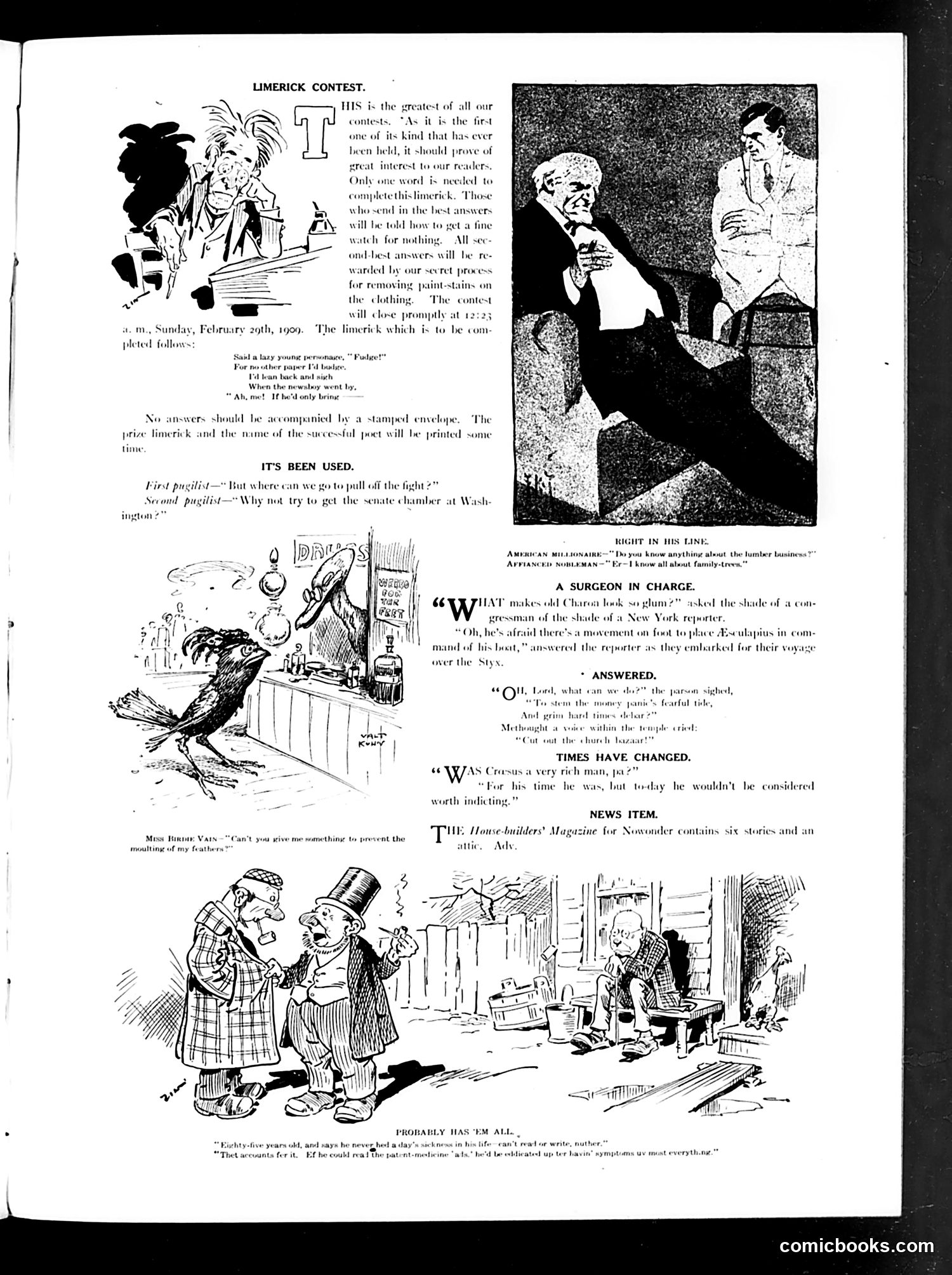
This page announces Judge's limerick-writing contest, dated February 29, 1900. The contest invites readers to submit limericks completing the prompt "Said a lazy young presbyter, 'Padder'" with a prize of fine whisky for the winner. Below are comedic exchanges labeled "It's Been Used," "A Surgeon in Charge," "Answered," "Times Have Changed," and "News Item"—brief jokes on contemporary topics. The cartoons depict everyday scenes: a bird ransacking a medicine cabinet, a woman complaining about fluttering feathers, and construction workers lounging on a job site. The humor targets familiar themes: medical absurdity, domestic annoyances, and worker laziness. These are light satirical observations rather than pointed political commentary, reflecting Judge's mix of gentle social satire and humorous domestic situations typical of the era.
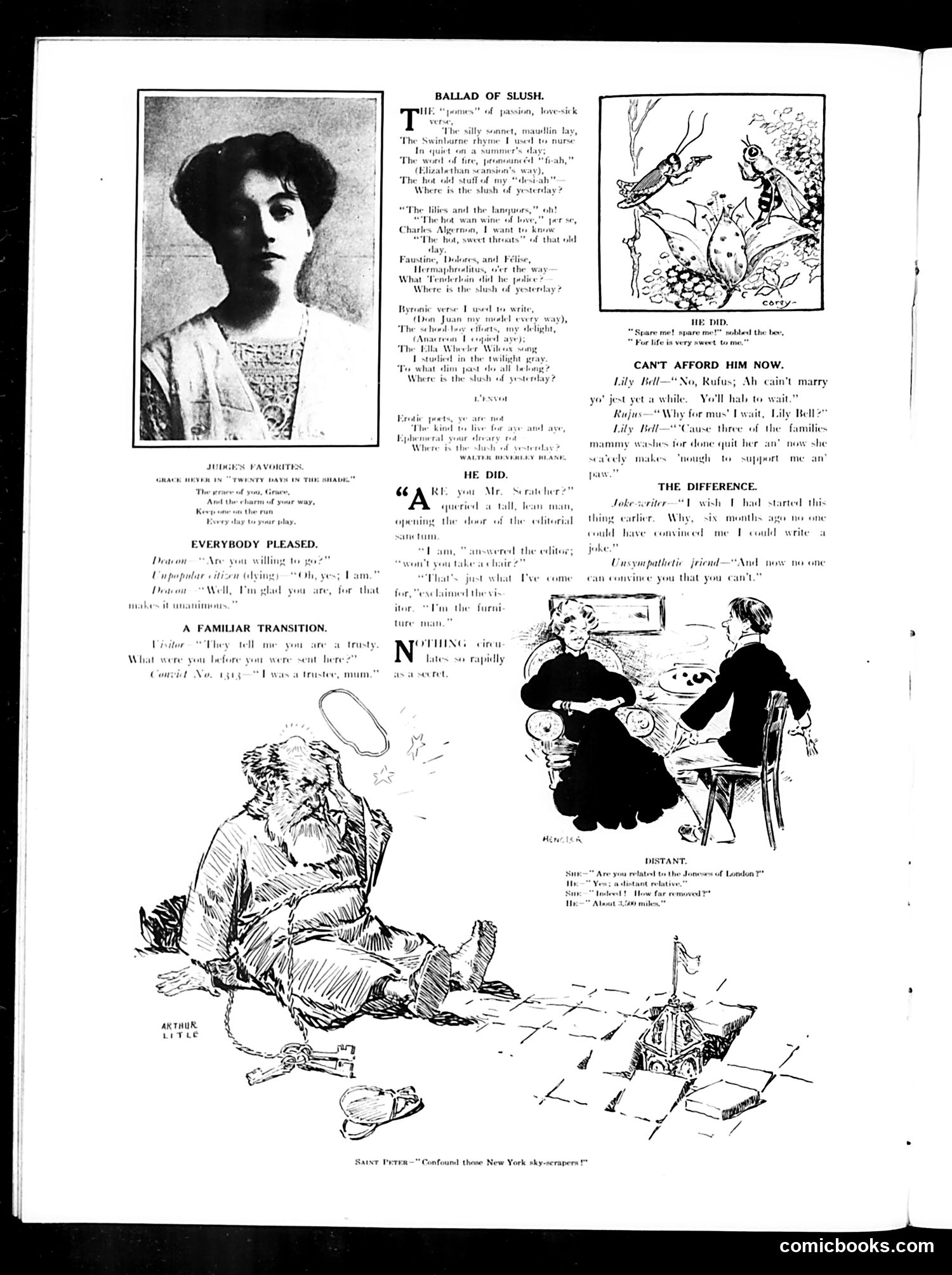
This page contains humor sketches and a portrait of **Grace Dyer** (identified as appearing in "Twenty Days in the Shade"). The sketches use common early-20th-century satirical tropes: - **"Everybody Pleased"** and **"A Familiar Transition"** depict domestic situations playing on class assumptions and marital dynamics - **"He Did"** and **"Can't Afford Him Now"** joke about courtship and financial constraints in marriage - **"The Difference"** contrasts naive optimism with worldly experience - **"Distance"** uses a geographic joke about London relatives The cartoons employ period-typical humor about money, relationships, and social pretension. Without clearer historical context about the specific events or people referenced in the "Ballad of Slush" text, the precise satirical targets remain unclear, though they appear to mock everyday middle-class anxieties.
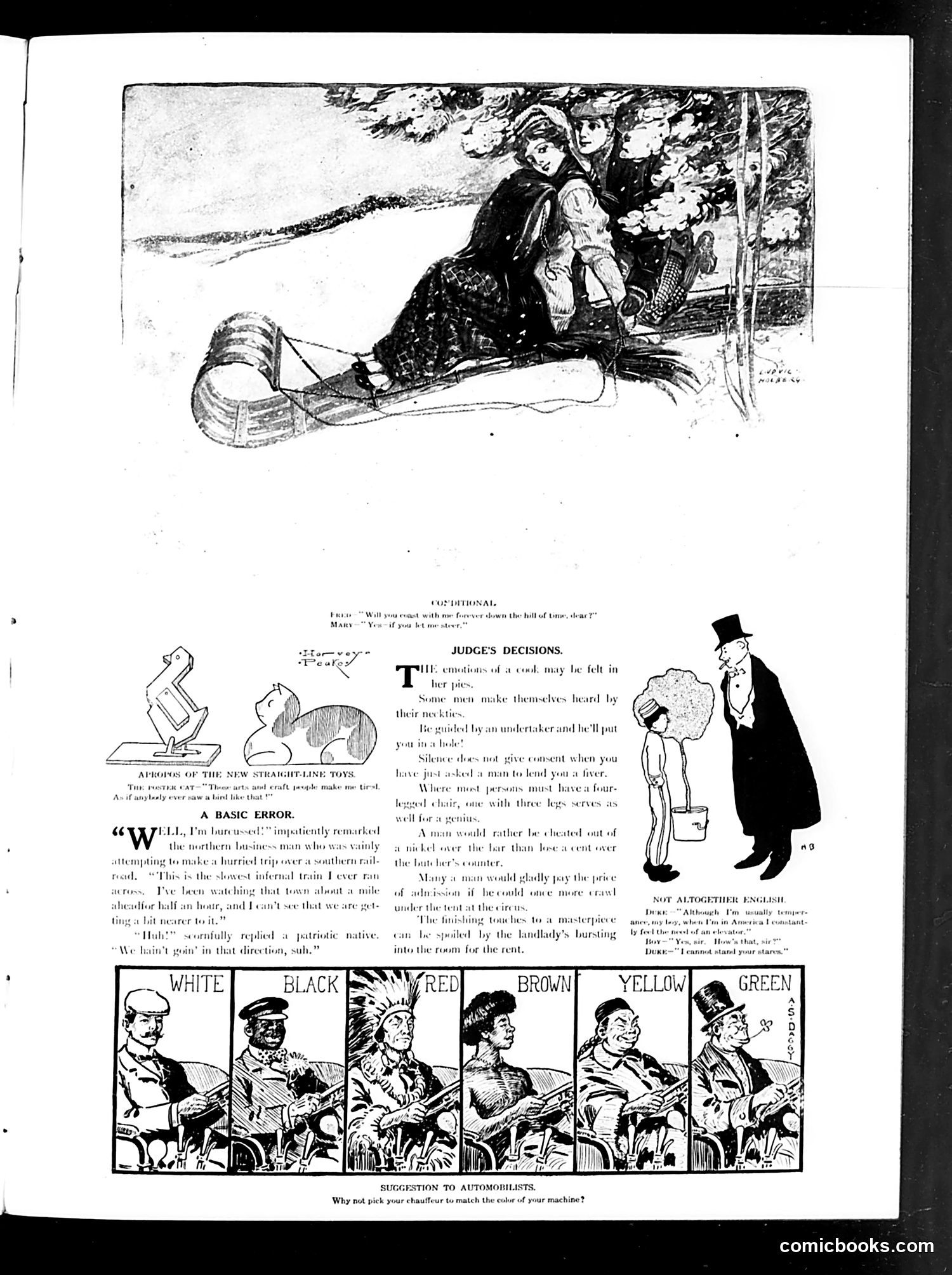
This page contains several satirical pieces targeting early 20th-century society: **Top illustration**: Shows a woman on a toboggan with children, captioned about "racing with the forces down the hill of time." Likely commentary on reckless behavior or parenting. **"A Basic Error"**: Mocks a northern businessman who boasted about industrial progress, then contradicted himself—satirizing inconsistent bragging about American manufacturing. **"Judge's Decisions"**: Humorous advice column offering absurd legal/social rulings (e.g., "A man would rather be cheated out of a hundred dollars than lose a cent over the bar's counter"). **Bottom section**: Six caricatured heads labeled by colors (White, Black, Red, Brown, Yellow, Green), each appearing to operate some machinery. The caption asks why motorists don't match their chauffeur's skin color to their car color—crude racial satire typical of the era's offensive humor.
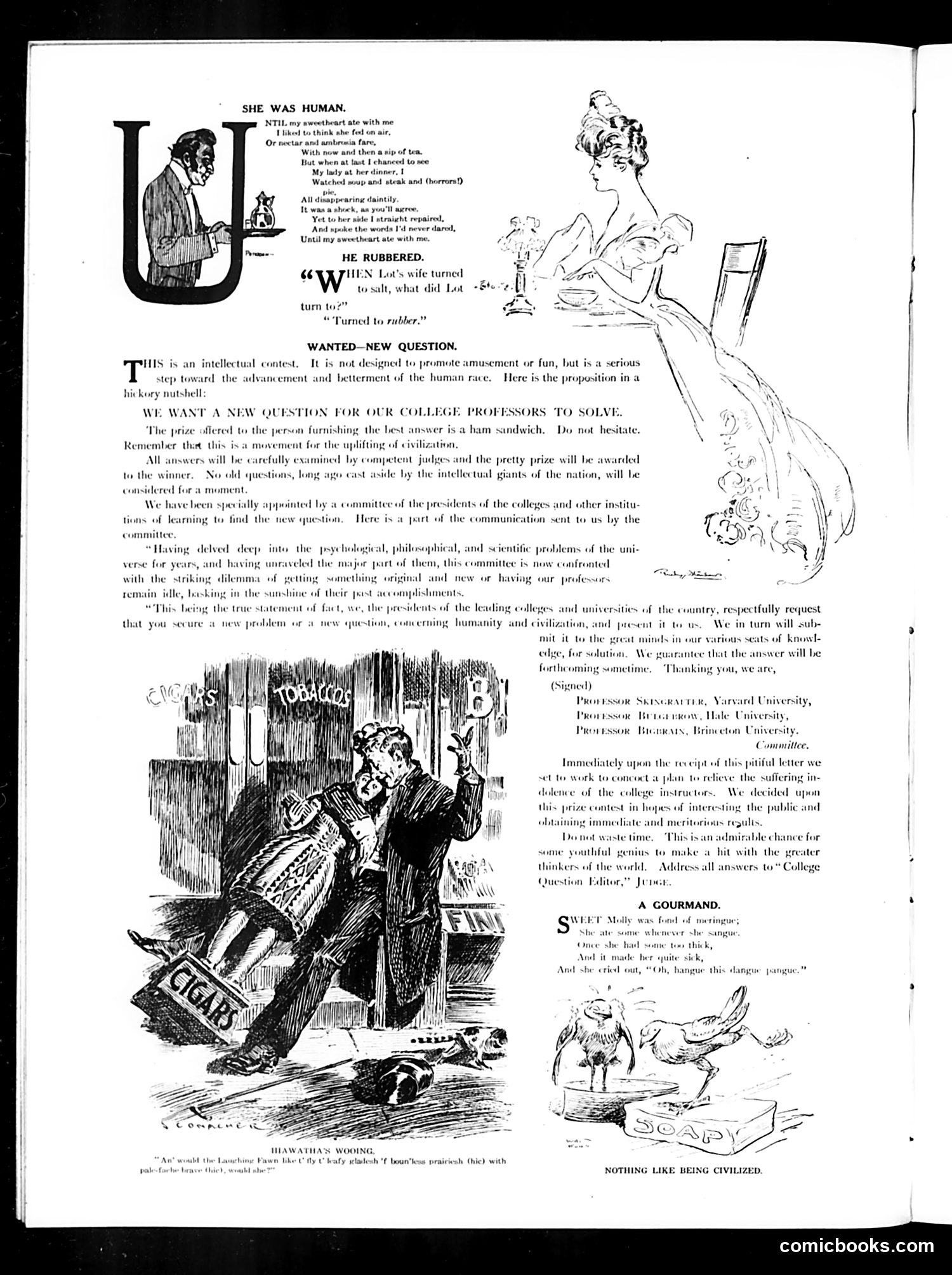
This page from *Judge* magazine contains several satirical pieces mocking Victorian sentimentality and intellectual pretension. **"She Was Human"** and **"He Rubbered"** are brief humorous poems playing on romantic clichés and word-play jokes typical of the era. The main feature, **"Wanted—New Question,"** satirizes academia and college presidents. It mocks the intellectual establishment by presenting a mock "contest" where professors are challenged to solve an important new problem—with the absurd prize being a ham sandwich. The satire suggests that America's leading colleges and universities (Harvard, Yale, Princeton are named) have exhausted all meaningful intellectual questions and now resort to trivial pursuits. The accompanying illustration shows a pompous figure surrounded by scholarly debris, emphasizing the ridicule of academic self-importance. **"A Gourmand"** continues the food-themed humor, while **"Miawatha's Wooing"** parodies Longfellow's famous poem with drunken gibberish (marked "hic"—Latin for hiccup). The overall tone mocks pretension, excess consumption, and academic pomposity.
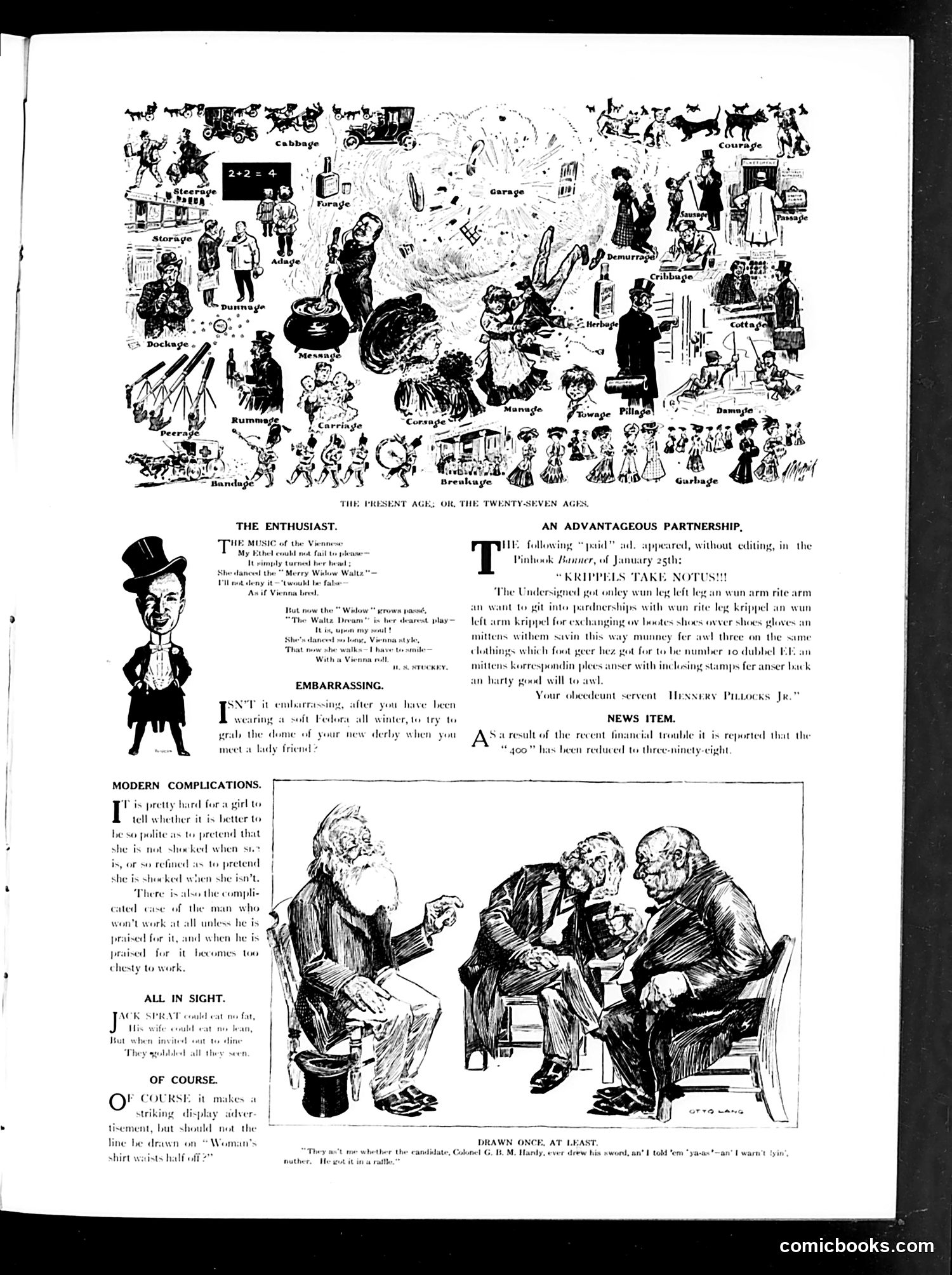
This page from Judge magazine contains several satirical pieces mocking social conventions and contemporary absurdities of the early 20th century. **Top illustration**: "The Present Age; or, The Twenty-Seven Ages" is a chaotic scene labeling various Victorian-era activities and locations (storage, courage, garage, etc.), satirizing the complexity and compartmentalization of modern life. **Main cartoons below** address social embarrassments and contradictions: - "The Enthusiast" mocks pretentious behavior - "Embarrassing" jokes about seasonal fashion transitions - "Modern Complications" ridicules the impossible social standards women face—appearing both shocked and refined simultaneously - "All in Sight" and "Of Course" continue poking fun at social hypocrisy **"An Advantageous Partnership"** reproduces a deliberately misspelled, poorly punctuated personal ad from the "Pinhook Banner," apparently from someone with disabilities seeking to pool resources with others to save money on clothing and footwear. The humor targets both the desperation of the poor and satirizes absurd "business partnerships." The page reflects Judge's typical approach: mocking Victorian social pretense, gender relations confusion, and economic struggle through exaggeration and crude satire.
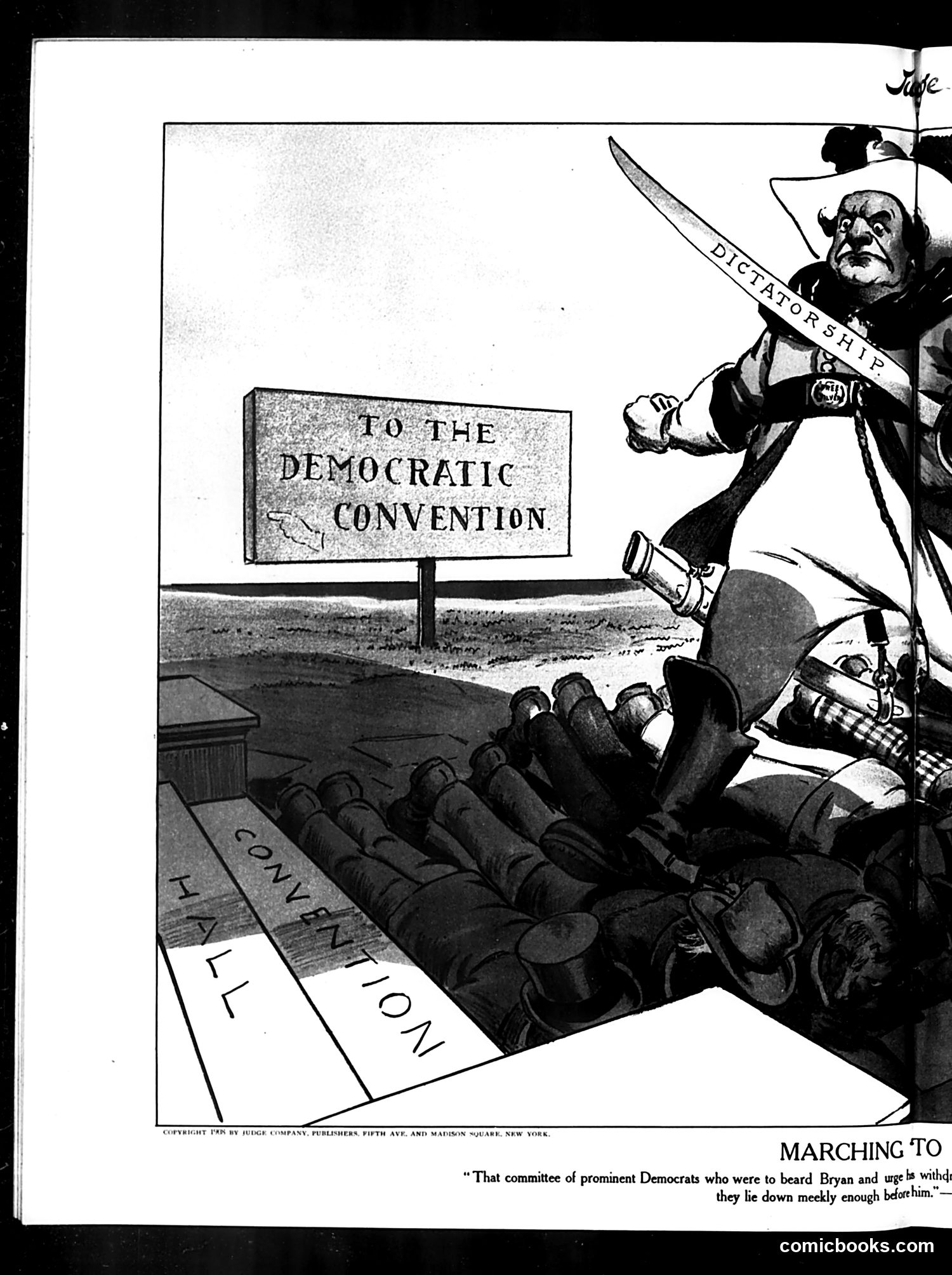
This Judge magazine cartoon satirizes divisions within the Democratic Party, likely from the 1896 election cycle. A figure labeled "DICTATORSHIP" (right) wields a sword toward a sign reading "TO THE DEMOCRATIC CONVENTION." Below, prominent Democrats lie prone on the ground, labeled with what appears to be "CONVEY" and "TION," suggesting they're being forced into submission. The caption references a committee of prominent Democrats who intended to challenge William Jennings Bryan's leadership but instead capitulated meekly. The cartoon mocks these Democrats as powerless and dominated, suggesting Bryan's control over the party was autocratic. The "dictatorship" imagery criticizes what the artist viewed as Bryan's authoritarian grip on Democratic convention proceedings and party direction.
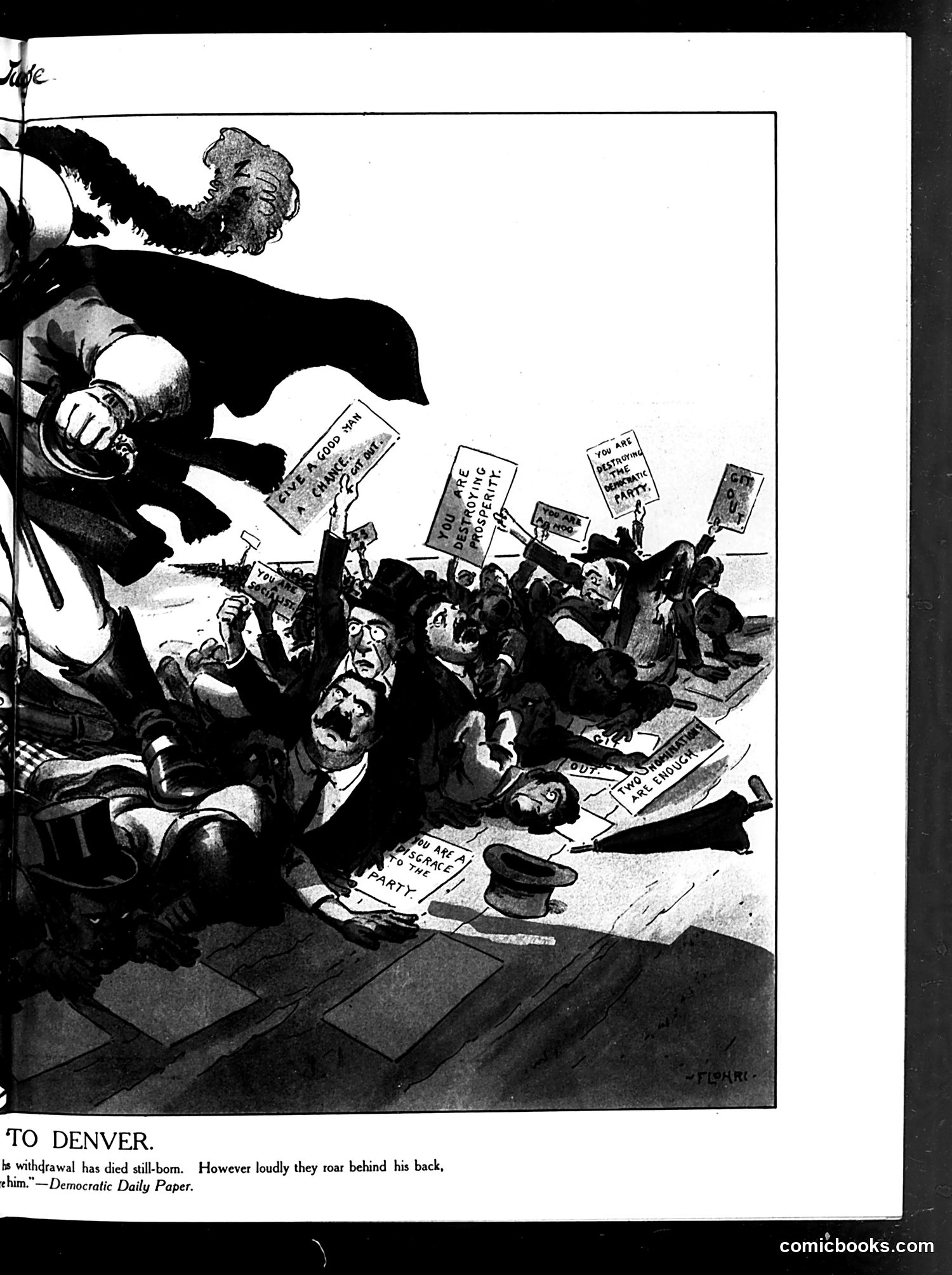
This political cartoon satirizes a politician's withdrawal from consideration (likely for office). The large figure on the left appears to be a powerful political boss or party leader, towering over a crowd of protesters below holding signs that read variations of "YOU ARE AT PEACE PARTY" and similar slogans. The caption references a "Democratic Daily Paper" quote suggesting that while supporters "roar" publicly in protest against the withdrawal, they lack real power to stop it. The cartoon mocks the gap between public outcry and actual political control—the crowd's noise is dismissed as meaningless theater against the entrenched power above them. The destination "TO DENVER" likely references a specific political convention or gathering, though the exact historical event remains unclear without additional context.
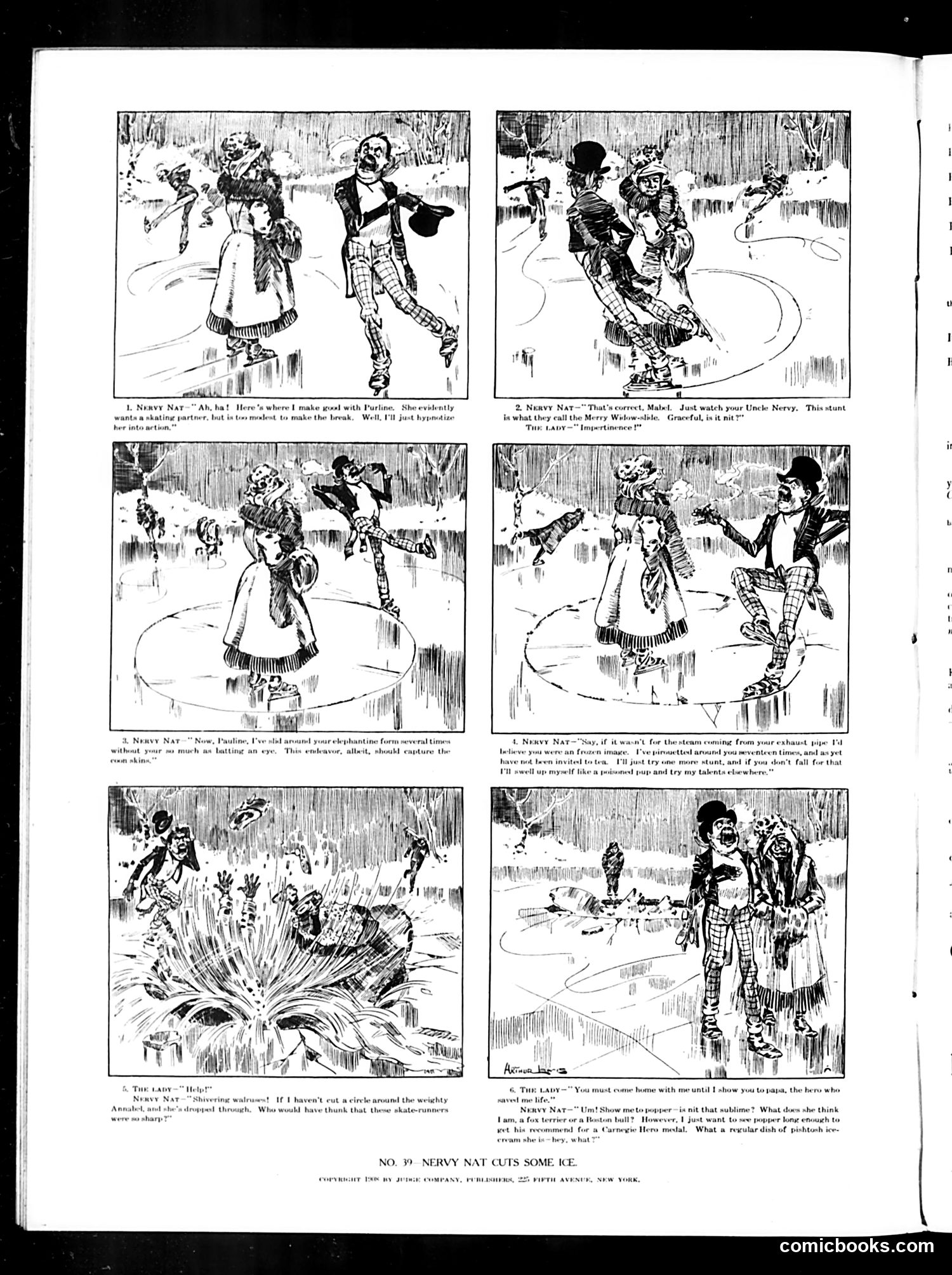
This is a comic strip featuring "Nervy Nat," a character who appears to be a working-class or street youth attempting to impress a woman (referred to as "The Lady") through ice-skating. The humor relies on slapstick: Nat repeatedly falls or loses control on the ice despite boasting about his skating abilities. The satire mocks male overconfidence and pretension—Nat claims expertise he clearly lacks, trying to appear sophisticated to attract the lady while spectacularly failing. The "nervy" characterization suggests someone brash or impudent, attempting feats beyond his station. This reflects early 20th-century American humor about class aspiration and masculine bravado undermined by physical comedy. The strip's multiple panels build comedic timing through escalating failures.
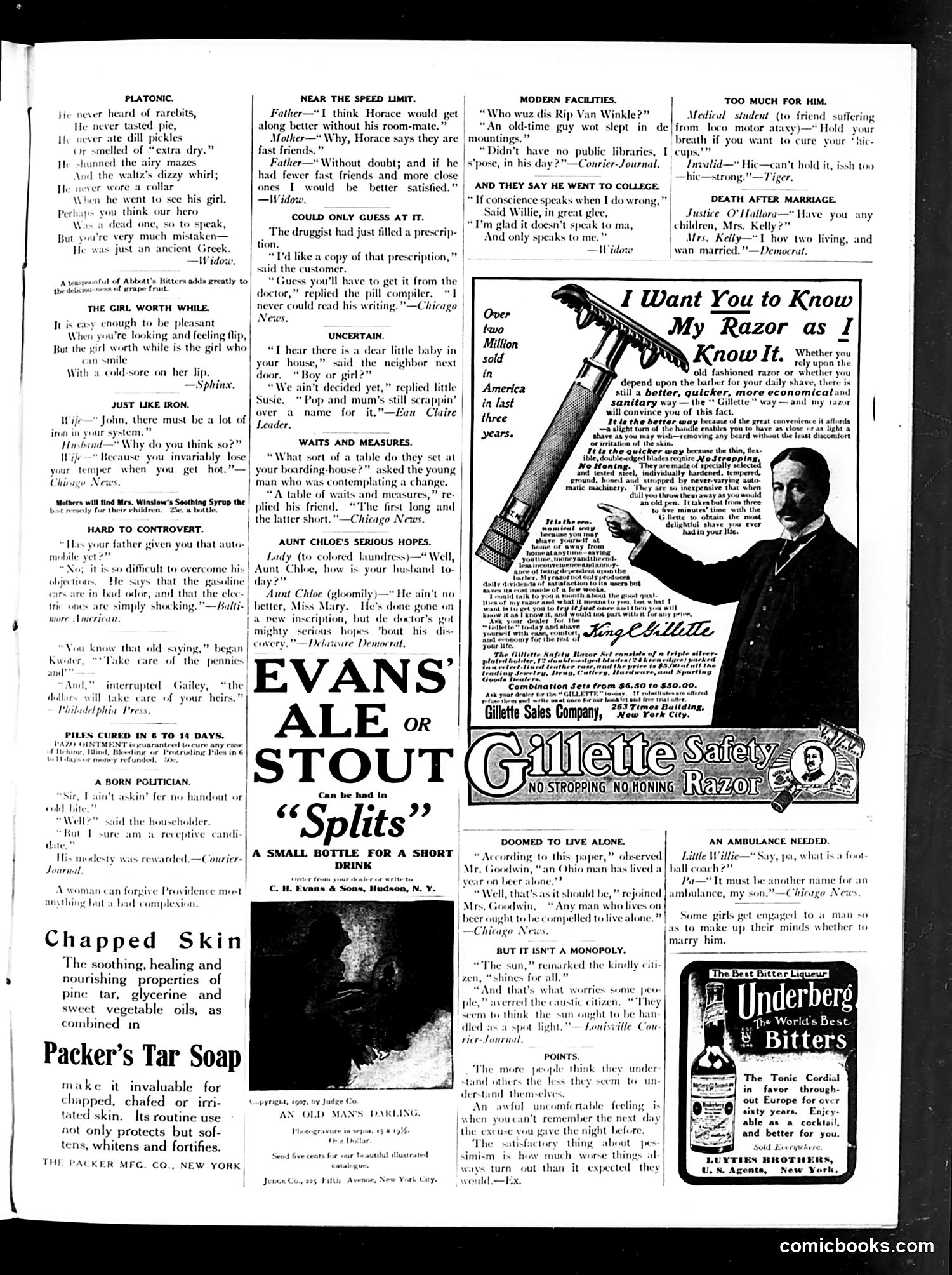
This page from *Judge* magazine contains various short humorous pieces typical of early 20th-century American satire. The cartoons and jokes mock everyday social situations: **"Platonic"** satirizes an overly innocent suitor who avoids worldly pleasures—a jab at excessive prudishness. **"Near the Speed Limit"** jokes about a father's complaint that his son's friend group enables reckless behavior ("fast friends"). **"The Girl Worth While"** humorously inverts expectations by praising a girl who smiles despite having a cold sore—mocking sentimentality about feminine virtue. Other pieces target domestic life ("Just Like Iron" about a husband's temper), social climbing, and incompetent professionals (the druggist's illegible handwriting). The dominant feature is a **Gillette Safety Razor advertisement** with an illustrated man and lengthy marketing copy emphasizing the razor's superiority and economy—typical of period advertising's verbose, benefit-heavy approach. The page reflects *Judge*'s focus: gentle satire of middle-class manners and social conventions, paired with patent medicine and consumer product advertising.
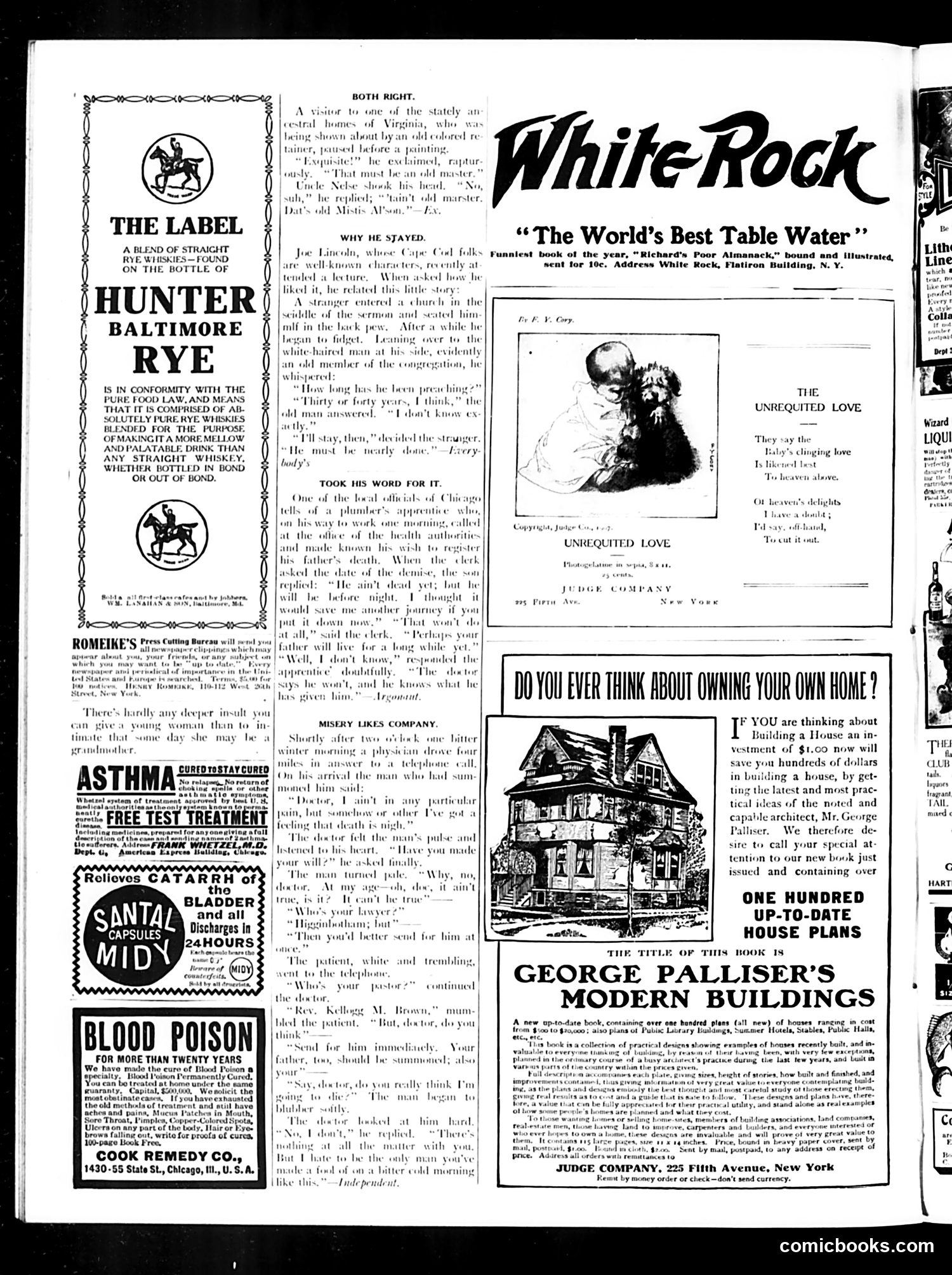
This is primarily an **advertising and miscellaneous content page** from Judge magazine, not a political cartoon page. The left side features ads for products (Hunter Baltimore Rye whiskey, asthma treatments, blood poison cures) alongside three brief humorous anecdotes typical of the era. The three short jokes employ **racial stereotypes and dialect humor** common to early 20th-century American publications: 1. "Both Right" features an enslaved person ("old Mistis Af'son"), playing on nostalgia for the antebellum South 2. "Why He Stayed" uses exaggerated Black dialect ("Dat's old Mistis") in a church story 3. "Took His Word for It" involves a misunderstanding about death timing The right side advertises **George Palliser's architecture book** and White Rock table water. These anecdotes and ads reflect period attitudes rather than sophisticated satire—they're mild humor relying on caricature and linguistic mockery acceptable to Judge's contemporary audience.
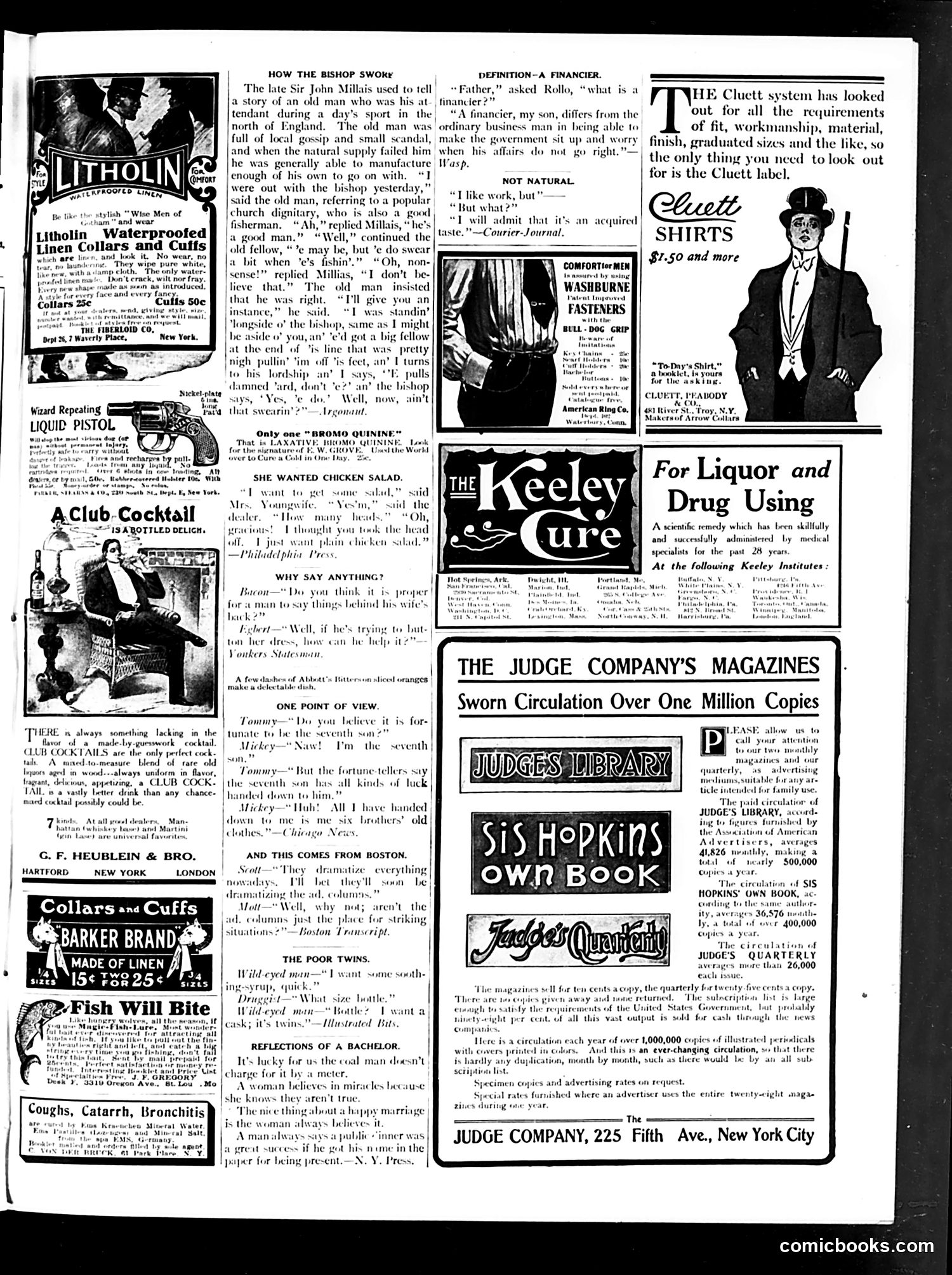
This is primarily an **advertising and humor page** from Judge magazine, not a political cartoon page. The content consists of: **Humorous anecdotes** (non-political): - "How the Bishop Swore" — a story about a gossipy old man claiming a bishop cursed while fishing - "Definition — A Financier" — a joke about government worries - Various short jokes about marriage, fortune-telling, and domestic life **Advertisements** dominate the page, promoting: - Litholin waterproofed collars and cuffs - Club Cocktails (pre-mixed drinks) - Cluett shirts - Barker Brand linen collars - Various patent medicines **Social humor** reflects early 20th-century middle-class concerns: wives' spending, marital dynamics, servant gossip, and consumer products. There is **no apparent political satire or social commentary** on this page — it's primarily commercial advertising interspersed with lighthearted domestic humor typical of the era's general-interest magazines.
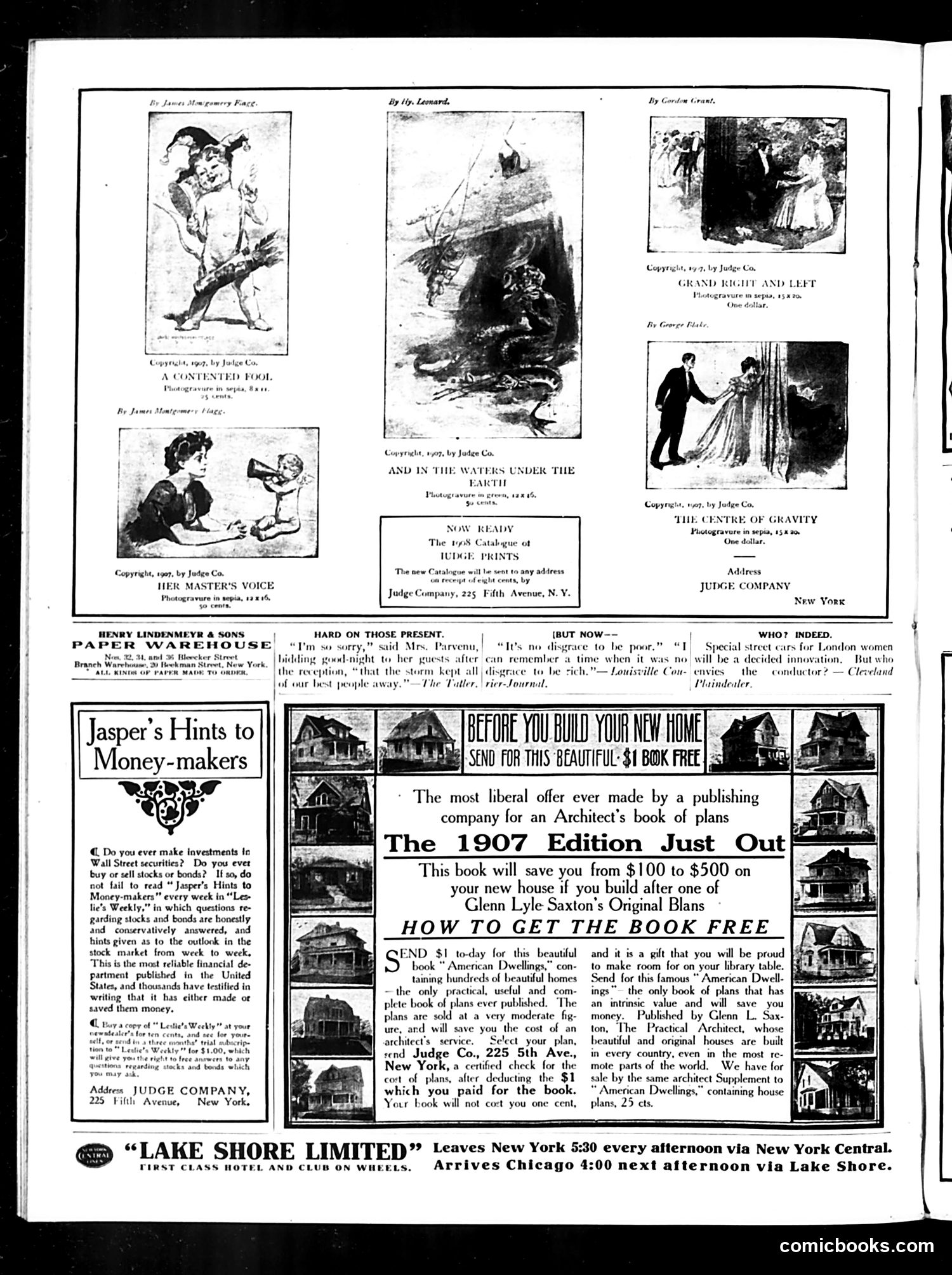
This page is primarily **advertising and promotional content** rather than political commentary. The upper portion showcases photogravure illustrations from Judge's 1907 catalog—small reproductions of artworks available for purchase, including pieces titled "Grand Right and Left," "Her Master's Voice," and "The Centre of Gravity." The satirical content is minimal: three brief one-liner jokes appear mid-page. "Hard on Those Present" mocks wealthy social climbers (a "Mrs. Parvenu") caught in an embarrassing situation. "But Now" and "Who? Indeed" contain mild social commentary about London's proposed women-only street cars. The remaining space features advertisements: Jasper's investment tips, the 1907 edition of Glenn Lyle Saxton's architectural home-design book (offered free for $1), and the Lake Shore Limited railway service. **For modern readers:** This reflects how 19th-century magazines blended editorial content with advertising to sustain publication.
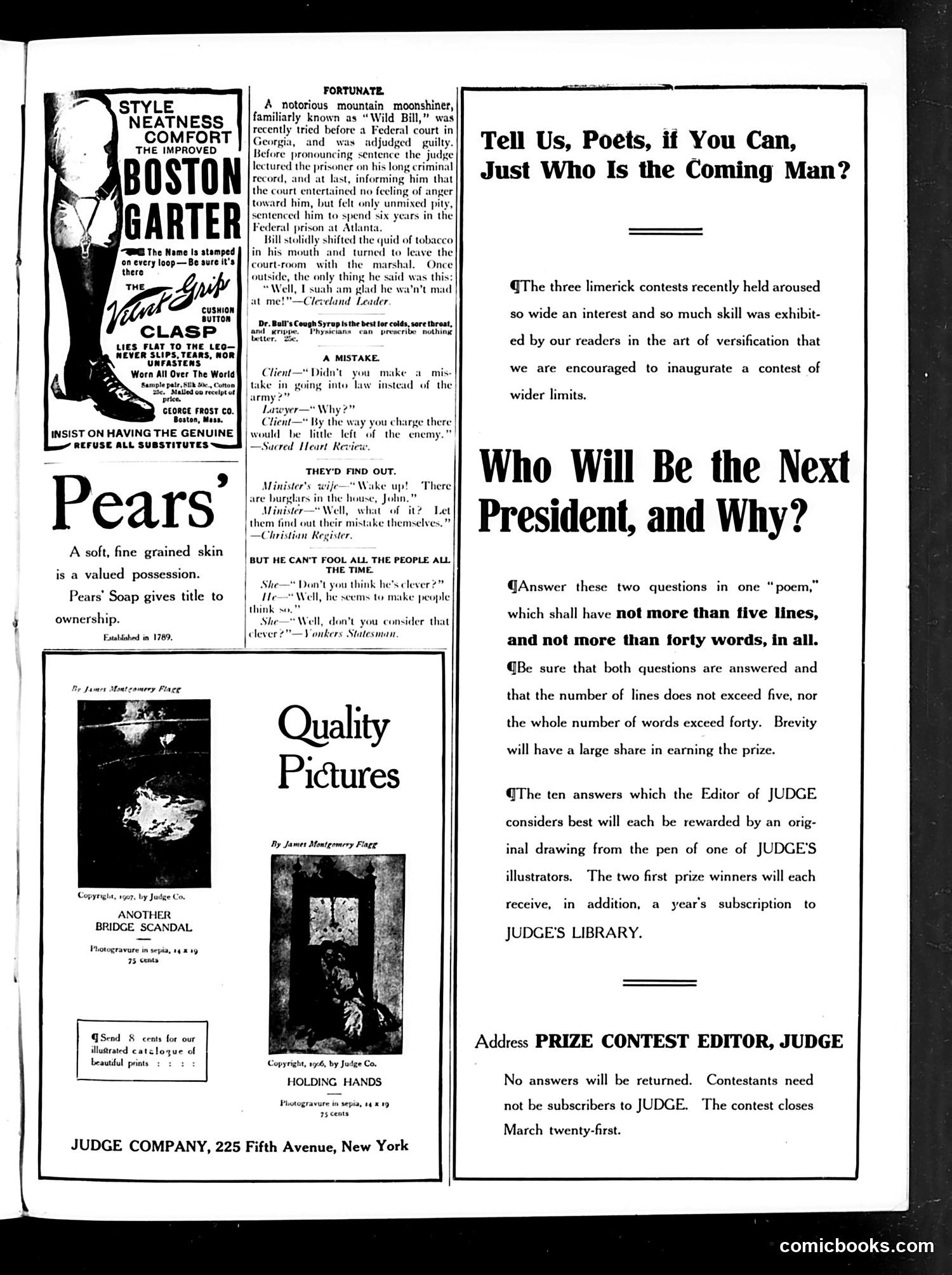
This page is primarily **advertising and contest announcements** rather than editorial cartoons. The left side features product ads (Boston Garter, Pears' Soap, and art prints) and brief humorous anecdotes—including one about "Wild Bill," a moonshiner sentenced to six years in federal prison who expresses relief the judge wasn't angry with him. The right side announces a **poetry contest** asking readers to answer two questions in verse: "Who Will Be the Next President, and Why?" Entries must not exceed five lines or forty words total. The contest promises original illustrations by Judge's artists and year-long subscriptions as prizes, closing March 21st. The contest indicates this is from the **pre-election period** (likely 1908 or 1912), when such presidential speculation contests were popular magazine features. No specific candidate or political controversy is evident on this page—it's largely a reader-engagement mechanism typical of early-20th-century periodicals.
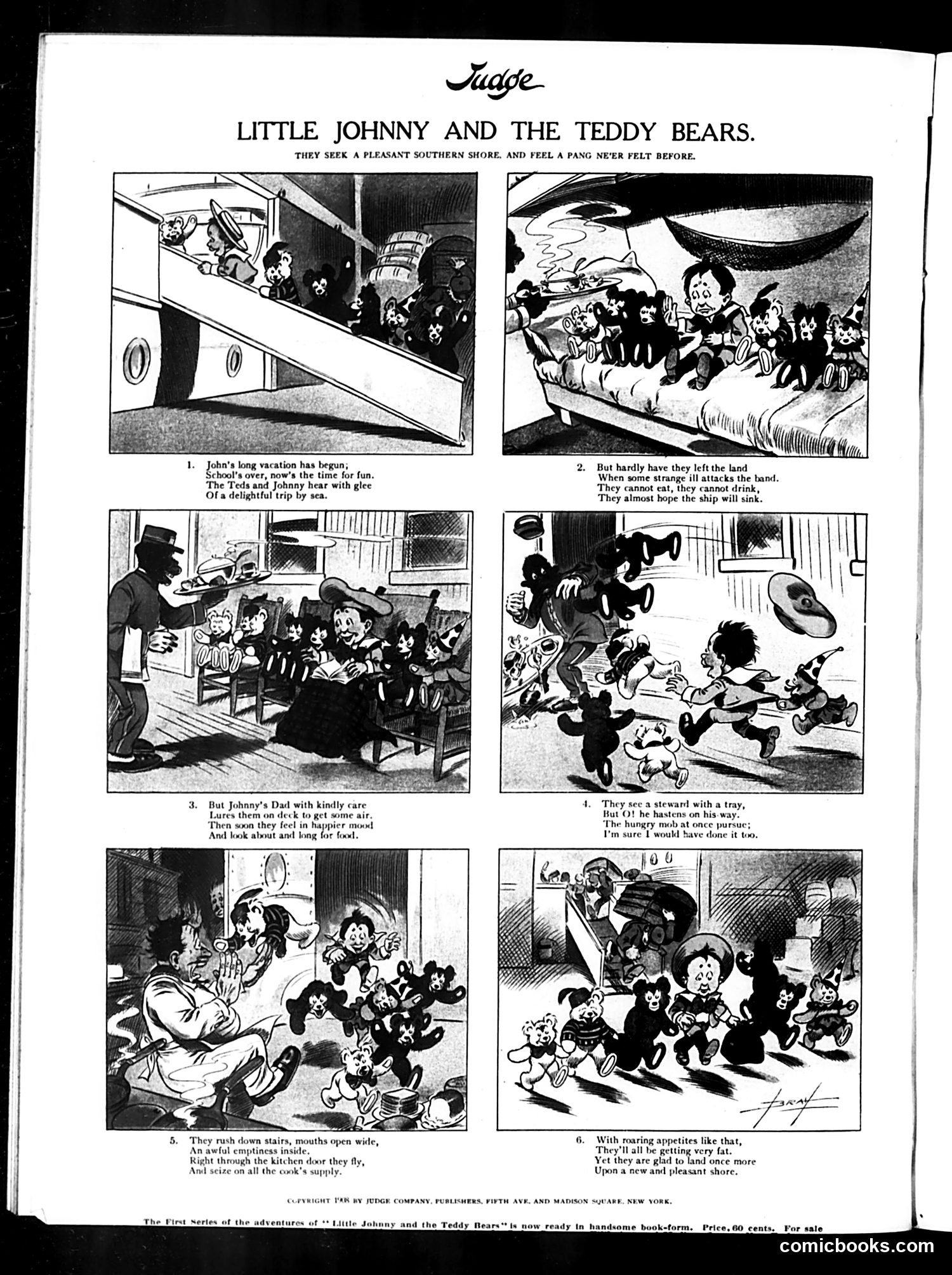
This is a children's adventure comic strip, not political satire. It follows Little Johnny and anthropomorphic teddy bears on a seaside vacation that goes awry. The plot: The group embarks on a pleasant boat trip but is struck by mysterious illness—they cannot eat or drink and grow desperately hungry. A steward with a food tray frustrates them by hurrying past. The hungry children pursue him through the ship in comedic chaos. Eventually they land on a pleasant shore, their appetites restored and spirits recovered. The "joke" is simply the physical humor of seasickness and ravenous hunger afflicting the young travelers. There's no apparent political commentary—it's straightforward entertainment for Judge magazine's readers, likely appealing to families. The title references the then-popular "Teddy Bear" toys (named after President Theodore Roosevelt), making it timely consumer culture content rather than satire.