
A complete issue · 16 pages · 1908
Judge — February 29, 1908
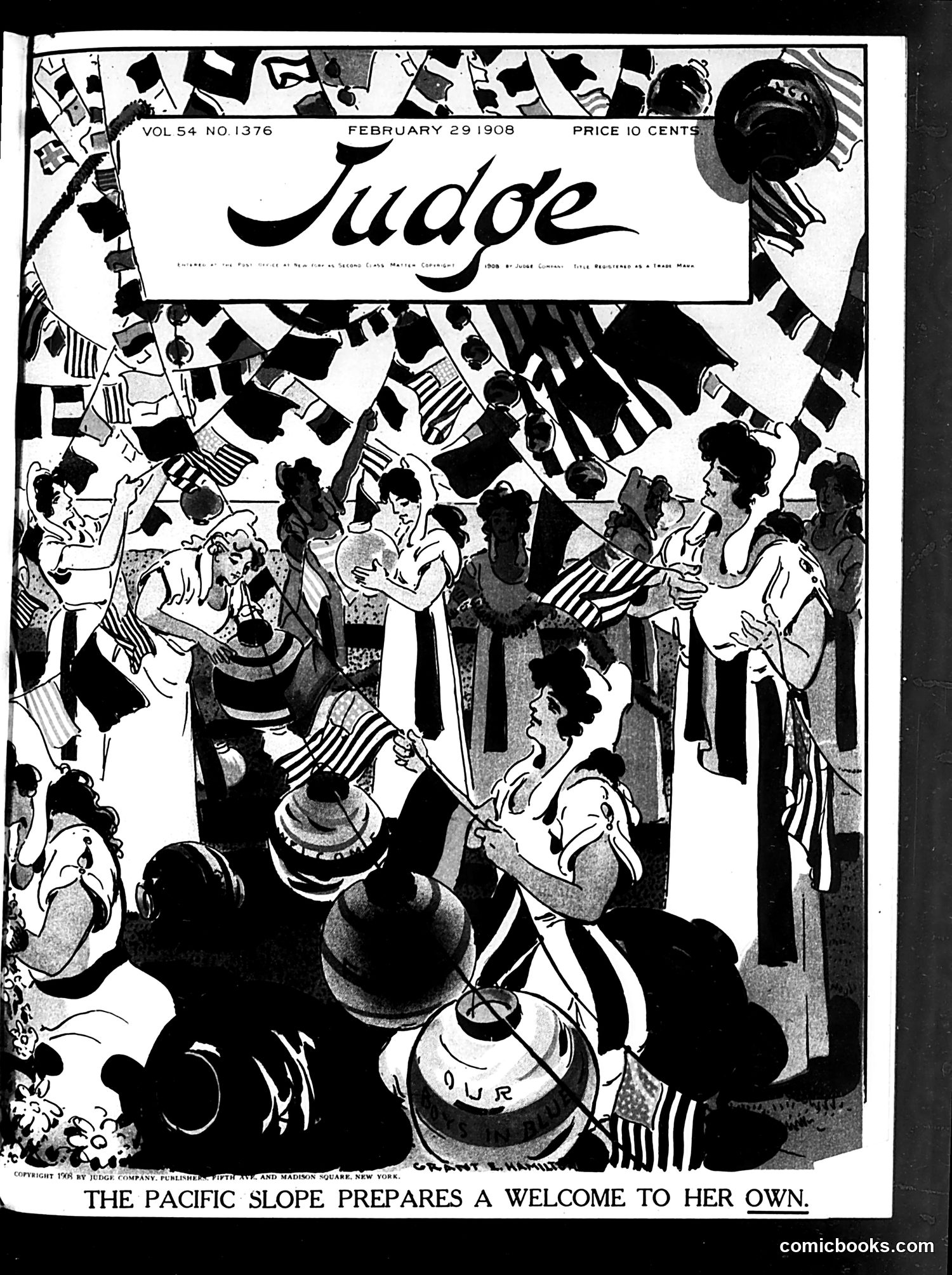
**Title:** "The Pacific Slope Prepares a Welcome to Her Own" This cover depicts a jubilant crowd waving American flags in what appears to be a celebration on the Pacific Coast. The caption suggests this relates to a significant arrival or homecoming event in 1908. Given the date and context, this likely references the **Great White Fleet**—Theodore Roosevelt's famous naval fleet that completed a round-the-world voyage in February 1908, returning to the Pacific Coast. The illustration satirizes the patriotic fervor and public enthusiasm surrounding the fleet's return home, showing Americans celebrating what was presented as a demonstration of American naval power and prestige. The crowded, exuberant scene captures period attitudes toward American naval expansion and global influence.
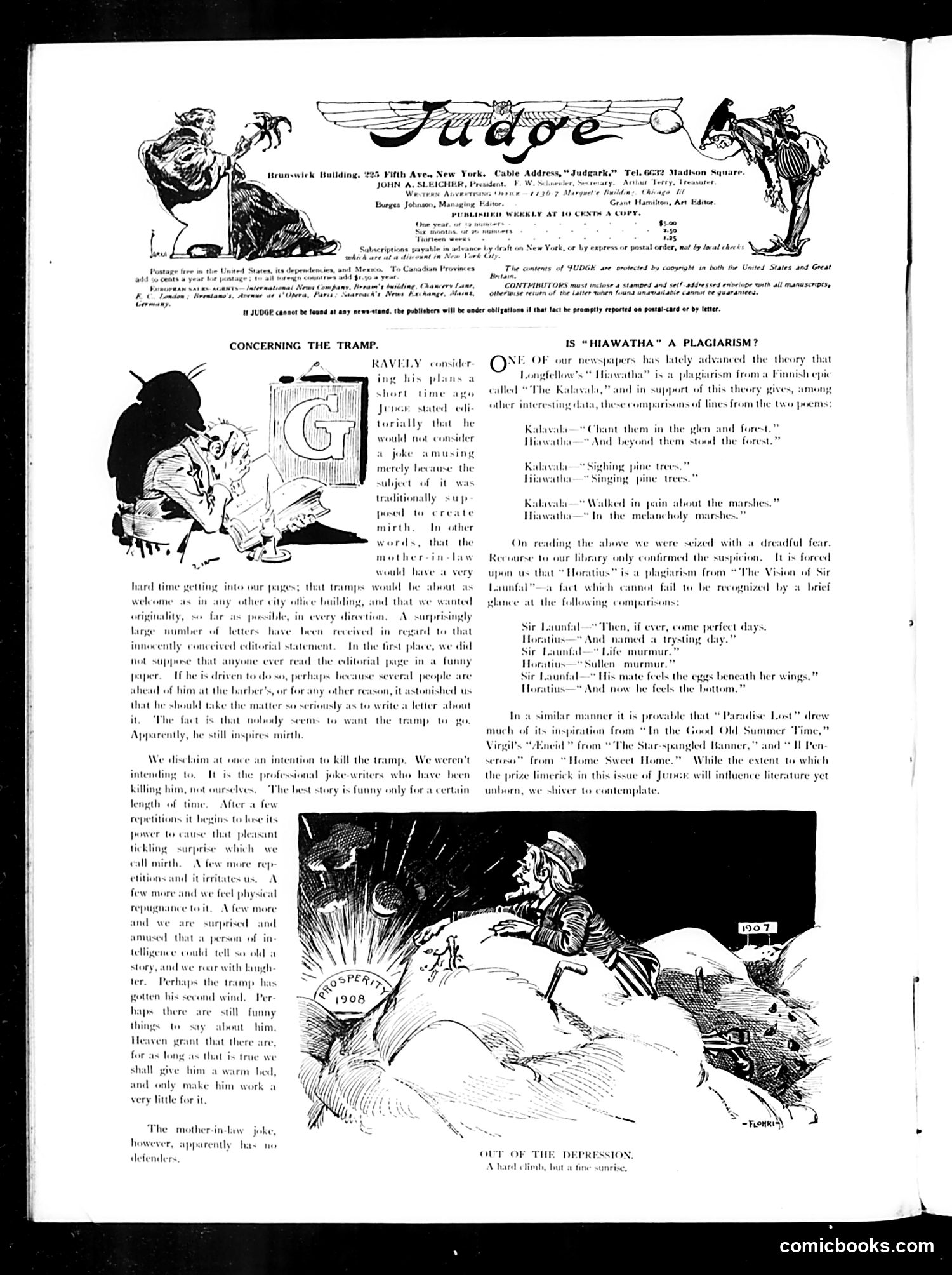
This page from Judge magazine contains two distinct sections: **"Concerning the Tramp"** (left): A humorous editorial defending the magazine's satirical treatment of tramps/hobos. The editors argue they weren't trying to genuinely harm anyone—just create entertainment. They note that repeated criticism has made them lose the surprise value of the joke. **"Is 'Hiawatha' a Plagiarism?"** (right): Compares passages from Longfellow's "Hiawatha" with a Finnish epic called "The Kalevala," suggesting the American poem borrowed heavily from the source material. The parallel passages shown make this plagiarism accusation concrete. **The Cartoon**: "Out of the Depression" (bottom) depicts a figure emerging from economic hardship—likely referencing the 1907 financial panic, with dates marked showing economic recovery timeline.
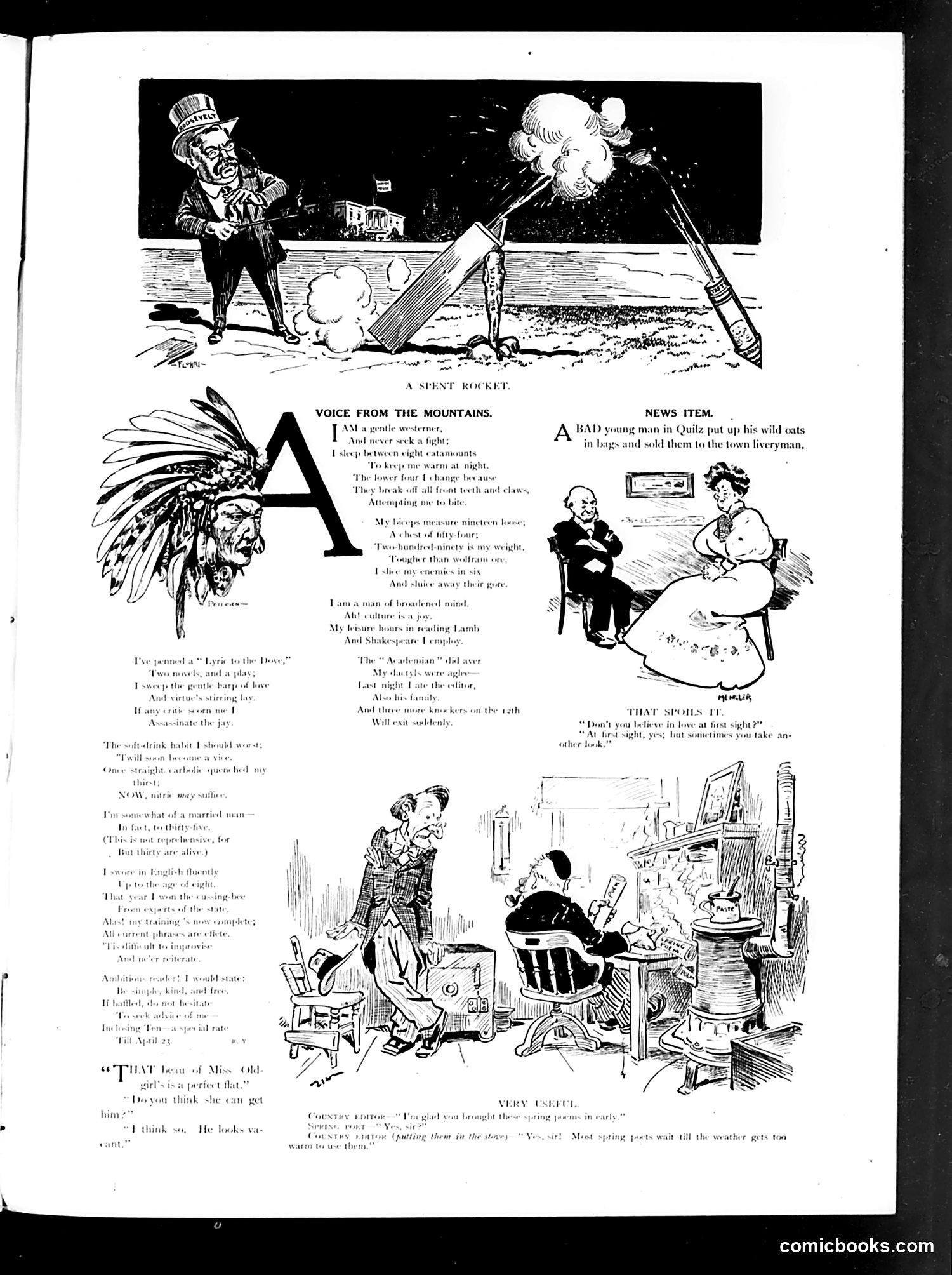
The top cartoon depicts two figures: one appears to be Uncle Sam (identifiable by his top hat), confronting another caricatured figure labeled as representing a "spent rocket"—likely referencing a failed political initiative or campaign that has exhausted its momentum. The poem "Voice from the Mountains" presents a first-person monologue from what appears to be a Western prospector or miner, boasting of frontier toughness and independence while criticizing Eastern establishment culture and pretense. The other illustrated sections include domestic humor scenarios ("That Spoils It," "Very Useful") depicting everyday social situations, typical of Judge's mix of political satire and general comedy. Without clearer dating or context, the specific political reference remains unclear.
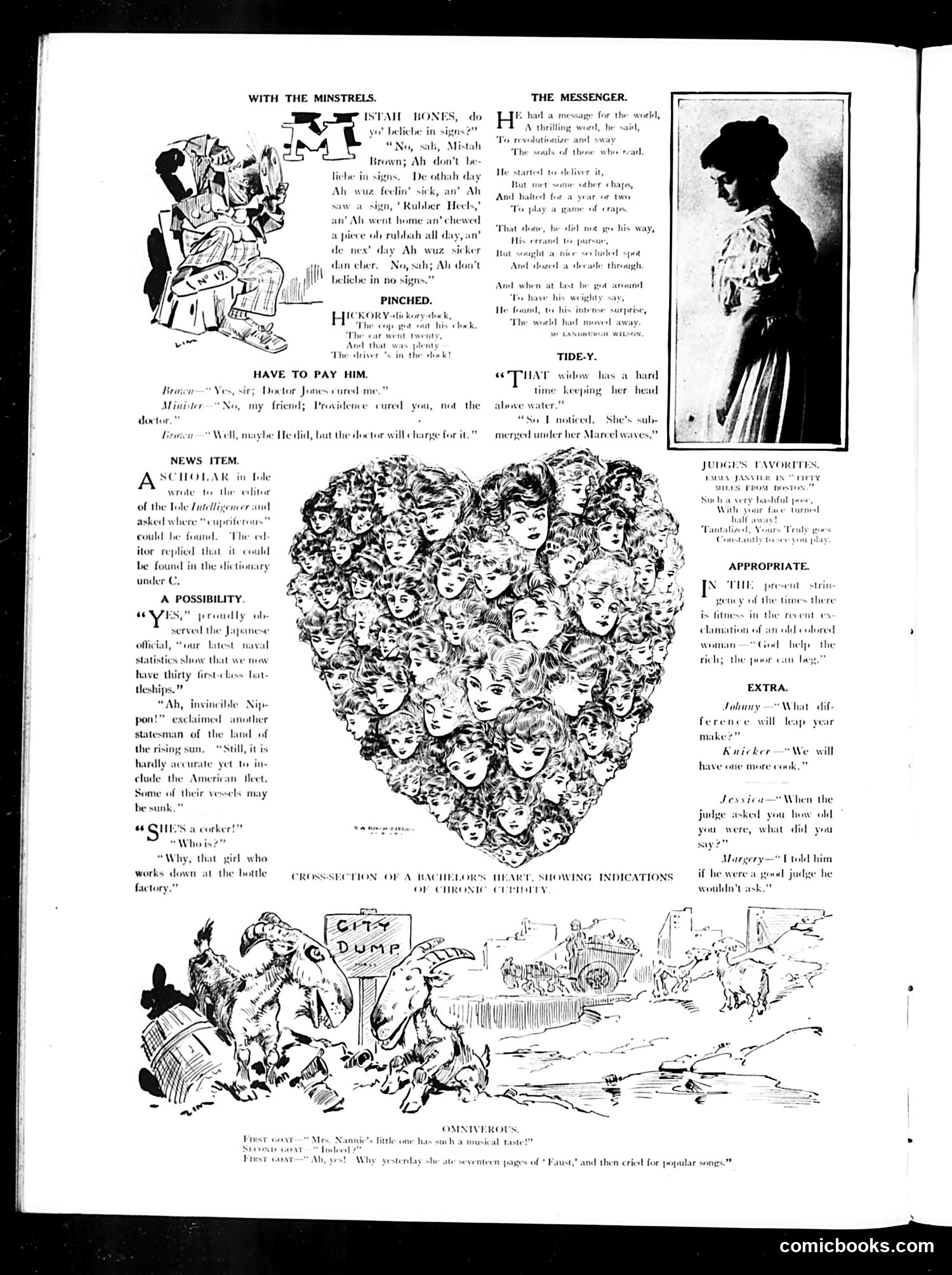
This page contains various humorous short pieces and illustrations typical of Judge's satirical humor. The central large illustration shows a heart composed of many faces, captioned "CROSS-SECTION OF A BACHELOR'S HEART, SHOWING INDICATIONS OF CHRONIC CUPIDITY"—mocking men who pursue multiple romantic interests simultaneously. The lower cartoon, "OMINOUS," depicts goats at a "City Dump" with a caption about Mrs. Nanny's "musical taste," punning on the term "nanny goat." The page's other content includes brief comedic dialogues and poems addressing domestic life, naval statistics, and romantic misadventures—standard Judge fare satirizing American society, gender relations, and contemporary manners without specific political references. The humor relies on wordplay and stock situations rather than topical events.
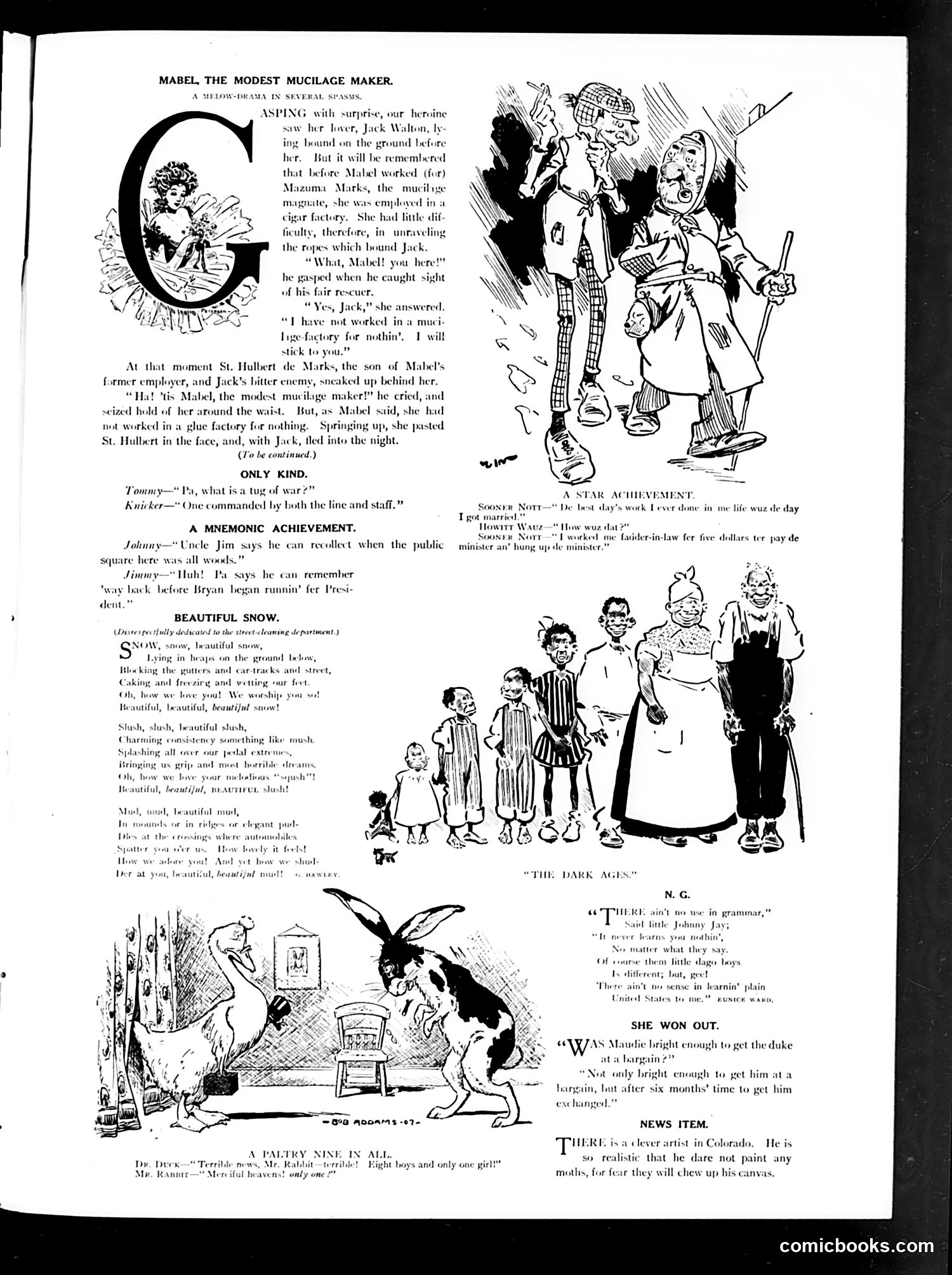
This page contains several unrelated satirical pieces rather than a single coherent cartoon. **"Mabel, the Modest Mucilage Maker"** is a serialized story about a woman working in a glue factory. The humor appears to derive from mild innuendo about her modest nature and factory work. **"A Star Achievement"** mocks workplace conversations, with characters bragging about minor accomplishments. **"Beautiful Snow"** is a sentimental poem about snow, likely parodying overly romantic Victorian verse. **"The Dark Ages"** presents a woman with multiple children in poor conditions—likely social commentary on poverty or large families. **"A Poultry Nine Is All"** shows animals playing baseball, a straightforward absurdist joke. **Other sections** include brief humorous observations about grammar and a news item about a realistic painter in Colorado. The page reflects Judge's mix of gentle domestic humor and social observation typical of early 20th-century American satire.
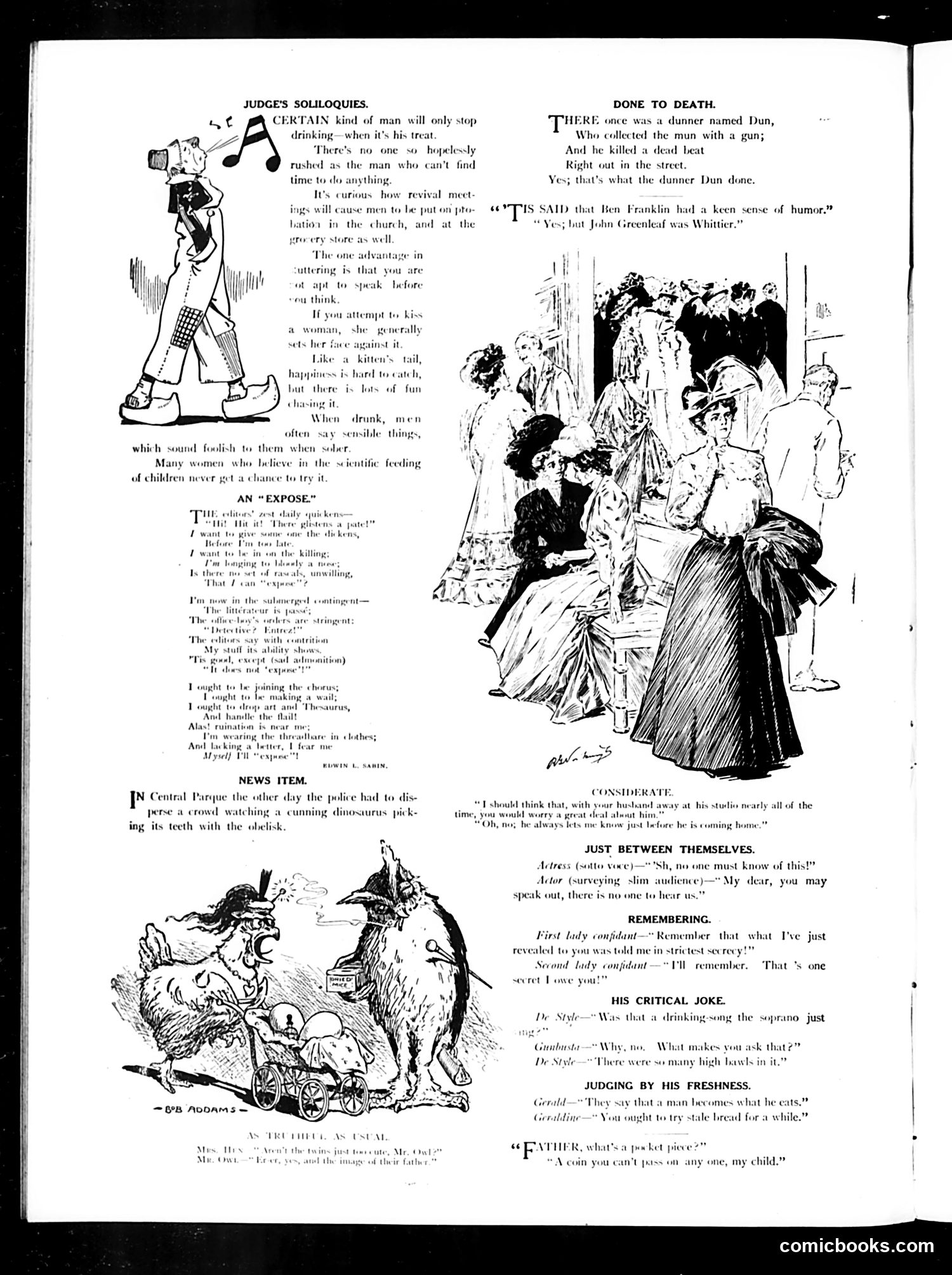
This page from the satirical magazine *Judge* contains multiple short humorous pieces targeting social pretensions and human foibles circa early 20th century. **Key content:** - **"Judge's Soliloquies"**: Observations on drinking, revival meetings, and the scientific feeding of children—mocking bourgeois earnestness. - **Ben Franklin/John Greenleaf Whittier reference**: A joke implying Whittier lacked Franklin's humor, likely reflecting contemporary literary reputation debates. - **"News Item" dinosaur cartoon**: References a real Central Park incident, humorously depicting police managing crowds around an unusual spectacle. - **Remaining vignettes**: Satirize theatrical pretension ("Just Between Themselves"), romantic secrecy, musical snobbery, and gender stereotypes about diet and character. The humor relies on class anxiety, literary celebrity gossip, and assumptions about proper behavior—concerns recognizable to *Judge's* middle-class readership. The overall tone is gently mocking rather than politically pointed.
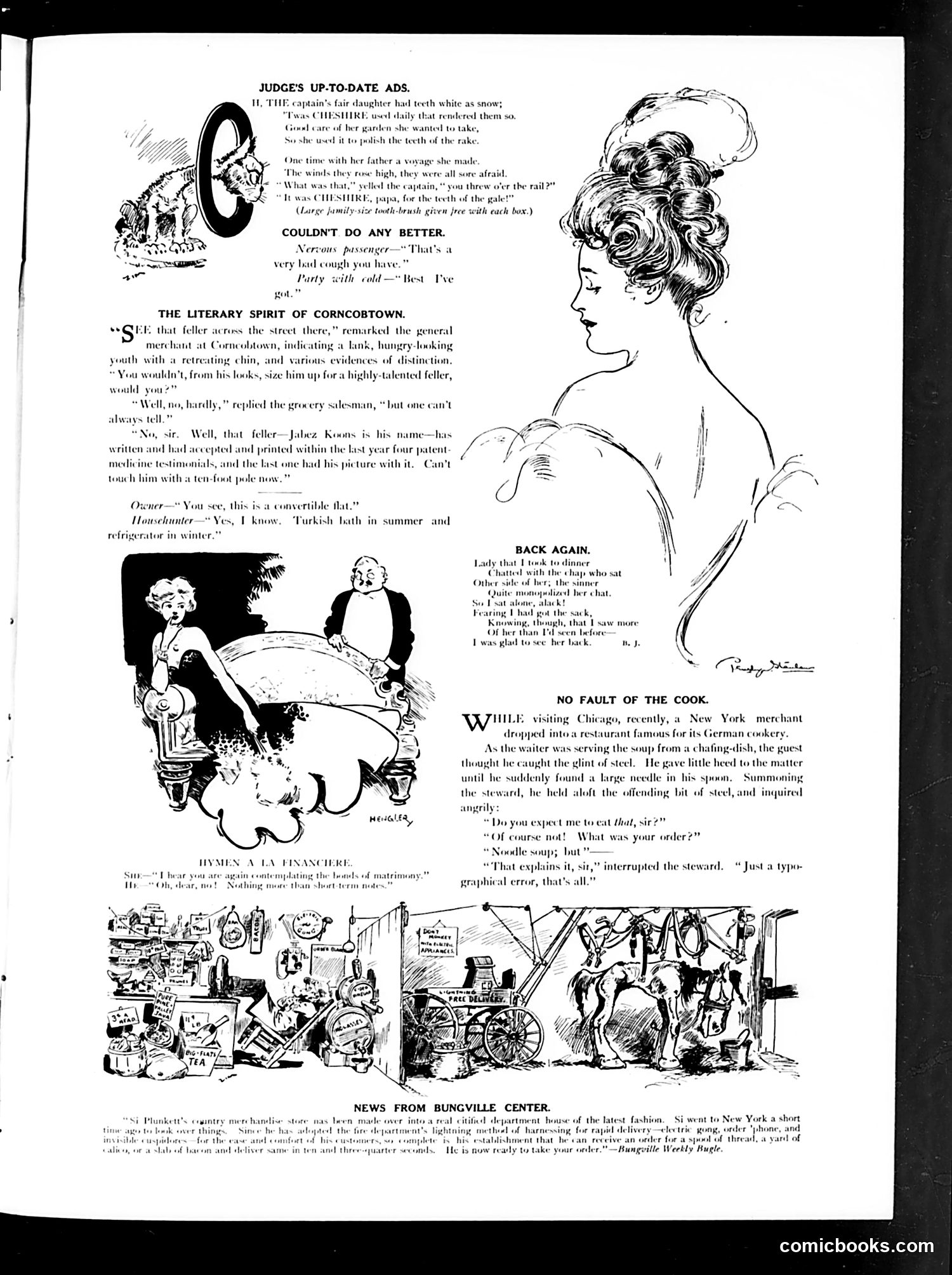
This page contains multiple short humorous pieces targeting turn-of-the-century American consumer culture and small-town life: **"Cheshire Toothbrush" ad-parody**: Mocks patent medicine advertising by presenting an absurd product endorsement wrapped in a nautical anecdote—typical of the era's exaggerated testimonial ads. **"Corncobtown" sketch**: Satirizes rural ambition and credibility through Jabez Koons, a nobody who becomes locally famous after four patent-medicine testimonials and a photograph appear in print. The joke: his sudden status despite his obvious lack of talent reflects how advertising and mass printing could manufacture reputation. **"Noodle Soup" joke**: Mocks German restaurant pretension in Chicago by literalizing "noodle soup"—a needle appears in the bowl. The steward's dismissal as mere "typographical error" satirizes corporate indifference to customer harm. **Minor jokes**: Further mock nervous hypochondria and real-estate marketing language. Throughout, Judge ridicules emerging mass-marketing techniques, consumer gullibility, and how print media could manufacture false prestige.
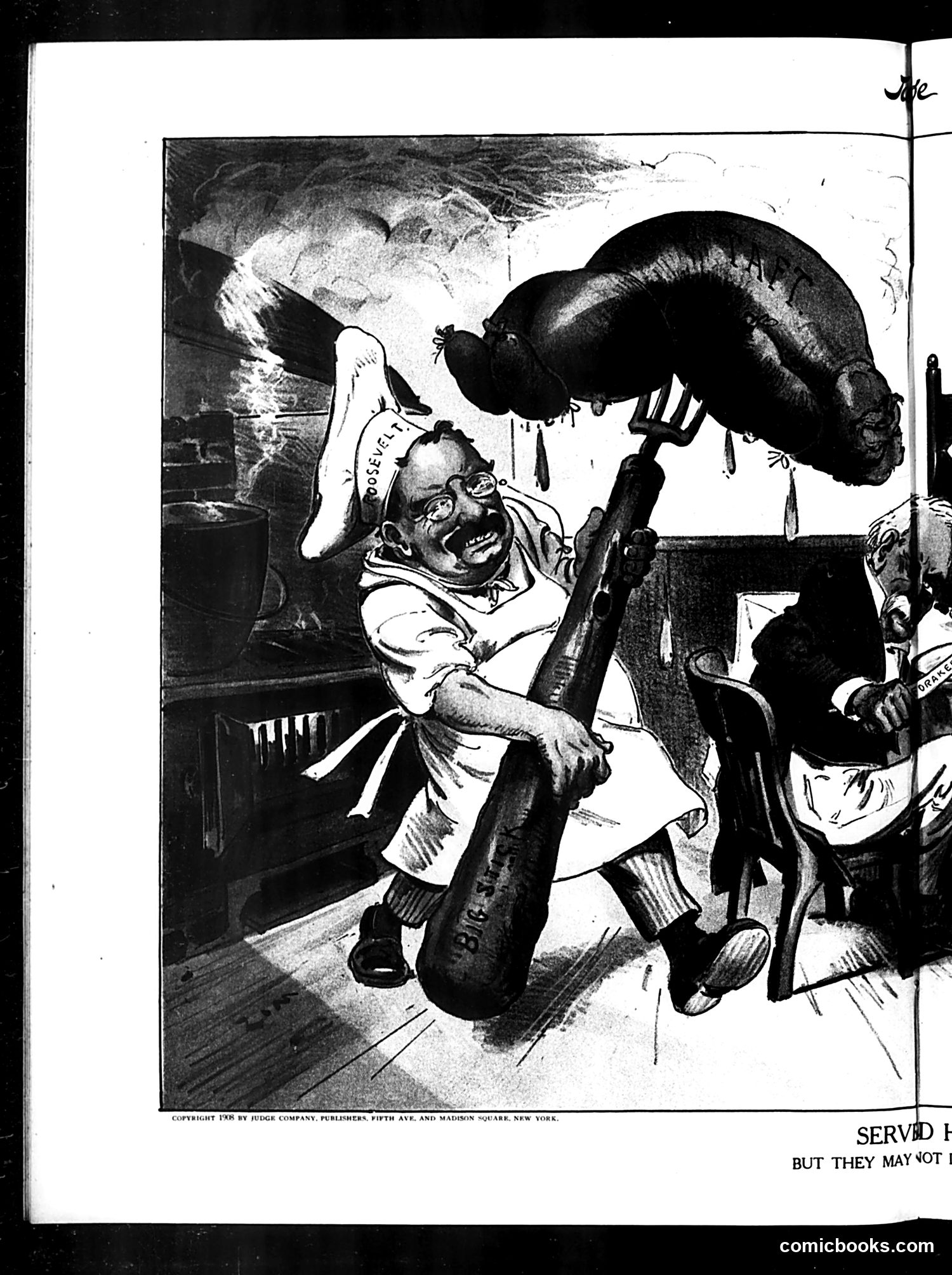
This appears to be a satirical cartoon from *Judge* magazine showing a caricatured figure (likely a politician or public figure) wielding a large rifle while confronting an enormous insect or pest. The figure wears glasses and appears distressed or grimacing. The incomplete OCR text ("SERVED |" and "BUT THEY MAY NOT |") suggests the caption's full meaning is cut off, making the specific political reference unclear. However, the composition suggests commentary on either: - Military action or warfare (the rifle) - Pest control as metaphor for addressing a social/political problem - The difficulty or unintended consequences of attempted solutions Without the complete caption and publication date, I cannot identify the specific figure or historical event being satirized. The exaggerated proportions typical of *Judge*'s style are evident throughout.
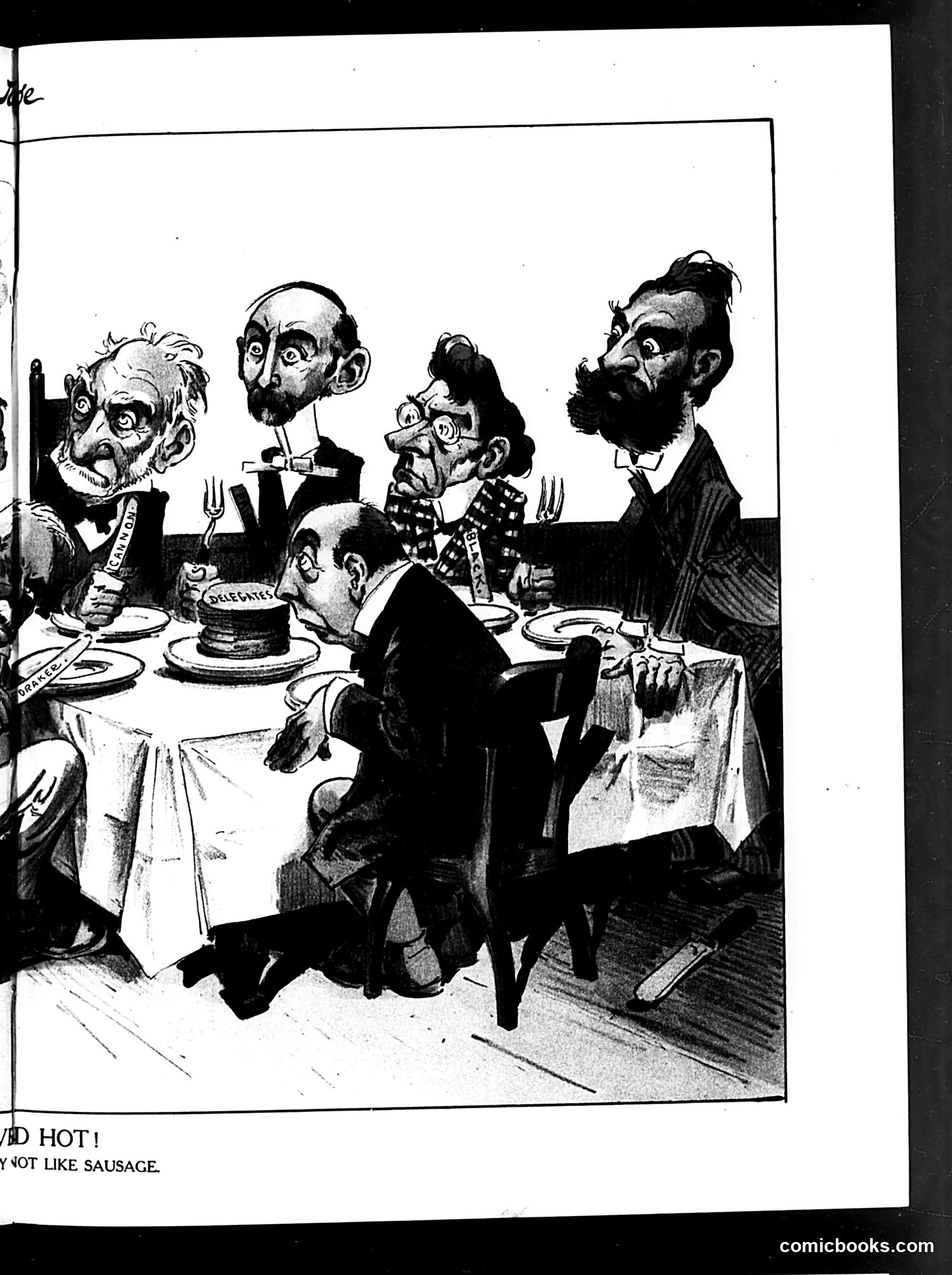
This appears to be a satirical dining scene from Judge magazine featuring five exaggerated male caricatures seated at a formal dinner table. The visible text reads "HOT!" and "NOT LIKE SAUSAGE," suggesting commentary on food—likely a pun or metaphor for a political or social topic. The caricatures display grotesque facial features typical of late 19th/early 20th-century satirical art. Without clearer identifying marks or additional context, I cannot definitively identify the specific figures or the precise political situation being mocked. The formal dinner setting and the reference to "sausage" suggest either a critique of dining habits among politicians or a metaphorical commentary on something considered "indigestible" to the depicted group. The cartoon's exact meaning remains unclear without additional historical documentation.
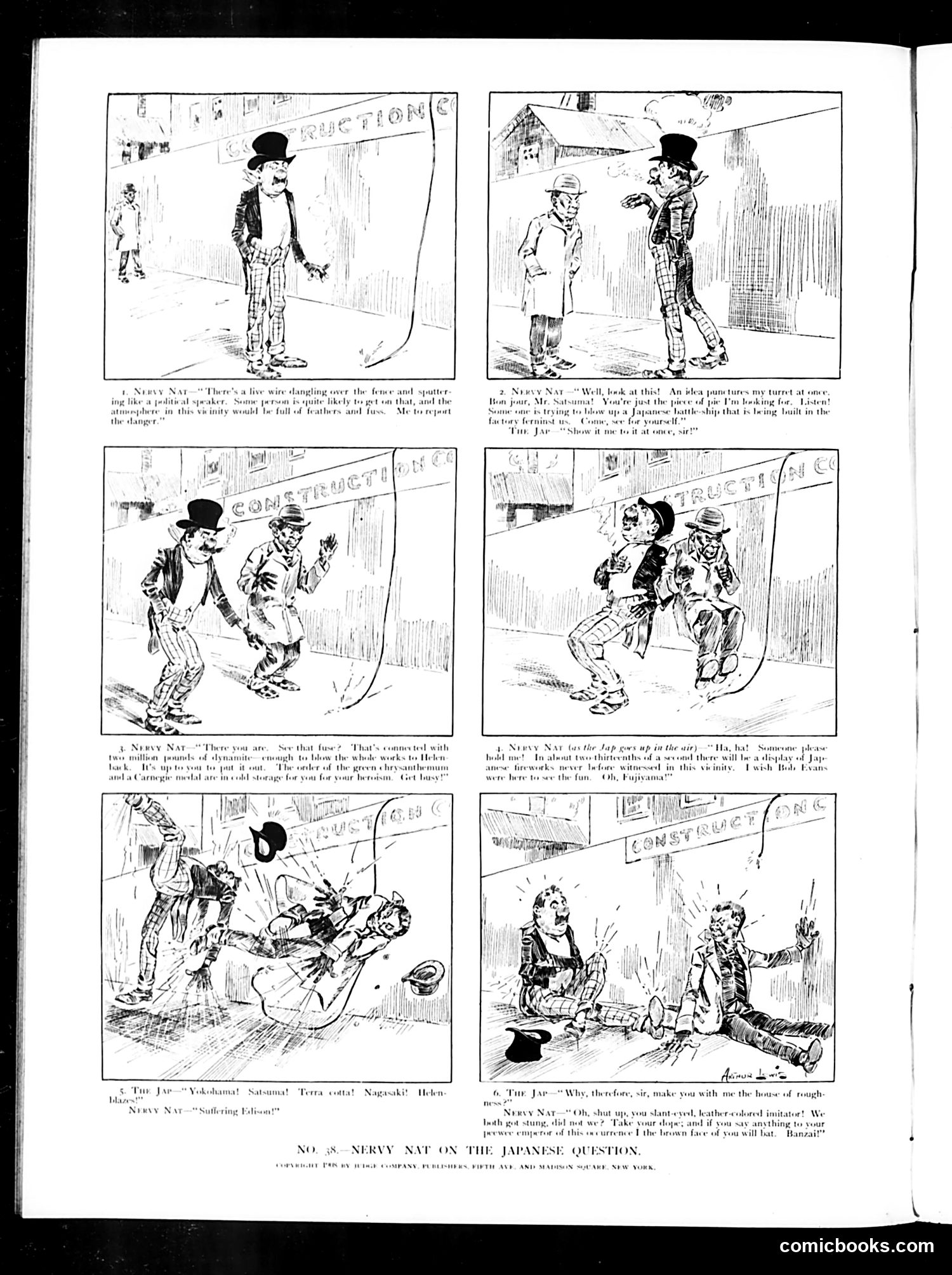
This comic strip satirizes diplomatic tensions between America and Japan, likely from the early 1900s when Japanese-American relations were strained. The protagonist "Nervy Nat" (a character type known for brash behavior) encounters a Japanese man and engages in a comedic misunderstanding, with dialogue mixing English and Japanese phrases. The humor relies on ethnic caricature typical of the era—exaggerated facial features and broken English. The satire mocks both American ignorance about Japan and the absurdity of cross-cultural miscommunication during a period of real geopolitical anxiety. "Nervy Nat" represents the loud, tactless American abroad, while the Japanese character represents the "foreign other." The strip trivializes serious diplomatic issues through slapstick humor common to Judge magazine's satirical approach.
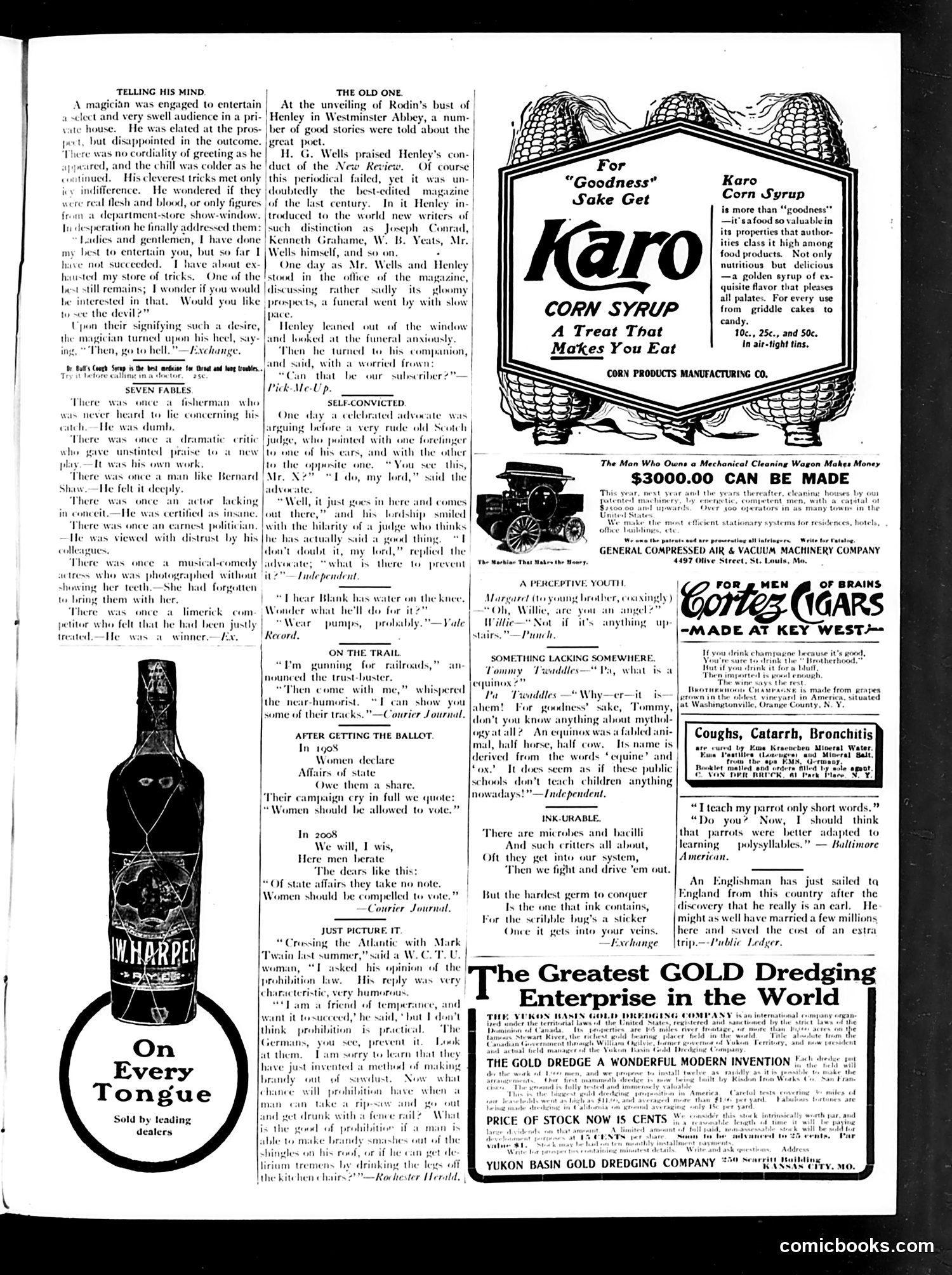
This page contains primarily **advertisements and humor columns** rather than political cartoons with clear satirical targets. The main illustrated content shows: 1. **"On Every Tongue"** (left): A bottle advertisement, likely for alcohol given Prohibition-era references in surrounding text about "drinking." 2. **Seven Fables** (center-left): Satirical one-liners mocking various professions—a dumb fisherman, a self-promotional dramatic critic, a vain actor, and an earnest politician viewed with distrust. These are gentle social satire about human nature rather than specific political targets. 3. **Multiple advertisements**: Karo Corn Syrup, Cortes Cigars, gold dredging company stock, and a mechanical cleaning wagon business—typical period advertisements. The page lacks specific political figures or events to satirize. Instead, it's primarily **commercial space mixed with light, misanthropic humor** about character types. The few cartoon vignettes target universal human flaws rather than topical politics.
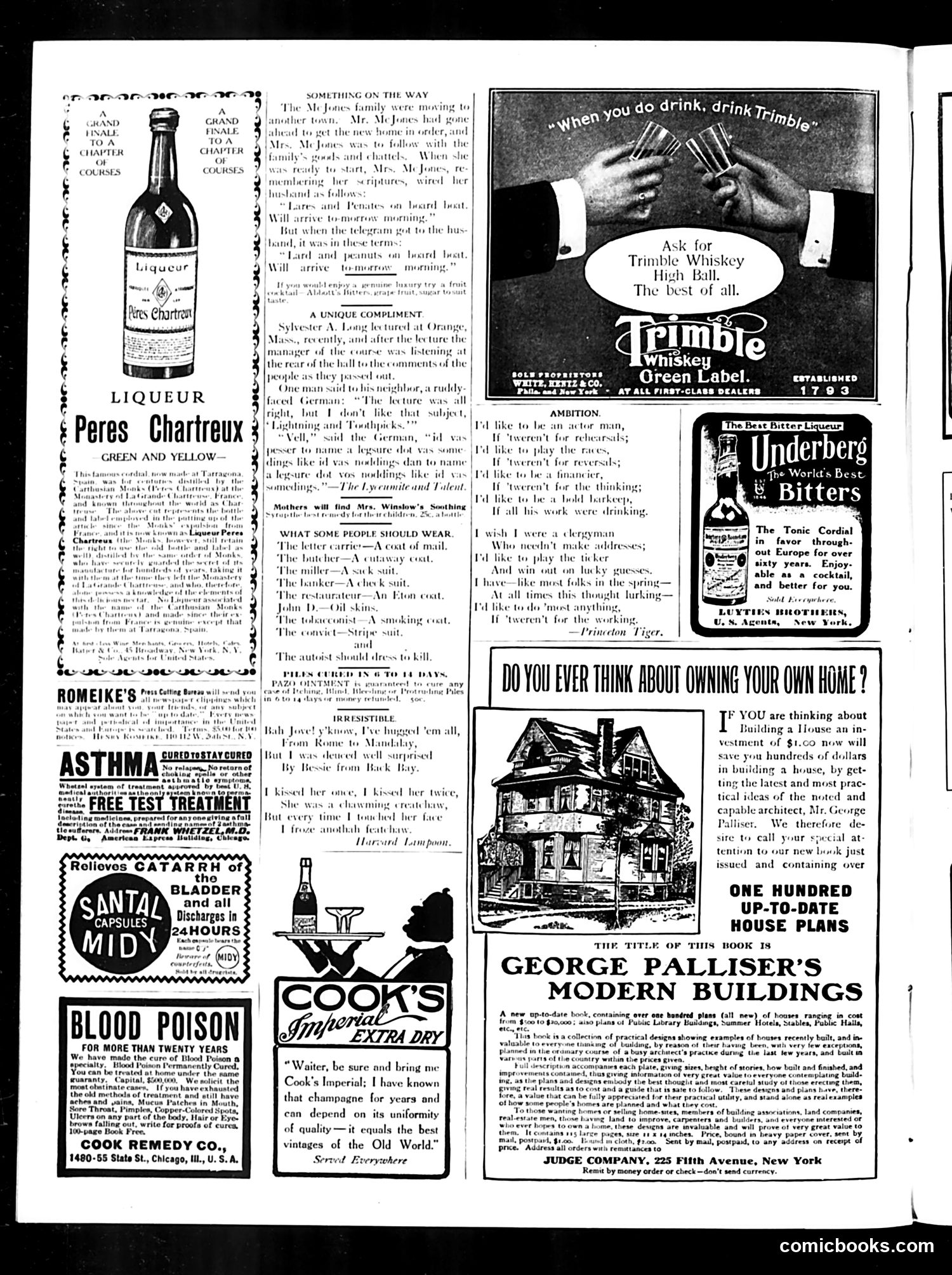
This is primarily a **page of advertisements** with some light humor pieces interspersed—typical of Judge magazine's format. **Key content:** The ads reflect early-20th-century concerns: patent medicines (blood poison cures, asthma treatments), alcoholic beverages (liqueurs, whiskeys, bitters—heavily advertised despite Prohibition-era tensions), and home-building guides. **The humor pieces** include: - "Something on the Way": A domestic joke about a wife wiring her husband about arriving with "lares and penates" (Roman household gods), which the telegraph mistranslates, creating wordplay confusion. - Verse about wishing to do various jobs "if 'tweren't for the working"—satirizing people's lazy fantasies. - "What Some People Should Wear": Light social satire assigning ironic clothing to professions (the butcher in a "cutaway," John D. Rockefeller in "oil skins"). The **George Palliser advertisement** for house-plan books suggests middle-class aspiration to home ownership. Overall, this reflects genteel, upper-middle-class humor and consumer culture of the period.
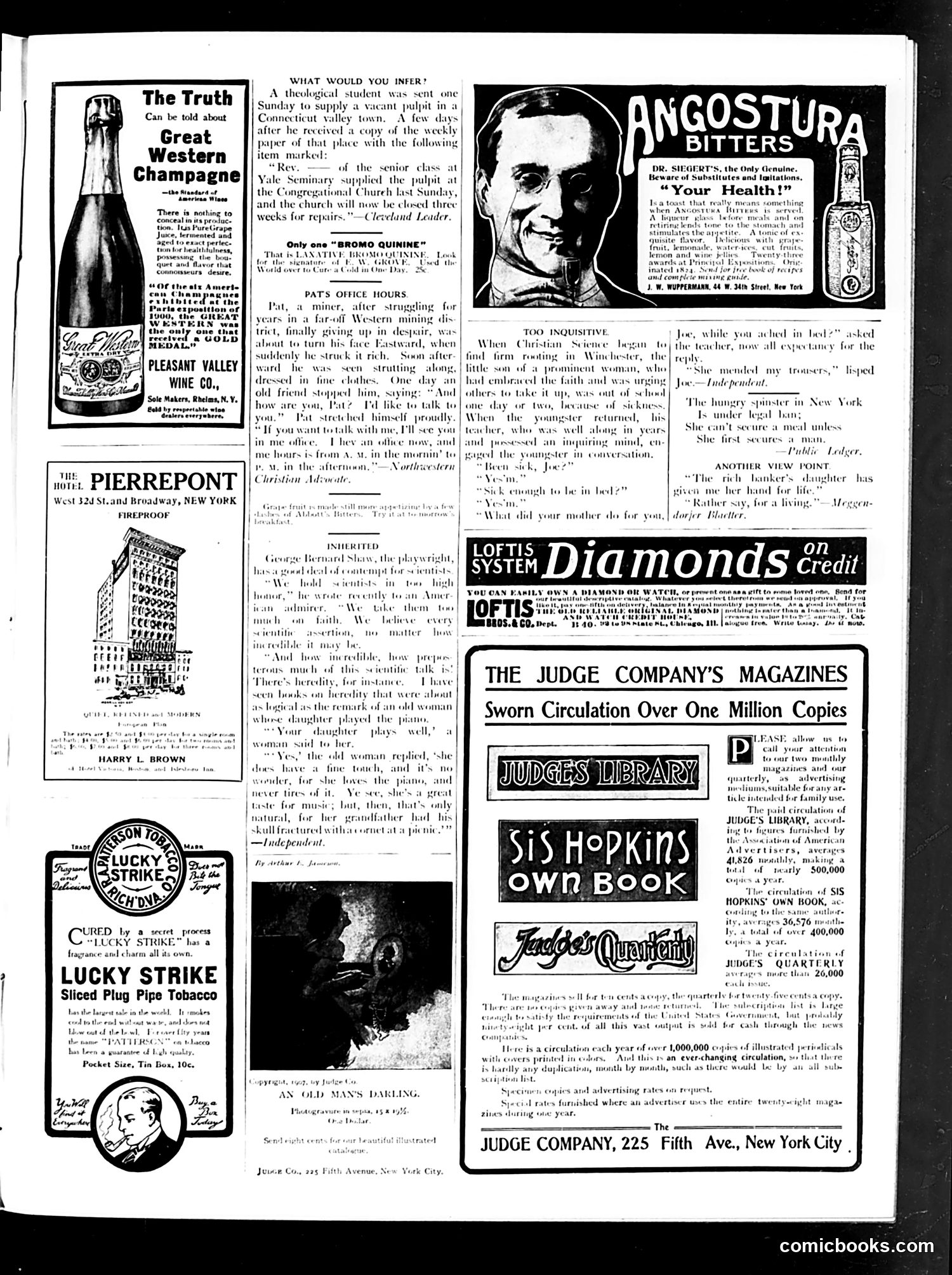
This page is primarily **advertising and promotional content**, typical of early 20th-century magazines. While several small humorous items appear (jokes about a closed church needing repairs, a miner striking it rich, a child's question about illness), they're minor filler. The dominant content promotes **Judge Company's own publications**—claiming "Sworn Circulation Over One Million Copies" for magazines including *Judge's Library*, *Sis Hopkins' Own Book*, and *Judge's Quarterly*. Other ads include champagne, bitters, hotels, cigarettes, and jewelry—standard luxury goods of the era. A brief note ridicules playwright George Bernard Shaw's contempt for scientists, but provides no clear satirical point. This is essentially a **house advertisement page** designed to promote Judge's publishing empire and attract advertising revenue, not political satire or commentary.
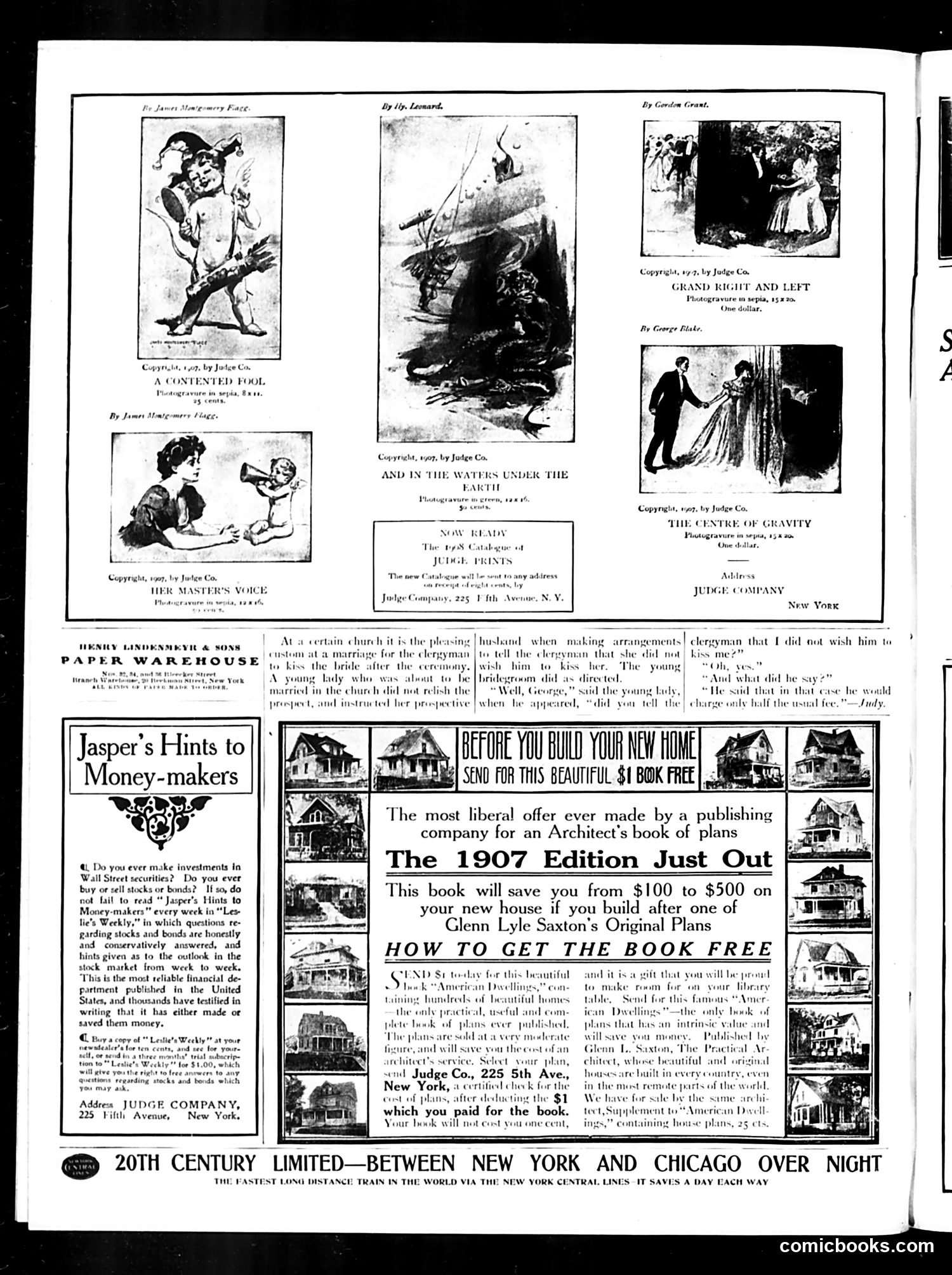
This page is primarily **advertising and filler content** rather than satirical cartoons. The upper portion shows four illustrated vignettes by various artists (Grant, Leonard, Blake) with titles like "A Contented Fool" and "Her Master's Voice." These appear to be humorous domestic scenes—one depicts a bride instructing her bridegroom not to kiss her at the altar, which the clergyman then relays as her own wish, creating awkward confusion. The **bulk of the page contains advertisements**: "Jasper's Hints to Money-makers" promotes stock market advice columns; "Before You Build Your New Home" advertises Glenn Lyle Saxton's 1907 architectural plan book (offered free with $1 payment); and a "20th Century Limited" train advertisement promotes overnight service between New York and Chicago. The page reflects early 1900s consumer culture and financial speculation interests. The content is mostly commercial rather than political satire—typical of Judge's revenue model mixing editorial humor with paid advertising.
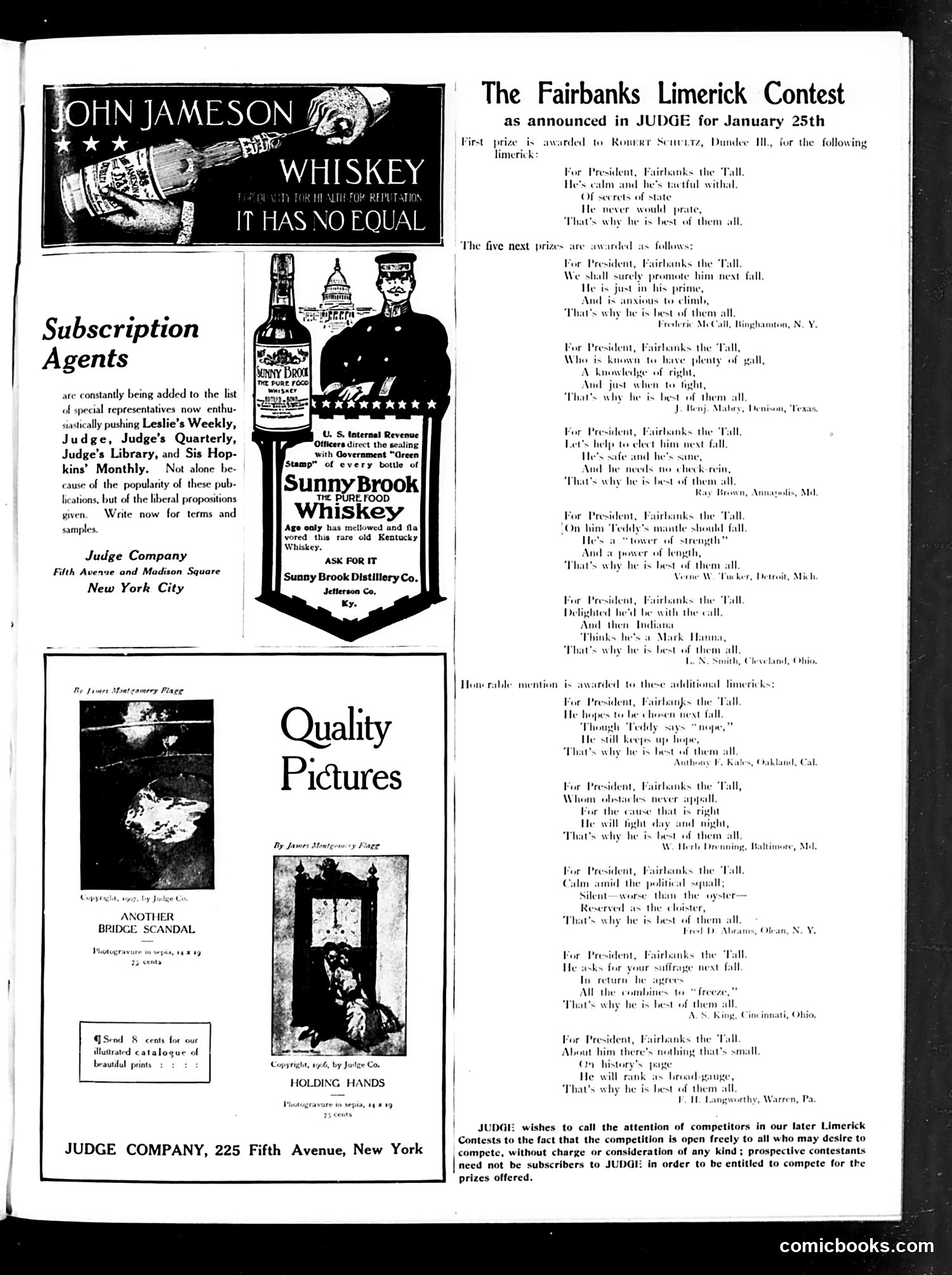
This page announces Judge magazine's limerick competition celebrating Vice President James Sherman Fairbanks as a potential presidential candidate. The contest solicits humorous verses praising "Fairbanks the Tall" for qualities like calmness, tactfulness, and strength—standard political virtues. The winning limericks, submitted by readers nationwide, all follow the same formulaic structure: endorsing Fairbanks for president while explaining "why he is best of them all." References to "Teddy" (Theodore Roosevelt) and "Mark Hanna" (Republican kingmaker) ground these verses in early 1900s Republican politics. The satire is gentle: the repetitive, identical praise structure across all entries suggests either manufactured enthusiasm or mockery of predictable political endorsements. The contest itself—turning candidate promotion into entertainment—pokes fun at political marketing. This appears designed to amuse Judge's readers while promoting Fairbanks.
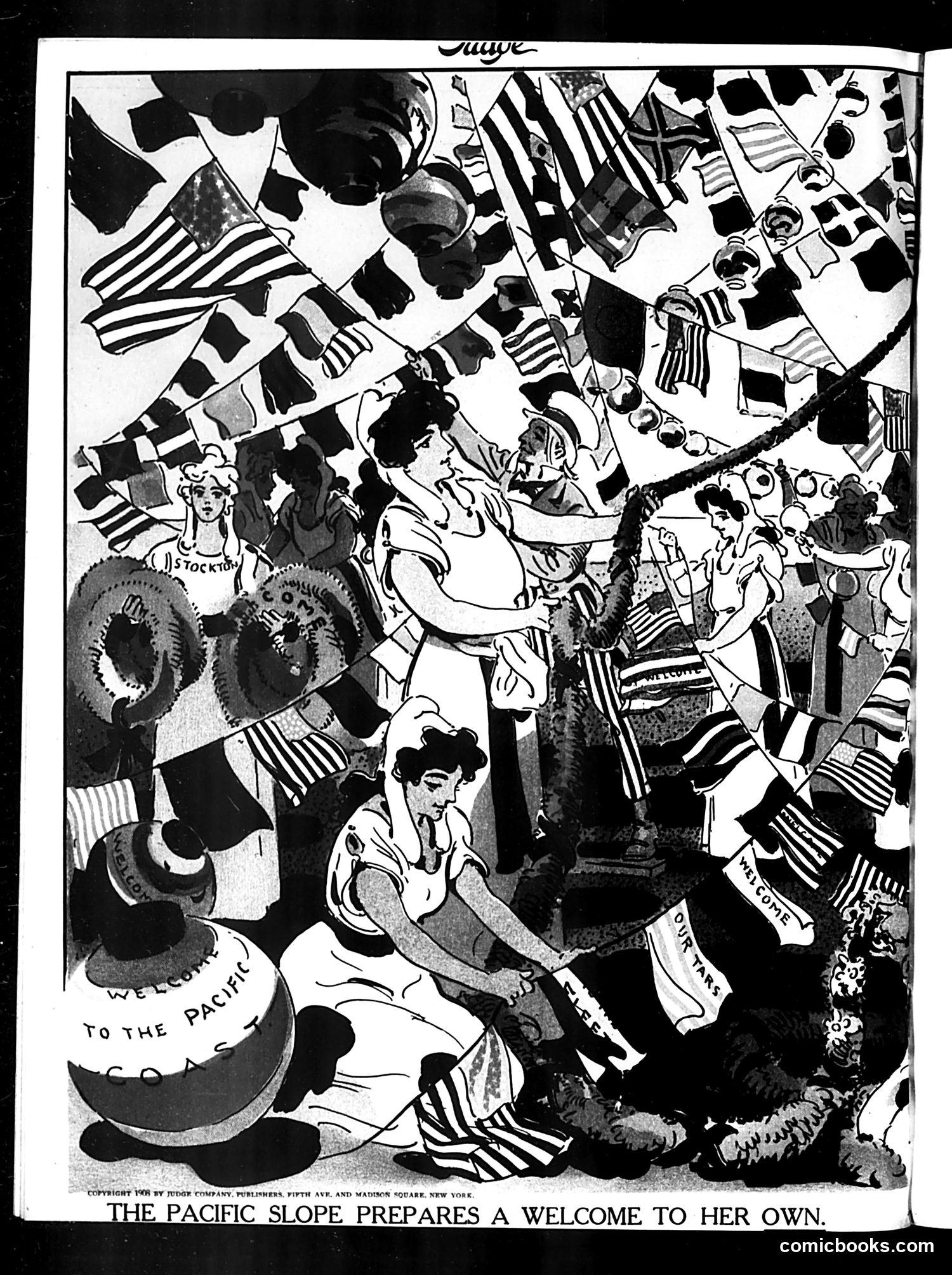
The OCR text is too corrupted to read clearly. Based on the IMAGE alone: This satirical cartoon depicts "The Pacific Slope" (likely California/West Coast) preparing a welcome celebration. Numerous American flags and bunting decorate an elaborate scene with multiple figures in celebratory poses. A woman in the center appears to be the personified "Pacific Slope." Various people around her seem to be preparing festivities—some holding flags, others in festive dress. The specific historical context—whom she's welcoming and why—remains unclear without legible text. Given Judge magazine's satirical nature and the elaborate patriotic imagery, this likely comments on a significant political or social event involving the West Coast, possibly related to immigration, statehood, or a visiting dignitary, but the exact reference cannot be determined from the visual information alone.