
A complete issue · 16 pages · 1908
Judge — February 8, 1908
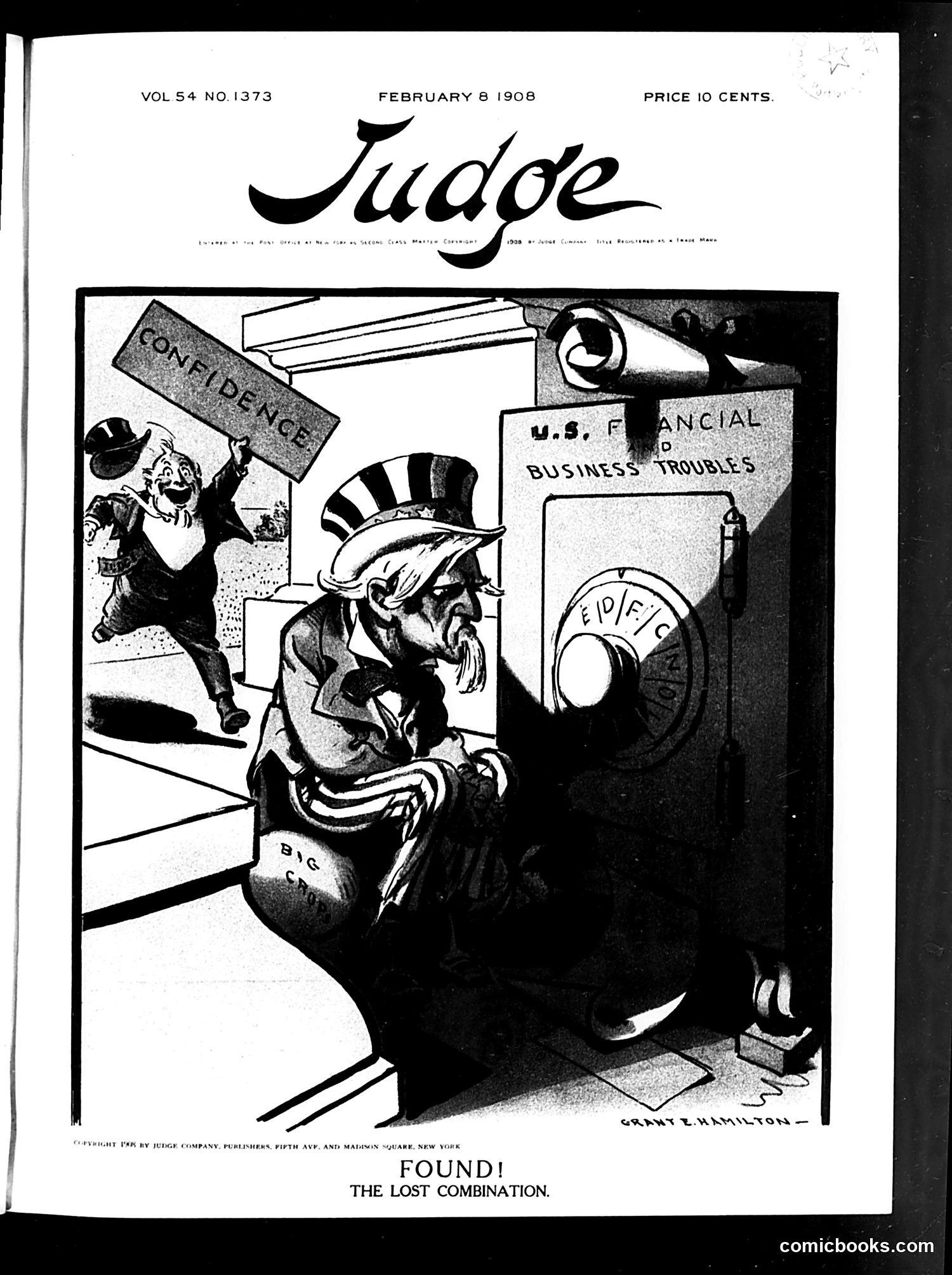
This political cartoon, titled "Found! The Lost Combination," depicts Uncle Sam (identifiable by his distinctive top hat) trying to open a large safe labeled "U.S. Financial and Business Troubles." A figure on the left holds a "Confidence" sign, while Uncle Sam attempts to crack the safe using a dial marked "EFFECT." The satire references the financial panic of 1907, a severe economic crisis that had recently devastated American markets. The "lost combination" represents the difficulty in solving the economic crisis—the missing "key" being public confidence and effective government intervention. The cartoon suggests that restoring confidence and implementing proper monetary policy (the "effect") were essential to unlocking recovery from the financial disaster.
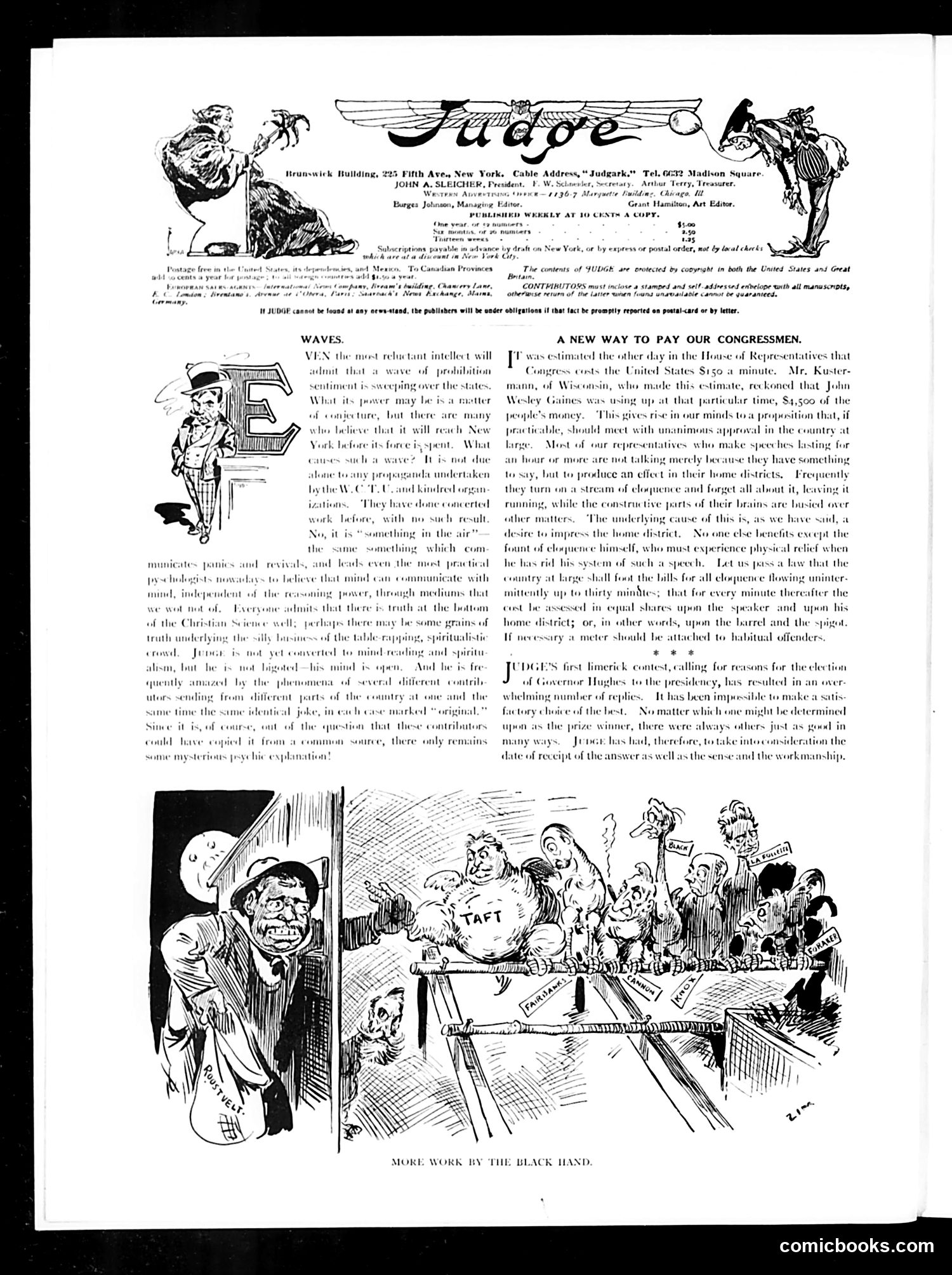
**Upper Section - "Waves":** This editorial cartoon critiques populist political movements sweeping through American states. It warns that waves of "prohibition sentiment" and similar crusades are reaching New York, suggesting such movements lack staying power and are merely temporary phenomena driven by emotional appeal rather than practical governance. **Lower Section - "More Work by the Black Hand":** This cartoon satirizes labor unrest and strikes. The figure labeled "Anarchy" lurks menacingly while workers labeled "Taft" engage in conflict. The "Black Hand" reference likely alludes to violent labor activism or anarchist associations. The cartoon suggests sinister forces manipulate worker movements, presenting labor organizing as dangerous rather than legitimate economic action—a common anti-labor stance in early 1900s satire.
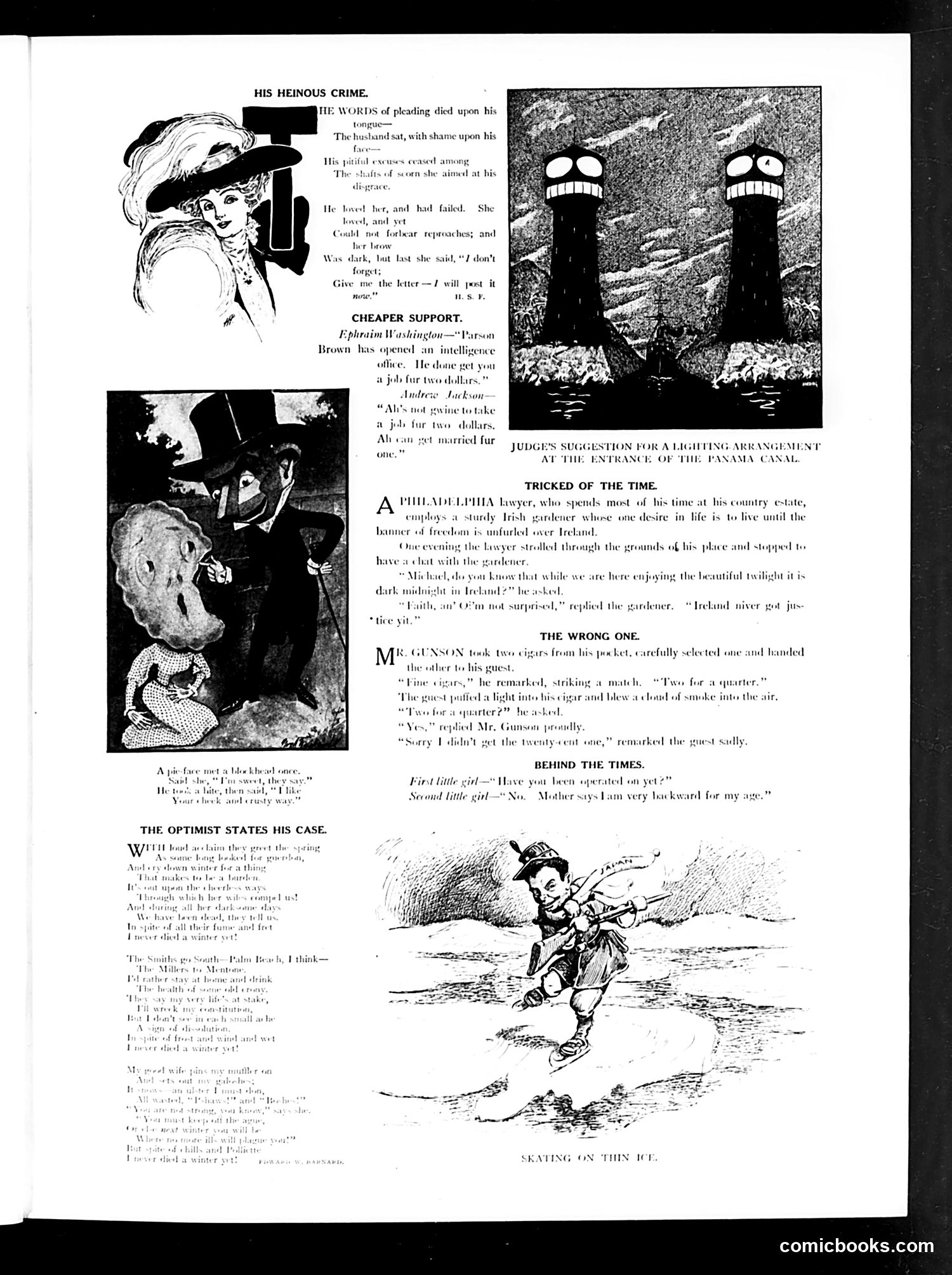
This page contains several unrelated humorous short stories and illustrations rather than a coherent political cartoon: **"His Heinous Crime"** depicts a woman angry at a man's failed romantic gesture—she wants a letter, not his pleading. **"Cheaper Support"** mocks a lawyer's country estate where an Irish gardener refuses low wages, using Irish dialect humor. **"Tricked of the Time"** features a Philadelphia lawyer tricked by his Irish gardener about Irish twilight hours—a joke about cultural misunderstanding. **"The Wrong One"** shows a wealthy man (Mr. Gunson) accidentally giving cheap cigars to a guest instead of expensive ones—physical comedy about embarrassment. **"Behind the Times"** is a brief exchange about age expectations. **"The Optimist States His Case"** is a poem about positive thinking, accompanied by a skating illustration. The page represents typical Judge magazine fare: light social satire and domestic humor rather than political commentary.
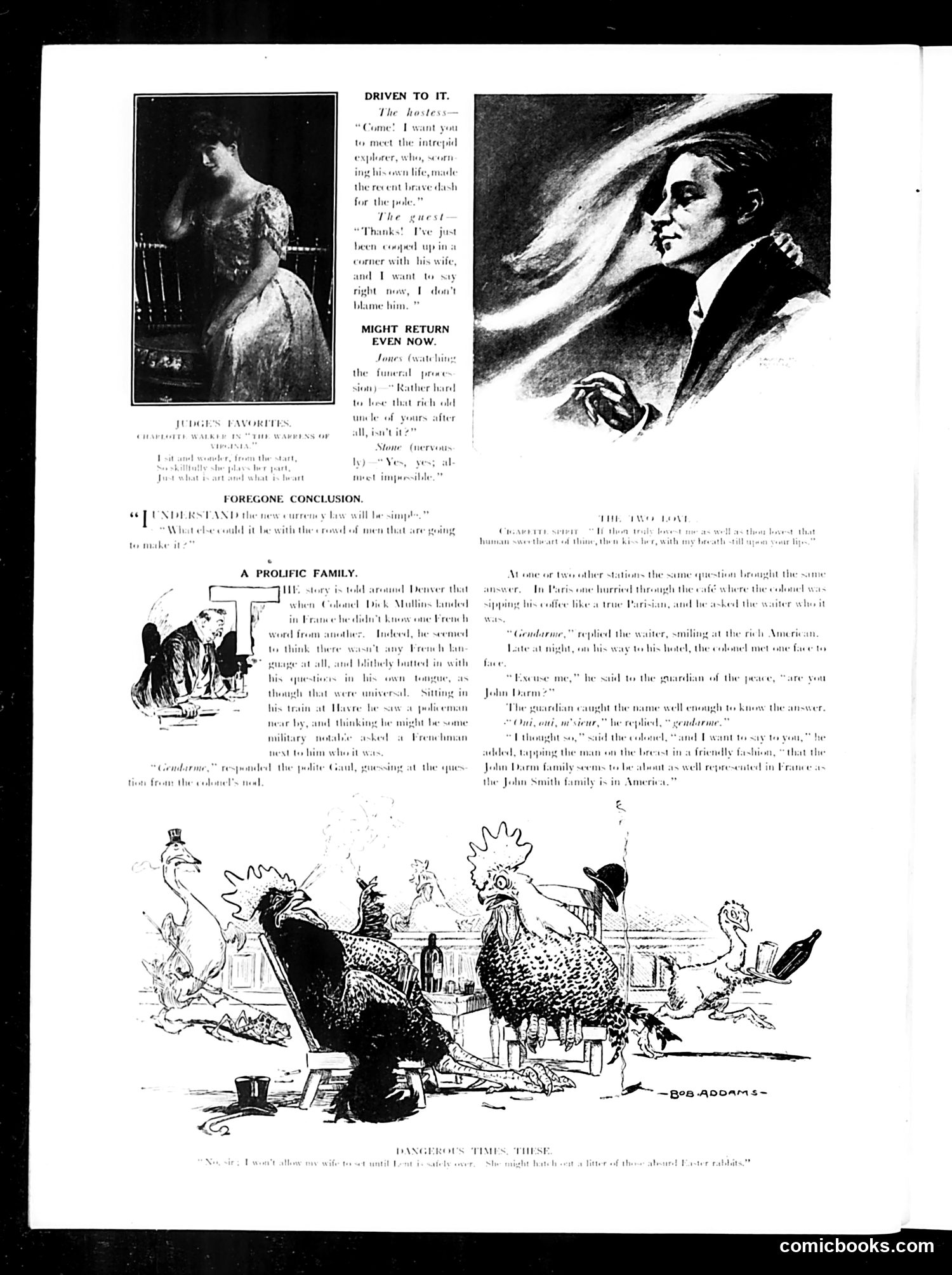
This page contains several distinct satirical pieces. The top section titled "DRIVEN TO IT" depicts a social scenario about an intrepid explorer and family pride—likely mocking Victorian society's obsession with status and introducing prestigious (if disreputable) family members. "A PROLIFIC FAMILY" appears to be a French-focused satire about a family from Denver with connections to French nobility, possibly satirizing Americans' pretensions toward European aristocratic lineage. The bottom cartoon "DANGEROUS TIMES: THESE" by Bob Adams shows anthropomorphic roosters and chickens in what appears to be a farmyard chaos scene, with the caption suggesting marital discord humor—typical early 20th-century domestic comedy. The exact political context remains unclear without publication date, but the overall tone targets American social pretension and European fascination prevalent in that era.
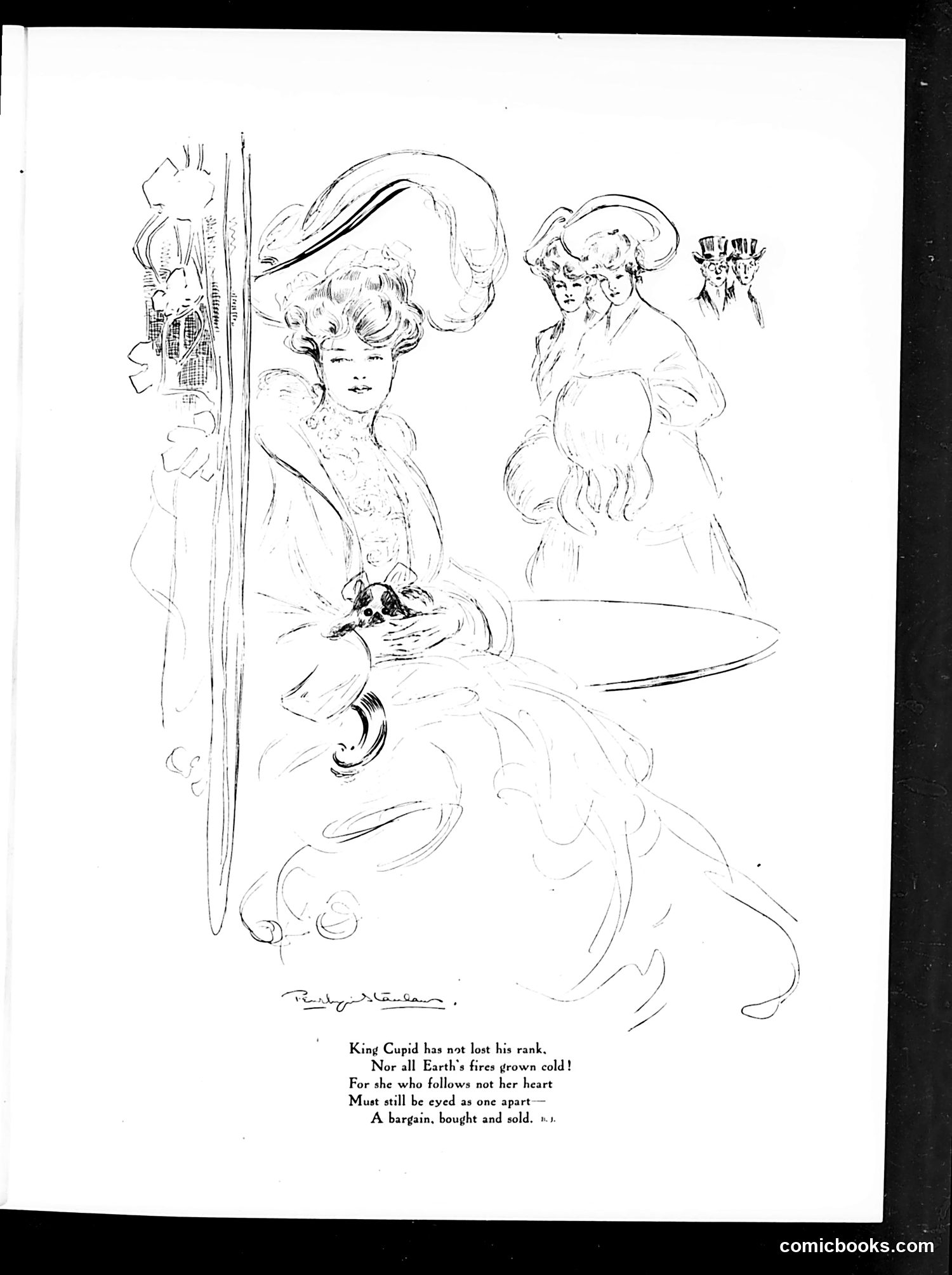
This appears to be an illustration by Gibson (likely Charles Dana Gibson, famous for "Gibson Girl" imagery) depicting fashionable women in early 1900s attire. The verse below references Cupid and romantic matters: "King Cupid has not lost his rank, Nor all Earth's fires grown cold! For she who follows not her heart Must still be eyed as one apart— A bargain, bought and sold." The satire critiques marriage as a **mercenary transaction** rather than a romantic union based on love. The poem suggests women who marry for reasons other than genuine affection are essentially "bought and sold"—treated as commodities rather than equals with agency. This reflects Progressive Era concerns about women's autonomy and the critique of arranged or economically-motivated marriages among society's upper classes depicted by Gibson's elegant female figures.
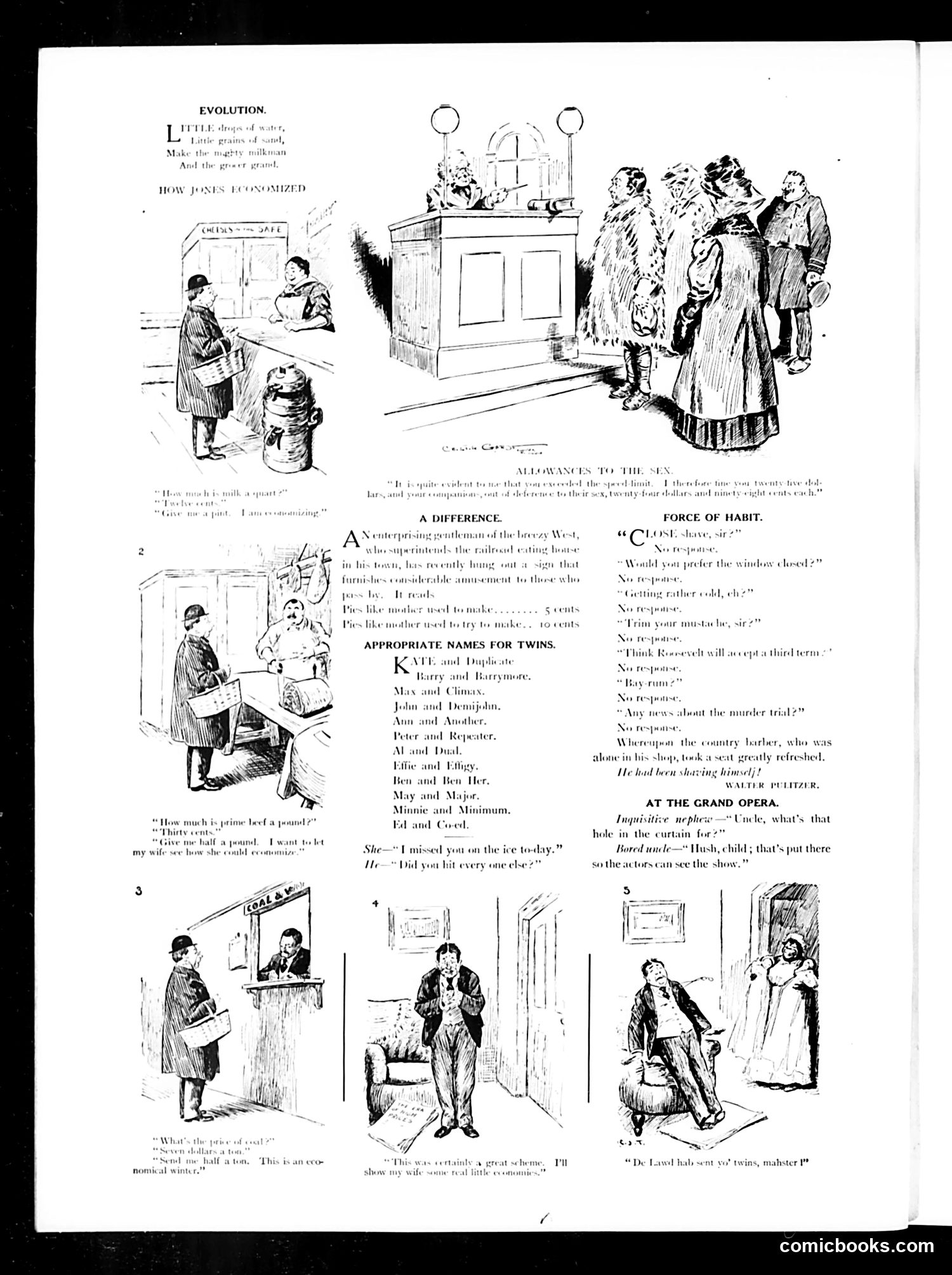
This page contains several unrelated humor pieces typical of Judge magazine's satirical format: **"How Jones Economized"** shows a railroad eating-house owner posting prices—5 cents for pie, 10 cents for another pie—mocking cheap establishments and their transparent economics. **"Appropriate Names for Twins"** is wordplay humor listing name pairs (Kate and Duplicate, Max and Climax), requiring no political context. **"A Difference"** jokes about a barber's prices increasing from 5 to 10 cents, with accompanying dialogue about shaving. **"Force of Habit"** depicts a barber asking routine questions (close shave? close window? trim mustache? about Roosevelt's third term?) to an unresponsive customer—satirizing mechanical professional habits and contemporary political speculation about Theodore Roosevelt. **"At the Grand Opera"** is a family humor piece where a bored uncle explains a curtain hole to his nephew, mocking both opera pretension and parental explanations. The page appears primarily comic/humorous rather than overtly political, typical of Judge's mixed content approach.
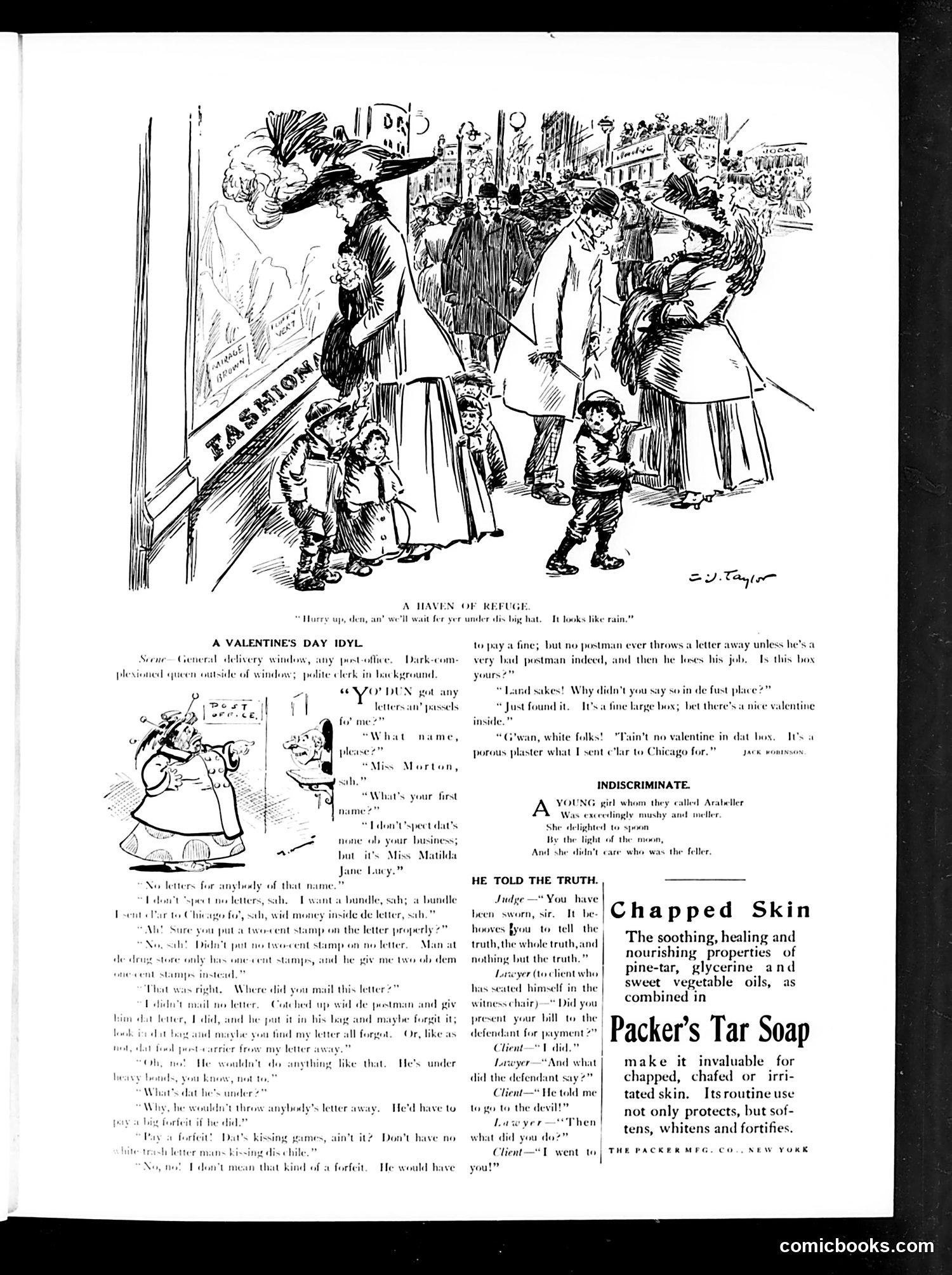
This page contains three satirical pieces from Judge magazine (a publication known for social commentary): **"A Haven of Refuge"** (top cartoon): Depicts an African American woman and children seeking shelter under a large hat during rain. The caption's dialect humor and the image suggest commentary on racial segregation and lack of access to public facilities or protection—the "refuge" being inadequate shelter. **"A Valentine's Day Idyl"** (middle section): A comedic dialogue at a post office between a Black woman and a clerk about mail. The humor relies on dialect stereotyping, but the substance satirizes postal inefficiency and confusion. The punchline reveals she expected a valentine but received a porous plaster instead—a commentary on disappointed expectations or misdirected mail. **"He Told the Truth"** and "Indiscriminate"** (bottom): Brief jokes about lawyers and honesty, unrelated to racial themes. The page reflects Judge's era (appears early 20th century) when crude racial caricatures were standard satirical fare, even when addressing legitimate social grievances. The racial stereotyping is offensive by modern standards, though the underlying commentary sometimes addressed real systemic issues.
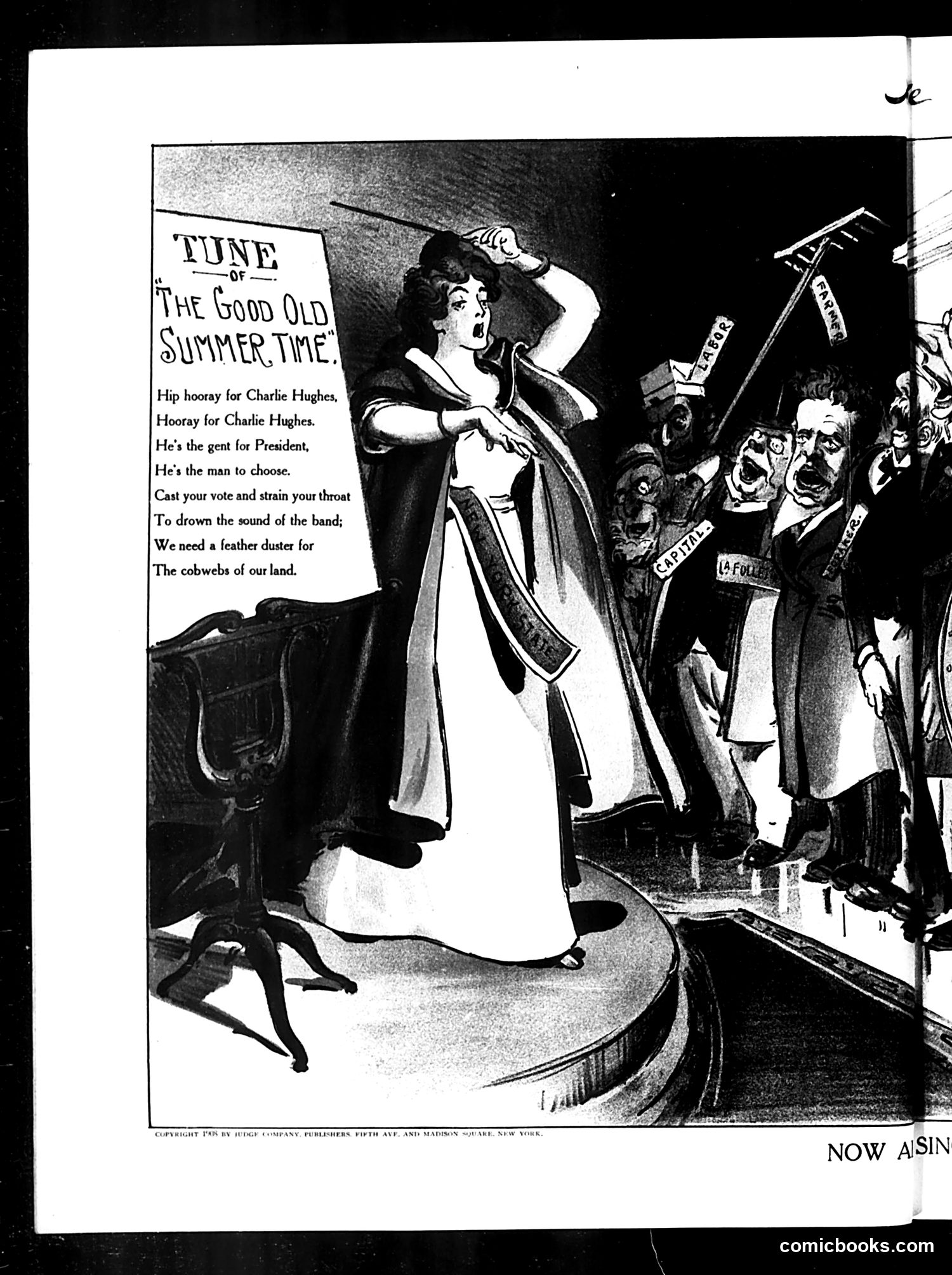
This Judge magazine cartoon satirizes support for Charles Evans Hughes as a 1916 presidential candidate. The central female figure represents Lady Liberty or the American electorate, holding a feather duster—symbolizing Hughes as merely a tool for "cleaning cobwebs" from government rather than offering substantive reform. The verse mocks the enthusiasm of Hughes supporters, suggesting their "hip hoorays" and noise are meant to "drown the sound of the band"—implying their campaign relies on empty cheerleading rather than real policy substance. The caricatured crowd on the right, labeled with terms like "CABINET" and "LA FOLLE" (unclear without fuller context), likely represents political factions or opposition figures. The satire suggests Hughes's candidacy lacks real vision—he's presented as a decorative solution to deep governmental problems requiring more than superficial cleaning.
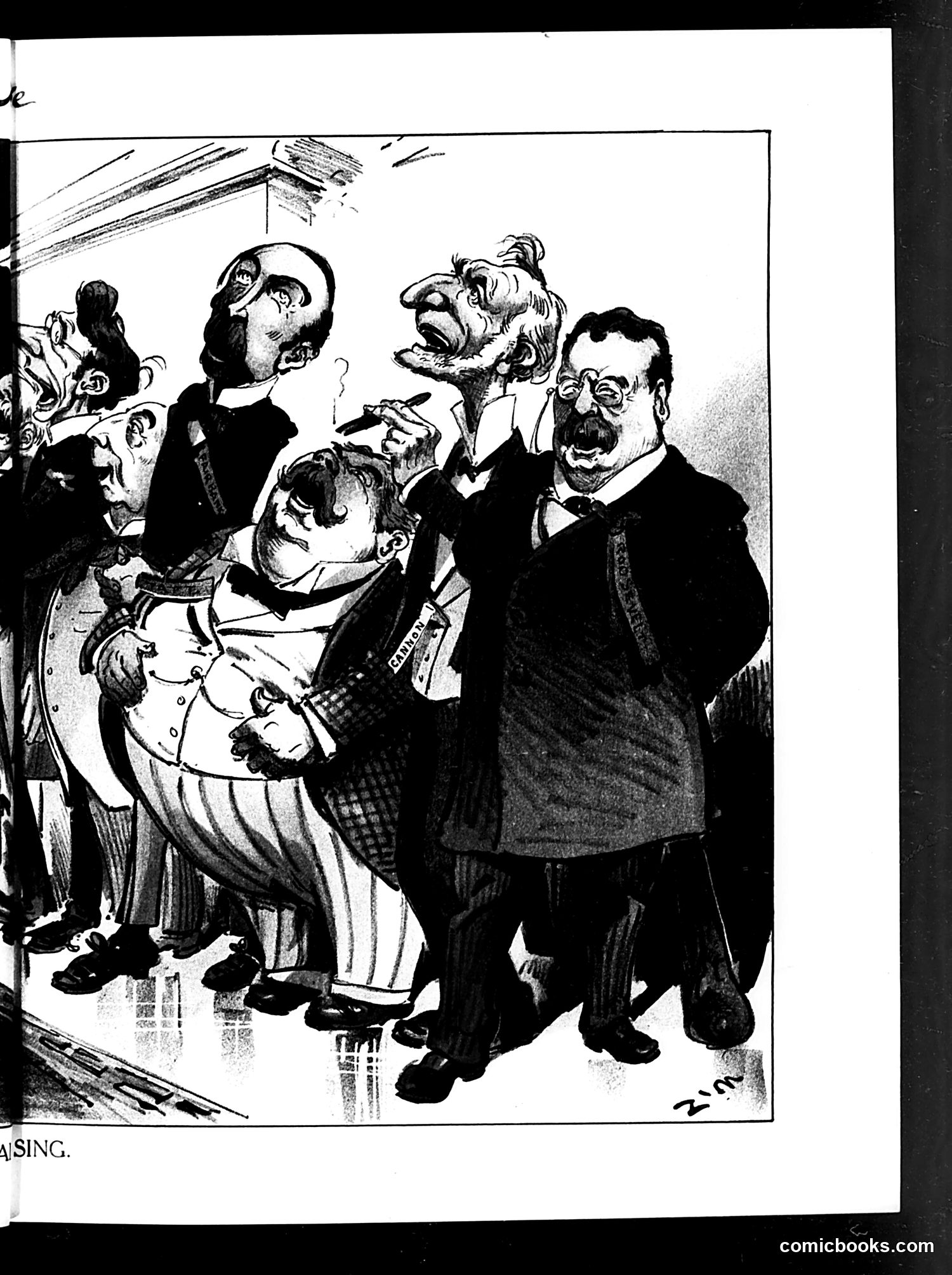
This appears to be a satirical cartoon from *Judge* magazine depicting a dental or medical examination scene. The central figure is a heavyset man in a chair being examined by practitioners, while other men in formal dress observe or react with exaggerated expressions of concern or disgust. The visible caricatured features—particularly the grotesque facial expressions and physical distortions—suggest this is political satire targeting a specific public figure, likely from the late 19th or early 20th century. However, without additional context or visible text identifying the subject, I cannot definitively name who is being satirized or what specific political/social issue is being mocked. The composition implies commentary on either a medical condition, political "treatment," or public scrutiny of a notable person, but the exact meaning remains unclear without more supporting information.
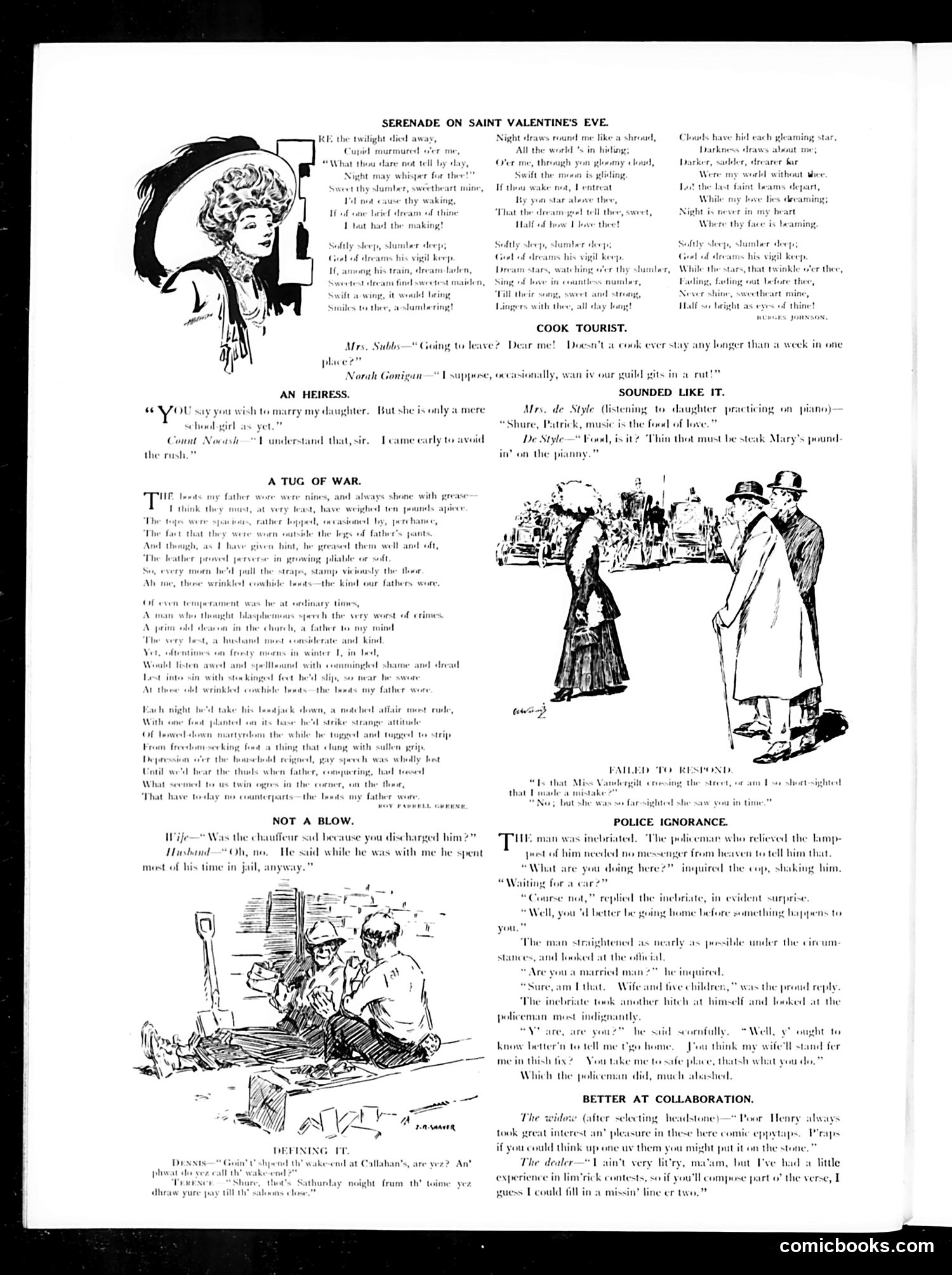
This page from *Judge* (a late 19th/early 20th-century satirical weekly) contains several humorous sketches targeting domestic and social inconveniences of the era: **"Cook Tourist"** mocks the chronic servant problem—wealthy households' inability to retain household help, with cooks departing after mere weeks of employment. **"An Heiress"** satirizes fortune-hunting suitors pursuing rich young women, while **"Sounded Like It"** jokes about pretentious social climbers (Mrs. de Style) misinterpreting music terminology. **"A Tug of War"** is a lengthy narrative poem about the difficulty of removing stiff, old leather boots—a mundane domestic struggle treated with mock-epic seriousness. **"Police Ignorance"** ridicules an inebriated man's encounter with a seemingly dense policeman who, told the man is "waiting for a car," takes this literally rather than understanding he means transportation. The sketches employ gentle, domestic humor rather than political satire, focusing on class relations, marriage, servants, and urban inconveniences familiar to the magazine's middle-to-upper-class readership.
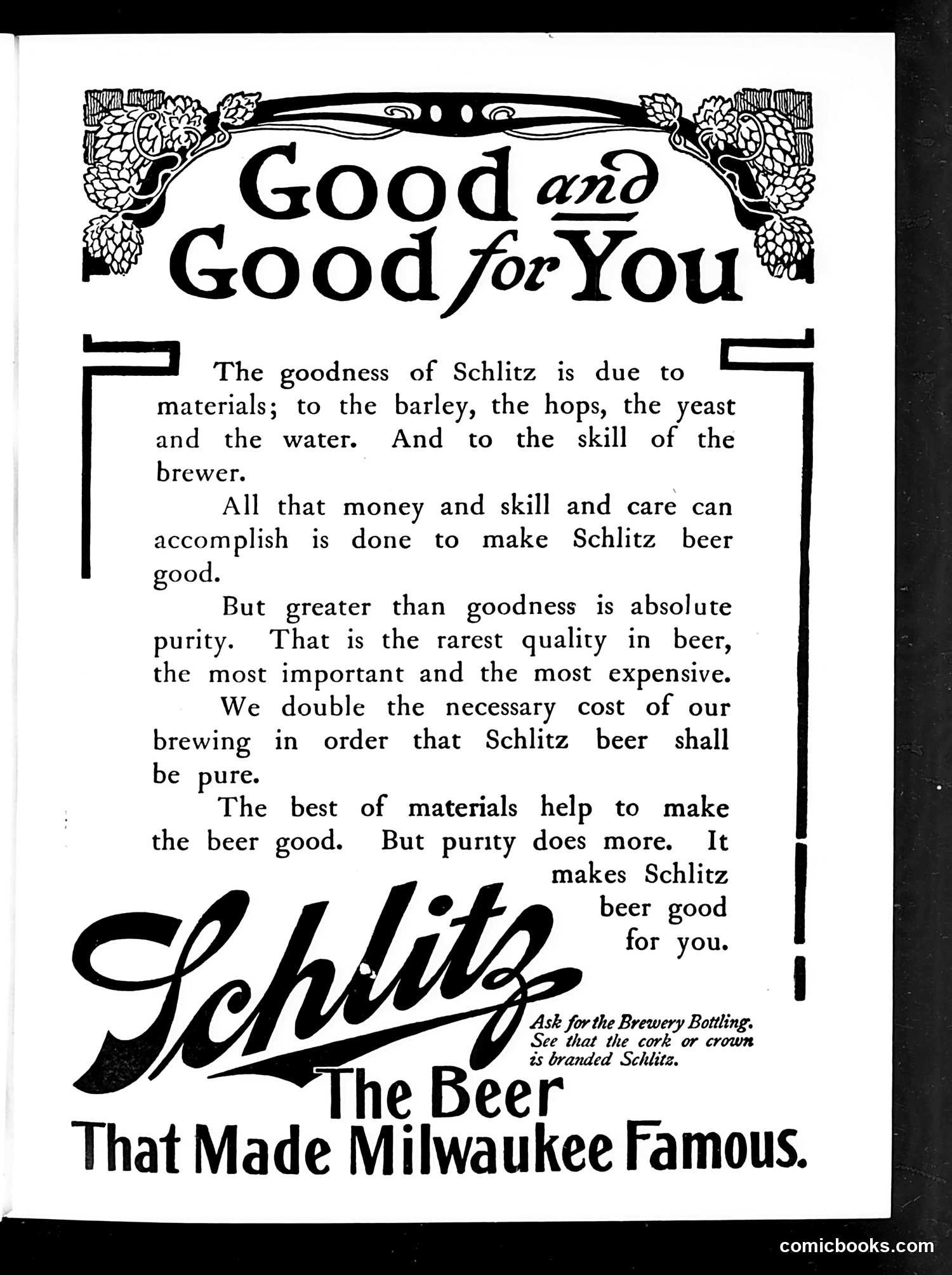
This is a **Schlitz beer advertisement**, not a political cartoon. The page promotes Schlitz as "The Beer That Made Milwaukee Famous" by emphasizing purity as its defining quality. The ad argues that while good materials (barley, hops, yeast, water) and skilled brewing create decent beer, absolute purity is superior and justifies higher costs. It instructs consumers to verify authenticity by checking that bottle corks or crowns are branded "Schlitz." The decorative hops imagery frames the text. For modern readers: this reflects early 20th-century beer marketing emphasizing safety and quality assurance—concerns born from the era's widespread contamination and adulteration of food and beverages before FDA regulations.
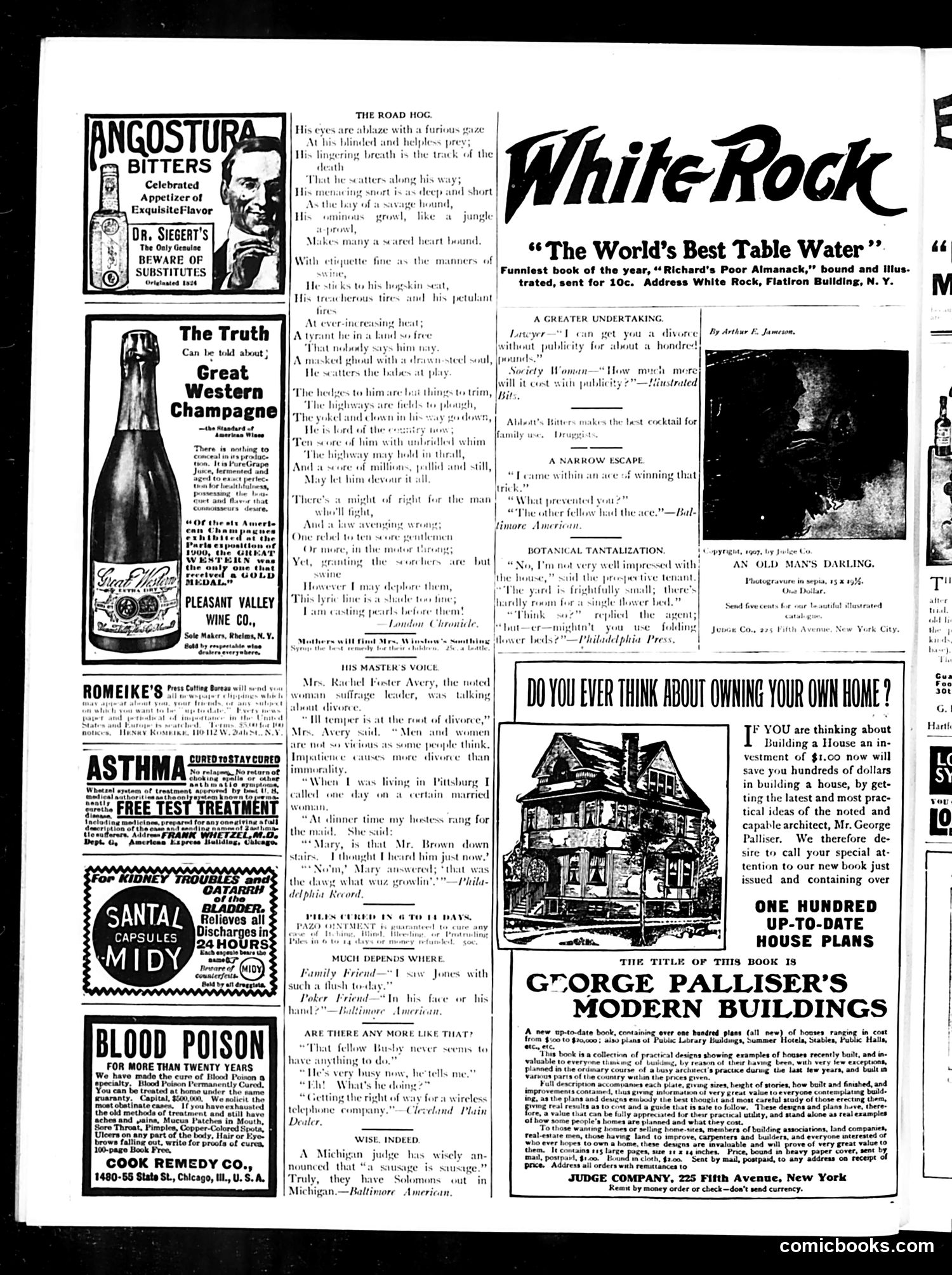
This page features "The Road Hog," a satirical poem accompanying a caricature of a reckless automobile driver. The piece mocks early 20th-century motorists who drove dangerously and arrogantly on public roads. The "road hog" is portrayed as a tyrant—a man whose eyes "blaze with a furious gaze," driving a vehicle that scatters pedestrians and horses with petulant disregard. The satire targets the social menace of speeding, aggressive drivers who treated roads as personal domains, terrorizing other travelers. Lines like "A tyrant he in a hand-cart's way" and references to his "treacherous tires" emphasize how automobiles, then still novel luxury items, represented dangerous privilege. The accompanying verses in *London Chronicle* style reinforced the message: wealthy motorists posed physical and moral threats to society. This reflects genuine contemporary anxiety about automobiles as instruments of reckless behavior by the privileged class. The remainder is largely period advertising (bitters, wine, real estate guides).
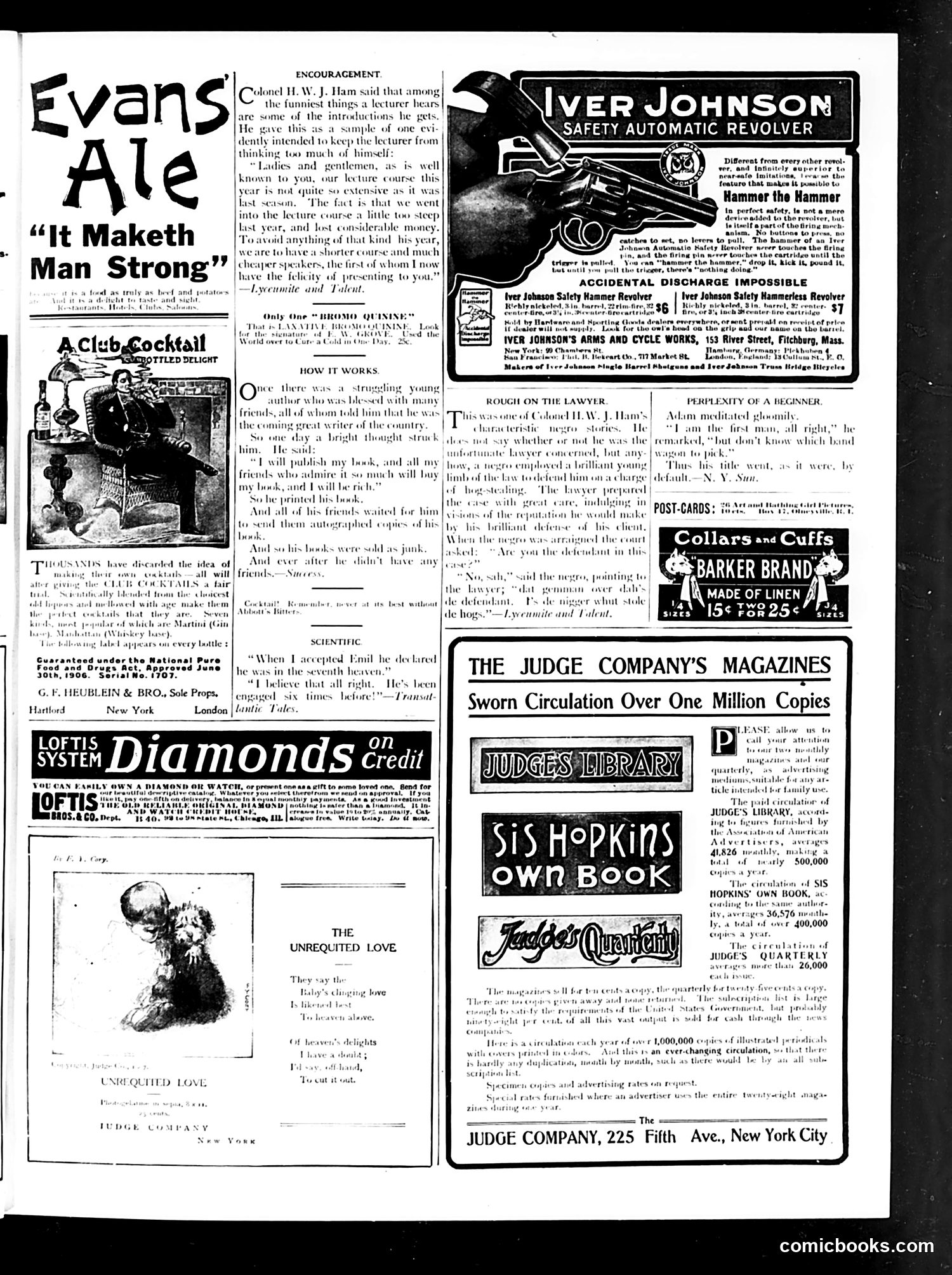
This page is primarily **advertising and filler content** from Judge magazine, with minimal political satire. The main elements are: **"Encouragement" Section**: Colonel H.W.J. Ham discusses declining lecture attendance—audiences found the pricing too steep last season, so organizers are now offering cheaper speakers and shorter courses. This reflects post-WWI economic strain. **"How It Works"**: A humorous anecdote about a naive author who prints books expecting friends to buy them, only to have them sold as junk. It's gentle social satire about vanity publishing and false friendship. **Minor jokes** include references to romantic disappointment and a lawyer's courtroom exchange with a Black defendant—the latter reflecting the casual racial stereotyping common to the era. **The bulk of the page is advertisements**: for Evans Ale, Iver Johnson revolvers, Loftis diamonds, and Judge Company's own magazines (Judge's Library, Sis Hopkins' Own Book, Judge's Quarterly), which claim over one million combined circulation. No significant political commentary is present—this appears a typical magazine filler page from the 1910s-1920s period.
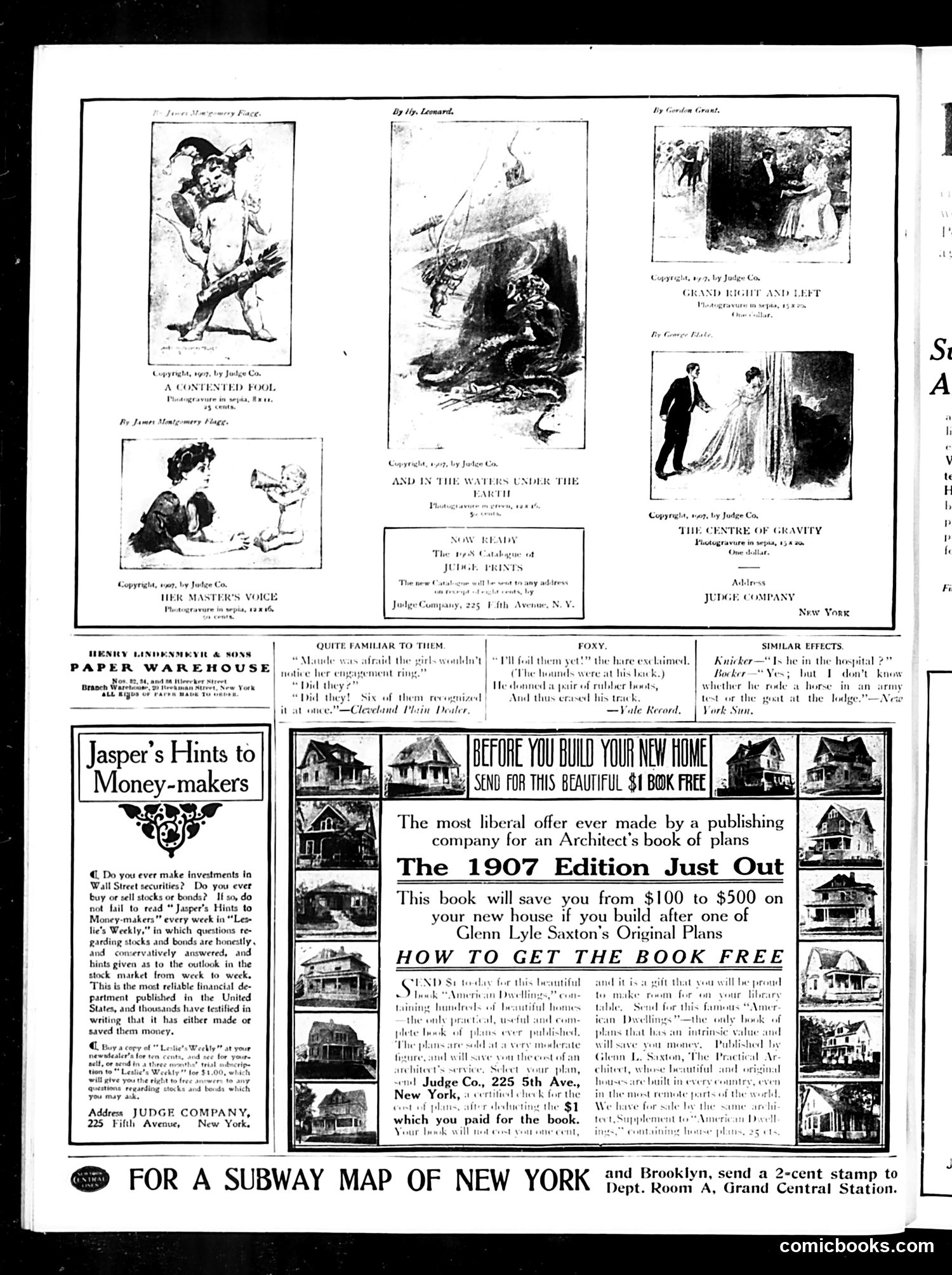
This page from Judge magazine (1907) contains several elements: **Top section:** Four illustrated cartoons with titles like "A Contented Fool" and "Her Master's Voice," featuring sketched scenes of domestic or social situations. The specific satirical targets are unclear from the image quality, but they appear to mock contemporary social types or behaviors typical of Judge's humor. **Middle section:** Three brief joke captions about familiar situations and similar effects—light, observational humor rather than political satire. **Lower section:** Primarily **advertisements** for practical services: Jasper's financial advice column for stock market tips, and significantly, a major promotional offer for Glenn Lyle Saxton's 1907 architectural book—offering house plans that supposedly save $100-$500, available free with a $1 payment. **Bottom:** A subway map advertisement for New York and Brooklyn transit. The page is predominantly commercial advertising rather than political satire, typical of Judge's mixed content format blending editorial cartoons with lucrative advertising revenue.
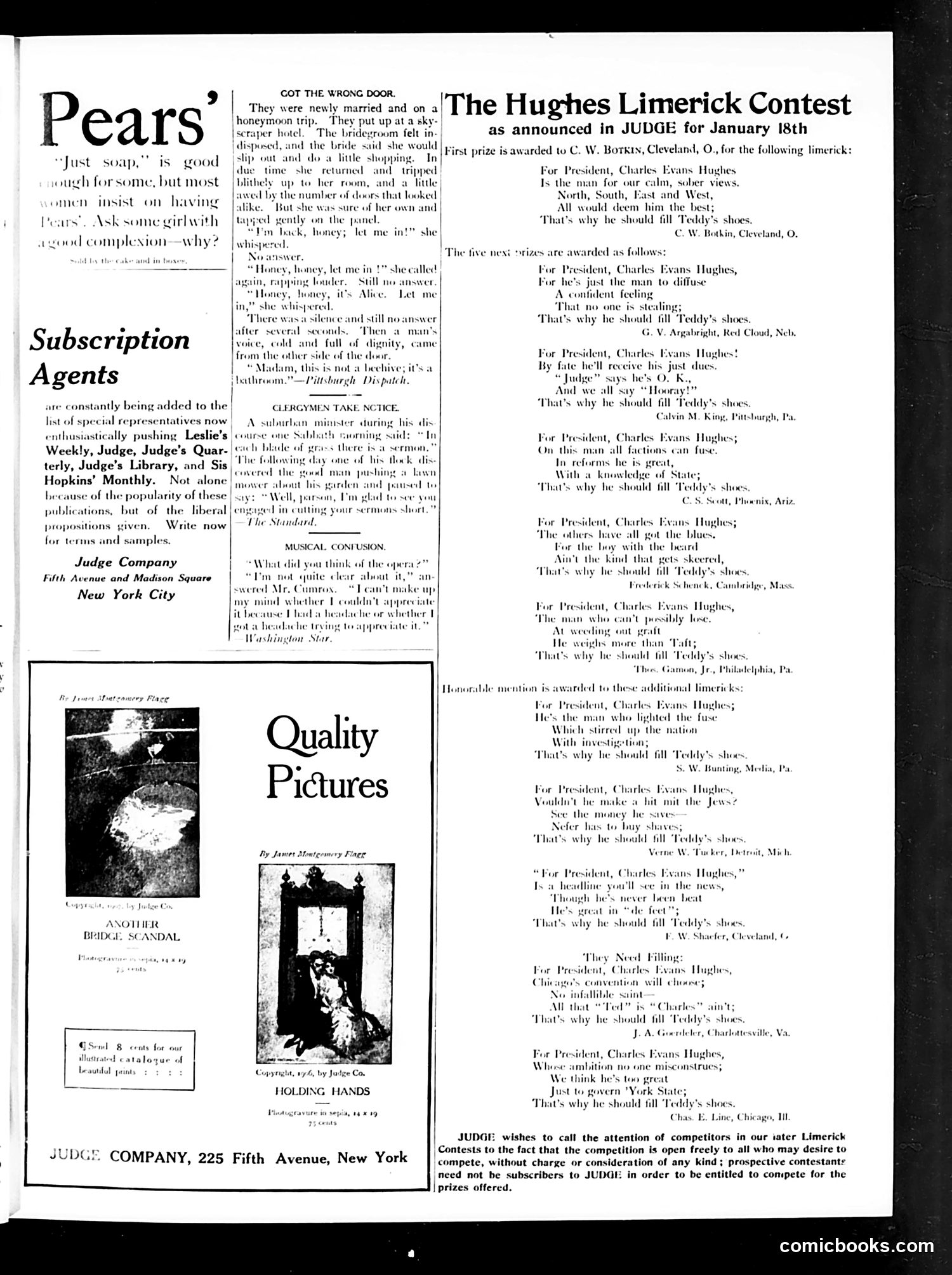
This page primarily showcases **The Hughes Limerick Contest**, promoting Charles Evans Hughes as a presidential candidate. The limericks are satirical campaign material disguised as reader submissions, all reaching the same conclusion: Hughes should succeed Theodore Roosevelt ("fill Teddy's shoes"). The humor is straightforward propaganda—multiple "winners" all praise Hughes identically, emphasizing his appeal across regions ("North, South, East and West") and factions ("all factions can fuse"). One limerick jokes about Hughes's beard ("the boy with the beard / Ain't the kind that gets scared"), while another makes an antisemitic reference ("Wouldn't he make a hit mit the Jews?"), reflecting period prejudices. The page also contains unrelated short humor pieces (honeymoon mishap, clergyman's sermons) and advertisements for Judge Company publications. **Context**: This reflects 1912 Republican efforts to position Hughes as Roosevelt's successor, though he ultimately lost to Woodrow Wilson.
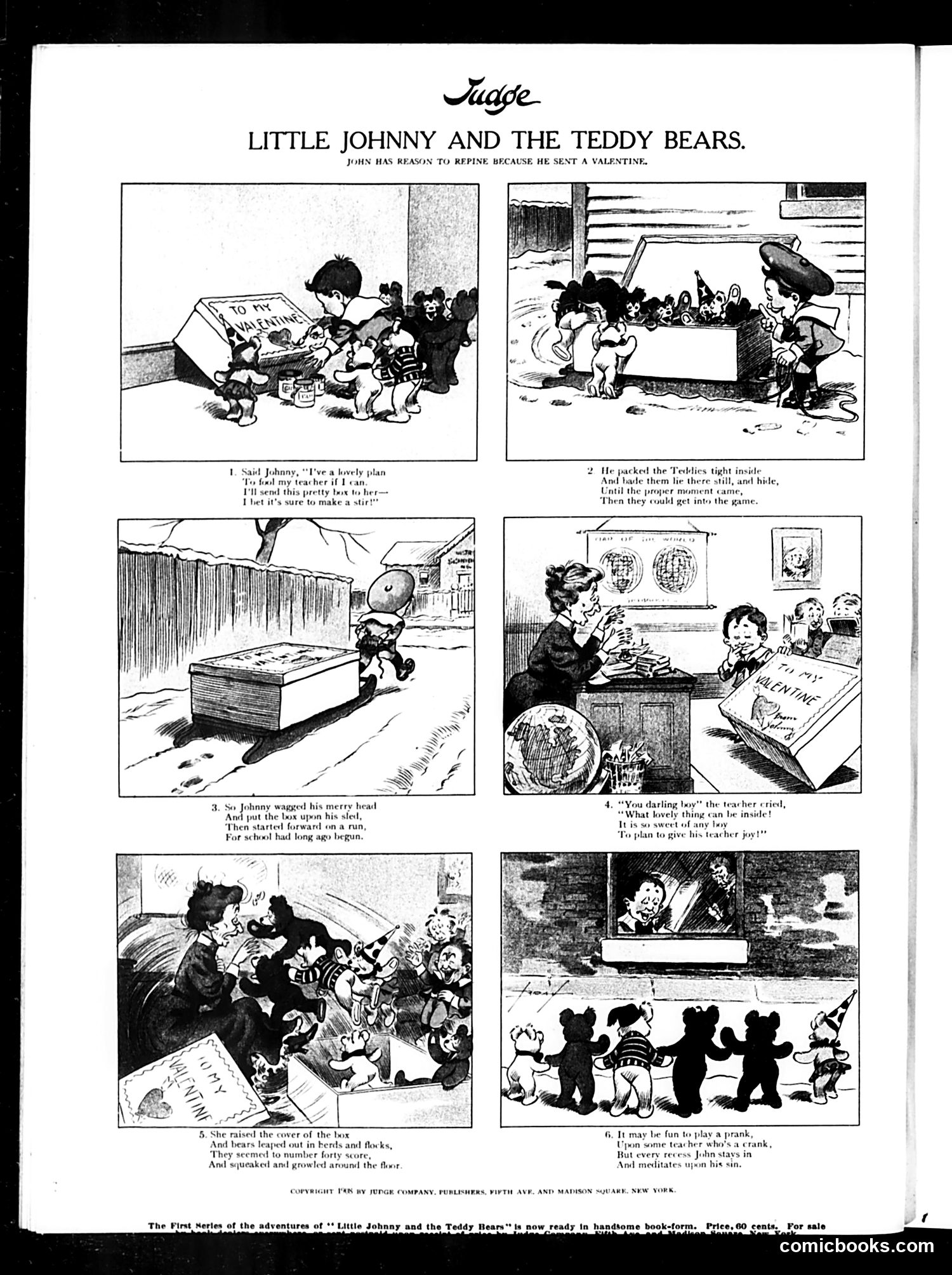
This is a humorous six-panel comic strip, not political satire. It tells a simple children's story: Little Johnny plans to impress his teacher with a valentine, so he packages teddy bears as a gift. He sneaks the box to school, hides the bears inside, and releases them at the opportune moment. The prank succeeds—the teddy bears scatter throughout the classroom, delighting students and shocking the teacher ("You darling boy!"). The final panel shows Johnny reflecting on his successful mischief. The strip's humor derives from innocent childhood pranks and the contrast between Johnny's sneaky planning and the chaotic, joyful result. The title note indicates this was part of a serialized children's adventure series published in book form for 60 cents. There are no identifiable political figures or social commentary—it's simply light entertainment for Judge's family audience.