
A complete issue · 18 pages · 1908
Judge — February 1, 1908
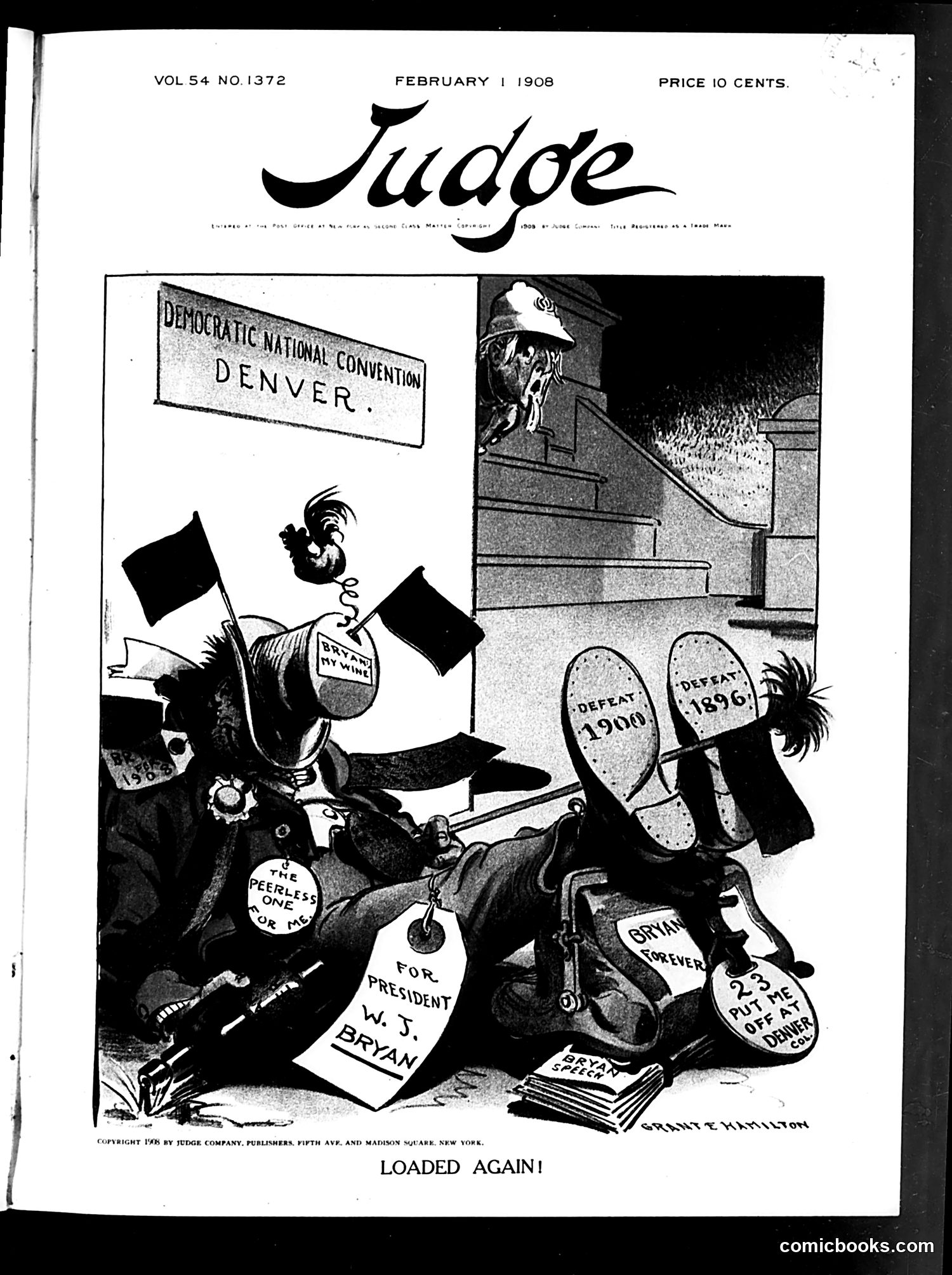
This political cartoon satirizes the Democratic National Convention preparing for Denver. The donkey (traditional symbol of the Democratic Party) is depicted as heavily "loaded"—burdened with past electoral defeats marked on tombstones ("Defeat 1896," "Defeat 1900"). The cartoon mocks the party's attempt to nominate William Jennings Bryan for president again, suggesting they're repeating failed strategies. Campaign materials and Bryan's name appear among the donkey's burdens. The figure climbing the convention hall stairs represents Republican confidence, implying the Democrats are handicapped by their history of losses and Bryan's previous unsuccessful candidacies. The title puns on the donkey being literally loaded down with baggage.
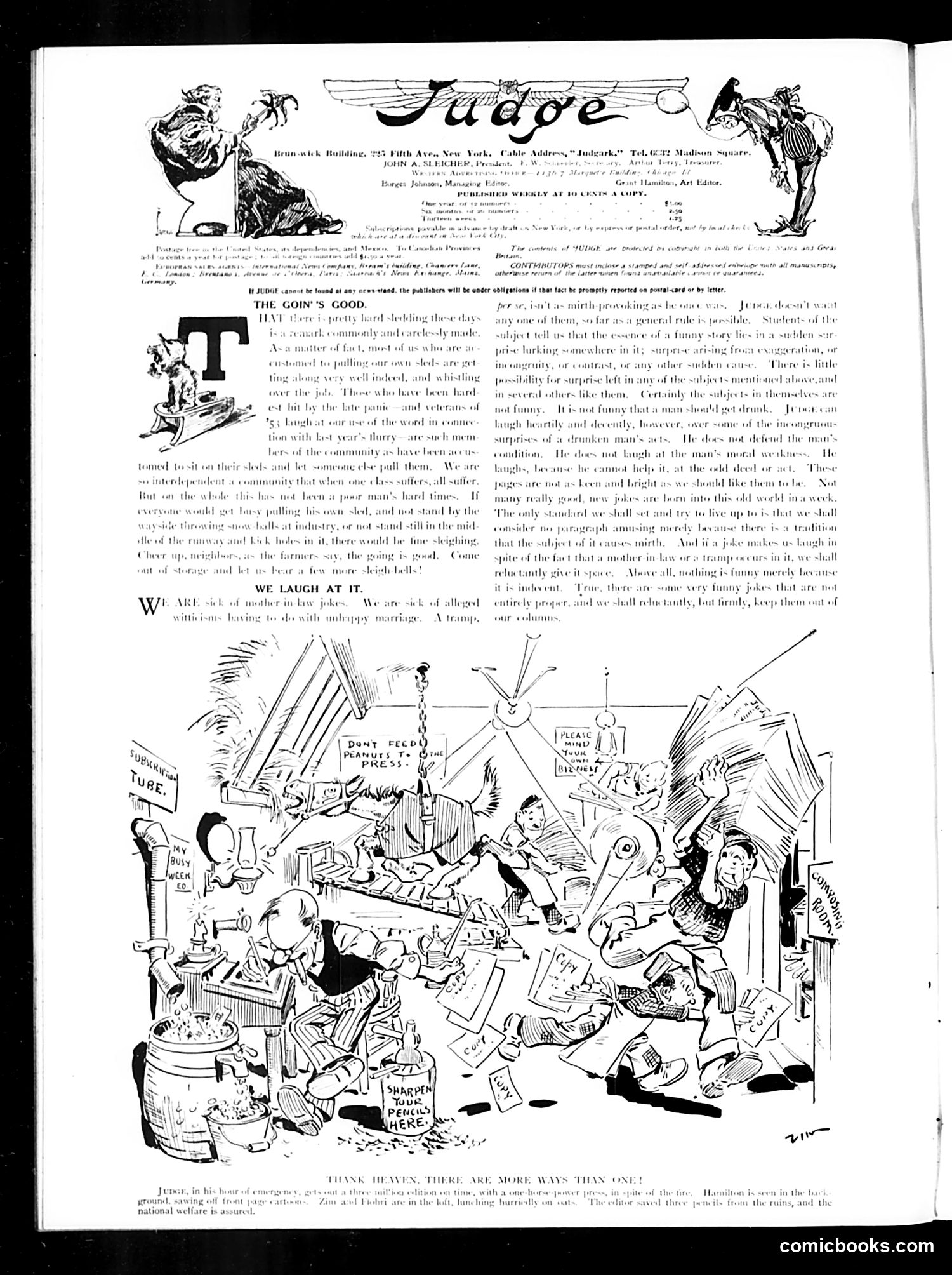
This appears to be an early 20th-century satirical piece titled "We Laugh at It," depicting a chaotic newsroom or editorial office. The cartoon illustrates journalists and editors in comedic disarray—people fighting, papers scattered everywhere, with signs reading "Don't Feed Personals," "Please Mind the Copydesk," and other office notices. The satire targets the newspaper industry itself, mocking the supposedly genteel profession of journalism by showing it as pandemonium. The accompanying text discusses what makes humor in journalism, suggesting that funny stories often contain sudden surprises or contradictions. The specific political figures or events referenced remain unclear from this page alone, though it's clearly commentary on contemporary media practices and the chaotic nature of producing satirical publications.
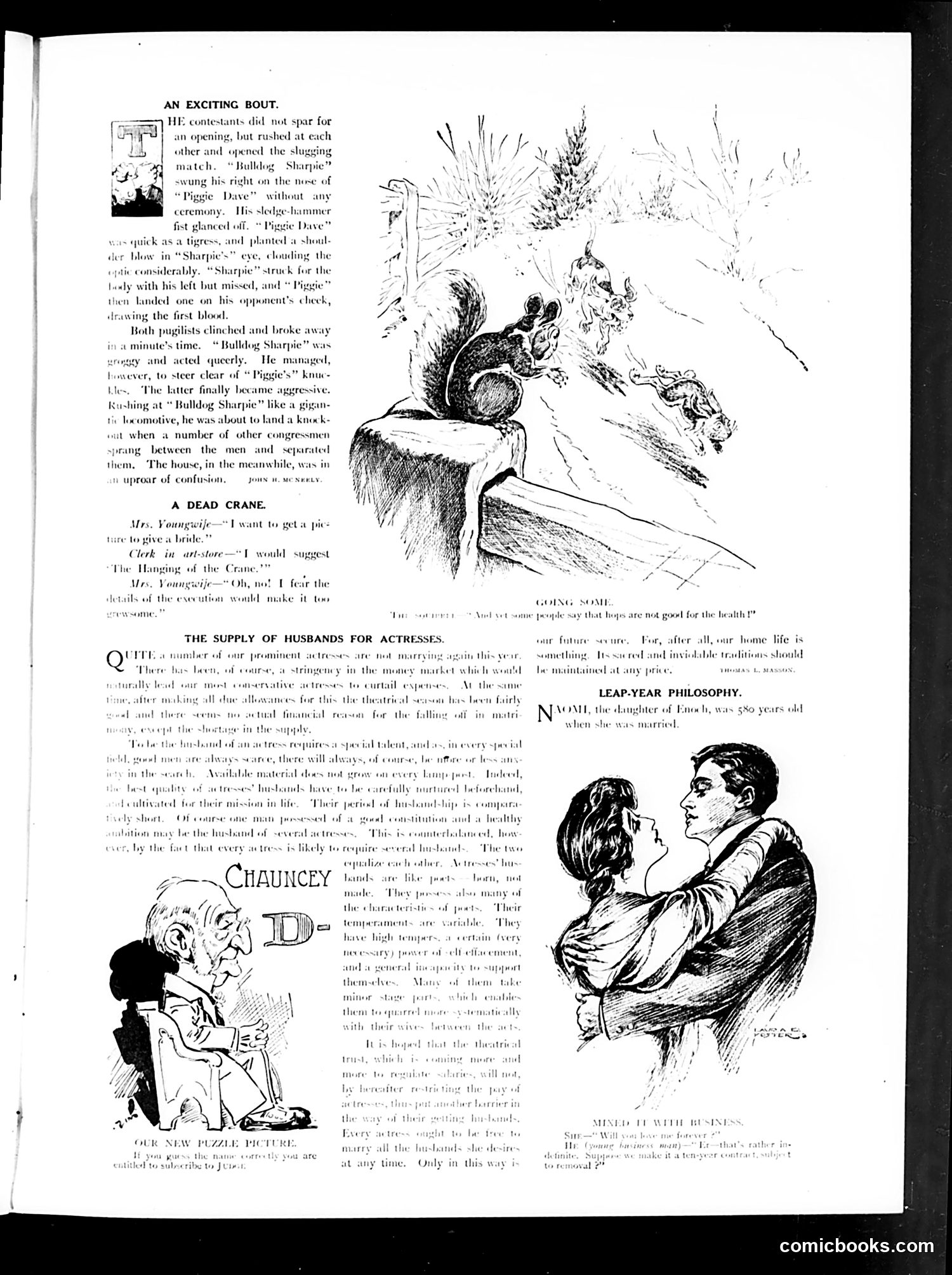
This page contains several humorous pieces typical of Judge's satirical style: **"An Exciting Bout"** depicts an animal fight (appears to be bulldogs named "Sharpe" and "Piggie Dave"), illustrated with energetic action. The satire likely comments on a contemporary boxing match or political rivalry, though the specific figures aren't clearly identifiable from the image alone. **"A Dead Crane"** and **"The Supply of Husbands for Actresses"** appear to be lighter satirical pieces about social conventions—one concerning marriage prospects for actresses. **"Half-Year Philosophy"** discusses actress marriages and husbands, reflecting contemporary social attitudes about theatrical professionals. The **Chauncey** caricature (left) appears to be a character illustration, though its specific reference is unclear. The page is primarily editorial/humorous content rather than political commentary, reflecting Judge's mix of social satire and entertainment.
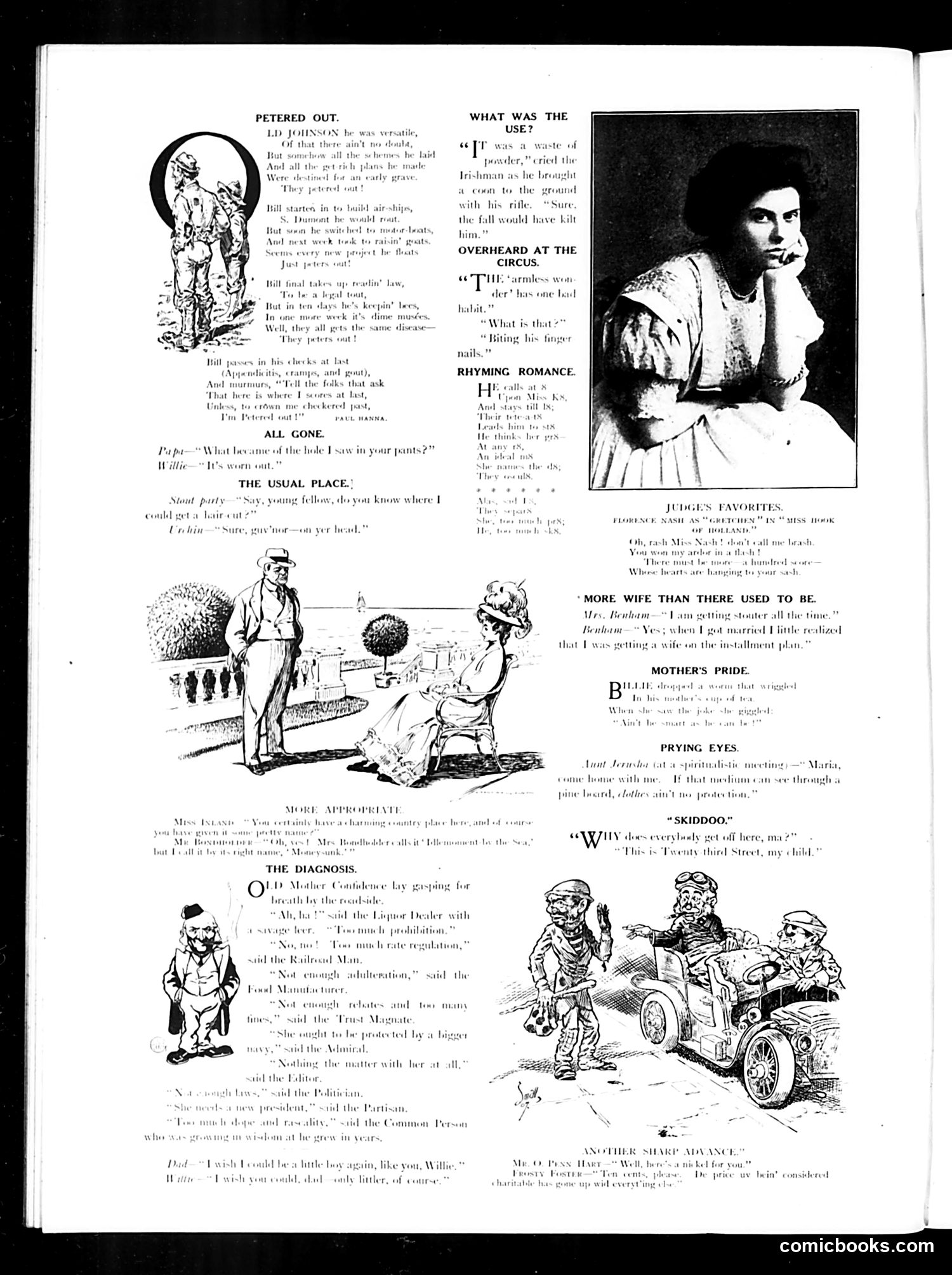
This page contains multiple unrelated humor pieces typical of Judge's format. The cartoons mock various social situations: **"The Usual Place"** depicts a working-class man unable to afford a haircut, reflecting economic hardship. **"The Diagnosis"** appears to satirize bureaucratic regulation and trust-busting, with characters discussing industrial monopolies and government intervention—likely referencing early 20th-century Progressive Era concerns about corporate consolidation. The remaining pieces are domestic humor ("Rhyming Romance," "Mother's Pride," "Prying Eyes") and light comedic scenarios ("Skiddoo," "Another Sharp Advance") without clear political intent. The page's tone suggests pre-WWI American anxieties about modernization, labor, and government power, delivered through accessible comic vignettes rather than pointed editorial commentary.
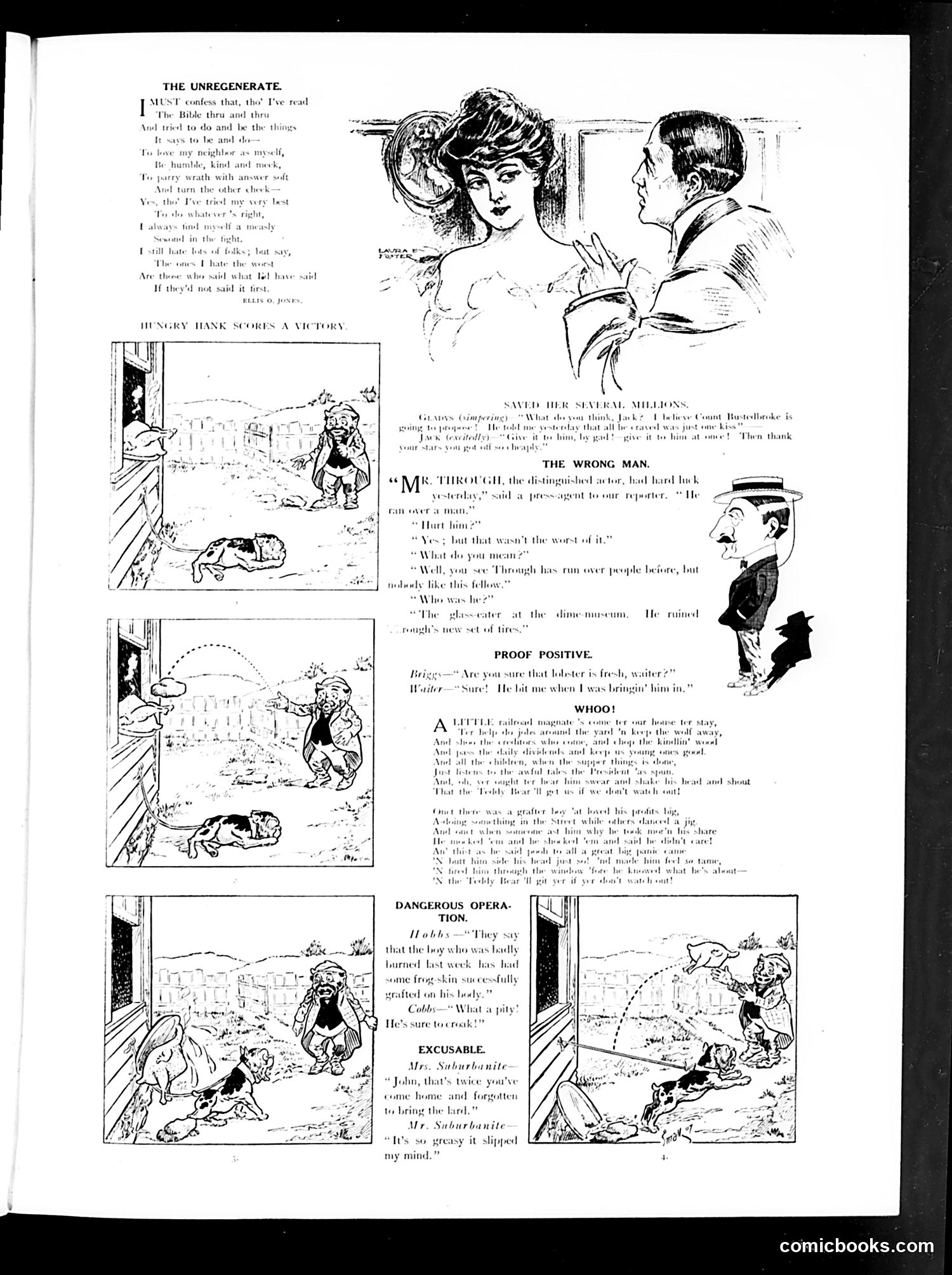
This page contains several short humorous pieces rather than a single political cartoon. "The Unregenerate" is a poem about someone who read the Bible but hasn't reformed their behavior—they still lie, parry conversations, and hate their enemies despite religious instruction. "Hungry Hank Scores a Victory" shows a comic strip sequence where a character appears to steal or acquire food. The other pieces are brief joke exchanges: "The Wrong Man" involves mistaken identity with a distinguished actor; "Saved Her Several Millions" plays on marriage/money themes; "Proof Positive," "Whoo!", "Dangerous Operation," and "Excusable" are short quips about various domestic or social situations. These appear to be general humor and satire rather than commentary on specific political figures or events. The magazine used varied content to entertain readers with observations about everyday life and human nature.
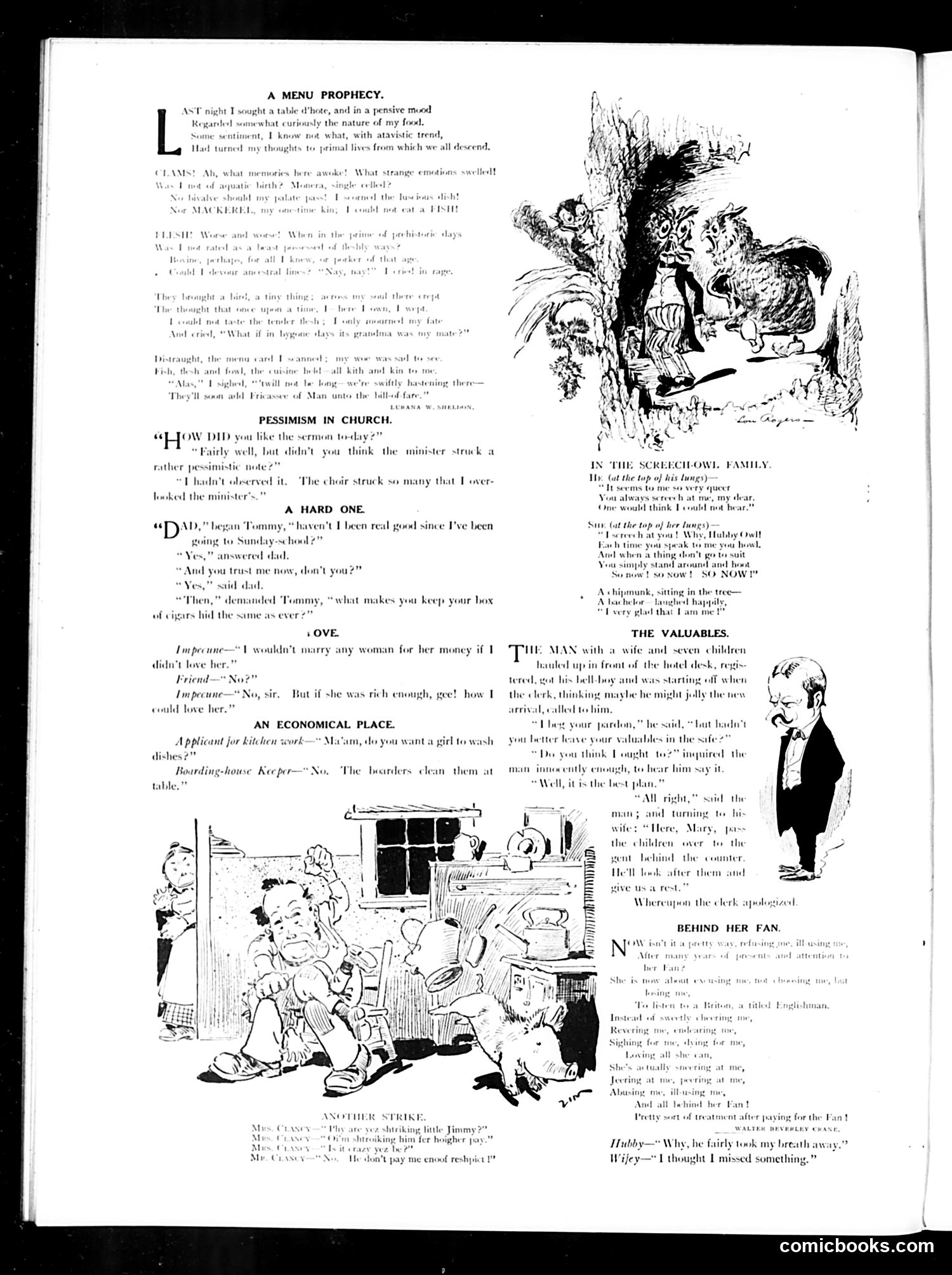
This page from *Judge* magazine contains several short satirical pieces: **"A Menu Prophecy"** satirizes evolutionary theory (likely referencing Darwin debates still active in the 1880s-90s): a diner contemplates eating clams and mackerel while musing that these creatures represent his evolutionary ancestors—a pessimistic view of human origins. **"Pessimism in Church"** jokes that the choir's poor singing was so discordant it overshadowed the minister's sermon's actual pessimism. **"The Valuables"** depicts a hotel clerk advising a man with seven children to leave valuables in the safe—implying the children themselves are valuable/precious but also humorously suggesting they're as risky as unguarded valuables. **"Behind Her Fan"** plays on courtship pretense: a woman pretends her husband took her breath away romantically, when his "taking her breath" actually means he forgot something ordinary. The humor relies on wordplay, evolutionary anxiety, domestic life observations, and Victorian social conventions—common *Judge* targets.
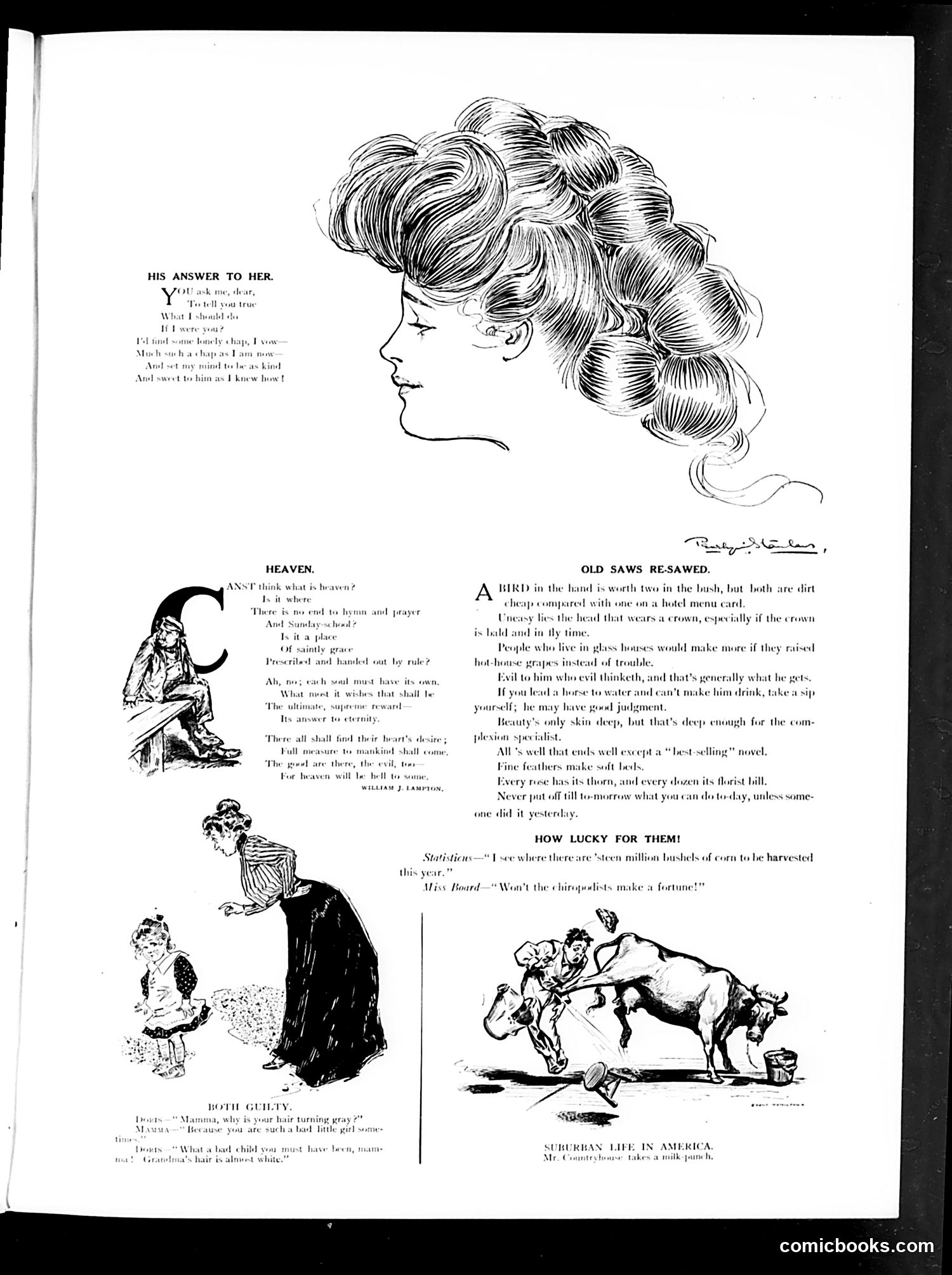
This page from the satirical magazine *Judge* contains multiple unrelated pieces typical of early 20th-century humor publications: **"His Answer to Her"**: A romantic poem where a man responds to a woman's question about what he'd do if she left, promising devotion—sentimental Victorian courtship humor. **"Heaven"** and **"Both Guilty"**: Poems and a domestic joke playing on tired themes: heaven's nature, and a child asking why mother's hair is graying (implying the child causes stress). **"Old Saws Re-sawed"**: Cynical rewrites of common proverbs, mocking conventional wisdom with modern skepticism—commentary on how dated advice fails contemporary life. **"How Lucky for Them!"**: A pun-based joke about corn harvests and chiropodists (foot doctors), relying on wordplay for humor. **"Suburban Life in America"**: A sketch showing rural/suburban life, with a man taking a "milk-punch" (alcoholic drink)—likely satirizing country gentlemen imitating urban sophistication. The page blends sentimental poetry with cynical social commentary, typical of *Judge*'s satirical approach to American culture.
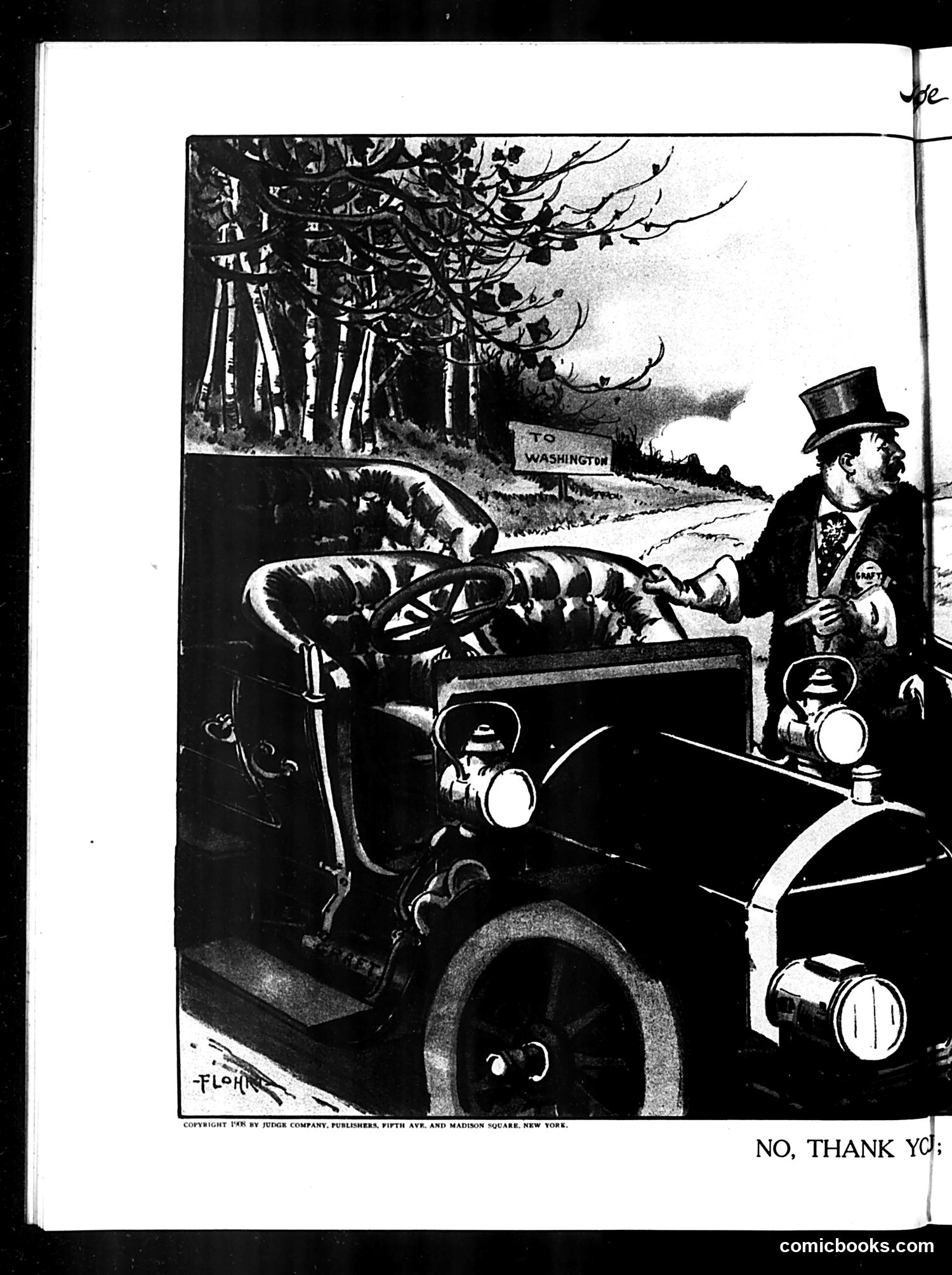
This is a Judge magazine cartoon (copyright 1908) satirizing a wealthy gentleman's refusal of a ride to Washington. The well-dressed figure in the top hat and formal attire sits in an early automobile on a road marked "TO WASHINGTON," declining the offer with "NO, THANK YOU." The satire likely critiques the reluctance of the wealthy or politically powerful to engage with Washington politics or government affairs—perhaps mocking those who avoid civic responsibility or political involvement despite their station. The gentleman's haughty demeanor and formal dress contrast with the practical automobile, suggesting he considers himself above such matters or destinations. The artist's signature reads "Florian" (or similar). The satirical point appears to be commentary on wealthy Americans' political apathy or aloofness during the Progressive Era.
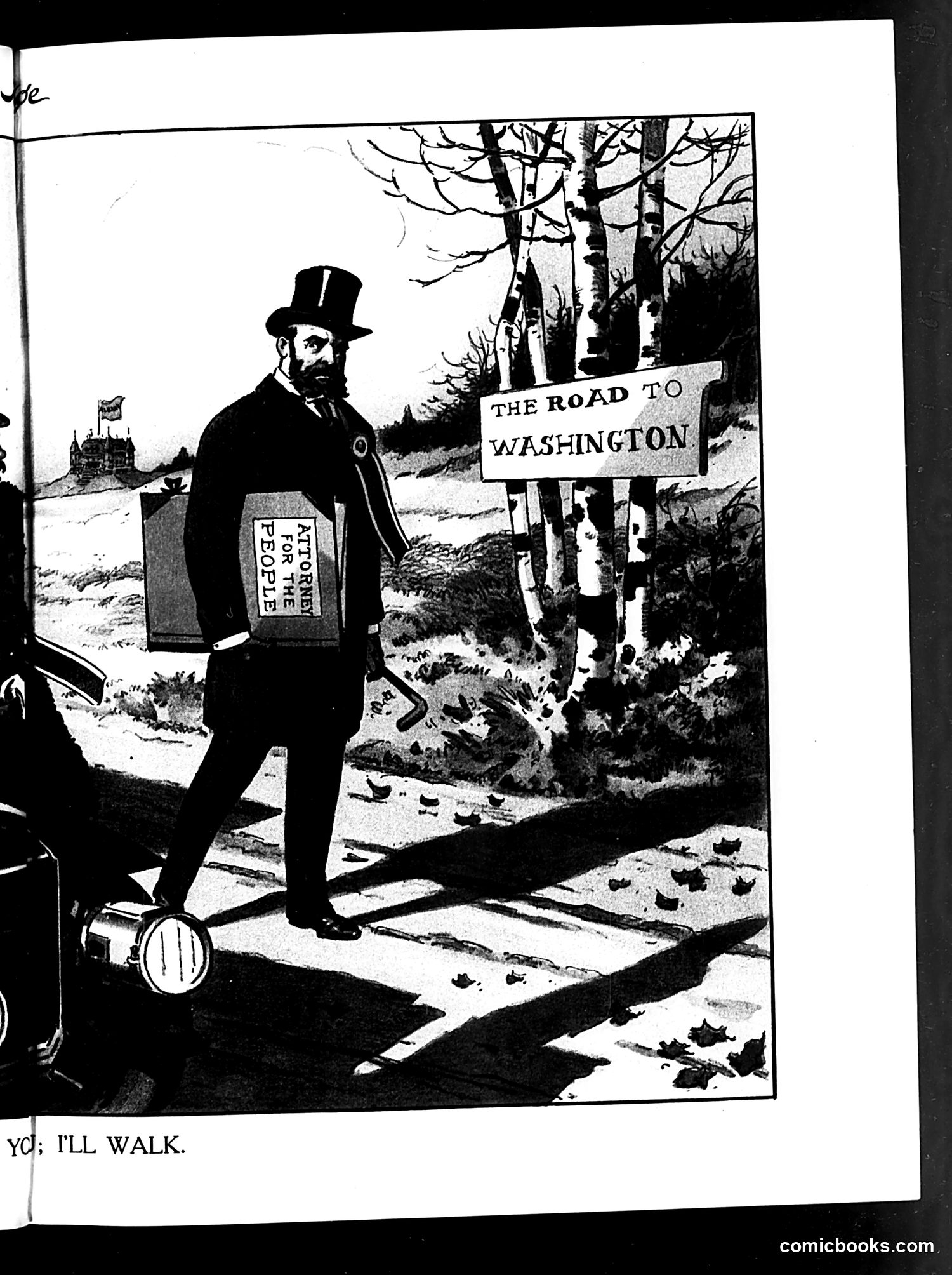
This political cartoon depicts a well-dressed gentleman in a top hat standing at a signpost marked "The Road to Washington." He carries a suitcase labeled "ADVICE FOR THE PEOPLE," suggesting he's a political figure or reformer heading to the capital with policy proposals. The caption "I'll Walk" indicates he's choosing to travel by foot rather than conventional means—likely satirizing a politician's claimed dedication to the common people or grassroots approach. The winter landscape and bare birch trees reinforce themes of a harsh journey or difficult political path. Without a visible date or identifying details, the specific political figure or event remains unclear, but this appears to critique an ambitious politician's self-presentation regarding popular support and accessibility.
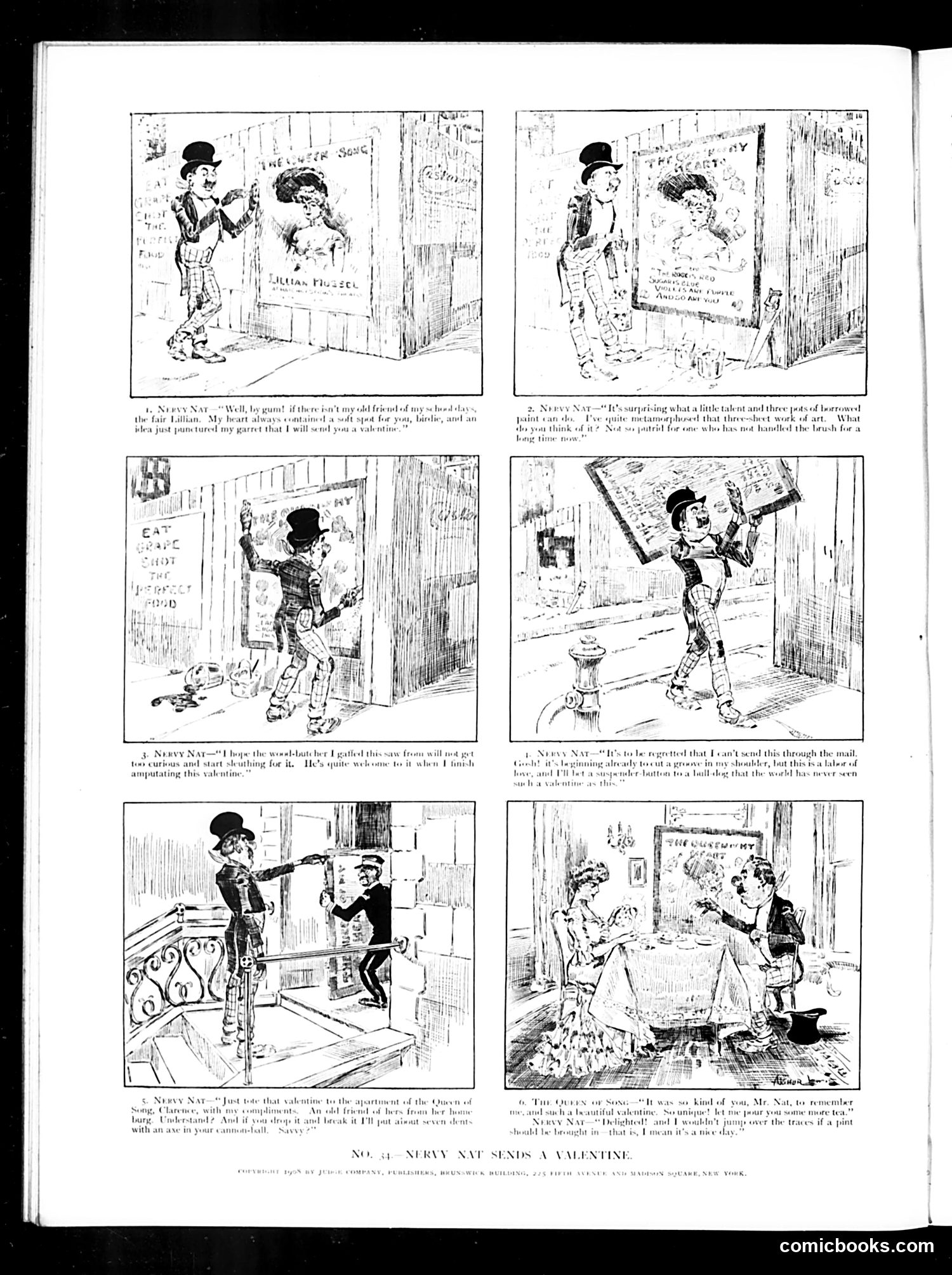
This is a six-panel comic strip featuring a character called "Nervy Nat," a young boy in formal attire (top hat and suit). The humor follows Nat's misadventures attempting to deliver a valentine to a girl. The strip satirizes romantic social conventions of the era: Nat struggles with the formality required for courting (his attempts at gentlemanly behavior), physical awkwardness, and class anxieties (references to a Queen). The comedy derives from slapstick—Nat repeatedly fails at dignified delivery through clumsiness and mishaps. The final panels show him successfully reaching the girl, though his interactions remain awkward, poking fun at youthful romantic earnestness and the gap between social expectations and actual teenage behavior.
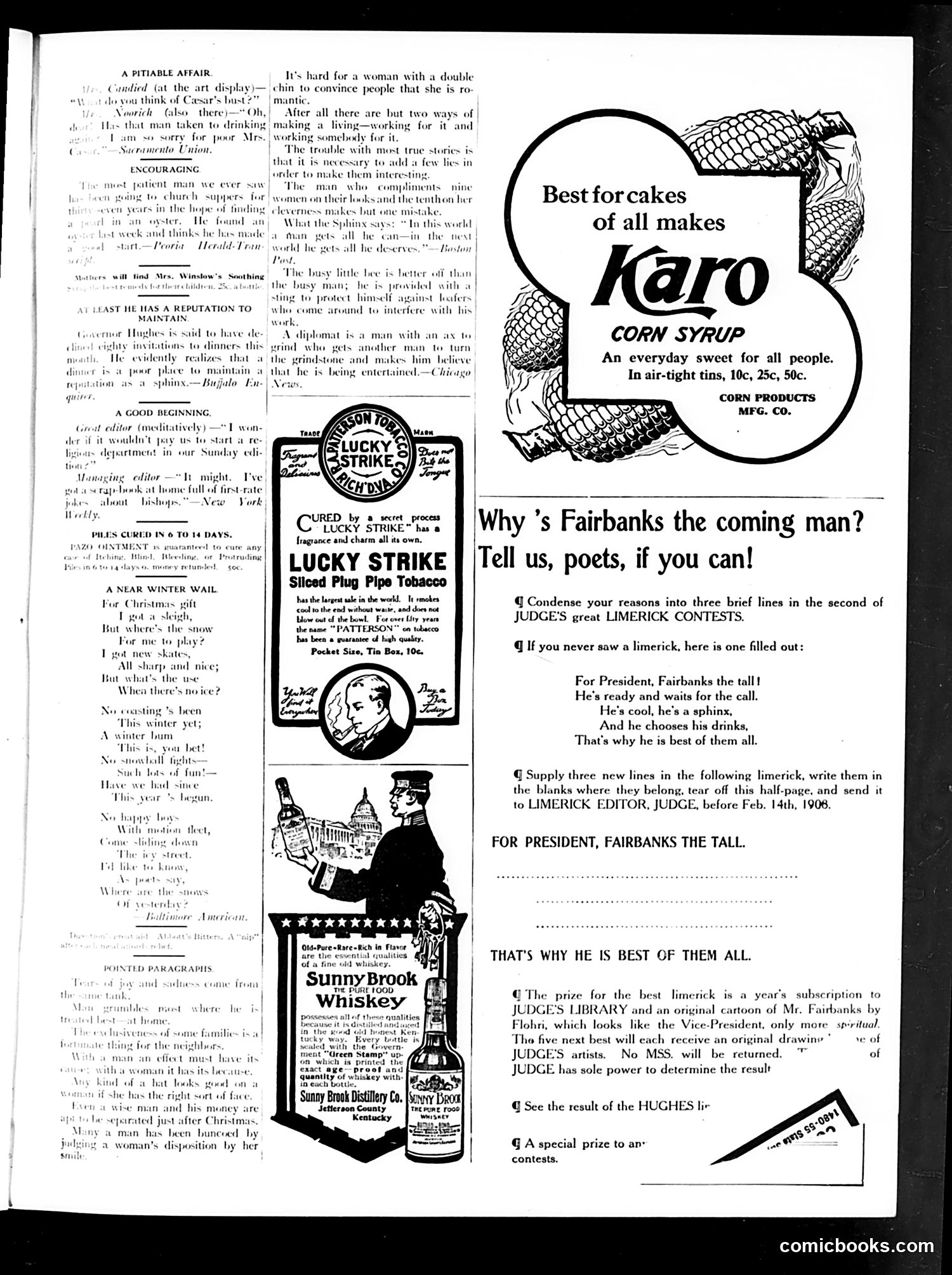
This 1906 *Judge* magazine page is primarily **advertising and a poetry contest**, not political satire in the traditional sense. The **contest** promotes Vice President James Sherman Fairbanks as a presidential candidate through a limerick competition. The example limerick characterizes him as: tall, ready, cool, sphinx-like (mysterious/enigmatic), and a drinker who "chooses his drinks"—suggesting he's sophisticated or perhaps implicitly attacking his character regarding alcohol. The page includes period advertisements (Lucky Strike tobacco, Sunny Brook whiskey, Karo corn syrup, and a hemorrhoid treatment) typical of early 1900s magazines. The scattered humor pieces at left are unrelated social commentary—jokes about women's appearance, business, and relationships—standard filler content for the era. **The satire is subtle**: characterizing a serious political figure through playful verses while surrounding him with liquor ads creates implied commentary on his fitness for office, though readers must infer the criticism rather than seeing explicit political attack.
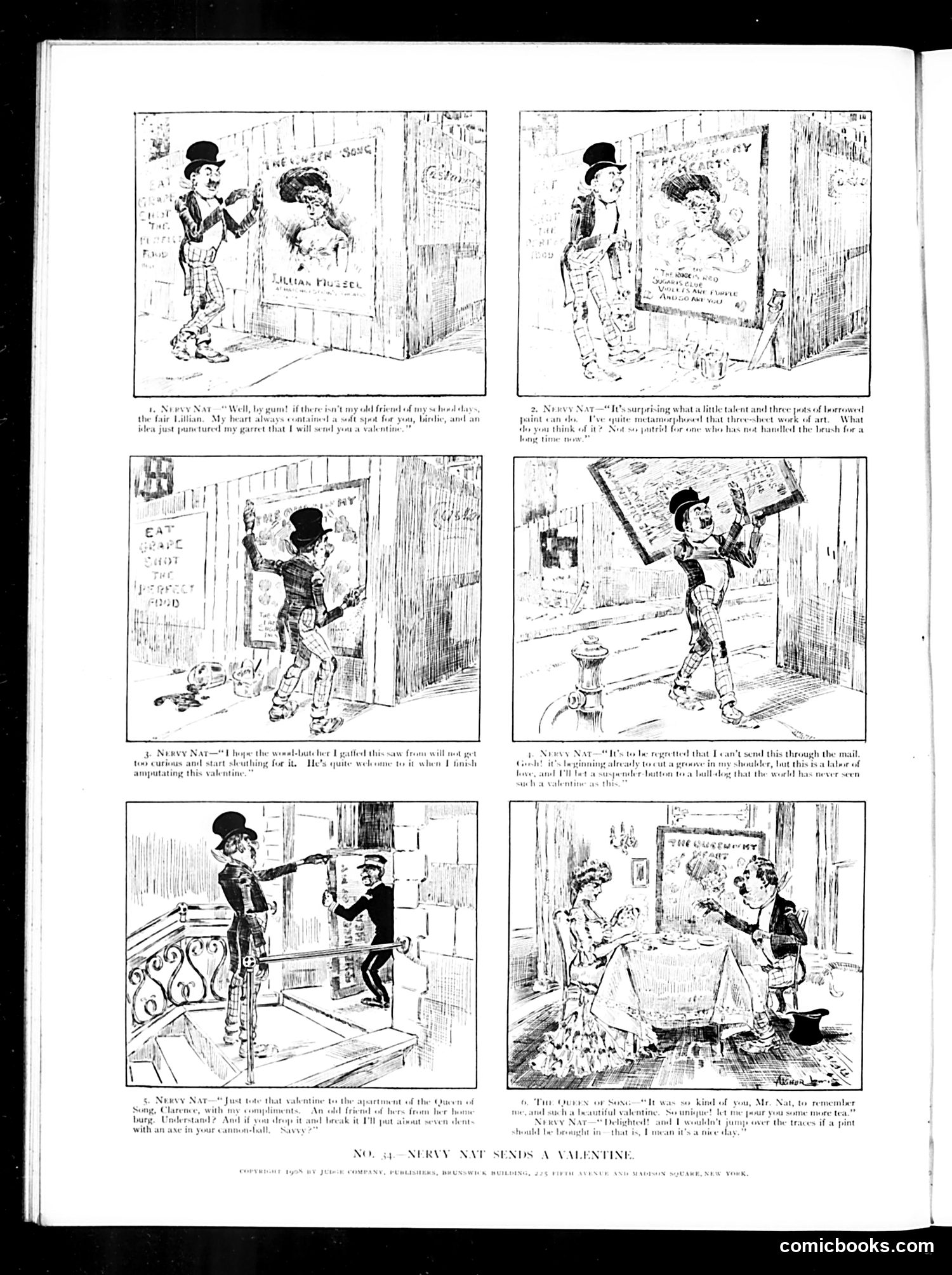
This is a comedic six-panel story featuring a character named "Nervy Nat," a working-class boy in a bowler hat and patched clothes. The narrative follows Nat attempting to deliver a valentine to a young woman named Lillian, whom he admires. The humor derives from Nat's persistent, bumbling efforts despite repeated obstacles and rejections. He encounters her family members, endures sarcastic comments about his appearance and social class, and faces physical mishaps (including what appears to be paint-related incidents). The satire gently mocks both Nat's audacious romantic persistence despite his lowly station and the snobbish responses of the upper-class family. It's a lighthearted commentary on class distinctions and the earnest romantic aspirations of working-class youth in early 20th-century America.
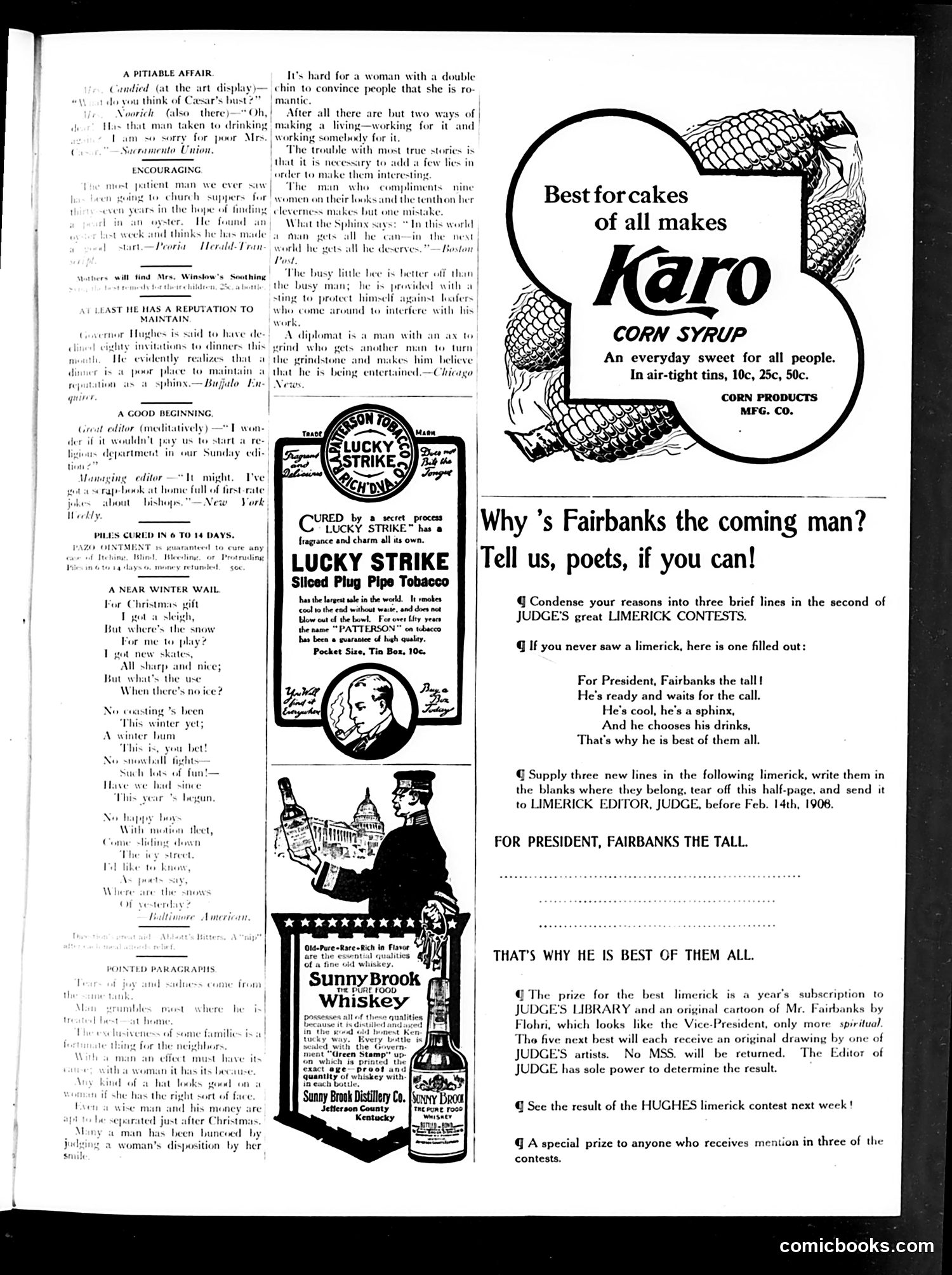
This page contains a **limerick contest** promoting **James Sherman Fairbanks** as a presidential candidate. The contest invites readers to complete a limerick praising "Fairbanks the tall" with three new lines. The sample limerick provided mocks Fairbanks subtly: it emphasizes he's a "sphinx" (emotionally distant/enigmatic), describes him as "cool," and notes he "chooses his drinks"—suggesting detachment, lack of passion, and perhaps indulgence. The satire appears to question whether these are genuinely presidential qualities, even while framing the contest as celebrating him. The page is dated before February 14, 1906, indicating this was published during Theodore Roosevelt's presidency when succession discussions were active. Fairbanks was Roosevelt's Vice President. The remainder of the page consists of **period advertisements** (Lucky Strike tobacco, Sunny Brook whiskey, Karo corn syrup) and unrelated humorous short pieces typical of Judge magazine's satirical format.
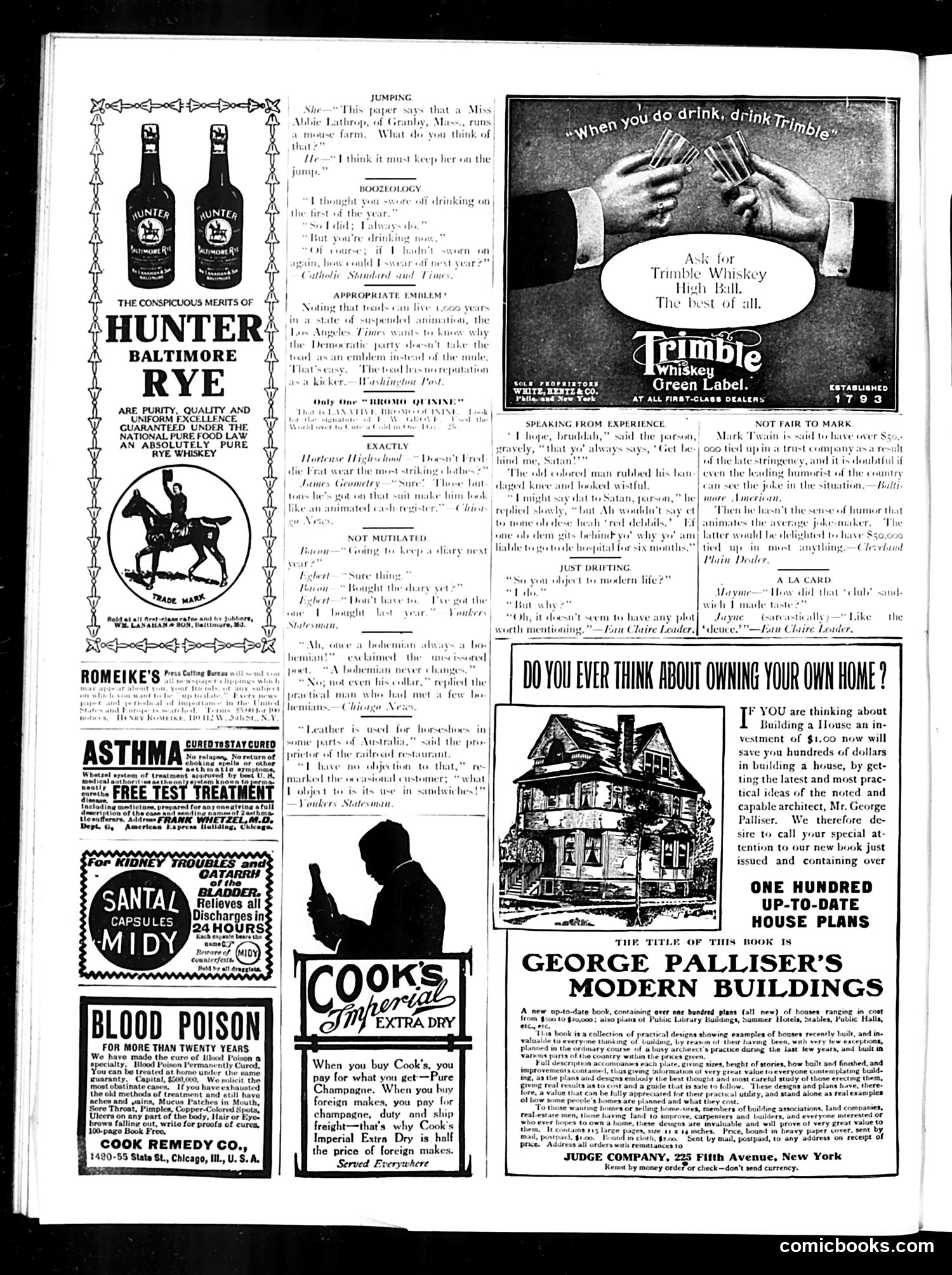
This is primarily a **satirical advertisement and humor page** from Judge magazine, typical of early 20th-century American periodicals. The main cartoon appears top-left: a woman named "Abbie Lathrop" is observed jumping, with dialogue joking that she keeps "her on the jumps"—a visual pun on the phrase about New Year's resolutions. The satire mocks people who swear off drinking on January 1st but resume immediately. The page is dominated by **advertisements** for whiskey (Hunter Baltimore Rye, Trimble Whiskey), patent medicines (asthma cure, blood poison treatment), and household books. Scattered throughout are **short comedic vignettes** with minimal political content—mostly domestic humor and wordplay about bohemians, diary-keeping, and romantic confusion. These are typical Judge filler material. The single substantive reference: a quip about Mark Twain having "$50,000 tied up in a trust" relates to real financial/legal matters of the era, used here for humor about wealth and obligations. Overall, this is a **commercial, entertainment-focused page** rather than sharp political satire.
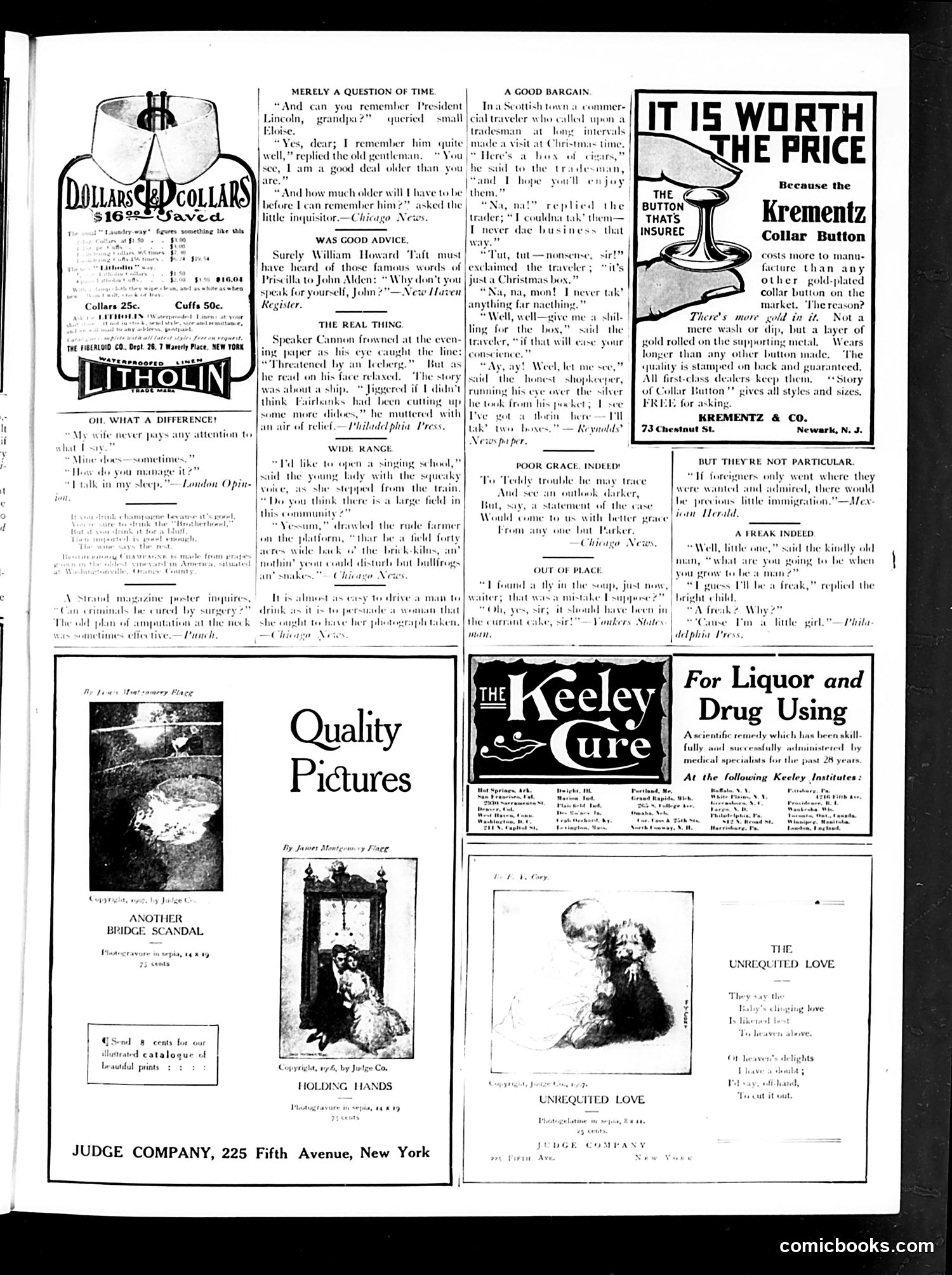
This page from the satirical magazine **Judge** contains mostly **humorous short anecdotes and advertisements** rather than political cartoons. The jokes reference contemporary figures and situations: - **"Merely a Question of Time"**: A grandfather joke playing on age and memory of President Lincoln (suggesting the old man is ancient). - **"Was Good Advice"**: References **William Howard Taft**, mocking him for not being assertive enough—a jab at his perceived weakness compared to his predecessor Theodore Roosevelt. - **"The Real Thing"**: Features **Speaker Cannon** (House Speaker Joseph Cannon), a powerful political figure, relieved by scandal news about someone else—likely commenting on political infighting. - **"A Good Bargain"**: A Scottish anecdote about business ethics and refusing gifts. The page is predominantly **commercial advertising**—notably for Krementz collar buttons and "The Keeley Cure" (a real treatment facility for alcohol and drug addiction, operating from the 1880s onward). The humor is gentle, relying on wordplay and social observation rather than sharp political satire.
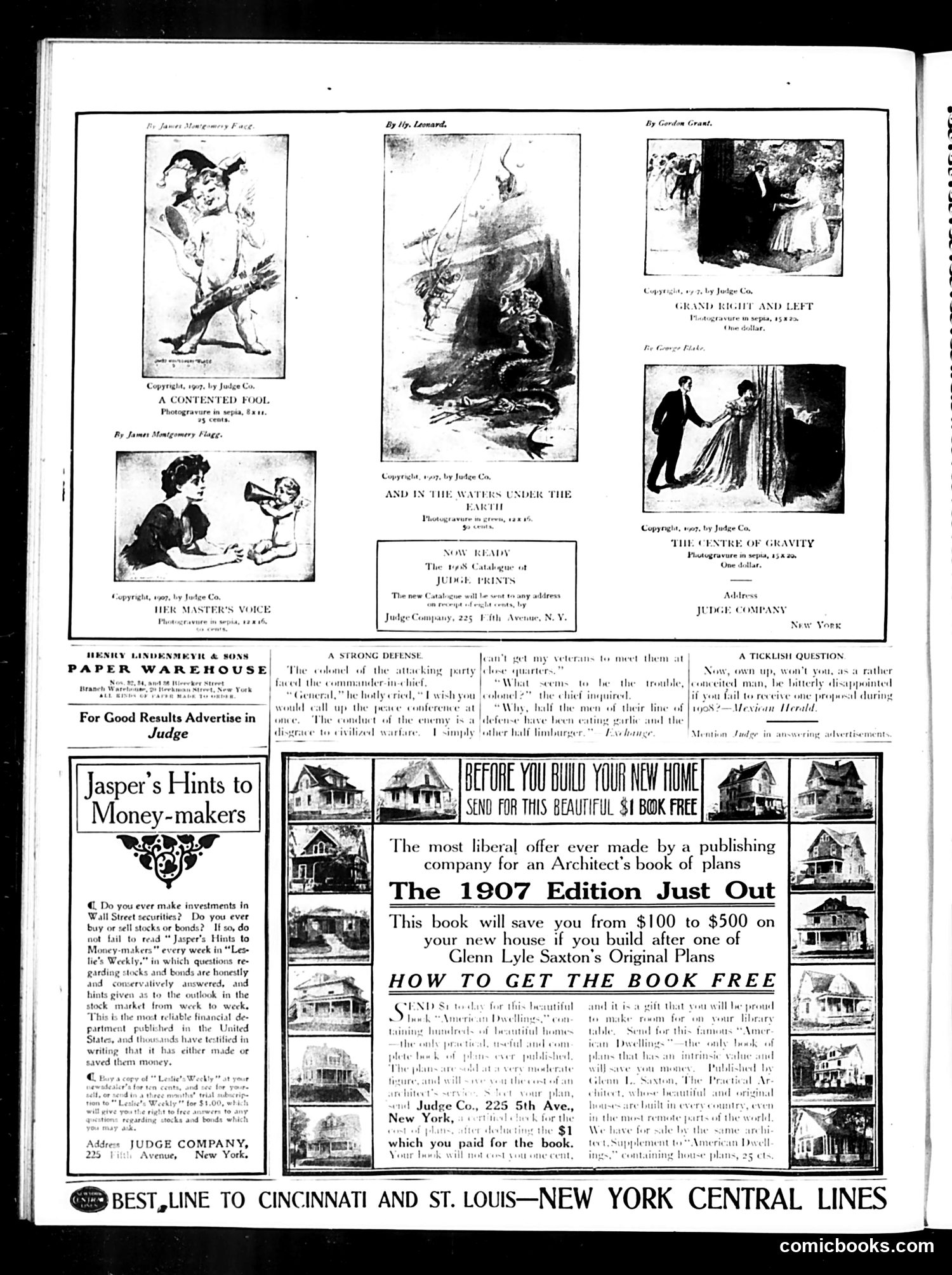
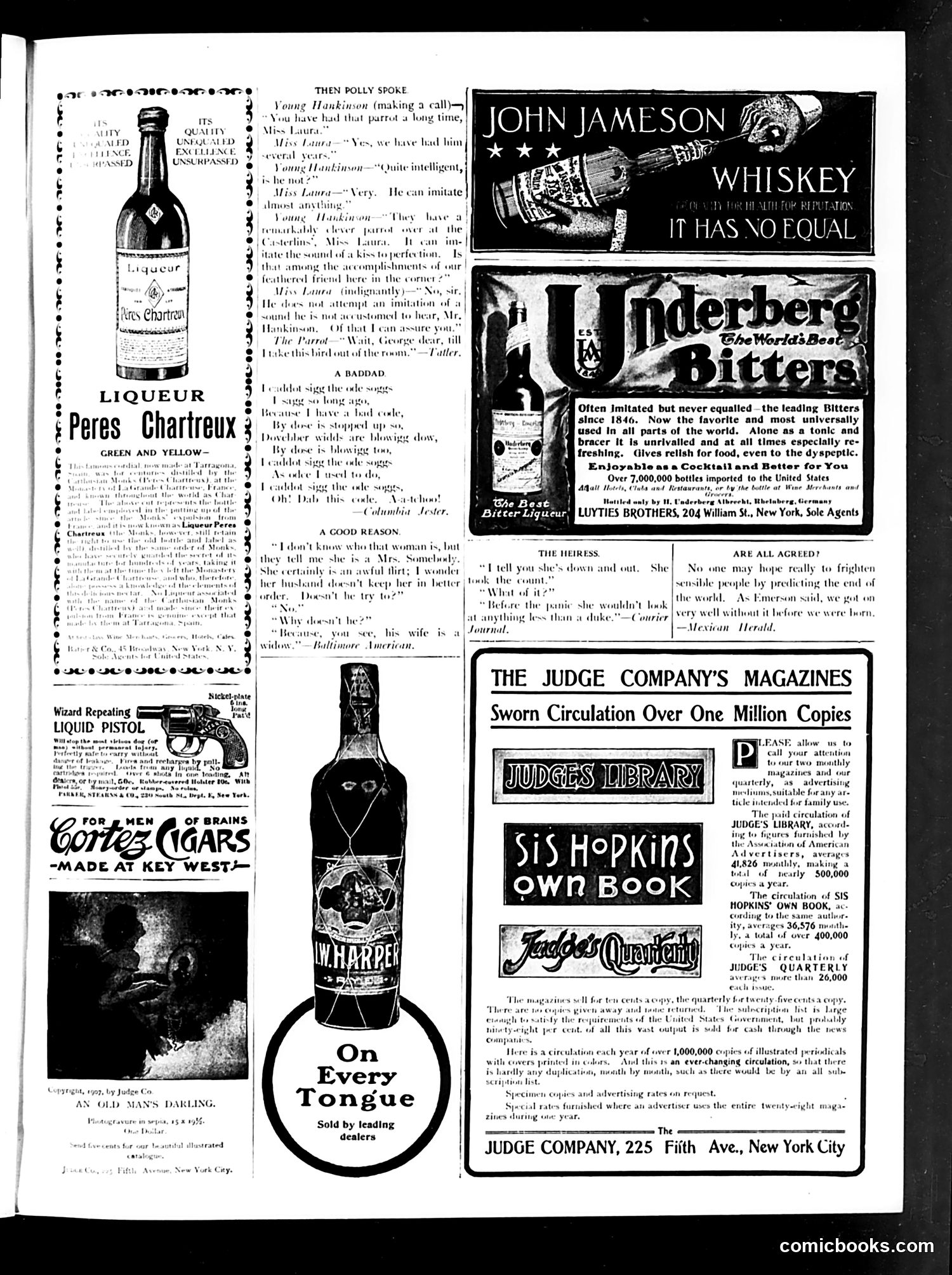
This page is primarily **advertising and filler material** rather than satirical cartoons. The top portion shows three small photographic scenes from what appear to be Judge Company film productions ("A Contested Fool," "And in the Waters Under the Earth," "Grand Opera Ballet"), typical of early 1900s entertainment advertising. Below are three brief humorous dialogue snippets—"A Strong Defense," "A Ticklish Question"—presenting military and domestic comedy scenarios common to the era's humor magazine format. The bulk of the page features advertisements, including: - **Jasper's Hints to Money-makers** (financial advice) - A major ad for Glenn Lyle Saxton's **1907 house-plan book**, offering architectural designs to save homebuilders money - Various business addresses and promotional copy The page reflects Judge's dual function as both satirical publication and advertising vehicle, with minimal political or social satire visible. The content targets middle-class concerns: investments, home construction, and domestic humor typical of 1907 American commercial magazines.
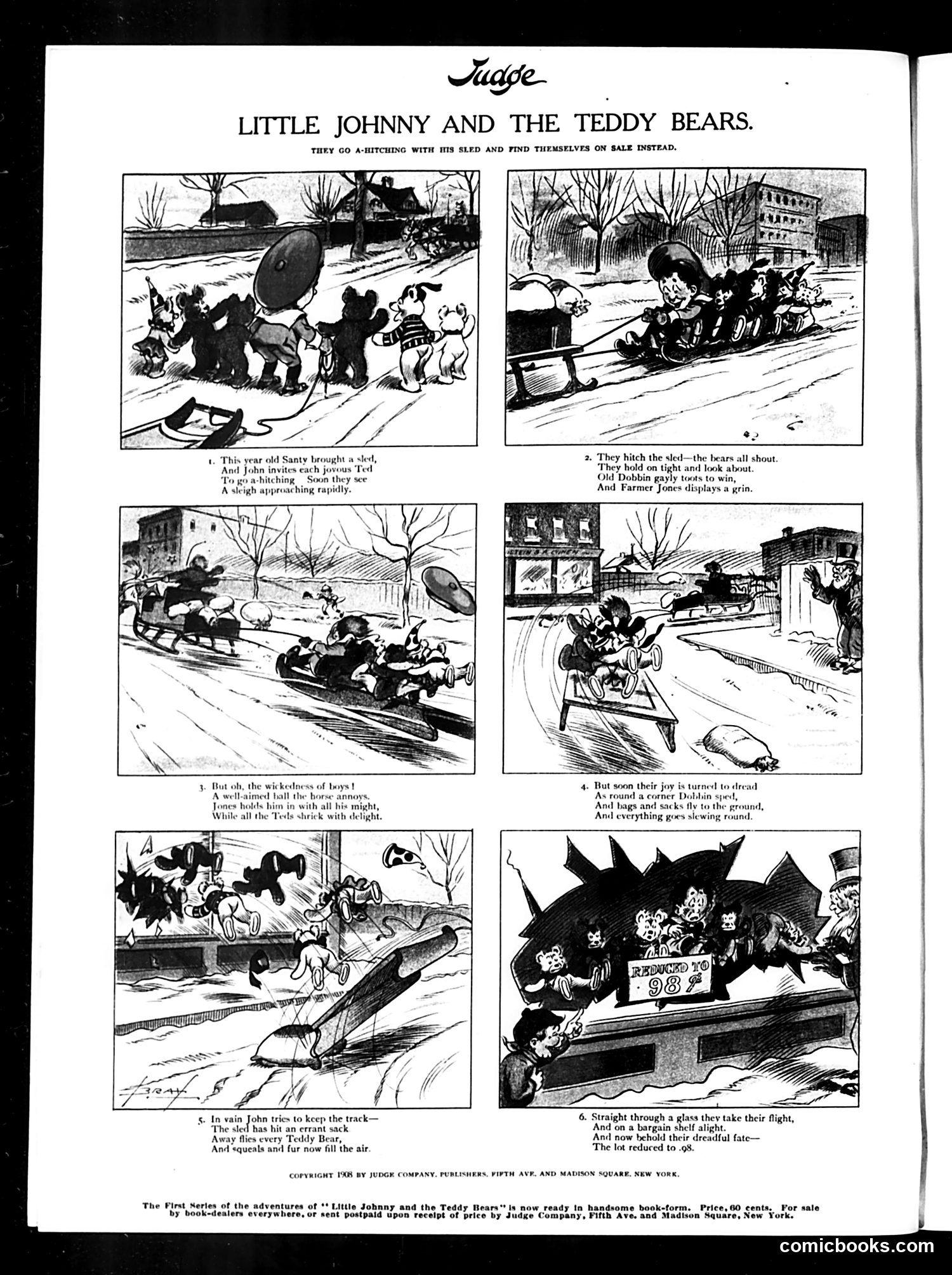
This is a comic strip about a boy and stuffed teddy bears that accidentally end up in a store window instead of sledding. The narrative follows their mishap: Johnny hitches the bears to his sled, they're picked up by a horse ("Old Dobbin"), crash through a store window, and land on a bargain shelf marked down to 98 cents. The humor relies on slapstick chaos and the ironic twist that toys meant for play become merchandise for sale at a discount. There's no apparent political satire—this is simply light entertainment humor typical of Judge magazine's family-friendly comic content. The page ends with an advertisement for the first book collection of this series, priced at 60 cents, available through bookstores or Judge Company.