
A complete issue · 17 pages · 1905
Judge — June 24, 1905
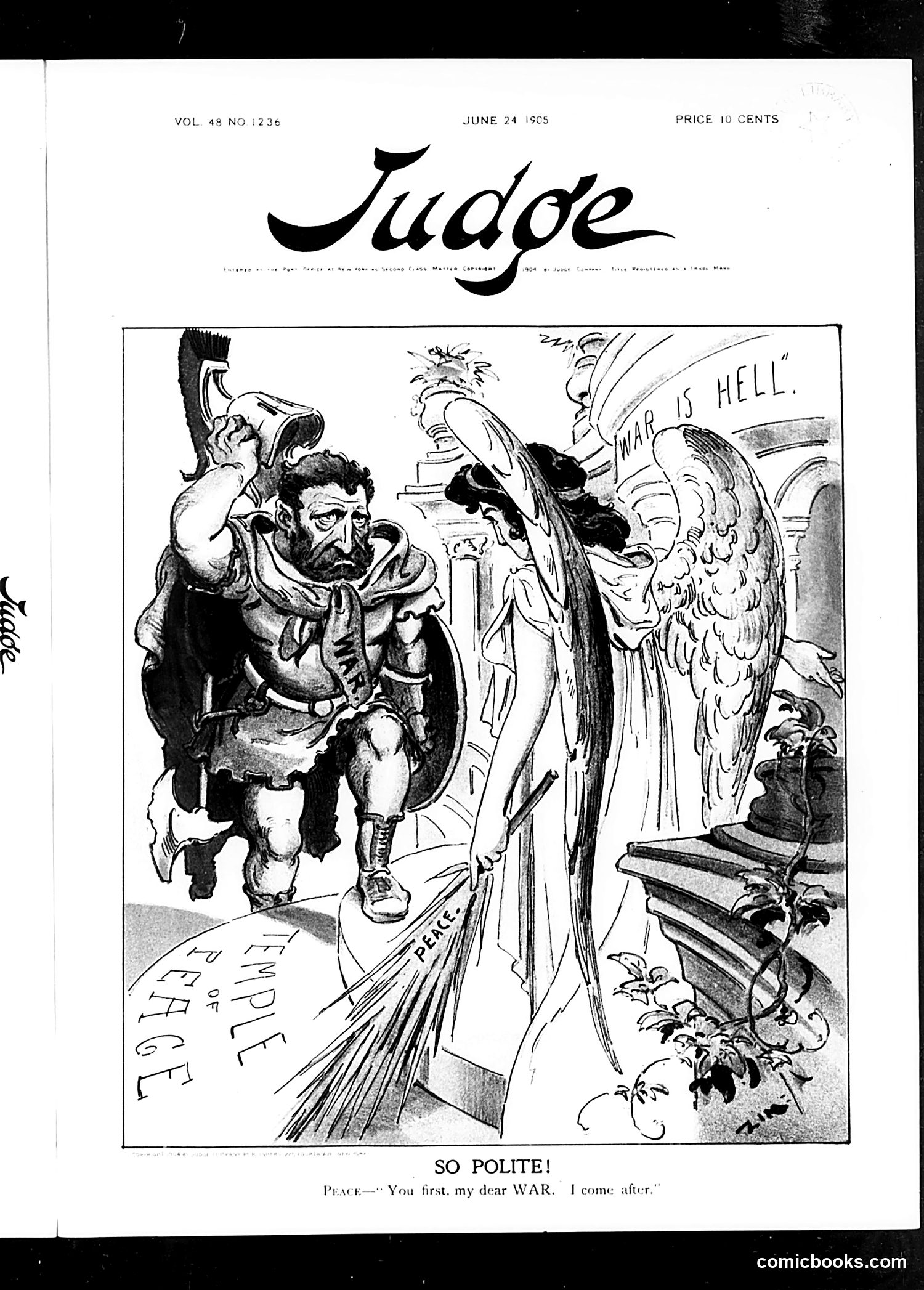
This political cartoon depicts **War** (a bearded, demonic figure on the left) encountering **Peace** (an angelic figure on the right, labeled "WAR IS HELL"). The caption reads: "Please—'You first, my dear WAR. I come after.'" The satire critiques the superficial politeness masking genuine conflict during this period. War appears aggressive and eager, while Peace offers hollow courtesy, suggesting that diplomatic niceties were merely theatrical gestures that couldn't prevent military confrontation. The date (June 1905) likely references tensions during the **Russo-Japanese War** or broader imperial conflicts of the era, when nations performed civility while preparing for violence. The cartoon cynically suggests "politeness" was merely a pretext preceding inevitable warfare.
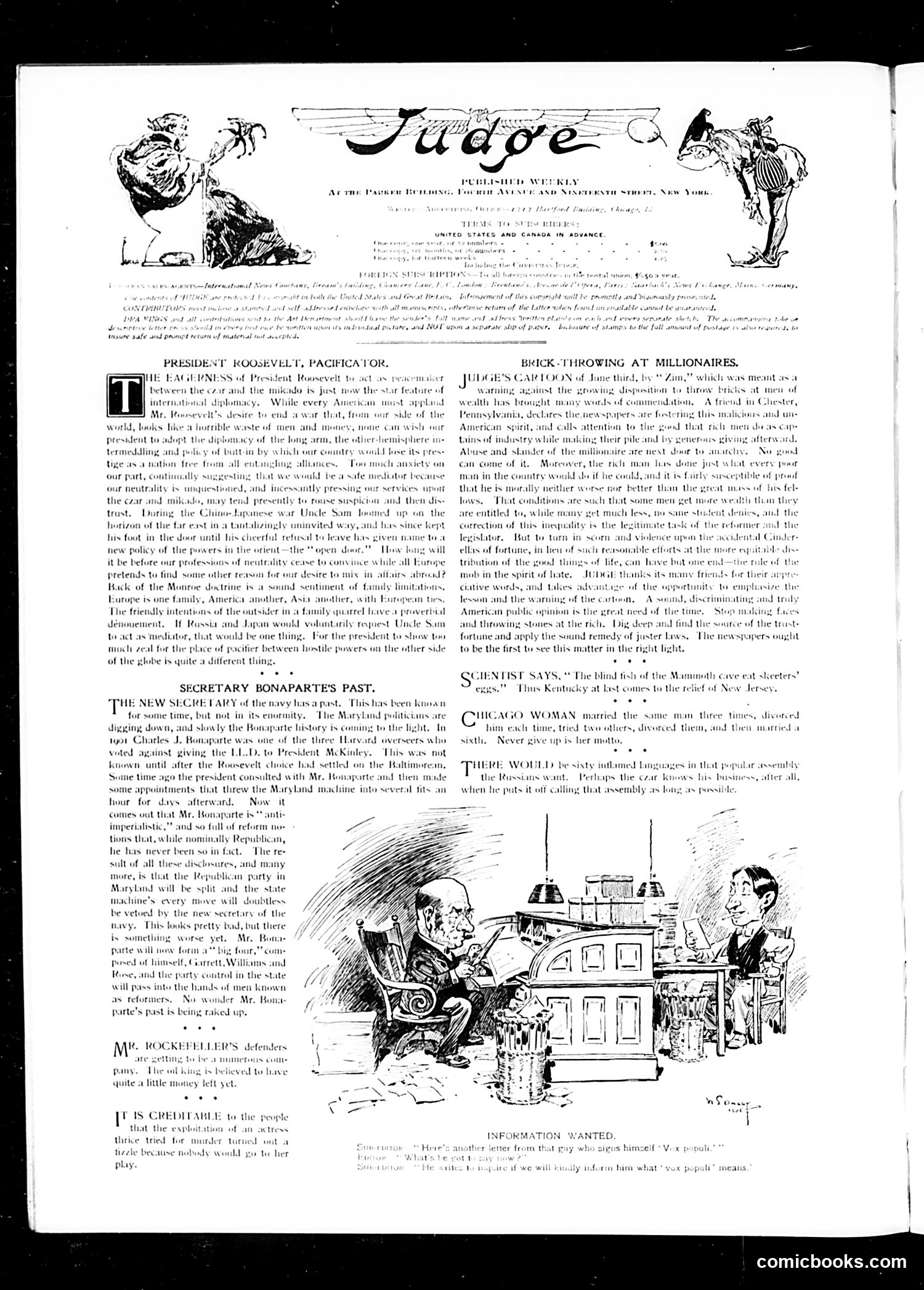
This page contains several satirical pieces from an early 20th-century American publication. The main political cartoon (bottom right) depicts an assembly or legislature scene, likely mocking inefficiency or verbose debate—suggested by the cramped workspace and scattered papers. The text articles include commentary on President Roosevelt's foreign policy ("Pacificator"), criticism of wealthy industrialists ("Brick-Throwing at Millionaires"), and social observations about secretaries and divorce. One piece humorously notes a Chicago woman's multiple marriages. Without clearer visual identification of specific figures or a publication date visible in the OCR, the exact political targets remain partially unclear. However, the overall tone mocks governmental incompetence, wealth inequality, and contemporary social scandals typical of Progressive Era satire.
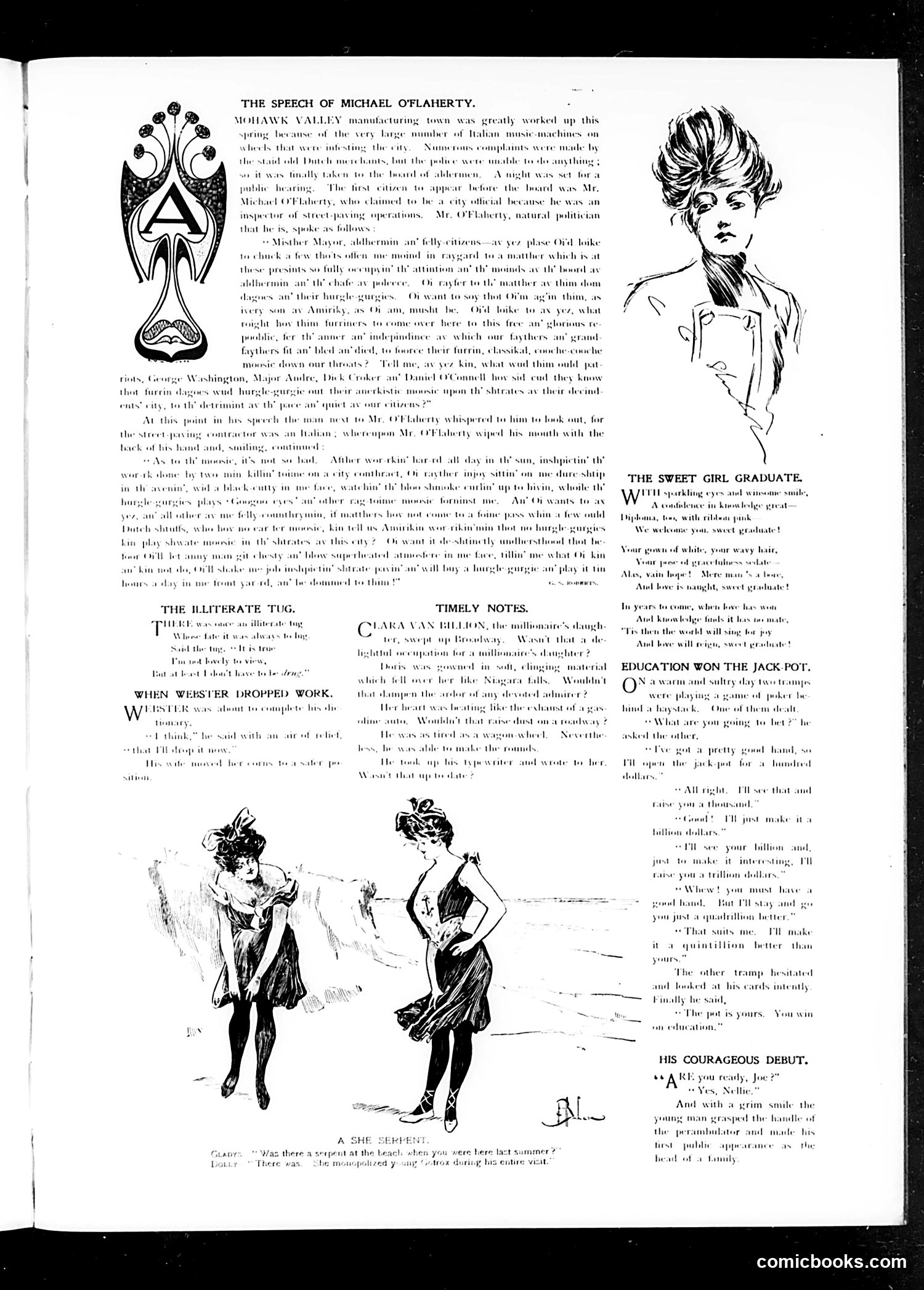
This page contains satirical commentary and verse rather than political cartoons. "The Speech of Michael O'Flaherty" mocks Irish-American political speech patterns and concerns—referencing Tammany Hall politics and municipal complaints about city services. "The Illiterate Tug" presents working-class dialect humor. "A She Serpent" cartoon depicts two women in confrontational poses, likely satirizing female social rivalry or gossip, a common Judge theme. The right side includes lighter pieces: "The Sweet Girl Graduate" (poking fun at educated women), "Timely Notes" (social observation), and "His Courageous Debut" (theatrical satire). Overall, the page targets Irish-Americans, the working class, and educated women—typical Judge Magazine targets of the early 20th century.
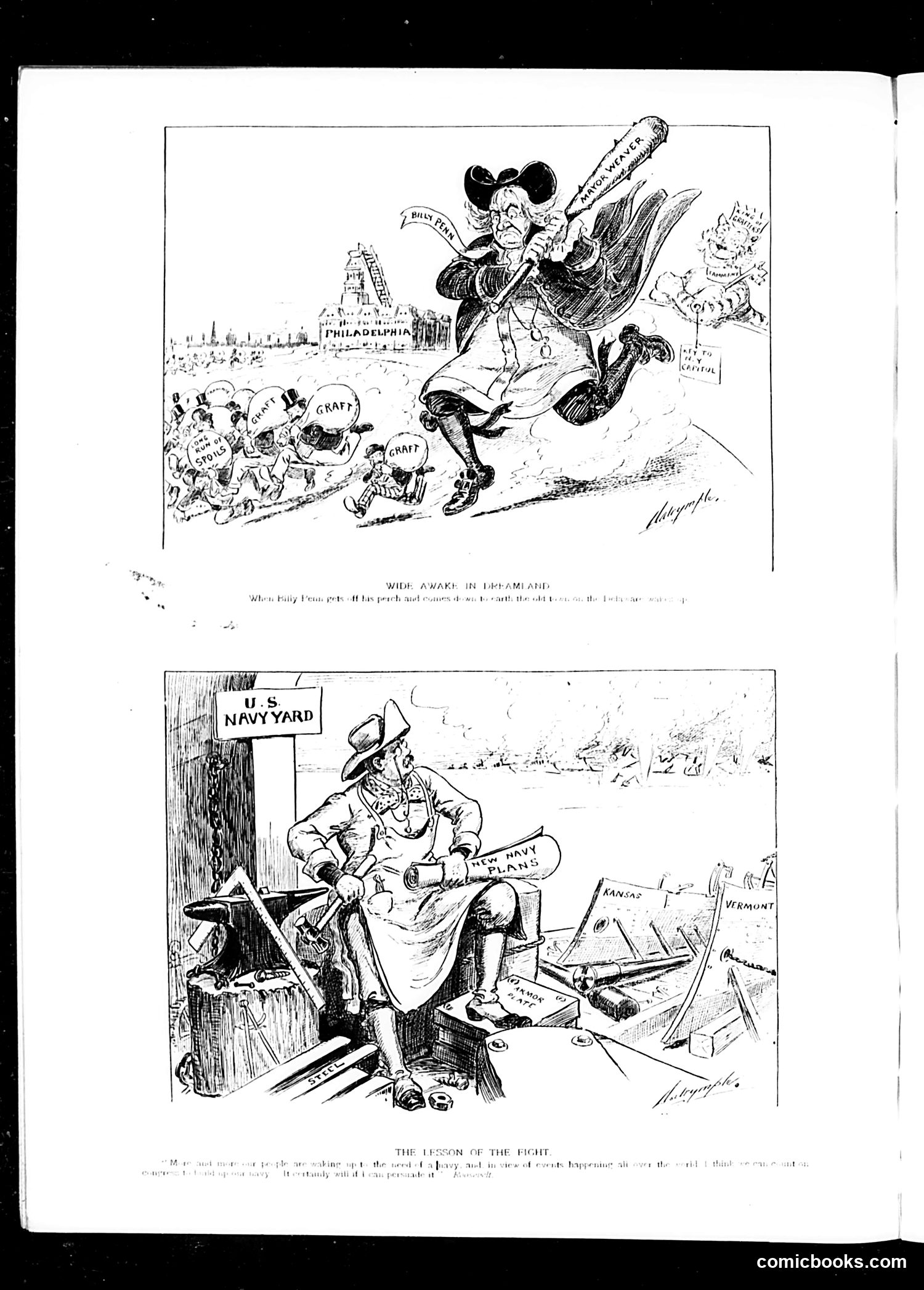
The page contains two satirical cartoons from *Judge* magazine, likely from the early 1900s. **Top cartoon ("Wild Awake in Dreamland"):** Shows a caricatured figure with an exaggerated Mickey Mouse-style head wielding a large club, swinging wildly at smaller figures labeled "Graft" below. The setting appears to be a European city (possibly depicting anti-corruption efforts abroad). The figure seems to represent American political reform or intervention against corruption. **Bottom cartoon ("The Lesson of the Right"):** Depicts a woman at a U.S. Shipyard holding navy plans, surrounded by state labels (Kansas, Vermont visible). She appears to be instructing or demonstrating to figures representing different states, likely satirizing federal shipbuilding policy or naval expansion decisions and their distribution across regions. Both cartoons employ exaggeration and caricature typical of early political satire.
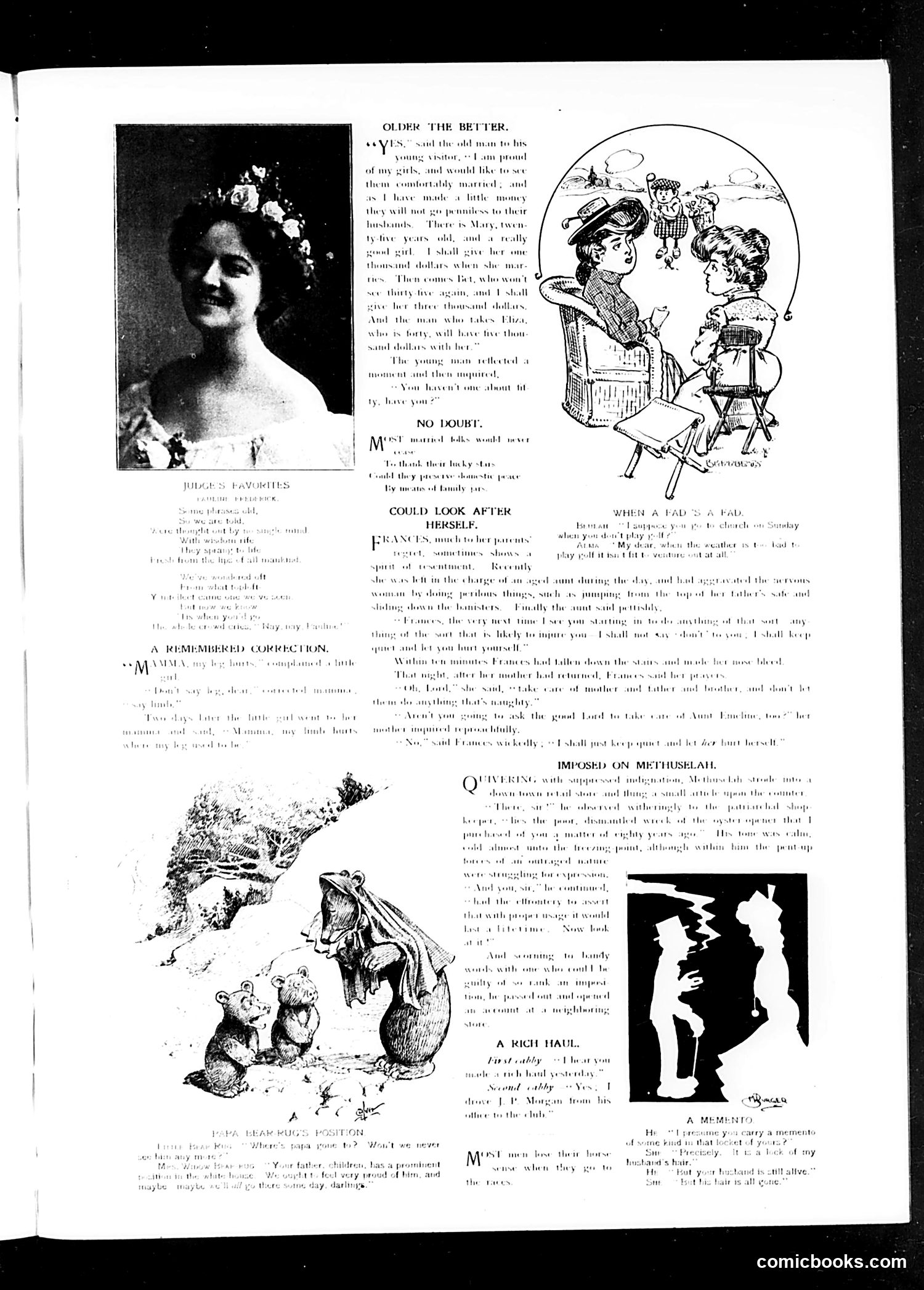
This page contains several short humorous stories typical of early 20th-century American satire: **"Older the Better"** mocks mercenary marriage attitudes—an old man boasts to a visitor about his daughters' dowries, increasing with age (youngest gets $1,000, oldest $5,000), suggesting men marry women for money rather than love. **"Could Look After Herself"** satirizes parenting through a story where a girl named Frances repeatedly injures herself doing dangerous things (jumping off safes, sliding down banisters). When her aunt finally warns her to stop, Frances responds she won't—she's waiting for her father's insurance payout, suggesting even children understand adult financial motivations. **"A Rich Haul"** and other brief anecdotes continue this theme of financial self-interest dominating relationships. The overall satirical point: money and material gain, rather than love or genuine concern, drive family and romantic relationships in American society. The humor relies on characters' frank admission of these mercenary motives.
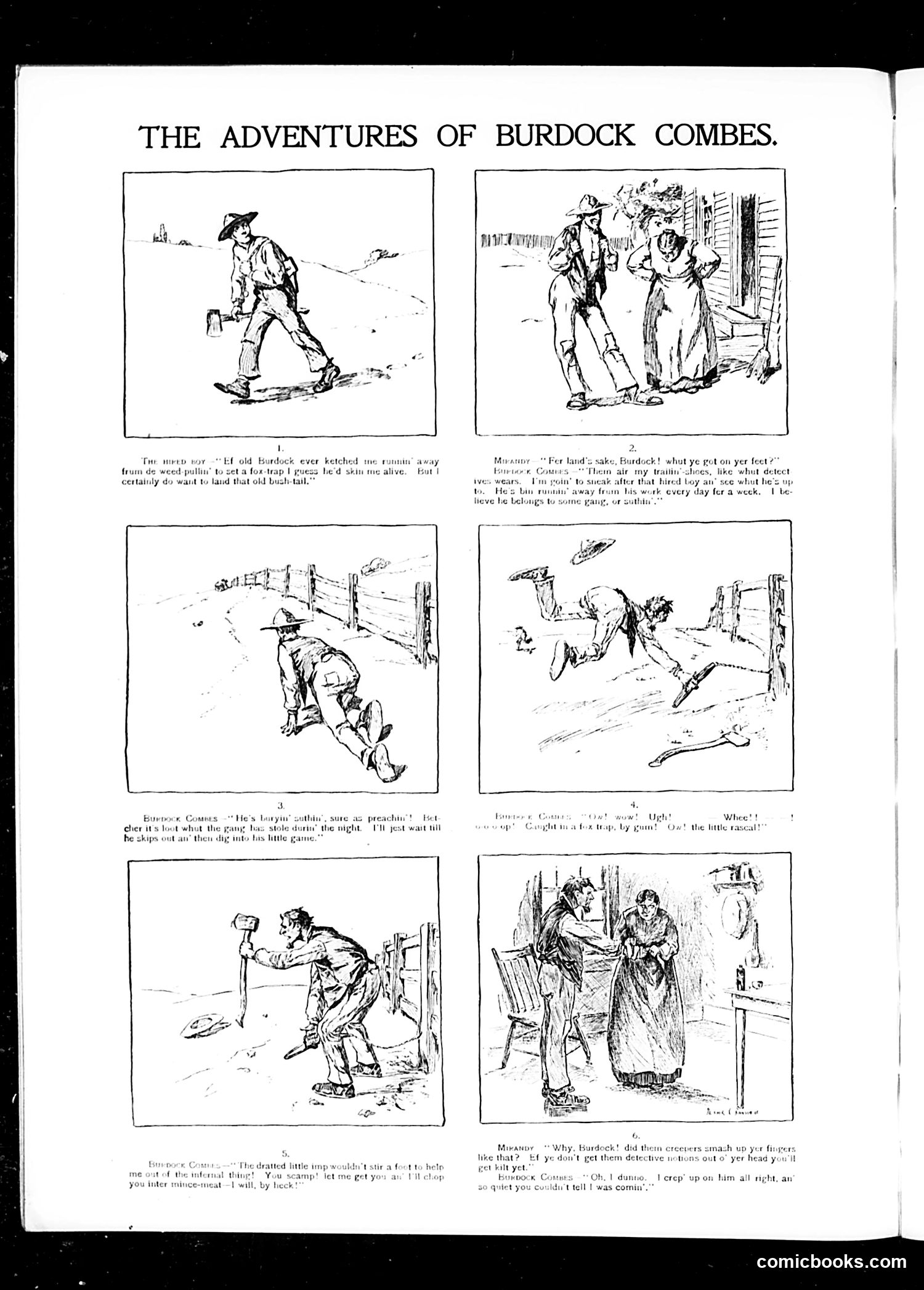
This is a serialized comic strip following a character named Burdock Combes through various misadventures. The six-panel narrative shows Combes as an apparent rube or country fellow encountering urban complications—he's kicked out of a rooming house, confronted by a landlord about unpaid rent, physically thrown out (panel 3), knocked down (panel 4), and finally confronted by what appears to be a landlady or proprietor. The humor derives from slapstick physical comedy and the social clash between an unsophisticated rural character and city life's harsh realities. This was typical Judge magazine content: satirizing rural-to-urban migration and class conflicts through the misfortunes of an everyman character. The strip mocks both Combes's incompetence and the cold, unforgiving urban environment.
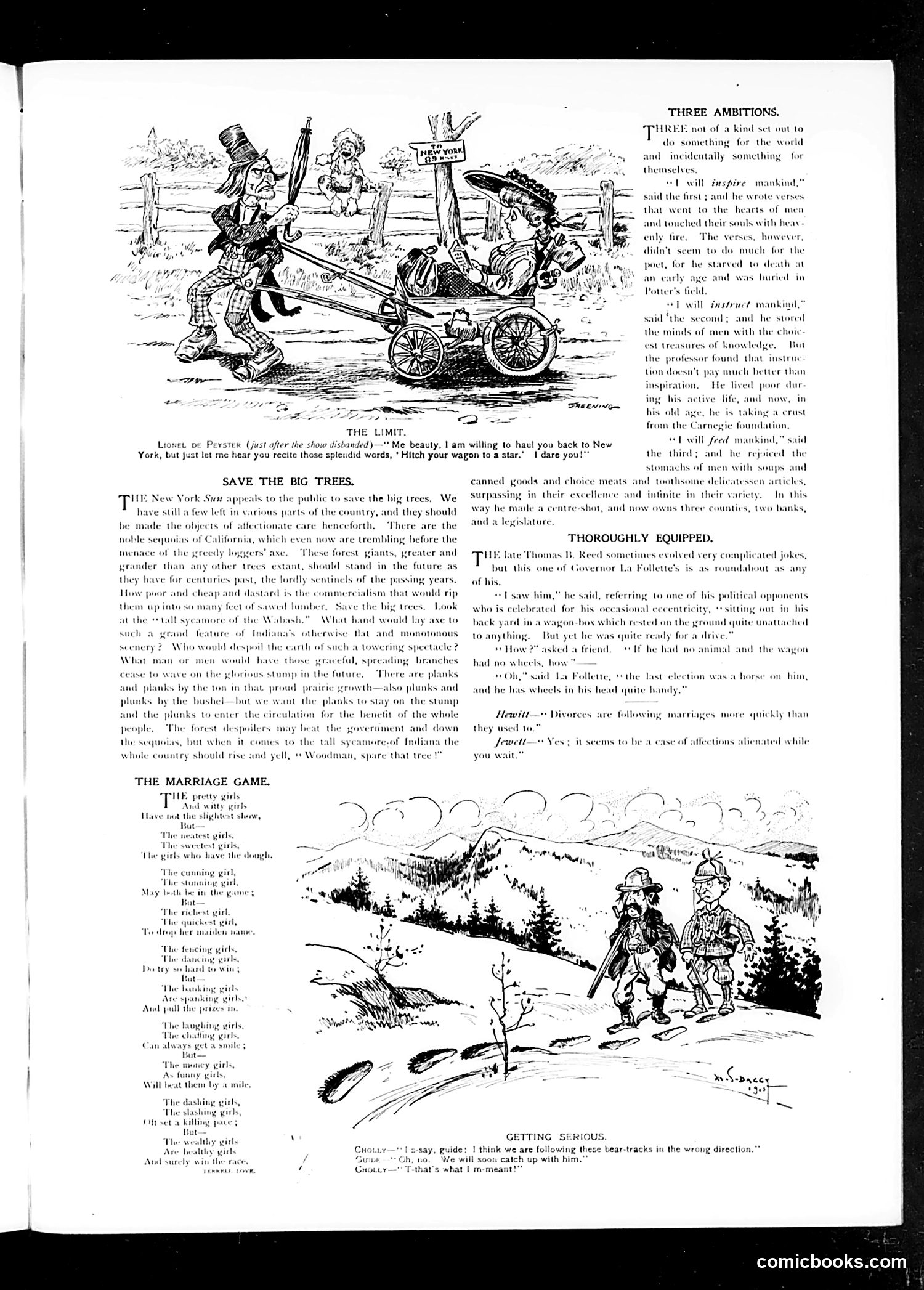
This page contains three separate satirical pieces typical of early 20th-century American humor magazines: **"The Limit"** depicts a figure (likely representing labor or commerce) pulling a wagon labeled with various ambitions, illustrating the tension between idealistic goals and practical reality. **"Save the Big Trees"** advocates conservation of California's sequoias and Indiana's sycamores against commercial logging interests—a genuine Progressive Era environmental concern treated with satirical urgency. **"Three Ambitions"** uses ironic contrasts: an idealistic poet starves, a knowledge-focused professor lives poorly, but a food businessman (representing purely commercial interests) grows wealthy with political influence. The satire critiques American capitalism's rewards system. **"The Marriage Game"** lists girl stereotypes (pretty, witty, neat, etc.) as marriage prospects, reflecting contemporary dating culture attitudes. Other brief pieces mock divorce trends and political eccentricity. The page reflects Progressive Era concerns—environmentalism, education's undervaluation, capitalism's moral questions—through Judge's characteristic biting humor.
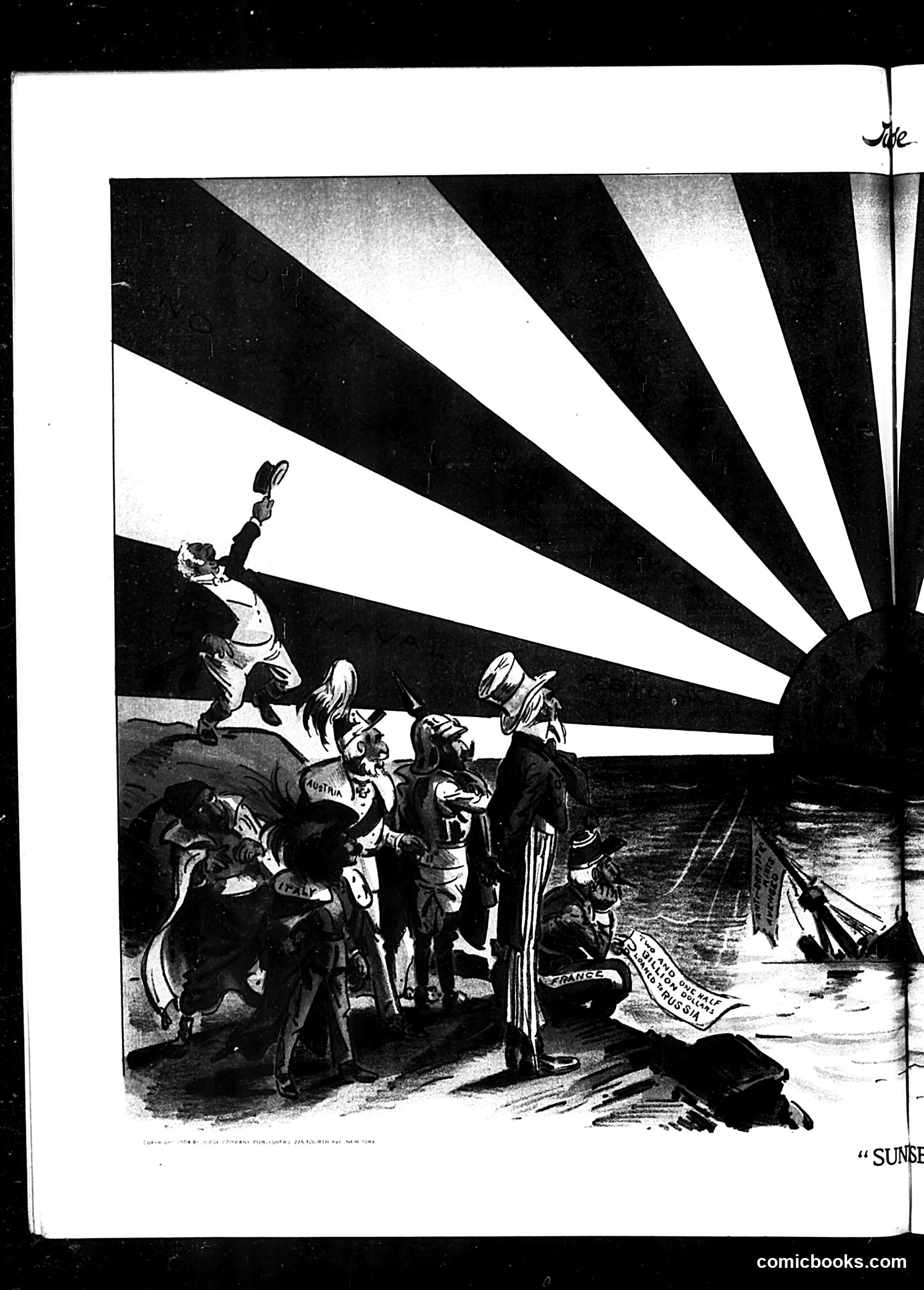
This political cartoon depicts what appears to be militaristic or authoritarian figures (wearing military uniforms and hats) seemingly worshipping or bowing before a large rising sun symbol—a visual reference to Japanese imperialism. One figure stands triumphantly above, while others below display submissive poses. The cartoon likely satirizes either Japanese imperial ambitions or the capitulation of certain nations/leaders to Japanese military power, given the prominent sun imagery and the date context of Judge magazine (which published political commentary). The dramatic rays of light suggest an expanding sphere of influence or dominance. Without visible text identifying specific figures or clearer dating, the exact political targets remain unclear, though the militaristic theme and Japanese symbolism are unmistakable.
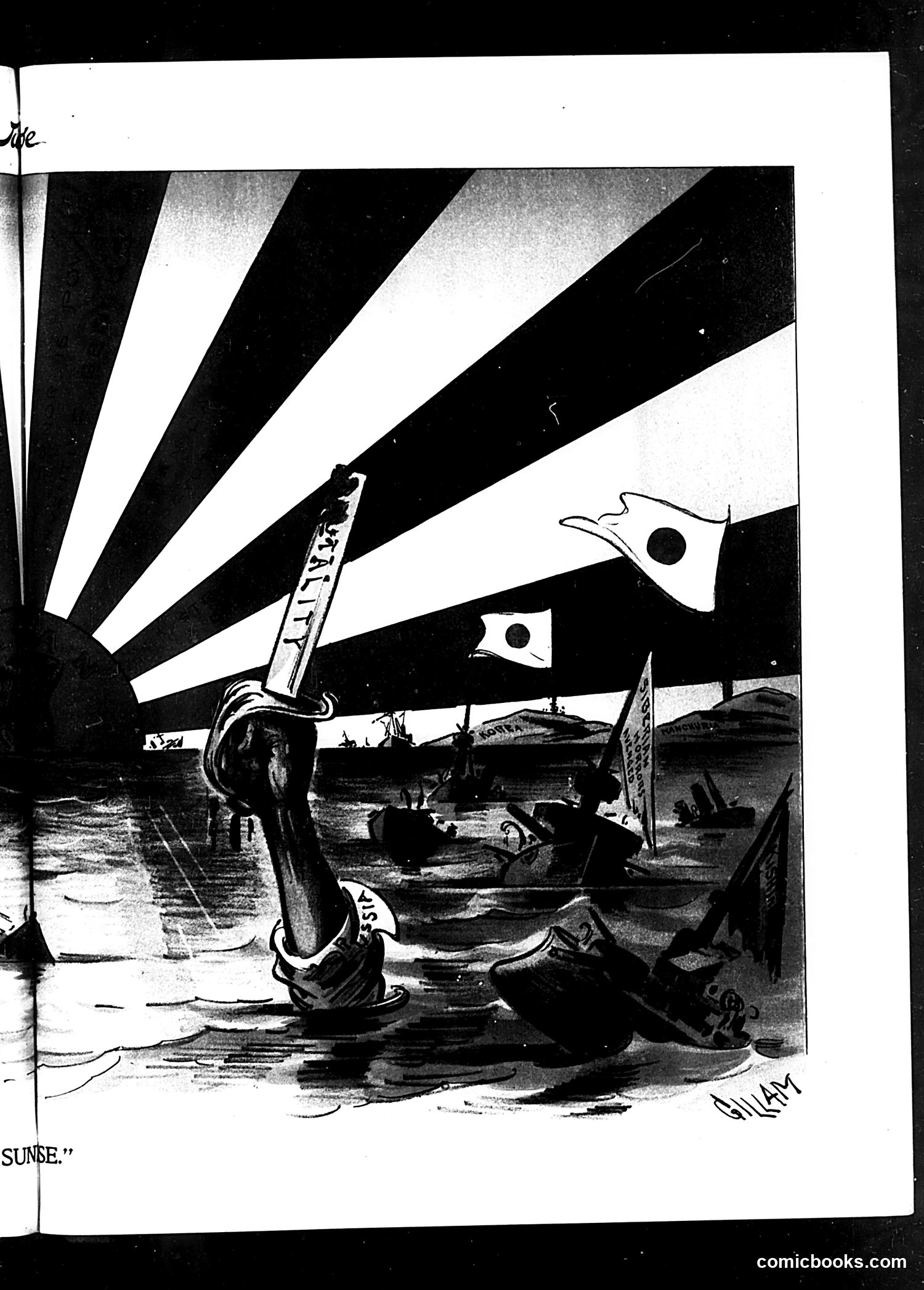
This appears to be a Japanese militaristic propaganda-style cartoon, likely from the early-to-mid 20th century. The image depicts a rising sun (Japan's national symbol) with radiating beams of light illuminating a landscape below. Japanese flags are visible in the scene. The cartoon likely satirizes or comments on Japanese imperial expansion and military aggression during this period. The "sunrise" imagery was commonly used in Japanese military propaganda to symbolize Japan's rising power and dominance in Asia. Without the full magazine context and date, the specific historical event referenced is unclear—it could relate to various conflicts or military campaigns during Japan's imperial era. The cartoonist's name appears to be signed but is illegible in this reproduction.
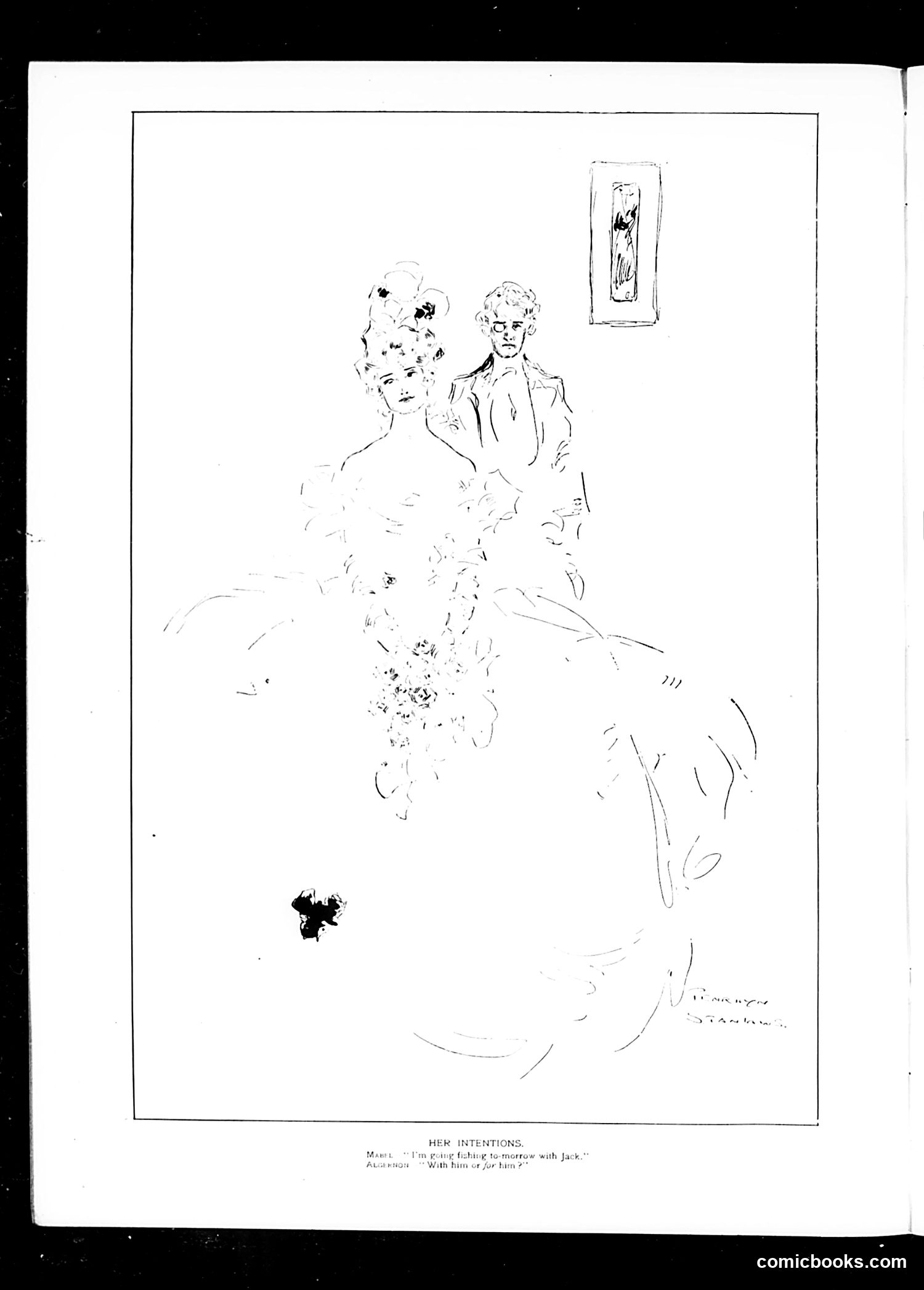
This cartoon depicts a woman with elaborate upswept hair speaking to a man, with the caption reading: "I'm going looking to marry with Jack" and "With him or for him?" The satire plays on deliberate ambiguity in the woman's phrasing about marriage intentions. The joke hinges on a double meaning: "marry *with* Jack" could suggest marrying Jack himself, while "marry *for* him" implies marrying someone else for Jack's benefit or money. The woman's fashionable appearance and the man's skeptical expression suggest she's a gold-digger whose vague language masks mercenary motives. This reflects early 20th-century concerns about women's financial dependence and satirizes the period's anxieties about women's marriage intentions being primarily material rather than romantic.
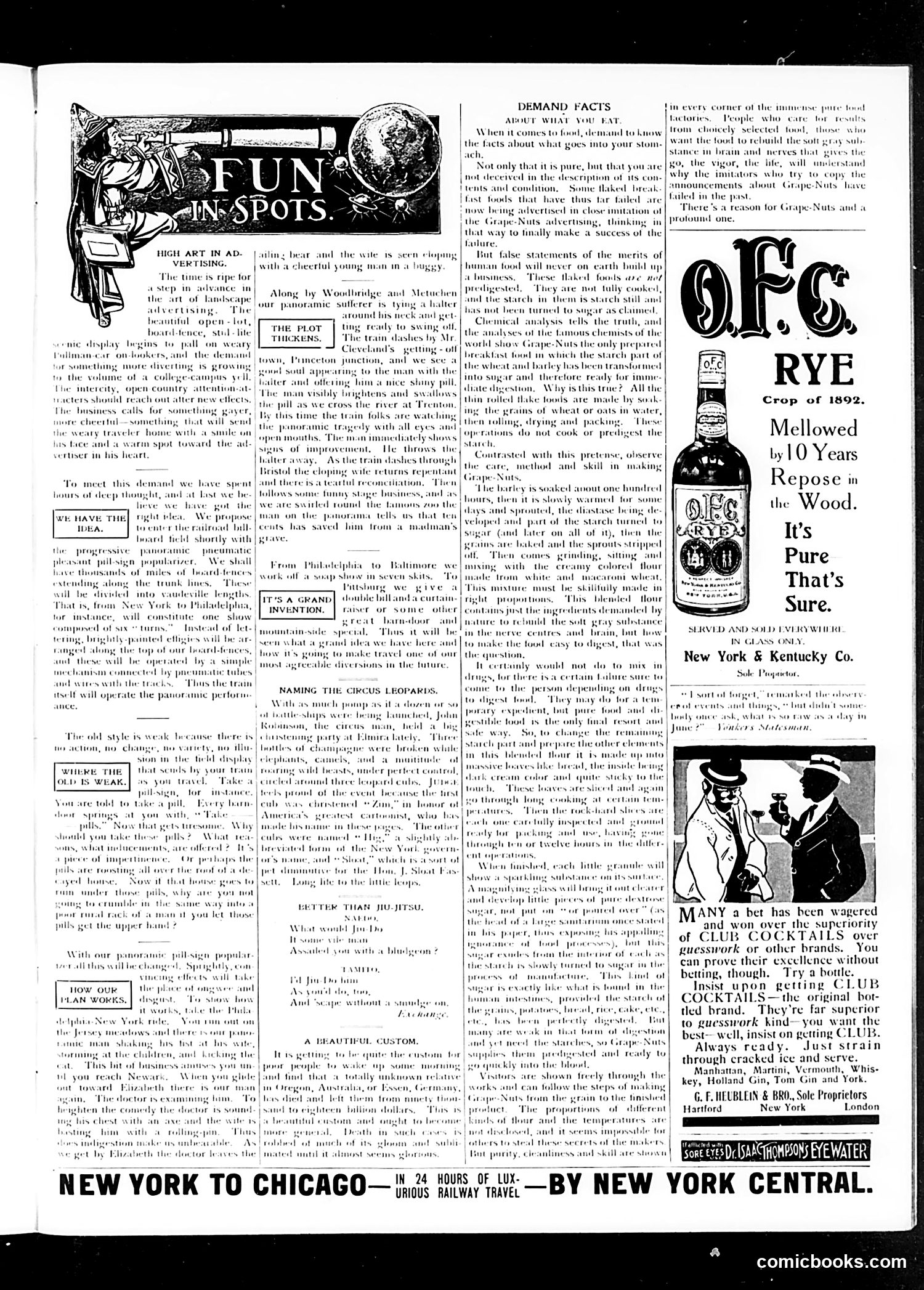
This page contains **advertising and satirical content** about food authenticity, circa 1892 (based on the Grape-Nuts advertisement dated "Crop of 1892"). ## Main Content: **"Demand Facts About What You Eat"** and **"High Art in Advertising"** sections critique misleading food marketing. The text attacks **imitation breakfast cereals** that falsely claim to match Grape-Nuts' nutritional properties. The satire highlights that competitors copy Grape-Nuts' *advertising* while their products remain inferior—they don't properly convert starch to sugar through cooking/sprouting as Grape-Nuts does. **The cartoon narrative** (described in "The Plot Thickens") depicts a panoramic advertising train journey from New York to Chicago. A suicidal man contemplating jumping is distracted by pill advertisements, eventually reconciled with his wife through the journey's spectacle. This mocks how advertisers use emotional manipulation and "vaudeville" entertainment to sell products rather than discussing actual merit. ## Context for Modern Readers: This reflects the **Progressive Era's growing concern** about food fraud and false advertising—predating the 1906 Pure Food and Drug Act. Judge magazine uses humor to mock both deceptive competitors and the excessive, manipulative advertising tactics of the era.
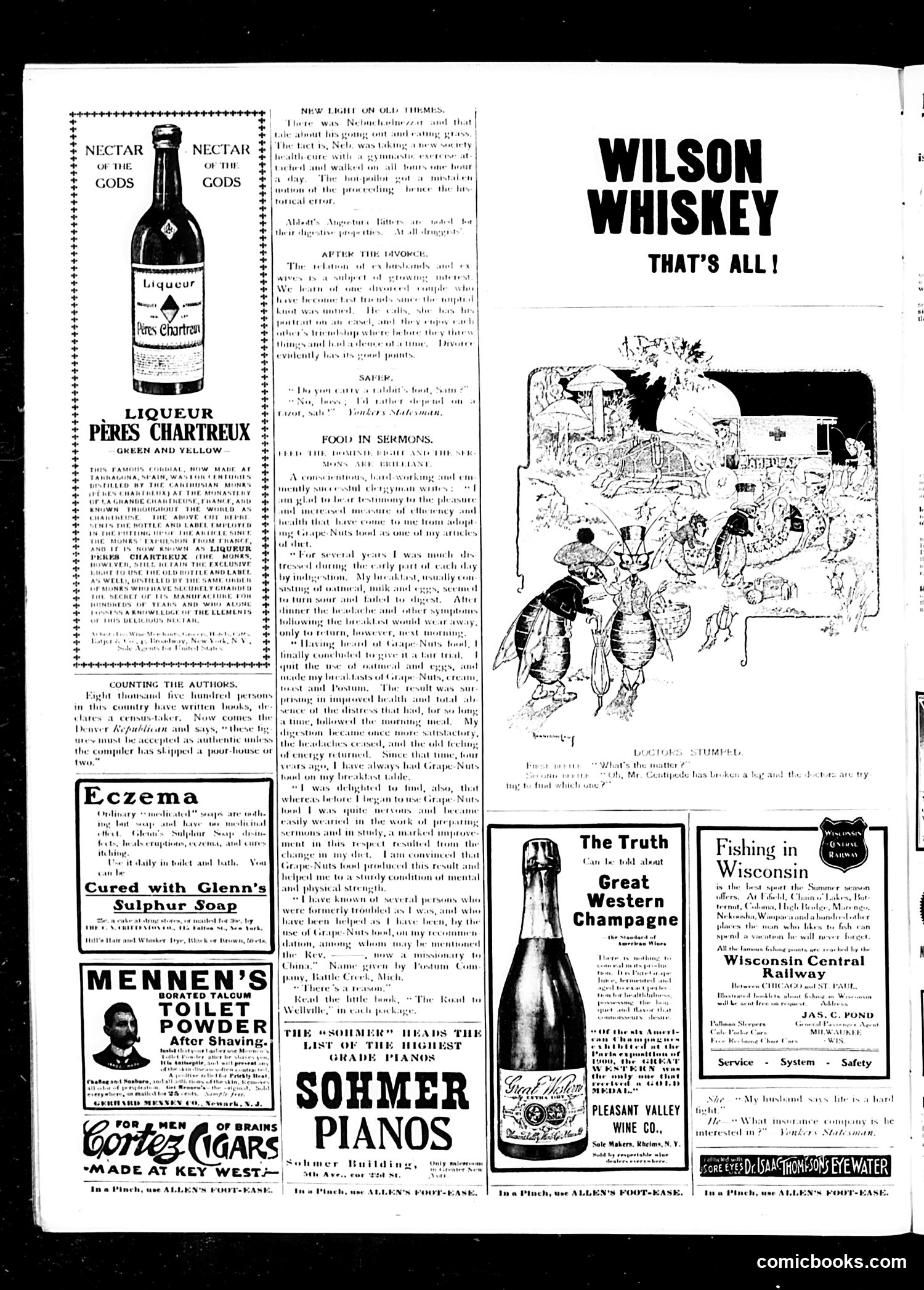
This appears to be primarily a **advertisements and filler content page** rather than political satire. The page contains: **Main cartoon**: "That's All I" depicts two insects (appearing to be a centipede and another bug) in conversation. The joke references a centipede breaking a leg—a visual pun on the phrase "breaking a leg." **Surrounding content**: The page is dominated by period advertisements (Sohmer Pianos, Wilson Whiskey, Mennen's Talcum Powder, Grape-Nuts cereal) interspersed with brief humorous vignettes about marriage ("After the Divorce"), sermons, and daily life. **Social context**: The ads reveal early 20th-century consumer culture—grooming products, spirits, and packaged foods (Grape-Nuts) marketed with health claims. **The satire, where present**, is mild domestic humor rather than political commentary—poking fun at marriage troubles and everyday absurdities rather than addressing social or political issues. The page reflects Judge's mixed model of combining advertisements with light comedic content for a general audience.
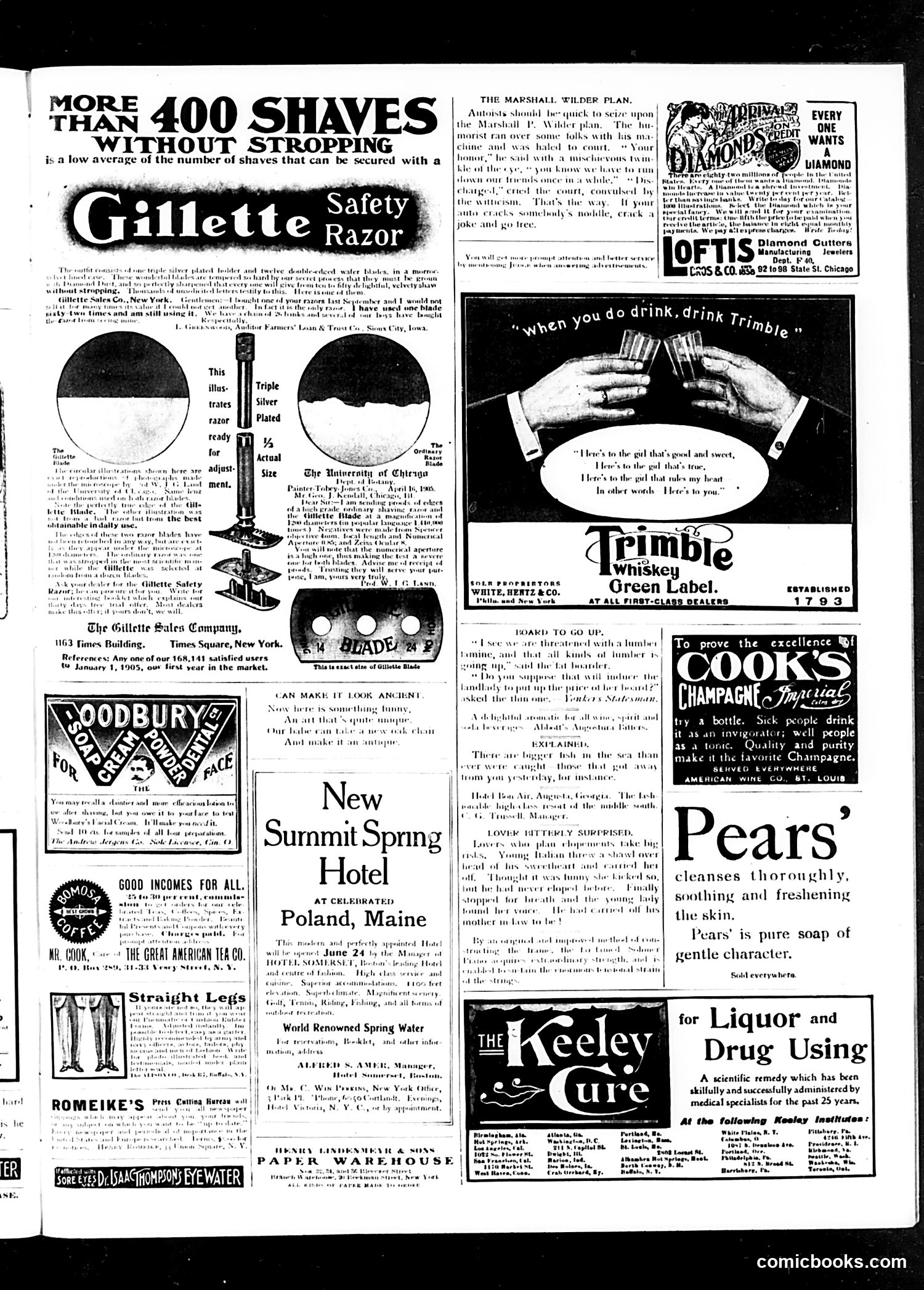
This is primarily an **advertising page** rather than editorial content or political cartoons. The page features commercial advertisements typical of early 1900s magazines. **Key advertisements include:** - **Gillette Safety Razor**: Claims "more than 400 shaves without stropping"—a sales pitch emphasizing the razor's durability and convenience compared to straight razors requiring regular stropping (sharpening). - **Trimble Whiskey**: Uses a romantic toast image ("Here's to the girl...") to market liquor. - **Pears' Soap**: Advertises its gentle cleansing properties. - **Keeley Cure**: A "scientific remedy" for "liquor and drug using"—reflecting period attitudes toward addiction treatment, which was often dubious and sometimes included alcohol itself. - **Summit Spring Hotel** (Poland, Maine) and other regional businesses. **Context for modern readers**: These ads reveal early 1900s consumer culture, marketing strategies, and social attitudes—including the normalization of alcohol advertising and period "cures" for addiction that would be considered highly suspect today.
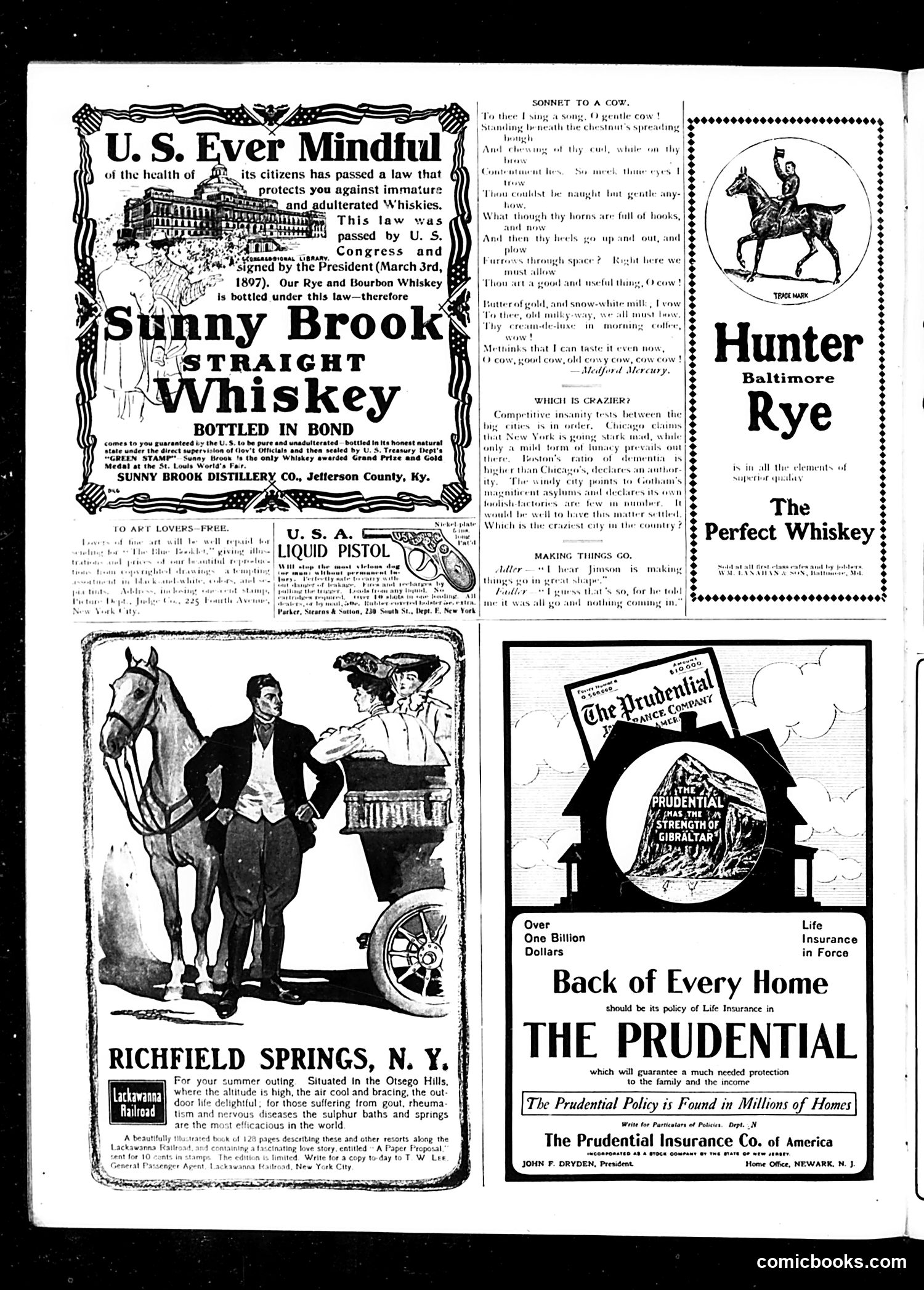
This page is primarily **advertising**, with minimal satirical content. The main advertisements promote: 1. **Sunny Brook Whiskey** — emphasizing it's "bottled in bond" under an 1897 U.S. law protecting against adulterated spirits, positioning the product as government-guaranteed pure. 2. **Richfield Springs, N.Y.** — a mineral spa resort claiming curative properties for gout and rheumatism. 3. **The Prudential Insurance Company** — promoting life insurance as essential protection for families. The page's only comic content includes a humorous "Sonnet to a Cow" (light verse, not satire) and a brief joke about "Which Is Crazier?" comparing competitive insanity between cities—mild humor rather than pointed social commentary. The whiskey ad's legal reference reflects Progressive Era consumer protection efforts, but the page functions chiefly as a revenue-generating advertising vehicle rather than satirical commentary. This was common for early 20th-century magazines.
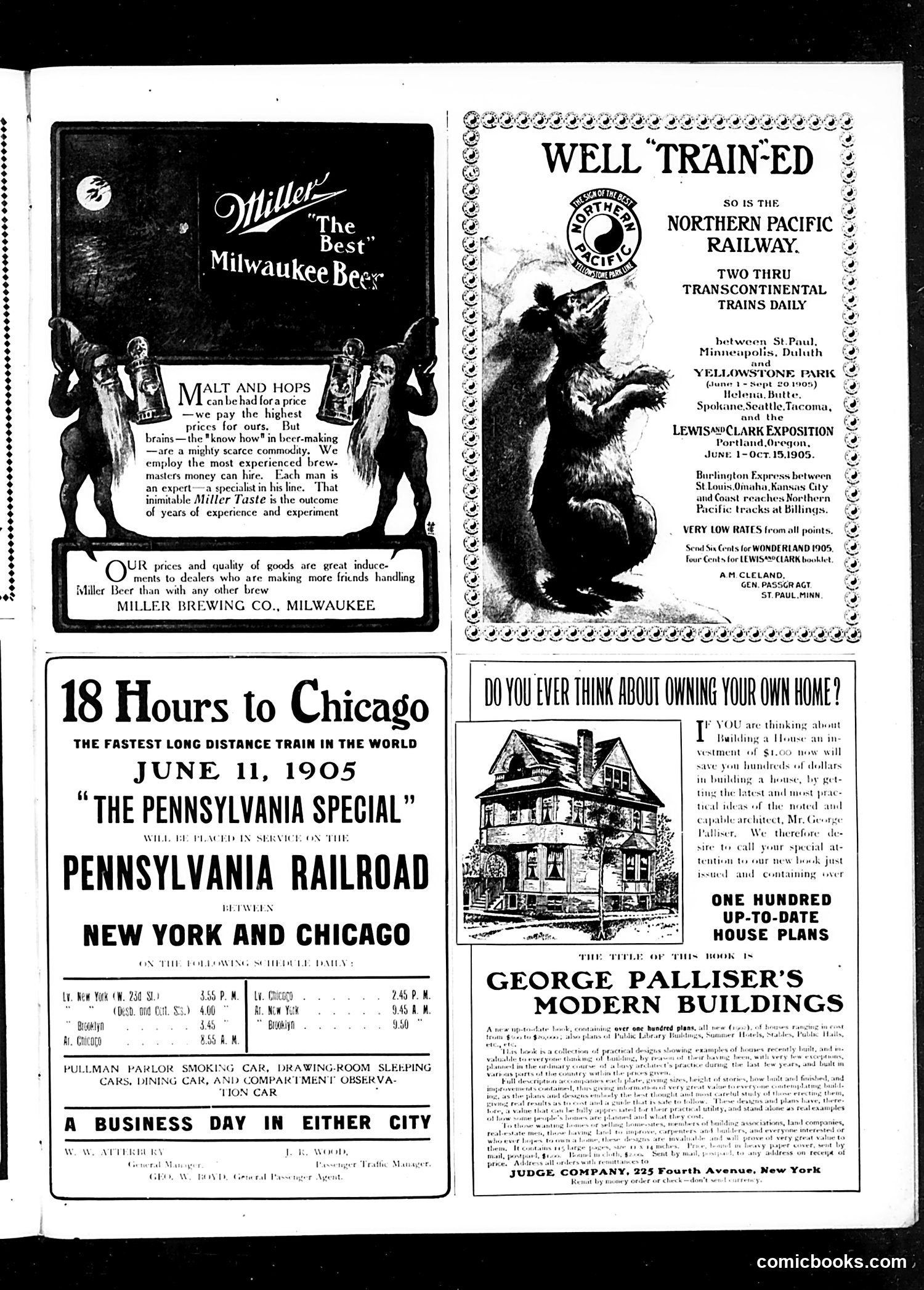
This is primarily an **advertising page** from Judge magazine (June 1905), not a satirical cartoon page. The advertisements reflect early-1900s American commercial interests: **Main advertisements:** - **Miller Beer** (Milwaukee) emphasizes quality and expert brewmasters - **Pennsylvania Railroad's "Pennsylvania Special"** promotes the fastest train service (18 hours New York to Chicago), a technological marvel of the era - **Northern Pacific Railway** advertises transcontinental service to western destinations like Yellowstone Park and the Lewis and Clark Exposition in Portland - **George Palliser's Modern Buildings** offers house plans for $1.00 **Social context for modern readers:** These ads reveal early-20th-century priorities—industrial innovation (speed in rail travel), westward expansion tourism, home ownership aspirations, and consumer brand loyalty. The repeated emphasis on "modern" and "fastest" reflects the period's obsession with progress and technological advancement. No political satire is present on this page.
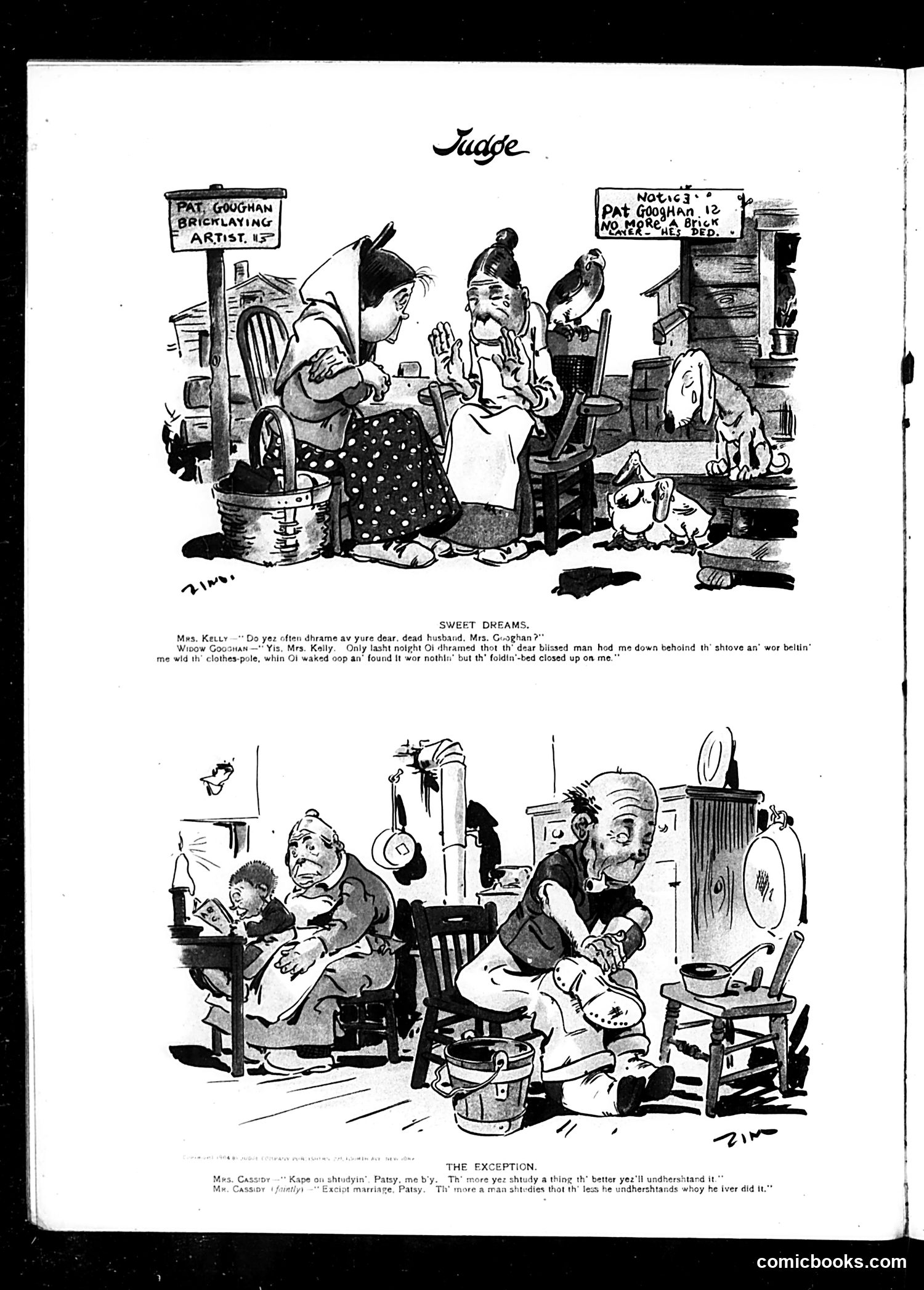
These two cartoons mock working-class Irish immigrants through exaggerated dialect and domestic stereotypes. **"Sweet Dreams"**: Mrs. Kelly describes a nightmare where her dead husband beat her, only to wake and realize it was her folding bed closing on her. The joke plays on the grim humor of domestic violence in Irish tenement life—presented as an amusing domestic mishap rather than tragedy. **"The Exception"**: Mrs. Cassidy complains that marriage requires understanding, but her husband (appearing befuddled) represents the "exception"—a man who *doesn't* understand. The caption suggests wives accept their husbands' incomprehension as inevitable. Both cartoons rely on heavy Irish dialect ("Oi," "yiz") and depict crude domestic scenes with sparse furnishings, reinforcing period stereotypes about Irish-American poverty and working-class family dynamics. The humor derives from ethnic caricature and normalizing marital dysfunction as comedic fodder.

I can see this is a page from *Judge* magazine, but the image quality is too poor for me to discern specific cartoon content, figures, caricatures, or satirical details with confidence. The page appears to be mostly blank or very lightly printed, with only scattered dots visible and the "comicbooks.com" watermark at the bottom. Without being able to read text or identify imagery clearly, I cannot accurately explain what political or social references the cartoons contain, who is being caricatured, or what the satire intended to communicate to contemporary readers. To provide a reliable analysis, I would need a clearer image where the cartoon illustrations and any accompanying text are legible.