
A complete issue · 16 pages · 1905
Judge — June 17, 1905
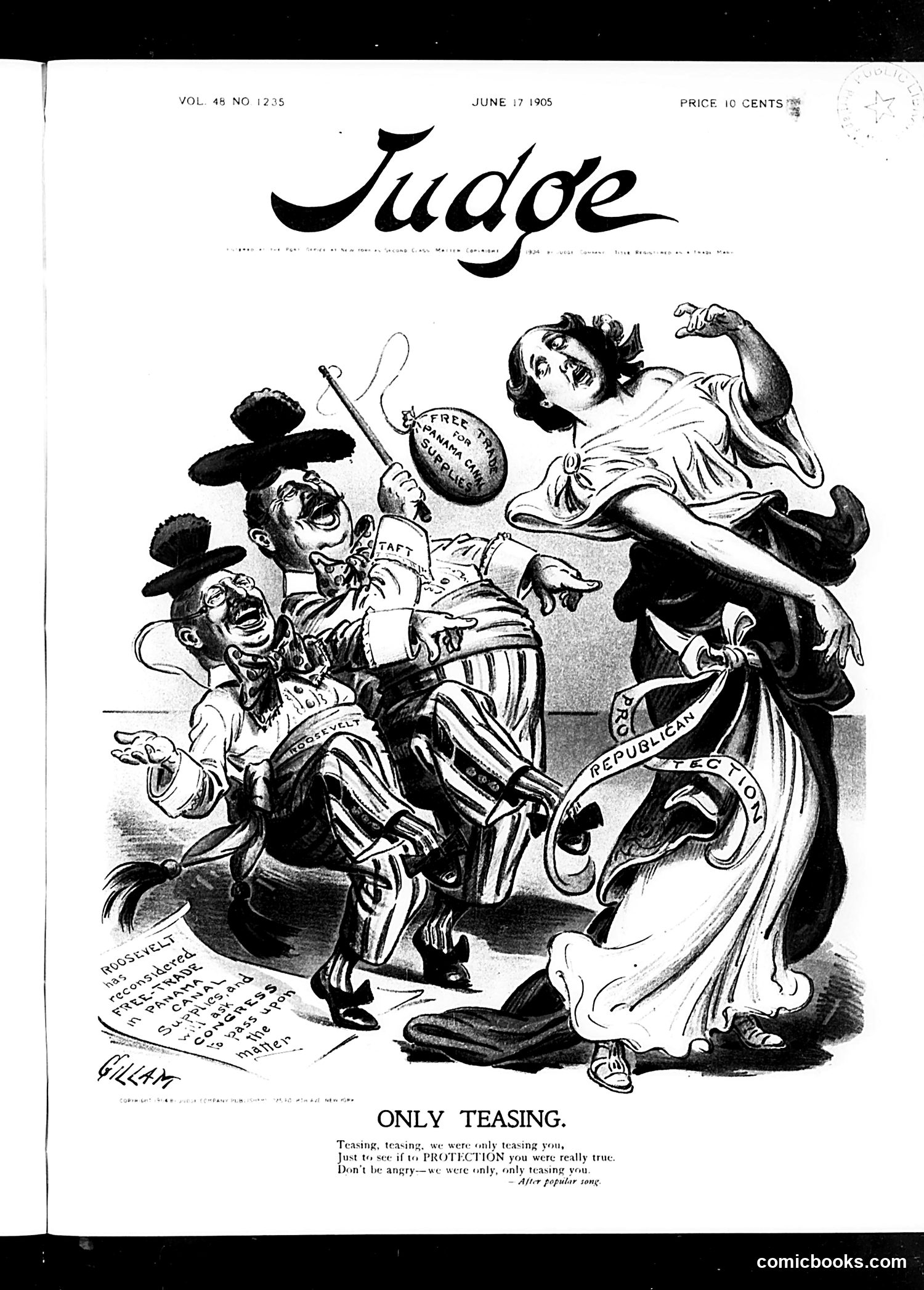
This political cartoon satirizes Republican protectionist trade policies. The female figure on the right (labeled "Republican Protectionist") playfully torments three male figures representing American workers or business interests. They're juggling items labeled "Free Trade" and what appears to be tariff-related documents. The caption's verse mocks the Republicans' approach: they claim protective tariffs benefit workers, but the cartoon suggests they're merely "teasing"—that protectionism is an empty promise used to manipulate public support. The satire implies the GOP used protective trade rhetoric as political theater without delivering real benefits. This reflects early 1900s debates over tariff policy and whether Republican protectionism genuinely helped working Americans or simply enriched certain interests.
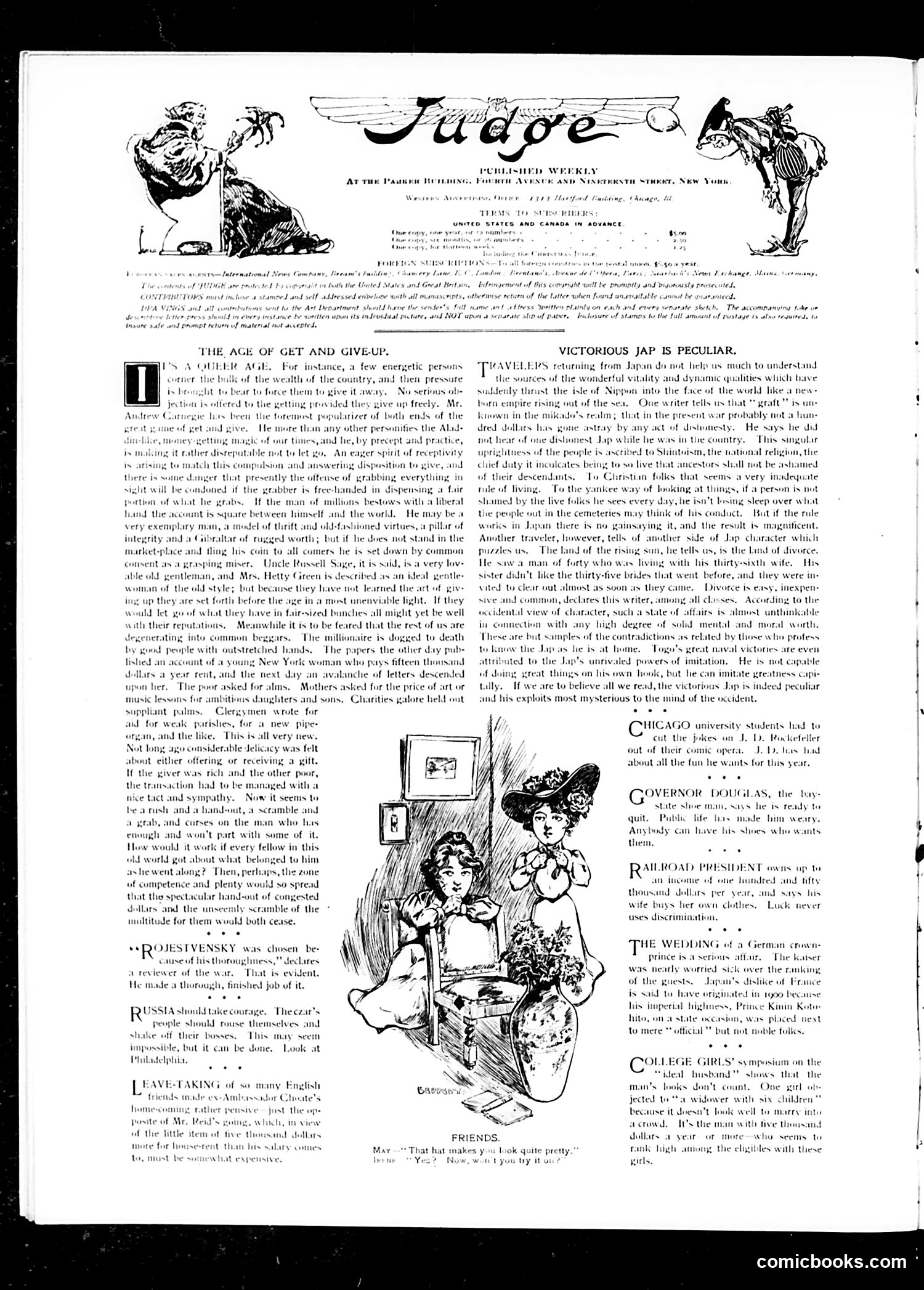
This page contains several short satirical pieces rather than a single cartoon. The visible content includes: **"The Age of Get and Give-Up"** — critiques modern laziness and entitlement, arguing people expect others to solve their problems rather than persisting through difficulty. **"Victorious Jap is Peculiar"** — discusses Japanese cultural practices as strange to Western observers, reflecting post-war attitudes toward Japan following what appears to be a recent military conflict. **"Friends"** — a small illustrated joke about a hat, though the punchline is partially cut off in this scan. The bottom illustration shows children with what appear to be gifts or presents, possibly related to Christmas or holiday giving. The page reflects early-20th-century American attitudes toward both personal virtue and foreign cultures, typical of Judge magazine's satirical approach.
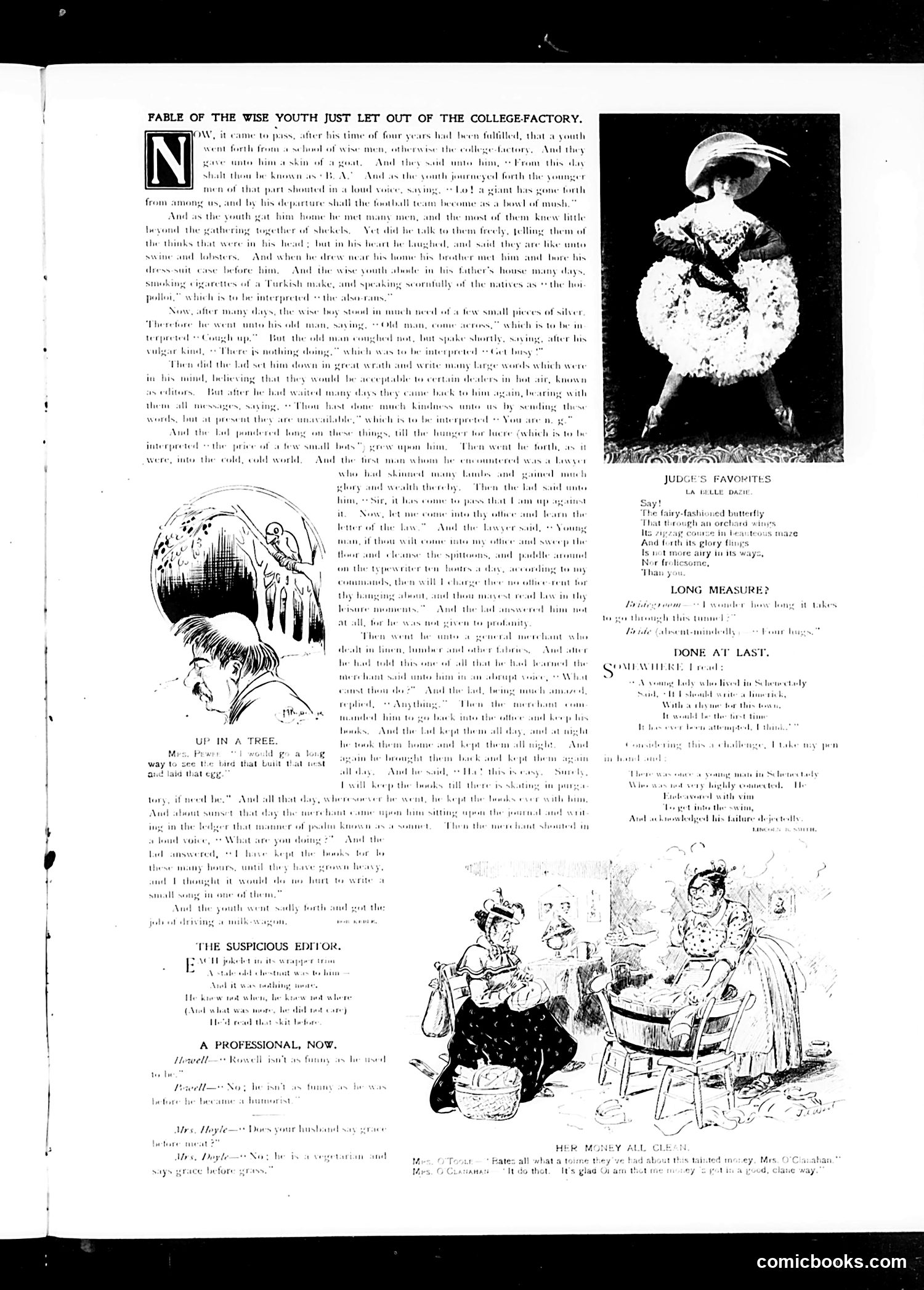
This page contains multiple satirical pieces typical of Judge magazine's format: **"Fable of the Wise Youth Just Let Out of the College-Factory"** (top): A lengthy moral tale criticizing how college education produces young men who return home arrogant and disconnected from practical life. The narrative mocks the graduate's pretentiousness and ultimate failure, suggesting college creates impractical idealists. **Other sections** include brief satirical vignettes: "Up in a Tree," "The Subpoena'd Editor," and "A Professional Now"—all appear to be social commentary on contemporary professions and professionalism. **"Judge's Favorites"** lists poems in the right column. The illustrations show period-appropriate dress and domestic scenes. Without clearer context or dates visible, the specific political references remain unclear, though the overall tone criticizes class pretension and impractical education outcomes—common Judge targets during the late 19th/early 20th century.
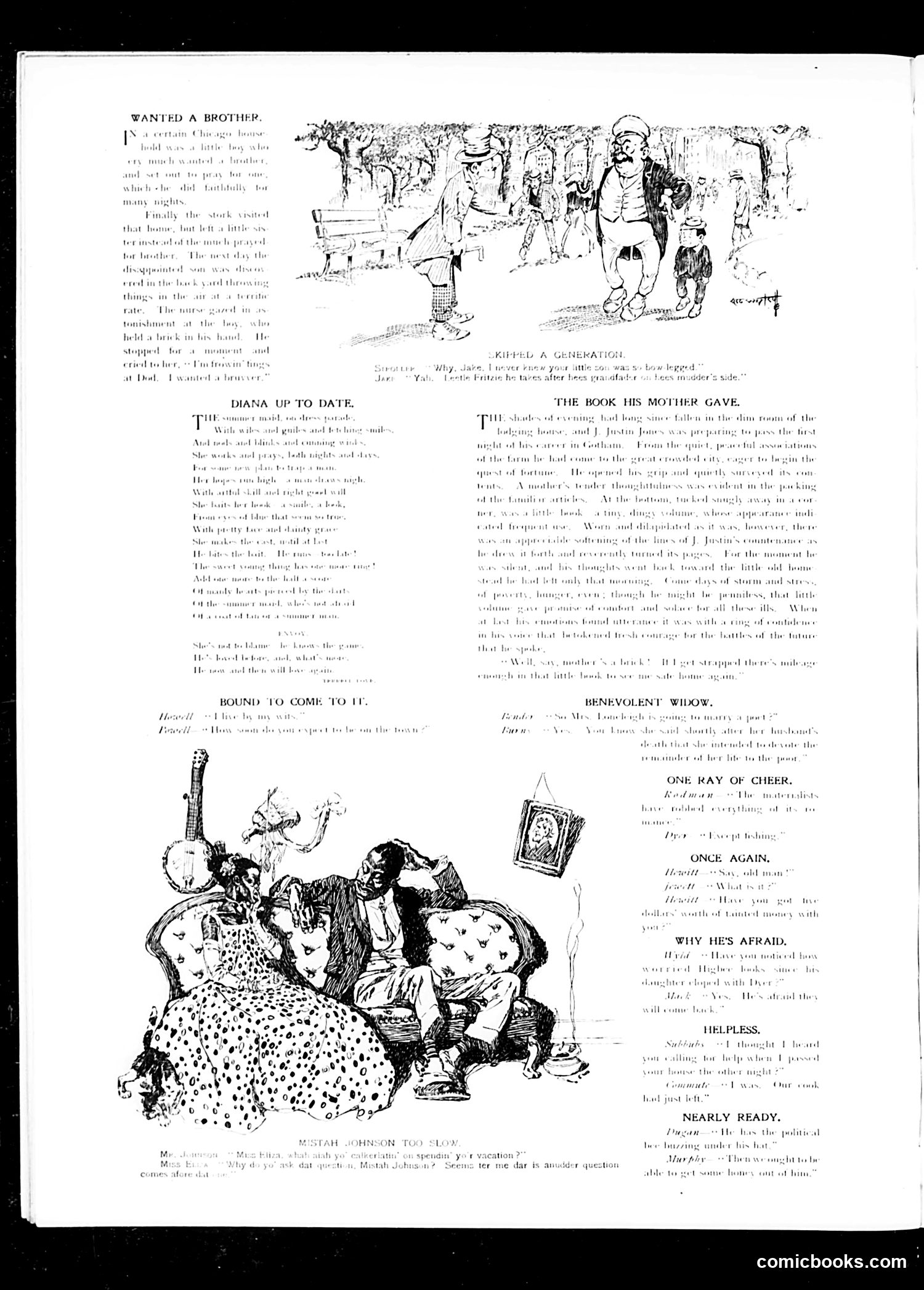
This page contains several short comedic sketches rather than a single political cartoon. The pieces—"Wanted a Brother," "Diana Up to Date," "Killed a Generation," "The Book His Mother Gave," and others—appear to be domestic humor focused on family situations and social interactions. The largest illustration shows a woman in an elaborate spotted dress seated with a man, likely depicting a romantic or social scenario. The accompanying text "Marian Johnson Too Slow" suggests the humor involves romantic competition or timing. Most sketches mock everyday situations: sibling relationships, marriage dynamics, and courtship. Without clearer historical context about specific references or individuals caricatured, the satire appears directed at general social conventions rather than particular political figures or events.
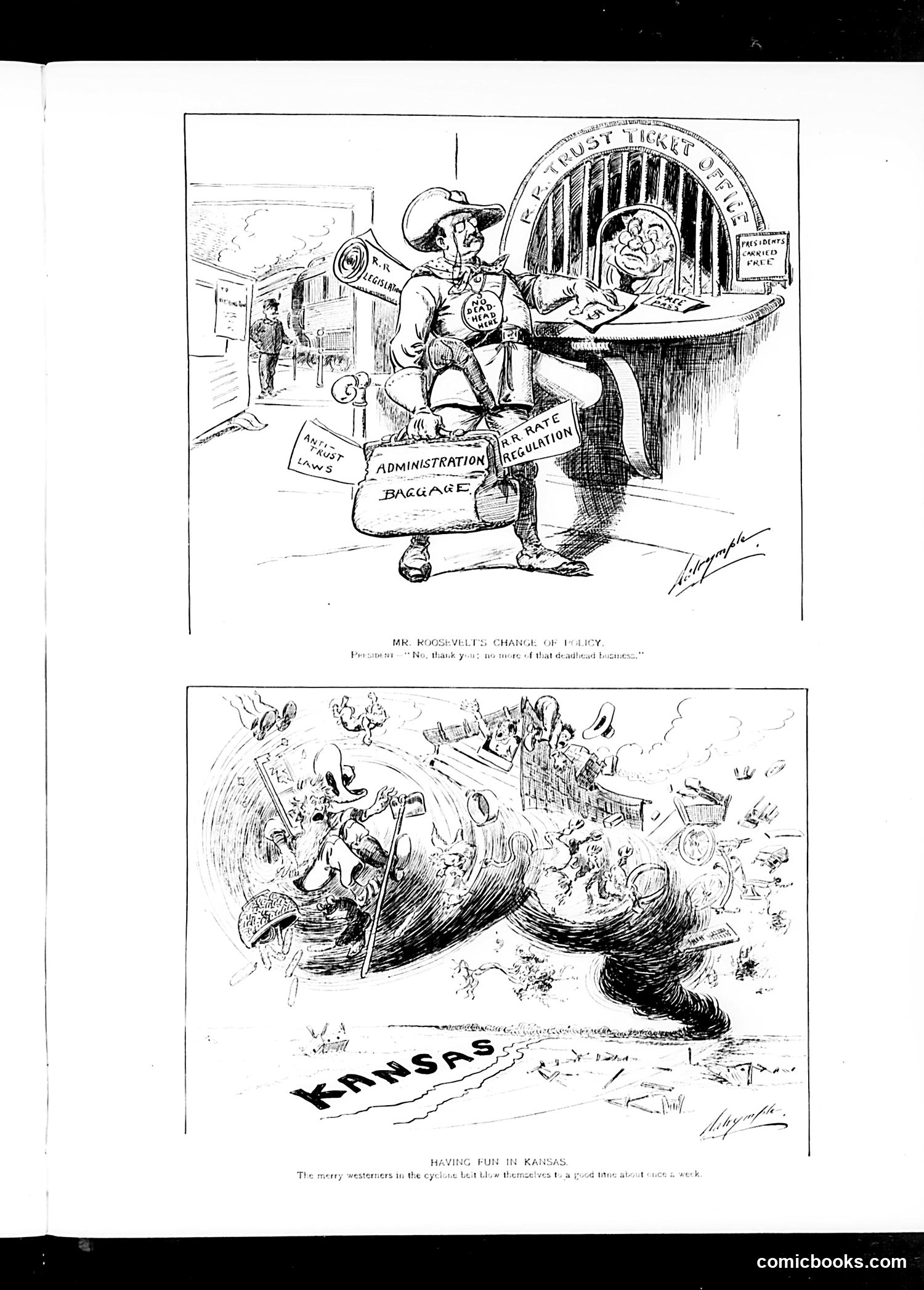
**Top Cartoon:** Depicts a figure (likely a customs official or administrator) juggling multiple heavy burdens labeled "Trust Laws," "Administration," "Baggage," and "Railroad Regulation" while stuffing items into a "Post Office" window. The caption references "Mr. Roosevelt's Change of Policy," suggesting criticism of President Theodore Roosevelt's attempt to manage numerous reform initiatives simultaneously. The satire implies his administrative agenda is chaotic and unwieldy. **Bottom Cartoon:** Shows a tornado labeled "Kansas" with people and objects being violently swept up. The caption reads "Having Fun in Kansas," suggesting the state's political turmoil or instability during this period. This likely references Kansas's contentious political climate in the early 1900s. Both cartoons mock governmental overreach and regional political chaos through exaggerated imagery.
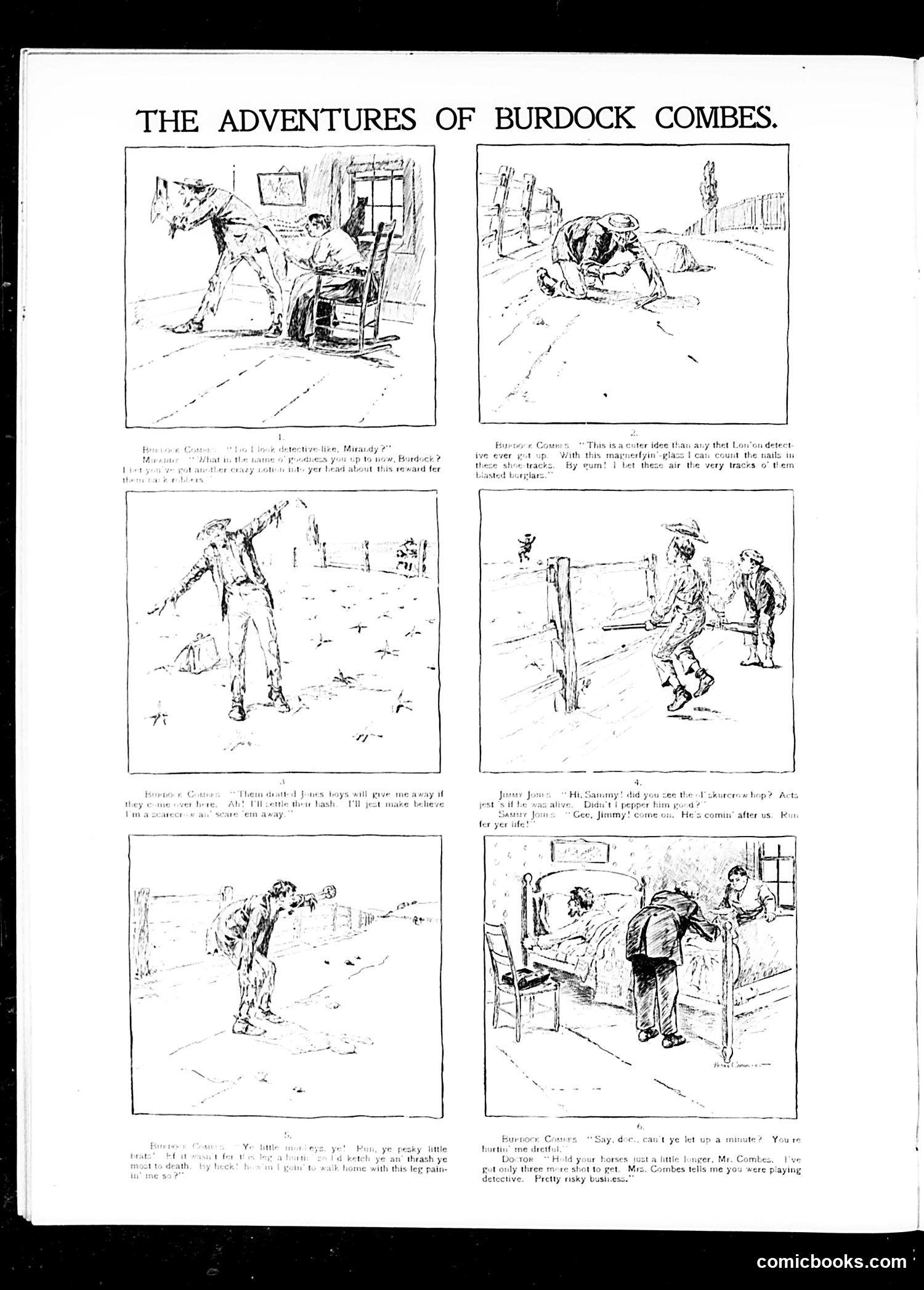
This is a comic strip series following a character named Burdock Combes through six sequential panels. The narrative appears to involve Combes encountering various mishaps and misadventures in everyday situations—including interactions with horses, other men, and domestic settings. The humor derives from slapstick physical comedy and verbal wordplay typical of early 20th-century American comics. The strip's title suggests Combes is a recurring character whose "adventures" are meant to chronicle his bumbling attempts to navigate ordinary circumstances, which consistently go awry. Without additional historical context about Judge magazine's specific satirical targets during the publication date, the strip appears to be general comedic entertainment rather than political or social satire. The humor relies on visual gags and situational comedy rather than topical references.
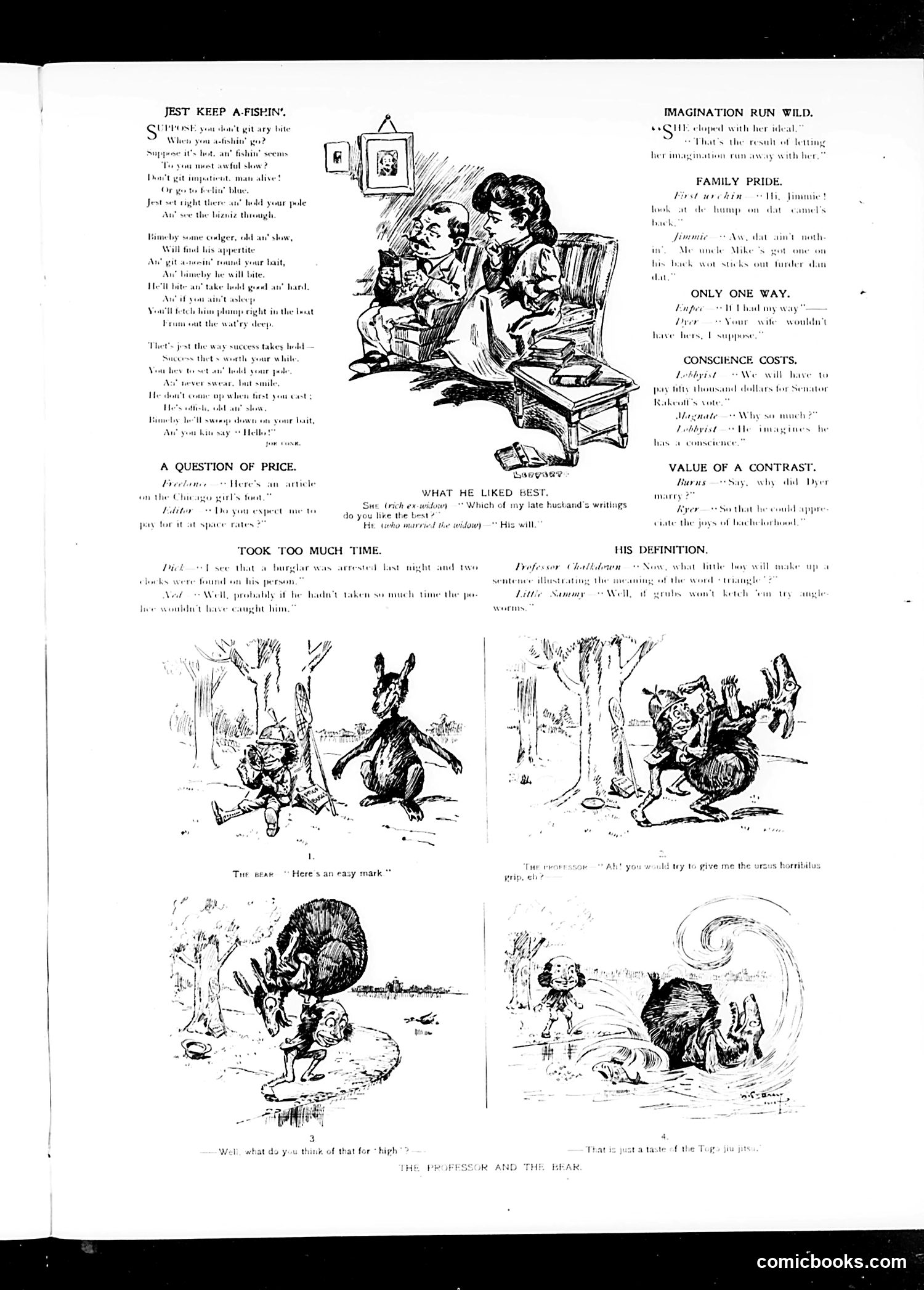
This page contains multiple short humorous dialogues and accompanying illustrations, typical of Judge's satirical format from the early 20th century. The jokes target various social subjects: marital discord ("Imagination Run Wild"), class pretension ("Family Pride"), political corruption ("Conscience Costs"—a lobbyist must pay a senator who has a conscience), and marriage dynamics ("Value of a Contrast," where a man married a widow to appreciate bachelorhood). "A Question of Price" satirizes newspaper economics, while "Took Too Much Time" jokes about criminal justice delays. The illustrations feature exaggerated character types common to period satire: working-class figures, animals (a kangaroo, bear), and slapstick scenarios. The humor relies on wordplay, irony about morality and social hypocrisy, and physical comedy—standard Judge fare aimed at educated, middle-class readers. The specific political references are unclear without publication date context.
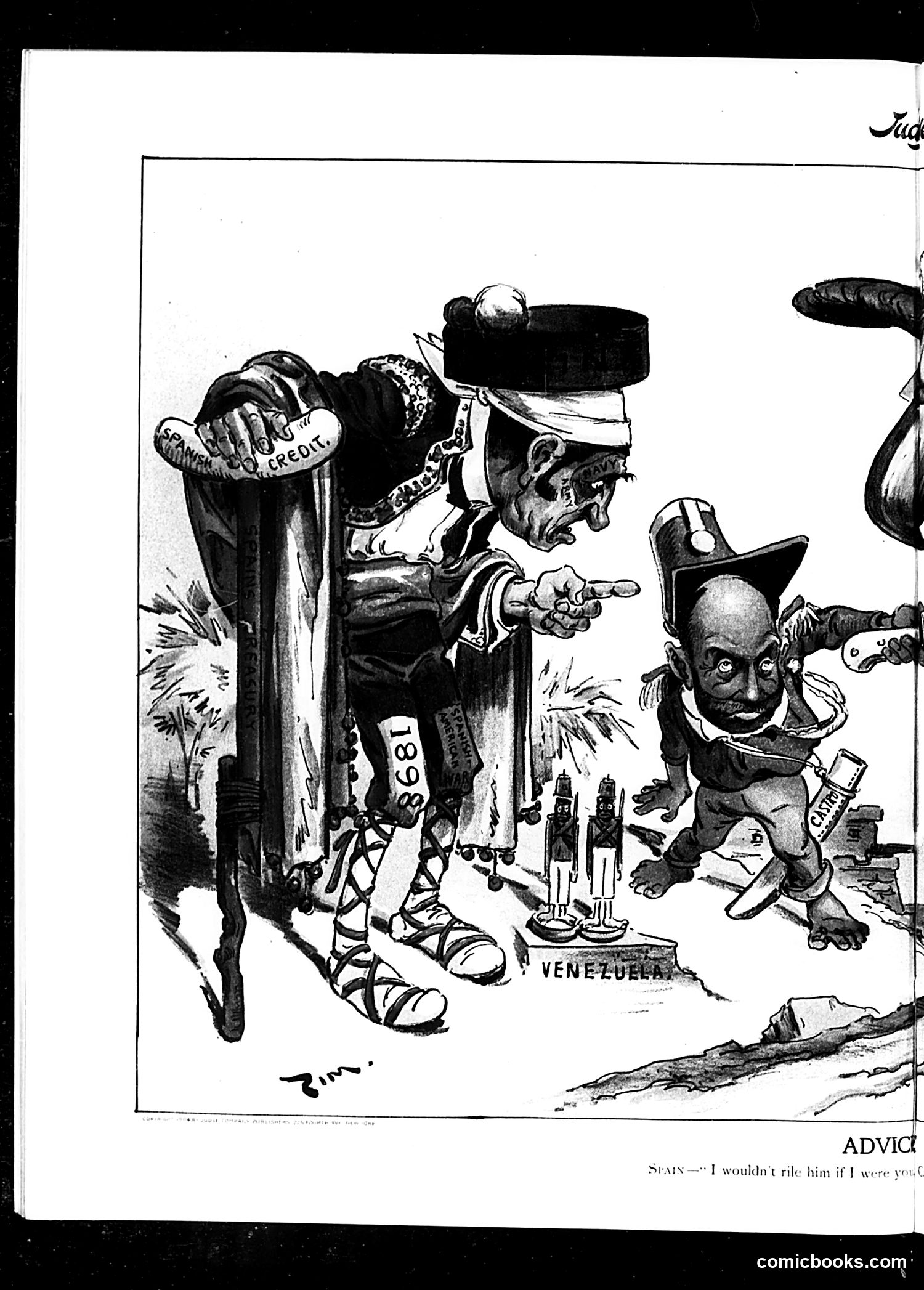
This appears to be a satirical cartoon from *Judge* magazine depicting international political tensions, likely from the early 20th century. The central figure is labeled "Spain," depicted as a nobleman or aristocrat holding a bag labeled "Credit" while pointing accusingly. To the right stands a caricatured figure labeled "Venezuela," depicted in a dehumanizing manner typical of period political cartoons. The caption reads: "Spain—'I wouldn't rile him if I were you.'" This satirizes Spain's political position regarding Venezuela, likely commenting on colonial or diplomatic disputes of that era. The cartoon uses caricature to suggest that Spain is warning against provoking Venezuela, possibly referencing debt issues ("Credit") or imperial rivalries in the Americas. The dehumanizing imagery reflects the racist visual conventions of early 20th-century American political satire.
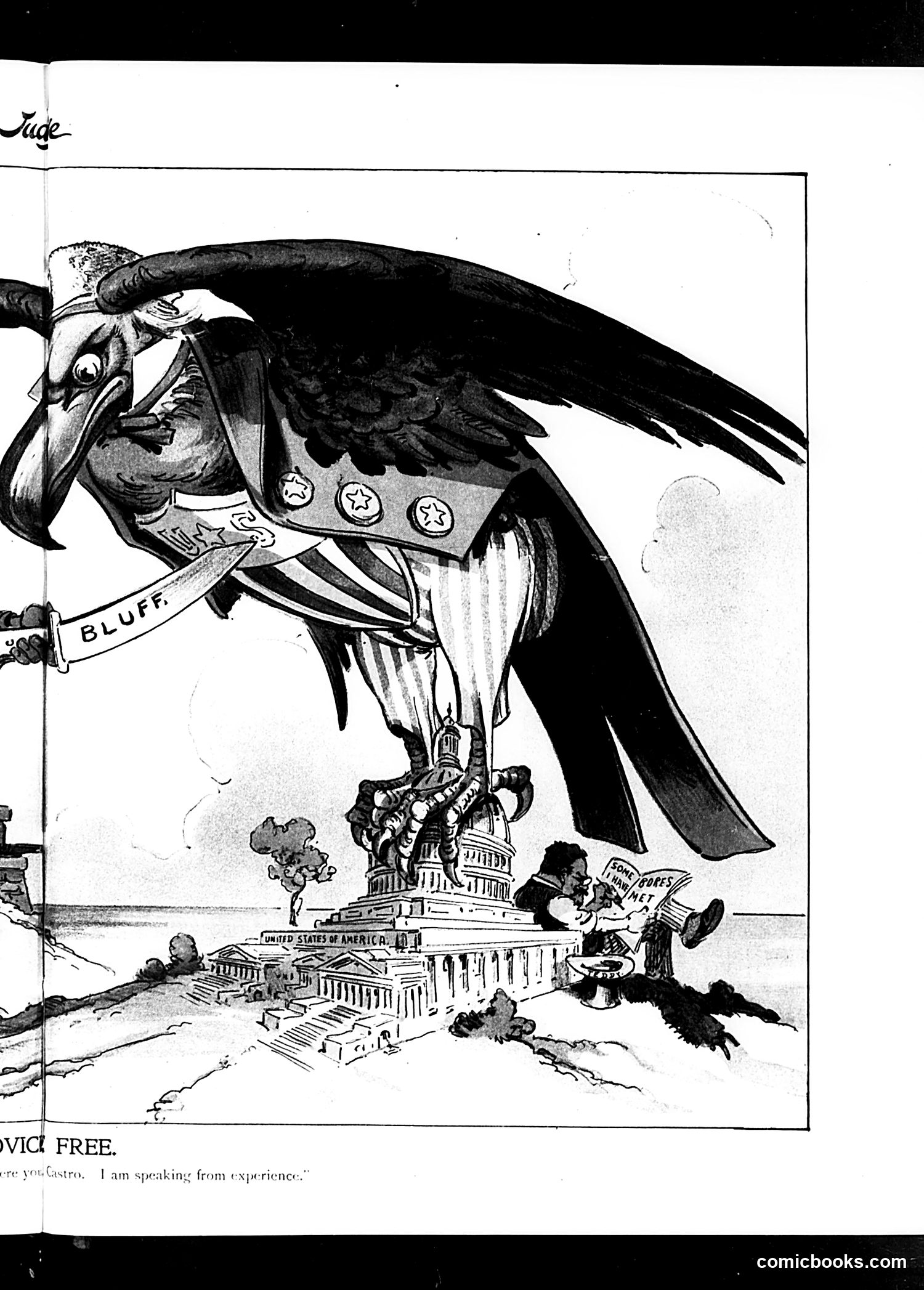
This appears to be a political cartoon from *Judge* magazine depicting an eagle labeled "BLUFF" perched menacingly above the U.S. Capitol building. Below, small figures appear to be fleeing or in distress near the Capitol, with one holding what looks like a sign reading "FORCE RULES NOT." The cartoon satirizes what the artist portrays as aggressive bluffing or intimidation tactics directed at American government institutions. The eagle—traditionally a symbol of American authority—is recast here as a threatening force. The caption "VICE FREE" and the partial quote "I am speaking from experience" suggest commentary on political deception or hypocrisy regarding claims of virtue or righteousness. Without the publication date, identifying the specific historical context is difficult, though the Capitol imagery and "force rules" reference suggest commentary on governmental overreach or coercion during a particular political crisis.
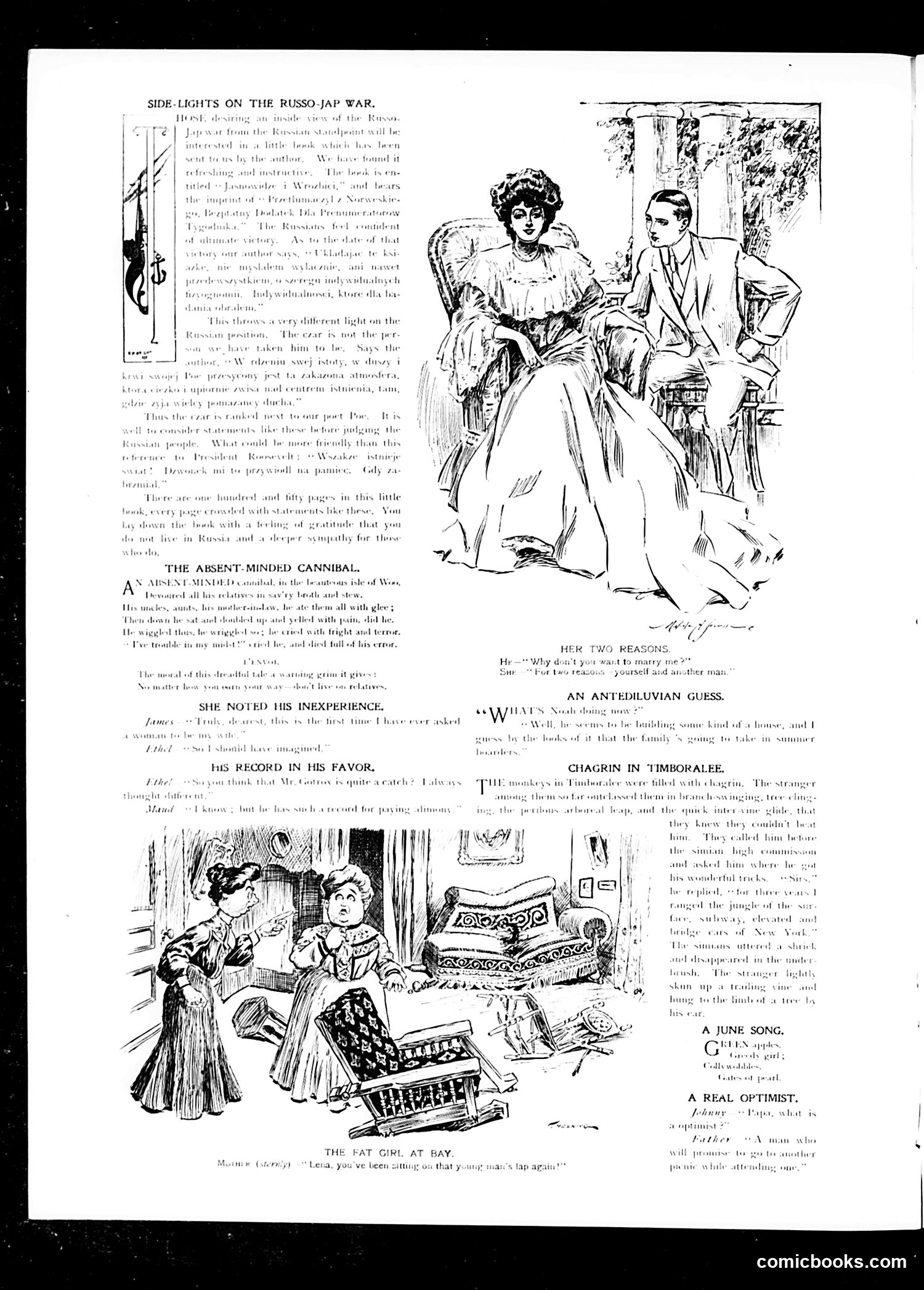
This page from Judge magazine satirizes the Russo-Japanese War (1904-1905) through multiple cartoons and comic vignettes. **Main Content:** The top illustration captioned "Her Two Reasons" depicts a woman declining marriage, referencing the war's impact on romantic prospects. The section titled "Side-Lights on the Russo-Jap War" appears to offer commentary on the conflict's effects on American society. **Lower Cartoons:** "The Absent-Minded Cannibal" and "The Fat Girl at Bay" are separate humor pieces unrelated to the war—typical of Judge's mixed-content format featuring social comedy and domestic situations. **Historical Context:** The Russo-Japanese War was major international news in 1904-1905, affecting American public discourse and potentially marriage prospects due to military involvement concerns. The magazine uses the war as contemporary reference material for topical humor aimed at educated American readers. **Note:** The OCR text is too corrupted to reliably identify specific satirical targets or detailed arguments beyond the general war-related framing.
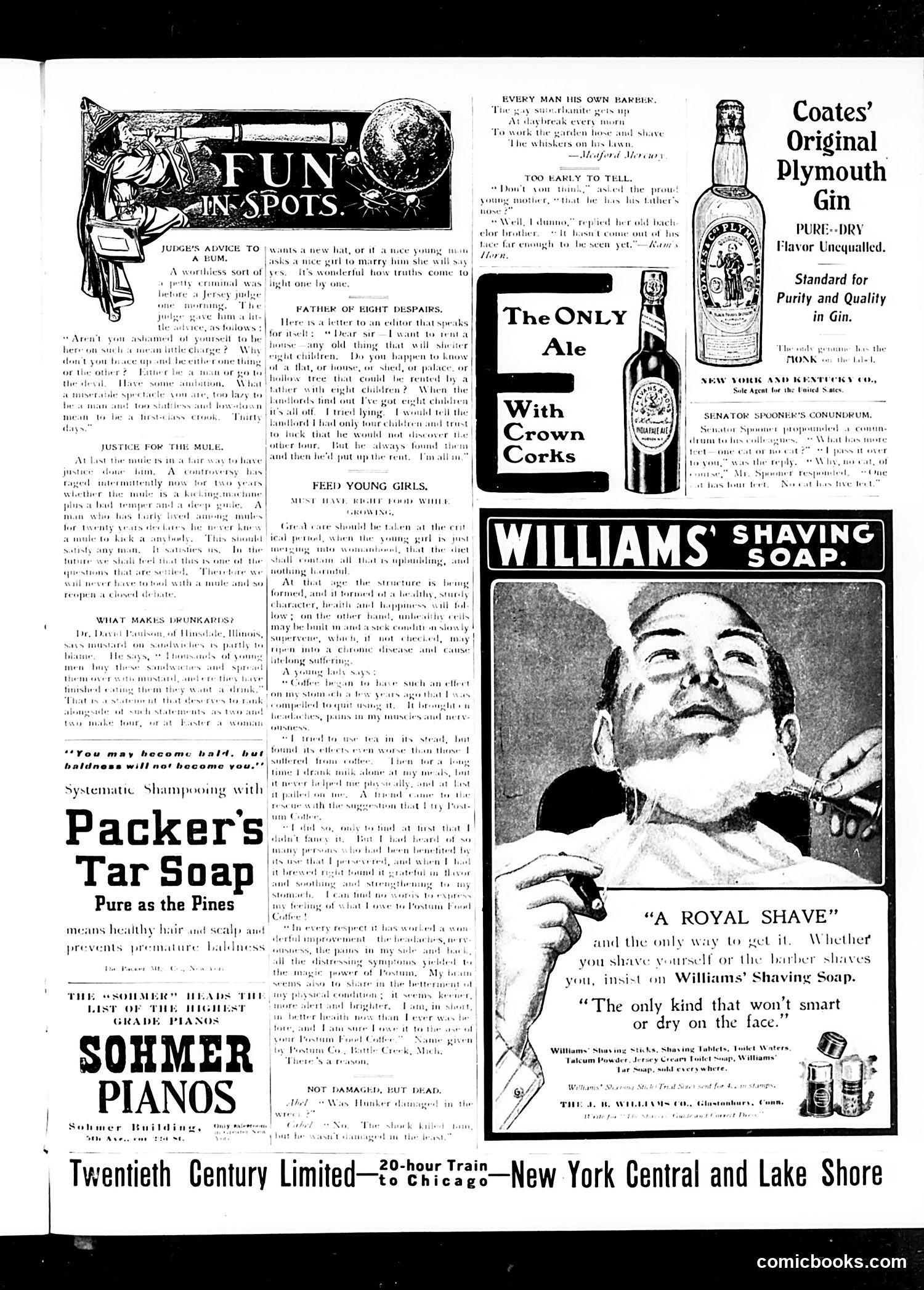
This page is primarily **advertising with minimal satirical content**. The dominant features are product advertisements (Coates' Plymouth Gin, Williams' Shaving Soap, Parker's Tar Soap, Sohmer Pianos, and train service). The small satirical sections include: **"Too Early to Tell"** — A joke about a newborn's paternity, suggesting the infant's features haven't yet developed enough to determine which family member he resembles. **"Father of Eight Despairs"** — Social commentary on landlords who won't rent to large families, and a poor man trapped between two roles: he can't afford decent housing, yet landlords reject him because of his many children. **"Justice for the Mule"** — An unclear reference, likely criticizing unfair treatment of animals or comparing someone's situation to a mule's mistreatment. **"Senator Spooner's Conundrum"** — References a real senator (likely John Spooner of Wisconsin) but the OCR is too garbled to determine the satirical point. The page reflects early 20th-century concerns about poverty, housing discrimination, and paternity questions—typical Judge humor blending social criticism with product placement.
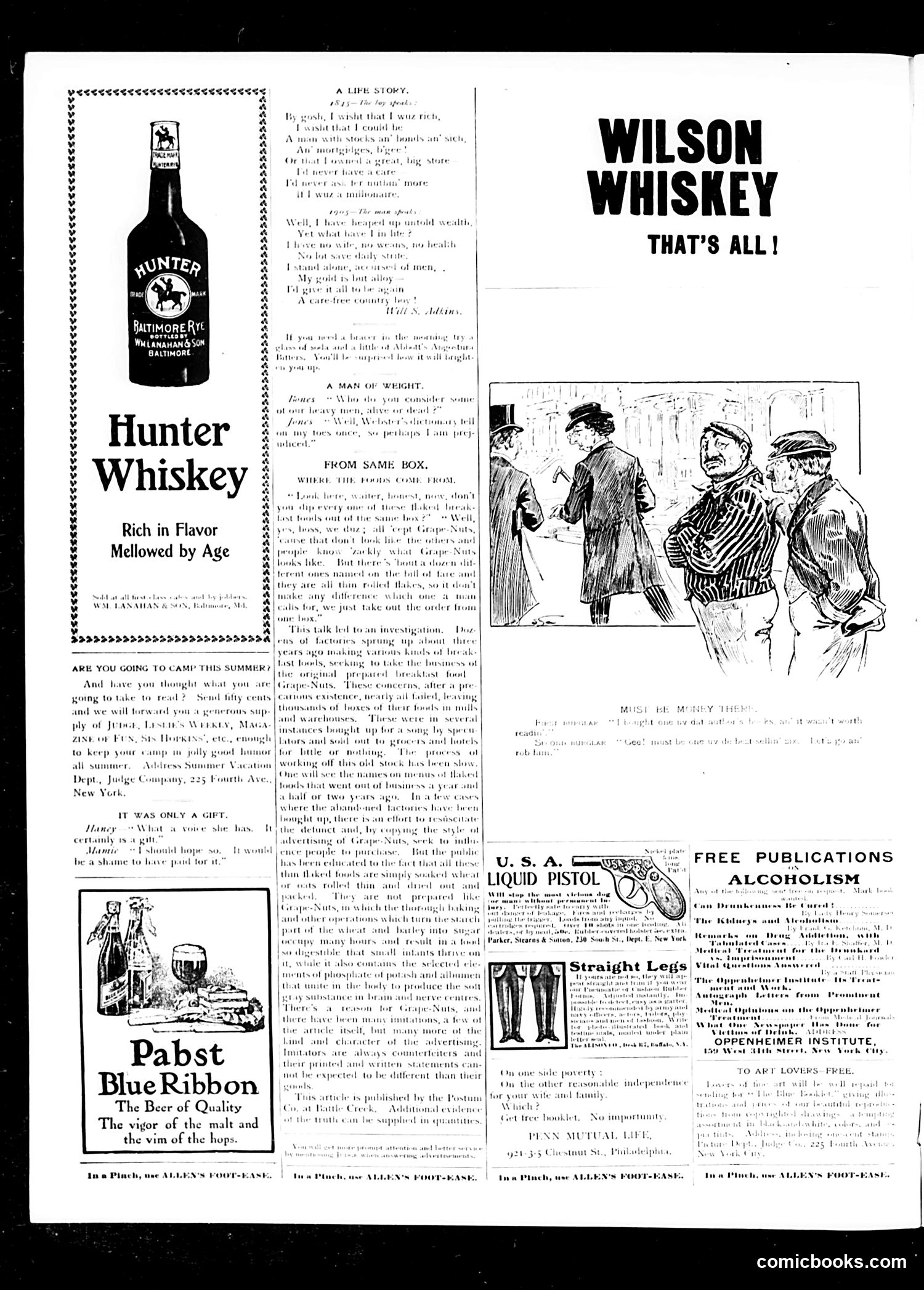
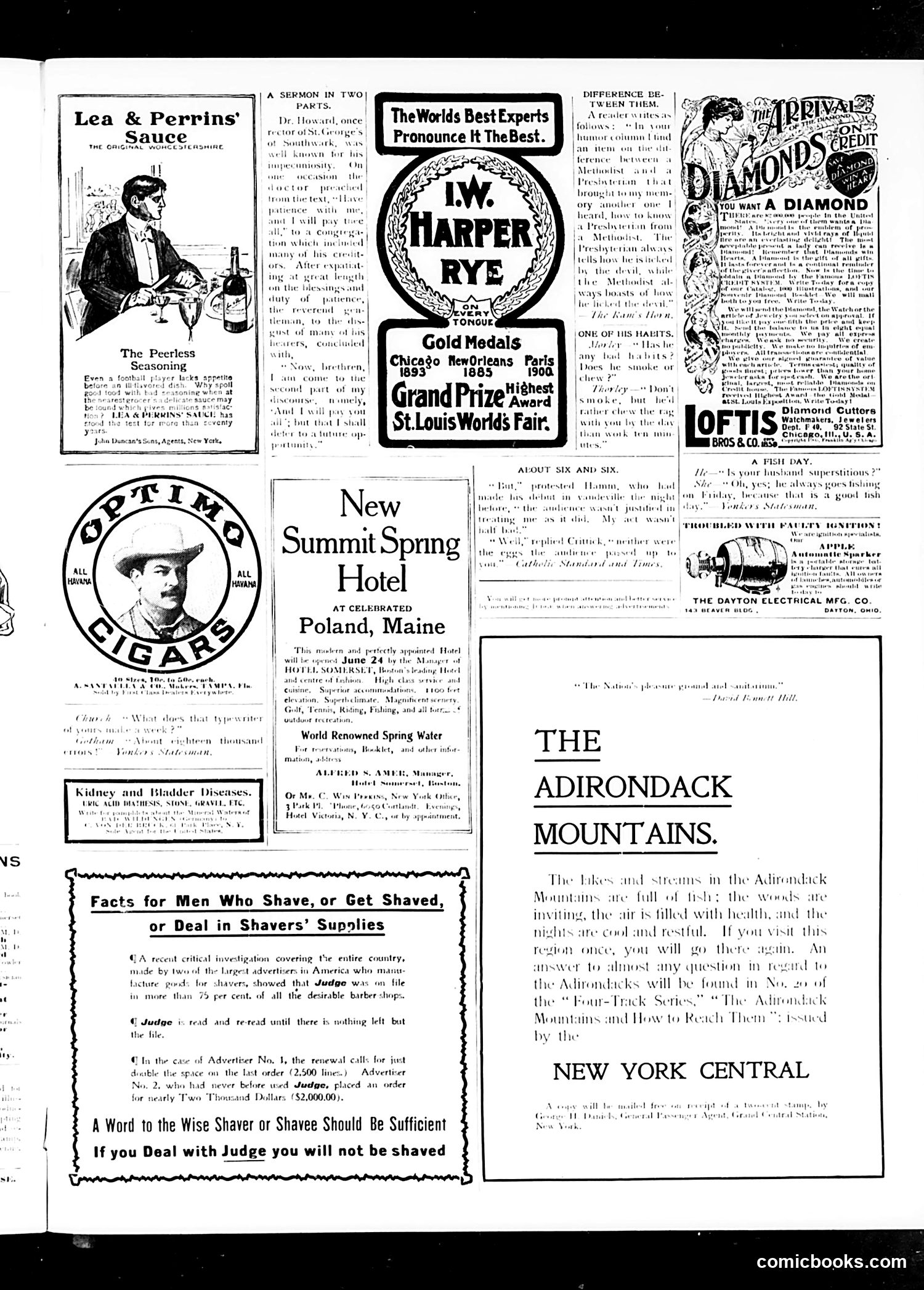
This page is primarily **advertisements and promotional content** rather than political satire or comics. The notable elements include: - **"Facts for Men Who Shave"**: A self-promotional advertisement claiming *Judge* magazine reaches 75% of American barber shops, emphasizing its value to advertisers in the shaving industry. - **Product ads**: Lea & Perrins Sauce, I.W. Harper Rye (winning gold medals), and Optimo Cigars represent typical late-19th-century branded goods advertising. - **Travel/hospitality ads**: Summit Spring Hotel and the Adirondack Mountains appeal to leisure travelers. - **Medical ads**: References to kidney/bladder disease treatments reflect common period concerns. The page demonstrates how *Judge* funded itself through advertising revenue while promoting its own reach and credibility to potential advertisers. The content reflects Gilded Age consumer culture and emerging mass-market advertising strategies.
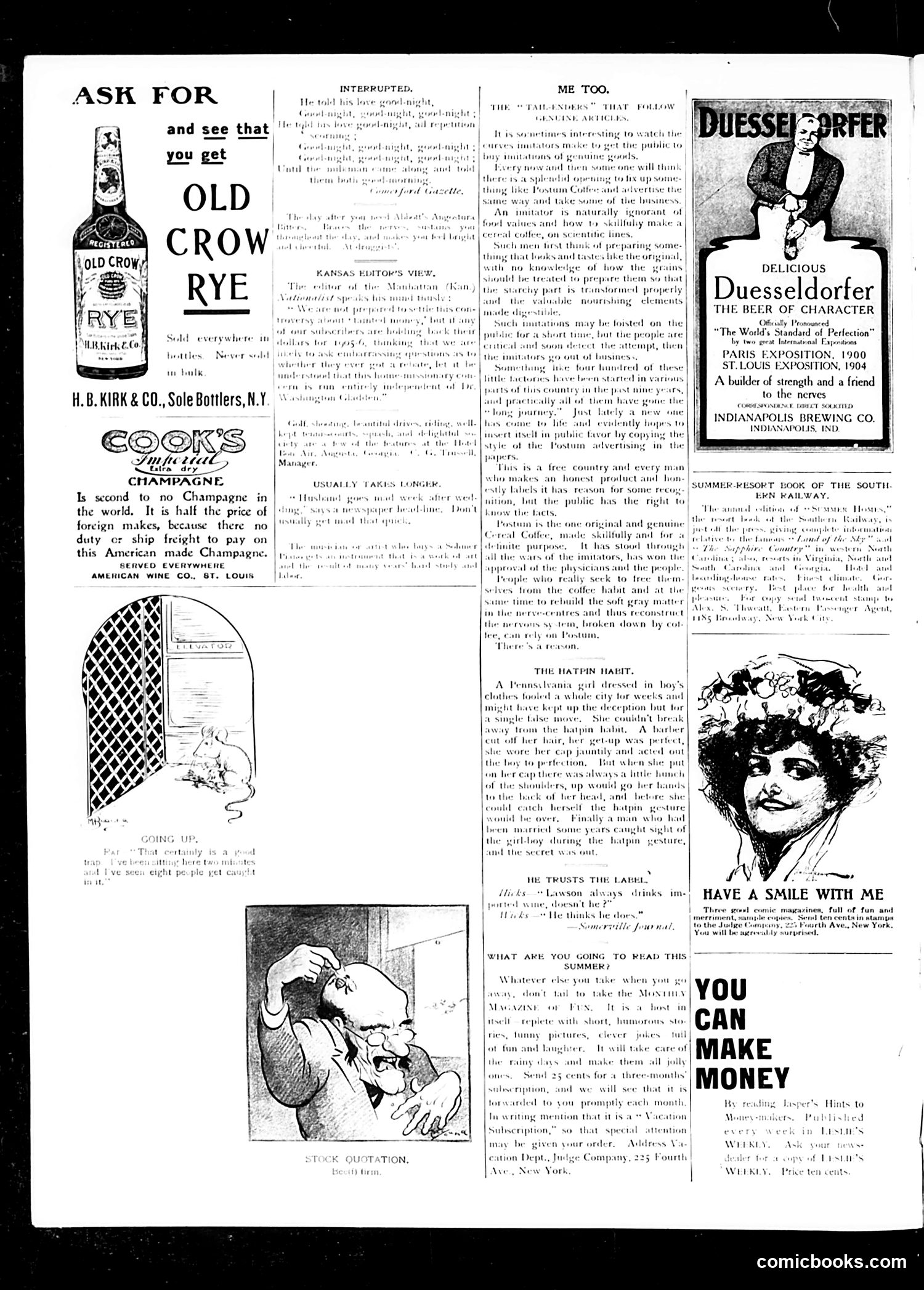
This page is primarily **advertising**, with several unrelated commercial notices for alcoholic beverages (Old Crow Rye, Cook's Champagne, Duesseldorfer Beer) and other products interspersed with brief editorial content. The limited editorial material includes: - **"Interrupted"** and **"Kansas Editor's View"**: Brief snippets about coffee imitation and newspaper editorial practices—seemingly minor social commentary on commercial deception and journalistic integrity. - **"The Hatpin Habit"**: A humorous anecdote about a Pennsylvania girl who disguised herself as a boy but was discovered because she couldn't break the habit of adjusting her hatpin—a gendered behavioral tell. This reflects early 1900s fascination with gender presentation. - **"He Trusts the Label"** and other fragments: Scattered jokes about advertising and consumer trust. The cartoons are small, decorative illustrations without clear political significance. Overall, this appears to be a standard Judge issue mixing light social satire with substantial advertising revenue—typical of early 20th-century American magazines.
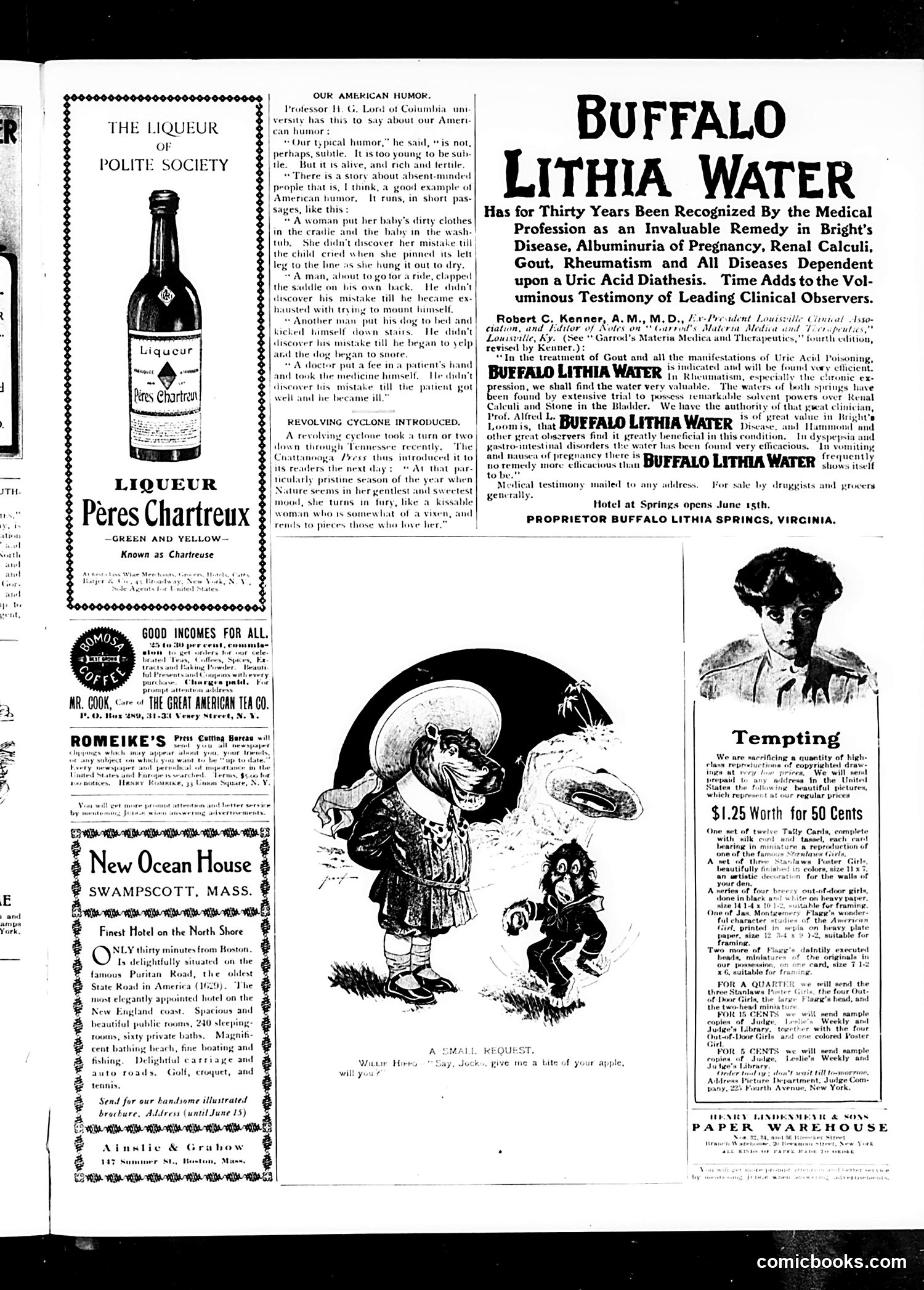
This page is primarily **advertising**, not political satire. The dominant content includes: **Main Advertisement:** Buffalo Lithia Water dominates the right side—a patent medicine claiming 30-year medical recognition for treating Bright's disease, gout, rheumatism, and kidney ailments. It includes endorsements from doctors (Robert C. Kenner, M.D., and references to medical authorities). **Other Advertisements:** - Peres Chartreux liqueur (left) - New Ocean House hotel in Swampscott, Massachusetts - A "Tempting" offer (bottom right) selling $1.25 worth of goods for 50 cents **Non-Advertisement Content:** A brief section titled "Our American Humor" quotes Columbia University Professor H.G. Lord explaining American humor through absurdist anecdotes about mistaking objects (babies for laundry, dogs for bedmates, etc.). **One Small Cartoon:** A whimsical illustration shows a woman with a large basket and cat, captioned "A Small Request"—appears to be gentle domestic humor rather than political commentary. The page reflects early 1900s American magazine culture mixing editorial content with patent medicine advertising.
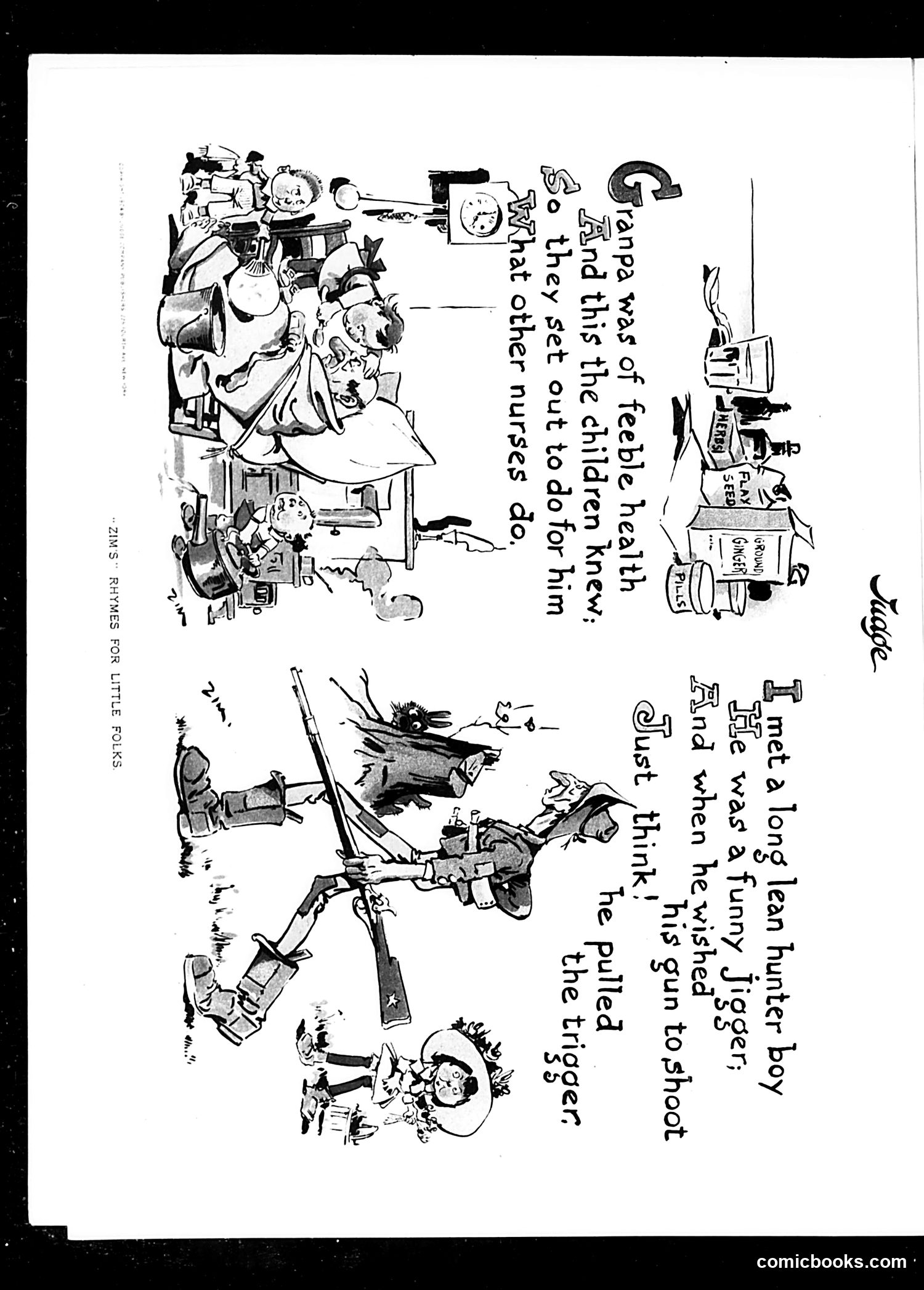
This page appears to be from "Judge" magazine's "Zimm's Rhymes for Little Folks" children's section. The illustrated verse tells of "a long lean hunter boy" of "feeble health" whose children decide to nurse him back to vigor by taking him hunting. The top cartoon shows a chaotic domestic scene with children attempting various physical activities around an ill or weak adult figure. The bottom illustration depicts children engaged in hunting, pulling a trigger. The satire likely mocks both overly-solicitous child-rearing practices of the era and the romanticization of hunting as a "cure" for weakness. The humor derives from children taking medical care into their own hands through vigorous outdoor activity—presenting an absurd but earnest solution to poor health that was perhaps reflective of contemporary attitudes about fresh air, exercise, and outdoor pursuits as universal remedies.