
A complete issue · 16 pages · 1905
Judge — April 29, 1905
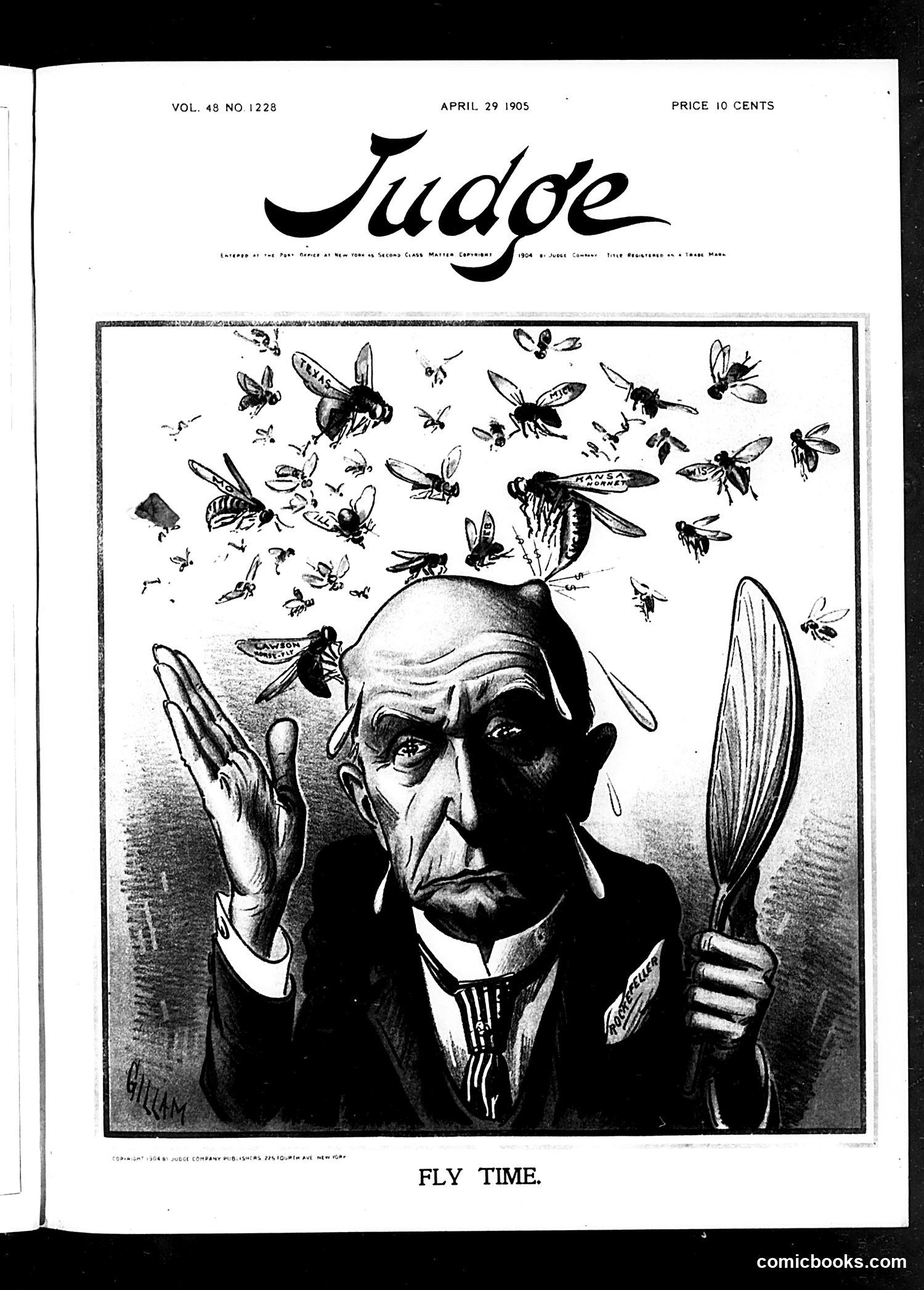
This cartoon depicts a frustrated man wielding a fly swatter and fork defensively against a swarm of flies. The title "Fly Time" indicates this is seasonal commentary—spring/early summer when flies become a household nuisance. The satirical point appears to be social rather than strictly political: it's a humorous commentary on the universal domestic annoyance of dealing with insects during warmer months. The man's exaggerated expression of distress and his armed stance with both defensive and offensive implements (swatter and fork) exaggerate the common experience into absurdist comedy. The cartoon likely resonated with readers facing actual fly problems before modern pest control and screened windows became standard, making it both timely social satire and relatable domestic humor.
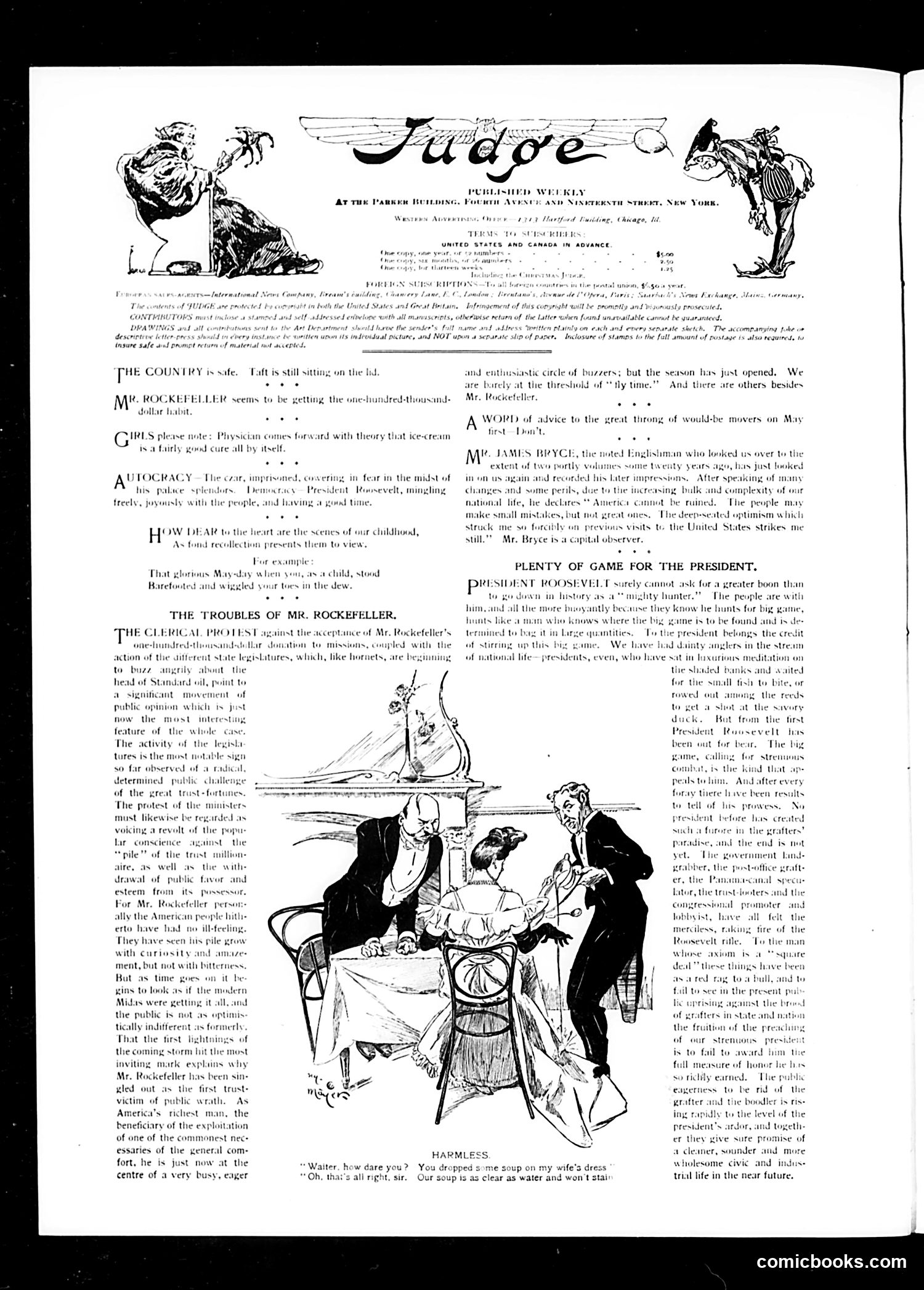
This page satirizes **John D. Rockefeller** and his monopolistic business practices. "The Troubles of Mr. Rockefeller" cartoon depicts him at a dining table, apparently being confronted or pressured—likely representing legal/regulatory challenges to Standard Oil. The text references Rockefeller's "one-hundred-thousand-dollar donation" and discusses public opinion against him, framing him as a target of anti-trust scrutiny. The accompanying editorial criticizes the wealthy industrialist's attempts to improve his public image through philanthropy while facing accusations of exploitation. The cartoon's caption ("Harmless") appears ironic—suggesting Rockefeller presents himself as benign despite his predatory business reputation. This reflects early 1900s Progressive Era concerns about monopolistic trusts and robber barons.
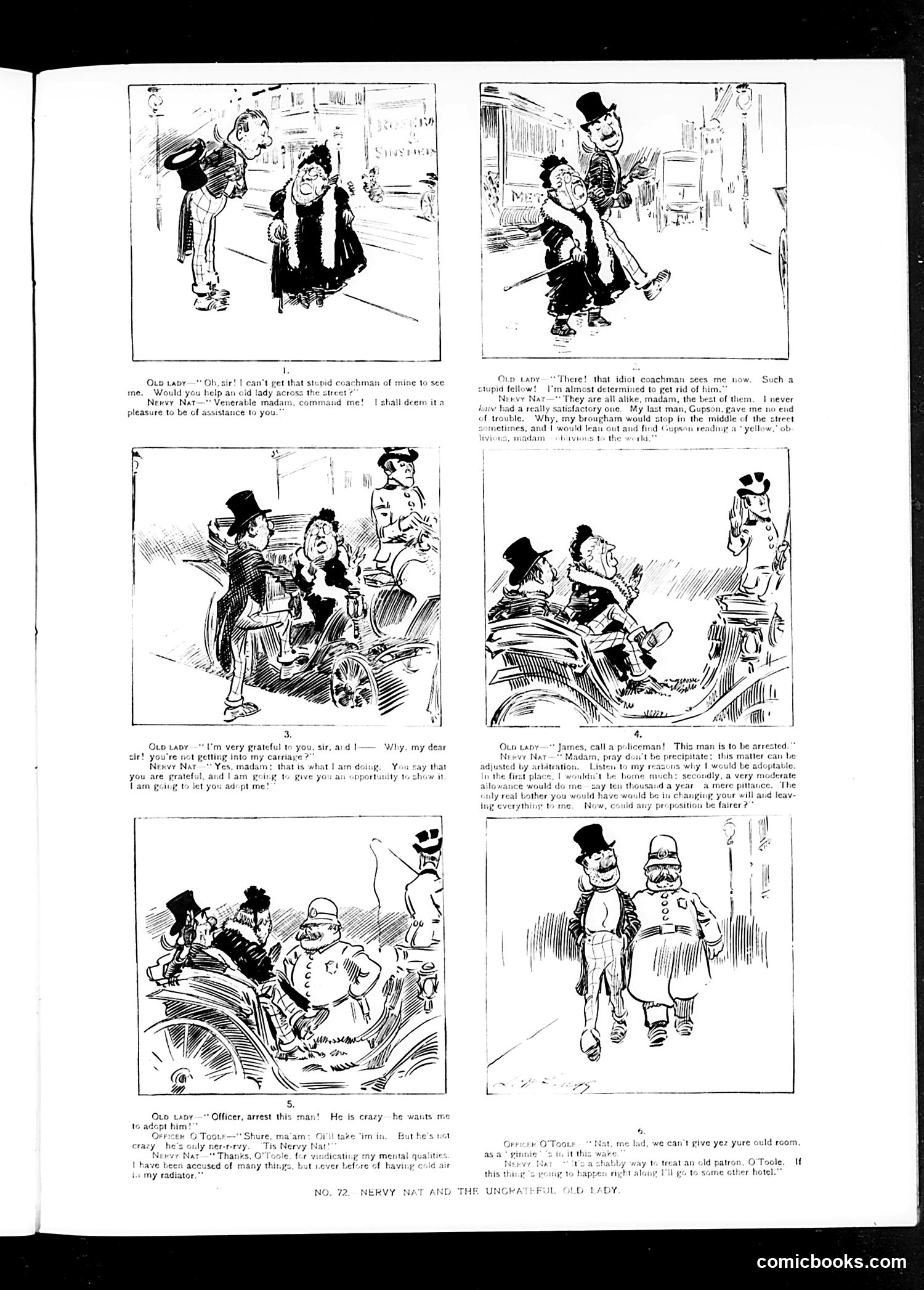
This appears to be a comic strip titled "Hervey Nat and the Ungrateful Old Lady," depicting a working-class man (Hervey Nat) attempting various schemes to assist an elderly woman. The humor derives from her consistent ingratitude and rejection of his help despite his earnest efforts. The strip satirizes class dynamics and social charity of the era. Each panel shows Hervey offering assistance—finding her a coachman, arranging lodging, offering financial aid—only to be rebuffed with complaints. The satire targets both the working-class character's naive optimism and the wealthy elderly woman's unreasonable expectations and class-based disdain. The comic's point appears social commentary on the futility of cross-class charity and mutual incomprehension between economic classes in this period.
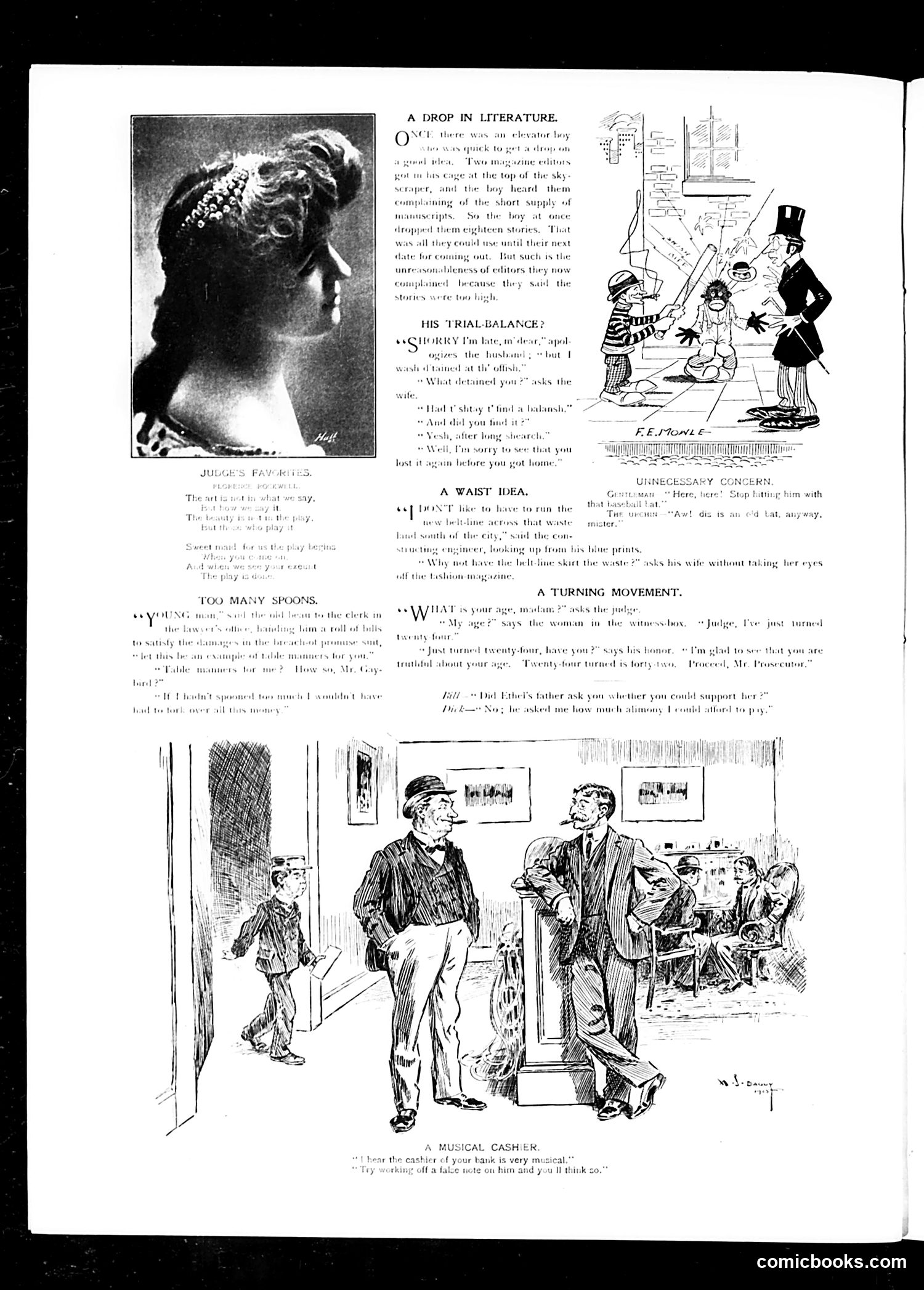
This page contains several short humorous sketches satirizing domestic life and social conventions of the early 20th century: **"A Drop in Literature"** mocks magazine editors rejecting short stories as too lengthy. **"His Trial Balance"** presents a husband caught between complaint (lost a lobster) and appeasement (buying flowers). **"A Waist Idea"** jokes about a wife's fashion concern—wanting a belt-line skirt—while the husband obsesses over practical wastefulness. **"Too Many Spoons"** satirizes a young woman's frivolous spending on table settings. **"A Turning Movement"** depicts a woman bragging about her age change while her husband expresses relief. The large sketch at bottom shows social awkwardness between men and women in what appears to be a public space, likely satirizing dating or courting conventions. All sketches target gender dynamics, consumerism, and marital discord—typical Judge fare of the era.
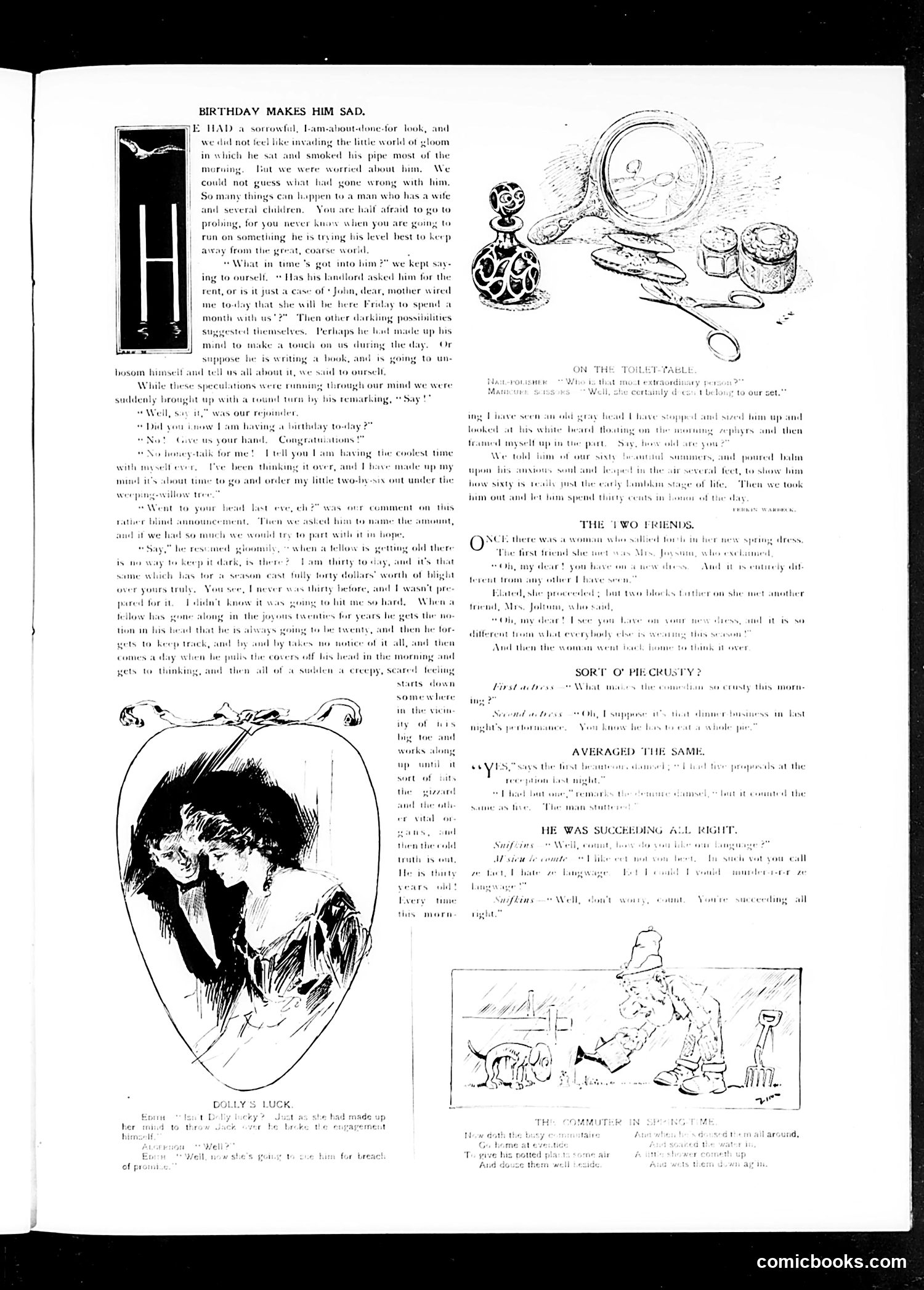
This page contains several humorous sketches typical of early 20th-century American satire: **"Birthday Makes Him Sad"** (main story): A man becomes melancholy realizing he's turning 30. The narrator consoles him by claiming 60 is really just "the early Lanblan stage of life"—satirizing how people use absurd logic to deny aging. The joke targets masculine anxieties about milestone birthdays and mortality. **"The Two Friends"** and other brief sketches: These are light domestic humor pieces about courtship, fashion, and marriage—women discussing dress, romantic misunderstandings, and spousal communication. **"He Was Succeeding All Right"** (bottom): A dialogue between "Sniffins" and "Wifkins" joking about language and success, likely satirizing marital discord. The page reflects Judge's typical content: gentle social satire about urban middle-class life, relationships, aging, and gender dynamics, without specific political references. The drawings are competent but unremarkable pen-and-ink illustrations characteristic of the period.
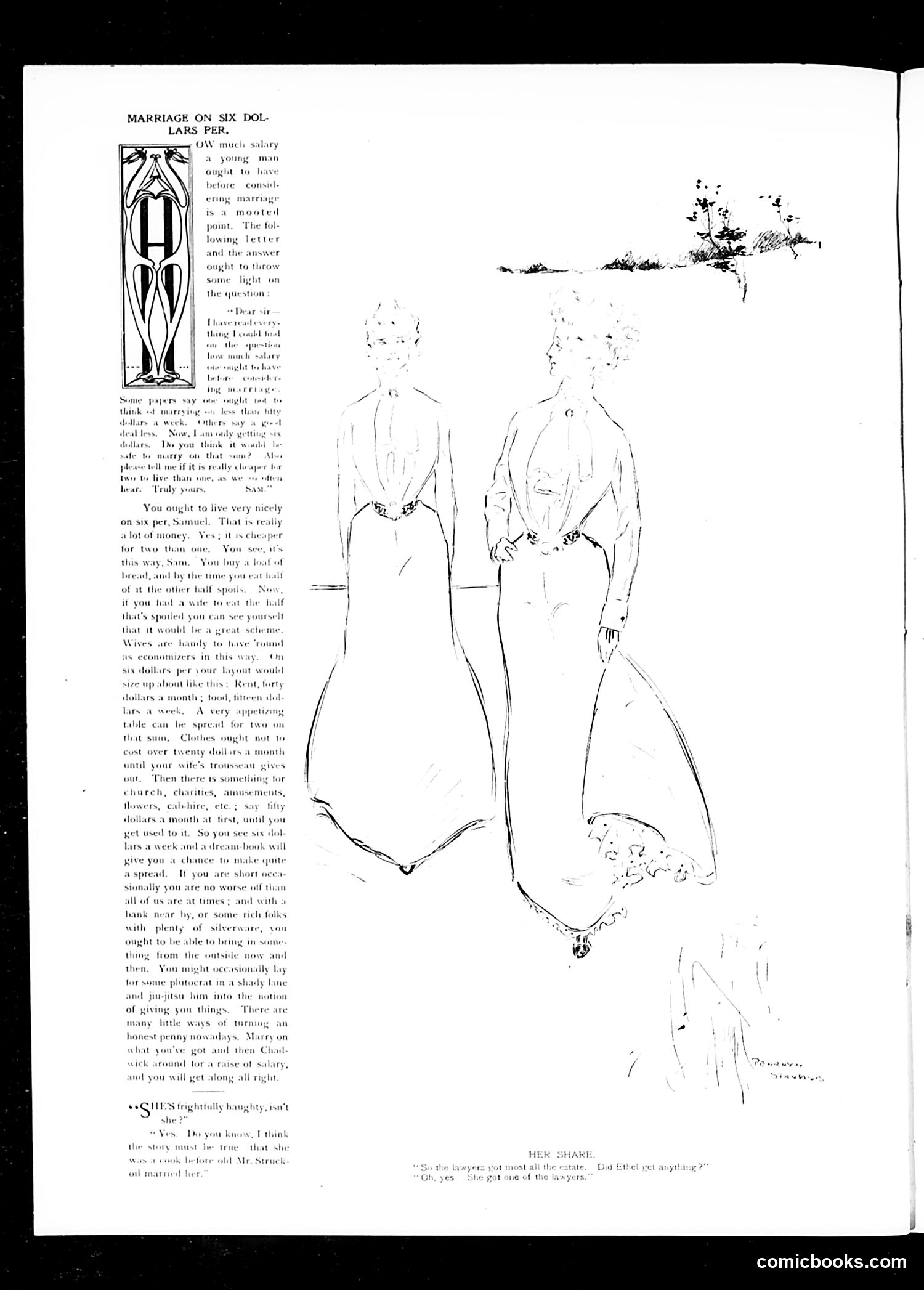
This satirical advice column mocks the economic pressures on young working-class men considering marriage. A correspondent asks whether six dollars per week provides adequate income for married life. The response is tongue-in-cheek: it claims six dollars is "really a lot of money" and offers absurdly stingy budgeting advice—dividing expenses between bread, clothing, and church donations while suggesting the new wife will be a useful "economizer" who can stretch resources. The satire lies in presenting threadbare poverty as manageable through thrift and optimism. The accompanying illustration shows a couple in modest dress, likely representing this economic class. The final dialogue humorously reveals the wife's haughty attitude despite their financial constraints—a jab at pretension among the poor. The overall point critiques the era's expectation that working men could marry on minimal wages, and implicitly questions whether such marriages were realistic or advisable.
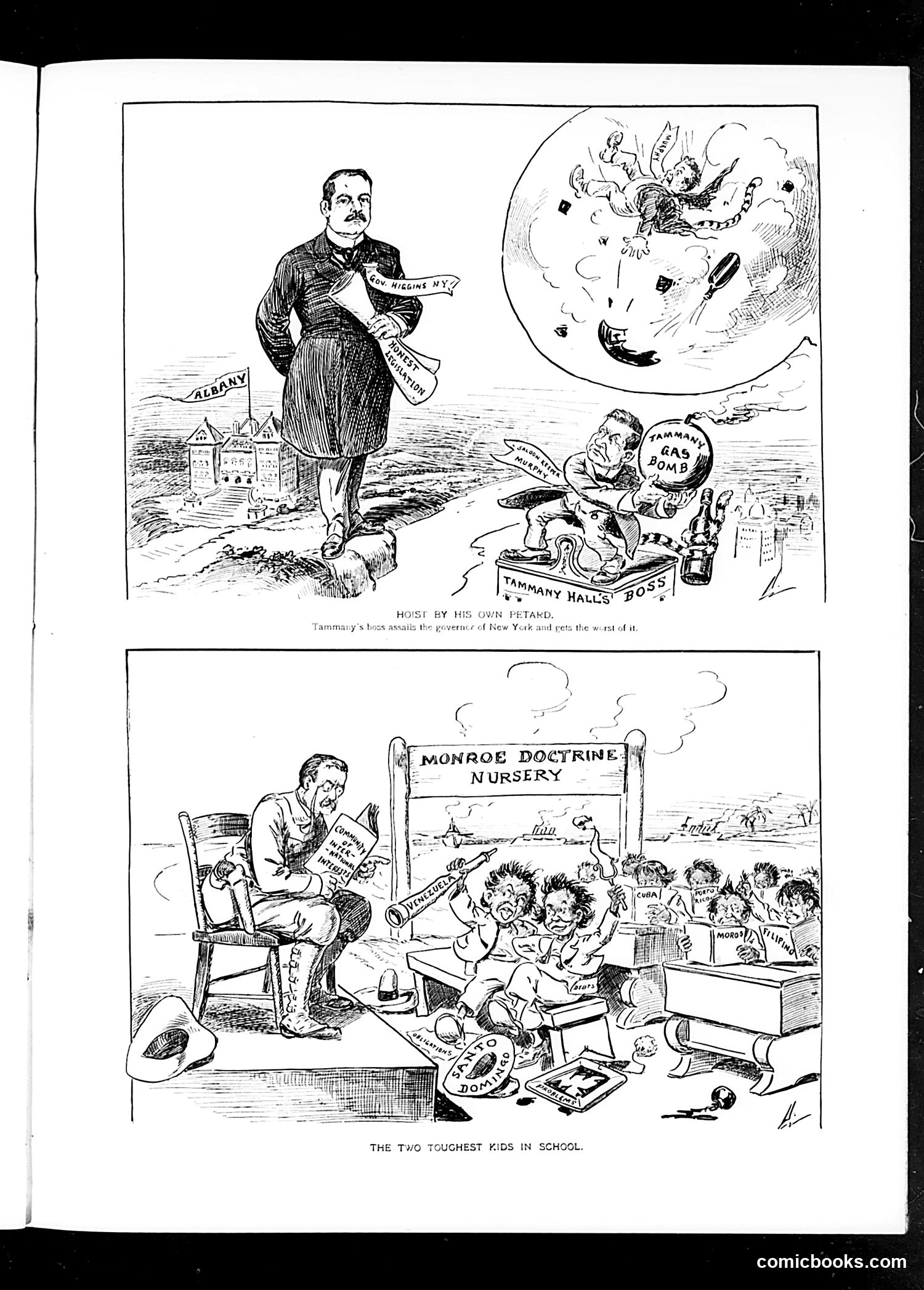
**Top Cartoon**: A man labeled with "New Higgins N.Y." holds documents about Albany while standing over Tammany Hall. The figure appears to be Governor (or mayoral candidate) opposing Tammany Hall's political machine. The large moon shows chaotic figures, suggesting Tammany's corrupt influence or "hoisting" the governor "by his own petard"—meaning his own plans backfire against him. **Bottom Cartoon**: Titled "The Two Toughest Kids in School," depicts a man teaching children the "Monroe Doctrine" nursery. The children appear rowdy and uncontrollable, satirizing how American foreign policy (Monroe Doctrine) is being presented to the next generation as rough, aggressive doctrine rather than reasoned diplomacy. Both cartoons mock political corruption and aggressive nationalism through satirical comparison to chaos and childish behavior.
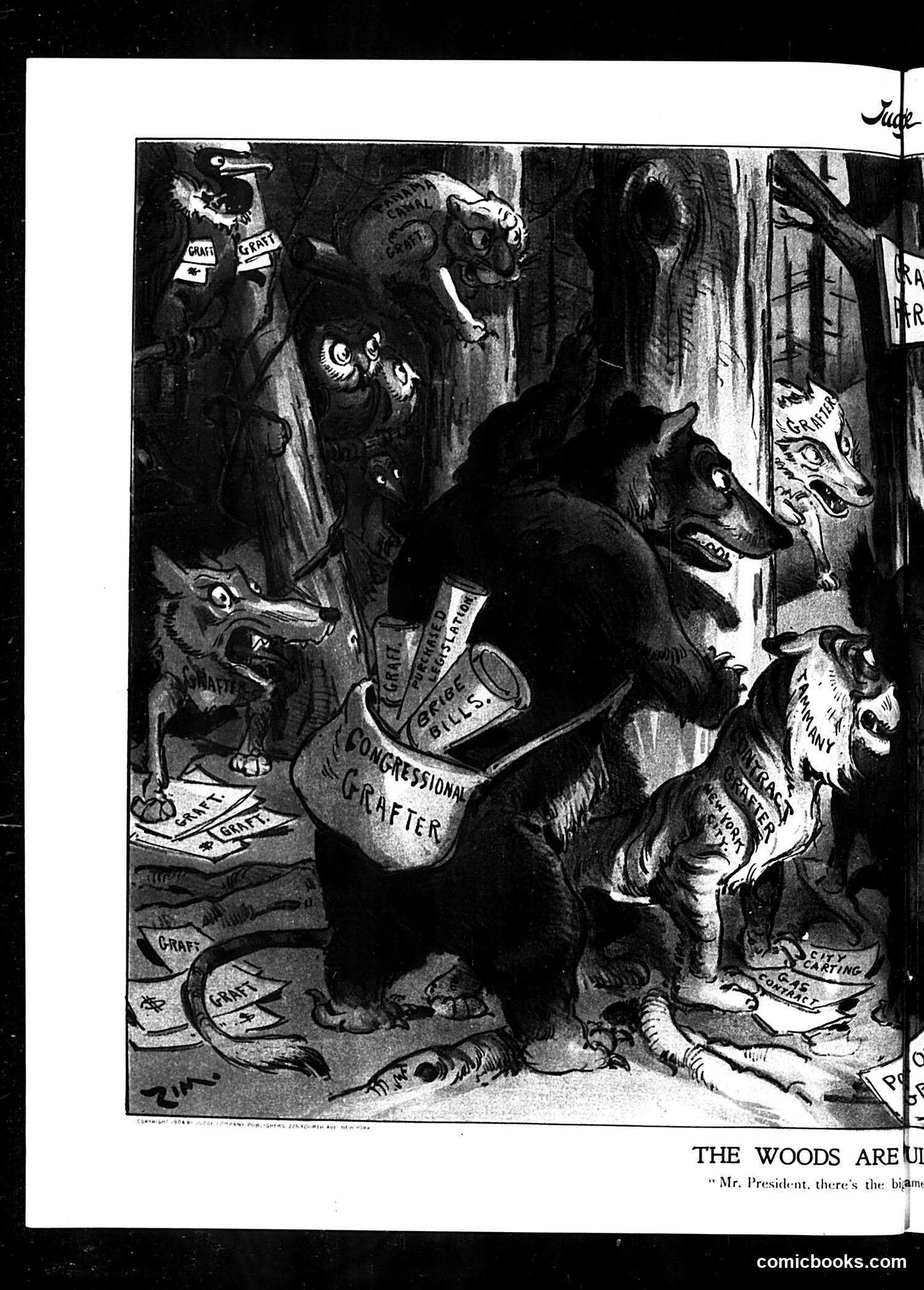
This **Judge** magazine cartoon satirizes corruption within the Roosevelt administration. The central figure, labeled "CONGRESSMAN CRAFTER," is depicted as a bear surrounded by other animals wearing labels such as "GRAFTS," "GRAFT," and "CRAFTER"—suggesting widespread corrupt practices. The cartoon's title, "THE WOODS ARE UNFIT," plays on the common phrase while implying the administration is infested with graft and corruption. The dialogue fragment "Mr. President, there's the bigtime" suggests officials are reporting malfeasance to the President himself. The animal caricatures represent political figures engaged in or benefiting from corrupt schemes. This reflects Progressive Era criticism of government inefficiency and corruption, common themes in **Judge's** satirical commentary on American politics.
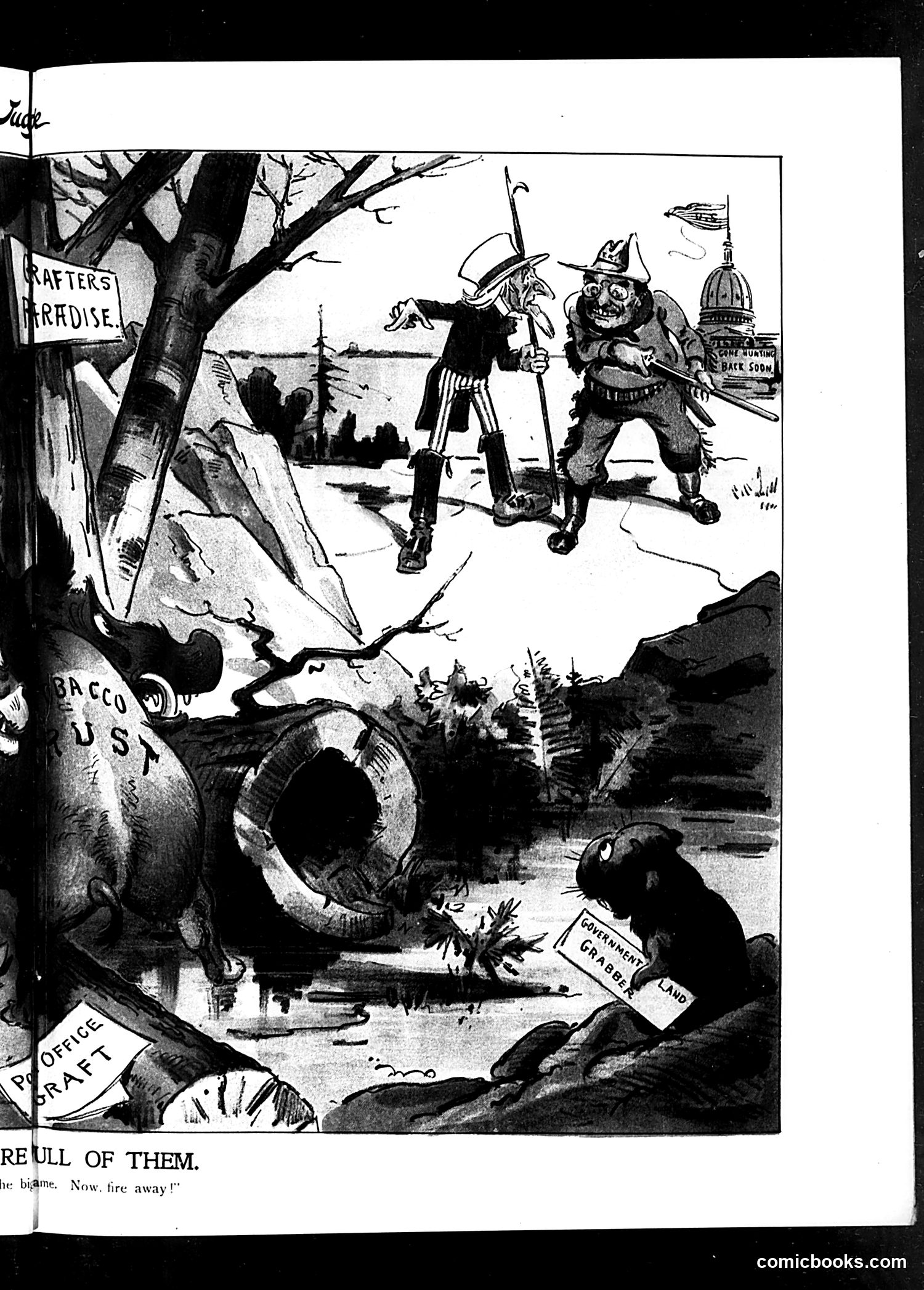
This satirical cartoon depicts two caricatured figures (appearing to represent political or governmental entities based on their exaggerated features and formal dress) standing over a landscape filled with labeled debris. Visible labels include "CRAFTERS PARADISE," "TOBACCO," "U.S.," "OFFICE CRAFT," and "GOVERNMENT OWNED LAND." The cartoon critiques corruption or mismanagement, with the phrase "NOW, FIRE AWAY!" suggesting destructive or reckless action. The dead tree, barren landscape, and scattered refuse symbolize environmental or economic devastation. The two figures appear to be malevolent forces—possibly representing corrupt officials or exploitative interests—overseeing the wreckage of public resources or natural lands. Without seeing the publication date clearly, the specific historical context remains unclear, but the imagery suggests criticism of governmental malfeasance or crony capitalism during the Progressive Era era.
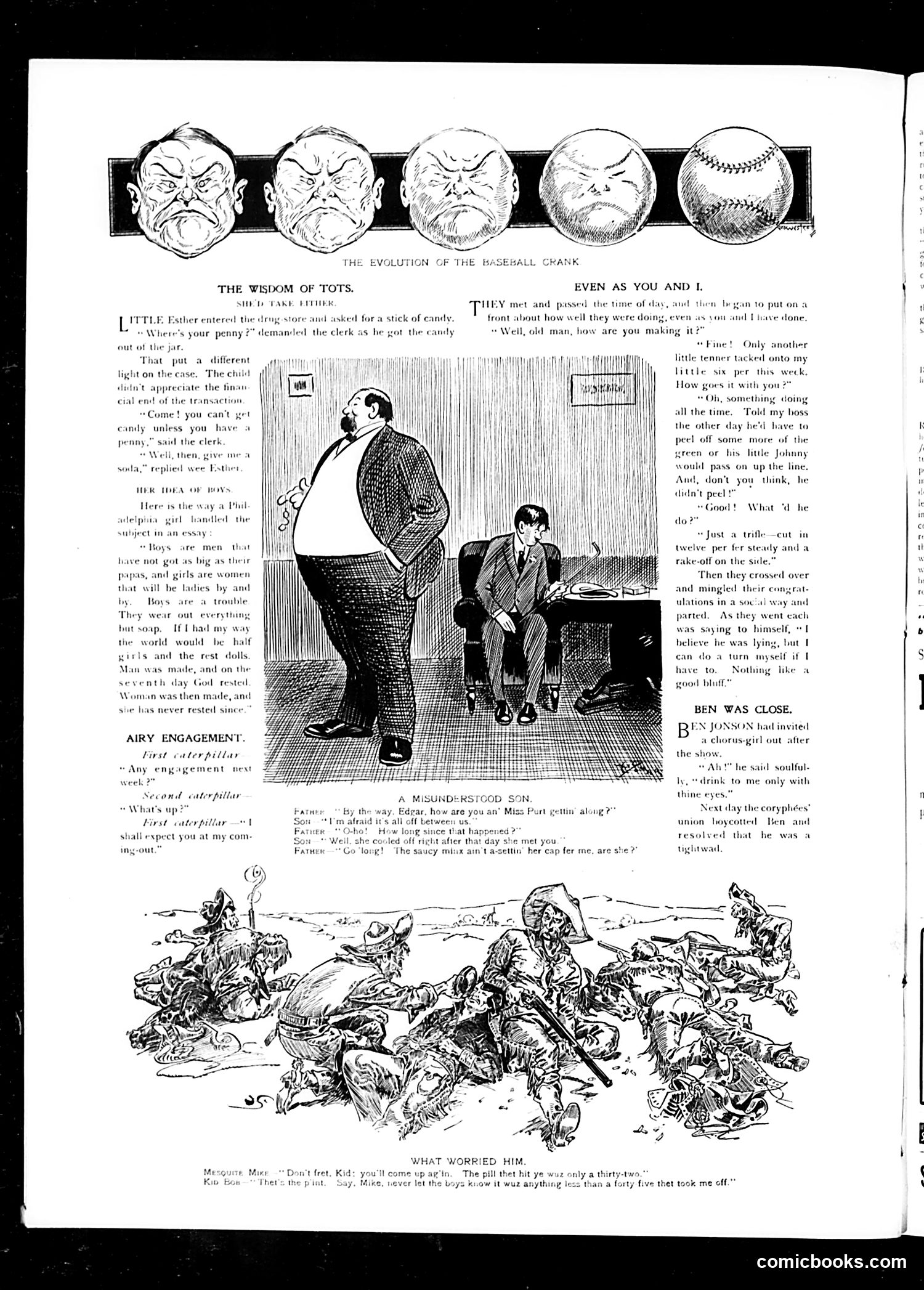
This page contains several short humorous pieces satirizing American social life circa early 1900s. **"The Wisdom of Tots"** shows children exhibiting adult cynicism—a girl demanding payment for candy, a boy calculating wages like a businessman. The joke is that children mimic their parents' mercenary attitudes. **"Her Idea of Boys"** presents an essay where a girl defines boys as "men that have not got as big as their papas" and girls as "trouble"—satirizing both childish logic and contemporary gender attitudes (the claim that men rest while women never do). **"Airy Engagement"** is a pun: caterpillars discussing engagement before becoming butterflies, playing on the double meaning of "coming out." **"A Misunderstood Son"** depicts a young man explaining his breakup—his father misinterprets "Miss Port" as a location rather than a person's name. **"Ben Was Close"** jokes about theatrical miserliness: a chorus girl thinks Ben Jonson's poetic invitation to "drink to me only with thine eyes" means he won't buy her a drink, so she boycotts him as a cheapskate. The top illustration shows baseball's evolution from angry faces to a baseball—unclear reference without date context.
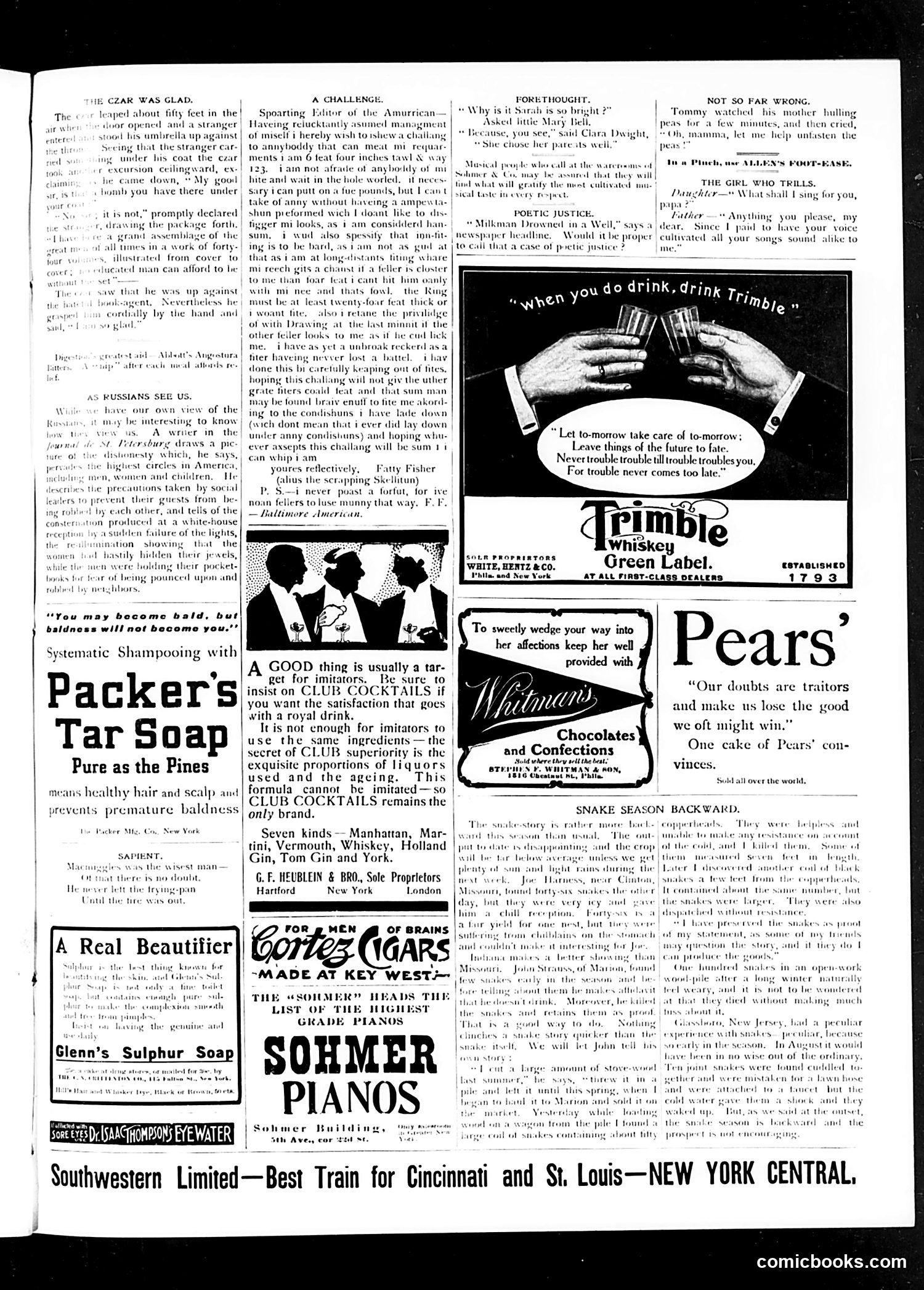
This page is primarily **advertisements interspersed with satirical content**, typical of Judge's format. ## The Cartoons/Articles: **"The Czar Was Glad" and "A Challenge"** appear to be interconnected satirical pieces mocking both Russian formality and American "sporting" challenges. The language—intentionally misspelled throughout—parodies an illiterate boxer's challenge letter. "Fatty Fisher" (a boxer, appears to be the author) issues a ridiculous challenge with absurd conditions (no hitting, minimum distance, etc.), which satirizes both posturing sportsmen and the pretensions of bare-knuckle boxing culture. The reference to the Czar suggests Cold War-era tensions, though specifics are unclear from this page alone. **"As Russians See Us"** discusses Russian perceptions of American dishonesty and greed. It's a commentary on international relations and national stereotypes. The rest consists of vintage advertisements for whiskey, chocolates, soap, pianos, and other products typical of 1920s-era publications.
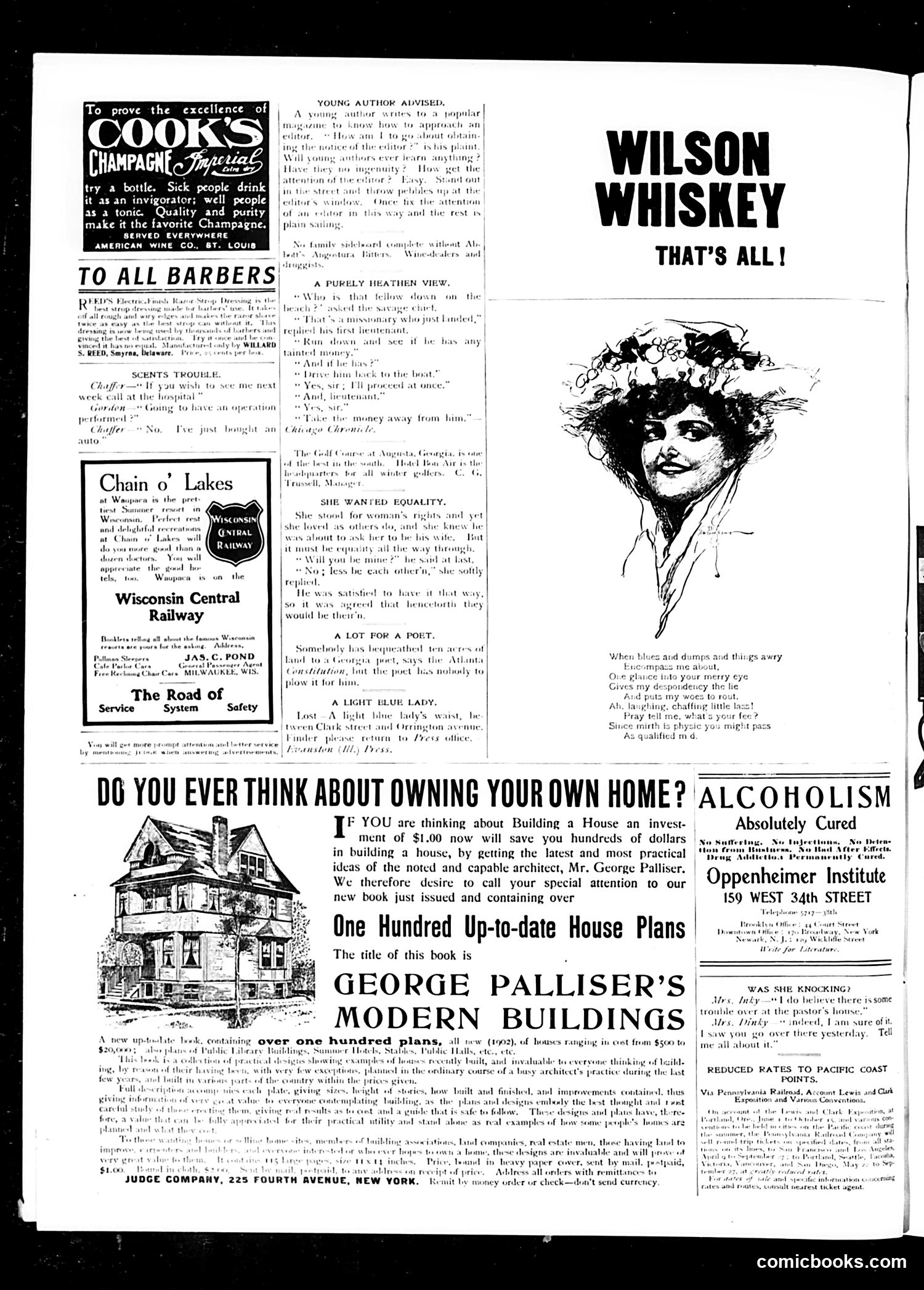
This page is primarily **advertising and light humor pieces** rather than political satire. The notable content includes: **"A Purely Heathen View"** — A crude ethnic joke depicting a missionary arriving in what appears to be a colonized location. The humor relies on stereotypical "native" speech patterns and portrays indigenous people as obsessed with stealing the missionary's money. This reflects the casual racism common in early-20th-century American publications. **"She Wanted Equality"** — A brief romantic anecdote mocking women's rights advocates. The joke suggests that a woman demanding equality in relationships is absurd, playing on contemporary anxieties about feminism. The remaining content is straightforward **commercial advertising**: Cook's Champagne, Wisconsin Central Railway, house plan books by architect George Palliser, and the Oppenheimer Institute (advertising treatment for alcoholism). The page shows Judge as a mixed publication of satirical commentary, social humor (often offensive by modern standards), and paid advertising — typical of American magazines from this era.
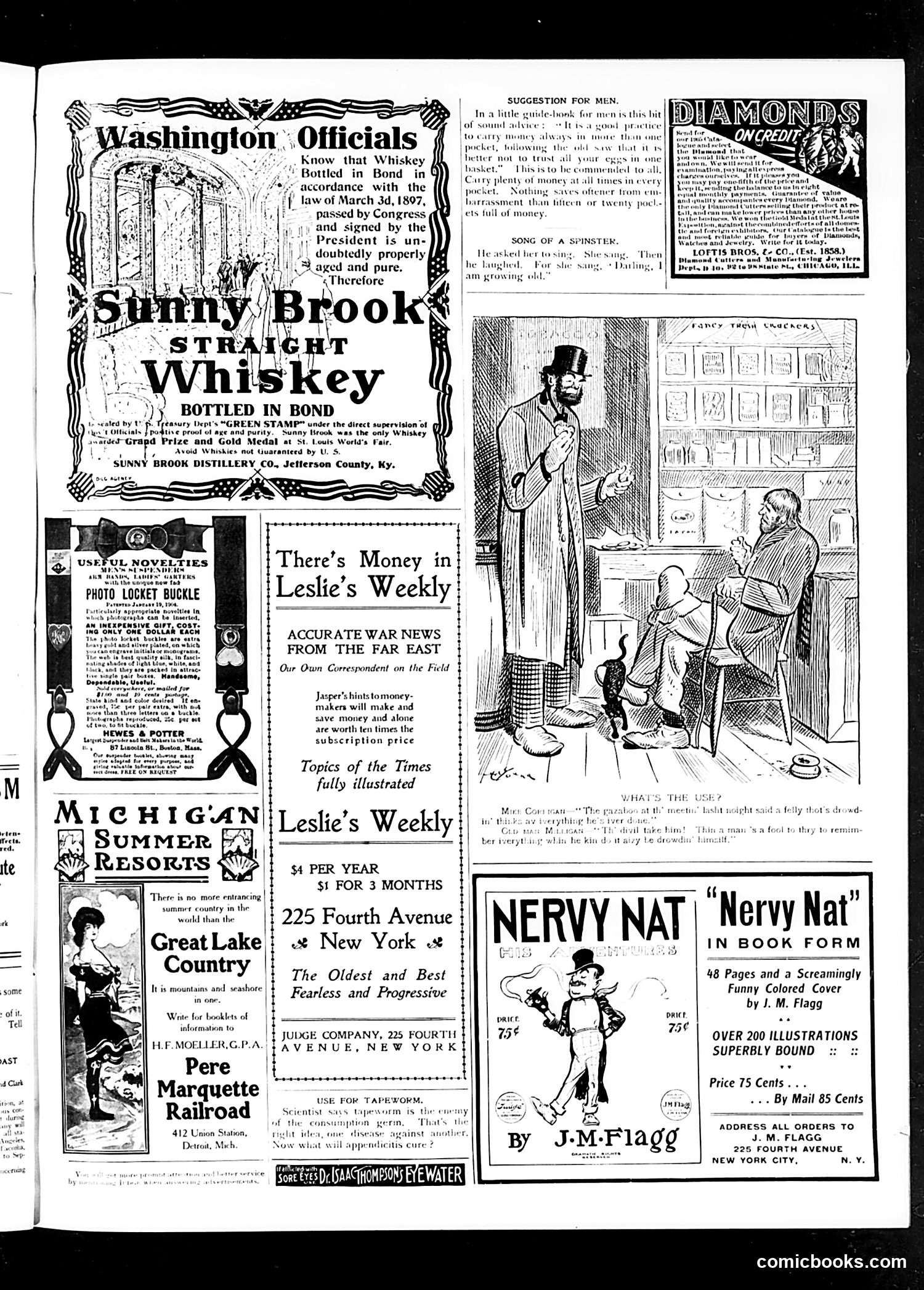
This page is primarily **advertising and promotional content** rather than political satire. The dominant features are commercial advertisements: **Main Content:** - A large Sunny Brook Whiskey ad emphasizing it's "bottled in bond" under federal law (March 3, 1897), appealing to quality-conscious consumers - Leslie's Weekly magazine promotion advertising "accurate war news from the far East" (likely referencing the Russo-Japanese War, circa 1904-1905) - Michigan Summer Resorts advertisement - Pere Marquette Railroad ad - A "Nervy Nat" book advertisement by J.M. Flagg (48 pages, 75 cents) **The Cartoon:** A small illustrated comic appears mid-page showing what appears to be a domestic scene, but the caption "WHAT'S THE USE?" is partially obscured and difficult to interpret clearly from this image quality. **Context:** This appears to be a typical Judge magazine page mixing humor with paid advertising—common practice for satirical publications of this era. The actual satirical content is minimal compared to commercial messaging.
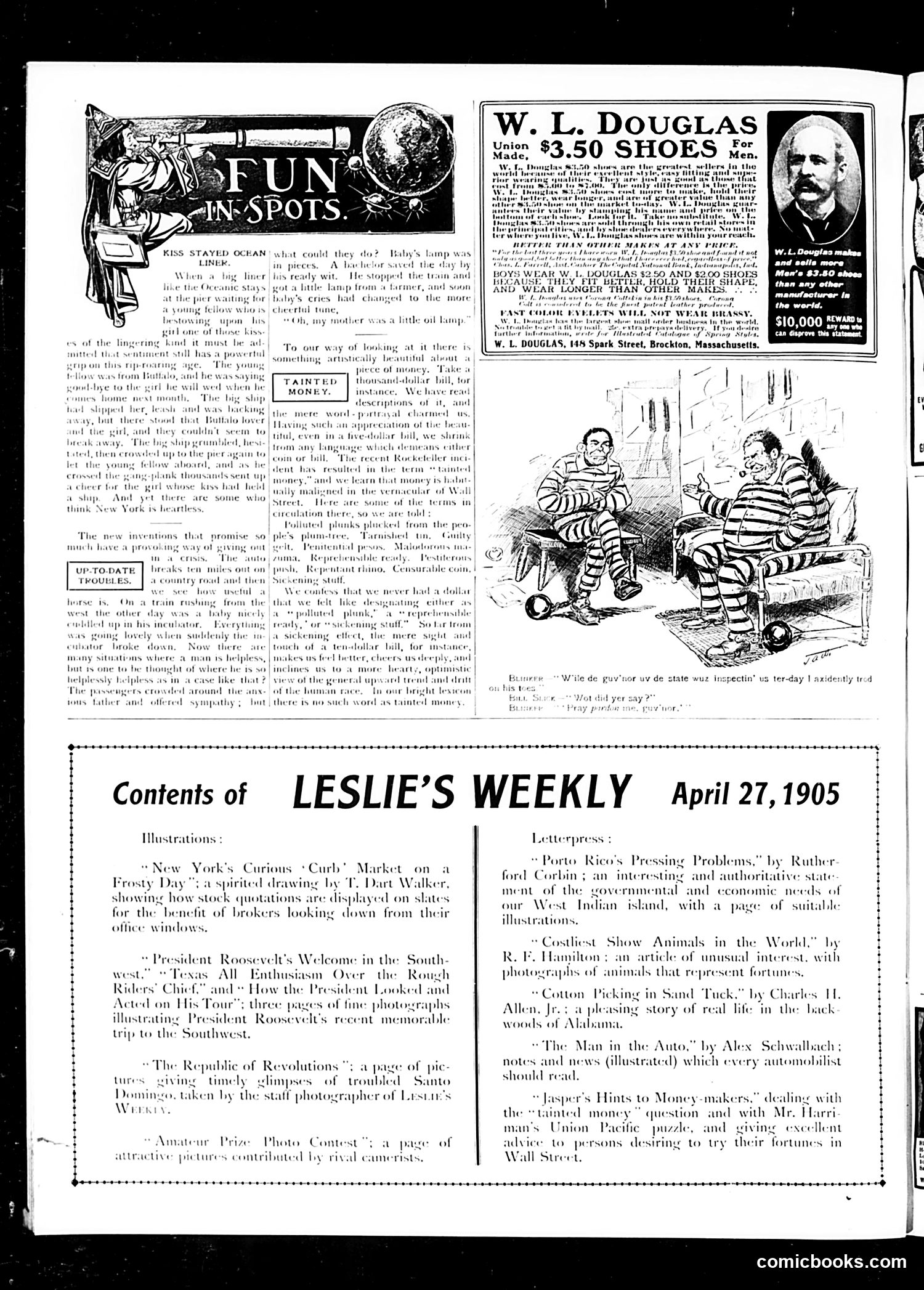
This page from Leslie's Weekly contains a satirical article titled "Fun in Spots" mocking attitudes toward money. The text critiques how people romanticize poverty while simultaneously rejecting actual currency as "tainted." The article uses humorous anecdotes—including one about a baby in an incubator on a train—to illustrate human contradictions. It argues that people find poetic beauty in abstract concepts of hardship but feel disgusted by concrete representations of money itself, calling it "polluted plank" or "reprehensible ready." The accompanying cartoon (right side) depicts two prisoners in striped uniforms, with dialogue about inspecting each other's conditions. This complements the satire's theme: society's hypocritical treatment of the poor and criminal classes. The page also advertises W.L. Douglas shoes and contains a contents listing for the issue, including articles on Roosevelt's Southwest tour and Porto Rico's economic problems—typical 1905 periodical fare.
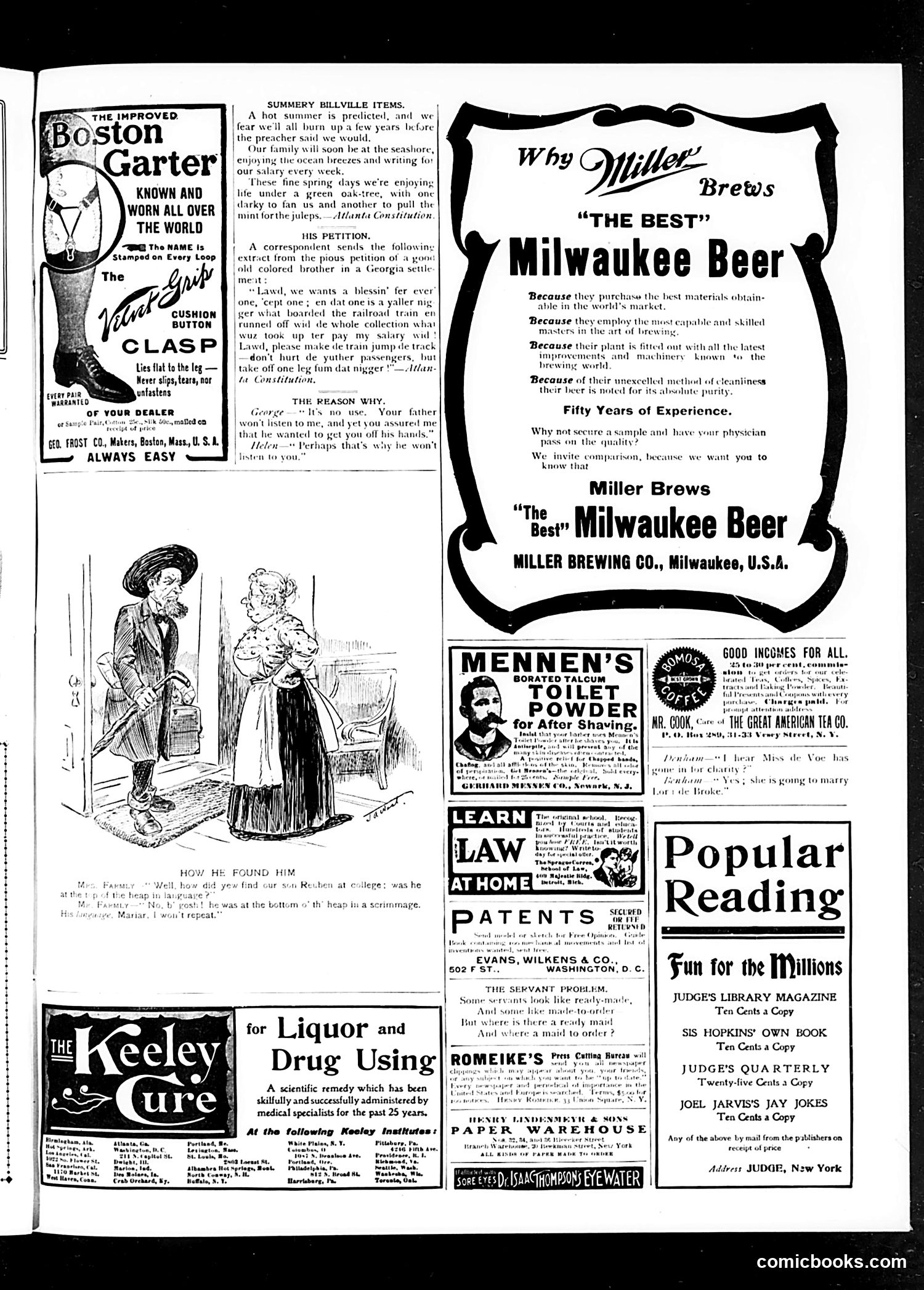
This is primarily an **advertising page** with one small cartoon. The main illustrated piece shows a domestic scene labeled "HOW HE FOUND HIM"—depicting a man discovering his son at college, with the caption indicating surprise at the son's academic standing (he's "at the bottom of th' heap in a scrimmage"). The page is dominated by **period advertisements** (corset clasps, talcum powder, beer, patent services, correspondence schools) typical of early 20th-century magazines. The text sections are brief humor items from "Summery Billville"—a fictional rural/Southern community. Notable is a racist passage presenting dialect humor from a Black character's prayer, reflecting the casual racism endemic to this era's "humor" publications. A brief marital joke plays on miscommunication: a father won't help his son because he wants him off his hands—but the son misunderstands why he refuses to listen. This page reflects Judge's mix of commercial content and casual period bigotry rather than focused political satire.
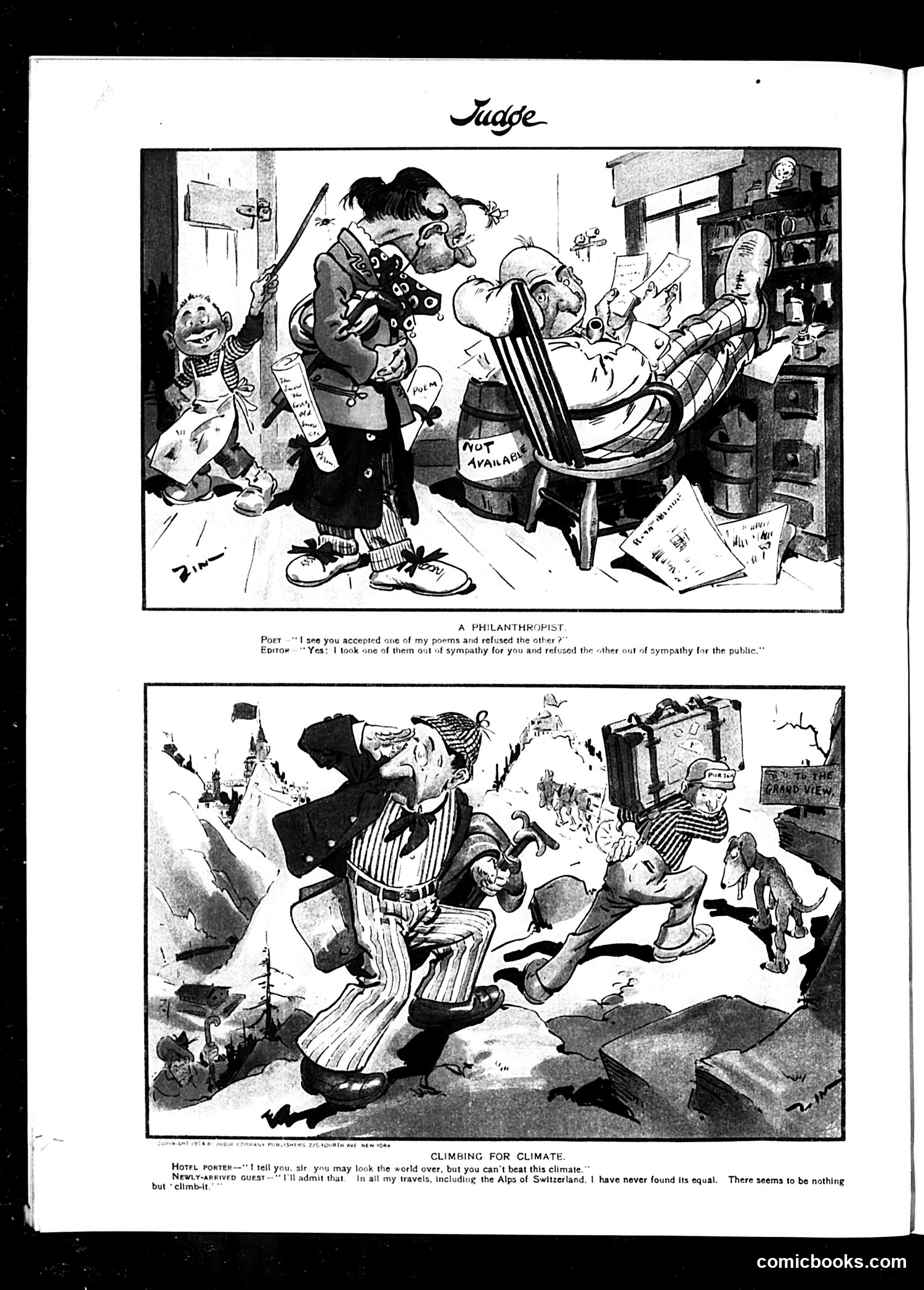
This page contains two separate satirical cartoons from Judge magazine: **"A Philanthropist"** (top): A poet meets an editor who accepted one poem but rejected another. The editor's punchline reveals the satire: he accepted one "out of sympathy for you" (the poet) and rejected the other "out of sympathy for the public." This mocks both struggling poets and editors' difficult gatekeeping role—suggesting the accepted poem is so poor that publishing it is charity toward the author, while rejecting the other protects readers from bad work. **"Climbing for Climate"** (bottom): A hotel porter boasts about the local climate to a newly-arrived guest, who responds with a pun: he's never found its equal, but there's "nothing but 'climb-it'"—playing on "climate." The joke satirizes both inflated travel marketing claims and the guest's corny response. The detailed cartoon illustration shows the porter gesturing dramatically while the guest sits. Both exemplify Judge's style of social satire through character dialogue and visual humor.